Chapter II · 1701-1717. MARLBOROUGH’S CAMPAIGNS IN THE WAR OF THE SPANISH SUCCESSION. (continued 2)
Reading edition
While the Prince of Orange was being buffeted on the left, Eugene, who commanded on the right flank, was forcing the French backwards through the woods. The process, though slow and very costly, was sure; and when de Villars, who had taken charge of the French left, heard that the red-coats of Withers’ column were appearing on his flank at La Folie, he did exactly what Marlborough expected him to do, and weakened his centre to reinforce his left. Three brigades, one of them composed of the Irishmen who had done so well at Blenheim, hurried up to de Villars’ help, plunged into the wood, and drove the Allies back on their supports. In this charge the Irish Brigade with reckless valour pursued so far that they lost their formation, and the whole or part of one of its battalions found itself alone in a glade, where it was attacked by the Royal Irish. The XVIIIth had come so late into action that it had been sent off to the extreme right of the whole army, where, in modern phraseology, it seems to have acted “on its own,” and according to Parker marched on till it came
“to an open in the wood. It was a small plain, on the opposite side of which we perceived a battalion of the enemy drawn up. Upon this Colonel Kane who was then at the head of the regiment, having drawn us up and formed our Platoons, advanced gently towards them, and the six Platoons of our first fire made ready. When we had advanced within a hundred yards of them, they gave us a fire of one of their ranks, whereupon we halted, and returned them the fire of our six Platoons at once; and immediately made ready the six Platoons of our second fire, and advanced upon them again. They then gave us the fire of another rank, and we returned them a second fire, which made them shrink; however they gave us the fire of a third rank after a scattering manner, and then retired into the wood in great disorder, on which we sent our third fire after them, and saw them no more. We advanced cautiously up to the ground which they had quitted and found several of them, killed and wounded; among the latter was one Lieutenant O’Sullivan, who told us the battalion we had engaged was the Royal Regiment of Ireland in the French service.”
In this skirmish the XVIIIth, or Royal regiment of Foot of Ireland, had but few casualties; while the Iro-Gallic regiment, as “their opposite number” in Louis’ army was termed, is said to have lost several officers and about forty men.[62]
While the Irishmen were settling their quarrel, the climax of the battle was approaching. Eugene had rallied his infantry in the wood of Taignières, and was struggling to hold his own against the fresh troops which de Villars in person led against him. Both generals were wounded—Eugene was struck on the head by a musket-ball, but refused to leave the fighting line to have his injury attended to by a surgeon; de Villars, hard hit in the leg, made a gallant effort to direct the battle from a chair, but swooning from pain was carried away insensible to the nearest village. Though deprived of their leader, the French fought obstinately, and on the right of the allied line the combat raged without any decisive result, neither side knowing that when the three brigades were moved from the centre to the left of de Villars’ line, Marlborough had ordered the Dutch forward on his left, and had hurled himself against the heart of the French position. Orkney’s fifteen battalions of British infantry, who for many hours had been waiting for their chance, were let loose against the redans across their front, and carrying them after a sharp fight, promptly lined with marksmen the reverse parapets—i.e., those looking backwards into the enemy’s second line. On the left, the Dutch infantry atoned for their mistake in the morning by capturing not only the wood of Laignières, but the abattis and trenches connecting it with the works now in the hands of the red-coated battalions, and the Dutch cavalry poured through the openings won by their infantry comrades. But in the scramble over shelter trenches and abattis their ranks became disordered, and before they had time to re-form they were attacked by the Gendarmerie, and forced to take shelter under the muskets of Orkney’s battalions, whose steady shooting beat off the French and gained time for Marlborough to come up with the British and Prussian horse. These were driving the Gendarmerie backwards, when a splendid counter-attack of the French Household troops crashed through their first line, penetrated the second, and threw the third into confusion. At that moment Eugene, dashing up bloodstained from his wound, threw his last squadrons against the enemy’s flank; Louis’ Bodyguard wavered and gave way, and de Boufflers, on whom the command had devolved after de Villars was wounded, seeing that his centre was pierced, his right dislodged, and his left beaten though not routed, ordered a retreat.
His retirement was quite unmolested by the Allies, who were too much exhausted to pursue an enemy who after such a desperate struggle was still able to retire in good order. Marlborough had begun the engagement with about 95,000 troops, but by three o’clock in the afternoon twenty thousand of his men were killed or wounded. Millner’s analysis of the casualties shows that the Germans lost 5321 officers and men; the Prussians, 1694; the Hanoverians, 2219; the Dutch (thanks to the Prince of Orange’s untimely movement), 8680; and the British, 1783. In the British contingent 32 officers were killed and 111 wounded; among the other ranks, 492 were killed and 1073 wounded. Of the XVIIIth, two officers were wounded, four men killed and six wounded.[63] Though the French lost the day, only twelve thousand of their men fell; and the only trophies of the victory left in the hands of the Allies were sixteen guns, five hundred prisoners, and many standards.
Three days after the battle the Duke resumed the siege of Mons, where the Royal Irish were among the regiments of the covering force, and when the fall of the fortress brought the campaign to an end, the XVIIIth returned to its usual winter quarters in the town of Ghent.
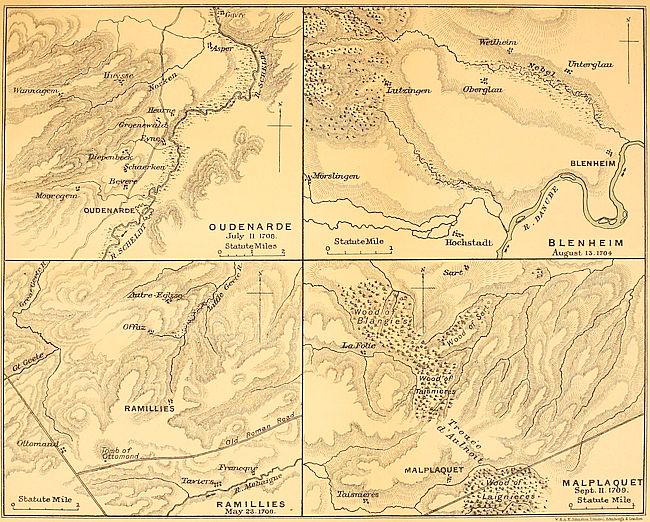
MAP No. 1.
W. & A.K. Johnston Limited, Edinburgh & London.
OUDENARDEBLENHEIM July 11, 1708August 13, 1704 RAMILLESMALPLAQUET May 23, 1706Sept. 11, 1709
Though no great battle occurred in 1710, the army in Flanders was by no means idle. As Marlborough failed to induce Villars to try conclusions with him in the field, he began to prepare for a future invasion of France by the successive capture of the fortresses of Douai, St Venant, Bethune, and Aire. The XVIIIth was in the besieging force at Aire, where the small garrison defended itself gallantly for nearly ten weeks, not surrendering until it had lost about 1400 men and inflicted nearly five times as many casualties on the attackers. Nothing is known of the work done in this siege by the XVIIIth; Stearne and Parker contented themselves with recording that owing to the capture of a convoy food was very scarce in camp,[64] and that the regiment had three officers killed and five wounded, with about eighty casualties among the other ranks.[65]
During the winter of 1710-11 the French made gigantic efforts to protect their country against the threatened invasion, and threw up fresh lines, which ran from Namur to a point on the English Channel a few miles south of Boulogne, using rivers and canals, swamps, and artificial inundations as barriers against the general whom they feared so greatly. Before Marlborough was ready to open the campaign of 1711, his trusted friend and invaluable colleague, Prince Eugene, was recalled to Austria with a large body of troops, but though left with forces greatly inferior in numbers to those of de Villars, he resolved to carry out the first task he had already set himself, the capture of Bouchain. As this fortress was protected by the new lines, which were far too strong to be carried by force, the Duke determined to decoy Marshal de Villars from the opening in the works at Arleux, where he intended to cross. He advanced and retired; threatened first one part of the lines and then another; issued contradictory orders; pretended to be cast down at the loss of a weak detachment intentionally thrown away as a bait to his adversary; simulated alternately rage, dejection, rashness; and deceived not only the French spies in his camp, but also his own army, who began to fear that their beloved “Corporal John” had lost his judgment. By acting apparently like a madman, but really with the profound skill of a great master of war, he lured de Villars forty miles to the westward of Arleux, and on the morning of August 4, ostentatiously reconnoitred the Marshal’s position, explaining in unusual detail to the generals who accompanied him the part each was to play in the assault which was to be delivered on the morrow: then he returned to camp and issued orders for the coming battle. At tattoo the word was passed to strike tents and fall in at once, and in an hour the troops were in motion. At first they thought they were merely taking up ground for the attack next day, but when hour after hour they plodded steadily eastward, they were fairly puzzled until, just before dawn, the message ran down the column: “The cavalry have reached Arleux and have passed the lines, and the Duke desires that the infantry will step out.” And step out they did! They forgot the fatigue of the fifteen miles they had marched already with heavy muskets on their shoulders and fifty pounds’ weight upon their backs, and without a halt for rest or food trudged manfully over an apparently endless plain. When the sun grew hot the work began to tell, and it became a question of the survival of the fittest. The weaker men dropped exhausted on the ground, first by scores, then by hundreds, and later in the day literally by thousands; but without stopping to help their comrades, those soldiers who still had the strength to keep their places in the ranks set their teeth and staggered on, determined not to be beaten in the race by the French, whose horsemen they could see on the other side of the lines hurrying in the same direction as themselves. Early in the afternoon the leading battalions reached Arleux and reinforced the cavalry, who were already in possession of the entrance to the works. The XVIIIth came up about 4 P.M.; apparently the discipline and the marching powers of the regiment had brought it there fairly intact, but when the men realised that the prize was won and Arleux safe in the Duke’s hands, the reaction, inevitable after so prolonged a strain, set in, and half of the Royal Irish collapsed, dead beat and unable to walk another yard. Barely fifty per cent of the infantry had kept up with the army in this forced march, when nearly forty miles was covered in eighteen hours. Numbers of men were found dead from exhaustion, and it was fully three days before all the stragglers had rejoined the Colours.
Marlborough now laid siege to Bouchain, and handled the covering force so well against de Villars’ superior numbers that the French failed to interfere with his operations, and on the 13th of September had the mortification of seeing the garrison surrender. The investing force was desperately hard worked during the siege. For thirteen days consecutively the Royal Irish marched and dug trenches all day, and at night stood to their arms, ready to fight at any moment. “This,” says Parker, “was the greatest fatigue I ever underwent at any one time of my life.” Though the French surrendered before the breach was stormed, they inflicted heavy losses on the besiegers, whose casualties amounted to 4018, of which 1154 were among the fifteen British battalions employed in the siege. The Royal Irish were fortunate: only four officers were wounded, and about forty of the other ranks killed or wounded.[66] It is said that an officer of the XVIIIth, whose courage was as high as his stature was low, was nearly drowned in wading across a deep inundation, so he had himself hoisted on the shoulders of the biggest of the grenadiers of his party, and when safely landed at the foot of the parapet led an assault upon the enemy’s works.
The capture of Bouchain was the last service the Duke of Marlborough was allowed to render to his country. Political intrigues had long been directed against him, and when he returned to England in the autumn he was coldly received by Queen Anne, insulted in the House of Lords, prosecuted for peculation by the House of Commons, and deprived of all his offices. Nay, more, to such a height did party pamphleteers rouse popular indignation against him, that the General “who never fought a battle that he did not gain nor sat down before a fortress he did not take” was forced to go to the Continent to escape from the jeers of the London mob. Even before his fall, the Ministers in power had begun secret negotiations with Louis, by which England was to desert her Allies and make a separate peace with France; and when the Duke of Ormond, his successor in command of the British forces in Flanders, joined the army in the spring of 1712, he understood that he was on no account to cross swords with de Villars. During several months the British troops were in a very miserable position; for being still, at least in name, part of the allied army, to the supreme command of which Eugene had now succeeded, they followed its operations, but in a novel and humiliating capacity: they were no longer chief actors, but spectators—soldiers whom their Government would not allow to fight; and when Ormond announced to them that the suspension of hostilities between England and France was signed, the news filled them with profound grief. In July they turned their backs upon their former comrades and returned to Ghent and Bruges, after a gloomy march past Douai, Tournai, Bouchain, Lille, and Oudenarde, places which they had helped to take, but to which the Dutch garrisons now contemptuously refused them admittance.
After twenty years of almost uninterrupted fighting, every army requires careful handling at the beginning of peace, but more especially one sore at the ill-treatment of its beloved Chief, sorer still at the loss of its honour by its desertion of its comrades in the time of need. Ormond did not manage his men well, and neglected their commissariat; the garrison of Ghent lost their discipline, listened to the words of agitators, and formed a mad scheme to rise; loot and burn the town, and then disperse over the Netherlands. The plot was discovered, but two or three thousand men seized part of the town, where they barricaded themselves, holding out until field-guns were brought against them. Soon after this mutiny was put down the troops were withdrawn to England, but the Royal Irish and another regiment were left to garrison the town until political questions regarding it had been settled. Their detention at Ghent gave them the opportunity to see Marlborough once more, for when he passed through the town at the end of 1712 the whole garrison was on foot to do him honour.
To many of the officers and men of the XVIIIth Ghent must have been more familiar than their own homes in Ireland, for they had wintered there for many years during the war, and did not finally leave it until the autumn of 1715, when the regiment returned to England. A few months later it was quartered at Oxford, where “the scholars and the soldiers did not agree,” until the officers ordered their men to leave their weapons behind them when they went out at night, taking instead stout cudgels with which to teach the undergraduates good manners. This stopped the trouble, and all was quiet until, on the Prince of Wales’ birthday, the officers lit a bonfire outside the Post Office, and then went to supper. While they were at table stones began to come in through the window; a number of soldiers rushed to the defence of their officers, and broke the windows of the house from which the supper party had been pelted. Then arose a furious row: the townsmen turned out; so did the soldiers from their quarters, and headed by a Lieutenant of grenadiers, who “was a little elevated,” a mass of Royal Irishmen went through the town breaking every window they could reach that was not illuminated in honour of the Royal birthday. Patrols were sent out to stop the window-breaking, but it is possible they were not very zealous—at any rate, much damage was done before the rioting was stopped. The Dons announced that they would have every officer in the regiment cashiered for this insult to the University, and solemnly complained to the Privy Council, who at once asked for “reasons in writing,” or their equivalent at the beginning of the eighteenth century. Then the House of Lords debated the matter at great length, and finally decided in favour of the officers, charging the University with disloyalty for not celebrating properly the Prince of Wales’ birthday. Thus the affair ended without detriment to the regiment, and to the great benefit of the Oxford glaziers who had to replace £500 worth of broken glass.
In January, 1712, Lieutenant-General Ingoldsby died. Brigadier-General Richard Stearne, his successor, made over the regiment in 1717 to Colonel William Cosby.[67]