Chapter XV · THE FIRST BATTALION. 1900-1902. SOUTH AFRICA (continued). SLABBERT’S NEK: THE BRANDWATER BASIN: BERGENDAL: MONUMENT HILL: LYDENBURG: THE MOUNTED INFANTRY OF THE ROYAL IRISH REGIMENT. (continued 2)
Reading edition
Since the beginning of June, De Wet had kept the Free State in a blaze, and although after his failure in various minor enterprises he was chased up and down the country, and very roughly handled at Bothaville on November 6, he rallied enough burghers around him to be able to swoop upon the British garrison of Dewetsdorp, which surrendered to him on the 23rd of November, 1900. The fall of this place seemed to remove one of the chief obstacles to the raid into Cape Colony which for months had been discussed round the camp fires of every Free State commando,[321] and De Wet pushed towards the Orange river, believing that once he gained its southern bank the Dutch population in the colony would welcome him with enthusiasm. As soon as his plan was discovered, troops were hurried from all parts of the theatre of war towards the Orange river, among them the column to which the Cork company was attached. After a long and weary journey by train from Pretoria to Bethulie, it shared in the operations in December by which De Wet was prevented from crossing the river, and driven backwards into the eastern Free State, where though harried incessantly by our troops he never abandoned his scheme for a second invasion of British territory. The Cork company was soon called away from the pursuit of De Wet to that of two of his lieutenants, Kritzinger and Hertzog, who succeeded in passing across the river and waged guerilla warfare in many districts of Cape Colony. Early in February, 1901, De Wet, with extraordinary skill and equally extraordinary good fortune, threaded his way through the troops closing round him, and dashed across the Orange at an unguarded drift, but there his lucky star failed him, and the British mounted troops, though almost spent by their unending pursuit of Kritzinger and Hertzog’s raiders, who had now joined the commandos of their leader, drove the invaders back into the Free State at the end of February, 1901.
Between March and November 1901, the section was in the south of the Free State, occupied in clearing the country and similar uncongenial duties, the monotony of which was relieved by occasional skirmishes. In one of these affairs two soldiers distinguished themselves. Private W. Sweeney found himself surrounded by four mounted Boers who, covering him with their rifles, called upon him to surrender; though they were all within fifty yards of him he refused to do so, and firing at them from the saddle succeeded in making his escape. His name was specially mentioned to the General commanding the column for his gallantry on this occasion.[322] Private Radford, while carrying a message for Lieutenant Vigors, was wounded and his horse was hit under him; nevertheless he delivered his message and then made his way back to report that he had done so. The next two months were spent at Winburg, and in January, 1902, the section began to take part in the “drives” which marked the final phase of the war in the north-east of the Free State. In addition to the non-commissioned officer and men already mentioned, Lieutenant Vigors, in the statement he prepared for the regimental records, gives praise to the good conduct throughout the war of Sergeants Kennedy and Colthorpe, Lance-Corporals Mackay and Griffin, Privates Tobin and (5914) Power.
It was said on page 311 that just before the battalion sailed from England Captain R. A. Smyth, Lieutenants S. H. L. Galbraith and E. Lloyd, with sixty-seven of the other ranks went to the mounted infantry at Shorncliffe. From this nucleus developed a company, composed of the same officers and a hundred and thirty-six non-commissioned officers and men, who landed at Cape Town on January 31, 1900, and formed part of the 5th regiment of mounted infantry. The company received its baptism of fire on February 11, 1900, while reinforcing the flank-guard of a convoy in difficulties between Ramah and Roodipan. In this affair Private M. Maher greatly distinguished himself by volunteering to carry a written order to a detachment, separated from the main body by a broad stretch of ground completely swept by the enemy’s fire. He set an excellent example by walking, not running, across the danger zone; delivered the note, and then, refusing to remain with the detachment which was under cover, coolly returned to report that the order had duly reached the officer to whom it was addressed. Maher was not hit; in this affair there were only two casualties among the Royal Irish, neither fatal.[323] The company was at a skirmish near Jacobsdal, where Major Hatchell was wounded; and after a long night march arrived at Klip drift on the Modder river on the 15th, too late to take part in Lieutenant-General French’s charge through the Boer position, though in time to see the cavalry division re-form and start on its final advance upon Kimberley. The Royal Irish were sent on outpost at once, and remained on piquet until dawn, when they were ordered to work eastward down the river to Klipkraal drift, one of the fords by which it was expected that Cronje, now in full retreat from the kopjes of Magersfontein, would attempt to cross the stream. The company was engaged all day with the Boer rear-guard, and several men were wounded, among whom was Sergeant Peebles, whose experiences were singularly unpleasant;[324] while on patrol he was shot through the thighs, and falling helpless on the ground was stripped naked by marauding Boers, and left for dead, until late in the evening he was rescued by a party of his comrades. After spending the night in guarding a battery of artillery, the company at daybreak on the 17th was sent to ascertain if the burghers still held the ground they had occupied when darkness put an end to the combat. As soon as the Royal Irish reported that the position had been evacuated, the column was set in motion, but the Boers had gained a long start; their rear-guard again fought stoutly, and it was not until late in the evening of the 17th that the mounted infantry bivouacked two miles south of Paardeberg drift, near the laager which Cronje had formed a few hours sooner, when to his dismay he found that he had been “headed off” by French, who with a weak brigade of cavalry and two batteries of Royal Horse artillery from Kimberley had thrown himself boldly across the Boer general’s path. At 4 A.M. on the 18th, Hannay’s brigade marched eastwards to form the right of the line of troops with which Lord Kitchener proposed to attack the enemy’s position on every side. The Royal Irish company was engaged all day, and in the ill-fated charge led by Colonel Hannay against the north-east face of the laager was represented by Captain Smyth, Lieutenant Lloyd, and thirteen or fourteen non-commissioned officers and men, of whom several privates were wounded.[325] During the remainder of the operations, ending in Cronje’s surrender on February 27, the company was employed in scouting and patrolling the country south-east of Paardeberg; and after taking part in the action of Poplar Grove it marched into Bloemfontein with Lieutenant-General Tucker’s column on March 16th.
During the next five weeks the 5th regiment of mounted infantry was not employed in any important operation, but at the end of April it joined a force under Lieutenant-General Ian Hamilton, which forced its way through the defile of Israel’s Poort, and after co-operating in driving the Boers from Thabanchu, marched northwards as right flank-guard to the main column in Lord Roberts’ advance from Bloemfontein to the Transvaal. Between the 23rd of April, when the Royal Irish company left Bloemfontein, and the 4th of June, when it entered Pretoria, there were few days when it was not under fire, and it was present at nearly all the actions in which the enemy was driven from one fortified position after another. Considering how constantly the company was engaged its casualties were not heavy: at Thabanchu, Captain Smyth and a private soldier were wounded; at Welkom, Private Murphy was killed by a shell, which striking him on the back of the head, hurled him ten feet out of the saddle; and in a fight between Heilbron and Lindley on May 20, Lieutenant M. H. E. Welch and several men were wounded by the burghers, who after driving in the rear-guard succeeded in getting between the main column and the right flank-guard, of which the Royal Irish company formed part.[326] In this skirmish, where Britons and Boers were fighting in a confused mass, Captain Smyth had a narrow escape: he had given up his horse to a wounded Royal Irishman when a mounted burgher tried to ride him down, but Smyth “dodged” the charge, and then laid his enemy low by a well-aimed shot. Though the company was exposed to heavy artillery fire at the battle of Diamond Hill, none of the officers and men were hit; and the same good fortune attended them for many weeks, for though as part of Hamilton’s (afterwards Hunter’s) Force, the 5th M.I. fought their way from Heidelberg to the Brandwater Basin, there were no casualties among them until July 28, when at Naauwpoort Nek Corporal Hogan was blown to pieces by a shell, and a private soldier was wounded. After Prinsloo’s surrender the company helped to escort two thousand prisoners to the railway, reaching Winburg on August 12, and in less than a fortnight was again “on trek,” this time in a column hurriedly despatched to the help of a detachment which, while reconnoitring in the Doornberg range, a few miles from Winburg, had been surrounded by a body of Boers five times its strength. This detachment, composed of South African volunteers and a handful of British militia, was hard pressed, and had lost nearly fifteen per cent of its numbers when the Boers retired on the approach of the relieving column. The only casualty among the Royal Irish was Captain Smyth, who was so severely hurt by a fall that he was obliged to go into hospital. Captain Brush replaced him in command of the company, at that moment only about thirty strong, the remainder of the men being either in hospital or stranded in various parts of South Africa waiting for remounts.
A few hours after the return of the troops to Winburg on the 27th of August, the town was attacked by the Boers, who finding it too strong to take, drew off and sent a portion of their force against Ladybrand. The 5th mounted infantry and all other available troops were at once concentrated at Bloemfontein, and after relieving Ladybrand hunted the commandos up and down the Orange Free State for many weeks. As a rule the burghers succeeded in eluding their pursuers, but on November 6, 1900, C. De Wet with a strong body of men was surprised near Bothaville by the 5th mounted infantry under Major K. E. Lean, Royal Warwickshire regiment, who when Major Hatchell was wounded at Jacobsdal had succeeded him in command. The fight began at dawn and lasted till midday, when the timely arrival of reinforcements broke down the enemy’s resistance; De Wet and the greater part of his followers retired in confusion, leaving behind them a detachment of brave men, who fought stubbornly until, threatened by a charge of bayonets, they hoisted the white flag. Our spoils of war included a 12-pr. Horse Artillery gun, taken by the Boers at Sannah’s Post, and one of the 15-prs. lost by us at Colenso; four Krupps, a pom-pom, a machine gun, much artillery and rifle ammunition, many horses and carts, and a hundred and thirty prisoners. The Boers lost twenty-five men killed and thirty wounded; our casualties were thirteen killed and thirty-three wounded, among whom were three of the Royal Irish.[327] Most of the company were hotly engaged on the right of the line throughout the action, often at very close range; while a few were attached to the guns, where three privates of the Royal Irish greatly distinguished themselves. One of the gun detachments was reduced to a single man, who served his piece alone; while Privates Radigan and Maher by their steady and well-aimed shooting kept back a party of the enemy who threatened to take the gun in flank. In another part of the field Private Murphy was conspicuous by his bravery in dragging a wounded officer from under a deadly fire. Two or three days later Major-General Knox thanked the whole of the company for their services at Bothaville, and gave especial praise to these three men for their behaviour during the fight.
Soon after the 5th regiment of mounted infantry had refitted at Kroonstad important news reached them: De Wet had recovered from his losses at Bothaville, and had appeared in the south-east of the Free State, where he was attacking Dewetsdorp, whose defenders were hard pressed. The regiment was sent off by rail to Edenburg, where it joined the relieving column, which unfortunately did not arrive in time to prevent the surrender of the garrison. The company for the next two months marched almost incessantly in the eastern half of the Free State, chasing De Wet, who, like the rainbow, was always “in the next field.” They had a couple of days’ rest at Christmas, when they bivouacked at a farm near Ficksburg, where, according to the diary of one of the officers, “the only liquid available for our dinner was of so substantial a nature that a mugful evaporated would leave enough solid matter to make a good-sized brick! We shared the only dam in the place with the horses, mules, and oxen. Tea was an impossibility, and the coffee we swallowed with our eyes shut.” Towards the end of January, 1901, it was discovered that De Wet was secretly concentrating his burghers for another attempt to raid into Cape Colony. Many columns, including that in which the 5th M.I. were serving, were directed against him and caught up his rear-guard at the Tabaksberg, where on the 29th of January the Boers fought a delaying action, in the course of which a handful of the Royal Irish earned praise first for their dash in “rushing” a kopje, and then for holding it against very heavy odds. The 5th were now ordered to Bloemfontein, and after a slow railway journey detrained at Bethulie to take part in the movements by which De Wet and his guerilla bands were to be expelled from Cape Colony. They were sent off to the north-west, and so hard was the marching that when the Royal Irish company reached Hopetown at the end of February, it had lost sixty out of the eighty horses it possessed a month before. In the course of the trek Private Maher again came to the fore by volunteering to cross a drift, in order to ascertain if the farther bank of the river was occupied by the enemy.
From Hopetown the company worked its way back to the east of the Free State, on one occasion bivouacking near Ramah, where it had smelt powder for the first time, on another halting at Hout Nek, where under Hamilton it had fought at the beginning of May, 1900. During the remainder of the war the 5th regiment of mounted infantry was chiefly employed in patrolling, escorting convoys, and clearing farms, duties which entailed incessant and monotonous work. The process of clearing a farm of food and forage was by no means easy, especially when it had to be done very quickly by a flank-guard under stringent orders to keep its proper place in the column. After a harassing day’s work, an officer in the regiment wrote in his diary that “to tell a flank-guard to clear farms on its march is all very well in theory, but when it comes to getting sacks of wheat or tons of loose mealies [i.e., Indian corn] out of a back room through several narrow doors or narrower windows, the flank-guard often finds itself left behind the rear-guard. Some people seem to think that in clearing a farm you have only to blow a whistle, and all the animals commit suicide and all the grain jumps into the nearest dam.” It must not be imagined that these duties were carried on unopposed. There were frequent skirmishes; in one of these affairs (October 17, 1901) a detachment of the Royal Irish company, finding itself surrounded by an overwhelming force of burghers in a place from which there was no possibility of fighting its way out, was compelled to lay down its arms after the officer in command and three soldiers had been wounded.
The British losses in South Africa were by no means heavy, considering that the war lasted two years and eight months, and that during a great part of the time more than a quarter of a million of troops were in the field. The casualties were—
Officers (exclusive of staff).Other ranks.Total.
Killed5185,2565,774
Died of wounds, disease, or from accident55415,61416,168
Wounded185120,97822,829
The casualties in the Royal Irish regiment were as follows:[328]—
Officers—
KilledCaptains S. G. French, W. Gloster, and F. L. Fosbery.
Died of woundsCaptains J. B. S. Alderson, R. R. Arbuthnot, and Sir John Power, Bart. (5th battalion).
Died of diseaseCaptain G. A. Ashfordby-Trenchard (5th battalion) and 2nd Lieutenant A. C. S. Fletcher.
WoundedMajors H. M. Hatchell and B. J. C. Doran; Captains E. F. Milner, R. A. Smyth, and T. Warwick-Williams (volunteer company); Lieutenants M. H. E. Welch and J. A. M. J. P. Kelly.
Severely injuredCaptain G. Hearn (4th battalion).
Other ranks—
Killed.Died of wounds.Died from accidents.Died from disease.Total.
2715661109
Wounded, 128; severely injured, 2.
In recognition of the services of the Royal Irish regiment the words “South Africa 1900-02” were added to the battle honours on the Colours, and the following officers, non-commissioned officers, and private soldiers were mentioned in despatches and received special rewards for their services:—
To be Companion of the Order of the Bath—Lieutenant-Colonel H. W. N. Guinness.
To be Companions of the Distinguished Service Order— Major H. M. Hatchell, Major A. S. Orr, Major and Brevet-Lieutenant-Colonel W. R. B. Doran, Major H. J. Downing, Captain E. H. E. Daniell, Lieutenant J. A. M. J. P. Kelly.
Promotions by brevet— Major A. G. Chichester, Major A. N. Lysaght, and Major B. J. C. Doran to be Brevet-Lieutenant-Colonels. Captain R. A. Smyth (mounted infantry) and Captain E. M. Panter-Downes to be Brevet-Majors.
To be Honorary Major— Quartermaster and Honorary Captain F. P. Reger.
Mentioned in Despatches— Major K. P. Apthorp, Captain E. F. Milner, Captain A. W. Brush, Lieutenants S. H. L. Galbraith, P. U. Vigors, E. C. Lloyd, and H. G. Gregorie (while serving in the Imperial Light Infantry before he joined the Royal Irish regiment).
The Victoria Cross was awarded to No. 3733 Private John Barry.
The Distinguished Conduct Medal was awarded to the following non-commissioned officers and men who were also mentioned in despatches:—
Sergeant-Major J. Bergin. Sergeants J. O’Connor, H. Loney, T. Connolly. Lance-Corporals P. Doyle, E. Lovely, P. Dumphy, W. Tytherleigh. Privates T. Baker, W. Sweeney, M. Maher, J. Murphy, J. Radigan.
Mentioned in Despatches—
Colour-Sergeants: T. Mahoney, J. Reddan, E. Murray.
Sergeants: H. Hall, T. McHale. Lance-Sergeants: C. Kennedy and T. Kelly.
Corporals: M. Kelly, J. Chaffey. Lance-Corporals: J. Moran, M. Tobin, J. Rathbone, C. Beresford.
Privates: J. Kavanagh, J. Kennedy, J. O’Neill, J. Ryan, J. McCullough, W. Patterson, M. Healey, H. Densmore (volunteer company).
Special promotions—
Corporal Wallace was appointed Lance-Sergeant for good service during the campaign, and Private P. Doyle was promoted to be Corporal to reward his excellent behaviour at the action of Slabbert’s Nek.
In the militia battalions affiliated to the Royal Irish the following were mentioned in despatches:—
Captain C. Langford, 4th battalion, serving with Imperial Yeomanry.
Captain A. B. Crabbe, 5th battalion, with Imperial Yeomanry.
Lance-Corporal J. Mahood, 5th battalion, while on railway patrol on May 16, 1901, “was suddenly fired at by a party of Boers who were mining the line. Though mortally wounded he continued to fire as long as he could hold his rifle.”
To all who served in South Africa one, and in many cases two medals were granted. Towards the end of 1900, it was believed officially in England that the war was virtually at an end, and a medal was struck, bearing the effigy of Queen Victoria, for issue to those who had taken part in the campaign. But after the war had dragged on for more than a year longer, it was decided to prepare a second medal with the effigy of King Edward VII., which was to be given to all who had served in the war for eighteen months and who had been in South Africa on January 1, 1902. Clasps were granted for various battles, sieges, and series of operations, and for service in certain specified areas during the years 1899-1900; and also for service in any part of South Africa during the years 1901-1902. The battle clasps obtained by the first battalion were for Wittebergen (i.e., Bethlehem, Slabbert’s Nek, Brandwater Basin), and Bergendal; the Royal Irish section of the 1st mounted infantry received clasps for the Relief of Kimberley, Paardeberg, Driefontein, Johannesburg, Diamond Hill, and Bergendal, and the Royal Irish company of the 5th mounted infantry for the Relief of Kimberley, Paardeberg, Johannesburg, Diamond Hill, and Wittebergen.
During the war the militia battalions of the regiment were embodied, and formed part of the garrison of the United Kingdom.[329]
In memory of the members of the regular or militia battalions who died in South Africa two memorials have been erected, one in St Patrick’s Cathedral, the other in the barracks at Clonmel. Both are described in Appendix 10.
It has been decided that this history should end with the close of the South African war, and therefore nothing will be said about the doings of the regiment since May, 1902. And indeed, a detailed record would show little beyond that unceasing training for active service for which the army and the nation have to thank the campaign in South Africa. During this period there have been only two incidents of note. In December, 1905, the first battalion had the honour of sending three officers and a hundred men to guard His Majesty George V. when, during his tour in India as Prince of Wales, he was encamped at Kala-Ki-Serai. Three years later the same battalion was mobilized for active service in the expedition against the Mohmands on the north-west frontier of India; but unfortunately for the Royal Irish, this hill campaign was brought to so speedy and successful a conclusion that they were not called up to the front.
During the two hundred and twenty-seven years of its existence the XVIIIth regiment has served in nearly all the important wars in which England has been engaged, and has earned undying laurels whenever it has had an opportunity of distinguishing itself. The roll of battle honours, long as it is, by no means commemorates all the achievements of the regiment: in the Low Countries the Royal Irish took a leading part in the storming, not only of Namur, but of many other fortresses; in the capture of the Schellenberg, in the engagement at Bunker’s Hill, in the defence of Toulon, and in the fighting in Corsica the regiment won great praise, but the names of none of these operations are emblazoned on its Colours. Early in its career, the regiment earned the reputation of being second to none in the British army. This reputation it has maintained to the present day; and the author is convinced that when in years to come, his successor writes the continuation of this history, it will be seen that the future generations of officers and men of the Royal Irish regiment have carried on the glorious traditions of the XVIIIth, and have rivalled, though they could not surpass the brilliant feats of arms which have been described in these pages.
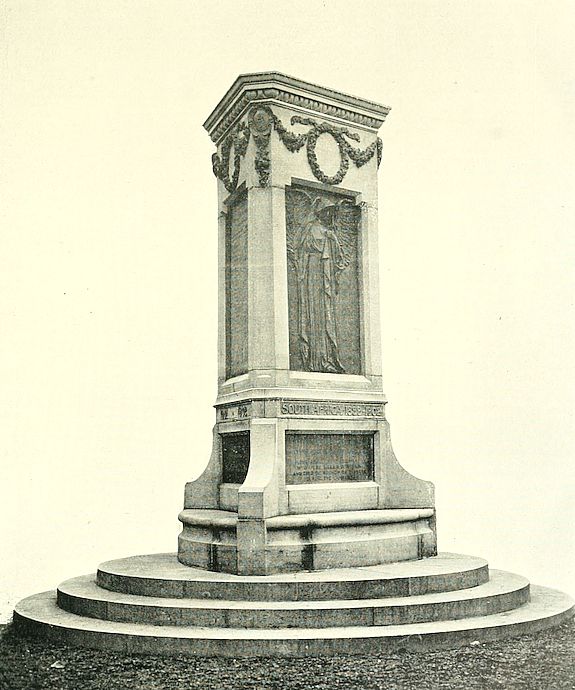
THE SOUTH AFRICAN WAR MONUMENT AT CLONMEL.