Chapter XIV · ARACHNIDA EMBOLOBRANCHIATA (CONTINUED)—ARANEAE (CONTINUED) (continued 2)
Reading edition
This strange peril braved by the male in courting the female, which has, as far as is known, no parallel in any other department of the animal kingdom, is frequently mentioned as universal among spiders. It unquestionably exists, and may be verified by any patient observer in the case of the large Garden-spider Epeira diademata, but it has only been observed among certain species of the Epeiridae and Attidae. It will be remembered that in the Epeiridae the males are sometimes absurdly small in comparison with the females, and this diminution of size is thought to have a direct connection with the danger undergone at the mating season. Small active males stand a better chance of escape from ferocious females, so that natural selection has acted in the direction of reducing their size as far as is compatible with the performance of their functions.
Pickard-Cambridge[303] cites an extreme case. He says: “The female of Nephila chrysogaster, Walck. (an almost universally distributed tropical Epeirid), measures 2 inches in the length of its body, while that of the male scarcely exceeds ⅒th of an inch, and is less than ¹⁄₁₃₀₀th part of her weight.”
During the mating season the males may be looked for on the borders of the snares of the females. Their action is hesitating and irresolute, as it well may be, and for hours they will linger on the confines of the web, feeling it cautiously with their 381legs, and apparently trying to ascertain the nature of the welcome likely to be extended to them. If accepted, they accomplish their purpose by applying their palps alternately to the epigyne of their mate. If repulsed, they do their best to make their escape, and wait for a more auspicious moment. Emerton[304] says: “In these encounters the males are often injured; they frequently lose some of their legs; and I have seen one, that had only four out of his eight left, still standing up to his work.”
Among the other groups of sedentary spiders the relations between the sexes seem to be more pacific, and there is even some approach to domesticity. Males and females of Linyphia may be found during the mating season living happily together in their irregular snares. The same harmony seems to exist among the Tube-weavers, and Agelena labyrinthica lingers for days unmolested about the web of the female, though it is perhaps hardly correct to say that they have their home in common.
Among the wandering spiders the male usually seeks out the female and leaps on her back, from which position his sperm-laden palps can reach their destination. This is the habit of the Thomisidae or Crab-spiders, and of the quick-running Wolf-spiders, or Lycosidae.
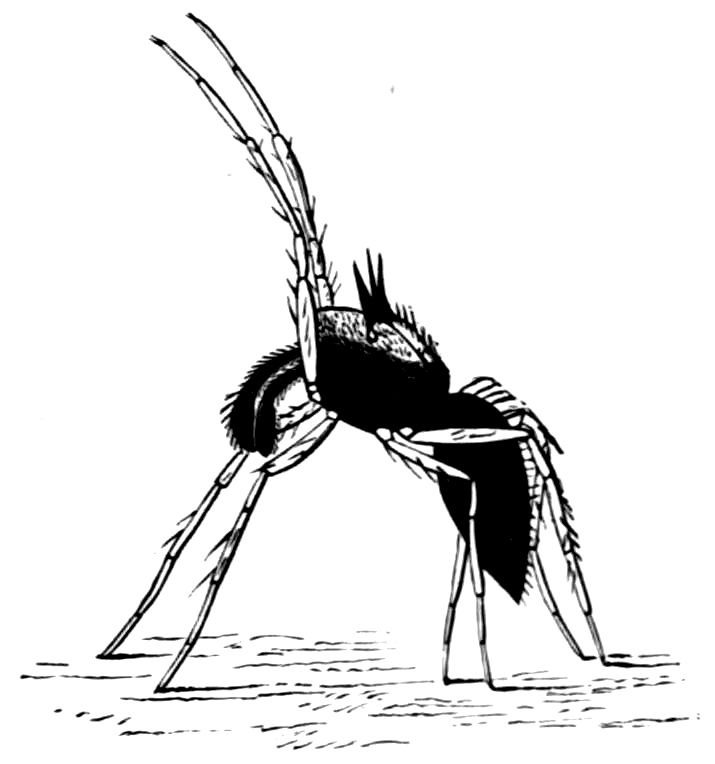
Fig. 199.—Male Astia vittata dancing before the female. (After Peckham.)
The sexual relations of the Leaping-spiders, or Attidae, are so remarkable as to deserve a longer notice. This Family includes the most beautiful and highly ornamented examples of spider life. Their headquarters are the tropics, and their brilliant colouring led Wallace to speak of those he saw in the Malay Archipelago as “perfect gems of beauty.”
Now among these spiders the male is almost always more highly decorated than the female, and Peckham’s observations would lead to the conclusion that the female is influenced by the display of these decorations in the selection of her mate.
The so-called “love-dances” of certain tropical birds are known to all readers of natural history, 382but it was hardly to be expected that their counterpart would exist among spiders. Yet the antics by which male Attidae endeavour to attract the attention of the females afford an almost exact parallel.
The following extract from the account of Professor and Mrs. Peckham[305] of their observations on Saitis pulex will make this abundantly clear: “When some four inches from her he stood still, and then began the most remarkable performances that an amorous male could offer to an admiring female. She eyed him eagerly, changing her position from time to time, so that he might be always in view. He, raising his whole body on one side by straightening out the legs, and lowering it on the other by folding the first two pairs of legs up and under, leaned so far over as to be in danger of losing his balance, which he only maintained by sidling rapidly towards the lowered side.... Again and again he circles from side to side, she gazing towards him in a softer mood, evidently admiring the grace of his antics. This is repeated until we have counted a hundred and eleven circles made by the ardent little male. Now he approaches nearer and nearer, and when almost within reach whirls madly around and around her, she joining with him in a giddy maze. Again he falls back and resumes his semicircular motions, with his body tilted over; she, all excitement, lowers her head and raises her body so that it is almost vertical; both draw nearer; she moves slowly under him, he crawling over her head, and the mating is accomplished.”
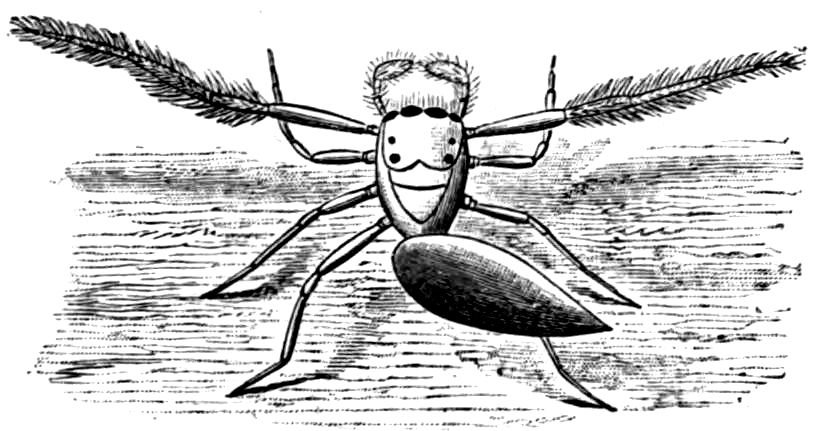
Fig. 200.—Dancing attitude of male Icius mitratus. (After Peckham.)
A similar but not exactly identical performance was gone through by the male of several different species, but it was noteworthy that the particular attitudes he adopted were always such as to display to the best advantage his special beauties, whether they consisted in crested head, fringed palpi and fore-legs, or iridescent abdomen. Sometimes even such exertions failed to captivate the female, and she would savagely attack the male, occasionally with fatal effect.
383In the case of some species, when the male had won the consent of his mate, he would weave a small nuptial tent or web, into which he would partly lead and partly drive the female, who no longer offered serious resistance.
Fossil Spiders.
About 250 species of fossil spiders have been discovered. Of these about 180 are embedded in amber, a fossil resinous substance which exuded from ancient coniferous trees, and quantities of which are annually washed up from the Baltic upon the shores of northern Prussia.
The most ancient fossil spider known was obtained from the argillaceous slate of Kattowitz in Silesia, and belongs, therefore, to the Carboniferous strata of the Palaeozoic epoch. It has been named Protolycosa anthrocophila. There is some doubt as to the affinities of this spider. Roemer, who described it, placed it among the Citigradae, while others have thought it to belong rather to the Territelariae. Thorell, on account of its agreement in certain important points with the very curious recent Malay spider Liphistius, has placed them both in a separate sub-family, Liphistioidae. To the same epoch belongs the American fossil spider Arthrolycosa antiqua, which was found in the Coal measures of Illinois.
The other localities from which fossil spiders have been obtained are the Swiss Miocene at Oeningen, the Oligocene deposits at Aix, the Oligocene of Florissant, Colorado, Green River, Wyoming, and Quesnel, British Columbia.
Many of the spiders from the rocks are so fragmentary that it is impossible to decide with certainty on their systematic position, but a considerable number of them—more than half—have been assigned to recent genera.
The amber spiders are mostly well preserved, and can be classified with more certainty. Many of them are surprisingly like existing forms, though others, like Archaea paradoxa, differ greatly from most spiders now extant, though they show some affinities with one or two remarkable and aberrant forms.
384