THE CALL OF THE EAST (continued 5)
Reading edition
"Doctor, you beat the devil."
"Nothing to get excited about, Beauchamp! Percussion fuse! If it did not explode when it hit the corner of the fort, it wasn't likely to when it went into the soft soil."
"Yes, that's all right. But you hadn't time to work that out before you served again. Besides, it passed within a yard of where you were standing."
"Well, what if it did? A miss is as good as a mile. There was no use going up in the air about it."
"Look here, Sinclair. What the devil ever induced you to play this fool game, anyway?"
"I had to."
The consul looked at him in silence for a minute.
"Well, perhaps you had," he said slowly.
"I'll leave you to see those people back to the rendezvous, Beauchamp. Carteret may need a stretcher. I see that Miss MacAllister is quite able to walk. I'm going to MacKay's."
He turned to go. As he did so he heard Miss MacAllister pronounce his name. He thought that she was only saying a conventional farewell. He lifted his hat and said:
"Good-afternoon, Miss MacAllister."
Without looking in her direction he was gone.
XXVII
THE CHARGE OF THE TAMSUI BLUES
During the week which lay between the first and second bombardments, Dr. Sinclair and Miss MacAllister saw very little of each other. The doctor was busy. But that was not the main reason why he did not meet Miss MacAllister. The previous week, no matter how busy he was, he could always find time to meet her.
The fact was that circumstances had changed. He did not want to see her. Between the halcyon days of the previous week and the gloom of this one some painful episodes had occurred. The stormy interview between mother and daughter had taken place. In her indignation the young lady had determined to make it plain to everybody in general, and to Dr. Sinclair in particular, that she was not enamoured of him and was not offering her love where it had not been sought.
In some respects she succeeded beyond her expectations. Sinclair was convinced. More than that! He was convinced that all along she had been only playing him. That reference to the song he had sung at the dinner made assurance doubly sure. All through those days when she had been so fascinatingly kind she had only been leading him on so that her revenge might be the sweeter.
If Sinclair had been a melodramatic individual, he would probably have torn out whole handfuls of his fair hair, thrown them two or three feet above his head in the direction of the high heavens, and raved some foolish and incoherent ravings, telling his wrongs to the winds and the wild waves, if they cared to listen. If he had been a profane person, he would have sworn picturesquely and would have asked Sergeant Gorman or some one else equally vigorous to kick him down the steep hill, on which the consulate was built, and up again for being a fool.
As he was neither melodramatic nor profane, he did neither of those things. He merely made up his mind in a cool, determined way that he would avoid Miss MacAllister as much as the narrow limits of their little community would allow, and when he was forced to meet her he would not grow enthusiastic over her, to say the least. When he met Gorman he did not ask to be kicked, but said:
"Look here, sergeant, there are going to be some lively times round here, or I'm no prophet. The French are not going to be satisfied with bombarding. And if they land a force and it comes to rifle-fire and perhaps the bayonet, there'll be some Chinese hurt."
"Right you are, docther. The shells don't take manny lives, barrin' thim that the noise scares to death. But the rifle bullets, they're the little divils that do the wurrk."
"Well, supposin' that you get leave again and we offer our services to General Soon to organize an ambulance brigade."
"I'm wid you, docther, from the drop of the hat."
So it came about that all that week Sinclair and Gorman were out on the wide commons in the vicinity of the Chinese camps, with squads of Chinese detailed for that service, to use General Leatherbottom's expression, "lickin' them into shape." Gorman gave them drill. Sinclair taught them how to splint and bandage, to put on a tourniquet and check the flow of blood, to make improvised stretchers and carry patients without irritating their wounds past recovery.
Soon the fair-haired "Life-healer" was nearly as well known and as popular among General Soon's yellow-skinned, slant-eyed hordes as he had become in Liu Ming-chuan's army before Keelung. But none of these Chinese soldiers knew how much of the training they received they owed to the fact that the "Red-haired Life-healer" had been badly used by the "barbarian girl" at a game of "phah-kiû," or strike ball.
One day Sinclair and Gorman were out as usual drilling their corps and training them in the principles of first aid. An exclamation of "Tai-eng-kok lang" (British people) from some of their men caused them to look up. Passing them some distance away were Miss MacAllister and Carteret. The latter was carrying an easel, for among his accomplishments he included considerable skill in sketching and painting.
They were making their way towards a little eminence which commanded a magnificent view in all directions. Carteret had asked her to take a walk, that he might point out the beautiful scenery. She had accepted the invitation in the hope of meeting Sinclair, whom she had not seen since he had so abruptly left the tennis lawn.
"Fwhat the divil is the spalpeen takin' the lady there for, wid thousands of Chinese soldiers rampagin' around for some diviltry to do?"
Sinclair took one look, then lowered his head, and went doggedly on with his work, giving the Chinese ambulance corps a demonstration of how to splint a broken thigh. Gorman looked at him wonderingly for an instant; then without a word joined him, pulling the shortened leg out into position and explaining each movement in the vernacular.
Meanwhile, the prime danger to which Miss MacAllister and Carteret were exposed was not from the Chinese soldiers. A herd of water-buffaloes were feeding on the short grass of the downs. Docile as these huge beasts are with the little native herd boys, they are often exceedingly vicious towards strangers, especially those dressed in a style to which they are unaccustomed. Now they were irritated by the bombardment and frequent ill-usage by the soldiers.
At the sight of the man and woman in foreign dress they began to show signs of excitement. Crowding in a dense mass of blue-grey, hairless bodies, they moved in arcs of a circle, of which the centre was the object of their intended attack. Their ugly snouts were thrust forward on a level with their shoulders. Their great, curved horns lay back on their necks. They pressed closer and closer behind the two foreigners. Suddenly one enormous brute with a snort threw itself forward in a charge.
A yell from one of the Chinese attracted the attention of Sinclair and Gorman. Miss MacAllister had turned to face the beast, with the light walking-stick she carried upraised in her hand. Carteret flung his easel at it, but did not interpose himself between his companion and the danger.
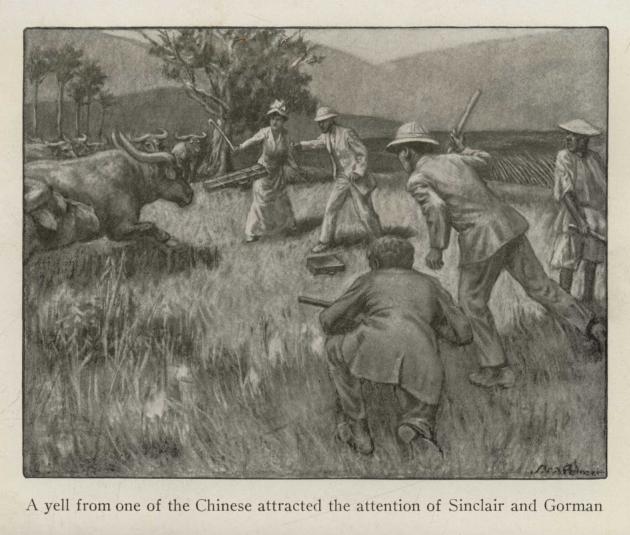
A yell from one of the Chinese attracted the attention of Sinclair and Gorman.
With a shout Gorman sprang to his feet and started to run, waving a heavy stick in his hand. He had not taken a half-dozen paces when a rifle cracked behind him. A bullet sang past and the great blue beast plunged forward on its knees, then rolled over on its side almost at Miss MacAllister's feet. Gorman glanced back. Sinclair was lying on the ground, in the act of throwing another shell into the breach of the rifle he held in his hands.
"Better go on, Gorman, and drive off the rest of the herd. You may have to escort these people home. It's not safe for them to be out."
With some shouts and a few resounding thwacks of his stick on their tough hides, Gorman drove off the buffaloes, and then turned savagely on Carteret:
"Tearin' ages! Fwhat in the name of all the saints possessed you to bring the young lady here? ... Fwhat? ... For a walk! ... Faith, an' if it hadn't been for the docther here, God bless him!—it's a walk her young ladyship wud have been takin' to hivin and you to hell this very minnit."
"You make very fine distinctions, Sergeant Gorman," said Carteret sarcastically.
"Distinction, is it? Begorra, the only man that has come out of this wid distinction is Dr. Sinclair here. An' you had better be afther thankin' him that the angels and the divils are not this minnit holdin' a celebration over your two souls respectively."
In spite of the danger she had just passed through, this was too much for Miss MacAllister's gravity. Her merry peal of laughter rang out at the evident discomfiture of Carteret. It was with eyes dancing with fun as well as full of gratitude that she met Sinclair as he came to inquire courteously for her well-being. He received her warm thanks quietly and made light of his skill as a shot, which she praised so highly.
"I am only too glad to be of any service to you. As for the shot, that was nothing. I have been accustomed to hunting in Canada since I was a small boy. I had to learn to take sure aim and shoot quickly."
Carteret thanked him in courteous terms, but without warmth.
Sinclair did not wait for any further conversation.
"It is really not safe for you to be out here without an armed escort," he said; "when the country is so disturbed and there are so many camp-followers about. Even we who are in a sense in the Chinese service always carry arms. Sergeant Gorman will see you safely home. I am on duty here."
He did not mention the obvious fact that Sergeant Gorman was also on duty. But Miss MacAllister did not fail to notice it, and understood. She thanked him as bravely as she could, and turned away with her escort. But it was some time before even Gorman's quaint humours and repetitions could draw a laugh from her.
That was the only time Sinclair and Miss MacAllister met that week.
XXVIII
UNHOLY CONFESSORS
That evening De Vaux and Carteret sat in the latter's quarters in the buildings of the customs compound. There were a number of other occupants of the room. De Vaux and Carteret sat on chairs, at least they did during the earlier part of the evening. The others sat on the table. They were highly honoured and necessary guests. They consisted of sundry bottles of Scotch whiskey, a nearly equal number of bottles of soda, and a varied assortment of bottles of wine.
Carteret felt that he needed some comfort and sympathy after the exciting experiences of the day. He had called in the guests, who now sat on the table to comfort him. De Vaux, as being somewhat permanently installed in Carteret's quarters, was helping to entertain. Indeed, De Vaux had a singular facility in entertaining and being entertained by guests of this nature.
"A man needs something after such experiences as I have had those last few days," said Carteret, pouring out a glass of whiskey and starting to fill up with soda. "Talk about war! By Jove! I have been in more uncomfortable places in the last five days than I was in a whole campaign in Egypt."
"Not so much soda, Carteret! Not so much soda! ... it spoils the flavour and weakens the effect. 'Pon my honour, it does! ... If my nerves are shaky and I want the taste to stay in my mouth, a little less than half soda is my rule."
"To the devil with the taste! There's lots more taste where this came from. But you're right. My nerves are all on the jump."
"The consul tells me that you had a narrow escape. Those infernal water-buffaloes! Bless my soul! I'm more afraid of a herd of them than a whole regiment of Chinese.... 'Pon my word, I am."
"So am I, the ugly brutes! And if the girl had got killed or injured there would have been the very deuce to pay. The consul and her father would have blamed me."
"The consul blames you as it is."
"Yes, that's the way with Beauchamp. He's an Englishman. But he's down on his own countrymen and his own class, and all for those damn boors of Canadians. He thinks more of MacKay and that upstart doctor than he does of a whole colony of English."
"Well, I shouldn't like to say that. Beauchamp has always been awfully decent with me. 'Pon my soul, he has! ... But he is vexed at you. He says that you ought to be deported."
"Only wish he would deport me! Anyway, he can't till the next boat. And on it he's going to have to deport his wife and Mrs. Thomson and Miss MacAllister. That will hurt him worst of all. Don't you fret. There'll be no deporting by that boat, unless I deport myself."
"You are pressing your case with Miss MacAllister deuced hard.... How is it looking? You should have some results by this time. 'Pon my honour, you should!"
Carteret drained his glass and filled it again.
"The mother's with me. She knows that the heir has only one lung."
"And the father?"
"Says nothing one way or the other. Don't think that he is quite satisfied with my religious principles."
"Bless my soul! Could you blame him?"
"Not if he knew all about them. But, thank the Lord, he doesn't!"
Carteret laughed disagreeably, cynically as he spoke.
De Vaux took his cigar out of his mouth, blew a cloud of smoke into the air, and tipped his long glass so high that one might fancy that he feared lest even the moisture adhering to its sides should escape him. He set it down and wiped his lips with a sigh of satisfaction. Then he said:
"And what about the young lady herself?"
"An uncertain quantity."
"Has she given you no sign?"
"Signs enough sometimes that she wished I was in Jericho, or at the North Pole, or some other equally remote and cheerful place."
"Why? What's the matter?"
"Just at present she's taken with that Canadian peasant's muscles. Like the rest of the women, she is more attracted by the body of a man than by his birth or brains."
He laughed again, and his laugh was unpleasant to hear.
De Vaux gulped down another drink and answered with a little bit of angry stutter:
"You've said enough, Carteret.... By Jove! there are lots of decent women.... If you and I haven't met many of them, it's our own fault.... 'Pon my honour, it is!"
"There may be. But they are not in the Far East. When I was in Shanghai, every woman in the settlement had her price, if you only knew what it was."
"I don't know what they are in Shanghai," replied De Vaux. "But I do know what they are in some other places, and I'll stake my honour on it they are not all like that. 'Pon my soul, they're not."
"Name one."
"Mrs. Beauchamp."
"Bound by conventionalities and kept in a glass case by her husband," sneered Carteret. "Get her out of that and she'd be just like the rest."
De Vaux struggled to his feet, his face purple, his voice choking with rage.
"Carteret," he stuttered in his high voice, "that's a lie—-a damned lie! ... If you don't take it back"—he shook his fist across the table—"if you don't take it back, by God, I'll expose you!"
Carteret paled, sat up in his chair, and took the pipe out of his mouth.
"Look here, De Vaux," he said, "don't make a confounded fool of yourself. One would think that you were the lady's husband. I didn't mean anything. I was only joshing."
"Well, that's a kind of joshing I don't like when it is about my friends.... 'Pon my soul, I don't!" replied De Vaux, settling himself back into his chair.
"All right, De Vaux, there'll be no more of it. What'll you have? ... Let's break a bottle of champagne."
That was irresistible, and in a few minutes De Vaux's good-humour was restored. Presently he said:
"So you have hopes of winning the fair MacAllister yet?"
"Sure of it when I get her away from here and can use the title as a bait."
"The title! Is it so near as that? Have you had any word?"
"Had word from my agent and solicitor by the last boat. My dearly beloved brother's cough is quite distressing. He has been ordered to Mentone for the winter. The agent does not think that he will ever get there. And, if he does, he's sure that he'll never get back. The old man is taking on about it. He's not at all in love with the idea of the succession of the heir presumptive. They do not think that he will live through the autumn. If October does not finish him, November will."
De Vaux had little reason to love his own parents and family, whoever they were. But the cynical heartlessness of Carteret grated on him. He turned the conversation a little:
"So you intend to leave the island soon?"
"By the next trip of the Hailoong, if the French do not bottle us up for the winter."
"And then you'll bring matters to a conclusion with Miss MacAllister?"
"Yes. Her people intend to spend the winter in Hong-Kong. So do I. If the old man and my beloved brother are only sufficiently obliging to depart in peace with reasonable expeditiousness, I shall be Lord Lewesthorpe. You know what that means in the colony. I haven't yet seen the tradesman's daughter who could resist. They are all falling over each other in their willingness to exchange their money for a title. Quite envious of the preëminent success of their fair American cousins, as the newspapers say, in getting so many titles knocked down to them. The mother is ready to bid mine up. The decayed Lewesthorpe fortunes need the money more than I need the girl."
Drunk as he was getting to be, De Vaux was disgusted with the callousness of his companion. He sat silent for a few minutes, looking straight at Carteret out of his bulging, bloodshot eyes. Then he blurted out:
"Carteret, what are you going to do with the Chinese girl?"
"Nothing in particular," was the reply, with a cynical laugh. "Any of you fellows can have her, if you want her. If not, and the French take this beastly island, one of them will take her. They are generally ready for an affaire d'amour."
"And you are going to desert that Chinese girl and her child—your child—and let them go to the devil? And then you're going to ask Miss MacAllister to marry you, she of course knowing nothing of the other?"
"Of course. Why not? It won't hurt her so long as she doesn't know anything about it. If she does find it out afterwards, she can make the best of it. It would be the same if she married any other man."
"Carteret, you are a scoundrel.... 'Pon my soul! ... That's what you are—a double-dyed scoundrel."
Carteret rose to his feet and faced De Vaux across the table. His face was pale and ugly:
"Come now, De Vaux. A little of that goes a long way. If I am a scoundrel, you are five times as much a scoundrel. For, if my arithmetic and memory are right, that is just the number of half-breed youngsters I counted in your house up river."
De Vaux stood for some moments gasping for breath and struggling to get control of himself. He was dangerously near the apoplectic fit which had been so often foretold for him. But he passed the danger point, recovered himself, and said:
"Yes, Carteret, your memory and your arithmetic were right. There were five. But they are all the children of one woman. And that woman, though she is a Chinese, is just as much my wife as things out here go as if the banns had been published and the service read.... 'Pon my honour, she is! ... I am educating my children. They are safe in Hong-Kong at the present moment.... Bless my soul, I had a letter from the oldest by the last mail.... More than that, Carteret, since I have had that Chinese woman, I have never sought a white woman, and never intend to.... Thank God, I have a little bit of a man in me yet!"
"That's all old woman's sentiment, De Vaux. I didn't think you were such a molly-coddle. Wouldn't it make a furore in society if I was to take a Chinese tea-girl home to be the Countess of Lewesthorpe? I have none of your fastidious notions. I intend to have a woman suited to my position, and money to keep it up."
"And leave the girl and the kid."
"Then, by God, I'll have nothing more to do with you!"
And De Vaux meant what he said. But another bottle was broken, and then another. And when the dawn peeped in, De Vaux was stertorously slumbering on a long bamboo and rattan chair, and Carteret was hidden under his mosquito curtains.
XXIX
FLAGS OF TRUCE
"Looks as if we might have something doing to-day, sergeant. I shouldn't be surprised if we should have an interesting day. What do you make of those boats away there to the north?"
"Transports, docther. They're not men-o'-war, and what else could merchant ships be doin' there except waitin' for a chanst to land soldiers?"
"I wonder where the other warships are. I can make out only the Galissonnière and the Vipère."
"Maybe they're close in shore, behind that hill yonder. If they are goin' to put a landin' party ashore, they'll be needin' to cover it."
It was the eighth of October, six days after the previous bombardment. Sinclair and Gorman were, as was their custom, on the top of the Dutch fort, trying to foresee what might be the developments of the day.
The morning wore on until nine o'clock. Suddenly spirts of flame shot out from the two French warships which were in sight, and the thunder of their guns mingled with the distant boom from others which were hidden behind the northern hills. A transport appeared close to the shore, near the last stretch of beach visible from the fort. Another was probably hidden by the hills. The rattle of the machine guns covering the landing of the troops filled up the intervals between the booming of the big guns.
At the first report the consul joined them on the lookout. Boville, MacAllister, Commander Gardenier, and one or two others came later. With the consul's permission, Gorman left to personally superintend the work of his ambulance corps, of which he was very proud.
"Don't let the Chinese mistake you for a Frenchman," called Sinclair after him. "The Hakkas might fill you with slugs from their old match-locks."
"Faith, an' it's a poor opinion you have of their intilligence, to say nothin' of the insult you're offering meself," was the reply of Gorman, as he ran down the stair.
"There's the first load!" exclaimed the consul, as a boat filled with troops pulled from the transport to the beach.
Boat after boat followed, discharging their cargoes of armed men, who formed up on the beach and then marched away out of sight behind a spur of hills. Soon the volleys of rifle-fire joined the crash of machine guns in forming an interlude between the thunder of the cannon.
An hour passed away. As a week before, most of the residents of the hill-top had repaired to the rendezvous at MacAllister, Munro Co.'s. But the consul and his companions were still on the top of the fort.
"There comes the first of the Chinese wounded," said Sinclair. "It's some of Gorman's corps who are carrying him. I can see the red cross."
A moment later he said:
"There come more. The French must be doing some execution. There are already more wounded in sight than we had all day last Thursday. It's the rifle-fire which counts."
Singly or in groups, the squads of stretcher-bearers could be seen filing across the common on their way to the Mission Hospital.
"I must go now. We are going to have our hands full."
"Down! Down!" roared Gardenier.
Every one fell flat behind the battlements. There was a crash and the old fort trembled to its foundations. They sprang to their feet and looked over. A shell had struck it squarely a few feet above the ground. But the solid brick walls, eight feet thick, built by conscientious workmen two hundred and fifty years before, had hurled it back and were hardly even dented by the terrific impact.
Soon afterwards Sinclair left for the Mission Hospital down in the town. There he joined Dr. Bergmann in time to receive the first of the wounded. But they came so fast that before long the two doctors had to signal for Black of the Locust. As the afternoon came on the number increased. The hospital was small, and soon not only the operating-room and the wards, but the courtyard as well, were crowded with between one hundred and twenty and one hundred and thirty wounded men.
The forenoon passed into the afternoon; the afternoon wore slowly away. Up and down between the lines of rude plank cots the three doctors moved, with bare arms and clothing stained with blood. Several of the Christian students acted as nurses and assisted at the dressings.
The noon hour had passed, but they took no time for lunch. A messenger arrived from the rendezvous with an invitation from Mrs. Beauchamp and Mrs. MacAllister to go there for tiffin.
"I fancy that we had better accept this," said Black. "We have more time now than we shall have later. But these are slaughter-house clothes in which to go to tiffin with ladies."
"Das ist true," replied Bergmann. "Ve vill slip in mine house and vill get some clothes. I can fit Dr. Black. But Dr. Sinclair, I know not. He ist so big."
"That's all right, Bergmann. Somebody has to stay here and look after those fellows. You two go ahead and have tiffin. Present my compliments and regrets. If there is not too big a rush when you come back, I'll have something then."
His two confrères hastened away. Sinclair went on with his work silently, swiftly, determinedly. Again the pain-drawn faces appealed to him. Again the wistful eyes followed him. Again the word passed from lip to lip, "I-seng lâi" (The Life-healer comes).
Some belonged to regiments which had been in the camp before Keelung and had known him there. Some had come to know him during their ambulance work of the past week. Some had heard of him. Some were mainland men from the North, speaking a different tongue. But all caught the phrase, and from every plank bed he heard the word passed to the next, "I-seng lâi" (The Life-healer comes). And he worked on.
Presently Bergmann and Black returned, and with them a blue-jacket of the rendezvous guard, with a pressing invitation for him to go for tiffin. He looked at the invitation; then at the ever-increasing number of suffering men:
"Give my thanks to the ladies who sent you and say from me that there are so many wounded here now that I cannot find it in my heart to leave them. I can do very well without food till dinner-time."
"Very good, sir. I shall tell them."
The blue-jacket saluted and withdrew. Sinclair went on with his work.
A half-hour passed. Again the blue-jacket appeared accompanied by a native bearing on his carrying-pole a pair of the many-storied bamboo baskets in which the Chinese convey warm provisions.
"A chit for you, sir."
He took the note the sailor handed him and glanced at the address. It was in an unfamiliar feminine hand. Opening it quickly, he read:
"Will Dr. Sinclair be so good as to accept the accompanying refreshments from me?
"JESSIE MACALLISTER."
In spite of the mood of intense concentration which was always on him when he was at work, in spite of his rigid self-control, a slow flush showed in his face, doubtful under the tan, but certain when it climbed above the border-line of the sunburn. It was not so much the act, though that in itself would have been enough to quicken his pulses. It was the form of the brief epistle. She had started to write a purely formal note, but had ended by making it warmly personal.... "From me. Jessie MacAllister."
"I have no paper on which to write an answer, except a leaf out of a pocketbook. You will have to make apologies for me."
"I shall do my very best, sir," replied the sailor, with a grin, as he took the hastily-scribbled note of thanks, for the big, kindly doctor had, without an effort, got the good-will of this man, as he did of nearly every man his life touched.
Sinclair hastily swallowed several cups of tea, ate a piece of chicken, and, telling his student assistants to distribute the rest among the wounded, turned again to his work of mercy. But all the while four words kept writing and re-writing themselves upon his brain: "From me. Jessie MacAllister."
It was the first time that he had seen her full name written. It had always been "Miss MacAllister." Certain definite pictures had been formed in his mind with which that appellation was connected. Sometimes stately and magnificent, sometimes teasing and whimsical; sometimes kind, sometimes cruel; those clear-cut portraits were connected inseparably with the name "Miss MacAllister." But some way "Jessie MacAllister" was different. It suggested something more intimate, more confidential, more tender than the other had ever done. What could it mean?
Again and again he asked himself that question: "What could it mean?" Was she only playing with him? The week before the last bombardment she had been exceedingly kind. Then she had suddenly turned and treated him cruelly. Was she trying the same trick again? His jaw set and his lips closed tightly. She wouldn't catch him like that again.
But another thought would pass through his mind. This was different. There was something about this two-line note which he had never experienced before.... "From me. Jessie MacAllister."
Sinclair had made up his mind resolutely after that tennis game that he would not put himself in the way of receiving such treatment again. When he set his mind to anything, he was firm to the verge of stubbornness. He knew that. And with all the stubbornness of his nature he had resolved to have nothing more to do with Miss MacAllister than the laws of politeness required.
But somehow "Jessie MacAllister" did not seem just the same. Do his best, he could not be indignant and angry with her in the same degree as he had been with "Miss MacAllister." He knew that the fortifications of his resolution were shattered. He knew that the four words, "From me. Jessie MacAllister," had made a breach in them. They had been standing not quite a week.
Strange to say, the thought that they were broken, and the means by which it was effected, gave him a secret pleasure, a sense of lightness and exultation such as he had not felt for six whole days. To be consistent with himself, to maintain his self-respect and reputation for firmness, he made a pretence at repairing the breach and rebuilding the fortifications. But all the while the two-line note with its signature was stowed away in an inner pocket, which had an intimate relation to the spot beneath which his strong heart beat a little faster than usual. With a new hope and enthusiasm he toiled on among the wounded all the rest of the day. But the toil was light and the afternoon sped away.
Meanwhile, the bombardment had come to an end. The French attack had failed. Entangled in a maze of swampy rice-fields, their landing-party had been fiercely attacked by the Chinese. They were compelled to retreat to their boats, carrying their wounded with them, but abandoning their dead.
The wild Hakka tribesmen with General Soon's army, following the practice they had learned in border warfare against the Malay savages of the hills, had cut off the heads of the fallen French soldiers and exposed them on poles at the Chinese camp and in the market-place of Tamsui. Consul Beauchamp and Commander Gardenier had indignantly protested to General Soon. The Chinese commander had at once ordered that the bodies and heads of their fallen foes should be buried and promised that it should not occur again.
But the danger of the situation to the European residents and visitors had been revealed. While General Soon and many of his officers and men were deeply grateful for the services rendered by the Mission Hospital, the doctors, and Sergeant Gorman's ambulance corps, the foreigners stood in serious peril. A great European nation, a first-class military power, had been beaten back by the Chinese in an attempt to capture Tamsui. The savage instincts of the irregular and undisciplined levies of the Chinese army had been aroused by their success. There was no knowing the hour when these would break out in a general massacre. The consul resolved that all foreign women and children, and such of the men as duty did not compel to stay, should leave the island at the first opportunity.
XXX
THE MYSTERY OF LOVE
A day or two after the second bombardment the Hailoong again appeared off the harbour. The French detained her long enough to satisfy themselves that she carried no munitions of war, and then allowed her to enter the port. Nearly the whole foreign community was at the dock to receive her. It was only thirteen or fourteen days since she had been there before. But to those who had been in the midst of war's alarms it seemed as many weeks.
Of course, Sinclair was there to give McLeod a hearty greeting. There was little time to talk, as the chief officer had to oversee the discharging of the cargo. Sinclair joined him in this, his knowledge of the ship and of conditions ashore making his assistance most valuable. He had his countryman's knack of turning his hand to anything. By the afternoon they had so rushed the work that they were able to knock off and have a comfortable chat in the dining saloon.
After they had discussed the bombardment and the landing, the prospects of more fighting and the possibility of a blockade, and had laughed till their sides ached at the oddities and eccentricities brought out by the unusual situation, McLeod said suddenly:
"Say, Doc, you have not told me anything about the Highland girl. How is she?"
"Just as big a conundrum as ever, Mac."
"What! Have you not been getting along well?"
"No! I don't know where I'm at."
"Why? I thought from the way she spoke of you, and the way she received you when you came back from Keelung, that things were bound to go like a house on fire."
"Well, Mac, for a few days I was feeling pretty good myself. I thought that I was making great progress. But the day of the first bombardment my castle in the air was blown sky-high and there has hardly a fragment of it come back to earth yet."
He then told of the tennis game and of how disgusted with himself he had been. To his surprise McLeod did not take it very seriously. He expressed concern at Sinclair's narrow escape from the shell, but rather laughed about the rest of the incident, especially at his friend's having left the lawn in a tantrum, as he called it.
"You would have been madder than I was," retorted Sinclair, "if you had been in my place."
"Of course I should—if I had been in your place, because like you I should not have looked for the right reason for her actions—that is, if I had been in your place."
"I don't understand what you are driving at," said Sinclair, with a trace of irritation.
"It's all right, Doc. Never mind now. Go on and tell us some more."
When Sinclair related the incident of the "charge of the Tamsui blues," and Gorman's remarks to Carteret, McLeod laughed so heartily that the doctor had to join him.
"It's all very well for you to laugh like that," he said, a little ruefully, when McLeod stopped for a moment. "You have nothing at stake. But it's different with me."
"You'll laugh about it yet, just as heartily as I have done. Probably more so. Haven't you another yarn up your sleeve? I know that you have. Go on. Give us another."
He did. He told about Clark praying under the teak table, and De Vaux dancing and stuttering around it. Sinclair was a good story-teller, and before he was through with the Free Methodist prayer-meeting McLeod's laughter could be heard the length of the ship. Sinclair had forgotten his love troubles, and his laugh, mingled with his chum's, was as rollicking and care-free as that of a schoolboy.
In the midst of it Captain Whiteley's voice was heard outside:
"What in the world's going on in here?"
A lady's voice replied:
"It's those two lovers. They should never be separated. Either one is quite inconsolable without the other."
The door was pulled open, and the two young men, vainly endeavouring to choke down their laughter, rose to receive Miss MacAllister, her father, and the captain.
The two men did not remain long. Mr. MacAllister wanted to take Captain Whiteley to see some of the damage wrought by the shells. A few minutes after they left McLeod suddenly remembered that there were some duties connected with discharging or taking cargo which he had to attend to at once. Almost before they knew, Sinclair and Miss MacAllister were left alone.
For some moments neither spoke. Ordinarily both were good conversationalists, able to acquit themselves with credit in any company. But now, left to each other's company, each seemed suddenly bereft of speech. Sinclair probably never thought so quickly on any other occasion in his life. But with all his thinking he entirely failed to think of anything to say. If he had thought of anything, it is doubtful if he could have said it. His heart was pounding so hard and fast that he experienced a slight suffocating sensation. But he didn't open the door. He had that much presence of mind. He didn't open the door to let the outside air or any one else in. Though speechless, he was not bereft of reason.
It was Miss MacAllister who first recovered.
"Dr. Sinclair," she said, "I want you to forgive me."
Then Sinclair began to wonder what she had done that he should forgive. Could she ever have done anything for which she needed to ask his forgiveness?
"But, Miss MacAllister," he stammered, "what—what am I to forgive? You never did anything——"
"Oh, Dr. Sinclair, you know that I did. Last Thursday; you remember. I acted shamefully, and"—there was a little break in her voice—"I nearly caused you to be killed.... Can you ever forgive me?"
"I could forgive you anything."
"But you were very angry. You went away angry, and when I tried to call you back you wouldn't stop to speak to me. I wanted to ask your forgiveness then."
"Miss MacAllister, I suppose that I was angry. It is I who ought to ask your forgiveness.... I didn't mean to be angry. But I felt hurt.... You had been so kind just before that day.... I was foolish enough to hope that you would continue to be kind. But when that day came you were different, and it hurt.... Miss MacAllister, I can't keep it back. I love you.... That's why it hurt."
She was sitting by one of the small windows of the saloon, with one arm resting on its sill. Through the conversation she had kept her head lowered. As his accents grew warmer, she turned towards the window, and seemed to be gazing on the water, which the northeast monsoon, driving against the current, was raising in choppy waves. He had risen and was standing in front of her. He could not see her averted face, and she made no answer.
"I know that it must seem absurd and presumptuous of me. I'm a poor and unknown missionary doctor. But I love you.... I tried not to. But I couldn't help it.... I resolved never to mention it to you.... But we were left alone here together and—I just couldn't help myself.... I had to tell you."
Without turning her face, she extended her right hand to him. He caught it in his and, dropping on one knee, pressed his lips to it.
"I'm glad you told me, Donald."
For a moment he could hardly believe his ears. He looked up in a dazed, wondering fashion. Her face was no longer averted. Shy, blushing, but smiling, it was turned towards him, and their eyes met. Almost incredulously, wonderingly he asked:
"Do you mean that?" (He did not dare say her name.)
"Yes, Donald."
He bowed his head again over the hand he held, and felt her other hand laid softly, timidly on his wavy masses of fair hair. For a few moments it rested there like a benediction. When she lifted it he rose and, turning her face up to his, gravely, reverently pressed upon her lips the sacramental kiss of pledged love.
For a time they sat silent. His arm was around her. Her head was on his shoulder. Her forehead and the crown of rich brown hair were touching his cheek. Neither wanted to speak. Each was trying to comprehend the mystery of love, the mystery of two souls who had held aloof from each other, and had fenced with each other, and had strenuously asserted their independence of each other. But all the time they had been restless and dissatisfied. Then suddenly and unexpectedly they had been forced to confess that they could not be happy apart. And immediately in that confession they had found joy unutterable. Over and over again it passed through their minds. And when they were done they understood it no more than when they began. But they knew the fact.
At length he said:
"Jessie, where did you learn my name?"
She slipped her hand into her bosom and drew out a leaf torn from a pocketbook. It was his note of thanks for the refreshments she had sent to the hospital. It was signed, "Donald Sinclair."
"And where did you get mine, Donald?"
From an inner pocket close to his heart he brought out her note ending with the words: "From me. Jessie MacAllister."
"If it had not been for those four words, I do not think that I could ever have had the courage to tell you that I loved you."
"I'm so glad that I wrote them. I tried to end that note in formal fashion, but, before I knew, I had written those words. I sealed it in a hurry for fear I should think twice and change them." Her face was hidden against his breast now.... "And—I know you will think me silly—after the blue-jacket left, I ran out to call him back.... But I was too late."
"That's once I can thank God for a person's being late," he said, as he lifted her face to his own and kissed her again, but with more of the passion and abandon of love than before. And the wonder of it grew upon him. Over and over again he kept asking himself, Was this the proud young beauty of whom he had stood in awe? Was this blushing, tender girl yielding herself to his embraces and responding to his kisses,—was this the sprightly, mischievous belle of the dinner party who had teased him, and made game of him, and held him up to be laughed at by the assembled guests? It was almost incredible. But it was true. And the mystery of love deepened.
They were silent for a while. Thoughts were too busy and too happy for speech. Then she said:
"Donald, I know that this will sound awfully improper. But I do not want mother to know of what has taken place for some time. She would be so disappointed and angry that she would make rash statements. And afterwards, even if she were convinced that she had been wrong, she is so determined that she would not go back on them."
"I was afraid that she did not like me, Jessie."
"It is not that she dislikes you. It is because she is ambitious that I should marry a man with a title."
"Carteret, for example," said Sinclair, with a smile.
"Yes, Carteret. And I hate him," she replied, with a flash of indignation. "I shudder every time he comes near me. But mother has accepted him as a suitor. She has not been so taken with him of late, since the first bombardment, and especially since the charge of Sergeant Gorman's Blues. She knew that he played the coward both times. But that is all forgotten again. He has the title."
"What! Has Carteret succeeded to the title?"
"Yes. He got word by the Hailoong's mail. The heir with the one lung died of hemorrhage while crossing the Channel. His father died of shock when he was told of it. Carteret is now Lord Lewesthorpe. With mother the title has blotted out all his sins. She is more insistent than ever."
"Jessie, if Carteret bothers you, I'll wring his neck, and the Lewesthorpe title can go looking for another heir."
"Oh, no, Donald, you mustn't!" she said, in a little alarm, as she felt the big muscles against which she leaned swell with sudden passion. "You mustn't. Leave it to me. Mother is determined. But I can be determined, too. And father will not let me be pushed too far."
"I'll do whatever you want.
"Thank you, Donald. If mother knew now that I had let you speak to me of love, she would never forgive me. But she will change. There is something coming which will change her. I do not know what it is. But I know that it is coming. We are Highland, you know. It is the second sight."
The lovers sat for a while longer. Then she looked at her watch:
"Oh, Donald! Do you know that we have been here nearly two hours?"
"It seemed to me like five minutes," was the reply.
She gave a merry laugh and said:
"If time always passes so quickly, we'll be old before we know."
"I wish that I could be sure that the days after you leave would only pass as quickly," he said, a trifle sadly.
"They'll pass, Donald. I'll be thinking of you, and you'll be thinking of me, and the days will go. But what will Mr. McLeod be thinking of us, that we have stayed here so long? And isn't it strange that none of the Chinese boys ever came into the saloon in those two hours?"
Sinclair laughed his happy, boyish laugh.
"Trust McLeod!" he said. "Probably he could explain the prolonged absence of the boys, as well as his own."
She looked at him archly.
"I am not sure now that I have done wisely in giving you my undivided love, Donald. I am afraid that I am not getting the same in return. I am really jealous of Mr. McLeod."
The method of his reply need not be described. She was satisfied with it. And when they stepped out and met McLeod on the deck he knew without being told.
XXXI
ANCESTORS AND PEDIGREES
The last night of the stay of the MacAllisters in Tamsui had come. They were to sail for Hong-Kong on the Hailoong the next day. With them were going Mrs. Beauchamp and Constance, Mrs. MacKay and her children, Mr. and Mrs. Thomson, Carteret, Clark, and a number of others of the foreign community. The consul had ordered that all the foreign women and children should leave North Formosa. A number of the men who had no taste for the scenes and chances of war were going with them. Mr. MacAllister feared the possibility of a blockade and so chose to go to Hong-Kong, where he could freely prosecute his search.
As there had been on the evening after their arrival, so there was the evening before their departure a dinner at the consulate. This time the guests left early. Many of them were preparing for a hasty departure. They knew that their hostess had likewise much to occupy her time for the few remaining hours. Sinclair had gone on board the Hailoong to have a farewell talk with McLeod. Sergeant Gorman, who had been dining with the second officer and the second engineer, joined them by their invitation. They were sitting on the after deck, sheltered from the raw wind of the northeast monsoon. The conversation drifted from point to point of recent events. McLeod and Sinclair led Gorman on to tell in his inimitable way incident after incident, while they laughed like a pair of schoolboys out on a frolic.
"You never told me, sergeant, how you got along with Miss MacAllister and Carteret the day you saw them safely home after the charge of the Tamsui Blues."
Gorman cocked an eye at Sinclair, with an expression which was irresistibly comical.
"I knew that it wud come," he said. "You did nobly, docther. You held your whisht for a full week. But I knew it wud come."
"That's all right, Gorman," replied Sinclair, laughing to hide a little confusion. "That's all right. But that's not the subject under discussion. You tell us how you enjoyed your walk."
"How did I enjoy it? How could I do anything else but enjoy it, wid the young lady talkin' to me, and askin' me questions about me experiences in the wars, an' about the camp and the hospital at Keelung; and the two bright eyes of her lookin' at me so friendly loike. Fwhat kind of a man wud I be that wudn't enjoy it?"
"So the young lady talked to you all the way home?" said McLeod.
"Yes," said Gorman with a wink at McLeod, which distorted all one side of his face, "she didn't know that I was a married man."
McLeod laughed gaily at Sinclair. The latter took Gorman's banter good-naturedly. He could afford to be indulgent.
"How did Carteret take your monopolizing her?" he asked.
"He tould me that it wud become me to have less to say in the prisince of me betters. 'Begorra,' sez I, 'barrin' her young ladyship here, there's none of them prisint that I can see,' sez I. 'An' whin it comes to savin' young ladies from General Soon's Tamsui Blues, be the powers I haven't been seein' me betters around here, exceptin' Docther Sinclair, may the angels make his bed in glory,' sez I. Wid that the young lady fires up and sez, 'The divil a bit of it,' sez she. 'We don't want the doctor to go to glory yet,' sez she."
"What! What! What's that, Gorman!" exclaimed McLeod, while Sinclair was fairly shrieking with laughter. "You don't mean to tell us that Miss MacAllister said that—'the divil a bit of it.' Did she say that?"
"Och, Mr. McLeod, now you're spoilin' me story. If she didn't say that in so manny wurrds, she thought it annyway. An' fwhat's the difference? But I'll take me affydavit on it that she did say that she didn't want the docther here to go to glory yet. An' I'm jist tellin' the docther for his comfort, for be that sign, they were very encouragin' wurrds."
"Did Carteret try to sit on you again?" inquired Sinclair when they ceased laughing.
"He did. 'Sergeant,' sez he, 'you're too free with your tongue. Your company is offensive,' sez he. 'You may consider your services dispensed with. And I shall consider it my duty to report you to the consul.' 'Bedad,' sez I, 'if you had been a little freer wid your courage, you wudn't have needed me company. As for me services,' sez I, 'I'm not under your orders. I was sint to see this young lady safely home,' sez I. 'An' I cudn't think of lavin' her in your care, for fear you might chanst to meet a fieldmouse by the way, an' you moight run, an' lave her to be devoured by the feroshus wild beast,' sez I.
"Wid that the young lady tuk to laughin' an' laughed so that I cudn't finish wid the spalpeen for sayin' that he'd report me to the consul. I was jist goin' to be afther tellin' him that afther a consultashun together wid the consul, I had decided to deport him from the island. But the young lady sez, sez she, 'Mr. Carteret, if I wish to talk to Sergeant Gorman, I do not see why you should object. I hope that you will not interfere with him again, and I'm sure that Sergeant Gorman will not say anything more to offend you.'"
"Then the rest of your walk was quite peaceful and agreeable," said Sinclair.
"It was," replied the sergeant. "You see the young lady and I talked all the rest of the way. An' that spalpeen of a Carteret was as paceful as you plase, walkin' on the other side of her, kind of sulky an' hang-dog loike, for niver another wurrd did she say to him."
"You must have enjoyed it, for I never before knew you to take so long a time on so short an expedition."
"Och, docther, I wudn't have thought it of you. But seein' that it's troublin' you, I'll just make your moind aisy by tellin' you that I wasn't wid the young lady all the toime. Part of it I was wid her mother."
"Did Carteret tell her mother what had really happened?" asked McLeod.
"I hadn't the honor of hearin' what he did tell her. But she wasn't jist taken wid it, for she asked me to wait, an' afther the spalpeen was gone, she tould me to step in, for she wanted to have some conversashun wid me. 'Wid pleasure, ma'm,' sez I. 'Sergeant,' sez she, 'are these water-buffaloes dangerous to people?' 'That all depinds on the people,' sez I. 'But are they not very ferocious beasts?' sez she. 'Ag'in that depinds,' sez I. 'If there's a bit of a shillelagh wid a man behind it, they're as p'aceful as lambs in spring-time. But if there's nothin' but a paint-brush, wid a good-for-nothin' omadhaun at the back of it,' sez I, 'thin they bate Bengal tigers.'
"Wid that she got very red. 'Mr. Carteret's a gentleman,' sez she. 'Maybe,' sez I. 'He's well-born,' sez she. 'The divil,' sez I."
"You would say that," interrupted McLeod.
"Och, Mr. McLeod, there you'd be afther spoilin' me story agin. An' now that you call it to me moind, I didn't say that nayther, seein' that it was a lady I was talkin' to. Fwhat I did say was this, that I didn't know that he was anny better born than the rest of us; an' though I did not remember much about the occasion, I always onderstood that me own mother, considerin' her opportunities, had brought me into the wurrld jist about as nately as a duchess could have done.
"Wid that she gave a bit of a laugh, an' sez, 'No doubt, Sergeant Gorman! But I didn't mean it just that way,' sez she. 'I meant that his ancestors have been men of rank and noble birth for generations.' 'As for that,' sez I, 'I don't take much stock in me pedigree,' sez I. 'A man don't go far wid his ancesthors till he foinds wan he'd loike to trade off for some wan else. But seein' that they are both dead an' done wid, he can't do it convaniently. To illustrate, I'll jist tell your ladyship how it happened to mesilf,' sez I.
"'Wanst whin I was in Indy, I tuk it into me moind to go home to Ireland an' hunt up me ancesthors. I came to me birthplace, Sleeahtballymackcurraghalicky in County Cork, an' tould the ouldest man in the place who I was an' what was me business. "Yis," sez he, "yis; I don't know you; but I've hard of you, an' I knowed your fader. Your name is John Gorman. Your fader's was Shon Jay Pay. His fader was Shon Mor. An' his fader was another Shon who was hanged by the English for bein' a Rory of the Hills." 'An', ma'am,' sez I, 'wud you believe me, I didn't pursue me ancesthors anny farder—shure as I'm a livin' man. I didn't pursue me dead an' gone ancesthors anny farder.'
'But,' sez she, wid a little laugh, 'Mr. Carteret's ancestors were not like that. They were noblemen. His father is an earl. His oldest brother is the heir. But his father is an old man, and cannot live long, and the heir has only one lung, and when he dies, Mr. Carteret will succeed to the title and the estates.' 'Well, ma'am,' sez I, 'if it's my opinion you want, it's this. The heir shud trade off his wan lung wid an auctioneer for his two, an' give him £100,000 to boot. For it's little honor will be done to the title, an' little profit to the estates, if that spalpeen of a Carteret gets thim,' sez I, 'beggin' your ladyship's pardon for talkin' so freely in your prisince.'
"Thin she got very red agin. Afther a bit she sez, 'Thank you, Sergeant Gorman, for your opinions,' sez she. 'Here's a guinea for you.' 'Thank you, ma'am,' sez I, 'but I'm nayther a lawyer to be sellin' me gab for money, nor a beggar to be takin' charity,' sez I. 'I'm the son of an Irish gentleman.' Wid that she looked at me kind of curious loike, an' sez, 'Pardon me, Mr. Gorman, for offering it to you. But just the same I want to thank you for your services to my daughter and to me,' an' she reached out her hand an' shook hands wid me rale friendly loike."
When Sinclair, McLeod, and Gorman separated that night, Sinclair saw before him the possibility of a change of attitude on the part of Mrs. MacAllister towards Carteret and himself.
XXXII
A MAN AND A WOMAN.
The day of departure had come. The Hailoong was floating on a full tide, ready to cast off. Those who were remaining were down to bid farewell to those who were going. Impedimenta had been stored away, and all had gathered in two groups on the promenade deck. Dr. MacKay, his wife and children, Mr. and Mrs. Thomson, and a number of native students and preachers, formed one group. The Beauchamps, the MacAllisters, Commander Gardenier, Boville, Carteret (for the residents still called him by the name by which they had known him all along), and most of the young men of the customs and mercantile staffs, formed the other.
Dr. Sinclair, who had been busy helping in the hasty preparations for departure, walked forward along the side of the deck next the dock. Miss MacAllister disengaged herself from the little group and stepped to the rail, as though to watch the last incidents of the embarkation. They met on the very spot where they had stood that memorable evening on which the Hailoong put out from Amoy to face the capricious seas of the Channel.
What a change had come in their relations! They knew that many eyes were watching them. Their words, if spoken above a whisper, would be audible. There could be no demonstration, scarcely even a sign of understanding or affection. Yet there was the attitude of perfect confidence. And when their eyes met, they spoke a language which both understood.
"This scene must have grown very familiar to you in the last two and a half months," he said.
"Yes," she replied. "For that reason one is apt to pass over many of the features of it without noting them. I want to impress on my memory every detail."
"Isn't it strange," he said in a very low tone, "that this little port in a strange land, should so quickly have become a sacred spot to us?"
"The most sacred spot in all the world," she replied softly.
Some one called to them, and they both turned at once, and stood side by side facing the company.
"What a magnificent-looking pair they make!" exclaimed Mrs. Thomson, in a sudden enthusiasm forgetting that the voice would carry to the ears of all present.
"Was that what you called us to hear?" Miss MacAllister flashed back. "It certainly was worth while. Do you not think so, Dr. Sinclair?" She laughed gaily, a little defiantly, for she had seen the expression on her mother's face.
"I certainly do. And I'm proud to shine with the reflected light of beauty," he replied.
"Oh, you! You are worse than they are."
She turned hastily to the rail again, to hide her blushes. Her mother set her lips very tightly together, lifted her head very high, and sniffed. She was more intent than ever on forcing her daughter to marry Carteret. Whatever doubts of his suitability to be a good husband she may have entertained, had vanished with his actual succession to the title. A peerage can cover a multitude of sins.
"All aboard!" rang out in English and Chinese. Men sprang to the hawsers to cast off. At that instant a sedan chair, with sweating bearers on the run, reached the dock and was dropped at the end of the gang plank. An unusually pretty Chinese girl of seventeen or eighteen years, richly dressed, and bearing in her arms a child of a few months old, stepped hastily out of it, and ran for the gangway as fast as her bound feet would carry her. One look at the child was enough to learn its story. Almost as dark as a Chinese in complexion, the features were distinctly European. It was a Eurasian, the child of a European father and an Asiatic mother.
At the sight of the sedan chair Carteret had turned abruptly from the group on deck, and had run down the ladder. The next instant his voice was heard by those who leaned on the rail, speaking, not loudly, but in tones of restrained fury.
"Put that woman off. Don't let her on board this boat," uttered to the accompaniment of savage oaths.
"Stand back, Mr. Carteret. It is not for you to say who will be a passenger on this boat. This woman has money to pay her passage, and she has the same rights as you have. Make way there."
It was McLeod's voice, clear and cold and hard as steel.
Sinclair and Miss MacAllister did not look at each other for some moments. The others on the deck heard only very imperfectly what was said below. Some of the men talked continuously and loudly, so that the women might not hear. When Miss MacAllister's eyes did meet Sinclair's, they had in them such a look of confidence and content that the memory of it never faded from his mind.
There was no opportunity for them to speak such farewells as their hearts craved. Once she had the chance to whisper,
"I'll be thinking of you, Donald, and you'll be thinking of me."
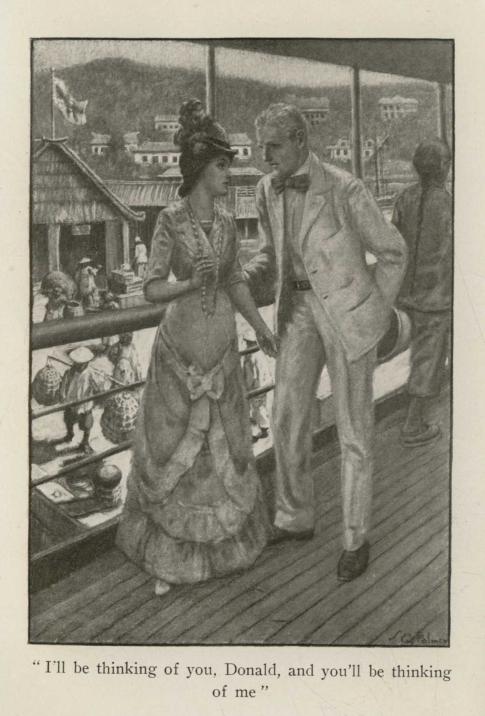
"I'll be thinking of you, Donald, and you'll be thinking of me"
His answer was,
"And I'll come to you, Jessie, though all the world try to keep us apart."
As the general farewells were said, Constance Beauchamp shook hands with Sinclair gravely, sedately; stood for an instant irresolute, and then with a movement as light as that of a fawn, sprang into his arms, clasped hers around his neck and kissed him again and again, before them all. She had another parting boon to bestow.
"I am going away where I can't see you, Dr. Sinclair. You may get your hair cut whenever you wish. But keep one of the curls for me."
And Miss MacAllister looking on, felt no jealous pang.
Amidst waving hats and handkerchiefs, the Hailoong swung out into the stream, and started on her voyage, with her strangely assorted freight of humanity, going to their various destinies. Among those surely none were more tragic than the destinies of a man, of a woman, and of their child. He was bound for an English earldom, and a seat in the House of Lords. She was to drift into a native brothel, frequented by the degraded of all nationalities, in the great cosmopolitan port of Hong-Kong. Their child was to grow up in the streets of that tropical city, a nameless, mongrel waif, never to know his father's face, till he should stand as his accuser before the judgment seat of God.
XXXIII
MY CHILDREN IN THE LORD
"Dr. MacKay, you are not well."
"I know that, Dr. Sinclair."
"You have a temperature, I'm sure. Have you taken it?"
"No."
"How's that? I thought that you were careful to watch your health. You told me that you could not afford to be sick."
"So I am, as a rule. But I could not take it this time till my wife left. She would not have gone if she had known."
"You should have gone yourself. The strain has been too much for you. Knowing the shape you are in, why didn't you take a trip to Hong-Kong, or at least to Amoy, and rest a while?"
"That would be to play the part of a hireling shepherd. 'He that is an hireling, and not the shepherd, whose own the sheep are not, seeth the wolf coming, and leaveth the sheep, and fleeth, and the wolf catcheth them and scattereth the sheep. The hireling fleeth because he is an hireling and careth not for the sheep.'"
Sinclair was silent while he counted the pulse, and awaited the report of the thermometer. When he looked at it, his face was grave.
"What is it?" asked MacKay. "You need not hesitate to tell me. Is it high?"
"Too high for a man to have and be walking about. One hundred and three and four-fifths."
"If it were malaria, I should not mind. I have worked for days on the East Coast with an average of one hundred and three. But this is not malaria. I cannot be deceived in it. I know malaria too well."
"Where is the trouble?"
"In my head."
"So I thought. We must get you to bed. I'll send a chit to Bergmann. He is your doctor."
That was the beginning of the fight for life. MacKay was battling with all the determination of his nature against cerebral meningitis. The battle was not very long, but it was exceedingly sharp. By his bedside all the time sat one or other of the three doctors. This stern, reserved, intensely concentrated man had won their respect and admiration, and no effort was spared to save his life. Native students, trained in the elements of nursing, glided noiselessly in and out of the room. Over at the college, where the native preachers, elders, and students assembled, a continuous prayer-meeting was in progress, these yellow and brown-skinned men who "ain't got no souls," praying with the simple faith of little children that their beloved pastor might be restored to health.
On the white bed in the middle of the room, beneath its drapery of mosquito curtains, MacKay's burning head turned ceaselessly from side to side, day and night, day and night without sleep. And day and night, day and night he talked, talked, talked, sometimes in English, sometimes in Chinese, talked without pause or cessation about his converts, the church which he had brought into being.
"My people! ... My people! ... My children in the Lord! ... Who will take care of them? My sheep! ... My poor sheep! ... Left without a shepherd! ... Who will feed them! ... My little lambs! My little lambs! ... Who will protect them from the wolves? ... O God! I commend them to Thee! ... My children! My children in the Lord!"
One day the raving suddenly ceased. Sinclair, startled by the unwonted silence, stepped to his bedside and threw back the curtains. MacKay was sitting bolt upright in bed. The fire of the fever was still in his face and eye. But his voice was perfectly natural, his manner calm and collected.
"Dr. Sinclair, what shall I do for my people? If I die, there is no one to take care of them. Mr. Thomson is not able now—perhaps never will be able. No person could come from Canada for a year, and when one would come, he would need another year or two for the language. Some of the native preachers are able, but none of them have authority to take the lead of their fellows. What shall I do?"
"Do not worry about that now," replied Sinclair soothingly. "There is the Good Shepherd still to lead His sheep. Leave it to Him. It is for you now to recover your strength."
"I am resolved what to do," MacKay went on, as if without noticing Sinclair's reply. "I shall ordain A Hoa and Tan He,[#] the two ablest of the preachers. That will give them authority to lead their brethren. That will make them pastors, shepherds of the sheep. It's irregular, I know. A presbytery should ordain. I'm not a presbytery. It's unusual. But unusual circumstances demand unusual methods. If I live, the church lawyers at home will crucify me for it. If I die, they'll condone my action, praise me in public, and scarify me in private. But neither their praise nor their blame can touch me then."
[#] Pronounced, Hay.
"The church lawyers be hanged, hanged in their own red tape!" exclaimed Sinclair savagely. "They have never seen anything but their own little parishes, and they think their tuppenny parochial rules can be applied to the whole world."
"I know, Dr. Sinclair, I know. What saith the Scripture? 'Where there is no vision the people perish.' But I am resolved that my people shall not perish.... Leng-a," he said in Chinese to the student nurse, "call A Hoa and Tan He to come here. Call all the other preachers, the students and elders to come at once."
In a few minutes the room was full of native Christians, while others stood in the hall on one side, or out on the verandah on the other. Briefly and impressively MacKay explained to them the need and his resolve, charged the two preachers to accept the holy office, asked them the prescribed questions, and then, when they had knelt beside his bed, he laid a hand upon the head of each and reverently, solemnly said in Chinese,
"In the name of the Lord Jesus Christ, the only King and Head of the Church, and by the authority He has given me when He committed to me the care of these His people, I invite you to take part of this ministry with me, and commit to your care these my children in the Lord."
Tears glistened on the faces of the natives. Sobs broke from many of them. But the sick man continued resolutely, now in English,
"Dr. Sinclair, I have written to the Foreign Mission Committee of our Church, asking them to appoint you a medical missionary in North Formosa. That is your desire?"
"It is."
"If they grant my request—I do not say that they will—but if they do, do you promise to stay with these people as long as you may find it possible so to do, to heal their souls as well as their bodies, and to give these native brethren your counsel, according as the Lord gives you wisdom?"
"I do."
"I am content."
With the benediction the Chinese softly withdrew. The sick man fell back exhausted on the pillows, soon to be tossing and raving in delirium again. But over in the little college building the native Christians, led by their two new-made pastors, bowed themselves continuously in prayer for the life which was more than any other life to them.
Was it in answer to those prayers that ice was unexpectedly brought into that port in that tropic clime? Who knows? So many things are veiled from our eyes! But certain it is that when the ice was heaped about his fevered head, MacKay fell into a sweet, childlike sleep, from which he did not awake for thirty-six hours. And when he awoke he was saved.
A few days later, under compulsion from the three doctors, he sailed on board the Fokien to join his family in Hong-Kong and rest. The day afterwards the French admiral declared a blockade, and Formosa was sealed against the world.
XXXIV
THE SOLDIER OF THE LEGION
For the five months from October till March Dr. Sinclair and Sergeant Gorman were with the Chinese forces before Keelung. For those five months rain fell almost continuously. Clouds drifted in from the sea, trailed through the valleys, and crept up the mountain sides, discharging their burdens of water as they went. The earth was sodden under foot. Walls and roofs sweated moisture. Tents and clothing mildewed. Food moulded and rotted in the constant wet. Scarcely ever a gleam of sunshine broke through the leaden canopy of cloud to cleanse the reeking earth and atmosphere. For one period of forty-five days the rain never ceased for an hour.
All through the wretched winter French transports arrived bringing reinforcements, and left again carrying sick and wounded men. All through the winter a succession of petty conflicts took place, a series of harassing, ineffectual actions was fought. A French column would issue from Keelung, plunge through roads which were nought but channels of liquid mud, struggle up dripping heights, through the tall grasses and ferns and brush, exposed to the fire of concealed sharp-shooters, and drive the enemy from the top at the point of the bayonet, only to find that their labour and the price of blood paid was all in vain. In some cases the small forces they were able to spare could not hold the heights against the rallying Chinese. In others immediately behind they discovered higher and more strongly fortified posts dominating those that they had captured.
All the while the French cemetery on the east side of the harbour, which they had named La Galissonière, was growing more and more populous at an alarming rate. Typhoid fever, malarial fever, cholera were far more dangerous than the bullets and knives of the Chinese. In spite of the numbers of sick and wounded men sent home to France, by the time the winter had passed into summer seven hundred of the small force employed had been laid away in the rain-soaked, wave-beaten beach at Keelung.
Meanwhile still heavier losses were suffered by the Chinese. The superior discipline and arms of the French more than compensated for their inferiority in numbers, and enabled them to work havoc in the close-set ranks of the Chinese. The little hospital at Loan-Loan was always filled with wounded. Sometimes they overflowed into the neighbouring houses requisitioned by the military authorities for the purpose.
Among these wounded men Sinclair and Gorman worked almost day and night. When a battle was in progress, one or other went out with the ambulance corps, gave the wounded first aid on the field, and forwarded them to the hospital for fuller treatment there. Under leaden skies and the incessant downpour of rain, with insufficient medicines and equipment, and subsisting on poor native food, they worked on week after week, month after month.
Perhaps what was hardest to bear was the fact that during all those months not a word reached them from the outside world. The blockade had effectually excluded all mails. Gorman heard nothing from his family in Amoy. Sinclair had never a line from Hong-Kong.
"Bedad," said Gorman one day, "this is a time when a man would be glad to be afther seein' the shape of a letter, even if it were only from his mother-in-law."
"Let me have a look at your tongue, and a feel of your pulse, Gorman!" exclaimed Sinclair, reaching for the sergeant's wrist. "I knew that you were in a bad way. But I had no idea that you were so far gone as that."
"Och, docther, but wudn't I show you the iligances of an Irish jig, if the ould lady wud only write to me that she was dead an' p'acefully departed. Then I cud go home to me wife an' childer."
It was a time when men were tested. Daily, hourly, Sinclair thought of the girl he loved, spending the winter in Hong-Kong, subject to the attentions and solicitations of the now titled Carteret, and the pressure brought to bear by her mother. His hands would clench and his jaws set hard. But he was sure that Jessie MacAllister would do her part. Over and over again her farewell words kept running through his mind, "I'll be thinking of you, Donald, and you'll be thinking of me."
The longest and dreariest months will always come to an end. When February had passed, the skies began to clear sometimes. The first week of March had some beautiful days.
With this came renewed activity on the part of the French. In a series of actions lasting five days, March 3d to 7th, they succeeded in capturing some of the strongest Chinese positions on the mountain-tops near Loan-Loan.
Sinclair had chosen for his field hospital and ambulance station a situation at the back of the post most strongly fortified by the Chinese. It was a mountain with a steep, almost perpendicular ascent, covered with grass and ferns and bamboos, on the side of the French attack. In this cover the Chinese irregulars were hidden. The crest of the hill was crowned by an interwoven fence of sharpened bamboos, a veritable chevaux-de-frise. Three other lines of entrenchments extended along the face of the hill, and had to be crossed by the assailants before the main position of the Chinese could be reached.
Behind the bamboo stockade, on the slope which led down towards the valley in which the river and the town lay, was a strong force of regular troops. Their right was commanded by the American, Silas Z. Leatherbottom; their left by a young Chinese officer, trained abroad. Gorman was with the right; Sinclair with the left.
It was the last day of the five. On an opposing hill which they had captured two days before, the French camp was plainly to be seen. Early in the morning the movement of troops began. A column moved off the open plateau and disappeared in the fog which hung in the valley, as if to attack the Chinese right. Before long heavy firing was heard in that direction, and Chinese troops were moved across from the left to strengthen the right under the American.
Unexpectedly rifle firing broke out under the curtain of mist in the valley directly in front. The French mountain guns on the opposite hill began to search the Chinese left. In an interval of the firing the order "Baïonnettcs au canon! En avant!" floated up to where Sinclair stood with some Chinese officers on the crest. The loud "Hourras!" of the French soldiers mingled with the shrill yells of the Chinese, and the crackling of rifles. The French were charging the first line of entrenchments with the bayonet.
It was taken, and they pressed their retreating foes on to the second. It too was captured, and in the same way the third. All the while their progress could be judged only by the sounds which came up through the canopy of fog.
Now the helmets of the Europeans began to appear through the veil of mist. They were at the foot of the last steep ascent, with its bamboo palisade at the top. The Chinese defenders poured on them a perfect hail of bullets. The ascent was so steep, the storm of lead so terrible, that even those seasoned troops shrank from it. The foremost, a company of the Bataillon d'Afrique, swung off to the left in search of an easier ascent and less deadly fire. Another company of the same regiment dashed straight at the steep hill-side. But the deadly fire of the Chinese mowed the foremost of them down. A company in a different uniform, which had been held in reserve, two hundred strong, was ordered to their support. On they came with a rush, cheering each other in a perfect babel of tongues. The "En avant" of their officers was echoed in almost every language of Europe. It was a company of the famous Légion Étrangère, the Foreign Legion.
Their polyglot cries mingled with the French of the Bataillon d'Afrique, as in regimental rivalry they struggled up that terrible ascent. Bamboo scaling ladders were placed, only to be thrown down. Men climbed them, only to be crushed by the rocks which the Chinese hurled upon them in savage hand-to-hand warfare. But the assailants did not draw back. French, Austrians, Germans, Italians, Corsicans, Poles, men of Alsace-Lorraine, exiles from every land of Europe, they struggled desperately up. They fought their way to the palisade, hewed gaps in it, and formed on top.
The Chinese irregulars, driven in on their regular troops, threw the latter into confusion. In spite of the gallant efforts is of their young commander, most of them broke and fled. Not so their leader. Rallying a hundred or so of his broken army, he led them in a bayonet charge against their foes. A volley decimated their ranks. When the smoke cleared away, the young officer was seen leading those who remained to the attack. Another volley rang out, leaving him only a handful of men. But once more the gallant Chinese gathered the little group around him, and dashed at the invaders. When the smoke of a third volley cleared away there were none left to charge. The brave young pioneer of the new China which is to be, had died on the field he was determined to hold.
The American general, Leatherbottom, realized when it was too late that the French had deceived him by a false attack on the right, while their real objective was the weakened left, commanded by the young Chinese. He explained to Sinclair afterwards,
"'Thet's whar these 'ar Europeans get the start on me. When it comes t' fightin', I kin fight. Don't yew make enny mistake about thet. But when it's a question of military evolyewtions an' tictacs, thet's whar they've got me beat by a mile."
And certain it was that when the Chinese left position was captured, and the right was forced to retreat, the French were kept from coming to close quarters by the deadly shooting of one rifle in the Chinese rearguard. And that rifle was in the hands of the general of the retreating force, the long, slab-sided Vermonter, Silas Z. Leatherbottom.
Meanwhile Dr. Sinclair, realizing that the day was lost to the Chinese, was forwarding the wounded with all possible speed, down into the valley towards a place of safety. As the Chinese left was broken, he had come down with a long line of stretchers, bearing wounded who had been picked up under fire.
As he descended to the level of the ravine which encircled the mountain, he saw within a hundred yards of him a squad of the Foreign Legion, hurrying along the ravine, either seeking an easier ascent to the field of battle, or making an attempt to cut off the Chinese retreat.
Suddenly out of a dense grove of bamboos on the hill-side spirted streams of flame and smoke. The stout, fair-complexioned sub-lieutenant who was leading them, threw up his arms, staggered, caught the trunk of a tree-fern which saved him from falling.
"Mein Gott im Himmel!" he screamed. "Je suis tué! En avant, mes camarades! Vorwärts!"
They were his last words. But they were typical of the character of the Legion.
A sergeant of almost gigantic size sprang forward.
"Vers la gauche!" he shouted. "Charges à la baïonnette! En avant!"
"Good for you, sergeant!" yelled an exile of Ireland fighting under a foreign flag. "Give the yellow divils a taste of the steel. Hurroosh!"
They dashed at the bamboos. But the withering fire cut them down. Not a man reached the ambuscade but the big sergeant. A bullet hit him. He fell; rose to his feet, and made a couple of paces forward. Another hit him on the leg. He raised himself on a foot and a knee. A heavy stone thrown at a few yards struck him on the head. He went down silent and motionless.
With wild screams the Chinese irregulars burst from their cover, brandishing long knives and racing with each other to be first to reach their victims. It was not merely their lust for blood which clamoured to be satisfied. Still more was it their lust for gain. There was a price set upon French heads.
Anticipating the result, and knowing what would follow, Sinclair dashed down the steep, grass-covered side of the ravine at the top of his speed.
"Wait a little!" he yelled in his imperfect Chinese. "Stop that!"
But the irregulars were Hakka tribesmen from the savage border, speaking a different language from that he was learning. They probably did not understand him. If they did, they were not to be baulked of their rewards by the orders of the foreign doctor.
Already the bloody knives were at work. Several were quarrelling over the body of the lieutenant, for there was a higher price for the head of an officer. Two or three had thrown themselves upon the sergeant. This was the nearest body to Sinclair. One of the knives was lifted. At a dozen paces Sinclair's big revolver spoke. The Chinese flung backwards down the slope, throwing his glittering knife high in the air.
That was a language they all could understand. For a moment they seemed disposed to resist. But the big foreign doctor was already among them, his revolver barking with the rapidity of a machine gun, and at every spirt of flame a man went down. Behind him came a number of well-armed regulars, who had been detailed to convoy the ambulances. The irregulars broke and fled. But they carried away with them the head of every man of that little squad save the sergeant.
The broken leg with its great gaping wound was hastily bandaged and supported by splints. The torn shoulder and the cut head had the blood staunched. Then the unconscious man was placed on a stretcher and borne to camp to be cared for in the same hospital as the Chinese wounded.
As the line of stretchers moved down the ravine, the tri-colour could be seen floating over the crest of the mountain where the battle had been fought, and the French bugles could be heard sounding "au drapeau."
XXXV
THE LANGUAGE OF PARADISE
The war was practically over. The Chinese could not dislodge the French from Keelung. The French could not advance any farther into the country.
What had they gained for all their expenditure of blood and effort? They had not been able to make themselves masters of a single foot of ground at Tamsui. At Keelung they held the ruined town and the harbour, and some outposts two miles from where their warships lay. Beyond the range of their naval guns they could not go. For such barren results, all of which in three months' time they were to relinquish again, they had sacrificed fully one thousand lives of French soldiers and sailors, had disabled hundreds more through wounds and disease, and had killed an unknown number of Chinese, none of whom knew what the war was about.
It dragged on for another month and a half before the blockade was raised and hostilities ceased. Six weeks elapsed after that before Keelung was evacuated, and the French squadron and transports sailed away, leaving their silent city of the dead, their tale of killed and wounded and missing.
Through the month of March and half of April, Sinclair laboured on among the wounded of the Chinese army. He was their Life-Healer. By one of the strange ironies of life two of those Hakka tribesmen who had gone down before his revolver on the seventh of March, were brought to him for treatment, and he healed them. They looked with wonder, not unmixed with fear, at the big fair-haired foreigner, who had been so ferocious a day or two before. Now his touch was as gentle as it before had been terrible, and in his very word was healing. They did not understand. It was a part of the foreign devil's madness. It was a part of his magic.
But there was one over whom Sinclair spent more time than over any other. It was the big sergeant of the Foreign Legion. He was desperately wounded, and for a long time lay silently unconscious. From that stage he passed into one of delirium. Then he raved, sometimes in French, sometimes in German, sometimes in English, sometimes in a jumble of languages like the Babel of tongues in the famous corps to which he belonged. But there was one language which he used more than all the others, and when he used it, his voice was soft and his accents tender, like those of a child talking to his mother, or of a lover to his beloved. That language Sinclair did not understand.
Day after day, night after night, he sat by the wounded man's bed in the tent where he and Gorman had their quarters. Every moment he could get off duty among the Chinese he was at his post. There was something about this French sergeant which attracted him strangely. He was big and dark, with jet black hair and large, dark eyes. When he was wounded his face, save where it was covered by thick, black, stubbly whiskers, was tanned to a dark brown. But as the days and weeks of illness passed by, the sunburn faded from his face, and left his skin clear, almost to transparency. Then Gorman shaved him, "to make the poor craythur a little more comfortable loike." The fineness of the features at once struck Sinclair. Was it only fancy, or was it a fact that he had somewhere seen some one who resembled this man? He racked his brain to recall who it was, or where he had seen that expression and form of face.
"I can't think. But I know that I have seen that face or its counterpart somewhere."
The big dark eyes of the patient opened, and began to wander over every object in the tent. Then the wounded man began to talk. It was in the language Sinclair did not understand.
"I wonder would Gorman know anything of that," he said to himself. "He has a little bit of each of a score of tongues."
A native boy ran for the sergeant. He came quickly. The wounded soldier was silent when he entered, and Sinclair was afraid that he would not speak again. Presently his eyes began to rove around. Then he spoke in a low, soft voice, words of the unknown tongue. For a few moments Gorman stood silent with a puzzled look on his face, as if unable to get the sense of what was being said. Then with a sudden start he lifted his hands above his head.
"Be all the saints in glory, docther, do you not know that? It's what you'll have to speak whin you get to hiven. It's Gaelic. Not Irish, but Scotch! The man's a Highlander.... He's jist a bit of a gossoon ag'in, wid his mother croonin' over him and puttin' him to sleep, an' him not wantin' to go. Och, the poor bhoy! The poor bhoy! An' the divils had nearly cut off his head!"
Sinclair sprang to his feet, his face as pale as death, his whole frame trembling with excitement.
"Gorman," he said, with the slow emphasis of absolute conviction, "it's Miss MacAllister's brother."
"Be the love of God, docther, I believe that you are right."
"I know that I'm right, Gorman. It's Allister MacAllister. I was trying to place his resemblance to some one I knew. Now I know what that resemblance is. It is neither to Miss MacAllister nor her mother. It is something between the two. He has his mother's colour of hair and eyes, and form of face, with his sister's expression."
"Right you are, docther. An', docther, he mustn't die."
"He must live, if human power can save him, and God's mercy will spare him," was the solemn reply.
Half-an-hour later a speedy runner left for Tamsui, bearing a letter to Drs. Bergmann and Black, with an account of the case of the wounded Frenchman, a request for needed medicines, and the hope that one of them might be able to come over to the camp before Keelung for a consultation.
They both came. They held a consultation, spoke many kind words of what Sinclair had accomplished, and returned to Tamsui to tell of the most wonderful work they had ever seen accomplished by one doctor against such obstacles.
The day after they left, Sinclair sat by his patient in the tent by the river side. The spring sun was shining gloriously, drawing up the moisture from the saturated earth. The rippling of the river, the scent of the flowers, the song of the birds floated into the tent where the sick man lay. Sinclair had been looking out on the flowing water. Something drew his gaze towards the patient's cot. The large dark eyes were fixed on him, no longer wandering and restless, but intelligent, full of questioning and wonder.
"Where am I?" he asked in French.
"With friends," was the reply in the same language.
"How did I get here?"
"You were wounded, sergeant."
The last word seemed to help his memory.
"I remember. We had taken the fort on the Table, and were trying to capture Fort Bamboo, on the South Mountain."
"Yes, that's it."