THE CALL OF THE EAST (continued 2)
Reading edition
"'Pon my soul, it's awfully good of you to ask me! I do not profess to be a singer. Really! I do not.... But, since you have been so good as to ask me, I shall do my best, on one condition, that Mrs. Beauchamp will honour me by playing my accompaniment.... Mrs. Beauchamp, will you be so kind?" Another bow meant to be profound.
"Certainly, Mr. De Vaux, with pleasure."
In a voice which had once been a sweet tenor, but was now fat and breathless, he sang, "Silver Threads Among the Gold." He had to take a breath in the middle of every long note. As for the high ones, he just touched them. Then his breath failed him, leaving the audience to imagine the rest. But when he was rewarded with a round of applause he responded with an encore, "In the Gloaming." His head was becoming crimson with the effort. Perspiration streamed down his face and neck, in spite of the constant use of his handkerchief. His collar had melted and fallen limply against his coat. The starch of his shirt front had disappeared, leaving it but a crumpled rag.
Some of the guests were insisting on a third number, when the consul came to the rescue:
"This sort of thing mustn't go any further. If my wife and De Vaux continue singing such sentimental songs, they'll have us all homesick. We cannot afford to ship all the English residents of North Formosa by the Hailoong to-morrow. Just to change the current of your thoughts, I'll make a break and give you something different."
He took his place at the piano, and to his own accompaniment sang with great spirit, in a strong baritone voice, the old English song, "A Hunting We Will Go."
The applause was as enthusiastic as the spirit in which he had sung, and he was pressed for an encore. The consul replied with mock stage bows, but refused to sing again. He had done his part in chasing away the blue devils of homesickness. Now it was some other body's turn to perform. He knew Miss MacAllister could sing. Would she not continue the good work and give them something rousing?
Miss MacAllister did not wait to be urged, but responded at once. Her voice was a rich, strong soprano. With a verve and fire worthy of her choice, she sang Lady Nairn's stirring war-song, "The Hundred Pipers." To the insistent demand for another song she replied with "The March of the Cameron Men." With her stately figure at its full height, head thrown back, and eyes which seemed to look away beyond her tropic surroundings to the hills of old Scotland, she sang as if possessed by the spirit of generations of Highland ancestors.
Sinclair, from his place over by the mantel-piece, was looking at her with undisguised admiration.
"Isn't she magnificent? Yon's a prize for some man! ... Sinclair, man, why don't you go in and win? If you don't try, I'll be ashamed of you, whatever."
It was McLeod. He was speaking in a low tone, only for his friend's ear. But he who had been the personification of coolness during the typhoon was now fairly quivering with excitement. The songs of his people had fired his blood.
"You needn't be ashamed of me, Mac. I'm going to try."
"Good for you! I'll back you to win."
"Don't stake too much on me, Mac. I'm new to this game. You might lose heavily. Carteret is ahead of me."
"That dirty snob!" exclaimed McLeod in a tone of disgust. "He wants her in just the same way as he wants every pretty woman he sees. And then her money would help to repair the Carteret fortunes. It's an insult to a good woman to mention him in relation to her."
"All the same she and her family are not supposed to know the things that you know against him, whatever they may be. He belongs to a titled family. That counts for a lot with most people who have risen from the ranks. Her mother is greatly taken with him."
"Yes, but the daughter is not."
"I'm not so sure about that."
"I'd stake my life on it. But look, Carteret is going to sing."
It was evident that Carteret had expected to sing, for he had just returned from the cloak-room with a roll of music in his hand. He placed it on the piano, and then turning to Miss MacAllister he conducted her to the instrument with almost an excess of courtesy. Yet his manners were easy and graceful. If at times he seemed to exceed the requirements of etiquette, his ultra politeness accorded well with his Gallic cast of countenance and the cut of beard which he affected.
His voice was a tenor, not very strong, but pure in tone and evidently well-trained. The first selection was "Drink to Me Only with Thine Eyes." It was sung with feeling. The strength of his voice accorded well with the size of the drawing-room, and passion was thrown into the tender lines. As an encore he sang another love song, still more amorous in sentiment and manner.
"His musical talent is Carteret's hope of promotion if he remains in the customs," said Boville, who was one of a little group of guests near to where Sinclair stood. "He thinks that, if he could get the opportunity to sing before the I.G., he would be promoted to Pekin at once."
"Or better still, if he should succeed in marrying a handsome wife who is musical," said a merchant. "I am told that the I.G. is even more considerate of a subordinate with an accomplished wife than one who possesses the accomplishments himself."
"He has the voice already, and now he seems to be making a bold stroke for the gifted wife," interjected another.
"I shouldn't wish Miss MacAllister any ill," replied Boville. "But I do hope something will happen to take him off my hands. If the I.G. wants him, he will be most welcome to the fellow, so long as I am well quit of him."
Sinclair took no part in the conversation. But he heard every word. The careless references to Miss MacAllister hurt him in a way which surprised himself. The callousness of the suggestion that Carteret should get promotion by marrying her cut him to the quick. How could any one entertain such an idea?
Then he wondered at himself. What was Miss MacAllister to him? A passing stranger, who had taken it into her whimsical head to amuse herself at his expense. Already she had succeeded in making him feel most uncomfortable; indeed, for a time something of a laughing-stock. What need he care? She was nothing to him, and he was nothing to her but the subject of an evening's laughter. What a fool he had been to accept McLeod's challenge! He would have to straighten that out in the morning. Then they both would have shaken off the glamour of that face and figure, and those martial Highland songs which had so stirred their blood. They would be in their cool senses then. They had not been when the one had made and the other had accepted the challenge.
Meanwhile Miss MacAllister and Carteret were still at the piano. She was slowly turning over some music. He was bending low as if to see it, and perhaps to choose another song. All the while he was speaking to her in a soft voice, and she was making monosyllabic replies. She realized that his head was sinking lower and his face closer to hers. She felt his hot breath on her face and neck and shoulder. It was hot and heavy with wine.
She turned her head slightly but quickly towards him. She saw his eyes fixed greedily on the rich beauties of form only half concealed by her low evening dress. Her face flamed crimson, and she rose hastily from the piano, disregarding his appeal that she should play just one more selection.
As she passed from the instrument to a chair she heard the consul say:
"Sinclair, you're the most confoundedly comfortable-looking duffer I ever saw in a dress suit."
"That's because the tailor who made my suit put side pockets in the trousers," was the reply. "You would be just as comfortable if you had pockets to put your hands in. I have noticed you trying to get them into the seams half a dozen times this evening."
"You're right there. But it's not my fault. I laid it on that tailor in Hong-Kong as a parting injunction to put pockets in my trousers. And he promised. When the suit arrived they had none, and I was five hundred miles too far away to get my hands on him and wring the beast's neck."
"Fortunate for the beast!"
"Yes. But he'll get his punishment yet, that tailor will. He has a lot to answer for. I have sworn outwardly often, and inwardly more times than could be numbered, whenever I have had these clothes on. I envy you. You do look comfortable in that suit. It fits you as if you had been born in it, and with your hands in the trousers' pockets."
Miss MacAllister, looking at Sinclair from the seat she had taken near the French window, agreed with the consul's judgment. The big Canadian was in conventional evening dress, except for one slight concession made to the heat of the climate. Instead of the low-cut vest he wore a broad kamarband of black silk about his waist. The only trace of jewellery was the gold locket on the end of a black leather watch guard, which hung over the kamarband. There was a total absence of dressiness. But as the girl who had been for years familiar with London drawing-rooms looked at the strong, clean-cut features, the massive head with its fair hair contrasting with the black clothing, the lazy grace of the powerful frame leaning against the mantel-piece, she thought to herself that she had never seen a man who had on him more of the marks of being to the manner born. Yet he was the self-confessed son of a Canadian farmer, and reared on a Canadian farm. She found it hard to remain offended with this big, good-looking, good-tempered man.
Involuntarily she compared him again with Carteret, the son of a noble English family. The latter was now talking to Mrs. Beauchamp. She could see that his ordinarily somewhat pallid face was flushed and there was an expression in his eyes which was not pleasant to see. She thought again of that greedy look and of the hot breath, heavy with wine. She turned her eyes once more towards Sinclair. He was talking to the consul and smiling. The distinction between the two young men took shape in her mind. Sinclair was clean and his smile was frank and pure as that of a child.
She heard the consul saying to him:
"McLeod tells me that you sing."
"McLeod tells a lot of things he knows very little about. I shall have to lay an injunction upon him to hold his peace."
"That's all right for some other time. But for the present you do not deny the charge that you do sing."
"I'll plead guilty to disturbing my neighbours sometimes by singing college songs and such things. But I have none of them here and no music for the accompanist."
"Just what we want; something lively. If there's a chorus, we'll all join in. Give me an idea how it goes and I can chord for you."
Beauchamp ran his fingers over the keys while Sinclair hummed or lilted the tune. Soon the proper chord was struck. Sinclair repeated the words of the chorus till all got them. Then he sang a rollicking college song. When he reached the chorus all joined in, and for the first time the walls of the old Dutch fort and the listening palms and oleanders and magnolias heard the jolly abandon of "The Old Ontario Strand."
When the chorus was reached the second time, Sinclair relinquished the leadership of the air to Miss MacAllister. She took it as if by prearrangement, while he dropped into his rightful place and supplied the undertone of a bass powerful enough to balance the voices of all the rest of the company.
When it was finished there was an outbreak of applause and even cheers, which showed that all reserve had disappeared and the company were prepared to give themselves up with childish delight to singing. Another college song was sung with the same spirit as the first, and Sinclair was pressed to lead still another.
"I will," he said at last, "if you will allow me to choose one as characteristic of our French Canadian people as those we were favoured with by Miss MacAllister are of the Highland Scotch."
In response to the general consent he sang some verses of—
"En roulant ma boule roulant,
En roulant ma boule,"
and a number of the company joined in the simple refrain. The song which had so often echoed on lake and stream, by the evening campfire, where the paddle dipped, or in the frosty stillness of the snow-laden forests of the north rang out through the scented darkness of the warm tropic night.
A number of other songs were rendered by different members of the party. Then Sinclair was called for again.
"I am afraid that my repertoire has come very near the point of being exhausted," he said. "I have only those songs the words of which I can remember, and the selection is not very choice."
This time it was a plaintive negro melody of the Sunny South. Again Miss MacAllister found herself singing heartily with the rest in the refrain, and after the first verse leading the chorus while Sinclair sang bass. When the song was done she suddenly said to herself:
"What a silly I am making of myself! I came in here determined to get even with that doctor. And here I am singing with him and for him like a sissy in a Sunday-school concert. He can do his own singing from now on. I'll pay him back yet."
The rest were urging Sinclair to sing again, when Miss MacAllister said:
"Dr. Sinclair has shown wonderful versatility in his choice of songs this evening. English, French, negro, he sings them all with equal facility. I wonder if he would not favour us with a Canadian Indian song. I have never heard any of their music. I should so love to have the opportunity. Will you not sing us one, Dr. Sinclair?"
Her face wore an expression of childlike innocence and interest. But McLeod thought he saw a mischievous gleam in her eyes. Mr. MacAllister looked at his daughter with a puzzled face and shook his head a little. The consul eyed her doubtfully, as though trying to fathom the purpose behind this request. He saw nothing but the appearance of almost infantile guilelessness. Then he heard Sinclair saying:
"Certainly, Miss MacAllister. I am happy to do anything in my power to serve you. Only it is a little hard on Mr. Beauchamp to ask him even to chord to a type of music he may never have heard before."
"Thank you so much, Dr. Sinclair. I am all anxiety to hear you."
Then she added:
"I am sure Mr. Beauchamp will be able to accompany you. He is a man of infinite resource in music." For she was afraid that Sinclair's concern about placing the consul in a difficult position was only an attempt to provide a loop-hole for his own escape.
A buzz of conversation broke out in the room while Sinclair bent over the instrument, softly humming a slow, stately measure, and the consul's fingers felt for the harmonious chords. Soon the voice and the chords were moving together in harmony.
"That may be an Indian tune," said Beauchamp, "but it sounds remarkably like certain bars from an old sixteenth-century mass I had to practise when a boy until my fingers were nearly worn out."
"Perhaps the Indians learned it from the early Roman Catholic missionaries," was the quick reply. "In any case, I fancy it is the sound of the language Miss MacAllister wishes to hear rather than the music."
"If you like, I shall play the tune for you. I remember it perfectly."
"Thank you, I prefer the chords."
Sinclair straightened himself, and the buzz of conversation instantly ceased. Then his voice rolled forth to the slow, solemn air, words as melodious as the notes of the music. At their first sound the consul's head ducked below the level of the piano, which hid him from most in the room. Sinclair gave him a vicious dig in the ribs, but sang on without the quiver of an eyelid. The full vowel sounds of the unknown language brought out to perfection the tones of his rich bass voice.
His eyes glanced around the room. All were listening intently, and all, save Commander Gardenier, had their eyes on him. He thought that he could detect a grim smile on the naval officer's averted face. Miss MacAllister had a keen look—was it a suspicious look?—in her eyes.
Under cover of the applause which followed the consul turned on him:
"You have the nerve to pass a chorus from a Greek tragedy on a company like this for a Red Indian war-song."
"I plead guilty," replied Sinclair. "But I had to do something or be again held up to ridicule as I was at dinner. I thought that you were the only one likely to recognize it and I knew that you would not betray me."
"I acknowledge that you had to do something. For some reason Miss MacAllister seems bound to make game of you. She deserves what you have given her, and I'll not give you away. But it was nervy just the same." And the consul laughed indulgently as he turned away.
Miss MacAllister did not join in the general applause. But when it was done she said gravely:
"Thank you, Dr. Sinclair, for gratifying my whim to hear a song in the Indian language. I had no idea that it would be so beautiful. Thank you very much."
Sinclair's face flushed as he replied:
"I am only too glad to have been able to do anything which has pleased you." At the same moment he felt a pang of remorse for the deception.
He had not long to think of it when he heard Mrs. MacAllister saying to Commander Gardenier:
"What a barbarous jargon to be called a language!"
"Yes," replied the officer drily, "but I have heard a good many others more barbarous."
Then Thomson, the missionary, remarked in his slow way:
"It—some—way—seems—to—me—that—I—have —heard—some—thing—like—that—before."
Sinclair had to act quickly:
"You were a missionary once among the Indians of Bruce Peninsula, were you not?"
"Yes—I—was."
"You probably heard it there."
"Well—perhaps—I—did."
Some of the guests rose to depart, and their hostess rose with them. Before they had time to begin to say farewell, Carteret said loudly enough to be heard by all in the room:
"Mrs. Beauchamp, before we go, may we not hear Mr. De Vaux sing again? I know that we should all be delighted to hear him."
"I am afraid that we are imposing on Mr. De Vaux," replied the hostess, who realized the condition De Vaux ordinarily reached by that hour after a dinner. "I think that he is tired. He has done his part so well this evening that it seems unfair to ask him for any more."
"I am sure, Mrs. Beauchamp, that Mr. De Vaux will not feel it a hardship to sing again. He is our foremost vocalist in Formosa. We want him to uphold the honour of the local talent. Mr. De Vaux, will you not sing for us 'Rocked in the Cradle of the Deep'?"
"Lord! ... Mr. Carteret—ladies and gentlemen—how good of you to ask me! ... By——! ... Bless my soul, I mean! ... It is good of you.... I'm afraid.... I'm not in very good voice. But since you insist—I'll try.... By——! ... I mean 'pon my honour, I shall!"
"Shall I play your accompaniment, De Vaux?" said the consul, in response to an appealing look from his wife.
"How good of you, Beauchamp! ... By——! ... 'Pon my soul, I mean—it is!"
Purple-faced, perspiring, steadying himself by the piano, The Honourable Lionel Percival Dudley De Vaux sang, in a series of high-toned asthmatic gasps, "Rocked in the Cradle of the Deep."
Then the guests said their farewells and, preceded by natives carrying lanterns, they began to move off into the warm aromatic darkness of the southern night.
VIII
SINCLAIR'S OPPORTUNITY
Sinclair and McLeod were awaiting their opportunity to say good-night when one of the consul's Chinese servants hastily entered and handed his master a letter:
"One boy b'long Kai Bok-su come Keelung side, one piecee chit new sick-boy-man can catchee."
"All right, boy," replied the consul. "Dr. Sinclair, here's a letter for you from Dr. MacKay."
The doctor cut the letter open and read:
"CHINESE CAMP, LOAN-LOAN, NEAR KEELUNG,
"Aug. 5th, 1884.
"DEAR DR. SINCLAIR:
"As you are aware, a battle is raging. A number of the Chinese have been killed. Many more are wounded. The end is not yet. They have no doctors but native fakirs. They have no medicines, no instruments, no knowledge of surgery. There is dreadful suffering. Will you help? Never a better opportunity to serve humanity and win the Chinese.
"The consul will give you passports. The bearer of this will guide you. A Hoa will come with you as far as Taipeh and secure a permit from the governor. Mrs. MacKay and Dr. Bergmann will give you a free hand with the Mission's stock of medicines, and will help you to pack them. Will you come?
"Yours,
"G. L. MACKAY."
Without a word Sinclair handed the open letter to the consul, who had now bidden farewell to the rest of the guests. He read it quickly and looked up:
"You are going?"
"Yes."
"When?"
"First launch in the morning."
"Good! I'll have your papers ready."
"Thank you, Mr. Beauchamp. Good-night."
"I'll send the constable over to MacKay's with the papers. Take care of yourself. Good-night, doctor. Good-night, McLeod."
* * * * *
The first faint rose of dawn was showing in the sky behind the great bulk of the Taitoon Mountains when Sinclair stepped out on the broad verandah of the missionary's bungalow, ready for his journey. The Chinese student who was to guide him was already there. A coolie bearing two round baskets containing the medicines, instruments, and other necessaries, balanced on the end of his long bamboo carrying pole, came round the corner of the house.
The iron gate at the foot of the garden clicked sharply. A vigorous step sounded on the gravelled walk. An erect, soldierly figure stepped out of the darkness into the light streaming from the doorway, rapped his heels together, saluted, and handed Dr. Sinclair a packet of letters.
"Good-morning, Sergeant Gorman. You're sharp on time."
"No credit to me, sir! It's the consul, sir! The divil himself wud have to get up in the morning before he went to bed at night to catch the consul late."
There was no mistaking Sergeant Gorman's native land. Sinclair laughed as he said:
"I suppose these are my passports."
"Right you are, sir! But wud you moind lookin' at the last one furst, for, widout army conceit in meself, it's the most important of thim all."
Sinclair opened it and read:
"H. B. M. CONSULATE, TAMSUI, Aug. 6th, 1884.
"DEAR DR. SINCLAIR:
"I am presuming on your good nature to make a request of you. Will you accept of Sergeant Gorman's assistance in your volunteer Red Cross Service? Ever since the cannon fire began yesterday morning, he has been aching to get into the field of action. Your going is an opportunity. He will not be an encumbrance. He has been at various times surgeon's assistant and hospital sergeant. He speaks pidgin, and knows quite a bit of vernacular. Commander Gardenier will spare me a man to take his place. Feeling sure that you will grant my request as soon as you read it, I have enclosed his passports with yours.
"Wishing you a safe and speedy return, I am,
"Your obedient servant, "H. R. L. BEAUCHAMP."
Sinclair read between the lines. It was not merely the desire to gratify Sergeant Gorman's passion to be in any fighting which might be handy which had actuated the consul. It was solicitude for himself. He was a stranger in the island. He did not know the language. He had never been nearer war than the annual camp of a brigade of Canadian militia. This resourceful Irishman, with more than twenty years of varied service, mostly in the Orient and among Oriental peoples, would simply be invaluable to him. The consul had been up all night arranging for his convenience and safety. More to himself than to any one else he exclaimed:
"Beauchamp's a trump!"
"An' the right bower at that!" interjected Gorman.
Sinclair dashed into MacKay's study, scribbled off a hasty note of thanks, and was out again before the sergeant had finished congratulating himself on his good fortune.
"We must be off. There goes the launch's whistle," said Sinclair, as he swung off with his long, powerful strides, which put Gorman to his best gait and made the natives drop into their peculiar little jogging trot.
Although the day had scarcely broken when they left the house, and it was but a few hundred yards down the steep hill to the beach, the impatient sun of the South had already sprung into the heavens when they reached the little jetty at which the launch lay. A Hoa, the chief Chinese assistant of Dr. MacKay, and McLeod were already there.
"Hallo, Mac!" exclaimed the doctor. "I thought you would be sleeping yet. It's more than decent of you to turn out so early to see me off."
"I am going with you as far as Twatutia," replied McLeod. "The Chinese are so excited over this war that they have not forwarded part of our cargo. I am going up to see what persuasives I can apply to the compradore. We have to sail by this afternoon's tide and want to take a full cargo. We may not get another chance for a while."
"I certainly am in luck this morning," said Sinclair. "You to keep me company as far as Twatutia; A Hoa to get my passports viséd, and Sergeant Gorman to act as my bodyguard and be generally responsible for my safety and good conduct."
By this time the two friends and the Chinese preacher had found for themselves as comfortable positions as possible under the awning which covered the decks of the little launch and sheltered them from the rays of the sun.
The launch was threading its way through a fleet of junks which were hasting to get out to sea with the ebbing tide. Some had already hoisted their huge, brown, bat-wing sails and turned their watchful eyes towards the open sea. Some were just lifting their anchors, while priests from the neighbouring temple rowed around them in boats with beating drums and droning pipes, to frighten away the demons, propitiate the goddess of the sea, secure for the sailors a prosperous voyage, undisturbed by the French, and incidentally to get for themselves and their temple a substantial contribution. Some had not yet finished taking cargo, and their crews were working with feverish haste to get loaded in time not to miss the last of the ebb. From them all came the ceaseless shrill, nasal shouting of the Chinese seamen as they pulled at the ropes, or heaved up the anchor or hauled away at the tackle hoisting their cargo on board.
It was all intensely interesting to Sinclair, who never wearied of studying human life, especially when it presented types and phases which were new and strange to him. But he was not so much interested in the Chinese as to fail to notice the large house, with its cool-looking upper and lower verandahs, looking out on the river, in which the MacAllisters were quartered. He wondered if the maiden who had teased him so were awake and plotting some new mischief to make him or some one else uncomfortable. Or was she sleeping as peacefully as if she had never done a naughty deed in all her bright young life? It was with a start, as if a guilty secret had been discovered, that he heard McLeod's voice saying:
"I suppose your Highland girl is having her beauty sleep. I never saw any one who to my mind needed it less."
Sinclair was annoyed that McLeod so often seemed to read his thoughts. It was a little tartly that he replied:
"Are you still harping at that? If I were a suitor for that young lady's hand, I should have to look upon you as a rival, you seem so smitten with her."
"Not the slightest danger, Doc. The fact that a fellow admires a girl's looks or style doesn't necessarily mean that he has fallen in love with her. Oh, no! I have my own dreams of a trip I hope to make next year to Prince Edward Island, and if I come back to the China Coast I'll not come back alone. That's good enough for me. I admire Miss MacAllister. I think she's splendid. But falling in love with her! Not the slightest notion! Any interest I have in her is on your account."
"I'm sorry, Mac. I shouldn't have said what I did. I knew that you were as true as steel."
"It's all right, doctor. I've been jollying you too much. And the way she acts sometimes makes it a little hard to bear. But you'll win out in the end."
"I do not know about that," said Sinclair, somewhat gloomily. "The way she treated me last night did not look much like it."
"Never mind that. She would not treat you like that if she were not taking more interest in you than in any one else at present. She doesn't know just what is the matter with herself. That is the way she is taking to work it off. She'll change after a bit."
"I'll yield to your superior knowledge of the ways of women," said the doctor, with a laugh which had but little mirth in it. "It may be all right. Just the same, it doesn't look good to me.... Here comes Sergeant Gorman. I had better see my passports, and get him to instruct A Hoa what is to be done when we get to Taipeh."
Opening the packet, he found copies of passports in English, French, and Chinese. One addressed to the French Commander read:
"HER BRITANNIC MAJESTY'S CONSULATE,
"TAMSUI, August 6th, 1884.
"To the Officer in Chief Command of the French Forces at Keelung:
"The bearer of this paper, Doctor Donald Sinclair, a British subject, has volunteered his services as a medical doctor to the sick and wounded of the Chinese army, at present engaged before Keelung. He will observe strict neutrality, and will be equally ready to perform humane offices and render skilled medical and surgical assistance to any of the French troops, should circumstances bring that within his power. Wherefore I, the undersigned consul for Great Britain at Tamsui, do beg the Officer in Command of the French Forces at Keelung, to accord to the said Doctor Donald Sinclair protection and liberty to perform his offices of mercy, in accordance with the terms of the Geneva Convention. He will be accompanied by one European assistant, likewise a British subject, Sergeant John Gorman, and by one or more Chinese assistants, all wearing the badge of the Red Cross.
"H. R. L. BEAUCHAMP, "Her Britannic Majesty's Consul."
Passports of a similar tenor were addressed to the Chinese authorities.
"Sergeant Gorman, you know Chinese. Tell A Hoa what we want him to do when we get to Taipeh. He is to get these viséd and, if possible, to get a special permit from the governor. It will carry more weight than the passports."
"Very good, sir! I'll make him understand."
Sergeant Gorman's mastery of the language was not perfect. But the Chinese preacher required little instruction. He knew better than either Sinclair or the sergeant what should be done. Before becoming a Christian he had been private secretary to a mandarin in an official position at Pekin. He had travelled much on the mainland as well as in Formosa, and was well acquainted with official procedure both in peace and in war. Scarcely had Sergeant Gorman begun his explanations when his "Ho! ... Ho! ... An-ni ho! ... Put-tsi ho!" (Good! good! That's good! Very good!) showed that he fully understood what was expected of him.
IX
A QUIET LIFE
Meanwhile McLeod and Sinclair were studying the sergeant. He was a man of perhaps forty-five years, but could pass for much younger. Five feet eight or nine inches in height, he was broad-shouldered and sturdily built. No matter where he might be or how dressed, there could be no mistaking that he had been a soldier. Long military training spoke in every movement. His thick hair was a red-brown, with the emphasis on the red. So was his heavy, fierce-looking moustache. So were his bristling eyebrows. So were his eyes. His face, save where it was ordinarily covered by the band of his sun-helmet, was pretty nearly the same shade.
He talked rapidly; very rapidly; so rapidly that his words often stumbled over one another in their eagerness to get out, until he actually stuttered. When he tried, he spoke English with just enough Irish accent to make it sweet on his tongue. But when he didn't try, and that was most of the time, the brogue was rich and thick. Nearly always he had the peculiarly Irish trick of repeating the last words of a closing sentence.
"How long has Gorman been here?" asked Sinclair in a low tone.
"Only a couple of months," replied McLeod. "Came over with us from Amoy."
"How does it come that a sergeant with his record of service should end up by being consulate constable in an out-of-the-way corner like Tamsui?"
"Search me! I can't tell you."
"Probably the old story of a man who has served his Queen and country well and then been dropped, to live or die wherever he may chance to fall."
"Yes, and none of the blockheads who have commanded him have sense enough to know how much good service they could get out of a man like that, if they would only give him a chance to rise. Instead they turn him adrift like a worn-out horse."
"Perhaps he has a history behind him. It seems to me that most men out here, except you and I, Mac, have histories. Here he comes. Perhaps he will talk."
The sergeant crossed the little deck, stood at attention, and saluted:
"I have the honour to report, sir, that I have given the Chinese, A Hoa, the instructions you commanded and that he seems to understand them very well, sir."
"Very good, sergeant. There is nothing further to be done until we reach Twatutia. Be seated."
"Thank you, sir."
"By the way, sergeant, I notice by the passport that your name is John Gorman."
"It is, sir."
"I used to know a Sergeant John Gorman on the police force in Kingston, Canada. They say that, when the college boys were out on a frolic and raising cain, he could do more to keep them within bounds with a smile and a bit of blarney than all the rest of the force could do with their batons."
"Och, but he'll be from Sleeahtballymackcurraghalicky, in County Cork. All the people there are Gormans, an' most of thim are John Gormans. An' as for the shmile, all the Gormans have it. They get it whin they're childer, sayin' the name of their native place. An' whin they grow up, no matther where they go, the shmile wan't come off—the divil a bit will it come off."
"You're right there, sergeant," said McLeod. "You have the smile, sure enough. But it never shows to best advantage until you say the name of the place where you were born. What's this it is, again?"
"Sleeahtballymackcurraghalicky."
"Exactly! That's a name to make any one smile."
"Och, Misther McLeod, but you shud have seen it on me whin I furst left the ould place. Me face was all shmile. But on the Afghan border wan day, an ould black-face of a Pathan—may the divil fly away wid him!—tuk a pot shot at me from betune two rocks. He got me through the two cheeks of me, an' siv'ral of me teeth. After the wounds healed up I never had me natural shmile ag'in,—wud you bel'ave me I niver was able to shmile natural ag'in."
"Did you get back at him at all?" inquired McLeod.
"That's jist what was hurtin' me. For while I was spittin' out me teeth, an' in no condishun to take aim, the onderhanded, tricherous Afghan was dodgin' away through the rocks. But me next in file in the Munsters, he was a Scotchman from Aberdeen got a squint of him as he bint double, goin' round the corner of a pricipice, an' be the blissin' of Hiven, took a chip off the stern works of him—a mortial good shot, for the target he hit was the only part in sight."
"But how did you know that he was hit?" asked McLeod. "Did you take him prisoner?"
"Divil a bit! A wounded Pathan can crawl loike a wounded snake. But eighteen months afterwards I was up in the hills, wan of an escort of the p'ace envoys. The very first day wan of the native policemen pointed out an ould black-face among the chiefs an' tould me that was the man that put the bullet through me two cheeks. An' be the powers, that ould haythen cud no more sit down than I cud shmile. The shot of me next in file had spoiled the joint in the middle of him. It was the furst rale comfort that had come to me since the day I was shot. I began to laugh whin I saw him shtandin' up shtiff as a ramrod whin the others sat; or lyin' on his back, shtraight as a yardstick whin the rest were reclinin'-loike on the divans. The more I thought of it, the more I laughed, an' the shmile of the Gormans began to come back to me little by little. But I'll niver have the shmile ag'in that I had in Sleeahtballymackcurraghalicky—sure as I'm livin', I'll niver shmile ag'in as I used to whin I left Sleeahtballymackcurraghalicky."
"How did you come to leave Sleeahtballymack-what-a-ghalicky?" inquired Sinclair.
"Shure, docther, an' it wasn't me own doin'. To the best of me ricolliction it was the doin' of Providence, wid a bit of help from the priests, an' me father, an' the government, an' the recruitin' sergeant thrown in."
"How did they all come to the help of Providence?" asked the doctor.
"Faix, but you're of an inquirin' turn of moind, docther; beggin' your pardon for makin' so bould as to tell you that same."
"It's all right, sergeant. Go on."
"Well, docther, to make a long story short, it began this way. Me father was an indepindint farmer, wid a bit of land right forninst the dure of the church at Sleeahtballymackcurraghalicky, an' a hundred pounds in a bank in Cork. He was gittin' on in years. Me mother was dead, an' I was the only choild. What does me father do but tips an' wills his land to the Church for masses, me to be a priest, an' the money to the college that was to educate me. You'll onderstand that the land an' the money were not to be paid over till me father was dead an' done wid thim, d'ye see? But I was to go to school at wanst to be trained for a priest, d'ye onderstand?"
"Yes, I see the plan."
"Well, widout even so much as sayin' 'by your l'ave,' they packed me off to the Classical School in Skibbereen, to learn Latin an' the other dead-an'-gone languages. To make a long story short, it didn't agree wid me, an' I didn't agree wid it. It wasn't the languages. I cud get thim all right. It was this business of bein' a priest. Moind ye, I'm not sayin' annything ag'in the Church. I was born a Catholic, an' I'll die a Catholic. But bein' a priest wint ag'in me grain. To repeat ould dead prayers for dead people, in dead languages, which nobody prisint but the blissed Lord Himself cud onderstand, an He tired of hearin' thim centuries before you were born; to hear ould wives confessin' their sins which they shudn't tell to anny man, barrin' another ould wife loike thimselves; to live on the fat of the land while the Paddies an' Dinnies an' Mickies were livin' on pitaties an' salt, wid now an' ag'in a taste of butthermilk—it didn't seem to me givin' value for the money received.
"An' thin I was gettin' to be a bit of a gossoon, an' sometoimes I was afther thinkin' of me farm at Sleeahtballymackcurraghalicky, which wasn't moine ayther, for it was willed to the Church. They often tould me that whin I was a priest I wud have no use for the farm. They said that a half-acre of purgatory was worth more to a priest than the best two-hundred-acre farm in County Cork. But they all had their well-cultivated garden plots in purgatory, an' bedad but they wanted me farm as well—d'ye moind. They were afther me farm in County Cork as well.
"Not to be wearyin' you wid the details of me autybiography, the longer I was at it the less I loiked it, an' the more I had differences of opinion wid the priests of the college, 'speshully wid the wan they called the Prefect of Discipline, which is the polite name for the Wallopin' Masther. Jist as I was gettin' tired of the b'atin's, an' was thinkin' of runnin' away an' joinin' the navy for the sake of a quiet loife, the English Government came to the assistance of Providence, an' betune the two they got me out of bein' a priest—thanks to the government an' the Hivenly Lord, I got out of bein' a priest."
"How in the world did the government come to interfere with your course in the college?" inquired Sinclair.
"The government did not interfere directly, as you moight say. It didn't make what you moight call a frontal attack. It jist made a kind of divarshun in the rear. It appointed me father a Jay Pay."
"A Jay Pay!" exclaimed McLeod. "What kind of a pay is that?"
"Why, Misther McLeod, it's a Jay Pay, jist. A Justice of the P'ace for the District of West Cork."
"Oh, I understand!"
"Yes, sir! It appointed me father a Jay Pay for West Cork. An', docther, did you ever hear of annything foolisher in your loife? To appoint a man a Jay Pay who was sixty-foive years ould, foive fut two inches high, weighed only seven stone, and had never learned how to use the two hands of him or the proper twisht to give a blackthorn? Wud you tell me now, fwhat was the use of makin' a Justice of the P'ace in West Cork out of a little ould man who cud nayther use his hands nor twirl a shillelagh?"
"It does appear unreasonable."
"Onreasonable? Begorra, it was wurrse than that. There was no sinse to it. An' anny man that knows West Cork will tell you the same. But the ways of the governmint are loike the ways of Providence, past foinding out. Anny way, it meant that me course for the priesthood was brought to a speedy conclusion.
"How?"
"Well, it was this way. Me father was appointed a Jay Pay, wid headquarters at Bantry. The very furst case he troied was wan of assault committed by Micky Murphy on Paddy O'Leary whin he was seein' Biddy O'Hea home afther mass. They were pretty well matched, and wan got as much damage as the other. So me father jist bound both of thim over to kape the p'ace. Wud you belave me, just to show th'ir contimpt for the law an' for a little ould man loike that bein' made a Jay Pay, by common consult they fought it out forninst the very dure of his court, while the local consthables held their coats an' Biddy O'Hea was referee.
"Thin was me chanst. Before that me father wud hear nothin' for me but bein' a priest. Now he appointed me a speshull consthable. He wanted me to go to Dublin an' take some lessons wid me hands an' wid a shtick from a profissor of the science. I tould him that it was quite unnecessary. Anny likely gossoon of eighteen or nineteen who had spint three years contindin' wid the Wallopin' Masther of that school in Skibbereen had all the science he was likely to need as a speshull consthable. An' be the powers, me father had no reason to repint of his choice. There was no more contimpt shown for the law whin he held court—shure as the saints are in hiven, niver a wan showed anny more contimpt of court in West Court, but he was sorry for the day he was born.
"Not to be wearyin' you wid particulars, this wint along for about three years. Thin me father got too feeble to do the wurrk, an' the governmint appointed an associate Jay Pay. That was the ind of me service as a speshull consthable. The new Jay Pay stood six fut three, an' weighed two hundred an' fifty pounds. I was out of a job.
"But there was no lack of divarshun. From Mullaghareirk to Ballingurreen, from Clonakilty to Ballydehob, from Musheramore to Teampeall-na-bo'ct, every Rory of the Hills that had iver been in me father's court, or iver had a relation there, was lyin' for me wid his shillelagh, an' sometimes an ould rusty fowlin'-piece. It wasn't healthy for me in West Cork anny more. The priests cud have made it safe enough. But I had wanst studied to be a priest, an' had continded wid the Prefect of Discipline, d'ye see? An' thin there was the hundred pounds in the bank in Cork, an' the farm forninst the dure of the church in Sleeahtballymackcurraghalicky, d'ye moind? They wud be surer if I was out of the way. So, for the sake of a quiet loife, I tuk the Queen's shillin' an' went away to the wars—God pardon me if I'm not speakin' the truth, it was for a quiet loife I left West Cork, an' was shipped out wid the Munsters to the wars in Indy."
"Did you ever see your father again?"
"Niver! He doied a twelvemonth after I left for Indy."
"Have you ever been back to see the old place where you were born?"
"Wanst. Tin years afther I enlisted, I got l'ave an' wint back from Indy."
"And the farm——?"
"It was still there. They hadn't moved it."
"Who had it?"
"The priests."
"Was the money still in the bank in Cork?"
"Divil a bit!"
"Did you inquire?"
"I did."
"What did they tell you?"
"They tould me that they had expinded the hundred pounds, an' the value of the farm, an' a little more in masses an' prayers to get me father out of purgatory. They said that I was a bit in their debt, an' that they would need a trifle yet for they hadn't got him quite free. I asked thim if that was God's truth they were speakin'. They tould me that it was. 'Thin,' says I, 'if you know so much of what's goin' on in purgatory, wud you jist give me father a message from me? Jist tell him to ask the Blissed Lord to open the dure and let him out, an' I'll stake me sowl's salvation on it that the Lord will do it at wanst, and niver ask him for a farm or a hundred pounds in the bank. For me father was a man that niver willingly hurted a chicken.' An' wid that I left them wid me farm an' the hundred pounds. But it's many a cintury me father will be restin' on the beds of flowers in glory before the fires of purgatory will have burned that farm an' the hundred pounds out of the sowls of the black dragoons who defrauded me of me inheritance. An' that's God's truth I'm tellin' you. An' moind ye, it's a Catholic I was born and a Catholic I intind to die."
For a time the three white men sat in silence, each busy with his own thoughts. The broad river streamed past them, gleaming in the sun, bearing its fleet of fishing boats and market boats and here and there a cargo boat, with big mat sails, dropping down with the current and tide, laden with tea or sugar or camphor or coal. The low green shores were quick with the life of a dense population. Beyond these the blue and purple hills rose and stretched away in wavy lines of colour till the far-off lofty peaks blended with the sky.
Dr. Sinclair turned from the natural scenery to look again at the Irish soldier who was to be his companion in the new and unaccustomed scenes which lay before him. Sergeant Gorman was looking out over river and plain and mountain. But his eyes were those of one who did not see. There was a far-away look in them. Dreams slept in their red-brown depths. He interested Sinclair strangely. He was a rare specimen in the doctor's field of research, human kind. He wanted to know more of him.
"You have put in most of your service in the Far East, Sergeant Gorman?" he said.
"I have, sir. All except two years spint at the Cape."
"Mostly in India?"
"Mostly, wid spells at Aden and in Burmah. Thin I was sint to Hong-Kong, where I picked up the pidgin. I put in my last years of service in the Straits, where I learned a bit of the lingo spoken here. At the Straits all the wurrk is done by Chinese from Amoy, the same people as these in Formosa. Thin, as there was nothing for a time-expired soldier to do, an' the climate was too hot for the wife an' childer, I came north to Amoy an' tuk service ag'in wid some more has-beens, to guard the consulate an' do a bit of police wurrk in the Settlement durin' the trouble wid the French. But, begorra, it was out of the fryin'-pan into the fire."
"How was that?"
"Me mother-in-law came to live wid us."
"That was hard lines," said McLeod sympathetically.
"Faith, an' if you'd known her you'd say that from the heart."
"How long did you stand it?
"Six weeks."
"And then——?"
"Thin I heard that the French were beloike to kick up a shindy in Formosa. So for the sake of a quiet loife I exchanged to Tamsui. An' here I am off to the wars ag'in an' enjoyin' p'ace an' happiness—by the blissin' of Hiven, enjoyin' p'ace an happiness."
X
GLORIOUS WAR
The launch had reached the landing-place at Twatutia. The little party stepped ashore. A parting grasp of the hand from McLeod, and Dr. Sinclair, Sergeant Gorman, A Hoa and the student guide stepped into chairs, to be borne to the governor's yamen in the adjoining walled city of Taipeh.
The governor was not at home. He had already left for Keelung to take personal charge of the defences. But the deputy he had left in Taipeh seemed to have imbibed some of the active and progressive spirit of Liu Ming-chuan. He read a Chinese copy of the passports, listened carefully to A Hoa's courteous and polished explanations, affixed the official seals, and wrote a brief order to all officials, civil and military, to extend all courtesy and afford every assistance to the distinguished foreigners who were volunteering their services to the Chinese forces. There were none of the old-time red-tape evasions and delays of Chinese officialdom. He was another of the pioneers of a new China.
A Hoa returned to Tamsui, having fulfilled his commission. The rest pushed on towards the camp at Loan-Loan.
Before they left the city they met in the streets many natives who were plainly refugees from Keelung and the vicinity. Once outside the walls, they saw the narrow road as it wound and zigzagged through the rice-fields, dotted with town and country people, hurrying as best they could towards the capital for safety. The farther they advanced the denser grew the stream of fugitives.
The rice-fields were left behind with the plain near Taipeh. The road began to pass through a more and more mountainous region. It grew narrower and narrower, until it was a mere foot-path, sometimes threading the bottom of a ravine and sometimes clinging precariously to the face of a hill which was almost a precipice; now dropping down to the very margin of the river or fording a tributary stream, and now far up on a mountain side. And all the way, like a huge, writhing, variegated snake, appearing on the hillsides and open spaces, disappearing in the ravines, in the long grass or groves of bamboos, that endless line of refugees wound its slow length along.
It is about twenty miles from Taipeh to Keelung. After the first ten miles the throng of fugitives became so dense that it was very difficult for the chairs to proceed. Honest fathers of families laden with all they could carry of their poor household possessions; rascally banditti and sneak thieves taking advantage of the general disorder and distress to loot their neighbours' deserted houses, and even to snatch from the hands or shoulders of the defenceless the few valuables they were trying to save; women hobbling along on their little feet with infants strapped to their backs, and older children, whom they were ill-able to help, clinging to their hands; maidens terror-stricken by the tales of the imaginary atrocities of the foreign devils, and scarcely less afraid of the real atrocities of their own rascally fellow-countrymen, especially of many of the braves from the mainland.
At long intervals a sedan-chair pressed its way through the throng, bearing a sick or wounded officer back to the capital. Wounded regulars in white or red or maroon tunics and straw hats limped along, adding a touch of colour to the writhing serpent. Irregular levies in the ordinary dark-blue cotton clothing of the Chinese coolies were hastening home, glad of the success of the French attack, so that they might get an opportunity to desert with their arms and all the loot they could lay their hands upon.
The flight had its comedies and its tragedies. But the comedies only played lightly over the surface of the general tragedy. A coolie jogged along with two huge baskets swinging from the ends of the bamboo carrying-pole. In one were a small pig and a number of live ducks and hens. Balancing these in the other basket were his two children.
Some farmers, making an effort to save their livestock, drove a number of pigs and a herd of water-buffaloes into the midst of the long line of refugees. But frightened by the yells and execrations, pounded with staffs and bamboo yokes, and jabbed by the knives, spears, and bayonets of the soldiers, they stampeded along the narrow way through the midst of the procession. The pigs, running between the feet of the weary plodders, upset many. But the buffaloes, with their huge bulk and enormous horns, flung them right and left and trampled some to death, till their mad rush turned off at an angle from the road being followed. Over all rose a continual clamour of shrill, high-pitched voices—talking, scolding, cursing, crying, screaming hysterically.
One old woman with white hair, hobbling painfully along with the aid of a staff, stopped again and again, saying that she could go no farther. Each time her son, who was laden with the most precious of his household goods, reasoned with her, pled with and adjured her to try again. He was backed by all the members of the family. After much shrill altercation, she would make another attempt and struggle along a short distance. At last she stopped, sat down by the wayside, and, in spite of all they could do, refused to budge an inch. Her poor little bound feet could carry her no farther. Seeing that persuasion was in vain, the son put down his load of valuables. He looked hesitatingly from his mother to his poor possessions, and from them back to his mother again. Filial piety prevailed, and crouching down he lifted his mother on his back and trudged on, leaving his chattels by the way. He had not gone a hundred feet when there was not an article left. But there were other old and feeble, other women and children, who had none to carry them. They were left beside the road to live or die.
A man dressed in a long gown of mauve silk, evidently a prosperous merchant, was trudging along, followed closely by his wife, a couple of young maidens, evidently daughters, and some younger children. One of the bandits who had been enrolled as soldiers and had deserted was hurrying past. Like a flash he snatched at a cord he saw around the merchant's neck, jerked a bag of money from within his clothes and with a tug which well-nigh strangled him wrenched it away. Recovering himself a little the merchant, with a scream of anger, struck the robber over the head with his staff. Instantly the ruffian levelled his gun and blew out his victim's brains, in the midst of the shrieking women of his household. Then, darting into the long grass and bamboos, he made his escape. There was none to avenge. There were none save the weeping women to care. Fear and the instinct of self-preservation made them all brutes. The throng pressed blindly on, trampling the still quivering body of the murdered man under their feet.
There were many more women and children in the flight than men. It was not merely because some of the men had willingly taken service against the enemy, and others had been impressed. In many cases it was because the husbands and fathers had fled first and left their wives and children to fare as best they could. Love plays so small a part in Chinese home life that there was little bond to bind husbands to wives. A wife is purchased in much the same way as any other domestic animal. When it came to a choice between his individual safety by unencumbered flight and incurring some risk by waiting to save his wife, many a Chinese husband unhesitatingly chose the former. The women of such families had to seek safety as best they could. Great numbers of them were among the fugitives.
These defenceless women were the special prey of the irregular levies, deserters, and banditti, who were everywhere searching for loot and committing deeds of violence. Taking advantage of the crowding and confusion caused by the passing of Sinclair's chair at a narrow part of the road, one scoundrel snatched some jewellery from several unprotected women, twisted bracelets from their arms, and even twitched earrings from their bleeding ears. It was right in front of Sergeant Gorman's chair. Then the robber sprang past the chair on the side next the mountain in his attempt to escape. He was not quick enough.
"Och, you dirty thavin' blackguard, take that!"
A fist shot out of the little opening in the side of the covered chair, and a blow like that of trip-hammer caught the Chinese on the jaw and dashed him against the steep hillside. Then, with a spring which knocked his forward chair-bearer off his feet, Gorman was out in the open ready for action.
He was none too soon. Supple as a cat, the Chinese had rolled over and, lying on the ground, was already taking aim. But Gorman was too quick. The rifle was dashed aside and discharged harmlessly along the mountain slope. In another instant it was wrenched out of the hands of the Chinese and flung across the path, down the bank into the river. Then, gripping his adversary by the neck-band of his short blue jacket, the Irishman, with one tremendous heave of hand and foot together, lifted the Chinese clear of the ground and pitched him headlong after his rifle. The last wild scream of rage and fear ended in the splash of the falling body. The swift dark water swept it out of sight.
"Begorra, an' ye'll not abuse definseless women anny more!"
At the first sound of Gorman's voice mingling with the shrill clamour of the Chinese, Sinclair had sprung from his chair with a big .44 revolver in his hand, ready for action. He did not know what had brought on the scrimmage. But a glance showed him that, while Gorman was quite able to cope with the present situation, there was a possibility of serious danger. A few long strides brought him to where the sergeant had just flung his opponent down the bank into the river.
The screams of terror of the women redoubled at the sight of the two foreigners. The size of Sinclair, the fierce vigour of Gorman, the fair complexions, the foreign dress and foreign weapons of both, brought to mind the stories they had heard from infancy of the great, green-eyed, red-faced, hairy barbarians who came from over the sea, who knew not the rules of good conduct, and who, whenever they got the chance, maltreated the sons and daughters of Han.
Cries of "Ang-mng! Ang-mng!" (Red-heads), "Hoan-a-kui!" (Foreign devils) rose above the inarticulate shrieks of fear.
Sergeant Gorman was equal to the occasion. Utterly unmindful of the wild disorder about him, he busied himself gathering up the articles of jewellery which the thief had dropped in the struggle. Then with his best Chinese and profound bows he returned these to the women from whom they had been torn.
For a moment the terrified women could not realize his meaning. When they did, their shrill cries of "Ang-mng!" and "Hoan-a-kui!" gave place to that of "Ho-sim! Ho-sim!" (Good heart).
At the same time the student guide, getting an opportunity to make his voice heard, was explaining that these were not Frenchmen, but Englishmen, that they were friends of the missionary, Kai Bok-su, and that they were doctors going to heal the Chinese who had been wounded in the battle with the French. Again the cry "Ho-sim!" (Good heart) rose from the fugitives. Only some of the rascally looters looked at them with evil eyes and sullen faces.
Sending their chairs back, Dr. Sinclair, Sergeant Gorman, and their Chinese companions proceeded on foot. Before long they turned off into a path leading in an easterly direction and soon touched the Chinese lines. The order from the governor's deputy gained them courteous treatment, and they were conducted to the general's headquarters at the village of Loan-Loan.
XI
THE LIFE-HEALER IS COME
Dr. MacKay had prepared the Chinese commander for their coming. Liu Ming-chuan lost no time in meaningless formalities. He read their passports, thanked them for coming, issued orders giving Dr. Sinclair a free hand in dealing with the sick and wounded, and in half an hour saw him beginning his work.
"I am glad you have come," said MacKay. "I was sure you would." The keen black eyes looked straight into Sinclair's blue ones. "I was sure you would," he repeated. "You want to do good to humanity. I never saw a time when it was more needed. God sent you here for this very time."
"I hope that may be true," replied Sinclair. "For the present we must get busy. Have many wounded been brought in?"
"More than a hundred. But I believe that there are many more in the various forts or on the open hillsides, lying where they fell. There has been no system about collecting the wounded."
"That will be for you to organize, sergeant—an ambulance corps."
"Bedad, sir, an' if they'll give me the men I ask for I'll train them till they can pick up a wounded man before he falls."
"That's what we want, sergeant. Meanwhile, Dr. MacKay, what accommodation can they give us? Just as we went into the governor's you spoke of a hospital. Have you succeeded in improvising one?"
"That's where we are going now. You can see for yourself. Here we are."
He turned into a narrow lane. As he did so the pungent odour of disinfectants reached their nostrils. Another sharp turn and he stopped at the door of a long, low, but well-built house of durable burned brick. They had approached it from the back. On the other side two long buildings extended from each end of the main structure, at right angles to it, with it forming three sides of a square and enclosing a large paved courtyard. The fourth side had been shut in by a high fence of interwoven bamboos. But this had been cleared away. Now the courtyard opened directly on a beautiful, swift-flowing stream, a branch of the Tamsui River. Mountains clothed with verdure from base to summit rose from the farther shore. A soft breeze blew up the river and, eddying in the courtyard, modified the intense heat. A clump of feathery bamboos nodded gracefully over the buildings.
On the earthen floor of the houses, on the cobblestones which paved the courtyard, on the ground outside, quicklime had been plentifully scattered. A strong odour of carbolic told that other precautions had been taken.
Sinclair passed through the building with long, swift strides, his eyes seeing everything. He paused when he reached the river bank and noted the means provided for the disposal of sewage. Then he turned to MacKay:
"Had any provision been made for this before you arrived?"
"None."
"Had the Chinese done nothing to care for their wounded?"
"Nothing."
"Did their doctors help you to get this hospital in shape?"
"No. They opposed me all they could."
"MacKay, you're a marvel."
"Do not praise me. You have not looked at the wounded yet. They are suffering. You must remember that I am not a qualified medical doctor. I am a preacher of the gospel. I know little of medicine, and almost nothing of surgery."
"The more wonder that you have accomplished so much!"
"It is my work. My Master not only healed the souls of men, but relieved the suffering of their bodies. To the best of my ability I try to do the same."
"You're right. That's what we're here for—to make life better for as many as we can. There are a lot here who need our help. Let us get busy."
They stepped again into the main building and stood in the narrow passage between the rows of bare trestle boards which served as beds. Wounded men were lying there as close together as was possible and yet leave room for a doctor to step in beside them. There was a hum of conversation, but very little moaning, and rarely a cry of pain. The Chinese, so noisy in their times of sorrow or of joy, so clamorous in their excitement, are strangely silent in pain and bear suffering stoically.
Dr. MacKay lifted his voice so that all could hear, speaking in Chinese.
"Friends," he said, "the physician of whom I told you has come. Listen to him. Submit to his treatment. Do what he tells you. He will heal you. He will give you your lives again."
At the sound of his voice all other voices were hushed. Thin brown forms turned painfully on the bare boards; rows of black heads were raised from the hard bolsters; black eyes looked out of bronze or ghastly yellow faces at the fair giant who towered above the black-bearded missionary; from lip to lip the word passed down the lines:
"I-seng lâi![#] I-seng lâi!" (The doctor is come. Literally, the life-healer is come.)
[#] Pronounced, Ee-see-ung li.
Without a word Sinclair threw off his coat, rolled up his sleeves, and went to work. Sergeant Gorman and one of MacKay's students went first, preparing each case for treatment. Sinclair followed, with MacKay to assist and interpret and another student to carry basins of water.
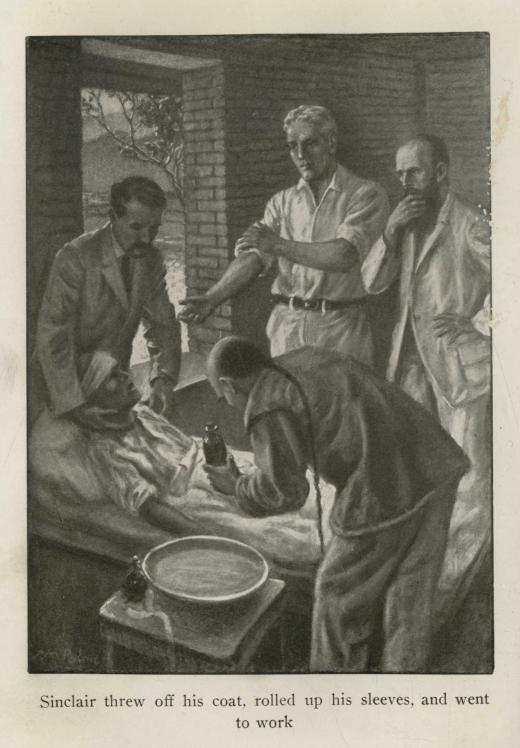
Sinclair threw off his coat, rolled up his sleeves, and went to work
The wounds were nearly all caused by shells or shrapnel. There were no clean wounds by rifle bullets. The range had been too great and the Chinese too well protected behind their fortifications. The mitrailleuses had accomplished little. They were noisy, terrifying, spectacular, but ineffective. Only once had a machine gun done much execution. A part of the fortifications on the east side of the harbour had been rendered untenable by the heavy shell-fire. A body of Chinese regulars were retreating to the new fort in too close formation. The marines working a mitrailleuse in the Villars' tops, found their range perfectly and poured a stream of bullets into their midst, killing many and threatening the whole detachment with extermination. But just at the critical moment the quick-firer jammed, and all the oaths and efforts of the squad could not get it into working order again until the Chinese were under cover.
The sights were all the more ghastly, the suffering the more intense, the prospects of recovery the fewer because the death-dealing had been done by shell and shrapnel. There was nothing clean-cut about their work. A fragment of shell had shorn away a man's left shoulder, taking with it the joint, but missing the axillary artery and part of the great breast muscle, by which the arm still hung.
Sinclair glanced at MacKay. The latter understood:
"Better not have an amputation first thing. They are ignorant and suspicious."
"I thought so. Anyway, I do not want to take time to amputate now. We'll dress it and amputate later."
A shrapnel shell had exploded close to another's side. The hip, part of the pelvis, and much of the flesh had been shredded away, exposing the working of the organs of the abdomen. It was not good to see. From that ghastly rent blood-poisoning had already set in. There was nothing to be done. They made him as easy as possible on the hard boards of his cot, administered an opiate, and left him to sleep till the last sleep should fall upon him.
One had been struck just above the ear, and a chip of his skull three inches in diameter shot away, leaving his brain uncovered.
"He will die. We'll make him comfortable in the meantime."
A fragment had caught another on the cheek, and his lower jaw was gone.
"Better if he would die, too. It would be a mercy to let him out easy. But, no; if God gives him a chance, so must I. We'll patch him up."
More to himself than to any one else, he was speaking in a low tone. All the while the doctor's hands were busy dressing, soothing, trimming, mending, healing those poor, shattered bodies of ignorant Asiatic peasants, the weak atoms of humanity which a great European nation had sent her mighty engines of death to destroy—the pitiful trophies of glorious war. And not one of those brown or yellow men had the faintest glimmer of an idea what the war was about, or why his poor body had been maltreated so. The foreign devils had come to take his land and he had been set to defend it. That was all he knew.
Stranger still was what these other foreign devils were doing. They were trying to heal him. One set of foreign devils by their magic had knocked his fortifications to pieces, mangled his body, and brought him to the verge of death. And now another set of foreign devils, by some other magic, were patching his broken body together again and bringing it back to life. He could not understand.
But some way or another those last foreigners grew into his confidence. There was something in the words of that barbarian with the long black beard, who spoke their language more perfectly than they did themselves, which quieted him and gave him hope. There was something about the great, red-haired giant,[#] who did not seem to understand their language at all and yet seemed to understand at once what his sufferings were and how to heal them, which inspired him with confidence. It might be magic he was using, but it must be good magic. Before him men were writhing restlessly on their wooden beds, sometimes moaning, occasionally uttering an agonized "ai-yah," ever and anon asking plaintively for water or tea. Behind him they lay back peacefully and, with few exceptions, went to sleep.
[#] The Chinese do not distinguish between the different shades of fair hair. All that is not jet black, is called red.
So all down the rows of improvised cots heads were raised, yellow or brown faces were turned, and black eyes, some anxious, some curious, still more wistful, watched every movement of the foreign doctor. His size, the massive head with its crown of wavy, fair hair, his huge shoulders, his bare arms, powerful and white beside their skinny brown ones, all were noted. Why did he wash his hands so often? It was a part of his magic. What was he going to do with that knife? Was he going to cut the man's heart out? No, he used it on one farther down, and now the man was sitting up drinking tea. So they watched, and so confidence grew. And at every movement the doctor made from cot to cot, the word "I-seng lâi" (the life-healer is coming) was passed from one to another of the patients.
The sun had sunk behind the hills and night was coming on. Smoky Chinese lamps and one good lantern belonging to MacKay were lighted. Still Sinclair worked on.
"You had better stop long enough to get something to eat," said MacKay.
"Thank you, MacKay; but I haven't time just now. Minutes mean lives to some of these men."
"Well, you must take a cup of tea. The boy will bring some to you here."
"Very well."
Standing at the foot of a cot studying a case, he hastily gulped down several tiny native cups of tea, without either sugar or milk. Then he was at work again.
The night was wearing on—the dark, close, hot night, with a temperature only a couple of degrees cooler than in the middle of the day. Still he worked swiftly, certainly, almost silently. What a transformation from the evening before, at the consul's dinner party! The lazy grace of the big, powerful frame, which had caught the consul's eye, was gone. Every line of the body, every play of muscles spoke of intense, forceful energy, and yet energy which was under perfect control. The physical strength which enabled him to lift a man like a child in his hands, or draw with apparent ease a dislocated hip-joint back into its place—the same self-controlled strength made his touch in another case as light as that of a delicate woman. The look of good-humoured interest with which he had studied the characteristics of his fellow-guests, or bandied repartee with Miss MacAllister, or amused the company with his songs, was gone. It was still a kindly face, a face which inspired confidence in even those ignorant Chinese soldiers over whom he bent. But no one who looked into that face would lightly trifle with the man in his present mood.
Every one present felt it. MacKay, something of an autocrat in his own sphere, read the face of the man beside him and never, except at his command to interpret for him or to give desired assistance, offered a suggestion. A group of Chinese officers came in, manifesting their usual supercilious air towards foreigners. Talking loudly and pushing inquisitively forward, they got in Sinclair's way.
"Tell these fellows to shut their mouths and keep out of my road."
MacKay interpreted it, more courteously perhaps, but forcibly. It was in silence and at a respectful distance that the Chinese officers continued to look on. Presently some more came in, louder spoken and more inquisitive than the first.
"Tell that last bunch to get out. The rest can stay if they want. Tell their senior officer to set a guard. I'll have no more in here except on business."
It was done.
The night wore on. Some of the hopeless cases found relief in death. From time to time others were brought in to take their places. Some of these had now been nearly forty-eight hours since being wounded, lying out in the long grass and brushwood of the hillsides or crawling slowly, painfully towards safety. Worse still, some had been through the hands of native quack doctors.
The brief, grey dawn, followed by the swift sunrise, took the place of the night. Still Sinclair worked on, for still the pleading, wistful eyes of suffering men were watching his movements and still he heard them say in words whose meaning he had come to understand:
"I-seng lâi" (The life-healer comes).
As he straightened himself after bending over a patient, Sergeant Gorman saluted him:
"Excuse me, sir; but a bad case has just come in. If I am not mistaken, it is more in need of immediate treatment than any of the others I have seen."
The jocular manner, the excessive brogue, the constant tendency to bulls and repetitions had dropped from Sergeant Gorman like a cloak. His manner was serious; his accent hardly noticeable; his bearing that of a thoroughly capable and efficient officer on important duty.
"What is the injury, sergeant?"
"A hand shot off at the wrist. The poor devil tied a cord around it to stop the blood. Been that way for two days without dressing. It's badly swollen, gangrened, and fly-blown."
"Very well, sergeant. I guess we'll have to amputate at once. Where is the patient?"
"In the operating tent."
Swiftly, surely the work was done, and the man carried back to a cot of boards in the improvised hospital.
Sinclair was turning back to the wards to attend to other cases when an exclamation from MacKay arrested him:
"Lee Ban! Is it possible?"
A sampan had come down with the current and run its bow ashore at the hospital. A man was lifted out and deposited on the bank, up which he crawled painfully on hands and knees. His face was drawn and ghastly with suffering. His clothing, which had once been rich, was torn to ribbons.
It was Lee Ban, one of the wealthiest merchants of Keelung. He had sent his family away to safety earlier, but had to stay himself till the day of the bombardment. When escaping from the town a shell had exploded near his chair. A fragment had passed through the bottom of it, at the same time shearing away the entire calf from one of his legs. He had paid the chair-bearers generously. But they fled for their lives and left him where he lay. He had the name of being the most charitable citizen of Keelung, and he saw many a one that day whom he had helped with his means. But they rushed past him, utterly unheeding. War had kindled in them the primal instinct of self-preservation, and had subordinated every human feeling to brute fear.
He bound his leg as best he could and started to crawl towards safety. All day he crept on hands and knees, and through the night until he lay exhausted and unconscious. In the morning he bribed some soldiers who were searching for wounded to carry him to the camp. They took him to a native doctor, who plastered the great open wound with a mixture of mud and cow-dung. Then he heard that Kai Bok-su was here, and the foreign doctor. He had himself brought to them.
While he told his story in Chinese to MacKay, Sergeant Gorman and his helpers had carried him to a cot and were unbandaging the leg for the doctor's inspection.
"For the love of heaven!"
The great, gaping wound, extending from the knee to the ankle, was alive with maggots.
This also is one of the glories of war.
XII
MATUTINAL CONFIDENCES
Eight o'clock on the morning Dr. Sinclair left Tamsui for the front found the consul in the breakfast room. Clean-shaven, dressed in spotless white, he looked as cool and fresh, and was as prompt to the minute, as if he had enjoyed a perfect night's rest. A moment or two later Mrs. Beauchamp entered.
"Good-morning, Harry. I am afraid that I have disgraced myself by being late," she said with a little mock anxiety.
"Not at all, my dear. My wife is never late. I think my watch is a few seconds fast."
"Thank you, Harry. You always find an excuse for me."
"Oh, no! it is not that," replied her husband, as if ashamed that he should allow any partiality to cause him to swerve from his rigid rule of punctuality. "Really, I am a little ahead of time. I'm deuced hungry this morning. I could hardly wait for Ah Soon to get breakfast ready."
"What time did you come to bed last night? I believe that I did not hear you at all."
"You certainly did not. You were sleeping so soundly that the French might have bombarded Tamsui and come ashore and carried you off without you waking."
"Oh, Harry! I think that's real mean of you. You know perfectly that I know your step and movements so well, that I sleep just as soundly when you are moving about as when there is absolute silence. But any other person's step would waken me at once."
"You're right there. I do not believe that you heard me this morning, either."
"No, I did not. What time did you rise? I think it is not a bit fair of you to steal out of bed like that without awaking me. And then to wait down here with your watch in your hand to catch me ten seconds late! I do not like that. I have a mind to get offended."
"Hold! This is getting tragic.
'You've ungently, Brutus,
Stole from my bed . . . . . . . .
You stared upon me with ungentle looks.
. . . . . . then you scratch'd your head,
And too impatiently stamped with your foot.'
Let's change the subject. May I have another cup of coffee?"
"What an anti-climax! From high tragedy to hot coffee! How shocking!"
"Where is Constance?"
"I fancy that she is sleeping yet."
"Was she not put to bed at her usual time?"
"Yes. But the amah says that, once the singing began, she wakened up and insisted on getting out where she could hear it better. She was out on the upper verandah all the time. So she didn't waken as early as usual. But she'll be down soon."
"She should have been made stay in bed."
"Oh, well! we cannot tie her down too hard and fast. She dearly loves singing, and she has taken a most extraordinary fancy to Dr. Sinclair."
"I do not mind how much fancy she may take to Sinclair. But there are some of the others who were here last night whom I do not want her to meet any more than she must. By the way, Sinclair is off to the war."
"Off to the war! What to do?"
"To give his services as a doctor to the Chinese and to try to organize a Red Cross corps for them."
"How interesting! But is it not very dangerous for a foreigner to venture among the Chinese just now? Especially one who is a stranger and does not know the language?"
"It is a little. But Dr. MacKay is over there at present. I also let Sergeant Gorman go with Sinclair. Each is an expert in his own line. They are all pretty shrewd. I do not think that they are likely to get into trouble. Gardenier is lending me a man to take Gorman's place."
"When did they leave?"
"By the first launch this morning."
A light was dawning on Mrs. Beauchamp's mind:
"There was no mention of this at dinner last evening. When did Dr. Sinclair decide to go?"
"Just after he bade you good-night. He got a letter from MacKay, asking him to go, and decided at once."
"And all the arrangements had to be made, passports and everything else drawn up between then and the first launch this morning."
The consul's eyes were dancing and his face was a study:
"It had to be done."
"You base deceiver! After all your talk about my sleeping so soundly, you were never in bed at all."
The consul laid back his head and laughed till even the grave, slant-eyed Celestial waiter hurried into the room to see if there was need of assistance.
"You missed me a whole lot, didn't you, Gwen?"
"I do not want to talk to you."
"Oh, yes, you do! We'll change the subject again."
"You needn't. I shall not talk."
"Yes, you will. How ever did Miss MacAllister get such a spite at Sinclair as she showed last evening?"
"Spite!" (with immense contempt). "Spite!" (still more contemptuously).
"Well, I do not know what else you would call it. She made game of him and bally-ragged him at every turn. If he hadn't been so well able to take care of himself, I should have had to interfere and protect him, since he was our guest."
"And you think that it was because she had a spite at him? It's a lot a man, even a married man, knows about the ways of a woman."
"I'll acknowledge it, Gwen. 'There be three things which are too wonderful for me, yea, four which I know not,' and the most wonderful of the four are the ways of a maid with a man." He took the chance that she would not notice the inversion; and she did not. "Solomon was much more married than I am, and he did not understand the ways of a woman, Gwen. It's not fair to expect it of me."
She did not know whether to laugh or not. It was hard to resist the serio-comic, mock-penitent expression on his face. She felt like punishing him by breaking off the conversation. But the subject was too interesting to drop. That was what he had counted on, and he judged wisely.
"I should have thought that a man who had been married nearly a dozen years, and who had such a wide ante-nuptial experience, ought to be able to recognize the symptoms when a woman is falling in love."
"Do you mean to say that the way Miss MacAllister treated Sinclair last evening is a symptom that she is falling in love with him?"
"I do."
"It looks more to me like cruelty to animals."
"She'll make up for the cruelty afterwards."
"Or falling in love with the other fellow."
"Well, it isn't."
"But you didn't act like that with me."
"You silly."
"Serious! I mean it."
"You caught me before I was old enough to know any better. I was hopelessly gone before I knew what was the matter with me."
"Are you sorry?"
"No, Harry; you know that I'm not."
Their hands touched for a moment across the corner of the little breakfast table. Their eyes looked at each other as they had looked in the days when he, the young student interpreter, who had just got his first step in the service and was home on his first furlough, with all the romance about him of having lived in the Far East amidst far, strange peoples, won the love of the young girl, fresh out of a boarding-school. A flush suffused her delicate face, making it look very youthful and beautiful.
It was in a gentle tone that the husband continued:
"You really think that this is what is the matter with Miss MacAllister, that she is in danger of losing her heart to the big Canadian doctor?"
"Yes, I do. She told me that they had a bit of a tiff coming over on the Hailoong, and that she sauced him shamefully. But he got back at her before they left the boat, and now she wants to get even. She knows that there is something wrong with her, and has a suspicion what it is. That is what makes her so hard on him. She doesn't want to give in."
"A case of playing with fire?"
"Yes, I fancy it is."
"Well, it may be only a passing flirtation, quite harmless to all concerned. But if it is anything more, and she has a notion of turning this Asiatic trip of hers into a matrimonial venture, by Jove! I believe that big doctor, with all his notions about being a missionary, is the best investment she could make in these parts."
"Her mother doesn't think so."
"What has she in view?"
"A title."
"What! Carteret?"
"Yes."
"The thundering old fool!"
"Oh, Harry!"
"I mean it. If you weren't here, Gwen, I'd swear. It's always the way with those tradespeople who have started as peasants or domestics and made money. They would sell themselves or their daughters to the devil for a title. If Beelzebub, the prince of the devils, came along they would marry a daughter to him, so as to be able to speak of her as Her Royal Highness the Princess of the Devils."
"Oh, Harry, stop! You mustn't say that. Surely Mr. Carteret is not so bad as that."
"He's not far short of it."
"You never told me that."
"There are a lot of things I don't tell you. They wouldn't be pleasant for you to hear, nor for me to tell. And, anyway, in this little hole-in-the-corner of the world you have to associate with all those fellows more or less. It's easier for you if you do not know too much about them."
"But the men here are not all bad, are they?"
"Oh, no! No! I wouldn't have you think that. Some of them, I think most of them, are as good as you could get at home. But there are others. And Carteret is one of the others."
"Mrs. MacAllister does not know that."
"Perhaps not. But she has seen enough of the world to know the difference between a man like Sinclair and one like Carteret."
"I am afraid that it is the title. She told me that his father, the present lord, is an old man and cannot live long; and that his older brother, the present heir, is dying of consumption—as she expressed it, 'has only one lung.' So she thinks that Carteret is sure to succeed to the title soon."
"Yes; and in the meantime the two brothers love each other so that the heir will not hear of this prospective supplanter being nearer to him than China is to England. Esau and Jacob! And Mrs. MacAllister would give her daughter to that scavenger, and the MacAllister money to fix up the Carteret estates, just to have a title in the family! Gwen, I want to swear."
"Oh, Harry, you are shocking!"
"Can't help it, Gwen. I must swear."
"Well, Harry, if it will save you from injury——"
"It's damnable! ... Thanks, awfully, Gwen. I feel some better now."
"I hope that you'll not have another attack for some time."
"Then we'll have to talk about something else."
"What a marvellously versatile entertainer Dr. Sinclair is! I think that he is quite a wonder."
"What is better, he has both brains and gumption. He was as keen on getting to the front as a hound on a scent. But, unlike most hounds, he didn't give tongue. He said nothing. Just went, and that at once."
"I was afraid that it would come to a passage at arms between him and Carteret? Did you ever hear so much insult put into the tone of voice as Carteret did last evening?"
"It will be a bad day for Carteret when he pushes Sinclair too far. Most men from Sinclair's country don't take much stock in titles. They would pull a peer's nose just as soon as a peasant's. That's the kind of Sinclair.... Hallo, Puss, what time is this to be getting down to breakfast?"
"Good-morning, daddy. This is a lovely time to be getting down, much nicer than eight o'clock. Good-morning, mother. Have you been up long?"
"Long enough to have my breakfast eaten. I hear you were a bad girl last evening, Constance—that you didn't stay in bed or go to sleep till all hours."
But Constance—a tall, straight child of nine, with step as light and graceful as that of a fawn, and a wealth of dark-brown curls framing her clear-cut features and frank eyes—did not seem to be very penitent:
"Oh, mother, it was just lovely to hear the singing. I could have listened to you, and daddy, and Miss MacAllister, and Dr. Sinclair all night."
"Wise child!" remarked her father, somewhat grimly. "She knows the proper selection to make and whom to put first."
"There were others singing, Constance, besides the ones you mentioned," said her mother.
"Oh, yes; I know. I did not recognize some of the voices. But I knew Mr. Carteret's and Mr. De Vaux's."
"Mr. Carteret is a fine singer."
"Yes, I suppose. But I didn't like the way he sang. He put such a funny tone in his voice. He kind of—— Oh, I don't know how to describe it. It sounded like the way Carlo used to howl after daddy sent Fan over to Amoy."
"Good heavens!"
"And Mr. De Vaux's voice was just like my singing doll after I burst the bellows in her. She could give only one squeak, and then had to wait till I put some more wind into her before she could give another."
"That'll do, Constance; we've had enough of your opinions on singing. Get busy with your breakfast or you'll get none."
"All right, daddy."
"Boy! You tell coolie boys to roll the lawn. Tennis this afternoon. Can savey?"
"All lite! All lite! My can savey. Loll lawn. A-paw phah-kiû" (Afternoon strike-ball).
"Oh, goody! Dr. Sinclair will be here."
"No, Constance; Dr. Sinclair will not be here."
"Why, mother?"
"He has gone away over to Keelung to care for the sick and wounded after the battle."