SUBFAMILY NYMPHALINÆ (THE NYMPHS)
Reading edition
"Entomology extends the limits of being in new directions, so that I walk in nature with a sense of greater space and freedom. It suggests, besides, that the universe is not rough-hewn, but perfect in its details. Nature will bear the closest inspection; she invites us to lay our eye level with the smallest leaf and take an insect view of its plane."—Thoreau.
"My butterfly-net and pocket magnifying-glass are rare companions for a walk in the country."—William Hamilton Gibson, Sharp Eyes, p. 117.
Butterfly.—The butterflies of this subfamily are mainly of moderate or large size, though some of the genera contain quite small species. The antennæ are always more or less heavily clothed with scales, and are usually as long as the abdomen, and in a few cases even longer. The club is always well developed; it is usually long, but in some genera is short and stout. The palpi are short and stout, densely clothed with scales and hairs. The thorax is relatively stout, in some genera exceedingly so. The fore wings are relatively broad, the length being to the breadth in most cases in the ratio of 5 to 3, or 3 to 2, though in a few mimetic forms these wings are greatly produced, and narrow, patterning after the outline of the Heliconians and Ithomiids, which they mimic. The fore wings are in most genera produced at the apex, and more or less strongly excavated on the outer margin below the apex. The discoidal cell is usually less than half the length of the wing from base to tip. It is occasionally open, but is more generally closed at its outer extremity by discocellular veins diminishing in thickness from the upper to the lower outer angle of the cell. The costal nervure usually terminates midway between the end of the cell and the tip. The two inner subcostal nervules usually arise before the end of the cell; the outer subcostal nervules invariably arise beyond the end of the cell.
The hind wings are rounded or angulated, with the outer border scalloped or tailed; the inner border always affords a channel for the reception of the abdomen. The costal nervule invariably terminates at the external angle of this wing. The discoidal cell is frequently open, or simply closed by a slender veinlet, which it is not always easy to detect; the anal vein is never lacking.
The fore legs are greatly reduced in the male, less so in the female.
Egg.—The egg is either somewhat globular, or else barrel-shaped, with the sides marked with net-like elevations, or vertically ribbed (see Figs. 1, 8, 10).
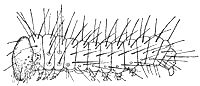
Caterpillar.—When first emerging from the egg the caterpillar is generally furnished with long hairs rising singly from wart-like elevations which are arranged either in longitudinal rows or in geometric patterns (Fig. 85). As the caterpillars pass their successive moults the hairs are transformed into branching spines or tubercles (see Plate III, Figs. 28-38).
Fig. 85.—Caterpillar of Vanessa antiopa, just hatched. (Greatly magnified.) (After Scudder.)
Chrysalis.—The chrysalis invariably hangs suspended from a button of silk, and is frequently furnished, especially on the dorsal or upper surface, with a number of prominences; the head is usually bifurcate, or cleft (see Plate IV, Figs. 21, 39, etc.).
This is the largest of all the subfamilies of the butterflies, and is widely distributed, including many of the most beautifully colored and most vigorous species which are known. There are twenty-six genera represented in our fauna, containing about one hundred and seventy species.
Genus COLÆNIS, Doubleday
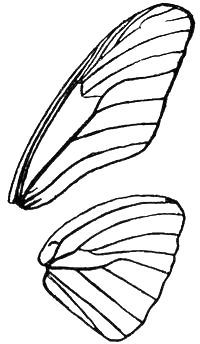
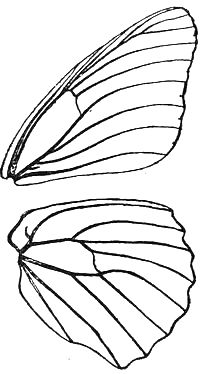
Butterfly.—Butterflies of moderately large size, the fore wings greatly produced and relatively narrow; the hind wings evenly rounded and relatively small, of bright reddish-brown color, with darker markings. The species are mimics, and in the elongation of their wings reveal the influence of the Heliconians, protected species, which abound in the regions in which the genus attains its greatest development. The median vein in the upper wing is characterized by the presence at the base of a minute, thorn-like, external projection; the second subcostal nervule is emitted beyond the cell; the cell of the hind wing is open.
The life-history of the two species found within our fauna has not as yet been carefully worked out, and aside from a knowledge of the fact that the caterpillars closely resemble in many respects the caterpillars of the two succeeding genera, being provided with branching spines on their bodies, we do not know as yet enough to give any complete account of the early stages of these insects.
Fig. 86.—Neuration of the genus Colœnis, slightly less than natural size.
(1) Colænis julia, Fabricius, Plate VIII, Fig. 6, ♂ (Julia).
The upper side is dark reddish-orange, the borders are black, a black band extends from the costa at the end of the cell to the outer margin on the line of the third median nervule; the costal area on the hind wings is silver-gray; the wings on the under side are pale rusty-red, mottled with a few darker spots, principally on the costa, at the end of the cell, and at the apex of the primaries. There are a few crimson marks at the base of the hind wings, and two light-colored lunules near the inner angle of the hind wings. Expanse of wing, 3.50 inches.
This butterfly, which mimics the genus Heliconius in the outline of the wings, is very common in the tropics of America, and only appears as an occasional visitant in southern Texas.
(2) Colænis delila, Fabricius, Plate VIII, Fig. 4, ♂ (Delila).
The Delila Butterfly very closely resembles Julia, and principally differs in being paler in color and without the black band extending from the costa to the outer margin of the primaries. This species has nearly the same form and the same size as the preceding, and, like it, is occasionally found in southern Texas. It is very common in Central America and the West Indies. One of the earliest memories of my childhood relates to a collection of Jamaican butterflies in which were a number of specimens of this butterfly, which I have always much admired.
Genus DIONE, Hübner (Agraulis, Boisd.-Lec.)
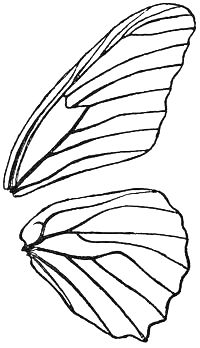
Butterfly.—Head large, the antennæ moderately long, with the club flattened; the tip of the abdomen does not extend beyond the inner margin of the hind wings; the cell of the hind wings is open; the primaries are elongated, nearly twice as long as broad, with the exterior margin excavated; the secondaries at the outer margin denticulate. The prevalent color of the upper side of the wings is fulvous, adorned with black spots and lines, the under side of the wings paler brown, in some of the species laved with pink and brilliantly adorned with large silvery spots, as in the genus Argynnis.
Egg.—Conoidal, truncated on top, with fourteen ribs running from the apex to the base, between which are rows of elevated striæ, causing the surface to appear to be covered with quadrangular pits.
Larva.—The caterpillar is cylindrical in its mature stage, tapering a little from the middle toward the head, which is somewhat smaller than the body. The head and each segment of the body are adorned with branching spines.
Fig. 87.—Neuration of the genus Dione.
Chrysalis.—The chrysalis is suspended, and has on the dorsal surface of the abdomen a number of small projections. At the point where the abdominal and thoracic segments unite on the dorsal side there is a deep depression, succeeded on the middle of the thorax by a rounded elevation composed of the wing-cases. At the vertex of the chrysalis there is a conical projection; on the ventral side the chrysalis is bowed outwardly.
This genus is confined to the New World, and contains five species. It is closely related to the genus Colœnis on the one hand and to the genus Argynnis on the other. It is distinguished from Colœnis by the more robust structure of the palpi, which closely approximate in form the palpi of the genus Argynnis. It is distinguished from the species of the genus Argynnis by the form of the wings and by the open cell of the secondaries. The larva feeds upon the different species of the genus Passiflora. I cannot at all agree with those who have recently classed this butterfly with the Heliconians. In spite of certain resemblances in the early stages between the insect we are considering and the early stages of some of the Heliconians, and in spite of the shape of the wings, which are remarkably elongated, there are structural peculiarities enough to compel us to keep this insect in the ranks of the Nymphalinæ, where it has been placed for sixty years by very competent and critical observers. In a popular work like this it manifestly is out of place to enter into a lengthy discussion of a question of this character, but it seems proper to call attention to the fact that in the judgment of the writer the location of this genus in the preceding subfamily does violence to obvious anatomical facts.
(1) Dione vanillæ, Linnæus, Plate VIII, Fig. 7, ♂ (The Gulf Fritillary).
Butterfly.—The upper side is bright fulvous; the veins on the fore wings are black, very heavy near the tip; there are four black spots on the outer border, and three discal spots of the same color; there are three irregular black spots toward the end of the cell, pupiled with white; the hind wings have a black border inclosing rounded spots of the ground-color; between the base and the outer margin there are three or four black spots; the under side of the fore wings is light orange, the markings of the upper side showing through upon the under side; the apex of the front wing is brown, inclosing light silvery spots; the secondaries are brown, with numerous elongated bright silver spots and patches. The female does not differ from the male, except that she is darker and the markings are heavier. Expanse, 2.50-3.25 inches.
Caterpillar.—The caterpillar is cylindrical, with the head somewhat smaller than the body, pale yellowish-brown in color, marked with longitudinal dark-brown bands, of which the two upon the side are deeper in color than the one upon the back, which latter is sometimes almost entirely effaced; the base is slaty-black. There are orange spots about the spiracles. There are six rows of black branching spines upon the body, and two similar spines upon the head, these latter somewhat recurved. The feet and legs are black. The caterpillar feeds upon the various species of passion-flower which are found in the Southern States.
Chrysalis.—The chrysalis is dark brown, marked with a few small pale spots.
This species ranges from the latitude of southern Virginia southward to Arizona and California. It is abundant also in the Antilles and Mexico.
Genus EUPTOIETA, Doubleday
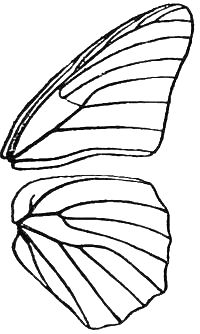
Butterfly.—Butterflies of medium size, having wings of a yellowish-brown color, marked with black, the under side of the wings devoid of silvery spots such as are found in the genera Dione and Argynnis. The palpi have the second joint strongly developed, increasing in thickness from behind forward, and thickly covered with long hair; the third joint is very small and pointed; the antennæ are terminated by a conspicuous pear-shaped club. The cell of the fore wing is closed by a very feeble lower discocellular vein, which unites with the median vein at the origin of the second median nervule; the cell of the hind wing is open, though occasionally there are traces of a feebly developed lower discocellular vein on this wing. The outer margin of the fore wing is slightly excavated below the apex; the outer margin of the hind wing is somewhat strongly produced at the end of the third median nervule.
Fig. 88.—Neuration of the genus Euptoieta.
Egg.—Short, subconical, with from thirty to forty vertical ribs, pale green in color.
Caterpillar.—The caterpillar is cylindrical, with short branching spines arranged in longitudinal rows upon the body, the spines on the first segment being bent forward over the head. The head is somewhat smaller in the mature stage than the body.
Chrysalis.—The chrysalis is suspended, marked upon its dorsal side with a number of small angular eminences, with the head and the ventral side evenly rounded.
The larva of these insects feeds upon the various species of passion-flower. It is also said to feed upon violets. The butterflies frequent open fields, and are sometimes exceedingly abundant in worn-out lands in the Southern States.
There are two species of this genus, both of which are found within the United States, and range southwardly over the greater portion of Central and South America.
(1) Euptoieta claudia, Cramer, Plate VIII, Fig. 9, ♂ (The Variegated Fritillary).
Butterfly.—The upper side of both wings is dull ferruginous, darker toward the base, crossed by an irregular black median line, which is darker, broader, and more zigzag on the fore wing than on the hind wing. This line is followed outwardly on both wings by a pair of more or less wavy limbal lines, inclosing between them a series of round blackish spots. The outer margin is black, with the fringes pale fulvous, checkered with black at the end of each nervule. At the end of the cell in the fore wing there are two black lines inclosing paler fulvous spots, and both wings near the base have some curved black lines. On the under side the fore wings are marked somewhat as on the upper side, but paler in color, with a large apical patch of brownish-gray broken by a transverse band of darker brown. The hind wings are dark brown, with the markings of the upper side obscurely repeated; they are mottled with gray and crossed by a broad central band of pale buff.
The species varies very much, according to locality, both in size and in the depth of the markings. Expanse, 1.75-2.75 inches.
Egg.—The egg is conoidal, relatively taller than the eggs of the genus Argynnis, which closely resemble it. There is a depression at the apex, surrounded by a serrated rim, formed by the ends of the vertical ribs, of which there are about twenty, some longer and some shorter, about half of them reaching from the apex to the base. Between these vertical ribs there are a multitude of smaller cross-ridges.
Caterpillar.—The caterpillar is cylindrical, reddish-yellow in color, marked with two brown lateral bands and a series of white spots upon the back. There are six rows of short branching spines upon the body, which are black in color; the two uppermost of these spines on the first segment are much elongated and are directed forward. The head is smaller than the body in the mature caterpillar, and is black. On the under side the caterpillar is pale or whitish; the legs are blackish-brown. It feeds upon the passion-flower.
Chrysalis.—The chrysalis is pearly-white, marked with black spots and longitudinal streaks.
This species has been taken as far north as Long Island and Connecticut, though it is a very rare visitant in New England; it is quite common in Virginia and thence southward, and occurs not infrequently in southern Illinois and Indiana, ranging westward and southward over the entire continent to the Isthmus of Panama, and thence extending over the South American continent, wherever favorable conditions occur.
(2) Euptoieta hegesia, Cramer, Plate VIII, Fig. 8, ♂ (The Mexican Fritillary).
The upper side is marked very much as in the preceding species, but all the lines are finer and somewhat more regular, and the basal and discal areas of the hind wings are without dark spots in most specimens. The under side is less mottled and more uniformly dark rusty-brown than in E. claudia. Expanse, about 2 inches.
The life-history of this species has not as yet been thoroughly worked out, but there is every reason to believe that the insect in its early stages very closely approaches the Variegated Fritillary. It is a Southern form, and only occasionally is taken in Arizona and southern California. It is common in Central and South America.
LUTHER'S SADDEST EXPERIENCE
"Luther, he was persecuted, Excommunicated, hooted, Disappointed, egged, and booted; Yelled at by minutest boys, Waked up by nocturnal noise, Scratched and torn by fiendish cats, Highwayed by voracious rats. "Oft upon his locks so hoary Water fell from upper story; Oft a turnip or potato Struck upon his back or pate, Oh! And wherever he betook him, A papal bull was sure to hook him. "But the saddest of all I am forced to relate: Of a diet of worms He was forced to partake— Of a diet of worms For the Protestants' sake; Munching crawling caterpillars, Beetles mixed with moths and millers; Instead of butter, on his bread, A sauce of butterflies was spread. Was not this a horrid feast For a Christian and a priest? "Now, if you do not credit me, Consult D'Aubigné's history. You'll find what I have told you Most fearfully and sternly true." Yale Literary Magazine, 1852.
Plate IX.
Genus ARGYNNIS, Fabricius
(The Fritillaries, the Silver-spots)
"July is the gala-time of butterflies. Most of them have just left the chrysalis, and their wings are perfect and very fresh in color. All the sunny places are bright with them, yellow and red and white and brown, and great gorgeous fellows in rich velvet-like dresses of blue-black, orange, green, and maroon. Some of them have their wings scalloped, some fringed, and some plain; and they are ornamented with brilliant borders and fawn-colored spots and rows of silver crescents.... They circle about the flowers, fly across from field to field, and rise swiftly in the air; little ones and big ones, common ones and rare ones, but all bright and airy and joyous—a midsummer carnival of butterflies."—Frank H. Sweet.
Butterfly.—Butterflies of medium or large size, generally with the upper surface of the wings reddish-fulvous, with well-defined black markings consisting of waved transverse lines, and rounded discal and sagittate black markings near the outer borders. On the under side of the wings the design of the fore wings is generally somewhat indistinctly repeated, and the hind wings are marked more or less profusely with large silvery spots. In a few cases there is wide dissimilarity in color between the male and the female sex; generally the male sex is marked by the brighter red of the upper surface, and the female by the broader black markings, the paler ground-color, and the sometimes almost white lunules, which are arranged outwardly at the base of the sagittate spots along the border.
Fig. 89.—Neuration of the genus Argynnis.
The eyes are naked; the palpi strongly developed, heavily clothed with hair rising above the front, with the last joint very small and pointed. The antennæ are moderately long, with a well-defined, flattened club. The abdomen is shorter than the hind wings; the wings are more or less denticulate. The subcostal vein is provided with five nervules, of which the two innermost are invariably given forth before the end of the cell; the third subcostal nervule always is nearer the fourth than the second. The cell of the fore wing is closed by a fine lower discocellular vein, which invariably joins the median vein beyond the origin of the second nervule. The hind wing has a well-defined precostal nervule; the cell in this wing is closed by a moderately thick lower discocellular vein, which joins the median exactly at the origin of the second median nervule. The fore feet of the males are slender, long, and finely clothed with hair. The fore feet of the females are of the same size as those of the males, but thin, covered with scales, and only on the inner side of the tibiæ clothed with moderately long hair.
Egg.—The eggs are conoidal, truncated, and inwardly depressed at the apex, rounded at the base, and ornamented on the sides by parallel raised ridges, not all of which reach the apex. Between these ridges there are a number of small raised cross-ridges.
Caterpillar.—The caterpillar is cylindrical, covered with spines, the first segment always bearing a pair of spines somewhat longer than the others. All of the species in North America, so far as their habits are known, feed upon violets at night. During the daytime the caterpillars lie concealed.
Chrysalis.—The chrysalis is angular, adorned with more or less prominent projections. The head is bifid.
The genus Argynnis is one of the largest genera of the brush-footed butterflies. It is well represented in Europe and in the temperate regions of Asia, some magnificent species being found in the Himalayas and in China and Japan. It even extends to Australia, and recently two species have been discovered in the vicinity of the great volcanic peak, Kilima-Njaro, in Africa. But it has found its greatest development upon the continent of North America. The species composing this genus are among our most beautiful butterflies. Owing to the fact that there is a great tendency in many of the forms closely to approximate one another, the accurate distinction of many of the species has troubled naturalists, and it is quite probable that some of the so-called species will ultimately be discovered to be merely local races or varietal forms. The species that are found in the eastern part of the United States have been studied very carefully, and their life-history has been worked out so thoroughly that little difficulty is found in accurately determining them. The greatest perplexity occurs in connection with those species which are found in the region of the Rocky Mountains. While silvery spots are characteristic of the under side of most of the fritillaries, in some species the silvery spots are not found; in others they are more or less evanescent, occurring in the case of some individuals, and being absent in the case of others.
(1) Argynnis idalia, Drury, Plate X, Fig. 3, ♁; Plate V, Fig. 4, chrysalis (The Regal Fritillary).
Butterfly.—The upper side of the fore wings of the male is bright fulvous, marked very much as in other species of the genus. The upper side of the hind wings is black, glossed with blue, having a marginal row of fulvous and a submarginal row of cream-colored spots. On the under side the fore wings are fulvous, with a marginal row of silver crescents, and some silvery spots on and near the costa. The hind wings are dark olive-brown, marked with three rows of large irregular spots of a dull greenish-silvery color. The female is at once distinguished from the male by having the marginal row of spots on the hind wings cream-colored, like the submarginal row, and by the presence of a similar row of light spots on the fore wings. Expanse, 2.75-4.00 inches.
Egg.—The egg in form is like those of other species of Argynnis.
Caterpillar.—The caterpillar moults five times before attaining to maturity. When fully developed it is 1.75 inches long, black, banded and striped with ochreous and orange-red, and adorned with six rows of fleshy spines surmounted by several black bristles. The spines composing the two dorsal rows are white, tipped with black; those on the sides black, tinted with orange at the point where they join the body. The caterpillar feeds on violets, and is nocturnal in its habits.
Chrysalis.—The chrysalis is brown, mottled with yellow and tinted on the wing-cases with pinkish. It is about an inch long, and in outline does not depart from the other species of the genus.
This exceedingly beautiful insect ranges from Maine to Nebraska. It is found in northern New Jersey, the mountainous parts of New York and northern Pennsylvania, and is reported from Arkansas and Nebraska. It is rather local, and frequents open spots on the borders of woodlands. At times it is apparently common, and then for a succession of seasons is scarce. It flies from the end of June to the beginning of September.
(2) Argynnis diana, Cramer, Plate IX, Fig. 1, ♂; Fig. 2, ♁ (Diana).
Butterfly.—The male on the upper side has both wings deep rich brown, bordered with fulvous, this border being more or less interrupted by rays of brown along the nervules and two rows of circular brown spots, larger on the fore wings than on the hind wings. The wings on the under side are pale buff, deeply marked with black on the base and middle of the fore wings, and clouded with grayish-fulvous on the inner two thirds of the hind wings. A blue spot is located near the end of the cell in the fore wings, and the hind wings are adorned by a marginal and submarginal row of narrow silvery crescents and a few silvery spots toward the base. The female on the upper side is a rich bluish-black, with the outer border of the fore wings marked by three rows of bluish-white quadrate spots, the outer row being the palest, and often quite white. The hind wings are adorned by three more or less complete rows of bright-blue spots, the inner row composed of large subquadrate spots, each having a circular spot of black at its inner extremity. On the under side the female has the ground-color slaty-brown, paler on the hind wings than on the fore wings, which latter are richly marked with blue and black spots. The silvery crescents found on the under side of the hind wings of the male reappear on the under side of the female, and are most conspicuous on the outer margins. Expanse, 3.25-4.00 inches.
Egg.—The egg is pale greenish-white, and conformed in outline to type.
Caterpillar.—The larva is velvety-black, adorned with six rows of fleshy spines armed with bristles. The spines are orange-red at the base. The head is dull brown.
Chrysalis.—The chrysalis is dusky-brown, with lighter-colored short projections on the dorsal side.
This splendid butterfly, which is the most magnificent species of the genus, is confined to the southern portion of the Appalachian region, occurring in the two Virginias and Carolinas, northern Georgia, Tennessee, and Kentucky, and being occasionally found in the southern portion of Ohio and Indiana, and in Missouri and Arkansas.
(3) Argynnis nokomis, Edwards, Plate X, Fig. 1, ♂; Fig. 2, ♁ (Nokomis).
Plate X.
Butterfly.—The male on the upper side is bright fulvous, with the characteristic black markings of the genus. On the under side the wings are pale greenish-yellow, with the fore wings laved with bright pink at the base and on the inner margin. The spots of the upper side reappear on the under side as spots of silver bordered narrowly with black. The female has the ground-color of the upper side yellow, shaded outwardly with fulvous. All the dark markings of the male sex reappear in this sex, but are much broader, and tend to fuse and run into one another, so as to leave the yellow ground-color as small subquadrate or circular spots, and wholly to obliterate them at the base of the wings. On the under side this sex is marked like the male, but with all the markings broader. Expanse, 3.40-3.60 inches.
This species, the male of which resembles the male of A. leto, and the female the same sex of A. diana, is as yet quite rare in collections. It has been taken in Arizona and southern Utah. We have no knowledge of the life-history of the species.
(4) Argynnis nitocris, Edwards, Plate XIII, Fig. 4, ♂, under side (Nitocris).
Butterfly.—The male is bright reddish-fulvous, marked like A. nokomis. The under side of the fore wings is cinnamon-red, ochre-yellow at the tip. The hind wings are deep rusty-red, with a broad yellowish-red submarginal belt. The silver spots are as in A. nokomis. The female on the upper side is blackish-brown, darker than A. nokomis. The extradiscal spots in the transverse rows are pale yellow, and the submarginal spots whitish. The under side of the fore wings is bright red, with the tip yellow. The hind wings on this side are dark brown, with a submarginal yellow belt. Expanse, 3.25-3.75 inches.
This species, like the preceding, is from Arizona, and nothing is known of its egg, caterpillar, or chrysalis.
(5) Argynnis leto, Edwards, Plate IX, Fig. 5, ♂; Fig. 6, ♁ (Leto).
Butterfly.—The male on the upper side is marked much as A. nokomis, but the ground-color is duller red, and the basal area is much darker. The under side of the fore wings is pale fulvous, upon which the markings of the upper side reappear; but there are no marginal silver crescents. Both wings on the under side are shaded with brown toward the base; the hind wings are traversed by a submarginal band of light straw-yellow. The female is marked as the male, but the ground-color is pale straw-yellow, and all the darker markings are deep blackish-brown, those at the base of both wings being broad and running into one another, so that the inner half of the wings appears to be broadly brownish-black. On the under side this sex is marked as the male, but with the dark portions blacker and the lighter portions pale yellow. Expanse, 2.50-3.25 inches.
The life-history of this insect remains to be worked out. It is one of our most beautiful species, and occurs in California and Oregon.
(6) Argynnis cybele, Fabricius, Plate IX, Fig. 3, ♂; Fig. 4, ♁; Plate XIII, Fig. 1, ♁, under side; Plate V, Figs. 1-3, chrysalis (The Great Spangled Fritillary).
Butterfly.—The male is much like the male of A. leto, but the dark markings of the upper surface are heavier, and the under sides of the hind wings are more heavily silvered. The yellowish-buff submarginal band on the under side of the hind wings is never obliterated by being invaded by the darker ferruginous of the marginal and discal tracts of the wing. The female has the ground-color of the wings paler than the male, and both wings from the base to the angled median band on the upper side are dark chocolate-brown. All the markings of the upper side in this sex are heavier than in the male. On the under side the female is like the male. Expanse, 3.00-4.00 inches.
Egg.—Short, conoidal, ribbed like those of other species, and honey-yellow.
Caterpillar.—The larva in the mature state is black. The head is blackish, shaded with chestnut behind. The body is ornamented with six rows of shining black branching spines, generally marked with orange-red at their base. The caterpillar, which is nocturnal, feeds on violets, hibernating immediately after being hatched from the egg, and feeding to maturity in the following spring.
Chrysalis.-The chrysalis is dark brown, mottled with reddish-brown or slaty-gray.
This species, which ranges over the Atlantic States and the valley of the Mississippi as far as the plains of Nebraska, appears to be single-brooded in the North and double-brooded in Virginia, the Carolinas, and the Western States having the same geographical latitude. A small variety of this species, called A. carpenteri by Mr. W.H. Edwards, is found in New Mexico upon the top of Taos Peak, and is believed to be isolated here in a colony, as Œneis semidea is isolated upon the summit of Mount Washington. Specimens of cybele much like those of this New Mexican variety are found in eastern Maine and Nova Scotia, and on the high mountains of North Carolina.
(7) Argynnis aphrodite, Fabricius, Plate XIV, Fig. 11, ♁, under side; Plate V, Fig. 5, chrysalis (Aphrodite).
Butterfly.—This species closely resembles cybele, but is generally smaller, and the yellow submarginal band on the hind wings is narrower than in cybele, and often wholly wanting, the hind wings being broadly brown, particularly in the female sex. The under side of the fore wings at the base and on the inner margin is also brighter red.
The caterpillar, chrysalis, and egg of this species closely resemble those of cybele. The caterpillar has, however, a velvety-black spot at the base of each spine, the chrysalis has the tubercles on the back shorter than in cybele, and the basal segments are party-colored, and not uniformly colored as in cybele.
(8) Argynnis cipris, Edwards, Plate XII, Fig. 3, ♂; Fig. 4, ♁ (The New Mexican Silver-spot).
Butterfly.—This species, which belongs to the Aphrodite-group, may be distinguished by the fact that the fore wings are relatively longer and narrower than in aphrodite. The black markings on the upper side of the wings in both sexes are narrower, the dusky clouding at the base of the wings is less pronounced, and the ground-color is brighter reddish-fulvous than in aphrodite. On the under side the fore wings lack in the male the pinkish shade at the base and on the inner margin which appears in aphrodite, and both the male and the female have the inner two thirds of the hind wings deep cinnamon-red, with only a very narrow buff submarginal band, deeply invaded on the side of the base by rays of the deeper brown color of the inner portion of the wing. Expanse, 2.75-3.15 inches. The insect flies from late June to the end of August.
Caterpillar, etc.—We know nothing of the larval stages of this insect. The specimens contained in the Edwards collection came from Colorado, Utah, and New Mexico, and these localities approximately represent the range of the species.
(9) Argynnis alcestis, Edwards, Plate X, Fig. 6, ♂, under side (The Ruddy Silver-spot).
Butterfly.—Very much like aphrodite, from which it may be most easily distinguished by the fact that the hind wings are uniformly dark cinnamon-brown, without any band of buff on the outer margin. Expanse, 2.50-3.00 inches. The insect flies from late June to the end of August.
Egg.—Greenish, conoidal, with about eighteen vertical ribs.
Caterpillar.—Head black, yellowish behind. The body velvety-black, ornamented with black spines which are yellowish at their basal ends. The caterpillar feeds on violets.
Chrysalis.—Reddish-brown or gray, irregularly mottled and striped with black, the abdominal segments slaty-gray, marked with black on the edges where the short angular projections are located.
This butterfly is found in the Western States, extending from the prairie lands of northwestern Ohio to Montana. It largely replaces aphrodite in these regions.
(10) Argynnis nausicaä, Edwards, Plate XI, Fig. 9, ♂ (The Arizona Silver-spot).
Butterfly.—The species is related to the foregoing, but is rather smaller in size. The upper side of the wings is dusky reddish-brown, with the characteristic markings of the genus. On the under side the fore wings are pink, laved with buff at the tip. The hind wings on this side are deep cinnamon-brown, mottled with buff on the inner two thirds; a narrow but clearly defined submarginal band of bright yellowish-buff surrounds them. The silvery spots are clearly marked. The female has the black markings broader and more conspicuous than the male. Expanse, 2.25-2.50 inches.
This insect is quite common in the mountain valleys of Arizona, at an elevation of from six to seven thousand feet above the level of the sea, and flies in July and August. We have no knowledge of the early stages, but it probably does not differ greatly in its larval state from the allied species of the genus.
(11)Argynnis atlantis, Edwards, Plate X, Fig. 9, ♂; Plate V, Fig. 6, chrysalis (The Mountain Silver-spot).
Butterfly.—This insect, which resembles aphrodite, is distinguished from that species by its smaller size, its somewhat narrower wings, the deeper brown color of the base of the wings on the upper side, and their darker color on the under side. The submarginal band is pale yellow, narrow, but distinct and always present. Expanse, 2.50 inches.
Plate XI.
Egg.—Conoidal, with twelve to fourteen ribs, honey-yellow. The caterpillars are hatched in the fall, and hibernate without feeding until the following spring.
Caterpillar.—The head is dark blackish-brown. The body is velvety-purple above, a little paler on the under side. The usual spines occur on the body, and are black, grayish at the base. The larva feeds on violets.
Chrysalis.—The chrysalis is light brown, speckled, except on the abdominal segments, with black.
This species ranges from Maine to the mountains of western Pennsylvania, and thence southward along the central ridges of the Alleghanies into West Virginia. It is also found in Canada, and extends westward into the region of the Rocky Mountains. It is especially common in the White Mountains of New Hampshire and the Adirondacks.
(12) Argynnis lais, Edwards, Plate XIV, Fig. 12, ♂; Fig. 13, ♁ (The Northwestern Silver-spot).
Butterfly.—The male is bright reddish-fulvous on the upper side, slightly obscured by fuscous at the base. The discal band of spots common to both wings is broken and irregular, and the spots on the hind wings are quite small. The fore wings on the under side are buff at the tips and pale red at the base and on the inner margin, lighter at the inner angle. The under side of the hind wings as far as the outer margin of the discal row of silvery spots is dark brown, mottling a yellowish ground. The submarginal band of the hind wings is pale yellow and moderately broad. The female is marked much as the male, but the discal band of spots on the upper side of the fore wings is confluent and broader, the fringes whitish, and the spots included between the sagittate marginal spots and the marginal lines paler than in the male sex. Expanse, 2.00-2.20 inches.
Caterpillar, etc.—The early stages are unknown.
This species is found in the territories of Alberta and Assiniboia, and in British Columbia among the foot-hills and the lower slopes of the mountain-ranges.
(13) Argynnis oweni, Edwards, Plate XII, Fig. 5, ♂; Fig. 6, ♁, under side (Owen's Silver-spot).
Butterfly, ♂.—The wings on the upper side are dull reddish-fulvous, not much obscured with brown on the base, the black markings moderately heavy, the two marginal lines tending to flow together. The fore wings on the under side are yellowish-buff from the base to the outer row of spots, or in some specimens with the buff lightly laved with reddish; the nerves reddish-brown. The subapical patch is dark brown, with a small silvered spot; the five submarginal spots are small and obscurely silvered. The hind wings are dark brown on the discal area and outer margin, with a rather narrow grayish-buff submarginal band, strongly invaded by projections of the dark brown of the discal area. The spots of the outer discal row are generally well silvered; the inner spots less so in most cases.
♁.—The female has the wings more or less mottled with yellowish outside of the mesial band. The black markings are very heavy in this sex. On the under side the spots are well silvered.
The dark markings on the upper side of the wings of the male are much heavier than in A. behrensi. On the under side of the wings in both sexes it may be distinguished from behrensi by the fact that the ground-color toward the base is mottled with yellow, and not solid brown as in behrensi. Expanse, 2.25-2.40 inches.
This species abounds on Mount Shasta, in California, at an elevation of seven to eight thousand feet above sea-level.
(14) Argynnis cornelia, Edwards. Plate XI, Fig. 8, ♂ (Miss Owen's Fritillary).
Butterfly, ♂.—The upper side of both wings is dark brown from the base to the mesial band of spots, with the exception of the outer end of the cell. The space beyond the band is reddish-fulvous; the dark markings are not very heavy; the two marginal lines are fine, and confluent at the ends of the nervules. The under side of the fore wings is reddish-brown from the base to the outer margin on the inner half of the wing; the outer spaces toward the apex are yellowish; the subapical patch is reddish-brown, inclosing a small silvery spot; the outer margin is reddish-brown, adorned with five small silvery spots toward the apex. The hind wings on the under side are almost solid reddish-brown to the clear yellow submarginal belt, only slightly mottled on the discal area with buff. The spots are small and well silvered.
♁.—The female on the upper side is duller red, with the dark markings heavier; the marginal spots on the fore wings are pale yellowish, and the marginal lines are confluent on the upper half of these wings. The wings on the under side in this sex are as in the male, but the ground-color on the inner half of the wings is darker, and the spots are more brilliantly silvered. Expanse, 2.30-2.50 inches.
Early Stages.—Unknown.
This pretty species is found with A. electa and A. hesperis in Colorado. It was originally described from specimens taken at Manitou and Ouray, and named by Edwards in honor of a deceased daughter of Professor Owen of the University of Wisconsin.
(15) Argynnis electa, Edwards, Plate X, Fig. 8, ♂ (Electa).
Butterfly.—The male is dull reddish-fulvous on the upper side. The black markings are narrow. The base of both wings is slightly obscured. On the under side the fore wings are pale cinnamon-red, with the tip dark cinnamon-red. The hind wings are broadly dark cinnamon-red, mottled on the disk with a little buff. The submarginal band is buff, quite narrow, and often invaded by the ground-color of the inner area. The silvery spots are usually very well marked and distinct, though in a few instances the silvery color is somewhat obscured. The female has the black markings a little heavier than in the male; otherwise there is but little difference between the sexes. Expanse, 2.00-2.25 inches.
Caterpillar, etc.—The early stages are unknown.
This species has been confounded with A. atlantis, from which it is wholly distinct, being much smaller in size, the fore wings relatively broader, and the markings not so dark on the upper surface. It is found in Colorado and Montana, among the mountains.
(16) Argynnis columbia, Henry Edwards, Plate XIV, Fig. 3, ♂ (The Columbian Silver-spot).
Butterfly.—The male has the upper side of the fore wings pale reddish-fulvous. In the median band of both wings the spots do not flow together, but are separate and moderately heavy. The under side of the fore wings is pale fulvous, buff at the tip; spots silvered. The hind wings on the under side are light rusty-red, but little mottled with buff on the disk; the submarginal band is narrow, buff, and sometimes almost wholly obscured by the darker ground-color. The spots, which are small, are well silvered. The female is much lighter than the male, and, as usual, the dark lines are heavier than in that sex. The spots of the median band are bent and partly lanceolate, and the light spots of the outer border are whitish. Expanse, 2.25-2.50 inches.
Caterpillar, etc.—The early stages have not as yet been worked out.
This species, which is related to electa, may easily be distinguished from it by the pale marginal series of light spots, in the male, between the sagittate spots and the dark outer marginal lines, which latter are confluent, forming a solid dark outer border to the wing, while in electa they are separated by a narrow band of light-brown spots. The female is also much lighter and larger than in electa, as has been pointed out. The types which came from the Caribou mining region of British Columbia are in my possession, as are those of most of the other North American species of the genus.
(17) Argynnis hesperis, Edwards, Plate XII, Fig. 1, ♂; Fig. 2, ♁ (Hesperis).
Butterfly.—The male on the upper side of the wings is fulvous, shaded with dark fuscous for a short distance from the base. The black spots of the median band are rather broad, and seem to coalesce through dark markings along the nervules. The under side of the fore wings is pale ferruginous, tinged with a little buff at the tips, which, together with the outer margin, are somewhat heavily clouded with dark ferruginous. The under side of the hind wings is dark ferruginous, with a narrow buff submarginal band, which in some specimens is almost lost. The female is paler than the male in the ground-color of the upper side, the black markings are heavier, the marginal lines fuse, as do also the sagittate marginal markings, leaving the marginal spots between them, which are quite light in color, deeply bordered on all sides by black. The under side is like that of the male, but darker and richer in color. In neither sex are the light spots marked with silver; they are opaque, yellowish-white. Expanse, 2.25-2.40 inches.
Caterpillar, etc.—The life-history remains to be learned.
This insect is not uncommon among the mountains of Colorado.
(18) Argynnis hippolyta, Edwards, Plate XII, Fig. 10, ♂ (Hippolyta).
Plate XII.
Butterfly.—The male is fulvous upon the upper side, all the dark markings being heavy and black, and the basal areas of the wings clouded with fuscous, this dark clouding on the hind wings reaching down and nearly covering the inner angle. The fore wings on the under side are buff, laved with pale red at the base, marked with ferruginous on the outer margin and about the subapical spots. The submarginal and subapical spots are silvered, especially the latter. The hind wings are deep ferruginous, mottled with buff. The submarginal band is buff, narrow, and dusted with more or less ferruginous. All the spots are well silvered. The female has the basal area of the fore wings bright pinkish-fulvous, and the belt of the secondaries almost lost in the deep ground-color.
(19) Argynnis bremneri, Edwards, Plate X, Fig. 7, ♂ (Bremner's Silver-spot).
Butterfly.—The male on the upper side is bright fulvous. The black markings, especially those about the middle of the wing, are heavy. Both wings at the base are clouded with fuscous, the under side of the primaries red toward the base, buff on the apical area; the subapical and the upper marginal spots well silvered; the hind wings with the inner two thirds more or less deeply ferruginous, a little mottled with buff, very rarely encroached upon by the dark color of the inner area, except occasionally near the anal angle. Expanse, ♂, 2.40 inches; ♁, 2.70 inches.
Early Stages.—The early stages have not as yet been described.
This species is found in Oregon, Washington, Montana, and in the southern portions of British Columbia and Vancouver's Island.
(20) Argynnis zerene, Boisduval, Plate XIV, Fig. 9, ♂, under side (Zerene).
Butterfly.—The male on the upper side is reddish-fulvous, with rather heavy black markings, the mesial band of spots being confluent. The under side of the fore wings is reddish, inclining to pink, with the apex laved with buff. The hind wings have the ground-color purplish-gray, mottled on the inner two thirds with ferruginous. The spots are not silvered, but are a delicate gray color. The female is colored like the male, but the red at the base of the fore wings in this sex is much deeper, and the yellow at the apex of the primaries contrasts much more strongly. The spots on the under side in the female sex are frequently well silvered, though in many specimens they are colored exactly as in the male sex. Expanse of wing, ♂, 2.17 inches; ♁, 2.50 inches.
Early Stages.—The early stages of this species have not as yet been ascertained.
This beautiful butterfly, which is somewhat inclined to variation, is found in northern California, being quite common about Mount Shasta. It is also found in Oregon and Nevada. One of the varietal forms was named Argynnis purpurescens by the late Henry Edwards, because of the decided purplish tint which prevails on the under side of the secondaries, extending over the entire surface of the hind wings and covering likewise the apex of the fore wings. This purplish-brown is very marked in specimens collected about the town of Soda Springs, in northern California.
(21) Argynnis monticola, Behr, Plate XIII, Fig. 7, ♂, under side; Fig. 8, ♂; Plate XIV, Fig. 17, ♁ (Behr's Fritillary).
Butterfly.—This species is very closely allied to the preceding in some respects; the upper surface, however, of the wings in both sexes is brighter than in zerene, and the dark markings stand forth more clearly upon the lighter ground-color. The wings are not shaded with fuscous toward the base as much as in A. zerene. While the markings on the upper side are almost identical with those of Dr. Boisduval's species, they are much brighter and clearer, giving the insects quite a different aspect. On the under side the wings are colored as in zerene, the primaries in the male being ferruginous, laved with a little red toward the base, marked with purplish-gray toward the apex, the light spots near the end of the cell on this wing being pale buff. The hind wings are very uniformly purplish-gray, mottled with dark brown, the spots very little, if at all, silvered in the male. In the female the fore wings are bright red at the base, and the hind wings are colored as in the male; but all the spots in both the fore wings and hind wings are broadly and brightly silvered.
Early Stages.—The early stages have not been ascertained, and there remains something here for young entomologists to accomplish.
This species is quite common in the same localities as the last, and some authors are inclined to regard it as being a mere variety, which is a belief that can only be verified by careful breeding from the egg.
(22) Argynnis rhodope, Edwards, Plate XI, Fig. 6, ♁, under side (Rhodope).
Butterfly.—In the male sex the upper side is bright fulvous, with both wings on the inner half heavily clouded with dark fuscous. The black markings are very heavy and confluent. The outer border is solid black, very slightly, if at all, interrupted by a narrow marginal brown line, in this respect resembling A. atlantis. On the under side the fore wings are dark ferruginous, on the outer margin rich dark brown. Between the spots at the end of the cell and the nervules below the apex are some clear, bright straw-yellow spots. The upper spots of the marginal series are silvered. The hind wings are dark reddish-brown, very slightly paler on the line of the marginal band. The spots are pale straw-yellow, except those of the marginal series, which are distinctly silvered. The female on the upper side is of a lighter and brighter red, with the markings dark and heavy as in the male sex. On the under side the markings in the female do not differ from those in the male, except that the primaries on the inner half and at the base are bright pinkish-red. Expanse, ♂, 2.20 inches; ♁, 2.40 inches.
Early Stages.—Unknown.
This striking species has been heretofore only found in British Columbia.
(23) Argynnis behrensi, Edwards, Plate XIV, Fig. 10, ♂, under side, (Behrens' Fritillary).
Butterfly.—The male on the upper side is dull fulvous, clouded with fuscous at the base, the black markings much narrower and lighter than in the preceding species. The primaries on the under side are pale fulvous, clouded with dark brown at the apex. The subapical spots and the upper spots of the marginal series on this wing are well silvered. The hind wings on the under side are deep reddish-brown, with the marginal band only faintly indicated. All the spots are distinctly well silvered. The female does not differ materially from the male, except in the larger size and the somewhat paler ground-color of the upper side of the wings. On the under side the wings are exactly as in the male, with the marginal band even less distinct than in that sex.
Early Stages.—Not yet ascertained.
The type specimens upon which the foregoing description is founded came from Mendocino, in California.
(24) Argynnis halcyone,, Edwards, Plate XIII, Fig. 5, ♂; Fig. 6, ♂, under side, (Halcyone).
Butterfly, ♂.—The primaries are produced and relatively narrower than in the preceding species, fulvous on the upper side, with the black markings distinct, the mesial band of the secondaries confluent. The fore wings on the under side are pale fulvous, reddish at the base, pale buff at the end of the cell and on the costal margin before the apex. The subapical spots and the pale spots of the marginal series are very little silvered. The hind wings have the inner two thirds deep reddish-brown, slightly mottled with buff. The marginal band is buff, and all the spots are well silvered.
♁.—The female, which is considerably larger than the male, is marked much as in that sex; but all the black markings are heavier, and on the under side of the primaries the base and inner margin are laved with red. The marginal band on the hind wings is not as distinct in this sex as in the male, in many specimens being somewhat obscured by olive-brown. Expanse, ♂, 2.50 inches; ♁, 2.90-3.10 inches.
Early Stages.—Not known.
This species, which is still rare in collections, is found in southern Colorado and the adjacent parts of Utah and Arizona.
(25) Argynnis chitone, Edwards, Plate XIV, Fig. 16, ♁ (Chitone).
Butterfly, ♂.—The wings on the upper side are dull fulvous, greatly obscured by brown at the base of the wings. The dark spots and markings are not heavy. The fore wings on the under side are yellowish-fulvous at the base and on the inner half of the wing; the apical patch and the nervules on the apical area are heavy ferruginous; the marginal spots are buff, with no silver. The hind wings on the under side are light ferruginous, mottled with buff; the belt is broad, clear buff; the outer margin is brown. All the spots are small and imperfectly silvered.
♁.—The female is nearly the same shade as the male, with the marginal spots on the under side always silvered, the remainder without silver, or only now and then with a few silvery scales. Expanse, 2.25-2.50 inches.
Plate XIII.
Early Stages.—Not ascertained.
This species occurs in southern Utah and Arizona.
(26) Argynnis platina,, Skinner, Plate XVIII, Fig. 7, ♂ (Skinner's Fritillary).
Butterfly, ♂.—The original description of this species, contained in the "Canadian Entomologist," vol. xxix, p. 154, is as follows:
"♂.—Expands two and a half inches. Upper side: Rather light tawny or even light buff. Black markings dense and wide, with outer halves of wings looking rather clear or open, with rows of round spots not very large; marginal border light; bases of wings not much obscured. Under side: Superiors have the two subapical silver spots and silver spots on margin well defined; color of inner half of wing rosy. The silver spots on the inferiors are large and well defined, and placed on a very light greenish-gray ground. The intermediate buff band is well defined, comparatively wide, and very light in color. ♁.—The ground-color on the inferiors below is reddish-brown in the female."
Early Stages.—Unknown.
This species occurs in Utah and Idaho, and is possibly a varietal form of A. coronis, specimens agreeing very nearly with the type figured in the plate being contained in the Edwards collection under the name of A. coronis.
(27) Argynnis coronis, Behr, Plate XI, Fig. 10, ♂; Fig. 11, ♁ (Coronis).
Butterfly, ♂.—The wings on the upper side are yellowish-brown, with but little brown obscuring the base. The dark markings are not heavy, but distinct. The fore wings on the under side are buff, with the basal area orange-fulvous. The subapical and submarginal spots are more or less imperfectly silvered. The hind wings are brown, mottled with reddish. The discal area is buff, and the belt is pale yellowish-buff. All the spots are large and well silvered on these wings.
♁.—The female is paler than the male, with the markings on the upper side a little heavier. The wings on the under side are much as in the male sex. Expanse, ♂, 2.10-2.50 inches; ♁, 2.50-3.00 inches.
Early Stages.—The early stages remain to be ascertained.
This species ranges from southern California northward to the southern part of British Columbia, and is found as far east as Utah.
(28) Argynnis snyderi, Skinner, Plate XVIII, Fig. 6, ♂ (Snyder's Fritillary).
Butterfly, ♂.—The wings on the upper side are light tawny, but little obscured by fuscous at the base. The black markings are moderately heavy and very sharply defined against the lighter ground-color. The outer margin is distinctly but not heavily marked. On the under side of the fore wings there are two subapical and five marginal silver spots. The ground-color of the under side of the hind wings is grayish-green, with a narrow pale-buff marginal belt. The spots are large and well silvered.
♁.—The female is much like the male, but on the hind wings the ground-color from the base to the outer belt is brownish. Expanse, ♂, 3.00 inches; ♁, 3.30 inches.
Early Stages.—Unknown.
This species, which is very closely allied to A. coronis, is found in Utah.
(29) Argynnis callippe, Boisduval, Plate XI, Fig. 1, ♂; Fig. 2, ♁; Fig. 3, ♁, under side (Callippe).
Butterfly,.—This species may easily be recognized by the general obscuration of the basal area of the wings, the light-buff quadrate spots on the discal area of the fore wings, and the clear oval spots of the same color on the hind wings, as well as by the light triangular marginal spots, all standing out distinctly on the darker ground. The wings on the under side are quite pale buff, with the spots large and well silvered. Expanse, 2.30-3.00 inches.
Early Stages.—Unknown.
Callippe is abundant in California.
(30) Argynnis nevadensis, Edwards, Plate X, Fig. 4, ♂, under side (The Nevada Fritillary).
Butterfly, ♂.—The ground-color is pale fulvous, but little obscured with fuscous at the base. The outer margins are heavily bordered with black. The dark markings of the discal area are not heavy. The fore wings on the under side are pale buff, the spots well silvered; the hind wings are greenish; the belt is narrow and clear, and the spots are large and well silvered.
♁.—The female is much like the male, but larger and paler. The outer margin of the fore wings in this sex is more heavily marked with black, and the marginal spots are light buff in color. Expanse, ♂, 2.50-3.00 inches; ♁, 3.00-3.50 inches.
Early Stages.—These remain to be discovered.
This species is found in the Rocky Mountains of Utah, Nevada, Montana, and British America.
(31) Argynnis meadi, Edwards, Plate XIV, Fig. 1, ♂; Fig. 2, ♂, under side (Mead's Silver-spot).
Butterfly.—This species is very closely allied to the preceding, of which it may be an extreme variation, characterized by the darker color of the fore wings on the upper side, the nervules being heavily bordered with blackish, and the deeper, more solid green of the under side of the wings. All the specimens I have seen are considerably smaller in size than A. nevadensis.
Early Stages.—Wholly unknown.
This species or variety is found from Utah northward to the province of Alberta, in British America.
(32) Argynnis edwardsi, Reakirt, Plate XI, Fig. 4, ♂; Fig. 5, ♁ (Edwards' Fritillary).
Butterfly.—This beautiful insect is closely related to the Nevada Fritillary, from which it may be distinguished by the brighter color of the upper side, the heavier black borders, especially in the female sex, and the olive-brown color of the under side of the hind wings. The olivaceous of these wings greatly encroaches upon the marginal belt. Expanse, 3.00-3.25 inches.
Early Stages.—These have been carefully and minutely described by Edwards in the "Canadian Entomologist," vol. xx, p. 3. They are not unlike those of A. atlantis in many respects.
This species is not uncommon in Colorado and Montana.
(33) Argynnis liliana, Henry Edwards, Plate XIII, Fig. 11, ♂ (Liliana).
Butterfly, ♂.—The wings on the upper side are reddish-fulvous. The black markings and the spots are slight. The fore wings on the under side are yellowish-buff; the base and the hind margin to below the cell, brown, with buff on the median interspaces. The outer end of the cell is yellowish-buff. The subapical patch is brown, adorned by two or three well-silvered spots. The five upper marginal spots are well silvered. The hind wings are brown, but little mottled with buff. The spots are well silvered. The marginal belt is narrow, ochreous-brown.
♁.—The female is much paler than the male, and the marginal spots on both wings are much lighter. On the under side the wings are as in the male sex, with the basal area and the nervules of the fore wings red. Expanse, ♂, 2.20 inches; ♁, 2.35 inches.
Egg.—W.H. Edwards gives the following description: "Conoidal, truncated, depressed at summit, marked vertically by twenty-two or twenty-three ribs, which are as in other species of the genus; the outline of this egg is much as in eurynome, the base being broad, the top narrow, and the height not much more than the breadth; color yellow."
Caterpillar.—The same author has given us a description of the caterpillar immediately after hatching; but as the young larvæ were lost after being sent to Maine to be kept over winter we do not yet know the full life-history.
The range of this species is northern California and Utah, so far as is known at present.
(34) Argynnis rupestris, Behr, Plate XII, Fig. 8, ♂. Fig. 9, ♂, under side (The Cliff-dwelling Fritillary).
Butterfly, ♂.—The upper side of the fore wings is deep reddish-fulvous, with the black markings very heavy. The fore wings on the under side are buff, shaded with red at the base and on the inner margin. The spots are buff, without any silver. The hind wings are buff, mottled with cinnamon-red, sometimes dark, sometimes lighter. The marginal belt is narrow, buff, encroached upon by the darker color of the median area at the ends of the oval spots. None of the spots is silvered, except very lightly in exceptional cases.
♁.—The female is much like the male on the upper side, with the dark markings much heavier, the ground-color somewhat paler, and the marginal row of spots quite light. The wings on the under side are more brightly tinted than in the male, and the marginal spots are more or less silvered. Expanse, ♂, 2.00 inches; ♁, 2.20 inches.
Early Stages.—Nothing is as yet known about the egg and larva.
This species is quite abundant at a considerable elevation upon Mount Shasta, Mount Bradley, and in the Weber Mountains in Utah.
(35) Argynnis laura, Edwards, Plate XII, Fig. 11, ♂; Fig. 12, ♁ (Laura).
Butterfly, ♂.—The upper side is deep reddish-fulvous, with both wings somewhat obscured at the base by fuscous. The black markings on the upper side of the wings are heavy; the outer margin is also heavily banded with dark brown, the marginal lines being fulvous. The four spots on the hind wings are lighter in color than the ground. The fore wings on the under side are reddish-orange, with the apex and the hind margin yellowish-buff. The apical and upper marginal spots are more or less well silvered. The hind wings are pale yellow, the marginal belt very broad and clear yellow. All the spots are large and well silvered.
♁.—The female is much paler than the male, but otherwise closely resembles that sex. Expanse, ♂, 2.20 inches; ♁, 2.35 inches.
Early Stages.—Unknown.
This species is found in northern California, Oregon, Washington, and Nevada.
(36) Argynnis macaria, Edwards, Plate XIII, Fig. 9, ♂ (Macaria).
Butterfly, ♂.—The upper side of the wings is yellowish-fulvous, the black markings very light. The fore wings on the under side are orange-red, at the apex yellowish-buff. The subapical upper marginal spots are lightly silvered. The hind wings are yellowish-buff on the outer third, mottled with brown on the basal and median areas. The marginal belt is clear buff. The spots are large and well silvered.
♁.—The female is paler than the male. On the upper side of the hind wings the second row of silver spots is indicated by spots much paler than the ground. The black markings are lighter than in the male. Expanse, ♂, 2.00 inches; ♁, 2.20 inches.
Early Stages.—Unknown.
This species, which is somewhat like A. coronis, but smaller, and brighter fulvous, is found in California, but is still quite rare in collections.
(37) Argynnis semiramis, Edwards, Plate XIII, Fig. 2, ♂, under side; Fig. 3, ♁ (Semiramis).
Butterfly, ♂.—The wings are bright fulvous on the upper side, with the black markings much as in A. adiante, slight on the fore wings and even slighter on the hind wings. The under side of the fore wings is cinnamon-red at the base and on the inner half of the wing, beyond this buff. The apical patch and the outer margin are brown. The upper marginal spots and two spots on the subapical patch are well silvered. The hind wings are rusty-brown from the base to the second row of spots, mottled with lighter brown. The marginal belt is clear brownish-buff. All the spots are well silvered.
♁.—The female on the upper side is colored like the male, with the dark markings somewhat heavier. On the under side the fore wings are laved over almost their entire surface with red, the upper angle of the cell alone being buff. The hind wings are in many specimens fawn-colored throughout, except that the marginal band is paler. In a few specimens the ground is darker and the band more distinct. All the spots are well silvered. Expanse, ♂, 2.60 inches; ♁, 2.75-3.00 inches.
Early Stages.—The life-history of this butterfly has not been ascertained.
The species appears to be very common at San Bernardino, California, and vicinity, and resembles A. adiante on the upper side and A. coronis upon the lower side.
(38) Argynnis inornata, Edwards, Plate XIII, Fig. 10, ♁, under side (The Plain Fritillary).
Butterfly, ♂.—This species resembles A. rupestris in its markings, but is somewhat paler, the black margins are heavy and the black markings on the disk comparatively light; the base of the wings is obscured with fuscous. On the under side the fore wings are cinnamon-brown, with the apical area buff. The hind wings are reddish-brown, with the marginal band clear buff. All the spots are buff, and completely devoid of silvery scales.
♁.—Paler than the male on the upper side. The fore wings on the under side are orange-fulvous; the hind wings are pale greenish-brown, mottled with buff. In some specimens a few silver scales are found on the submarginal spots. Expanse, ♂, 2.50 inches; ♁, 2.70 inches.
Early Stages.—Unknown.
This butterfly, which is as yet not very common in collections, is found in California and Nevada.
(39) Argynnis atossa, Edwards, Plate XIII, Fig. 12, ♂ (Atossa).
Plate XIV.
Butterfly, ♂.—The upper side is bright yellowish-fulvous, with the wings at the base slightly dusted with brown. The margins of both wings are bordered by a single line, there being no trace of the outer line usually found in other species of the genus. The dark markings of the outer margin are almost entirely absent, and those of the discal and basil areas very greatly reduced. On the under side both wings are very pale, the spots entirely without silver, in some specimens even their location being but faintly indicated. The fore wings at the base and on the inner margin are laved with bright red.
♂.—The female resembles the male, except that the red on the under side of the fore wings is in many specimens very bright and fiery. Expanse, ♂, 2.50 inches; ♁, 2.75-3.00 inches.
Early Stages.—Entirely unknown.
This butterfly, which is still rare in collections, has been taken in southern California. It may be an extreme variation of the next species, A. adiante, Boisduval.
(40) Argynnis adiante, Boisduval, Plate XIV, Fig. 4, ♁ (Adiante).
Butterfly, ♂.—The wings on the upper side are bright fulvous; the black markings are slight. The fore wings on the under side are pale buff, much lighter at the apex, laved with orange-red at the base. The hind wings are pale buff, clouded with fawn color on the basal and discal areas. All the spots which are generally silvered in other species are in this species wholly devoid of silvery scales.
♁.—The female is like the male, but the black markings on the upper side are heavier, and the basal area and inner half of the primaries are laved with brighter and deeper red. Expanse, ♂, 2.30-2.40 inches; ♁, 2.30-2.60 inches.
Early Stages.—Unknown.
This species is found in southern California, and is somewhat local in its habits, hitherto having been taken only in the Santa Cruz Mountains.
(41) Argynnis artonis, Edwards, Plate XII, Fig. 13, ♂, under side (Artonis).
Butterfly, ♂.—Closely resembling A. eurynome, Edwards, from which species it may be at once distinguished by the entire absence of silvery scales upon the under side of the wings, and also by the fact that the silver spots on the under side of the hind wings are not compressed and elongated as much as in eurynome, and by the further fact that all the dark marginal markings of the under side are obliterated.
♁.—The female does not differ materially from the male, except that the dark markings on the upper side are all much heavier, standing out very distinctly upon the paler ground, and the marginal spots within the lunules are very light in color and relatively large. On the under side the fore wings are laved with red, very much as in the female of A. adiante. Expanse, ♂, 1.75-2.00 inches; ♁, 2.00-2.15 inches.
Early Stages.—These still remain to be ascertained.
This interesting butterfly, which seems to indicate a transition between the butterflies of the Adiante-group and those of the Eurynome-group, has been found in Colorado, Nevada, Utah, and Arizona.
(42) Argynnis clio, Edwards, Plate XIV, Fig. 5, ♂; Fig. 6, ♁; Fig. 7, ♂, under side (Clio).
Butterfly.—Closely resembling A. eurynome and A. artonis. Like artonis, the spots on the under side of the wing are without silver. The female very closely resembles the female of artonis, and in fact I am unable to distinguish the types of the females of the two species by any marks which seem to be satisfactory. Expanse, ♂, 1.75 inch; ♁, 1.75-1.90 inch.
Early Stages.—Unknown.
This species, which is as yet comparatively rare in collections, is found in Montana and the province of Alberta, in British America, at a considerable elevation.
(43) Argynnis opis, Plate XIV, Fig. 8, ♂, under side (Opis).
Butterfly.—This species, which apparently belongs to the Eurynome-group, appears by the location of its markings to be closely related to eurynome, but on the upper side the wings of both the male and female are more heavily obscured with fuscous at the base; the dark markings are heavier than in eurynome, and in both sexes it is smaller in size, being the smallest of all the species of the genus thus far found in North America. The spots on the under side of the wings are none of them silvered. Expanse, ♂, 1.50 inch; ♁, 1.60 inch.
Early Stages.—Nothing is known of these.
The types came from Bald Mountain, in the Caribou mining district of British Columbia.
(44) Argynnis bischoffi, Edwards, Plate XI, Fig. 7, ♂ (Bischoff's Fritillary).
Butterfly, ♂.—The fore wings on the upper side are bright reddish-fulvous, the base of the primaries and the inner half of the secondaries being heavily obscured by blackish, so as to conceal the markings. Both wings have moderately heavy black marginal borders. The other markings are as in A. eurynome. On the under side the fore wings are buff, laved with reddish at the base. The hind wings are pale buff, with the basal and discal areas mottled with green. The marginal belt is clear buff. In some specimens the spots on the under side are not silvered; in others they are well silvered.
♁.—The female on the upper side is very pale buff, slightly laved with fulvous on the outer margin of both wings. All the markings are heavy; the margins of both wings are solid black, the spots within the lunules being pale and almost white. The fore wings at the base and the inner half of the hind wings are almost solid black. On the under side the wings are very much as in the male, and the same variation as to the silvering of the spots is found. Expanse, ♂, 1.80 inch; ♁, 1.90 inch.
Early Stages.—Unknown.
The types of this genus came from Sitka, in Alaska. It may be an extreme boreal variation of A. eurynome.
(45) Argynnis eurynome, Edwards, Plate XII, Fig. 7, ♂; Plate XIV, Fig. 14, ♁; Fig. 15, ♂, under side (Eurynome).
Butterfly, ♂.—The wings on the upper side are bright yellowish-fulvous, but little obscured at the base. The outer margins are edged by two fine lines which are occasionally confluent. The under side of the fore wings is pale buff, laved with cinnamon-brown at the base and along the nervules; the spots on the margin and in the apical area are well silvered. The hind wings on the under side are buff, with the basal and discal areas mottled with pale brown or pale olive-green. The marginal belt is broad and clear buff; all the spots are well silvered.
♁.—The female is like the male, but paler, with the dark markings, especially those of the margin, heavier. The marginal spots inclosed by the lunules are much paler than the ground-color, and in many specimens almost white. On the under side the wings in this sex are like those of the male, but the fore wings are more heavily laved with cinnamon-brown at the base. Expanse, ♂, 1.70-2.00 inches; ♁, 2.00 inches.
Early Stages.—Mr. Edwards, in "The Butterflies of North America," vol. ii, has given us a beautiful figure of the egg of this species. Of the other stages we have no knowledge.
A. eurynome is a very common butterfly in Colorado, Montana, and British America, and is the representative of a considerable group, to which the four preceding species belong, if, indeed, they are not local races or climatic varieties of eurynome, a fact which can be demonstrated only by the careful breeding of specimens from various localities. There is a fine field here for study and experiment.
(46) Argynnis montivaga, Behr, Plate X, Fig. 5, ♂, under side (Montivaga).
Butterfly.—This species in both sexes very closely approximates the foregoing. The main points of distinction consist in the somewhat darker red of the upper side of the wings, the slightly heavier dark markings, and the absence on the under side, especially of the hind wings, of the olive-green shade which is characteristic of typical specimens of A. eurynome. The mottling of the basal and median areas on this side is reddish-brown. The spots are more or less silvered on the under side. Expanse, ♂, 1.75 inch; ♁, 1.90 inch.
Early Stages.—Unknown.
This species is found in the Sierras of California and among the mountains of Nevada.
(47) Argynnis egleis, Boisduval, Plate XIII, Fig. 13, ♂; Fig. 14, ♁, under side; Fig. 15, ♁ (Egleis).
Butterfly, ♂.—The ground-color of the wings on the upper side is deep fulvous, with rather heavy black markings. The wings on the under side are pale fulvous, mottled with buff on the subapical interspaces of the fore wings. The basal and discal areas of the hind wings are mottled with brown, which in many specimens is of a distinctly purplish shade. In some specimens the inner half of the primaries is rather heavily laved with red. The spots on the under side are either silvered or without silver, in the latter case being pale buff.
♁.—The female is much like the male, but paler. The red on the under side of the primaries is deeper, and the purplish-brown on the inner surface of the secondaries is also darker. Expanse, ♂, 2.25 inches; ♁, 2.50 inches.
Early Stages.—These remain to be ascertained.
This is a common species in California and Nevada. For many years it has been placed in all catalogues at the end of the list of the species of this genus, where I also leave it, though to my way of thinking its proper location is near A. rupestris. It certainly reveals but small affinity to the species of the Eurynome group.
Besides the species of Argynnis enumerated in the foregoing pages and delineated upon the plates, there are several others of more or less doubtful validity credited to our fauna, and a number of varieties which have received names. With all of these the more advanced student will become familiar as he prosecutes his researches, but it is not necessary to speak of them here.
A RACE AFTER A BUTTERFLY
There is much that is pleasing about "first things." I shall never forget the first dollar I earned; the first trout I took with my fly; the first muskalonge I gaffed beside my canoe on a still Canadian lake; the first voyage I made across the Atlantic. So I shall never forget my first capture of a female specimen of Argynnis diana.
My home in my boyhood was in North Carolina, in the village of Salem, famous as one of the most successful of the settlements made by the Moravian Brethren under the lead of the good Count Zinzendorf, and well known throughout the Southern States as the seat of an excellent seminary for young ladies. The Civil War broke out, and the hopes cherished of sending me North to be educated were disappointed. I was left to pursue my studies under a tutor, and to roam the neighborhood in quest of insects, of which I gathered a large collection.
One day I spied upon a bed of verbenas a magnificent butterfly with broad expanse of wing and large blue spots upon the secondaries. In breathless haste I rushed into the house and got my net. To the joy of my heart, when I returned to the spot, the beauty was still hovering over the crimson blossoms. But, as I drew near with fell intent, it rose and sailed away. Across the garden, over the fence, across the churchyard, out into the street, with leisurely flight the coveted prize sped its way, while I quickly followed, net in hand. Once upon the dusty street, its flight was accelerated; my rapid walking was converted into a run. Down past the church and—horribile dictu!—past the boarding-school that pesky butterfly flew. I would rather have faced a cannonade in those days than a bevy of boarding-school misses, but there was no alternative. There were the dreaded females at the windows (for it was Saturday, and vacation hour), and there was my butterfly. Sweating, blushing, inwardly anathematizing my luck, I rushed past the school, only to be overwhelmed with mortification by the rascally porter of the institution, who was sweeping the pavement, and who bawled out after me: "Oh, it's no use; you can't catch it! It's frightened; you're so ugly!" And now it began to rise in its flight. It was plainly my last chance, for it would in a moment be lost over the housetops. I made an upward leap, and by a fortunate sweep of the net succeeded in capturing my prize.
Many years later, after a long interval in which ornithology and botany had engrossed my mind to the exclusion of entomology, my boyish love for the butterflies was renewed, and I found out the name of the choice thing I had captured on that hot July day on the streets of Salem, and returned to North Carolina for the special purpose of collecting a quantity of these superb insects. My quest was entirely successful, though my specimens were not taken at Salem, but under the shadow of Mount Mitchell, in the flower-spangled valleys which lie at its feet.
Genus BRENTHIS, Hübner
"The garden is fragrant everywhere; In its lily-bugles the gold bee sups, And butterflies flutter on winglets fair Round the tremulous meadow buttercups." Munkittrick.
Butterfly.-Small or medium-sized butterflies, very closely approximating in form and color the species of the genus Argynnis, in which they are included by many writers. The principal structural difference between the two genera is found in the fact that in the genus Brenthis only one of the subcostal nervules arises before or at the end of the cell of the primaries, while in Argynnis the two innermost subcostal nervules thus arise. In Brenthis the palpi are not as stout as in Argynnis, and the short basal spur or branch of the median vein of the front wings, which is characteristic of the latter genus, is altogether lacking in Brenthis.
Egg.—The eggs are subconical, almost twice as high as wide, truncated at the top, and marked with thirteen or fourteen raised longitudinal ridges connected by a multitude of smaller cross-ridges.
Larva.—The caterpillars are not noticeably different in their general appearance from those of the genus Argynnis, except that they are smaller and generally not as dark in color as the larvæ of the latter genus. They feed, like the caterpillars of Argynnis, upon violets.
Chrysalis.—The chrysalis is pendant, about six tenths of an inch long, and armed with two rows of sharp conical tubercles on the back.
Fig. 90.—Neuration of the genus Brenthis, enlarged.
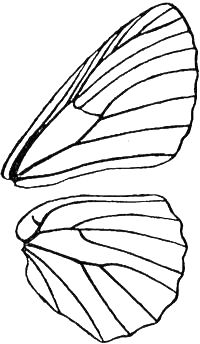
(1) Brenthis myrina, Cramer, Plate XV, Fig. 1, ♂; Fig. 2, ♂, under side; Plate V, Figs. 12-14, chrysalis (The Silver-bordered Fritillary).
Butterfly.—The upper side of the wings is fulvous; the black markings are light, the borders heavy. The fore wings on the under side are yellowish-fulvous, ferruginous at the tip, with the marginal spots lightly silvered. The hind wings are ferruginous, mottled with buff. The spots, which are small, are well silvered. Expanse, ♂, 1.40 inch; ♁, 1.70 inch.
Egg.—The egg is conoidal, about one third higher than wide, marked by sixteen or seventeen vertical ribs, between which are a number of delicate cross-lines. It is pale greenish-yellow in color.
Caterpillar.—The caterpillar has been carefully studied, and its various stages are fully described in "The Butterflies of New England," by Dr. Scudder. In its final stage it is about seven eighths of an inch long, dark olive-brown, marked with green, the segments being adorned with fleshy tubercles armed with needle-shaped projections, the tubercles on the side of the first thoracic segment being four times as long as the others, cylindrical in form, and blunt at the upper end, the spines projecting upward at an angle of forty-five degrees to the axis of the tubercle.
Chrysalis.—The chrysalis is yellowish-brown, spotted with darker brown spots, those of the thoracic and first and second abdominal segments having the lustre of mother-of-pearl.
This very pretty little species has a wide range, extending from New England to Montana, from Nova Scotia to Alaska, and southward along the ridges of the Alleghanies into Virginia and the mountains of North Carolina.
(2) Brenthis triclaris, Hübner, Plate XV, Fig. 3, ♂ (Hübner's Fritillary).
Butterfly, ♂.—The male above is bright fulvous, with the base of the fore wings and the inner margin of the hind wings heavily obscured with blackish scales. The usual dark markings are finer than in the preceding species; the black marginal borders are not so heavy. The submarginal spots are relatively large and distinct in most specimens, and uniform in size. The light spots of the under side of the median band of the hind wings show through from below on the upper side lighter than the ground-color of the wings. On the under side the fore wings are fulvous, tipped with ferruginous. The hind wings are broadly ferruginous, with a couple of bright-yellow spots near the base and a curved band of yellow spots crossing the median area. The outer margin about the middle is marked with pale fulvous. The spots on the under side are none of them silvered.
♁.—The female is much paler than the male in most cases, and the marginal spots within the lunules are very pale, almost white. The submarginal row of round black spots is relatively large and distinct, quite uniform in size. On the under side the wings are much more conspicuously marked on the secondaries than in the male sex, being crossed by three conspicuous bands of irregularly shaped yellow spots, one at the base and one on either side of the discal area. The submarginal round spots of the upper side reappear on the under side as small, slightly silvered, yellow spots. The marginal spots are bright yellow, slightly glossed with silver. Expanse, ♂, 1.50 inch; ♁, 1.60 inch.
Early Stages.—Unknown.
This extremely beautiful little species is found throughout arctic America, is not uncommon in Labrador, and also occurs upon the loftier summits of the Rocky Mountains in Colorado and elsewhere. It is, as most species of the genus, essentially arctic in its habits.
Plate XV.
(3) Brenthis helena, Edwards, Plate XVIII, Fig. 16, ♂, under side; Fig. 17, ♂ (Helena).
Butterfly, ♂.—The wings on the upper side are fulvous, greatly obscured by brown at the base of the fore wings and along the inner margin of the hind wings. The usual black markings are light, and the marginal border is also not so heavily marked as in B. myrina. The fore wings on the under side are pale fulvous, laved with ferruginous at the tip. The hind wings are brightly ferruginous, with small yellow marginal spots, and paler spots inclining to buff on the costal border and at the end of the cell, about the region of the median nervules.
♁.—The female is very much like the male on the upper side, but the ground-color is paler. On the under side the wings are somewhat paler, and all the spots and light markings, especially on the secondaries, are far more conspicuous, being bright yellow, and standing out very prominently upon the dark ferruginous ground. Expanse, 1.40 inch.
Early Stages.—The early stages of this insect are not as yet known.
Helena appears to be a common species in Colorado, Montana, and New Mexico. It is subject to considerable variation, both in the intensity of the coloring of the under side of the wings, and in the distinctness of the maculation.
(4) Brenthis montinus, Scudder, Plate XV, Fig. 7, ♂; Fig. 8, ♁, under side (The White Mountain Fritillary).
Butterfly, ♂.—The upper side is fulvous, closely resembling B. chariclea, but the ground-color is darker. The under side of the hind wings is deep ferruginous, mottled with white, the most conspicuous of the white spots being a white bar occurring at the end of the cell, and a small round white spot at the base of the wing. The hind wings have also a marginal row of slightly silvered white spots.
♁.—The female is very much like the male, but the ground-color of the upper side is paler. Expanse, ♂, 1.50 inch; ♁, 1.75 inch.
This interesting butterfly is found on the barren summits of Mount Washington, New Hampshire. It represents the survival of the arctic fauna on these desolate peaks, and, like the arctic flora of the spot where it is found, is a souvenir of the ice-age, which once shrouded the northeastern regions of the United States with glaciers.
(5) Brenthis chariclea, Schneider, Plate XV, Fig. 4, ♂ (Chariclea).
Butterfly, ♂.—Fulvous on the upper side, with heavy black markings, both wings greatly obscured at the base by fuscous. On the under side the fore wings are pale yellowish-fulvous, mottled with ferruginous at the tip and on the outer margin. The hind wings on the under side are dark purplish-ferruginous, mottled with yellow, crossed by a central row of conspicuous yellow spots. The row of marginal spots and two or three small spots at the base are white, slightly silvered.
♁.—The female differs from the male in having the markings of the upper side darker and heavier, and the outer margins more heavily marked with black, and having all the spots on the under side more distinctly defined against the dark ground. Expanse, ♂, 1.50 inch; ♁, 1.75 inch.
Early Stages.—Undescribed.
This species, like B. freija, is circumpolar, being found in Lapland, Greenland, and throughout arctic America. It also occurs within the limits of the United States, in the Yellowstone Park at considerable elevations, and is not uncommon on the high mountains in British Columbia, numerous specimens having been captured in recent years about Banff and Laggan, in Alberta.
(6) Brenthis boisduvali, Duponchel, Plate XV, Fig. 5. ♂; Fig. 6, ♁, under side (Boisduval's Fritillary).
Butterfly.—Somewhat closely resembling B. chariclea, but with the markings much heavier on the outer margin, and the base of the wings generally more deeply obscured with dark brown. The wings on the under side in color and marking closely approximate those of B. chariclea, and I have been unable to distinguish the specimens marked as boisduvali, and contained in the Edwards collection, from the specimens designated as B. chariclea in the same collection, so far as the color and maculation of the under sides of these specimens are concerned. Expanse, ♂, 1.50 inch; ♁, 1.75 inch.
Early Stages.—Unknown.
This species, originally described from Labrador, is found throughout boreal America and British Columbia.
(7) Brenthis freija, Thunberg, Plate XV, Fig. 9, ♂; Fig. 10, ♁, under side (The Lapland Fritillary).
Butterfly.—The wings are pale fulvous, the fore wings at the base and the hind wings on the inner half being deeply obscured with fuscous. The markings are quite heavy. The fore wings on the under side are very pale fulvous, yellowish at the tip, mottled with ferruginous. The hind wings are ferruginous on the under side, mottled with yellow. The spots are quite large, consisting of lines and dashes, and a marginal row of small lunulate spots, pale yellow or white, slightly silvered. Expanse, 1.50 inch.
This butterfly is circumpolar, being found in Norway, Lapland, northern Russia, and Siberia, through Alaska, British America, and Labrador, occurring also upon the highest peaks of the Rocky Mountains as far south as Colorado.
(8) Brenthis polaris, Boisduval, Plate XV, Fig. 11, ♂; Fig. 12, ♂, under side (The Polar Fritillary).
Butterfly.—The upper side dull fulvous; the markings on the inner half of the wings are confluent, and lost in the brownish vestiture which obscures this portion of the wing. The outer median area is defined by irregular zigzag spots which flow together. Beyond these the submarginal row of small black spots stands out distinctly upon the lighter ground-color of the wings. The outer margin is marked by black spots at the end of the nervules, on the fore wings somewhat widely separated, on the hind wings narrowly separated by the lighter ground-color. On the under side the wings are fulvous, with a marginal row of white checkerings on both wings. The hind wing is deeply mottled with ferruginous, on which the lighter white markings stand forth very conspicuously. Expanse, ♂, 1.50 inch.; ♁, 1.50-2.00 inches.
Early Stages.—Unknown.
This butterfly has been found in Labrador, Greenland, and other portions of arctic America, as far north as latitude 81° 52´.
(9) Brenthis frigga, Thunberg, Plate XV, Fig. 13, ♂; Fig. 14, ♁, lower side (Frigga).
Butterfly, ♂.—On the upper side this butterfly somewhat closely resembles polaris, but the markings are not so compact—more diffuse. The fore wings at the base and the hind wings on the inner two thirds are heavily obscured with brown. The outer margins are more heavily shaded with blackish-brown than in B. polaris. On the under side the wings are quite differently marked. The fore wings are fulvous, shaded with brown at the tips, and marked with light yellow on the interspaces beyond the end of the cell. The hind wings are dark ferruginous, shading into purplish-gray on the outer margin, with a whitish quadrate spot on the costa near the base, marked with two dark spots, and a bar of pale, somewhat obscured spots, forming an irregular band across the middle of the hind wings.
♁.—The female does not differ greatly from the male, except that the spots on the under side of the hind wings stand forth more conspicuously, being lighter in color and better defined. Expanse, 1.65-2.00 inches.
This pretty little butterfly occurs in Labrador, across the continent as far west as northern Alaska, and is also occasionally taken upon the alpine summits of the Rocky Mountains as far south as Colorado.
(10) Brenthis bellona, Fabricius, Plate XV, Fig. 16, ♂; Plate V, Fig. 10, chrysalis, side view; Fig. 11, chrysalis, side view (Meadow Fritillary).
Butterfly.—Pale fulvous on the upper side, with the dark markings on the inner half of the wing narrow, but more or less confluent. The dark markings on the outer part of the wing are slighter. The fore wings are a little angled on the outer margin below the apex. On the under side the fore wings are pale fulvous, mottled with purple at the tip and on the outer margin. The hind wings on this side are ferruginous, mottled with purple. Expanse, 1.65-1.80 inch.
Egg.—The egg of this species is similar in form, size, color, and markings to the egg of B. myrina.
Caterpillar.—The caterpillar also in its early stages closely resembles myrina, but in its mature form it differs in not having the spines on the second segment of the body lengthened as in that species.
Chrysalis.—The chrysalis, which is represented in Plate V, is bluish-gray in color, marked with dark spots. The life-history has been given us by several authors.
This butterfly is very common in the whole of the northern United States, as far south as the mountain-ranges of Virginia, and occurs throughout Quebec, Ontario, and British America, as far west as the foot-hills of the Rocky Mountains. It flies commonly with B. myrina, the only other species of the genus found in the densely populated portions of our territory, from which it may be at once distinguished by the entire absence of the silvered markings which make B. myrina so bright and attractive.
(11) Brenthis epithore, Boisduval, Plate XV, Fig. 17, ♂; Fig. 18, ♂, under side (Epithore).
Butterfly.—This species on the upper side is pale fulvous, with the markings slighter than in B. bellona, and the inner half of the hind wings much more heavily clouded with fuscous. On the under side the wings are somewhat like those of B. bellona, but less purple and mottled more distinctly with yellow. Expanse, ♂, 1.50 inch; ♁, 1.85 inch.
Early Stages.—Undescribed.
This species appears to replace B. bellona, its close ally, in California, Oregon, and the States eastward as far as parts of Colorado.
(12) Brenthis alberta, Edwards, Plate XV, Fig. 15, ♂ (Alberta).
Butterfly.—This, the least attractive in appearance of the species composing the genus, has pale wings with a "washed-out" appearance on the upper side, almost all the dark markings being greatly reduced or obliterated. On the under side the wings are even more obscurely marked than on the upper side. The female is darker than the male, and specimens have a greasy look. Expanse, ♂, 1.55 inch; ♁, 1.65-1.75 inch.
Early Stages.—Unknown, except the egg and the young caterpillar, which have been most beautifully figured by Edwards in vol. iii of "The Butterflies of North America." The only locality from which specimens have as yet been received by collectors is Laggan, in Alberta, where the species apparently is not uncommon at lofty elevations above sea-level.
(13) Brenthis astarte, Doubleday and Hewitson, Plate XVIII, Fig. 14, ♂; Fig. 15, ♁, under side (Astarte).
Butterfly.—This rare insect, the largest of the genus, may at once be distinguished from all others by the very beautiful markings of the under side of the hind wings, crossed by a band of irregular, bright-yellow spots, which are narrowly edged with black, and beyond the black bordered by red. Expanse, ♂, 2.00 inches; ♁, 2.15 inches.
Early Stages.—Unknown.
The first description and figure of this insect were given by Doubleday and Hewitson in their large and now very valuable work on "The Genera of Diurnal Lepidoptera." They correctly attributed it to the Rocky Mountains, but Kirby afterward gave Jamaica as its habitat, and this led to its subsequent redescription by Edwards under the name Victoria. It is a rare species still, having been received only from Laggan, Alberta, where it was rediscovered by that most indefatigable collector and observer, Mr. T.E. Bean. It frequents the highest summits of the lofty mountains about this desolate locality. Mr. Bean says: "Astarte seems always on the lookout for an entomologist, whose advent is carefully noted, and at any approach of such a monster nearer than about fifteen feet, its wings rise to half-mast, vibrate there a doubtful instant, and away goes the butterfly."