SUBFAMILY NYMPHALINÆ (THE NYMPHS) (continued 3)
Reading edition
The range of H. misippus is southern Florida, the Antilles, and the northern parts of South America. It is not common on this side of the Atlantic, but very common in Africa, tropical Asia, and the islands south as far as northern Australia.
Genus BASILARCHIA, Scudder (The White Admirals)
Butterfly.—Head large; the eyes are large, naked; the antennæ are moderately long, with a distinct club; the palpi are compact, stout, produced, densely scaled. The fore wings are subtriangular, the apex well rounded, the lower two thirds of the outer margin slightly excavated. The first two subcostal nervules arise before the end of the cell. The hind wings are rounded, crenulate.
Egg.—Nearly spherical, with the surface pitted with large hexagonal cells (see p. 3, Fig. 1).
Caterpillar.—The caterpillar in its mature state is cylindrical, somewhat thicker before than behind, with the second segment adorned with two prominent rugose club-shaped tubercles. The fifth segment, and the ninth and tenth segments also, are ornamented with dorsal prominences (see p. 8, Fig. 20).
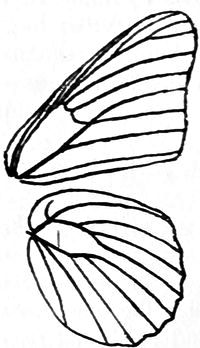
Fig. 106.—Neuration of the genus Basilarchia.
Chrysalis.—The chrysalis is suspended by a stout cremaster; the abdominal segments are rounded. On the middle of the dorsum is a prominent projecting boss. The thorax is rounded. The head is rounded or slightly bifid.
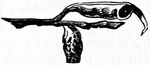
The caterpillars feed upon the leaves of various species of oak, birch, willow, and linden. The eggs are laid upon the extreme tip of the leaves, and the infant caterpillar, feeding upon the leaf in immediate proximity to the point where it has been hatched, attaches bits of bitten leaf by strands of silk to the midrib, thus stiffening its perch and preventing its curling as the rib dries. Out of bits of leaves thus detached it constructs a packet of material, which it moves forward along the midrib until it has completed its second moult. By this time winter begins to come on, and it cuts away for itself the material of the leaf on either side of the rib, from the tip toward the base, glues the rib of the leaf to the stem by means of silk, draws together the edges of the remaining portions of the leaf, and constructs a tube-like hibernaculum, or winter quarters, exactly fitting the body, in which it passes the winter.
Fig. 107.—Leaf cut away at end by caterpillar of Basilarchia (Riley).
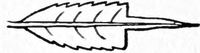
Fig. 108.—Hibernaculum, or winter quarters, of larva of Basilarchia.
There are a number of species of the genus found in the United States, the habits of which have been carefully studied, and they are among our most interesting butterflies, several species being mimics of protected species.
(1) Basilarchia astyanax, Fabricius, Plate XXII, Fig. 1, ♂; Plate III, Figs. 17, 21, 25, larva; Plate IV, Figs. 12, 13, chrysalis (The Red-spotted Purple).
Butterfly.—This common but most beautiful species is sufficiently characterized by the plate so far as the upper surface is concerned. On the under side the wings are brownish, banded with black on the margins; the lunules are on this side as above, but the inner band of spots is red. There are two red spots at the base of the fore wings, and four at the base of the hind wings. The palpi are white below, and the abdomen is marked with a lateral white line on each side. Expanse, 3.00-3.25 inches.
Egg.—The egg, which resembles somewhat closely that of B. disippus (see p. 3, Fig. 1), is yellowish-green, gradually turning dark brown as the time for the emergence of the caterpillar approaches.
Caterpillar.—The caterpillar is so well delineated in Plate III, Fig. 17, as to obviate the necessity for a lengthy verbal description.
Chrysalis.—What has been said of the caterpillar is also true of the chrysalis (see Plate IV).
The larva feeds upon the willow, cherry, apple, linden (Tilia), huckleberry, currant, and other allied shrubs and trees. The butterfly is somewhat variable, and a number of varietal forms have been described. It ranges generally over the United States and southern Canada as far as the Rocky Mountain ranges in the West, and is even said to occur at high elevations in Mexico.
(2) Basilarchia arthemis, Drury, Plate XXII, Fig. 4, ♂, form lamina, Fabricius; Fig. 5, ♂, form proserpina, Edwards, Plate III, Fig. 26, larva; Plate IV, Figs. 14, 23, chrysalis (The Banded Purple).
Butterfly.—Easily distinguished in the form lamina from astyanax, which in other respects it somewhat closely resembles, by the broad white bands crossing both the fore wings and the hind wings, and followed on the secondaries by a submarginal row of red spots shading inwardly into blue. In the form proserpina there is a tendency on the part of the white bands to become obsolete, and in some specimens they do entirely disappear. The likeness to astyanax in such cases is striking, and the main point by which the forms may then be discriminated is the persistence of the red spots on the upper side of the secondaries; but even these frequently are obsolete. Expanse, 2.50 inches.
Egg.—The egg is grayish-green, with "kite-shaped" cells.
Caterpillar.—Greenish-or olive-brown, blotched with white in its mature form, which is well represented in Plate III. It feeds upon the willow, the hawthorn (Cratægus), and probably other plants.
Chrysalis.—The figure in Plate IV is sufficiently exact to obviate the necessity for further description.
This beautiful insect ranges through northern New England and New York, Quebec, Ontario, and the watershed of the Great Lakes, spreading southward at suitable elevations into Pennsylvania. I have taken it about Cresson, Pennsylvania, at an elevation of twenty-five hundred feet above sea-level. It is not uncommon about Meadville, Pennsylvania. The species appears to be, like all the others of the genus, somewhat unstable and plastic, or else hybridization is very frequent in this genus. Probably all the species have arisen from a common stock.
Plate XXII.
(3) Basilarchia weidemeyeri, Edwards, Plate XXII, Fig. 6, ♂ (Weidemeyer's Admiral).
Butterfly.—Superficially like arthemis, but easily distinguished by the absence of the lunulate marginal bands of blue on the margins of the hind wings and by the presence of a submarginal series of white spots on both wings. Expanse, 3.00 inches.
Early Stages.—These have been described by W.H. Edwards in the "Canadian Entomologist," vol. xxiv, p. 107, and show great likeness to the following species, B. disippus. The caterpillar feeds upon cottonwood (Populus).
The insect is found on the Pacific slope and eastward to Montana, Nebraska, and New Mexico.
(4) Basilarchia disippus, Godart, Plate VII, Fig. 4, ♂; Plate III, Figs. 19, 22, 24, larva; Plate IV, Figs. 18-20, chrysalis (The Viceroy).
Butterfly.—This species mimics Anosia plexippus in a remarkable manner, as may be seen by referring to Plate VII. An aberration in which the mesial dark transverse band on the secondaries has disappeared was named pseudodorippus by Dr. Strecker. The type is in the Mead collection, now belonging to the writer. Expanse, 2.50-2.75 inches.
Early Stages.—These have all been carefully studied by numerous writers. The egg is depicted on p. 3, Fig. 1. The caterpillar is shown on p. 8, as well as in Plate III.
The species ranges everywhere from southern Canada and British America into the Gulf States.
(5) Basilarchia hulsti, Edwards, Plate VII, Fig. 5, ♂ (Hulst's Admiral).
Butterfly.—This form is apparently a mimic of Anosia berenice. The ground-color of the wings is not so bright as in B. disippus, and the mesial band of the secondaries on the upper side is relieved by a series of small whitish spots, one on each interspace. The perfect insect can easily be distinguished by its markings. Expanse, 2.50-2.60 inches. Thus far it is only known from Utah and Arizona. The early stages have not been described.
(6) Basilarchia lorquini, Boisduval, Plate XXII, Fig. 3, ♂ (Lorquin's Admiral).
Butterfly.—Easily distinguished from all the other species of the genus by the yellowish-white bar near the end of the cell of the fore wings and the reddish color of the apex and upper margin of the same wings. Expanse, 2.25-2.75 inches.
Early Stages.—These have been partially described by Henry Edwards, and minutely worked out by Dr. Dyar, for whose description the reader may consult the "Canadian Entomologist," vol. xxiii, p. 172. The food-plant of the caterpillar is Populus, willows, and the choke-cherry (Prunus demissa).
Besides the forms figured in our plates there is a species in Florida named floridensis by Strecker, and subsequently eros by Edwards, which is generally larger and much darker than B. disippus, which it otherwise closely approximates.
THE BUTTERFLIES' FAD
"I happened one night in my travels To stray into Butterfly Vale, Where my wondering eyes beheld butterflies With wings that were wide as a sail. They lived in such houses of grandeur, Their days were successions of joys, And the very last fad these butterflies had Was making collections of boys. "There were boys of all sizes and ages Pinned up on their walls. When I said 'Twas a terrible sight to see boys in that plight, I was answered: 'Oh, well, they are dead. We catch them alive, but we kill them With ether—a very nice way: Just look at this fellow—his hair is so yellow, And his eyes such a beautiful gray. "'Then there is a droll little darky, As black as the clay at our feet; He sets off that blond that is pinned just beyond In a way most artistic and neat. And now let me show you the latest,— A specimen really select, A boy with a head that is carroty-red And a face that is funnily specked. "'We cannot decide where to place him; Those spots bar him out of each class; We think him a treasure to study at leisure And analyze under a glass.' I seemed to grow cold as I listened To the words that these butterflies spoke; With fear overcome, I was speechless and dumb, And then with a start—I awoke!"
Ella Wheeler Wilcox.
Genus ADELPHA, Hübner (The Sisters)
Butterfly.—This genus is very closely allied to the preceding, and is the South American representative of Basilarchia. The only difference which is noticeable structurally is in the fact that the eyes are hairy, the palpi not so densely clothed with scales. The prothoracic legs of the males are smaller than in Basilarchia. The cell of the primaries is very slightly closed by the lower discocellular vein, which reaches the median a little beyond the origin of the second median nervule. The outer margin of the fore wing is rarely excavated, as in Basilarchia, and the lower extremity of the hind wing near the anal angle is generally more produced than in the last-mentioned genus.
Early Stages.—The life-history of the genus has not been carefully worked out, but an account has been published recently of the caterpillar of the only species found within our fauna, which shows that, while in general resembling the caterpillars of the genus Basilarchia, the segments are adorned with more branching spines and with short fleshy tubercles, giving rise to small clusters of hairs.
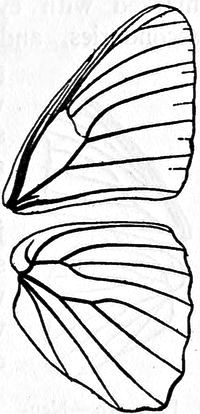
Fig. 109.—Neuration of the genus Adelpha.
The chrysalids are of peculiar form, with bifid heads and broad wing-cases. They are generally brown in color, with metallic spots. The only species in our fauna is confined to southern California, Arizona, and Mexico.
(1) Adelpha californica, Butler, Plate XXII, Fig. 2, ♁ (The Californian Sister).
Butterfly.—Easily recognized by the large subtriangular patch of orange-red at the apex of the primaries. In its habits and manner of flight it closely resembles the species of the genus Basilarchia. Expanse, 2.50-3.00 inches.
Early Stages.—So far as is known to the writer, these have not been described, except partially by Henry Edwards in the "Proceedings of the California Academy of Sciences," vol. v, p. 171. The caterpillar feeds upon oaks.
The insect is found in California, Nevada, Arizona, and Mexico.
Genus CHLORIPPE, Boisduval (The Hackberry Butterflies)
Butterfly.—Small butterflies, generally some shade of fulvous, marked with eye-like spots on the posterior margin of the secondaries, and occasionally upon the outer margin of the primaries, the fore wings as well as the hind wings being in addition more or less strongly spotted and banded with black. The eyes are naked; the antennæ are straight, provided with a stout, oval club; the palpi are porrect, the second joint heavily clothed with hairs, the third joint short, likewise covered with scales. The costal vein of the fore wing is stout. The first subcostal vein alone arises before the end of the cell. The cell is open in both wings.
Egg.—The eggs, which are deposited in clusters, are nearly globular, the summit broad and convex. The egg is ornamented by from eighteen to twenty rather broad vertical ribs, having no great elevation, between which are numerous faint and delicate cross-lines.
Fig. 110.—Neuration of the genus Clorippe, ♂.
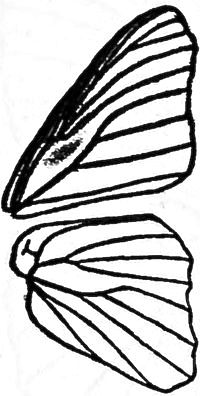
Caterpillar.—The head is subquadrate, with the summit crowned by a pair of diverging stout coronal spines which have upon them a number of radiating spinules. Back of the head, on the sides, is a frill of curved spines. The body is cylindrical, thickest at the middle, tapering forward and backward from this point. The anal prolegs are widely divergent and elongated, as in many genera of the Satyrinœ.
Chrysalis.—The chrysalis is compressed laterally and keeled on the dorsal side, concave on the ventral side, the head distinctly bifid. The cremaster is very remarkable, presenting the appearance of a flattened disk, the sides studded with hooks, by means of which the chrysalis is attached to the surface, from which it depends in such a manner that the ventral surface is parallel to the plane of support.
The caterpillars feed upon the Celtis, or hackberry.
There are a number of species, mainly confined to the southwestern portion of the United States, though some of them range southward into Mexico. Two only are known in the Middle States. The species are double-brooded in the more northern parts of the country, and the caterpillars produced from eggs laid by the second brood hibernate.
(1) Chlorippe celtis, Boisduval and Leconte, Plate XXIII, Fig. 3, ♂; Fig. 4, ♁; Fig. 11, ♂, under side (The Hackberry Butterfly).
Butterfly, ♂.—The primaries at the base and the secondaries except at the outer angle pale olive-brown, the rest of the wings black. The dark apical tract of the primaries is marked by two irregular, somewhat broken bands of white spots. There is a red-ringed eye-spot between the first and second median nervules, near the margin of the fore wing, and there are six such spots on each hind wing. On the under side the ground-color is grayish-purple; the spots and markings of the upper side reappear on this side.
♁.—The female has the wings, as is always the case in this genus, much broader and not so pointed at the apex of the primaries as in the male sex, and the color is much paler. Expanse, ♂, 1.80 inch; ♁, 2.10 inches.
Early Stages.—These are beautifully described and delineated by Edwards in "The Butterflies of North America," vol. ii. The caterpillar feeds on the hackberry (Celtis occidentalis).
This species is found generally from southern Pennsylvania, Ohio, Indiana, and Illinois to the Gulf of Mexico. It is not, so far as is known, found on the Pacific coast.
(2) Chlorippe antonia, Edwards, Plate XXIII, Fig. 12, ♂ (Antonia).
Butterfly.—Bright yellowish-fulvous on the upper side. Easily distinguished from celtis by the two eye-spots near the margin of the primaries. Expanse, 1.75-2.00 inches.
Early Stages.—Unknown.
Antonia is found in Texas.
(3) Chlorippe montis, Edwards, Plate XXII, Fig. 7, ♂; Fig. 8, ♁ (The Mountain Emperor).
Butterfly.—Very closely allied to C. antonia in the style and location of the markings, but tinted with pale ashen-gray on the upper side of the wings, and not yellowish-fulvous as in the last-named species. Expanse, ♂, 1.75 inch; ♁, 2.15 inches.
The early stages are unknown.
Montis occurs in Arizona and Colorado, and by some writers is regarded as a varietal form of antonia, in which opinion they may be correct.
(4) Chlorippe leilia, Edwards, Plate XXIII, Fig. 11, ♂ (Leilia).
Butterfly.—Like antonia, this species has two extra-median eye-spots on the primaries, and thus may be distinguished from celtis. From antonia it may be separated by its larger size and the deeper reddish-brown color of the upper surfaces. Expanse, 2.10-2.50 inches.
Early Stages.—Unknown.
So far we have received this butterfly only from Arizona.
(5) Chlorippe alicia, Plate XXIII, Fig. 9, ♂; Fig. 10, ♁ (Alicia).
Butterfly.—Very bright fawn at the base of the wings, shading into pale buff outwardly. There is but one eye-spot on the primaries. The six eye-spots on the secondaries are black and very conspicuous. The marginal bands are darker and heavier than in any other species of the genus. Expanse, ♂, 2.00 inches; ♁, 2.50 inches.
The early stages are only partially known.
Alicia ranges through the Gulf States from Florida to Texas.
(6) Chlorippe clyton, Boisduval and Leconte, Plate XXIII, Fig. 5, ♂; Fig. 6, ♁; Plate III, Fig. 20, larva; Plate IV, Figs. 15-17, chrysalis (The Tawny Emperor).
Butterfly, ♂.—The fore wings without an extra-median eye-spot, and the secondaries broadly obscured with dark brown or blackish, especially on the outer borders, so that the eye-spots are scarcely, if at all, visible.
♁.—Much larger and paler in color than the male, the eye-spots on the secondaries conspicuous. Expanse, ♂, 2.00 inches; ♁, 2.50-2.65 inches.
Early Stages.—The life-history has been carefully worked out, and the reader who wishes to know all about it should consult the writings of Edwards and Scudder.
Plate XXIII.
This species is occasionally found in New England, and ranges thence westward to Michigan, and southward to the Gulf States. It is quite common in the valley of the Ohio.
(7) Chlorippe flora, Edwards, Plate XXIII, Fig. 1, ♂; Fig. 2, ♁ (Flora).
Butterfly, ♂.—The ground-color is bright reddish-fulvous on the upper side. The usual markings occur, but there is no eye-spot, or ocellus, on the primaries. The hind wings are not heavily obscured with dark brown, as in clyton, and the six ocelli stand forth conspicuously upon the reddish ground. The hind wings are more strongly angulated than in any other species. The borders are quite solidly black.
♁.—The female is much larger than the male, and looks like a very pale female of clyton. Expanse, ♂, 1.75 inch; ♁, 2.35 inches.
Early Stages.—The life-history has been described by Edwards in the "Canadian Entomologist," vol. xiii, p. 81. The habits of the insect in its early stages and the appearance of the larva and chrysalis do not differ widely from those of C. clyton, its nearest ally.
Flora is found in Florida and on the borders of the Gulf to Texas.
Genus PYRRHANÆA, Schatz (The Leaf-wings)
Butterfly.—Medium-sized butterflies, on the upper side of the wings for the most part red or fulvous, on the under side of the wings obscurely mottled on the secondaries and the costal and apical tracts of the primaries in such a manner as to cause them to appear on this side like rusty and faded leaves. Structurally they are characterized by the somewhat falcate shape of the primaries and the strongly produced outer margin of the secondaries about the termination of the third median nervule. The first and second subcostal nervules coalesce with one another and with the costal vein. The costal margin of the fore wing at the base is strongly angulated, and the posterior margin of the primaries is straight. The cell of the secondaries is very feebly closed.
Egg.—Spherical, flattened at the base and somewhat depressed at the apex, with a few parallel horizontal series of raised points about the summit.
Caterpillar.—Head somewhat globular in appearance; the anterior portion of the first thoracic segment of the body is much smaller in diameter than the head; the body is cylindrical, tapering to a point.
Chrysalis.—Short, stout, with transverse ridges above the wings on the middle of the abdomen, keeled on the sides. The cremaster is small and furnished with a globular tip, the face of which is on the same plane as the ventral surface of the body, causing the chrysalis to hang somewhat obliquely from the surface which supports it.
This is a large genus of mostly tropical species, possessed of rather singular habits. The caterpillars in the early stages of their existence have much the same habits as the caterpillars of the genus Basilarchia, which have been already described. After passing the third moult they construct for themselves nests by weaving the edges of a leaf together, and thus conceal themselves from sight, emerging in the dusk to feed upon the food-plant. They live upon the Euphorbiaceæ, the Lauraceæ, and the Piperaceæ. The insects are double-brooded in the cooler regions of the North, and are probably many-brooded in the tropics.
Fig. 111.—Neuration of the genus Pyrrhanæa.
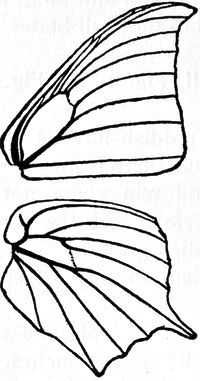
(1) Pyrrhanæa andria, Scudder, Plate XXIV, Fig. 1, ♁ (The Goatweed Butterfly).
Butterfly, ♂.—Solidly bright red above, the outer margins narrowly dusky on the borders. On the under side the wings are gray, dusted with brown scales, causing them to resemble the surface of a dried leaf.
♁.—The female has the upper side paler and marked by pale fulvous bands, as shown in the plate. Expanse, ♂, 2.50 inches; ♁, 3.00 inches.
Early Stages.—In Fig. 21, on p. 9, is a good representation of the mature caterpillar, the nest which it constructs for itself, and the chrysalis. A full account of the life-history may be found in the "Fifth Missouri Report" from the pen of the late C.V. Riley. The caterpillar feeds on Croton capitatum.
The insect ranges from Illinois and Nebraska to Texas.
(2) Pyrrhanæa morrisoni, Edwards, Plate XXIV, Fig. 2, ♁ (Morrison's Goatweed Butterfly).
Butterfly, ♂.—Much like P. andria, but more brilliantly and lustrously red on the upper side, and marked with paler macular bands like the female.
♁.—Differing from the female of P. andria in the more macular, or spotted, arrangement of the light bands on the wings, as is well shown in the plate. Expanse, 2.25-2.50 inches.
Early Stages.—Unknown.
This species occurs in Arizona and Mexico.
(3) Pyrrhanæa portia, Fabricius, Plate XXIV, Fig. 3, ♂ (Portia).
Butterfly.—Splendid purplish-red on the upper side. On the under side the fore wings are laved with bright yellow on the basal and inner marginal tracts, and the secondaries are dark brown, irrorated with blackish scales arranged in spots and striæ. Expanse, 2.75-3.00 inches.
Early Stages.—Unknown.
Portia occurs in the extreme southern part of Florida and in the Antilles.
Genus AGERONIA, Hübner (The Calicoes)
Fig. 112.—Neuration of the genus Ageronia.
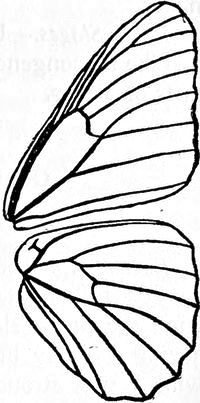
Butterfly.—The antennæ moderately long, delicate, terminated in a gradually thickened club. The eyes are naked; the palpi are compressed, only slightly porrect, not densely covered with scales. The neuration is alike in both sexes, the costal and the median veins greatly thickened toward the base. The first and second subcostals arise from before the end of the cell; the fourth and fifth subcostals arise from a common stem emitted from the third subcostal beyond the end of the cell. The cells in both the fore and hind wings are closed. The butterflies are of medium or large size, curiously marked with checkered spots, blue and white, with broad paler shades on the under side of the secondaries. They are rapid fliers and are said to alight on the trunks of trees with their wings expanded and their heads down. When flying they emit a clicking sound with their wings.
Early Stages.—Very little is known of these.
The chrysalids are slender and have two ear-like tubercles on the head.
This genus is, strictly speaking, neotropical. About twenty-five species have been described from Central and South America, some of them being exceedingly beautiful and rich in color. The two species credited to our fauna are reported as being occasionally found in Texas. I have specimens of one of the species which certainly came from Texas. I cannot be so sure of the other.
(1) Ageronia feronia, Linnæus, Plate XXIV, Fig. 4, ♂ (The White-skirted Calico).
Butterfly.—Easily distinguished from the only other species of the genus found in our fauna by the white ground-color of the under side of the hind wings. Expanse, 2.50 inches.
Early Stages.—Unknown.
This remarkable insect is said to be occasionally found in Texas.
(2) Ageronia fornax, Hübner, Plate XXIV, Fig. 5, ♂, under side (The Orange-skirted Calico).
Butterfly.—Closely resembling the preceding species on the upper side, but at once distinguished by the orange-yellow ground-color of the under side of the hind wing. Expanse, 2.60 inches.
Early Stages.—Unknown.
Like its congener, A. fornax is reported only from the hotter parts of Texas.
Genus VICTORINA, Blanchard (The Malachites)
Butterfly.—Large butterflies, curiously and conspicuously marked with light-greenish spots upon a darker ground; wings upon the under side marbled with brown about the spots and having a satiny luster. The third median nervule of the fore wing is very strongly bowed upward. The cells of both wings are open. The hind wing is tailed at the end of the third median nervule. The two first subcostals arise before the end of the cell; the fourth and fifth spring from a common stem which is emitted from the third beyond the end of the cell, as the cut shows.
Early Stages.—We know nothing of these.
This genus, in which are reckoned five species, all found in the tropics of the New World, is represented by but a single species in our fauna, which occurs in southwestern Texas and in Florida. It is very common in the West Indies and Central America.
Fig. 113.—Neuration of the genus Victorina.
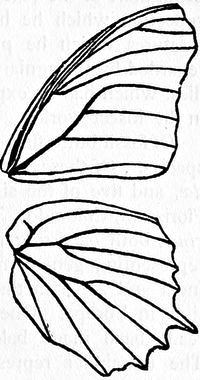
(1) Victorina steneles, Linnæus, Plate XXIV, Fig. 6, ♂ (The Pearly Malachite).
This splendid insect is occasionally found in southern Florida and the extreme southern part of Texas. It is common throughout tropical America. Nothing has ever been written upon its early stages.
FOSSIL INSECTS
Investigations within comparatively recent times have led to the discovery of a host of fossil insects. A few localities in Europe and in North America are rich in such remains, and the number of species that have been described amounts to several thousands. Strangely enough, some of these fossil insects are very closely allied in form to species that are living at the present time, showing the extreme antiquity of many of our genera. One of the comparatively recent discoveries has been the fossil remains of a butterfly which Dr. Scudder, who has described it, declares to be very near to the African Libythea labdaca, which differs in certain minor anatomical respects from the American Libytheas which are figured in this work; and Dr. Scudder has therefore proposed a new generic name, Dichora, meaning "an inhabitant of two lands," which he applies to the African species because related to the extinct American butterfly. The strange discoveries, which have been made by palæontologists as to the huge character of many of the mammals, birds, and reptiles which at one time tenanted the globe, are paralleled by recent discoveries made in insect-bearing strata in France. M. Charles Brongniart of the Paris Museum is preparing an account of the collection which he has made at Commentry, and among the creatures which he proposes to figure is an insect which is regarded by Brongniart as one of the forerunners of our dragon-flies, which had an expanse of wing of two feet, a veritable giant in the insect world.
Of fossil butterflies there have thus far been discovered sixteen species. Of these, six belong to the subfamily of the Nymphalidæ, and five of the six were found in the fossiliferous strata of Florissant, Colorado. Two species belong to the subfamily Satyrinæ, both occurring in deposits found in southern France, and representing genera more nearly allied to those now found in India and America than to the Satyrinæ existing at the present time in Europe. One of the fossils to which reference has already been made belongs to the subfamily of the Libytheinæ. The remainder represent the subfamilies of the Pierinæ, the Papilioninæ, and the family Hesperiidæ.
It is remarkable that the butterflies which have been found in a fossil state show a very close affinity to genera existing at the present time, for the most part, in the warmer regions of the earth. Though ages have elapsed since their remains were embedded in the mud which became transformed into stone, the processes of life have not wrought any marked structural changes in the centuries which have fled. This fixity of type is certainly remarkable in creatures so lowly in their organization.
Plate XXIV.