Front matter
Reading edition

University of Kansas Publications Museum of Natural History
Volume 12, No. 14, pp. 575-655, 10 figs.
May 18, 1964

The Breeding Birds of Kansas
BY RICHARD F. JOHNSTON
University of Kansas Lawrence 1964
University of Kansas Publications, Museum of Natural History Editors: E. Raymond Hall, Chairman, Henry S. Fitch, Theodore H. Eaton, Jr.
Volume 12, No. 14, pp. 575-655, 10 figs.
Published May 18, 1964
University of Kansas
Lawrence, Kansas
PRINTED BY HARRY (BUD) TIMBERLAKE, STATE PRINTER TOPEKA, KANSAS 1964 30-1476

The Breeding Birds of Kansas
BY RICHARD F. JOHNSTON
CONTENTS
PAGE
Introduction 577
Distribution of Birds in Kansas 579
Avian habitats in Kansas 581
Species reaching distributional limits in Kansas 584
Breeding Seasons 588
Introduction 588
Variation in breeding seasons 589
Zoogeographic categories 593
Significance of phylogeny to breeding schedules 595
Regulation of breeding schedules 598
Accounts of Species 601
Acknowledgments 652
Literature Cited 652
INTRODUCTION
The breeding avifauna of Kansas has received intermittent attention from zoologists for about 75 years. Summary statements, usually concerning all birds of the state, have been published by Goss (1891), Long (1940), Goodrich (1941), Tordoff (1956) and Johnston (1960). All but the first dealt with the breeding birds chiefly in passing, and none was concerned primarily with habitat distributions and temporal characteristics of Kansan birds. The present work treats mainly certain temporal relationships of breeding birds in Kansas, but also geographic distribution, habitat preferences, and zoogeographic relationships to the extent necessary for a useful discussion of temporal breeding phenomena.
Information on breeding of some of the 176 species of birds known to breed in Kansas is relatively good, on a few is almost non-existent, and on most is variously incomplete. It is nevertheless possible to make meaningful statements about many aspects of the breeding biology and distribution of most species of Kansan birds; we can take stock, as it were, of available information and assess the outstanding avenues of profitable future work. In the accounts of species below, the information given is for the species as it occurs in Kansas, unless it is otherwise stated. For the various subsections analyzing biology and distribution, only information taken in Kansas is used, and for this reason the analyses are made on about half the species breeding in the state. An enormous amount of observational effort has been expended by several dozen people in order that suitable data about breeding birds of Kansas be available; all persons who have contributed in any way are listed in the section on acknowledgments, following the accounts of species.
Kansas has been described topographically, climatically, and otherwise ecologically many times in the recent past; the reader is referred to the excellent account by Cockrum (1952), which treats these matters from the viewpoint of a zoologist. For present purposes it will suffice to mention the following characteristics of Kansas as a place lived in by birds.
Topographically, Kansas is an inclined plane having an elevation of about 4100 feet in the northwest and about 700 feet in the southeast. West of approximately 97° W longitude, the topography is gently rolling, low hills or flat plain; to the east the Flint Hills extend in a nearly north to south direction, and to the east of these heavily weathered, grassy hills is a lower-lying but more heavily dissected country, hills of which show no great differences in elevation from surrounding flatland.
The vegetation of eastern Kansas comingles with that of the western edge of the North American deciduous forest; a mosaic of true forest, woodland remnants, and tall-grass prairie occupies this area east of the Flint Hills. From these hills west the prairie grassland today has riparian woodland along watercourses; the prairie is composed of proportionally more and more short-grass elements to the west and tall-grass elements to the east.
Climate has a dominating influence on the vegetational elements sketched above. Mean annual rainfall is 20 inches or less in western sectors and increases to about 40 inches in the extreme eastern border areas. Mean monthly temperatures run from 25°F. or 30°F. in winter to 80°F. or 90°F. in summer. The northwestern edges of Caribbean Gulf warm air masses regularly reach northward only to the vicinity of Doniphan County, in northeastern Kansas, and extend southwestward into west-central Oklahoma; these wet frontal systems are usually dissipated along the line indicated by masses of arctic air, sometimes in spectacular fashion. The regular recurrence of warm gulf air is responsible for the characteristically high relative humidity in summer over eastern Kansas and it has an ameliorating effect on winter climate in this region. Almost immediately to the north in Nebraska and to the west in the high plains, summers are dryer and winters are notably more severe. The breeding distributions of some species of birds fairly closely approximate the distribution of these warm air masses; these examples are noted where appropriate below.
DISTRIBUTION OF BIRDS IN KANSAS
Birds breeding in Kansas are taxonomically, ecologically, and distributionally diverse. Such diversity is to be expected, in view of the mid-continental position of the State. Characteristics of insularity, owing to barriers to dispersal and movement, tend to be lacking in the makeup of the avifauna here. The State is not, of course, uniformly inhabited by all 176 species (Table 1) of breeding birds; most species vary in numbers from one place to another, and some are restricted to a fraction of the State. Variations in numbers and in absolute occurrence are chiefly a reflection of restriction or absence of certain plant formations, which is to say habitats; the analysis to follow is thus organized mainly around an examination of gross habitat-types and the birds found in them in Kansas.
Table 1.—The Breeding Birds of Kansas
Woodland Species
Elanoides forficatus N [A] Ictinia misisippiensis U Accipiter striatus U A. cooperii U Buteo jamaicensis O B. lineatus N B. platypterus N Aquila chrysaëtos O Falco sparverius U Colinus virginianus N Phasianus colchicus O Meleagris gallopavo N Philohela minor U Zenaidura macroura N Ectopistes migratorius N Conuropsis carolinensis U Coccyzus americanus N C. erythropthalmus N Otus asio U Bubo virginianus O Strix varia U Asio otus U Aegolius acadicus U Caprimulgus carolinensis N C. vociferus U Phalaenoptilus nuttallii N Chaetura pelagica U Archilochus colubris N Colaptes auratus N C. cafer N Dryocopus pileatus O Centurus carolinus N Melanerpes erythrocephalus N Dendrocopos villosus O D. pubescens O Tyrannus tyrannus S T. vociferans S Muscivora forficata S Myiarchus crinitus S Sayornis phoebe S Empidonax virescens S Contopus virens S Iridoprocne bicolor N Progne subis N Cyanocitta cristata N Pica pica O Corvus brachyrhynchos O C. cryptoleucus O Parus atricapillus O P. carolinensis O P. bicolor O Sitta carolinensis O Troglodytes aedon N Thryomanes bewickii N Thryothorus ludovicianus N Mimus polyglottos N Dumetella carolinensis N Toxostoma rufum N Turdus migratorius O Hylocichla mustelina N Sialia sialis O Bombycilla cedrorum N Lanius ludovicianus O Sturnus vulgaris O Vireo atricapillus N V. griseus N V. bellii N V. flavifrons N V. olivaceus N V. gilvus N Mniotilta varia N Protonotaria citrea N Parula americana N Dendroica aestiva N D. discolor N Seiurus motacilla N Oporornis formosus N Icteria virens N Wilsonia citrina N Setophaga ruticilla N Passer domesticus O Icterus spurius N I. galbula N I. bullockii N Quiscalus quiscula N Molothrus ater N Piranga olivacea N P. rubra N Richmondena cardinalis S Pheucticus melanocephala S P. ludoviciana S Guiraca caerulea S Passerina ciris S P. cyanea S P. amoena S Spinus pinus O S. tristis O Loxia curvirostra O Pipilo erythrophthalmus N Chondestes grammacus N Spizella passerina N
Limnic Species
Podilymbus podiceps U Phalacrocorax auritus U Ardea herodias U Leucophoyx thula U Nycticorax nycticorax U Nyctanassa violacea U Ixobrychus exilis U Botaurus lentiginosis U Plegadis chihi U Branta canadensis U Anas platyrhynchos U A. acuta U A. discors U A. clypeata U Aix sponsa U Aythya americana U Oxyura jamaicensis U Rallus elegans U Butorides virescens U Florida caerulea U Casmerodius albus U Porzana carolina U Laterallus jamaicensis U Gallinula chloropus U Fulica americana U Charadrius alexandrinus U Actitis macularia U Steganopus tricolor U Sterna albifrons U Chlidonias niger U Telmatodytes palustris N Cistothorus platensis N Geothlypis trichas N Xanthocephalus xanthocephalus N Agelaius phoeniceus N Rallus limicola U
Grassland Species
Buteo swainsonii N B. regalis U Circus cyaneus O Tympanuchus cupido N T. pallidicinctus N Pedioecetes phasianellus N Charadrius vociferus U Eupoda montana U Numenius americanus U Bartramia longicauda U Speotyto cunicularia U Asio flammeus U Sayornis saya S Eremophila alpestris O Dolichonyx oryzivorus N Sturnella magna N S. neglecta N Spiza americana N Calamospiza melanocorys N Ammodramus savannarum N Passerherbulus henslowii N Aimophila cassinii N Spizella pusilla N
Xeric Scrub Species
Callipepla squamata N Salpinctes obsoletus N Geococcyx californianus N
Unanalyzed Species
Cathartes aura N Coragyps atratus N Falco peregrinus U Columba livia O Tyto alba U Petrochelidon pyrrhonota U Chordeiles minor U Megaceryle alcyon U Riparia riparia O Stelgidopteryx ruficollis N Hirundo rustica O
Avian Habitats in Kansas
Four major habitat-types can be seen in looking at the distribution of the breeding avifauna of Kansas. These are woodland, grassland, limnic, and xeric scrub plant formations. A little more than half the breeding birds of Kansas live in woodland habitats, about one-fifth in limnic habitats, about one-eighth in grassland habitats, and less than two per cent in scrub habitats; this leaves some 6.4 per cent of the breeding avifauna unanalyzed (Table 2).
Table 2.—Analysis of the Breeding Avifauna of Kansas by Habitat-types
Habitat-type Percentage of the Avifauna of
Kansas North America Stated Habitat
Woodland: 101 species 58 16.7 44.4
Limnic: 36 species [B] 21 6.0 38.5
Grassland: 23 species 13 3.8 71.3
Xeric scrub: 3 species 2 0.5 10.2
Unanalyzed: 11 species 6 2.0 55.0
Totals: 174 species 100 29.0 43.2
Woodland Habitats
One hundred one species of Kansan birds are woodland species (tables 1 and 2). The analysis of Udvardy (1958) showed woodland birds to be the largest single avifaunal element in North America, with 38 per cent of North American birds relegated to it. It is likewise the largest element in the Kansan avifauna, representing 58 per cent of Kansan birds. Although woodland makes up a relatively small fraction of the vegetational complexes in Kansas, a large number of habitats exist in what woodland is present. An even larger number of possible woodland habitats is clearly missing, however, because the 101 Kansan species actually represent but 44 per cent of all woodland birds in North America, according to Udvardy's analysis. Broad-leaved, deciduous woodlands in Kansas are of restricted horizontal and vertical stratification. More complex deciduous forest associations and all coniferous forest associations are absent from the State.
Using Mayr's (1946) breakdown of geographical origin of the North American bird fauna, about 53 per cent of the woodland passerine birds in Kansas are of "North American" origin, 22 per cent are of "Eurasian" origin, and 14 per cent are of "South American" origin (Table 3). These figures for Kansas are commensurate with those found for other geographic districts at the same latitude in North America (Mayr, 1946:28). Other characteristics of woodland birds are summarized in tables 4 and 5.
Table 3.—Analysis of Ecologic Groups of Birds by Status of Residency and Area of Origin
Migrant Resident Pt. Migr. Old World N. Amer. S. Amer. Unanalyzed
Woodland species, 60% 29% 11% 22% 53% 14% 11%
101:58%
Limnic species, 94% 0 6% 0 14% 0 86%
36:21%
Grassland species, 61% 26% 13% 9% 56% 3% 30%
23:13%
Xeric Scrub species, 33% 66% 0 0 100% 0 0
3:2%
Unanalyzed species, 64% 27% 9% 26% 26% 0 48%
11:6%
Limnic Habitats
Of Kansan birds, 36 species (20 per cent) prefer limnic habitats (Table 1). Udvardy found this group to represent 15 per cent of the North American avifauna. Kansas is not notably satisfactory for limnic species, and only 38 per cent of the total North American limnic avifauna is present in the State.
Thirty-one species of limnic birds belong to families that Mayr (1946) considered to be unanalyzable as to their geographic origin; of the five remaining species, all seem to be of North American origin. Other characteristics of limnic birds are summarized in tables 4 and 5.
Grassland Habitats
Twenty-three species of our total can be called grassland species (Table 1). The subtotal is less than one-fifth of the Kansan avifauna, but it represents 72 per cent of the grassland birds of North America; grassland habitats abound in Kansas. Only 5.3 per cent of all North American birds are grassland species (Udvardy, 1958).
About 56 per cent of these birds are of North American stocks, nine per cent of Eurasian stocks, and three per cent of South American stocks. The percentage of North American species is the greatest for any habitat group here considered. Other characteristics of grassland birds are summarized in tables 4 and 5.
Table 4.—Analysis by Habitat-type and Residency Status of Historic Avian Stocks in Kansas
Woodland Limnic Grassland Xeric Scrub Unanal. Hab. Migrant Resident Partly Migrant
Old World Element 0% 0 8% 0 12% 11% 78% 11%
27:16%
North American Element 69% 6% 17% 4% 4% 72% 14% 14%
77:44%
South American Element 93% 0 7% 0 0 93% 7% 0
15:8%
Unanalyzed Origin 22% 56% 13% 0 9% 79% 16% 5%
53:32%
Xeric-Scrub Habitats
Three species of Kansan birds can be placed in this category (Table 1). This is less than one per cent of the North American avifauna, two per cent of the Kansan avifauna, and ten per cent of the birds of xeric scrub habitats in North America. The three species are considered to be of North American origin.
Unanalyzed as to Habitat
Eleven species of Kansan birds could not be assigned to any of the habitat-types mentioned above. The total represents two per cent of the North American avifauna, six per cent of the birds of Kansas, and 55 per cent of the species reckoned by Udvardy (loc. cit.) to be unanalyzable. Fifty-five per cent is a large fraction, but only to be expected: species are considered unanalyzable if they show a broad, indiscriminate use of more than one habitat-type, and such birds tend to be widely distributed.
Table 5.—Analysis by Ecologic Status and Area of Origin of Migrant and Resident Birds
Woodland Limnic Grassland Xeric Scrub Unanal. Hab. Old World N. Amer. S. Amer. Unanalyzed
Migrant species 52% 29% 12% 1% 6% 2% 49% 12% 37%
117:67%
Resident species 73% 0 15% 5% 7% 51% 26% 2% 21%
40:23%
Partly migrant 64% 11% 17% 0 6% 17% 66% 0 17%
17:10%
Species Reaching Distributional Limits in Kansas
The distributional limits of a species are useful in indicating certain of its adaptive capacities and implying maintenance of or shifts in characteristics of habitats. Although it is generally an oversimplification to ignore abundance when treating of distribution, the present remarks of necessity do not pertain to abundance.
Table 6.—Breeding Birds Reaching Distributional Limits in Kansas
Species reaching northern distributional limits
Florida caerulea Leucophoyx thula Coragyps atratus Elanoides forficatus Ictinia misisippiensis Tympanuchus pallidicinctus Callipepla squamata Geococcyx californianus Caprimulgus carolinensis Muscivora forficata Parus carolinensis Vireo atricapillus Passerina ciris Aimophila cassinii
Species reaching southern distributional limits
Aythya americana Parus atricapillus Bombycilla cedrorum Dolichonyx oryzivorus Pedioecetes phasianellus Empidonax minimus Steganopus tricolor Chlidonias niger
Coccyzus erythropthalmus
Species reaching eastern distributional limits
Eupoda montana Numenius americanus Phalaenoptilus nuttallii Colaptes cafer Tyrannus verticalis Sayornis saya Corvus cryptoleucus Salpinctes obsoletus Icterus bullockii Pheucticus melanocephalus
Passerina amoena
Species reaching western distributional limits
Aix sponsa Buteo platypterus Philohela minor Ectopistes migratorius Conuropsis carolinensis Chaetura pelagica Archilochus colubris Dryocopus pileatus Centurus carolinus Myiarchus crinitus Empidonax virescens E. traillii Parus bicolor Thryothorus ludovicianus Cistothorus platensis Hylocichla mustelina Vireo griseus V. flavifrons Mniotilta varia Protonotaria citrea Parula americana Dendroica discolor Seiurus motacilla Oporornis formosus Wilsonia citrina Setophaga ruticilla Sturnella magna Piranga olivacea Pheucticus ludovicianus Pipilo erythrophthalmus
Passerherbulus henslowii
Western Limits Reached in Kansas
Thirty-one species (tables 6 and 7) reach the western limits of their distribution somewhere in Kansas. Most of these limits are in eastern Kansas, and coincide with the gradual disappearance of the eastern deciduous forest formation. Twenty-nine species are woodland birds, and few of these seem to find satisfactory conditions in the riparian woods extending out through western Kansas. The Wood Thrush is the one woodland species that has been found nesting in the west (Decatur County; Wolfe, 1961). Descriptively, therefore, the dominant reason for the existence of distributional limits in at least 28 of these birds is the lack of suitable woodland in western Kansas; these 28 are the largest single group reaching distributional limits in the State. Many other eastern woodland birds occur in western Kansas along riparian woodlands, as is mentioned below.
Two species showing western limits in Kansas are characteristic of grassland habitats; the Eastern Meadowlark seems to disappear with absence of moist or bottomland prairie grassland and the Henslow Sparrow may be limited westerly by disappearance of tall-grass prairie.
The Short-billed Marsh Wren, a marginal limnic species, reaches its southwesterly mid-continental breeding limits in northeastern Kansas. The species breeds in Kansas in two or three years of each ten, in summers having unusually high humidity.
Northern Limits Reached in Kansas
Fourteen species (tables 6 and 7) reach their northern distributional limits in Kansas. Eight of these are birds of woodland habitats, but of these only the Carolina Chickadee is a species of the eastern deciduous woodlands; the other seven live in less mesic woodland. Three of these species (Chuck-will's-Widow, Scissor-tailed Flycatcher and Painted Bunting) have breeding ranges that suggest the northwesterly occurrences of summer humid warm air masses ("gulf fronts") and this environmental feature perhaps is of major importance for these birds, as it is also for the vegetational substratum in which the birds live.
The Lesser Prairie Chicken and the Cassin Sparrow are the two birds of grasslands that are limited northerly in Kansas. Xeric, sandy grassland is chiefly limited to the southwestern quarter of Kansas, and this limitation is perhaps of major significance to these two species. The Scaled Quail and Roadrunner tend to drop out as the xeric "desert scrub" conditions of the southwest drop out in Kansas.
Table 7.—Analysis by Habitat-type of Birds Reaching Distributional Limits in Kansas
Directional Limit Habitat-types
Woodland Grassland Limnic Xeric Scrub Total
Western extent 28 2 2 0 31
Northern extent 8 2 2 2 14
Eastern extent 6 4 0 2 11
Southern extent 4 2 3 0 9
Totals 46 10 6 3 65
Per cent of the Species in Stated Habitat 46 43 14 100 37
Eastern Limits Reached in Kansas
Eleven species (tables 6 and 7) reach their eastern distributional limits in Kansas. Six of these are woodland birds. Four of these are members of well-known species-pairs: the Red-shafted Flicker, Bullock Oriole, Black-headed Grosbeak, and Lazuli Bunting. Presence to the east of complementary species has much to do with the absence of these species in eastern Kansas. Four of the eleven are birds of grasslands, and they drop out as the short-grass prairie is restricted easterly.
The Rock Wren may be considered characteristic of xeric scrub in Kansas, and it is not found to the east in the absence of such scrub.
Southern Limits Reached in Kansas
Eight species (tables 6 and 7) reach their southern distributional limits in Kansas. Half of these birds are of woodland habitats, and of these four, the Black-capped Chickadee and Cedar Waxwing are chiefly of sub-boreal distribution. The Black-capped Chickadee also finds its niche partly pre-empted in southern Kansas by the Carolina Chickadee.
The Bobolink and Sharp-tailed Grouse are grassland species that are seemingly adapted to cooler, dryer grassland than is found in most of Kansas.
The Redhead, Wilson Phalarope, and Black Tern are limnic species, perhaps limited southerly by high summer temperatures; the three species are entirely marginal anywhere in Kansas.
Table 8.—Birds of the Eastern Deciduous Forest Found in Western Kansas in Riparian Woodland
Accipiter cooperii [C] Coccyzus americanus[C] Centurus carolinus Melanerpes erythrocephalus Tyrannus tyrannus Myiarchus crinitus Contopus virens Sayornis phoebe Cyanocitta cristata Dumetella carolinensis Toxostoma rufum Sialia sialis Vireo olivaceus Icterus spurius[C] Icterus galbula Quiscula quiscalus Piranga rubra[C] Passerina cyanea Richmondena cardinalis Pipilo erythrophthalmus[C]
Spizella passerina[C]
Influence of Riparian Woodland
Although the largest single element of the Kansan avifauna that reaches distributional limits in Kansas is made up of birds of the eastern deciduous forest, several species of the eastern woodlands are present in Kansas along the east-west river drainages in riparian woodland; the species are listed in Table 8. Twenty-one kinds are involved if we include the Cooper Hawk, Yellow-billed Cuckoo, Orchard Oriole, Summer Tanager, Rufous-sided Towhee, and Chipping Sparrow, all of which breed farther to the west but are present in western Kansas only along river drainages. This leaves 15 species of eastern deciduous woodlands that occur west in Kansas along riparian woodland (versus 30 species that drop out chiefly where eastern woodland drops out). These 15 species are about one-third of all woodland birds in western Kansas. Riparian woodland does not seem to afford first-rate habitat for most of the eastern woodland species that do occur; breeding density seems to be much lower than in well-situated eastern woodland.
The importance of these linear woodlands as avenues for gene-flow between eastern and western populations, especially of species-pairs (grosbeaks, flickers, orioles, and buntings), is obviously great. Likewise significant is the existence of these alleys for dispersal from the west of certain species (for instance, the Black-billed Magpie and the Scrub Jay) into new but potentially suitable areas.
BREEDING SEASONS
Introduction
An examination of breeding seasons or schedules is properly undertaken at several levels. The fundamental description of variation in breeding schedules must itself be detailed in several ways and beyond this there are causal factors needing examination. The material below is a summary of the information on breeding schedules of birds in Kansas, treated descriptively and analytically in ways now thought to be of use.
Almost any event in actual reproductive activity has been used in the following report; nestbuilding, egg-laying, incubation, brooding of young, feeding of young out of the nest are considered to be of equal status. To any such event days are added or subtracted from the date of observation so as to yield the date when the clutch under consideration was completed.
Such corrected dates can be used in making histograms that show the time of primary breeding activity, or the "egg-season." All such schedules are generalizations; data are used for a species from any year of observation, whether 50 years ago or less than one year ago. One advantage of such procedure is that averages and modes are thus more nearly representative of the basic temporal adaptations of the species involved, as is explained below.
When information on the schedule of a species from one year is lumped with information from another year or other years, two (and ordinarily more than two) frequency distributions are used to make one frequency distribution. The great advantage here is that the frequency distribution composed of two or more frequency distributions is more stable than any one of its components. Second, the peak of the season, the mode of egg-laying, is represented more broadly than it would have been for any one year alone. Third, the extremes of breeding activity are fairly shown as of minute frequency and thus of limited importance, which would not be true if just one year were graphed. All these considerations combine to support the idea that general schedules in fact represent the basic temporal adaptations of a species much better than schedules for one year only.
Variation in Breeding Seasons
In the chronology of breeding seasons of birds, there are three basic variables: time at which seasons begin, time at which seasons end, and time in which the major breeding effort occurs. These variables have been examined in one population through time (Lack, 1947; Snow, 1955; Johnston, 1956), in several populations of many species over wide geographic ranges (Baker, 1938; Moreau, 1950; Davis, 1953), and in several populations of one species (Lack, loc. cit.; Paynter, 1954; Johnston, 1954). The analysis below is concerned with breeding of many kinds of birds of an arbitrarily defined area and with the influence of certain ecologic and zoogeographic factors on the breeding seasons for those several species.
The Influence of Seasonal Status.—Here we are interested in whether a species is broadly resident or migrant in Kansas; 70 species are available for analysis.
Resident Species
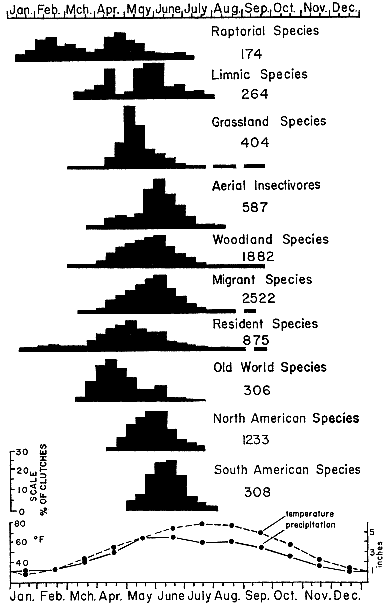
Twenty-four species, furnishing 875 records of breeding, are here considered to be resident birds in northeastern Kansas. These species are Cooper Hawk, Red-tailed Hawk, Prairie Chicken, Bobwhite, Rock Dove, Great Horned Owl, Red-bellied Woodpecker, Hairy Woodpecker, Downy Woodpecker, Horned Lark, Blue Jay, Common Crow, Black-billed Magpie, Black-capped Chickadee, Tufted Titmouse, Carolina Wren, Bewick Wren, Mockingbird, Eastern Bluebird, Loggerhead Shrike, Starling, House Sparrow, Eastern Meadowlark, and Cardinal. The distribution of completed clutches (Fig. 1) runs from mid-January to mid-September, with a modal period in the first third of May. Conspicuous breeding activity occurs from mid-April to the first third of June.
Migrant Species
Forty-six species, furnishing 2,522 records of breeding, are considered to be migrant in northeastern Kansas. These species are Great Blue Heron, Green Heron, Swainson Hawk, American Coot, Killdeer, Upland Plover, American Avocet, Least Tern, Yellow-billed Cuckoo, Black-billed Cuckoo, Burrowing Owl, Common Nighthawk, Chimney Swift, Red-headed Woodpecker, Eastern Kingbird, Western Kingbird, Scissor-tailed Flycatcher, Great Crested Flycatcher, Eastern Phoebe, Eastern Wood Pewee, Bank Swallow, Rough-winged Swallow, Barn Swallow, Purple Martin, Brown Thrasher, Catbird, House Wren, Robin, Wood Thrush, Blue-gray Gnatcatcher, Bell Vireo, Warbling Vireo, Prothonotary Warbler, Yellow Warbler, Chat, Western Meadowlark, Red-winged Blackbird, Orchard Oriole, Baltimore Oriole, Common Grackle, Black-headed Grosbeak, Indigo Bunting, Dickcissel, Lark Sparrow, and Field Sparrow. The distribution of completed clutches runs from mid-March to the first third of September, with a modal period of egg-laying in the first third of June (Fig. 1). Conspicuous breeding activity occurs from the first third of May to the last third of June.
The Influence of Dominant Foraging Adaptation.—Five categories here considered reflect broad foraging adaptation: woodland species, taking invertebrate foods in the breeding season from woody vegetation or the soil within wooded habitats; grassland species, taking invertebrate foods in the breeding season from within grassland situations; limnic species, foraging within marshy or aquatic habitats; aerial species, foraging on aerial arthropods; raptors, feeding on vertebrates or large insects.
Raptors
Six species, furnishing 174 records of breeding, are here considered, as follows: Cooper Hawk, Red-tailed Hawk, Swainson Hawk, Great Horned Owl, Burrowing Owl, and Loggerhead Shrike. The distribution of clutches (Fig. 1) runs from mid-January to the first third of July and is bimodal. One period of egg-laying occurs in mid-February and a second in the last third of April. Such a distribution indicates that two basically independent groups of birds are being considered. The first peak of laying reflects activities of the large raptors, and the second peak is that of the insectivorous Burrowing Owl and Loggerhead Shrike. The peak for these two birds is most nearly coincident with that for grassland species, a category to which the Burrowing Owl might well be relegated.
Fig. 1.—Histograms representing breeding schedules of ten categories of Kansan birds. Heights of columns indicate percentage of total of clutches of eggs, and widths indicate ten-day intervals of time, with the 5th, 15th, and 25th of each month as medians. The occurrences of monthly means of temperature and precipitation are indicated at the bottom of the figure.
Limnic Species
Six species, the Great Blue Heron, Green Heron, American Coot, American Avocet, Least Tern and Red-winged Blackbird, furnish 264 records of breeding. The distribution of clutches (Fig. 1) runs from mid-March to the last third of July and is bimodal. This is another heterogeneous assemblage of birds; the Great Blue Heron is responsible for the first peak, in the first third of April. The other five species, however, show fair consistency and their peak of egg-laying almost coincides with peaks for aerial foragers, woodland species, and migrants, considered elsewhere in this section.
Grassland Species
Ten species, Greater Prairie Chicken, Bobwhite, Killdeer, Upland Plover, Horned Lark, Starling, Eastern Meadowlark, Western Meadowlark, Common Grackle, and Dickcissel, furnish 404 records of breeding activity. The distribution of clutches (Fig. 1) runs from the first of March to mid-September. The peak of egg-laying occurs in the first third of May. This is coincident with the peak for resident species, perhaps a reflection of the fact that half the species in the present category are residents in northeastern Kansas.
Woodland Species
In this category are included species characteristic of woodland edge. Thirty-four species, furnishing 1,882 records of breeding, are here treated: Yellow-billed Cuckoo, Black-billed Cuckoo, "flicker" (includes birds thought to be relatively pure red-shafted, pure yellow-shafted, as well as clear hybrids), Red-bellied Woodpecker, Red-headed Woodpecker, Hairy Woodpecker, Downy Woodpecker, Blue Jay, Black-billed Magpie, Common Crow, Black-capped Chickadee, Tufted Titmouse, Carolina Wren, Bewick Wren, House Wren, Brown Thrasher, Catbird, Mockingbird, Robin, Wood Thrush, Eastern Bluebird, Blue-gray Gnatcatcher, Bell Vireo, Warbling Vireo, Prothonotary Warbler, Yellow Warbler, Chat, Orchard Oriole, Baltimore Oriole, Cardinal, Black-headed Grosbeak, Indigo Bunting, Lark Sparrow, and Field Sparrow. The distribution of clutches runs from the first third of March to mid-September (Fig. 1). The modal period for completed clutches is the first third of June. Conspicuous breeding activity occurs from the first third of May to mid-June. The distribution of the season in time is almost identical with that for migrant species, reflecting the large number of migrant species in woodland habitats in Kansas.
Aerial Foragers
Twelve species, Common Nighthawk, Chimney Swift, Eastern Kingbird, Western Kingbird, Scissor-tailed Flycatcher, Great Crested Flycatcher, Eastern Phoebe, Eastern Wood Pewee, Bank Swallow, Rough-winged Swallow, Barn Swallow, and Purple Martin, furnish 587 records of breeding. The distribution of clutches (Fig. 1) extends from the last third of March to the first third of August, and the modal date of clutches is in the first third of June. Conspicuous breeding activity occurs from the end of May to the end of June. The peak of nesting essentially coincides with that characteristic of migrants.
Zoogeographic Categories
Three categories of Mayr (1946) are of use in analyzing trends in breeding schedules of birds in Kansas. These categories of presumed ultimate evolutionary origin are the "Old World Element," the "North American Element," and the "South American Element." Not always have I agreed with Mayr's assignments of species to these categories, and such differences are noted. There is some obvious overlap between these categories and those discussed previously.
Old World Element
Eighteen species, Red-tailed Hawk, Rock Dove, Great Horned Owl, Hairy Woodpecker, Downy Woodpecker, Black-billed Magpie, Common Crow, Black-capped Chickadee, Tufted Titmouse, Robin, Loggerhead Shrike, Starling, House Sparrow, Bank Swallow, Barn Swallow, and Blue-gray Gnatcatcher, furnish 969 records of breeding (Fig. 1). Species for which I have records but which are not here listed are the Blue Jay and the Wood Thrush, both of which I consider to be better placed with the North American Element. The distribution of completed clutches runs from mid-January to the first third of August, and shows a tendency toward bimodality. The second, smaller peak is due to the inclusion of relatively large samples of three migrant species (Robin, Bank Swallow, and Barn Swallow). The timing of the breeding seasons of these three species is in every respect like that of most other migrants; if they are removed from the present sample the bimodality disappears, indicating an increase in homogeneity of the unit.
North American Element
Twenty-six species, Greater Prairie Chicken, Bobwhite, "flicker," Rough-winged Swallow, Purple Martin, Blue Jay, Carolina Wren, Bewick Wren, House Wren, Mockingbird, Catbird, Brown Thrasher, Wood Thrush, Bell Vireo, Warbling Vireo, Prothonotary Warbler, Yellow Warbler, Chat, Eastern Meadowlark, Western Meadowlark, Red-winged Blackbird, Orchard Oriole, Baltimore Oriole, Common Grackle, Lark Sparrow, and Field Sparrow, furnish 1,233 records of breeding (Fig. 1). The distribution of completed clutches runs from the first third of April to the first third of September. The modal date for completion of clutches is June 1.
South American Element
Twelve species, Eastern Kingbird, Western Kingbird, Scissor-tailed Flycatcher, Great Crested Flycatcher, Yellow-bellied Flycatcher, Traill Flycatcher, Eastern Wood Pewee, Eastern Phoebe, Cardinal, Black-headed Grosbeak, Rose-breasted Grosbeak, and Indigo Bunting, furnish 552 records of breeding (Fig. 1). The curve representing this summary schedule is bimodal, wholly as a result of including the Eastern Phoebe and the Cardinal with this sample.
Relationship of Schedules to Temperature and Precipitation
In outlining the ten categories above, attention has been given to certain similarities and differences in the frequency distributions. A slightly more refined way of comparing the frequency distributions is to relate them to other, seasonally variable phenomena. Figure 1 shows the frequency distributions of egg-laying of these ten categories of birds in terms of the regular changes in mean temperature and mean precipitation characteristic of the environments in which these birds live in the breeding season.
Table 9 shows that there are two basic groups of birds according to peak of egg-laying and incidence of precipitation; raptors, birds of Eurasian origin, resident birds, and birds of grassland habitats tend to have their peaks of egg-laying prior to the peak of spring-summer rains, and the other six categories tend to have their peaks of egg-laying occur in the time of spring-summer rains. Regarding temperature, there are four categories of birds; these are evident in the table.
Some of the correspondences deserve comment. Residents and grassland species both breed before the rains come and before mean temperatures reach 70°F., and this correspondence probably results from most of the grassland species being residents. Contrariwise, most birds of Eurasian stocks are residents, but not all residents are of such stocks; the two groups are discrete when mean temperature at breeding is considered. Woodland birds, aerial foragers, and birds of South American evolutionary stocks breed after temperatures surpass 70°F. on the average. Almost all such species are migrants, but many migrants have different temporal characteristics, and the categories thus are shown to be discrete on the basis of temperature at time of breeding. The change through spring and summer of temperature and precipitation delineates the inception and waxing of the growing season of vegetation and of the subsequent arthropod populations, on which most of the birds feed in the breeding season. The temporal characteristics of growing seasons in North America have been treated by Hopkins (1938) and have been related to timing of breeding seasons in Song Sparrows (Passerella melodia) of the Pacific coast of North America (Johnston, 1954).
Significance of Phylogeny to Breeding Schedules
Evidence from a variety of sources demonstrates that timing of breeding seasons is either broadly or specifically genetically-determined. For some species in some situations major environmental variables are paramount in regulating timing of breeding, but in others the innate, regulatory "clock" is less closely tied to conspicuous exogenous stimuli. The work by Miller (1955a, 1955b, 1960) with several species of Zonotrichia strongly indicates that endogenous timing is most important for these birds, and there is ecological evidence for Song Sparrows that supports the same point (Johnston, 1954, 1956). It is, in any event, possible to treat breeding schedules as species-specific characters, for any one geographic area.
In an attempt to relate a breeding schedule to previous ancestral modes, that is by extension to phylogeny, it is necessary to know how often ancestral adaptations can persist in the face of necessity to adapt to present environmental conditions. It is necessary to know how conservative or how immediately plastic breeding schedules can be. The disadvantage of using available information about configurations of breeding seasons (as shown in Figs. 3 to 9) is that it is extremely difficult to compare visually at one time more than six or eight histograms as to the trenchant similarities and differences regarding times of inception and cessation of breeding, and time of peak egg-laying. It is possible, however, to reduce these three variables to one variable (as described below), which allows the necessary comparisons to be made more easily; this variable may be called the breeding index.
Calculation of Breeding Index
The chronological year is broken roughly into ten-day intervals numbered 1 to 36. The histogram describing the temporal occurrence of the breeding season of a species in our area usually will lie within intervals 7 to 25. The modal date for completion of clutches is given a value corresponding to the number of ten-day intervals beyond interval 7 (March 1-10); this describes the modal variable. The date of completion of 83 per cent of all clutches is given a value corresponding to the number of ten-day intervals it lies from interval 11 (April 11-20); this describes the 83 per cent variable (and is a measure of the length of the season in terms of its inception). The breeding index can then be calculated as follows:
I =
X
m
+
X
sd
,
where: I is the breeding index,
Xm is the modal variable, and
Xsd is the 83 per cent variable.
This is obviously an arbitrary scheme to gain a simple measure of beginning, peak, and end of a breeding season. Other schemes could be devised whereby different absolute values would be involved, but the relative nature of the results would be preserved. The values under the present system for 73 species of Kansan birds run from -5 to +22; early modal dates and cessation to breeding give low values, late dates high values.
Within this framework there are other, presumably subordinate, factors that influence the values of breeding indices, as follows:
1. Migratory habit. Any migrant tends to arrive on breeding grounds relatively late, hence migrants ordinarily have higher index values than do residents.
2. Colonial breeding. The strong synchrony of colonially-breeding species tends to move the modal egg-date toward the time of inception of breeding; as a result colonially-breeding species probably have lower index values than they would have if not colonial.
3. Single-broodedness. Species having only one brood per season tend to have shorter seasons than double-brooded species, and their index values tend to be lower than those of double-brooded species.
Migratory habit unquestionably has considerable influence on index values in some species. It is not, however, as important as other matters, such as the condition of the food substratum or sensitivity of the pituitary-gonadal mechanism, in determining timing and mode of breeding activity. The schedule of the Purple Martin is the extreme example showing that time of spring arrival on breeding grounds is not necessarily related to time of inception of breeding. It should be emphasized that the factors leading to northward migratory movement may be involved in timing of the annual gonadal and reproductive cycle.
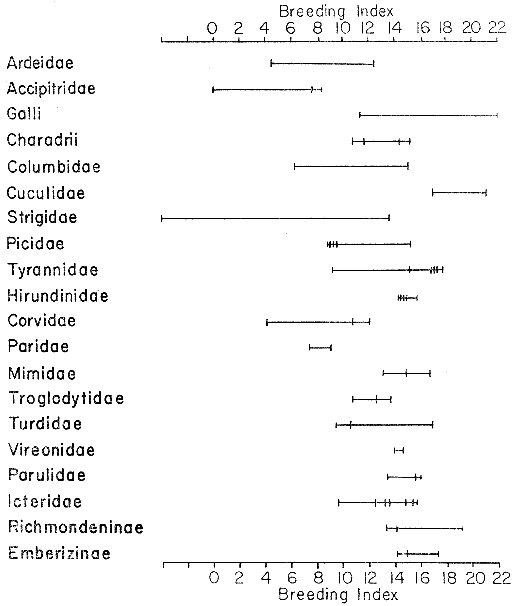
Figure 2 presents a graphic summary of values of breeding indices for many groups of Kansan birds. The values for species of a given family have been linked by a horizontal line. The length of this line is proportional to the degree to which the index values for the species concerned resemble one another. Note that the plottings for the Picidae, Corvidae, Turdidae, Tyrannidae, and Icteridae each contain one point that is well-removed from a cluster of points. This can be interpreted as a measure of the frequency of adaptive plasticity versus adaptive conservatism; five of the 24 plottings show a plastic character, 19 a conservative. There are 26 plottings that show temporal consistency, all of which may be taken as evidence of adaptive (or relictual) conservatism of the species in question.
Fig. 2.—Breeding indices for Kansan birds. Vertical hash-marks indicate the value of breeding index for a given species; horizontal lines show the range of values of breeding index for families and orders.
Conclusion
Such patterns of breeding chronology support the idea that seasonal response to the necessities of breeding is conservative more often than plastic. Most students of breeding schedules believe that since these are highly adaptive, they must also be capable of flexibility to meet variable environments within the range of the species. Such thinking receives support when different geographic localities are considered for one species (Johnston, 1954), or when specific features of a special environment are considered (see Miller, 1960; Johnston, 1956).
Yet, if one, relatively restricted locality is considered, as in the present study, evidence of a conservative characteristic in breeding schedules can be detected. This conservatism may result from the historic genetic "burden" of the species; that is to say, previous adaptive peaks may in part be evident in the matrix of contemporary adaptation. Adaptive relicts of morphological nature have been many times documented, but characteristics associated with seasonality and timing schedules have not.
In any event, genetic relationships are evident in the configuration of breeding seasons of many species here treated. Thus, any consideration of variation in breeding schedules must be sensitive to the limits, whether broad or restricting, that the heritage of a species sets on its present chronological adaptation.
Regulation of Breeding Schedules
Regulation of breeding schedules in birds always involves some exogenous, environmental timing or triggering mechanism. Broad limits to functional reproductive activity seem to be set by the photoperiod—neuroendocrine system. This basic, predominately extra-equatorial, regulator can be ignored by temperate-zone species only if they possess chronological adaptation to special, aperiodic environmental conditions, as does the Red Crossbill (Loxia curvirostra; see McCabe and McCabe, 1933; H. B. Tordoff, ms.), for which the chief consideration seems to be availability of conifer seeds. Environmental phonomena otherwise known to trigger breeding activity include rainfall (Davis, 1953; Williamson, 1956), presence of suitable nesting material (Marshall and Disney, 1957; Lehrman, 1958), temperature (Nice, 1937), and presence of a mate (Lehrman, Brody, and Wortis, 1961). Such regulators, or environmental oscillators, are the "phasing factors" of the physiologic clock that dictate the temporal occurrence of primary reproductive activity.
None of the regulators mentioned above has been specifically investigated for any Kansan bird, but it is reasonable to suppose that, in these temperate-zone species, the photoperiod is the most important general phasing factor in seasonal breeding. Although gonadal response and seasonal restriction of breeding are set by the photoperiod, specific temporal relationships are dictated by more immediate environmental variables.
Table 9.—Relationship Between Environmental Factors and Timing of Breeding in Birds of Kansas
Occurrence of Peak of Egg-laying
When Precipitation is: When Mean Temperature (F.) is:
Light Heavy < 55° < 70° ± 70° > 70°
Raptors x x
O. W. Element x x
Residents x x
Grassland species x x
Marshland species x x
N. Amer. Element x x
Migrants x x
Woodland species x x
Aerial foragers x x
S. Amer. Element x x
Table 9, as already noted, shows the gross relationships between certain groups of birds, certain arbitrary indicators of seasonal temperature-humidity conditions bearing significantly on the growing season, and occurrence in time of peak of egg-laying by the birds involved. Some species and groups of Kansan birds breed chiefly under cool-dry environmental conditions, and some under warm-wet environmental conditions. Within each of these categories some variation occurs. Thus, raptors and boreally-adapted species (the Eurasian zoogeographic element) breed under cool conditions prior to rains, and residents and grassland species breed under slightly warmer conditions prior to rains; limnic species, species derived from North American evolutionary stocks, and migrants tend to breed in the cooler segment of the warm-wet period, and woodland birds, aerial foragers, and species derived from South American evolutionary stocks tend to breed in the warmer segment of the warm-wet period.
So much, then, for relationships between birds and their environments at a descriptive level. It would be useful at this point to examine how environmental variables relate to timing of breeding. Certain independent lines of investigation indicate that birds have a well-developed internal timing device; most convincing is the work of Schmidt-Koenig (1960) and the others who have shown that the endogenous clock of birds can be shifted in its periodicity forward or backward in time. This and much other evidence (see Brown, 1960) indicate that many fundamental periodic regulators are extrinsic to the animal; it is thus permissible for present purposes to consider any expression of variation in timing as dependent on environmental oscillators. It is not hereby meant to ignore the fact that differential responses to dominant environmental variables occur within a species, indicating endogenous control over timing of breeding. The work by Miller (1960:518) with three populations of the White-crowned Sparrow, revealing innately different responses to vernal photoperiodic increase, is especially important in this regard. For the moment, however, we may consider exogenous controls only.
Any exogenous control, or environmental variable, can be looked on simply as a timing oscillator. Such variables show regular or irregular periodic activity, and the independent actions as a whole result in the more-or-less variable annual schedule of breeding for any species at any one place. It would seem that some oscillators are linked to one another, but there is a real question concerning the over-all degree to which linkage is present. It is significant that frequency distributions of breeding activity of various species and groups of birds take on the shape of a skewed normal curve. The more information is added to such distributions, the more nearly they approach being wholly normal, with irregularities tending to disappear. This kind of response itself is evidence that most of the variables influencing the distribution are not mutually linked.
This conclusion is warranted if we examine what would happen to frequency distributions if the variables or oscillators regulating timing were linked. The frequency distribution of breeding activity in birds is described by a nonlinear curve (a normal distribution is nonlinear). Let us assume that each of the environmental variables is a nonlinear oscillator, as is probable. A set of nonlinear oscillators mutually entrained or coupled and operating with reference to a given phenomenon would result in that phenomenon being described by a frequency distribution much more stable than if it were regulated by any one oscillator alone. However, the frequency distribution of a set of coupled nonlinear oscillators is non-normal (Wiener, 1958).
We do not obtain such distributions in describing breeding activity, so we may say that the oscillators regulating such activity are not coupled. Present distribution, habitat preference, residency status, foraging adaptation, previous zoogeographic history, and relicts of ancestral adaptation, all bear on the character of the breeding schedule of any bird species. The emphasis above on multiple regulation of breeding schedules conceivably reflects the true picture, but any such emphasis is made at the expense of taking one factor as basic, or reducing the many to one, in order to manufacture simplicity.
ACCOUNTS OF SPECIES
In each account below information is given concerning status, habitat, geographic distribution, seasonal occurrence, schedule of egg-laying, number of eggs laid, and sites of nests, as these pertain to Kansas, unless otherwise stated. The ways in which some of these points were elucidated are as follows.
1.—Breeding schedule. Frequency distributions of egg-laying in time are calculated on the basis of dates of completed clutches, as described earlier (p. 588). Any event in the series of actions of nesting—nestbuilding, egg-laying, incubation, brooding, feeding young out of nests—can be manipulated by adding or subtracting days to or from the date of record to yield the probable date of completion of the clutch. The resulting data are grouped into class intervals of ten days. Extreme dates here given for egg-laying may be as much as nine days off in accuracy, but the error does not often exceed five days. Extreme dates indicated here may be taken as actual or predicted extremes. The raw data used are on file at the Museum of Natural History and are available for use by any qualified individual.
2.—Dates of occurrence. First and last annual occurrences in the State for migrant species are indicated by both a range of dates and a median date. Twenty to 30 dates of first observation in spring are available for most of the common species, and 10 to 20 dates of last observation in autumn are at hand for such species. The median dates, earlier than and subsequent to which an equal number of observations are available, are reliable indicators of the dates on which a species is likely to be seen first in the State in an average year.
3.—Clutch-size. Information on number of eggs is given for each species according to the mode, followed by the mean, the range, and the size of the sample.
4.—Distribution in Kansas. Information on distribution in the breeding season within the borders of Kansas is given in accounts below chiefly by reference to one or more counties of the State. Location of counties can be made by referring to Figure 10.
Pied-billed Grebe: Podilymbus podiceps podiceps (Linnaeus).—This is a common but local summer resident, in and on ponds, marshes, streams, ditches, and lakes. The species can be seen in the State at any time, but usually arrives in the period March 1 to April 13 (the median is March 21), and departs southward in the period October 13 to November 18 (the median is October 24).
Breeding schedule.—Nineteen records of breeding span the period May 1 to June 30; the modal date for egg-laying is May 15.
Number of eggs.—Clutch-size is 4 to 10 eggs.
Nests are floating masses of marsh vegetation (cattail, smartweed, duckweed, filamentous green algae, and the like), kept green on top by addition of fresh material, in or at the edge of emergent marsh vegetation.
Double-crested Cormorant: Phalacrocorax auritus auritus (Lesson).—This is a transient, but has been found nesting on one occasion in Barton County (Tordoff, 1956:311).
Breeding schedule.—Eggs were laid in July and August in the one known nesting effort.
Number of eggs.—Clutch-size is 2 to 4 eggs (Davie, 1898).
Great Blue Heron: Ardea herodias Linnaeus.—This common summer resident nests in tall trees along rivers, streams, and marshes. The sector of greatest abundance is the Flint Hills. A. h. herodias Linnaeus occurs in extreme northeastern Kansas, A. h. wardi Ridgway breeds in southeastern Kansas, and A. h. treganzai Court breeds in western Kansas; specimens showing intermediate morphology have been taken from the central part of the State. Occurrence in time, exclusive of the few that overwinter in Kansas, is shown in Table 10.
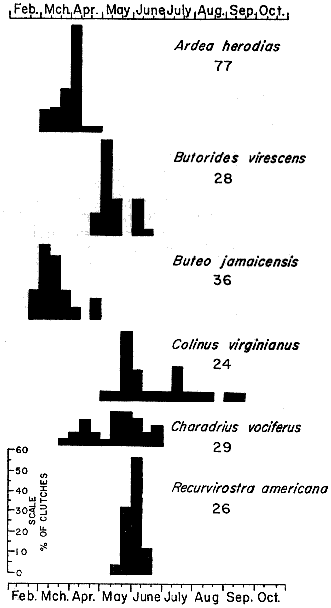
Breeding schedule.—Seventy-seven records of breeding span the period March 1 to April 30 (Fig. 3); the modal date of egg-laying is April 5.
Number of eggs.—Clutch-size is 4 eggs (4.4, 3-6; 36).
Nests are placed in crotches of sycamore, cottonwood, elm, hackberry, oak, and walnut, from 30 to 60 feet high; the average height is about 40 feet.
Table 10.—Occurrence in Time of Summer Resident Herons in Kansas
Species Arrival Departure
Range Median Range Median
Great Blue Heron Feb. 4-Apr. 8 Mar. 20 Oct. 10-Nov. 29 Oct. 23
Green Heron Mar. 29-May 4 Apr. 27 Sept. 1-Oct. 30 Sept. 9
Common Egret Apr. 8-May 12 Apr. 2 Sept. 4-Sept. 30 Sept. 21
Black-crowned Night Heron Mar. 27-May 18 Apr. 25 Sept. 10-Nov. 11 Sept. 25
Yellow-crowned Night Heron Apr. 15-May 18 Apr. 27 ........ ........
American Bittern Apr. 4-May 9 May 1 Oct. 6-Dec. 12 Oct. 16
Least Bittern Apr. 9-May 22 Apr. 8 Oct. 24 ........
Green Heron: Butorides virescens virescens (Linnaeus).—This is a common summer resident about streams, lakes, and marshes throughout the State. Some characteristics of the temporal occurrence of this species are indicated in Table 10.
Breeding schedule.—Twenty-eight records of breeding span the period April 21 to June 20 (Fig. 3); the modal date of completion of clutches is May 5.
Number of eggs.—Clutch-size is 3 eggs (3.1, 3-5; 17).
Nests are placed about 10 feet high (two to 35 feet) in willow, cottonwood, elm, and the like.
Little Blue Heron: Florida caerulea caerulea (Linnaeus).—This is chiefly a postbreeding summer visitant, but there is one record of breeding in Finney County (Tordoff, 1956:312).
Breeding schedule.—There is no information on breeding schedule in Kansas or in adjacent areas.
Number of eggs.—Clutch-size is 2 to 4 eggs (Davie, 1898).
Nests are placed in trees and bushes at various heights above the ground.
Common Egret: Casmerodius albus egretta (Gmelin).—This is a postbreeding summer visitant, but has been found nesting once in Cowley County (Johnston, 1960:10). Occurrence in time is listed in Table 10.
Breeding schedule.—There is no information on breeding schedule in Kansas.
Number of eggs.—Clutch-size is 2 to 4 eggs (Davie, 1898).
Nests are placed in trees, usually above 20 feet in height; the one instance of nesting in the State was within a colony of Great Blue Herons.
Snowy Egret: Leucophoyx thula thula (Molina).—This postbreeding summer visitant has been found nesting once in Finney County (Tordoff, 1956:312).
Breeding schedule.—There is no information on breeding schedule in the State.
Number of eggs.—Clutch-size is 2 to 5 eggs (Davie, 1898).
Nests in Kansas are placed among those of Great Blue Herons.
Black-crowned Night Heron: Nycticorax nycticorax hoactli (Gmelin).—This is a locally common summer resident around marshes and riparian habitats. Characteristics of the occurrence of the species in time are given in Table 10.
Breeding schedule.—Eggs are laid in the period May 1 to August 10.
Number of eggs.—Clutch-size is about 4 eggs.
Nests are placed at medium elevations in riparian trees, in Kansas chiefly cottonwood, or in beds of emergent marsh vegetation.
Yellow-crowned Night Heron: Nyctanassa violacea violacea (Linnaeus).—This is a local summer resident in riparian habitats, chiefly in southeastern Kansas. Specimens taken in the breeding season and records of nesting come from Meade, Stafford, Doniphan, Douglas, Greenwood, Woodson, Labette, and Cherokee counties. Characteristics of occurrence in time in Kansas are shown in Table 10. Breeding schedule.—Eggs are laid in May and June.
Number of eggs.—Clutch-size is about 4 eggs.
Nests are placed in riparian trees.
Least Bittern: Ixobrychus exilis exilis (Gmelin).—This is a local summer resident in marshland. Characteristics of its occurrence in time are indicated in Table 10.
Breeding schedule.—Eleven records of breeding span the period May 21 to July 20; the modal date of egg-laying seems to be in the first week of June.
Number of eggs.—Clutch-size is about 4 eggs.
Nests are placed in dense emergent vegetation a few inches to a foot above the surface of the water.
American Bittern: Botaurus lentiginosus (Rackett).—This is a local summer resident in marshes and heavy grassland. The species occurs temporally according to characteristics as listed in Table 10.
Breeding schedule.—Eggs are laid in May and probably in June.
Number of eggs.—Clutch-size is 3 or 4 eggs.
Nests are placed on the ground in heavy cover.
White-faced Ibis: Plegadis chihi (Vieillot).—This is a local summer resident in marshland; actual records of breeding come only from Barton County (Nossaman, 1952:7; Zuvanich, 1963; M. Schwilling, personal communication, July, 1962). The species has been recorded in the State from April 17 to October 6.
Breeding schedule.—Twenty-five breeding records are for June and early July.
Number of eggs.—Clutch-size is about 4 eggs (3.9, 3-4; 24).
Nests are placed in emergent marsh vegetation near the surface of the water, in Barton County in extensive cattail beds harboring also Black-crowned Night Herons.
Mallard: Anas platyrhynchos platyrhynchos Linnaeus.—This is a local summer resident around marshes. The time of greatest abundance is October to April, but most birds move north for breeding.
Breeding schedule.—Fifteen records of breeding span the period April 1 to June 10; the modal date of egg-laying is in the first ten days of May.
Number of eggs.—Clutch-size varies widely; first clutches are of about 12 eggs. Brood sizes vary from 3 to 12 individuals in Kansas.
Nests are placed on the ground surface, in pasture grasses, marsh grasses, cattail, sedge, and smartweed.
Pintail: Anas acuta Linnaeus.—This is a local summer resident in marshland. The time of greatest abundance is from September to May, but most birds move north for breeding.
Breeding schedule.—Eleven records of breeding span the period April 21 to June 10; the peak of egg-laying seems to be in the period May 1 to 10.
Number of eggs.—Clutch-size is around 10 eggs. Brood sizes vary from 3 to 8 individuals in Kansas.
Nests are placed on the ground surface, in cover of marsh grass, cattail, or sedge.
Blue-winged Teal: Anas discors discors Linnaeus.—This summer resident is locally common around marshes and ponds. The species arrives in spring in the period March 9 to April 5 (the median is March 23); birds are last seen sometime between October 7 and November 26 (the median is October 20).
Breeding schedule.—Twenty-two records of breeding span the period May 1 to May 30; the peak of egg-laying is around May 15. It is doubtful that the present data indicate the full extent of the egg-season in this duck.
Number of eggs.—Clutch-size is 8 to 12 eggs.
Nests are placed on the ground surface, in cover of grasses, cattail and sedges.
Shoveler: Anas clypeata Linnaeus.—This is an irregular and local summer resident, around marshes. Most individuals seen in the State are passage migrants. Breeding records are from Barton and Finney counties.
Breeding schedule.—Seasonal limits are unknown for the Shoveler in Kansas.
Number of eggs.—Clutch-size is about 8 eggs (Davie, 1898).
Nests are placed on the ground surface in cover of marsh vegetation.
Wood Duck: Aix sponsa (Linnaeus).—This is an uncommon summer resident around wooded streams and ponds in eastern Kansas. Nesting records and specimens taken in the breeding season come from east of stations in Pottawatomie, Coffey, and Woodson counties. Most nesting records at present come from the Marais des Cygnes Wildlife Refuge, Linn County. The species is present in the State from March 5 to December 8.
Breeding schedule.—Eleven records of breeding span the period March 21 to May 10; the peak of egg-laying is probably in mid-April. The present data are inadequate for showing the full span of the breeding season.
Number of eggs.—Clutch-size is around 15 eggs, varying from 10 to 23 in the sample at hand.
Nests are placed in crevices and hollows in trees near water, 10 to 70 feet high.
Redhead: Aythya americana (Eyton).—This duck nested at Cheyenne Bottoms, Barton County, 1962: 9 eggs found May 31 (M. Schwilling); also reported to have nested at Cheyenne Bottoms about 1928 (Tordoff, 1956:316).
Canvasback: Aythya valisineria (Wilson).—This duck nested at Cheyenne Bottoms, Barton County, 1962: 14 eggs found June 20 (M. Schwilling).
Ruddy Duck: Oxyura jamaicensis rubida (Wilson).—This is a local summer resident in marshland; numbers seem generally higher in western than in eastern Kansas. The season of greatest abundance is March through November, but numbers are conspicuously reduced in midsummer.
Breeding schedule.—Eggs are known to be laid in May and June.
Number of eggs.—Clutch-size is about 10 eggs (Davie, 1898).
Nests are placed near the edge of water, either in or on emergent marsh vegetation; nests of other marshland birds, such as coots, are sometimes appropriated (Davie, 1898).
Turkey Vulture: Cathartes aura teter Friedmann.—This summer resident is common throughout Kansas. Occurrence in time is indicated in Table 11.
Breeding schedule.—Fifteen records of breeding span the period April 21 to June 10; earlier records will doubtless be found, to judge from the frequency distribution of the present sample. The peak of egg-laying is perhaps around May 1.
Number of eggs.—Clutch-size is 2 eggs (1.8, 1-2; 12).
Nests are placed in holes and crevices in trees and cliffs, on rocky ledges, and the like.
Fig. 3.—Histograms representing breeding schedules of two herons, the Red-tailed Hawk, Bobwhite, and two shore birds in Kansas. See legend to Figure 1 for explanation of histograms.
Black Vulture: Coragyps atratus (Meyer).—This is possibly a summer resident in the southeastern sector of Kansas. There is one nesting record, for Labette County (Goss, 1891:245).
Breeding schedule.—There are no data for this species in Kansas.
Number of eggs.—Clutch-size is 2 eggs (Davie, 1898).
Nests are placed in hollows (logs, stumps, etc.) on the ground surface.
Swallow-tailed Kite: Elanoides forficatus forficatus (Linnaeus).—This kite was formerly a summer resident in eastern Kansas; it no longer occurs as a breeding species.
Breeding schedule.—In Kansas the season seemed to occur relatively late in the year for a raptor; eggs were laid in May, so far as is known.
Number of eggs.—Clutch-size is about 2 eggs (Davie, 1898).
Nests are placed in tops of trees.
Mississippi Kite: Ictinia misisippiensis (Wilson).—This is a common summer resident in southern Kansas, west to Morton County. Specimens taken in the breeding season and records of nesting come from south of stations in Grant, Barton, Harvey, and Douglas counties; the present center of abundance is in Meade, Clark, Comanche, Barber, and Harper counties.
Breeding schedule.—Seven records of breeding span the period April 20 to June 10; the peak of egg-laying seems to be in the first week of May.
Number of eggs.—Clutch-size is 2 eggs.
Nests are placed about 35 feet high (from 25 to 50 feet) in cottonwood, willow, elm, black locust, and the like.
Sharp-shinned Hawk: Accipiter striatus velox (Wilson).—This rare summer resident apparently occurs only in the eastern part. The two nesting records are from Cloud and Pottawatomie counties.
Breeding schedule.—The information at hand suggests the birds lay in April and May.
Number of eggs.—Clutch-size is about 4 eggs (Davie, 1898).
Nests are placed 20 or more feet high in coniferous or deciduous trees.
Cooper Hawk: Accipiter cooperii (Bonaparte).—This is an uncommon resident. Specimens taken in the breeding season and actual records of nesting come from east of stations in Cloud, Anderson, and Montgomery counties.
Breeding schedule.—Fourteen records of breeding span the period March 21 to May 30; the modal date of egg-laying is April 25.
Number of eggs.—Clutch-size is 4 eggs (3.8, 2-5; 5).
Nests are placed from 15 to 30 feet high, averaging 25 feet in elm, oak, and other trees.
Red-tailed Hawk: Buteo jamaicensis borealis (Gmelin).—This is a common resident east of the 100th meridian; to the west numbers are reduced, although the species is by no means unusual in western Kansas. Red-tails probably always were uncommon in western Kansas; Wolfe (1961) reports that they were "very rare as a nesting species" in Decatur County shortly after the turn of the 20th Century. Breeding schedule.—Thirty-six records of breeding span the period February 21 to April 10 (Fig. 3); the modal date of egg-laying is March 5.
Number of eggs.—Clutch-size is 3 eggs (2.6, 2-3; 20).
Nests are placed about 40 feet high, ranging from 15 to 70 feet in cottonwood, honey locust, osage orange, sycamore, and walnut.
Red-shouldered Hawk: Buteo lineatus lineatus (Gmelin).—This is an uncommon summer resident in eastern Kansas, in riparian and bottomland timber. Nesting records are available from Leavenworth, Woodson, and Linn counties, and red-shoulders probably also nest in Doniphan County (Linsdale, 1928).
Breeding season.—Eggs are laid in March and April.
Number of eggs.—Clutch-size is about 3 eggs (Davie, 1898).
Nests are placed up to 70 feet high in elms and other streamside trees.
Table 11.—Occurrence in Time of the Summer Resident Vulture and Hawks in Kansas
Species Arrival Departure
Range Median Range Median
Turkey Vulture Mar. 7-Mar. 30 Mar. 15 Sept. 24-Oct. 28 Oct. 5
Red-shouldered Hawk Feb. 10-Mar. 14 Feb. 26 Oct.-Dec. ........
Broad-winged Hawk Apr. 4-Apr. 21 Apr. 12 Sept. 1-Oct. 20 ........
Swainson Hawk Mar. 24-Apr. 28 Apr. 12 Oct. 5-Nov. 2 Oct. 11
Broad-winged Hawk: Buteo platypterus platypterus (Vieillot).—This is an uncommon summer resident in eastern Kansas, in swampy woodland. Specimens taken in the breeding season and nesting records are from Shawnee, Douglas, Leavenworth, and Johnson counties; there are several nesting records from Missouri in the bottomlands just across the river from Wyandotte County Kansas. Occurrence in time is listed in Table 11.
Breeding schedule.—Four records of nesting span the period April 21 to May 30, but it is likely that the egg-season is longer than this.
Number of eggs.—Clutch-size is about 3 eggs.
Nests are placed high in deciduous trees.
Swainson Hawk: Buteo swainsoni Bonaparte.—This is a common summer resident in prairie grassland with open groves and scattered trees. Records of breeding are available from all parts of the State, but are least numerous from the southeastern quarter. Occurrence in time is listed in Table 11.
Breeding schedule.—Sixteen records of breeding span the period April 11 to June 10; the modal date for completion of clutches is April 25.
Number of eggs.—Clutch-size is 2 eggs (2.4, 2-3; 5).
Nests are placed about 35 feet high, actually ranging from 12 to 75 feet, in cottonwood, elm, willow, and honey locust. Occasionally nests are placed on ledges in cliffs.
Ferruginous Hawk: Buteo regalis (Gray).—This is an uncommon resident in western Kansas, in grassland with scattered trees. Records of nesting and specimens taken in the breeding season come from Wallace, Hamilton, Gove, Logan, and Finney counties.
Breeding schedule.—Five records of breeding span the period March 11 to April 30.
Number of eggs.—Clutch-size is about 3 eggs (3.3, 3-4; 4).
Nests are placed on the ground surface on small cliffs or promontories or low (six to 10 feet) in small trees such as osage orange, cottonwood, and mulberry.
Marsh Hawk: Circus cyaneus hudsonius (Linnaeus).—This is a local resident in grassland throughout Kansas. Most records of breeding come from east of the Flint Hills, but it is not certain that the few records from the west actually reflect a low density of Marsh Hawks in that area.
Breeding schedule.—Sixteen records of breeding span the period April 11 to May 20; the modal date for egg-laying is May 5.
Number of eggs.—Clutch-size is 5 eggs (5.2, 3-7; 14).
Nests are placed on the ground surface in grassy cover.
Peregrine Falcon: Falco peregrinus anatum Bonaparte.—This falcon nested, perhaps regularly but clearly in small numbers, in Kansas prior to the 20th Century. The best documented breeding occurrence was at Neosho Falls, Woodson County (Goss, 1891:283).
Breeding schedule.—Eggs were recorded as being laid in February and March.
Number of eggs.—Clutch-size is 3 or 4 eggs (Davie, 1898).
Nests are placed relatively high on cliffs and in trees; at Neosho Falls these birds used open cavities 50 to 60 feet high in sycamores.
Sparrow Hawk: Falco sparverius sparverius Linnaeus.—This is a common resident throughout Kansas, in parkland and woodland edge.
Breeding schedule.—Thirteen records of egg-laying span the period March 21 to May 20; the modal date of laying is not evident in this sample but it probably falls around April 10.
Number of eggs.—Clutch-size is 4 eggs (4.2, 3-5; 5).
Nests are placed in cavities about 16 feet high, actually 12 to 30 feet, in cottonwood, ash, maple, Purple Martin "houses," and human dwellings.
Greater Prairie Chicken: Tympanuchus cupido pinnatus (Brewster).—This is a locally common resident in eastern Kansas, in and about bluestem prairie grassland, and is local in the northwest in undisturbed plains grassland. Wolfe (1961) reports that the species was common in Decatur County shortly after the turn of the Century, but that it became rare by 1914.
Breeding schedule.—Twenty-one records of breeding span the period May 1 to June 10 (Fig. 3); the modal date for laying is May 5. The sample indicates an abrupt inception to laying of eggs, and this may be a reflection of timing characteristic of behavior at leks, or booming grounds.
Number of eggs.—Clutch-size is 12 eggs (11.7, 9-15; 17).
Nests are placed on the surface of the ground in bluestem grassland or plains bunchgrass, usually under cover of prairie grasses and forbs.
Lesser Prairie Chicken: Tympanuchus pallidicinctus (Ridgway).—This is a local resident in sandy grassland in southwestern Kansas. Distribution is to the west and south of Pawnee County.
Breeding schedule.—There is no information on timing of the breeding season in Kansas.
Number of eggs.—Clutch-size is thought to be near that of the Greater Prairie Chicken. Vic Housholder (MS) observed a hen with ten chicks ten miles south of Dodge City, Ford County, on June 1, 1955.
Bobwhite: Colinus virginianus (Linnaeus).—This is a common resident in the east, but is local in western Kansas; occurrence is in broken woodland and other edge habitats. C. v. virginianus (Linnaeus) is found northeast of stations in Nemaha, Douglas, and Miami counties, and C. v. taylori Lincoln is found in the remainder of the State.
Breeding schedule.—Twenty-four records of breeding span the period May 1 to September 20 (Fig. 3); the modal date for first clutches is May 25. The long period of egg-laying after May probably includes both renesting efforts and true second nestings.
Number of eggs.—Clutch-size is about 13 eggs (12.8, 8-21; 22); in the present sample 16 eggs was the most frequent number.
Nests are placed on the surface of the ground at bases of bunch grasses, saplings, trees, or posts, under cover of prairie grasses, forbs, or small woody plants.
Scaled Quail: Callipepla squamata pallida Brewster.—This is a locally common resident in southwestern Kansas, chiefly west of Clark County and south of the Arkansas River; preferred habitat seems to be in open, sandy prairie.
Breeding schedule.—Eggs are laid at least in May; the egg-season in Kansas is unlikely to be so prolonged as that of the Bobwhite; among other factors involved, the Scaled Quail in Kansas is at a northern extreme of its distribution, where suboptimal environmental conditions may occur relatively frequently.
Number of eggs.—Clutch-size is around 10 to 12 eggs.
Nests are placed on the ground surface under woody or herbaceous cover.
Ring-necked Pheasant: Phasianus colchicus Linnaeus.—This introduced resident is common in western Kansas, is local and uncommon in the east, and is found in agricultural land with scattered woody vegetation.
Breeding schedule.—Eggs are laid at least in May.
Number of eggs.—Clutch-size is 10 to 12 eggs.
Nests are placed on the surface of the ground in woody or herbaceous cover.
Wild Turkey: Meleagris gallopavo Linnaeus.—Turkeys formerly occurred as common residents in flood-plain woodland in eastern Kansas, and their distribution extended through the west in riparian woodland. Present population in eastern and southern sectors are partly the result of introductions of birds from Missouri by humans in the 1950s. Turkeys in southern Kansas are also present owing to natural dispersal along the Arkansas and Medicine Lodge rivers of birds native to and introduced into Oklahoma. No specimens of turkeys presently found in Kansas are available for examination but these birds probably are referable to M. g. silvestris Vieillot, the trinomen applied to turkeys in Missouri and northeastern Oklahoma.
Turkeys from southern Texas recently have been liberated at several localities in southern Nebraska; turkeys seen in extreme northern Kansas are thus probably of these stocks. The name M. g. intermedia Sennett is applicable to these birds.
Breeding schedule.—No information is available on the egg-season in Kansas; turkeys have nested in southern Kansas within recent years, however.
Number of eggs.—Clutch-size is perhaps 12 eggs.
Nests are placed on the surface of the ground, usually well-concealed under woody vegetation.
King Rail: Rallus elegans elegans Audubon.—This summer resident is locally common in marshlands. Nesting records or adults taken in the breeding season are from Cheyenne, Meade, Pratt, Stafford, Cloud, Riley, Douglas, Anderson, and Allen counties. Dates of arrival in spring are recorded from April 7 to April 28; the median date is April 18. Departure in autumn is possibly as early as September in the north, but four records are in the period October 12 to November 25. The species occasionally can be found in winter (Douglas County, December 28, 1915).
Breeding schedule.—Fourteen records of breeding span the period May 1 to July 20; the modal date for egg-laying is June 5.
Number of eggs.—Clutch-size is about 10 eggs (9 to 12; 4 records).
Nests are placed on the surface of the ground, under grassy or woody cover.
Virginia Rail: Rallus limicola limicola Vieillot.—This is an uncommon summer resident, presumably throughout the State. The one breeding record is from Morton County (May 24, 1950; Graber and Graber, 1951). Dates of spring arrival are from April 19 to May 18; dates of last observation in autumn are within the period September 1 to October 30. A few birds overwinter in the southern part of the State (Meade County, December and January).
Breeding season.—Eggs are laid probably in May and June.
Number of eggs.—Six to 12 eggs are laid (Davie, 1898).
Nests are placed in emergent aquatic plants, near the surface of the water.
Sora: Porzana carolina (Linnaeus).—This is an uncommon summer resident in marshland. Nesting records or specimens taken in the breeding season come from Finney, Barton, Jefferson, Douglas, and Miami counties. First dates of observation in spring are from April 11 to May 9 (the median is May 1); dates when last observed in autumn are from September 30 to November 9 (the median is October 18).
Breeding schedule.—The one dated record comes from August.
Number of eggs.—Clutch-size is around 10 eggs (Davie, 1898).
Nests are on the ground in grassy or herbaceous cover.
Black Rail: Laterallus jamaicensis jamaicensis (Gmelin).—This is an uncommon summer resident in Kansas. Records of breeding and specimens taken in the breeding season come from Finney, Meade, Riley, and Franklin counties. Seasonal occurrence is within the period March 18 to September 26.
Breeding schedule.—Eggs are laid at least in June.
Number of eggs.—Clutch-size is about 8 eggs (6-10; 4). Nests are on the ground under cover of marsh plants.
Common Gallinule: Gallinula chloropus cachinnans Bangs.—This is a local summer resident in marshlands. Nesting records and specimens taken in the breeding season come from Barton, Stafford, Shawnee, Douglas, and Coffey counties. Occurrence in the State is from April through September.
Breeding schedule.—Eggs are laid in May and June.
Number of eggs.—Clutch-size is about 10 eggs.
Nests are in marsh grasses and other emergent vegetation, not necessarily over water.
American Coot: Fulica americana americana Gmelin.—This is an uncommon, local summer resident in wetlands in Kansas. Coots are at greatest abundance in autumnal and spring migratory movements, but are present all year. Nesting has been recorded from Barton, Stafford, Doniphan, and Douglas counties.
Breeding schedule.—Thirty-eight records of breeding span the period May 11 to June 30; the mode to laying is May 25. Earlier breeding probably occurs in the State.
Number of eggs.—Clutch-size is 8 eggs (7.7, 5-12; 28).
Nests are made of marsh vegetation (arrowhead, cattail) and float on water.
Snowy Plover: Charadrius alexandrinus tenuirostris (Lawrence).—This summer resident is fairly common on the saline flats of central and south-central Kansas. Breeding records are from Barton, Stafford, Meade, Clark, and Comanche counties.
Breeding schedule.—Fifteen records show that eggs are laid in the period May 25 to June 20; the peak of laying seems to be around June 10.
Number of eggs.—Clutch-size is 3 eggs.
Eggs are deposited on bare sand.
Killdeer: Charadrius vociferus vociferus Linnaeus.—This summer resident is common throughout the State, in open country frequently near wetlands. A few individuals overwinter in Kansas, especially in the southern counties.
Breeding schedule.—The 29 records of breeding span the period March 21 to June 30; the modal date of laying is May 20. The distribution of completed clutches (Fig. 3) suggests that Killdeers are here double-brooded.
Number of eggs.—Clutch-size is 4 eggs.
Eggs are laid on the surface of the ground, frequently on gravel, field stubble, plowed earth, and pasture.
Mountain Plover: Eupoda montana (Townsend).—This is an uncommon and local summer resident in western short-grass prairie. Breeding records come from Greeley and Decatur counties.
Breeding schedule.—Wolfe (1961) wrote that the species in Decatur County laid eggs in the "last of May" in the early 1900s. The only other dated breeding record is of downy young (KU 5512, 5513) taken on June 21.
Number of eggs.—Clutch-size is usually 3 eggs.
Eggs are laid in slight depressions in the ground, "lined with a few grass stems," according to Wolfe (1961).
American Woodcock: Philohela minor (Gmelin).—This is a rare summer resident in wet woodlands in eastern Kansas. Arrival in the northeast is from mid-March through April, with departures southward occurring from September to December; the last date on which the species has been seen in any year is December 5. There are nesting records only from Woodson County; probably the species nests in Douglas County (Fitch, 1958:194).
Breeding schedule.—Eggs are laid in April.
Number of eggs.—Clutch-size is usually 4 eggs.
Nests are depressions in the dry ground within swampy places, usually under heavy plant cover.
Long-billed Curlew: Numenius americanus americanus Bechstein.—This is an uncommon summer resident in western Kansas, in prairie grassland. Breeding records are from Stanton and Morton counties.
Breeding schedule.—Eggs are laid at least in May and June.
Number of eggs.—Clutch-size is 4 eggs.
Eggs are laid in slight depressions in the ground in grassy cover.
Upland Plover: Bartramia longicauda (Bechstein).—This is a locally common summer resident, most conspicuously in the Flint Hills, in grassland. Breeding records are from Trego, Hamilton, Finney, Morton, Meade, Marion, Chase, Kearny, Butler, Cowley, Douglas, Johnson, Wabaunsee, Franklin, Anderson, and Coffey counties. Dates of first arrival in spring span the period April 2 to May 5 (the median is April 19), and dates last seen in autumn are from September 3 to October 6 (the median is September 13).
Breeding schedule.—Sixteen records of breeding span the period April 21 to June 10; the modal date for egg-laying is May 5.
Number of eggs.—Usually 4 eggs are laid.
Eggs are placed on vegetation on the ground surface, in pasture, field stubble, or gravel, frequently under heavy plant cover.
Spotted Sandpiper: Actitis macularia (Linnaeus).—This summer resident is locally common on wet ground and along streams. Dates of arrival in spring are from March 29 to April 30 (the median is April 24), and dates of last observation in autumn span the period September 2 to October 10 (the median is September 18).
Breeding schedule.—Egg records are all from the northeastern sector, and all are for May.
Number of eggs.—Usually 4 eggs are laid.
Nests are of plant fibers in depressions in dry ground on gravel banks, pond or stream borders, or in pastureland.
American Avocet: Recurvirostra americana Gmelin.—This is a local summer resident in marshes in central and western Kansas. There are breeding records from Finney, Barton, and Stafford counties. Extreme dates within which avocets have been recorded are April 2 to November 21.
Breeding schedule.—Forty-one records of breeding span the period May 11 to June 20 (26 records shown in Fig. 3); the modal date for laying is June 5.
Number of eggs.—Usually 4 eggs are laid.
Nests are placed on the surface of the ground, near water.
Wilson Phalarope: Steganopus tricolor Vieillot.—This is a local summer resident in marshes in central and western Kansas, but breeding records are available only from Barton County. The earliest date of occurrence is April 7 and the latest is October 14.
Breeding schedule.—Ten records indicate eggs are laid in May and June.
Number of eggs.—Three or 4 eggs are laid.
Nests are of plant stems in slight depressions in the ground.
Forster Tern: Sterna forsteri Nuttall.—This is a local summer resident in central Kansas, in marshes. There are breeding records only from Cheyenne Bottoms, Barton County (Zuvanich, 1963:1). First dates of arrival in spring span the period April 9 to 29 (the median is April 22), and apparent departure south in autumn occurs from August 1 to November 1 (the median is September 3).
Breeding schedule.—Twenty-three records of nesting are from late May to mid-June; all records are for the year 1962.
Number of eggs.—Usually 4 eggs are laid.
Nests are frequently floating platforms of vegetation (algae, cattail, and the like) in shallow water; old nests of Pied-billed Grebes are sometimes used as bases, and occasionally the birds nest on the ground.
Least Tern: Sterna albifrons athalassos Burleigh and Lowery.—This tern is a local summer resident in marshes and along streams in central and western Kansas. There are breeding records from Hamilton, Meade, and Stafford counties. First dates of arrival in spring are from May 14 to 30 (the median is May 28), and last dates of occurrence in autumn are from August 9 to September 7 (the median is August 25).
Breeding schedule.—Twenty-one records of egg-laying are from May 21 to June 30 (Fig. 4); the modal date for laying is June 5.
Number of eggs.—Two, 3 or 4 eggs are laid.
Eggs are laid on the bare ground, usually a sandy surface, near water.
Black Tern: Chlidonias niger surinamensis (Gmelin).—This is a local summer resident in marshlands in central Kansas. There are breeding records only from Barton County for 1961 and 1962; possibly the species breeds in Douglas County. First dates of arrival in spring are from May 3 to 29 (the median is May 14), and last dates of occurrence in autumn are from September 2 to 30 (the median is September 11).
Breeding schedule.—Twenty-four sets of eggs (Parmelee, 1961:25; M. Schwilling) were complete between June 11 and July 12.
Number of eggs.—Clutch-size is 3 eggs.
Nests are of dead plant matter placed on floating parts of emergent green plants in shallow water.
Rock Dove: Columba livia Gmelin.—This species was introduced into North America by man from European stocks of semi-domesticated ancestry. "Pigeons" now are feral around towns and farms, and cliffsides in the west, and are locally common permanent residents throughout the State.
Breeding schedule.—Eggs are laid in every month of the year. The main season of breeding is spring, and this is depicted in Figure 4; the 26 records of breeding by feral birds are from January 11 to June 10, and the modal date of laying is probably April 5.
Number of eggs.—Pigeons usually lay 2 eggs. Nests are of sticks and other plant matter placed on ledges and recesses of buildings, bridges, and cliffs, 10 to 60 feet high.
Fig. 4.—Histograms representing breeding schedules of the Least Tern, two doves, the Yellow-billed Cuckoo, and two owls in Kansas. See legend to Figure 1 for explanation of histograms.
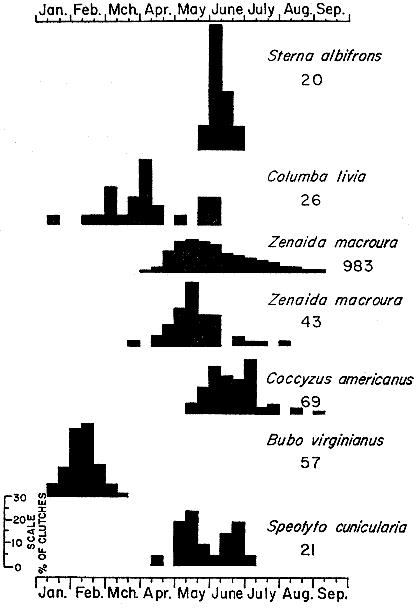
Mourning Dove: Zenaidura macroura marginella (Woodhouse).—This is a common summer resident throughout the State, in open country and woodland edge. The species is also present in winter in much reduced numbers, and many are transient in periods of migration. The time of greatest abundance is from March to November. Doves of extreme eastern Kansas have by some workers been referred to the subspecies Z. m. carolinensis (Linnaeus); specimens at the Museum of Natural History indicate that these doves are best regarded as members of populations of intermediate subspecific, or morphologic, affinities, and that they are satisfactorily included within Z. m. marginella.
Breeding schedule.—Numerous (983) records of egg-laying from north-central Kansas are from April 1 to September 10; the modal date for laying is May 15. Forty-three records of breeding from northeastern Kansas span the period March 21 to August 10; the modal date of laying is May 15. These samples are depicted in Figure 4.
Both sets of data are shown here to illustrate some of the differences between large and small samples of heterogeneous data. The small sample tends to be incomplete both early and late in the season, and the mode tends to be conspicuous. Yet, the modes for the two samples coincide. Also, the data from the north-central sector indicate that egg-laying in March would be found less than once in 983 records, but the small sample from the northeast includes one record for March. Such an instance doubtless reflects, at least in part, the fact that the two geographic sectors have different environmental conditions, but it is likely that the instance also partly reflects the unpredictable nature of sampling.
Number of eggs.—Doves lay two eggs. About one per cent of all nests have 3 eggs, but it is not known for any of these whether one or two females were responsible.
Nests are placed in a wide variety of plants, or on the ground. The commonest plants are those used most frequently; in north-central Kansas one-third of all nests are placed in osage orange trees, but in the northeast elms are most frequently used. Nestsites are from zero to 15 feet high.
Yellow-billed Cuckoo: Coccyzus americanus americanus (Linnaeus).—This is a common summer resident in riparian and second-growth habitats throughout the State. Twenty-three dates of first arrival in spring fall between April 29 and May 22 (the median is May 12), and nine dates of last observation in autumn run from September 13 to October 12 (the median is September 23).
Breeding schedule.—Sixty-nine records of egg-laying span the period May 11 to September 10 (Fig. 4); the modal date of laying is June 5.
Number of eggs.—Clutch-size is 3 eggs (3.1, 2-5; 54).
Nests are placed about six feet high (from four to 20 feet) in sumac, rose, pawpaw, mulberry, elm, cottonwood, willow, redbud, oak, osage orange, walnut, boxelder, usually on horizontal surfaces, and in heavy cover.
Black-billed Cuckoo: Coccyzus erythropthalmus (Wilson).—This is an uncommon summer resident, occurring in heavy riparian shrubbery and second-growth. Breeding records are chiefly from eastern Kansas, but specimens have been taken in the breeding season in all parts of the State. Eleven dates of first arrival in spring are from May 7 to May 30 (the median is May 19), and four dates of last observed occurrence in autumn are between September 4 and October 7 (the average is September 18).
Breeding schedule.—Seventeen records of egg-laying are between May 21 and August 10; the mode is at June 5.
Number of eggs.—Clutch-size is 2 to 3 eggs (2.5, 2-3; 13).
Nests are placed about four feet high in heavy cover in plum, elm, locust, and the like.
Roadrunner: Geococcyx californianus (Lesson).—This is a local resident in southern Kansas in xeric scrub or open edge habitats. Breeding records are from Cowley and Sumner counties.
Breeding schedule.—Eggs are laid at least from early April to mid-July.
Number of eggs.—Clutch-size is about 5 eggs (4.5, 3-6; 4).
Nests are placed on the ground under plant cover, or occasionally low in bushes.
Barn Owl: Tyto alba pratincola Bonaparte.—This resident has a low density throughout Kansas in open woodland and near agricultural enterprises of man.
Breeding schedule.—The few records available indicate egg-laying occurs at least from April to July; elsewhere the species is known to have a more protracted breeding schedule.
Number of eggs.—Clutch-size is about 5 eggs (4.7, 2-6; 4).
Nests are informal aggregations of sticks and litter placed in recesses in stumps, hollow trees, rocky and earthen banks, and dwellings and outbuildings of man.
Screech Owl: Otus asio (Linnaeus).—This is a common resident in woodland habitats throughout Kansas. O. a. aikeni (Brewster) occurs west of Rawlins, Gove, and Comanche counties, and O. a. naevius (Gmelin) occurs in the remainder of the State except for the eastern south-central sector, occupied by O. a. hasbroucki Ridgway.
Breeding schedule.—Fifteen records of egg-laying span the period March 20 to May 10; there is a strong mode at April 5.
Number of eggs.—Clutch-size is 4 eggs (4.0, 3-6; 12).
Nests are placed in holes and recesses in trees, three to 20 feet high.
Great Horned Owl: Bubo virginianus (Gmelin).—This is a common resident throughout Kansas, especially near woodlands and cliffsides. B. v. virginianus (Gmelin) occurs east of a line through Rawlins and Meade counties and B. v. occidentalis Stone occurs to the west.
Breeding schedule.—Fifty-seven records of egg-laying span the period January 11 to March 20 (Fig. 4); the modal date for laying is near February 10.
Number of eggs.—Clutch-size is 2 eggs (2.4, 2-3; 22).
Nests are placed about 30 feet high in cottonwood, elm, osage orange, hackberry, juniper, locust, cliffsides, and buildings of man. Old nests of hawks, crows, and herons are frequently appropriated.
Burrowing Owl: Speotyto cunicularia hypugaea (Bonaparte).—This is an uncommon summer resident in western Kansas in grassland and open scrub habitats. Stations of breeding all come from west of a line running through Cloud and Barber counties. Arrival in spring is between March 22 and April 17 (the median for 7 records is April 9), and dates last seen in autumn span the period September 8 to November 14 (the median for 9 records is September 26).
Breeding schedule.—Twenty-one records of egg-laying run from April 11 to July 10 (Fig. 4); the mode of laying is May 15.
Number of eggs.—Clutch-size is 7 or 8 eggs.
Nests are informal aggregations of plant and animal fibers in chambers of earthen burrows usually made by badgers or prairie dogs.
Barred Owl: Strix varia varia Barton.—This is a local resident in eastern Kansas, in heavy woodland. The species is said by implication (A. O. U. Check-list, 1957) to occur in western Kansas, but no good breeding records are available, all such records coming from and east of Morris County. Specimens from southeastern Kansas show morphologic intergradation with characters of S. v. georgica Latham.
Breeding schedule.—Three records of egg-laying are for the first half of March.
Number of eggs.—Clutch-size in our sample is 2 eggs.
Nests are situated in cavities in trees or in old hawk or crow nests.
Long-eared Owl: Asio otus wilsonianus (Lesson).—This owl is a local resident or summer resident in woodland with heavy cover throughout the State. Breeding records are available from Trego, Meade, Cloud, and Douglas counties.
Breeding schedule.—Four records of egg-laying are for the period March 11 to April 10.
Number of eggs.—Clutch-size is 5 or 6 eggs.
Nests are placed in hollows of trees, stumps, cliffsides, on the ground surface, or in old hawk, crow, or magpie nests (Davie, 1898).
Short-eared Owl: Asio flammeus flammeus (Pontoppidan).—This is a local resident or summer resident in open, marshy, and edge habitats; records of nesting come from Republic, Marshall, Woodson, and Bourbon counties.
Breeding schedule.—Eggs are laid at least in April.
Number of eggs.—Clutch-size is about 6 eggs (Davie, 1898).
Nests are simple structures of sticks and grasses, placed on the ground in grasses, frequently near cover of downed timber or bushes.
Saw-whet Owl: Aegolius acadicus acadicus (Gmelin).—This is a rare and local resident, in woodland. There is one breeding record (summer, 1951, Wyandotte County; Tordoff, 1956:331).
Chuck-will's-widow: Caprimulgus carolinensis Gmelin.—This is a locally common summer resident in woodland habitats in eastern Kansas. Stations of occurrence of actual breeding fall south of Wyandotte County and east of Shawnee, Greenwood, Stafford, and Sedgwick counties.
Breeding schedule.—Five records of breeding come between April 21 and May 31, with a peak perhaps in the first third of May.
Number of eggs.—Clutch-size is 2 eggs.
Eggs are laid on heavy leaf-litter, usually under shrubby cover.
Whip-poor-will: Caprimulgus vociferus vociferus Wilson.—This is a local summer resident in woodland in eastern Kansas. Breeding records are available only from Doniphan, Leavenworth, and Douglas counties; there are sight records in summer from Shawnee County.
Breeding schedule.—Two records of breeding cover the period May 21 to June 20.
Number of eggs.—Clutch-size is 2 eggs.
Eggs are laid on heavy leaf-litter in shrubby cover.
Poor-will: Phalaenoptilus nuttallii nuttallii (Audubon).—This is a common summer resident in western Kansas, in xeric, scrubby woodland. Breeding records are chiefly from west of Riley County, but there is one from Franklin County; specimens taken in the breeding season are available from Doniphan, Douglas, Anderson, Woodson, and Greenwood counties.
Breeding schedule.—Six records of egg-laying are from the period May 1 to June 20.
Number of eggs.—Clutch-size is 2 eggs.
Eggs are laid on the ground, with or without plant cover.
Table 12.—Occurrence in Time of Summer Resident Caprimulgids and Apodids in Kansas
Species Arrival Departure
Range Median Range Median
Chuck-will's-widow Apr. 20-May 1 Apr. 28 Oct.-Dec. Oct. ?
Whip-poor-will Apr. 6-Apr. 25 Apr. 17 Sept. 10-Oct. 11 Sept. 21
Poor-will Apr. 12 ........ Sept. 20 ........
Common Nighthawk Apr. 29-May 23 May 15 Sept. 13-Oct. 18 Sept. 23
Chimney Swift Apr. 2-Apr. 30 Apr. 22 Sept. 18-Oct. 30 Oct. 4
Ruby-throated Hummingbird Apr. 2-May 19 May 6 Sept. 3-Oct. 15 Sept. 10
Common Nighthawk: Chordeiles minor (Forster).—This is a common summer resident throughout Kansas. Temporal occurrence is indicated in Table 11. Three subspecies reach their distributional limits in the State, C. m. minor (Forster) in northeastern Kansas, C. m. chapmani Coues in southeastern Kansas, and C. m. howelli Oberholser west of the Flint Hills.
Breeding schedule.—Twenty-two records of breeding span the period May 11 to June 30; the modal date for egg-laying is June 10 (Fig. 5).
Number of eggs.—Clutch-size is 2 eggs.
Eggs are laid on the ground in rocky or gravelly areas, on unpaved roads, or on flat, gravelled tops of buildings of man.
Chimney Swift: Chaetura pelagica (Linnaeus).—This is a common summer resident in eastern Kansas, around towns. Temporal occurrence in the State is indicated in Table 12.
Breeding schedule.—Thirty-six records of breeding span the period May 11 to June 30; the modal date for egg-laying is May 25 (Fig. 5).
Number of eggs.—Clutch-size is about 4 eggs.
Nests are secured by means of a salivary cement to vertical surfaces, usually near the inside tops of chimneys in dwellings of man, but occasionally in abandoned buildings and hollow trees.
Ruby-throated Hummingbird: Archilochus colubris (Linnaeus).—This is an uncommon summer resident in eastern Kansas, and is rare in the west, in towns and along riparian vegetation. Temporal occurrence in the State is listed in Table 12.
Breeding schedule.—Eight records of breeding fall within the period May 21 to July 10; there seems to be a peak to laying in the last third of June.
Number of eggs.—Clutch-size is 2 eggs.
Most nests are on outer branches of shrubs and trees, in forks or on pendant branches, 10 to 20 feet high.
Belted Kingfisher: Megaceryle alcyon alcyon (Linnaeus).—This summer resident is common throughout the State in streamside and lakeside habitats. Timing of arrival and departure of the breeding birds is not well-documented owing to the fact that the species is also transient and a winter resident in the State.
Breeding schedule.—Eggs are laid at least from April 21 to May 20.
Number of eggs.—Clutch-size is near 6 eggs.
Eggs are laid on the floor of the chamber at the inner end of a horizontal tunnel excavated in an earthen bank. The tunnel is two to six feet long and many tunnels are strewn with bones and other dietary refuse.
Yellow-shafted Flicker: Colaptes auratus (Linnaeus).—This is a common resident and summer resident in eastern Kansas, meeting, hybridizing with, and partly replaced by Colaptes cafer westward, in open woodlands. C. a. auratus (Linnaeus) occurs in southeastern Kansas, and C. a. luteus Bangs occurs in the remainder, intergrading west of the Flint Hills with C. cafer.
Breeding season.—Forty-eight records of breeding span the period April 11 to June 10; the modal date for egg-laying is May 10 (Fig. 5). This sample is drawn from central and eastern Kansas, but includes records of breeding by some birds identified in the field as C. cafer.
Number of eggs.—Clutch-size is about 6 eggs.
Nests are piles of wood chips in cavities excavated in stumps and dead limbs of trees such as willow, cottonwood, mulberry, and catalpa, ordinarily about six feet above the ground.
Red-shafted Flicker: Colaptes cafer collaris Vigors.—This woodpecker is a common summer resident in western Kansas, meeting, hybridizing with, and largely replaced by C. auratus in central and eastern sectors. The vast majority of specimens taken in Kansas show evidence of intergradation with C. auratus.
Breeding schedule.—The few records of flickers identified in the field as C. cafer have been combined with those of C. auratus (Fig. 5).
Number of eggs.—Clutch-size is perhaps 6 eggs.
Nests are like those of C. auratus.
Pileated Woodpecker: Dryocopus pileatus (Linnaeus).—This is a rare and local resident in the east, in heavy timber. The species has been seen, chiefly in winter, in all sectors of eastern Kansas in recent years, but actual records of breeding come only from Linn and Cherokee counties. D. p. abieticola (Bangs) occurs in the northeast, and D. p. pileatus (Linnaeus) in the southeast.
Breeding schedule.—Eggs are laid at least in April.
Number of eggs.—Clutch-size is 3 or 4 eggs.
Nests are of wood chips in cavities excavated 45 to 60 feet high in main trunks of cottonwood, sycamore, and pin oak.
Red-bellied Woodpecker: Centurus carolinus zebra (Boddaert).—In woodland habitats this is a common resident in eastern Kansas, local in the west.
Breeding schedule.—Thirty-seven records of breeding span the period March 1 to June 30 (Fig. 5); the modal date of egg-laying is around April 25.
Number of eggs.—Clutch-size is about 5 eggs.
Nests are of wood chips in cavities excavated in elm, cottonwood, box elder, ash, hickory, or willow, about 25 feet high (nine to 60 feet).