Front matter (continued 2)
Reading edition
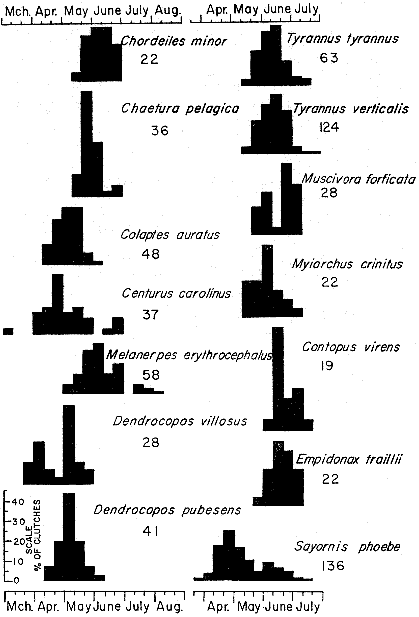
Fig. 5.—Histograms representing breeding schedules of the Common Nighthawk, Chimney Swift, woodpeckers, and flycatchers in Kansas. See legend to Figure 1 for explanation of histograms.
Red-headed Woodpecker: Melanerpes erythrocephalus (Linnaeus).—This is a common summer resident and uncommon permanent resident in open woodland; in winter it is noted especially around groves of oaks. M. e. erythrocephalus (Linnaeus) occurs in eastern Kansas and M. e. caurinus Brodkorb occurs in central and western Kansas.
Breeding schedule.—Fifty-eight records of breeding span the period May 1 to August 10 (Fig. 5); the modal date of egg-laying is June 5.
Number of eggs.—Clutch-size is 3 or 4 eggs.
Nests are of wood chips in cavities excavated about 25 feet high in willow, cottonwood, and elm.
Hairy Woodpecker: Dendrocopos villosus villosus (Linnaeus).—This resident is common in woodlands throughout the State.
Breeding schedule.—Twenty-eight records of breeding span the period March 21 to May 30 (Fig. 5); the modal date of egg-laying is May 5.
Number of eggs.—Clutch-size is about 4 eggs.
Nests are of wood chips in cavities excavated about 13 feet high in elm, honey locust, and ash.
Downy Woodpecker: Dendrocopos pubescens (Linnaeus).—This resident is common in woodland throughout the State. D. p. pubescens (Linnaeus) occurs in southeastern Kansas, and D. p. medianus (Swainson) in the remainder.
Breeding schedule.—Forty-one records of breeding span the period April 11 to June 10 (Fig. 5); the modal date of egg-laying is May 5.
Number of eggs.—Clutch-size is about 4 eggs.
Nests are of wood chips in cavities excavated about 20 feet high in willow, honey locust, ash, apple, and pear.
Eastern Kingbird: Tyrannus tyrannus (Linnaeus).—This summer resident is common throughout the east; it is local in the west but there maintains conspicuous numbers in favorable places, such as riparian woodland; preferred habitat in eastern sectors is typically in woodland edge. Temporal occurrence is indicated in Table 13.
Breeding season.—Sixty-three dates of egg-laying span the period May 11 to July 20 (Fig. 5); the modal date for completion of clutches is June 15. Nearly 70 per cent of all eggs are laid in June.
Number of eggs.—Clutch-size is 3 eggs (3.3, 2-3; 10). Clutches are probably larger than the average in May and smaller in June and July.
Nests are placed in crotches, terminal forks, and some on tops of limbs, about 16 feet high, in elm, sycamore, honey locust, willow, oak, apple, and red cedar.
Western Kingbird: Tyrannus verticalis Say.—This summer resident is common in the west, but is local and less abundant in the east. Preferred habitat is in woodland edge, open country with scattered trees, and in towns. Temporal occurrence is indicated in Table 13. Breeding schedule.—The 124 dates of egg-laying span the period May 11 to July 31 (Fig. 5); the modal date for egg-laying is June 15. More than 70 per cent of all clutches are laid in June.
Number of eggs.—Clutch-size is 4 eggs (3.6, 3-4; 8).
Nests are placed in crotches, lateral forks, or on horizontal limbs, about 26 feet high, in cottonwood, elm, osage orange, hackberry, honey locust, mulberry, oak, and on power poles.
Scissor-tailed Flycatcher: Muscivora forficata (Gmelin).—This summer resident is common in central and southern Kansas; it is rare to absent in the northwestern sector, and is local in the northeast. Preferred habitat is in open country with scattered trees. Temporal occurrence is indicated in Table 13.
Breeding schedule.—Twenty-eight records of breeding occur from May 21 to July 10 (Fig. 5); the modal date of egg-laying is June 25. The present sample of records is small, and there is otherwise no evidence suggesting that the breeding schedule of this species differs from those of the other two kingbirds in Kansas.
Number of eggs.—Clutch-size is 3 eggs (3.2, 2-5; 17). Mean clutch-size for the first peak of laying shown in Figure 5 is 4.0 eggs; that for the second peak is 2.7 eggs.
Nests are placed in forks or on horizontal limbs of osage orange, red haw, elm, and on crosspieces of power poles, about 15 feet high (ranging from five to 35 feet).
Table 13.—Occurrence in Time of Summer Resident Flycatchers in Kansas
Species Arrival Departure
Range Median Range Median
Eastern Kingbird Apr. 22-Apr. 30 Apr. 28 Sept. 1-Sept. 24 Sept. 13
Western Kingbird Apr. 23-Apr. 30 Apr. 28 Sept. 1-Sept. 26 Sept. 8
Scissor-tailed Flycatcher Apr. 15-Apr. 28 Apr. 18 Sept. 21-Oct. 22 Oct. 12
Great Crested Flycatcher Apr. 15-May 4 Apr. 29 Sept. 1-Sept. 21 Sept. 9
Eastern Phoebe Mar. 3-Mar. 31 Mar. 22 Oct. 3-Oct. 27 Oct. 9
Say Phoebe Apr. 4-Apr. 22 Apr. 12 ........ ........
Acadian Flycatcher Apr. 30-May 19 May 9 Sept. 3-Sept. 17 Sept. 4
Eastern Wood Pewee Apr. 2-May 28 May 19 Aug. 30-Sept. 18 Sept. 6
Great Crested Flycatcher: Myiarchus crinitus boreus Bangs.—This summer resident is common in eastern Kansas, but is less numerous in the west. Preferred habitat is in woodland and woodland edge. Temporal occurrence is indicated in Table 13.
Breeding schedule.—The twenty-two records of egg-laying are in the period May 11 to July 10 (Fig. 5); the modal date for egg-laying is June 5. The shape of the histogram (Fig. 5) indicates that some breeding for which records are lacking occurs earlier in May.
Number of eggs.—Clutch-size is 5 eggs (4.8, 4-6; 6).
Nests are placed in hollows and crevices in elm, maple, cottonwood, willow, pear, apple, oak, drain spouts, and, occasionally, "bird houses" made by man, about 17 feet high (four to 45 feet high).
Eastern Phoebe: Sayornis phoebe (Latham).—This summer resident is common in eastern Kansas, but is local in the west. Preferred habitat is in woodland edge and riparian groves, where most birds are found near bridges, culverts, or isolated outbuildings of man. Temporal occurrence is indicated in Table 13.
Breeding schedule.—The 136 records of breeding span the period March 21 to July 20 (Fig. 5); the modal date for egg-laying is April 25 (for first clutches) and June 5 (for second clutches); this species seems to be the only double-brooded flycatcher in Kansas.
Number of eggs.—Clutch-size is 4 to 5 eggs (4.2, 3-5; 58). The seasonal progression in clutch-size can be summarized as follows:
March 21-April 10: 4.0 eggs (2 records)
April 11-May 10: 4.4 eggs (37 records)
May 11-June 10: 3.9 eggs (10 records)
June 11-July 20: 3.6 eggs (9 records)
Nests are placed on horizontal, vertical, or overhanging surfaces of culverts, bridges, houses of man, earthen cliffs, rocky ledges, and entrances to caves, at an average height of 7.8 feet.
Say Phoebe: Sayornis saya saya (Bonaparte).—This is a common summer resident in western Kansas, breeding at least east to Cloud County, in open country. Occurrence in time is listed in Table 13.
Breeding schedule.—Ten records of breeding fall in the period May 1 to July 20; the modal date for egg-laying is in late May.
Number of eggs.—Clutch-size is about 5 eggs.
Nests are placed under bridges, in houses, or on cliffsides and earthen banks.
Acadian Flycatcher: Empidonax virescens (Vieillot).—This is an uncommon summer resident in eastern Kansas, in woodland and riparian habitats. Temporal occurrence is indicated in Table 13.
Breeding schedule.—The available records of breeding by this species in Kansas are too few to indicate reliably the span of the breeding season. Information on hand suggests that Acadian Flycatchers lay most eggs in late May or early June, and this places their nesting peak some 10 to 20 days earlier than peaks for Wood Pewees and Traill Flycatchers.
Number of eggs.—Five records show 3 eggs each.
Nests are placed about six feet high on terminal twigs of oak and alder.
Traill Flycatcher: Empidonax traillii traillii (Audubon).—This flycatcher has only recently been found nesting within Kansas; the species is not included in analyses above. Twenty-three nesting records are here reported, for the species in Kansas City, Jackson and Platte counties, Missouri. Most of these records are from within a few hundred yards of the political boundary of Kansas. The Traill Flycatcher is a local summer resident in extreme northeastern Kansas (Doniphan County), in wet woodland and riparian groves. Temporal occurrence is not well-documented; first dates run from May 19 to 25; the last dates of annual occurrence, possibly not all for transients, run from August 14 to September 24.
Breeding schedule.—Twenty-three records of breeding are from May 21 to July 10 (Fig. 5); the modal date for egg-laying is June 15.
Number of eggs.—Clutch-size is 3 eggs (3.4, 2-5; 22).
Nests are placed in forks, crotches, and occasionally near trunks, chiefly of willow, from 4.5 to 12 feet high (averaging six feet).
Eastern Wood Pewee: Contopus virens (Linnaeus).—This summer resident is common in the east, but is rare in the west. Preferred habitat is in edge of forest and woodland. Temporal occurrence is indicated in Table 13.
Breeding schedule.—Nineteen dates of egg-laying span the period June 1 to July 20 (Fig. 5); the modal date for completion of clutches is June 15, and more than half of all clutches are laid in the period June 11 to 20.
Number of eggs.—Clutch-size is about 3 eggs.
Nests are placed on upper surfaces of horizontal limbs of oak, elm, and sycamore, about 22 feet high.
Horned Lark: Eremophila alpestris (Linnaeus).—Breeding populations are resident in open country with short or cropped vegetation. E. a. praticola (Henshaw) lives in the east, and E. a. enthymia (Oberholser) in the west.
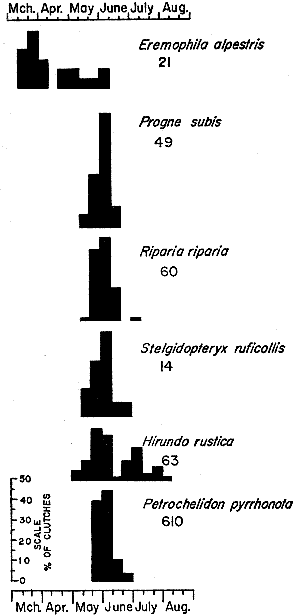
Breeding schedule.—Twenty-one records of breeding span the period March 11 to June 10 (Fig. 6); the modal date for egg-laying is March 25. The histogram (Fig. 6) is constructed on a clearly inadequate sample, and records of breeding both earlier and later are to be expected. The peak of first nesting activity is probably reasonably well-indicated by the available records.
Number of eggs.—Clutch-size is 3 eggs (3.6, 3-5; 16).
Nests are placed on the ground, usually amid short vegetation such as cropped prairie grassland or cultivated fields (notably soybeans and wheat), and occasionally on bare ground.
Table 14.—Occurrence in Time of Summer Resident Swallows in Kansas
Species Arrival Departure
Range Median Range Median
Tree Swallow Apr. 5-Apr. 30 Apr. 24 Sept. 30-Oct. 21 Oct. 8
Bank Swallow Apr. 9-May 19 May 7 Sept. 3-Sept. 20 Sept. 10
Rough-winged Swallow Mar. 29-May 30 Apr. 22 Sept. 23-Oct. 21 Oct. 10
Cliff Swallow Apr. 14-May 27 May 11 Sept. 3-Oct. 25 Sept. 11
Barn Swallow Mar. 31-Apr. 29 Apr. 21 Sept. 22-Oct. 25 Oct. 7
Purple Martin Mar. 5-Apr. 9 Mar. 26 Aug. 28-Sept. 23 Sept. 3
Tree Swallow: Iridoprocne bicolor (Vieillot).—This is a summer resident in extreme northeastern Kansas; nesting birds have been found only along the Missouri River in Doniphan County. Habitat is in open woodland, and in Kansas is always associated with water. Temporal occurrence in the State is indicated in Table 14.
Breeding schedule.—Eight records of breeding span the period May 21 to June 20; the modal date for egg-laying is May 25. The small sample may not accurately reflect the peak of nesting activity.
Number of eggs.—Clutch-size is 5 or 6 eggs (5.5, 5-6; 4).
Nests are placed chiefly in abandoned woodpecker diggings in willows, four to ten feet high, over water.
Bank Swallow: Riparia riparia riparia (Linnaeus).—This summer resident is common wherever cut-banks suitable for nesting activities allow relatively undisturbed behavior. The species is almost always found near water. Temporal occurrence is indicated in Table 14.
Breeding schedule.—Sixty records of breeding span the period May 11 to June 20 (Fig. 6); the modal date for completion of clutches is June 5.
Nearly 75 per cent of all clutches are laid in the period May 21 to June 10. Under unusual circumstances time of breeding can be greatly delayed; such circumstances occurred in 1961 in many places along the Kansas River in eastern Kansas, where the soft, sandy-clay banks were repeatedly washed away in May and June by high water undercutting the cliffs. Bank Swallows attempted to work on burrows in late May, but stabilization of the banks occurred only by late June, and the peak of egg-laying for many colonies was around July 12. Records for 1961 are omitted from the sample used here (Fig. 6).
Number of eggs.—Clutch-size is 5 eggs (4.8, 3-7; 60). Yearly clutch-size at one colony 3 miles east of Lawrence, Douglas County, is as follows:
1959: 5.2, 19 records
1960: 5.0, 12 records
1961: 3.7, 11 records
1962: 4.8, 18 records
The sample for 1961 is that taken in early July when breeding occurred after a delay of more than a month, as described above.
Nesting chambers are excavated in sandy-clay banks, piles of sand, piles of sawdust, or similar sites, at ends of tunnels one to more than three feet in depth from the vertical face of the substrate.
Rough-winged Swallow: Stelgidopteryx ruficollis serripennis (Audubon).—This summer resident is common in most places; it is not restricted to a single habitat, but needs some sort of earthen or other substrate with ready-made burrows for nesting. Temporal occurrence is indicated in Table 14.
Breeding schedule.—The 14 records of breeding are in the period May 11 to June 30; the modal date of egg-laying is June 5. Seventy per cent of all eggs are laid in the period May 21 to June 10.
Number of eggs.—Clutch-size is 5 eggs (5.0, 4-6; 4).
Nesting chambers are in old burrows of Bank Swallows, Kingfishers, rodents, or in crevices remaining subsequent to decomposition of roots of plants; frequently this swallow uses a side chamber off the main tunnel, near the mouth, of a burrow abandoned or still in use by the other species mentioned above.
Cliff Swallow: Petrochelidon pyrrhonota pyrrhonota (Vieillot).—This common summer resident occurs wherever suitable sites for nests are found. Temporal occurrence is indicated in Table 14.
Breeding schedule.—The 610 records of breeding span the period May 21 to June 30 (Fig. 6); the modal date for egg-laying is June 5, and 85 per cent of all clutches are laid from May 21 to June 10. Such synchronous breeding activity is probably a function of strong coloniality with attendant "social facilitation" of breeding behavior.
Number of eggs.—Clutch-size is 5 eggs (4.9, 3-7; 7).
Nests are built in mud jugs plastered to vertical rock faces, bridges, culverts, and buildings from a few feet to more than 100 feet above the ground.
Fig. 6.—Histograms representing breeding schedules of the Horned Lark and swallows in Kansas. See legend to Figure 1 for explanation of histograms.
Barn Swallow: Hirundo rustica erythrogaster Boddaert.—This summer resident is common in most habitats, occurring chiefly about cultivated fields and pastures. Temporal occurrence is indicated in Table 14.
Breeding schedule.—Sixty-three records of breeding in northern Kansas span the period May 1 to July 31 (Fig. 6); the modal date for completion of first clutches is May 25, and that for the second is July 5. The schedule of breeding in southern Kansas (chiefly Cowley County), to judge by 41 records, conforms to the one for northern Kansas: the season spans the period May 1 to August 10, and the modal date for first clutches is May 15. The ten-day lag in peak of first clutches of the northern over the southern sample is about what would be expected on the basis of differential inception of the biological growing season from south to north each spring.
Number of eggs.—Clutch-size does not vary geographically, to judge only from the present samples, and all are included in the listing to follow. The modal size of clutches is 5 eggs (4.7, 3-7; 43); clutches from the period May 1 to 30 show an average of 5.0 eggs, from June 1 to 20 an average of 4.9 eggs, and from June 21 to August 10, 4.4 eggs.
Nests are usually placed on horizontal surfaces in barns, sheds, or other such structures; more rarely they are put on bridges, and less frequently yet on vertical walls of culverts or sheds.
Purple Martin: Progne subis subis (Linnaeus).—This summer resident is common in the east but rare in the west. The only documented colony west of the 99th meridian was in Oberlin, Decatur County (Wolfe, 1961), occupied some 50 years ago. Temporal occurrence is indicated in Table 14.
Breeding schedule.—The breeding season spans the period May 11 to June 20 (Fig. 6); the modal date of egg-laying is June 5, and 57 per cent of all clutches are laid in the period June 1 to 10.
Number of eggs.—Clutch-size is 5 eggs (4.2, 3-6; 33). Mean clutch-size is 4.3 eggs in May and 4.2 in June. Adults tend to lay clutches of 5 eggs and first-year birds clutches of 4. Replacement clutches by birds of any age tend to be of 3 eggs.
Nests are built of sticks and mud placed in cavities; in Kansas these are almost always in colony houses erected by man. Use of holes and crevices in old buildings is known to have occurred on the campus of The University of Kansas in the nineteen thirties (W. S. Long, 1936, MS), in Oberlin, Decatur County in 1908-1914 (Wolfe, loc. cit.), and presently in Ottawa, Franklin County (Hardy, 1961).
Blue Jay: Cyanocitta cristata bromia Oberholser.—This resident is common throughout Kansas in woodland habitats. Most first-year birds move south in winter, but adults tend to be strictly permanent residents. Groups of ten to more than 50 individuals can be seen moving south in October and north in April. All individuals taken from such mobile groups are in first-year feather.
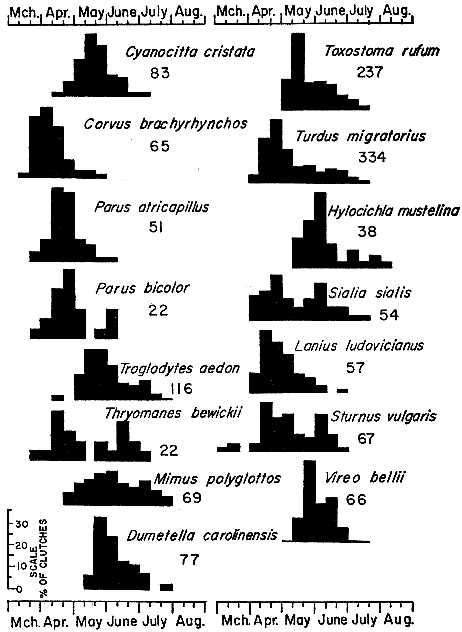
Breeding schedule.—Eighty-three records of breeding span the period April 10 to July 10 (Fig. 7); the modal date of egg-laying is May 15, and about 50 per cent of all clutches are laid in the period May 11-31.
Number of eggs.—Clutch-size is 4 eggs (4.1, 3-6; 15).
Nests are placed from eight to 70 feet high (averaging 24 feet) in forks, crotches, and on horizontal limbs of elm, maple, osage orange, cottonwood, and ash.
Black-billed Magpie: Pica pica hudsonia (Sabine).—This resident is common in western Kansas, along riparian groves and woodland edge. Records of nesting are from as far east as Clay County. Wolfe (1961) outlines the history of magpies in Decatur County as follows: the species was purported to have appeared in rural districts near Oberlin in 1918, but Wolfe saw the birds only by 1921, at which time he also found the first (used) nests. The first reported occupied nest was one in Hamilton County in 1925 (Linsdale, 1926). Earlier records, chiefly of occurrence in winter, can be found in Goss (1891).
Breeding schedule.—Fourteen records of breeding span the period April 11 to June 20; the modal date for egg-laying is May 15.
Number of eggs.—There are no data on clutch-size in Kansas; elsewhere Black-billed Magpies lay 3 to 9 eggs, and clutches of 7 are found most frequently (Linsdale, 1937:104).
Nests are placed from 10 to 18 feet high (averaging 13 feet) in forks or lateral masses of branches in cottonwood, box elder, ash, and willow.
White-necked Raven: Corvus cryptoleucus Couch.—This summer resident is common in western Kansas, probably occupying locally favorable sites in prairie grassland and woodland edge west of a line from Smith to Seward counties. The species is known to nest in Cheyenne, Sherman, and Finney counties.
Breeding schedule.—There are few data from Kansas; Aldous (1942) states that the birds begin activities leading to building sometime in April in Oklahoma; the peak of egg-laying probably occurs in May, which coincides with the records from Kansas.
Number of eggs.—Outside Kansas, this species lays 3 to 7 eggs; these figures seem applicable to Kansas, where brood sizes are known to run from 1 to 7 young.
Nests are placed about 20 feet high in cottonwood and other trees.
Common Crow: Corvus brachyrhynchos brachyrhynchos Brehm.—This resident is common in most of Kansas, but numbers are lower in the west. Distribution in the breeding season is west at least to Cheyenne, Logan, and Meade counties.
Breeding schedule.—Sixty-nine records of breeding span the period March 10 to May 31 (Fig. 7); the modal date for egg-laying is April 5, and 60 per cent of all eggs are laid between March 21 and April 10.
Number of eggs.—Clutch-size is 4 eggs (4.2, 3-5; 19).
Nests are placed about 20 feet high in crotches near trunks or heavy branches of such trees as red cedar, elm, oak, osage orange, cottonwood, honey locust, box elder, and pine.
Black-capped Chickadee: Parus atricapillus Linnaeus.—This resident is common north of the southernmost tier of counties, in forested and wooded areas. P. a. atricapillus Linnaeus occurs chiefly east of the 98th meridian, and P. a. septentrionalis Harris occurs west of this; a broad zone of intergradation exists between these two subspecies. Breeding schedule.—Fifty-one records of breeding span the period March 21 to June 10 (Fig. 7); the modal date for laying is April 15, and 64 per cent of all eggs are laid between April 11 and 30.
Number of eggs.—Clutch-size is 5 eggs (5.4, 4-7; 10).
Nests are placed in cavities about ten feet high (ranging from four to 20 feet) in willow, elm, cottonwood, honey locust, apricot, or nestboxes placed by man.
Fig. 7.—Histograms representing breeding schedules of crows, chickadees, wrens, thrashers, thrushes, and their allies in Kansas. See legend to Figure 1 for explanation of histograms.
Carolina Chickadee: Parus carolinensis atricapilloides Lunk.—This resident is common in the southernmost tier of counties, from Comanche County east, in forest and woodland edge. Actual records of breeding are from Barber and Montgomery counties.
Breeding schedule.—There are no data on breeding of this species in Kansas.
Number of eggs.—Clutch-size is about 5 eggs.
Nests are placed in cavities of trees.
Tufted Titmouse: Paras bicolor Linnaeus.—This resident is common in the eastern half of Kansas, in woodlands. Specimens taken in the breeding season and nesting records come from east of a line running through Cloud, Harvey, and Sumner counties, and the species probably breeds in Barber County.
Breeding schedule.—Twenty-two records of breeding span the period March 21 to June 10 (Fig. 7); the modal date for laying is April 25, and 54 per cent of all clutches are laid in the period April 11 to 30.
Number of eggs.—Clutch-size is 4 to 5 eggs (4.5; 6).
Nests are placed in cavities about 12 feet high (ranging from three to 30 feet) in elm, oak, cottonwood, hackberry, redbud, osage orange, and nestboxes placed by man.
White-breasted Nuthatch: Sitta carolinensis Latham.—This resident in eastern Kansas, in well-developed woodland, is uncommon. S. c. cookei Oberholser occurs east of a line running through Douglas and Cherokee counties, on the basis of specimens taken in the breeding season and actual nesting records, and S. c. carolinensis Latham occurs in Montgomery and Labette counties. S. c. nelsoni Mearns has been recorded in Morton County but probably does not breed there.
Breeding schedule.—Eggs are laid in March and April; young have been recorded being fed by parents throughout May.
Number of eggs.—Clutch-size is between 5 and 10 eggs.
Nests are placed in cavities about 30 feet high in elm and sycamore.
House Wren: Troglodytes aedon parkmanii Audubon.—This summer resident is common in the east and uncommon in the west. Preferred habitat is in woodland, brushland, and urban parkland. House Wrens arrive in eastern Kansas in the period April 3 to 27 (the median is April 19), and are last seen in autumn in the period September 19 to October 13 (the median is September 30).
Breeding schedule.—The 116 records of breeding span the period April 11 to July 31 (Fig. 7); the modal date of laying is May 20. About 45 per cent of all clutches are laid in the period May 11 to 31.
Number of eggs.—Clutch-size is 7 eggs (5.8, 3-7; 20). Clutches laid in May average 6.1 eggs (4-7; 14); those laid in June and July average 5.0 eggs (3-7; 6).
Nests are placed in cavities about ten feet high (ranging from two to 50 feet) in cottonwood, elm, willow, and a wide variety of structures, mostly nestboxes, built by man.
Bewick Wren: Thryomanes bewickii Audubon.—This wren is an uncommon resident in Kansas, except for the northeastern quarter, in woodland understory and brushland. T. b. bewickii Audubon occurs north and east of stations in Riley, Pottawatomie, Douglas, and Linn counties, and T. b. cryptus Oberholser is found south of stations in Greeley, Stafford, and Linn counties; a zone of intergradation occurs between the two named populations. The species occupies marginal habitat in most of Kansas and periodically is reduced in numbers by severe winters.
Breeding schedule.—Twenty-two records of breeding span the period March 21 to July 10 (Fig. 7); the modal date for first clutches is April 15 and for second clutches June 15.
Number of eggs.—Clutch-size is 5 eggs (5.5, 5-7; 12).
Nests are placed in crevices about five feet high (ranging from zero to nine feet) in trees (oak, cherry, and pear), boulders, and a wide variety of structures, some of them nestboxes, built by man; appropriation and modification of nests of Barn Swallows is known to occur.
Carolina Wren: Thryothorus ludovicianus ludovicianus Latham.—This common resident of southeastern Kansas in woodland understory and brushland is uncommon in the northeastern and south-central sectors. Stations of breeding all fall east of a line running through Doniphan, Riley, and western Reno counties. North and west of southeastern Kansas the Carolina Wren is in marginal habitat and periodically is reduced in numbers by severe winters.
Breeding schedule.—Fourteen records of breeding span the period April 11 to August 10; the modal date for laying is April 15, to judge only from the present sample. The species probably breeds also in late March and early April.
Number of eggs.—Clutch-size is 4 eggs (4.2, 3-8; 9).
Nests are placed near the ground in stumps, and a wide variety of structures built by man, or in crevices in earthen banks.
Long-billed Marsh Wren: Telmatodytes palustris dissaëptus (Bangs).—This is an uncommon summer resident in eastern Kansas in and around marshes. Presumably breeding individuals occur east of stations in Doniphan, Shawnee, and Sedgwick counties, but actual records of breeding come only from Doniphan County (Linsdale, 1928:505). First dates of arrival in spring run from April 19 to 29 (the median is April 22), and dates of last autumnal occurrence are from September 26 to October 31 (the median is October 8).
Breeding schedule.—Eggs are laid from May to August.
Number of eggs.—Clutch-size is 5 or 6 eggs; the range is from 3 to 10 (Welter, 1935).
Nests are woven of broad-bladed grasses, usually no farther than two feet from water or mud, suspended in vertical plant stalks or branches in marshes.
Short-billed Marsh Wren: Cistothorus platensis stellaris (Nauman).—This rare and irregular summer resident in northeastern Kansas occurs in wet meadowland. Breeding records are available from Douglas and Coffey counties. Temporal occurrence in the State is at least from April 29 to October 25; early dates are most likely of transients.
Breeding schedule.—Eggs are laid in late July and August.
Number of eggs.—Clutch-size is 6 or 7 eggs.
Nests are woven of plant fibers and placed in vertically-running stalks and stems of grasses and short, woody vegetation, within two feet of the ground.
Rock Wren: Salpinctes obsoletus obsoletus (Say).—This species is a common summer resident in western Kansas, in open, rocky country. Specimens taken in the breeding season and actual nests found come from west of stations in Decatur, Trego, and Comanche counties. Dates of occurrence are from April 2 to October 25. Autumnal, postbreeding movement brings the species east at least to Cloud County (October 7, 8, and 12) and Douglas County (October 25).
Breeding schedule.—Sixteen records of breeding span the period May 11 to July 20; the modal date for egg-laying is June 15.
Number of eggs.—Clutch-size is 5 eggs (4.6, 3-7; 5).
Nests are placed in holes in rocks, occasionally in rodent burrows, from ground level to 80 feet high on faces of cliffs, but there averaging about 20 feet.
Northern Mockingbird: Mimus polyglottos (Linnaeus).—This is a common resident in parkland and brushy savannah throughout Kansas. M. p. polyglottos (Linnaeus) occurs in the east, and M. p. leucopterus (Vigors) in the west; a broad zone of intergradation exists between the two. Most specimens from Kansas are of intermediate morphology.
Breeding schedule.—Sixty-nine records of breeding span the period April 21 to July 31 (Fig. 7); the modal date for first clutches is June 5, but is weakly indicated in the histogram (Fig. 7).
Number of eggs.—Clutch-size is 3 eggs (3.5, 3-5; 27). Size of clutch does not vary seasonally or geographically in the present sample.
Nests are placed about four feet high (two to 10 feet) in osage orange, red cedar, mulberry, scotch pine, catalpa, cottonwood, rose, and arbor vitae.
Catbird: Dumetella carolinensis (Linnaeus).—This is a common summer resident in the eastern half of Kansas, but is local in the west, in and near woodland edge and second-growth. First dates of arrival in spring are from April 25 to May 14 (the median is May 6), and last dates of autumnal occurrence are between September 20 and November 16 (the median is September 26).
Breeding schedule.—Seventy-seven records of breeding span the period May 11 to July 31 (Fig. 7); the modal date for egg-laying is May 25, and 57 per cent of all clutches are laid from May 21 to June 10.
Number of eggs.—Clutch-size is 4 eggs (3.3, 2-5; 43). Clutches laid between May 11 and June 10 tend to be of 4 eggs (3.5, 2-5; 27), and clutches laid between June 11 and July 31 tend to be of 3 eggs (2.9, 2-4; 16).
Nests are placed about four feet high in shrubs (rose, lilac, plum, elderberry) and about seven feet high in trees (red cedar, honey locust, willow, elm, apple, and in vines in such trees).
Brown Thrasher: Toxostoma rufum (Linnaeus).—This is a common summer resident in woodland understory, edge, and second-growth. T. r. rufum (Linnaeus) occurs in eastern Kansas, to the western edge of the Flint Hills, and T. r. longicauda Baird occurs west of stations in Decatur, Lane, and Meade counties; the intervening populations are of intermediate morphologic character. Some individuals overwinter in Kansas, but most are regular migrants and summer residents, arriving in spring from April 1 to April 25 (the median is April 19), and departing in autumn between September 19 and October 13 (the median is September 28).
Breeding schedule.—The 237 records of breeding span the period May 1 to July 20 (Fig. 7); the modal date for egg-laying is May 15, and one-third of all eggs are laid in the period May 11 to 20.
Number of eggs.—Clutch-size is 4 eggs, ranging from 2 to 5. Seasonal variation and mean values are shown in Table 15.
Nests are placed about four feet high (ranging from 12/3 to 15 feet) in osage orange, elm, ornamental evergreens, gooseberry, barberry, honey locust, cottonwood, red cedar, rose, plum, honeysuckle, spirea, arbor vitae, willow, oak, apple, dogwood, and maple.
Table 15.—Seasonal Variation in Clutch-size of the Brown Thrasher
Time Mean clutch-size Number of records
May 1-10 3.3 15
May 10-20 3.9 38
May 21-31 4.1 13
June 1-10 3.5 13
June 11-20 3.5 12
June 21-30 3.4 9
July 1-10 3 1
July 11-20 3 1
All: 3.63 102
Robin: Turdus migratorius migratorius Linnaeus.—This summer resident is common in the east, and is locally common in the west. Some individuals, usually in small groups, can be seen throughout the winter in eastern Kansas, and their presence makes it difficult to document dates of arrival and departure of the strictly summer resident birds; these can be said to arrive in March and to leave in October, but these indications are the barest approximations.
Breeding schedule.—The 334 records of breeding span the period April 1 to July 20 (Fig. 7); the modal date of laying of first clutches is April 25, but subsequent peaks are indistinct. Nearly half of all eggs are laid in the period April 11 to 30.
Number of eggs.—Clutch-size is 3 eggs (3.6, 3-6; 57). Clutches laid prior to May 10 average 3.6 eggs (3-6; 47), and those laid subsequent to May 10 average 3.5 eggs (3-4; 10).
Nests are placed about 13 feet from the ground (ranging from two to 30 feet) in elm, ornamental conifers, fruit trees, cottonwood, mulberry, walnut, hackberry, oak, ash, maple, osage orange, and coffeeberry. Robins rarely nest in manmade structures, such as on rafters in sheds and barns, on bridge stringers, and, exceptionally, on electrical utility pole installations.
Wood Thrush: Hylocichla mustelina (Gmelin).—This is an uncommon summer resident in eastern Kansas, presently absent from the State west of stations in Cloud and Barber counties. Preferred habitat is found in understory of forest and woodland. Wood Thrushes appear to have nested in small numbers as far west as Oberlin, Decatur County (Wolfe, 1961), some 50 years ago, but have since disappeared from such places, probably as a result of progressive modification of watershed and riparian timber by man. First dates of arrival in spring are from April 19 to May 20 (the median is May 9), and departure southward is in the period September 3 to October 1 (the median is September 15).
Breeding schedule.—Thirty-eight records of breeding fall in the period May 11 to August 10 (Fig. 7); the modal date of egg-laying is June 5 for first clutches. Fifty-five per cent of all eggs are laid between May 21 and June 10.
Number of eggs.—Clutch-size is 3 eggs (3.4, 3-4; 9).
Nests are placed about 11 feet high in elm, dogwood, willow, linden, and oak.
Eastern Bluebird: Sialia sialis sialis (Linnaeus).—This locally common resident and summer resident in eastern Kansas, is only casual west of Comanche County, in open parkland and woodland edge.
Breeding schedule.—Fifty-four records of breeding span the period April 1 to July 20 (Fig. 7); the modal date for first clutches is April 25 and for second clutches is June 5.
Number of eggs.—Clutch-size is 5 eggs (4.9, 4-6; 15).
Nests are placed in cavities about eight feet high in trees (elm, box elder, fruit trees, willow, and ash), and about four feet high in stumps, fence posts, and nestboxes placed by man.
Blue-gray Gnatcatcher: Polioptila caerulea caerulea (Linnaeus).—This summer resident is common in eastern Kansas in brushy woodland, edge, and second growth. Specimens taken in the breeding season and nesting records come from east of stations in Riley and Cowley counties, but there is a breeding specimen from Oklahoma just south of Harper County, Kansas. The species is present from March 30 to September 18.
Breeding schedule.—Twelve records of breeding span the period April 20 to June 20; the modal date for egg-laying is May 10.
Number of eggs.—Clutch-size is about 5 eggs.
Nests are placed in forks or on limbs about 17 feet high in oak, elm, honey locust, red haw, pecan, and walnut.
Cedar Waxwing: Bombycilla cedrorum Vieillot.—This waxwing is a rare, local, and highly irregular summer resident in northeastern Kansas, in woodland and forest edge habitats. The known nesting stations are in Wyandotte and Shawnee counties; six nests have been found in the period 1949 to 1960. The species has been recorded in all months.
Breeding schedule.—Eggs are laid in June and early July.
Number of eggs.—Clutch-size is about 4 eggs (Davie, 1898).
Nests are placed four to 24 feet high in a variety of deciduous and coniferous trees and shrubs.
Loggerhead Shrike: Lanius ludovicianus Linnaeus.—This common resident and summer resident favors open country with scattered shrubs and thickets. L. l. migrans Palmer occurs in eastern Kansas, west to about the 96th meridian, and L. l. excubitorides Grinnell occurs in western Kansas, east to about the 100th meridian; populations of intermediate character occupy central Kansas. These shrikes tend to be resident in southern counties, but are migratory in the north. Dates of spring arrival in Cloud County are between March 9 and 31 (the median is March 21) and the birds leave southward between October 19 and December 19 (the median is November 1).
Breeding schedule.—Fifty-seven records of breeding span the period April 1 to June 30 (Fig. 7); the modal date for egg-laying is April 15.
Number of eggs.—Clutch-size is 5 eggs (5.3, 4-7; 32). There is no seasonal variation in the sample.
Nests are placed about six feet high (ranging from four to 10 feet) in osage orange, small pines, honeysuckle vines, and elm.
Starling: Sturnus vulgaris Linnaeus.—This species is a common resident in towns and around farms, foraging in open fields of various kinds. Starlings (introduced into North America from European stocks of S. v. vulgaris) first appeared in eastern Kansas in the early 1930s and were established as successful residents by 1935 or 1936. Occupancy of Kansas to the west took only a few years. There are no specimens taken in the breeding season or actual nesting records from southwest of Ellis and Stafford counties; Starlings seem to be resident in Cheyenne County, but no nesting record exists from there.
Breeding schedule.—Sixty-seven records of breeding span the period March 1 to June 30 (Fig. 7); the modal date for first clutches is April 15, and for second clutches is June 5.
Number of eggs.—Clutch-size is 5 eggs (5.2, 4-8; 19).
Nests are placed about 22 feet high (ranging from eight to 50 feet) in crevices in elm, locust, hackberry, nestboxes placed by man, and in a variety of other structures of man.
Black-capped Vireo: Vireo atricapilla Woodhouse.—This was a summer resident, apparently of limited distribution but in good numbers, in Comanche County, in oak woodland and brushland edge. No specimens have been taken in Kansas since 1885.
Breeding schedule.—Eggs are probably laid in May and June. Goss (1891:351) found a nest under construction on May 11, 1885, and this is the only nesting record of the species in the State.
Number of eggs.—Clutch-size is about 4 eggs (Davie, 1898).
Nests are placed low, perhaps around four feet high, in deciduous trees and shrubs (Davie, op. cit.).
White-eyed Vireo: Vireo griseus noveboracensis (Gmelin).—This is a local summer resident in eastern Kansas, in woodland and forest edge. Stations of breeding occurrence are in Doniphan, Douglas, Johnson, Anderson, Labette, and Montgomery counties. The species is present within the extreme dates of April 23 to October 5 (Table 16).
Breeding schedule.—Ten records of breeding span the period May 10 to June 30; the modal date for egg-laying is June 10. The present sample is not adequate to indicate extreme or modal dates with reasonable accuracy.
Number of eggs.—Clutch-size is 4 eggs (3.6, 3-4; 5).
Nests are placed relatively low in forks in trees and shrubs.
Bell Vireo: Vireo bellii bellii Audubon.—This summer resident is common in riparian thickets and second-growth scrub. Temporal occurrence is indicated in Table 16.
Breeding schedule.—Sixty-six records of breeding span the period May 1 to July 20 (Fig. 7); the modal date for egg-laying is May 25, and a little under 40 per cent of all eggs are laid in the period May 21-31. Renesting following disruption of first nests is regular, and the small peak in the histogram in the period June 11-20 is representative of this.
Number of eggs.—Clutch-size is 4 eggs (4.6, 3-6; 21). Clutches in May have an average of 3.7 eggs, and those in June and July 3.6 eggs.
Nests are placed about two feet high (ranging from one to five feet) in terminal or lateral forks of small branches in elm, hackberry, osage orange, coralberry, dogwood, plum, honey locust, mulberry, willow, cottonwood, and box elder.
Yellow-throated Vireo: Vireo flavifrons Vieillot.—This is a rare and local summer resident in deciduous forest and woodland in eastern Kansas. Stations of breeding occurrence fall east of Shawnee and Woodson counties. Temporal occurrence is indicated in Table 16.
Breeding schedule.—Eggs are laid at least in May.
Number of eggs.—Clutch-size is about 4 eggs.
Nests are placed 16 to 30 feet high in forks of mature deciduous trees.
Red-eyed Vireo: Vireo olivaceus olivaceus (Linnaeus).—This summer resident is common in the east, but is local and less abundant in the west, in woodland and deciduous forest. Temporal occurrence is indicated in Table 16.
Breeding schedule.—Eight records of breeding fall in the period May 21 to July 31; most records of egg-laying are in the first week of June.
Number of eggs.—Clutch-size is 4 eggs (4.0, 3-5; 5).
Nests are placed in forks of mature deciduous trees, usually fairly high—perhaps 15 to 25 feet (Davie, 1898).
Table 16.—Occurrence in Time of Summer Resident Vireos in Kansas
Species Arrival Departure
Range Median Range Median
White-eyed Vireo Apr. 23-May 25 May 8 Oct. 5 ........
Bell Vireo Apr. 14-May 20 May 8 Aug. 26-Sept. 27 Sept. 6
Yellow-throated Vireo Apr. 27-May 22 May 7 Aug. 23-Oct. 1 Aug. 31
Red-eyed Vireo Apr. 21-May 10 May 4 Sept. 2-Oct. 7 Sept. 10
Warbling Vireo Apr. 20-May 9 Apr. 28 Sept. 2-Oct. 6 Sept. 9
Warbling Vireo: Vireo gilvus gilvus (Vieillot).—This summer resident is common in woodland and forest edge. Temporal occurrence is indicated in Table 16.
Breeding schedule.—Seventeen records of breeding span the period May 1 to June 20, but it is likely that breeding later in June and July will be recorded. The modal date for egg-laying is June 5, and this seems to be a reliable index to the major effort in egg-laying in spite of the small sample.
Number of eggs.—Clutch-size is 4 eggs (3.6, 3-4; 5). Nests are placed three to 25 feet high in a variety of deciduous shrubs and trees.
Black-and-white Warbler: Mniotilta varia (Linnaeus).—This local and uncommon summer resident lives in deciduous forest and woodland. Specimens taken in the breeding season and actual records of nesting come from Doniphan, Douglas, Coffey, Greenwood, Sedgwick, Labette, and Cherokee counties. Temporal occurrence in the State is indicated in Table 17.
Breeding schedule.—Eggs are laid in May and June.
Number of eggs.—Clutch-size is around 5 eggs (Davie, 1898).
Nests are placed on the ground, in depressions or niches, under heavy cover.
Prothonotary Warbler: Protonotaria citrea (Boddaert).—This is a local summer resident in eastern Kansas, in understory of riparian timber and swampy woodland. Specimens taken in the breeding season and actual records of nesting come from Doniphan, Douglas, Linn, and Cowley counties. Temporal occurrence is indicated in Table 17.
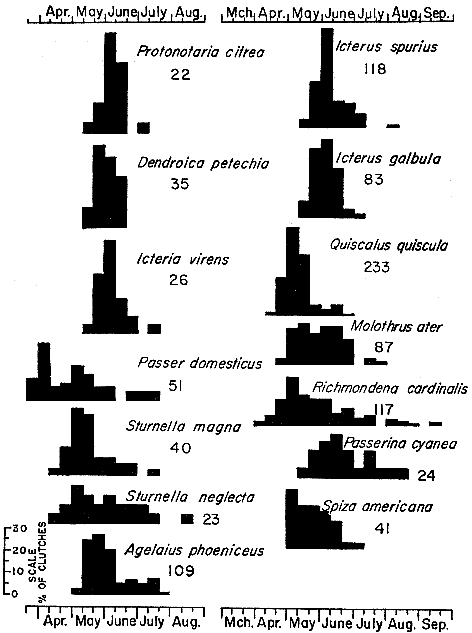
Breeding schedule.—Twenty-two records of breeding span the period May 11 to July 10 (Fig. 8); the modal date for egg-laying is June 5, and 75 per cent of all clutches are laid in the period June 1 to 20.
Number of eggs.—Clutch-size is 5 eggs (4.5, 3-6; 15).
Nests are placed in holes and niches in willow, red haw, elm, and a variety of stumps, about eight feet high (ranging from five to 20 feet), usually over water. A pair nested once in a gourd under the eave of a house in Winfield, Cowley County, and another pair in a tin cup on a shelf at a sawmill (Goss, ex Long, 1936).
Parula Warbler: Parula americana (Linnaeus).—This summer resident in eastern Kansas usually can be found in heavy woodland and flood-plain timber. Specimens taken in the breeding season and actual records of breeding come from Doniphan, Riley, Douglas, Montgomery, Labette, and Cherokee counties. Temporal occurrence is indicated in Table 17.
Breeding schedule.—Eggs are laid at least from mid-May to mid-June.
Number of eggs.—Clutch-size is about 4 eggs.
Nests are placed in debris in root tangles along stream banks, and, presumably, in pendant arboreal lichens.
Yellow Warbler: Dendroica petechia (Linnaeus).—This summer resident is common in the east, in woodland and riparian growths. D. p. aestiva (Gmelin) occupies eastern Kansas west at least to Barber County, but it is not known how far west representatives of this population breed. D. p. morcomi Coale breeds in western Kansas. D. p. sonorana Brewster, a name applicable to Yellow Warblers of the southwestern United States and northern Mexico, has been considered a "straggler" (Long, 1940) or probable summer resident (Tordoff, 1956; Johnston, 1960) in southwestern Kansas, on the basis of one specimen taken on June 24, 1911, at a point two miles south of Wallace, Wallace County. This specimen, which is pale, was identified in 1935 as D. p. sonorana by H. C. Oberholser. Specimens taken subsequently from Cheyenne, Hamilton, and Morton counties in the breeding season can be referred adequately to D. p. morcomi. Probably the specimen of 1911 is a pale variant of D. p. morcomi within its normal distributional range. Breeding schedule.—Thirty-five records of breeding span the period May 11 to June 20 (Fig. 8); this probably is inadequate to show the extent of the season, and some egg-laying into July is likely to be found in the future. The modal date of egg-laying is May 25, and this is likely to be reliable.
Number of eggs.—Clutch-size is 4 eggs (4.2, 3-5; 29).
Nests are placed about nine feet high (ranging from five to 20 feet) in crotches of trees and shrubs including willow, elderberry, cottonwood, crabapple, plum, and coralberry.
Prairie Warbler: Dendroica discolor discolor (Vieillot).—This rare, local summer resident occurs in deciduous second-growth. The only breeding records are from Wyandotte and Johnson counties.
Breeding schedule.—Eggs are laid at least in June.
Number of eggs.—Clutch-size is about 4 eggs (Davie, 1898).
Nests are placed low, perhaps about four feet high, in a wide variety of small trees and shrubs.
Louisiana Waterthrush: Seiurus motacilla (Vieillot).—This uncommon to rare summer resident in eastern Kansas lives in woodland understory near streams. Nesting records come from Douglas, Miami, Linn, and Crawford counties. Wolfe (1961) reports he found a nest with young near Oberlin, Decatur County, on June 10, 1910, under an overhanging bank of Sappa Creek; Decatur County is some 250 miles west of the present western limit of the breeding range of the Louisiana Waterthrush, and western habitats are not favorable for their occurrence. Temporal characteristics of their distribution are indicated in Table 17.
Breeding schedule.—Eggs are laid in May and June.
Number of eggs.—Clutch-size is about 5 eggs (Davie, 1898).
Nests are placed in concealed places in banks or stumps always where it is wet.
Table 17.—Occurrence in Time of Summer Resident Wood Warblers in Kansas
Species Arrival Departure
Range Median Range Median
Black-and-white Warbler Apr. 2-May 12 May 5 Sept. 10-Oct. 14 Sept. 22
Prothonotary Warbler Apr. 24-May 25 May 8 Aug. 6-Sept. 10 Aug. 22
Parula Warbler Apr. 6-May 5 Apr. 23 Sept. 12-Oct. 7 Sept. 18
Yellow Warbler Apr. 21-May 7 Apr. 30 Aug. 28-Oct. 1 Sept. 4
Louisiana Waterthrush Apr. 2-May 2 Apr. 16 Aug. ? ........
Kentucky Warbler Apr. 24-May 15 May 3 Sept. 13 ........
Yellowthroat Apr. 21-May 10 May 3 Sept. 8-Oct. 3 Sept. 17
Yellow-breasted Chat Apr. 29-May 19 May 11 Aug. 29-Oct. 1 Sept. 8
American Redstart Apr. 22-May 20 May 12 Sept. 1-Oct. 7 Sept. 10
Kentucky Warbler: Oporornis formosus (Wilson).—This is an uncommon summer resident in eastern Kansas, in deciduous forest and woodland. Specimens taken in the breeding season and actual records of nesting come from Riley, Doniphan, Douglas, Leavenworth, Linn, Montgomery, and Labette counties. Temporal occurrence is indicated in Table 17.
Breeding schedule.—Eggs are laid in May and June.
Number of eggs.—Clutch-size is 4 or 5 eggs.
Nests are placed near or on the ground, usually at the base of small shrubs or clumps of grass.
Yellowthroat: Geothlypis trichas (Linnaeus).—This summer resident in and near marshes is common in the east and is local and somewhat less common in the west. G. t. brachydactylus (Swainson) breeds east of stations in Clay, Greenwood, and Montgomery counties, G. t. occidentalis Brewster breeds west of stations in Decatur, Stafford, and Pratt counties, and the intervening area is occupied by warblers of intermediate morphologic characters. Temporal occurrence is indicated in Table 17.
Breeding schedule.—Nine records of breeding span the period May 11 to June 10; the modal date of egg-laying is June 1. The season is probably more extended in time than is indicated by the available records.
Number of eggs.—Clutch-size is 5 eggs (4.8, 4-5; 6).
Nests are placed in cattails and sedges one to two and one-half feet high.
Yellow-breasted Chat: Icteria virens (Linnaeus).—This summer resident is common in willow thickets and rank second-growth. I. v. virens (Linnaeus) breeds in eastern Kansas, from Nemaha County south, I. v. auricollis (Deppe) breeds in western Kansas, from Norton County south, and the intervening sector is occupied by chats of intermediate morphologic character. Temporal occurrence is indicated in Table 17.
Breeding schedule.—Twenty-six records of breeding span the period May 11 to July 20 (Fig. 8); the modal date for completion of clutches is June 5. Forty-two per cent of all eggs are laid in the period June 1 to 10.
Number of eggs.—Clutch-size is 4 eggs (3.9, 3-5; 21). Clutches in May are larger than those in June and July.
Nests are placed in forks and crotches about three feet high in dogwood, willow, rose, coralberry, cottonwood, and thistles.
Hooded Warbler: Wilsonia citrina (Boddaert).—This warbler is a rare summer resident in eastern Kansas, in wet, open woodland. Specimens (a total of four) taken in the breeding season are from Leavenworth and Shawnee counties, and the one nesting record is from Anderson County.
Breeding schedule.—Eggs are laid at least in May.
Number of eggs.—Clutch-size is about 4 eggs.
Nests are low (some as high as six feet) in woody vegetation.
American Redstart: Setophaga ruticilla ruticilla (Linnaeus).—This summer resident occurs locally in woodlands east from stations in Cloud and Sumner Counties. Temporal occurrence is indicated in Table 17.
Breeding schedule.—Eggs are laid in May and June.
Number of eggs.—Clutch-size is about 4 eggs (Davie, 1898), but there are two records of 5 in Kansas. Nests are placed six to 30 feet high, but usually about 12 feet, in forks or saddled on a branch, in deciduous trees.
Fig. 8.—Histograms representing breeding schedules of wood warblers, the House Sparrow, icterids, and cardinal grosbeaks in Kansas. See legend to Figure 1 for explanation of histograms.
House Sparrow: Passer domesticus (Linnaeus).—This sparrow, introduced from stocks in Ohio and New York (originally from England and Germany), has been present since about 1876 in eastern Kansas; it is a common resident in towns and at farmsteads throughout the state.
Nomenclaturally, House Sparrows in North America consistently have been referred to the European ancestral stocks, P. d. domesticus, but none in North America today duplicates morphologically the European birds. This is evidence of meaningful adaptation of the North American populations to environments in which they now live, and continued use of P. d. domesticus is misleading. Studies on local differentiation in North American House Sparrows are in progress, and when the biology of sparrows in the midwest is better understood, suitable nomenclatural proposals will be made.
Breeding schedule.—Fifty-one records of breeding span the period March 20 to July 20 (Fig. 8); the modal date for laying of first clutches is April 5, and for second clutches May 5.
Number of eggs.—Clutch-size is 4 eggs (3.9, 3-7; 13).
Nests are placed in niches of various sorts seven to 50 feet high in buildings, nestboxes, and trees, or freely situated in forks and crotches of large trees.
Bobolink: Dolichonyx oryzivorus (Linnaeus).—This species is a rare and local summer resident, in and about grassy meadows. There are but two stations of breeding in Kansas: Jamestown State Lake, Cloud County, and Big Salt Marsh, Stafford County. Temporal occurrence is indicated in Table 18.
Breeding schedule.—Eggs are laid in June.
Number of eggs.—Clutch-size is about 5 eggs.
Nests are placed on the ground amidst grasses.
Eastern Meadowlark: Sturnella magna (Linnaeus).—This summer resident and resident is common in eastern Kansas, in moist grassland. S. m. argutula Bangs occurs in Montgomery, Labette, and Cherokee counties and intergrades to the north and west with S. m. magna (Linnaeus). Good numbers of birds are found east of the Flint Hills, but to the west the species is of restricted and local distribution. Extreme outliers of the species are found no farther west than stations in Jewell, Stafford, and Barber counties.
Breeding schedule.—Forty records of breeding span the period April 10 to July 20 (Fig. 8); the modal date for egg-laying is May 5. Fifty-seven per cent of all eggs are laid in the period May 1 to 20.
Number of eggs.—Clutch-size is 5 eggs (5.2, 4-7; 26). Prior to May 11, clutch-size is 5.3 eggs (13 records), and after that date it is 5.1 eggs (13 records).
Nests are placed on the ground, with cover of grasses or forbs.
Western Meadowlark: Sturnella neglecta neglecta (Audubon).—This is a common resident and summer resident in western Kansas, and is restricted and local in the east; preferred habitat is in grassy uplands.
Breeding schedule.—Twenty-three records of breeding span the period April 10 to July 30 (Fig. 8); the modal date for egg-laying is May 5 for first nests and June 5 for second nests.
Number of eggs.—Clutch-size is 4 eggs (4.3, 3-6; 16).
Nests are placed on the ground with cover of grasses or forbs.
Yellow-headed Blackbird: Xanthocephalus xanthocephalus (Bonaparte).—This uncommon and local summer resident occurs chiefly in the west, in marshes. Nesting records are from Wallace, Meade, Barton, Stafford, Doniphan, and Douglas counties. Temporal occurrence is indicated in Table 18.
Breeding schedule.—Fifty-one records of breeding span the period May 20 to June 30; the modal date of egg-laying is June 5. The sample is probably not large enough to be wholly reliable.
Number of eggs.—Clutch-size is about 4 eggs.
Nests are placed within a few feet of water in cattail, rush, sedge, and willow.
Red-winged Blackbird: Agelaius phoeniceus (Linnaeus).—This is a common summer resident in marshes, wet pasture, and scrubby parkland throughout the State. A. p. phoeniceus (Linnaeus) occurs in most of Kansas and A. p. fortis (Ridgway) occurs in the west, east to about Decatur County. A few birds can be found in eastern Kansas in winter; the full breeding population is present between April and October.
Breeding schedule.—The 109 records of breeding in Cloud County span the period May 1 to July 30 (Fig. 8); the modal date for laying is May 25, and 71 per cent of all eggs are laid in the period May 11 to June 10. Eighty-eight records of breeding from northwestern Kansas make a histogram almost exactly duplicating the one from Cloud County.
Number of eggs.—Clutch-size at Concordia, Cloud County, is 4 eggs (3.7, 3-5; 48); in northeastern Kansas mean clutch-size is 3.7 eggs (3-5; 46). For the total sample, mean clutch-size in May is 4.0 eggs, in June, 3.7 eggs, and in July, 3.3 eggs.
Nests are placed about four feet high (one to nine feet) in willow, cattail, sedge, grass, elm, exotic conifer, elderberry, coralberry, buttonbrush, honeysuckle, smartweed, ash, osage orange, and yellow clover.
In central Kansas red-wings are host to the Brown-headed Cowbird in a frequency of one parasitized nest out of nine; in northeastern Kansas the ratio is 1:25.
Table 18.—Occurrence in Time of Summer Resident Icterids in Kansas
Species Arrival Departure
Range Median Range Median
Bobolink May 4-May 21 May 11 Aug. 28-Oct. 1 Sept. 12
Yellow-headed Blackbird Mar. 31-Apr. 29 Apr. 19 Sept. 19-Oct. 18 Sept. 24
Orchard Oriole Apr. 25-May 14 May 4 Aug. 5-Sept. 15 Aug. 9
Baltimore Oriole Apr. 24-May 5 Apr. 29 Sept. 6-Sept. 29 Sept. 10
Common Grackle Mar. 2-Mar. 27 Mar. 17 Oct. 15-Nov. 14 Oct. 31
Orchard Oriole: Icterus spurius (Linnaeus).—This summer resident is common in parkland, woodland, and old second-growth. Temporal occurrence is indicated in Table 18.
Breeding schedule.—The 118 records of breeding span the period May 11 to August 10 (Fig. 8); the modal date for completion of clutches is June 5, and 45 per cent of all eggs are laid in the first ten days of June.
Number of eggs.—Clutch-size is 4 eggs (4.1, 3-6; 41). Clutches laid at the peak of the season average 4.3 eggs (3-6; 26), and replacement clutches average 3.8 eggs (3-4; 9). Nests are hung about 15 feet high (ranging from six to 55 feet) in elm, cottonwood, hackberry, locust, catalpa, willow, alder, osage orange, walnut, pear, linden, and ash.
Baltimore Oriole: Icterus galbula (Linnaeus).—This common summer resident is most numerous in the east, in woodland and riparian timber. The species hybridizes freely with the Bullock Oriole in western Kansas, and individuals morphologically typical of Baltimore Orioles are rare west of the 100th meridian. Evidence of such hybridization can be found in specimens taken in eastern Kansas, but the linear nature of distribution along water-courses to the west restricts gene-flow, and evident hybrids are not yet conspicuous. Temporal occurrence is indicated in Table 18.
Breeding schedule.—Eighty-three records of breeding span the period May 11 to July 10 (Fig. 8); the modal date of egg-laying is June 5, and 66 per cent of all eggs are laid between May 21 and June 10.
Number of eggs.—Clutch-size is 4 eggs.
Nests are hung about 24 feet high (ranging from nine to 70 feet) in elm, cottonwood, sycamore, maple, and oak.
Bullock Oriole: Icterus bullockii (Swainson).—This summer resident is common in western Kansas in woodland and riparian situations. The species hybridizes freely with the Baltimore Oriole, and most Bullock Orioles in Kansas show evidence of such interbreeding. Almost all records of breeding come from west of the 100th meridian, but the species in recognizable form probably breeds locally at least as far east as Stafford County.
Breeding schedule.—Few nesting records are available, but these suggest that the breeding schedule of the Bullock Oriole resembles those of the preceding two species in Kansas.
Number of eggs.—Clutch-size is about 4 eggs.
Nests are hung about 26 feet high (ranging from 10 to 50 feet) in cottonwood, elm, and other large trees.
Common Grackle: Quiscalus quiscula versicolor Vieillot.—This summer resident is common in parkland, and around towns and farms. Most individuals move out of Kansas in winter, and the temporal occurrence of these birds is indicated in Table 18.
Breeding schedule.—The 233 records of breeding span the period April 11 to June 30 (Fig. 8); the modal date for egg-laying is May 5, and two-thirds of all eggs are laid between May 1 and May 20.
Number of eggs.—Clutch-size is 5 eggs (4.5, 3-6; 33). Clutches laid at the peak of the season average 4.7 eggs (3-6; 21), and those laid as replacement clutches average 4.3 eggs (3-6; 12).
Nests are placed in forks and crotches about 22 feet high (ranging from six to 50 feet) in elm, red cedar, cottonwood, oak, box elder, and pine.
Brown-headed Cowbird: Molothrus ater ater (Boddaert).—Many individuals of this common summer resident overwinter in the southern part of the State and it is difficult to determine dates of arrival and departure in Kansas. Conspicuous abundance in the north covers the period April to October.
Breeding schedule.—The 141 instances of egg-laying span the period April 21 to July 20 (Fig. 8); the modal date of laying is May 15, and 53 per cent of all eggs are laid in the period May 11 to June 10. Inception of laying is here fairly reliably indicated, but in exceptionally early springs laying does occur earlier; a few eggs were found on April 6, 1963, too late for incorporation into this report other than in this sentence.
Number of eggs.—Clutch-size in cowbirds is not readily determined. On the basis of ovarian examination of five females taken in mid-season, the birds here lay about five eggs at a time. There is no question that the birds are "double-brooded" in Kansas, and the season is sufficiently long for as many as five "clutches" to be laid by a given female.
Eggs are laid in nests of some forty species of birds in Kansas; 39 of these are passerines. No preference for any one species is detectable; the most frequently parasitized species are simply the common species, and these are the kinds for which nesting records are easily gathered by man. In the following list of host species, the names marked with an asterisk are the conspicuously parasitized species.
Mourning Dove, Eastern Kingbird, Eastern Phoebe,* Say Phoebe,* Acadian Flycatcher, Barn Swallow, Horned Lark, Carolina Wren, Rock Wren, Brown Thrasher,* Mockingbird, Catbird, Wood Thrush,* Eastern Bluebird, Yellow-throated Vireo, Bell Vireo,* White-eyed Vireo,* Parula Warbler, Yellow Warbler, Black-and-white Warbler, Kentucky Warbler, Louisiana Waterthrush, Yellow-breasted Chat, Yellowthroat, Eastern Meadowlark, Western Meadowlark, Red-winged Blackbird,* Orchard Oriole,* Cardinal,* Black-headed Grosbeak, Indigo Bunting,* Blue Grosbeak, Dickcissel,* Pine Siskin,* Rufous-sided Towhee,* Grasshopper Sparrow, Lark Sparrow,* Chipping Sparrow, Field Sparrow.*
Scarlet Tanager: Piranga olivacea (Gmelin).—This rare summer resident in northeastern Kansas occurs in deciduous forest and bottomland timber. Specimens taken in the breeding season and records of nesting come from Clay, Doniphan, Douglas, Wyandotte, Johnson, and Linn counties, but the species probably occupies the entire eastern third of the State. Dates of arrival in spring are from April 29 to May 25 (the median is May 11), and dates of departure in autumn are from August 4 to September 23 (the median is August 10).
Breeding schedule.—Six records of breeding fall in the period May 11 to June 20.
Number of eggs.—Clutch-size is about 4 eggs.
Nests are placed 20 to 35 feet high in elm, linden, hickory, and walnut.
Summer Tanager: Piranga rubra rubra (Linnaeus).—This uncommon summer resident in eastern Kansas occurs in woodland. Specimens taken in the breeding season and records of nesting come from east of stations in Doniphan, Shawnee, and Montgomery counties. Dates of arrival in spring run from April 24 to May 18 (the median is April 29), and the species departs southward in September and October.
Breeding schedule.—Eleven records of egg-laying cover the period May 21 to July 20; the modal date for laying is June 5.
Number of eggs.—Clutch-size is about 4 eggs.
Nests are situated ten to 20 feet high on horizontal limbs of large trees.
Cardinal: Richmondena cardinalis cardinalis (Linnaeus).—This species is a common resident in eastern Kansas, west to about the 99th meridian; west of this line the species becomes local and uncommon to rare. Habitat in the east is found in woodland, edge, second-growth and open riparian timber, and in the west the species is restricted to riparian growths, chiefly along the Republican, Solomon, Smoky Hill, Arkansas, and Cimarron rivers, and their larger tributaries.
Breeding schedule.—The 117 records of breeding span the period April 1 to September 20 (Fig. 8); the modal date for laying of first clutches is May 1, subsequent to which breeding activity is regular but asynchronous.
Number of eggs.—Clutch-size is 3 eggs (3.5, 3-6; 65). Seasonal variation in clutch-size is as follows:
Date Mean clutch-size Number of records
April 1-20 3.0 6
April 21-May 10 3.8 25
May 11-May 31 3.3 15
June 1-June 20 3.6 11
June 21-July 20 3.3 7
Nests are placed about five feet high (ranging from 10 inches to 40 feet) in osage orange, elm, grape, rose, red cedar, coralberry, willow, cottonwood, gooseberry, oak, elderberry, box elder, arbor vitae, Lombardy poplar, Forsythia, pines, honeysuckle, wisteria, lilac, red haw, hickory, dogwood, and sycamore.
Rose-breasted Grosbeak: Pheucticus ludovicianus (Linnaeus).—This is a local and at times common summer resident in eastern Kansas, in woodland, edge, and riparian timber. Specimens taken in the breeding season and actual records of breeding come from Clay, Riley, Doniphan, Leavenworth, and Douglas counties. This species meets and hybridizes with the Black-headed Grosbeak west of the Flint Hills. Temporal occurrence in the State is indicated in Table 19.
Breeding schedule.—Eleven records of breeding span the period May 11 to July 10; the modal date for laying is probably June 5.
Number of eggs.—Clutch-size is 3 or 4 eggs.
Nests are placed in deciduous trees, in forks and crotches six to 30 feet high.
Black-headed Grosbeak: Pheucticus mehnocephalus melanocephalus (Swainson).—This summer resident is common in western Kansas, chiefly along streams. Individuals referable to this species by sight records alone breed in fair numbers as far east as Cloud and Sedgwick counties, but to the east of these stations numbers are reduced, partly as a result of presumed competition with the Rose-breasted Grosbeak. Hybrids between these two grosbeaks are regularly produced. The easternmost record of breeding by this species is at St. Mary's, Pottawatomie County, where a male was seen as probably mated with a female Rose-breasted Grosbeak. Temporal occurrence is indicated in Table 19.
Breeding schedule.—Sixteen records of breeding span the period May 11 to July 10; the modal date for egg-laying is June 5.
Number of eggs.—Clutch-size is about 4 eggs (3.7, 3-4; 4). Nests are placed about 12 feet high in a variety of deciduous trees.
Blue Grosbeak: Guiraca caerulea (Linnaeus).—This is a common to uncommon summer resident in most of Kansas, in brushland and streamside thickets. G. c. caerulea (Linnaeus) breeds in the east, east of stations in Douglas, Greenwood, and Cowley counties, and G. c. interfusa Dwight and Griscom breeds in the west, west of stations in Cloud, Stafford, and Clark counties; a broad zone of intergradation exists between the two named populations. Temporal occurrence is indicated in Table 19.
Breeding schedule.—Seven records of breeding span the period May 21 to June 30; the modal date of laying seems to be in late May or early June.
Number of eggs.—Clutch-size is about 4 eggs.
Nests are placed from three to 30 feet high in a variety of deciduous plants.
Table 19.—Occurrence in Time of Summer Resident Cardinal Grosbeaks in Kansas
Species Arrival Departure
Range Median Range Median
Rose-breasted Grosbeak Apr. 25-May 5 May 2 Sept. 4-Oct. 1 Sept. 13
Black-headed Grosbeak Apr. 26-May 11 May 5 Aug. 17-Sept. 18 Sept. 2
Blue Grosbeak Apr. 25-May 26 May 13 Aug. 15-Sept. 3 Aug. 27
Indigo Bunting Apr. 20-May 15 May 6 Aug. 23-Oct. 31 Oct. 1
Lazuli Bunting May 5-May 24 May 10 ........ ........
Painted Bunting Apr. 30-May 25 May 9 ........ ........
Dickcissel Apr. 21-May 10 May 4 Sept. 7-Oct. 11 Sept. 18
Indigo Bunting: Passerina cyanea (Linnaeus).—This summer resident is common in mixed-field and heavy brushland habitats. The species extends westerly, in riparian situations, in reduced numbers, ultimately meeting and hybridizing with the Lazuli Bunting. Specimens referrable to the Indigo Bunting have been taken as far west as Finney County, but most specimens from that far west show evidence of interbreeding with Lazuli Buntings. Temporal occurrence is indicated in Table 19.
Breeding schedule.—Twenty-four records of breeding span the period May 11 to August 20 (Fig. 8); the modal date for egg-laying is June 15.
Number of eggs.—Clutch-size is 3 eggs (3.1, 2-4; 17).
Nests are placed about three feet high (ranging from one to nine feet) in coralberry, sumac, thistle, sycamore sprouts, hickory sprouts, grape, elderberry, cottonwood, dogwood, ragweed, and grasses.
Lazuli Bunting: Passerina amoena (Say).—This uncommon summer resident of western Kansas occurs in edge habitats and streamside thickets. The one breeding record is from Morton County, and there is a breeding specimen taken at Sharon Springs, Wallace County. The species hybridizes with the Indigo Bunting in the western half of the State. Temporal occurrence in spring is indicated in Table 19.
Breeding schedule.—Eggs are laid in June and July.
Number of eggs.—Clutch-size is about 4 eggs (Davie, 1898).
Nests are placed a few feet from the ground, probably much as are nests of the Indigo Bunting.
Painted Bunting: Passerina ciris pallidior Mearns.—This is an uncommon summer resident in the southeastern third of Kansas, in edge habitats and streamside brush. Specimens taken in the breeding season and actual nesting records come from Douglas, Shawnee, Geary, Barber, and Crawford counties. Temporal occurrence in spring is indicated in Table 19.
Breeding schedule.—Eggs are laid in June and July.
Number of eggs.—Clutch-size is about 4 eggs (Davie, 1898).
Nests are placed in deciduous shrubs and trees.
Dickcissel: Spiza americana (Gmelin).—This species is a common summer resident in eastern Kansas and is local and irregular in the west, in grassland habitats. Temporal occurrence is indicated in Table 19.
Breeding schedule.—Forty-one records of breeding span the period May 1 to July 10 (Fig. 8); the modal date for egg-laying seems to be May 5, but the curiously abrupt inception of breeding described by this sample suggests that more records are needed to document fully the breeding schedule of this species. Breeding in April almost certainly will be found.
Number of eggs.—Clutch-size is about 4 eggs (4.1, 3-5; 14).
Nests are placed about two feet high (ranging from ground level to 12 feet) in grasses, osage orange, sedge, box elder, honey locust, clover, thistle, and blackberry.
Pine Siskin: Spinus pinus pinus (Wilson).—This irregular summer resident occurs locally north of the 38th parallel, chiefly around planted conifers. Known stations of breeding are in Hays, Ellis County, Concordia, Cloud County, and Onaga and St. Marys, Pottawatomie County.
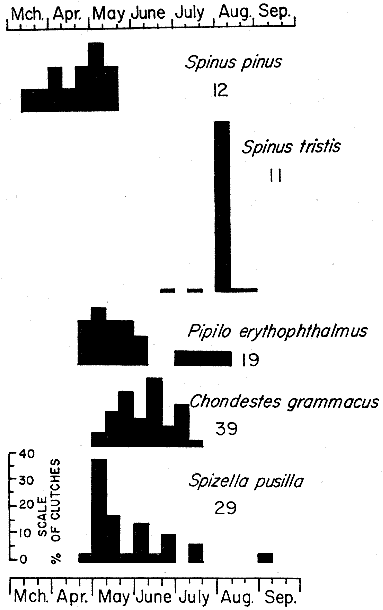
Breeding schedule.—Twelve records of breeding span the period March 11 to May 20 (Fig. 9); most nests have been established in late April or by early May.
Number of eggs.—Clutch-size is about 4 eggs. Of ten nests examined for eggs, five had at least one egg of the Brown-headed Cowbird; if it is assumed that each cowbird egg replaced one of the siskins, mean clutch-size is 3.7 eggs.
Nests are placed about seven feet high (ranging from 3.5 to 13 feet) in red cedar, exotic conifers, and Lombardy poplar.
American Goldfinch: Spinus tristis tristis (Linnaeus).—This resident is common in woodland edge, scrubby second-growth, old fields, and riparian thickets. Occurrence tends to be local and at low density in the southwestern sector.
Breeding schedule.—Twelve records of breeding span the period June 20 to September 10 (Fig. 9); the modal date for laying is August 5.
Number of eggs.—Clutch-size is 4 eggs (4.4, 3-6; 8).
Nests are placed from two to eight feet high in woody or herbaceous vegetation.
Red Crossbill: Loxia curvirostra Linnaeus.—This is an uncommon and irregular winter visitant to Kansas, but it nested once in Shawnee County. L. c. minor (Brehm), on geographic grounds, probably nested here, but five other subspecies have been recorded in the State and any one of these might have undertaken the aberrant breeding.
Breeding record.—Three eggs, set completed March 24, 1917, Shawnee County; successfully fledged (Hyde, 1917:166). The species usually lays 4 eggs and places its nests in conifers.
Rufous-sided Towhee: Pipilo erythrophthalmus erythrophthalmus (Linnaeus).—This is an uncommon summer resident in eastern Kansas, in understory of woodland and streamside timber. Specimens taken in the breeding season and actual records of nesting come from east of stations in Cloud, Marion, and Cherokee counties. Temporal occurrence is indicated in Table 20; records of P. e. arcticus (Swainson) have been eliminated from the sample as far as has been possible.
Breeding schedule.—Nineteen records of breeding span the period April 21 to August 10 (Fig. 9); the modal date for egg-laying is May 5.
Number of eggs.—Clutch-size is 4 eggs (4.0, 3-7; 14).
Nests are placed on the ground, in heavy cover.
Fig. 9.—Histograms representing breeding schedules of cardueline and emberizine finches in Kansas. See legend to Figure 1 for explanation of histograms.
Lark Bunting: Calamospiza melanocorys Stejneger.—This species is ordinarily a common summer resident in western Kansas, in grassland and open scrub. Specimens taken in the breeding season and all breeding records except one for western Franklin County come from west of stations in Decatur, Ellis, and Comanche counties. Irregular fluctuations in breeding density have been recorded from Decatur County (Wolfe, 1961). Temporal occurrence is indicated in Table 20.
Breeding schedule.—Fourteen records of breeding span the period May 21 to June 20; the modal date of egg-laying cannot be determined from the present sample.
Number of eggs.—Clutch-size is 4 eggs (4.1, 3-5; 7).
Nests are placed on the ground, at bases of clumps of grasses.
Grasshopper Sparrow: Ammodramus savannarum perpallidus (Coues).—This species is a local and at times common summer resident throughout Kansas, in grassland. Temporal occurrence is indicated in Table 20.
Breeding schedule.—Seven records of breeding fall in the period May 1 to June 30; the modal date of laying seems to be about May 21.
Number of eggs.—Clutch-size is 5 eggs (4.8, 4-5; 5).
Nests are placed on the ground or in low vegetation, with cover of grasses or forbs.
Henslow Sparrow: Passerherbulus henslowii henslowii (Audubon).—This is an uncommon and local summer resident in eastern Kansas, in grassland. Breeding records are from Cloud, Shawnee, Douglas, Morris, and Anderson counties. Temporal occurrence is indicated in Table 20.
Breeding schedule.—Eggs are laid in May and June.
Number of eggs.—Clutch-size is about 5 eggs.
Nests are placed on the ground, usually in bluestem pasture, but in any case grasses.
Lark Sparrow: Chondestes grammacus (Say).—This is a common summer resident in grassland edge habitats. C. g. grammacus (Say) breeds east of the Flint Hills, east of stations in Pottawatomie, Anderson, and Montgomery counties, and C. g. strigatus Swainson breeds west of stations in Clay, Dickinson, Harvey, and Sedgwick counties; specimens from the intervening area are of intermediate subspecific character. Temporal occurrence is indicated in Table 20.
Breeding schedule.—Thirty-nine records of breeding span the period May 1 to July 20 (Fig. 9); the modal date for egg-laying is probably May 25, but the sample may not be reliable in this respect.
Number of eggs.—Clutch-size is 4 eggs (4.1, 3-5; 28).
Nests are usually placed on the ground, in cover of pasture grasses, clover, thistle, milo maize, and soybean; there is one record of a nest one and one-half feet high in a small pine.
Cassin Sparrow: Aimophila cassinii (Woodhouse).—This is a common summer resident in open scrub and grassland edge, to the south and west of Wallace and Comanche counties. Specimens taken in the breeding season and actual nesting records are from Wallace, Hamilton, Kearny, Finney, Morton, and Comanche counties; the A. O. U. Check-list (1957) cites Hays, Ellis County, as a breeding locality, but it is doubtful that the species now occurs there. Breeding schedule.—Eggs are laid in May and June.
Number of eggs.—Clutch-size is about 4 eggs.
Nests are placed on the ground, at bases of small bushes.
Table 20.—Occurrence in Time of Summer Resident American Buntings in Kansas
Species Arrival Departure
Range Median Range Median
Rufous-sided Towhee Apr. 2-Apr. 19 Apr. 9 Sept. 20-Oct. 8 Sept. 29
Lark Bunting May 5-May 14 May 10 ........ ........
Grasshopper Sparrow Apr. 12-May 11 Apr. 29 Aug. 20-Oct. 6 Aug. 31
Henslow Sparrow Apr. 14-Apr. 30 Apr. 22 Oct. 15 ........
Lark Sparrow Mar. 29-Apr. 21 Apr. 18 Sept. 13-Oct. 16 Oct. 12
Chipping Sparrow Mar. 6-Apr. 29 Apr. 23 Oct. 3-Nov. 15 Oct. 20
Field Sparrow Mar. 4-Apr. 28 Apr. 7 Oct. 5-Nov. 12 Oct. 30
Chipping Sparrow: Spizella passerina passerina (Bechstein).—This is an uncommon summer resident in open woodland, second-growth, and edge. S. p. passerina is found east of stations in Barber and Shawnee counties; Chipping Sparrows are not known to breed farther to the west, but records for north-central Kansas are likely to be found. The subspecific affinities of our Chipping Sparrows are entirely with the nominate subspecies, and there is no basis for earlier reports (Long, 1940; Tordoff, 1956; Johnston, 1960) that S. p. arizonae Coues (= S. p. boreophila Oberholser) occurs in Kansas.
Breeding schedule.—Nine records of breeding fall in the period May 1 to May 10, in no way indicating the whole span of the breeding season; the species probably lays eggs in May and July, as well as in June.
Number of eggs.—Clutch-size is 4 eggs.
Nests are placed four to 40 feet high in evergreens of a variety of kinds.
Field Sparrow: Spizella pusilla (Wilson).—This species is a common summer resident in grassland and edge habitats. S. p. pusilla (Wilson) breeds in eastern Kansas chiefly east of the Flint Hills; S. p. arenacea Chadbourne breeds in central and western Kansas, intergrading easterly with S. p. pusilla.
Breeding schedule.—Twenty-nine records of breeding span the period April 21 to September 10 (Fig. 9); the modal date for first clutches is May 5.
Number of eggs.—Clutch-size is 4 eggs (4.1, 3-5; 21).
Nests are placed about 10 inches high (ranging from ground level to three feet) in or among coralberry, osage orange, elm, oak, rose, and, once, peony.
Chestnut-collared Longspur: Calcarius ornatus (Townsend).—This was formerly a summer resident in western Kansas, in short-grass habitat. The only known nesting area was in the vicinity of Ft. Hays, Ellis County. The species is to be looked for in prairie with short grass type of vegetation.
ACKNOWLEDGMENTS
Many persons have contributed field observations such as dates of arrival and departure for migrants, and the various activities of the breeding cycle for most of the species here discussed. An alphabetic listing of their names follows.
Galen Abbot, Ruth Abbot, Ted Anderson, Ted F. Andrews, Jon Barlow, Amelia Betts, Grace Thompson Bigelow, L. C. Binford, Bessie Boso, William J. Brecheisen, J. Walker Butin, L. B. Carson, Mrs. Eunice Dingus, Charles S. Edwards, A. S. Gaunt, Sue Griffith, Mrs. Mary F. Hall, J. W. Hardy, Stanley Hunter, Katherine Kelley, E. E. Klaas, W. C. Kerfoot, John A. Knouse, Eugene Lewis, Eulalia Lewis, John Lenz, Nathan H. McDonald, Marno McKaughan, Merrill McHenry, Robert M. Mengel, Robert Merz, Jim Myers, Mary Louise Myers, Mrs. Kathryn Nelson, T. W. Nelson, Steven Norris, Dan Michener, P. W. Ogilvie, Gary C. Packard, Mrs. Marion J. Mengel, Dwight Platt, William Reynolds, Frank Robl, S. D. Roth, Jr., Nancy Saunders, Richard H. Schmidt, Marvin D. Schwilling, T. M. Sperry, Steve Stephens, Max Thompson, Fr. Matthew Turk, Emil Urban, J. W. Wallace, H. E. Warfel, A. W. Wiens, Mrs. Joyce Wildenthal, George Young, and Richard Zenger.
LITERATURE CITED
Aldous, S. E.
1942. The white-necked raven in relation to agriculture. U. S. Fish and Wildlife Serv., Research Rep. 5:1-56.
American Ornithologists' Union, Check-list Committee
1957. Check-list of North American Birds (Lord Baltimore Press, Baltimore), xiii + 691 pp.
Baker, J. R.
1938. The relation between latitude and breeding season in birds. Proc. Zool. Soc. London, 108 (A):557-582.
Brown, F. A., Jr.
1960. Response to pervasive geophysical factors and the biological clock problem. Cold Spring Harbor Symp. Quant. Biol., 25:57-71.
Cockrum, E. L., Jr.
1952. Mammals of Kansas. Univ. Kansas Publ. Mus. Nat. Hist., 7:1-303.
Davie, O.
1898. Nests and eggs of North American birds (David McKay, Philadelphia). (vi) + 509 pp.
Davis, T. A. W.
1953. An outline of the ecology and breeding seasons of birds of the lowland forest region of British Guiana. Ibis, 95:450-467.
Fitch, H. S.
1958. Home ranges, territories, and seasonal movements of vertebrates of the Natural History Reservation. Univ. Kansas Publ. Mus. Nat. Hist., 11:63-326.
Goodrich, A. L., Jr.
1946. Birds in Kansas. Rept. Kansas State Brd. Agric, 44(267): 1-340.
Goss, N. S.
1891. History of the birds of Kansas (G. W. Crane Co., Topeka). 692 pp.
Graber, R., and Graber, J.
1951. Notes on the birds of southwestern Kansas. Trans. Kansas Acad. Sci., 54:145-174.
Hardy, J. W.
1961. Purple martins nesting in city buildings. Wilson Bull., 73:281.
Hopkins, A. D.
1938. Bioclimatics, … U. S. Dept. Agric., Misc. Publ. 280:iv + 188 pp.
Johnston, R. F.
1954. Variation in breeding season and clutch-size in song sparrows of the Pacific coast. Condor, 56:268-273.
1956. Population structure in salt marsh song sparrows, I. Condor, 58:24-44.
1960. Directory to the bird-life of Kansas. Univ. Kansas Publ. Mus. Nat. Hist., Misc. Publ. 23:1-69.
Lack, D.
1947. The significance of clutch-size, I, II. Ibis, 89:302-352.
Lehrman, D. S.
1958. Induction of broodiness by participation in courtship and nestbuilding in the ring dove (Streptopelia risoria). Jour. Comp. Physiol. Psychol., 51:32-36.
Lehrman, D. S., Brody, P. N., and Wortis, R. P.
1961. The presence of the mate and of nesting material as stimuli for the development of incubation behavior and for gonadotropin in the ring dove (Streptopelia risoria). Endocrinol., 68:507-516.
Linsdale, J. M.
1926. The magpie nesting in Kansas. Condor, 28:179-180.
1928. Birds of a limited area in eastern Kansas. Univ. Kansas Sci. Bull., 18:517-626.
1937. The natural history of magpies. Pac. Coast Avif., 25:1-234.
Long, W. S.
1940. Check-list of Kansas birds. Trans. Kansas Acad. Sci., 43:433-456.
Marshall, A. J., and Disney, H. J. de S.
1957. Experimental induction of the breeding season in a xerophilous bird. Nature, 177:143-144.
Mayr, E.
1946. History of the North American bird fauna. Wilson Bull., 38:3-41.
McCabe, T. T., and McCabe, E. B.
1933. Notes on the anatomy and breeding habits of crossbills. Condor, 35:136-147.
Miller, A. H.
1955a. The expression of innate reproductive rhythm under conditions of winter lighting. Auk, 72:260-264.
1955b. Breeding cycles in a constant equatorial environment in Columbia, South America. Proc. XI Congr. Internat. Ornithol., Basel, 1954: 495-503.
1960. Adaptation of breeding schedule to latitude. Proc. XII Congr. Internat. Ornithol., Helsinki, 1958:513-522.
Moreau, R. E.
1950. The breeding seasons of African birds, I. Land birds. Ibis, 92:223-267.
Nice, M. M.
1937. Studies in the life history of the song sparrow, I. Trans. Linnean Soc. New York, 4:1-247.
Nossaman, L. O.
1952. [Photograph] in "Kansas Fish and Game," 9(3):7.
Parmelee, D.
1961. A nesting colony of black terns in Kansas. Bull. Kansas Ornith. Soc., 12:25-27.
Paynter, R. A., Jr.
1954. Interrelations between clutch-size, brood-size, prefledging survival and weight in Kent Island tree swallows, I. Bird-Banding, 25:35-58.
Schmidt-Koenig, K.
1960. The sun azimuth compass: one factor in the orientation of homing pigeons. Science, 131:826-828.
Snow, D. W.
1955. The breeding of blackbird, song thrush, and mistle thrush in Great Britain. I. Clutch-size. Bird Study, 2:72-84.
Tordoff, H. B.
1956. Check-list of the birds of Kansas. Univ. Kansas Publ. Mus. Nat. Hist, 8:307-359.
Udvardy, M. D. F.
1958. Ecological and distributional analysis of North American birds. Condor, 60:50-66.
Welter, W. A.
1935. The natural history of the long-billed marsh wren. Wilson Bull., 97:1-34.
Wiener, N.
1958. Nonlinear problems in random theory. (Technology Press, Cambridge, England.)
Williamson, F. S. L.
1956. The molt and testis cycle of the Anna hummingbird. Condor, 58:342-366.
Wolfe, L. R.
1961. The breeding birds of Decatur County, Kansas: 1908-1915. Bull. Kansas Ornith. Soc., 12:27-30.
Zuvanich, J. R.
1963. Forster terns breeding in Kansas. Bull. Kansas Ornith. Soc., 14:1-3.
Transmitted November 21, 1963.
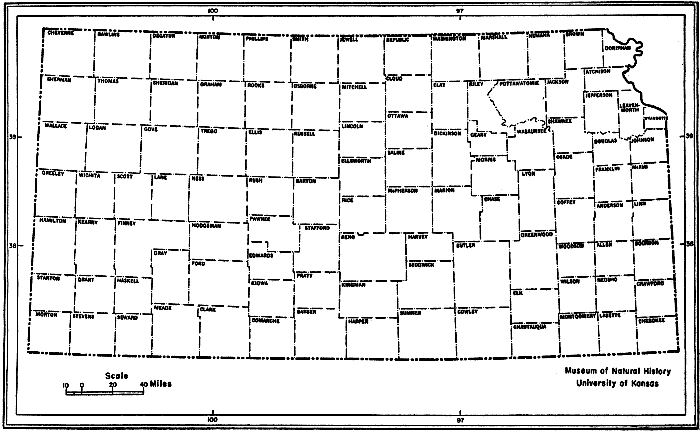
Click on map to view larger size image.
Fig. 10.
—Map of Kansas showing names of counties.
UNIVERSITY OF KANSAS PUBLICATIONS MUSEUM OF NATURAL HISTORY
Institutional libraries interested in publications exchange may obtain this series by addressing the Exchange Librarian, University of Kansas Library, Lawrence, Kansas. Copies for individuals, persons working in a particular field of study, may be obtained by addressing instead the Museum of Natural History, University of Kansas, Lawrence, Kansas. There is no provision for sale of this series by the University Library, which meets institutional requests, or by the Museum of Natural History, which meets the requests of individuals. Nevertheless, when individuals request copies from the Museum, 25 cents should be included, for each separate number that is 100 pages or more in length, for the purpose of defraying the costs of wrapping and mailing.
* An asterisk designates those numbers of which the Museum's supply (not the Library's supply) is exhausted. Numbers published to date, in this series, are as follows:
Vol. 1. Nos. 1-26 and index. Pp. 1-638, 1946-1950.
*Vol. 2. (Complete) Mammals of Washington. By Walter W. Dalquest. Pp. 1-444, 140 figures in text. April 9, 1948.
Vol. 3. Nos. 1-4 and index. Pp. 1-681. 1951.
*Vol. 4. (Complete) American weasels. By E. Raymond Hall. Pp. 1-466, 41 plates, 31 figures in text. December 27, 1951.
Vol. 5. Nos. 1-37 and index. Pp. 1-676, 1951-1953.
*Vol. 6. (Complete) Mammals of Utah, taxonomy and distribution. By Stephen D. Durrant. Pp. 1-549, 91 figures in text, 30 tables. August 10, 1952.
Vol. 7. Nos. 1-15 and index. Pp. 1-651, 1952-1955.
Vol. 8. Nos. 1-10 and index. Pp. 1-675, 1954-1956.
Vol. 9. *1. Speciation of the wandering shrew. By James S. Findley. Pp. 1-68, 18 figures in text. December 10, 1955.
2. Additional records and extension of ranges of mammals from Utah. By Stephen D. Durrant, M. Raymond Lee, and Richard M. Hansen. Pp. 69-80. December 10, 1955.
3. A new long-eared myotis (Myotis evotis) from northeastern Mexico. By Rollin H. Baker and Howard J. Stains. Pp. 81-84. December 10, 1955.
4. Subspeciation in the meadow mouse, Microtus pennsylvanicus, in Wyoming. By Sydney Anderson. Pp. 85-104, 2 figures in text. May 10, 1956.
5. The condylarth genus Ellipsodon. By Robert W. Wilson. Pp. 105-116, 6 figures in text. May 19, 1956.
6. Additional remains of the multituberculate genus Eucosmodon. By Robert W. Wilson. Pp. 117-123, 10 figures in text. May 19, 1956.
7. Mammals of Coahuila, Mexico. By Rollin H. Baker. Pp. 125-335, 75 figures in text. June 15, 1956.
8. Comments on the taxonomic status of Apodemus peninsulae, with description of a new subspecies from North China. By J. Knox Jones, Jr. Pp. 337-346, 1 figure in text, 1 table. August 15, 1956.
9. Extensions of known ranges of Mexican bats. By Sydney Anderson. Pp. 347-351. August 15, 1956.
10. A new bat (Genus Leptonycteris) from Coahuila. By Howard J. Stains. Pp. 353-356. January 21, 1957.
11. A new species of pocket gopher (Genus Pappogeomys) from Jalisco, Mexico. By Robert J. Russell. Pp. 357-361. January 21, 1957.
12. Geographic variation in the pocket gopher, Thomomys bottae, in Colorado. By Phillip M. Youngman. Pp. 363-387, 7 figures in text. February 21, 1958.
13. New bog lemming (genus Synaptomys) from Nebraska. By J. Knox Jones, Jr. Pp. 385-388. May 12, 1958.
14. Pleistocene bats from San Josecito Cave, Nuevo León, México. By J. Knox Jones, Jr. Pp. 389-396. December 19, 1958.
15. New subspecies of the rodent Baiomys from Central America. By Robert L. Packard. Pp. 397-404. December 19, 1958.
16. Mammals of the Grand Mesa, Colorado. By Sydney Anderson. Pp. 405-414, 1 figure in text. May 20, 1959.
17. Distribution, variation, and relationships of the montane vole, Microtus montanus. By Sydney Anderson. Pp. 415-511, 12 figures in text, 2 tables. August 1, 1959.
18. Conspecificity of two pocket mice, Perognathus goldmani and P. artus. By E. Raymond Hall and Marilyn Bailey Ogilvie. Pp. 513-518, 1 map. January 14, 1960.
19. Records of harvest mice, Reithrodontomys, from Central America, with description of a new subspecies from Nicaragua. By Sydney Anderson and J. Knox Jones, Jr. Pp. 519-529. January 14, 1960.
20. Small carnivores from San Josecito Cave (Pleistocene), Nuevo León, México. By E. Raymond Hall. Pp. 531-538, 1 figure in text. January 14, 1960.
21. Pleistocene pocket gophers from San Josecito Cave, Nuevo León, México. By Robert J. Russell. Pp. 539-548, 1 figure in text. January 14, 1960.
22. Review of the insectivores of Korea. By J. Knox Jones, Jr., and David H. Johnson. Pp. 549-578. February 23, 1960.
23. Speciation and evolution of the pygmy mice, genus Baiomys. By Robert L. Packard. Pp. 579-670, 4 plates, 12 figures in text. June 16, 1960.
Index. Pp. 671-690.
Vol. 10. 1. Studies of birds killed in nocturnal migration. By Harrison B. Tordoff and Robert M. Mengel. Pp. 1-44, 6 figures in text, 2 tables. September 12, 1956.
2. Comparative breeding behavior of Ammospiza caudacuta and A. maritima. By Glen E. Woolfenden. Pp. 45-75, 6 plates, 1 figure. December 20, 1956.
3. The forest habitat of the University of Kansas Natural History Reservation. By Henry S. Fitch and Ronald R. McGregor. Pp. 77-127, 2 plates, 7 figures in text, 4 tables. December 31, 1956.
4. Aspects of reproduction and development in the prairie vole (Microtus ochrogaster). By Henry S. Fitch. Pp. 129-161, 8 figures in text, 4 tables. December 19, 1957.
5. Birds found on the Arctic slope of northern Alaska. By James W. Bee. Pp. 163-211, plates 9-10, 1 figure in text. March 12, 1958.
*6. The wood rats of Colorado: distribution and ecology. By Robert B. Finley, Jr. Pp. 213-552, 34 plates, 8 figures in text, 35 tables. November 7, 1958.
7. Home ranges and movements of the eastern cottontail in Kansas. By Donald W. Janes. Pp. 553-572, 4 plates, 3 figures in text. May 4, 1959.
8. Natural history of the salamander, Aneides hardyi. By Richard F. Johnston and Gerhard A. Schad. Pp. 573-585. October 8, 1959.
9. A new subspecies of lizard, Cnemidophorus sacki, from Michoacán, México. By William E. Duellman. Pp. 587-598, 2 figures in text. May 2, 1960.
10. A taxonomic study of the middle American snake, Pituophis deppei. By William E. Duellman. Pp. 599-610, 1 plate, 1 figure in text. May 2, 1960.
Index. Pp. 611-626.
Vol. 11. Nos. 1-10 and index. Pp. 1-703, 1958-1960.
Vol. 12. 1. Functional morphology of three bats: Eumops, Myotis, Macrotus. By Terry A. Vaughan. Pp. 1-153, 4 plates, 24 figures in text. July 8, 1959.
*2. The ancestry of modern Amphibia: a review of the evidence. By Theodore H. Eaton, Jr. Pp. 155-180, 10 figures in text. July 10, 1959.
3. The baculum in microtine rodents. By Sydney Anderson. Pp. 181-216, 49 figures in text. February 19, 1960.
*4. A new order of fishlike Amphibia from the Pennsylvanian of Kansas. By Theodore H. Eaton, Jr., and Peggy Lou Stewart. Pp. 217-240, 12 figures in text. May 2, 1960.
5. Natural history of the bell vireo. By Jon C. Barlow. Pp. 241-296, 6 figures in text. March 7, 1962.
6. Two new pelycosaurs from the lower Permian of Oklahoma. By Richard C. Fox. Pp. 297-307, 6 figures in text. May 21, 1962.
7. Vertebrates from the barrier island of Tamaulipas, México. By Robert K. Selander, Richard F. Johnston, B. J. Wilks, and Gerald G. Raun. Pp. 309-345, pls. 5-8. June 18, 1962.
8. Teeth of Edestid sharks. By Theodore H. Eaton, Jr. Pp. 347-362, 10 figures in text. October 1, 1962.
9. Variation in the muscles and nerves of the leg in two genera of grouse (Tympanuchus and Pedioecetes). By E. Bruce Holmes. Pp. 363-474, 20 figures. October 25, 1962.
10. A new genus of Pennsylvanian Fish (Crossopterygii, Coelacanthiformes) from Kansas. By Joan Echols. Pp. 475-501, 7 figures. October 25, 1963.
11. Observations on the Mississippi Kite in southwestern Kansas. By Henry S. Fitch. Pp. 503-519. October 25, 1963.
12. Jaw musculature of the Mourning and White-winged doves. By Robert L. Merz. Pp. 521-551, 22 figures. October 25, 1963.
13. Thoracic and coracoid arteries in two families of birds, Columbidae and Hirundinidae. By Marion Anne Jenkinson. Pp. 553-573, 7 figures. March 2, 1964.
14. The breeding birds of Kansas. By Richard F. Johnston. Pp. 575-655, 10 figures. May 18, 1964.
Index to come.
Vol. 13. 1. Five natural hybrid combinations in minnows (Cyprinidae). By Frank B. Cross and W. L. Minckley. Pp. 1-18. June 1, 1960.
2. A distributional study of the amphibians of the Isthmus of Tehuantepec, México. By William E. Duellman. Pp. 19-72, pls. 1-8, 3 figures in text. August 16, 1960.
3. A new subspecies of the slider turtle (Pseudemys scripta) from Coahuila, México. By John M. Legler. Pp. 73-84, pls. 9-12, 3 figures in text. August 16, 1960.
4. Autecology of the copperhead. By Henry S. Fitch. Pp. 85-288, pls. 13-20, 26 figures in text. November 30, 1960.
5. Occurrence of the garter snake, Thamnophis sirtalis, in the Great Plains and Rocky Mountains. By Henry S. Fitch and T. Paul Maslin. Pp. 289-308, 4 figures in text. February 10, 1961.
6. Fishes of the Wakarusa river in Kansas. By James E. Deacon and Artie L. Metcalf. Pp. 309-322, 1 figure in text. February 10, 1961.
7. Geographic variation in the North American cyprinid fish, Hybopsis gracilis. By Leonard J. Olund and Frank B. Cross. Pp. 323-348, pls. 21-24, 2 figures in text. February 10, 1961.
8. Descriptions of two species of frogs, genus Ptychohyla; studies of American hylid frogs, V. By William E. Duellman. Pp. 349-357, pl. 25, 2 figures in text. April 27, 1961.
9. Fish populations, following a drought, in the Neosho and Marais des Cygnes rivers of Kansas. By James Everett Deacon. Pp. 359-427, pls. 26-30, 3 figures. August 11, 1961.
10. Recent soft-shelled turtles of North America (family Trionychidae). By Robert G. Webb. Pp. 429-611, pls. 31-54, 24 figures in text. February 16, 1962.
Index. Pp. 613-624.
Vol. 14. 1. Neotropical bats from western México. By Sydney Anderson. Pp. 1-8. October 24, 1960.
2. Geographic variation in the harvest mouse. Reithrodontomys megalotis, on the central Great Plains and in adjacent regions. By J. Knox Jones, Jr., and B. Mursaloglu. Pp. 9-27, 1 figure in text. July 24, 1961.
3. Mammals of Mesa Verde National Park, Colorado. By Sydney Anderson. Pp. 29-67, pls. 1 and 2, 3 figures in text. July 24, 1961.
4. A new subspecies of the black myotis (bat) from eastern Mexico. By E. Raymond Hall and Ticul Alvarez. Pp. 69-72, 1 figure in text. December 29, 1961.
5. North American yellow bats, "Dasypterus," and a list of the named kinds of the genus Lasiurus Gray. By E. Raymond Hall and J. Knox Jones, Jr. Pp. 73-98, 4 figures in text. December 29, 1961.
6. Natural history of the brush mouse (Peromyscus boylii) in Kansas with description of a new subspecies. By Charles A. Long. Pp. 99-111, 1 figure in text. December 29, 1961.
7. Taxonomic status of some mice of the Peromyscus boylii group in eastern Mexico, with description of a new subspecies. By Ticul Alvarez. Pp. 113-120, 1 figure in text. December 29, 1961.
8. A new subspecies of ground squirrel (Spermophilus spilosoma) from Tamaulipas, Mexico. By Ticul Alvarez. Pp. 121-124. March 7, 1962.
9. Taxonomic status of the free-tailed bat, Tadarida yucatanica Miller. By J. Knox Jones, Jr., and Ticul Alvarez. Pp. 125-133, 1 figure in text. March 7, 1962.
10. A new doglike carnivore, genus Cynaretus, from the Clarendonian Pliocene, of Texas. By E. Raymond Hall and Walter W. Dalquest. Pp. 135-138, 2 figures in text. April 30, 1962.
11. A new subspecies of wood rat (Neotoma) from northeastern Mexico. By Ticul Alvarez. Pp. 139-143. April 30, 1962.
12. Noteworthy mammals from Sinaloa, Mexico. By J. Knox Jones, Jr., Ticul Alvarez, and M. Raymond Lee. Pp. 145-159, 1 figure in text. May 18, 1962.
13. A new bat (Myotis) from Mexico. By E. Raymond Hall. Pp. 161-164, 1 figure in text. May 21, 1962.
14. The mammals of Veracruz. By E. Raymond Hall and Walter W. Dalquest. Pp. 165-362, 2 figures. May 20, 1963.
15. The recent mammals of Tamaulipas, México. By Ticul Alvarez. Pp. 363-473, 5 figures in text. May 20, 1963.
16. A new subspecies of the fruit-eating bat, Sturnira ludovici, from western Mexico. By J. Knox Jones, Jr. and Gary L. Phillips. Pp. 475-481, March 2, 1964.
17. Records of the fossil mammal Sinclairella, Family Apatemyidae, from the Chadronian and Orellan. By William C. Clemens. Pp. 483-491. March 2, 1964.
More numbers will appear in volume 14.
Vol. 15. 1. The amphibians and reptiles of Michoacán, México. By William E. Duellman. Pp. 1-148, pls. 1-6, 11 figures in text. December 20, 1961.
2. Some reptiles and amphibians from Korea. By Robert G. Webb, J. Knox Jones, Jr., and George W. Byers. Pp. 149-173. January 31, 1962.
3. A new species of frog (Genus Tomodactylus) from western México. By Robert G. Webb. Pp. 175-181, 1 figure in text. March 7, 1962.
4. Type specimens of amphibians and reptiles in the Museum of Natural History, the University of Kansas. By William E. Duellman and Barbara Berg. Pp. 183-204. October 26, 1962.
5. Amphibians and Reptiles of the Rainforests of Southern El Petén, Guatemala. By William E. Duellman. Pp. 205-249, pls. 7-10, 6 figures in text. October 4, 1963.
6. A revision of snakes of the genus Conophis (Family Colubridae, from Middle America). By John Wellman. Pp. 251-295, 9 figures in text. October 4, 1963.
7. A review of the Middle American tree frogs of the genus Ptychohyla. By William E. Duellman. Pp. 297-349, pls. 11-18, 7 figures in text. October 18, 1963.
8. Natural history of the racer Coluber constrictor. By Henry S. Fitch. Pp. 351-468, pls. 19-22, 20 figures in text. December 30, 1963.
9. A review of the frogs of the Hyla bistincta group. By William E. Duellman. Pp. 469-491, 4 figures in text. March 2, 1964.
More numbers will appear in volume 15.
Transcriber's Notes.
With the exception of six typographical errors that were corrected and moving the list of Publications to the end of the document, the original text and illustrations are presented as they appeared in the printed version.