MANUFACTURED PRODUCTS.
Reading edition
SUGAR.
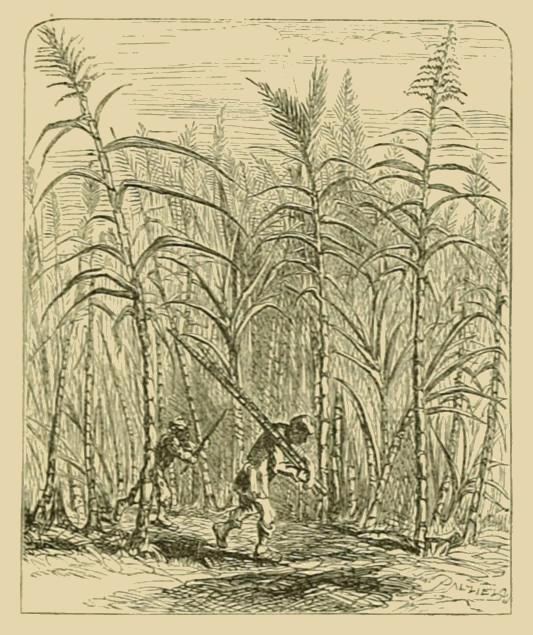
Sugar, like starch, exists naturally formed in many vegetables, and has to be separated from the various foreign matters with which it is combined; the sugar used in this country is all extracted from the juice of the sugar-cane, Arundo Saccharifera, but in France a great portion is extracted from beet-root.
The raw, or Muscovado sugar as it is called, is a brownish compound of small crystals of sugar held together by molasses or treacle, which gives the sugar its color and peculiar moistness; when pure, sugar is quite white and capable of crystallization, as may be seen in sugar candy, which is crystallized sugar; sugar, if heated, becomes converted into a dark brown liquid called burnt sugar or “caramel,” this has an intensely rich color, but scarcely any sweetness; it is used to color wines and spirits. The tendency of sugar to be converted into caramel is very great, and the whole difficulty of sugar refining depends upon this fact, for a solution of sugar heated is constantly changing into this substance.
To obtain the sugar from the sugar cane, it is first crushed between powerful rollers, by which all the juice is pressed out, this is immediately clarified by boiling it strongly with a small quantity of slaked lime, or it would speedily ferment, it is then put into evaporating pans, in which it is evaporated till it is ready to crystallize or granulate; from these pans it is ladled out into a cooler, and from thence into wooden boxes where it granulates; the next process is called “curing” this consists of draining the sugar of its molasses, for this purpose hogsheads or large broad barrels are arranged on a sloping floor, and having several holes at their lower part with a piece of plantain leaf put into them; through these holes the molasses runs out and is collected in a vessel for the purpose. The best kinds of sugar are partly purified by a process called “claying;” this consists in putting the sugar into conical earthen jars, with a hole at the point which is turned downwards; the top is piled up with a mass of wet clay, the moisture from which slowly sinks down, carrying with it most of the coloring matter of the sugar; the cone of sugar is afterwards dried, broken up, and each part ground up separately, as they form sugars of different value, the point being the brownest and the base of the cone the whitest.
Sugar is made from the beet root in the same way as from the cane, the roots being rasped up into a pulp by a wheel with a notched edge acting against them. Beet-root sugar crystallizes better than cane sugar; otherwise it is exactly like it, and purifies as well.
ALCOHOL, OR SPIRIT.
Alcohol, commonly called spirits of wine, is procured from any liquid which has undergone the vinous fermentation, such as wine and beer. The spirit used in England is procured from a wash made by pouring boiling water upon ground malt, as for making beer; this, when fermented and distilled, produces a colorless spirit, which, by being again distilled at a gentle heat, called rectifying, produces a very strong spirit; but even this contains some considerable quantity of water, and to get rid of this, for certain chemical purposes, it is necessary to add carbonate of potash, quick lime, or some other ingredient greedy of water, and again distil it. Brandy, rum, and whiskey, are but various forms of spirit colored and flavored with different substances. Brandy is distilled from wine; rum from the molasses, a sort of treacle produced in sugar making; and whiskey from malt. The strongest brandy does not contain more than one half of its bulk of pure spirit.
Alcohol, when pure, is a very limpid, colorless fluid, lighter than water, in the proportion that 792 bears to 1000. It is very volatile, boiling at 172 deg. of Fahrenheit, and highly inflammable, it dissolves resins and volatile oils, and is, therefore, used largely in perfumery. The well known lavender water and eau de Cologne, are solutions of volatile oils of various kinds in pretty strong alcohol, and what are called spirit-varnishes, are most of them solutions of various kinds of resin in strong alcohol, although some of them, as mastic varnish, are made with spirit of turpentine, a volatile oil, in place of alcohol.
STARCH.
Starch exists naturally in various kinds of grain, as wheat and barley, and in the roots and tubers of many plants, as potatoes. The process of extracting the starch, and separating it from the other constituents of the seed or root, consists, essentially, of crushing it, and wishing out the starch with cold water; the liquid resulting from this mode of treatment is of a milky whiteness, and deposits starch by sediment. This liquid is passed through five sieves to separate the husks and skins, and when the starch has settled, and the liquid fermented and become sour, it is drawn off; it is allowed to become sour as the gluten of the grain is more completely separated by so doing. The starch is repeatedly stirred, allowed to settle, and the water drawn off, till it is quite pure; the top of the starch is scraped to separate any slime adhering, and the pure starch dug out with wooden shovels and put in a box lined with linen, in which the moisture drains off; the cakes taken from these boxes are cut up into squares, put upon bricks, and dried by a gentle heat; the squares are then scraped clean and packed in paper for sale, in these packages it breaks up into pieces, so that when they are opened, the starch has that peculiar appearance so familiar, and almost resembling six-sided columns. Arrow-root is the starch obtained from a West Indian plant called Maranta Arundinacea.
Cassava and Tapioca are starches from the manioc, and Sago, from the sago palm. Starch, under the microscope, appears in the form of minute globules, and is quite insoluble in cold water, in which it falls to the bottom, leaving the water at the upper part quite clear; but water that is nearly boiling (that is to say at 160 deg. of Fahrenheit’s thermometer, or above), breaks or dissolves the granules, and the starch forms with it a sort of paste, this is the liquid used for stiffening linen and other articles in domestic laundry.
The starch sold in this country is colored blueish by smalt or indigo; but on the continent is used of its natural white color. If starch be baked in an oven at the temperature of about 300 deg. it becomes, to a great extent, soluble in cold water, forming what is called “British gum,” this is largely used for calico printing and other purposes; if boiled in water under great pressure, so that the temperature can be raised to the same degree, it is also changed into an adhesive sort of gum—this is the substance made use of by the government authorities to spread over the backs of postage and receipt stamps to make them adhere. The starch of grain during germination, or growth, becomes converted into sugar; the same effect can be produced by heating starch with diluted sulphuric acid.
SOAP.
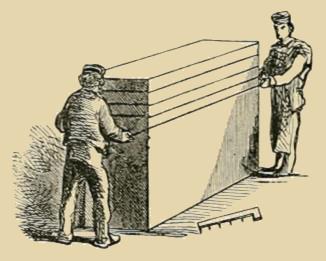
CUTTING SOAP.
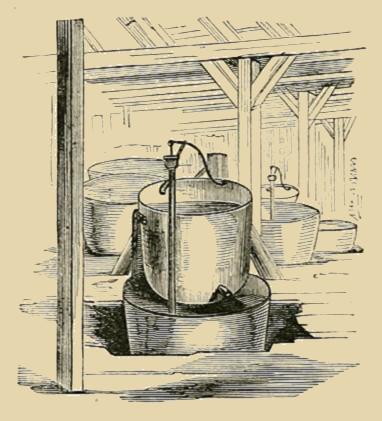
COPPERS FOR THE MIXING PROCESS.
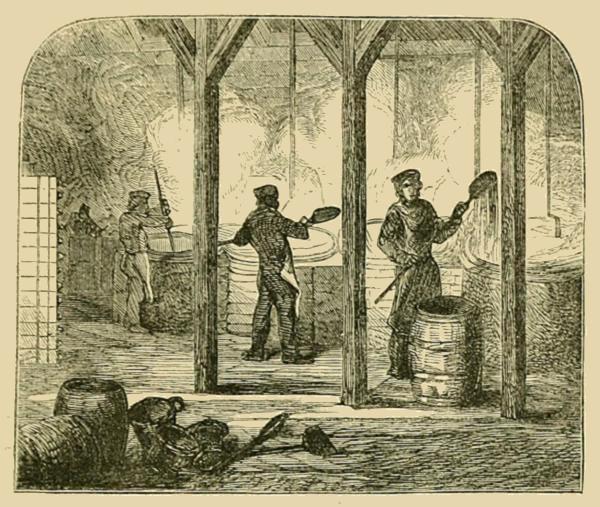
This very useful article is produced by a combination of tallow or oil with soda or potash; with soda, hard soap is formed; with potash, soft soap. The yellow soap of commerce has also an addition of resin or turpentine, and often palm oil, these give it its yellow color and peculiar smell; pure white soap is made by boiling a solution of soda with tallow or olive oil; ordinary soaps are generally made by mixing a solution of the soda of commerce, (carbonate of soda) with quick lime, this takes away the carbonic acid and makes the soda what is called “caustic;” this solution is drawn off, and kitchen stuff, tallow, turpentine, and sometimes palm oil, are added and boiled together, until all is converted into soap, but a large quantity of water remaining, it is necessary to separate the soap from this, for this purpose salt is added until the water becomes so heavy that the soap rises to the surface, whence it is removed into moulds or frames and allowed to cool, when it is cut into bars for sale.
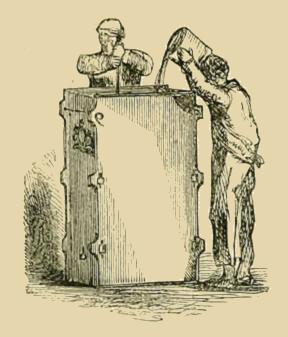
FILLING YELLOW SOAP.
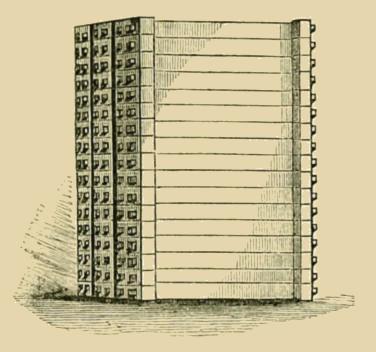
MOTTLED SOAP FRAMES.
Soft soap is made in the same way, using potash instead of soda, and, generally, a large quantity of train-oil. Castile soap is pure soda soap, and the blueish or red mottled appearance is produced by stirring in some sulphate of iron (green vitriol); when new it is of a blueish color, but gets red by exposure to the air.
Oils and fats combine with the oxides of several of the metals, and a combination of oxide of lead with olive oil forms a firm solid substance, or plaister, which, with the addition of a little resin, is used in surgery, and when spread upon linen or calico, forms the common adhesive plaister.
Oils and fats all consist of a combination of organic acids, (stearic, oleic, and margaric), with glycerine. When these fats are boiled with soda, potash, or metallic oxides, a combination of the oxide and fatty acid takes place, and this constitutes soap. The glycerine is then set free, and, when purified, forms a sweet, oily, colorless fluid, very similar to syrup, but not so sweet; it has lately been used for several purposes, especially as a remedy for chapped hands; a soap called “glycerine soap,” has lately been used for the same purpose; it is a soap made without separating the glycerine.
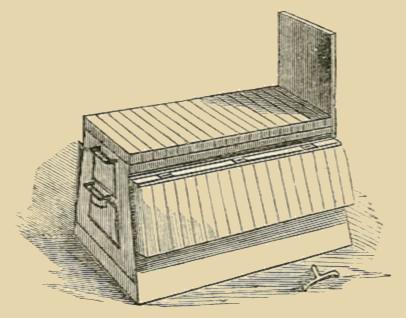
MACHINE FOR CUTTING SOAP IN BARS.
The above illustration represents an ingenious contrivance for the purpose of cutting soap.
STEARINE.
The Stearine Candles, so much in use of late, are made of what chemists call “stearic acid.” It is extracted from tallow by the following process:—The fat is first melted, then boiled with water and quick lime; the lime forms a solid insoluble soap with the stearic acid of the fat. This, when cold, is dug out of the cistern and separated from the watery parts; it is then melted in a wooden cistern by means of perforated iron pipes, through which steam passes; the steam not only melts it, but condenses and runs to the bottom, thoroughly washing it; it is again allowed to cool, separated when it is mixed, stirred well with sulphuric acid and a large quantity of water, and allowed to settle. This separates all the lime, which settles to the bottom, leaving the stearine floating on the top, from whence, when cold, it is taken and again well washed with steam. The mass, after cooling, is cut into shavings by a machine consisting of a wheel, having knives attached to its edge; the shavings are put into hair-cloth bags and subjected to the most powerful pressure by means of the hydraulic press; each hair-cloth bag having a warm iron plate interposed between it and the next bag. The oily parts of the mass are, by these means, all pressed out; the remainder is again cut up and a second time pressed, leaving the pure stearine, white and crystalline like spermaceti.
SODA.
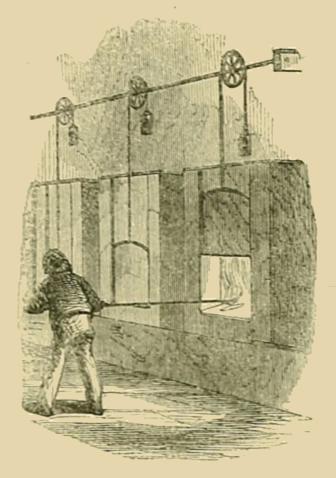
The Soda of commerce is a carbonate of soda, and it is made from sea salt. It is used in large quantities for the general purposes of washing and cleansing, and very extensively in bleaching and soap making. Soda occurs in two forms—soda ash and in crystals; the first is the crude soda before crystallization. To make soda, oil of vitriol (sulphuric acid) is poured, by degrees, on a layer of sea salt, in a sort of funnel connected with a tall chimney; on the addition of the vitriol, copious fumes of the hydrochloric acid are given off; this is the acid formerly called spirit of salt. When the furnace is heated and all the acid driven off, the dried residue is taken out, it is sulphate of soda. It was formerly the custom to allow the hydrochloric acid to pass up a very tall chimney so that it may be dispersed in the air; but such an injurious effect was produced on the surrounding vegetation that this could no longer be allowed; the plan adopted was, to cause the acid to be condensed by filling the chimney with coke, and causing water to trickle through it; the acid vapours, coming into contact with this porous wet surface, is condensed into a liquid, which runs down into a cistern placed to receive it. The sulphate of soda, when taken from the furnace and cooled, is next ground in a mill with rather more than its weight of chalk, and about half its weight of coal. This mixture is placed in a furnace and raised to a sufficient heat to partly fuse it, during which time it is stirred about; the black mass which results is called by the workmen “black ball.” It is taken out and put into a cistern; water is then poured over it, and after stirring, it is drained off and evaporated to a dry mass; this is impure soda. It is mixed with coal-dust, again burnt, again washed and evaporated, by this second process the soda ash is produced, which, being dissolved, filtered and evaporated, produces large crystals of soda. The large quantity of hydrochloric acid produced in the first part of the process, is used in the of making chloric of lime. A few years back, soda was got from the ashes of the plant called “salsola soda,” and sold in the form of an impure carbonate called “barilla.”
WINES.
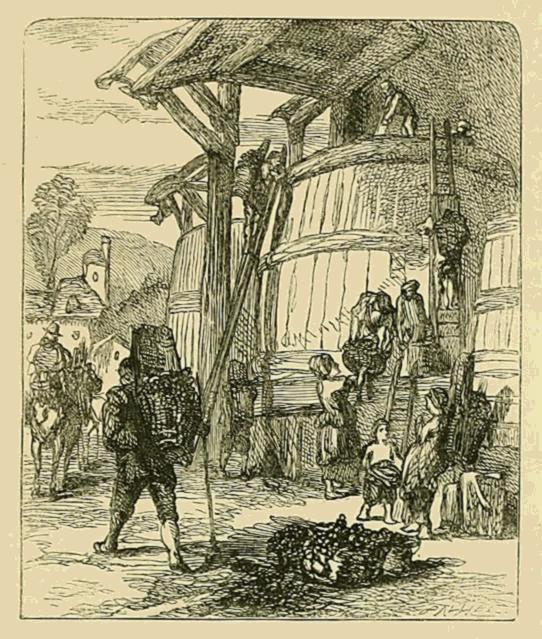
WINE MAKING.
Wine is made from the juice of grapes. When the grapes are ripe, they are gathered and at once put into a press, by which all the juice is squeezed out, and the skins, stalks, and seeds left in the press. This juice, which is called “must,” is allowed to ferment, which it does of its own accord, in the countries where grapes most abound, and at the season of the year when they are gathered, without the addition of yeast or other ferment; in a few days nearly all the sugary matter contained in the “must” becomes converted into spirit, and it has now the pungent taste of wine; (if the wine is allowed to ferment too long, it is very apt to become sour), the wine is now put into casks and kept for a time, during which a slow fermentation goes on, and that substance, which is called “tartar,” is deposited in the form of a thick crust of an acidulus taste and brown color; when purified till it is quite white, it forms the cream of tartar of the druggists’ shop. The color of wine depends upon the color of the grapes used, whether white or black.
Wine, at a general average, contains about 20 per cent. of spirit or alcohol; when port wine is put into bottles, a slow fermentation continues to go on, and a crust of tartar is deposited similar to that described above, and it is the separation of this tartar which causes port wine to improve by age.
What are called British wines, are liquids mostly made by fermenting the juice of the fruits whose name they bear, as currant wine, gooseberry wine, &c.; but as the climate of this country is not favorable to the growth of grapes, or the spontaneous fermentation of their juice, the grape wine of England is very inferior to the foreign. The juice of any fruit required to make wine of, has to be fermented artificially; this is generally done by making it slightly warm, and floating on the surface a piece of bread soaked with yeast; the wines thus produced are very apt to become sour, and it is generally necessary to add brandy to preserve them. Many of the British wines sold in London are made of an impure weak spirit called “faints,” sweetened and flavored with various substances, as ginger, orange-peel, &c. and sell for ginger or orange wine.
VINEGAR.
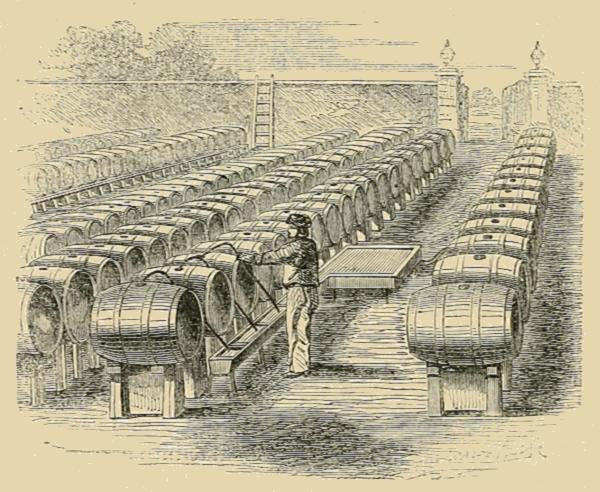
Vinegar is produced by fermenting and exposing to the air any liquor which contains sugar, such as wine, infusion of malt, cyder, &c.; by the addition of yeast, this sets up a fermentation, by means of which the sugar in any of these liquors is converted, first into spirit, and afterwards into vinegar; this contains a certain quantity of acetic acid, which makes the vinegar sour. In warm countries, vinegar is made by simply exposing the poorer kinds of wine to the sun’s rays, when they ferment and become sour. In England, all the vinegar produced is made by fermenting wort made of malt, this is fermented for three or four days, and is then put into casks, with the bunghole left open for several weeks, or until it is thoroughly sour. In ordinary vinegar, there is about five or six parts only in the hundred of real acetic acid, but this acid, when pure, is so strong as to blister the skin when dropped on it; it is often extracted from vinegar for chemical purposes, and to smell too; for when scented, it constitutes aromatic vinegar. Vinegar, besides acid and water, contains a little unchanged spirit, much coloring matter, and some mucilage.
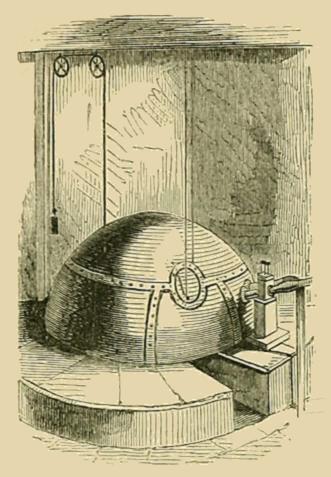
BOILER OR COPPER.
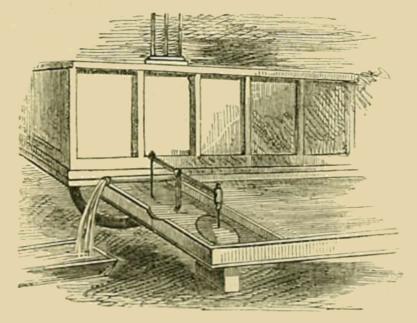
COOLING APPARATUS.
Vinegar is chiefly used as a condiment, and for making pickles, and has considerable powers of preserving vegetable or animal substances; if common vinegar be distilled, a weak colorless acid comes over, commonly known as white or distilled vinegar. It is a common thing to sprinkle a sick room with vinegar, under the impression that it has disinfecting properties, but this is an error; although the odour is very refreshing. Vinegar has, of late, been made by means of the vinegar plant, which is a fungus, causing a species of slow fermentation, and converting the sugar or treacle used into acetic acid.
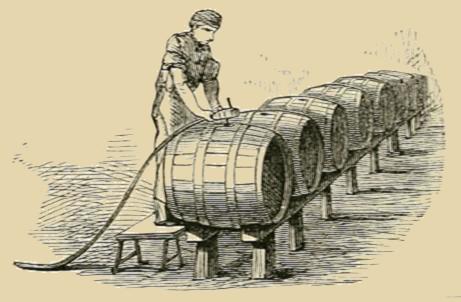
FILLING CASKS.
The heading of this section gives a good idea of the large scale on which vinegar is made; being an accurate representation of the extensive works of Messrs. Beaufoy & Co. at Lambeth.
COAL GAS.
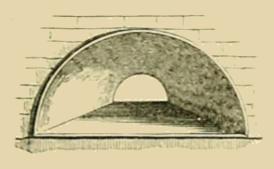
SECTION OF RETORT.
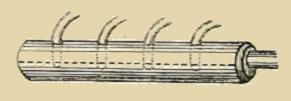
FIG. 2.
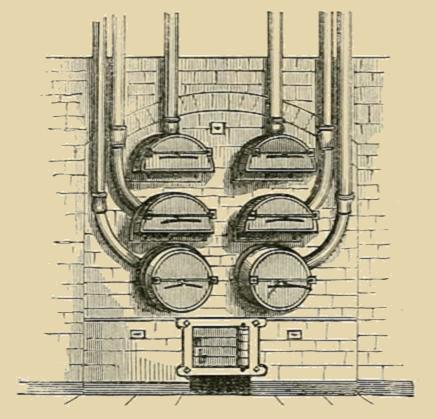
FIG. 1.
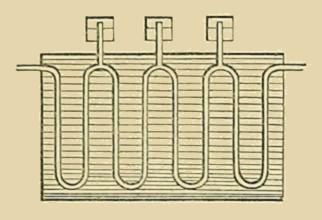
FIG. 3.
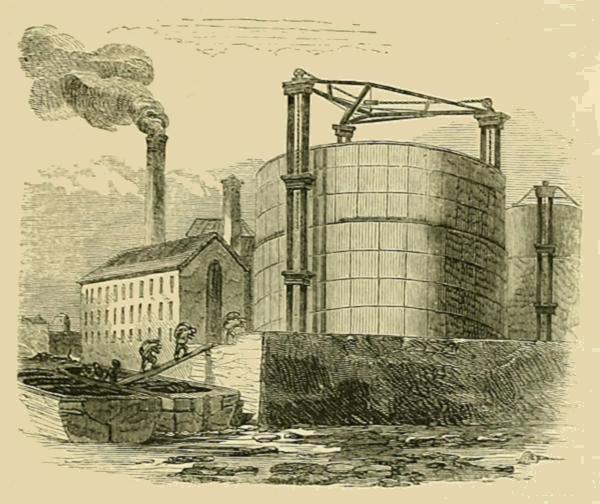
Gas, for lighting, is made from coal, by subjecting it to heat in iron tubes and collecting and purifying the gas which is produced; the following is a summary of the process:—The vessels in which the coal is put are called “retorts,” they are six or seven feet long, one-and-a-half broad, and one high, generally fitted up six to a furnace, in such a way that the flame may entirely surround them (see fig. 1); from each retort an iron tube passes, and these all dip into a large horizontal tube, reaching nearly to its bottom (fig. 2), this is the receiver for all the gas from the retorts; it is connected with a pit for tar and ammonical liquor, which copiously condenses from the hot newly-formed gas. The object of causing the tubes to dip nearly to the bottom of the receiver is, that the fluid in it may close the end of each tube, and so prevent the gas returning when any of the retorts are opened for a fresh supply of coal; from the receiver, the gas passes by tubes bent up and down inside of a great cistern of water (fig. 3) kept cold by a constant change of its contents; this is the condenser, it causes the separation of all the tar and ammonia that remain; but the gas is still contaminated with sulphur, and this is got rid of by causing it to pass into a broad iron cylinder perforated with holes and dipping into a reservoir of lime and water mixed together and stirred about with a machine contrived for the purpose; the gas enters this lime mixture in hundreds of bubbles through the holes, and the sulphur the gas contains is attracted by the lime with which it unites. The gas now rises to the top of this reservoir, which is, of course, air tight, and from thence passes for use to the gasometer; this is the store-house where the gas is kept to supply the service pipes b, c, under the streets.
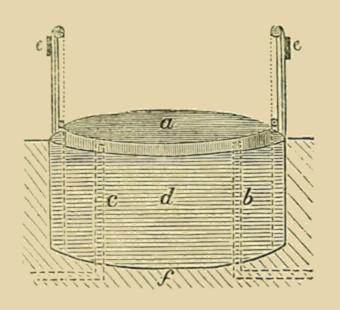
FIG. 4.
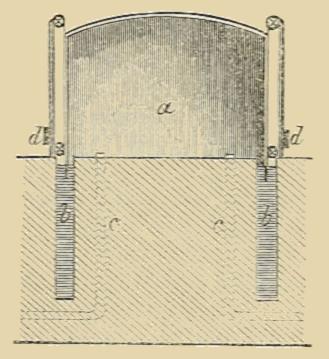
FIG. 5.
The gasometer is made of plates of iron rivetted together. The lower part of this cylinder (see figs. 4 and 5) is received into a circular deep channel cut in the ground (b b, fig. 5) and filled with water, so that the gasometer d, which is suspended and balanced by means of the chains and weights e e, may be raised or depressed at pleasure. When the gasometer is quite down, the inside of its top, a, rests on the ground; when the gas enters, it raises it up till the lower edge is but a few inches below the water, and is prevented from rising higher by frames which support it; when some of the weights, d d, are removed, the huge cylinder, a, slowly sinks down and forces the gas through the tubes, c c, to be burnt by thousands of consumers. About four cubic feet of gas is produced from every pound of coal used; the gas is lighter than air in the proportion of 650 to 1000, and it is owing to this lightness that balloons ascend when filled with it, not from any peculiar power it has of ascending, but because the air, being heavier, presses downwards and forces it up. When gas is mixed with air it becomes very explosive, and when any escape is suspected in a room, the windows of the room should be opened at the top, and the door also opened, before any light is introduced; a few minutes will then suffice to ensure safety.
One ton of good coal produces—
1 Chaldron of Coke, weighing 1494 lbs.
12 Gallons of Tar ” 135 ”
12 Gallons Ammoniacal liquor 100 ”
9500 Cubic feet of Gas, weighing 291 ”
Loss (chiefly water) ” 220 ”
2240 lbs.
A cubic foot of gas weighs 514 and a-half grains.
TAR.
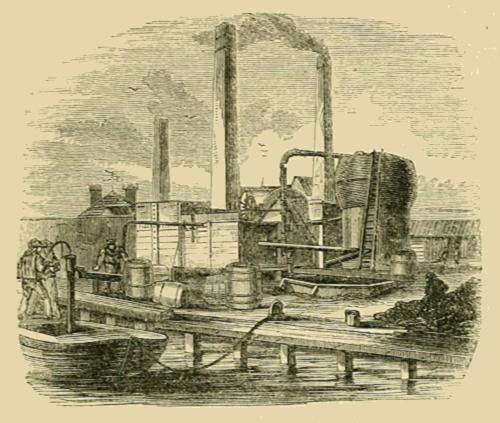
Tar is one of the results left in the distillation both of wood and coal; in places where wood is plentiful and tar in request, it is produced by burning the wood for that purpose; and in some of the pits in which charcoal is produced, an arrangement is made to collect the tar also. Coal-tar and wood-tar are different in some respects, and are both distilled to procure the napthas which bear the respective names. From wood-tar, creasöte is also extracted, and it is this substance which gives the peculiar tarry flavor to provisions cured or preserved by being smoked over wood fires, such as ham, bacon, or herrings. Tar is used as a sort of paint for covering wood-work and cordage, when much exposed to wet, which it resists better than anything else at the same price; but the tar chiefly used for these purposes, is that produced by burning fir or deal wood and condensing the tar in a pit below the stack of wood, it is called Stockholm tar, as it comes chiefly from that place.
ACETIC ACID, OR WOOD VINEGAR.
Acetic acid forms a considerable article of commerce. It is not only used in medicine and the culinary art, but is extensively employed in forming acetate of iron for dyeing and calico printing. To prepare it, large iron cylinders, about eight feet long and three in diameter, are embedded in brickwork in a row, and in such a manner that furnaces placed below may heat them red-hot; these cylinders have a tube leading from each into a main tube, where the liquid products from each cylinder are received for condensation; the other end of the cylinder has a plate of iron fitting closely to it. The cylinders are filled with logs of wood, either oak, beech, birch, or ash, the door is closely fastened and the joints smeared with clay; the fires are now lighted and kept up all day, till the cylinders are red-hot; at night they are allowed to cool. About seven or eight hundred weight of wood is put into each cylinder. In the morning, the charcoal, into which the wood is now converted, is withdrawn, and a fresh charge supplied; from this charge of wood about thirty or forty gallons of liquid is condensed in the main tube from each cylinder, the remainder being charcoal and gases which pass off; the liquid is acid, brown, and very offensive, and contains acetic acid, tar, and several other ingredients, among which may be named creasote; it is from this source all the creasote, so famous for the cure of toothache, is obtained. The next process is to purify this liquid; it is first distilled, and this separates much tar, it is then mixed with lime, evaporated to dryness, and heated to expel the remaining tar and other impurities; it is next mixed with sulphate of soda and water and the whole stirred together, the soda, now in unison with the acetic acid, is washed out from the lime and strained quite clear; it is afterwards evaporated till it crystallizes, and vitriol (sulphuric acid) then added; finally, the acetic acid is distilled over, and the acid left in unison with the soda, forming sulphate of soda, to be used in a similar process for the next batch of acid; the acetic acid is now quite colorless, transparent, and very sour, possessing a fragrant and agreeable smell. This acid is not pure acetic acid, but contains a considerable quantity of water. The acetic acid of commerce, mixed with seven times its bulk of water, forms an acid of about the strength of malt vinegar, perfectly wholesome, and, to many, more agreeable as a condiment.
Pure acetic acid may be made by mixing dry acetate of potash with oil of vitriol in a retort, and distilling the acetic acid into a very cold receiver; this, when flavored with various volatile oils, forms the aromatic vinegar sold by druggists. It is a very strong acid, and if applied to the skin will quickly blister it.
VARNISHES.
Varnishes are solutions of various resinous substances that will dry with a bright surface on exposure to the air. They are used to protect different substances from the action of the atmosphere, and to give them an elegant bright surface; woods and painted work are the chief things varnished; metals are coated with a kind of varnish called “lacquer,” this is to prevent the bright surface of the metal from being dulled by the air or damp, and to give an artificial appearance to some metals; tin, for instance, if lacquered with yellow lacquer, acquires somewhat the appearance of brass. Mastic varnish is the varnish generally used for paper and pictures; it is made by dissolving gum mastic in oil of turpentine. Copal varnish is that most generally used for carriages and wood, it is made by adding boiled linseed oil to melted copal, and afterwards thinning it with oil of turpentine. A common varnish, fit for many purposes, may be made by adding common resin to oil of turpentine, and warming it till dissolved. Lacquers are made by dissolving shellac and various other gums in strong spirits of wine, and in some cases coloring it, either yellow, by means of gamboge, or red, by dragon’s blood (a kind of resin). French polish is nearly the same as lacquer, but the mode of applying it is different; the grain of the wood is first filled up by means of drying oil and chalk rubbed in, when this becomes thoroughly dry, a rubber of flannel is covered by a piece or two of clean old linen, and some of the polish put on it, just enough to moisten it, and then a little oil, this is slowly rubbed round and round, the varnish adhering to the wood, and the oil preventing the rubber sticking to it, and at the same time, polishing the surface of the varnish as it dries. This process requires a good deal of art to produce a perfect surface. Old work, before being varnished with any varnish that contains oil (as copal varnish), should be thoroughly freed from grease or greasy matter, or the varnish will never dry. Good varnish should dry in twenty-four hours so that dust will not adhere to it.
OILS.
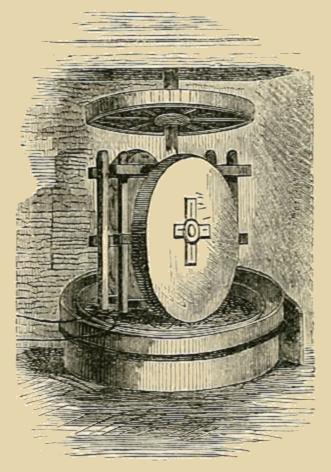
PRESSING LINSEED FOR OIL.
Oils, whether animal or vegetable, have pretty much the same properties. The vegetable oils are got by crushing and pressing certain seeds, as linseed; the animal oils are obtained chiefly from the whale and seal tribe, or from fish, as the cod and sturgeon. They are viscid and of a pale yellow color, lighter than water, and therefore float upon it, and are very combustible. Oils are used for a multiplicity of purposes: for burning in lamps, for making paints and varnishes, preventing the friction of machinery, in making soap, and numerous other processes. Oils are generally divided into fixed and volatile oils; as an example of the first, linseed oil may be selected; of the last, oil of lavender.
Some of the fixed oils are called drying oils, and it is this kind that are used for varnish making; as linseed oil possesses the properties of this class very perfectly, it may serve as a description of all. Linseed oil has the power of drying when spread out in a thin layer, becoming of a resinous consistence like varnish, and upon this quality depends the drying powers of paint, for the other non-drying oils, as olive oil, may be exposed to the air for months without drying at all; the drying powers of linseed oil are greatly increased by boiling it with litharge (oxide of lead). This forms the drying or boiled oil used in painting, and is employed in making varnishes, printers’ ink, and for other purposes. Oiled silk is formed by brushing silk over with this oil and exposing it to the air till it is dry; this oiled silk is the same that is used for sponge-bags and bathing-caps. Of the non-drying oils, the chief are those used for burning in lamps, as sperm oil. Salad oil is expressed from the olive, and is called olive oil. Of the volatile oils, the most useful is oil of turpentine, commonly called spirit of turpentine; it is got by distilling common turpentine (the concrete juice of trees of the fir and pine tribe), it has a strong odour, is very inflammable, and is volatile, that is to say, if spread out, will evaporate, leaving nothing behind; this oil is capable of mixing with drying oils, and it not only increases their drying powers, but, by thinning them, makes them more applicable to many purposes. Oil of turpentine dissolves resin and many resinous substances, and forms useful varnishes with them. Mastic varnish is mastic dissolved in oil of turpentine; it is the varnish always used for varnishing pictures. Many of the volatile oils are used as perfumes, and the odour of plants and flowers depends upon the volatile oil which evaporates from them, as lavender, cloves, and others. Peppermint water, dill water, and cinnamon water are produced by distilling water mixed with the substances, and is simply water containing a small quantity of the volatile oil of these substances in solution; but eau-de-Cologne and lavender water, although called “waters,” are mixtures of volatile oils and spirit of wine, and contain no more water than is comprehended in the spirit used.
INKS.
Inks are fluids of various kinds suitable for writing with pens. The chief inks in use are black, blue, and red writing inks, and indelible or marking ink, intended for marking linen which has to be washed. Indian ink is not used as an ink, properly so called. All the black inks in use are composed of green vitriol (sulphate of iron), in union with some astringent vegetable matter, the best is the gall-nut, although, for cheapness, logwood and oak bark have each been used. An excellent black ink may be made by putting into a gallon stone bottle twelve ounces of bruised galls, six ounces of green vitriol, and six of common gum, and filling up the bottle with rain water, this should be kept three or four weeks before using, shaking the bottle from time to time. Blue ink has lately been much used, it is made by dissolving newly-formed Prussian blue in a solution of oxalic acid. To make it, dissolve some yellow prussiate of potash in water in one vessel, and some sulphate of iron in another, adding a few drops of nitric acid to the sulphate of iron; now mix the two liquids, and a magnificent blue color will appear in the form of a light sediment; this is to be put upon a paper filter, and well washed by pouring over it warm water and allowing it to run through; a warm solution of oxalic acid should now be mixed with it, and the Prussian blue will dissolve into a bright blue ink.
Red ink is made by boiling chips or raspings of Brazil wood in vinegar, and adding a little alum and gum; it keeps well, and is of a good color. A red ink of more beautiful appearance, but not so durable, may be made by dissolving a few grains of carmine in two or three tea-spoonfuls of spirit of hartshorn.
Marking ink is made by dissolving nitrate of silver in water, and then adding some solution of ammonia, a little gum water, and some Indian ink to color it. Printers’ ink is made by grinding drying oil with lamp-black.
CHARCOAL.
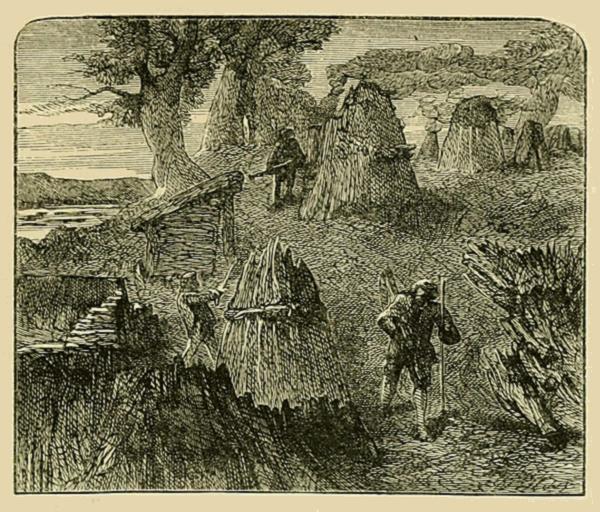
Charcoal is made by burning wood in such a manner that but little air shall be admitted during the operation, that is to say, only sufficient to keep up the combustion of the more easily destroyed parts of the wood, leaving a black residue called charcoal. The best charcoal is made when the wood is quite excluded from the air, as in making acetic acid, but where large quantities of charcoal are used for common fuel, as in France, of course this process is too expensive. The usual way is to pile up billets of wood and cover the whole with turf; when fired, the wood consumes gradually and the charcoal is left behind. Charcoal is light and porous, and of a shining black color; it weighs about one quarter as much as the wood used, and burns without flame or smoke, giving out a strong heat. When charcoal burns, it combines with part of the air, and is converted into a gas called carbonic acid, which, although invisible, is much heavier than air, and is a deadly poison; it is therefore necessary, where charcoal is burning, to always have some opening at the bottom of the room. Many fatal accidents have arisen from people sleeping in a small room with a pot of burning charcoal, and no outlet for the poisonous vapour but the chimney, up which it will not pass on account of its weight. Charcoal enters into the composition of gunpowder, and is used for several other purposes. It is an excellent sweetener of foul water, and a few pieces should always be kept in the top of the filter when the water has any bad odour, or in the cistern or butt, where a filter is not used; powdered charcoal has also the power of taking away the color of many liquids, as well as the bad smell; vinegar, if warmed with powdered charcoal, and then strained, will be almost colorless. Water butts are sometimes burnt or charred inside, that the water may be the better preserved in them.
Chemically considered, charcoal consists of carbon with a certain amount of earthy matter (the ashes or earthy part of the wood from which it was made), but these ashes may be easily removed by maceration in an acid; the charcoal then remains unaltered in appearance and consists of carbon, but its structure is exceedingly porous.
CEMENTS.
In various processes, cements of different descriptions are required for a variety of purposes. The common cement used in building, which is called mortar, is made of sand and quicklime mixed with water. Roman and Portland cements consist of certain kinds of clay burnt and ground. Plaster of Paris forms a useful cement, it is to be mixed with water to the consistence of cream, and it hardens in a few minutes. Glue is an invaluable cement for wood and many other purposes, it also joins any kind of broken glass or china that will not have to be subjected to much wetting. Shellac dissolved in spirit is a useful cement; and isinglass, dissolved in weak spirit, and having some gum ammonicum added to it, forms the “diamond cement” for uniting china. China and glass which require to be much wetted, are best united by being made very hot and having the broken edges rubbed with a piece of shellac, this melts on them, and forms, while hot, a sort of cement; if they be immediately applied and pressed firmly and accurately together, and then permitted slowly to cool, they will unite so as to be almost as strong as before breaking.
COKE.
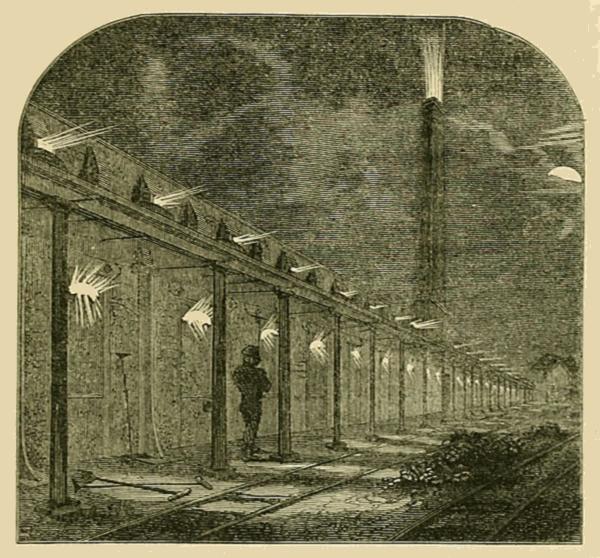
Coke is produced by the partial burning of coal, in the same way that charcoal is from wood. The great source of coke is the gas manufactory, where it is sold in large quantities, being the result left in the retorts after the gas has all been driven off; but the consumption of coke by locomotive engines, &c., where coal would not be admissible on account of the smoke produced, has become so great that it is necessary to burn coals for its production; this is done by a range of ovens fitted up for that purpose, having iron doors which can be closed to any extent required so as to regulate the draught of air. Dr. Ure gives the following in his account of the coke ovens belonging to the London and North Western Railway Company:—“An excellent range of furnaces for making a superior article of coke for the service of the locomotive engines of the London and Birmingham Railway Company, has been erected at the Camden Town Station, consisting of eighteen ovens, in two lines, the whole discharging their products of combustion into a horizontal flue which terminates in a chimney-stalk one hundred and fifteen feet high. Each alternate oven is charged, between eight and ten o’clock every morning, with three-and-a-hall tons of good coals, a wisp of straw is thrown in on the top of the heap, which takes fire by the radiation from the dome, which is in a state of dull ignition from the preceding operation, and inflames the smoke then rising from the surface by the reaction of the hot sides and bottom upon the body of the fuel, in this way the smoke is consumed at the very commencement of the process, when it would otherwise be most abundant. The coke being perfectly freed from all fuliginous and volatile matters by a calcination of upwards of forty hours, is cooled down to moderate ignition by sliding in the dampers and sliding up the doors, which had been partially closed during the latter part of the process. It is now observed to form prismatic concretions, somewhat like a columnar mass of basalt. These are loosened by means of iron bars, lifted out upon shovels furnished with long iron shanks, which are poised upon swung chains with hooked ends, and the lumps are thrown upon the pavement, to be extinguished by sprinkling water upon them from the rose of a watering can, or they may be transferred into a large chest of sheet iron set on wheels, and then covered up. Good coals, thus treated, yield eighty per cent. of an excellent, compact, glistening coke, weighing fourteen cwt. per chaldron.”
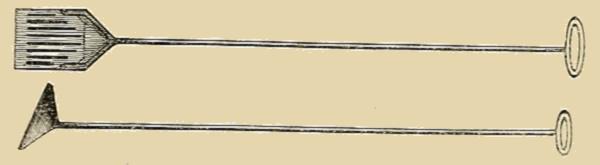
Coke burns without smoke, and not so rapidly by far as charcoal, it is, moreover, considerably cheaper than that article is.
GUNPOWDER.
Gunpowder is a mixture of nitre, sulphur, and charcoal, and the more completely they are mixed, the more finely ground, and the purer they are, the more perfect will be the gunpowder. The proportions used of these ingredients differ slightly in different powder mills; but the average is about seventy-four parts nitre, ten sulphur, and fourteen charcoal, by weight; the sulphur and nitre can easily be completely purified, but the charcoal differs very much in almost every specimen, and charcoal that has been burnt long ago and exposed to the air and moisture is almost unfit for the purpose, that charcoal which has the least ash when burnt is found to be the best, and the charcoal which has been made in iron cylinders, is better than that made in the usual way, when each of the ingredients are separately powdered and sifted through a kind of sieve of silk called a bolting machine (such as is used in dressing flour), they are mixed in the proper proportions and taken to the mill, where they are moistened with water and ground to a smooth paste, this is pressed hard and then broken up into pieces which are put into a copper sieve, the bottom of which is perforated with small hole; a flat wooden ball is put into each sieve with the pieces of damp powder, and the sieves are all put into a circular motion by machinery, this causes the wooden ball to turn round in the sieve and so rub the damp powder through the little holes; it is collected below in small grains or “corns,” this process is called “corning,” this is now dried, and then put into a “reel” (a sort of barrel which turns round) and the grains, by rubbing against each other, become smoothed on the surface; the dust is now removed by a sieve, too fine to let the grains through; the powder is now fit for use.
Gunpowder was first known in England about five hundred years ago. It is not only used to discharge firearms, but in the more peaceful occupations of quarrying stone, mining, and to get rid of rocks both below and above water; these processes are called “blasting.”
GUN COTTON.
To prepare gun cotton, make a mixture of three parts sulphuric acid and one part nitric acid; when this has cooled (for it becomes hot on mixing), put into it some cotton wool, and let it be stirred about with a glass rod, then taken out, and all the superfluous acid strained from it; it is then to be covered up for an hour or so. It should now be thoroughly washed in cold water, so that all the acid be removed; to ensure this completely, let it be afterwards washed in a very weak solution of potash, and then dried by a very gentle heat, produced by either steam or hot water; when dry, soak it in a solution of nitre and dry it again. It is now so explosive that great care is required in its management, being about three times as explosive as gunpowder.
PHOSPHORUS.
This substance, since the general use of lucifer-matches, has become an important article of manufacture; whereas, but a few years ago, it was a mere chemical curiosity. It is prepared by mixing bone ashes with sulphuric acid, straining off the liquid part, and evaporating it to a syrupy consistence; with this, about a quarter of its weight of powdered charcoal is mixed, and the whole stirred and evaporated to a dry powder; this is put into earthenware retorts, which are connected by copper tubes to receivers filled with water; the retorts are raised to a white heat and maintained at this high temperature as long as any phosphorous passes into the receivers, the water in which is kept warm, so that the phosphorous melts and runs to the bottom, from whence it is taken and strained through chamois leather bags, under warm water, and then cast in glass tubes into sticks. Phosphorous is of a whitish color, like wax, is easily melted, readily takes fire even by slight friction, and, in the air, gives off fumes which in the dark appear luminous. It is chiefly used in the manufacture of lucifer matches, and, mixed with flour, butter, or sugar, is used to poison rats, mice, and other vermin, under the name of “phosphorous paste.” Phosphorous is poison, and most dangerous stuff to handle, minute particles often getting under the nails and causing painful sores.
WHITE LEAD.
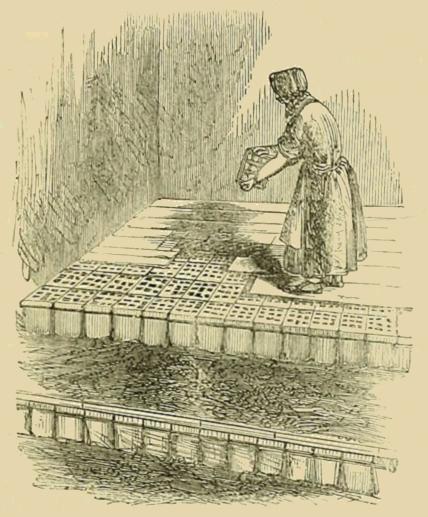
WHITE LEAD BED.
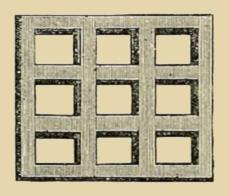
FIG. 1.
White Lead is used in very large quantities by painters, not only as white paint, but to mix with and qualify every shade of color, and to give body to them. It is prepared by different processes, and several patents have been taken out for improvements in its manufacture; but the most usual, and, perhaps, the best process, is as follows:—A layer of spent tan (from the tanner’s pits) is spread out three or four feet thick, and in it a number of earthen pots are arranged in rows, each partly filled with a mixture of vinegar, water, and treacle, or some other acid fermenting liquid, each of these pots is covered with a piece of lead made in the form of a grating (fig. 1), and over all these a flooring of boards, and then again a layer of tan, pots covered with lead, and boards, two or three times repeated; this is called a white lead bed, and is left for several weeks; the tan ferments and gets warm, causing the acid vapours to rise and corrode the lead, at the same time giving off carbonic acid. At the end of about three months the leaden covers are found to have become completely changed into a white shining substance (carbonate and oxide of lead), this is washed from impurities and ground in a mill, under water, to a fine powder. It is the white lead of commerce; but what is familiarly called white lead, is this substance ground up with linseed oil into a thick paste so as to be ready for the use of painters.
White lead is a very poisonous substance, and produces the disease called painters’ colic, when taken into the system in minute quantities and for a long time, so that all who have much to do with this dangerous substance, as house-painters and artists, should be extremely careful that their hands are well washed frequently, and especially before going to meals. Cisterns of lead, used for containing water, very soon become coated inside with a thin film of sulphate of lead, this prevents the water from acting further on the lead, and the water from such cisterns is never found to be poisonous; but, if distilled water were used, it would act rapidly on the lead, corroding it, and causing a deposit in the water of white lead, which would render such water dangerous in the extreme.
PRUSSIAN BLUE.
This beautiful blue color is made by mixing solutions of sulphate of iron (green vitriol) and prussiate of potash together, when the Prussian blue falls in the form of a precipitate, or moist powder, of a pale greenish color, but which, by exposure to the air and the addition of a little nitric acid, becomes intensely blue; but the Prussian blue of commerce is never pure, for the solution of prussiate of potash is used as it comes from the factory, before being crystallized, and contains carbonate of potash, to get rid of which, alum is added, and the result is, the formation of a considerable amount of alumina, which is a white earth produced from the alum, and which falls down in the precipitate mixed with the Prussian blue, which is thereby increased in bulk and but little injured in color; when a larger quantity of this alumina is purposely produced, the result is a blue of a rather less intense color, called “Antwerp blue.” The chemical name for pure Prussian blue is percyanide of iron. Chinese blue is this substance in its purest state.
PRUSSIATE OF POTASH.
Prussiate of potash is the commercial name given to what chemists call “ferrocyanide of potassium,” it is used largely for the production of Prussian blue, and also in the art of electro-plating, which, of late, has greatly increased the demand for its manufacture, and many patents have been taken out for various modifications in the form of production, the result, however, is the same, and it occurs in commerce in magnificent crystals of a square form, with bevelled edges, and of a yellow color; there is, however, another kind called the “red prussiate,” which is much used in the process of calico printing. Prussiate of potash is made by heating together carbonate of potash, scraps of iron, and any kind of animal refuse, as blood, horns and hoofs, clippings of skin or old woollen rags; these are stirred together, and the heat raised, till they form a sort of paste of a black color, which, when cold, is thrown into water and all the soluble parts washed out; this fluid is filtered till quite clear, evaporated, and set aside that crystals may form; these are dissolved and again crystallized. The red prussiate is made by passing chlorine over the yellow prussiate in powder dissolving and crystallizing.
The most deadly of all poisons, prussic or hydrocyanic acid, is obtained from the ferrocyanide of potassium, or prussiate of potash, by adding diluted sulphuric acid and distilling the vapour into an ice-cold receiver. This experiment should never be made by any but those well conversant with such matters.
SULPHATE OF IRON.
Also called “Green Vitriol” and “Green Copperas,” is a combination of sulphuric acid and oxide of iron, and may be made by putting iron filings or pieces of iron into a mixture of sulphuric acid and water, and when all action has ceased evaporating the liquid, and setting it by till crystals form—these are of a pale green color. The sulphate of iron of commerce is formed by exposing the iron pyrites found in the coal districts to the air till it falls to powder; water is then poured over this substance, and the fluid collected and evaporated. Sulphate of iron is used chiefly to form the black dye so much in demand to dye cloth, and also in making writing ink.
SULPHATE OF COPPER.
This substance is also known by the names, “Blue Vitriol” and “Blue Stone.” It is a combination of sulphuric acid with oxide of copper, and may be made by uniting those substances; but what is used on a large scale for commercial purposes is obtained from the waters which flow into copper mines where “copper pyrites” abound; this water is evaporated, and the sulphate of copper crystallizes. Sulphate of copper has of late been in great demand for the electro-deposition of copper.
CHLORIDE OF LIME.
Chloride of lime or “bleaching-powder” is made for the purposes of bleaching calicoes, linens, &c., and also for purifying foul air, which it does by giving out chlorine, a gas capable of uniting with and changing the injurious properties of foul air (which generally contains some combination of sulphur and hydrogen). Chloride of lime is made on the large scale by mixing hydrochloric acid with black oxide of manganese. This mixture gives off chlorine. This is made to pass over a layer of slaked lime, which absorbs it greedily, and becomes converted into the bleaching powder. The hydrochloric acid used is a product resulting from the manufacture of soda, and was formerly wasted; it is now used in large quantities for the process above described. “Burnett’s Disinfecting Fluid” is a solution of chloride of zinc. It is made by dissolving scraps of zinc in hydrochloric acid; hydrogen gas is given off, with effervescence, and the liquid remaining is the solution of chloride of zinc, which acts like chloride of lime, by giving off chlorine; for the chloride is slowly decomposed by the air, the oxygen of which takes the place of the chlorine, uniting with the zinc to form oxide of zinc, while the chlorine is set free.
SULPHURIC ACID.
This was formerly called “Oil of Vitriol,” because it has an oily consistence, and was originally distilled from green vitriol. Sulphuric acid is one of the most useful chemical agents known; scarcely a process in chemical manufacture can be performed without its assistance. Sulphuric acid is colorless, and very heavy, being nearly double that of water (the proportion is 1·842, while water is 1,000); it is powerfully acid, even when largely diluted with water, and during this mixture with water gives out great heat, a mixture of equal parts will become hotter than boiling water; if it be mixed, however, with snow instead of water, it becomes extremely cold (below zero).
Sulphuric acid is made by burning sulphur in a furnace, and causing the vapours to pass into a large chamber lined with lead, and having some water at the bottom; into this chamber the vapours arising from nitre mixed with sulphuric acid are also admitted, together with air and a jet of steam. These arrangements require to be properly and nicely regulated, and it was only by study of the complicated changes which take place between these gases (sulphurous acid, nitric oxide, and atmospheric air), that this arrangement has been devised and adopted, a great part of the product having been formerly wasted in a more clumsy mode of preparation. The sulphuric acid condensed in the water at the bottom of the leaden chamber is too weak for use, and is concentrated by evaporating the water from it; for this purpose it is placed in shallow leaden pans placed on the bars of a furnace, and finally distilled in glass retorts, or retorts of iron lined with platinum. Sulphuric acid has such a powerful attraction for water, that an open vessel half-full of strong acid placed in a damp situation will attract enough water from the atmosphere to cause it to be quite full before long. This power of attracting water has been taken advantage of to procure ice in those places where it is not to be had naturally, as India, &c. If a vessel of water be placed under the receiver of an air-pump, and the receiver exhausted of air, the vapour of the water will speedily fill it, taking the place of the air, and so stop any further evaporation; but if another vessel containing some sulphuric acid be placed also in the receiver, the acid will absorb the vapour of water as fast as it is formed, and this rapid evaporation continuing produces such cold, that the remaining water is shortly frozen. Iron and zinc dissolve rapidly in diluted sulphuric acid, giving off abundance of hydrogen gas, and this was the way this gas was formerly produced for the inflation of balloons, but the common coal-gas being easily obtainable in almost any quantity in all towns, it is now used for that purpose instead of hydrogen gas. Sulphuric acid (chemically considered) consists of 1 equivalent of sulphur with 3 of oxygen, and 1 of water. Pure sulphuric acid (without water) is in the form of fine crystals, much resembling snow, which, on exposure to air containing the slightest quantity of moisture, absorbs it, and becomes converted into the ordinary sulphuric acid.
If this acid (even when greatly diluted) be spilt on cotton or linen it destroys it, producing a hole; this is owing to the acid converting the fibre into sugar. A proposition was once made to produce sugar from this source, but linen and cotton rags are in too great demand for paper-making to allow of its being done.
LEATHER.
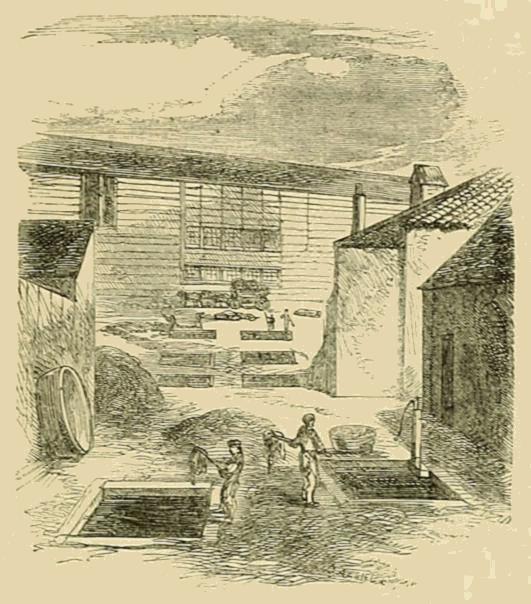
TAN-YARD AND PITS.
Tanning is the name given to the process for converting the skins of animals into leather, by combining them with a substance called “Tannin.” This tannin exists in many vegetable substances, such as oak-bark, gall-nuts, catechu, sumach, &c.: all of these, and many more, are used for tanning, but, on account of its cheapness, oak-bark is the usual substance employed. It is tannin which gives the quality of astringency to many vegetables, and this very taste of astringency is produced by a partial combination of the tannin with the surface of the mouth.
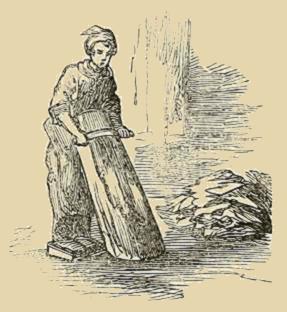
UNHAIRING THE SKIN.
The skins (called “hides” or “pelts”) are first freed from all loose pieces of flesh, fat, or skin; the hair is then removed by soaking them in lime and water. The skins are then laid in the “tan-pit” between layers of crushed oak-bark until the pit is nearly full; water is then pumped in, and the whole is allowed to remain for several weeks or months (according to the thickness of the skin), during which time, however, the skins are changed in position by removing them from one pit to another with fresh bark in it, so that those taken from the top of the first are placed at the bottom of the next; and this is done from time to time, in order that all may receive the same pressure and strength of tan-liquor. Very thick hides take a year to tan perfectly in this way, and consequently many processes have been tried to quicken the operation; but the leather made most slowly seems to wear the best, and consequently fetches the higher prices.
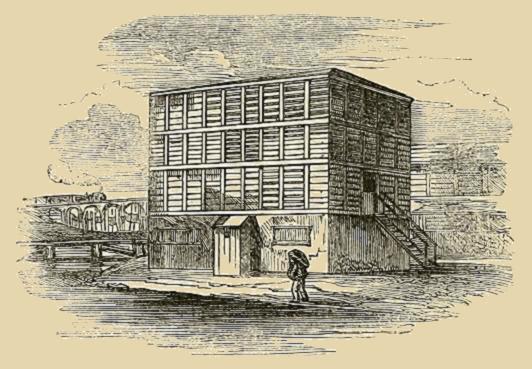
DRYING ROOMS.
Skins which are thin, and to be used for fancy work, and for book-binding and glove-making, are either tanned with “sumach,” or with alum and salt made into a paste with flour and yolk of eggs; this is put into a tub, and the mixture and skins worked together with the hands till they are thoroughly united.
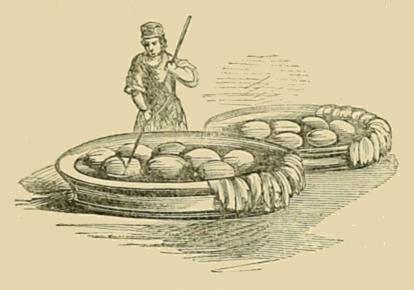
SUMACH TAN TUBS.
Besides boots and shoes, leather is used for the harness of horses, covers for seats, gloves, and innumerable other purposes.
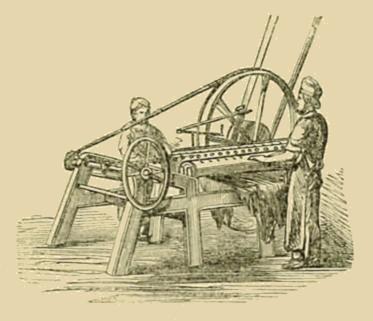
SPLITTING MACHINE.
For some purposes the leather is required to be very thin, and of exactly one thickness. This is obtained by the process of splitting, for which a machine is used whose exactness is such, that one slice is taken from the inner part of the whole skin, reducing it in thickness without cutting a hole in any part. The skin is stretched tightly round a roller, which slowly revolves against a straight knife-edge, fixed at a certain distance from it, according to the thickness of the skin, and which is passed by the machine backwards and forwards, cutting the skin a little further each time.
GLUE AND SIZE.
Glue is made from the clippings of hides or any other refuse of skins, horn shavings, bones, &c. All these substances are piled up in a boiler having a second bottom within, perforated with holes, and kept from the true bottom by short feet; this arrangement is to prevent the substances boiled from burning at the bottom of the boiler. After many hours’ boiling the liquid is tested, and if it “sets” into a sort of jelly readily, the liquor is drawn off into another boiler, where it is kept warm, that it may not set till used. From this boiler it is strained through flannel into square wooden boxes, having ridges at the bottom dividing them into squares (to direct the workmen where to cut the glue when cold); these boxes are set apart, and when the contents have become cold and set into a firm jelly, a knife is passed between the sides of the box and its contents, and the glue turned out in a large solid square. This is now cut by means of a wire with a handle at each end into squares of about eight inches each way and an inch thick; these are now placed on nets made of cord fixed in frames one above another in a “drying-room,” which is open to the air at the sides, and able to be closed up in case of wet weather. In this room the glue dries up, shrinks, and hardens, until it is quite brittle; the marks of the net can be seen on every square of glue.
Size is the same as glue, but instead of being dried it is put into small barrels. Two qualities of size are made, single and double size. It is much used by whitewashers, paper-hangers, and others, but for any purpose requiring good size, it may be made by soaking isinglass or gelatine in cold water till it is softened, and then standing the vessel in boiling water till it is dissolved; this produces a jelly nearly pure. A cheaper kind of size, almost as pure, may be made by boiling clippings of clean parchment till they are dissolved, and straining off the solution. Gelatine is the same as glue, but made of materials that are clean and fresh. Isinglass is the “sound” or swimming-bladder of the sturgeon, cleaned, dried, and cut up into fine shreds.
PARCHMENT.
Parchment is prepared from the skins of sheep, goats, calves, and asses. Sheep-skins furnish by far the greater part of all parchment prepared, indeed all that which is used for deeds and law purposes. From whatever skin prepared, it is first soaked in lime and water to remove the hair and greasiness, and then stretched tightly on a frame, and the surface rubbed smooth with pumice-stone, after which the skin is allowed to dry. Parchment is used for deeds, which require to be very durable and not easily torn, both of which qualities it possesses much more than any kind of paper; it is also used for book-binding, drum-heads, and many other purposes. Clippings of parchment boiled for some time, and the liquid strained off, forms an excellent colorless size. Vellum is a thick kind of parchment, made chiefly of calf-skin.
CATGUT.
What is called catgut is made from the inner or lining membrane of the intestines of sheep. These are washed, soaked, scraped, and otherwise prepared, to render them even and clear; they are then soaked in a solution of pearlash to clear them from grease, twisted, exposed to the vapour of sulphur, polished by rubbing, and afterwards stretched and dried. Catgut is used not only for the strings of violins and other musical instruments, but also for what is called “clock-makers’ cord,” that is to say, for the bow by which the drill is turned, and for several other purposes. It is very strong, and does not easily get ragged, as would any hempen cord.
PAPER.
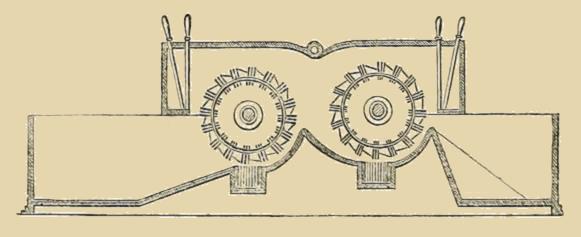
FIG. 1. SECTION OF RAG ENGINE, WITH DOUBLE ROLLER.
This important article of civilisation is made from rags of various descriptions and qualities, according to the kind of paper to be made, the finest white paper being made of old clean linen rags, while brown paper is made of all sorts of old rope-yarns, sacking, &c., and some kinds of paper have a considerable amount of straw bleached and worked up in them. The rags are first sorted and cut up into small pieces; they are then beaten on a wire screen to separate all dust, and afterwards put into the washing-machine, through which a stream of water runs, and in which they are kneaded and torn by a broad wheel having iron wedges or knives fastened to its edge (fig. 1) or surface, which work as it is turned against knives of a similar description fastened to the bottom of the cistern. When the rags are thoroughly washed, and at the same time torn to a coarse pulp, it constitutes what the workmen call “half-stuff.” This is mixed with chloride of lime, and the machine again set in motion; this is for the purpose of bleaching the pulp; after this has been effected, more water is turned on, as in the first washing, and all the chloride of lime washed thoroughly away. The pulp is now either put into another machine of the same description which cuts sharper and finer, or else the same machine used at first is so screwed up as to cause the knives to come more closely together; in either case the rate of turning is greatly increased, so that the wheel turns at about 150 revolutions per minute, and completely grinds up the pulp till it is perfectly smooth: at this part of the process some “indigo” or “smalt” is added if the paper is to be of a blueish tint, as in “foolscap” paper. The “stuff” is now run off into a cistern ready for use. Paper is now nearly all made by machinery, in pieces of a certain width, but of an indefinite length, and is cut up into sheets afterwards by a “cutting machine.”

FIG. 2. PAPER-MAKING MACHINE.
These machines (fig. 2) consist essentially of a vat, A, for the pulp, which flows out on to a bed of wire gauze, B B B, covered with felt, and bounded on each side by straps or deckles, and forming a circle or endless band by being stretched over a succession of rollers, C D E F G, which, by turning round continually, move its upper surface onwards and between other cylinders, which press out the superfluous moisture; it is then carried forward till it arrives at several pairs of large hollow cylinders, H H H, heated by means of steam which is passed through them, and which compress and at the same time thoroughly dry the paper, which comes from them as paper perfectly formed, and of any length that may be required. It is then glazed on the surface by the rollers I, and coiled on the cylinder L. Any name, device, or water-mark can be worked in the bed on to which the pulp flows, and which, being repeated at definite distances, appears on each sheet into which the paper is afterwards cut. The apparatus marked K is to conduct to the earth the electricity developed by the friction of the paper against the rollers. Beneath the bed of wire gauze, on which the pulp is laid is a cavity from which the air is pumped, and which causes the air to press upon the surface of the pulp, and force out a great deal of its moisture.
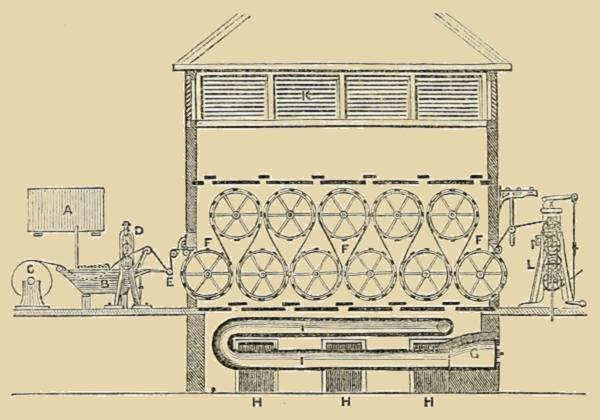
FIG. 3. SIZING MACHINE.
If the paper has to be sized (which is the case in all “hard” papers) it has to pass through a process, the machinery of which is shown in fig. 3. A is a reservoir for size, B a trough for the paper to dip into, C the reel of paper to be sized, D rollers to press out all superfluous size, E a pulley to keep the paper on the stretch, F F F a succession of hollow “drums,” to prolong the passage of the paper through the air of the drying-room, which is heated by the furnace G and the tubes I I. H H are openings to admit fresh air, and K openings to allow the exit of the steam from the paper as it dries. L is a series of rollers to glaze it.
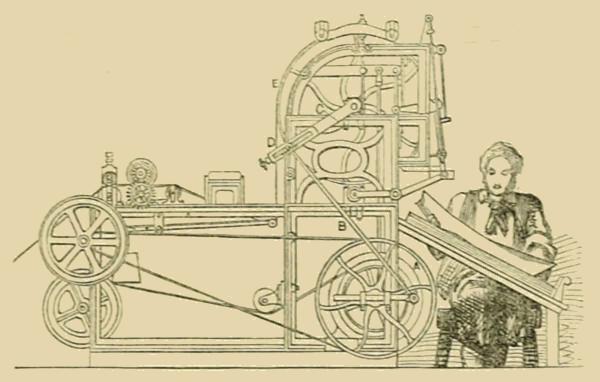
FIG. 4. CUTTING MACHINE.
The “cutting-machine” before referred to is represented at fig. 4. A is a wheel upon which is fixed a plate with projections and screws for fixing the position of the arm attached to the link B; B link connecting the wheel A with the lever-arm G, and capable of adjustment by means of the plate attached to the wheel A, and the screw D; D a screw regulating the position of the rod B; E the drum by whose motion the web of the paper is carried forward.
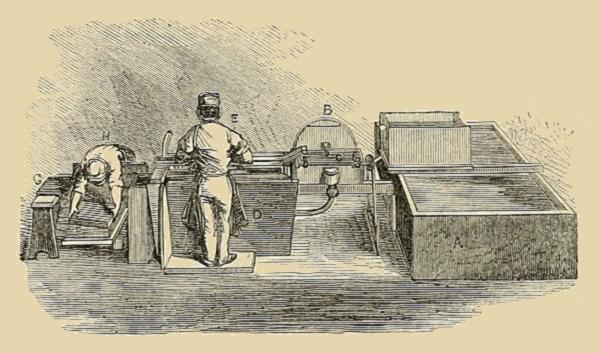
FIG. 5. HAND PROCESS.
But the process, as conducted by hand (fig. 5), will give a much better notion of how paper is formed from the pulp. A reservoir, A, is filled with pulp, which is supplied by a wheel in the box B, to a strainer C, and passed to a vat D, and a man, E, takes in his hands a mould consisting of a shallow frame of wood of the size the sheet of paper is to be, having a bottom of fine wires laid side by side, and having wires crossing at intervals to keep them firm (the marks of these may be seen in any sheet of laid foolscap paper held up to the light); he dips this mould edgewise into the reservoir, and brings it up horizontally full of pulp; this he gently shakes, to make the pulp lie level and allow all superfluous water to drain through the wires. It is then handed to another man H, who has a sheet of flannel or felt spread out on a table F G, on which the mould is inverted, and the sheet of pulp left on the flannel, which sucks up more of its moisture; over this is placed another piece of flannel, and then another sheet of pulp on it, and so on to the number of five or six dozen F, then the whole is put into a powerful press, and screwed down till all the water is squeezed out, when they are pretty firm, and are lifted out and hung on lines to dry, after which they are immersed in a cistern filled with thin size made by boiling clippings of skin in water (see “Glue and Size”), and having some alum dissolved in it—they are once more pressed and dried. What is called “hot-pressed” paper is pressed between smooth sheets of pasteboard, having a hot iron plate placed between every three or four dozen sheets of paper; this gives a smooth surface to the paper. The names, dates, and other marks seen on hand-made paper are formed by wires worked into the bottom of the mould, which, projecting, make the pulp thinner in those places. The water-mark of Bank-notes is made in the same way. More than half-a-million sterling is paid annually for duty upon paper—so vast is the consumption!
MALT.
Barley is the grain generally chosen for producing malt, although others may be used. It is first soaked in cold water till it is softened; it is then spread out about two feet thick on the floor of the malt-house, where it begins to germinate, in the same manner as if sown in the earth; this is allowed to go on so far only till the first part of the root and stem make their appearance, in the form of a little bud and a fibre. During germination the malt gives out a poisonous gas called “carbonic acid,” and becomes warm, in fact it would become too warm and be injured, but it is kept stirred by means of wooden shovels from time to time, and the temperature ascertained by means of a thermometer. As the process of germination goes on, all the starchy matter naturally contained in the grain becomes changed into sugar, and the malt, when made, has a sweetish taste. As soon as the germination has proceeded to a certain extent it is stopped by drying; for this purpose the malt is put into a kiln and heated almost to scorching—if but slightly, it is called pale malt or “amber,” if more, “brown malt” or roasted malt. Malt, if kept dry, will remain a long time unchanged. It is used for producing beer and vinegar, and for “wash,” from which all the raw spirit used in England is distilled. Whiskey is also distilled in Scotland and Ireland from malt.
Malt has the property of converting the starch of barley unmalted into sugar while in contact with it. For example, if barley were ground and boiling water poured on it, it would form a thick sort of paste, which is because it contains starch only; while malt treated in the same way, sinks to the bottom, and leaves a clear limpid “wort,” which can be strained off, because the starch is changed into sugar, which is soluble. Now, if equal parts of malt and ground barley be also treated in the same way, the malt very shortly converts the starch of the barley into sugar, and the result is the same as if all had been malt. This was once a matter of great importance to the brewers, who thereby saved the heavy duty imposed upon malt.
CHOCOLATE AND COCOA.
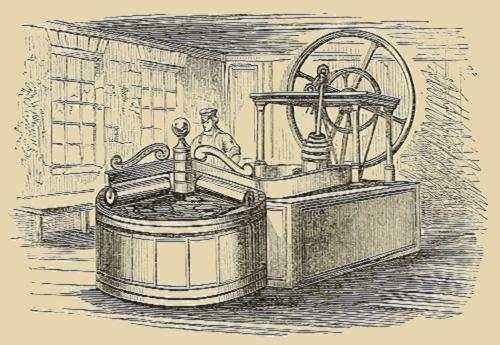
CHOCOLATE CRUSHING MACHINE.
Chocolate and cocoa are made from the seeds or beans of the Theobroma Cacao. The fruit of this plant somewhat resembles a cucumber, and contains from twenty to thirty seeds; these are dried and packed for the market. They come to this country from the West Indies (Berbice and Demerara). The beans are roasted in an iron cylinder with holes to let out the vapour, &c.; when cool they are deprived of their husks, and then crushed by means of rollers turning on a flat slab, kept warm by stoves or steam. The seeds when crushed on the warm slab become almost liquid, owing to a kind of butter or concrete oil which they contain, and which melts by a gentle heat. When the seeds are rolled by the machine into a smooth paste, this is either put into a mould of tin and formed into squares and various other forms, or left rough as it is scraped from the slab (this is called “rock” cocoa). For chocolate it is mixed with sugar, and either dried and powdered, or made, as the cocoa, into paste. On the Continent it is flavoured with “vanilla.”
STEEL.
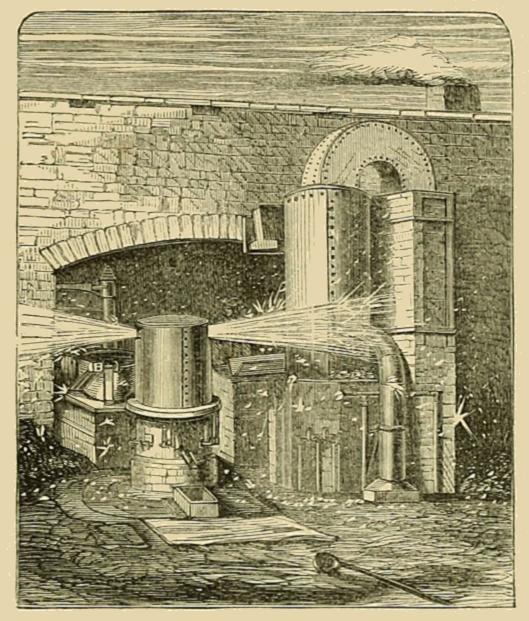
BESSEMER’S PROCESS.
Steel is usually made by a process called “cementation.” Bars of the best Swedish or Russian iron, about six feet long, are placed in an iron box, the bottom of which is covered with a layer of charcoal powder; over the first row of iron bars some more charcoal is put, and then another row of iron bars, and so on till the box is full, when it is carefully closed and kept at a white heat for four or five days. When cold, the bars are found to be converted into steel, and, being rough and blistered on the surface, are called “blistered steel;” this is broken up, and the bars laid side by side and made hot in a forge, where they are welded together by the blows of a heavy hammer, and drawn or rolled out by machinery into bars of “fine steel.” Steel differs from iron in the closeness of its grain, in being very much “tougher,” and in having that very useful and peculiar property called “temper,” which is the power of hardening when suddenly cooled while red-hot. If a bar of steel as soft as iron be made of a bright red heat, and then suddenly plunged into cold water, it will be found to have become harder than any other metal (so hard, indeed, that it will scratch glass), and is as brittle and readily broken as flint or glass. If now a gentle heat be applied to it, this extreme hardness of temper gives way. For instance, if a piece of bright hard steel is held for a moment in the hollow of a clear fire, a pale straw color appears on its surface, it is now still very hard (but not so hard as before), and is fit for razors, surgeons’ instruments, &c; but if held in the fire a moment or two longer, it becomes of a bright golden yellow, and is fit for penknives, and other cutting instruments; held longer still, it becomes bright blue, and is fit for watch-springs, swords, and other purposes requiring great elasticity but no great hardness; if the heat be carried still further a brown tinge is seen, and it is now rather soft, but greatly harder than iron, and is still elastic; saws, coach-springs, and many other articles are made from steel at this temper. If the heat be carried on to redness, the steel would be quite soft when it had slowly cooled, but if suddenly cooled (as by being plunged into water) the original hard temper comes back again.
Steel, like iron, may be cast, and cast-steel is one of its most useful forms, and much resembles “fine steel.” The mode of preparing cast-steel is to melt the “blistered steel” in a crucible, or earthen pot, and then run it into a mould: this forms an “ingot” of steel, which may be afterwards rolled or welded as the case may require.
Steel may be drawn into very fine wire, or wrought into the most minute articles, as the springs and other parts of watches. It bears a very fine and bright polish, and does not rust or tarnish so easily as iron. It has lately been proposed to make heavy cannon of cast-steel, which is much tougher than either cast-iron or gun-metal.
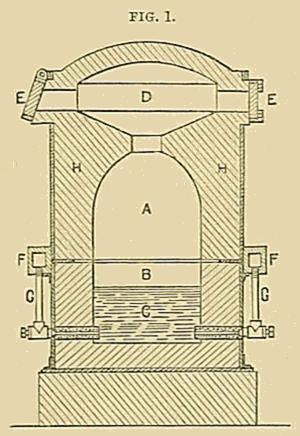
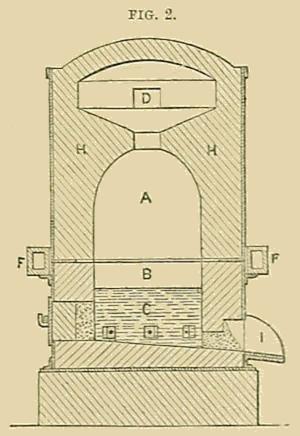
PERPENDICULAR SECTIONS OF CONVERTING VESSEL.
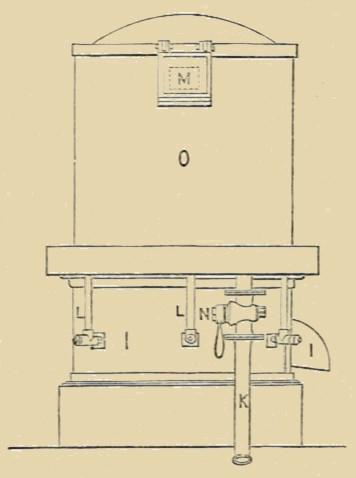
FIG. 3. OUTSIDE VIEW OF CONVERTING VESSEL.
A process has lately been invented by Bessemer to supersede the long and laborious process of “puddling.” It consists essentially of transferring the melted iron into a vessel in which there are tubes inserted at the lower part, and through which air is forced at a great pressure, which bubbles up in streams through the melted metal, and, as it does so, unites with the carbon and sulphur of the iron, converting them into carbonic and sulphurous acids, and at the same time producing an increased heat, which is quite necessary to the success of the process, for as the iron becomes purer it also becomes more difficultly fusible, and would set into a solid mass, but that this greatly increased temperature keeps it fluid. This rising of temperature is similar to what takes place upon blowing a common fire with bellows; for the more air that is admitted to carbon raised to a very high temperature, the more rapidly does it combine with its oxygen, or, in other words, the more rapidly does it burn. So that, in this process of Bessemer’s contriving, the carbon of the iron acts as fuel to keep up the heat necessary to maintain its fusion, and at the same time, by being converted into carbonic acid, escapes in bubbles (like the bubbles which escape from soda-water), and this rapid production of gas in every part of the fused iron also assists in bringing about a thorough stirring-up and mixing together of all its parts. Reference to the accompanying diagrams will illustrate the working of the process. In figs. 1 and 2, A B are lower chambers, C is the melted iron, D is an upper chamber for melting scrap-iron, &c., E in fig. 1 and D in fig. 2 are openings for the escape of gas and flame, F F is an air-passage running all round and communicating by G with the tuyere-holes shown at E in fig. 4, H is the fire-brick lining to the furnace, and I the tapping-hole through which the fluid iron is discharged. In fig. 3, I is the tapping-hole, K the main air-tube leading from the blast-engine, L L perpendicular tubes (marked G in figs. 1 and 2) leading from circular air-passage to tuyere-holes, M is an opening for the insertion of iron into the upper chamber, opposite to opening D in fig. 2, and N the tap for regulating the blast; O indicates the outer casing of wrought iron.
When the process is carried only to a certain point, the result is a sort of semi-steel, which the inventor of the process expects will be a very useful article of commerce.
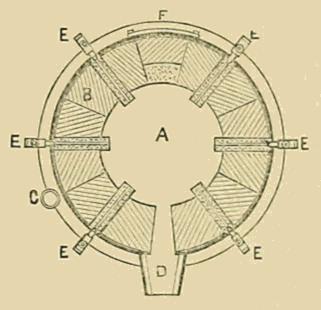
FIG. 4. HORIZONTAL SECTION OR PLAN OF CONVERTING VESSEL.
During the bubbling up of the whole mass of iron and the extreme elevation of temperature caused by the union of the carbon of the impure iron with the oxygen of the air, the oxide of iron as fast as it forms fuses into a sort of glass, and this unites with the earthy matters of the impure iron and floats on the upper part as a flux, thus ridding the cast-iron of all its impurities, with no other fuel than that contained in the iron itself and the air.
The accompanying illustration represents a horizontal section or plan of the converting vessel; A the central chamber, B a lining of fire-bricks, C the main air-tube, D the tapping-hole, E the tuyere-holes through which the air is forced into the melted iron to be purified, F is the outside casing of wrought-iron.
TIN-PLATE, AND GALVANISED IRON.
What is usually called tin is, in fact, sheet-iron coated with tin, and of this tin-plate, kettles, saucepans, &c., are made. The art of coating iron plates with tin has been practised in England hardly more than one hundred years. The very best soft iron is used for the purpose of being tinned. It is rolled out into thin plates, which are cut by shears into squares of usually thirteen inches long and ten broad, these plates are dipped into weak acid to clean their surfaces, then rubbed with sand, and finally washed; they are next dipped into melted tallow, which preserves their surfaces bright till they can be used. They are then immersed in melted tin, which has its surface covered with melted tallow, to keep it from being converted into oxide. When the plates have remained for a short time in the tin, they are removed, and the superfluous tin is wiped from the lower edge with a brush made of hemp, and then cleaned from the grease with dry bran. The objects gained by coating iron with tin are, increased beauty of appearance (for when tinned ware is kept bright, it has almost the color of silver), and a protection to keep the surface from rusting, and consequently being corroded into holes.
Copper and brass vessels are tinned inside, to prevent the formation of that poisonous substance called verdigris. The mode of tinning them is as follows:—They are cleaned inside by means of vitriol, and then made hot, fine grain-tin and a little rosin being put into them, and turned about and brushed over the surface with a ball of tow: by this means, the tin is equally spread over the inner surface of the vessel.
Tin-tacks, buckles, and other small articles, receive a coating of tin by being put into an earthen pot together with some grain-tin and a substance called “sal ammoniac,” and the pot being heated over a fire sufficiently to melt the tin, is then shaken up till the articles inside have received a coating of tin.
Iron plates have lately been coated with melted zinc instead of tin, and the surface thus covered enables them to be used for various purposes and in situations where they are exposed to the action of the weather, as on housetops, &c. The plates, thus treated, are called “galvanised iron,” and they are generally used in a corrugated form. They withstand the action of the weather very much better than simple iron plates would, for the latter would be very soon eaten into holes from rusting.
GLASS.
This most useful and elegant material—now an article of almost universal application, in various forms—is made on a very large scale by fusing together sea-sand and alkali (either potash, soda, or lime), and, in the case of “crystal,” or “flint-glass,” oxide of lead. The following is about the composition of the chief kinds of glass in use:—
FLINT GLASS. PARTS. PLATE GLASS. PARTS.
Pure white sea-sand 52 Pure white sand 55
Potash 14 Soda 35
Oxide of lead 34 Nitre 8
Lime 2
100 100
CROWN GLASS. PARTS. GREEN BOTTLE GLASS. PARTS.
Fine white sand 63 Sea-sand 80
Chalk 7 Salt 10
Soda 30 Lime 10
100 100
Flint-glass or “crystal” is very heavy, moderately soft (being easily cut with a file), and very bright and white. It is used for all table-glass, as decanters, wine-glasses, &c., and for the drops or lustres of chandeliers. Plate-glass is that kind of glass now in such general use for shop-windows, looking-glasses, &c. It is cast on flat iron tables, and rolled out to the sizes required, then cut and polished by machinery. In the rough state it is called “rough plate,” and is the substance used in the Crystal Palace, and has of late become almost a substitute for ground glass, which is simply ordinary glass ground or roughened on the surface by means of sand, so that it will admit light and yet not allow objects to be seen through it. Crown-glass is the ordinary “window-glass.” It is made in great circular pieces (see “Glass-blowing”), and cut up into the sizes required. Crown or window-glass made some years back, had a disagreeable tinge of green, which has been removed in modern glass by the addition of a minute quantity of oxide of manganese.
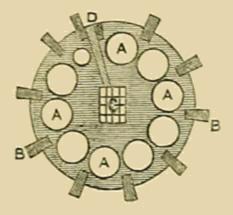
FIG. 1.
The ingredients to be made into glass (of whatever kind it may be) are thoroughly mixed together and thrown a little at a time into large crucibles or melting-pots placed in a circle (A A, fig. 1) in a furnace resting on buttresses (B B, fig. 1), and heated to whiteness by means of a fire in the centre, C, blown by a blowing machine, the tube of which is seen at D. This furnace is shown in perspective in fig. 2. The ingredients melt and sink down into a clear fluid, throwing up a scum, which is removed from time to time. This clear glass in the fused state is now kept at a white heat till all air-bubbles have disappeared; the heat is then lowered to a bright redness, when the glass assumes a consistence and ductility suitable to the purposes of the glass blower.
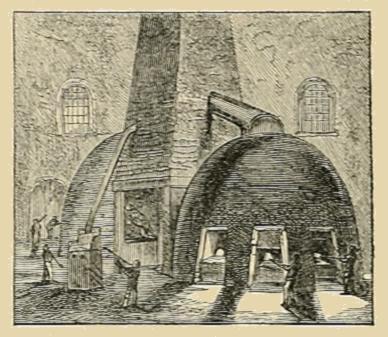
FIG. 2.
Artificial gems are all but varieties of glass. What is called “paste,” “French diamonds,” &c., are glasses of peculiar brilliancy, well cut and polished. Garnets, emeralds, and other precious stones are imitated by coloring the “paste” with various substances, chiefly metallic oxides, as oxide of cobalt, which produces a blue color, oxide of copper a red, and oxide of chromium a green color, &c.
Glass is used for a variety of purposes besides the one great purpose of admitting light to houses while air and damp are excluded. It furnishes an immense variety of beautiful and useful articles in the form of drinking-vessels, vases, chandeliers, &c., and to the chemist and manufacturer generally, it is invaluable, for vessels of glass thoroughly resist the action of all acids (with the exception of the hydrofluoric) and nearly every other substance. It stands a considerable heat, and if made equal in substance and rather thin, will not easily crack by sudden alterations of temperature. Without glass, microscopes, telescopes, cameras, barometers and thermometers—upon which some of our best and most useful knowledge and some very beautiful results of chemical action depend—could hardly have been constructed.
SODA-WATER.
Soda-water was formerly prepared by the ordinary chemist, but since it has become so general a beverage has been made a separate branch of chemical manufacture. Soda-water consists of a very weak solution of carbonate of soda, holding a large quantity of carbonic acid in solution, for water has the property of absorbing a certain quantity of carbonic acid, and this quantity is increased in proportion to the pressure exerted on the water. This pressure is secured in the first place by machinery, and afterwards maintained by the bottle being closely corked and the cork fastened in by means of wire.
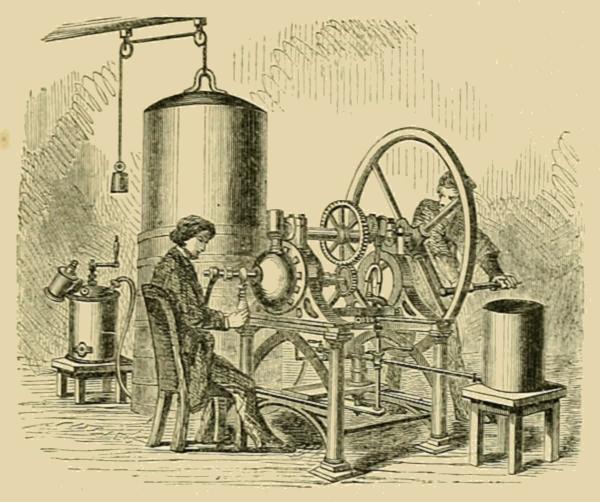
FIG. 1. SODA-WATER APPARATUS.
In fig. 1 there is an illustration of the machinery used. It consists of a small vessel holding sulphuric acid, attached to another vessel containing chalk and water kept constantly stirred by a small windlass passing through a hole in the top, and working air-tight. When some of the sulphuric acid is allowed to run into the vessel holding the chalk an effervescence takes place, and a rapid extrication of carbonic acid; this is conducted by a tube to a gas-holder as a store. A tube leads from this gas-holder into a sort of air-pump, and a man, by turning a windlass, not only works this and thereby forces a certain quantity of gas into another vessel of copper (plated with silver inside), but turns this vessel itself rapidly round. In this vessel the solution of carbonate of soda is placed, and is agitated under pressure with the carbonic acid thus forced into it, and which it rapidly absorbs. From this vessel it is drawn off into bottles, which are adroitly corked before much of the carbonic acid can escape, and then wired down, a fresh supply of solution of soda and carbonic acid being constantly introduced. Potash-water and Carrara water are made in the same way, using potash in the former, and chalk in the latter, instead of soda.
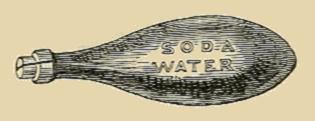
FIG. 2.
The form of a soda-water bottle is shown in fig. 2; it is made of very thick glass, that it may resist the outward pressure of the carbonic acid, and so formed that it cannot stand on its bottom, and when laid on its side the bubble of air shall rise up to the middle of the bottle and not to the cork, or else it would escape through the cork before long, however nicely it may be fitted.
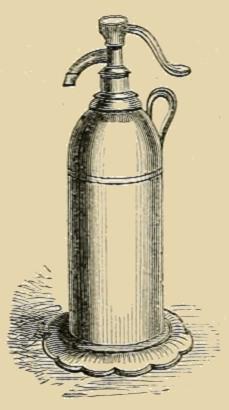
FIG. 3.
Fig. 3 is a convenient vessel for holding about a quart of soda-water or any other effervescing drink, all of which is not at once required. A tube passes from the top to nearly the bottom of the vessel, and when this is filled with aerated water, the expansive power of the carbonic acid forces the water up this tube and out of the spout when the handle is depressed and the tap opened, and when sufficient is obtained, the tap can be immediately closed.
A very convenient apparatus called a “Gasogene” has lately been constructed. It consists of a double vessel, into the upper part of which a solution of any kind—wine and water, or even plain water—is put, to be saturated with carbonic acid or “aerated,” and into the lower one some carbonate of soda and tartaric acid. A tube leads from this lower to the top of the upper vessel, which screws on and off. By shaking the apparatus when thus charged and screwed together, some of the liquid descends through the tube into the lower vessel and moistens the soda and acid, which therefore act on each other, and cause carbonic acid to be disengaged; this, rising up through the tube (which is perforated with small holes at the upper part), disperses itself through the liquid in small bubbles, and causes sufficient pressure to enable the liquid to absorb it, which therefore effervesces when drawn off by the tap and this pressure removed.
COAL-TAR NAPTHA.
This is distilled from the coal-tar produced at the gas-house, the residuum being pitch, and it has a very offensive smell. It is in demand as a solvent for India-rubber, and also for use in lamps so constructed as to require no wick, for naptha is very volatile, and the vapour is burnt as it rises.
WOOD NAPTHA, OR PYROXYLIC SPIRIT.
This is often called wood spirit, and is procured from the tar resulting from the distillation of wood for wood vinegar or pyroligneous acid. It is colorless, without the disagreeable odour of coal-tar naptha, and very inflammable, burning without smoke, very much in the manner of spirits of wine. It is used in varnish-making, and also for burning in lamps where heat and not light is required.