ARTS AND TRADE PROCESSES.
Reading edition
WOOD AND PLATE ENGRAVING.
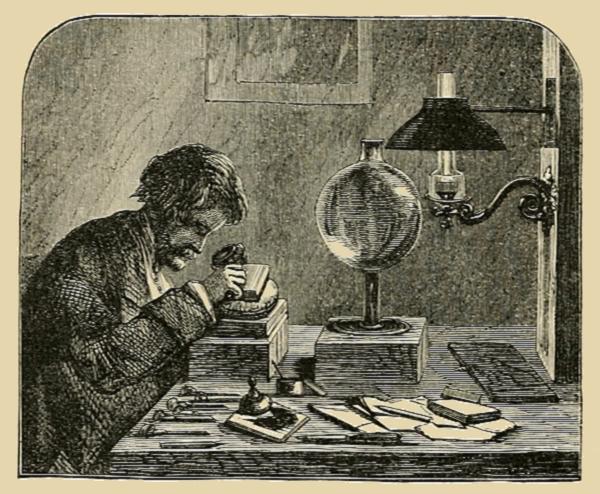
WOOD ENGRAVING.
Engraving consists principally of two kinds, that in which the design is made to project, and that in which it is cut in or indented; the first kind is used in wood engraving, and in engraving metallic or wooden blocks and cylinders for calico printing, the other is called “plate engraving,” and is used to produce copper, steel, and zinc plates for printing.
In wood engraving a block of box wood is used, or several pieces are screwed or tongued together in order to make a block of the required size, for the box wood must be cut across the grain, therefore large blocks are not easily procured. These blocks are about an inch in thickness, so that they may range with type and be printed with it, they are made perfectly smooth on the face, which is rubbed with a little flake-white and Bath brick, to give it a whitish and slightly roughened surface. On this prepared surface the design is drawn with a black-lead pencil, and the block is then put into the hands of the engraver, who cuts away—to the depth of about one-twentieth of an inch—all those parts which have not been blackened by the pencil, leaving every line and dot of the drawing projecting, and this serves as a sort of stamp or type, to print from. (See “Printing.”) In this way the illustrations to the present work are produced.
In plate engraving the design is copied from the original and cut into the plate in a manner quite opposite to that of engraving on wood; for every line intended to be printed, instead of projecting, is cut in with a sharp edge, so that they may be filled with ink, instead of being covered, as in wood engraving. When the design is formed entirely by lines, it is called “line engraving,” and when formed by dots, it is said to be “stippled,” and these two kinds are often combined in the same plate. There is a process for engraving plates, called “etching,” by which the lines or dots on the plate are not made by cutting, but are corroded or eaten in by the chemical action of nitric acid; and few plates are now produced by the graver alone, the design being first etched and afterwards finished off by the graver, but some are produced by etching alone, whence they are called “etchings.” The process of etching is as follows:—The surface of the plate is made smooth and bright, then heated, and afterwards coated with a mixture of asphaltum, wax, and mastic—called “etching-ground”—a ball of which is tied up in a piece of silk, rubbed over the hot plate, and dabbed with a dabber till a smooth layer or coating is formed all over it; it is “smoked” over the flame of a candle, to blacken it, and the result is a smooth black varnish, which covers the surface of the plate, and is capable of resisting the action of nitric acid. On this surface the design is drawn with an “etching-point,” a steel instrument which cuts or scratches quite through the etching-ground, exposing the surface of the copper at the bottom of each scratch. When the design is finished—in hues or dots, according to the style required—a ridge or border of wax is made all round the plate so as to form it into a sort of shallow tray, and into this the nitric acid, mixed with a little water, is poured, and carefully watched till in the judgment of the engraver it has bitten into the plate sufficiently for the fainter parts of the design. The acid is then poured off, and the plate washed and dried, after which the parts intended to remain most lightly etched are stopped out with varnish, and the acid again poured on, to corrode the lines left exposed to its action more deeply. This is repeated two or three times, according to the nature of the design, when the plate is again heated, to melt the etching-ground, and the whole is cleaned off with turpentine. The plate may now be used to print from, or it may be further finished by the “graver,” “burnisher,” or “dry point,” which is simply a point of steel used to make very fine and faint scratches instead of cuts, for the graver cuts out the piece of copper, while the dry point merely indents it.
There is another kind of plate engraving, called “mezzo-tinto.” This is done by first covering the whole plate with a rough granulated surface—called a “mezzo-tint ground,”—by means of a sort of notched chisel, called a “cradle” or “grounding-tool,” which is rocked to and fro over the surface in every possible direction, till the whole is covered with minute dots; so that if it were then used to print from, it would produce an even dark surface. On this ground the engraver works with a “scraper,” scraping gradually away all those parts which are to appear as lights in the finished picture, and the more the ground is scraped away the lighter will be the tint, till, finally, those parts which are to be quite white are scraped smooth and burnished, so that they shall hold no ink at all. In this way the engraver proceeds till his design is finished, trying the effect from time to time. This kind of engraving is often combined with etching, producing greater sharpness of outline than mezzo-tint alone.
LITHOGRAPHY.
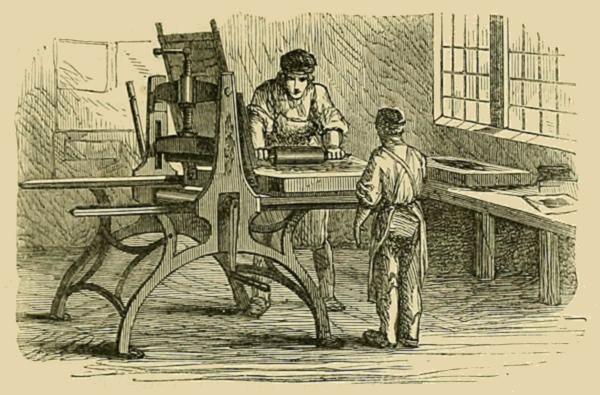
LITHOGRAPHIC PRESS.
This is the art of producing designs upon stone in such a manner that impressions may be printed from them. It is often miscalled “engraving on stone;” properly speaking, it is not engraving, but a process depending on the want of affinity between watery and greasy matters, the design being made with a greasy substance, either in the form of ink or crayon called “lithographic chalk,” as follows. A close-grained stone called lithographic stone (a kind of magnesian limestone) is ground perfectly even on the surface, and (if for being written upon) polished with pumice-stone, or (if for being drawn upon with chalk) grained with fine sand; the design is drawn with chalk or ink, each of which is made up of greasy materials—wax, soap, and asphaltum, colored with lamp-black. When the design is made, the stone is etched—washed over with a weak mixture of nitric acid and water—which answers three purposes; it very slightly bites away the stone in all places except where it is covered with the ink or chalk, it smoothes the grain in the same places, and it converts the soap of the ink or chalk into grease. We have now the surface of the stone quite wet, except where the design is, which, being greasy, keeps quite dry. The stone, placed in a press, is rolled over with a roller smeared with greasy printing ink, which will not adhere to the wet stone, but it readily does to all parts of the design; a piece of paper is placed over the stone, and a flap of leather covers it; along this leather the scraper of the press is brought very forcibly when it is worked, and on removing the paper an impression is found to be transferred to it from the stone. This process is repeated again and again, many hundred times, without much injury to the original design.
Colored lithography, called chromo-lithography, is produced by using several stones consecutively (each transferring a separate color), so that the design shall be complete when the whole are printed.
PRINTING.
The art of printing consists in producing impressions from a pattern or types—cut out and projecting, or engraved and indented—by smearing the projecting parts or filling up the indented markings with ink, so that impressions, to any number, and exactly resembling each other, may be taken from them. Printing is comparatively a modern invention, although impressing or taking impressions from seals is one of the very oldest. It is divided into two kinds, plate-printing and surface-printing. Printing from type or blocks having the marks to be impressed raised, is called surface-printing, while that in which the lines or marks are cut in, is called plate-printing.
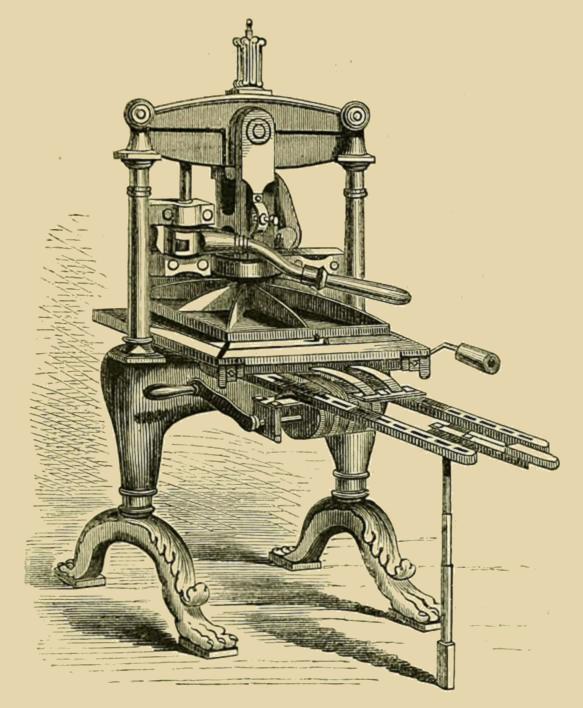
PRINTING-PRESS.
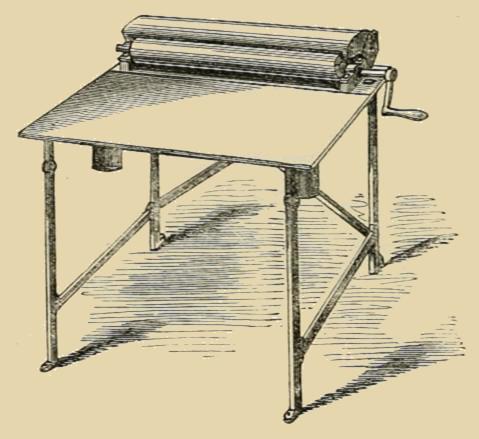
INKING-TABLE.
In surface-printing, when types are used, they are packed up closely into masses and wedged together in iron frames, so that they form, as it were, solid blocks; the types or wood-blocks when required to be printed from are placed in the press, and rolled over by a roller smeared with printing-ink—this roller is coated with an elastic substance made of glue and treacle, and resembling India-rubber. It is worked to and fro on the “inking-table” (a smooth iron slab fitted with a receptacle for ink), in order that the ink may be evenly distributed over its surface—a point to which great care and attention, and no little skill, on the part of the workman, is directed. The ink, being rolled over the type, covers and adheres to the surface of the projecting parts. The paper is placed on a frame turning upon a hinge, and is secured in its place by another frame brought down upon it. These frames, with the paper, are now turned down upon the blackened surface of the type, and the whole—paper and type—passed under the printing press, where, by the working of a handle, a piece of iron is caused to descend and press evenly and with great force upon them. On being withdrawn, and the frames opened, the paper is found to have received a perfect impression, in ink, of the type upon which it was impressed. This process, of course, can be repeated to any extent, and as many impressions produced as may be required.
In plate-printing, the plate is first warmed, and all the engraved parts are filled in with ink, the superfluous ink being wiped off, and the surface cleaned bright by using a little whiting (which is rubbed on the hands), leaving only the indented parts full of ink. The paper (in a damp state) is then laid on the plate, with a fold or two of flannel over it, and the whole is carried, by turning the handles of the press, between two rollers, which compress the plate and paper together so forcibly that, when removed, the ink is found to have left the plate and attached itself to the paper, forming an impression.
Printing is now in very many cases done by machinery, worked by steam power, so that a very large number of impressions can be produced in a very short time, as in the case of newspapers, the whole impression of which (amounting to many thousands) is printed in a few hours.
Printing in colors of various tints, so arranged as to form a picture, has lately been much resorted to. The usual method pursued is to print one color, and when that is dry, to print the next, and so on till the picture is complete; but a machine has been invented by which many colors may be printed at one time.
PHOTOGRAPHY.
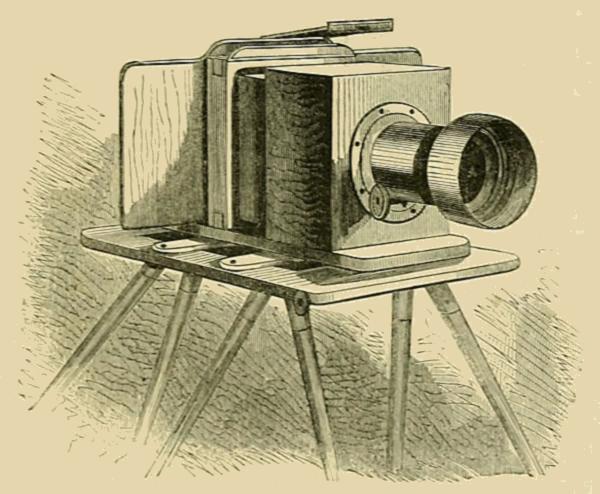
CAMERA FOR STEREOSCOPIC PICTURES.
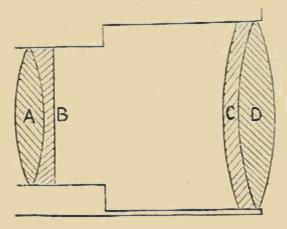
FIG. 2.
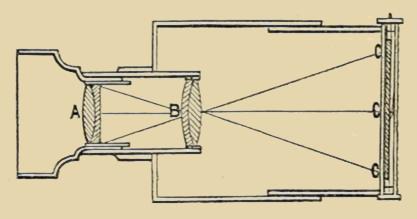
FIG. 3.
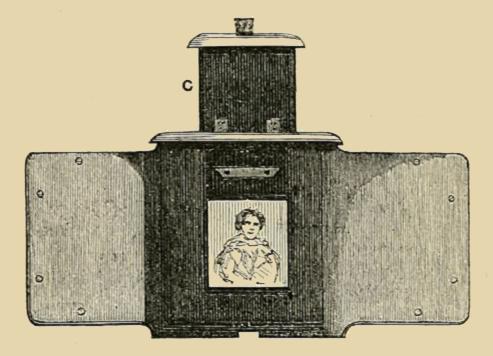
FIG. 1.
The principle of this art depends upon the property which certain chemical preparations (chiefly those of silver) possess of being blackened by exposure to light while in contact with organic matter, and that in so gradual a manner that every degree of shade may be represented. Now, as the various appearances of everything we see depend upon the effects of light and shadow (together with the peculiar color of the objects themselves), it follows that if these lights and shadows can be transcribed, we shall have a representation of the objects, minus their own proper colors—and this is what photography effects. For the purpose of bringing the objects to be taken within a small compass, and for increasing their vividness, an instrument is used called a camera, in which there is an achromatic arrangement of lenses (shown in figs. 2 and 3), which produces a picture on the paper or glass to be affected by the light, in the same way that a common magnifying glass will, if held at a proper distance from a piece of paper, but much more perfectly (fig. 1). The effect of this camera-picture on the paper or glass when properly prepared and subjected to its influence, is to darken the paper in all those parts which in the camera-picture are the brightest, and to leave unaffected those parts which are the darkest, thus producing what is called a “negative picture,” having the lights represented by shadows and the shadows by lights. This is used to form the true or “positive” picture, which is done by placing the negative on a piece of prepared paper, and exposing it to the light. The negative having been made partly transparent by wax (as will be further explained), and the parts of the picture which are to be dark being left transparent, the light passes through them and blackens those parts of the prepared paper behind, while those which are to be light, being dark in the negative, exclude the light and thus preserve the paper at the back from being darkened; the paper is thus affected in the contrary way to the negative, and is therefore a true picture of the lights and shadows of the object copied. This is the principle of all photographic pictures, but with numberless variations in its practice; it would therefore be impossible here to describe the particulars of each process, beyond the most simple.
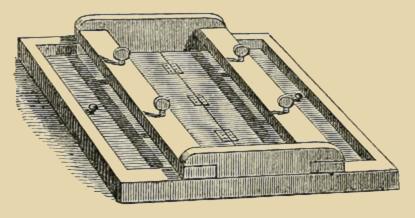
FIG. 4.
Perhaps of all the various arts discovered by man, this is the most beautiful, producing a perfect likeness of any being or object in a few moments, and with a truth not to be equalled by years of study and practice in other ways. One of the earliest discovered and simplest modes of forming a sun picture consists in using the object itself (where this is possible) to form the negative. This can only be done when the object is flat, as a manuscript, a picture, a leaf, or a piece of lace-work; a piece of paper washed over with a solution of common salt, dried, and again washed over with a solution of nitrate of silver, will answer for this purpose; it should be prepared by candle-light, as daylight blackens it, and it should be kept from the light till the moment for use. If this paper, having the object to be copied placed on it and kept flat by a piece of glass pressed firmly on by a contrivance shown in fig. 4, be exposed to the sunshine, it will be blackened in all places but those kept from the light by the darker parts of the object, and the lights and shadows will vary accordingly as the various parts of the object itself are more or less transparent. When the effect has been produced to a sufficient degree, the paper should be removed and at once washed in a solution of hyposulphite of soda, which removes all the superfluous silver (which otherwise would be darkened by the light); when removed from the hyposulphite of soda it should be well soaked in clean water. This when finished is a true negative picture of the object, and can be used to produce the positive. The negative should first be made partly transparent by brushing it over with some melted white wax, then placing it between folds of blotting paper and passing a hot iron over it, the blotting paper will absorb all the superfluous wax, and the negative will be fit for use. A piece of paper prepared like the first with salt and nitrate of silver, should be placed against the front of the negative, kept smooth by a piece of glass, and exposed to the sunshine for a quarter of an hour or more, taking care that the back of the negative is exposed to the light and the prepared paper behind; a positive picture will be produced, which is to be at once treated with a solution of hyposulphite of soda and washed with clean water, as was the negative. Any number of positive impressions may thus be produced.
The “Calotype” or “Talbotype” process may be performed as follows, recollecting that all these processes must be conducted by candlelight, or in a room having the window covered with yellow silk, or some other substance excluding white light. Select a piece of paper of an even surface and structure, such as Whatman’s paper, brush it over with a solution of nitrate of silver—about sixteen grains to an ounce of water—and let it dry, then fold up the edge of the paper all round and dip the surface to which the solution of nitrate of silver has been applied into a solution of iodide of potassium—an ounce to a pint of water—contained in a shallow vessel, and let it partly dry; float it for a quarter of an hour in a vessel of clean water, moving it gently about so as to remove all soluble matter, and hang it up by a corner to dry, taking care to let nothing touch the surface. When about to be used, this paper must be brushed over (using a soft camel-hair brush) with a mixture, in equal quantities, of a solution of nitrate of silver—fifty grains to an ounce of water—and a saturated solution of gallic acid, forming what is called the “gallo-nitrate” of silver. Leave this solution on the surface for ten minutes, and again immerse the paper in two or three successive portions of pure water, moving it to and fro; this, when nearly dry, is in a fit state to place in the camera, and is an exceedingly sensitive paper, which in a good light will be affected in a few seconds. When the image has been impressed by the camera, the paper should again be brushed over with the gallo-nitrate of silver, and held either near a fire or a plate of hot iron, so as to receive a gentle warmth; the impression will now come out, of a deep rich colour. Dip it into warm water for a few minutes, and put it into the hyposulphite of soda bath—an ounce to a quart of water—from which it is finally removed and placed in a large vessel of pure water for several hours. When dry, it is complete, forming a good negative, which, when waxed, may be used to print positives as before described.
The “Collodion” process is conducted as follows. Having selected a plate of glass of the required size and of good quality (patent plate answers well), clean it thoroughly with rottenstone and spirits of wine, and polish it with a clean dry linen cloth; then hold it on the tips of the fingers and thumb in a horizontal position, pour upon it a small quantity of the “iodized collodion,” and so incline it from side to side, that all the surface shall be covered with the collodion, that which is superfluous being returned to the bottle by pouring it from one corner of the glass. In a few minutes the coating of collodion will be dry, and should form a perfectly even surface, without air spots or uneven markings. The iodized collodion is made by dissolving gun-cotton in ether, and adding spirit of wine and iodide of ammonia. The glass plate coated with collodion is now dipped into a solution of nitrate of silver—thirty grains to an ounce of water—and allowed to remain two or three minutes; when all the superfluous fluid has drained off, the plate is ready for use, and is extremely sensitive to light. When the impression has been produced by the camera, a solution of pyro-gallic acid, mixed with a little acetic acid, is poured over the surface, which brings up the image; when this is developed to a proper extent, the surface must be washed with clean water and afterwards with a solution of hyposulphite of soda, which dissolves out all the silver from those parts not darkened by the light in the camera, leaving the glass in those parts quite transparent. A negative is thus obtained fit to print from in the usual way, but glass being more transparent than the waxed paper, it produces a more perfect positive. The surface thus prepared should be coated with a varnish, made by dissolving amber in chloroform, which is done by pouring it on and decanting the superfluous varnish similarly to the mode of coating with collodion; this varnish dries in a few minutes, and preserves the surface from injury. Sometimes these negatives are converted into positives, instead of being used to print from; in these cases the surface is coated with black japan, and the collodion, having a whitish surface, owing to reduced silver, shows up in comparison with the black varnish which is seen through the transparent parts. These positives are extremely sharp and well defined.
The “Daguerreotype” process consists in forming the image on the surface of a metallic plate (copper coated with silver), which is first polished to a perfect surface like a looking-glass, then exposed to the vapour of iodine in a properly-constructed box, afterwards to the vapour of chloride of bromine, and again to the vapour of iodine; this produces a thin film of a mixture of bromide and iodide of silver, which covers the surface of the plate, and is very sensitive to light, which reduces the iodide and bromide to the metallic state in a few seconds. The plate is then exposed to the action of the light in the camera, and when sufficiently affected, exposed to the vapour of mercury, the mercury being put into a box, and heated by a spirit lamp; the mercurial vapour adheres to all the parts of the silver reduced by the light, and forms a light-coloured amalgam, corresponding to the lights of the objects represented. The plate is then washed with a solution of hyposulphite of soda, which removes all the bromide and iodide of silver not reduced by the light, and exposes the highly-polished surface of the silver, which forms the shadows of the picture; this is now “fixed” with a very weak solution of chloride of gold and hyposulphite of soda, which is poured over the surface and heated while there by applying the flame of the spirit lamp to the back of the plate for a minute or two; the solution is then poured off, and the picture when washed with water is complete.
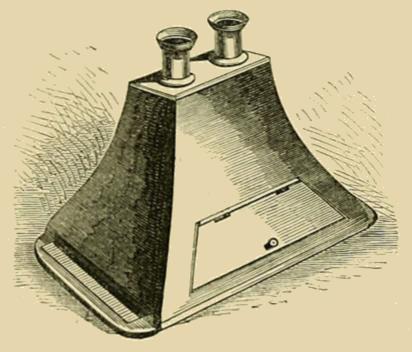
FIG. 5.
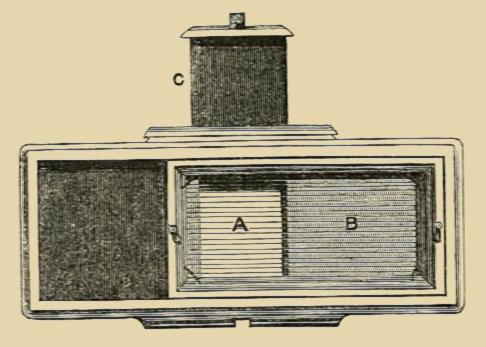
FIG. 6.
Many photographic pictures, whether Talbotype or Daguerreotype, are taken double for the “stereoscope” (fig. 5). This is an instrument having two lenses (one for each eye), through which the two views may be seen. The principle is this:—Every object is seen by each eye in a slightly different view; for instance, if you look at the edge of a print—placing the printed part towards your right hand, and bringing the edge in front of the lace between the two eyes—by closing the right eye, the left will see the back of the print only, but by closing the left eye the front of the print may be seen, and the front only. The stereoscope presents both of these views to the eyes at once, as when we look with both eyes, and the objects have therefore the appearance of projecting, as do read objects. To take these views, the slide after one view is taken is moved about four inches on one side, and then the other is taken; the distance moved corresponds to the distance between the eyes, and therefore produces the correct view for each. The box for the stereoscopic slide is shown at fig. 6, in which A is the first view to be taken, while the other half of the glass is kept dark, at B, and C is the shutter for A.
BOOK-BINDING.
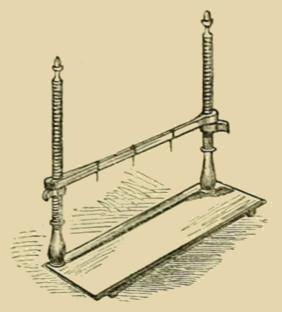
FIG. 1.
The sheets of which a book is to be made, when properly folded (into half for folio, quarter for quarto, &c.) are pressed flat in a press and then placed, one or more at a time, on a board behind a frame called a “sewing-press” (fig. 1), which has pieces of string or cord (called bands) tied in an upright position, and against these the folded edge of the sheet is brought in such a manner that the bands may be sewn on to the back of the sheet by a thread being passed from the inner part of the folded sheet to one side of the string, then in again on the other, and so on for each cord till they are fastened on to the first sheet, when another is placed on the top of the first and sewed in the same way.
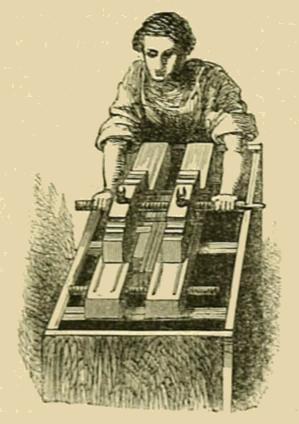
FIG. 2.
When all are sewn, the back is glued thickly over, and the book is fixed between two boards in a press and the back beaten till it is curved; the sides and front are then cut smooth with an instrument called a plough (fig. 2), which works in the grooves of a press where the book is fixed, and a knife (which forms part of the plough) being passed backwards and forwards, cuts through the edges of the book and makes them smooth.
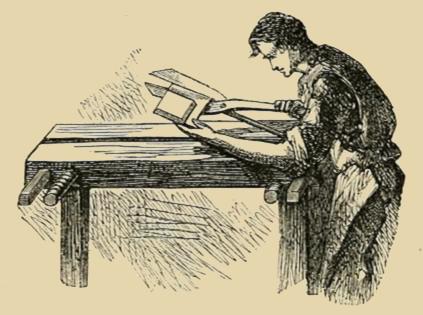
FIG. 3.
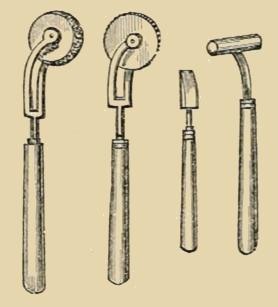
FIG. 4.
The covers—made of a thick pasteboard called “millboard,” and cut to the right size by shears (fig. 3)—are fitted to the sides of the book, the ends of the string-bands are then passed through holes in the sides of the boards, and are beaten flat and glued down. The book is then covered with cloth, vellum, paper, or leather, as desired, and finally pressed in a powerful press to make the leaves smooth. Ornaments, such as gilt bands or corner decorations, are produced by gold-leaf put on and stamped by means of tools engraved at their ends, or, where the margin is to have a pattern or line on it, by means of wheels with engraved edges (fig. 4). Leather-backed books are glazed on the outside with white of eggs, which forms a kind of varnish when dry.
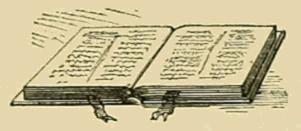
FIG. 6.
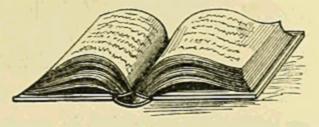
FIG. 7.
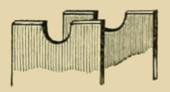
FIG. 5.
Books have lately been bound without any sewing, by “Hancock’s Patent” process. This consists in having all the sheets folded into double leaves, and the folded parts all brought evenly to a curved form for the back of the book by means of a mould or hollow cut in the edges of two upright boards (fig. 5); they are then removed to a press which holds the book tightly together, leaving this curved back just projecting in front of the press-boards. The back is smeared with India-rubber dissolved in naptha, which when dry is several times repeated, till a coating of sufficient thickness is produced, when it is covered with cloth or linen and the book is ready to be finished in the usual way; thus the sewing is quite dispensed with, for the folded edge of each sheet is held to the next one by a thin coating of India-rubber. This plan allows great freedom in opening, and for thick books produces a level surface much superior to those bound in the old way (figs. 6 and 7).
PAPER-STAINING.
“GROUNDING” THE PAPER.
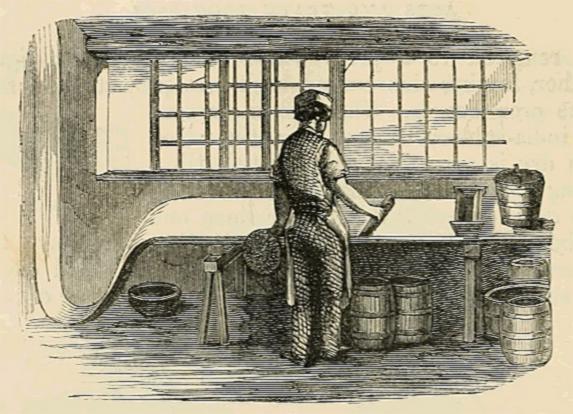
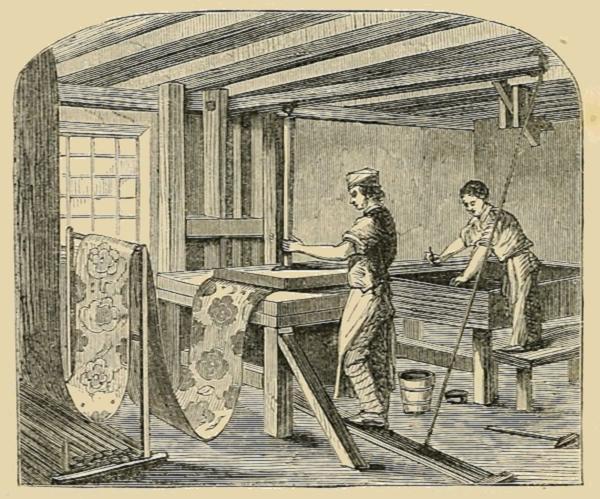
This name is given to the process for making paper-hangings for the decoration of the walls of apartments. The colors used in this process are all what are called body-colors, or those which are not transparent, but mixed with whiting or prepared chalk and a small quantity of size to the required tint. The colors are applied by means of wooden blocks having their surfaces so engraved that the pattern shall project; all the pattern is not engraved on one block, but only that part of it which is to be of one color, and the number of blocks required depends upon the number of colors in the pattern—usually three or four. The paper is printed in pieces of about twelve yards in length; these are first “grounded,” that is, colored all over with the color intended to form the ground of the pattern, and hung on poles to dry. The blocks are applied to a sort of sieve, with a leather bottom, on which some color is spread with a brush, and when the block is taken up sufficient of the color adheres to give a good impression on the paper. Each block has a register, which produces a little mark at the edge of the paper, and serves as a guide in applying the succeeding blocks, so that when printed they fit into and correspond with each other.
PRINTING THE PATTERN.
“Flock” paper is produced by printing part of the pattern in a varnish of boiled oil and whiting, and laying the paper so printed in a trough or tray over which the flock is sprinkled. The flock is made by grinding shreds of cloth of the required color in a mill. This rough surface gives a very rich and velvety appearance to the paper.
FLAX MANUFACTURE.
Flax, before being spun into “yarn” for weaving linens, undergoes several processes, to separate its fibres sufficiently, and to rid them of all short and uneven portions. The first operation consists in a kind of fermentation called “retting,” the stalks of the flax being packed up in bundles and steeped in water, or exposed to damp air, spread out, till they soften and become fit for the next process, called “breaking.” This is done by contrivances which beat and bruise or give it several sharp bends, the object being to break off the outer part, called the “boon,” and leave the inner fibres or “harl” free; this, which is the part to be used, is thus in a great measure freed from the outer part, but to do so completely it is scraped with a blunt kind of knife till all the “boon” is gone. The next process is called “heckling,” a sort of combing, in which the flax is dragged through brushes of fine iron spikes, used closer and closer till the flax is combed out quite fine and perfectly free from knots or uneven pieces, being beaten from time to time to break or separate the fibres. During this process much of the short and uneven fibres collect in the “heckle,” and is called “tow,” which has to be separated and the fibres arranged similarly to “carding” cotton (see “Cotton Manufacture”). The flax has now to be drawn out, doubled, and drawn out again into “slivers,” also in the same way that is described for drawing out cotton, and these slivers are finally twisted into yarn, being previously wetted to take off their stillness. The yarn is then wound upon bobbins, forming the material from which linens, muslins, and other goods are woven.
GLASS-PAINTING.
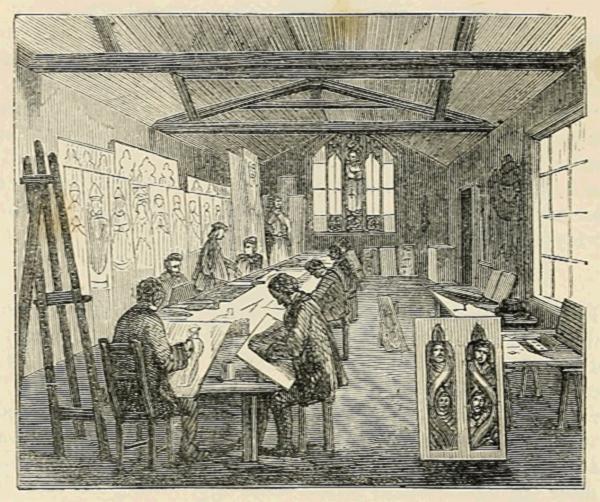
CARTOON, OR DESIGNING ROOM.
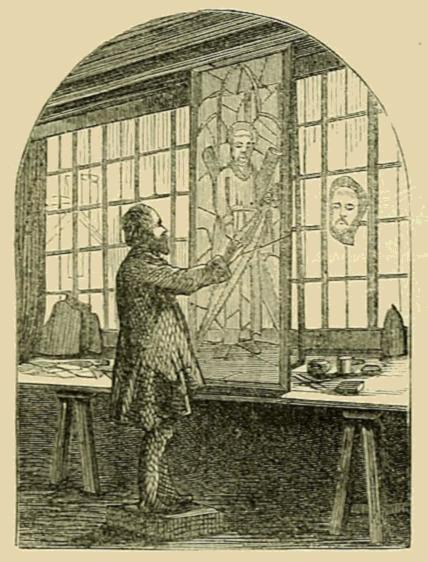
PAINTING.
Of glass-painting there are two kinds, the one being known as “painted,” and the other as “stained glass.” In the former the design and coloring are produced by the application, to the surface of colorless glass, of transparent pigments of various colors, which, under the action of the furnace, become vitrified and incorporated with the body of the glass. In this manner of glass-painting—which is capable of none of the powerful and rich effects of color peculiar to stained glass—it will be understood that the process much resembles the practice of the picture painter. In the one case canvasses are used, and in the other sheets of colorless glass; the picture-painter using colors mixed with oils and varnishes, the glass-painter colors made of earths and metals, and mixed with a flux, which, under the action of fire, vitrifies his work. It is quite possible to produce a large composition, containing many figures and a great variety of colors, on but few pieces of glass. Indeed, one of the necessities of making a window of “painted glass” in several pieces, is simply to avoid the danger of breakage, in using sheets of too large a size. The various pieces are joined together with lead work of precisely similar nature to that which is used in the diamond “quarry-glass” seen in the windows of country cottages.
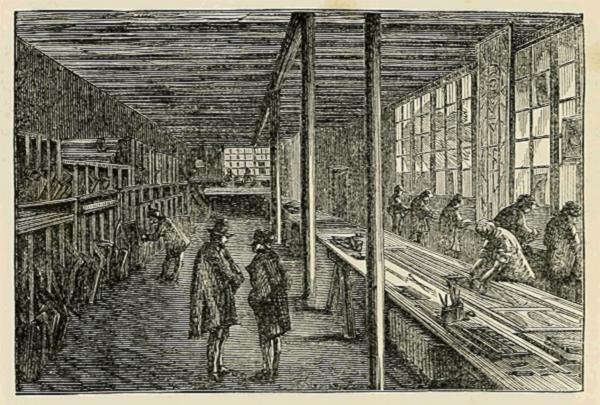
CUTTING ROOM.
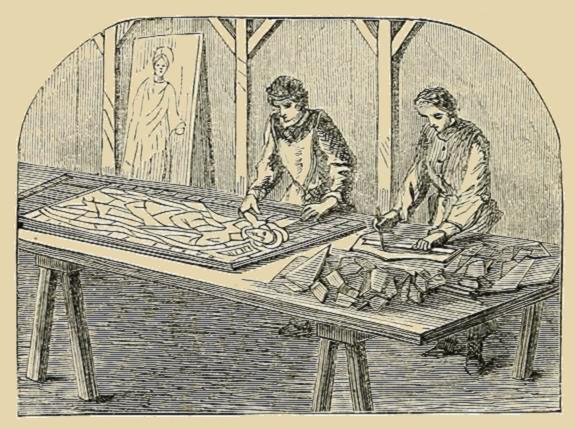
GLAZING THE WORK UP.
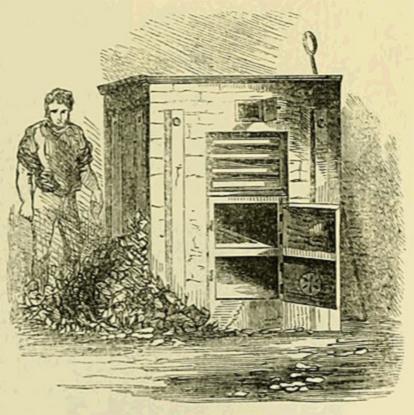
FURNACE.
“Stained glass” differs from glass-painting in very many particulars. In this case the colors, instead of being laid on with a brush as in painted glass, are formed in the substance of the glass itself. This necessitates the use of separate pieces of glass for every color or tint required, and thus the process in some degree resembles that of mosaic work, a term, indeed, which is often applied to this kind of glass-painting. The first process in producing a stained glass window is the making of the design, colored or otherwise. This office is, of course, that of the artist, who is at the head of his establishment. From his design, which is always made to a small scale, the full-sized drawings or cartoons are made, by the artist and his assistants. When finished, with all details and colors determined, they are placed in the hands of the glazier, who cuts with his diamond the glass of the required shapes and colors, respectively, so that when his task is complete, the window, as laid out on the “cutting-board,” much resembles a child’s puzzle—each piece of glass, although often of the most complicated form and minute size, fitting with accuracy to the other pieces by which it is surrounded. This process completed, the next course is for the painter to produce on the blank piece of colored glass prepared for him by the glazier the various outlines and shadings, as represented in the cartoon, it being his business to take such means as will ensure the production of a faithful copy. This outlining and shading is produced by the use of a brownish or warm grey tint, which is generally used a little over all the colors represented in the work. There are some slight gradations of these brown tints used occasionally, principally when it is desired to paint the flesh shadows with some separate tint, but generally it may be understood that the office of the painter in stained glass is not to produce the colors, but by his brown shadowing to bring out the design and forms of the composition. When the glass, thus shaded and outlined, has passed through the furnace—where the shadows are vitrified—and been allowed gradually to cool, the glazier fits it together with lead-work, soldering in all the pieces, then the whole is made weather-tight, and the stained glass window is complete.
COTTON MANUFACTURE.
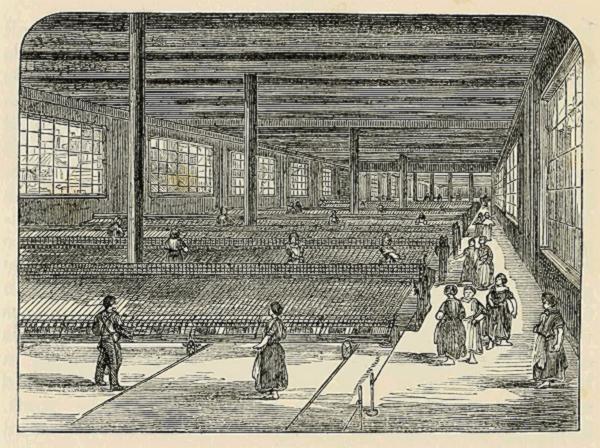
MULE FRAMES.
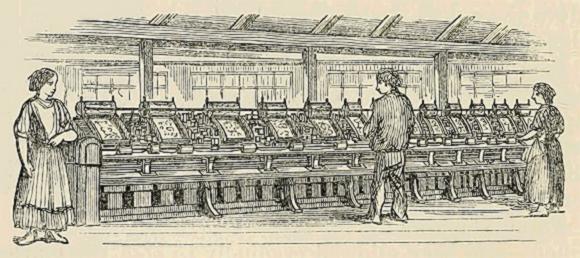
FRENCH COMBING-MACHINE.
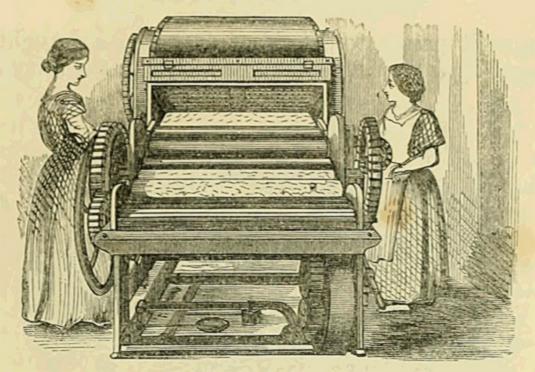
“SCOTCHING” OR BLOWING MACHINE.
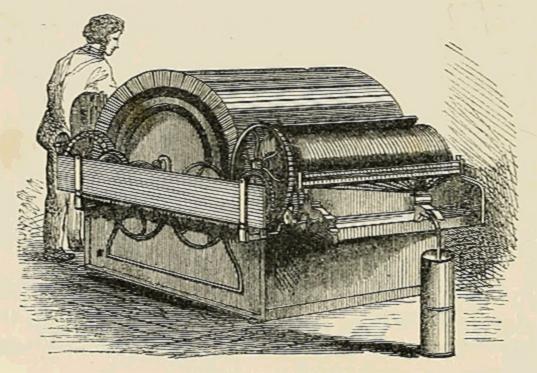
CARDING MACHINE.
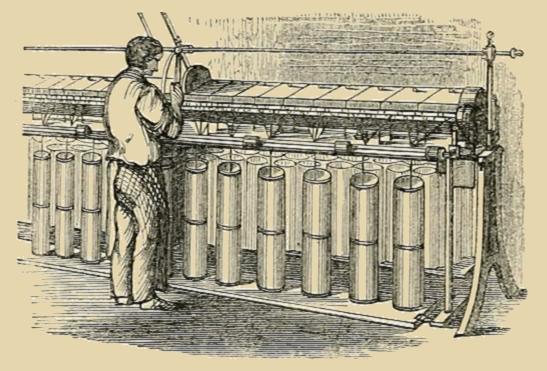
DRAWING MACHINE.
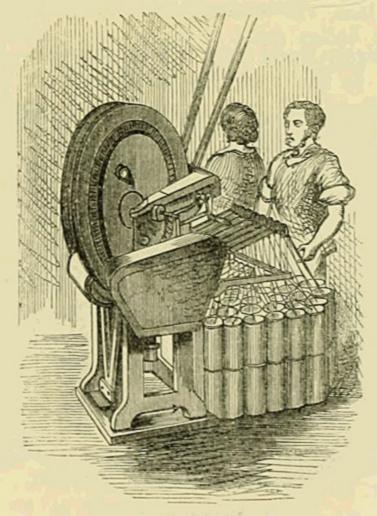
LAP FRAME.
After the cotton is sorted, and the grosser impurities picked from it by hand, it is dressed by the “combing machine,” or subjected to a machine (called a “willow,” as it was originally a sort of basket) contrived to open out and mix the cotton well together, at the same time blowing off all dust and allowing the heavier impurities to fall through a grating. The next process is called “scotching,” and the machine is sometimes called a “blowing machine.” From this the cotton is passed in a “lap” or thin layer, which is beaten as it passes, to get rid of dust, and a draught of air produced by a blowing apparatus assists in the same object; it is thus entirely freed from all impurities. The cotton is then carried to the “carding machine,” for the purpose of having its fibres all laid parallel with each other; this machine is, in fact, a sort of comb, and consists of cylinders having fine wires projecting from their surfaces acting in different directions, so as to draw out the fibres till they all lie in one direction, forming a kind of “fillet,” called a “card,” which is carried by rollers into a tin can and then subjected to a process called “drawing and doubling.” As the “card ends” are not yet sufficiently parallel in their fibres, they have to be passed between three sets of rollers, the undermost of which are fluted on their surfaces, the upper ones being covered with flannel. These rollers act in a peculiar manner; the first pair pass the cotton at a certain rate on to the second pair, which would pass it on to the third unchanged if they revolved at the same rate as the first pair, but they are turned a little faster, and therefore stretch the fillet of cotton at an even and regular rate, and in such a manner that it is not broken; the third pair, going faster than the second, again stretch the fillet. After the fillet has passed through it is doubled, passed through again and again, till it is quite uniform in its structure, and drawn out by these stretchings very fine, it is then called a “sliver.” When it is drawn as fine as the kind of cotton admits, the first twist is given to it by the “roving” machine, which twists it into a soft card, delivers it wound on “bobbins,” and it is finally twisted into yarn by the “winding machine.”
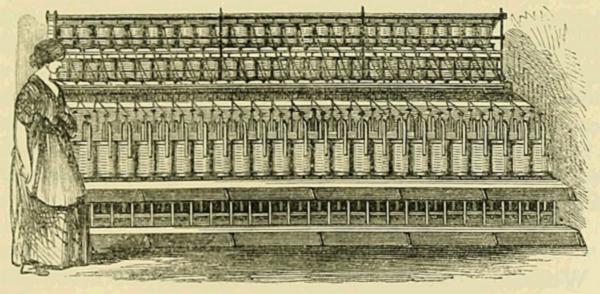
BOBBIN FRAME.
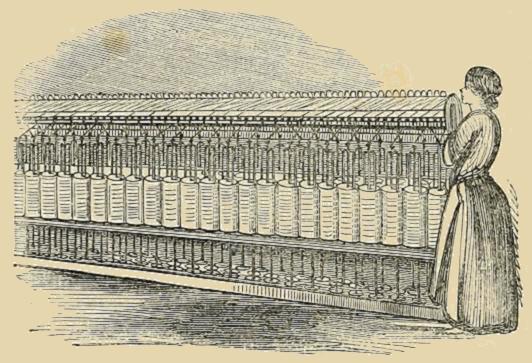
WINDING MACHINE.
These processes are carried on with great precision and rapidity, and, by the aid of these machines, one man is able in a day to produce as much yarn as the most expert spinner by hand could furnish in a year! Cotton, until about 1760, was all spun by hand. A little later, James Hargreaves invented the “spinning-jenny,” and Arkwright afterwards improved the “carding machine;” the “mule-jenny” (see Heading), invented by Crompton, was a still further improvement.
The cotton, when spun, is called yarn, which is used for weaving into calicoes and other cotton goods. Cotton thread is made by twisting (by machinery) two or more yarns into one, which are afterwards dressed with starch, and wound on reels or into balls.
WOOLLEN MANUFACTURE.
Wool is almost exclusively derived from the fleece of the sheep, goats’ wool being only occasionally used. Wool differs from hair in possessing a notched surface, giving it the very useful quality of “felting,” and enabling the fibres to adhere into a mass when pressed and beaten together, the notches catching into each other. Woollen articles are chiefly of two kinds, “woollens,” or those partly felted and made from “short” or “clothing” wools, called “cloths,” and those made without felting from “combing” or “long” wools, as “merinos,” “stuffs,” &c. Wool undergoes a numerous succession of processes before it is complete in its manufacture. It is first sorted according to the quality required, next scoured and washed in a warm solution of soap, and then rinsed in cold water, to get rid of the “yelk” or grease with which the wool is naturally coated. It is then passed between rollers to dry it, next dyed, and then “willowed” (this last process is to disentangle the fibres and at the same time get rid of any dust which may have been mixed with it); afterwards it is spread out and sprinkled with a small quantity of olive oil being thoroughly beaten with rods, to spread the oil over the surface of every fibre. It next undergoes a process called “scribbling,” which is effected by a machine which combs out the fibres and lays them in layers, in a parallel direction; the wheels which effect this are armed on their surfaces with wires and the wool passes from one set to another, finer and finer, till at last it passes out in threads or “cards” and these are spun by the “slubbing machine” into “yarns” for weaving. After being woven, the oil is again washed out with warm soap and water, and the fabric is then stretched by means of “tenter-hooks” stuck in a margin or “list” of coarser worsted, left on each side of the cloth for that purpose, and it is allowed to dry in this position.
The material is now fit for “felting,” or “fulling,” as it is called, which is done in the “fulling mill.” The process consists in thoroughly beating the cloth with heavy wooden mallets or “stocks” for ten or twelve hours, it being at the same time wetted with soap and water, and folded into a mass of many layers. This beating causes the fibres to interlace and adhere together till the cross-bar pattern made by the warp and weft in weaving is obliterated, and the cloth has the appearance of a felted surface, which, however, is rugged and uneven. It is next “teazled,” a process formerly performed by means of a bundle of thistle-heads—called “teazles”—which were dragged over the cloth, so as to raise the ends of the woollen fibres perpendicular to the surface; but this is now performed by machinery, the teazles being fixed round a roller turning one way, while the cloth is moved in an opposite direction. In some machines wire brushes are used instead of teazles. The cloth is next “milled,” or “sheared,” which is done by stretching it out on a perfectly level surface, where a pair of circular knives fixed to a wheel work over it and “shear” off the fibres, leaving the surface perfectly even. It is now wetted, brushed, and finally dried and packed in a finished state.
WEAVING.
The art of weaving threads of various descriptions is one of the oldest, and is frequently mentioned in the Scriptures and other ancient records. It consists in so crossing or interlacing the fibres that they shall form fabrics fitted for the various requirements to which they are applied.
Weaving, as now performed by machinery, for the production of what are called “textile fabrics,” is far too complicated to be here described in detail, the machines which are used being amongst the most complicated contrivances of men’s hands. Dr. Ure says of the weaving of “bobbin-net,”—“It may be said to surpass every other branch of human industry in the complex ingenuity of its machinery; one of ‘Fisher’s spotting-frames’ being as much beyond the most curious chronometer as that is beyond a common roasting-jack.” The principle is, however, nearly the same, whether performed by hand or by machinery, but some of the more complex fabrics could only be produced by hand, and by those few who may have devoted great talents and years of application to the acquirement of the requisite skill, whereas a machine once made can be imitated by ordinary workmen, and itself worked by unskilled mechanics.
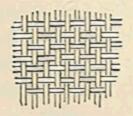
FIG. 1.
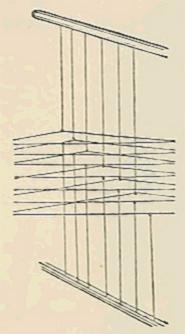
FIG. 2.
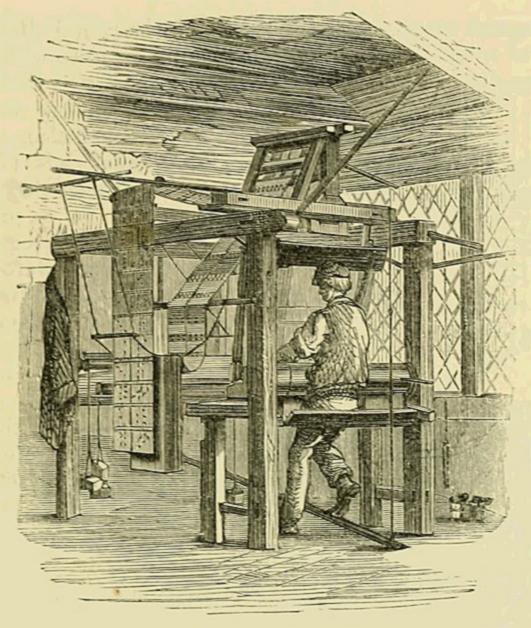
THE JACQUARD LOOM.
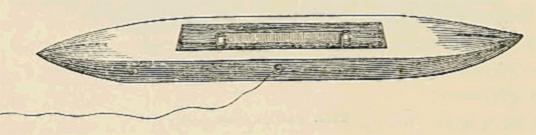
FIG. 3.

FIG. 4.
In plain weaving, as in fig. 1, of which linen or calico may be the examples, the yarn or threads simply cross each other, going alternately above and below. The thread which runs from end to end of the cloth is called the “warp,” and that from side to side the “weft” or “woof.” In nearly all wearing the weft is the same, but in “figured” or “twilled” fabrics the warp is so arranged that a pattern shall be formed, as is seen on towels, table-cloths, &c. In plain weaving, the threads are first wound off, of the required quantity and length, on a frame called a “warping frame;” they are then wound on a roller, side by side, and attached to the “loom,” or machine for weaving, through which they run, also side by side. Near the end they are attached to what are called heddles, which consist of threads stretched in an upright frame, having loops near their centres; a pair of these is used in plain weaving, one half of the warp threads being attached to the loops of one, and the rest to those of the other heddle, alternately, thus—first a thread through a loop of one heddle, then another through a loop of the other heddle, and so on. These heddles can be raised alternately by a pulley attached to treadles worked by the weaver’s feet, and it follows, that when one of the heddles is raised, every alternate thread of the warp is raised also, a space of a triangular form being left (fig. 2). Through this space the weaver throws the “shuttle” (fig. 3), which is a piece of wood pointed at each end, bearing a reel of “weft” in its centre, which weft-thread unwinds as it is thrown through. The other heddle is then raised, and the shuttle thrown back again, each time leaving a line of weft behind it. In this way the crossings of all plain fabrics are produced, a contrivance being used between each throw to press the weft close to the former one. If instead of one half of the warp-threads being up and the other half down at the time the shuttle is thrown, one only is raised at every fifth thread, the intervening four being down, and the one that is raised differing at each throw of the shuttle, a kind of structure is produced called “tweeled” or “twilled,” such as satin, bombazine, &c.; fig. 4 shows the appearance of the edge of such a structure. If the warp consists of alternate threads of different colors, white and blue for example, it is clear that either color will predominate where the warp thread of that particular color is most seen. In fig. 5, a a a a represent white, and b b b b blue threads, and this will show how the pattern on any structure, although the same on both sides, is blue on the one side where it is white on the other, as in damasks, or raised on one side where it is sunk on the other, as in dimity, or diaper.

FIG. 5.
BLEACHING.
BLEACHING WORKS.
SINGEING APPARATUS.
DRYING APPARATUS.
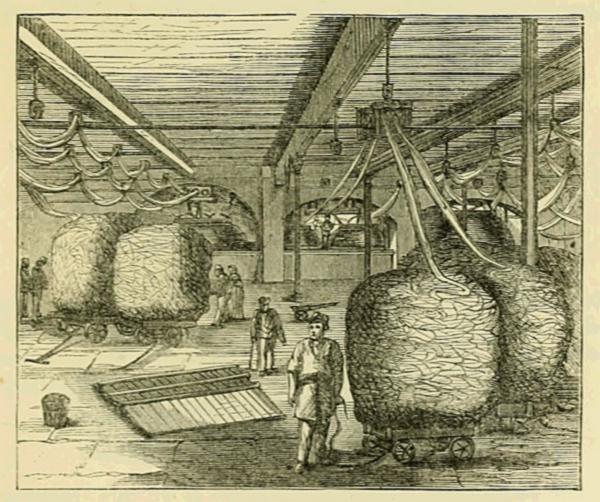
The chief object of bleaching is to get rid of the natural coloring matter which always tinges cotton, silk, &c., as produced from the raw material, and also to get rid of any greasy matters, or stains from accidental causes. Cotton is not only required to be bleached when intended to remain white, but also before dyeing or printing, the colors being thereby rendered more uniform and brilliant. The oldest method of bleaching consisted in simply exposing the goods, moistened with water, to the action of light and air, by spreading them out on the grass, and hence the term “grass-bleached;” but this is by far too tedious a process for the present day, when the manufacture is so great and the consumption so rapid.
The process of bleaching cotton goods consists in boiling them first in water, then in a mixture of lime and water, and then in a solution of soda, soaking them in a solution of chloride of lime, afterwards in water acidulated with sulphuric acid, and finally in pure water. Linens are chiefly bleached by repeated boilings in solutions of potash or pearlash, and afterwards in chloride of lime; wool by soaking in warm water, exposing it to the vapour of sulphur, and finally washing in a solution of soft soap.
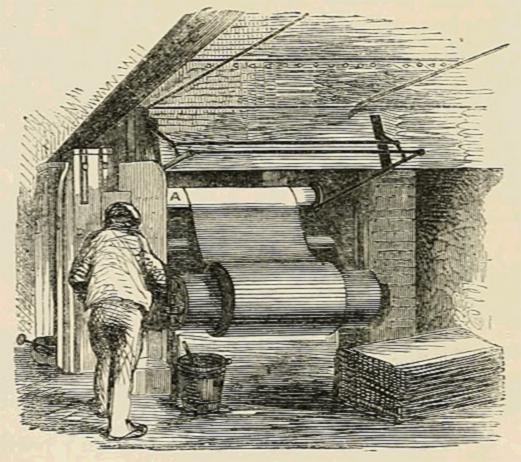
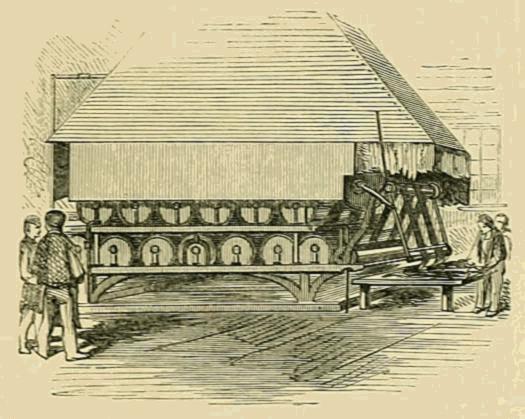
Before being printed, it is necessary that all the loose fibres should be removed from the surface of the goods. This is effected by “singeing,” which is done by causing the goods to pass over a red-hot roller, setting fire to the fine fibres projecting from the surface only, but with a motion too rapid to allow the fabric to be scorched. This process, and also the apparatus by which the articles are dried after bleaching, are shown in the accompanying illustrations. The latter consists of a series of hollow rollers heated by steam, over which the goods to be dried are passed, a current of air being admitted to carry off the vapour.
CALICO-PRINTING.
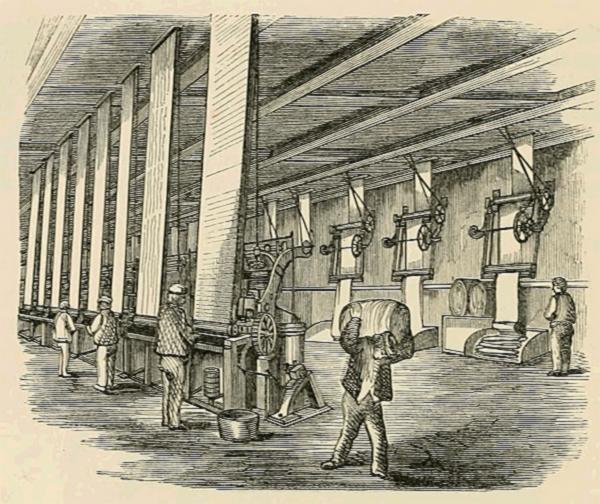
CALICO-PRINTING WORKS.
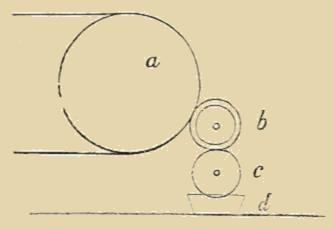
FIG. 1.
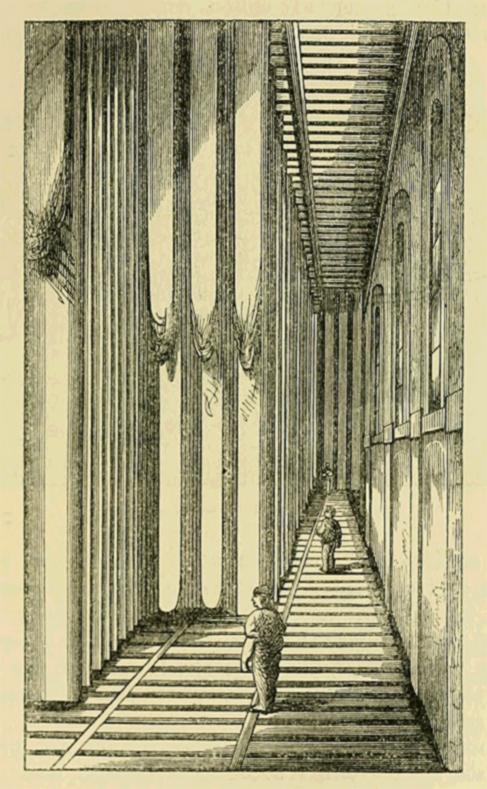
AGEING PROCESS.
Calico-printing is executed either by hand (with wooden blocks having the pattern engraved—projecting—on their surfaces) or by means of machinery. Printing by hand-blocks is a tedious operation, and is now almost superseded by the cylinder. The hand process is very similar to that made use of in paper-staining (which see). Cylinder-printing is a much more rapid process, conducted by means of a brass cylinder with the pattern engraved on its surface, which is made to revolve against another cylinder covered with flannel, and charged with color from a trough into which its lower part is dipped. The calico is passed over a large cylinder made to revolve in contact with that on which the pattern is engraved, and which is charged with color from the one below it. Fig. 1 shows this arrangement, a being the large cylinder with the calico round it, b the engraved cylinder, c the color cylinder, and d the color trough. As the engraved cylinder revolves, it prints the pattern at each revolution, and this is repeated again and again, to the whole length of the piece of calico. In some machines there are several engraved cylinders, each printing its own color, and so arranged that the colors shall fit into the parts of the design requiring them, the whole making up the complete pattern.
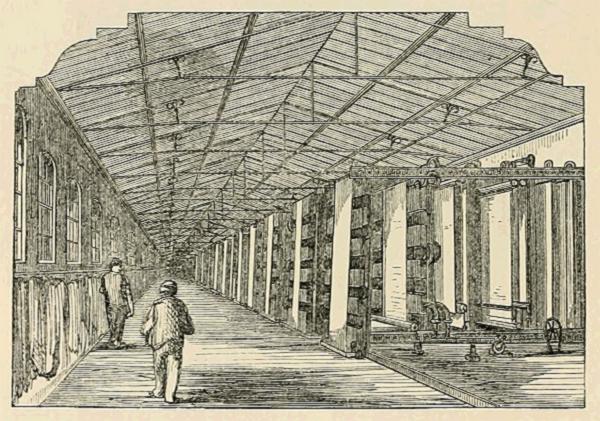
DRYING ROOM.
Before being printed, the calico is prepared by being passed through a preparation, called a mordant, capable of fixing the colors, and preventing them being washed out, and several of these are used, according to the colors required. The colors are thickened with paste, so as to prevent them from running into each other when printed. Muslins, chintzes, &c., are printed in a similar manner to calicoes.
When the pieces of calico come from the printing cylinders, they are made to pass upwards through holes in the ceiling to a room above, where they pass over surfaces of iron heated by steam, so as to thoroughly dry them; they then descend through the floor into the printing room, where they are packed. The process called “ageing” consists in exposing the calicoes to the air for a certain time, to take off the harshness and stiffness peculiar to new goods.
In some cases the colors themselves are not printed on the goods, the mordants being used instead, and the whole piece is then boiled in a vat of dye-stuff, which, however, only adheres to the parts printed with the mordant, all the rest being easily got rid of by simple washing.
DYEING.
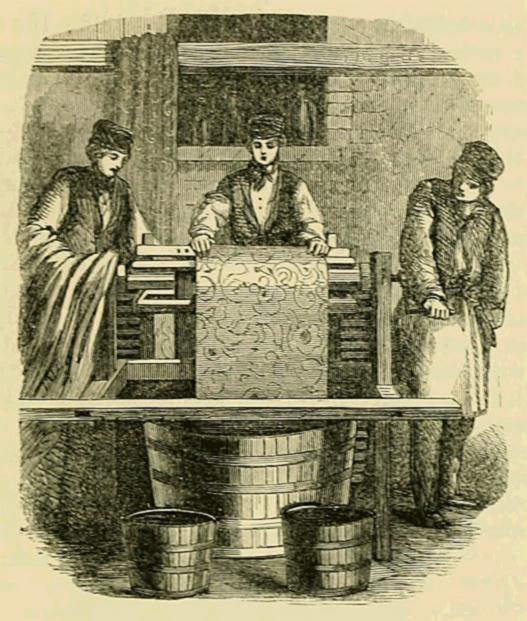
The art of dyeing does not simply consist in coloring the different substances; if this were the case, the color would be washed out as easily as imparted. Nearly all the colors used in dyeing being of vegetable origin, it is necessary to apply some substances to the fabrics to be dyed which shall fix the colors in the grain. Of these (called “mordants”) the chief are acetate of alumina, acetate of iron, and chloride of tin (substances well known to chemists), which have the property of making the coloring matter insoluble, so that it cannot be washed out.
There are various ways of dyeing. If the fabric has to be dyed all one color, it is dipped in the mordant, dried, and afterwards boiled in a solution of the dye-stuff. If a colored ground with white figures is required, then the figures are printed on it with what is called a “resist,” that is, some substance thickened with gum, paste, or pipe-clay, which will resist the action of the mordant and dye-stuff, so that when the fabric is afterwards rinsed these figures remain white. If the ground is to be white and the pattern dyed on it, then this is printed with the mordant and the color adheres only to the parts printed, although the whole be boiled with the dye-stuff, what little may adhere to the ground being easily washed out in the rinsing. Sometimes the kind of mordant used determines the color of the dye; for instance, madder will dye red with the chloride of tin, and black with the acetate of iron. If we now suppose a piece of cloth to be printed in lines of acetate of iron, and figures of chloride of tin, when the whole is boiled in the madder vat, the cloth comes out with black lines and red figures on a white ground.
Another point to be considered is the kind of stuff to be dyed, whether cotton, silk, or woollen, or a mixture of either, for what will take one kind of dye will not always take another, and advantage is taken of this to dye two colors at once, or part white and part colored. A table-cover, for instance, woven with worsted and cotton, can be boiled in various kinds of dye, and produce white and blue, or white and red, for that dye is selected which will attach itself only to one kind of fabric, and leave the other.
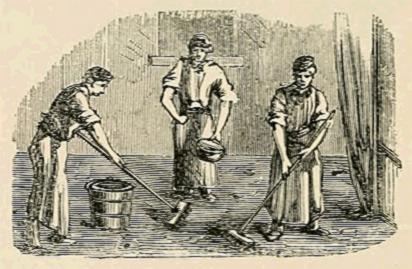
SCOURING.
Many other chemical qualities of the substances used as dyes, and of the substances to be dyed, are also taken into consideration. One of the chief of these is shown in dyeing with indigo. This substance (a vegetable extract) as brought to England is quite insoluble in water and unfit for use as a dye; but it is made soluble, and at the same time almost colorless, by mixing with lime, sulphate of iron, and water. These substances deprive it of its oxygen, and the straw-colored solution is then used for dyeing, the substances boiled in it attaining—as the indigo regains its oxygen on exposure to the air—a deep blue color.
With dyeing is often associated the art of “scouring,” for a knowledge of the properties of the dye-stuffs used enables the workman to discriminate between what will brighten and what would injure the goods to be cleaned.
CALENDERING.
The process of calendering is resorted to for producing a fine smooth surface on calicoes and other goods, and for rendering them sufficiently even to be printed upon (see “Calico-printing”). The calendering machine consists of a set of five rollers, constructed to revolve at unequal rates, so that the one which turns upon the face of the calico not only rolls it between itself and its fellow, but—turning faster—rubs it and gives a gloss to the surface similar to the effect which would be produced if the goods were laid on a table, and the roller rubbed over them instead of being rolled. These rollers are very curiously constructed. They are made by packing many hundreds of round pieces of pasteboard—having each a square hole in the centre, and several smaller circular ones in the margin—on to a central bar of iron, with similar bars through the smaller holes, until a sufficient number have been added to produce the length of roller required. Nuts are then fitted to the ends of the smaller iron bars, and these being screwed tightly, compress the whole into so solid a mass, that it can be turned in a lathe to a perfectly smooth surface, which is (unlike wood) not liable to crack, and, being slightly elastic, does not crush the goods, as metal rollers would.
BREAD MAKING.
This process is much the same whatever kind of meal or flour may be used, whether wheaten, barley, &c. A certain portion of the flour is mixed with warm water (in which a little salt is generally dissolved), some yeast or “barm” (the froth from the fermentation of beer) is added, and the whole worked together to a pasty consistence, this is put into a pan to keep warm, and is called “the sponge;” besides flour and water nearly every baker mixes his sponge with a certain proportion of potatoes boiled to a “squash,” and passed through a sieve to separate the rinds. In an hour or so it swells up to double its original size, from the fermentation which is going on producing a kind of gas called “carbonic acid,” which being formed in every part of the “sponge,” inflates it to a great extent. After a time it sinks down (most of the gas escaping), and begins to rise again; it is then mixed with the remainder of the flour (and some water if necessary), and the whole thoroughly kneaded together with the hands till it is all of an equal consistence—this should be neither too stiff, nor so soft as to stick to the hands. It is now to be cut up and weighed out into pieces to form each loaf. The oven in which the bread is baked is made of “fire-brick,” and so embedded in earth or brickwork that when heated it shall not readily cool; this is heated with coal or wood till it is nearly red-hot and the loaves are put in and left till baked.
SUGAR REFINING.
When brown or raw sugar is refined it forms the white crystalline product known as loaf sugar. The process involves many ingenious arrangements in its detail, but the essential object to be obtained is the separation of all coloring matter from the raw material without producing any more by the process, which is a greater difficulty than would at first appear, for all solutions of sugar evaporated in the open air become to a great extent colored, and the longer the exposure, and the higher the temperature, the worse the product; a substance forming called “caramel,” which discolors it.
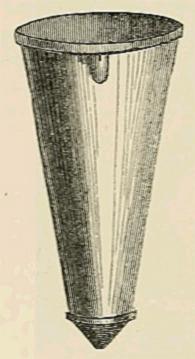
FIG. 1.
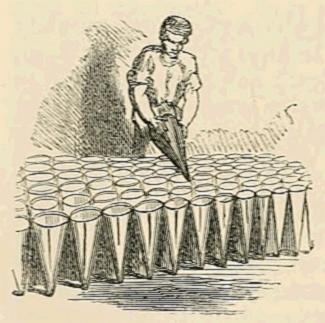
FIG. 2.
The brown sugar is first mixed with a very small quantity of boiling water, just sufficient to form a thick pasty mass, which is put into conical pots (figs. 1 and 2), and allowed to drain, the small quantity of water washes out only the brown part, and leaves the crystals pretty white; they are then dissolved in water, mixed with some bone-black and bullock’s blood; the bone-black is the charcoal from burnt bones, and has the power of taking away the color of most vegetable solutions, the bullock’s blood is used as affording a cheap kind of albumen, which when the solution of sugar is boiled coagulates and entangles all the floating matters so that they may be removed by filtration.
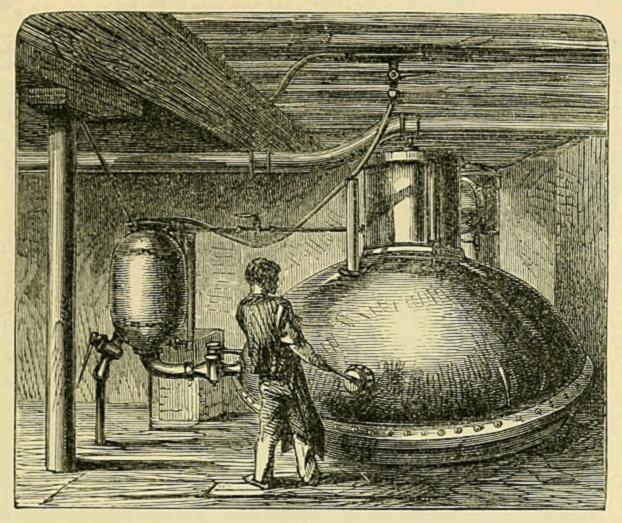
VACUUM-PAN.
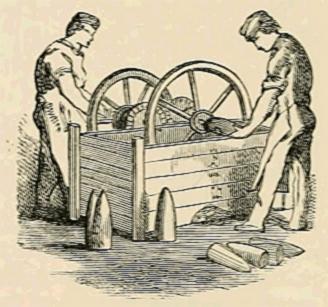
FIG. 3.
The liquid is boiled for a time, and then put into a cistern excluded from the light, having holes at the bottom into which long tubes of thick twilled cotton are fastened, through which the solution runs as bright as water; they all hang down into another cistern below, also kept from the light, from which it is pumped up into the evaporating apparatus—a copper vessel entirely air-tight, heated by steam and having a powerful air-pump attached to it by which all the vapour and air are removed as the syrup becomes hot; this is called a “vacuum pan” (see engraving), and by this the syrup is condensed to the proper consistence, and is put into moulds of the shape the loaf is to be, having holes at the lower part which are plugged up, the syrup as it cools forming a solid mass of crystals; these moulds are arranged in rows over a channel leading to a proper receptacle, the plugs are taken out from the holes at the bottom of each and some pure concentrated syrup is poured on to the upper part; this slowly descending filters through the sugar, carrying with it any “caramel” that may have formed, finally escapes at the hole, and runs into the cistern; this completely whitens the sugar, and gives it a brighter and coarser grain. The loaves are then taken from the moulds, dried in an oven at a gentle heat, and finally packed in paper for sale. If the pointed ends are discolored or ragged the loaf is put into a lathe (fig. 3) and the end turned to a proper figure or cut off.
BREWING.
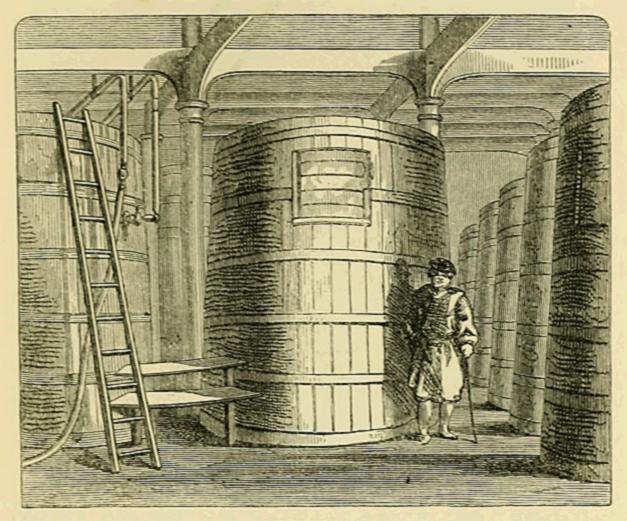
THE VATS.
Beer is made by pouring boiling water upon ground malt, and after a time drawing it off, which is repeated until all its soluble parts are removed and dissolved in the water; the liquor resulting is called “sweet wort,” which is then boiled with a certain proportion of hops (the dried “stobules” or flowers of the hop plant), and the liquor allowed to cool.
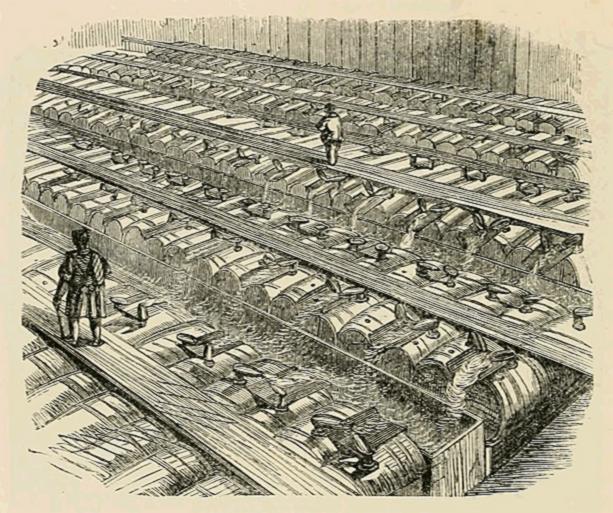
FERMENTING ROOM.
ENGINE ROOM.
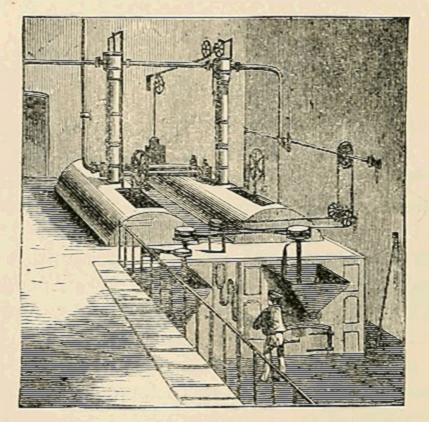
It is then mixed with a small quantity of “yest,” which is the scum thrown off by a former brewing, and the whole is allowed to ferment till nearly all the sweet sugary matter which was got from the malt is converted into spirit, it is then put into casks and allowed to ferment slowly, in which process it throws off more yest, which is collected, as seen in the cut, for the next brewing. It is then bunged up in the barrels and kept for a time, when it is fit for use.
MASH TUN.
BOILER.
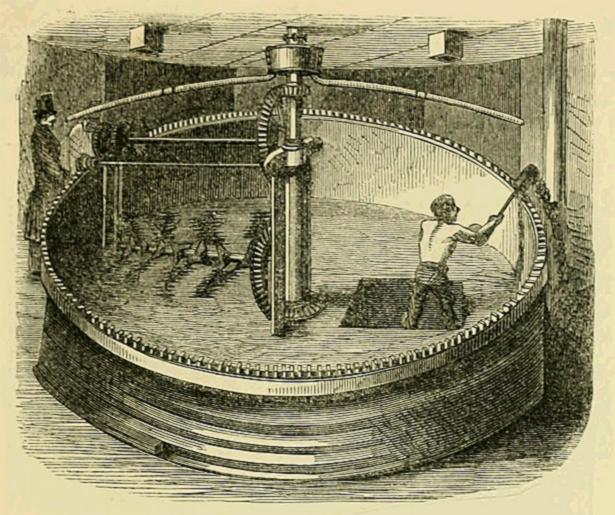
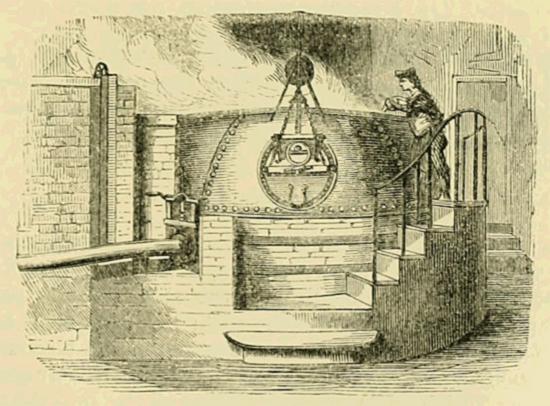
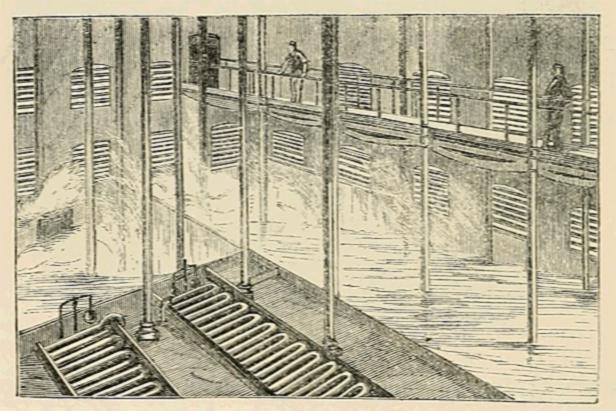
In large breweries machinery of various kinds is employed, such as pumps for pumping up water, taps for drawing it off machinery for stirring up the mash in the “mash tun,” and also the hops in the boiler, to prevent them burning at the bottom of it. The “cooling floor” is a contrivance for cooling the wort, consisting of a series of pipes which pass in a serpentine manner through it, and through which cold water is made to flow. The kind of beer, whether ale or porter, chiefly depends upon the kind of malt used; for ale, very pale malt, called “amber,” while for porter, burnt malt is employed, and hence the color of these two descriptions of beer. If the fermentation is not carried far enough the beer will be too sweet, and if too far it will be sour.
COOLING FLOOR.
DISTILLATION.
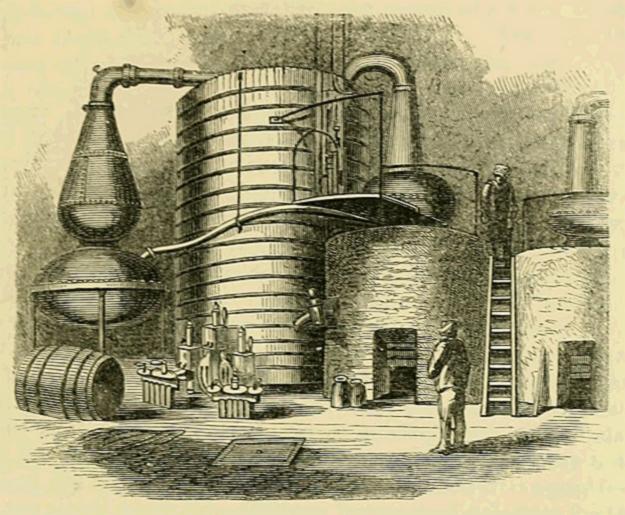
The process of distilling consists in converting the fluid to be distilled into vapour, and condensing it into a fluid in another vessel. By this process the more volatile parts of any fluid are separated from the rest; for example, if brandy be distilled, the spirit or alcohol it contains will be converted into vapour and will condense in the receiver comparatively pure (see “Alcohol”), leaving behind in the still the water, coloring matter, &c., so that the spirit is colorless, although the brandy may have been quite brown. Also, if common water be distilled, pure water will pass over, and the earthy matters which the water had contained will be left behind (for all ordinary water contains considerable quantities of earthy matters, dissolved out from the earth over which it flows). The vessels used for distilling are very various in their forms, to suit the different fluids, both as to quantity and quality (see “Still”). There is a contrivance lately used for distilling spirit from the fermented wash containing it, by which it is allowed to flow into an apartment full of double floors, a few inches above each other, the upper ones being made of thin copper perforated all over with minute holes, and on which the wash is allowed to flow to the depth of about an inch. Into the space between the upper and lower parts of each floor steam is admitted, which, rising through the little holes, is condensed by the wash, giving out its heat to the spirit contained therein, and causing it to be converted into vapour, which passes off from the spaces between the floors to a condensing apparatus with which they all communicate.
GILDING.
Gilding consists in covering the surfaces of various articles with a thin layer of gold, and may be divided into two kinds, quite different processes and practised by different artisans. The first is “oil-gilding,” which is a mechanical application of gold-leaf to some adhesive surface, the second is “water-gilding,” and is a chemical process.
In oil-gilding, where frames, &c., are to be covered with gold-leaf, the first thing necessary is to obtain a smooth even surface on which it will lie, but as carved frames are expensive, ornaments of a kind of putty are fixed to the frame, and coated with whiting and size. The gold-leaf is made to adhere easily to this clammy surface, by simply damping it, and pressing the gold on by means of a piece of cotton wool, afterwards gently brushing it into all the markings. Wood and other articles to be gilt are coated with “gold-size,”—a sort of varnish—and when this is nearly dried, so as to be what is called “tackey,” it will hold the gold in the same way. When lettering is to be done in gold, the painted or varnished surface is first brushed over with whiting, which prevents the gold adhering where it is not wanted, the writing is then executed in gold-size, and the gold-leaf applied by pressing the book on to the surface, and finishing off with cotton wool, which rubs off all the superfluous gold-leaf and smooths it on the surface.
Water-gilding (a process, however, in which no water is used) consists in covering the surface of metal with a thin coating of gold; the best metal for water-gilding is either brass, or a mixture of brass and copper. A mixture of gold and mercury, in the proportion of one part of gold to eight of mercury, is made hot over a fire till they have united; it is then put into a bag of chamois-leather, and the superfluous mercury pressed out. What remains is called an “amalgam;” it is soft, and of a greasy nature, so that it can be smeared over any surface with the fingers. The articles to be gilt are made perfectly clean on the surface, and a liquid made by dissolving mercury in nitric acid (aqua-fortis) is brushed over them by means of a brush made of fine brass wire, called a “scratch-brush.” The mercury immediately adheres to the surface of the metal, making it look like silver, when this is done, a little of the amalgam is rubbed on, and the article evenly covered with it. It is now heated in a charcoal fire till all the mercury evaporates, and the brass is left with a coating of gold, which is very dull but may be burnished with a steel burnisher and made bright if necessary. In former times articles were inlaid with thin plates of gold, which were placed in hollows made with a graver and melted in, a little borax being applied between.
When a solution of “chloride of gold” is mixed with ether, the ether takes the gold away from the solution, and may be poured off the top charged with it. This solution, if applied to polished steel by means of a camel-hair pencil, rapidly evaporates, leaving a film of gold adhering to the steel, which, when burnished with any hard substance, has a very elegant appearance. In this way any ornamental design in gold may be produced, but it is not very durable. The gilt ornaments, scrolls, and mottoes on sword-blades, &c., are sometimes done in this way.
“Gilding refined gold” would appear a great absurdity, but something very like it is often practised in the process called “coloring,” used by jewellers. This is however never applied to “refined gold” but to gold that is not quite so good in color as it should be. It is boiled in a liquid containing chemical substances capable of dissolving the alloy from the surface of the article and depositing a thin coating of pure gold, giving it the appearance of being made of better gold than it really is. This is in truth a species of electro-plating, but was in use very many years before the electro-depositing process had been discovered.
SILVERING LOOKING-GLASSES.
Although this process is called “silvering,” yet no silver is used; the substance at the back of the glass is a mixture of tin and mercury, called an “amalgam,”—indeed, the term “amalgam” applies to all mixtures of mercury with other metals. The process is as follows:—A sheet of “tin-foil” (tin rolled out to about the thickness of paper) the size of the glass to be silvered is placed on a perfectly level table, covered with cloth; upon the tin-foil some mercury is poured, and spread evenly and quickly over the surface with a hare’s foot. The plate of glass is in the meanwhile to be made perfectly clean and dry—not the slightest speck or smear must remain. A sheet of tissue paper, also clean and dry, is laid over the surface of the mercury, the plate of glass is placed on the paper and made to correspond with the mercurialised tin-foil beneath. Weights are now placed on the plate of glass to keep it firmly down, and the sheet of paper is drawn out steadily and slowly; as it passes over the surface of the mercury it brings away all film or dust, and the surface being left perfectly bright, adheres so firmly to the dry glass that it is not easily removed. A great difficulty is to prevent air-bubbles from finding their way between the glass and mercury. The table is now raised slightly at one end, and the superfluous mercury allowed to drain off. After a few hours the tin-foil will be found to be completely united all through with the mercury, and will be so brittle that it can be scraped off in powder from the glass. Great care and practice are required to silver large plates, but any one by a few trials may succeed perfectly with a piece of glass a few inches square. Glass globes are silvered inside by shaking in them a mixture of mercury and tin filings until it adheres to the surface of the glass, which must first be made perfectly dry and warm.
SILVER PLATING.
Plated goods consist of metallic articles coated with a thin plate of silver; the metal is made of a mixture of brass and copper, which is cast into flat slabs or ingots about an inch-and-a-half thick, the surface on one or both sides is filed flat and smooth, and a plate of silver of about the thirtieth part of an inch thick, but a little smaller than the metal, is applied smoothly to it, the edges are covered all round with borax ground fine with water and the plates tied tightly together with wire. The whole is then put into a furnace and closely watched till the silver begins to melt, when it is at once taken out and allowed to cool; by this mode of treatment the silver adheres so firmly to the metal that they become as one piece. It is then passed between steel rollers and rolled out to the required substance, the silver and metal both becoming thinner in about the same proportion, so that on a plate of metal, of whatever thickness, the silver is somewhere about a fortieth or forty-fifth part of its thickness; these plates of metal coated with silver are worked by stamping, punching, or passing between rollers the edges of which have mouldings, curves, &c., cut on them, and the parts of each article when moulded are afterwards soldered together so as to form what is intended. Wires of various forms are plated in the same way and afterwards drawn out by means of draw-plates (see “Wire-drawing”). Electro-plating has to a great extent superseded this process (see “Electro-plating”).
ELECTRO-PLATING AND DEPOSITION OF METALS.
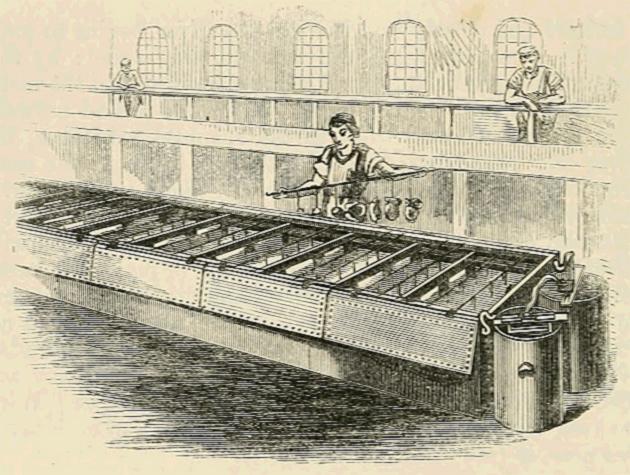
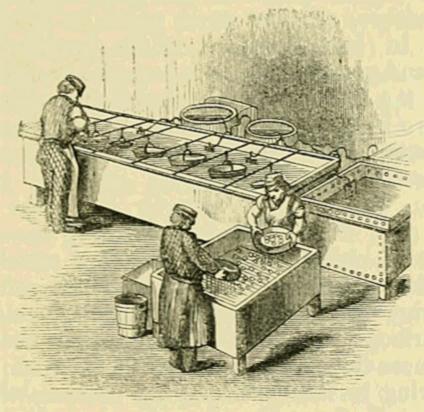
This art has for its objects the coating of metallic articles with other metals of more value, beauty, or durability, such as gold, silver, or copper, by means of electricity, and the formation (by the same means) of other articles by the deposition of metals, from liquids containing them, upon moulds or engraved surfaces capable of modelling them. When the deposit forms a coating intended to be permanent, and which adheres to the article so as to be incapable of removal, it is called “electro-plating,” but when a fac-simile of any surface is required, or a cast of a mould which may be removed, forms the object to be produced, it is called “electrotyping” or “electro-depositing.”
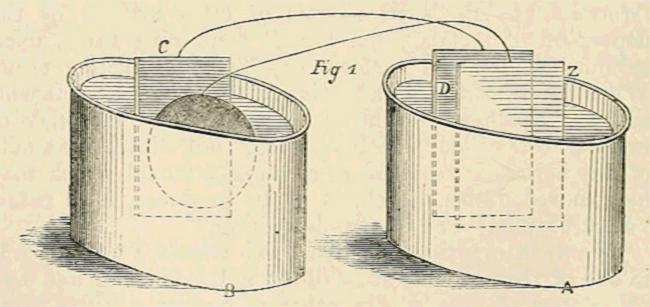
FIG. 1.
GILDING RINGS.
By way of experiment, procure two vessels, A and B, fig. 1, in one of them, A, put some dilute sulphuric acid and two plates, one of zinc, Z, the other of copper, c, these must not touch each other, but may be separated about half an inch by two or three pieces of wood or cork, and bound round with string; each of these plates must have a piece of wire fastened by soldering to their upper parts. In the vessel B put some solution of sulphate of copper and a small quantity of dilute sulphuric acid, and attach another copper plate to the wire which comes from the copper plate in the acid; this second copper plate is to be immersed in the solution of sulphate of copper, and to the wire from the zinc plate is to be fixed the object to be coated with copper. If a medallion or other object is plaster, it should be soaked in very hot wax and then brushed over with blacklead until the surface is perfectly blackened and bright; the wire should be bound all round the margin and soldered (as it were) with melted wax to the medallion, taking care that this wax also is well coated with blacklead. If the object be now immersed in the sulphate of copper solution and kept at a short distance from the plate (it must not touch it), a coating of copper will soon cover the surface and form a perfect cast, which when of sufficient thickness may be removed by filing the edge all round (if instead of the plaster cast a copper coin or other copper object be used, the blackleading is not required, but the surface must be first made clean and bright). With the same arrangement, but using instead of the sulphate of copper a solution made by dissolving cyanide of silver in a solution of cyanide of potassium, a coating of silver will be deposited, and the same of gold (if cyanide of gold be used), but these coatings will not adhere. If it be intended that the coatings shall adhere, to plate the article with silver or gold, it should be first thoroughly cleaned, then brushed over with a solution of nitrate of mercury, washed in clean water, and put into the gold or silver solution; the nitrate of mercury will cover the copper article with a thin coating of mercury, which will be taken up as the gold or silver is deposited, and this coating will adhere, the article being thus “electro plated.” As in using the solution of sulphate of copper, a copper plate was immersed in the solution and united by the wire to the copper plate in the vessel A, so in using the solution of cyanide of silver, a silver plate must be used, and in the gold solution a gold plate, these plates being dissolved as the metal is deposited, the liquid remaining pretty much the same and serving for future operations. The gold and silver thus deposited are dull, but may be burnished with a steel burnisher, all over or in parts as the design may require. In manufacturing, these processes are much modified, and powerful galvanic batteries or electro-magnets used; in the latter case the electro-magnetic machine is often driven by a steam-engine and the troughs of depositing liquids contain often many dozens of articles, which are all receiving a coating at once.
SOLDERING AND BRAZING.
The art of uniting metals by another metal or alloy, is called soldering (which includes “hard and soft soldering,” and “brazing”). If any metal be applied in a melted state to the surface of a piece of cold metal, under ordinary circumstances it will not adhere, but runs off in globules, this is owing to the surface being covered with “oxide” or rust, but if the surface be scraped or filed bright and some substance applied which will defend it from the air, and at the same time become fluid at the heat of the melted metal, then it will adhere. For this purpose borax is used in hard soldering and brazing, that is in soldering with metals which require a considerable amount of heat to melt them; and sal ammoniac, rosin, oil, &c., in cases of soldering with “soft solder,” or solder that will readily melt. This soft solder is made of a mixture of lead and tin, and if required to melt very easily (as in soldering pewter), then some “bismuth” is added. Bismuth itself does not melt more readily than lead, but it has the property of causing other metals to melt more readily.
If the edges of two pieces of tin, for example, have to be soldered together, an iron with a wooden handle and a piece of copper joined to the other end is used. This is made red-hot, and the pieces of tin being placed smoothly together and their edges sprinkled with rosin or sal ammoniac, the hot iron (first touched on a piece of rosin to clean it) is then applied to the joint, a piece of soft solder being applied at the same time, and as this melts it is drawn in a melted state by means of the hot iron (to which it adheres) down the joint. An excellent substance for soldering: all sorts of small work, such as pieces of brass, copper, or tin, is chloride of zinc-this may easily be made by putting pieces of zinc into spirit of salt, (hydrochloric acid), and allowing them to remain as long as any effervescence continues; this solution may be kept in a bottle and applied to any edge to be soldered, by means of a small brush or feather. When iron and copper have to be “brazed,” the joints are made bright, and then coated with borax ground into a paste with water. A mixture of brass and zinc (called spelter) in small grains is sprinkled on the joint and it is then put into the hollow of a bright fire which is urged by bellows till the spelter melts. Silver is joined by hard or “silver” solder, which is a mixture of silver, zinc, and copper, and the fusion is generally effected by a blow-pipe, (see “Blow-pipe”); gold is soldered by a mixture of gold and copper. Leaden pipes are joined by having the ends to be united scraped bright and introduced a short way one within the other, some melted solder is then poured from a small iron ladle on the joint at the same time that it is rubbed round with a piece of folded cloth greased on the surface. Joints in cisterns, etc., are generally made by scraping the edges clean with a steel scraper, and applying some lamp-black and size by means of a brush to the parts beyond, leaving a bright space of an inch or so on each side of the joint, a ladle of melted solder is then gradually poured on the joint and rubbed down with a piece of greased cloth, the lamp-black and size preventing the solder adhering to any part but that left bright, and in this way a straight neat joint is produced.
THE SMELTING OF METALS.
All metals are got from the earth where they exist in the form of “ores” (in reality metals combined with other matters), and “smelting” is the process of getting rid of these other matters, the chief of which are sulphur and oxygen. The ores when dug from the mine are generally stamped into powder, then “roasted,” that is, made hot and kept so for some time to drive off water, sulphur, or arsenic, which would prevent the “fluxes” acting properly. The fluxes are substances which will mix with, melt, and separate the matters to be got rid of, the chief being charcoal, coke, and limestone. The ore is then mixed with the flux and the whole raised to a great heat; as the metal is separated it melts, runs to the bottom of the “smelting furnace” and is drawn off into moulds made of sand; it is thus cast into short thick bars called “pigs,” so we hear of pig-iron, pig-lead, &c. Iron is smelted from “ironstone,” which is mixed with coke and limestone. The heat required to smelt iron is so very great, that a steam-engine is now always employed to blow the furnace (before the invention of the steam-engine, water-mills were used for the same purpose). The smelting is conducted in what is called a blast furnace. When the metal has all been “reduced” or smelted, and run down to the bottom of the furnace, a hole is made, out of which it runs into the moulds; this is called “tapping the furnace.”
Smelting is often confounded with melting, as the names are somewhat alike, but the processes are entirely different; in melting, the metal is simply liquified, in smelting the metal has to be produced from ores which often have no appearance of containing any, as in the case of iron-stone, which looks like brown clay. By way of experiment let the reader take a small portion of “litharge,” which is a reddish powder, mix it with a drop of oil into a thick paste and place it on the end of a flat piece of charcoal or wood, and direct the flame of a candle upon it by means of a blow-pipe; a slight hissing noise will be heard, and in a moment or two a small, bright globule of lead will make its appearance.
FOUNDING.
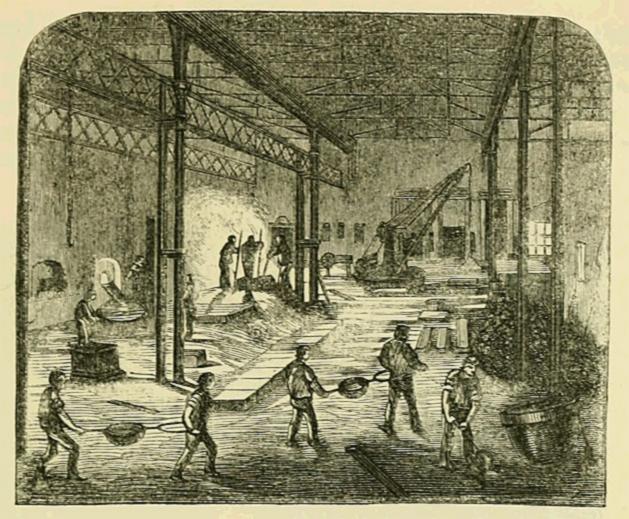
GENERAL FOUNDRY, WOOLWICH ARSENAL.
Founding is the art of casting metals into various forms by means of moulds. The products of smelting are of a coarse kind, and have to be remelted before the process of casting or founding begins. Before any article can be cast in metal, a pattern must be formed in wood, clay, or other suitable substance. The floor of the foundry is made up of sand and powdered charcoal to the depth of several feet, serving to imbed the moulds which are used, and in several places deep pits full of the same material are formed for large castings; an iron frame, corresponding to another like it, and capable of being united to it by pins and sockets, is used to contain the moulding sand and pattern.
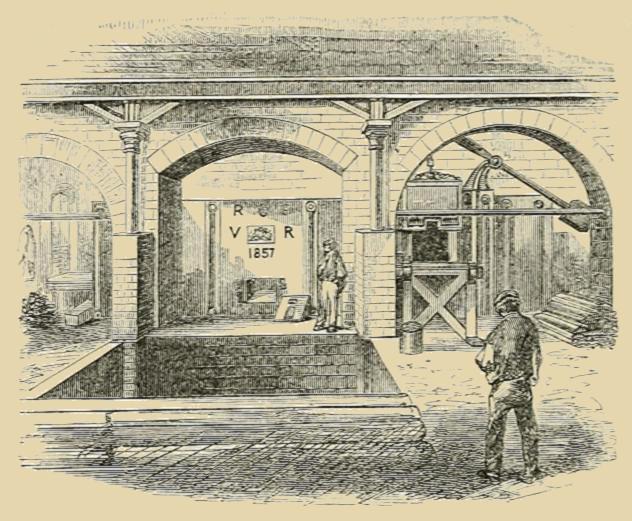
GUN FOUNDRY, WOOLWICH ARSENAL.
Let it be supposed, for simplicity, that a cannon ball has to be cast, one of the frames is filled with moulding sand moist enough to bear a good impression, and a cannon ball pressed half-way in; the surface is now dusted over with red ochre (to keep the upper half from sticking to it), and the other frame applied and united with the lower one, this is now filled with the sand and beaten or trodden down firmly. On separating the two and removing the pattern, there is an impression of half a ball in each half of the mould, and when these are again put together there is a hollow corresponding to the pattern used. There are, however, two things more to be attended to, one is to have an opening for the melted metal to be poured in, the other an opening for the air to escape, and this is effected by attaching to the pattern two pieces of wood or iron which project upwards through the upper half of the mould, and when this is carefully lifted up two holes appear which on being united to the lower half lead into the round hollow. When the moulds are ready they are put into a room heated by means of stoves, and thoroughly dried. They are then buried in the floor of the foundry, leaving the holes for pouring the metal exposed, channels being formed in the sand, so that when the furnace is “tapped” the melted metal may flow down these and fill the moulds. Some forms are so complicated that the moulds have to be made in several pieces, and the ingenuity of the founder is taxed to the utmost to produce those required.
GLASS BLOWING AND CASTING.
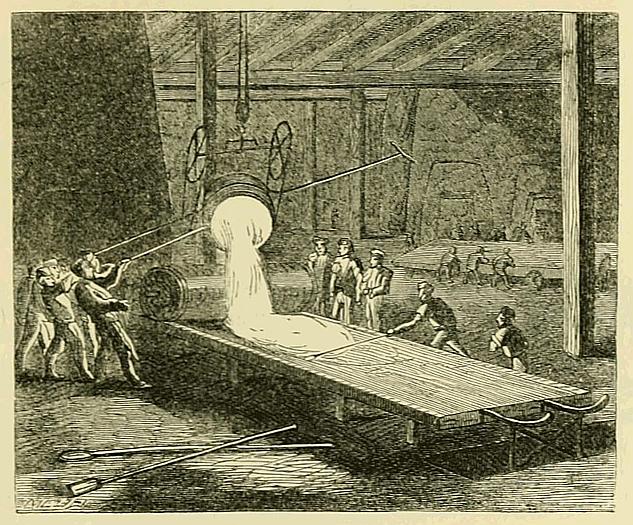
CASTING PLATE GLASS.
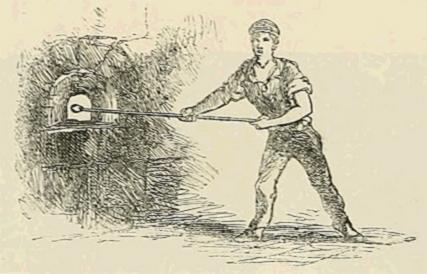
FIG. 1.
FIG. 3.
FIG. 4.
FIG. 2.
Glass-blowing requires great practice and manual dexterity, for the material used being red-hot cannot be touched with the hands, and has to be very rapidly worked, or it becomes cooled and hard; to any one unused to work with it, it is the most unmanageable material conceivable, but by practice the glass-blower contrives to produce almost any form required, and of a size quite astonishing—as, for instance, the globular bottles seen in druggists’ windows, which often hold twelve gallons, also glass shades, which are of an uniform thickness, and two or three feet high. This is all done by means of a hollow rod of iron called a “puntil,” on the one end of which a mass of molten glass is collected (fig. 1), and the workman blows into the other, at the same time turning the tube rapidly round in his hands (fig. 2). When the kind of glass called “crown-glass” has to be made, the end of the iron tube is put into the pot of melted glass, and turned round till a ball of it is collected about the size of one’s head, the workman then blows in at the other end, still turning the rod in his hands; it has now the appearance presented at fig. 3. An iron rod is stuck on to the side of the globe opposite to the “puntil,” which is then pulled suddenly away, leaving a round hole. The globe of glass is again made red-hot, and spun round rapidly, the hole increasing in size until it resembles fig. 4. By continuing the rapid twirling of the rod, the hole opens wider and wider till at last one broad sheet is produced; it is then separated from the rod by putting a drop of cold water at its junction with the glass, which causes it to crack across at that part. It is now about six feet in diameter, perfectly round and flat, and when cold it is cut into halves and packed with straw in a “crate” for carriage. The knot of glass often seen in kitchen or stable windows, is the part in the centre of the glass where the iron rod has joined it, and is called the “punty.”
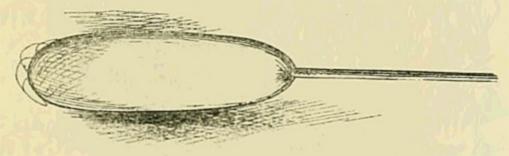
FIG. 5.
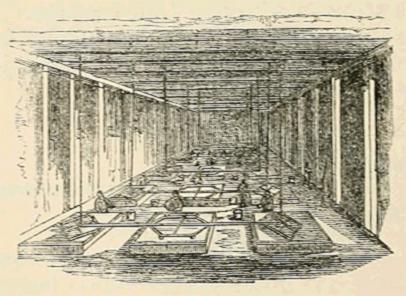
FIG. 6.
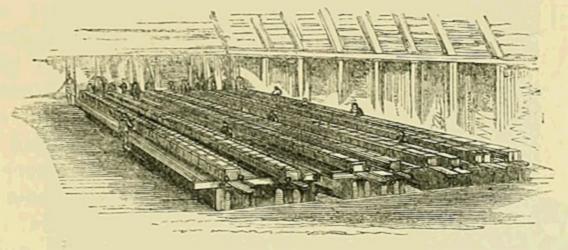
FIG. 7.
Sheet-glass is commenced in the same way as crown, but instead of a hole being made the blowing is continued till a great round ball is formed, the rod and this ball are then swung round at arm’s length—a hole being sunk in the ground for the purpose—which causes the globe to become elongated, as in fig. 5. It is then laid upon an iron table, and rapidly slit up, the compressed air escaping from within opening it out into a broad sheet, which is instantly cut square while yet soft.
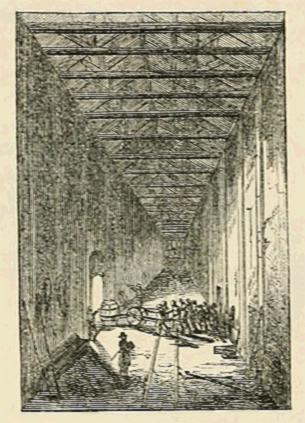
PLATE GLASS CASTING. BRINGING OUT THE POT.
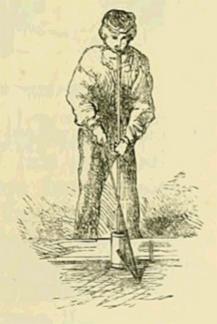
FIG. 8.
Plate glass is cast by pouring it from a large pot on to a flat iron table with a ridge all round it, and on which an iron roller is so placed that when the molten glass flows on the table it passes over and flattens it out to the required thinness, which is regulated by elevating or depressing the ridges at the sides of the table, made moveable for that purpose (the process is illustrated by the cut at the head of this article). When cold, the surface of the plate is ground perfectly flat and even by means of emery-powder (fig. 6), and then polished with a cloth rubber charged with a fine red oxide of iron called “crocus” (fig. 7). The grinding and polishing are both performed by steam machinery.
Bottles, and such like articles are either simply blown into the form required, or into moulds made to close upon the ball of soft glass, and again open when the required form has been given (fig. 8).
Many articles of glass are cast, or “struck-up” by compression in a mould, and are often made to resemble cut-glass articles, but they are much inferior in appearance. The best articles of glass are first blown, and afterwards cut and polished (see “Glass-cutting”). Of whatever kind the article of glass may be, it is so brittle that the slightest blow would break it, a bad quality which is got rid of by a process called “annealing.” This consists in placing it while quite hot on the floor of an oven, which is allowed to cool very gradually indeed. This slow cooling takes off the brittleness; and articles of glass well annealed, will scarcely break with boiling water, and are very much tougher than others.
GLASS-CUTTING.
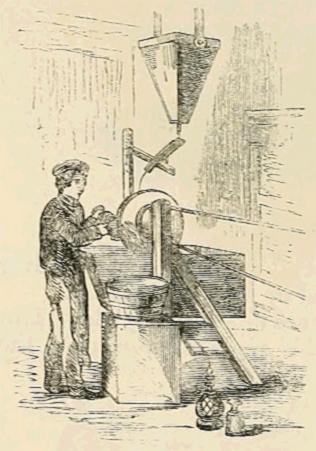
GLASS-CUTTING.
The kind of glass generally used for ornamental cutting is flint-glass. Decanters, wine-glasses, &c., are also made of it; it is very bright, white, and easily cut. Glass is cut by means of wheels of different sizes and materials, turned by a treadle, as in a common lathe; some are made of fine sandstone, some of iron, others of tin or copper; the edges of some are square, some round, and some are sharp. They are used with sand and water, or emery and water, but stone wheels are used with water only. The glass-cutter also uses rods of copper with knobs at their ends, for making round indentations; these turn on their axis, so that the end cuts a round hollow in the glass. The work is at first cut roughly, afterwards smoothed off with the sandstone or tin wheel (the latter has to be smeared with emery and water), and finally polished by a wooden wheel with finely-powdered pumice-stone applied to its edge, and moistened with water. The glasses for spectacles and optical instruments are cut by concave or convex moulds of brass moistened with emery and water, and polished by means of a mould of pitch wetted with crocus and water. Great art and accuracy are required to grind the glasses for optical instruments, especially very large or very small ones, as for microscopes, the various “powers” of which constitute their chief expense—one of the sixteenth of an inch in diameter costing about twelve pounds.
BRICKLAYING.
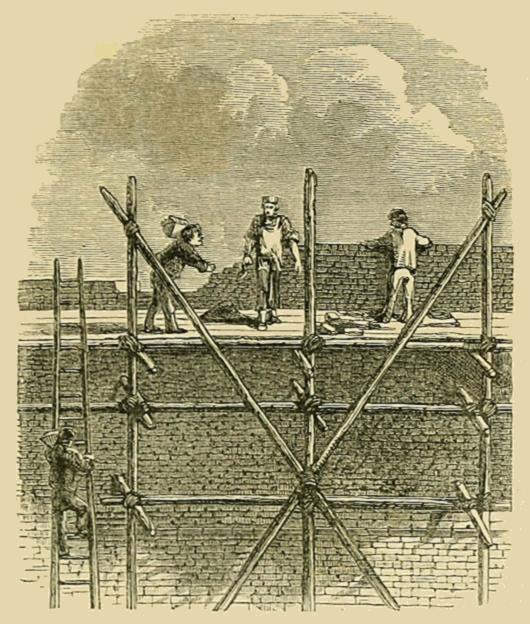
BRICKLAYING.
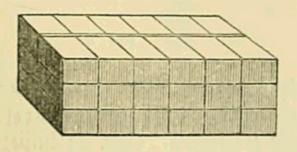
FIG. 1.
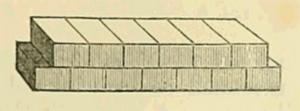
FIG. 2.
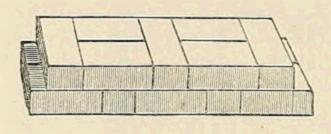
FIG. 3.
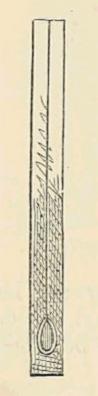
FIG. 4.
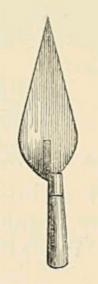
FIG. 5.
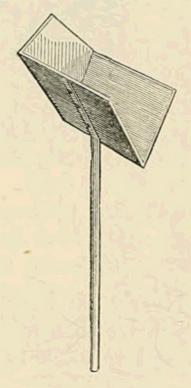
FIG. 6.
Nearly all houses are built of bricks, as they are less expensive than stone, and more durable than wood, besides being less liable to be burnt. Walls of brick may be formed of any required thickness, and as the length of a brick is twice its breadth, they admit of being so laid that the wall shall not part in pieces, which would be the case if laid as in fig. 1, as the seams of mortar run continuously through the wall, which in bricklaying is always avoided, by different methods. Formerly bricks were laid in what was called “English bond” (fig. 2), but this is not now used, “Flemish bond” (fig. 3) having superseded it. The mortar with which bricks are laid is made of lime and sand, mixed with water to a convenient consistence; it sets quickly, hardens with age, and resists the action of rain and time. The ordinary mode of laying bricks is to stretch a line from end to end of the course on which they are to be laid; the surface of the under course is spread for a short distance with mortar, and the bricks intended to form the outer surface of the wall are laid first, in an exact line with the cord, the “plumb” (fig. 4) being frequently used to ascertain if they are perpendicular. The “plumb” is a piece of board with a notch at the centre of the top, and a hole, also in the centre, near the bottom; a piece of cord is passed through the notch, with a leaden ball attached, which swings in the hole as the plumb is placed at the side of the wall. The ball of lead just falls in the hole if the wall is upright, and in this way a wall may be built to any height, exactly perpendicular. The corner of brickwork where windows occur, is called the “arris,” and has to be made upright both in front and at the side. When very thick walls are to be made (as in railway cuttings), the outer surface and back of the walls are laid in the usual way, the space between is filled with a layer of bricks, and thin liquid mortar is poured on and scraped about with a sort of hoe till the spaces between the bricks are all filled up and the surface left level, when another course is laid in the same manner. Fig. 5 is a trowel, or instrument used to take up and spread out the mortar, and fig. 6 is the hod, in which the labourer carries supplies of bricks or mortar to the spot where the bricklayer is working.
STONE CUTTING.
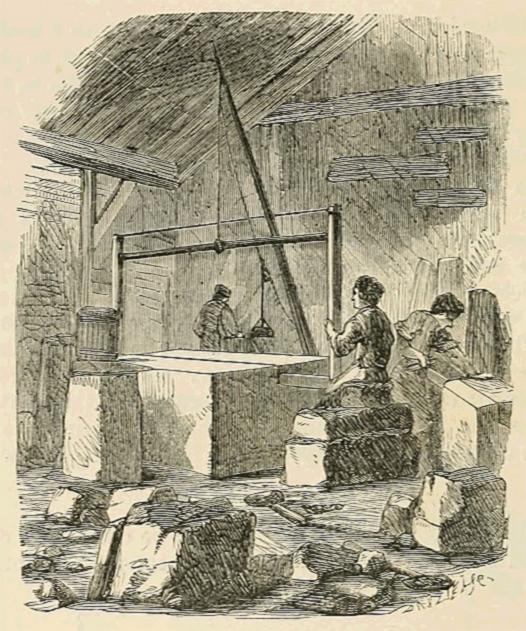
STONE-CUTTING.
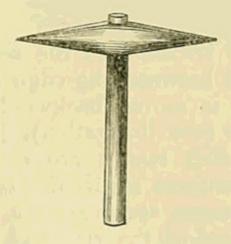
FIG. 1.
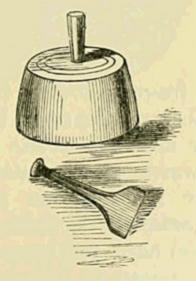
FIG. 2.
Some stones, as “Bath stone” can be cut with a common toothed saw, and are but little harder than chalk; others, as marble, Portland stone, &c., require to be cut with a flat blade of iron stretched in a frame and having a supply of sand and water. A man sits in a shed having this heavy saw suspended from two poles, and balanced by a piece of stone swung over a pulley; he alternately pushes and pulls the frame, allowing the water to trickle into the seam as it forms, the sand being rubbed between the edge of the saw and the stone as the saw is moved backwards and forwards, slowly cutting the stone (see illustration). By this slow and tedious process building stones are cut into squares, slices, slabs, or any other form required. Granite is too hard for even this slow process, and after the pieces are chosen as nearly as can be got of the size and shape required, they are worked with a heavy iron pick (fig. 1), which at each blow strikes off a little piece not bigger than a pea, by which method the stone is shaped into the form required. Smaller cuttings of stone for building purposes, such as carvings, &c., are formed by the mallet and chisel (fig. 2), the work being finished with a rasp or steel scraper.