THE AFFAIR OF CHERRY VALLEY.
Reading edition
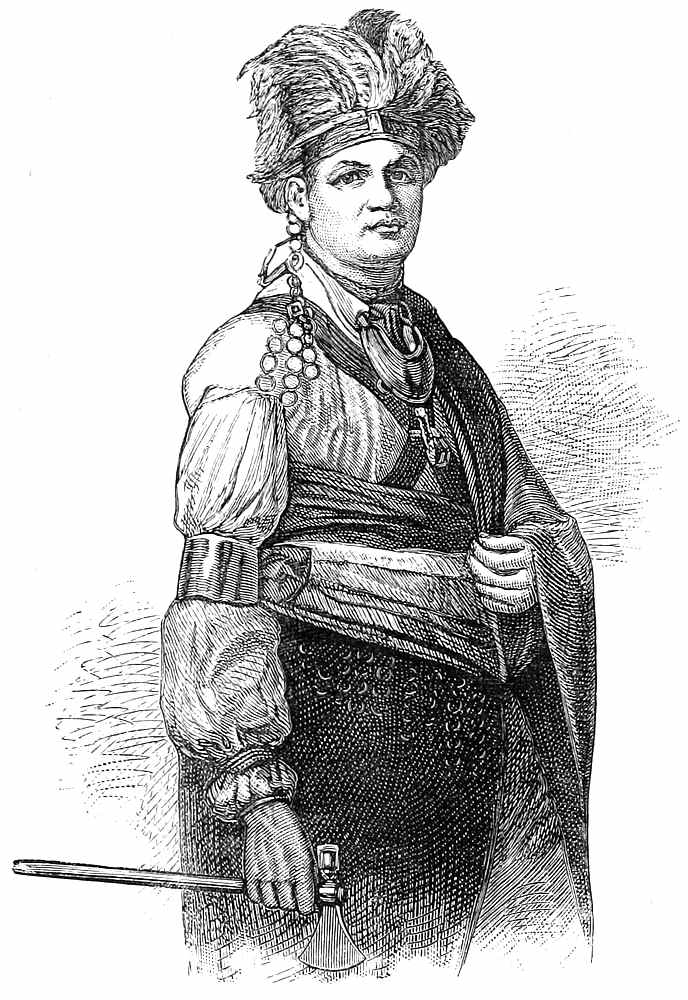
JOSEPH BRANT.
The massacre at Cherry Valley, New York, was notably cruel and bloody. In November, 1778, Walter Butler, with two hundred loyalists, and Joseph Brant, with five hundred Indians, swept down on the place, and commenced an indiscriminate slaughter. The very loyalists among the inhabitants were not spared. John Wells was well affected to the crown, yet he and his family, with the exception of his son John, who happened to be in Schenectady, were killed. Jane Wells was very much esteemed for her kindness and other good qualities. The elder Wells was a particular friend of Colonel John Butler, Walter’s father, who said, when he heard of his death, “I would have gone miles on my hands and knees to have saved that family, and why my son did not do it God only knows.” One loyalist, Peter Smith, who had formerly been a servant in the family, tried to save Miss Jenny, but the Indian who had seized her struck her on the head with his tomahawk and killed her. One man by the name of Mitchell was at a distance, saw the savages approaching, and finding that he could not rejoin his family, escaped into the woods. On his return he found his house burning, and near it lay the bodies of his wife and four children. One of these, a little girl, was still living, when he saw a party approach. He dropped the child, and secreted himself behind a tree. One of the new-comers saw the child to be alive yet, and stooping, brained her with a hatchet. The wretch was not an Indian, but a white loyalist savage named Newbery, who was afterwards hanged as a spy by General James Clinton. Brant saved a number of prisoners, and would have spared the women and children, but Walter Butler denied all appeals for mercy.
Butler’s time was to come. On the 22d of August, 1781, Colonel Willet attacked a force of five hundred loyalists and Indians at Johnstown, and defeated them. They were commanded by Major Ross and Walter Butler. The remnant of the enemy retreated all that night, and could not be overtaken. It was during that retreat that Butler was killed in the manner related in the ballad. Skenando, the Oneida chief, who is supposed to have been his slayer, was about seventy-four years old at the time. He lived many years after, dying at the age of one hundred and ten, on March 19, 1816. His burial was attended by a large number of citizens. A short time before his death he said to a visitor, who made some inquiries about his age, “I am an old hemlock. The winds of a hundred winters have whistled through my top. The generation to which I belonged has gone and left me. Pray to my Jesus that I may have patience to wait for my appointed time to die.”
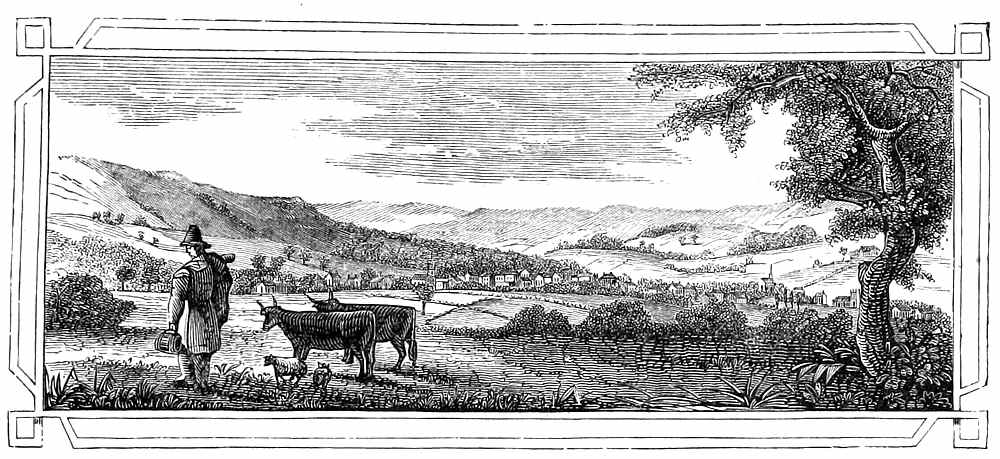
DISTANT VIEW OF CHERRY VALLEY.
DEATH OF WALTER BUTLER.
I.
Overhead the sky of morning Gives of goodly weather sign; From the milking to the meadows Slowly go the lowing kine. Fall in sparks of fire the dew-drops From the overburdened leaves; Flit from bough to bough the peewees; Hum the mud-wasps at the eaves. Mists that recent wrapped the valley Now are sweeping o’er the hills; And the broad red sun is casting Gold upon the lakes and rills. Deep and brown and sombre shadows Creep the forest trees between; Here and there the shades of crimson Speck the liquidambars’ green. Lo! a horseman swiftly rising From between the river’s banks; Dust is on the rider’s garments, Blood upon his horse’s flanks. At the portal of the tavern Hard he draws the bridle-rein, For a moment, feet in stirrup, One refreshing draught to drain. What can make the village dwellers, In a hushed and breathless group, Gather round that jaded horseman By the village-tavern stoop? To him come the anxious mothers, Bearing babes upon their arms; Close behind them crowd the maidens, Yet unscathed by love’s alarms. Near him gather stalwart farmers, Sturdy, strong, and sun-embrowned; And the curious village children, Play suspending, stand around. Breathless all, until the horseman, Mug in hand, has told his tale; Then around there spreads a murmur Like the warning of the gale. Now it lulls and now it rises, Like the patter of the rain— “Heaven at last has dealt its vengeance! Walter Butler has been slain!”
II.
Never tongue may tell the horror Of that dark November day, When through startled Cherry Valley Walter Butler took his way— Walter Butler and his Tories, With the savage Brant in train, Marking every rod of progress By the bodies of the slain. Walter Butler! cruel panther, Lapping tongue in human gore; Even Brant, the bloody Mohawk, Had of truth and pity more. His the will to save the helpless From the tomahawk and ball, Had not you with rage forbade him, Saying, “Curse them! kill them all!” Even boyhood’s old companions, Comrades of your later days, Friends who, seeing not your vices, Gave your scanty virtues praise— None of these could gain your mercy On that long-remembered day; For the stranger, friend or foeman, Came one doom relentless—“Slay!” Swiftly at your word the hatchet Crashed into the quivering brain, And the swarthy fiends in fury Tore the scalp-skins from the slain. Gray-haired elders, whom your father Knew as friends in days of yore, You had joy to see their corses Welter in their oozing gore. Mothers lying mangled, dying, In their throes made deeper moans As they saw the skulls of infants Shattered on the ruthless stones. These, and shrieks of fleeing maidens, Speechless children’s pleading tears, And the yelling of the savage, Made sweet music to your ears. Bloody Walter Butler! owning Brain of fire and heart of stone, Twenty deaths, could you endure them, Would not for these deeds atone. Nevermore may come your victims To the pleasant earth again— Never hear the blessed tidings— “Walter Butler has been slain!”
III.
When the savage had departed, Careless of the woe he caused, Then, amid the smouldering ruins, An Oneida came and paused. He was tall and gaunt and aged, Crowned his head with films of snow; For the frosts of seventy winters Thus had honored Skenando. Gazed he on the work of evil, Which around its traces spread, On the blood which stained the herbage, On the pale and mangled dead. “I have been,” so spake the chieftain, “Forty years the white man’s friend; So have been to Walter Butler— Would have proved so to the end. “Cruel son of lying father, Faithless, too, as this may show, You shall rue the dreadful doing Which creates in me a foe. “Here are friends—I knew and loved them, Proved them often in my need. Great Monedo’s curse be on you, Walter Butler, for this deed. “Here, by all his bitter sorrow, By his scant and whitened hairs, By the spirits of the fallen, Thus the old Oneida swears: “He will follow in your pathway, He will hang upon your track, Through the hurry of the foray, Through the battle’s awful rack, “Till at length his keen-edged hatchet, Driven to your coward brain, With its crashing voice shall utter, ‘Walter Butler has been slain!’”
IV.
In the waste of Cherry Valley Desolation long was seen, Seated on the heaps of ashes Where the home of man had been. Desolation there was sitting, Brooding on the fearful past, Crouching in the murky shadows Of her sullen pinions vast. There, amid the thorny briers, Mingled with the earth and stones, Hidden by the noxious herbage, Were the weather-whitened bones. On the branches of the maples Sat the houseless cocks, and crowed; In the forest’s dark recesses Starveling watch-dogs made abode. Through the copse-wood, snorting, scampered Herds of wild and savage swine; And with yellow deer there wandered What survived among the kine. In the fenceless fields the panther Crouched to spring upon his prey; And the rattlesnake lay basking Careless in the public way. Where had stood the barn and stable, And the garden with its bees; Where the house, with peakèd gable, Peeped through groves of locust-trees; Where the children, newly risen, Peered at sunrise through the pane, But through which the murdered children Nevermore may peer again; Where the housewife in the morning, Pail in hand, the fountain near, Stopped to gossip with her neighbors, And the village news to hear; Where the farmers in the porches Sat at closing of the day, Smoking pipes whose odors mingled With the fragrance of the hay; Where at eve the cows were lowing Answer to the milkmaid’s cry; And, with hens about him, proudly Sultan Spurs came strutting by; Where the horses, in the pasture, On the fence’s topmost rail, Crossed their necks and loudly whinnied, Some tired traveller’s horse to hail; Where the rooting swine at footsteps Raised their heads beneath the trees, And the watch-dog bayed defiance To the murmur of the breeze— Clouds that overhung the valley Would not melt in gentle rain; They were waiting for the tidings— “Walter Butler has been slain!”
V.
Where the Canada so swiftly Through the mountain gorges flows, Walter Butler found the mercy He had dealt to hapless foes. He had fought that day with Willet, And the battle had been lost, For our men the past remembered, To the ruthless Tories’ cost. No one there would seek for quarter, No one mercy would bestow; From the wrath that swept around them, Flight alone could save the foe. Butler, baffled, fled the combat On his charger tried and good, Through the glen and o’er the valley, Through the gap within the wood. Rode he steadily and swiftly, While a swart and angry pack Of the hound-like, wild Oneidas Yelped in anger on his track. On the Canada was rushing, Tempest-swollen, from the hills, Maddened with the furious urging Of a hundred surging rills. But he heeded not its raging; At the danger fear was lost. In he spurred his panting charger, And the foaming river crossed. On its bank a moment halting, To the foes upon his track Words and motions of defiance Butler hurled, exulting, back. On his hot and spent pursuers Thus his words of scorning fell: “He who rides with Walter Butler Sits a steed that carries well. “In the battle and the foray Human blood shall fall like rain, Ere you carry round the tidings— ‘Walter Butler has been slain!’”
VI.
As he waved his hand in mocking Came the whizzing of the ball; Loudly shouted the Oneidas As they saw the braggart fall. Then the white-haired chief who led them Flung his powder-horn aside, And his rifle dropped, preparing For a leap within the tide. “Skenando!” exclaimed a comrade, “Stay! the stream runs fierce and wild; And your age will make you weaker In its current than a child. “For the youngest there is danger Ere he’d reach the farther shore, From the raging of the waters, And the rocks o’er which they pour.” “Stay me not!” he answered, sternly; “Vengeance to the flood impels; Hear you not the dying moaning Of the murdered Jenny Wells?” Plunging in the yellow torrent With his tomahawk in hand, Swam the chief of the Oneidas, Struggling till he reached the land— Till upon the green bank’s summit, Close beside the shaded, wood, O’er the sorely wounded Butler With a purpose fierce he stood. Said the pallid, craven butcher, “Let my ransom save my head; I can give you gold if living, I am profitless if dead!” Skenando replied, “With fever I in Cherry Valley lay, Where a white man nursed and healed me, Clothed and sent me on my way. “That same white man had a daughter; She with you in childhood played; Yet one day, when leaves had fallen, By your orders died the maid. “The Oneida, sworn to vengeance, Stands prepared to keep his vow; Think of Jenny Wells and tremble! Ah! you ask no mercy now. “Wretch! remember Cherry Valley!” Sank the Tory with a groan, And the fierce and vengeful savage Drove his hatchet through the bone. Back returned the swart Oneidas Ere the setting of the sun; And the scalp of Walter Butler Dangled from the belt of one. To the stout, victorious soldiers Who so well that day had fought, And were now at ease reposing, Pleasant was the news they brought. When was told around the camp-fire How the hatchet clave the brain, Oh, how joyous was the shouting— “Walter Butler has been slain.”