Volume 3 — CONTINUATION OF THE TALE OF KING OMAR BIN AL-NU'UMAN AND HIS SONS SHARRKAN AND ZAU AL-MAKAN. (continued 3)
Richard Francis Burton translation
In their tents safe close gaberlunzie's eyne, ✿ Nor his poverty's ugly features scan:
And I for their aidance sue of Him ✿ Who is King of Kings and made soul of man.
Then he rushed upon the she-camels like a he-camel in rut and drove all before him, sheep and cattle, horses and dromedaries. Therewith the slaves ran at him with their blades so bright and their lances so long; and at their head rode a Turkish horseman who was indeed a stout champion, doughty in fray and in battle chance and skilled to wield the nut-brown lance and the blade with bright glance. He drove at Kanmakan, saying, "Woe to thee! Knewest thou to whom these herds belong thou hadst not 81done this deed. Know that they are the goods of the band Grecian, the champions of the ocean and the troop Circassian; and this troop containeth none but valiant wights numbering an hundred knights, who have cast off the allegiance of every Sultan. But there hath been stolen from them a noble stallion, and they have vowed not to return hence without him." Now when Kanmakan heard these words, he cried out, saying, "O villain, this I bestride is the steed whereof ye speak and after which ye seek, and ye would do battle with me for his sake! So come out against me, all of you at once, and do you dourest for the nonce!" Then he shouted between the ears of Al-Katul who ran at them like a Ghul; whereupon Kanmakan let drive at the Turk[98] and ran him through the body and threw him from his horse and let out his life; after which he turned upon a second and a third and a fourth, and also of life bereft them. When the slaves saw this, they were afraid of him, and he cried out and said to them, "Ho, sons of whores, drive out the cattle and the stud or I will dye my spear in your blood." So they untethered the beasts and began to drive them out; and Sabbah came down to Kanmakan with loud voicing and hugely rejoicing; when lo! there arose a cloud of dust and grew till it walled the view, and there appeared under of it riders an hundred, like lions an-hungered. Upon this Sabbah took flight, and fled to the hill's topmost height, leaving the assailable site, and enjoyed sight of the fight, saying, "I am no warrior; but in sport and jest I delight."[99] Then the hundred cavaliers made towards Kanmakan and surrounded him on all sides, and one of them accosted him, saying, "Whither goest thou with this loot?" Quoth he, "I have made it my prize and am carrying it away; 82and I forbid you from it, or come on to the combat, for know ye that he who is before you is a terrible lion and an honourable champion, and a sword that cutteth wherever it turneth!" When the horseman heard these words, he looked at Kanmakan and saw that he was a knight like a mane-clad lion in might, whilst his face was as the full moon rising on its fourteenth night, and valour shone from between his eyes. Now that horseman was the captain of the hundred horse, and his name was Kahrdash; and when he saw in Kanmakan the perfection of cavalarice with surpassing gifts of comeliness, his beauty reminded him of a beautiful mistress of his whose name was Fátin.[100] Now she was one of the fairest of women in face, for Allah had given her charms and grace and noble qualities of all kinds, such as tongue faileth to explain and which ravish the hearts of men. Moreover, the cavaliers of the tribe feared her prowess and all the champions of that land stood in awe of her high spirit; and she had sworn that she would not marry nor let any possess her, except he should conquer her in combat (Kahrdash being one of her suitors); and she said to her father, "None shall approach me, save he be able to deal me overthrow in the field and stead of war-thrust and blow. Now when this news reached Kahrdash, he scorned to fight with a girl, fearing reproach; and one of his intimates said to him, "Thou art complete in all conditions of beauty and goodliness; so if thou contend with her, even though she be stronger than thou, thou must needs overcome her; for when she seeth thy beauty and grace, she will be discomfited before thee and yield thee the victory; for verily women have a need of men e'en as thou heedest full plain. Nevertheless Kahrdash refused and would not contend with her, and he ceased not to abstain from her thus, till he met from Kanmakan that which hath been set down. Now he took the Prince for his beloved Fatin and was afraid; albeit indeed she loved him for what she had heard of his beauty and valour; so he went up to him and said, "Woe to thee,[101] O Fatin! Thou comest here to show me thy prowess; but now alight from thy steed, that I may talk with thee, for I have lifted these cattle and have foiled my friends and waylaid many a brave and man of knightly race, all for the sake of thy beauty of form and face, which are without 83peer. So marry me now, that Kings' daughters may serve thee and thou shalt become Queen of these countries." When Kanmakan heard these words, the fires of wrath flamed up in him and he cried out, "Woe to thee, O Persian dog! Leave Fatin and thy trust and mistrust, and come to cut and thrust, for eftsoon thou shalt lie in the dust;" and so saying, he began to wheel about him and assail him and feel the way to prevail. But when Kahrdash observed him closely he knew him for a doughty knight and a stalwart in fight; and the error of his thought became manifest to him, whenas he saw the green down on his cheeks dispread like myrtles springing from the heart of a rose bright-red. And he feared his onslaught and quoth he to those with him, "Woe to you! Let one of you charge down upon him and show him the keen sword and the quivering spear; for know that when many do battle with one man it is foul shame, even though he be a kemperly wight and an invincible knight." Upon this, there ran at Kanmakan a horseman like a lion in fight, mounted on a black horse with hoofs snow-white and a star on his forehead, the bigness of a dirham, astounding wit and sight, as he were Abjar, which was Antar's destrier, even as saith of him the poet:—
The courser chargeth on battling foe, ✿ Mixing heaven on high with the earth down low:[102]
As though the Morning had blazed his brow, ✿ And he rends her vitals as quid pro quo.
He rushed upon Kanmakan, and they wheeled about awhile, giving blows and taking blows such as confound the sprite and dim the sight; but Kanmakan was the first to smite the foe a swashing blow, that rove through turband and iron skull-cap and reached his head, and he fell from his steed with the fall of a camel when he rolleth over. Then a second came out to him and offered battle, and in like guise a third, a fourth and a fifth, and he did with them all as he had done with the first. Thereupon the rest at once rushed upon him, for indeed they were roused by rage and wild with wrath; but it was not long before he had pierced them all with the point of his spear. When Kahrdash saw these feats of 84arms, he feared death; for he knew that the youth was stoutest of heart and concluded that he was unique among knights and braves; and he said to Kanmakan, "I waive my claim to thy blood and I pardon thee the blood of my comrades: so take what thou wilt of the cattle and wend thy ways, for thy firmness in fight moveth my ruth and life is better for thee than death." Replied Kanmakan, "Thou lackest not of the generosity of the noble! but leave this talk and run for thy life and reck not of blame nor think to get back the booty; but take the straight path for thine own safety." Thereupon Kahrdash waxed exceeding wroth, and rage moved him to the cause of his death; so he said to Kanmakan, "Woe to thee, an thou knew who I be, thou wouldst not wield these words in the open field. I am the lion to bash known as Kahrdash, he who spoileth great Kings and waylayeth all travellings and seizeth the merchants' preciousest things. And the steed under thee is that I am seeking; and I call upon thee to tell me how thou camest by him and hast him in thy keeping." Replied Kanmakan, "Know thou that this steed was being carried to my uncle King Sasan, under the escort of an ancient dame high in rank attended by ten slaves, when thou fellest upon her and tookest the horse from her; and I have a debt of blood against this old woman for the sake of my grandfather King Omar bin al-Nu'uman and my uncle King Sharrkan." "Woe to thee!" quoth Kahrdash, "who is thy father, O thou that hast no lawful mother?" Quoth he, "Know that I am Kanmakan, bin Zau al-Makan, son of Omar bin al-Nu'uman." But when Kahrdash heard this address he said, "Thy perfection cannot be denied, nor yet the union in thee of knightly virtue and seemlihead," and he added, "Fare in peace, for thy father showed us favour." Rejoined Kanmakan, "By Allah, I will not deign to honour thee, O wretch I disdain, so far as to overcome thee in battle-plain!" Upon this the Badawi waxed wroth and they drove at each other, shouting aloud, whilst their horses pricked their ears and raised their tails.[103] And they ceased not clashing together with such a crash that it seemed to each as if the firmament were split in sunder, and they continued to strive like two rams which butt, smiting and exchanging with their spears thrust and cut. Presently Kahrdash foined at Kanmakan; but he evaded it and rejoined upon him and so 85pierced him through the breast that the spearhead issued from his back. Then he collected the horses and the plunder, and he cried out to the slaves, saying, "Up and be driving as hard as ye may!" Hearing this, down came Sabbah and, accosting Kanmakan, said to him, "Right well hast thou dight, O Knight of the age! Verily I prayed Allah for thee and the Lord heard my prayer." Then he cut off Kahrdash's head and Kanmakan laughed and said, "Woe to thee, O Sabbah! I thought thee a rider fain of fight." Quoth the Badawi, "Forget not thy slave in the division of the spoil, so haply therewith I may marry my cousin Najmah." Answered Kanmakan, "Thou shalt assuredly share in it, but now keep watch over the booty and the slaves." Then he set out for his home and he ceased not journeying night and day till he drew near Baghdad city, and all the troops heard of Kanmakan, and saw what was his of loot and cattle and the horse-thief's head on the point of Sabbah's spear. Also (for he was a noted highwayman) the merchants knew Kahrdash's head and rejoiced, saying, "Allah hath rid mankind of him!"; and they marvelled at his being slain and blessed his slayer. Thereupon all the people of Baghdad came to Kanmakan, seeking to know what adventures had befallen him, and he told them what had passed, whereupon all men were taken with awe of him and the Knights and champions feared him. Then he drove his spoil under the palace walls; and, planting the spear-heel, on whose point was Kahrdash's head, over against the royal gate, gave largesse to the people of Baghdad, distributing horses and camels, so that all loved him and their hearts inclined to him. Presently he took Sabbah and lodged him in a spacious dwelling and gave him a share of the loot; after which he went in to his mother and told her all that had befallen him in his last journey. Meanwhile the news of him reached the King, who rose from his levee and, shutting himself up with his chief officers, said to them, "Know ye that I desire to reveal to you my secret and acquaint you with the hidden facts of my case. And further know that Kanmakan will be the cause of our being uprooted from this kingdom, our birth-place; for he hath slain Kahrdash, albeit he had with him the tribes of the Kurds and the Turks, and our affair with him will end in our destruction, seeing that the most part of our troops are his kinsmen and ye weet what the Wazir Dandan hath done; how he disowneth me, after all I have shown him of favours; and after being faithful he hath turned traitor. Indeed it hath reached me that he hath levied an army in the provinces and 86hath planned to make Kanmakan Sultan, for that the Sultanate was his father's and his grandfather's; and assuredly he will slay me without mercy." Now when the Lords of the Realm heard from him these words, they replied, "O King, verily his man[104] is unequal to this, and did we not know him to have been reared by thee, not one of us would approve of him. And know thou that we are at thy commandment; if thou desire his death, we will do him die; and if thou wilt remove him, we will remove him." Now when King Sasan heard this, he said, "Verily, to slay him were wise; but needs must ye swear an oath to it." So all sware to slay Kanmakan without giving him a chance; to the end that, when the Wazir Dandan should come and hear of his death, his force might be weakened and he fail of his design. When they had made this compact and covenant with him, the King honoured them with the highest honours and presently retired to his own apartments. But the officers deserted him and the troops refused their service and would neither mount nor dismount until they should espy what might befal, for they saw that most of the army was with the Wazir Dandan. Presently, the news of these things came to Kuzia Fakan and caused her much concern; so that she sent for the old woman who was wont to carry messages between her and her cousin, and when she came, bade her go to him and warn him of the plot. Whereto he replied, "Bear my salutation to the daughter of my uncle and say to her:—Verily the earth is of Allah (to whom belong Might and Majesty!), and He giveth it as heritage to whomsoever of His servants he willeth. How excellent is the saying of the sayer:—
Allah holds Kingship! Whoso seeks without Him victory ✿ Shall be cast out, with soul condemned to Hell of low degree:
Had I or any other man a finger-breadth of land, ✿ The rule were changed and men a twain of partner-gods would see."
Then the old woman returned to Kuzia Fakan and told her his reply and acquainted her that he abode in the city. Meanwhile, King Sasan awaited his faring forth from Baghdad, that he might send after him some who would slay him; till it befel one morning that Kanmakan went out to course and chase, accompanied by Sabbah, who would not leave him night or day. He caught ten gazelles and among them one that had tender black eyes and 87turned right and left: so he let her go and Sabbah said to him, "Why didst thou free this gazelle?" Kanmakan laughed and set the others free also, saying, "It is only humane to release gazelles that have young, and this one turned not from side to side, save to look for her fawns: so I let her go and released the others in her honour." Quoth Sabbah, "Do thou release me, that I may go to my people." At this Kanmakan laughed and smote him with the spear-butt on the breast, and he fell to the ground squirming like a snake. Whilst they were thus doing, behold, they saw a dust-cloud spireing high and heard the tramp of horses; and presently there appeared under it a plump of knights and braves. Now the cause of their coming was this. Some of his followers had acquainted King Sasan with Kanmakan's going out to the chase; so he sent for an Emir of the Daylamites, called Jámi' and twenty of his horsemen; and gave them money and bade them slay Kanmakan. So when they drew near the Prince, they charged down upon him and he met them in mid-charge and killed them all, to the last man. And behold, King Sasan took horse and riding out to meet his people, found them all slain, whereat he wondered and turned back; when lo! the people of the city laid hands on him and bound him straitly. As for Kanmakan after that adventure, he left the place behind him and rode onward with Sabbah the Badawi. And the while he went, lo! he saw a youth sitting at the door of a house on his road and saluted him. The youth returned his greeting and, going into the house, brought out two platters, one full of soured milk and the other of brewis swimming in clarified butter; and he set the platter before Kanmakan, saying, "Favour us by eating of our victual." But he refused and quoth the young man to him, "What aileth thee, O man, that thou wilt not eat?" Quoth Kanmakan, "I have a vow upon me." The youth asked, "What is the cause of thy vow?", and Kanmakan answered, "Know that King Sasan seized upon my kingdom like a tyrant and an enemy, although it was my father's and my grandfather's before me; yet he became master of it by force after my father's death and took no count of me, by reason of my tender years. So I have bound myself by a vow to eat no man's victual till I have eased my heart of my foe." Rejoined the youth, "Rejoice, for Allah hath fulfilled thy vow. Know that he hath been prisoned in a certain place and methinks he will soon die." Asked Kanmakan, "In what house is he confined?" "Under yon high dome," answered the other. The Prince looked and saw the folk 88entering and buffeting Sasan, who was suffering the agonies of the dying. So he arose and went up to the pavilion and noted what was therein; after which he returned to his place and, sitting down to the proferred victual, ate what sufficed him and put the rest in his wallet. Then he took seat in his own place and ceased not sitting till it was dark night and the youth, whose guest he was slept; when he rose and repaired to the pavilion wherein Sasan was confined. Now about it were dogs guarding it, and one of them sprang at him; so he took out of his budget a bit of meat and threw it to him. He ceased not casting flesh to the dogs till he came to the pavilion and, making his way to where King Sasan was, laid his hand upon his head; whereupon he said in a loud voice, "Who art thou?" He replied, "I am Kanmakan whom thou strivest to kill; but Allah made thee fall into thine evil device. Did it not suffice thee to take my kingdom and the kingdom of my father, but thou must purpose to slay me?"[105] And Sasan swore a false oath that he had not plotted his death and that the bruit was untrue. So Kanmakan forgave him and said to him, "Follow me." Quoth he, "I cannot walk a single step for weakness." Quoth Kanmakan, "If the case be thus we will get us two horses and ride forth, I and thou, and seek the open." So he did as he said, and he took horse with Sasan and rode till daybreak, when they prayed the dawn-prayer and fared on, and ceased not faring till they came to a garden, where they sat down and talked. Then Kanmakan rose to Sasan and said, "Is aught left to set thy heart against me?" "No, by Allah!" replied Sasan. So they agreed to return to Baghdad and Sabbah the Badawi said, "I will go before you, to give folk the fair tidings of your coming." Then he rode on in advance, acquainting women and men with the good news; so all the people came out to meet Kanmakan with tabrets and pipes; and Kuzia Fakan also came out, like the full moon shining in all her splendour of light through the thick darkness of the night. So Kanmakan met her, and soul yearned to soul and body longed for body. There was no talk among the people of the time but of Kanmakan; for the Knights bore witness of him that he was the most valiant of the folk of the age and said, "It is not right that other than Kanmakan 89should be our Sultan; but the throne of his grandfather shall revert to him as it began." Meanwhile Sasan went in to his wife, Nuzhat al-Zaman, who said to him, "I hear that the folk talk of nothing but Kanmakan and attribute to him such qualities as tongue never can." He replied, "Hearing of a man is not like seeing a man. I have seen him, but have noted in him none of the attributes of perfection. Not all that is heard is said; but folk ape one another in extolling and cherishing him, and Allah maketh his praises to run on the lips of men, so that there incline to him the hearts of the people of Baghdad and of the Wazir Dandan, that perfidious and treacherous man; who hath levied troops from all lands and taketh to himself the right of naming a King of the country; and who chooseth that it shall be under the hand of an orphan ruler whose worth is naught." Asked Nuzhat al-Zaman, "What then is it that thou purposest to do?"; and the King answered, "I mean to kill him, that the Wazir may be baulked of his intent and return to his allegiance, seeing nothing for it but my service." Quoth she, "In good sooth perfidy with strangers is a foul thing and how much more with kith and kin! The righteous deed to do would be to marry him to thy daughter Kuzia Fakan and give heed to what was said of old time:—
An Fate some person 'stablish o'er thy head, ✿ And thou being worthier her choice upbraid,
Yet do him honour due to his estate; ✿ He'll bring thee weal though far or near thou vade:
Nor speak thy thought of him, else shalt thou be ✿ Of those who self degrade from honour's grade:
Many Haríms are lovelier than the Bride; ✿ But Time and Fortune lent the Bride their aid."
When Sasan heard these her words and comprehended what her verse intended, he rose from her in anger and said, "Were it not that thy death would bring on me dishonour and disgrace, I would take off thy head with my blade and make an end of thy breath." Quoth she, "Why art thou wroth with me? I did but jest with thee." Then she rose to him and bussed his head and hands, saying, "Right is thy foresight, and I and thou will cast about for some means to kill him forthright." When he heard this, he was glad and said, "Make haste and contrive some deceit to relieve me of my grieving: for in my sooth the door of device is straitened upon me!" Replied she, "At once I will devise for thee to do 90away his life." "How so?" asked he; and she answered, "By means of our female slave the so-called Bákún." Now this Bakun was past mistress in all kinds of knavery and was one of the most pestilent of old women, in whose religion to abstain from wickedness was not lawful; she had brought up Kuzia Fakan and Kanmakan who had her in so great affection that he used to sleep at her feet. So when King Sasan heard his wife name her, he said, "Right is this recking"; and, sending for the old woman, told her what had passed and bade her cast about to kill Kanmakan, promising her all good. Replied she, "Thy bidding shall be obeyed; but I would have thee, O my lord, give me a dagger[106] which hath been tempered in water of death, that I may despatch him the speedilier for thee." Quoth Sasan, "And welcome to thee!"; and gave her a hanger that would devance man's destiny. Now this slave-woman had heard stories and verses and had learned by rote great store of strange sayings and anecdotes: so she took the dagger and went out of the room, considering how she could compass his doom. Then she repaired to Kanmakan, who was sitting and awaiting news of tryst with the daughter of his uncle, Kuzia Fakan; so that night his thought was taken up with her and the fires of love for her raged in his heart. And while he was thus, behold, the slave-woman, Bakun, went in to him and said, "Union time is at hand and the days of disunion are over and gone." Now when he heard this he asked, "How is it with Kuzia Fakan?"; and Bakun answered, "Know that her time is wholly taken up with love of thee." At this he rose and doffing his outer clothes put them on her and promised her all good. Then said she, "Know that I mean to pass this night with thee, that I may tell thee what talk I have heard and console thee with stories of many passion-distraughts whom love hath made sick." "Nay," quoth he, "rather tell me a tale that will gladden my heart and gar my cares depart." "With joy and good will," answered she; then she took seat by his side (and that poniard under her dress) and began to say:—Know thou that the pleasantest thing my ears ever heard was
91
THE TALE OF THE HASHISH EATER.
A certain man loved fair women, and spent his substance on them, till he became so poor that nothing remained to him; the world was straitened upon him and he used to go about the market-streets begging his daily bread. Once upon a time as he went along, behold, a bit of iron nail pierced his finger and drew blood; so he sat down and wiping away the blood, bound up his finger. Then he arose crying out, and fared forwards till he came to a Hammam and entering took off his clothes, and when he looked about him he found it clean and empty. So he sat him down by the fountain-basin, and ceased not pouring water on his head, till he was tired.——And Shahrazad perceived the dawn of day and ceased to say her permitted say.
Now when it was the Hundred and Forty-third Night,
She said, It hath reached me, O auspicious King, that the man sat down by the fountain-basin and ceased not pouring water on his head till he was tired. Then he went out to the room in which was the cistern of cold water; and seeing no one there, he found a quiet corner and taking out a piece of Hashísh,[107] swallowed it. Presently the fumes mounted to his brain and he rolled over on to the marble floor. Then the Hashish made him fancy that a great lord was shampooing him and that two slaves stood at his head, one bearing a bowl and the other washing gear and all the requisites of the Hammam. When he saw this, he said in himself, "Meseemeth these here be mistaken in me; or else they are of the company of us Hashish-eaters."[108] Then he stretched out his legs and he imagined that the bathman said to him, "O my master, the time of thy going up to the Palace draweth near and it is to-day thy 92turn of service." At this he laughed and said to himself, "As Allah willeth,[109] O Hashish!" Then he sat and said nothing, whilst the bathman arose and took him by the hand and girt his middle with a waist-cloth of black silk, after which the two slaves followed him with the bowls and gear; and they ceased not escorting him till they brought him into a cabinet, wherein they set incense and perfumes a-burning. He found the place full of various kinds of fruits and sweet-scented flowers, and they sliced him a water-melon and seated him on a stool of ebony, whilst the bathman stood to wash him and the slaves poured water on him; after which they rubbed him down well and said, "O our lord, Sir Wazir, health to thee for ever!" Then they went out and shut the door on him; and in the vanity of phantasy he arose and removed the waist-cloth from his middle, and laughed till he well nigh fainted. He gave not over laughing for some time and at last quoth he to himself, "What aileth them to address me as if I were a Minister and style me Master, and Sir? Haply they are now blundering; but after an hour they will know me and say, This fellow is a beggar; and take their fill of cuffing me on the neck." Presently, feeling hot he opened the door, whereupon it seemed to him that a little white slave and an eunuch came in to him carrying a parcel. Then the slave opened it and brought out three kerchiefs of silk, one of which he threw over his head, a second over his shoulders and a third he tied round his waist. Moreover, the eunuch gave him a pair of bath-clogs,[110] and he put them on; after which in came white slaves and eunuchs and supported him (and he laughing the while) to the outer hall, which he found hung and spread with magnificent furniture, such as beseemeth none but kings; and the pages hastened up to him and seated him on the divan. Then they fell to kneading him till sleep overcame him; and he dreamt that he had a girl in his arms. So he kissed her and set her between his thighs; then, sitting to her as a man sitteth to a woman,[111] he took yard in hand and drew her 93towards him and weighed down upon her, when lo! he heard one saying to him, "Awake, thou ne'er-do-well! The noon-hour is come and thou art still asleep." He opened his eyes and found himself lying on the marge of the cold-water tank, amongst a crowd of people all laughing at him; for his prickle was at point and the napkin had slipped from his middle. So he knew that all this was but a confusion of dreams and an illusion of Hashish and he was vexed and said to him who had aroused him, "Would thou hadst waited till I had put it in!" Then said the folk, "Art thou not ashamed, O Hashish-eater, to be sleeping stark naked with stiff-standing tool?" And they cuffed him till his neck was red. Now he was starving, yet forsooth had he savoured the flavour of pleasure in his dream. When Kanmakan heard the bondwoman's tale, he laughed till he fell backward and said to Bakun, "O my nurse, this is indeed a rare story and a delectable; I never heard the like of this anecdote. Say me! hast more?" "Yes," replied she, and she ceased not to tell him merry adventures and laughable absurdities, till sleep overcame him. Then she sat by his head till the most part of the night was past, when she said to herself, "It is time to profit by the occasion." So she sprang to her feet and unsheathed the hanger and rushing up to Kanmakan, was about to cut his throat when behold, his mother came in upon the twain. As soon as Bakun saw her, she rose in respect and advanced to meet her, and fear gat hold of her and she fell a-trembling, as if 94she had the ague. When his mother looked at her she marvelled to see her thus and aroused her son, who awoke and found her sitting at his head. Now the cause of her coming was that Kuzia Fakan overheard the conversation and the concert to kill Kanmakan, and she said to his mother, "O wife of my uncle, go to thy son, ere that wicked whore Bakun murther him;" and she told her what had passed from first to last. So she fared forth at once, and she thought of naught and stayed not for aught till she went in to her son at the very moment when Bakun was about to slay him in his sleep. When he awoke, he said to his mother, "O my mother, indeed thou comest at a good time, for nurse Bakun hath been with me this night." Then he turned to Bakun and asked her, "By my life! knowest thou any story better than those thou hast told me?" She answered, "And where is what I have told thee compared with what I will tell thee?; but however better it be, it must be told at another time." Then she rose to depart, hardly believing, in her escape albeit he said, "Go in peace!" for she perceived by her cunning that his mother knew what had occurred. So she went her way; whereupon his mother said to him, "O my son, blessed be this night, for that Almighty Allah hath delivered thee from this accursed woman." "And how so?" enquired he, and she told him the story from beginning to end. Quoth he, "O my mother, of a truth the live man findeth no slayer, and though slain he shall not die; but now it were wiser that we depart from amongst these enemies and let Allah work what He will." So, when day dawned he left the city and joined the Wazir Dandan, and after his departure, certain things befel between King Sasan and Nuzhat al-Zaman, which compelled her also to quit the city and join herself to them; and presently they were met by all the high officers of King Sasan who inclined to their party. Then they sat in counsel together devising what they should do, and at last all agreed upon a razzia into the land of Roum there to take their revenge for the death of King Omar bin al-Nu'uman and his son Sharrkan. So they set out with this intent and, after sundry adventures (which it were tedious to tell as will appear from what follows), they fell into the hands of Rúmzán, King of the Greeks. Next morning, King Rumzan caused Kanmakan and the Wazir Dandan and their company to be brought before him and, when they came, he seated them at his side, and bade spread the tables of food. So they ate and drank and took heart of grace, after having made sure of death, when they were 95summoned to the King's presence; and they had said to one another, "He hath not sent for us but to slay us." And when they were comforted the King said, "In truth I have had a dream, which I related to the monks, and they said, 'None can expound it to thee save the Wazir Dandan.'" Quoth the Minister, "Weal it was thou didst see in thy dream, O King of the age!" Quoth the King, "O Wazir, I dreamt that I was in a pit which seemed a black well where multitudes were tormenting me; and I would have risen, but when springing up I fell on my feet and could not get out of that same pit. Then I turned and saw therein a girdle of gold and I stretched out my hand to take it; but when I raised it from the ground, I saw it was two girdles. So I girt my middle with them both and behold, the girdles became one girdle; and this, O Wazir, is my dream and what I saw when my sleep was deepest." Said Dandan, "O our Lord the Sultan! know that this thy dream denoteth thou hast a brother or a brother's son or an uncle's son or other near kinsman of thy flesh and blood whom thou knowest not; withal he is of the noblest of you all." Now when the King heard these words he looked at Kanmakan and Nuzhat al-Zaman and Kuzia Fakan and the Wazir Dandan and the rest of the captives and said to himself, "If I smite these people's necks, their troops will lose heart for the destruction of their chiefs and I shall be able to return speedily to my realm, lest the Kingship pass out of my hands." So having determined upon this he called the Sworder and bade him strike off Kanmakan's head upon the spot and forthright, when lo! up came Rumzan's nurse and said to him, "O auspicious King, what purposest thou?" Quoth he, "I purpose slaughtering these prisoners who are in my power; and after that I will throw their heads among their men: then will I fall upon them, I and all my army in one body, and kill all we can kill and rout the rest: so will this be the decisive action of the war and I shall return speedily to my kingdom ere aught of accident befal among my subjects." When the nurse heard these words, she came up to him and said in the Frankish tongue, "How canst thou prevail upon thyself to slay thine own brother's son, and thy sister, and thy sister's daughter?" When he heard this language, he was wroth with exceeding wrath and said to her, "O accursed woman, didst thou not tell me that my mother was murthered and that my father died by poison? Didst thou not give me a jewel and say to me:—Of a truth this jewel was thy father's? Why didst thou 96not tell me the truth?" Replied she, "All that I told thee is true, but my case and thy case are wonderful and my history and thy history are marvellous. My name is Marjanah and thy mother's name was Abrizah: and she was gifted with such beauty and loveliness and valour that proverbs were made of her, and her prowess was renowned among men of war. And thy father was King Omar bin al-Nu'uman, Lord of Baghdad and Khorasan, without doubt or double dealing or denial. He sent his son Sharrkan on a razzia in company with this very Wazir Dandan; and they did all that men can. But Sharrkan, thy brother, who had preceded the force, separated himself from the troops and fell in with thy mother Queen Abrizah in her palace; and we happened to have sought a place apart in order to wrestle, she and I and her other damsels. He came upon us by chance while we were in such case, and wrestled with thy mother, who overcame him by the power of her splendid beauty and by her prowess. Then she entertained him five days in her palace, till the news of this came to her father, by the old woman Shawahi, surnamed Zat al-Dawahi, whereupon she embraced Al-Islam at the hands of Sharrkan, and he took her and carried her by stealth to Baghdad, and with her myself and Rayhánah and twenty other damsels, all of us having, like her, followed the True Faith. When we came into the presence of thy Father, the King Omar bin al-Nu'uman, and he saw thy mother, Queen Abrizah, he fell in love with her and going in unto her one night, had connection with her, and she conceived by him and became with child of thee. Now thy mother had three jewels which she presented to thy father; and he gave one of them to his daughter, Nuzhat al-Zaman, another to thy brother, Zau al-Makan, and the third to thy brother Sharrkan. This last thy mother took from Sharrkan and kept it for thee. But as the time of her delivery drew near she yearned after her own people and disclosed to me her secret; so I went to a black slave called Al-Ghazban; and, privily telling him our case, bribed him to go with us. Accordingly the negro took us and fled the city with us, thy mother being near her time. But as we approached a desert place on the borders of our own country, the pangs of labour came upon thy mother. Then the slave proved himself a lustful villain and approaching her sought of her a shameful thing; whereupon she cried out at him with a loud cry, and was sore affrighted at him. In the excess of her fright she gave birth to thee at once, and at that moment there arose, in the direction of our country, a dust-cloud which 97towered and flew till it walled the view. Thereupon the slave feared for his life; so he smote Queen Abrizah with his sword and slew her in his fury; then mounting his horse he went his way. Soon after his going, the dust lifted and discovered thy grandfather, King Hardub, Lord of Græcia-land, who, seeing thy mother (and his daughter) lying slain on the plain, was sorely troubled with a distress that redoubled, and questioned me of the manner of her death and the cause of her secretly quitting her father's realm. So I told him all that had passed, first and last; and this is the cause of the feud between the people of the land of the Greeks and the people of the city of Baghdad. Then we bore off thy murthered mother and buried her; and I took thee and reared thee, and hung about thy neck the jewel which was with Queen Abrizah. But, when being grown up thou camest to man's estate, I dared not acquaint thee with the truth of the matter, lest such information stir up a war of blood-revenge between you. Moreover, thy grandfather had enjoined me to secrecy, and I could not gainsay the commandment of thy mother's father, Hardub, King of the Greeks. This, then, is the cause of my concealment and the reason why I forbore to inform thee that thy father was King Omar bin al-Nu'uman; but when thou camest to the throne, I told thee what thou knowest; and I durst not reveal to thee the rest till this moment, O King of the Age! So now I have discovered to thee my secret and my proof, and I have acquainted thee with all I know; and thou reckest best what is in thy mind." Now all the captives had heard the slave-woman Marjanah, nurse to King Rumzan, speaking as she spake; when Nuzhat al-Zaman, without stay or delay, cried out, saying, "This King Rumzan is my brother by my father, King Omar bin al-Nu'uman, and his mother was Queen Abrizah, daughter of King Hardub, Lord of the Greeks; and I know this slave-woman Marjanah right well." With this, trouble and perplexity got hold upon Rumzan and he caused Nuzhat al-Zaman to be brought up to him forthright. When he looked upon her, blood yearned to blood and he questioned her of his history. She told him the tale and her story tallied with that of Marjanah, his nurse; whereupon the King was assured that he was, indeed and without a doubt, of the people of Irak; and that King Omar bin al-Nu'uman was his father. So without losing time he caused his sister to be unpinioned, and Nuzhat al-Zaman came up to him and kissed his hands, whilst her eyes ran over with tears. The King wept also to see 98her weeping, and brotherly love possessed him and his heart yearned to his brother's son Sultan Kanmakan. So he sprang to his feet and, taking the sword from the Sworder's hands (whereat the captives made sure of death), he caused them to be set close to him and he cut their bonds with the blade and said to his nurse Marjanah, "Explain the matter to this company, even as thou hast explained it to me." Replied she, "O King, know that this Shaykh is the Wazir Dandan and he is the best of witnesses to my story, seeing that he knoweth the facts of the case." Then she turned to the captives and repeated the whole story to them on the spot and forthright, and in presence of the Kings of the Greeks and the Kings of the Franks; whereupon Queen Nuzhat al-Zaman and the Wazir Dandan and all who were prisoners with them confirmed her words. When Marjanah, the bond-woman, had finished, chancing to look at Sultan Kanmakan she saw on his neck the third jewel, fellow to the two which were with Queen Abrizah; and, recognising it, she cried so loud a cry, that the palace re-echoed it and said to the King, "O my son, Know that now my certainty is still more assured, for this jewel that is about the neck of yonder captive is the fellow to that I hung to thy neck; and, these being the two, this captive is indeed thy brother's son, Kanmakan." Then the slave-woman Marjanah turned to Kanmakan and said to him, "Let me see that jewel, O King of the Age!"; so he took it from his neck and handed it to her. Then she asked Nuzhat al-Zaman of the third jewel and she gave it to her; and when the two were in her hand she delivered them to King Rumzan, and the truth and proof were made manifest to him; and he was assured that he was indeed Sultan Kanmakan's uncle and that his father was King Omar bin al-Nu'uman. So he rose at once and on the spot and, going up to the Wazir Dandan, threw his arms round his neck; then he embraced King Kanmakan and the twain cried a loud cry for excess of joy. The glad news was blazed abroad without delay; and they beat the tabrets and cymbals, whilst the shawms sounded and the people held high festival. The armies of Irak and Syria heard the clamour of rejoicing among the Greeks; so they mounted to the last man, and King Zibl Khan also took, horse saying to himself, "Would I knew what can be the cause of this clamour and rejoicing in the army of the Franks and the Greeks!" Then the army of Irak dight itself for fight and advanced into the plain and place of cut and foin. Presently, 99King Rumzan turned him round and saw the army deployed and in preparing for battle employed, so he asked the cause thereof and was told the state of the case. Thereupon he bade his niece and brother's daughter, Kuzia Fakan, return at once and forthright to the troops of Syria and Irak and acquaint them with the plight that had betided and how it was come to light that King Rumzan was uncle to Sultan Kanmakan. She set out, putting away from her sorrows and troubles and, coming to King Zibl Khan,[112] saluted him and told him all that had passed of the good accord, and how King Rumzan had proved to be her uncle and uncle of Kanmakan. And when she went in to him she found him tearful-eyed, in fear for the captive Emirs and Princes; but when he heard what had passed, from first to last, the Moslem's sadness was abated and they joyed with the more gladness. Then King Zibl Khan and all his officers and his retinue took horse and followed Princess Kuzia Fakan till they reached the pavilion of King Rumzan; and when entering they found him sitting with his nephew, Sultan Kanmakan. Now he had taken counsel with the Wazir Dandan concerning King Zibl Khan and had agreed to commit to his charge the city of Damascus of Sham and leave him King over it as he before had been while they themselves entered Irak. Accordingly, they confirmed him in the vice-royalty of Damascus of Syria, and bade him set out at once for his government; so he fared forth with his troops and they rode with him a part of the way to bid him farewell. Then they returned to their own places whereupon, the two armies foregathered and gave orders for the march upon Irak; but the Kings said one to other, "Our hearts will never be at rest nor our wrath cease to rage till we have taken our wreak of the old woman Shawahi, surnamed Zat al-Dawahi, and wiped away our shame and blot upon our honour." Thereupon King Rumzan and his nephew set out, surrounded by their Nobles and Grandees; and indeed Kanmakan rejoiced in his uncle, King Rumzan, and called down blessings on nurse Marjanah who had made them known to each other. They fared on and ceased not faring till they drew near their home Baghdad, and when the Chief Chamberlain, Sasan, heard of their approach, he came out to meet them and kissed the hand of King Rumzan who bestowed on him a dress of honour. Then the King of Roum sat down on the 100throne and seated by his side his nephew Sultan Kanmakan, who said to him, "O my uncle, this Kingdom befitteth none but thee." Replied Rumzan, "Allah be my refuge and the Lord forbid that I should supplant thee in thy Kingdom!" Upon this the Wazir Dandan counselled them to share the throne between the two, ruling each one day in turn; and with this they were well satisfied.——And Shahrazad perceived the dawn of day and ceased saying her permitted say.
Now when it was the Hundred and Forty-fourth Night,
She said, It hath reached me, O auspicious King, that the two Kings agreed each to rule one day in turn: then made they feasts and offered sacrifices of clean beasts and held high festival; and they abode thus awhile, whilst Sultan Kanmakan spent his nights with his cousin Kuzia Fakan. And after that period, as the two Kings sat rejoicing in their condition and in the happy ending of their troubles, behold, they saw a cloud of dust arise and tower till it walled the world from their eyes. And out of it came a merchant shrieking and crying aloud for succour and saying, "O Kings of the Age! how cometh it that I woned safely in the land of the Infidels and I am plundered in your realm, though it be the biding place of justice[113] and peace?" Then King Rumzan went up to him and questioned him of his case and he replied, "I am a merchant and, like other merchants, I have been long absent from my native land, travelling in far countries for some twenty years; and I have a patent of exemption from the city of Damascus which the Viceroy, King Sharrkan (who hath found mercy) wrote me, for the cause that I had made him gift of a slave-girl. Now as I was drawing near my home, having with me an hundred loads of rarities of Hind, when I brought them near Baghdad, which be the seat of your sovereignty and the place of your peace and your justice, out there came upon me wild Arabs and Kurds[114] in band gathered together 101from every land; and they slew my many and they robbed my money and this is what they have done me." Then the trader wept in presence of King Rumzan, saying that he was an old man and infirm; and he bemoaned himself till the King felt for him and had compassion on him; and likewise did King Kanmakan and they swore that they would sally forth upon the thieves. So they set out amid an hundred horse, each reckoned worth thousands of men, and the merchant went before them to guide them in the right way; and they ceased not faring on all that day and the livelong night till dawn-break, when they came to a valley abounding in rills and shady with trees. Here they found the foray dispersed about the valley, having divided that merchant's bales among them; but there was yet some of the goods left. So the hundred horsemen fell upon them and surrounded them on all sides, and King Rumzan shouted his war cry, and thus also did his nephew Kanmakan, and ere long they made prize of them all, to the number of near three hundred horsemen, banded together of the refuse of rascality.[115] They took what they could find of the merchant's goods and, binding them tightly, brought them to Baghdad, where King Rumzan and his nephew, King Kanmakan, sat down together on one throne and, passing the prisoners in review before them, questioned them of their case and their chiefs. They said, "We have no chiefs but these three men and it was they who gathered us together from all corners and countries." The Kings said to them, "Point out to us your head-men!"; and, when this was done, they bade lay hands on the leaders and set their comrades free, after taking from them all the goods in their possession and restoring them to the merchant, who examined his stuffs and monies and found that a fourth of his stock was missing. The Kings engaged to make good the whole of his loss, whereupon the trader pulled out two letters, one in the handwriting of 102Sharrkan, and the other in that of Nuzhat al-Zaman; for this was the very merchant who had bought Nuzhat al-Zaman of the Badawi, when she was a virgin, and had forwarded her to her brother Sharrkan; and that happened between them which happened.[116] Hereupon King Kanmakan examined the letters and recognised the handwriting of his uncle Sharrkan, and, having heard the history of his aunt, Nuzhat al-Zaman, he went in to her with the second letter written by her to the merchant who had lost through her his monies; Kanmakan also told her what had befallen the trader from first to last. She knew her own handwriting and, recognising the merchant, despatched to him guest-gifts and commended him to her brother and nephew, who ordered him largesse of money and black slaves and pages to wait on him; besides which Nuzhat al-Zaman sent him an hundred thousand dirhams in cash and fifty loads of merchandise and presented to him other rich presents. Then she sent for him and when he came, she went up to him and saluted him and told him that she was the daughter of King Omar bin al-Nu'uman and that her brother was King Rumzan and that King Kanmakan was her nephew. Thereupon the merchant rejoiced with great joy, and congratulated her on her safety and on her reunion with her brother, and kissed her hands thanking her for her bounty; and said to her, "By Allah! a good deed is not lost upon thee!" Then she withdrew to her own apartment and the trader sojourned with them three days, after which he took leave of them and set out on his return march to the land of Syria. Thereupon the two Kings sent for the three robber-chiefs who were of the highwaymen, and questioned them of their case, when one of them came forward and said, "Know ye that I am a Badawi who am wont to lie in wait, by the way, to snatch small children[117] and virgin girls and sell them to merchants; and this I did for many a year until these latter days, when Satan incited me to join yon two gallows-birds in gathering together all the riff-raff of the Arabs and other peoples, that we might plunder merchandise and waylay merchants." Said the Kings, "Tell us the rarest of the adventures that have befallen thee in kidnapping children and maidens." Replied he, "O Kings of the Age, the strangest thing that happened 103to me was that one day, two-and-twenty years ago, I snatched a girl who belonged to the Holy City; she was gifted with beauty and comeliness, despite that she was but a servant and was clad in threadbare clothes, with a piece of camlet-cloth on her head. So I entrapped her by guile as she came out of the caravanserai; and at that very hour mounting her on a camel, made off with her, thinking to carry her to my own people in the Desert and there set her to pasture the camels and gather their droppings in the valley. But she wept with so sore a weeping that after coming down upon her with blows, I took her and carried her to Damascus city where a merchant saw her with me and, being astounded at her beauty and marvelling at her accomplishments, wished to buy her of me and kept on bidding me more and more for her, till at last I sold her to him for an hundred thousand dirhams. After selling her I heard her display prodigious eloquence; and it reached me that the merchant clothed her in handsome gear and presented her to the Viceroy of Damascus, who gave him three times the price which he had paid to me, and this price, by my life! was but little for such a damsel. This, O Kings of the Age, is the strangest thing that ever befel me." When the two Kings heard her story they wondered thereat, but when Nuzhat al-Zaman heard what the Badawi related, the light became darkness before her face and she cried out and said to her brother Rumzan, "Sure and sans doubt this is the very Badawi who kidnapped me in the Holy City Jerusalem!" Then she told them all that she had endured from him in her strangerhood of hardship, blows, hunger, humiliation, contempt, adding, "And now it is lawful for me to slay him." So saying she seized a sword and made at him to smite him; and behold, he cried out and said, "O Kings of the Age, suffer her not to slay me, till I shall have told you the rare adventures that have betided me." And her nephew Kanmakan said to her, "O my aunt, let him tell us his tale, and after that do with him as thou wilt." So she held her hand and the Kings said to him, "Now let us hear thy history." Quoth he, "O Kings of the Age, if I tell you a rare tale will ye pardon me?" "Yes," answered they. Then the Badawi robber-chief began,
104
THE TALE OF HAMMAD THE BADAWI;
And he said:—Know ye that a short while ago, I was sore wakeful one night and thought the morn would never dawn; so, as soon as it was break of day I rose, without stay or delay; and, slinging over my shoulder my sword, mounted horse and set my lance in rest. Then I rode out to sport and hunt and, as I went along, a company of men accosted me and asked me whither I was bound. I told them and they said, "We will keep thee company." So we all fared on together, and, whilst we were faring, lo and behold! up started an ostrich and we gave her chase, but she escaped our pursuit and spreading wings ceased not to fly before us (and we following by sight) till she lost us in a desert wherein there was neither grass nor water, nor heard we aught therein save hiss of snake and wail of Jinn and howl of Ghul; and when we reached that place the ostrich disappeared nor could we tell whether she had flown up into the sky or into the ground had gone down. Then we turned our horses' heads and thought to return; but found that to retrace our steps at that time of burning heat would be toilsome and dangerous; for the sultry air was grievous to us, so that we thirsted with sore thirst and our steeds stood still. We made sure of death; but while we were in this case we suddenly espied from afar a spacious mead where gazelles were frisking. Therein was a tent pitched and by the tent side a horse tethered and a spear was planted with head glittering in the sun.[118] Upon this our hearts revived after we had despaired, and we turned our horses' heads towards that tent making for the meadow and the water which irrigated it; and all my comrades fared for it and I at their head, and we ceased not faring till we reached the mead. Then we alighted at the spring and watered our beasts. But I was seized with a fever of foolish curiosity and went up to the door of that tent, wherein I saw a young man, without hair on his cheeks, who fellowed the new moon; and on his right hand was a slender-waisted maid, as she were a willow-wand. No sooner did I set eyes on her than love gat hold upon my heart and I saluted the youth, who returned my greeting. Then said I, "O my brother, tell me who thou art and what to thee is this damsel sitting by thy 105side?"[119] Thereupon the youth bent his head groundwards awhile, then raised it and replied, "Tell me first who thou art and what are these horsemen with thee?" Answered I, "I am Hammad son of al-Fazári, the renowned knight, who is reckoned among the Arabs as five hundred horse. We went forth from our place this morning to sport and chase and were overcome by thirst; so I came to the door of this tent, thinking haply to get of thee a draught of water." When he heard these my words, he turned to the fair maiden and said, "Bring this man water and what food there is ready." So she arose trailing her skirts, whilst the golden bangles tinkled on her ankles and her feet stumbled in her long locks, and she disappeared for a little while. Presently she returned bearing in her right hand a silver vessel full of cold water and in her left hand a bowl brimming with milk and dates, together with some flesh of wild cattle. But I could take of her nor meat nor drink for the excess of my passion, and I applied to her these two couplets, saying:—
It was as though the sable dye[120] upon her palms, ✿ Were raven perching on a swathe of freshest snow;
Thou seest Sun and Moon conjoined in her face, ✿ While Sun fear-dimmed and Moon fright-pallid show.
After I had eaten and drunk I said to the youth, "Know thou, O Chief of the Arabs, that I have told thee in all truth who and what I am, and now I would fain have thee do the like by me and tell me the truth of thy case." Replied the young man, "As for this damsel she is my sister." Quoth I, "It is my desire that thou give me her to wife of thy free will: else will I slay thee and take her by force." Upon this, he bowed his head groundwards awhile, then he raised his eyes to me and answered, "Thou sayest sooth in avouching thyself a renowned knight and famed in fight and verily thou art the lion of the desert; but if ye all attack me treacherously and slay me in your wrath and take my sister by force, it will be a stain upon your honour. An you be, as ye aver, cavaliers who are counted among the Champions and reck not the 106shock of foray and fray, give me a little time to don my armour and sling on my sword and set lance in rest and mount war-steed. Then will we go forth into the field of fight, I and you; and, if I conquer you, I will kill you to the last man; but if you overcome me and slay me, this damsel, my sister, is yours." Hearing such words I replied, "This is only just, and we oppose it not." Then I turned back my horse's head (for my love for the damsel waxed hotter and hotter) and returned to my companions, to whom I set forth her beauty and loveliness as also the comeliness of the young man who was with her, together with his valour and strength of soul and how he had avouched himself a match for a thousand horse. Moreover, I described to my company the tent and all the riches and rarities therein and said to them, "Know ye that this youth would not have cut himself off from society and have taken up his abode alone in this place, were he not a man of great prowess: so I propose that whoso slayeth the younker shall take his sister." And they said, "This contenteth us." Then my company armed themselves and mounting, rode to the tent, where we found that the young man had donned his gear and backed his steed; but his sister ran up to him (her veil being drenched with tears), and took hold of his stirrup and cried out, saying, "Alas!" and, "Woe worth the day!" in her fear for her brother, and recited these couplets:-
To Allah will I make my moan of travail and of woe; ✿ Maybe Ilàh of Arsh[121] will smite their faces with affright:
Fain would they slay thee, brother mine, with purpose felon-fell; ✿ Albe no cause of vengeance was, nor fault forewent the fight.
Yet for a rider art thou known to those who back the steed, ✿ And twixt the East and West of knights thou art the prowest knight:
Thy sister's honour thou shalt guard though little might be hers, ✿ For thou'rt her brother and for thee she sueth Allah's might:
Then let not enemy possess my soul nor 'thrall my frame, ✿ And work on me their will and treat thy sister with despight.
I'll ne'er abide, by Allah's truth, in any land or home ✿ Where thou art not, though dight it be with joyance and delight:
For love and yearning after thee myself I fain will slay, ✿ And in the gloomy darksome tomb spread bed upon the clay.
But when her brother heard her verse he wept with sore weeping 107and turned his horse's head towards his sister and made this answer to her poetry:—
Stand by and see the derring-do which I to-day will show, ✿ When meet we and I deal them blows that rend and cleave and split;
E'en though rush out to seek a bout the lion of the war, ✿ The stoutest hearted brave of all and eke the best in wit;
To him I'll deal without delay a Sa'alabiyan blow,[122] ✿ And dye my cane-spear's joint in blood by wound of foe bespit:
If all I beat not off from thee, O sister, may this frame ✿ Be slain, and cast my corpse to birds, for so it would befit:
Yes, for thy dearest sake I'll strike my blows with might and main, ✿ And when we're gone shall this event in many a book be writ.
And when he had ended his verse, he said, "O my sister, give ear to what I shall enjoin on thee"; whereto she replied, "Hearkening and obedience." Quoth he, "If I fall, let none possess thy person;" and thereupon she buffeted her face and said, "Allah forbid, O my brother, that I should see thee laid low and yield myself to thy foe!" With this the youth put out his hand to her and withdrew her veil from her face, whereupon it shone forth as the sun shineth out from the white clouds. Then he kissed her between the eyes and bade her farewell; after which he turned to us and said, "Holla, Knights! Come ye as guests or crave ye cuts and thrusts? If ye come to us as your hosts, rejoice ye in the guest-rite; and, if ye covet the shining moon, come ye out against me, knight by knight, into this plain and place of fight." Thereupon rushed out to him a doughty rider and the young man said to him, "Tell me thy name and thy father's name, for I am under an oath not to slay any whose name tallies with mine and whose father's name is that of my father; and if this be the case with thee, I will give thee up the maid." Quoth the horseman, "My name is Bilál;"[123] and the young man answered him, saying:—
108Thou liest when speaking of "benefits," while ✿ Thou comest to front with thine evillest will:
An of prowess thou'rt prow, to my words give ear, ✿ I'm he who makes champions in battle-field reel
With keen blade, like the horn of the cuspèd moon, ✿ So 'ware thrust that shall drill through the durest hill!
Then they charged down, each at each, and the youth thrust his adversary in the breast so that the lance-head issued from his back. With this, another came out, and the youth cried:—
Ho thou hound, who art rotten with foulness in grain,[124] ✿ What high meed is there easy for warrior to gain?
'Tis none save the lion of strain purest pure ✿ Who uncareth for life in the battle-plain!
Nor was it long before the youth left him drowned in his blood and cried out, "Who will come forth to me?" So a third horseman rushed out upon the youth and began saying:—
To thee come I forth with my heart a-flame, ✿ And summon my friends and my comrades by name:
When thou slewest the chief of the Arabs this day, ✿ This day thou remainest the pledge of my claim.
Now when the youth heard this he answered him in these words:—
Thou liest, O foulest of Satans that are, ✿ And with leasings calumnious thou comest to war:
This day thou shalt fall by a death-dealing point ✿ Where the lances lunge and the scymitars jar!
Then he so foined him in the breast that the spear-point issued from his back and he cried out, saying, "Ho! will none come out?" So a fourth fared forwards and the youth asked him his name and he answered, "My name is Hilál, the New Moon." And the youth began repeating:—
Thou hast failed who would sink me in ruin-sea, ✿ Thou who camest in malice with perfidy:
I, whose verses hast heard from the mouth of me, ✿ Will ravish thy soul though unknown to thee.
Then they drave at each other and delivered two cuts, but the youth's stroke devanced that of the rider his adversary and 109slew him: and thus he went on to kill all who sallied out against him. Now when I saw my comrades slain, I said to myself, "If I go down to fight with him, I shall not be able to prevail against him; and, if I flee, I shall become a byword of shame among the Arabs." But the youth gave me no time to think, for he ran at me and dragged me from my saddle and hurled me to the ground. I fainted at the fall and he raised his sword designing to cut off my head; but I clung to his skirts, and he lifted me in his hand as though I were a sparrow. When the maiden saw this, she rejoiced in her brother's prowess and coming up to him, kissed him between the eyes. Then he delivered me to her, saying, "Take him and look to him and entreat him hospitably, for he is come under our rule." So she took hold of the collar of my hauberk[125] and led me away by it as one would lead a dog. Then she did off her brother's coat of mail and clad him in a robe, and set for him a stool of ivory, on which he sat down; and she said to him, "Allah whiten thy honour and prevent from thee the shifts of fortune!" And he answered her with these couplets:—
My sister said, as saw she how I stood ✿ In fight, when sun-rays lit my knightlihood,
"Allah assain thee for a Brave of braves ✿ To whom in vale bow lions howso wood!"
Quoth I, "Go ask the champions of my case, ✿ When feared the Lords of war my warrior-mood!
My name is famed for fortune and for force, ✿ And soared my spirit to such altitude;"
Ho thou, Hammád, a lion hast upstirred, ✿ Shall show thee speedy death like viper-brood!
110Now when I heard his verse, I was perplexed as to my case and, considering my condition and how I was become a captive, I was lowered in my own esteem. Then I looked at the damsel, his sister, and seeing her beauty I said to myself, "'Tis she who caused all this trouble; and I fell a-marvelling at her loveliness till the tears streamed from my eyes and I recited these couplets:—
Dear friend! ah leave thy loud reproach and blame; ✿ Such blame but irks me yet may not alarm:
I'm clean distraught for one whom saw I not ✿ Without her winning me by winsome charm:
Yestreen her brother crossed me in her love, ✿ A Brave stout-hearted and right long of arm."
Then the maiden set food before her brother and he bade me eat with him, whereat I rejoiced and felt assured that I should not be slain. And when he had ended eating, she brought him a flagon of pure wine and he applied him to it till the fumes of the drink mounted to his head and his face flushed red. Then he turned to me and said, "Woe to thee, O Hammad! dost thou know me or not?" Replied I, "By thy life, I am rich in naught save ignorance!" Quoth he "O Hammad, I am 'Abbád bin Tamím bin Sa'labah and indeed Allah giveth thee thy liberty and leadeth thee to a happy bride and spareth thee confusion." Then he drank to my long life and gave me a cup of wine and I drank it off; and presently he filled me a second and a third and a fourth, and I drained them all; while he made merry with me and swore me never to betray him. So I sware to him one thousand five hundred oaths that I would never deal perfidiously with him at any time, but that I would be a friend and a helper to him. Thereupon he bade his sister bring me ten suits of silk; so she brought them and laid them on my person, and this dress I have on my body is one of them. Moreover, he made bring one of the best of his she-dromedaries[126] carrying stuffs and provaunt, he 111bade her also bring a sorrel horse, and when they were brought he gave the whole of them to me. I abode with them three days, eating and drinking, and what he gave me of gifts is with me to this present. At the end of the three days he said to me, "O Hammad, O my brother, I would sleep awhile and take my rest and verily I trust my life to thee; but, if thou see horsemen making hither, fear not, for know that they are of the Banu Sa'labah, seeking to wage war on me." Then he laid his sword under his head-pillow and slept; and when he was drowned in slumber Iblis tempted me to slay him; so I arose in haste, and drawing the sword from under his head, dealt him a blow that made his head fall from his body. But his sister knew what I had done, and rushing out from within the tent, threw herself on his corpse, rending her raiment and repeating these couplets:—
To kith and kin bear thou sad tidings of our plight; ✿ From doom th' All-wise decreed shall none of men take flight:
Low art thou laid, O brother! strewn upon the stones, ✿ With face that mirrors moon when shining brightest bright!
Good sooth, it is a day accurst, thy slaughter-day ✿ Shivering thy spear that won the day in many a fight!
Now thou be slain no rider shall delight in steed, ✿ Nor man-child shall the breeding woman bring to light.
This morn Hammád uprose and foully murthered thee, ✿ Falsing his oath and troth with foulest perjury.
When she had ended her verse she said to me, "O thou of accursed forefathers, wherefore didst thou play my brother false and slay him when he purposed returning thee to thy native land with provisions; and it was his intent also to marry thee to me at the first of the month?" Then she drew a sword she had with her, and planting the hilt in the earth, with the point set to her breast, she bent over it and threw herself thereon till the blade issued from her back and she fell to the ground, dead. I mourned for her and wept and repented when repentance availed me naught. Then I arose in haste and went to the tent and, taking whatever was light of load and weighty of worth, went my way; but in my haste and horror I took no heed of my dead comrades, nor did I bury the maiden and the youth. And this my tale is still more wondrous than the story of the serving-girl I kidnapped from the Holy City, Jerusalem. But when Nuzhat al-Zaman heard these words from the Badawi, the light was changed in her eyes to night——And Shahrazad perceived the dawn of day and ceased to say her permitted say.
112
Now when it was the Hundred and Forty-fifth Night,
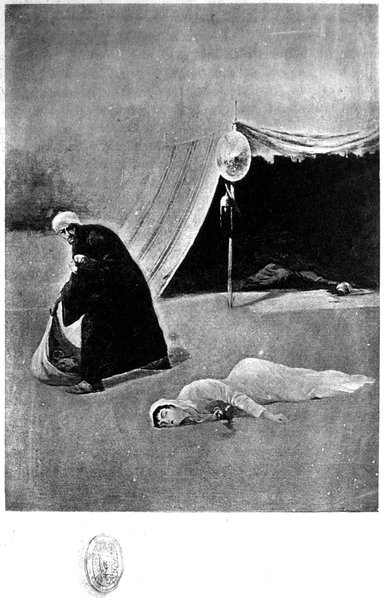
She said, It hath reached me, O auspicious King, that when Nuzhat al-Zaman heard these words from the Badawi, the light was changed in her eyes to night, and she rose and drawing the sword, smote Hammad the Arab between the shoulder-blades so that the point issued from the apple of his throat.[127] And when all present asked her, "Why hast thou made haste to slay him;" she answered, "Praised be Allah who hath granted me in my life-tide to avenge myself with mine own hand!" And she bade the slaves drag the body out by the feet and cast it to the dogs. Thereupon they turned to the two prisoners who remained of the three; and one of them was a black slave, so they said to him, "What is thy name, fellow? Tell us the truth of thy case." He replied, "As for me my name is Al-Ghazbán," and acquainted them what had passed between himself and Queen Abrizah, daughter of King Hardub, Lord of Greece, and how he had slain her and fled. Hardly had the negro made an end of his story, when King Rumzan struck off his head with his scymitar, saying, "Praise to Allah who gave me life! I have avenged my mother with my own hand." Then he repeated to them what his nurse Marjanah had told him of this same slave whose name was Al-Ghazban; after which they turned to the third prisoner. Now this was the very camel-driver[128] whom the people of the Holy City, Jerusalem, hired to carry Zau al-Makan and lodge him in the hospital at Damascus of Syria; but he threw him down on the ashes-midden and went his way. And they said to him, "Acquaint us with thy case and tell the truth." So he related to them all that had happened to him with Sultan Zau al-Makan; how he had been carried from the Holy City, at the time when he was sick, till they made Damascus and he had been thrown into the hospital; how also the Jerusalem folk had paid the cameleer money to transport the stranger to Damascus, and he had taken it and fled after casting his charge upon the midden by the side of the ash-heap of the Hammam. But when he ended his words, Sultan 113Kanmakan took his sword forthright and cut off his head, saying, "Praised be Allah who hath given me life, that I might requite this traitor what he did with my father, for I have heard this very story from King Zau al-Makan himself." Then the Kings said each to other, "It remaineth only for us to wreak our revenge upon the old woman Shawahi, yclept Zat al-Dawahi, because she is the prime cause of all these calamities and cast us into adversity on this wise. Who will deliver her into our hands that we may avenge ourselves upon her and wipe out our dishonour?" And King Rumzan said, "Needs must we bring her hither." So without stay or delay he wrote a letter to his grandmother, the aforesaid ancient woman, giving her to know therein that he had subdued the kingdoms of Damascus and Mosul and Irak, and had broken up the host of the Moslems and captured their princes, adding, "I desire thee of all urgency to come to me, bringing with thee Queen Sophia, daughter of King Afridun, and whom thou wilt of the Nazarene chiefs, but no armies; for the country is quiet and wholly under our hand." And when she read the letter and recognised the writing of King Rumzan, she rejoiced with great joy and forthright equipping herself and Queen Sophia, set out with their attendants and journeyed, without stopping, till they drew near Baghdad. Then she fore-sent a messenger to acquaint the King of her arrival, whereupon quoth Rumzan, "We should do well to don the habit of the Franks and fare forth to meet the old woman, to the intent that we may be assured against her craft and perfidy." Whereto Kanmakan replied, "Hearing is consenting." So they clad themselves in Frankish clothes and, when Kuzia Fakan saw them, she exclaimed, "By the truth of the Lord of Worship, did I not know you, I should take you to be indeed Franks!" Then they sallied forth with a thousand horse, King Rumzan riding on before them, to meet the old woman. As soon as his eyes fell on hers, he dismounted and walked towards her and she, recognizing him, dismounted also and embraced him; but he pressed her ribs with his hands, till he well nigh broke them. Quoth she, "What is this, O my son?" But before she had done speaking, up came Kanmakan and Dandan; and the horsemen with them cried out at the women and slaves and took them all prisoners. Then the two Kings returned to Baghdad, with their captives, and Rumzan bade them decorate the city which they did for three days, at the end of which they brought out the old woman Shawahi, hight Zat al-Dawahi, with a peaked red turband of palm-leaves on her head, diademed with asses'-dung and preceded by a herald proclaiming aloud, "This is the reward of those who presume to lay hands on Kings and the sons of Kings!" Then they crucified her on one of the gates of Baghdad; and, when her companions saw what befel her, all embraced in a body the faith of Al-Islam. As for Kanmakan and his uncle Rumzan and his aunt Nuzhat al-Zaman and the Wazir Dandan, they marvelled at the wonderful events that had betided them and bade the scribes chronicle them in books that those who came after might read. Then they all abode for the remainder of their days in the enjoyment of every solace and comfort of life, till there overtook them the Destroyer of all delights and the Sunderer of all societies. And this is the whole that hath come down to us of the dealings of fortune with King Omar bin al-Nu'uman and his sons Sharrkan and Zau al-Makan and his son's son Kanmakan and his daughter Nuzhat al-Zaman and her daughter Kuzia Fakan. Thereupon quoth Shahryar to Shahrazad, "I desire that thou tell me somewhat about birds;" and hearing this Dunyazad said to her sister, "I have never seen the Sultan light at heart all this while till the present night; and his pleasure garreth me hope that the issue for thee with him may be a happy issue." Then drowsiness overcame the Sultan, so he slept;[129]——And Shahrazad perceived the approach of day and ceased saying her permitted say.
Now when it was the Hundred and Forty-sixth Night,
Shahrazad began to relate, in these words,
114