DISCOURSE VI. MESDAMES, THE DAUGHTERS OF THE NOBLE HOUSE OF FRANCE.[19]
Reading edition
DISCOURSE VI. MESDAMES, THE DAUGHTERS OF THE NOBLE HOUSE OF FRANCE.[19]
1. Madame Yoland de France.
’Tis a thing that I have heard great personages, both men and ladies of the Court, remark, that usually the daughters of the house of France have been good, or witty, or gracious, or generous, and in all things accomplished; and to confirm this opinion they do not go back to the olden time, but say it of those of whom they have knowledge themselves, or have heard their fathers and grandfathers who have been at the Court talk of.
First, I shall name here Madame Yoland of France, daughter of Charles VII., and wife of the Duc de Savoie and Prince of Piedmont.
She was very clever; true sister to her brother, Louis XI. She leaned a little to the party of Duc Charles de Bourgogne, her brother-in-law, he having married her elder sister Catherine, who scarcely lived after wedding her husband, so that her virtues do not appear. Yoland, seeing that Duc Charles was her neighbour and might be feared, did what she could to maintain his friendship, and he served her much in the business of her State. But he dying, King Louis XI. came down upon her grandeur and her means, and those of Savoie. But Madame la duchesse, clever lady! found means of winning over her brother the king;, and went to see him at Plessis-lez-Tours to settle their affairs. She having arrived, the king went down to meet her in the courtyard and welcome her; and having bowed and kissed her and put his arm around her neck, half laughing, half pinching her, he said: “Madame la Bourgognian, you are very welcome.” She, making him a great curtsey, replied: “Monsieur, I am not Bourgognian; you will pardon me if you please. I am a very good Frenchwoman and your humble servant.” On which the king took her by the arm and led her to her chamber with very good welcome; but Madame Yoland, who was shrewd and knew the king’s nature, was determined not to remain long with him, but to settle her affairs as fast as she could and get away.
The king, on the other hand, who knew the lady, did not press her to stay very long; so that if one was displeased with the other, the other was displeased with the first; wherefore without staying more than eight days she returned, very little content with the king, her brother.
Philippe de Commines has told about this meeting more at length; but the old people of those days said that they thought this princess a very able female, who owed nothing to the king, her brother, who twitted her often about being a Bourgognian; but she tacked about as gently and modestly as she could, for fear of affronting him, knowing full well, and better than even her brother, how to dissimulate, being a hundred times slyer than he in face, and speech, and ways, though always very good and very wise.
2. Madame Jeanne de France.
Jeanne de France, daughter of the aforesaid king, Louis XI., was very witty, but so good that after her death she was counted a saint, and even as doing miracles, because of the sanctity of the life she led after her husband, Louis XII., repudiated her [to marry Anne de Bretagne]; after which she retired to Bourges, which was given her as a dowry for the term of her natural life; where all her time was spent in prayer and orisons and in serving God and his poor, without giving any sign of the wrong that was done her by such repudiation. But the king protested that he had been forced to marry her fearing the wrath of her father, Louis XI., a master-man, and declared positively that he had never known her as his wife. Thus the matter was allowed to pass; in which this princess showed her wisdom, not making the reply of Richarde of Scotland, wife of Charles le Gros, King of France, when her husband repudiated her, affirming that he had never lived with her as his wife. “That is well,” she said, “since by the oath of my husband I am maid and virgin.” By those words she scoffed at her husband’s oath and her own virginity.
But the king was seeking to recover his first loves, namely: Queen Anne and her noble duchy, which gave great temptations to his soul; and that was why he repudiated his wife. His oath was believed and accepted by the pope, who sent him the dispensation, which was received by the Sorbonne and the parliament of Paris. In all of which this princess was wise and virtuous, and made no scandal, nor uproar, nor appeal to justice, because a king can do much and just what he will; but feeling herself strong to contain herself in continence and chastity, she retired towards God and espoused herself to Him so truly that never another husband nor a better could she have.
3. Madame Anne de France.
After her comes her sister, Anne de France, a shrewd woman and a cunning if ever there was one, and the true image of King Louis, her father. The choice made of her to be guardian and administrator of her brother, King Charles [VIII.], proves this, for she governed him so wisely and virtuously that he came to be one of the greatest of the kings of France, who was proclaimed, by reason of his valour, Emperor of the East. As to his kingdom she administered that in like manner. True it is that because of her ambition she was rather mischief-making, on account of the hatred she bore to M. d’Orléans, afterwards King Louis XII. I have heard say, however, that in the beginning she loved him with love; so that if M. d’Orléans had been willing to hear to her, he might have had better luck, as I hold on good authority. But he could not constrain himself, all the more because he saw her so ambitious, and he wished his wife to depend upon him as first and nearest prince to the crown, and not upon herself; while she desired the contrary, for she wanted to hold the highest place and to govern in all things.
She was very vindictive in temper like her father, and always a sly dissembler, corrupt, full of deceit, and a great hypocrite, who, for the sake of her ambition, could mask and disguise herself in any way. So that the kingdom, beginning to be angry at her humours, although she was wise and virtuous, bore with them so impatiently that when the king went to Naples she no longer had the title of regent, but her husband, M. de Bourbon, received it. It is true, however, that she made him do what she had in her head, for she ruled him and knew how to guide him, all the better because he was rather foolish,—indeed, very much so; but the Council opposed and controlled her. She endeavoured to use her prerogative and authority over Queen Anne, but there she found the boot on the other foot, as they say, for Queen Anne was a shrewd Bretonne, as I have told already, who was very superb and haughty towards her equals; so that Madame Anne was forced to lower her sails and leave the queen, her sister-in-law, to keep her rank and maintain her grandeur and majesty, as was reasonable; which made Madame Anne very angry; for she, being virtually regent, held to her grandeur terribly.
I have read many letters from her to our family in the days of her greatness; but never did I see any of our kings (and I have seen many) talk and write so bravely and imperiously as she did, as much to the great as to the small. Of a surety, she was a maîtresse-femme, though quarrelsome, and if M. d’Orléans had not been captured and his luck had not served him ill, she would have thrown France into turmoil; and all for her ambition, which so long as she lived she never could banish from her soul,—not even when retired to her estates, where, nevertheless, she pretended to be pleased and where she held her Court, which was always, as I have heard my grandmother say, very fine and grand, she being accompanied by great numbers of ladies and maids of honour, whom she trained very wisely and virtuously. In fact she gave such fine educations (as I know from my grandmother) that there were no ladies or daughters of great houses in her time who did not receive lessons from her, the house of Bourbon being one of the greatest and most splendid in Christendom. And indeed it was she who made it so brilliant, for though she was opulent in estates and riches of her own, she played her hand so well in the regency that she gained a great deal more; all of which served to make the house of Bourbon more dazzling. Besides being splendid and magnificent by nature and unwilling to diminish by ever so little her early grandeur, she also did many great kindnesses to those whom she liked and took in hand. To end all, this Anne de France was very clever and sufficiently good. I have now said enough about her.
4. Madame Claude de France.
I must now speak of Madame Claude de France, who was very good, very charitable, and very gentle to all, never doing any unkindness or harm to any one either at her Court or in the kingdom. She was much beloved by King Louis [XII.] and Queen Anne, her father and mother, being their good and best-loved daughter, as they showed her plainly; for after the king was peaceably Duke of Milan they declared and proclaimed her, in the parliament of Paris with open doors, duchess of the two finest duchies in Christendom, to wit, Milan and Bretagne, the one coming from her father, the other from her mother. What an heiress, if you please! These two duchies joined together made a noble kingdom.
Queen Anne, her mother, desired to marry her to Charles of Austria, afterwards emperor, and had she lived she would have done so, for in that she influenced the king, her husband, wishing always to have the sole charge and care of the marriage of her daughters. Never did she call them otherwise than by their names: “My daughter Claude,” and “My daughter Renée.” In these our days, estates and seigneuries must be given to daughters of princesses, and even of ladies, by which to call them! If Queen Anne had lived, never would Madame Claude have been married to King François [I.] for she foresaw the evil treatment she was certain to receive; the king, her husband, giving her a disease that shortened her days. Also, Madame la regente treated her harshly. But she strengthened her soul as much as she could, by her sound mind and gentle patience and great wisdom, to endure these troubles, and in spite of all, she bore the king, her husband, a fine and generous progeny, namely: three sons, François, Henri, and Charles; and four daughters, Louise, Charlotte, Magdelaine, and Marguerite.
She was much beloved by her husband, King François [I.], and well treated by him and by all France, and much regretted when she died for her admirable virtues and goodness. I have read in the “Chronique d’Anjou” that after her death her body worked miracles; for a great lady of her family being tortured one day with a hot fever, and having made her a vow, recovered her health suddenly.
5. Madame Renée de France.
Madame Renée, her sister, was also a very good and able princess; for she had as sound and subtle mind as could be. She had studied much, and I have heard her discoursing learnedly and gravely of the sciences, even astrology, and knowledge of the stars, about which I heard her talking one day with the queen-mother, who said, after hearing her, that the greatest philosopher in the world could not have spoken better.
She was promised in marriage to the Emperor Charles, by King François; but the war interrupting that marriage, she was given to the Duc de Ferrara, who loved her much and treated her honourably as the daughter of a king. True it is they were for a time rather ill together because of the Lutheran religion he suspected her of liking. Possibly; for resenting the ill-turns the popes had done to her father in every way, she denied their power and refused obedience, not being able to do worse, she being a woman. I hold on good authority that she said this often. Her husband, nevertheless, having regard to her illustrious blood, respected her always and honoured her much. Like her sister, Queen Claude, she was fortunate in her issue, for she bore to her husband the finest that was, I believe, in Italy, although she herself was much weakened in body.
She had the Duc de Ferrara, who is to-day one of the handsomest princes in Italy and very wise and generous; the late Cardinal d’Est, the kindest, most magnificent and liberal man in the world (of whom I hope to speak hereafter); and three daughters, the most beautiful women ever born in Italy: Madame Anne d’Est, afterwards Mme. de Guise; Madame Lucrezia, Duchesse d’Urbino; and Madame Leonora, who died unmarried. The first two bore the names of their grandmothers: one from Anne de Bretagne on her mother’s side; the other, on the father’s side, from Lucrezia Borgia, daughter of Pope Alexander [VI.], both very different in manners as in character, although the said lady Lucrezia Borgia was a charming princess of Spanish extraction, gifted with beauty and virtue (see Guicciardini). Madame Leonora was named after Queen Leonora. These daughters were very handsome, but their mother embellished them still more by the noble education that she gave them, making them study sciences and good letters, the which they learned and retained perfectly, putting to shame the greatest scholars. So that if they had beautiful bodies they had souls that were beautiful also. I shall speak of them elsewhere.
Now, if Madame Renée was clever, intelligent, wise, and virtuous, she was also so kind and understood the subjects of her husband so well that I never knew any one in Ferrara who was not content or failed to say all the good in the world of her. They felt above all her charity, which she had in great abundance and principally for Frenchmen; for she had this good thing about her, that she never forgot her nation; and though she was thrust far away from it, she always loved it deeply. No Frenchman passing through Ferrara, being in necessity and addressing her, ever left without an ample donation and good money to return to his country and family; and if he were ill, and could not travel, she had him treated and cured carefully and then gave him money to return to France.
I have heard persons who know it well, and an infinite number of soldiers who had good experience of it say that after the journey of M. de Guise into Italy, she saved the lives of at least ten thousand poor Frenchmen, who would have died of starvation and want without her; and among the number were many nobles of good family. I have heard some of them say that never could they have reached France without her, so great was her charity and liberality to those of her nation. And I have also heard her maître d’hôtel assert that their food had cost her more than ten thousand crowns; and when the stewards of her household remonstrated and showed her this excessive expense, she only said: “How can I help it? These are poor Frenchmen of my nation, who, if God had put a beard on my chin and made me a man, would now be my subjects; and truly they would be so now if that wicked Salic law did not hold me in check.”
She is all the more to be praised because, without her, the old proverb would be still more true, namely, that “Italy is the grave of Frenchmen.”
But if her charity was shown at that time in this direction, I can assure you that in other places she did not fail to practise it. I have heard several of her household say that on her return to France, having retired to her town and house of Montargis about the time the civil wars began to stir, she gave a refuge as long as she lived to a number of persons of the Religion [Reformers] who were driven or banished from their houses and estates; she aided, succoured, and fed as many as she could.
I myself, at the time of the second troubles, was with the forces in Gascoigne, commanded by MM. de Terridès and de Montsalès, amounting to eight thousand men, then on their way to join the king. We passed through Montargis and went, the leaders, chief captains, and gentlemen, to pay our respects to Madame Renée, as our duty commanded. We saw in the castle, as I believe, more than three hundred persons of the Religion, who had taken refuge there from all parts of the country. An old maître d’hôtel, a very honest man, whom I had known in Ferrara, swore to me that she fed every day more than three hundred mouths of these poor people.
In short, this princess was a true daughter of France in kindness and charity. She had also a great and lofty heart. I have seen her in Italy and at Court, hold her state as well as possible; and though she did not have an external appearance of grandeur, her body being weakened, there was so much majesty in her royal face and speech that she showed plainly enough she was daughter of a king and of France.
6. Mesdames Charlotte, Louise, Magdelaine, and Marguerite de France.
I have said that Madame Claude [wife of François I.] was fortunate in her fine progeny of daughters as well as of sons. First she had Mesdames Charlotte and Louise, whom death did not allow to reach the perfect age and noble fruit their tender youth had promised in sweet flowers. Had they come to the perfection of their years they would have equalled their sisters in mind and goodness, for their promise was great. Madame Louise was betrothed to the Emperor when she died. Thus are lovely rosebuds swept away by the wind, as well as full-blown flowers. Youth thus ravished is more to be regretted than old age, which has had its day and its loss is not great. Almost the same thing happened to Madame Magdelaine, their sister, who had no great time allowed her to enjoy the thing in all the world she most desired; which was, to be a queen, so proud and lofty was her heart.
She was married to the King of Scotland; and when they wanted to dissuade her—not, certainly, that he was not a brave and handsome prince, but because she thus condemned herself to make her dwelling in a barbarous land among a brutal people—she replied: “At least I shall be queen so long as I live; that is what I have always wished for.” But when she arrived in Scotland she found that country just what they had told her, and very different from her sweet France. Still, without one sign of repentance, she said nothing except these words: “Alas! I would be queen,”—covering her sadness and the fire of her ambition with the ashes of patience as best she could. M. de Ronsard, who went with her to Scotland, told me all this; he had been a page of M. d’Orléans, who allowed him to go with her, to see the world.
She did not live long a queen before she died, regretted by the king and all the country, for she was truly good, and made herself beloved, having, moreover, a fine mind, and being wise and virtuous.
Her sister, Madame Marguerite de France [the second of the three Marguerites], afterwards Duchesse de Savoie, was so wise, virtuous, and perfect in learning and knowledge that she was called the Minerva, or the Pallas, of France, and for device she bore an olive branch with two serpents entwining it, and the words: Rerum Sapientia custos: signifying that all things are ruled, or should be, by wisdom—of which she had much, and knowledge also; improving them ever by continual study in the afternoons, and by lessons which she received from learned men, whom she loved above all other sorts of people. For which reason they honoured her as their goddess and patron. The great quantity of noble books which they wrote and dedicated to her show this, and as they have said enough I shall say no more about her learning.
François I
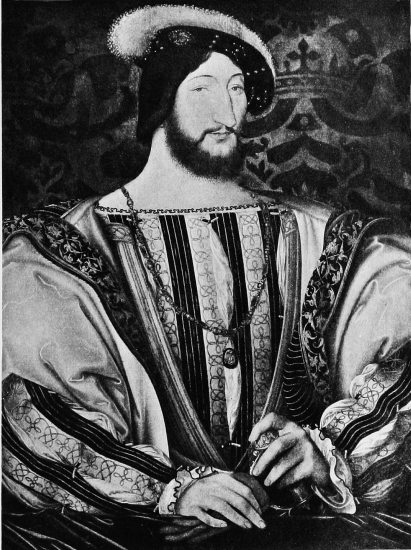
Her heart was grand and lofty. King Henri wished to marry her to M. de Vendôme, first prince of the blood; but she made answer that never would she marry a subject of the king, her brother. That is why she was so long without a husband; until, peace being made between the two Christian and Catholic kings, she was married to M. de Savoie, to whom she had aspired for a long time, ever since the days of King François, when Pope Paul III. and King François met at Nice, and the Queen of Navarre went, by command of the king, to see the late Duc de Savoie in the castle of Nice, taking with her Madame Marguerite, her niece, who was thought most agreeable by M. de Savoie, and very suitable for his son. But the affair dragged on, because of the great war, until the peace, when the marriage was made and consummated at great cost to France; for all that we had conquered and held in Piedmont and Savoie for the space of thirty years, was given back in one hour; so much did King Henri desire peace and love his sister, not sparing anything to marry her well. But all the same, the greater part of France and Piedmont murmured and said it was too much.
Others thought it very strange, and others very incredible, until they had seen her; and even foreigners mocked at us: and those who loved France and her true good wept, and lamented, especially those in Piedmont who did not wish to return to their former masters.
As for the French soldiers, and the war companions who had so long enjoyed the garrisons, charms, and fine living of that beautiful country, there is no need to ask what they said, nor how they grumbled and were desperate and bemoaned themselves. Some, more Gascon than the rest, said: “Hey! cap de Diou! for the little bit of flesh of that woman, must we give back that large and noble piece of earth?” Others: “A fine thing truly to call her Minerva, goddess of chastity, and send her here to Piedmont to change her name at our expense!”
I have heard great captains say that if Piedmont had been left to us, and only Savoie and Bresse given up, the marriage would still have been very rich and very fine; and if we could have stayed in Piedmont that region would have served as a school and an amusement to the French soldiers, who would have stayed there and not been so eager after civil wars,—it being the nature of Frenchmen to busy themselves always with the toils of Mars, and to hate idleness, rest, and peace.
But such was now the unhappy fate of France. It was thus that peace was bought, and Madame de Savoie could not help it; although she never desired the ruin of France; on the contrary, she loved nothing so much as the people of her nation; and if she received benefits from them she was not ungrateful, but served them and succoured them all she could; and as long as she lived she persuaded and won her husband, Monsieur de Savoie, to keep the peace, and not combine, he being a Spaniard for life, against France, which he did as soon as she was dead. For then he stirred up, supported, and strengthened secretly M. le Maréchal de Bellegarde to do what he did and to rebel against the king, and seize upon the marquisate of Saluces (which I shall speak of elsewhere); in which certainly his Highness did great wrong, and ill returned the benefits received from the Kings of France his relatives, especially our late King Henri III., who, on his return from Poland, gave him so liberally Pignerol and Savillan.
Many well-advised persons believe that if Madame de Savoie had lived she would have died sooner than allow that blow, so grateful did she feel to the land of her birth. And I have heard a very great person say that he thought that if Madame de Savoie were living and had seen her son seize upon the marquisate of Saluces (as he did in the time of the late king), she would have strangled him; indeed, the late king himself thought so and said so. That king, Henri III., felt such wrath at that stroke that the morning when the news reached him, as he was about to take the sacrament, he put off that act and would not do it, so excited, angry, and scrupulous was he, within as well as without; and he always said that if his aunt had lived it would never have happened.
Such was the good opinion this good princess left in the minds of the king and of other persons. And to tell the truth, as I know from high authority, if she had not been so good never would the king or his council have portioned her with such great wealth, which, surely, she never spared for France and Frenchmen. No Frenchman could complain, when addressing her for his necessities in going or coming across the mountains, that she did not succour and assist him and give him good money to help him on his way. I know that when we returned from Malta, she did great favours and gave much money to many Frenchmen who addressed her and asked her for it; and also, without being asked, she offered it. I can say that, as knowing it myself; for Mme. de Pontcarlier, sister of M. de Retz, who was Madame de Savoie’s favourite and lady of honour, asked me to supper one evening in her room, and gave me, in a purse, five hundred crowns on behalf of the said Madame, who loved my aunt, Mme. de Dampierre, extremely and had also loved my mother. But I can swear with truth and security that I did not take a penny of it, for I had enough with me to take me back to Court; and had I not, I would rather have gone on foot than be so shameless and impudent as to beg of such a princess. I knew many who did not do like that, but took very readily what they could get.
I have heard one of her stewards say that every year she put away in a coffer a third of her revenue to give to poor Frenchmen who passed through Savoie. That is the good Frenchwoman that she was; and no one should complain of the wealth she took from France; and it was all her joy when she heard good news from there, and all her grief when it was bad.
When the first wars broke out she felt such woe she thought to die of it; and when peace was made and she came to Lyon to meet the king and the queen-mother, she could not rejoice enough, begging the queen to tell her all; and showing anger to several Huguenots, telling them and writing them that they stirred up strife, and urging them not to do so again; for they honoured her much and had faith in her, because she gave pleasure to many; indeed M. l’Amiral [Coligny] would not have enjoyed his estates in Savoie had it not been for her.
When the civil wars came on in Flanders she was the first to tell us on our arrival from Malta; and you may be sure she was not sorry for them; “for,” said she, “those Spaniards rejoiced and scoffed at us for our discords, but now that they have their share they will scoff no longer.”
She was so beloved in the lands and countries of her husband that when she died tears flowed from the eyes of all, both great and small, so that for long they did not dry nor cease. She spoke for every one to her husband when they were in trouble and adversity, in pain or in fault, requesting favour or pardon, which without her intercessions they would often not have had. Thus they called her their patron-saint.
In short, she was the blessing of the world; in all ways, as I have said, charitable, munificent, liberal, wise, virtuous, and so accessible and gentle as never was, principally to those of her nation; for when they went to do her reverence she received them with such welcome they were shamed; the most unimportant gentlemen she honoured in the same way, and often did not speak to them until they were covered. I know what I say, for, speaking with her on one occasion, she did me this honour, and urged and commanded me so much that I was constrained to say: “Madame, I think you do not take me for a Frenchman, but for one who is ignorant who you are and the rank you hold; but I must honour you as belongs to me.” She never spoke to any one sitting down herself, but always standing; unless they were principal personages, and those I saw speaking to her she obliged to sit beside her.
To conclude, one could never tell all the good of this princess as it was; it would need a worthier writer than I to represent her virtues. I shall be silent, therefore, till some future time, and begin to tell of the daughters of our King Henri [II. and Catherine de’ Medici], Mesdames Élisabeth, Claude, and Marguerite de France.
7. Mesdames Élisabeth, Claude, and Marguerite de France.
I begin by the eldest, Madame Élisabeth de France, or rather I ought to call her the beautiful Élisabeth of the world on account of her rare virtues and perfections, the Queen of Spain, beloved and honoured by her people in her lifetime, and deeply regretted and mourned by the same after death, as I have said already in the Discourse I made upon her. Therefore I shall content myself for the present in writing no more, but will speak of her sister, the second daughter of King Henri, Madame Claude de France (the name of her grandmother), Duchesse de Lorraine, who was a beautiful, wise, virtuous, good, and gentle princess. So that every one at Court said that she resembled her mother and aunt and was their real image. She had a certain gayety in her face which pleased all those who looked at her. In her beauty she resembled her mother, in her knowledge and kindness she resembled her aunt; and the people of Lorraine found her ever kind as long as she lived, as I myself have seen when I went to that country; and after her death they found much to say of her. In fact, by her death that land was filled with regrets, and M. de Lorraine mourned her so much that, though he was young when widowed of her, he would not marry again, saying he could never find her like, though could he do so he would remarry, not being disinclined.
She left a noble progeny and died in childbed, through the appetite of an old midwife of Paris, a drunkard, in whom she had more faith than in any other.
The news of her death reached Reims the day of the king’s coronation, and all the Court were in mourning and extreme sadness, for her kindness was shown to all when she came there. The last time she came, the king, her brother, made her a gift of the ransoms of Guyenne, which came from the confiscations that took place there; but the ransoms were made so heavy that often they exceeded the value of the confiscations.
Mme. de Dampierre asked her for one, one day when I was present, for a gentleman whom I know. The princess made answer: “Mme. de Dampierre, I give it to you with all my heart, having merely accepted this gift from the king, my brother, not having asked for it; he gave it to me of his own good-will; not to injure France, for I am French and love all those who are so like myself; they will have more courtesy from me than from another who might have had that gift; therefore what they want of me and ask of me I will give.” And truly, those who had to do with her found her all courtesy, gentleness, and goodness.
In short, she was a true daughter of France, having good mind and ability, which she proved by seconding wisely and ably her husband, M. de Lorraine, in the government of his seigneuries and principalities.
After this Claude de France, comes that beautiful Marguerite de France, Queen of Navarre, of whom I have already spoken; for which reason I am silent here, awaiting another time; for I think that April in its springtime never produced such lovely flowers and verdure as this princess of ours produced blooming at all seasons in noble and diverse ways, so that all the good in the world could be said of her.
8. Madame Diane de France.
Nor must I forget Madame Diane de France; although she was bastard and a natural child, we must place her in the rank of the daughters of France, because she was acknowledged by the late King Henri [II.] and legitimatized and afterwards dowered as daughter of France; for she was given the duchy of Chastellerault, which she quitted to be Duchesse d’Angoulême, a title and estate she retains at this day, with all the privileges of a daughter of France, even to that of entering the cabinets and state business of her brothers, King Charles and King Henri III. (where I have often seen her), as though she were their own sister. Indeed, they loved her as such. She had much resemblance to King Henri, her father, as much in features of the face as in habits and actions. She loved all the exercises that he loved, whether arms, hunting, or horses. I think it is not possible for any lady to look better on horseback than she did, or to have better grace in riding.
I have heard say (and read) from certain old persons, that little King Charles VIII. being in his kingdom of Naples, Mme. la Princesse de Melfi, coming to do him reverence, showed him her daughter, beautiful as an angel, mounted on a noble courser, managing him so well, with all the airs and paces of the ring, that no equerry could have done better, and the king and all his Court were in great admiration and astonishment to see such beauty so dexterous on horseback, yet without doing shame to her sex.
Those who have seen Madame d’Angoulême on horseback were as much delighted and amazed; for she was so born to it and had such grace that she resembled in that respect the beautiful Camilla, Queen of the Volsci; she was so grand in body and shape and face that it was hard to find any one at Court as superb and graceful at that exercise; nor did she exceed in any way the proper modesty and gentleness; indeed, like the Princesse Melfi, she outdid modesty; except when she rode through the country, when she showed some pretty performances that were very agreeable to those who beheld them.
Diane de France
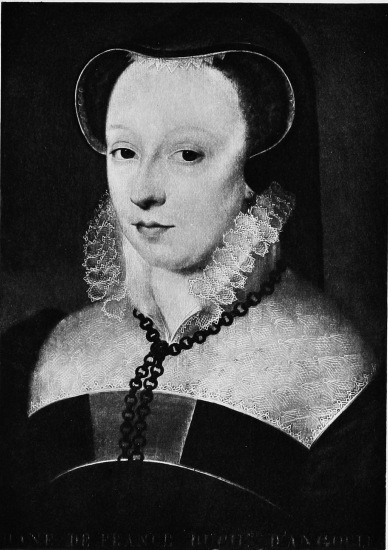
I remember that M. le Maréchal d’Amville, her brother-in-law, gave her, once upon a time, a very fine horse, which he named le Docteur, because he stepped so daintily and advanced curveting with such precision and nicety that a doctor could not have been wiser in his actions; and that is why he called him so. I saw Madame d’Angoulême make that horse go more than three hundred steps pacing in that way; and often the whole Court was amused to see it, and could not tell which to admire most, her firm seat, or her beautiful grace. Always, to add to her lustre, she was finely attired in a handsome and rich riding-dress, not forgetting a hat well garnished with plumes, worn à la Guelfe. Ah! what a pity it is when old age comes to spoil such beauties and blemish such virtues; for now she has left all that, and quitted those exercises, and also the hunting which became her so much; for nothing was ever unbecoming to her in her gestures and manners, like the king, her father,—she taking pains and pleasure in what she did, at a ball, in dancing; indeed in whatever dance it was, whether grave or gay, she was very accomplished.
She sang well, and played well on the lute and other instruments. In fact, she is her father’s daughter in that, as she is in kindness, for indeed she is very kind, and never gives pain to any one, although she has a grand and lofty heart, but her soul is generous, wise, and virtuous, and she has been much beloved by both her husbands.
She was first married to the Duc de Castro, of the house of Farnese, who was killed at the assault at Hesdin; secondly, to M. de Montmorency, who made some difficulty in the beginning, having promised to marry Mlle. de Pienne, one of the queen’s maids of honour, a beautiful and virtuous girl; but to obey a father who was angry and threatened to disinherit him, he obtained his release from his first promise and married Madame Diane. He lost nothing by the change, though the said Pienne came from one of the greatest families in France, and was one of the most beautiful, virtuous, and wise ladies of the Court, whom Madame Diane loved, and has always loved without any jealousy of her past affections with her husband. She knows how to control herself, for she is very intelligent and of good understanding. The kings, her brothers, and Monsieur loved her much, and so did the queens and duchesses, her sisters, for she never shamed them, being so perfect in all things.
King Charles loved her, because she went with him to his hunts and other joyous amusements, and was always gay and good-humoured.
King Henri [III.] loved her, because he knew that she loved him and liked to be with him. When war arose so cruelly on the death of M. de Guise, knowing the king, her brother, to be in need, she started from her house at Isle-Adam, in a diligence, not without running great risks, being watched for on the road, and took him fifty thousand crowns, which she had saved from her revenues, and gave them to him. They arrived most à propos and, as I believe, are still owing to her; for which the king felt such good-will that had he lived he would have done great things for her, having tested her fine nature in his utmost need. And since his death she has had no heart for joy or profit, so much did she regret and still regrets him, and longs for vengeance, if her power were equal to her will, on those who killed him. But never has our present king [Henri IV.] consented to it, whatever prayer she makes, she holding Mme. de Montpensier guilty of the death of the king, her brother, abhorring her like the plague, and going so far as to tell her before Madame, the king’s sister, that neither Madame nor the king had any honest reason to love her, except that through this murder of the late king they held the rank they did hold. What a hunt! I hope to say more of this elsewhere; therefore am I silent now.
9. Marguerite de Valois, Queen of Navarre.
I must now speak somewhat of Marguerite, Queen of Navarre. Certainly she was not born daughter of a king of France, nor did she bear the name, except that of Valois or d’Orléans, because, as M. du Tillet says in his Memoirs, the surname of France does not belong to any but the daughters of France; and if they are born before their fathers are kings they do not take it until after their said fathers’ accession to the crown. Nevertheless this Marguerite, as the greatest persons of those days have said, was held to be daughter of France for her great virtues, although there was some wrong in putting her in that rank. That is why we place her here among the Daughters of France.[20]
She was a princess of very great mind and ability, both by nature and power of acquisition, for she gave herself to letters in her early years and continued to do so as long as she lived, liking and conversing with the most learned men in her brother’s kingdom in the days of her grandeur and usually at Court. They all so honoured her that they called her their Mæcenas; and most of their books composed at that period were dedicated either to her brother, the king, who was also learned, or to her.
She herself composed well, and made a book which she entitled “La Marguerite des Marguerites” which is very fine and can still be found in print.[21] She often composed comedies and moralities, which were called in those days pastorals, and had them played and represented by the maids of honour at her Court.
She was fond of composing spiritual songs, for her heart was much given to God; and for that reason she bore as her device a marigold, which is the flower that has the most affinity with the sun of any there is, whether in similitude of its leaves to rays, or by reason of the fact that usually it turns to the sun wherever it goes from east to west, opening and closing according to its rise and its setting. Also she arranged this device with the words: Non inferiora secutus—“It stops not for earthly things;” meaning that she aimed and directed all her actions, thoughts, will, and affections to that great sun on high which is God; and for that reason was she suspected of being of Luther’s religion. But out of the respect and love she bore the king, her brother, who loved her only and called her his darling [his mignonne] she never made any profession or semblance of that religion; and if she believed it she kept it in her soul very secretly, because the king hated it much, saying that that, and all other new sects, tended more to the destruction of kingdoms, monarchies, and civil dominions than to the edification of souls.
The great sultan, Solyman, said the same; declaring that however much it upset many points of the Christian religion and the pope, he could not like it, “because,” he said, “the monks of this new faith are only seditious mischief-makers, who can never rest unless they are stirring up trouble.” That is why King François, a wise prince if ever there was one, foreseeing the miseries that would come in many ways to Christianity, hated these people and was rather rigorous in burning alive the heretics of his day. Nevertheless, he favoured the Protestant princes of Germany against the emperor. That is how these great kings govern as they please.
I have heard a trustworthy person relate how the Connétable de Montmorency, in the days of his greatest favour, discoursing of this with the king, made no difficulty or scruple in telling him that if he wanted to exterminate the heretics of his kingdom he would have to begin with his Court and his nearest relations, naming the queen, his sister. To which the king replied: “Do not speak of her; she loves me too well. She will never believe except as I believe, and never will she take any religion prejudicial to my State.” After which, hearing of it, she never liked M. le connétable, and helped much in his disfavour and banishment from Court. Now it happened that the day on which her daughter, the Princesse de Navarre, was married to the Duc de Clèves at Chastellerault, the bride was so weighted with jewels and with her gown of gold and silver stuff that her body was too weak to walk to church; on which the king commanded the connétable to take his niece in his arms and carry her to the church; which amazed the Court very much; a duty like that being little suitable and honourable for a connétable, and might have been given very well to another. But the Queen of Navarre was in no wise displeased and said: “The man who tried to ruin me with my brother now serves to carry my daughter to church.”
I have this story from the person I mentioned, who added that M. le connétable was much displeased at this duty and showed great vexation at being made such a spectacle, saying: “It is all over with my favour, I bid it farewell.” And so it proved; for after the fête and the wedding dinner, he had his dismissal and departed immediately. I heard this from my brother, who was then a page at Court and saw the whole mystery and remembered it well, for he had a good memory. Possibly I am wearisome in making this digression; but as it came to my remembrance, may I be forgiven.
To speak again of the learning of this queen: it was such that the ambassadors who spoke with her were greatly delighted, and made reports of it to their nations when they returned; in this she relieved the king, her brother, for they always went to her after paying their chief embassy to him; and often when great affairs were concerned they intrusted them to her. While they awaited the final and complete decision of the king she knew well how to entertain and content them with fine discourse, in which she was opulent, besides being very clever in pumping them; so that the king often said she assisted him much and relieved him a great deal. Therefore was it discussed, as I have heard tell, which of the two sisters served their brothers best,—one the Queen of Hungary, the emperor; the other, Marguerite, King François; the one by the effects of war, the other by the efforts of her charming spirit and gentleness.
When King François was so ill in Spain, being a prisoner, she went to him like a good sister and friend, under the safe-conduct of the emperor; and finding her brother in so piteous a state that had she not come he would surely have died, and knowing his nature and temperament far better than all his physicians, she treated him and caused him to be treated so well, according to her knowledge of him, that she cured him. Therefore the king often said that without her he would have died, and that forever would he recognize his obligation and love her for it; as he did, until his death. She returned him the same love, so that I have heard say how, hearing of his last illness, she said these words: “Whoever comes to my door and announces the cure of the king, my brother, whoever may be that messenger, be he lazy, ill-humoured, dirty or unclean, I will kiss him as the neatest prince and gentleman of France, and if he needs a bed to repose his laziness upon, I will give him mine and lie myself on the hardest floor for the good news he brings me.” But when she heard of his death her lamentations were so great, her regrets so keen, that never after did she recover from them, nor was she ever as before.
When she was in Spain, as I have heard from my relations, she spoke to the emperor so bravely and so honestly on the bad treatment he had given to the king, her brother, that he was quite amazed; for she showed him plainly the ingratitude and felony he had practised, he, a vassal, to his seigneur in relation to Flanders; after which she reproached him for his hardness of heart and want of pity to so great and good a king; saying that to use him in this way would never win a heart so noble and royal and so sovereign as that of her brother; and that if he died of such treatment, his death would not remain unpunished; he having children who would some day, when they grew up, take signal vengeance.
Those words, pronounced so bravely and with such deep anger, gave the emperor much to think of,—so much indeed that he softened and visited the king and promised him many fine things, which he did not, nevertheless, perform at this time.
Now, if the queen spoke so well to the emperor, she spoke still more strongly to his council, of whom she had audience. There she triumphed in speaking and haranguing nobly with that good grace she never was deprived of; and she did so well with her fine speech that she made herself more pleasing than odious and vexatious,—all the more, withal, that she was young, beautiful, the widow of M. d’Alençon, and in the flower of her age; which is very suitable to move and bend such hard and cruel persons. In short, she did so well that her reasons were thought good and pertinent, and she was held in great esteem by the emperor, his council, and the Court. Nevertheless he meant to play her a trick, because, not reflecting on the expiration of her safe-conduct and passport, she took no heed that the time was elapsing. But getting wind that the emperor as soon as her time had expired meant to arrest her, she, always courageous, mounted her horse and rode in eight days a distance that should have taken fifteen; which effort so well succeeded that she reached the frontier of France very late on the evening of the day her passport expired, circumventing thus his Imperial Majesty [Sa Cæsarée Majesté] who would no doubt have kept her had she overstayed her safe-conduct by a single day. She sent him word and wrote him this, and quarrelled with him for it when he passed through France. I heard this tale from Mme. la seneschale, my grandmother, who was with her at that time as lady of honour.
During the imprisonment of the king, her brother, she greatly assisted Mme. la regente, her mother, in governing the kingdom, contenting the princes, the grandees, and winning over the nobility; because she was very accessible, and so won the hearts of many persons by the fine qualities she had in her.
In short, she was a princess worthy of a great empire; besides being very kind, gentle, gracious, charitable, a great alms-giver and disdaining none. Therefore was she, after her death, regretted and bemoaned by everybody. The most learned persons vied with each other in making her epitaph in Greek, Latin, French, Italian; so much so that there is still a book of them extant, quite complete and very beautiful.
This queen often said to this one and that one who discoursed of death, and eternal happiness after it: “All that is true, but we shall stay a long time under ground before we come to that.” I have heard my mother, who was one of her ladies, and my grandmother, who was her lady of honour, say that when they told her in the extremity of her illness that she must die, she thought those words most bitter, and repeated what I have told above; adding that she was not so old but that she might live on for many years, being only fifty-two or fifty-three years old. She was born under the 10th degree of Aquarius, when Saturn was parted from Venus by quaternary decumbiture, on the 10th of April, 1492, at ten in the evening; having been conceived in the year 1491 at ten hours before mid-day and seventeen minutes, on the 11th of July. Good astrologers can make their computations upon that. She died in Béarn, at the castle of Audaus [Odos] in the month of December, 1549. Her age can be reckoned from that. She was older than the king, her brother, who was born at Cognac, September 12th, year 1494, at nine in the evening, under the 21st degree of Gemini, having been conceived in the year 1493, December 10th, at ten o’clock in the morning, became king January 11th, 1514 [1515 new style], and died in 1547.
This queen took her illness by looking at a comet which appeared at the death of Pope Paul III.; she herself thought this, but possibly it only seemed so; for suddenly her mouth was drawn a little sideways; which her physician, M. d’Escuranis, observing, he took her away, made her go to bed, and treated her; for it was a chill [caterre], of which she died in eight days, after having well prepared herself for death. She died a good Christian and a Catholic, against the opinion of many; but as for me, I can affirm, being a little boy at her Court with my mother and my grandmother, that we never saw any act to contradict it; indeed, having retired to a monastery of women in Angoumois, called Tusson, on the death of the king, her brother, where she made her retreat and stayed the whole summer, she built a fine house there, and was often seen to do the office of abbess, and chant masses and vespers with the nuns in the choir.
I have heard tell of her that, one of her waiting-maids whom she liked much being near to death, she wished to see her die; and when she was at the last gasp and rattle of death, she never stirred from beside her, gazing so fixedly upon her face that she never took her eyes away from it until she died. Some of her most privileged ladies asked her why she took such interest in seeing a human being pass away; to which she answered that, having heard so many learned persons discourse and say that the soul and spirit issued from the body at the moment of death, she wished to see if any wind or noise could be perceived, or the slightest resonance, but she had noticed nothing. She also gave a reason she had heard from the same learned persons, when she asked them why the swan sang so well before its death; to which they answered it was for love of souls, that strove to issue through its long throat. In like manner, she said, she had hoped to see issue or feel resound and hear that soul or spirit as it departed; but she did not. And she added that if she were not firm in her faith she should not know what to think of this dislodgment and departure of the soul from the body; but she believed in God and in what her Church commanded, without seeking further in curiosity; for, in truth, she was one of those ladies as devotional as could ever be seen; who had God upon her lips and feared Him also.
In her gay moments she wrote a book which is entitled Les Nouvelles de la Reine de Navarre, in which we find a style so sweet and fluent, so full of fine discourse and noble sentences that I have heard tell how the queen-mother and Madame de Savoie, being young, wished to join in writing tales themselves in imitation of the Queen of Navarre; for they knew that she was writing them. But when they saw hers, they felt such disgust that theirs could not approach them that they put their writings in the fire, and would not let them be seen; a great pity, however, for both being very witty, nothing that was not good and pleasant could have come from such great ladies, who knew many good stories.
Queen Marguerite composed these tales mostly in her litter travelling through the country; for she had many other great occupations in her retirement. I have heard this from my grandmother, who always went with her in her litter as lady of honour, holding the inkstand while she wrote, which she did most deftly and quickly, more quickly than if she had dictated. There was no one in the world so clever at making devices and mottoes in French, Latin, and other languages, of which we have a quantity in our house, on the beds and tapestries, composed by her. I have said enough about her at this time; elsewhere I shall speak of her again.
The Queen of Navarre, sister of François I., has of late years frequently occupied the minds of literary and learned men. Her Letters have been published with much care; in the edition given of the Poems of François I. she is almost as much concerned as her brother, for she contributes a good share to the volume. At the present time [1853] the Société des Bibliophiles, considering that there was no correct edition of the tales and Nouvelles of this princess,—because, from the first, the early editors have treated the royal author with great freedom, so that it was difficult to find the true text of that curious work, more famous than read,—have assumed the task of filling this literary vacuum. The Society has trusted one of its most conscientious members, M. Le Roux de Lincy, with compiling an edition from the original manuscripts; and, moreover, wishing to give to this publication a stamp of solidity, that air of good old quality so pleasing to amateurs, they have sought for old type, obtaining some from Nuremberg dating back to the first half of the eighteenth century, and have caused to be cast the necessary quantity, which has been used in printing the present work, and will serve in future for other publications of this Society. The Nouvelles de la Reine de Navarre are presented, with a portrait of the author and a fac-simile of her signature, in a grave, neat, and elegant manner. Let us therefore thank this Society, composed of lovers of fine books, for having thus applied their good taste and munificence, and let us come to the study of the personage whom they have aided us to know.
Marguerite de Valois, the first of the three Marguerites of the sixteenth century, does not altogether resemble the reputation made of her from afar. Born at the castle of Angoulême, April 11, 1492, two years before her brother, who will in future be François I., she received from her mother, Louise de Savoie, early a widow, a virtuous and severe education. She learned Spanish, Italian, Latin, and later, Hebrew and Greek. All these studies were not made at once, nor in her earliest youth. Contemporary of the great movement of the Renaissance, she shared in it gradually; she endeavoured to comprehend it fully, and to follow it in all its branches, as became a person of lofty and serious spirit, with a full and facile understanding and more leisure than if she had been born upon the throne. Brantôme presents her to us as “a princess of very great mind and ability, both by nature and power of acquisition.” She continued to acquire as long as she lived; she protected with all her heart and with all her influence the learned and literary men of all orders and kinds; profiting by them and their intercourse for her own advantage,—a woman who could cope with Marot in the play of verses as well as she could answer Erasmus on nobler studies.
We must not exaggerate, however; and the writings of Marguerite are sufficiently numerous to allow us to justly estimate in her the two distinct parts of originality and simple intelligence. As poet and writer her originality is of small account, or, to speak more precisely, she has none at all. Her intelligence, on the contrary, is great, active, eager, generous. There was in her day an immense movement of the human spirit, a Cause essentially literary and liberal, which filled all minds and hearts with enthusiasm as public policy did much later. Marguerite, young, open to all good and noble sentiments, to virtue under all its forms, grew passionate for this cause; and when her brother François came to the throne she told herself that it was her mission to be its good genius and interpreter beside him, and to show herself openly the patron and protectress of men who were exciting against themselves by their learned innovations much pedantic rancour and ill-will. It was thus that she allowed herself to be caught and won insensibly to the doctrines of the Reformers, which appealed to her, in the first instance, under a learned and literary form. Translators of Scripture, they only sought, it seemed to her, to propagate its spirit and make it better understood by pious souls; she enjoyed and favoured them in the light of learned men, and welcomed them as loving at the same time “good letters and Christ;” never suspecting any factious after-thought. And even after she appeared to be undeceived in the main, she continued to the last to plead for individuals to the king, her brother, with zeal and humanity.
The passion that Marguerite had for that brother dominated all else. She was his elder by two years and a half. Louise de Savoie, the young widow, was only fifteen or sixteen years older than her daughter. These two women had, the one for her son the other for her brother, a love that amounted to worship; they saw in him, who was really to be the honour and crown of their house, a dauphin who would soon, when his reign was inaugurated at Marignano, become a glorious and triumphant Cæsar.
“The day of the Conversion of Saint Paul, January 25, 1515,” says Madame Louise in her Journal, “my son was anointed and crowned in the church at Reims. For this I am very grateful to the Divine mercy, by which I am amply compensated for all the adversities and annoyances which came to me in my early years and in the flower of my youth. Humility has kept me company, and Patience has never abandoned me.”
And a few months later, noting down with pride the day of Marignano [victory of François I. over the Swiss and the Duke of Milan, making the French masters of Lombardy], she writes in the transport of her heart:—
“September 13, which was Thursday, 1515, my son vanquished and destroyed the Swiss near Milan; beginning the combat at five hours after mid-day, which lasted all the night and the morrow till eleven o’clock before mid-day; and that very day I started from Amboise to go on foot to Notre-Dame-de-Fontaines, to commend to her what I love better than myself, my son, glorious and triumphant Cæsar, subjugator of the Helvetians.
“Item. That same day, September 13, 1515, between seven and eight in the evening, was seen in various parts of Flanders a flame of fire as long as a lance, which seemed as though it would fall upon the houses, but was so bright that a hundred torches could not have cast so great a light.”
Marguerite, learned and enlightened as she was, must have believed the presage, for she writes the same words as her mother. Married at seventeen years of age to the Duc d’Alençon, an insignificant prince, she gave all her devotion and all her soul to her brother; therefore when, in the tenth year of his reign, the disaster of Pavia took place (February 25, 1525), and Marguerite learned the destruction of the French army and the captivity of their king, we can conceive the blow it was to her and to her mother. While Madame Louise, appointed regent of the kingdom, showed strength and courage in that position, we can follow the thoughts of Marguerite in the series of letters she wrote to her brother, which M. Genin has published. Her first word is written to console the captive and reassure him: “Madame (Louise de Savoie) has felt such doubling of strength that night and day there is not a moment lost for your affairs; therefore you need have no anxiety or pain about your kingdom or your children.” She congratulates herself on knowing that he has fallen into the hands of so kind and generous a victor as the Viceroy of Naples, Charles de Lannoy; she entreats him, for the sake of his mother, to take care of his health: “I have heard that you mean to do this Lent without eating flesh or eggs, and sometimes fast altogether for the honour of God. Monseigneur, as much as a very humble sister can implore you, I entreat you not to do this, but consider how fish goes against you; also believe that if you do it Madame has sworn to do so too; and I shall have the sorrow to see you both give way.”
Marguerite, about this time, sees her husband, who escaped from Pavia, die at Lyon. She mourns him; but after the first two days she surmounts her grief and conceals it from her mother the regent, because, not being able to render services herself, she should think she was most unfortunate, she says, to hinder and shake the spirit of her who can do such great things. When Marguerite is selected to go to her brother in Spain (September, 1525) and work for his deliverance, her joy is great. At last she can be useful to this brother, whom she considers “as him whom God has left her in this world; father, brother, and husband.” She mingles and varies in many ways those names of master, brother, king, which she accumulates upon him, without their sufficing to express her affection, so full and sincere is it: “Whatever it may be, even to casting to the winds the ashes of my bones to do you service, nothing can seem to me strange, or difficult, or painful, but always consolation, repose, honour.” Such expressions, exaggerated in others, are true on Marguerite’s lips.
She succeeded but little in her mission to Spain; there, where she sought to move generous hearts and make their fibre of honour vibrate, she found crafty dissimulation and policy. She was allowed to see her brother for a short time only; he himself exacted that she should shorten her stay, thinking her more useful to his interests in France. She tears herself from him in grief, above all at leaving him ill, and as low as possible in health. Oh! how she longed to return, to stay beside him, and to take the “place of lacquey beside his cot.” It is her opinion that he should buy his liberty at any price; let him return, no matter on what conditions; no terms can be bad provided she sees him back in France, and none can be good if he is still in Spain. As soon as she sets foot in France she is received, she tells him, as a forerunner, “as the Baptist of Jesus Christ.” Arriving at Béziers, she is surrounded by crowds. “I assure you, Monseigneur,” she writes, “that when I tried to speak of you to two or three, the moment I named the king everybody pressed round to listen to me; in short, I am constrained to talk of you, and I never close my speech without an accompaniment of tears from persons of all classes.” Such was at that time the true grief of France for the loss of her king.
As Marguerite advances farther into the country she observes more and more the absence of the master; the kingdom is “like a body without a head, living to recover you, dying in the sense that you are absent.” As for herself, seeing this, she thinks that her toils in Spain were more endurable than this stillness in France, “where fancies torment me more than efforts.”
In general, all Marguerite’s letters do the greatest honour to her soul, to her generous, solid qualities, filled with affection and heartiness. Romance and drama have many a time expended themselves, as was indeed their right, on this captivity in Madrid and on those interviews of François I. and his sister, which lend themselves to the imagination; but the reading of these simple, devoted letters, laying bare their feelings, tells more than all. Here is a charming passage in which she smiles to him and tries, on her return, to brighten the captive with news of his children. François I. at this date had five, all of whom, with one exception, were recovering from the measles.
“And now,” says Marguerite, “they are all entirely cured and very healthy; M. le dauphin does marvels in studying, mingling with his studies a hundred other exercises; and there is no question now of temper, but of all the virtues. M. d’Orléans is nailed to his book and says he wants to be wise; but M. d’Angoulême knows more than the others, and does things that may be thought prophetic as well as childish; which, Monseigneur, you would be amazed to hear of. Little Margot is like me, and will not be ill; they tell me here she has very good grace, and is growing much handsomer than Mademoiselle d’Angoulême ever was.”
Mademoiselle d’Angoulême is herself; and the little Margot who promises to be prettier than her aunt and godmother, is the second of the Marguerites, who is presently to be Duchesse de Savoie.
As a word has now been said about the beauty of Marguerite de Navarre, what are we to think about it? Her actual portrait lessens the exaggerated idea we might form of it from the eulogies of that day. Marguerite resembles her brother. She has his slightly aquiline and very long nose, the long, soft, and shrewd eye, the lips equally long, refined and smiling. The expression of her countenance is that of shrewdness on a basis of kindness. Her dress is simple; her cotte or gown is made rather high and flat, without any frippery, and is trimmed with fur; her mob-cap, low upon her head, encircles the forehead and upper part of the face, scarcely allowing any hair to be seen. She holds a little dog in her arms. The last of the Marguerites, that other Queen of Navarre, first wife of Henri IV., was the queen of modes and fashions in her youth; she gave the tone. Our Marguerite did nothing of all that; she left that rôle to the Duchesse d’Étampes and her like. Marot himself, when praising her, insists particularly on her characteristic of gentleness, “which effaces the beauty of the most beautiful,” on her chaste glance and that frank speech, without disguise, without artifice. She was sincere, “joyous, laughing readily,” fond of all honest gayety, and when she wanted to say a lively word, too risky in French, she said it in Italian or in Spanish. In other respects, full of religion, morality, and sound training; justifying the magnificent eulogy bestowed upon her by Erasmus. That wise monarch of literature, that true emperor of the Latinity of his period, consoling Marguerite at the moment when she was under the blow of the disaster of Pavia, writes to her: “I have long admired and loved in you many eminent gifts of God: prudence worthy of a philosopher, chastity, moderation, piety, invincible strength of soul, and a wonderful contempt for all perishable things. Who would not consider with admiration, in the sister of a great king, qualities which we can scarcely find in priests and monks?” In this last stroke upon the monks we catch the slightly satirical tone of the Voltaire of those times. Remark that in this letter addressed to Marguerite in 1525, and in another letter which closely followed the first, Erasmus thanks and congratulates her on the services she never ceases to render to the common cause of literature and tolerance.
These services rendered by Marguerite were real; but that which is a subject of eulogy on the part of some is a source of blame on the part of others. Her brother having married her for the second time, in 1527, to Henri d’Albret, King of Navarre, she held her little Court at Pan which thenceforth became the refuge and haven of all persecuted persons and innovators. “She favoured Calvinism, which she abandoned in the end,” says Président Hénault, “and was the cause of the rapid progress of that dawning sect.” It is very true that Marguerite, open to all the literary and generous sentiments of her time, behaved as, later, a person on the verge of ‘89 might have favoured liberty with all her strength without wishing or even perceiving the approaching revolution. She did at this period as did the whole Court of France, which, merely following fashion, the progress of Letters, the pleasure of understanding Holy Scripture and of chanting the Psalms in French, came near to being Lutheran or Calvinistic without knowing it. Their first awakening was on a morning (October 19, 1534) when they read, affixed to every wall in Paris, those bloody placards against the Catholic faith. The imprudent ones of the party had fired the train before the appointed time. Marguerite, good and loyal, knowing nothing of parties and judging only by honourable persons and the men of letters of her acquaintance, leaned to the belief that those infamous placards were the act, not of Protestants, but of those who sought a pretext to compromise and persecute them. Charitable and humane, she never ceased to act upon her brother in the direction of clemency.
It was thus that on two or three occasions she tried to save the unfortunate Berquin, who persisted in dogmatizing, and was, in spite of all the princess’s efforts with the king, her brother, burned on the Grève, April 24, 1529. To read the passages of the letters in which she commends Berquin, one would think she espoused his opinions and his beliefs; but we must not ask too much rigour and precision of Marguerite in her ideas and their expression. There are moments, no doubt, in reading her verse or her prose, when we might think that she had fully accepted the Reformation; she reproduces its language, even its jargon. Then, side by side, we see her become once more, or rather continue to be, a believer after the manner of the best Catholics of her age, given to all their practices, and not fearing to couple with them her inconsistencies. Montaigne, who had great esteem for her, could not prevent himself from noting, for example, her singular reflection about a young and very great prince, whose history she relates in her Nouvelles, and who has all the look of being François I.; she shows him on his way to a rendezvous that is not edifying, and, to shorten his way, he obtains permission of the porter of a monastery to cross its enclosure. On his return, being no longer so hurried, the prince stops to pray in the church of the cloister; “for,” she says, “although he led the life of which I tell you, he was a prince who loved and feared God.” Montaigne takes up that remark, and asks what good she found at such a moment in that idea of divine protection and favour. “This is not the only proof to be adduced,” he adds, “that women are not fitted to treat of matters of theology.”
And, in truth, Marguerite was no theologian; she was a person of real piety, heart, knowledge, and humanity, who mingled with her serious life a happy, enjoying temperament, making a most sincere harmony of it all; which surprises us a little in the present day. Brantôme relates (in his “Lives of Illustrious Captains”) an anecdote of Marguerite which paints her very well in this connection and measure. A brother of Brantôme, the Capitaine de Bourdeille, had known at Ferrara in the household of the duchess of that country (daughter of Louis XII.) a French lady, Mlle. de La Roche, by whom he had made himself beloved. He brought her back with him to France, and she went to the Court of the Queen of Navarre, where she died, he no longer caring for her. One day, three months after this death, Capitaine de Bourdeille passed through Pau, and having gone to pay his respects to the Queen of Navarre as she returned from vespers, was well received by her; and talking from topic to topic as they walked, the princess led him quietly through the church to the spot where the tomb of the lady he had loved and deserted was placed. “Cousin,” she said, “do you not feel something moving beneath your feet?” “No, madame,” he replied. “But reflect a moment, cousin,” she said. “Madame, I do reflect,” he answered, “but I feel no movement, for I am walking on solid stone.” “Then I inform you,” said the queen, without keeping him further in suspense, “that you stand upon the grave and body of that poor Mlle. de La Roche, who is buried beneath you, whom you loved so much; and, since souls have feelings after death, it cannot be doubted that so honest a being, dying of coldness, felt your step above her; and though you felt nothing, because of the thickness of that stone, she was moved, and conscious of your presence. Now, inasmuch as it is a pious deed to remember the dead, I request you to give her a Pater noster, an Ave Maria, and a De Profundis, and to sprinkle her with holy water; you will thus obtain the name of a faithful lover and a good Christian.” She left him and went away, that he might fulfil with a collected mind the pious ceremonies that were due to the dead. I do not know why Brantôme adds the remark that, in his opinion, the princess said and did all this more from good grace and by way of conversation than from conviction; it seems to me, on the contrary, that there was belief as well as grace, the conviction of a woman of delicacy and a pious soul, and that all is there harmonized.
In Marguerite’s own time there were not lacking those who blamed her for the protection she gave to the lettered friends of the Reformation; she found denunciators in the Sorbonne; she found them equally at Court. The Connétable de Montmorency, speaking to the king of the necessity of purging the kingdom of heretics, added that he must begin with the Court and his nearest relations, naming the Queen of Navarre. “Do not speak of her,” said the king, “she loves me too well; she will believe only what I believe; she will never be of any religion prejudicial to my State.” That saying sums up the truth: Marguerite could be of no other religion than that of her brother; and Bayle has very well remarked, in a fine page of his criticism, that the more we show that Marguerite was not united in doctrine with the Protestants, the more we are forced to recognize her generosity, her loftiness of soul, and her pure humanity. By her womanly instinct she comprehended tolerance, like L’Hôpital, like Henri IV., like Bayle himself. From the point of view of the State there may have been some danger in the direction of this tolerance, too confiding and too complete; it so appeared, in Marguerite’s time, at this critical moment when the religion of the State, and with it the constitution of those days, was in danger of overthrow. Nevertheless, it is good that there should be such souls,—in love, before all else, with humanity; who insinuate, in the long run, gentleness into public morals and into laws and justice hitherto cruel; it is good because later, in epochs when severity begins again, repression, while it may be commanded by reasons of policy, is still forced to reckon with that spirit of humanity introduced into customs, and with acquired tolerance. Thus the rigour of present ages, softened and tempered as it now is by general manners and morals, would have been a blessing in past centuries; these are points gained in civil life which are never lost afterwards.
The Contes et Nouvelles of the Queen of Navarre have nothing, as we can readily believe, that is much out of keeping or contradictory with her life and the habitual character of her thoughts. M. Genin has already made that judicious remark, and an attentive reading will only justify it. Those Tales are neither the gayeties nor the sins of youth; she wrote them at a ripe age, for the most part in her litter while travelling, and by way of amusement—but the amusement had its serious side. Death prevented her from concluding them; instead of the seven Days which we actually have, she intended to make ten, like Boccaccio; she wished to give, not an Heptameron, but a French Decameron. In her prologue she supposes that several persons of condition, French and Spanish, having met, in the month of September, at the baths of Cauterets, in the Pyrenees, separate after a few weeks; the Spaniards returning as best they can across the mountains, the French delayed on their way by floods caused by the heavy rains. A certain number of these travellers, men and women, after divers adventures more extraordinary than agreeable, find themselves again in company at the Abbey of Notre-Dame-de-Serrance, and there, as the river Gave is not fordable, they decide to build a bridge. “The abbé,” says the narrator, “who was very glad they should make this outlay, because the number of pilgrims would thus be increased, furnished the workmen, but not a penny to the costs, such was his avarice. The workmen declaring that they could not build the bridge under ten or a dozen days, the company, half men, half women, began to get very weary.” It became necessary to find some “pleasant and virtuous” occupation for those ten days, and for this they consulted a certain Dame Oisille, the oldest of the company.
Dame Oisille responded in a manner most edifying: “My children, you ask me a thing that I find very difficult, namely: to teach you a pastime which shall deliver you from ennui. Having searched for this remedy all my life, I have found but one, and that is the reading of Holy Epistles, in which will be found the true and perfect joy of the soul, from which proceeds the repose and health of the body.” But the joyous company cannot keep wholly to so austere a system, and it is agreed that the time shall be divided between the sacred and the profane. Early in the morning the company assembled in the chamber of Dame Oisille to share in her moral readings, and from there they went to mass. They dined at ten o’clock, after which, having retired each to his or her chamber for private affairs, they met again about mid-day on the meadow: “And, if it please you, every day, from mid-day till four o’clock, we went through the beautiful meadow, on the banks of the river du Gave, where the trees are so leafy that the sun cannot pierce the shadows, or heat the coolness; and there, seated at our ease, each told some story he had known, or else heard from a trustworthy person.” For it was well understood that nothing should be told that was not true; narrators must be content to disguise, if necessary, the names of both persons and places. The company numbered ten; as many men as women, and each told a story daily; so it followed that in ten days the hundred tales would be completed. Every afternoon, at four o’clock, a bell was rung, giving notice that it was time to go to vespers; the company went,—not, however, without sometimes obliging the monks to wait for them; to which delay the latter lent themselves with very good grace. Thus rolled the time away, no one believing that he or she had passed the limits of sanctioned gayety or committed any sin.
The Tales of the Queen of Navarre have nothing absolutely out of keeping with this framework and design. Each story has a moral, a precept, either well or ill deduced; each is related to support some maxim, some theory, on the pre-eminence of one or other of the sexes, on the nature and essence of love, with examples or proofs (often very contestable) of what is advanced. Prudery apart, there is not much in these tales that is really charming. The subjects are those of the time. At moments we exclaim with Dame Oisille: “Good God! shall we never get out of these stories of monks?” We are made aware that even the honourable men and well-bred women of those days were contemporaries of Rabelais. However, it all turns to a good end. There is wit and subtlety in the discussions which serve as epilogue or prologue to the different tales. Most of the histories, being true, are without art, composition, or dénouement. The Queen of Navarre has been very little imitated in the tales and verses made since her day; in fact, she lends herself poorly to imitation. Only once does La Fontaine put her under contribution, but then in what is, as I think, the most piquant of her writings, namely: the tale of La Servante justifiée. In Marguerite’s story a merchant, a carpet-dealer, emancipates himself with another than his wife, and is discovered by a female neighbour. Fearing that the latter will gabble, the merchant, “who knew how to give any colour to carpets,” arranges matters in such a way that his wife is induced of her own accord to walk to the same place; so that when the gossiping neighbour comes to tell the wife what she has seen, the latter replies, “Hey! my crony, but that was I.” This “that was I” repeated many times and in varying tones, becomes comical, like the sayings of the farce called Patelin, or a scene of Regnard; there are, however, not many such sayings in Marguerite’s Tales.
A question which arises on the reading of these Nouvelles, the image and faithful reproduction of the good society of that day, is on the singularity that the tone of conversation should have varied so much among honourable persons at different epochs before it settled down upon the basis of true delicacy and decency. Elegant conversation dates much farther back than we suppose; polished society began much earlier than we think. The character of conversation as we now understand it in society, and that which specially distinguishes it among moderns, is that women are admitted to it; and this it was that led, during the finest period of the middle ages, to charming conversations in certain Courts of the South, and also in Normandy, in France, and in England. In those castles of the South where troubadours disported, and whence the echo of their sweet songs comes to us, where exquisite and ravishing stories were composed (like that of Aucassin et Nicolette), there must have been all the delicacy, all the graces one could wish for in conversation. But taking matters as they appear to us at the end of the 15th century, we notice a mixture, a very perceptible struggle between purity and license, between coarseness and refinement. The pretty little romance Jehan de Saintré, in which the chivalric ideal is pictured from the start in the daintiest manner, and which assumes to give us a little code in action of politeness, courtesy and gallantry,—in a word, the complete education of a young equerry of the day,—this pretty romance is also full of pedantic precepts, essays on minute ceremonial, and towards the end it suddenly turns into gross sensuality and the triumph of the monk, after Rabelais.
The vein of license and wanton language never ceased its flow from the time it originated, disguising itself in brilliant moments and noble companies only to again unmask at the beginning of the sixteenth century, when it seems to borrow still further audacity from the Latin Renaissance. This was the time when virtuous women told and openly discoursed of tales à la Roquelaure. Such is the tone of the society which the Nouvelles of Marguerite of Navarre represent to us, all the more naïvely because their intention is in no way indecent. Nearly a century was needed to reform this vice of taste; it was necessary that Mme. de Rambouillet and her daughter should come to reprimand and school the Court, that professors of good taste and polite language, like Mlle. de Scudéry and the Chevalier de Méré, should apply themselves for years to preach decorum; and even then we shall find many backslidings and vestiges of coarseness in the midst of even their refinement and formalism.
The noble moment is that when, by some sudden change of season, intellects and minds are spread, all of a sudden, in a richer and more equal manner over a whole generation of vigorous souls who then return eagerly to that which is natural, and give themselves up to it without restraint. That noble moment came in the middle of the seventeenth century, and nothing can be imagined comparable to the conversations of the youth of the Condés, the La Rochefoucaulds, the Retzes, the Saint-Evremonds, the Sévignés, the Turennes. What perfect hours were those when Mme. de La Fayette talked with Madame Henriette, lying after dinner on the cushions! Thus we come, across the greatest of centuries, to Mme. de Caylus, the smiling niece of Mme. de Maintenon, to that airy perfection where the mind without reflecting about it, denies itself nothing and observes all.
In the second half of the seventeenth century no one but Mme. Cornuel was allowed to use coarse language and be forgiven because of the spicy wit with which she seasoned it. At all times virtuous women must have heard and listened to more than they repeated; but the decisive moment (which needs to be noted) is that when they ceased to say unseemly things and fix them in writing without perceiving that they themselves were lacking in a virtue. This moment is what Queen Marguerite, as a romance-writer and maker of Nouvelles, had not the art to divine.
As a poet she has nothing more than facility. She imitates and reproduces the various forms of poesy in use at that date. It is told how she often employed two secretaries, one to write down the French verses she composed impromptu, the other to transcribe her letters.
Marguerite died at the Castle of Odos in Bigorre, December 21, 1549, in her fifty-eighth year; in yielding her last breath she cried out three times: “Jesus!” She was the mother of Jeanne d’Albret.
Such as I have shown her as a whole, endeavouring not to force her features and to avoid all exaggeration, she deserves that name of gentil esprit [charming spirit] which has been so universally awarded to her; she was the worthy sister of François I., the worthy patron of the Renaissance, the worthy grandmother of Henri IV., as much for her mercy as for her joyousness, and one likes to address her, in the halo that surrounds her, these verses which her memory calls forth and which blend themselves so well with our thought of her:—
“Spirits, charming and lightsome, who have been, from all time, the grace and the honour of this land of France—ye who were born and played in those iron ages issuing from barbaric horrors; who, passing through cloisters, were welcomed there; the joyous soul of burgher vigils and the gracious fêtes of castles; ye who have blossomed often beside the throne, dispersing the weariness of pomps, giving to victory politeness, and recovering your smiles on the morrow of reverses; ye who have taken many forms, tricksome, mocking, elegant, or tender, facile ever; ye who have never failed to be born again at the moment you were said to have vanished—the ages for us have grown stern, reason is more and more accredited, leisure has fled; even our pleasures eagerness has turned into business, peace is without repose, so busy is she with the useful; to days serene come afterthoughts and cares to many a soul;—’tis now the hour, or nevermore, for awakening; the hour to once more grasp the world and again delight it, as, throughout all time, ye have known the way, eternally fresh and novel. Abandon not forever this land of France, O spirits glad and lightsome!”
Saint-Beuve, Causeries du Lundi (1852).