DISCOURSE II. CATHERINE DE’ MEDICI, QUEEN, AND MOTHER OF OUR LAST KINGS.
Reading edition
I HAVE wondered and been astonished a hundred times that, so many good writers as we have had in our day in France, none of them has been inquisitive enough to make some fine selection of the life and deeds of the queen-mother, Catherine de’ Medici, inasmuch as she has furnished ample matter, and cut out much fine work, if ever a queen did—as said the Emperor Charles to Paolo Giovio [Italian historian] when, on his return from his triumphant voyage in the “Goulette” intending to make war upon King François, he gave him a provision of ink and paper, saying he would cut him out plenty of work. So it is true that this queen cut out so much that a good and zealous writer might make an Iliad of it; but they have all been lazy,—or ungrateful, for she was never niggardly to learned men; I could name several who have derived good benefits from this queen, from which, in consequence, I accuse them of ingratitude.
There is one, however, who did concern himself to write of her, and made a little book which he entitled “The Life of Catherine;”[3] but it is an imposture and not worthy of belief, as she herself said when she saw it; such falsities being apparent to every one, and easy to note and reject. He that wrote it wished her mortal harm, and was an enemy to her name, her condition, her life, her honour, and nature; and that is why he should be rejected. As for me, I would I knew how to speak well, or that I had a good pen, well mended, at my command, that I might exalt and praise her as she deserves. At any rate, such as my pen is, I shall now employ it at all hazards.
Catherine de’ Medici
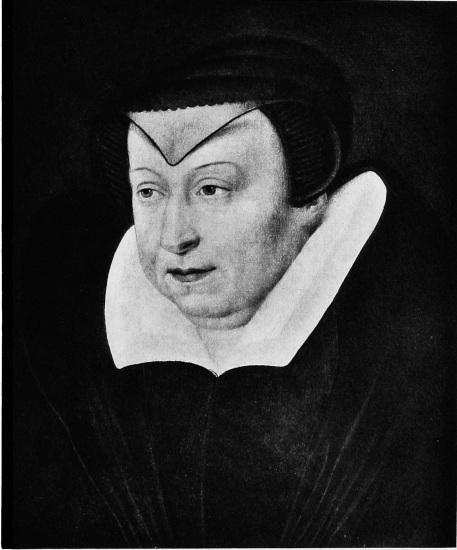
This queen is extracted, on the father’s side, from the race of the Medici, one of the noblest and most illustrious families, not only in Italy, but in Christendom. Whatever may be said, she was a foreigner to these shores because the alliances of kings cannot commonly be chosen in their kingdom; for it is not best to do so; foreign marriages being as useful and more so than near ones. The House of the Medici has always been allied and confederated with the crown of France, which still bears the fleur-de-lys that King Louis XI. gave that house in sign of alliance and perpetual confederation [the fleur de Louis, which then became the Florentine lily].
On the mother’s side she issued originally from one of the noblest families of France; and so was truly French in race, heart, and affection through that great house of Boulogne and county of Auvergne; thus it is hard to tell or judge in which of her two families there was most grandeur and memorable deeds. Here is what was said of them by the Archbishop of Bourges, of the house of Beaune, as great a learned man and worthy prelate as there is in Christendom (though some say a trifle unsteady in belief, and little good in the scales of M. Saint-Michel, who weighs good Christians for the day of judgment, or so they say): it is given in the funeral oration which the archbishop made upon the said queen at Blois:—
“In the days when Brennus, that great captain of the Gauls, led his army throughout all Italy and Greece, there were with him in his troop two French nobles, one named Felsinus, the other named Bono, who, seeing the wicked design of Brennus, after his fine conquests, to invade the temple of Delphos and soil himself and his army with the sacrilege of that temple, withdrew, both of them, and passed into Asia with their vessels and men, advancing so far that they entered the sea of the Medes, which is near to Lydia and Persia. Thence, having made great conquests and obtained great victories, they were returning through Italy, hoping to reach France, when Felsinus stopped at a place where Florence now stands beside the river Arno, which he saw to be fine and delectable, and situated much as another which had pleased him much in the country of the Medes. There he built a city which to-day is Florence; and his companion, Bono, built another and named it Bononia, now called Bologna, the which are neighbouring cities. Henceforth, in consequence of the victories and conquests of Felsinus among the Medes, he was called Medicus among his friends, a name that remained to the family; just as we read of Paulus surnamed Macedonicus for having conquered Macedonia from Perseus, and Scipio called Africanus for doing the same in Africa.”
I do not know where M. de Beaune may have taken this history; but it is very probable that before the king and such an assembly, there convened for the funeral of the queen, he would not have alleged the fact without good authority. This descent is very far from the modern story invented and attributed without grounds to the family of Medici, according to that lying book which I have mentioned on the life of the said queen. After this the said Sieur de Beaune says further, he has read in the chronicles that one named Everard de’ Medici, Sieur of Florence, went, with many of his subjects, to the assistance of the voyage and expedition made by Charlemagne against Desiderius, King of the Lombards; and having very bravely succoured and assisted him, was confirmed and invested with the lordship of Florence. Many years after, one Anemond de’ Medici, also Sieur of Florence, went, accompanied by many of his subjects, to the Holy Land, with Godefroy de Bouillon, where he died at the siege of Nicæa in Asia. Such greatness always continued in that family until Florence was reduced to a republic by the intestine wars in Italy between the emperors and the peoples, the illustrious members of it manifesting their valour and grandeur from time to time; as we saw in the latter days Cosmo de’ Medici, who, with his arms, his navy, and vessels, terrified the Turks in the Mediterranean Sea and in the distant East; so that none since his time, however great he may be, has surpassed him in strength and valour and wealth, as Raffaelle Volaterano has written.
The temples and sacred shrines by him built, the hospitals by him founded, even in Jerusalem, are ample proof of his piety and magnanimity.
There were also Lorenzo de’ Medici, surnamed the Great for his virtuous deeds, and two great popes, Leo and Clement, also many cardinals and grand personages of the name; besides the Grand Duke of Tuscany, Cosmo de’ Medici, a wise and wary man, if ever there was one. He succeeded in maintaining himself in his duchy, which he found invaded and much disturbed when he came to it.
In short, nothing can rob this house of the Medici of its lustre, very noble and grand as it is in every way.
As for the house of Boulogne and Auvergne, who will say that it is not great, having issued originally from that noble Eustache de Boulogne, whose brother, Godefroy de Bouillon, bore arms and escutcheons with so vast a number of princes, seigneurs, chevaliers, and Christian soldiers, even to Jerusalem and the Sepulchre of our Saviour; and would have made himself, by his sword and the favour of God, king, not only of Jerusalem but of the greater part of the East, to the confusion of Mahomet, the Saracens, and the Mahometans, amazing all the rest of the world and replanting Christianity in Asia, where it had fallen to the lowest?
For the rest, this house has ever been sought in alliance by all the monarchies of Christendom and the great families; such as France, England, Scotland, Hungary, and Portugal, which latter kingdom belonged to it of right, as I have heard Président de Thou say, and as the queen herself did me the honour to tell me at Bordeaux when she heard of the death of King Sebastian [in Morocco, 1578], the Medici being received to argue the justice of their rights at the last Assembly of States before the decease of King Henry [in 1580]. This was why she armed M. de Strozzi to make an invasion, the King of Spain having usurped the kingdom; she was arrested in so fine a course only by reasons which I will explain at another time.
I leave you to suppose, therefore, whether this house of Boulogne was great; yes, so great that I once heard Pope Pius IV. say, sitting at table at a dinner he gave after his election to the Cardinals of Ferrara and Guise, his creations, that the house of Boulogne was so great and noble he knew none in France, whatever it was, that could surpass it in antiquity, valour, and grandeur.
All this is much against those malicious detractors who have said that this queen was a Florentine of low birth. Moreover, she was not so poor but what she brought to France in marriage estates which are worth to-day twenty-six thousand livres,—such as the counties of Auvergne and Lauragais, the seigneuries of Leverons, Donzenac, Boussac, Gorrèges, Hondecourt and other lands,—all an inheritance from her mother. Besides which, her dowry was of more than two hundred thousand ducats, which are worth to-day over four hundred thousand; with great quantities of furniture, precious stones, jewels, and other riches, such as the finest and largest pearls ever seen in so great a number, which she afterwards gave to her daughter-in-law, the Queen of Scotland [Mary Stuart], whom I have seen wearing them.
Besides all this, many estates, houses, deeds, and claims in Italy.
But more than all else, through her marriage the affairs of France, which had been so shaken by the imprisonment of the king and his losses at Milan and Naples, began to get firmer. King François was very willing to say that the marriage had served his interests. Therefore there was given to this queen for her device a rainbow, which she bore as long as she was married, with these words in Greek φὡϛ φἑρι ἡδἑ γαλἡνην. Which is the same as saying that just as this fire and bow in the sky brings and signifies good weather after rain, so this queen was a true sign of clearness, serenity, and the tranquillity of peace. The Greek is thus translated: Lucem fert et serenitatem—“She brings light and serenity.”
After that, the emperor [Charles V.] dared push no longer his ambitious motto: “Ever farther.” For, although there was truce between himself and King François, he was nursing his ambition with the design of gaining always from France whatever he could; and he was much astonished at this alliance with the pope [Clement VII.], regarding the latter as able, courageous, and vindictive for his imprisonment by the imperial forces at the sack of Rome [1527]. Such a marriage displeased him so much that I have heard a truthful lady of the Court say that if he had not been married to the empress, he would have seized an alliance with the pope himself and espoused his niece [Catherine de’ Medici], as much for the support of so strong a party as because he feared the pope would assist in making him lose Naples, Milan, and Genoa; for the pope had promised King François, in an authentic document, when he delivered to him the money of his niece’s dowry and her rings and jewels, to make the dowry worthy of such a marriage by the addition of three pearls of inestimable value, of the excessive splendour of which all the greatest kings were envious and covetous; the which were Naples, Milan, and Genoa. And it is not to be doubted that if the said pope had lived out his natural life he would have sold the emperor well, and made him pay dear for that imprisonment, in order to aggrandize his niece and the kingdom to which she was joined. But Clement VII. died young, and all this profit came to nought.
So now our queen, having lost her mother, Magdelaine de Boulogne, and Lorenzo de’ Medici, Duke of Urbino, her father, in early life, was married by her good uncle the pope to France, whither she was brought by sea to Marseille in great triumph; and her wedding was pompously performed, at the age of fourteen. She made herself so beloved by the king, her father-in-law, and by King Henri, her husband [not king till the death of François I.], that on remaining ten years without producing issue, and many persons endeavouring to persuade the king and the dauphin, her husband, to repudiate her because there was such need of an heir to France, neither the one nor the other would consent because they loved her so much. But after ten years, in accordance with the natural habit of the women of the race of Medici, who are tardy in conceiving, she began by producing the Little King François II. After that, was born the Queen of Spain, and then, consecutively, that fine and illustrious progeny whom we have all seen, and also others no sooner born than dead, by great misfortune and fatality. All this caused the king, her husband, to love her more and more, and in such a way that he, who was of an amorous temperament, and greatly liked to make love and to change his loves, said often that of all the women in the world there was none like his wife for that, and he did not know her equal. He had reason to say so, for she was truly a beautiful and most amiable princess.
She was of rich and very fine presence; of great majesty, but very gentle when need was; of noble appearance and good grace, her face handsome and agreeable, her bosom very beautiful, white and full; her body also very white, the flesh beautiful, the skin smooth, as I have heard from several of her ladies; of a fine plumpness also, the leg and thigh very beautiful (as I have heard, too, from the same ladies); and she took great pleasure in being well shod and in having her stockings well and tightly drawn up.
Besides all this, the most beautiful hand that was ever seen, as I believe. Once upon a time the poets praised Aurora for her fine hands and beautiful fingers; but I think our queen would efface her in that, and she guarded and maintained that beauty all her life. The king, her son, Henri III., inherited much of this beauty of the hand.
She always clothed herself well and superbly, often with some pretty and new invention. In short, she had many charms in herself to make her beloved. I remember that one day at Lyons she went to see a painter named Corneille, who had painted in a large room all the great seigneurs, princes, cavaliers, queens, princesses, ladies of the Court, and damoiselles. Being in the said room of these portraits we saw there our queen, painted very well in all her beauty and perfection, apparelled à la Française in a cap and her great pearls, and a gown with wide sleeves of silver tissue furred with lynx,—the whole so well represented to the life that only speech was lacking; her three fine daughters were beside her. She took great pleasure at the sight, and all the company there present did the same, praising and admiring her beauty above all. She herself was so ravished by the contemplation that she could not take her eyes from the picture until M. de Nemours came to her and said: “Madame, I think you are there so well portrayed that nothing more can be said; and it seems to me that your daughters do you proper honour, for they do not go before you or surpass you.” To this she answered: “My cousin, I think you can remember the time, the age, and the dress of this picture; so that you can judge better than any of this company, for you saw me like that, whether I was estimated such as you say, and whether I ever was as I there appear.” There was not one in the company that did not praise and estimate that beauty highly, and say that the mother was worthy of the daughters, and the daughters of the mother. And such beauty lasted her, married and widowed, almost to her death; not that she was as fresh as in her more blooming years, but always well preserved, very desirable and agreeable.
For the rest, she was very good company and of gay humour; loving all honourable exercises, such as dancing, in which she had great grace and majesty.
She also loved hunting; about which I heard a lady of the Court tell this tale: King François, having chosen and made a company which was called “the little band of the Court ladies,” the handsomest, daintiest, and most favoured, often escaped from the Court and went to other houses to hunt the stag and pass his time, sometimes staying thus withdrawn eight days, ten days, sometimes more and sometimes less, as the humour took him. Our queen (who was then only Mme. la dauphine) seeing such parties made without her, and that even Mesdames her sisters-in-law were there while she stayed at home, made prayer to the king, to take her always with him, and to do her the honour to permit that she should never budge without him.
Henri II
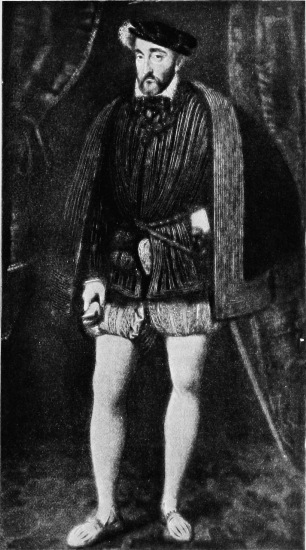
It was said that she, being very shrewd and clever, did this as much or more to see the king’s actions and get his secrets and hear and know all things, as from liking for the hunt.
King François was pleased with this request, for it showed the good-will that she had for his company; and he granted it heartily; so that besides loving her naturally he now loved her more, and delighted in giving her pleasure in the hunt, at which she never left his side, but followed him at full speed. She was very good on horseback and bold; sitting with ease, and being the first to put the leg around a pommel; which was far more graceful and becoming than sitting with the feet upon a plank. Till she was sixty years of age and over she liked to ride on horseback, and after her weakness prevented her she pined for it. It was one of her greatest pleasures to ride far and fast, though she fell many times with damage to her body, breaking her leg once, and wounding her head, which had to be trepanned. After she was widowed and had charge of the king and the kingdom, she took the king always with her, and her other children; but while her husband, King Henri, lived, she usually went with him to the meet of the stag and the other hunts.
If he played at pall-mall she watched him play, and played herself. She was very fond of shooting with a cross-bow à jalet [ball of stone], and she shot right well; so that always when she went to ride her cross-bow was taken with her, and if she saw any game, she shot it.
She was ever inventing some new dance or beautiful ballet when the weather was bad. Also she invented games and passed her time with one and another intimately; but always appearing very grave and austere when necessary.
She was fond of seeing comedies and tragedies; but after “Sophonisbe,” a tragedy composed by M. de Saint-Gélais, was very well represented by her daughters and other ladies and damoiselles and gentlemen of her Court, at Blois for the marriages of M. du Cypière and the Marquis d’Elbœuf, she took an opinion that it was harmful to the affairs of the kingdom, and would never have tragedies played again. But she listened readily to comedies and tragi-comedies, and even those of “Zani” and “Pantaloon,” taking great pleasure in them, and laughing with all her heart like any other; for she liked laughter, and her natural self was jovial, loving a witty word and ready with it, knowing well when to cast her speech and her stone, and when to withhold them.
She passed her time in the afternoons at work on her silk embroideries, in which she was as perfect as possible. In short, this queen liked and gave herself up to all honourable exercises; and there was not one that was worthy of herself and her sex that she did not wish to know and practise.
There is what I can say, speaking briefly and avoiding prolixity, about the beauty of her body and her occupations.
When she called any one “my friend” it was either that she thought him a fool, or she was angry with him. This was so well known that she had a serving gentleman named M. de Bois-Fevrier, who made reply when she called him “my friend”: “Ha! madame, I would rather you called me your enemy; for to call me your friend is as good as saying I am a fool, or that you are in anger against me; for I know your nature this long time.”
As for her mind, it was very great and very admirable, as was shown in so many fine and signal acts by which her life has been made illustrious forever. The king, her husband, and his council esteemed her so much that when the king went his journey to Germany, out of his kingdom, he established and ordered her as regent and governor throughout his dominions during his absence, by a declaration solemnly made before a full parliament in Paris. And in this office she behaved so wisely that there was no disturbance, change, or alteration in the State by reason of the king’s absence; but, on the contrary, she looked so carefully to business that she assisted the king with money, means, and men, and other kinds of succour; which helped him much for his return, and even for the conquest which he made of cities in the duchy of Luxembourg, such as Yvoy, Montmedy, Dampvilliers, Chimay, and others.
I leave you to think how he who wrote that fine life I spoke of detracted from her in saying that never did the king, her husband, allow her to put her nose into matters of State. Was not making her regent in his absence giving her ample occasion to have full knowledge of them? And it was thus she did during all the journeys that he made yearly in going to his armies.
What did she after the battle of Saint-Laurens, when the State was shaken and the king had gone to Compiègne to raise a new army? She so espoused affairs that she roused and excited the gentlemen of Paris to give prompt succour to their king, which came most apropos, both in money and in other things very necessary in war.
Also, when the king was wounded, those who were of that time and saw it cannot be ignorant of the great care she took for his cure: the watches she made beside him without ever sleeping; the prayers with which, time after time, she importuned God; the processions and visitation of churches which she made; and the posts which she sent about everywhere inquiring for doctors and surgeons. But his hour had come; and when he passed from this world into the other, she made such lamentations and shed such tears that never did she stanch them; and in memory of him, whenever he was spoken of as long as she lived, they gushed from the depths of her eyes; so that she took a device proper and suitable to her tears and her mourning, namely: a mound of quicklime, on which the drops of heaven fell abundantly, with these words writ in Latin: Adorem extincta testantur vivere flamma; the drops of water, like her tears, showing ardour, though the flame was extinct. This device takes its allegory from the nature of quicklime, which, being watered, burns strangely and shows its fire though flame is not there. Thus did our queen show her ardour and her affection by her tears, though flame, which was her husband, was now extinct; and this was as much as to say that, dead as he was, she made it appear by her tears that she could never forget him, but should love him always.
A like device was borne in former days by Madame Valentine de Milan, Duchesse d’Orléans, after the death of her husband, killed in Paris, for which she had such great regret that for all comfort and solace in her moaning, she took a watering-pot for her device, on the top of which was an S, in sign, so they say, of seule, souvenir, soucis, soupirer, and around the said watering-pot were written these words: Rien ne m’est plus; plus ne m’est rien—“Nought is more to me; more is to me nothing.” This device can still be seen in her chapel in the church of the Franciscans at Blois.
The good King René of Sicily, having lost his wife Isabel, Duchesse de Lorraine, suffered such great grief that never did he truly rejoice again; and when his intimate friends and favourites urged him to consolation he led them to his cabinet and showed them, painted by his own hand (for he was an excellent painter), a Turkish bow with its string unstrung, beneath which was written: Arco per lentare piaga non sana—“The bow although unstrung heals not the wound.” Then he said to them: “My friends, with this picture I answer all your reasons: by unstringing a bow or breaking its string, the harm thus done by the arrow may quickly be mended, but, the life of my dear spouse being by death extinct and broken, the wound of the loyal love—the which, her living, filled my heart—cannot be cured.” And in various places in Angers we see these Turkish bows with broken strings and beneath them the same words, Arco per lentare piaga non sana; even at the Franciscan church, in the chapel of Saint-Bernardin which he caused to be decorated. This device he took after the death of his wife; for in her lifetime he bore another.
Our queen, around her device which I have told of, placed many trophies: broken mirrors and fans, crushed plumes, and pearls, jewels scattered to earth, and chains in pieces; the whole in sign of quitting worldly pomp, her husband being dead, for whom her mourning never was remitted. And, without the grace of God and the fortitude with which he had endowed her, she would surely have succumbed to such great sadness and distress. Besides, she saw that her young children and France had need of her, as we have since seen by experience; for, like a Semiramis, or second Athalie, she foiled, saved, guarded, and preserved her said young children from many enterprises planned against them in their early years; and this with so much industry and prudence that everybody thought her wonderful. She, being regent of the kingdom after the death of her son King François during the minority of our king by the ordering of the Estates of Orléans, imposed her will upon the King of Navarre, who, as premier prince of the blood, wished to be regent in her place and govern all things; but she gained so well and so dexterously the said Estates that if the said King of Navarre had not gone elsewhere she would have caused him to be attainted of the crime of lèse-majesté. And possibly she would still have done so for the actions which, it was said, he made the Prince de Condé do about those Estates, but for Mme. de Montpensier, who governed her much. So the said king was forced to content himself to be under her. Now there is one of the shrewd and subtle deeds she did in her beginning.
Afterwards she knew how to maintain her rank and authority so imperiously that no one dared gainsay it, however grand and disturbing he was, for a period of three months when, the Court being at Fontainebleau, the said King of Navarre, wishing to show his feelings, took offence because M. de Guise ordered the keys of the king’s house brought to him every evening, and kept them all night in his room like a grand-master (for that is one of his offices), so that no one could go out without his permission. This angered the King of Navarre, who wished to keep the keys himself; but, being refused, he grew spiteful and mutinied in such a way that one morning suddenly he came to take leave of the king and queen, intending to depart from the Court, taking with him all the princes of the blood whom he had won over, together with M. le Connétable de Montmorency and his children and nephew.
The queen, who did not in any way expect this step, was at first much astonished, and tried all she could to ward off the blow, giving good hope to the King of Navarre that if he were patient he would some day be satisfied. But fine words gained her nothing with the said king, who was set on departing. Whereupon the queen bethought her of this subtle point: she sent and gave commandment to M. le connétable, as the principal, first, and oldest officer of the crown, to stay near the king, his master, as his duty and office demanded, and not to leave him. M. le connétable, wise and judicious as he was, being very zealous for his master and careful of his grandeur and honour, after reflecting on his duty and the command sent to him, went to see the king and present himself as ready to fulfil his office; which greatly astonished the King of Navarre, who was on the point of mounting his horse expecting M. le connétable, who came instead to represent his duty and office and to persuade him not to budge himself nor to depart; and did this so well that the King of Navarre went to see the king and queen at the instigation of the connétable, and having conferred with their Majesties, his journey was given up and his mules were countermanded, they having then arrived at Melun. So all was pacified to the great content of the King of Navarre. Not that M. de Guise diminished in any way his office, or yielded one atom of his honour, for he kept his pre-eminence and all that belonged to him, without being shaken in the least, although he was not the stronger; but he was a man of the world in such things, who was never bewildered, but knew very well how to brave all and hold his rank and keep what he had.
It is not to be doubted, as all the world knows, that, if the queen had not bethought her of this ruse regarding M. le connétable, all that party would have gone to Paris and stirred up things to our injury; for which reason great praise should be given to the queen for this shift. I know, for I was there, that many persons said it was not of her invention, but that of Cardinal de Tournon, a wise and judicious prelate; but that is false, for, old stager though he was, i’ faith the queen knew more of wiles than he, or all the council of the king together; for very often, when he was at fault, she would help him and put him on the traces of what he ought to know, of which I might produce a number of examples; but it will be enough to give this instance, which is fresh, and which she herself did me the honour to disclose to me. It is as follows:—
When she went to Guyenne, and lately to Coignac, to reconcile the princes of the Religion and those of the League, and so put the kingdom in peace, for she saw it would soon be ruined by such divisions, she determined to proclaim a truce in order to treat of this peace; at which the King of Navarre and the Prince de Condé were very discontent and mutinous,—all the more, they said, because this proclamation did them great harm on account of their foreigners, who, having heard of it, might repent of their coming, or delay it; and they accused the said queen of having made it with that intention. So they said and resolved not to see the queen, and not to treat with her unless the said truce were rescinded. Now finding her council, whom she had with her, though composed of good heads, very ridiculous and little to be honoured because they thought it impossible to find means to rescind the said truce, the queen said to them: “Truly, you are very stupid as to the remedy. Know you not better? There is but one means for that. You have at Maillezais the regiment of Neufvy and de Sorlu, Huguenots; send me from here, from Niort, all the arquebusiers that you can, and cut them to pieces, and there you have the truce rescinded and undone without further trouble.” As she commanded so it was executed; the arquebusiers started, led by the Capitaine l’Estelle, and forced their fort and their barricades so well that there they were quite defeated, Sorlu killed, who was a valiant man, Neufvy taken prisoner with many others, and all their banners captured and brought to Niort to the queen; who, using her accustomed turn of clemency, pardoned all and sent them away with their ensigns and even with their flags, which, as regards the flags, is a very rare thing. But she chose to do this stroke, rare or not, so she told me, to the princes; who now knew they had to do with a very able princess, and that it was not to her they should address such mockery as to make her rescind a truce by the very heralds who had proclaimed it; for while they were thinking to make her receive that insult, she had fallen upon them, and now sent them word by the prisoners that it was not for them to affront her by asking unseemly and unreasonable things, because it was in her power to do them both good and evil.
That is how this queen knew how to give and teach a lesson to her council. I might tell of many such things, but I have now to treat of other points: the first of which must be to answer those whom I have often heard say that she was the first to rouse to arms, and so was cause of our civil wars. Whoso will look to the source of the matter will not believe that; for the triumvirate having been created, she, seeing the proceedings which were preparing and the change made by the King of Navarre,—who from being formerly Huguenot and very reformed had made himself Catholic,—and knowing that through that change she had reason to fear for the king, the kingdom, and her own person that he would move against them, reflected and puzzled her mind to discover to what such proceedings, meetings, and colloquies held in secret tended. Not being able, as they say, to come at the bottom of the pot, she bethought her one day, when the secret council was in session in the room of the King of Navarre, to go into the room above his, and by means of a tube which she had caused to be slipped surreptitiously under the tapestry she listened unperceived to their discourse. Among other things she heard one thing that was very terrible and bitter to her. The Maréchal de Saint-André, one of the triumvirate, gave it as his opinion that the queen should be put in a sack and flung into the river, for that otherwise they could never succeed in their plans. But the late M. de Guise, who was very good and generous, said that must not be; for it were too unjust to make the wife and mother of our kings perish thus miserably, and he opposed it all. For this the said queen has always loved him, and proved it to his children after his death by giving them his estates.
I leave you to suppose what this sentence was to the queen, having heard it thus with her own ears, and whether she had no occasion for fear, although she was thus defended by M. de Guise. From what I have heard tell by one of her most intimate ladies, she feared they would strike the blow without the knowledge of M. de Guise, as indeed she had reason to do; for in deeds so detestable an upright man should always be distrusted, and the act not communicated to him. She was thus compelled to consider her safety, and employ those she saw already under arms [the Prince de Condé and other Protestant leaders], begging them to have pity for a mother and her children.
That is the whole cause, just as it was, of the civil war. She would never go to Orléans with the others, nor give them the king and her children, as she could have done; and she was very glad that in the hurly-burly of arms she and the king her son and her other children were in safety, as was reasonable. Moreover, she requested and held the promise of the others that whenever she should summon them to lay down their arms they would do so; which, nevertheless, they would not do when the time came, no matter what appeals she made to them, and what pains she took, and the great heat she endured at Talsy, to induce them to listen to the peace she could have made good and secured for all France had they then listened to her; and this great fire and others we have since seen lighted from this first brand would have been forever extinguished in France if they would then have trusted her. I know what I myself have heard her say, with the tears in her eyes, and with what zeal she endeavoured to do it.
This is why they cannot charge her with the first spark of the civil war, nor yet with the second, which was the day of Meaux; for at that time she was thinking only of a hunt, and of giving pleasure to the king in her beautiful house at Monceaux. The warning came that M. le Prince and others of the Religion were in arms and advancing to surprise and seize the king under colour of presenting a request. God knows who was the cause of this new disturbance, and without the six thousand Swiss then lately raised, who knows what might have happened? This levy of Swiss was only the pretext of their taking up arms, and of saying and publishing that it was done to force them to war. In fact it was they, themselves, as I know from being at Court, who requested that levy of the king and queen, on the passage of the Duke of Alba and his army, fearing that under colour of reaching Flanders he might descend upon the frontiers of France; and they urged that it was the custom to arm the frontiers whenever a neighbouring State was arming. No one can be ignorant how urgent for this they were to the king and queen by letters and embassies,—even M. le Prince himself and M. l’amiral [Coligny] coming to see the king on this subject at Saint-Germain-en-Laye, where I saw them.
I would also like to ask (for all that I write here I saw myself) who it was who took up arms on Shrove Tuesday, and who suborned and solicited Monsieur the king’s brother, and the King of Navarre, to give ear to the enterprises for which Mole and Coconas were executed in Paris. It was not the queen, for it was by her prudence that she prevented them from uprising,—by keeping Monsieur and the King of Navarre so locked in to the forest of Vincennes that they could not set out; and on the death of King Charles she held them so tightly in Paris and the Louvre, barring their windows one morning,—at any rate those of the King of Navarre, who was lodged on the lower floor (the King of Navarre, told me this himself with tears in his eyes),—that they could not escape as they intended, which would greatly have embroiled the State and prevented the return of Poland to the King, which was what they were after. I know all this from having been invited to the fricassée, which was one of the finest strokes ever made by the queen. Starting from Paris she conducted them to Lyons to meet the king so dexterously that no one who saw them would ever have supposed them prisoners; they went in the same coach with her, and she presented them herself to the king, who, on his side, pardoned them soon after.
Also, who was it that enticed Monsieur the king’s brother to leave Paris one fine night and the company of his brother who loved him well, and whose affection he cast off to go and take up arms and embroil all France? M. de La Noue knows well, and also the secret plots that began at the siege of Rochelle, and what I said to him about them. It was not the queen-mother, for she felt such grief at seeing one brother banded against another brother and his king, that she swore she would die of it, or else replace and reunite them as before—which she did; for I heard her say at Blois, in conversation with Monsieur, that she prayed for nothing so much as that God would grant her the favour of that reunion, after which he might send her death and she would accept it with all her heart; or else she would gladly retire to her houses of Monceaux and Chenonceaux, and never mix further in the affairs of France, wishing to end her days in tranquillity. In fact, she truly wished to do the latter; but the king implored her to abstain, for he and his kingdom had great need of her. I am assured that if she had not made this peace at that time, all was over with France, for there were in the country fifty thousand foreigners, from one region or another, who would have aided in humbling and destroying her.
It was, therefore, not the queen who called to arms at this time to satisfy the State-Assembly at Blois, the which, wanting but one religion and proposing to abolish that which was contrary to their own, demanded, if the spiritual blade did not suffice to abolish it, that recourse should be had to the temporal. Some have said that the queen had bribed them; that is false. I do not say that she did not bribe them later, which was a fine stroke of policy and intelligence; but it was not she who called together the said Assembly; so far from that, she blamed them for all, and also because they lessened greatly the king’s authority and her own. It was the party of the Religion which had long demanded that Assembly, and required by the terms of the last peace that it should be called together and assembled; to which the queen objected strongly, foreseeing abuses. However, to content them because they clamoured for it so much, they had it, to their own confusion and damage, and not to their profit and contentment as they expected, so that finally they took up arms. Thus it was still not the queen who did so.
Neither was it she who caused them to be taken up when Mont-de-Marsan, La Fère in Picardy, and Cahors were taken. I remember what the king said to M. de Miossans, who came to him on behalf of the King of Navarre; he rebuffed him harshly, and told him that while those princes were cloying him with fine words they were calling to arms and taking cities.
Now that is how this queen was the instigator of all our wars and civil fires, the which, while she never lighted them, she spent her pains and labour in striving to extinguish, abhorring to see so many of the nobles and men of honour die. And without that, and without her commiseration, they who have hated her with mortal hatred would have been ill-off, and their party underground and not flourishing as it now is; which must be imputed to her kindness, of which we now have sore need, for, as every one says and the poor people cry, “We have no longer the queen-mother to make peace for us.” It was not her fault that peace was not made when she went to Guyenne lately to treat of it with the King of Navarre and the Prince de Condé.
They have tried to accuse her also of being an accomplice in the wars of the League. Why, then, should she have brought about the peace of which I speak if she were that? Why should she have pacified the riot of the barricades in Paris? Why should she have reconciled the king and the Duc de Guise only to destroy the latter and kill him?
Well, let them launch into such foul abuse against her all they will, never shall we have another queen in France so good for peace.
They have accused her of that massacre in Paris [the Saint-Bartholomew]; all that is a sealed book to me, for at that time I was preparing to embark at Brouage; but I have often heard it said that she was not the chief actress in it. There were three or four others, whom I might name, who were more ardent in it than she and pushed her on, making her believe, from the threats uttered on the wounding of M. l’amiral, that the king was to be killed, and she with all her children and the whole Court, or else that the country would be in arms much worse than ever. Certainly the party of Religion did very wrong to make the threats it is said they made; for they brought on the fate of poor M. l’amiral, and procured his death. If they had kept themselves quiet, said no word, and let M. l’amiral’s wound heal, he could have left Paris at his ease, and nothing further would have come of it. M. de La Noue was of that opinion. He and M. Strozzi and I have often spoken of it, he not approving of such bravados, audacities, and threats as were made at the very Court of the king in his city of Paris; and he greatly blamed M. de Theligny, his brother-in-law, who was one of the hottest, calling him and his companions perfect fools and most incapable. M. l’amiral never used such language as I have heard from others, at least not aloud. I do not say that in secret and private with his intimate friends he never spoke it. That was the cause of the death of M. l’amiral and the massacres of his people, and not the queen; as I have heard say by those who know well, although there are many from whose heads you could never oust the opinion that this train was long laid and the plot long in hatching. It is all false. The least passionate think as I have said; the more passionate and obstinate believe the other way; and very often we give credit for the ordering of events to kings and great princes, and say after those events have happened how prudent and provident they were, and how well they knew how to dissimulate, when all the while they knew no more about them than a plum.
To return again to our queen; her enemies have put it about that she was not a good Frenchwoman. God knows with what ardour I saw her urge that the English might be driven from France at Havre de Grâce, and what she said of it to M. le Prince, and how she made him go with many gentlemen of his party, and the crown-companies of M. d’Andelot, and other Huguenots, and how she herself led the army, mounted usually on a horse, like a second beautiful Queen Marfisa, exposing herself to the arquebusades and the cannonades as if she were one of her captains, looking to the making of the batteries, and saying she should never be at ease until she had taken that town and driven the English out of France; hating worse than poison those who had sold it to them. And thus she did so much that finally she made the country French.
When Rouen was besieged, I saw her in the greatest anger when she beheld supplies entering the town by means of a French galley captured the year before, she fearing that the place, failing to be taken by us, would come under the dominion of the English. For this reason she pushed hard at the wheel, as they say, to take it, and never failed every day to come to the fort Sainte-Catherine to hold council and see the firing. I have often seen her passing along the covered way of Sainte-Catherine, the cannonades and arquebusades raining round her, and she caring nothing for them.
Those who were there saw her as I did; there are still many ladies, her maids of honour who accompanied her, to whom the firing was not too pleasant; I knew this for I saw them there; but when M. le connétable and M. de Guise remonstrated with her, telling her some misfortune would come of it, she only laughed and said: Why should she spare herself more than they, inasmuch as she had as good courage as they had, though not their strength, which her sex denied her? As for fatigue, she endured that well, whether on foot or on horseback. I think that for long there had never been a queen or a princess better on horseback, sitting with such grace,—not appearing, for all that, like a masculine dame, in form and style a fantastic amazon, but a comely princess, beautiful, agreeable, and gentle.
They said of her that she was very Spanish. Certainly as long as her good daughter lived [Élisabeth, wife of Philip II.] she loved Spain; but after her daughter died we knew, at least some of us, whether she had reason to love it, either country or nation. True it is that she was always so prudent that she chose to treat the King of Spain as her good son-in-law, in order that he in turn should treat better her good and beautiful daughter, as is the custom of good mothers; so that he never came to trouble France, nor to bring war there, according to his brave heart and natural ambition.
Others have also said that she did not like the nobility of France and desired much to shed its blood. I refer for that to the many times that she made peace and spared that blood; besides which, attention should be paid to this, namely: that while she was regent, and her children minors, there were not known at Court so many quarrels and combats as we have seen there since; she would not allow them, and forbade expressly all duelling and punished those who transgressed that order. I have seen her at Court, when the king went away to stay some days and she was left absolute and alone, at a time when quarrels had begun again and were becoming common, also duelling, which she never would permit,—I have known her, I say, give a sudden order to the captain of the guards to make arrests, and to the marshals and captains to pacify the quarrel; so that, to tell the truth, she was more feared than the king; for she knew how to talk to the disobedient and the dissolute, and rebuke them terribly.
I remember that once, the king having gone to the baths of Bourbon, my late cousin La Chastaignerie had a quarrel with Pardailhan. She had him searched for, in order to forbid him, on his life, to fight a duel; but not being able to find him for two whole days, she had him tracked so well that on a Sunday morning, he being on the island of Louviers awaiting his enemy, the grand provost arrived to arrest him, and took him prisoner to the Bastille by order of the queen. But he stayed there only one night; for she sent for him and gave him a reprimand, partly sharp and partly gentle, because she was really kind, and was harsh only when she chose to be. I know very well what she said to me also when I was for seconding my said cousin, namely: that as the older I ought to have been the wiser.
The year that the king returned to Poland a quarrel arose between Messieurs de Grillon and d’Entraigues, two brave and valiant gentlemen, who being called out and ready to fight, the king forbade them through M. de Rambouillet, one of his captains of the guard then in quarters, and he ordered M. de Nevers and the Maréchal de Retz to make up the quarrel, which they failed in doing. That evening the queen sent for them both into her room; and as their quarrel was about two great ladies of her household, she commanded them with great sternness, and then besought them both in all gentleness, to leave to her the settlement of their differences; inasmuch as, having done them the honour to meddle in it, and the princes, marshals, and captains having failed in making them agree, it was now a point of honour with her to have the glory of doing so: by which she made them friends, and they embraced without other forms, taking all from her; so that by her prudence the subject of the quarrel, which was delicate, and rather touched the honour of the two ladies, was never known publicly. That was the true kindness of a princess! And then to say she did not like the nobility! Ha! the truth was, she noticed and esteemed it too much. I think there was not a great family in the kingdom with whom she was not acquainted; she used to say she had learned from King François the genealogies of the great families of his kingdom; and as for the king, her husband, he had this faculty, that when he had once seen a nobleman he knew him always, in face, in deeds, and in reputation.
I have seen the queen, often and ordinarily, while the king, her son, was a minor, take the trouble to present to him herself the gentlemen of his kingdom, and put them in his memory thus: “Such a one did service to the king your grandfather, at such and such times and places; and this one served your father;” and so on,—commanding him to remember all this, and to love them and do well by them, and recognize them at other times; which he knew very well how to do, for, through such instruction, this king recognized readily all men of character and race and honour throughout his kingdom.
Detractors have also said that she did not like her people. What appears? Were there ever so many tailles, subsidies, imposts, and other taxes while she was governing during the minority of her children as have since been drawn in a single year? Was it proved that she had all that hidden money in the banks of Italy, as people said? Far from that, it was found after her death that she had not a single sou; and, as I have heard some of her financiers and some of her ladies say, she was indebted eight thousand crowns, the wages of her ladies, gentlemen, and household officers, due a year, and the revenue of the whole year spent; so that some months before her death her financiers showed her these necessities; but she laughed and said one must praise God for all and find something to live on. That was her avarice and the great treasure she amassed, as people said! She never amassed anything, for she had a heart wholly noble, liberal, and magnificent, like her great uncle, Pope Leo, and that magnificent Lorenzo de’ Medici. She spent or gave away everything; erecting buildings, spending in honourable magnificences, and taking pleasure in giving recreations to her people and her Court, such as festivals, balls, dances, tournaments and spearing the ring [couremens de bague], of which latter she held three that were very superb during her lifetime: one at Fontainebleau on the Shrove Tuesday after the first troubles; where there were tourneys and breaking of lances and combats at the barrier,—in short, all sorts of feats of arms, with a comedy on the subject of the beautiful Genevra of Ariosto, which she caused to be represented by Mme. d’Angoulême and her most beautiful and virtuous princesses and the ladies and damoiselles of her Court, who certainly played it very well, and so that nothing finer was ever seen. The second was at Bayonne, at the interview between the queen and her good daughter Élisabeth, Queen of Spain, where the magnificence was such in all things that the Spanish, who are very disdainful of other countries than their own, swore they had never seen anything finer, and that their own king could not approach it; and thus they returned to Spain much edified.
I know that many in France blamed this expense as being superfluous; but the queen said that she did it to show foreigners that France was not so totally ruined and poverty-stricken because of the late wars as they thought; and that if for such tourneys she was able to spend so much, for matters of importance she could surely do better, and that France was all the more feared and esteemed, whether through the sight of such wealth and richness, or through that of the prowess of her gentlemen, so brave and adroit at arms; as indeed there were many there very good to see and worthy to be admired. Moreover, it was very reasonable that for the greatest queen of Christendom, the most beautiful, the most virtuous, and the best, some great solemn festival above all others should be held. And I can assure you that if this had not been done, the foreigners would have mocked us and gone back to Spain thinking and holding us all in France to be beggars.
Therefore it was not without good and careful consideration that this wise and judicious queen made this outlay. She made another very fine one on the arrival of the Poles in Paris, whom she feasted most superbly in her Tuileries; after which, in a great hall built on purpose and surrounded by an infinite number of torches, she showed them the finest ballet that was ever seen on earth (I may indeed say so); the which was composed of sixteen of her best-taught ladies and damoiselles, who appeared in a great rock [roc, grotto?] all silvered, where they were seated in niches, like vapours around it. These sixteen ladies represented the sixteen provinces of France, with the most melodious music ever heard; and after having made, in this rock, the tour of the hall, like a parade in camp, and letting themselves be seen of every one, they descended from the rock and formed themselves into a little battalion, fantastically imagined, with violins to the number of thirty sounding a warlike air extremely pleasant; and thus they marched to the air of the violins, with a fine cadence they never lost, and so approached, and stopped before their Majesties. After which they danced their ballet, most fantastically invented, with so many turns, counterturns, and gyrations, such twining and blending, such advancing and pausing (though no lady failed to find her place and rank), that all present were astonished to see how in such a maze order was not lost for a moment, and that all these ladies had their judgment clear and held it good, so well were they taught! This fantastic ballet lasted at least one hour, the which being concluded, all these sixteen ladies, representing, as I have said, the sixteen provinces, advanced to the king, the queen, the King of Poland, Monsieur his brother, the King and Queen of Navarre, and other grandees of France and Poland, presenting to each a golden salver as large as the palm of the hand, finely enamelled and beautifully chased, on which were engraved the fruits and products of each province in which they were most fertile, such as citrons and oranges in Provence, cereals in Champagne, wines in Burgundy, and in Guyenne warriors,—great honour that for Guyenne certainly! And so on, through the other provinces.
At Bayonne the like presents were made, and a combat fought, which I could represent very well, with the presents and the names of those who received them, but it would be too long. At Bayonne it was the men who gave to the ladies; here, it was the ladies giving to the men. Take note that all these inventions came from no other devising and brain than that of the queen; for she was mistress and inventress of everything; she had such faculty that whatever magnificences were done at Court, hers surpassed all others. For which reason they used to say there was no one like the queen-mother for doing fine things. If such outlays were costly, they gave great pleasure; and people often said she wished to imitate the Roman emperors, who studied to exhibit games to their people and give them pleasures, and so amuse them as not to leave them leisure to do harm.
Besides the pleasure she took in giving pleasure to her people, she also gave them much to earn; for she liked all sorts of artisans and paid them well; employing them each in his own art, so that they never wanted for work, especially masons and builders, as is shown by her beautiful houses: the Tuileries (still unfinished), Saint-Maur, Monceaux, and Chenonceaux. Also she liked learned men, and was pleased to read, and she made others read, the books they presented to her, or those that she knew they had written. All were acceptable, even to the fine invectives which were published against her, about which she scoffed and laughed, without anger, calling those who wrote them gabblers and “givers of trash”—that was her use of the word.
She wished to know everything. On the voyage to Lorraine, during the second troubles, the Huguenots had with them a fine culverin to which they gave the name of “the queen-mother.” They were forced to bury it at Villenozze, not being able to drag it on account of its long shafts and bad harness and weight; after which it never could be found again. The queen, hearing that they had given it her name, wanted to know why. A certain person, having been much urged by her to tell her, replied: “Because, madame, it has a calibre [diameter] broader and bigger than that of others.” The queen was the first to laugh at this reply.
She spared no pains in reading anything that took her fancy. I saw her once, having embarked at Blaye to go and dine at Bourg, reading the whole way from a parchment, like any lawyer or notary, a procès-verbal made on Derbois, favourite secretary of the late M. le connétable, as to certain underhand dealings and correspondence of which he was accused and for which imprisoned at Bayonne. She never took her eyes off it until she had read it through; and there were more than ten pages of parchment. When she was not hindered, she read herself all letters of importance, and frequently with her own hand made replies; I saw her once, after dinner, write twenty long letters herself.
She wrote and spoke French very well, although an Italian; and even to persons of her own nation she usually spoke it, so much did she honour France and its language; taking pains to exhibit its fine speech to foreigners, grandees, and ambassadors, who came to visit her after seeing the king. She always answered them very pertinently, with great grace and majesty; as I have also seen and heard her do to the courts of parliament, both publicly and privately; often controlling the latter finely when they rambled in talk or were over-cautious, or would not comply with the edicts made in her privy council and the ordinances issued by the king and herself. You may be sure she spoke as a queen and made herself feared as one. I saw her once at Bordeaux when she took her daughter Marguerite to her husband, the King of Navarre. She had commanded that court of parliament to come and be spoken to,—they not being willing to abolish a certain brotherhood, by them invented and maintained, which she was determined to break up, foreseeing that it would bring some results in the end which might be prejudicial to the State. They came to meet her in the garden of the Bishop’s house, where she was walking one Sunday morning. One among them spoke for all, and gave her to understand the fruitfulness of this brotherhood and the utility it was to the public. She, without being prepared, replied so well and with such apt words, and apparent and appropriate reasons to show it was ill-founded and odious, that there was no one present who did not admire the mind of the queen and remain confused and astonished when, as her last word, she said: “No, I will, and the king my son wills that it be exterminated, and never heard of again, for secret reasons that I shall not tell you, besides those that I have told you; and if not, I will make you feel what it is to disobey the king and me.” So each and all went away and nothing more was said of it.
She did these turns very often to the princes and the greatest people, when they had done some great wrong and made her so angry that she took her haughty air,—no one on earth being so superb and stately as she, when needful, sparing no truths to any one. I have seen the late M. de Savoie, who was intimate with the emperor, the King of Spain, and so many grandees, fear and respect her more than if she had been his mother, and M. de Lorraine the same,—in short, all the great people of Christendom; I could give many examples; but another time, in due course, I will tell them; just now it suffices to say what I have said.
Among other perfections she was a good Christian and very devout; always making her Easters, and never failing any day to attend divine service at mass and vespers; which she rendered very agreeable to pious persons, by the good singers of her chapel,—she being careful to collect the most exquisite; also she herself loved music by nature, and often gave pleasure with it in her apartment, which was never closed to virtuous ladies and honourable men, she seeing all and every one, not restricting it as they do in Spain, and also in her own land of Italy; nor yet as our later queens, Isabella of Austria and Louise of Lorraine, have done; but saying, like King François, her father-in-law (whom she greatly honoured, he having set her up and made her free), that she wished to keep her Court as a good Frenchwoman, and as the king, her husband, would have wished; so that her apartments were the pleasure of the Court.
She had, ordinarily, very beautiful and virtuous maids of honour, who conversed with us daily in her antechamber, discoursing and chatting so wisely and modestly that none of us would have dared to do otherwise; for the gentlemen who failed in this were banished and threatened, and in fear of worse until she pardoned and forgave them, she being kind in herself and very ready to do so.
In short, her company and her Court were a true paradise in the world, and a school of all virtue and honour, the ornament of France, as the foreigners who came there knew well and said; for they were all most politely received, and her ladies and maids of honour were commanded to adorn themselves at their coming like goddesses, and to entertain these visitors, not amusing themselves elsewhere; otherwise she taunted them well and reprimanded them.
In fact, her Court was such that when she died the voices of all declared that the Court was no longer a Court, and that never again would France have a true queen-mother. What a Court it was! such as, I believe, no Emperor of Rome in the olden time ever held for ladies, nor any of our Kings of France. Though it is true that the great Emperor Charlemagne, King of France, during his lifetime took great pleasure in making and maintaining a grand and full Court of peers, dukes, counts, palatines, barons, and knights of France; also of ladies, their wives and daughters, with others of all countries, to pay court and honour (as the old romances of that day have said) to the empress and queen, and to see the fine jousts, tournaments, and magnificences done there by knights-errant coming from all parts. But what of that? These fine, grand assemblies came together not oftener than three or four times a year; at the end of each fête they departed and retired to their houses and estates until the next time. Besides, some have said that in his old age Charlemagne was much given over to women, though always of good company; and that Louis le Debonnaire, on ascending the throne, was obliged to banish his sisters to other places for the scandal of their lives with men; and also that he drove from Court a number of ladies who belonged to the joyous band. Charlemagne’s Courts were never of long duration (I speak now of his great years), for he amused himself in those days with war, according to our old romances, and in his last years his Court was too dissolute, as I have already said. But the Court of our King Henri II and the queen his wife, was held daily, whether in war or peace, and whether it resided in one place or another for months, or went to other castles and pleasure-houses of our kings, who are not lacking in them, having more than the kings of other countries.
This large and noble company, keeping always together, at least the greater part of them, came and went with its queen, so that usually her Court was filled by at least three hundred ladies and damoiselles. The intendants of the king’s houses and the quartermasters affirmed that they occupied fully one-half of the rooms, as I myself have seen during the thirty-three years I lived at Court, except when at war or in foreign parts. Having returned, I was always there; for the sojourn was to me most agreeable, not seeing elsewhere anything finer; in fact I think, since the world was, nothing has ever been seen like it; and as the noble names of these beautiful ladies who assisted our queen in adorning her Court should not be overlooked, I place them here, according as I remember them from the end of the queen’s married life and throughout her widowhood, for before that time I was too young to know them.
First, I place Mesdames the daughters of France. I place them first because they never lost their rank, and go before all others, so grand and noble is their house, to wit:—
Madame Élisabeth de France, afterwards Queen of Spain.
Madame Claude, afterwards Duchesse de Lorraine.
Madame Marguerite, afterwards Queen of Navarre.
Madame the king’s sister, afterwards Duchesse de Savoie.
The Queen of Scots, afterwards dauphine and Queen of France.
The Queen of Navarre, Jeanne d’Albret.
Madame Catherine, her daughter, to-day called Madame the king’s [Henri IV.] sister.
Madame Diane, natural daughter of the king [Henri II.], afterwards legitimatized, the Duchesse d’Angoulême.
Madame d’Enghien, of the house of Estouteville.
Madame la Princesse de Condé, of the house of Roye.
Madame de Nevers, of the house of Vendôme.
Madame de Guise, of the house of Ferrara.
Madame Diane de Poitiers, Duchesse de Valentinois.
Mesdames d’Aumale and de Bouillon, her daughters.[4]
Need I name more? No, for my memory could not furnish them. There are so many other ladies and maids that I beg them to excuse me if I pass them by with my pen,—not that I do not greatly value and esteem them, but I should dream over them and amuse myself too much. To make an end, I must say that in all this company there was nothing to find fault with in their day; beauty abounded, all majesty, all charm, all grace; happy was he who could touch with love such ladies, and happy those who could that love escapar. I swear to you that I have named only those ladies and damoiselles who were beautiful, agreeable, very accomplished, and well sufficient to set fire to the whole world. Indeed, in their best days they burned up a good part of it, as much us gentlemen of the Court as others who approached the flame; to some of whom they were gentle, aimable, favourable, and courteous. I speak of none here, hoping to make good tales about them in this book before I finish it, and of others whose names are not comprised here; but the whole told so discreetly, without scandal, that nothing will be known, for the curtain of silence will cover their names; so that if by chance they should any of them read tales of themselves they will not be annoyed. Besides, though the pleasures of love cannot last forever, by reason of many inconveniences, hindrances, and changes, the memories of the past are always pleasing.
Ball at the Court of Henry III
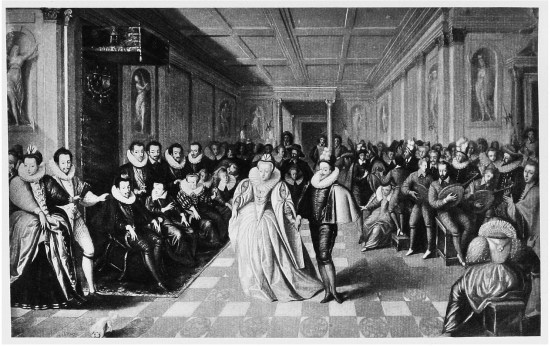
[This refers to “Les Dames Galantes,” and not to the present volume.]
Now, to thoroughly consider how fine a sight was this troupe of beautiful ladies and damoiselles, creatures divine rather than human, we must imagine the entries into Paris and other cities, the sacred and superlative bridals of our kings of France, and their sisters, the daughters of France; such as those of the dauphin, of King Charles, of King Henri III., of the Queen of Spain, of Madame de Lorraine, of the Queen of Navarre, not to speak of many other grand weddings of the princes and princesses, like that of M. de Joyeuse, which would have surpassed them all if the Queen of Navarre had been there. Also we must picture to ourselves the interview at Bayonne, the arrival of the Poles, and an infinite number of other and like magnificences, which I could never finish naming, where I saw these ladies appear, each more beautiful than the rest; some more finely appointed and better dressed than others, because for such festivals, in addition to their great means, the king and queen would give them splendid liveries.
In short, nothing was ever seen finer, more dazzling, dainty, superb; the glory of Niquée never approached it [enchanted palace in “Amadis”]. All this shone in a ballroom of the Tuileries or the Louvre as the stars of heaven in the azure sky. The queen-mother wished and commanded her ladies always to appear in grand and superb apparel, though she herself during her widowhood never clothed herself in worldly silks, unless they were lugubrious, but always properly and so well-fitting that she looked the queen above all else. It is true that on the days of the weddings of her two sons Henri and Charles, she wore gowns of black velvet, wishing, she said, to solemnize the event by so signal an act. While she was married she always dressed very richly and superbly, and looked what she was. And it was fine to see and admire her in the general processions that were made, both in Paris and other cities, such as the Fête Dieu, that of the Rameaux [Palm Sunday], bearing palms and branches with such grace, and on Candlemas Day, when the torches were borne by all the Court, the flames of which contended against their own brilliancy. At these three processions, which are most solemn, we certainly saw nothing but beauty, grace, a noble bearing, a fine gait and splendid apparel, all of which delighted the spectators.
It was fine also to see the queen in her married life going through the country in her litter, being pregnant, or afterwards on horseback attended by forty or fifty ladies and damoiselles mounted on handsome hackneys well caparisoned, and sitting their horses with such good grace that the men could not do better, either in equestrian style or apparel; their hats adorned with plumes which floated in the air as if demanding either love or war. Virgil, who took upon himself to write of the apparel of Queen Dido when she went to the chase, says nothing that approaches the luxury of that of our queen with her ladies, may it not displease her, as I think I have said elsewhere.
This queen (made by the act of the great King François), who introduced this beautiful pageantry, never forgot or let slip anything of the kind she had once learned, but always wanted to imitate or surpass it; I have heard her speak three or four times in my life on this subject. Those who have seen things as I did still feel their souls enchanted like mine, for what I say is true; I know it having seen it.
So there is the Court of our queen. Unhappy was the day when she died! I have heard tell that our present king [Henri IV.], some eighteen months after he saw himself more in hope and prospect of becoming King of France, began one day to discourse with the late M. le Maréchal de Biron, on the plans and projects he would undertake to make his Court prosperous and fine and in all things like that of our said queen, for at that time it was in its greatest lustre and splendour. M. le Maréchal answered: “It is not in your power, nor in that of any king who will ever reign, unless you can manage with God that he shall resuscitate the queen-mother, and bring her round to you.” But that was not what the king wanted, for when she died there was no one whom he hated so much, but without grounds, as I could see, and as he should have known better than I.
How luckless was the day on which such a queen died, at the very point when we had such great necessity for her, and still have!
She died at Blois of sadness caused by the massacre which there took place, and the melancholy tragedy there played, seeing that, without reflection, she had brought the princes to Blois thinking to do well; whereas it was true, as M. le Cardinal de Bourbon said to her: “Alas! madame, you have led us all to butchery without intending it.” That so touched her heart, and also the death of those poor men, that she took to her bed, having previously felt ill, and never rose again.
They say that when the king announced to her the murder of M. de Guise, saying that he was now absolutely king, without equal, or master, she asked him if he had put the affairs of his kingdom in order before striking the blow. To which he answered yes. “God grant it, my son,” she said. Very prudent that she was, she foresaw plainly what would happen to him, and to all the kingdom.[5]
Persons have spoken diversely as to her death, and even as to poison. Possibly it was so, possibly not; but she was held to have died of desperation, and she had reason to do so.
She was placed on her state-bed, as one of her ladies told me, neither more nor less like Queen Anne of whom I have already spoken, clothed in the same royal garments that the said Queen Anne wore, they not having served since her death for any others; and thus she was borne to the church of the castle, with the same pomp and solemnity as Queen Anne, where she lies and rests still. The king wished to take her to Chartres and thence to Saint-Denis, to put her with the king, her husband, in the same tomb which she had caused to be made, built, and constructed, so noble and superb, but the war which came on prevented it.
This is what I can say at this time of this great queen, who has given assuredly such noble grounds to speak worthily of her that this short discourse is not enough for her praise. I know that well; also that the quality of my speech does not suffice, for better speakers than I would be insufficient. At any rate, such as my discourse is, I lay it, in all humility and devotion, at her feet; also I would avoid too great prolixity, for which indeed I feel myself too capable; but I hope I shall not separate from her much, although in my discourses I shall be silent, and only speak of what her noble and incomparable virtues command me, giving me ample matter so to do, I having seen all that I have written of her; and as for what had happened before my time, I heard it from persons most illustrious; and thus I shall do in all my books.
This queen, who was of many kings the mother, Of queens also, belonging here to France, Died when we had most need of her support; For none but she could give us true assistance.
Mézeray [in his “History of France”], who never thinks of the dramatic, nevertheless makes known to us at the start his principal personages; he shows them more especially in action, without detaching them too much from the general sentiment and interests of which they are the leaders and representatives, while, at the same time, he leaves to each his individual physiognomy. The old Connétable de Montmorency, the Guises, Admiral de Coligny, the Chancellor de l’Hôpital define themselves on his pages by their conduct and proceedings even more than by the judgment he awards them. Catherine de’ Medici is painted there in all her dissimulation and her network of artifices, in which she was often caught herself; ambitious of sovereign power without possessing either the force or the genius of it; striving to obtain it by craft, and using for this purpose a continual system of what we should call to-day see-sawing; “rousing and elevating for a time one faction, putting to sleep or lowering another; uniting herself sometimes with the feeblest side out of caution, lest the stronger should crush her; sometimes with the stronger from necessity; at times standing neutral when she felt herself strong enough to command both sides, but without intention to extinguish either.” Far from being always too Catholic, there are moments when she seems to lean to the Reformed religion and to wish to grant too much to that party; and this with more sincerity, perhaps, than belonged to her naturally. The Catherine de’ Medici, such as she presents herself and is developed in plain truth on the pages of Mézeray is well calculated to tempt a modern writer. As there is nothing new but that which is old, for often discoveries are nothing more than that which was once known and is forgotten, the day when a modern historian shall take up the Catherine de’ Medici of Mézeray and give her some of the rather forced features which are to the taste of the present day, there will come a great cry of astonishment and admiration, and the critics will register a new discovery.[6]
M. Niel, librarian to the ministry of the Interior, an enlightened amateur of the arts and of history, has been engaged since 1848 in publishing a series of Portraits or “Crayons” of the celebrated personages of the sixteenth century, kings, queens, mistresses of kings, etc., the whole forming already a folio volume. M. Niel has applied himself in this collection to reproduce none but authentic portraits and solely from the original, and he has confined himself to a single form of portraiture, that which was drawn in crayons of divers colours by artists of the sixteenth century. “They designated in those days by the name of ‘crayons,’” he observes, “certain portraits executed on paper in red chalk, in black lead, and in white chalk, shaded and touched in a way to present the effect of painting.” These designs, faithfully reproduced, in which the red tone predominates, are for the most part originally due to unknown artists, who seem to have belonged to the true French lineage of art. They resemble the humble companions and followers of our chroniclers who simply sought in their rapid sketches to catch physiognomies, such as they saw them, with truth and candour; the likeness alone concerned them.
François I. leads the procession with his obscure wives, and one, at least, of his obscure mistresses, the Comtesse de Châteaubriant. Henri II. succeeds him, giving one hand to Catherine de’ Medici, the other to Diane de Poitiers. We are shown a Marie Stuart, young, before and after her widowhood. In general, the men gain most from this rapid reproduction of feature; whereas with the women it needs an effort of the imagination to catch their delicacy and the flower of their beauty. Charles IX. at twelve years of age, and again at eighteen and twenty, is there to the life and caught from nature. Henri IV. is shown to us younger and fresher than as we are wont to see him,—a Henri de Navarre quite novel and before his beard grizzled. His first wife, Marguerite de Valois, is portrayed at her most beauteous age, but so masked by her costume and cramped in her ruff that we need to be aware of her charm to be certain that the doll-like figure had any. Gabrielle d’Estrées, who stands aloof, stiffly imprisoned in her gorgeous clothes, also needs explanation and reflection before she appears what she really was. The testimony of “Notices” aids these portraits; for M. Niel accompanies his personages with remarks made with erudition and an inquiring mind.
One of the brief writings of that period which make known clearly the person and nature of Henri IV. is the Memoir of the first president of Normandy, Claude Groulard, at all times faithful to the king, who has left us a naïve account of his frequent journeys to that prince and the sojourns he made with him. Among many remarks which Groulard has collected from the lips of Henri IV. there is one that paints the king well in his sound good sense, his freedom from rancour, and his knowledge—always practical, never ideal—of human beings. Groulard is relating the approaching marriage of the king with a princess of Florence. When Henri IV. announced it to him the worthy president replied by an erudite comparison with the lance of Achilles, saying that the Florentine house would thus repair the wounds it had given to France in the person of Catherine de’ Medici. “But I ask you,” said Henri IV., speaking thereupon of Catherine and excusing her, “I ask you what a poor woman could do, left by the death of her husband, with five little children on her arms, and two families in France who were thinking to grasp the crown,—ours and the Guises. Was she not compelled to play strange parts to deceive first one and then the other, in order to guard, as she has done, her sons, who have successively reigned through the wise conduct of that shrewd woman? I am surprised that she never did worse.”
Sainte-Beuve, Causeries du Lundi (1855).