Front matter (continued 2)
Reading edition
Any one using a little perseverance and judgment may secure, at any part of the coast, sufficient good specimens to stock a tank of moderate size; and if the collection be watched closely for a week or two, the unsuitable sorts will make themselves known by their increasing shabbiness, and must either be removed altogether or treated according to the instructions to be included under the head of management in a subsequent chapter.
A few anemones may be detached from the rocky hollows in which they have ensconced themselves. The common smooth anemone, which may be known in a moment by its near resemblance to a large deep coloured strawberry, should be secured in plentiful numbers, for it is equal to most of its kindred in beauty, and is so hardy as to submit to the harshest treatment unhurt; the more delicate kinds of anemones, especially the white ones, should be obtained in the same way as the weeds; namely, detached with a portion of the rock on which they are found adhering.
In packing the collection for carriage, care must be taken not to allow any pieces of rock to press upon the soft anemones. The whole may be brought away in jars of sea-water, or packed in masses of wet fuci gathered from the beach.
There are very few of the specimens so obtained, but may be as well or better conveyed in wet sea-weed than in water, and if they remain a couple of days so packed, they will take little harm, and may be quickly revived if put into shallow bowls, with a little sea water, and oxygenised by means of the syringe before being placed in the tank. On this head I can say no more here, but must refer the reader for minute instructions to the chapter on specimen collection, in my work on Rustic Adornments, though, what should be sought on the beach, may be judged from the kinds recommended in the succeeding chapters, as well also as to what should be purchased from time to time. Before any specimens are placed in the tank, they ought to be rinsed with sea-water, and any barnacles or sponges scraped off the pieces of rock to which the plants are attached. Any neglect of this will be sure to be followed by the production in the tank of sulphuretted hydrogen, which blackens and kills all before it. Nor should any animal that appears exhausted be consigned to the tank until it has been kept some little time in a shallow bowl with a few weeds, and revived by the occasional use of the syringe. Otherwise, delays are dangerous, and no time should be lost in conveying the several objects to their proper home in the little crystal palace, where blue eyes are to admire, and ruddy lips smile approval of your work.
CHAPTER IV.
THE PLANTS.
As already stated, the green weeds are most suitable, the red next so, but of the brown and olive sorts there are very few that can be kept in a state of health for any length of time. There are only two plants suitable for the commencement of the experiment, and these are Ulva latissima, the common sea lettuce, and Enteromorpha compressa, a delicate grass-like algæ, of a very cheerful green. Of these Mr. Lloyd and Mr. Hall have always plenty on hand, ready cleaned and prepared for immediate submersion. Artificial water soon acquires the properties of natural sea water under the influence of these plants, which grow rapidly, and disseminate their spores throughout the tank, at the same time giving abundance of oxygen for the support of animal life.
When a few weeks have elapsed Chondrus crispus, better known as "Carrageen moss," may be added, it is a free grower found in plenty on the ledges at extreme low-water mark. The green weeds Codium tomentosum, Cladophora arcta, and rupestris, and Bryopsis plumosa may be considered safe stock when the water has been in use a month or two, but the growth of the more delicate of the Rhodosperms must not be attempted in artificial water for at least three or four months.
The best weeds of the latter class are Phyllophora rubens, Corallina officinalis, and Iridæa edulis. In collecting, no doubt the Dulse, Delesseria alata, and sanguinea, with, perhaps, some of the Polysiphoniæ will be considered valuable prizes, but they will not succeed in any but experienced hands, for whom this work is not written.
Dasya, Chylocladia, Nitophyllum, Griffithsia, Rhodymenia, and Ptilota will all contribute specimens as time goes on, and opportunity affords for obtaining them. But not one of these lovely weeds of the red class are fit for ordinary aquarian tactics, they are the "florists' flowers" of the aquarian world, and refuse to be domesticated by any but adepts. The exquisitely delicate Griffithsia setacea is perhaps the only one of the above that may be safely used in a well-seasoned tank of artificial water; the other genera seem to be still more delicately constituted and to require their own native element in a state of great purity.
Once more I urge the beginner to be content with Ulva and Enteromorpha at starting, with half-a-dozen plants of each of these, a large and pleasing variety of animal life may be preserved, and in the case of disaster of any kind, these are the most readily restored to health by a little timely and judicious management.
All coarse and dark coloured weeds, however tempting at first sight, are to be avoided. The sprawling tangles that one steps over in traversing the boulders and the slimy masses of sea-weed, everywhere cast upon the coast, are quite unfit, however fine the specimens, or strong the desire to possess them. Neither must much value be attached to any weed cast up by the surge. The only trustworthy specimens are those chipped from the rock in situ and brought away without being detached from their natural basis.
CHAPTER V.
THE ANIMALS.
Though Anemones take precedence in the order of stocking, and frequently monopolise the tank—for, after all, these are the main attraction of most marine aquaria—yet, as they do not stand the highest in the order of nature, we must recount zoologically what creatures are best fitted for domestication, and in another chapter give directions as to their selection and management.
Fishes take the first place, because they are the highest forms of life admitted to the marine tank; but they are the last introduced, because, being more delicately organized than the tribes beneath them, they require either real sea-water, in a state of high preservation, or artificial water of some months' seasoning, and good management.
The fishes best adapted for tank life are the queer-looking gobies, the lively blennies, small specimens of wrasse, rockling, and eel. The grey mullet is a pretty fish, but not to be domesticated without some difficulty. Some kinds of flat fish may be kept in tanks, but beginners had better have nothing to do with them. Small sticklebacks may be taken in plenty by means of a hand-net in quiet tide-pools, and do well in the tank, but they are pugnacious, and harass less vigorous creatures; so that some judgment is required in grouping them.
Mollusks.—The common Periwinkle is useful as a cleaner, and interesting also to those who find pleasure in contemplating the startling resources of Divine Wisdom, as evidenced in the construction of the most humble creatures. The winkles accomplish for the marine-tank what the fresh-water snails do for the river-tank, they scrape confervoid growths from the glass, and so help to preserve the crystalline aspect of the tank. All the species of winkle are capable of domestication, Littorina littorea, the common sort, and E. littoralis, a pretty little fellow, with a gaily mottled hybernaculum.
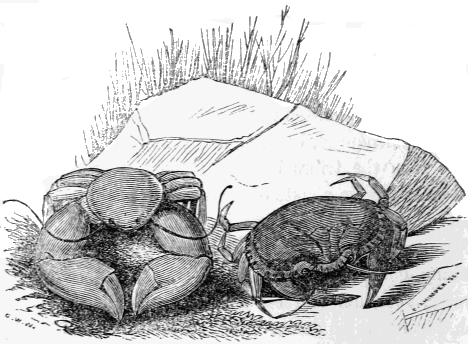
PORCELLANA PLATYCHELES, CANCER PAGURUS.
The Trochus tribe, better known as Tops, are also useful as cleaners, and in appearance are more stately and ornamental than the winkle, their cleanly marked conical shell attracting as much attention from strange eyes as the noble planorbis corneus does in the river-tank. Generally speaking, univalves are more easily kept than bivalves; many of the latter are apt to die off, and cause some amount of putrescence before their demise is discovered.
Crustacea are lively and interesting, but of course small species, or small specimens of large species are the most suitable. The Soldier crabs (Pagurus) and the Swimming crabs (Portunus) are eminently suitable, so is the pretty Strawberry crab, Eurynome aspera, and the interesting Broad-claw Porcellana platycheles. Shrimps and prawns may be used freely; they are lively creatures, and much more beautiful when seen in motion, gliding about like ghosts, than would be imagined by any one judging from the appearance of specimens on the table.
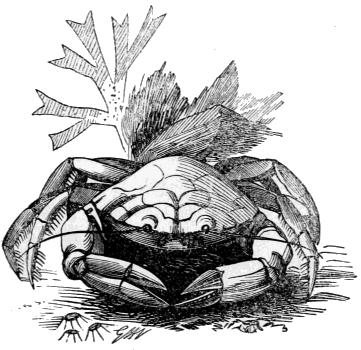
CARCINAS MÆNAS.
Annelides afford us the interesting serpulas, some pretty sea-worms, and the terebellas, all easy of preservation, and remunerative of the attention bestowed upon them.
Zoophytes.—This is the division from which the most prominent attractions of the tank are derived. Of these the Actinia take precedence of all the ordinary inhabitants of the tank, because of their exquisite beauty, strange habits, and still more general certainty attending their preservation.
Actinia mesembryanthemum is the common Smooth Anemone which abounds on every part of our coast. Its colour varies considerably, but it is usually of a deep, warm chocolate, dotted all over with small yellow spots, and when closed has the best possible resemblance to a large ripe strawberry. Every stone about the sea-beach is studded with this anemone, and a collector may secure any required number in a few hours, slipping each from its base, and dropping the whole into a jar with some fragments of fresh wet weed to keep them moist.
When it expands, a circle of bright blue beads, or tubercules, resembling torquoises, is seen just within the central opening; and, as the expansion proceeds, a number of coral-like fingers, or tentacles, unfold from the centre, and at last spread out on all sides like the hundred petals of a Peri flower, reminding one of Hinda's boon:—
----Be it our's to embellish thy pillow
With everything beauteous that grows in the deep;
Each flower of the rock, and each gem of the billow,
Shall sweeten thy bed and illumine thy sleep.
Around thee shall glisten the loveliest amber
That ever the sorrowing sea-bird has wept,
With many a shell in whose hollow-wreathed chamber
We, Peris of Ocean, by moonlight have slept.
Lalla Roohk.
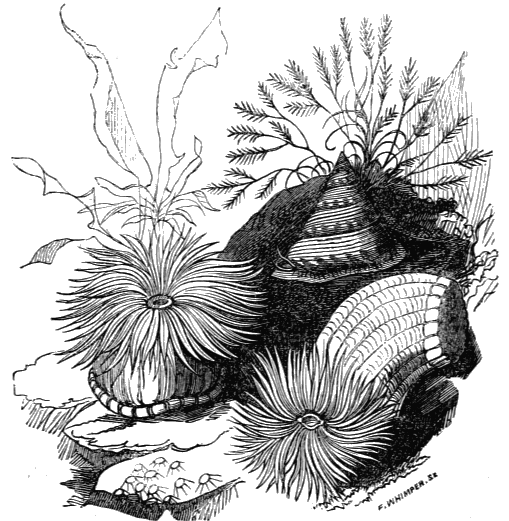
ACTINIA ANGUICOMA, TROCHUS ZIZIPHINUS, ULVA LATISSIMA, BRYOPSIS PLUMOSA, ACORN BARNACLE.
This anemone will remain expanded for many days together, if the water be kept bright and pure; but if the tank gets fouled, it closes and falls from its foothold, and perishes if not attended to. It is the hardiest of all the creatures that are regarded as stock for tanks, and survives many a wreck unhurt. To induce it to climb up the sides of the vessel, let it be placed with its base lying partly against it, or bring it close to a stone in the centre, and it will be pretty sure to attach itself where you desire in the course of a few days. This last suggestion applies to anemones generally; novices are surprised to find how well disposed the creatures are in a well-kept tank. The disposition dates from the day of introduction, for none of this tribe are fond of locomotion; and the arrangement of them for effect, depends upon whether you drop them quietly just in contact with the spot you wish them to adhere to, or throw them in pell mell, to cling to the weeds or to each other.
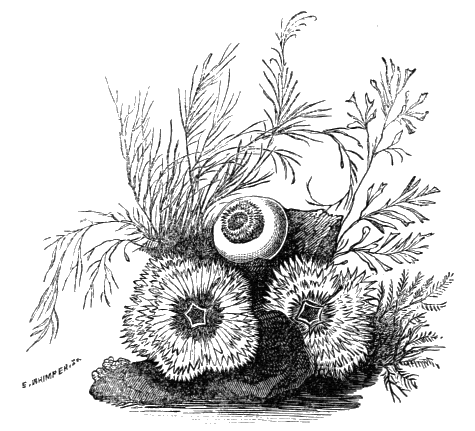
ACTINIA BELLIS AND GEMMACEA, DELESSERIA ALATA, POLYSIPHONIA URCEOLATA.
A. anguicoma, or the snaky-locked anemone, is a pretty but curious creature. It is all arms, just as a crab is all claws; but so delicate in form, so beautifully striped in the tentacles, that it stands quite apart in the tank as a thing unique. When found on the sea-shore, as it is usually after a storm, it is a flat-looking, smooth mass, of a brown tint, delicately striped with yellow and white. After a few days' residence in the tank, it begins to expand, and rises to so tall a figure, especially in the twilight, that it appears quite a different creature to that introduced a few days before. In fact, its actual bulk is increased vastly by expansion. It is constantly expanded.
A. Bellis is another good species. It is a delicate pink and brown and pink and white anemone, and certainly does resemble a daisy very closely indeed. Though much prized it is not rare. Mr. Lloyd usually has abundance of them on sale, at a shilling each, and a few should be used to give variety to the collection. In newly-made marine-water it will not do at all; but if it falls into the possession of an aquarian who has no ripe tank at hand for it, it may be kept for weeks in a shallow pan.
If anything goes wrong with this kind, it throws out a number of white threads, and shrinks out of form, and perishes in a few days; but once obtained in a sound state, and carefully treated at the outset, it is as hardy as mesembryanthemum, and more readily expanded at all seasons than most of its compeers.
Actinia Gemmacea.—This is a delicately-constituted anemone, that displays itself freely only in the most pure sea-water, in which there is abundance of oxygen. It is quite unfit for early experiments, but well repays the trouble it occasions when it can be successfully kept. A few weeks since I had the pleasure of witnessing the birth of a large cluster of this pretty anemone in the extensive collection of Mr. Lloyd, at Portland Road. To the naked eye they appeared mere flocculent specks, but a lens revealed their true form as they adhered to the side of the vessel; every one of the little creatures, with its tentacles expanded, a real microscopic gem, combining the grace of a flower with the tinting of a pearl, and the delicate volition of a new-born animal.
When full grown, the gemmed anemone is very showy in its tintings. Pink, yellow, and grey are all beautifully blended, and the rows of glands which reach from the margin to the base, add their dots of white to the garments of this tiny harlequin. The disk is brilliantly coloured, scarlet, green, and orange, shading into each other, and occasionally mingled with half-tints of every colour of the rainbow. The lip is usually of a vivid green, and the tentacles exhibit rose, violet, orange, and white on their upper surfaces. In the cut, this anemone is seen partially closed on a piece of stone behind two specimens of A. Bellis.
Actinia Crassicornis is another of the more delicate kinds, that dies speedily, unless treated with great care, and in a well-established tank. It is very abundant on every part of our coasts, and must be removed with the stone to which it is found adhering; for if removed, or even handled, it perishes in the course of a few hours. It is, however, too beautiful not to be worth an effort to preserve it; and, if the tank is in good condition, it will be well to obtain two or three specimens, and watch them narrowly, so that if any of them die, they may be immediately removed to avoid polluting the water.
The colour of this anemone varies considerably in different specimens. Violet and amber shades frequently predominate in the tentacles. Sometimes the disk is of a pearly white, at others of a warm fawn or bright orange and scarlet, sometimes a deep crimson or a dull chocolate; while the tentacles vary from pure white to dark brown, dingy fawn, and brick-dust red. The latter organs are very numerous and tubular. When irritated, the creature has the power of attaching the tentacles to the object which annoys it, and in this way it frequently clings to the fingers when handled, and at the same time squirts out numerous jets of water, until it is quite empty and collapsed.
Actinia Parasitica.—This is a good aquarium species, on account of the ease with which it may be kept. It is a species that the rambler on the sea-beach will not be at all likely to meet with, for it is truly pelagic in its habit. It is only to be obtained in a state fit for the aquarium by means of the dredge, and when so obtained it lives a long while in confinement.
The most interesting feature in the history of this zoophyte is that of its usually inhabiting the shell of some defunct univalve mollusk, such as the Trochus, or the great whelk, Buccinum undatum. This is not the most curious part of its history. The anemone loves company, and in the same shell as that on which it extends itself, we usually find a pretty but pugnacious crab, Pagurus bernhardus. To the anemone the crab acts as porter; he drags the shell about with him as if it were a palanquin, on which sits enthroned a very bloated but gaily-dressed potentate, destitute of power to move it for himself. Like most lazy dignitaries, this showy Actinia attracts more attention than the lively servant who drags it from place to place, for its form and colouring are beautiful in the extreme.
It is of large size, frequently attaining to a height of four inches with a diameter of two and a half. Mr. Gosse's description of this fine creature is so minute and interesting, that I must beg the reader to accept it in preference to any that I can write. He says, the "ground colour is a dirty white, or drab, often slightly tinged with pale yellow; longitudinal bands of dark wood-brown, reddish, or purplish brown, run down the body, sometimes very regularly, and set so closely as to leave the intermediate bands of ground colour much narrower than themselves; at other times these bands are narrower, more separated, and variously interrupted or broken. I have seen a variety in which the bands took the form of chains of round dark spots, the effect of which was handsome. Immediately round the base the bands usually subdivide, and are varied by a single series of upright, oblong spots of rich yellow, which are usually marginal, with deeper brown than the bands. The whole body is surrounded by close-set faint lines of pale blue, sometimes scarcely distinguishable, except near the summit, where they cut the bands in such a manner as to form, with other similar lines which there run lengthwise, a reticulated pattern.
"The disk is somewhat wider than the diameter of the body, which it over-arches on all sides. Its margin is somewhat thin, and occasionally thrown into puckered folds to a small extent. Thus it appears to approach the peculiar form of A. bellis. The disk is nearly flat, or slightly hollowed, but rises in the centre into a stout cone, in the middle of which is the mouth, edged with crenated lips. The tentacles are arranged in seven rows, of which the innermost contains about twenty, the second twenty-four, the third forty-eight, the fourth ninety-six; the other rows are too closely set, and too numerous to be distinguished. Probably the whole number of tentacles, in a full-grown specimen, may be considered as certainly not less than 500."
Actinia Dianthus.—This is the Plumose anemone of Mr. Gosse, and sometimes bears the very appropriate name of the Carnation anemone. It is the most superb of our native Actinias—a gorgeous creature, that in itself more than realizes our brightest imaginings of the hidden splendours of the ocean floor, and of the gems that bedeck the caves of Neptune. How will future poetry be affected by the revelations of the aquarium, and how far will the sober facts of scientific research influence the pictures and the incidents of romance? Even Keats's glowing description of "God Neptune's palaces" becomes tame in the presence of this splendid creature, which carries the fancy—
----"far below The sea-blooms and the oozy woods, which wear The sapless foliage of the ocean,"
and peoples the dark slippery slopes with wondrous forms of life and beauty, as if the lost argosies and the perished navies, that have found a common sepulchre in the waters, had given up their myriad souls to the conjuration of Glacus and Scylla, and all the dizzy troop of ocean spirits. It is, verily, a wondrous creature, of enormous size, and so delicately tinted, so light and fairy-like in structure, so constantly expanding and retracting its thousand delicate fingers, like the Indian blossom that the Brahmin believes to be endowed with life, that it never ceases to attract the attention of the coldest, and fill the ardent lover of nature with—
----"the amaze Of deep-seen wonders."
I have before me now five specimens of this splendid anemone. They are all expanded, and they glow in the sunshine like huge carnations of the brightest amber, one of them verging towards a pure white. Two of these are represented in the engraving, surrounded by fronds of Delesseria sanguinea, Callithamnium, and Griffithsia. The one attached to the perpendicular side of a stone is of the golden amber variety; when fully expanded it forms a massive column of five inches in height, at least, and nearly three in diameter. From the summit of the column the tentacles fringe over in rich masses, like the petals of a monster carnation, all of them in motion as if seeking something which they cannot find. The tentacular disk is deeply frilled and puckered, and constantly changes its outline under the capricious will of the animal; while, at the same time, the tentacles arrange and rearrange themselves into most confusing forms; then again expand to their utmost, and expose the oval mouth and crenated lips, of a pellucid softness that would appear as if chiselled out of alabaster, were they not constantly varying their form, and every instant undergoing a new "sea-change." The tentacles are very regularly arranged around the mouth, but towards the margin they thicken and thicken till they form a dense fringe that overlaps the column, and continues ever waving as if stirred by trembling ocean currents. If I now strike the glass with my finger, or even breathe lightly on the surface of the water, they are all withdrawn, the stately column shrinks down into a mass of pulp, and in a few moments swells out like a globular balloon, so tight and large that one momentarily expects it to burst. For an instant only it remains thus blown out; it is suddenly constricted as if clasped by a cord, and it then becomes double like a pair of globes placed one upon the other, and flattened where they meet. Suddenly the imaginary girdle slips downward, disappears, then it contracts, rises again, assumes its noblest proportions, expands its thousand fringes, all delicately waving above the dark stones, and is once more as lovely, or lovelier than ever.
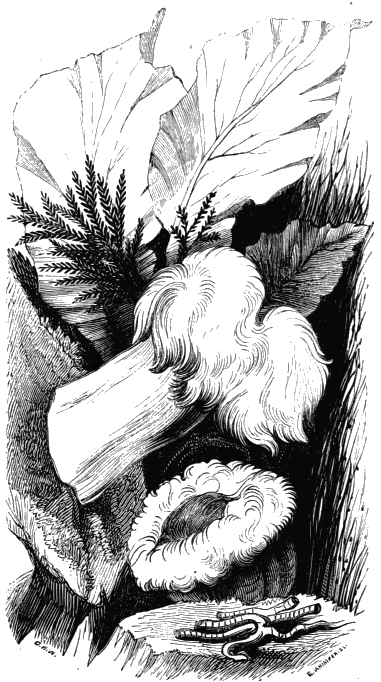
ACTINIA DIANTHUS, DELESSERIA SANGUINEA, CALLITHAMNIUM ROSEUM, GRIFFITHSIA SETACEA.
This has been described as one of the most tender of its class, but I have long been convinced that it is comparatively hardy, and may be preserved with very great certainty. So long as the water is kept moderately pure, by an occasional filtering through charcoal—which aerates and purifies at the same time—it lives and prospers, occasionally moving from place to place, but almost always expanded, and every instant assuming some new form. It is, however, so far delicate that, if frequently disturbed, it is sure to perish. When removed from its native "oozy bed" it should be kept on the stone or shell to which it is found attached, until it floats off of its own accord, and fixes itself elsewhere. When handled it throws out a number of white threads, which are afterwards withdrawn.
CHAPTER VI.
WHAT IS AN ANEMONE?
It is very strange that where the animal and vegetable kingdoms meet, the forms should assume such close resemblances to each other, as to make it frequently a matter of difficulty to determine to which of the two great departments some special specimen shall be assigned. Here are the lovely sea-flowers—flowers only in name and appearance—representing the lowest links of animal life and pointing to that last link where the animal and the vegetable blend into one, bearing all the outward resemblances to flowers from which they take their appropriate names, yet all of them strictly animals, endowed with volition, and in their general organization assimilating to the extensive series of zoological orders which stand above and beneath them. The sea anemones are animals of the lowest class—zoophytes of the great Cuverian division of Radiata. It is in this division that animation is seen to tremble and flicker in the socket, and to become gradually extinguished as we descend the scale and approach the confines of the kingdom of verdure. Here, then, life has its lowest if not least lovely forms; the individuals have less individuality, many of them live in groups and clusters, and increase in a semi-vegetative manner by gemmation, or the formation of bud-like germs, while others generate by spontaneous fissure, and break up into numerous forms, each of which rapidly acquires the form of the parent, and proceeds in the same way to increase its kind.
The Radiata are so named on account of the ray-like form generally observable in the structure of the creatures; in some the ray-like divisions give such a speciality to the structure as to distinguish them at once as members of this division; as in the star-fishes, for instance, in which the intestinal canal branches out from the body into the several rays which form the star, and in the anemones, in which the relation to the tribe is at first sight perceptible in the tentacles which surround the mouth, and which render it so exquisitely beautiful as a marine representative of a true flower.
But though the term Radiata is applied to an extensive division, in which the members have many characteristics in common with each other, the ray-like form is not equally distinguishable in all. In some tribes there is a tendency to associate into groups, in which each individual has a certain degree of connection with the rest, as in the infusoria common in our brooks, and indeed most of the polypes which thus live in community. The resemblance to vegetable forms is, however, common to a great portion of the Radiata, and those in which this resemblance is the strongest are grouped together under the general designation of Zoophytes. In Zoophytes, the leading feature of a radiate animal is very distinctly observable, and that leading feature is the arrangement of the vital organs around a centre, the organs composing the rays of the imaginary star, or the petals of the imaginary flower, to which the mouth or stomach is the centre.
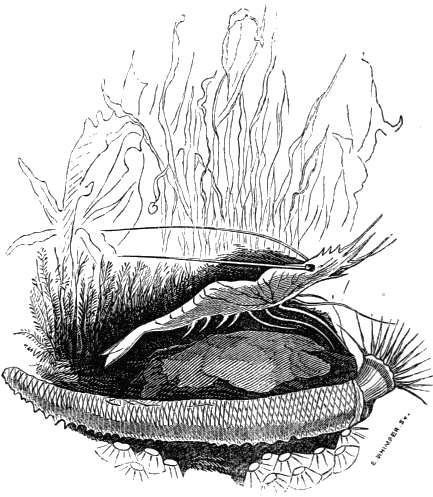
EDWARDSIA VESTITA, ÆSOP PRAWN, ENTEROMORPHA COMPRESSA, ULVA LATISSIMA.
Among the Zoophytes we meet with many of the creatures which have the greatest attraction for the student of the Aquarium. The brooks supply him with the curious hydra, the seven-headed monster that perpetuates one of the triumphs of Hercules—withal a beautiful and wondrous creature, that may be cut in pieces, turned inside out, or even thrust one animal within the other, and still remain the same. The sea supplies the madrepores, the builders of ocean-reefs, and the founders of islands and continents; as it also supplies the sea anemones of more than a hundred species, from the curious Edwardsia vestita, here figured, from the first seen in this country, at present in the collection of Mr. Alford Lloyd, to the familiar members of the genus Actinia, obtainable everywhere on our coasts.
The true Zoophytes have all, more or less, the plant-like form, and they readily separate into two great classes, namely, the Anthozoa, or flower-life, and the Polyzoa, or many-life, in which the individuals are associated together in numbers. They are all inhabitants of water, are all destitute of joints, lungs, nerves, and proper blood-vessels; but in the place of nerves possess what naturalists call an irritable system, in obedience to which they expand or contract at will. At the upper part of the body is situated the mouth, which is usually surrounded with tentacles, which are mostly used in securing prey. There is no alimentary duct, for the stomach has the form of a simple sac, the aliment being injected and ejected by the same orifice.
The Anthozoa comprise animals which are perfect in themselves, and these are mostly soft bodied, having no shelly covering, and are protected only by the leathery integument which surrounds them, and the thousand weapons of offence and defence which they expand in the form of tentacles. Among the Polyzoa we meet with creatures that encase themselves in horny shells, or calcareous coatings, such as the Madrepores, which, like submarine masons, elaborate the carbonate of lime which the sea supplies them with, into shelly retreats; and the tubed Hydrioda, which construct winding galleries and convoluted tubes, from the mouths of which they protrude their fans and tentacles in search of prey.
Among the higher orders of the Radiata we meet with the strange Sea Cucumbers and the Sea Urchins, and the Star fishes; and among the lower orders the Sea Anemones, many forms of which are described and figured in these pages.
A Sea Anemone, then, is a Zoophyte belonging to the class Anthozoa, or flower-life, and the order Helanthoida, or sunflower-like creatures. The central disk of the sea flower is composed of the lips, which open into a mouth which communicates with the simple sac which constitutes the stomach, and the petals and fringes which surround it—now like the anemone, now like the sunflower or the mesembryanthemum, or the richest carnation that ever won for a florist a golden prize. The further subdivision is dependent on the details of individual structure; and a large section—that of Actinia—comprehends most of those on which the aquarian bestows his patience in the work of domestication.
The Actiniadæ—so named from the Greek—signifying a ray of the sun—are an extensive family, of which more than a hundred species are to be found on our coasts, or in the deep bays adjacent. But few of these are suited for confinement in aquaria, and of these the chief are the Actinia proper, the Sagartia, most of which are usually grouped with the Actinia; the Anthea Cereus; the splendid Adamsia Palliata, which is the only known species of the genus to which it belongs; and a few of the Bunodes, Edwardsia, and Corynactis.
In all the varieties of sea anemones the mode of life is similar; they are carnivorous, and obtain their prey by means of the ever-seeking tentacles that search the lymph around them, and secure sometimes fishes, at others mollusks, but more frequently the minute forms of infusorial life that abound in the sea, or in the artificial water of the tank. The mode of reproduction is by ova, which are sometimes vivified in the body of the parent, and not only do they give birth by ejection from the mouth of a numerous progeny, but actual divisions of the body may be made, and each division will acquire completeness. Dr. Johnson relates several instances in proof of this, one of which is particularly interesting. A specimen of Actinia crassicornis had swallowed a large, sharp-edged shell, which so completely stretched the body of the creature as if on a ring of wire, as virtually to cut it into two equal parts. Thereupon it put out from the base a new disk, with mouth and tentacles, and became at once a double anemone, to which the gorged shell served as an intermediate base of attachment. Dr. Cocks has seen specimens of Bunodes alba acquire complete forms in duplicate when the original specimen has been severed into two or more parts; and there are many other instances on record of this plant-like division of sea anemones having been observed.
Though apparently immobile, there are few species but possess some power of locomotion. We frequently meet with anemones attached to stones, sand, or shells, by a wide sucking base, and if some species be moved from their chosen site, certain death is the result. Yet in by far the greater number there is a distinct faculty of progression—the anemone, by a slow, gliding motion, gradually removes itself, and climbs up the sides of the vessel, or takes possession of a tuft of weed, or shifts from one stone to another, or fairly leaves go of its anchorage, and floats like a balloon upon the surface. Thus low in the scale as they are, they possess will, and a power of obeying it; they have their organs of locomotion, of attack, and defence; though naked, they are armed for combat on an equality with their enemies, and succumb at last to man—the universal destroyer and appropriator—who turns them to account as food, or treasures them as gems of beauty that gratify his eye, and even win over the affections of his heart, while they lead him to contemplate the variety and profuseness of that life to which the Almighty has given so many wondrous forms, and instincts, and economies, every one of which proclaims—
"The hand that made us is divine."
CHAPTER VII.
GENERAL MANAGEMENT.
I shall in this Chapter only notice such particulars in the management of aquaria as belong especially to the marine department, since some of the directions given in the former division of the work apply to tanks of all kinds, and need not be repeated. When preliminary difficulties have been surmounted, the matter of first importance is the selection of the stock, and its arrangement in accordance with just principles.
Grouping.—In Chapters IV. and V. I have enumerated the kinds of animals and plants most suitable for aquaria, and must now caution the beginner against the injudicious grouping together of creatures of dissimilar habits. Anemones may, as a rule, be kept together. The several species agree well, and seldom or rarely injure each other; but star-fishes and crabs are best kept in vessels apart from them. Star-fishes are very destructive, and readily absorb the bodies of mollusks out of their shells. If exception is to be taken to any particular anemone, I think the grand plumosa must suffer by it; for this noble creature gives off a flocculent exudation, which seems injurious to other kinds. I have generally kept the plumose anemone in company with A. mesembryanthemum, A. bellis, troglodytes, and others, without perceiving any bad result; but I have always been careful to remove the slimy exuvia daily, by means of the dipping tube. Respecting mollusks, and especially trochus and most bivalves, it should be borne in mind that they are apt to die off rapidly, and to cause a putrescence of a most obnoxious character, which soon spoils the water, and causes a general havoc. Another remark applicable to mollusks is this, that the Eolids—members of the Nudibranch, or naked mollusks—are destructive of anemones, and delight in nibbling holes in their coats, or eating off their tentacles; whereas the pretty doris may be kept as long as it will live, in company with the most delicate creatures, without offering offence to any. The more varied the collection the more is our interest in its examination increased; and the possessor of a single vessel, or of a tank, and a few auxiliary jars, will be naturally anxious to preserve representatives of as many tribes as possible; and this may be done, to a certain extent, by appropriating the vessels to such creatures as agree amicably in confinement. It is, indeed, possible, if a vigilant watchfulness be observed, to bring together and preserve, for a length of time, specimens of creatures that are naturally antagonistic to each other; but where Crustaceans can be kept apart in one vessel, with perhaps a few fish, such as gobies and blennies—a second appropriated to anemones and madrepores—and a third to mollusks, madrepores, and tubeworms—there will be the greater certainty of success, and less supervision will be required. Crabs are very annoying to anemones, as they scratch and sprawl over the delicate creatures; and shrimps, prawns, and fishes frequently fall a prey to the barbed threads and the tentacles of the anemones; the latter also frequently take possession of the mouths of the cells of tube worms, and of the openings of the shells of mollusks, and thus suffocate the inmates, and insure their own death by the putrescence that ensues upon the demise of their victims.
Sulphuretted hydrogen.—When the death of an animal occurs, the water soon gets putrid; the stones assume a rich brown tint, the sides of the vessel lose their brightness, and an effete odour indicates the cause of the disturbance.
Preservation of the Water.—To those who live near the sea it is an easy matter to change the water, as soon as it shows signs of disorganization, but since the majority of those who will consult this work will have to depend on Mr. Bolton's marine salts, it is necessary that I should suggest in what way, and in the best manner, the water may be preserved, not only to avoid the expense, but the trouble attending a new supply. Charcoal is the grand restorative, purifier, and preserver; and for this department of aquarium management may be regarded as the ne plus ultra.
In the second Chapter of this part of the work I have described the process necessary in preparing artificial water by means of the filter. Now, whatever happens, set the filter to work, it will revive exhausted stock by æration, destroy sulphuretted hydrogen by the contact of the water with the charcoal, and remove all fragments of decayed weed, flocculent threads given off by anemones, and restore the whole to strength and purity. I repeat what I have already said more than once, that the necessity for changing the water is a proof of injudicious management; every new supply is a witness of the aquarian's lack of skill, as Mr. Lloyd wisely says, "properly managed, the water and other contents of an Aquarium may be kept unchanged for periods indefinitely prolonged." For the sake of aquarian science, I do implore the student to surmount any and every difficulty, rather than own the weakness implied by changing the water.
Aeration is frequently referred to in works on the Aquarium. It is at variance with the self-sustaining theory, and there is something wrong where it is wanted. If the tank is stocked before the plants are well established, or if overstocked with a crowd of animal life, or if sulphuretted hydrogen be produced and make its presence manifest to the nose, then æration may be necessary. A cup or jug may be used to dip water from the surface, and pour it back again from a height in a thin stream. Or a filter may be placed over the tank and filled from the surface, and the water allowed to drip back. But the most efficient instrument is a common syringe. This is simply to be charged at the surface, and discharged again with some force, so as to send a stream of oxygenised water deep into the tank. The process should be repeated for a quarter of an hour at least.
Filter.—A bee glass or a common flower-pot may soon be made into a filter. Thrust a piece of sponge into the hole in the bottom, and upon it lay a stratum of washed sand and powdered charcoal. Pass the water through it, and it will be purified, and saturated with oxygen at one and the same time. With the river-tank, the simplest way of reviving exhausted stock is wholly or partially to change the water; with marine stock, such a change is not easy, and the filter comes more legitimately into use. As already remarked, the necessity for æration marks error in management, except when you have stock for which no proper receptacle is at hand, or any such special contingency.
Decay of Plants.—The sea-weeds are apt to acquire a pale tint, which is the first evidence of decay. This generally happens with the first marine stock, when Ulva and Enteromorpha are used to season artificial water. When the water gets ripe, the plants recover and make healthy growth, but if many white fronds appear, lift out the blocks on which the plants are fixed, trim away the decayed portions with a pair of scissors, and then scrub the stones with a small brush in a little waste sea-water, and replace them; they will soon recover. If red plants have been hurriedly introduced, and decay manifests itself, remove them at once, and waste no time in attempts at revival. Mr. Lloyd will supply a new stock for a trifle, and it is better to begin de novo than to attempt to cure the incurable.
Death of Anemones.—If you observe any of the anemones to shrink up like button-covers, lift them out into a shallow vessel, and aerate them liberally. When small beads of gas appear upon them, you may rest assured that they have gone beyond the—
"Bourne from whence no traveller returns;"
for the first outward proof of death is the formation of bubbles of sulphuretted hydrogen upon their bodies, and they should be removed before this spreads and devastates the tank.
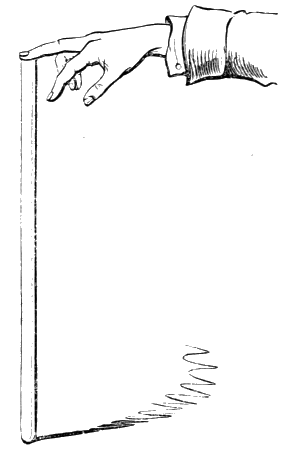
Removal of Objects.—For the removal of portions of decayed weed, and other small noxious bodies, from the bottom, a glass tube of ¼ or ½ inch diameter, open at both ends, will be found very useful. Place a thumb or finger on the top of the tube, and thrust it down over the object to be removed, then remove the finger, and the matter will rise in it. Lift the tube up to the surface of the water, then place the finger on again, and lift the whole away. The advantage of this plan is, that no disturbance is occasioned. A pewter spoon bent to a right angle, and attached to a stick is very useful for lifting up objects that are too large for the dipping tube.
Density of the Water.—Evaporation causes the pure water to escape from the Aquarium, and hence there is a constant tendency to increase of density—in fact, if left alone, the water in the tank soon gets too salt. To prevent this, additions of pure spring or distilled water must be made from time to time, and the amount regulated by a specific gravity bubble, which it would be as well to leave at all times floating in the tank. This instrument registers the density much more accurately than the hydrometer, for it is more delicate in its determination of a balance. I find it expedient to use two bubbles of different specific gravities—one which just floats when the water is sufficiently fluid, and another which just sinks when it is sufficiently saline. The movement of either indicates at once the exact cause, and enables the aquarian to regulate the density to perfection.
Green Stain.—I have never been troubled with confervoid growths in tanks filled with artificial water, though the same water has been in use during periods of from a few months to two years. When it occurs, the mollusks are the natural remedy, the sponge the artificial one. But a strange affection—which I think is most common in spring—is the sudden occurrence of a green turbidity, which destroys the translucence, and for which neither sponge nor winkle can afford a remedy. It is not a growth on the side of the vessel, but a green stain pervading the water, as if a green colouring matter had been dissolved in it. Mr. Gosse says, "it is vegetable in its origin, and arises from an infinite number of the spores (or seeds) of green Algæ dispersed through the fluid, and held in suspension there." Mr. Gosse further says, "I know of no cure for this," but he quotes Mr. Lloyd's experience as demonstrative of its curability by placing the water "in a dark closet for two or three weeks."
From the experience I have had in this matter, I have no hesitation in saying that the filter will be found an instantaneous remedy; the water need not be drawn off at all, but kept filtering through charcoal by frequent filling of the filter from the surface. In May last, a tank of mine became suddenly opaque, though otherwise in excellent order. The collection was valuable, and a disturbance of it would have been attended with risk. I suspended an old flower-pot half filled with fresh charcoal and sea-side grit above it, and set the filter to work. As fast as the filter ran out, I filled it again from the tank, without disturbing anything, and a change for the better was perceptible in an hour. Two days after, the water was as bright as ever, and the stock in the finest possible condition, owing to the brisk æration they had gained by the experiment.
Feeding.—Anemones generally do not require feeding, though the Daisy and the Dianthus will greedily partake of small fragments of oyster and minced mutton, and some other kinds will occasionally eat of the same food; but I cannot recommend the beginner to feed Anemones, for, in a well managed tank, Infusoria are sufficiently abundant to provide them with all they require, and food not eaten soon decays, unless speedily removed. Crabs and prawns positively require feeding, and Madrepores may be fed for amusement. Small fragments of the lean of raw meat should be given, or the flesh of a cooked prawn, and twenty-four hours afterwards, the undigested morsels should be removed.
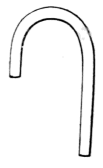
The Syphon is a simple affair enough. In using it, place the short end below the surface of the water in the tank, and apply the mouth to the longer end, and draw till the water flows; it will then continue to flow as long as the short end is kept under water. If you object to promote aquarian science by means of suction, first fill the syphon with water, and apply a finger to each end, and so turn it over, and withdraw the fingers when the short end is dipped beneath the surface of the water in the tank. Mr. Lloyd sells a syphon expressly for the purpose, which the aquarian should possess.
Purchase of Specimens.—There are now many dealers in Aquarian stock, but very few of them supply marine stock in any variety. I have my readers' interest only at heart when I suggest, that no one should attempt to set up an Aquarium without first paying a visit to the establishment of Mr. W. Alford Lloyd, of No. 20, Portland Road, Regent's Park, where choice may be made from a stock consisting of thousands of specimens, supplied, as, the oyster shops say, "fresh every day." Mr. Lloyd was a labourer in the field years before the Aquarium became popular, and his experience, attained by patient study, is now at the service of all who need advice or assistance in any department of the subject.
I have no interest in this matter beyond doing justice to my reader, and beg to add that Mr. Hall, of City Road, has supplied me with marine stock of high character, and that I can recommend him as an honest and intelligent naturalist, though, on marine matters he will not attempt to compete with Mr. Lloyd, for the latter has now the name, the trade, and the organization, and since he keeps everything, so he can supply everything of the commonest or rarest kind, in the highest condition.

THE BOOK OF THE AQUARIUM.
THE WATER CABINET.
CHAPTER I.
CONSTRUCTION OF CABINETS.
Distinctions between the Cabinet and the Aquarium.—The Aquarium has not only spread abroad a love for Natural History, it has also increased the facilities for the study of nature by removing the difficulties which have hitherto attended the preservation, for any length of time, of living specimens of aquatic life. The tank had scarcely taken its place among the resources for pleasureable recreation, and scientific study, when the field of culture extended itself, and every variety of minute life found in the waters, came to have its share of attention for the general profit and delight of the studious. The ordinary tank was found insufficient for the wants of the aquarian, and wherever a large vessel was to be seen stocked with fresh water fishes or marine objects, a collection of small jars, phials, or show glasses, was pretty sure to be found also. In an aquarium, we may group together many dissimilar objects; but it must be evident to the most superficial observer, that when immersed in a large body of water with other creatures, many objects are ill-placed for examination, especially if we use the microscope. Hence, where the study is pursued with any degree of ardour, some special arrangements are necessary to enable us to keep in a healthy state, and in a way that admits of close scrutiny at any moment, such of the smaller aquatic objects as most commend themselves for beauty or scientific interest. Many beginners, unable to resist the temptation of a jar of beetles, or a collection of larva, and having no other means of keeping them, have placed them in the tank to mingle with the stock of finny creatures, and have thereby either lost the better part of the collection or have been compelled to break up the stock and begin anew. I have already suggested that a few species of water beetles, and aquatic larva, may be safely preserved in an aquarium; but an aquarium is by no means the best place for them, if we wish to study their habits closely, or investigate their mechanism and economy by the aid of lenses: all insects, many mollusks, larva, and other small objects should be kept apart, and a collection of such objects is what we mean by a Water Cabinet.
To the genuine student, there is really more for remunerative study in such a collection than can be found in the Aquarium, though the tank, whether river or marine, will always prove most attractive as an ornament, and because it requires less care and study, will be pretty sure to retain the greatest number of admirers. But the Aquarium and the Cabinet are distinct things; they cannot be combined in the same vessel, and, though a Water Cabinet is but another form, or rather a series of separate and smaller aquaria, the uses and economies of each are in a great measure distinct. It is possible to cultivate either without the other, though we should generally expect to find them in company, the Cabinet being a growth or extension of the Aquarium.
Construction of a Cabinet.—Ingenuity, under the control of circumstances, will devise many modes of preserving the smaller specimens of aquatic life, and I shall here describe a plan which I think will be found most generally useful, particularly as it may have a very simple form, and be produced for a very trifling outlay; or may be elaborated into a noble piece of furniture for the adornment of an elegantly furnished room.
The frontispiece represents a series of shelves fitted into a carved framework, the lower portion of which forms a table with drawers. My own cabinet, which is a simple affair of stained deal, is made after the model of the one here represented, but without ornament of any kind; and if I describe its measurements, it may serve as a guide to any who may desire to have one constructed of a similar pattern, though, as a matter of course, the plan admits of endless modifications to suit the means of the student, or the position in which such a cabinet is to be placed.
The table measures nineteen inches from back to front across the centre drawer; and from back to front across the two side drawers, twelve inches. On this is placed a row of seven-inch cylindrical glasses of clear flint glass, and in the centre, behind the jars, stands a twelve-inch bell glass aquarium, to be stocked with choice fishes or superfluous cabinet specimens. The first shelf has a breadth of eight inches to receive a row of six inch glasses; the second shelf a breadth of five inches, and the jars upon it measure four inches in diameter. The top shelf is only three-and-a-half inches wide, and the glasses on it measure three inches across the top, and, two-and-a-half at the base; the jars of this size, in my own collection, are of a tapering form, half an inch narrower at the bottom than at the top, though I am not aware whether such is the usual form of the small vessels. The entire framework has a breadth of about thirty-two inches, and a height, from the floor of the room to the level of the top shelf, of about sixty-six inches.
The breadth and height of the window, in which the cabinet is to be placed, must have the first consideration, with any one who may intend to construct such a piece of furniture; the respective sizes of the vessels must be an after consideration, because, unless the whole be so adapted, as that it shall enjoy a full share of uninterrupted daylight, very little progress can be effected, especially if the growth of the more delicate forms of aquatic vegetation be attempted.
In the absence of a properly constructed set of shelves, a few plain ones may be fitted up in a window. A single strip of deal, on brackets, would afford room for a dozen jars, and in these by judicious grouping, specimens of from fifty to a hundred kinds could be kept, whether for observation by the naked eye, or the microscope.
Glasses.—In common with many aquarians I used phials and confectioners' show-glasses for a considerable length of time; but to preserve the uniformity of the collection, I should recommend cylindrical glasses of flint glass of the form represented in the engraving. Chancing to unearth a number of such glasses, at the warehouse of the Messrs. Phillips, of Bishopsgate Street, I have since abolished the olla podrida of acid bottles and phials, with which I had previously been content, and now use no other kinds, and I think their strength and clearness of colour must commend them to the student, as the best that can be had for the purpose. The cost of them is a shilling a pound, though common show-glasses may be had at ninepence a pound. If there is much dust in the room where the cabinet stands, a strip of green gauze might be stretched on light cane frames over each row of glasses.
The jars are intended for the reception of separate or grouped species, and the bell glass may be an ordinary aquarium or a receptacle for the omnium gatherum of general collecting. My jars are now (July, 1856,) stocked with minute aquatic plants, beetles of several species, diving spiders, water worms, and mites, larva of beetles and flies, tadpoles in progress of transformation, mollusks of choice kinds, and spawn of all kinds, removed from the tanks. The bell glass contains a miscellaneous assemblage of duplicates of all kinds, such as water weeds for renewal of tanks, tadpoles, leeches, whirlwigs, mollusks, crustacea, and infusoria for the microscope. Species that do not agree, may be introduced to the bell glass for the sake of teaching us the nature and incidents of the strife maintained in the great world out of doors; the battle may there have its way, and we may study destruction with as much profit as we may the momentary creation by which the system of nature is maintained in its completeness. In fact, the bell glass is a reservoir into which we may dip for almost anything we want to fill up vacancies in the jars, and in the proper tanks, and to which we may consign the superfluities of a day's collecting; having first assorted, and set apart such as are wanted for separate observation and study.
CHAPTER II.
COLLECTING AND ARRANGING SPECIMENS.
Implements for Collecting.—Most of the ordinary productions of ponds and brooks may be purchased of the dealers, especially beetles, larger kinds of larvæ, water spiders, and tadpoles; but very little progress can be made in the study of this branch of natural history, without personal visits to the fishing grounds.
An hour spent in dragging a brook or pond, will do more towards stocking a cabinet with wonders than a hundred purchases. To the pleasure of an excursion is added the intellectual profit of learning the nature of the haunts, and many of the habits of the creatures obtained; every haul of the net will bring forth from the oozy bottom, an immense variety of the most curious kinds of life.
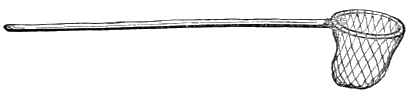
Nets, for the purpose, are easily obtainable. At least, two kinds will be necessary, namely, a small hand net attached to a short rod, or made to slip on a common walking stick, and a larger one for a long rod, or for hauling with a line. The small net should be of a fine mesh, and for convenience of carriage, may be fitted on a jointed ring of brass, so as to fold together. The large net need not be very fine in the mesh, but it should be very strong, both in the texture and the fittings, and should be lined inside with muslin so as to prevent the escape of the smallest game. Every variety of pond and drag-nets may be obtained of the dealers in fishing-tackle, at prices varying from one to five or six shillings, and of a quality that may be depended on for serviceableness. Some water-cord, a jointed rod or walking stick, and a few earthen jars, or live bait cans, make up the stock of implements, the whole of which, with the exception of rods, may be packed into a basket in which suitable divisions are made, and transported easily. Living in the neighbourhood of many prolific brooks and ponds, I have very little experience in the carriage of specimens, and, indeed, seldom use more than a single jar, and a single net at one time; but I should suggest to those who have to travel a distance for the pleasure of beetle fishing, to provide themselves with a basket or box, made after the fashion of the baskets in which bottles are sent out by vintners, the divisions being fitted with stone jars; and one division left the whole length of the basket, for nets, scissors, a pair of forceps, and a few small phials. Each vessel should have a lid of perforated zinc, to prevent the escape of objects during transit; the jolting of a railway train or coach might otherwise waste the contents. The stone jars used for the purpose, should have a cord attached round the rim of each for convenient handling at the brook side.
Pond fishing.—Every variety of stream or stagnant pond may be fished to advantage; but the specimens obtained from clear running brooks will, in general, differ greatly in character from those which the drag net brings from a dark still pool. Ponds which have formed in gravel pits, are generally well stocked with newts, mollusks, and tadpoles; but for the varieties of the beetle family, old ponds in meadows, and which are the resorts of cattle, are the best; ditches and rank brooks are the usual haunts of caddis worms, diving spiders, polypes, and the more beautiful varieties of water bugs; but every locality has its special attractions only to be learnt by experience.
Supposing that you have made a halt beside a pleasantly shaded brook, with hedge sparrows, robins, and black-caps warbling about you. You prepare by selecting a suitable spot free from brushwood, and where the edge of the water may be reached without danger. The first thing to be done is, to fill a few jars with clear water, and to throw into each a few strips of any common water-weed, of which callitriche is always the best, and most generally attainable. If the water is very foul it will be better to travel a little distance for a supply, because the specimens are wanted as cleanly as possible, and if thrown into clean water when caught, their own motions will tend to cleanse them, and fit them for the glass jars at home. The shore should be fished first, and the operation should be conducted with as much quiet as possible; any disturbance will be sure to drive away many of the livelier creatures. Take a small net attached to a walking stick or short rod, and thrust it out from you as far as possible over the water; then quickly dip and draw it towards you, and land it at your feet at some little distance from the edge of the water. Sort out the contents of the haul into separate jars, though, as you cannot have as many jars as the kinds which the net will bring up, a little judicious grouping will be necessary. Spawn of all kinds may be placed together in the same jar with mollusks, tadpoles, caddis worms, and colymbetes; most beetles must be kept by themselves, on account of their voracity, as must also the several kinds of carnivorous larvæ, such as those of the Dytiscus, and the dragon fly, and water worms of the genus Nais.
When the sides have been well fished, the deeper water may be operated on by means of the drag-net, and the produce disposed of in the same way.
On arriving home, sort over the jars seriatim, and dispose of the specimens according to the capacity and arrangement of your cabinet. The glass jars should be each furnished with a few tufts of some growing weeds, and with clear water. Some of the specimens will require to be washed to remove offensive matter, and some few will need a bottom of small pebbles, and a jar nearly filled with healthy vegetation. Anacharis, Myriophyllum, Nitella, Chara, Riccia, and choice Confervoids, are the best for the cabinet, on account of the limited space in which they must be kept, and the elegance they impart to the collection. In the larger jars it would be well to keep some tufts of vallisneria in order to propagate it to supply vacancies in the tanks. When the stock has been housed in the cabinet, whatever is left may be transferred to the bell glass for further examination. It would be better not to wash or disturb the refuse weed and sediment of the collecting jars, but to throw the whole into the vase. After a few hours it will settle down, and a lens will assist in the detection of whatever curiosities may swarm out of the refuse weed. Objects for the compound microscope may in this way be obtained and preserved in plenty.
CHAPTER III.
THE STOCK.
I have already indicated some of the varieties best suited for the cabinet, but will here briefly enumerate those which form the leading features of attraction, leaving the development of the collection to the perseverance of the student. The great division of Coleoptera will furnish by far the largest number of showy species, all of them interesting and lively creatures, many of them possessed of great beauty. The ravenous Dytiscus marginalis and dimidiatus, with their strong hooked claws, and brightly bronzed elytra; and the pretty, docile, and harmless Colymbetes, with its shining silver breast-plate, and jet black limbs and elytra, must take the first place among the beetles for beauty of form and colour. The large, harmless Hydrous piceus, the lively Notanecta, Gyrinus, and Nepa, are essential to the collection.
Among the larva, those of the Caddis fly should be kept in abundance, on account of the amusement afforded by their strange habits and their remarkable metamorphosis. Larva of the Dytiscus, known as the Water Tiger, of the Dragon fly, the gnat, the May fly, and of the two-winged fly, Stratiomys Chamæleon, the pretty blood-worm, which is the larva of the Chironomus plumosus, a very pretty gnat, with feathered antennæ; and the telescope-tailed grubs of Helophilus pendulus, which, in its larva form, is one of the most curious examples in the cabinet, and, in its imago, is frequently mistaken for the honey-bee.
The drag-net will also bring out many curious water-mites, than which there can be no more interesting subjects for the microscope, or prettier objects for ordinary observation. While writing this, I have before me several specimens of the beautiful mites, Hydrachna geographica and abstergens (Müller), in a jar of Nitella; they are ever in action, treading the water as if it were air, with a kind of motion that cannot be termed swimming, but rather a walking or dancing, maintained with the greatest ease at any level, or at the bottom of the vessel. Another, and much more showy one, is the bright carmine-coloured mite Limnochares holosericea (Latreille), of which I find an abundance in a neighbouring brook. Its pretty, spidery motions, and vivid colouring, render a jar, containing a dozen specimens, very attractive to the eye of a student of nature.
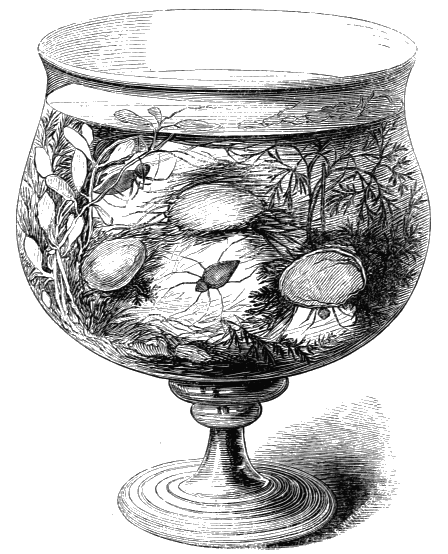
DIVING SPIDER AND NESTS.
The Diving Spiders are amusing, and should be kept in plenty in large jars, well stocked with healthy weed; and the curious Raft Spider may also be preserved in a shallow vessel, closely covered with gauze. Aquatic Spiders are most abundant in clear brooks and ditches near rivers; the small tributaries of the Lea, and the dykes that abound in the marshes at Tottenham, supply me with specimens whenever I seek them.
Among the water-worms most easily obtained, the hair-like Gordius aquaticus (Linnæus), and the curiously-formed Nais, may be recommended as curious and interesting. The latter requires a bottom of sand in which to burrow, and should be covered with only a few inches of water. When it takes to its new home, it plunges its body into the sand or mud, and extends its telescope-tail upwards to the surface for air, adapting its length to the depth of the water.
The generation and development of reptilia and mollusca may be better studied by the use of jars for the specimens, than by their immersion in the aquarium. Tadpoles, the larva of newts, and the spawn of mollusks, may be preserved in the cabinet for purposes of study, much better than in the tank; each species being separate in a bright and portable vessel, every minute change can be observed, and a lens applied at any time, or the specimens removed for close inspection without difficulty. I find it a good practice to remove any spawn, which may be deposited on the large vessels, to the small jars on my shelves. There the little Lymnea and Planorbis are developed in hundreds, without molestation; and if increase of Paludina vivipara be required, a jar is at once converted into a breeding tank by throwing a couple into it, with a bunch of Callitriche, and any vegetable waste from the tanks. In the aquarium, the young mollusks are devoured almost as soon as they are born; and the pleasing spectacle of their increase, coming forth from the gelatinous mass in hundreds, like minute beads of gold, is lost without the aid of the cabinet in which to rear them. The young of most species of univalve mollusks are vagrant in their habits, and the jars in which spawn is hatched should be closely covered with perforated card or gauze, fitting closely by means of India rubber rings.
Since it is unnecessary in this work to give a classified history of the several creatures that may be kept in water-cabinets, I shall devote the remainder of the space at my command to notices of a few of the most attractive and best known species, and to a few hints on the general management of the cabinet.
CHAPTER IV.
LARVA.
The great class of insects comprises many remarkable and diverse forms, among the 560,000 species which Dr. Imhoff estimates to be now known to naturalists. Yet, various as they are, it is by no means impossible to define what are the distinctive features by which this class is separated from those which approach it in conformation and habits. A true insect has the body divided into three parts—the head, the thorax, and the abdomen. It has never more than six legs, and these are attached to the thorax. The segments of the body seldom exceed thirteen in number, one of which forms the head, three the thorax, and the remaining nine the abdomen. The possession of one or two pairs of wings gives them their prominent characteristic to the eye, but it is the successive metamorphoses that arrests universal attention, and calls forth the admiration and wonder of mankind. In the progress of an insect from the minute egg to its completed form, we see the most remarkable series of developments which animal life ever displays in all its endless procession of forms—the egg, the worm, the chrysalis, the fly—a strange unfolding, for the first time accurately observed by Swammerdam, who detected, under the wrinkled skin of the disgusting worm, the complete outline of the lovely butterfly.
This metempsychosis may be studied in its several strange details by the aid of the Water-Cabinet. The first condition of the newly-hatched egg is that known as the grub, or caterpillar—scientifically called the larva. The larva generally bears no earthly resemblance to the imago, or perfect insect, into which it is to be hereafter developed, but leads a life of sensual enjoyment—it eats, eats! it is gluttony concentrated in type and act. It changes its skin several times, slips one coat off and acquires a new; growing, and eating, and changing garments, till, like man himself, it seeks a temporary tomb, from which it is to soar to the skies like a soul liberated. This second form is popularly known as the chrysalis, or aurelia, scientifically called the pupa. In this form the insect remains in a state of complete or partial torpidity for a few days, weeks, or months, according to the particular species.
The day of its deliverance arrives, its bonds burst, and it comes forth "a thing of beauty" to sport in sunbeams, and, for but a brief season, lead a life of joy—
"Fluttering round the jasmine stems, Like winged flowers or flying gems."
But beauty of the high poetic kind is not the inheritance of every member of the class insecta; and the water-cabinet presents us with many that have but analogical resemblances to the typical structure of the moth or the fly, though the naturalist finds beauty in a beetle, and points of profound interest in a maggot or grub.
Since larva are distributed through at least three elements, being, according to the species, inhabitants of earth, air, and water, the breathing apparatus arrests our attention, as constituting a distinct feature in the anatomy of the insect. A caterpillar may be regarded as all stomach, and the cravings of this immense digesting tube easily account for the voracity of larva of all kinds. In the larger animals, the food is elaborated into blood, and brought to the lungs to be oxygenated by means of contact with the air, but the insect does not breathe at the mouth, but at the other end, or by means of tubes arranged along the sides of the body. In a caterpillar there are usually eighteen of these tubes, the orifices of which may be seen in action. These tubes all run into two larger lateral tubes, or wind-pipes, arranged one on each side of the body; and from these lateral tubes innumerable smaller ones diverge, and convey air to the vessels in which the digested food is contained, and thus supply it with oxygen. Swammerdam was the first who successfully anatomised this class of animals, and to him we are indebted for the microscopic anatomy of grubs, and a revelation of their inner economy generally.
The Dragon Fly, Libellulidæ (Leach), a well-known summer beauty—the mere mention of which is always sufficient to set one's heart beating for rustic coolness, and the hushed music of the beechen shades—is, in its larva form, an interesting object for the cabinet. Between the larva and the imago of this insect, the difference is striking indeed; as a lady, not addicted to scientific studies, once characterised the larva—using Pope's lines—as,
"A monster of such hideous mien, That to be hated needs but to be seen."
But the gauze-winged and gaily-coloured fly merits all the praise bestowed upon it by the French, who call them Demoiselles, so light, fairy-like, and visionary are its form and movements. Scientific writers have applied many descriptive names to it, such as Calepteryx (pretty wing), Puella (girl), Sponsa (bride), and Virgo (virgin). The larva of the dragon fly exhibits, in a very striking manner, the mode of respiration in aquatic insects. It is not an active creature; for though it has six legs, it seldom uses these except in the capture of prey; its locomotion is chiefly performed by the tail in the action of breathing. When thrown into a jar with some fragments of weed and a few light chips, these will be seen to be drawn towards the tail of the creature, by the current occasioned by the absorption of water; and then again driven off, with considerable force, as the water is again ejected. The quantity drawn into the body by this hydrostatic action must be considerable, since the dimensions of the larva regularly change with the breathing action, the body becoming collapsed when the stream is ejected, and again swelled out with the suction that follows. If it be thrown into water, tinged with cochineal, and then quickly removed again into clear water, the coloured stream will be seen to be projected several inches, and with force sufficient to propel the creature forward by a series of successive jerks.
Besides the act of breathing, then, this anal pump has locomotive uses; and it also aids the creature in obtaining food by drawing minute creatures towards it in a manner similar to those animals which are furnished with cilia.
But the microscope reveals a still more curious fact, in the anatomy of this larva, which has been most faithfully described by Kirby and Spence. The under lip, when closed, entirely conceals the mouth, and it not only retains, but actually seizes, the animal's prey, by means of a very singular pair of jaws with which it is furnished. Conceive your under lip (to have recourse, like Reaumur, on another occasion, to such a comparison) to be horny instead of fleshy, and to be elongated perpendicularly downward, so as to wrap over your chin, and extend to its bottom—-that this elongation is there expanded into a triangular convex plate, attached to it by a joint, so as to bend upwards again and fold over the face as high as the nose, concealing not only the chin and the first mentioned elongations, but the mouth and part of the cheeks. Conceive, moreover, that to the end of this last-mentioned plate are fixed two other convex ones, so broad as to cover the whole nose and temples—that these can open at pleasure, transversely, like a pair of jaws, so as to expose the nose and mouth, and that their inner edges, where they meet, are cut into numerous sharp teeth, or spines, or armed with one or more long sharp claws—you will have as accurate an idea, as my powers of description can give, of the strange formation of the under lip in the larva of Libellulina, which conceals the mouth and face, precisely as I have supposed a similar construction of lip would do yours. You will probably admit that your own visage would present an appearance not very engaging, while concealed by such a mask; but it would strike still more awe into the spectators, were they to see you first open the two upper jaw plates, which would project from the temples like the blinders of a horse; and next, having, by means of the joint of your chin, let down the whole apparatus and uncovered your face, employ them in seizing any food that presented itself, and conveying it to your mouth. Yet this procedure is that adopted by the larvæ of the dragon-fly, provided with this strange organ. While it is at rest, it applies close to and covers the face. When the insects would make use of it, they unfold it like an arm, catch the prey at which they aim, by means of the mandibuliform plates, and then partly refold it, so as to hold the prey to the mouth, in a convenient position for the operation of the two pairs of jaws with which they are provided. The form of this masked jaw is represented, but not very clearly, in Rennies' "Insect Transformations," p. 164.
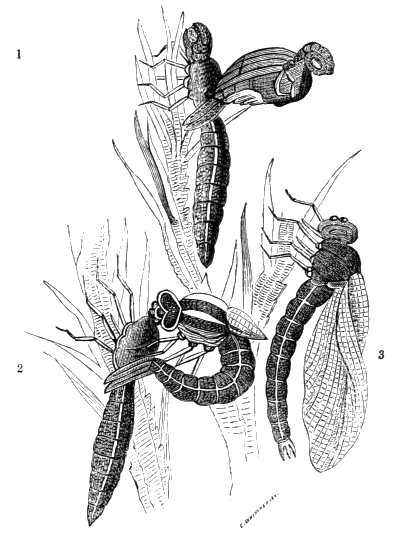
TRANSFORMATION OF THE DRAGON FLY.
1. The Fly just emerging. 2. The Fly nearly free, and forming an arch. 3. The Fly liberated, and with its body bent, to hasten the drying of the wings
When its season of larva life is over, it retires to the bottom of the vessel to repose, and becomes a pupa. When the crumpled form of the gaudy fly begins to expand within, and to knock at the door of its sepulchre, the pupa quits the watery element for ever, and betakes itself to the dry land, or to the slip of cork placed in the jar for its use. There, the apparently painful process of its unfolding takes place, and the fly slowly emerges. The envelope bursts asunder, and the head of the lovely, but bloodthirsty damsel, emerges to the light. Next appear the legs, not in action, but gathered up to the breast, as if in spasm, and, for a time, the effort is suspended, and the helpless, half-formed beauty hangs back her head, as if languid with the exhaustion of pain. Once more she pants for freedom, sighing to sun herself in the blue ether, and another struggle is made. This time she clutches at the pupa case with a convulsive grasp, and drags forth the whole of her delicate body from the grave, and there remains motionless, still clinging to it, as if contemplating the baseness of her origin—for beauty is ever the offspring of the dust. She is free at last—but, ah! how helpless. Her wings are damp, and closely folded, and would not yield to the wish for flight, even were she already possessed of the power to stir them into action. She is on the threshold of a new world—a creature born of the dust, just escaped from the dust; and now as we watch her wings dry and expand, away she goes—a thing of light and loveliness soaring heavenward. Like the mortal ark, out of which the spirit of man escapes, we may, without losing sight of the disparity of the subjects, speak of the chrysalis of the dragon fly as—
"A worn-out fetter, which the soul Has broken, and thrown away."
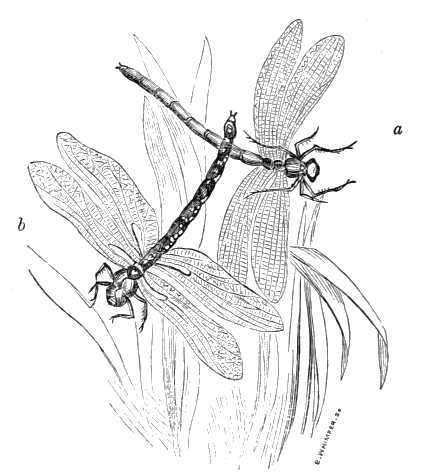
DRAGON FLIES. a. Virgin Dragon Fly—Calepteryx Virgo. b. Green Dragon Fly—Æshna varia
THE GNAT—Culex pipiens (LINNÆUS)
In the operation of dragging, many curious larva are brought out, and the mud should be searched carefully for them before washing the net for another cast. The larva of the gnat is one of the most interesting of these, and during summer may be obtained in hundreds if a little of the brook water be dipped to fill the jar with, and a few light weeds thrown in to supply oxygen. These larva are the produce of eggs deposited in a curious manner.
The gnats repair to the water soon after day-break, and commence an operation of a truly naval kind, such as would have delighted the savage heart of Peter the Great, could he have witnessed it in the midst of his dreams of achieving naval power. In fact, the mother gnats construct rafts of eggs, and each egg is added as a separate timber of the vessel, till a boat-like structure is produced. The skill as well as the necessity of the construction is well tested by the fact that each separate egg would of itself sink to the bottom, whereas being protruded one by one into the angle formed by the hind legs which serve as stocks for the future vessel, and successively glued to each other by the fluid which exudes with them, they gradually assume, under her guidance, a neat boat-like form of about three hundred minute pyramidal eggs.
"The most violent agitation," says Kirby, "cannot sink it, and what is more extraordinary, and a property still a disideratum in our life-boats, though hollow it never becomes filled with water, even though exposed."
The grubs at last come forth, and lead a very merry sort of life under the shadow of the sedges. Placed in the jars they appear at first sight like newly hatched fry of fishes, but we soon detect the segments of their pellucid bodies, and, as might be expected in water larva, they breathe at the wrong end, and hence most of their merry movements are performed between the surface and the bottom; every time they descend they carry with them a minute bubble from the surface. Under a good lens the pretty creature changes its form considerably, and comes out in the pantomime style, with huge horns, goggle eyes, and starched frills of shaggy hair; but then the tail becomes the object of attraction, and we watch the breathing action of the curious funnel which breaks away at an angle from the last segment of the body.
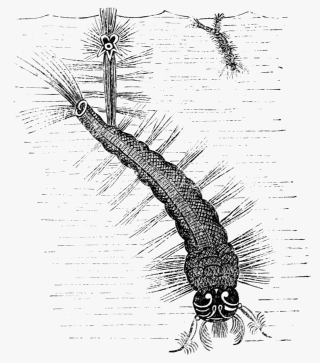
LARVA OF THE GNAT, NATURAL SIZE AND MAGNIFIED.
Swammerdam first observed that the breathing tube and tail are both anointed with oil, and that if the larva is handled roughly the oil is removed, and the grub "can no longer suspend itself on the surface of the water. I have, on these occasions, observed it put its tail in its mouth, and afterwards draw it back, as a water fowl will draw its feathers through its bill to prepare them for resisting water." I have now (July, 1856) some thousands of the larva of this and other species of gnats, and they are the most lively creatures in my collection. The flies come off in large numbers, and escape through the open window; or, if the window be closed, they swarm on the glass, and keep up a musical humming, closely resembling that of a swarm of bees at a distance.
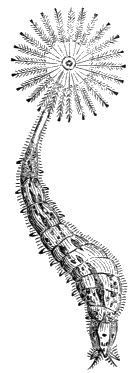
LARVA OF STRATIOMYS.
A more elegant example of this kind of breathing apparatus is seen in the grub of the two-winged fly, Stratiomys Chamæleon. The funnel tail spreads into a beautiful star of thirty distinct rays, and with this structure, the creature suspends itself to the surface of the water, as if it were a ceiling, and as it moves to and fro its changes of position may be noted by the shifting of the dimple on the surface.
In the little gnat, Corethra plumicornis (Meigen) we have some further examples of the peculiar conformation of the larva, to enable it to respire in the water; but the larva is so transparent that it requires an expert microscopist, and an effective instrument to work out the details as represented by Reaumur and Dr. Goring. The larva of this species is plentiful in our brooks, and worthy of close scrutiny by the aid of the microscope. Just now the gnats are abundant in meadows near streams, and to them we are indebted for that soft humming which has been appropriately termed the "music of the wild," and on which good old Gilbert White exhausted his ingenuity to find an explanation. The social communities of these ephemeral creatures are strictly music parties, and whenever we suffer them to assemble about our heads, when rambling in the hedgerows, we are entertained by their fairy-like performances. Expertum est.
The Case Fly Phryganea grandis.—There are several species in the family of Phryganea, which is the only tribe in the order Trichoptera, but such strong resemblances exist between the several members of the family that some entomological experience is necessary to enable the student to distinguish them. In an aquarium, the caddis worms are very amusing, and since they thrive there, they are very suitable additions to the happy family. We see them busy at the bottom, adding fragments of weed, pebbles, minute shells, even if the snails within them are alive, and any small debris that their fingers can seize hold of. Last season I had amongst a large number of cads, one that had his case nearly destroyed by accidentally falling from the table. I removed from him what remained of his case, and threw him into a jar with a soldier plant and a few Lymnea. He set to work to repair his tabernacle, and the Lymnea helped him, for they nibbled a plant of Stratoides into shreds. These shreds the cad gathered, and every day he added a fresh piece, so that, in about ten days, he appeared in a suit of green, his clothes bulged out to an enormous size, and everywhere studded with points and corners, the most comical sight that could be imagined. Since he could find nothing of a small neat pattern, he took what he could, and became a perfect Jack in the green, nearly an inch and a half in length, and thicker than a carpenter's lead pencil.
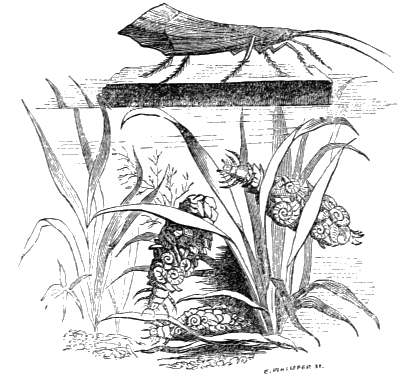
LARVÆ AND IMAGO OF CASE FLY.
The movements of these creatures are as comical as their specimens of tailoring. We see them mounting a stem or leaf with great gravity, when suddenly up goes the tail, the legs hold tight, and the case turns completely over, as if on the first of May, Jack-in-the-green were to dance on his head. When the creature is hidden, and the case sways to and fro like a buoy attached by too short a rope, the sight is very curious. This case-maker is the larva from a fly which bears resemblances to the two families which stand on either side of it—the Lepidoptera, or true butterflies, and the Neuroptera, of which the dragon flies and other membranaceous winged insects are members. As soon as he enters the world, he begins to show his skill in tailoring, and by means of silken threads and gluten constructs his case of bits of stick, straw, dead leaves, or shells, in fact, whatever he can get, and as long as he retains the worm-like form the case is his castle, and he can defy the world. The case outside is generally a rough affair, but if you draw out the cad you will see that inside it is perfectly cylindrical, smooth, and polished, and around the doorway, through which the larva makes acquaintance with the world, it is neatly finished with a very circular rim. When you have removed a cad, if you throw him into a tank you will learn in an instant what is the use of his case, for his soft nakedness is no sooner exposed, than the minnows finish him, and find the flavour excellent. But to see a cad in his proper uniform molested is a very rare sight indeed. He passes his larva life innocently, and is an amusing fellow; when he feels the numbness of death creeping over him, the cad draws in his six legs, and sets to work inside to weave a winding-sheet and to shut the shutters, for he knows that his time is come, and there is no one to do such melancholy offices for him. All alone in his solitary cell, the hermit works day and night, and hourly his fingers grow more feeble. We look and find the shutters closed, and by this time the larva has changed into a pupa.
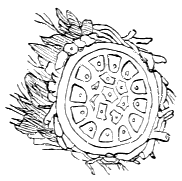
GRATING OF CASE-WORM, MAGNIFIED.
The mode in which the worm closes its cell is curious enough. Over its entrance it weaves a grating of silk, which hardens in water and remains insoluble. It may be seen very plainly by the naked eye, but under a good lens increases in interest. The grating is placed a little inside the margin of the opening, and fits exactly within it, and its object is to protect the pupa from invasion, and at the same time, to admit water for respiration. De Geer describes one of these gratings in which the pierced holes were disposed in concentric circles, as represented in the engraving. This, however, is not, as far as I am aware, the usual form of the grating, many that I have examined were formed in regular rays from a centre like the spokes of a wheel.
But the escape of the pupa, when about to undergo its last metamorphosis, is as interesting as the fact of its closing the shutters to announce its own death. It is provided with a pair of hooked mandibles, with which to gnaw through the grating, and no sooner have these accomplished their purpose than they fall off, and the pupa takes its last shape of a four winged fly, as represented in the cut.
CHAPTER V.
COLEOPTERA.
The beetle tribe are distinguished from other insects by the possession of elytra, or wing-cases; which wing-cases are, with regard to the typical structure of an insect, to be regarded as really the first pair of wings hardened into a horn-like consistence to protect the others. The wing-cases are of little or no use in flight, this action being accomplished by means of the second pair, or the true wings, which are generally of large size, and when not in use are neatly folded up beneath the elytra. The division of the body into three parts—head, thorax, and abdomen—is very plain to the eye; but the segments, of which the several parts are composed, are frequently so consolidated that it is difficult to detect or count them. For instance, the thorax, theoretically, consists of three segments; but, practically, the first of these is usually so largely developed as to appear to constitute the thorax in itself. The (theoretical) nine segments of the abdomen are, in like manner, reduced to six or seven, in consequence of the last two or three being consolidated into one.
The order is an immense one, as to its range and variety, and hence there are in it many curious exceptions to the general conformation of a beetle. Some are utterly incapable of flight, owing to the non-possession of elytra, or wings; some have elytra only; and in some the elytra meet and unite along the suture; so that, if the insect had wings underneath, it would be impossible for it to use them.
The specimens of coleoptera, kept in the water-cabinet, are among the most interesting of the whole collection, whether in the larva or imago form; and to this order we are indebted for a large number of aquatic species, that may be kept in jars, and some few that may be introduced without danger to the tank.
Dytiscus Marginalis is one of the handsomest of water-beetles, and its habits are amusing and instructive. It possesses an insatiable appetite, and great muscular power, as we soon discover when removing it from one jar to another, for if it succeeds in planting its claws firmly on the edge of the vessel, it is difficult to move it. It belongs to the large tribe of aquatic carnivora, ranged in the section Pentamera, in which the tarsi of all the feet are five-jointed, the fourth being of ordinary size.
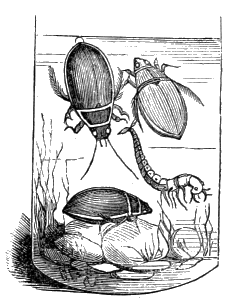
DYTISCUS AND LARVA (REDUCED).
The Dytiscus is a true water-beetle, being aquatic in both its larva and perfect forms. The larva, known as the water-tiger, is found in plenty in the muddy ditches round London, and is a strong, stubborn, ugly, and ravenous worm, with a tail formed for respiration, and curved mandibles to tear its prey to pieces. It is very active, and may be kept without difficulty; but nothing else should be placed in the same jar, unless intended as food for this savage. A small fish thrown is eagerly clutched, and held firm by the claws; and the larva then plunges its mandibles into it, and is soon buried head-deep in the mangled body of its prey. I have generally fed them on beef, but they prefer small fish, or larva of the dragon-fly, and do not go through their metamorphosis well without such food.
The imago is a handsome creature, with strong hooked claws, furnished with amber hairs, which, under a lens, resemble very closely the claws of a crab. The elytra are beautifully tinted with rich green and bronze, and the divisions of the head and thorax separated from the abdomen by sharp, whitish lines. Small fishes make the best diet for this beetle; but as this food fouls the water, it is best to keep them in clear jars, with a few pebbles and weeds, and once a week remove them to another vessel, to be fed. This plan preserves the brightness of the beetle jar, and prevents the annoyance of effluvia.
Hydrous Piceus.—This is the largest of our native aquatic beetles, and, with the exception of the stag-beetle, it exceeds in bulk any other species of indigenous Coleoptera. It is common in the brooks and ponds in southern counties, but becomes rare as we travel northwards. In the larva state this is a rapacious and bloodthirsty insect, and of so destructive a character as to deserve its French name of ver-assassin. In that early condition it resembles a large soft worm, of a somewhat conical form, provided with six feet, and having its large scaly head armed with two formidable jaws. The head moves with such freedom in all directions, that it can readily seize small shell-fish and other mollusca floating on the surface, without altering the horizontal position of the body maintained in swimming; and it is even bent backwards, and devours its prey more conveniently by using the back as a kind of support. These larvæ swim with facility, and have two fleshy appendages at the tail, by means of which they suspend themselves at the surface with their heads downwards, when they have occasion to respire (Cuvier). The beetle differs greatly in habit from the grub; it is by no means carnivorous, but quite harmless, docile, playful, and tameable. It is a noble creature for the cabinet, and may even be kept in the Aquarium safely. In its complete form it is as interesting for its gentleness as it is in the larva state for its rapacity and destructiveness. The female spins an elegant and waterproof cocoon for the reception of its eggs, and when they are deposited she watches them with a maternal solicitude not frequently exhibited by creatures of this family.
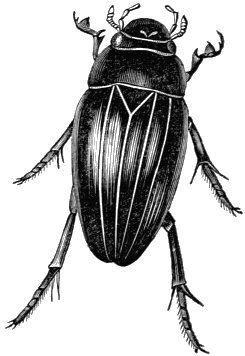
HYDROUS PICEUS.
The hydrous piceus is here represented of the natural size; the ground colour is black, with a shade of bronze, and the margins of the elytra are tinged with green and purple. Each wing case is marked with dotted lines, the breast is dingy yellow, and the antennæ and organs of the mouth dull red. The legs are black, and the hairs which fringe the tarsi reddish brown.
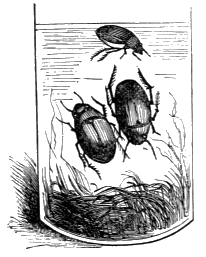
COLYMBETES.
Colymbetes, of several species, may be obtained in plenty from clear brooks in every part of the country. These are elegantly-formed and lively beetles; their elytra, legs, thorax, head, and breast of the same jet-black hue, and highly burnished, though, when immersed, the breast and abdomen glisten with an intensely metallic silvery lustre, owing to the film of atmospheric air which the beetle obtains from the surface, and which adheres to the hairy covering of the abdomen. This silvery species is here represented in its natural size. They are comparatively harmless, though I have just witnessed the demise of one that was attacked and eaten by his pretty kindred, the wing-cases and head only remaining to testify of his former individuality. This is a delicate beetle, that requires very pure water and a neat arrangement of aquatic plants, to give full effect to its beauty as a cabinet specimen, and, when carefully preserved, a jar of them forms a conspicuous and attractive object. I have several specimens of a smaller species in a very fine jar of confervoids; they are incessantly in motion, threading their way through the interstices of the delicate vegetation in a business-like way, that seems to say, "I'm on an important errand—have not a moment to lose, and, above all things, I must take care of the bubble of air that sticks to my tail."