PART TWO FAIRY STORIES (continued 2)
Reading edition
Meanwhile Timothy had reached the upper end of the room, and found himself close to a great curtain tightly drawn. On either side of it he beheld a marble basin. One of the basins had evidently contained a fountain, but it was now half choked with mud, and only a little water oozed out of it. On looking into the other, he was astonished to find it full of liquid fire.
Just then he heard behind the curtain the sound as of a mighty rushing wind, and at the same moment the two fountains boiled up and cast out their dirt, and this they continued to do until each basin was brimming full, one of pure water and the other of pure fire.
The little Imps, too, heard the sound. At first they were awed and hushed; then they began to fly about in confusion until Timothy was bewildered by the noise and movement.
Suddenly the curtain was parted, and Timothy saw a stately Lady seated upon a throne in a noble arched recess. Her head was thrown back, her eyes flashed, and in her hand she held a scourge every thong of which seemed to writhe and twist and end in little snappers of fire.
At the sight of this scourge and the frown on the Lady’s face, all the little Imps began to howl dismally. The Lady arose, and came down from her throne into the centre of the room, and the little Imps fled before her. But they could not escape. Seizing the first one she met, she plunged him several times into the basin of water. Then taking him out, she carried him kicking and quivering to the other basin, and plunged him into the fire. Timothy stood horror-stricken. He leaned against a pillar to support himself, but what was his astonishment to see the Lady take the little fellow out of the basin, and release him; and he ran away unharmed. But a strange thing had happened. The little Imp was no longer so black, and instead of grinning maliciously, he was now smiling as pleasantly as possible.
The Lady seized every little Imp in the room, in the same manner, and plunged him into both basins. Then she collected troops of the Imps, and drove them before her with the fiery scourge. She made them begin to scrape the dirt off the floor, and down from the walls, to repair the broken places in the roof, and to polish the rusty and musty spots. And all the rubbish she made them throw into the basin full of pure fire. Sometimes two or three little Imps would carry one of the great slimy reptiles, and drop him in, and all those thus dropped into the fire never came out again.
And as the little Imps worked, they broke into a song:—
“All the rubbish Thither take! Little whip Will make us ache! Tug! Tug! The big bug, Spider foul, And slimy thing, In the fire, Lightly fling! “Rub! Rub! Off the rust! Sweep! Sweep! Away the dust! Sparkle! Sparkle! Precious stone, Pearly roof, And ivory throne! “Oh, dear! dear! dear! Hear the fiery lashes crack! On each little lazy back! Hear the glowing basin boil! Little Imps must burn or toil!”
Timothy watched and listened until he became very weary; then he stretched himself out on the floor and fell asleep.
When he awoke, he found himself lying in a dazzling light. How long he had been asleep he did not know. He sprang to his feet with an agility and ease that he had never felt before. He looked about him. There was still the same great room, the same chandelier with its thousand lamps, the same pattering of little feet and rustling of wings! But, oh, how changed! How changed!
The arched roof was composed of transparent pearl, delicately carved, and fretted with lines of brilliant rose-diamonds. Pendants hung from the arches, formed of great diamonds and pearls cut into exquisite shapes. The walls were of ruby and topaz, and sparkled with mosaics of precious gems, representing scenes more beautiful than any ever seen on earth. The huge pillars were of jasper and around them was twined the graceful immortal amaranth. The floor was of coloured marble, inlaid with onyx and amethyst.
In the noble recess at the end of the room, sat the Lady on a throne carved from ivory and studded with diamonds. Her scourge and frown had disappeared, and from her smiling countenance shone a divine beauty.
The chandelier, every lamp of which was now pouring out a silver light, sent a glowing radiance into the farthest corners and recesses under the galleries, and revealed no signs of stain or shadow. The basins threw high their spray of sparkling water and pure fire, looking like fountains of liquid light, which fell back again with the softest music.
But the greatest change of all was in the little Imps. They were each and all of a purer transparency of white than anything Timothy had ever conceived. And there was not one upon whose face did not play a smile of joy. Some of them were working harder than ever, while others were bathing in the fountains, darting and fluttering in and out of the spray. They looked as light and brilliant as soap-bubbles in the sun, and flashing from their wings were all the colours of the rainbow. Indeed, the little Imps shone so brightly that Timothy could scarcely look at them.
But while he was examining all these wonderful changes with admiration, he heard a silver trumpet ring through the edifice. And as its sweet notes died away among the pearl arches, the little Imps with myriad voices, as sweet and clear as the trumpet-call, sang:—
“Lightly we rise In the azure shies! Lightly we dart away! Lightly we roam Through the boundless dome! Or in pathless depths we stray! Bright little, White little, Light little Thoughts! “When we would try How high we can fly, When we would gaze On His brightest rays, When through glory we range, In colours strange, Lightly we turn to God! There hide! There abide! Bright little, White little, Light little Thoughts!”
Then the most amazing thing of all happened. Timothy Tuttle, Esquire, suddenly found himself lying once more on the soft, comfortable sofa in his own home. The gas-light was flashing over the rich rug and rosewood furniture, just as it had done when he had last seen the room. He raised himself on his elbow and looked around, but not one of the little Imps was there. Indeed, he could find no traces of them except the marks of their tiny black feet on the rug.
But from that day forward Timothy was a changed man. His face was no longer hard and selfish, but it beamed with good and kind thoughts. He no longer preferred wealth to everything else in the world. He gave up the plan for his fine new mansion—indeed, he no longer wished for one—and he spent the remainder of his days making his family and friends happy, and relieving the poor and needy.
Dr. John Todd (Adapted)
BUTTERFLY’S DIAMOND
Once upon a time there was a little Fairy who was remarkable for her impatience and laziness. She was called Fairy Butterfly because she had such splendid green wings with silver spots on them. She loved dearly to be dressed in gorgeous colours, and to sleep in the rich chambers of the Foxgloves, or to flutter over beds of fragrant Mignonette. In truth, she was as luxurious a little Fairy as the sun ever shone on. So much did she like her ease that she would not gather a single dew-drop to bathe her face, nor would she pick a fresh rose-petal for a napkin. She played all day long, or slept curled up in the heart of a flower. Oh, she was a lazy Fairy!
When the Queen of the Fairies observed the faults of Butterfly, she resolved to help her to correct them. One day she summoned the lazy one to Court, and said:—
“Fairy Butterfly, we command you to go at once to the Green Cavern in the Island of Ceylon, and remain there until you have fashioned a diamond more pure and brilliant than any that has ever rested on the brow of mortal or Elf.”
Little Butterfly bowed in silence and withdrew. As soon as she was outside the green mound in which the Fairy Queen held her Court, she burst into a passionate flood of tears.
“I shall have to watch that diamond for months and months and years and years,” sobbed she, “and every day I must turn it over with my wand so that the crystals will form evenly! Oh, it is an endless labour to make a diamond! Oh, I am a most wretched Fairy!”
So she sat, and sobbed, and murmured for several minutes. Then she jumped up and stamped her little feet on the ground so furiously that the blue-eyed grasses trembled.
“I won’t bear it!” she exclaimed. “I’ll run away to the Fairies of the Air. I am sure they will be so pleased with my beauty that they will feed me, and I shall never need to work again! As for the diamond, why, it is just impossible for a little Fairy like me to make it!”
Then she peeped into a fountain to admire herself, and saw, alas! that the splendid green of her wings had faded, and the silver spots were dim. For, if Fairies have naughty thoughts, their wings always droop and their beauty fades. At this sight, little Butterfly wept aloud with vexation and shame.
“I suppose the old tyrant, our Queen, thinks that now I am so ugly, I’ll hide myself in the Green Cavern in the Island of Ceylon! But I’ll let her see that I do not care about her!” And, alas! as Butterfly spoke thus, the silver spots disappeared entirely, and her wings became a dirty brown.
Trembling with anger, the little one waved her wand, and called:—
“Hummingbird! Hummingbird! Come nigh! Come nigh! And carry me off To the far Blue Sky!”
In an instant a tiny hummingbird, shining like a jewel, alighted at her feet. She sprang on his back, and away they flew to the golden clouds in the West where the Queen of the Air Fairies held her Court. And when the Queen and all her Fairies saw Butterfly’s dirty brown wings, they waved their wands and vanished. And little Butterfly was left alone in the Palace of the Air.
But such a beautiful palace as it was! The clouds hung around it like transparent curtains of opal. The floor was paved with a rainbow. Thousands of gorgeous birds fluttered in the sunlight, and a multitude of voices filled the place with sweet sounds. Butterfly, fatigued by her flight through the sky and lulled by the voices, lay down on a rosy cloud, and fell into a gentle slumber.
When she awoke, she saw that a tiny bird, smaller than the hummingbird, was building a nest beside her. Straw after straw, shred after shred, the patient little creature brought in her bill and wove together. And then she flew away over hills and fields to find soft down with which to line the nest.
“She is a foolish thing!” murmured Butterfly. “How hard she works, and I don’t believe that she will finish it after all!”
But soon the bird came back with her bill full of down, and lined the soft warm nest so that it was fit for a Fairy to sleep in. Butterfly peeped into it, and exclaimed, “Oh, what a pretty thing!”
Immediately she heard the tinkling of a lute, and a clear voice singing:—
“Bit by bit the bird builds her nest!”
She started up, and the Queen of the Air Fairies stood before her, clad in a robe of azure gossamer, embroidered with rainbow lights.
“Foolish Butterfly,” said she, “we allow no idlers here. Obey your Queen, and go at once to the Green Cavern in the Island of Ceylon. Time and patience will accomplish all things. Go and make your diamond, and then you shall be welcome here.” Butterfly tried to tell her how very hard it was to make a diamond, but the Queen of the Air Fairies flew away, touching her lute, and singing:—
“Bit by bit the bird builds her nest!”
Butterfly leaned her head upon her hands for a minute. She began to be ashamed of being so lazy, but she did not yet wish to go to the lonely Green Cavern, and work hard. So she waved her wand, and called again:—
“Hummingbird! Hummingbird! Come nigh! Come nigh! And carry me back Through the clear Blue Sky!”
Immediately the little hummingbird returned, and she sprang on his back. He flew down with her, and she alighted near the green mound inside of which the Fairy Queen held her Court.
Close by the mound Butterfly saw some bees working in a crystal hive. Wearily and sadly she watched them. They left the hive, dipped into flowers, and carried their loads of sweet pollen back to the hive, and there they built their wax combs filled with golden honey. “I wish,” thought she, “that I loved to work as hard as the bees do! But as for that diamond, it is useless to think about it! I should never finish it!”
Just then she heard strains of delightful music coming from the mound, and a chorus of Fairy voices singing:—
“Little by little the bee builds its cell!”
Butterfly could have wept when she heard those familiar voices, for she longed to be with her Fairy sisters dancing hand-in-hand. “I will make the diamond,” murmured she. “I shall surely get it done sometime! And I can fly home every night and dance in the Fairy Ring, or sleep in the flowers!”
Immediately a joyful strain of music rose on the air, and she heard her sisters’ voices singing:—
“To the Green Cavern haste away! Sleep by night, and work by day! Little by little the gem will grow, Till pure as sunshine it will glow!”
Alas! when Butterfly heard this, instead of flying at once to the Green Cavern, she began to think how hard she should have to work, and how many times she must turn the diamond. “I never can do it!” thought she. “I will go to the Queen of the Ocean Fairies. I am sure she will let me live in her Sea-Palace; and I need never work again!”
Mournful notes came from the mound, as Butterfly turned toward the seashore. When she reached the beach, she waved her wand, and called:—
“Nautilus! Nautilus! Come to me And carry me through The cold green Sea!”
Immediately the delicate pearly boat of the nautilus came floating over the Ocean, and a wave landed it at Butterfly’s feet. She stepped in, and down, down, under the waves she went, down to the bed of the Ocean, to a coral grove. And there was the magnificent palace of the Queen of the Ocean Fairies. Its pink coral pillars were twisted into a thousand beautiful forms. Pearls hung in deep festoons from the arches. The fan-coral and the sea-moss were formed into deep, cool bowers. And the hard, sandy floor was covered with many-coloured shells.
But as it had been in the Air, so it was in the Sea! When the Queen of the Ocean Fairies saw Butterfly’s dirty brown wings, she and all her Court waved their wands and disappeared. And Butterfly was left alone in the Sea-Palace.
“How beautiful it is!” cried she. “Giants must have made these coral pillars!” As she spoke her eyes were nearly blinded by a swarm of tiny insects, and she saw them rest on an unfinished coral pillar. While she looked and wondered, she heard a thousand shell-trumpets being blown, and many voices singing:—
“Mite by mite the insect builds the coral bower!”
The sounds drew nearer and nearer, and a hundred Fairies, standing in beautiful shells, came floating through the water. In the largest shell of all was their Queen in a robe of wave-coloured silk spun by the Ocean silkworm. It was as thin as a spider’s web, and the border was gracefully wrought with seed pearls.
“Foolish Butterfly,” said the Queen, “learn to be industrious. We allow no idlers at our Court. Look at the coral pillars of my palace. They were made by these swarms of little creatures. Labour and patience did it all.”
And she waved her wand, and the hundred shells floated away, while all the Fairies sang:—
“Mite by mite the insect builds the coral bower!”
“Well!” said Butterfly, sighing. “All creatures are busy, on the earth, in the air, and under the water. All things seem happy at their work. Perhaps I can learn to be so, too. I will make the diamond. And it shall be as pure and brilliant as a sunbeam in a water-drop!”
So Butterfly sought the Green Cavern in the Island of Ceylon. Day by day she worked as busily as the coral insects. She grew cheerful and happy. Her wings once more became a splendid green, and the silver spots were so bright that they seemed like sparks of fire. Never had she been so beautiful, never so much loved by the little birds and flowers.
After seven years had passed by, Butterfly knelt at the feet of her Queen and offered her diamond. It gave light like a star, and the whole Fairy Mound shone with its rays. And to this day the Fairies call it “Butterfly’s Diamond.”
Lydia Maria Child (Adapted)
LITTLE NIEBLA
Have you seen the white mist over the River Yi in the morning—a light white mist that flies away when the sun gets hot? Yes? Then I will tell you a story about the white mist and a little girl named Alma.
Little Alma lived close to the River Yi, but far, far from here, beyond the trees and beyond the blue hills, for the Yi is a very long river. She lived with her grandmother and with six uncles, all big, tall men with long beards, and they always talked about wars, and cattle, and a great many other important things that Alma could not understand. There was no one to talk to Alma and for Alma to talk to or to play with. And when she went out of the house where all the big people were talking, she heard the cocks crowing, the dogs barking, the birds singing, the sheep bleating, and the trees rustling their leaves over her head, and she could not understand one word of all they said. At last, having no one to play with or talk to, she sat down and began to cry.
Now, it happened that near the spot where she sat there was an old black woman wearing a red shawl, who was gathering sticks for the fire, and she asked Alma why she cried.
“Because I have no one to talk to and play with,” said Alma.
Then the old black woman drew a long brass pin out of her shawl, and pricked Alma’s tongue with it, for she made Alma hold it out to be pricked.
“Now,” said the old woman, “you can go and play and talk with the dogs, cats, birds, and trees, for you will understand all they say, and they will understand all you say.”
Alma was very glad, and ran home as fast as she could to talk to the cat.
“Come, cat, let us talk and play together,” she said.
“Oh, no,” said the cat. “I am very busy watching a little bird, so you must go away and play with little Niebla down by the river.”
Then the cat ran away among the weeds and left her. The dogs also refused to play when she went to them, for they had to watch the house and bark at strangers. Then they also told her to go and play with little Niebla down by the river.
Then Alma ran out, and caught a little duckling, a soft little thing, that looked like a ball of yellow cotton, and said: “Now, little duck, let us talk and play.”
But the duckling only struggled to get away, and screamed: “Oh, Mamma! Mamma! Come and take me away from Alma!”
Then the old duck came rushing up, and said: “Alma, let my child alone; and if you want to play, go and play with Niebla down by the river. A nice thing to catch my duckie in your hands—what next, I wonder!”
So she let the duckling go, and at last she said, “Yes, I will go and play with Niebla down by the river.”
She waited till she saw the white mist, and then ran all the way to the Yi, and stood still on the green bank close by the water with the white mist all round her.
By and by she saw a beautiful little child come flying toward her in the white mist. The child came and stood on the green bank, and looked at Alma. Very, very pretty she was; and she wore a white dress—whiter than milk, whiter than foam, and all embroidered with purple flowers. She had also white silk stockings and scarlet shoes, bright as scarlet verbenas. Her hair was long and fluffy, and shone like gold, and round her neck she had a string of big, gold beads.
Then Alma said, “Oh, beautiful little girl, what is your name?”
To which the little girl answered: “Niebla.”
“Will you talk to me, and play with me?” said Alma.
“Oh, no,” said Niebla; “how can I play with a little girl dressed as you are, and with bare feet?”
For, you know, poor Alma only wore a little old frock that came down to her knees, and she had no shoes and stockings on.
Then little Niebla rose up and floated away, away from the bank and down the river. And at last, when she was quite out of sight in the white mist, Alma began to cry. When it got very hot, she went and sat down, still crying, under the trees. There were two very big willow trees growing near the river. By and by the leaves rustled in the wind, and the trees began talking to each other, and Alma understood everything they said.
“Have you got any nests in your branches?” said one tree.
“Yes, one,” said the other tree. “It was made by a little yellow bird, and there are five speckled eggs in it.”
Then the first tree said: “There is little Alma sitting in our shade. Do you know why she is crying, Neighbour?”
The other tree answered: “Yes, it is because she has no one to play with. Little Niebla by the river refused to play with her because she is not beautifully dressed.”
Then the first tree said: “Ah, she ought to go and ask the fox for some pretty clothes to wear. The fox always keeps a great store of pretty things in her hole.”
Alma had listened to every word of this conversation. She remembered that a fox lived on the hillside not far off; for she had often seen it sitting in the sunshine, with its little ones playing round it and pulling their mother’s tail in fun.
So Alma got up, and ran till she found the hole, and putting her head down it, she cried out: “Fox! Fox!”
But the fox seemed cross, and only answered, without coming out, “Go away, Alma, and talk to little Niebla. I am busy getting dinner for my children, and have no time to talk to you now.”
Then Alma cried: “Oh, Fox, Niebla will not play with me because I have no pretty things to wear! Oh, Fox, will you give me a nice dress, and shoes and stockings, and a string of beads?”
After a little while the fox came out of its hole with a big bundle done up in a red cotton handkerchief, and said: “Here are the things, Alma, and I hope they will fit you. But, you know, Alma, you really ought not to come at this time of day, for I am very busy just now cooking the dinner—an armadillo roasted and a couple of partridges stewed with rice, and a little omelette of turkeys’ eggs—I mean plovers’ eggs, of course; I never touch turkeys’ eggs.”
Alma said she was very sorry to give so much trouble.
“Oh, never mind,” said the fox. “How is your grandmother?”
“She is very well, thank you,” said Alma, “but she has a bad headache.”
“I am very sorry to hear it,” said the fox. “Tell her to stick two fresh dock-leaves on her temples, and on no account to go out in the hot sun. Give her my best respects. And now, run home, Alma, and try on the things, and when you are passing this way, you can bring me back the handkerchief, as I always tie my face up in it when I have the toothache.”
Alma thanked the fox very much, and ran home as fast as she could; and when the bundle was opened she found in it a beautiful white dress embroidered with purple flowers, a pair of scarlet shoes, silk stockings, and a string of great golden beads.
They all fitted her very well; and next day, when the white mist was on the Yi, she dressed herself in her beautiful clothes, and went down to the river. By and by little Niebla came flying along; and when she saw Alma, she came and kissed her, and took her by the hand. All the morning they played and talked together, gathering flowers and running races over the green sward. And, at last, Niebla bade her good-bye, and flew away, for all the white mist was floating off down the river.
But every day after that, Alma found her little companion by the Yi, and was very happy, for now she had some one to talk to and to play with.
W. H. Hudson (Condensed)
LITTLE TINY
There was once a woman who wished very much to have a little child; so she went to a Fairy, and said: “I should so very much like to have a little child. Can you tell me where I may find one?”
“Oh, that is easily managed,” said the Fairy. “Here is a barley-corn of a different kind to those which grow in the farmers’ fields, and which the chickens eat. Put it into a flower-pot, and see what will happen.”
“Thank you,” said the woman, and she gave the Fairy twelve shillings, which was the price of the barley-corn. Then she went home and planted it, and immediately there grew up a large handsome flower, something like a tulip in appearance, but with its leaves tightly closed as if it was still a bud.
“It is a beautiful flower,” said the woman, and she kissed the red and golden-coloured leaves, and while she did so the flower opened, and she could see that it was a real tulip.
Within the flower, upon the green velvet stamens, sat a very delicate and graceful little maiden. She was scarcely half as long as a thumb, and they gave her the name of “Little Thumb,” or Tiny, because she was so small. A walnut-shell, elegantly polished, served her for a cradle. Her bed was formed of blue violet-leaves, with a rose-leaf for a counterpane.
Here she slept at night, but during the day she amused herself on a table, where the woman had placed a plateful of water. Round this plate were wreaths of flowers with their stems in the water, and upon it floated a large tulip-leaf, which served Tiny for a boat. Here the little maiden sat and rowed herself from side to side, with two oars made of white horse-hair. It really was a very pretty sight. Tiny could, also, sing so softly and sweetly that nothing like her singing had ever before been heard.
One night, while she lay in her pretty bed, a large, ugly, wet toad crept through a broken pane of glass in the window, and leaped right up on the table where Tiny lay sleeping under her rose-leaf quilt.
“What a pretty little wife this would make for my son!” said the toad, and she took up the walnut-shell in which little Tiny lay asleep, and jumped through the window with it into the garden.
In the swampy margin of a broad stream in the garden lived the toad, with her son. He was uglier even than his mother, and when he saw the pretty little maiden in her elegant bed, he could only cry: “Croak, croak, croak.”
“Don’t speak so loud, or she will wake,” said the toad, “and then she might run away, for she is as light as swan’s down. We will place her on one of the water-lily leaves out in the stream. It will be like an island to her, she is so light and small, and then she cannot escape. And, while she is away, we will make haste and prepare the state-room under the marsh, in which you are to live when you are married.”
Far out in the stream grew a number of water-lilies, with broad green leaves, which seemed to float on the top of the water. The largest of these leaves appeared farther off than the rest, and the old toad swam out to it with the walnut-shell, in which little Tiny lay still asleep.
The little creature woke very early in the morning, and began to cry bitterly when she found where she was, for she could see nothing but water on every side of the large green leaf, and no way of reaching the land.
Meanwhile the old toad was very busy under the marsh, decking her room with rushes and wild yellow flowers, to make it look pretty for her new daughter-in-law. Then she swam out with her ugly son to the leaf on which she had placed poor little Tiny. She wanted to fetch the pretty bed, that she might put it in the bridal chamber to be ready for her.
The old toad bowed low to her in the water, and said: “Here is my son. He will be your husband, and you will live happily together in the marsh by the stream.”
“Croak, croak, croak,” was all her son could say for himself. So the toad took up the elegant little bed, and swam away with it, leaving Tiny all alone on the green leaf, where she sat and wept. She could not bear to think of living with the old toad, and having her ugly son for a husband.
The little fishes, who swam about in the water, had seen the toad, and heard what she said, so they lifted their heads above the water to look at the little maiden. As soon as they caught sight of her, they saw she was very pretty, and it made them sorry to think that she must go and live with the ugly toads. “No, it must never be!” so they assembled together in the water, round the green stalk which held the leaf on which the little maiden stood, and gnawed it away at the root with their teeth. Then the leaf floated down the stream, carrying Tiny far away.
Tiny sailed past many towns, and the little birds in the bushes saw her, and sang: “What a lovely little creature!” So the leaf swam away with her farther and farther, till it brought her to other lands. A graceful little white butterfly constantly fluttered round her, and at last alighted on the leaf. Tiny pleased him, and she was glad of it, for now the toad could not possibly reach her, and the country through which she sailed was beautiful, and the sun shone upon the water, till it glittered like liquid gold. She took off her girdle and tied one end of it round the butterfly, and the other end of the ribbon she fastened to the leaf, which now glided on much faster than ever, taking little Tiny with it as she stood.
Presently a large cockchafer flew by. The moment he caught sight of her, he seized her round her delicate waist with his claws, and flew with her into a tree. The green leaf floated away on the brook, and the butterfly flew with it, for he was fastened to it, and could not get away.
Oh, how frightened little Tiny felt when the cockchafer flew with her to the tree! But especially was she sorry for the beautiful white butterfly which she had fastened to the leaf, for if he could not free himself he would die of hunger. But the cockchafer did not trouble himself at all about the matter. He seated himself by her side on a large green leaf, gave her some honey from the flowers to eat, and told her she was very pretty, though not in the least like a cockchafer. After a time, all the cockchafers who lived in the tree came to visit her. They stared at Tiny, and then the young lady-cockchafers turned up their feelers, and said: “She has only two legs! how ugly that looks.” “She has no feelers,” said another. “Her waist is quite slim. Pooh! she is like a human being.”
“Oh! she is ugly!” said all the lady-cockchafers, although Tiny was very pretty. Then the cockchafer who had run away with her, believed all the others when they said she was ugly, and would have nothing more to say to her, and told her she might go where she liked. Then he flew down with her from the tree, and placed her on a daisy, and she wept at the thought that she was so ugly that even the cockchafers would have nothing to say to her. And all the while she was really the loveliest creature that one could imagine, and as tender and delicate as a beautiful rose-leaf!
During the whole summer poor little Tiny lived quite alone in the wide forest. She wove herself a bed with blades of grass, and hung it up under a broad leaf, to protect herself from the rain. She sucked the honey from the flowers for food, and drank the dew from their leaves every morning. So passed away the Summer and the Autumn, and then came the Winter,—the long, cold Winter.
All the birds who had sung to her so sweetly were flown away, and the trees and the flowers had withered. The large clover leaf under the shelter of which she had lived, was now rolled together and shrivelled up, nothing remained but a yellow withered stalk. She felt dreadfully cold, for her clothes were torn, and she was herself so frail and delicate, that, poor little thing, she was nearly frozen to death! It began to snow too; and the snow-flakes, as they fell upon her, were like a whole shovelful falling upon one of us, for we are tall, but she was only an inch high. Then she wrapped herself up in a dry leaf, but it cracked in the middle and could not keep her warm, and she shivered with cold.
Near the wood in which she had been living lay a large corn-field, but the corn had been cut a long time; nothing remained but the bare dry stubble standing up out of the frozen ground. It was to her like struggling through a large wood. Oh! how she shivered with the cold. She came at last to the door of a field-mouse, who had a little den under the corn-stubble. There dwelt the field-mouse in warmth and comfort, with a whole roomful of corn, a kitchen, and a beautiful dining-room. Poor little Tiny stood before the door just like a little beggar-girl, and begged for a small piece of barley-corn, for she had been without a morsel to eat for two days.
“You poor little creature,” said the field-mouse, who was really a good old field-mouse, “come into my warm room and dine with me.” She was very pleased with Tiny, so she said: “You are quite welcome to stay with me all the Winter, if you like; but you must keep my rooms clean and neat, and tell me stories, for I shall like to hear them very much.” And Tiny did all the field-mouse asked her, and found herself very comfortable.
“We shall have a visitor soon,” said the field-mouse one day. “My neighbour pays me a visit once a week. He is better off than I am. He has large rooms, and wears a beautiful black velvet coat. If you could only have him for a husband, you would be well provided for indeed! But he is blind, so you must tell him some of your prettiest stories.”
But Tiny did not feel at all interested about this neighbour, for he was a mole. However, he came and paid his visit, dressed in his black velvet coat.
“He is very rich and learned, and his house is twenty times larger than mine,” said the field-mouse.
He was rich and learned, no doubt, but he always spoke slightingly of the sun and the pretty flowers, because he had never seen them. Tiny was obliged to sing to him: “Lady-bird, lady-bird, fly away home,” and many other pretty songs. And the mole fell in love with her because she had such a sweet voice. But he said nothing yet, for he was very cautious.
A short time before, the mole had dug a long passage under the earth, which led from the dwelling of the field-mouse to his own, and here she had permission to walk with Tiny whenever she liked. But he warned them not to be alarmed at the sight of a dead bird which lay in the passage. It was a perfect bird, with a beak and feathers, and could not have been dead long, and was lying just where the mole had made his passage.
The mole took a piece of phosphorescent wood in his mouth, and it glittered like fire in the dark. Then he went before them to light them through the long, dark passage. When they came to the spot where lay the dead bird, the mole pushed his broad nose through the ceiling, the earth gave way, so that there was a large hole, and the daylight shone into the passage.
In the middle of the floor lay the dead swallow, his beautiful wings pulled close to his sides, his feet and his head drawn up under his feathers. The poor bird had evidently died of the cold. It made little Tiny very sad to see it, she did so love the little birds. All the Summer they had sung and twittered for her so beautifully.
But the mole pushed it aside with his crooked legs, and said: “He will sing no more now. How miserable it must be to be born a little bird! I am thankful that none of my children will ever be birds, for they can do nothing but cry, ‘Tweet, tweet,’ and always die of hunger in the Winter.”
“Yes, you may well say that, you clever man!” exclaimed the field-mouse. “What is the use of his twittering, for when Winter comes he must either starve or be frozen to death. Still, birds are very high-bred.”
Tiny said nothing; but when the others had turned their backs on the bird, she stooped down and stroked aside the soft feathers which covered the head, and kissed the closed eyelids. “Perhaps this was the one who sang to me so sweetly in the Summer,” she said; “and how much pleasure it gave me, you dear, pretty bird.”
The mole now stopped up the hole through which the daylight shone, and then accompanied Tiny and the field-mouse home.
But during the night Tiny could not sleep; so she got out of bed and wove a large, beautiful carpet of hay. Then she carried it to the dead bird, and spread it over him, with some down from the flowers which she had found in the field-mouse’s room. The down was as soft as wool, and she spread some of it on each side of the bird, so that he might lie warmly in the cold earth.
“Farewell, you pretty little bird!” said she, “farewell! Thank you for your delightful singing during the Summer, when all the trees were green, and the warm sun shone upon us.”
Then she laid her head on the bird’s breast, but she was alarmed immediately, for it seemed as if something inside the bird went “thump, thump.” It was the bird’s heart! He was not really dead, only benumbed with the cold, and the warmth had restored him to life. In Autumn all the swallows fly away into warm countries, but if one happens to linger, the cold seizes it, it becomes frozen, and falls down as if dead. It remains where it fell, and the cold snow covers it. Tiny trembled very much. She was quite frightened, for the bird was large, a great deal larger than herself—she was only an inch high. But she took courage, laid the wool more thickly over the poor swallow, and then took a leaf which she had used for her own counterpane, and laid it over the head of the poor bird.
The next morning she again stole out to see him. He was alive but very weak. He could only open his eyes for a moment to look at Tiny, who stood by holding a piece of decayed wood in her hand, for she had no other lantern.
“Thank you, pretty little maiden,” said the sick swallow; “I have been so nicely warmed, that I shall soon regain my strength, and be able to fly about in the warm sunshine.”
“Oh,” said she, “it is cold out of doors now. It snows and freezes. Stay in your warm bed. I will take care of you.”
Then she brought the swallow some water in a flower-leaf, and after he had drunk, he told her that he had wounded one of his wings in a thorn-bush, and could not fly so fast as the other birds, who were soon far away on their journey to warm countries. Then at last he had fallen to the earth, and could remember no more nor how he came to be where she had found him.
The whole Winter the swallow remained underground, and Tiny nursed him with care and love. Neither the mole nor the field-mouse knew anything about it, for they did not like swallows. Very soon the Spring-time came, and the sun warmed the earth. Then the swallow bade farewell to Tiny, and she opened the hole in the ceiling which the mole had made. The sun shone in upon them so beautifully that the swallow asked her if she would go with him. She could sit on his back, he said, and he would fly away with her into the green woods. But Tiny knew it would make the field-mouse very grieved if she left her in that manner, so she said: “No, I cannot.”
“Farewell, then, farewell, you good, pretty, little maiden!” said the swallow. And he flew out into the sunshine.
Tiny looked after him, and the tears rose in her eyes. She was very fond of the poor swallow.
“Tweet! Tweet!” sang the bird, as he flew out into the green woods, and Tiny felt sad. She was not allowed to go out into the warm sunshine. The corn which had been sown in the field over the house of the field-mouse had grown up high into the air, and formed a thick wood to Tiny, who was only an inch high.
“You are going to be married, Tiny,” said the field-mouse. “My neighbour has asked for you. What good fortune for a poor child like you! Now we will prepare your wedding clothes. They must be both woollen and linen. Nothing must be wanting when you are the mole’s wife.”
Tiny had to turn the spindle; and the field-mouse hired four spiders, who were to weave day and night. Every evening the mole visited her, and was continually speaking of the time when the Summer would be over. Then he would keep his wedding-day with Tiny. But now the heat of the sun was so great that it burned the earth, and made it quite hard, like a stone. As soon as the Summer was over, the wedding should take place.
But Tiny was not at all pleased; for she did not like the tiresome mole. Every morning when the sun rose, and every evening when it went down, she would creep out at the door, and as the wind blew aside the ears of corn, so that she could see the blue sky, she thought how beautiful and bright it seemed out there, and wished so much to see her dear swallow again. But he never returned; for by this time he had flown far away into the lovely green forest.
When Autumn arrived, Tiny had her outfit quite ready; and the field-mouse said to her: “In four weeks the wedding must take place.”
Then Tiny wept, and said she would not marry the disagreeable mole.
“Nonsense,” replied the field-mouse. “Now, don’t be obstinate, or I shall bite you with my white teeth. He is a very handsome mole. The Queen herself does not wear more beautiful velvets and furs. His kitchen and cellars are quite full. You ought to be very thankful for such good fortune.”
So the wedding-day was fixed, on which the mole was to fetch Tiny away to live with him, deep under the earth, and never again to see the warm sun, because he did not like it. The poor child was most unhappy at the thought of saying farewell to the beautiful sun; and, as the field-mouse had given her permission to stand at the door, she went to look at it once more.
“Farewell, bright sun!” she cried, stretching out her arm toward it. And then she walked a short distance from the house; for the corn had been cut, and only the dry stubble remained in the fields. “Farewell! Farewell!” she repeated, twining her arm round a little red flower that grew just by her side. “Greet the little swallow from me, if you should see him again.”
“Tweet! Tweet!” sounded over her head suddenly. She looked up, and there was the swallow himself flying close by. As soon as he spied Tiny, he was delighted; and then she told him how unwilling she felt to marry the ugly mole, and to live always beneath the earth, and never to see the bright sun any more. And as she told him she wept.
“Cold Winter is coming,” said the swallow, “and I am going to fly away into warmer countries. Will you go with me? You can sit on my back, and fasten yourself on with your sash. Then we can fly away from the ugly mole and his gloomy rooms—far away, over the mountains, into warmer countries, where the sun shines more brightly than here; where it is always Summer, and the flowers bloom in greater beauty. Fly now with me, dear little Tiny! You saved my life when I lay frozen in that dark, dreary passage.”
“Yes, I will go with you,” said Tiny. And she seated herself on the bird’s back, with her feet on his outstretched wings, and tied her girdle to one of his strongest feathers.
Then the swallow rose in the air, and flew over forest and over sea, high above the highest mountains, covered with eternal snow. Tiny would have been frozen in the cold air, but she crept under the bird’s warm feathers, keeping her little head uncovered, so that she might admire the beautiful lands over which they passed.
At length they reached the warm countries, where the sun shines brightly, and the sky seems so much higher above the earth. Here, on the hedges, and by the wayside, grew purple, green, and white grapes; lemons and oranges hung from trees in the woods; and the air was fragrant with myrtles and orange blossoms. Beautiful children ran along the country lanes, playing with large gay butterflies. And, as the swallow flew farther and farther, every place appeared still more lovely.
At last they came to a blue lake, and by the side of it, shaded by trees of the deepest green, stood a palace of dazzling white marble, built in the olden times. Vines clustered round its lofty pillars, and at the top were many swallows’ nests, and one of these was the home of the swallow who carried Tiny.
“This is my house,” said the swallow; “but it would not do for you to live there—you would not be comfortable. You must choose for yourself one of those lovely flowers, and I will put you down upon it, and then you shall have everything that you can wish to make you happy.”
“That will be delightful!” she said, and clapped her little hands for joy.
A large marble pillar lay on the ground, which, in falling, had been broken into three pieces. Between these pieces grew the most beautiful large white flowers; so the swallow flew down with Tiny, and placed her on one of the broad leaves. But how surprised she was to see, in the middle of the flowers, a tiny little man, as white and transparent as if he had been made of crystal! He had a gold crown on his head, and delicate wings at his shoulders, and was not much larger than Tiny herself. He was the Fairy of the flower; for a tiny man and a tiny woman dwell in every flower; and this was the King of them all.
“Oh, how beautiful he is!” whispered Tiny to the swallow.
The little King was at first quite frightened at the bird, who was like a giant compared to such a delicate little creature as himself. But when he saw Tiny, he was delighted, and thought her the prettiest little maiden he had ever seen. He took the gold crown from his head, and placed it on hers, and asked her name, and if she would be his wife, and Queen over all the flowers.
This certainly was a very different sort of husband to the son of the toad, or the mole, with his black velvet and fur; so she said “Yes,” to the handsome King.
Then all the flowers opened, and out of each came a little lady or a tiny lord, all so pretty it was quite a pleasure to look at them. Each of them brought Tiny a present. But the best gift was a pair of beautiful wings, which had belonged to a large white fly, and they fastened them to Tiny’s shoulders, so that she might fly from flower to flower.
Then there was much rejoicing, and the little swallow, who sat above them, in his nest, was asked to sing a wedding song, which he did as well as he could; but in his heart he felt sad, for he was very fond of Tiny, and would have liked never to part from her again.
“You must not be called Tiny any more,” said the Fairy of the flowers to her. “It is an ugly name, and you are so very pretty. We will call you Maia.”
“Farewell! Farewell!” said the swallow, with a heavy heart as he left the warm countries, to fly back into Denmark. There he had a nest over the window of a house in which dwelt the writer of Fairy tales. The swallow sang, “Tweet! Tweet!” And from his song came this whole story.
Hans Christian Andersen
THE IMMORTAL FOUNTAIN
In ancient times two little Princesses lived in Scotland, one of whom was extremely beautiful, and the other dwarfish, dark-coloured, and deformed. One was named Rose, and the other Marion.
The sisters did not live happily together. Marion hated Rose because the latter was handsome and everybody praised her. So Marion scowled and her face grew absolutely black when anybody asked her how her pretty little sister was. And once she was so wicked and jealous that she cut off all Rose’s glossy golden hair, and threw it in the fire. Poor Rose cried bitterly about it, but she did not scold or strike her sister, for she was an amiable and gentle little being.
No wonder, then, that all the family and all the neighbours disliked Marion; and no wonder that her face grew uglier and uglier every day. But the neighbours used to say that Rose had been blessed by the Fairies, to whom she owed her extraordinary beauty and goodness.
Not far from the castle where the Princesses resided was a deep grotto, said to lead to the Palace of Beauty where the Queen of the Fairies held her Court. Some said that Rose had fallen asleep there one day when she was tired of chasing a butterfly, and that the Queen had dipped her in an Immortal Fountain, from which she had risen with the beauty of an angel. Marion often asked Rose about this story, but the child always replied that she was forbidden to speak of it. When Rose saw any uncommon bird or butterfly, she would exclaim: “Oh, how much that looks like Fairyland!” But when asked what she knew about Fairyland, she blushed and would not answer.
Marion thought a great deal about this. “Why can I not go to the Palace of Beauty?” thought she. “And why may I not bathe in the Immortal Fountain?”
One Summer’s noon, when all was still save the faint twitterings of birds and the lazy hum of bees, Marion entered the deep grotto. She sat down on a bank of moss. The air around her was as fragrant as if it came from a bed of violets. And with the far-off sound of music in her ears, she fell into a gentle slumber.
When she awoke it was evening, and she found herself in a small hall, where opal pillars supported a rainbow roof, the bright reflection of which rested on crystal walls and on a golden floor inlaid with pearls. All around, between the opal pillars, stood the tiniest vases of pure alabaster, in which grew a multitude of brilliant and fragrant flowers; some of which, twining around the pillars, were lost in the floating rainbow above. This scene of beauty was lighted by millions of fireflies glittering in the air like wandering stars.
While Marion was gazing in amazement at all this, a little lady of rare loveliness stood before her. Her robe was of green and gold. Her flowing gossamer mantle was caught upon one shoulder with a pearl, and in her hair was a solitary star composed of five diamonds, each no bigger than a pin point. She smiled at Marion and sang:—
“The Fairy Queen Hath rarely seen Creature of earthly mould Within her door On pearly floor Inlaid with shining gold! Mortal, all thou seest is fair! Quick! Thy purposes declare!”
As she concluded, the song was taken up and thrice repeated by a multitude of soft voices in the distance. It seemed as if birds and insects joined in the chorus; and ever and anon between the pauses, the sound of a cascade was heard, whose waters fell in music.
All these delightful sounds died away, and the Queen of the Fairies stood patiently awaiting Marion’s answer. Curtsying low, and with a trembling voice, the little maiden said:—
“Will it please Your Majesty to make me as handsome as my sister Rose?”
The Queen smiled again. “I will grant your request,” said she, “if you will promise to fulfil all the conditions I propose.”
Marion eagerly promised that she would.
“The Immortal Fountain,” continued the Queen, “is on the top of a high, steep hill. At four different places Fairies are stationed around it, who guard it with their wands. None can pass except those who obey my orders. Go home now. For one week speak no ungentle word to your sister. At the end of that time come again to the grotto.”
Marion went home light of heart. Rose was in the garden, watering flowers. And the first thing Marion observed was that her sister’s sunny hair had grown as long and beautiful as before it was cut off. The sight made her angry, and she was just about to snatch the watering-pot from Rose’s hand with cross words, when she remembered the Fairy, and passed into the castle in silence.
The end of the week arrived, and Marion had faithfully kept her promise. Again she entered the grotto. The Queen was feasting when Marion reached the hall with opal pillars. The bees had brought, as a gift, golden honey, and placed it on small rose-coloured shells which adorned a crystal table. Bright butterflies floated about the head of the Queen, and fanned her with their wings. Fireflies flew near to give her light. And a large diamond beetle formed her footstool. After she had supped, a dew-drop on a violet petal was brought her to bathe her royal fingers.
Behind the Queen’s chair hovered numerous bright Fairies, but when Marion entered the diamond sparkles on their wings faded as they always do in the presence of anything bad. And in a second all the Queen’s attendants vanished, singing as they went:—
“The Fairy Queen Hath rarely seen Creature of mortal mould Within her door On pearly floor Inlaid with shining gold!”
“Mortal, have you fulfilled your promise?” asked the Queen.
“I have,” replied the maiden.
“Then follow me.”
Marion did as she was directed, and away they hastened over beds of Violets and Mignonette. Birds sang, butterflies fluttered, and the voices of many fountains came on the breeze.
Presently they reached the hill on the top of which was the Immortal Fountain. The foot of the hill was surrounded by a band of Fairies clothed in green gossamer, and with their ivory wands crossed to bar the ascent. The Queen waved her wand over them, and immediately they stretched their transparent wings and flew away.
The hill was steep, and far, far up climbed the Queen and Marion. The air became more and more fragrant; and more and more distinctly they heard the sound of waters falling in music. At length they were stopped by another band of Fairies, clothed in blue gossamer, with silver wands crossed.
“Here,” said the Queen, “our journey must end. You can go no farther until you have fulfilled the orders I shall give you. Go home now. For one month do by your sister as you would wish her to do by you, if you were Rose and she Marion.”
Marion promised and departed. She found the task harder than the first had been. When Rose asked her for playthings, she found it hard to give them gently and affectionately. When Rose talked to her, she wanted to go away in silence. And when a pocket mirror was found in her sister’s room, broken into a thousand pieces, she felt sorely tempted to conceal that she had done the mischief. But she was so anxious to be made beautiful that she did as she wished to be done by·
All the household remarked how Marion had changed.
“I love her dearly!” said Rose; “she is so good and amiable.”
“So do I!” said a dozen voices.
Marion blushed deeply, and her eyes sparkled with pleasure. “How pleasant it is to be loved!” thought she.
At the end of the month she went to the grotto again. Again the Fairy Queen conducted her up the hill, and this time the Fairies in blue lowered their silver wands and flew away. The two travelled on, higher and higher. The path grew steeper and steeper, but the fragrant air became more delicious, and more distinctly was heard the sound of waters falling in music.
At length their course was stayed by a troop of Fairies clothed in rainbow robes, and holding silver wands tipped with gold. In face and form they were far more beautiful than anything Marion had yet seen.
“Here we must pause,” said the Queen. “This boundary you cannot yet pass.”
“Why not?” asked the impatient Marion.
“Because those who pass the Rainbow Fairies must be very pure,” replied the Queen.
“Am I not very pure?” asked the maiden. “All the people in the castle tell me how good I have grown.”
“Mortal eyes see only the outside,” answered the Queen. “But those who pass the Rainbow Fairies must be pure in thought as well as action. Go home now. For three months never indulge in a wicked or envious thought. You shall then have a glimpse of the Immortal Fountain.”
Marion returned home. At the end of three months she again visited the hall with opal pillars. The Queen did not smile when she saw her; but in silence led the way up the hill toward the Immortal Fountain. The Green Fairies and the Blue Fairies flew away as they approached; but the Rainbow Fairies bowed low to the Queen, and kept their gold-tipped wands firmly crossed.
Marion saw that the silver specks on the Fairies’ wings began to grow dim, and she burst into tears.
“I knew,” said the Queen, “that you could not pass this boundary. Envy has been in your heart. But be not discouraged, for years you have been indulging in wrong feelings; and you must not wonder if it takes many months to drive them out. Go home and try once more.”
So poor Marion went sadly away. And when she visited the hall again, the Queen smiled, and touched her playfully with her wand. She then led her up the hill to the Immortal Fountain. The silver specks on the wings of the Rainbow Fairies shone bright as Marion approached, and the Fairies lowered their wings and flew away.
And now every footstep was on flowers that yielded beneath the feet like a pathway of clouds. The delicious fragrance could almost be felt, and loud and clear and sweet came the sound of waters falling in music. And now Marion could see a cascade leaping and sparkling over crystal rocks. Above it rested a rainbow. The spray fell in pearls forming delicate foliage around the margin of the Fountain. And deep and silent below the foam of the cascade was the Immortal Fountain of Beauty. Its amber-coloured waves flowed over a golden bed, and many Fairies were bathing in its waves, the diamonds in their hair gleaming like sunbeams on the water.
“Oh, let me bathe in the Fountain!” cried Marion, clapping her hands in delight.
“Not yet,” said the Queen. “Behold the Purple Fairies with golden wands that guard its brink.”
Marion looked, and saw Beings lovelier than any her eye had ever rested on.
“You cannot pass them yet,” said the Queen. “Go home. For one year drive from your heart all evil feelings, not for the sake of bathing in this Fountain, but because goodness is lovely and desirable for its own sake. Then your work is done.”
Marion returned home. This was the hardest task of all. For she had been willing to be good, not because it was right, but because she wished to be beautiful. Three times she sought the grotto, and three times she left in tears, for the golden specks on the wings of the Purple Fairies grew dim as she approached, and the golden wands were still crossed to shut her from the Immortal Fountain.
But the fourth time the Purple Fairies lowered their wands, singing:—
“Thou hast scaled the mountain, Go, bathe in the Fountain; Rise fair to the sight, As an angel of light; Go bathe in the Fountain!”
Marion, full of joy, was about to plunge in, but the Queen touched her, saying:—
“Look in the mirror of the water. Art thou not already as beautiful as heart can wish?”
Marion looked at herself, and saw that her eyes sparkled with new lustre, a bright colour shone in her cheeks, her hair waved softly about her face, and dimples played sweetly around her mouth.
“But I have not touched the Immortal Fountain!” cried she, turning in surprise to the Queen.
“True,” replied the Queen. “But its waters have been within your soul. Know that a pure and happy heart, and gentleness toward others, are the only Immortal Fountains of Beauty!”
Marion thanked the Queen, and joyfully returned home.
Rose ran to meet her, and clasped her to her bosom fervently.
“I know all,” she said; “I have been in Fairyland. Disguised as a bird, I have watched all your steps. When you first went to the grotto, I begged the Queen to grant your wish.”
Ever after the sisters lived lovingly together. It was the remark of every one: “How handsome Marion has grown! The ugly scowl has departed from her face, her eyes are so clear and gentle, her mouth is so pretty and smiling. To my taste she is as handsome as Rose.”
Lydia Maria Child (Adapted)
THE STORY OF CHILDE CHARITY
Once upon a time there lived in the west country a little girl who had neither father nor mother; they both died when she was very young, and left their daughter to the care of her uncle, who was the richest farmer in all that country. He had houses and lands, flocks and herds, many servants to work about his house and fields, a wife who had brought him a great dowry, and two fair daughters.
All their neighbours, being poor, looked up to the family—insomuch that they imagined themselves great people. The father and mother were as proud as peacocks; the daughters thought themselves the greatest beauties in the world, and not one of the family would speak civilly to anybody they thought low.
Now it happened that though she was their near relation, they had this opinion of the orphan girl, partly because she had no fortune, and partly because of her humble, kindly disposition. It was said that the more needy and despised any creature was, the more ready was she to befriend it: on which account the people of the west country called her Childe Charity, and if she had any other name, I never heard it.
Childe Charity was thought very mean in that proud house. Her uncle would not own her for his niece; her cousins would not keep her company; and her aunt sent her to work in the dairy, and to sleep in the back garret, where they kept all sorts of lumber and dry herbs for the winter. The servants learned the same tune, and Childe Charity had more work than rest among them. All the day she scoured pails, scrubbed dishes, and washed crockeryware. But every night she slept in the back garret as sound as a Princess could in her palace chamber.
Her uncle’s house was large and white, and stood among green meadows by a river’s side. In front it had a porch covered with a vine; behind, it had a farmyard and high granaries. Within, there were two parlours for the rich, and two kitchens for the poor, which the neighbours thought wonderfully grand. And one day in the harvest season, when this rich farmer’s corn had been all cut down and housed, he condescended so far as to invite his neighborhood to a harvest supper. The west country people came in their holiday clothes and best behaviour. Such heaps of cakes and cheese, such baskets of apples and barrels of ale, had never been at feast before.
They were making merry in kitchen and parlour, when a poor old woman came to the back door, begging for broken victuals and a night’s lodging. Her clothes were coarse and ragged; her hair was scanty and grey; her back was bent; her teeth were gone. She had a squinting eye, a clubbed foot, and crooked fingers. In short, she was the poorest and ugliest old woman that ever came begging.
The first who saw her was the kitchen-maid, and she ordered her to be gone for an ugly witch. The next was the herd-boy, and he threw her a bone over his shoulder. But Childe Charity, hearing the noise, came out from her seat at the foot of the lowest table, and asked the old woman to take her share of the supper, and sleep that night in her bed in the back garret.
The old woman sat down without a word of thanks. All the company laughed at Childe Charity for giving her bed and her supper to a beggar. Her proud cousins said it was just like her mean spirit, but Childe Charity did not mind them. She scraped the pots for her supper that night and slept on a sack among the lumber, while the old woman rested in her warm bed.
And next morning, before the little girl awoke, the old woman was up and gone, without so much as saying “Thank you,” or “Good morning.”
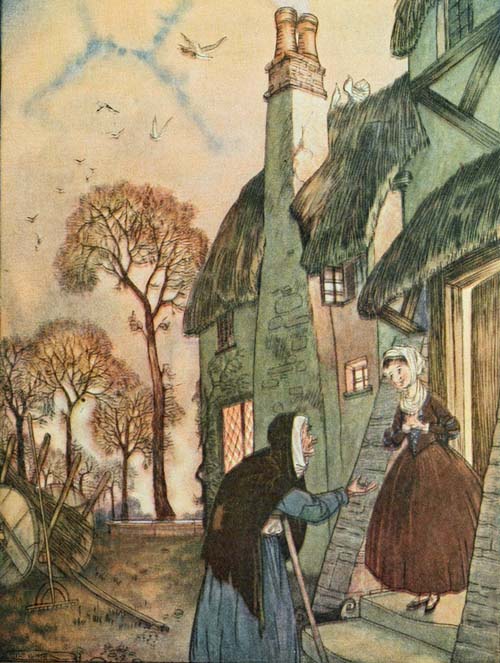
“CHILDE CHARITY CAME OUT AND ASKED THE OLD WOMAN TO TAKE HER SHARE OF THE SUPPER”
That day all the servants were sick after the feast, and mostly cross too—so you may judge how civil they were; when, at supper time, who should come to the back door but the old woman, again asking for broken victuals and a night’s lodging.
No one would listen to her or give her a morsel, till Childe Charity rose from her seat at the foot of the lowest table, and kindly asked her to take her supper, and sleep in her bed in the back garret. Again the old woman sat down without a word. Childe Charity scraped the pots for her supper, and slept on the sack.
In the morning the old woman was gone; but for six nights after, as sure as the supper was spread, there was she at the back door, and the little girl regularly asked her in.
Childe Charity’s aunt said she would let her get enough of beggars. Her cousins made continual game of what they called her genteel visitor. Sometimes the old woman said: “Child, why don’t you make this bed softer? and why are your blankets so thin?” but she never gave her a word of thanks, nor a civil good morning.
At last, on the ninth night from her first coming, when Childe Charity was getting used to scrape the pots and sleep on the sack, her accustomed knock came at the door, and there she stood with an ugly ashy-coloured dog, so stupid-looking and clumsy that no herd-boy would keep him.
“Good evening, my little girl,” she said when Childe Charity opened the door. “I will not have your supper and bed to-night—I am going on a long journey to see a friend. But here is a dog of mine, whom nobody in all the west country will keep for me. He is a little cross, and not very handsome; but I leave him to your care till the shortest day in all the year. Then you and I will count for his keeping.”
When the old woman had said the last word, she set off with such speed that Childe Charity lost sight of her in a minute. The ugly dog began to fawn upon her, but he snarled at everybody else. The servants said he was a disgrace to the house. The proud cousins wanted him drowned, and it was with great trouble that Childe Charity got leave to keep him in an old ruined cow-house.
Ugly and cross as the dog was, he fawned on her, and the old woman had left him to her care. So the little girl gave him part of all her meals, and when the hard frost came, took him privately to her own back garret, because the cow-house was damp and cold in the long nights. The dog lay quietly on some straw in a corner. Childe Charity slept soundly, but every morning the servants would say to her:—
“What great light and fine talking was that in your back garret?”
“There was no light, but the moon shining in through the shutterless window, and no talk that I heard,” said Childe Charity.
And she thought they must have been dreaming. But night after night, when any of them awoke in the dark and silent hour that comes before the morning, they saw a light brighter and clearer than the Christmas fire, and heard voices like those of lords and ladies in the back garret.
Partly from fear, and partly from laziness, none of the servants would rise to see what might be there. At length, when the winter nights were at the longest, the little parlour-maid, who did least work and got most favour, because she gathered news for her mistress, crept out of bed when all the rest were sleeping, and set herself to watch at a crevice of the door.
She saw the dog lying quietly in the corner, Childe Charity sleeping soundly in her bed, and the moon shining through the shutterless window. But an hour before daybreak there came a glare of lights, and a sound of far-off bugles. The window opened, and in marched a troop of little men clothed in crimson and gold, and bearing every man a torch, till the room looked bright as day. They marched up with great reverence to the dog, where he lay on the straw, and the most richly clothed among them said:—
“Royal Prince, we have prepared the banquet hall. What will Your Highness please that we do next?”
“Ye have done well,” said the dog. “Now, prepare the feast, and see that all things be in our first fashion: for the Princess and I mean to bring a stranger who never feasted in our halls before.”
“Your Highness’s commands shall be obeyed,” said the little man, making another reverence; and he and his company passed out of the window.
By and by there was another glare of lights, and a sound like far-off flutes. The window opened, and there came in a company of little ladies clad in rose-coloured velvet, and carrying each a crystal lamp. They also walked with great reverence up to the dog, and the gayest among them said:—
“Royal Prince, we have prepared the tapestry. What will Your Highness please that we do next?”
“Ye have done well,” said the dog. “Now, prepare the robes, and let all things be in our first fashion: for the Princess and I will bring with us a stranger who never feasted in our halls before.”
“Your Highness’s commands shall be obeyed,” said the little lady, making a low curtsy; and she and her company passed out through the window, which closed quietly behind them.
The dog stretched himself out upon the straw, the little girl turned in her sleep, and the moon shone in on the back garret.
The parlour-maid was so much amazed, and so eager to tell this great story to her mistress, that she could not close her eyes that night, and was up before cock-crow. But when she told it, her mistress called her a silly wench to have such foolish dreams, and scolded her so that the parlour-maid durst not mention what she had seen to the servants.
Nevertheless Childe Charity’s aunt thought there might be something in it worth knowing; so next night, when all the house were asleep, she crept out of bed, and set herself to watch at the back garret door.
There she saw exactly what the maid told her—the little men with the torches, and the little ladies with the crystal lamps, come in making great reverence to the dog, and the same words pass, only he said to the one, “Now prepare the presents,” and to the other, “Prepare the jewels.”
And when they were gone the dog stretched himself on the straw, Childe Charity turned in her sleep, and the moon shone in on the back garret.
The mistress could not close her eyes any more than the maid from eagerness to tell the story. She woke up Childe Charity’s rich uncle before cock-crow. But when he heard it, he laughed at her for a foolish woman, and advised her not to repeat the like before the neighbours, lest they should think she had lost her senses.
The mistress could say no more, and the day passed. But that night the master thought he would like to see what went on in the back garret: so when all the house were asleep, he slipped out of bed, and set himself to watch at the crevice in the door.
The same thing happened again that the maid and the mistress saw: the little men in crimson with their torches, and the little ladies in rose-coloured velvet with their lamps, came in at the window, and made an humble reverence to the ugly dog, the one saying, “Royal Prince, we have prepared the presents,” and the other, “Royal Prince, we have prepared the jewels.”
And the dog said to them all: “Ye have done well. To-morrow come and meet me and the Princess with horses and chariots, and let all things be in our first fashion: for we will bring a stranger from this house who has never travelled with us, nor feasted in our halls before.”
The little men and the little ladies said: “Your Highness’s commands shall be obeyed.”
When they had gone out through the window the ugly dog stretched himself out on the straw, Childe Charity turned in her sleep, and the moon shone in on the back garret.
The master could not close his eyes any more than the maid or the mistress, for thinking of this strange sight. He remembered to have heard his grandfather say, that somewhere near his meadows there lay a path leading to the Fairies’ country, and the haymakers used to see it shining through the grey Summer morning as the Fairy bands went home. Nobody had heard or seen the like for many years; but the master concluded that the doings in his back garret must be a Fairy business, and the ugly dog a person of great account. His chief wonder was, however, what visitor the Fairies intended to take from his house; and after thinking the matter over he was sure it must be one of his daughters—they were so handsome, and had such fine clothes.
Accordingly, Childe Charity’s rich uncle made it his first business that morning to get ready a breakfast of roast mutton for the ugly dog, and carry it to him in the old cow-house. But not a morsel would the dog taste. On the contrary, he snarled at the master, and would have bitten him if he had not run away with his mutton.
“The Fairies have strange ways,” said the master to himself. But he called his daughters privately, bidding them dress themselves in their best, for he could not say which of them might be called into great company before nightfall.
Childe Charity’s proud cousins, hearing this, put on the richest of their silks and laces, and strutted like peacocks from kitchen to parlour all day, waiting for the call their father spoke of, while the little girl scoured and scrubbed in the dairy.
They were in very bad humour when night fell, and nobody had come. But just as the family were sitting down to supper the ugly dog began to bark, and the old woman’s knock was heard at the back door. Childe Charity opened it, and was going to offer her bed and supper as usual, when the old woman said:—
“This is the shortest day in all the year, and I am going home to hold a feast after my travels. I see you have taken good care of my dog, and now if you will come with me to my house, he and I will do our best to entertain you. Here is our company.”
As the old woman spoke there was a sound of far-off flutes and bugles, then a glare of lights; and a great company, clad so grandly that they shone with gold and jewels, came in open chariots, covered with gilding, and drawn by snow-white horses.
The first and finest of the chariots was empty. The old woman led Childe Charity to it by the hand, and the ugly dog jumped in before her. The proud cousins, in all their finery, had by this time come to the door, but nobody wanted them. And no sooner was the old woman and her dog within the chariot than a marvellous change passed over them, for the ugly old woman turned at once to a beautiful young Princess, with long yellow curls and a robe of green and gold, while the ugly dog at her side started up a fair young Prince, with nut-brown hair, and a robe of purple and silver.
“We are,” said they, as the chariots drove on, and the little girl sat astonished, “a Prince and Princess of Fairyland, and there was a wager between us whether or not there were good people still to be found in these false and greedy times. One said ‘Yes,’ and the other said ‘No’; and I have lost,” said the Prince, “and must pay the feast and presents.”
Some of the farmer’s household, who were looking after them through the moonlight night, said the chariots had gone one way across the meadows, some said they had gone another, and till this day they cannot agree upon the direction.
But Childe Charity went with that noble company into a country such as she had never seen—for Primroses covered all the ground, and the light was always like that of a Summer evening. They took her to a royal palace, where there was nothing but feasting and dancing for seven days. She had robes of pale green velvet to wear, and slept in a chamber inlaid with ivory.
When the feast was done, the Prince and Princess gave her such heaps of gold and jewels that she could not carry them, but they gave her a chariot to go home in, drawn by six white horses. And on the seventh night, which happened to be Christmas time, when the farmer’s family had settled in their own minds that she would never come back, and were sitting down to supper, they heard the sound of her coachman’s bugle, and saw her alight with all the jewels and gold at the very back door where she had brought in the ugly old woman.
The Fairy chariot drove away, and never came back to that farmhouse after. But Childe Charity scrubbed and scoured no more, for she grew a great lady, even in the eyes of her proud cousins.
Frances Browne
THE SHINING CHILD AND THE WICKED MOUCHE
HOW THE RICH COUSINS CAME
Once upon a time a noble but poor Count lived in the lovely land of Alsace. He dwelt in a charming little house on a hill. All around the house the graceful trees stretched out their leafy branches like arms, as if they were saying: “Welcome! Welcome among us!” Not far from the house was a thick green wood filled with birds and flowers and scented grasses. The good Count did not live alone in this delightful spot; no indeed, his wife and his two children, Fanchon and Frederic, lived with him, happy and contented.
Now, one Summer the news arrived that a wealthy and distinguished nobleman, cousin of the Count, was coming the next day, with his family, to call upon his poor relatives.
The following morning the Countess got up very early, and baked a cake into which she put more almonds and raisins than she ever put into her Easter cakes, so that its delicious fragrance filled the house. The Count dusted and brushed his old green waistcoat; while Fanchon and Frederic, dressed in their best clothes, sat waiting for the guests to come.
“You must not run about in the wood, as you usually do,” said the Count to them, “but sit very still so that you will look clean and neat when your cousins arrive.”
So the poor children were forced to stay in the house. The morning sun was peeping bright and smiling from behind a cloud, and was darting his rays in at the window. Out in the wood the breeze was blowing sweet and fresh, and the robins, the thrushes, the goldfinches, and the nightingales, were all warbling their loveliest songs. Poor Fanchon sat still and listened, sometimes smoothing the bow on her pink sash, and sometimes knitting a bit, and all the while longing to run away to the wood. As for Frederic, he was looking at a picture book, but he kept jumping up every minute to gaze out at the window; for the big house dog Pepin was barking and bounding before the window, as if to say: “Aren’t you coming out? What in the world are you doing in that stuffy room?”
And so Fanchon and Frederic had to remain in the house; and this was all the more painful, because the company-cake, which was on the table, gave out the most delicious spicy odours, yet might not be cut until the cousins came. “Oh! that they would only come!—would only come!” the children cried, and almost wept with impatience.
At last the loud tramping of horses was heard, and the rumble of wheels, then a carriage approached, so brilliant and so covered with golden ornaments that the children were amazed, for they had never seen anything like it. The carriage stopped before the house, and a very tall, thin gentleman glided out with the help of a footman, and fell into the arms of the Count, to whose cheek he gently pressed his lips. Then the footman aided a stout, red-faced woman to alight, while two children, a boy and a girl, stepped languidly down after her.
When they were all safely in the house, Fanchon and Frederic came forward and curtsied politely, as their father had told them to do. Then each seized a hand of the tall gentleman, saying: “We are glad you are come, noble Cousin!” After which they permitted the red-faced lady to embrace them; then they went up to the children, but stood before them silent and amazed. Indeed, these rich children were wonderfully dressed! The boy wore a little jacket of scarlet cloth, embroidered with gold and ornamented with gold tassels. A bright little sword hung at his side. On his head was a curious red cap with a white feather, from under which peeped his yellow face and bleared eyes.
The little girl had on a white dress all ribbons, lace, and bows, and her hair was frizzled and curled into a knot, on top of which was a shining coronet. Fanchon plucked up courage, and was going to take the little girl’s hand, but she snatched it away in such a hurry and looked so tearful and angry, that Fanchon was frightened and let her alone.
Frederic wished to have a closer look at the boy’s sword, and put out his hand to touch it, when the youngster began to shout and cry: “My sword! My sword! He is going to take my sword!” and ran to his father and hid behind him.
After that Fanchon and Frederic stood back quietly, while their mother cut the cake, and the older people talked. The two rich children sat munching dry crackers, for their parents said that cake was not good for them. But Fanchon and Frederic each had a large slice, which their dear mother gave them.
After they had finished eating, the guests arose to say good-bye, and the glittering carriage was driven to the door. The footman took from it two large bandboxes. These, the rich children handed with condescending pride, to Fanchon and Frederic. And just as the guests were about to take their leave, the dog Pepin, Frederic’s faithful friend and darling, came dancing and barking around them. The rich children screamed, and had to be lifted, kicking with fright, into the carriage, which immediately drove away.
So ended the visit of these wealthy, distinguished, and noble cousins.
THE NEW PLAYTHINGS
After the carriage containing the wealthy cousins had rolled down the hill, the Count threw off his green waistcoat, and put on his loose jacket, and ran his fingers through his hair. The children, too, quickly got out of their best clothes, and felt light and happy.
“To the wood! To the wood!” shouted Frederic, jumping as high as he could for joy.
“But don’t you wish to see what is in these handsome bandboxes your cousins gave you?” asked his mother.
And Fanchon, who had been gazing at the bandboxes with longing eyes, cried out: “Can’t we open them first, and go to the wood afterward?”
But Frederic was hard to convince. “Surely that stupid boy could not have brought anything worth while,” said he scornfully, “nor his ribbony sister! He talked so boldly about bears and lions, but when my dear Pepin barked, he forgot his sword and hid under the table! A brave sportsman he!”
“Oh, dear, good brother!” cried Fanchon, “just let us take one peep at what is in the boxes!”
So Frederic, who always did what he could to please his sister, gave up the idea of being off to the wood at once, and sat down patiently beside the table where the bandboxes were.
The mother opened them—and then—oh, my dear readers, if you could have seen what lay within! The loveliest toys were in those boxes! and candies, and sweet cakes, and nuts! The children clapped their hands again and again, crying: “Oh, how nice! Oh, how delicious!”
They took them all out of the boxes, and piled them on the table. None of the toys caused Frederic such satisfaction as did a little hunter who, when a string that stuck out from his jacket was pulled, put a gun to his shoulder, and fired at a target. Next to him in Frederic’s affections, was a little fellow who bowed, and twanged on a harp, whenever Frederic turned a tiny handle. And, what pleased him nearly as much, was a shotgun of wood and a hunting pouch and belt.
Fanchon was equally delighted with a beautiful doll, a trunk filled with doll’s dresses, tiny shoes, hats, and other lovely clothes, and a set of charming doll’s furniture.
The two children forgot all about the wood, and enjoyed themselves with their playthings until quite late in the evening. They then went to bed and slept soundly.
WHAT HAPPENED TO THE PLAYTHINGS IN THE WOOD
The next morning, the children got their boxes and took out the playthings, and began to play. Then, just as on the day before, the sun shone brightly in at the window, the trees rustled in the breeze, and the birds sang their loveliest songs. At last Frederic cried out:—
“Why do we sit here in this stuffy room? I’ll tell you what we’ll do! Come, Fanchon, let us be off to the wood!”
Fanchon had just undressed her doll, and was going to put it to bed. “Why can’t we stay here?” she begged, “and play a little longer, Frederic?”
“I’ll tell you what we’ll do,” he replied. “We’ll take our toys out to the wood. I’ll put on my pouch and belt, and carry my gun. I’ll be a real sportsman! The hunter and the harper may come, too. And you may take your doll. Come along! Let’s be off!”
Fanchon hastened to dress her doll, then they both ran out of the house, and off to the wood. There they sat down on a nice grassy spot. And after they had played a while, Fanchon said:—
“Do you know, Frederic, that harper of yours does not play very well. Just listen how funny his harp sounds out here in the wood—with that eternal ting! ting! ping! ping!”
Frederic turned the handle more violently. “You’re right, Fanchon,” said he. “What the little fellow plays sounds quite horrible. He must make a better job of it!”
And with that he unscrewed the handle with such force, that—crack! crack!—the box on which the harper stood flew into a thousand splinters, and the arms of the little fellow were broken and hung useless at his sides.
“Oh! Oh!” cried Frederic.
“Ah, the poor little harper!” sighed Fanchon.
“Well, he was a stupid creature!” said Frederic. “He played very poor music, and bowed, and made faces like our yellow-faced cousin who gave him to us.” And as Frederic spoke, he threw the harper into a thicket.
“What I like, is my hunter,” he continued. “He hits the bull’s eye every time he fires.” And with that Frederic jerked the string so violently that—twang! twang!—the target was broken and the little man’s arms hung limp and motionless.
“Ah! Ah!” cried Frederic. “You could shoot at your target in-doors, but out here, you can’t shoot at all!” And so saying, Frederic, with all his might, shied the hunter after the harper into the thicket.
“Come, let us run about a bit,” said he to Fanchon.
“Ah, yes! let us,” said she. “This lovely doll of mine shall run with us. It will be great fun!”
So Fanchon and Frederic took each an arm of the doll, and off they ran through the bushes, on and on, until they came to a small lake. There they stopped, and Frederic said:—
“Suppose we wait a minute. I have a gun now, and perhaps I may hit a duck among the rushes.”
At that moment, Fanchon screamed out: “Oh! just look at my doll! What’s the matter with her?”
Indeed, the poor thing was in a miserable condition. Neither Fanchon nor Frederic had been paying any attention to her, and the bushes had torn all the clothes off her back; both her legs were broken; while her pretty waxen face was covered with so many scratches that it was hideous to look at.
“Oh! my beautiful, beautiful child!” sobbed Fanchon.
“There, you see what a stupid creature that doll of yours is!” cried Frederic. “She can’t even take a little run, but she must tear and spoil her clothes! Give her to me!”
And before Fanchon could say a word, or cry: “Oh! Oh!” Frederic snatched the doll, and flung her into the lake.
“Never mind, Fanchon!” said he consolingly. “Never mind, if I can shoot a duck, you shall have the most beautiful wing-feathers.”
Just then a noise was heard among the rushes, and Frederic instantly took aim with his wooden gun. But he dropped it quickly from his shoulder, saying:—
“Am I not an idiot! How can a fellow shoot a duck without powder and shot? What’s the use of this stupid wooden thing, anyway?” With that he flung the gun and his pouch and belt into the lake.