PART ONE FAIRY-LORE AND ELFIN LEGENDS
Reading edition
Around! Around! in Fairy Rings
In the glowing light of a Summer sky, When the fields are clad in green. Oft in their midst, with a sunnier dye, May the Fairies’ Ring be seen! ’Tis a circle formed by the tiny feet Of the Elves, as they dance around: When the moon rides high it is there they meet, And merrily tread the ground! William Jones
ADVENTURES OF ROBIN GOODFELLOW
From Merry England
HOW ROBIN GOODFELLOW WAS BORN
Once upon a time, when men did eat more and drink less, when men did know no knavery, there were wont to walk many harmless sprites called Fairies, dancing in brave order in Fairy Rings on green hills, to sweet music. These sprites would make themselves invisible, and many mad pranks would they play, pinching careless housemaids black and blue, and turning ill-kept houses topsy-turvy. But lovingly they would use neat housemaids, giving them silver and other pretty toys which they left in the maids’ shoes and pockets, or in bright kitchen pans.
Now, in those Fairy days there was born on earth a tiny Elfin boy whom folk called Robin Goodfellow. And wonderful were the gifts from Fairyland that came to Robin when he was a baby. In his room suddenly would appear rich embroidered cushions, delicate linen garments, and all sorts of delicious things to eat and drink. So he was never in want.
Now, when Robin was grown to six years, he was so mischievous that the neighbours all complained of his pranks until he was forced to run away.
He wandered about until he began to get hungry; then, going to a tailor, he took service with him. He remained there until he grew so mischievous that he was obliged to run away again.
HOW HE RECEIVED A MESSAGE FROM FAIRYLAND
After he had travelled a good day’s journey from the tailor’s house, he sat down by the wayside and, being weary, fell asleep. No sooner had he closed his eyes than he fancied he saw tiny beings tripping on the grass before him, to the sound of sweet music. And when he awoke, he found, to his surprise, a scroll lying near by on which were these verses, written in letters of gold:—
“Robin, my only son and heir, For food and drink take thou no care. Wish what thou wilt, and thou shalt have The power to tease both fool and knave. Change when thou wilt thine Elfish shape, To horse, or hog, or dog, or ape; And scare each idle dirty maid, And make all wicked men afraid. But love thou those that honest be, And help them in necessity. “Do thus, and all the world shall know The pranks of Robin Goodfellow. If thou’lt observe my just command, One day thou shalt see Fairyland.”
Robin, having read this, was very joyful, for he perceived that he had Fairy power. He straightway wished for something to eat, and it appeared before him. Then he wished himself a horse, and no sooner did he say so than he became a handsome colt, curveting and leaping about. He wished himself a dog, and was one. After that he turned himself into any shape he liked. Then taking his own form again, he once more started on his travels.
OF HIS MAD PRANKS—HO! HO! HO!
And from that time forward many were the merry tricks Robin played on those he met.
Once, seeing a rude and clownish fellow searching for a lost horse, Robin turned himself into a horse, and led the rude man a chase over field and briar, until he allowed the man to catch him and mount his back. Then Robin jumped into a stream and, turning into a fish, swam to the shore and ran away, laughing, “Ho! Ho! Ho!”—leaving the man to get out of the water as best he could.
At night Robin often visited farmers’ houses, and helped the neat housemaids with their work, breaking their hemp, dressing their flax, and spinning their yarn. One night he came to a house where there was a good and handsome maid. And while she slept Robin did her work, more than she could have done in twelve hours. The maid wondered the next morning to see all done so finely, and that night she watched to see what would follow.
At twelve of the clock in came Robin and, singing, fell to work breaking her hemp and doing her spinning, and as he worked he sang a mad song:—
“Within and out, in and out, round as a ball, With hither and thither, as straight as a line, With lily and germander, and sops of wine, With sweetbriar, And bonfire, And strawberry wire, And columbine!”
The maid, seeing that he had no clothes, pitied him, and the next night she laid out a little suit that she had cut and sewed during the day. Robin, coming in, spied the clothes, whereat he started, and said:—
“’Tis not your garments new or old That Robin loves. I feel no cold. Had you left me milk or cream, You should have had a pleasant dream, Became you left no drop or crumb, Robin never more will come.”
And with that he ran out of the door, laughing loudly, “Ho! Ho! Ho!”
And many other mad pranks did Robin Goodfellow play. At times he turned himself into a will-o’-the-wisp, misleading lovers who came over the heath; at other times he punished knaves and idle maids, or rewarded good and worthy people. And always he ran laughing, “Ho! Ho! Ho!”
HOW HE DANCED IN THE FAIRY RING
At length Oberon, King of Fairyland, seeing so many honest and merry tricks, called one night to Robin as he lay sleeping in the green-wood:—
“Robin, my son, come, quickly rise! First stretch, then yawn, and rub your eyes. For you must go with me to-night To dance with Fairy, Elf, and Sprite. Come quickly now, my roguish son, ’Tis time our sports were well begun.”
Robin, hearing this, woke and rose hastily, and, looking about, saw in the moonlight King Oberon, and many Fairies with him dressed in green silk. And all these did welcome Robin Goodfellow into their company.
King Oberon took Robin by the hand and led him a dance. And near by sat little Tom Thumb, the Fairy piper, no bigger than a plum. His bagpipe was made of a wren’s quill and the skin of a tiny bug. This pipe made music so shrill and sweet, that naught might be compared to it.
Then all the Fairies for joy did circle Robin around, and in a ring did dance about him; and Robin Goodfellow danced in the midst of them, and sang this song:—
“Quick and nimble! Quick and nimble! Round about little ones! In and out, wheel about, Run, hop, or amble! “Elves, Urchins, Goblins all, and little Fairies, Who do pinch black and blue, idle maids in dairies, Make a ring on the grass, with your quick measures. Tom shall play, and I will sing, for all your pleasures. “Quick and nimble! Quick and nimble! Round about little ones! In and out, wheel about, Run, hop, or amble!”
Thus they danced for a good space, then sat themselves down upon the grass, and the Fairies told Robin of many Elfish tricks and merry capers; until, the time passing, a shepherd in a field near by blew his pipes so loudly that he frightened little Tom Thumb.
The Fairies punished the shepherd by the loss of his pipes, so that they presently broke in his hand, to his great amazement. Hereat Robin Goodfellow laughed, “Ho! Ho! Ho!”
The morning being come, at cock-crow the Fairies hastened away to Fairyland, where I think they yet remain.
THE POTATO SUPPER
From Ireland
Some folk say that the Little People, the Fairies, were once angels that were cast out of Heaven for their sins. They fell to earth and grew smaller and smaller. And to-day they dance on moonlit nights in Fairy Rings, and play all manner of pranks.
Be that as it may, one night a merry troop of them was capering in the moonshine. On a nice green sward by a river’s bank the little fellows were dancing hand-in-hand, with their red caps wagging at every bound. And so light were their feet that the dew trembled, but was not disturbed. So they danced, spinning around and around, and twirling, and bobbing, and diving, until one of them chirped:—
“Cease! Cease with your humming! Here’s an end to your mumming! By my smell I can tell That a Priest is now coming!”
And away all the Fairies scampered as fast as they could. Some hid under the green leaves of the Foxglove, their little caps peeping out like crimson bells. Others crept under the shadow of stones, or beneath the bank of the river.
And scarcely had they done so, when along came Father Horrigan riding slowly on his pony. He was thinking to himself that he would end his journey at the first cabin he came to. And so he did, for soon he stopped at the little house of Dermod Leary, and, lifting the latch, walked in with: “A blessing on all here!”
And a welcome guest, you may be sure, was Father Horrigan, for no man was better loved in all that country. But when Dermod saw him enter, he was troubled, for he had nothing to offer for supper except some potatoes that his wife was boiling in a pot over the fire. Then he remembered that he had set a net in the river. “There’ll be no harm,” thought he, “in my stepping down to see if anything has been caught.”
So down to the river went Dermod. He found as fine a salmon in the net as ever jumped from water. But as he was taking it out, the net was jerked from his hands, and away the salmon went, swimming along as though nothing had happened.
Dermod looked sorrowfully at the wake that the fish left shining like a line of silver in the moonlight.
“May bitter luck attend you night and day!” cried he, shaking his fist. “Some evil thing sure it was that helped you, for did I not feel it pull the net out of my hand!”
“You’re all wrong, Dermod! There were a hundred or more of us pulling against you!” squeaked a little voice near his feet, and the whole troop of Fairies—hundreds and hundreds of them—came rushing from their hiding-places, and stood before him, their red caps nodding violently.
Dermod gazed at them in wonder; then one of the Fairies said:—
“Make yourself noways uneasy about the Priest’s supper, Dermod Leary. If you will go back and ask him one question for us, there’ll be as fine a supper spread before him in no time, as ever was put on table.”
“I’ll have nothing to do with you at all, at all!” answered Dermod; “I know better than to sell my soul to the likes of you!”
But the little Fairy was not to be repulsed. “Will you ask the Priest just one civil question for us, Dermod?” said he.
Dermod considered for a moment. “I see no objection,” said he, “to the same. But I’ll have nothing to do with your supper, mind that!”
The Little People all crowded near him, while the Fairy answered:—
“Go and ask Father Horrigan to tell us whether our souls will be saved at the Last Day. And, if you wish us well, Dermod Leary, you will bring the word that he says.”
Away went Dermod to his cabin.
“Please, your reverence,” said he to Father Horrigan, “may I make bold to ask your honour a question?”
“What is it?” said Father Horrigan.
“Why, then,” said Dermod, “will the souls of the Little People be saved at the Last Day?”
“Who bids you ask that question, Leary?” said Father Horrigan, fixing his eyes sternly on Dermod.
“I’ll tell no lies about the matter, nothing in life but the truth,” answered Dermod. “’Twas the Little People themselves who sent me. They are in thousands down on the bank of the river waiting for your word.”
“Go back,” said Father Horrigan, “and tell them that if they want to know they must come here to me themselves, and I’ll answer that and any other question.”
So back Dermod hurried to the river. The Fairies came swarming around him. They pressed close to his feet, with faces upturned as they anxiously waited. And Dermod, brave man that he was, spoke out boldly and gave them the Priest’s message. And when they heard that, the whole multitude of little Fairies uttered shrill cries and groans; and they whisked past Dermod in such numbers that he was quite bewildered. Then in a trice he found himself alone.
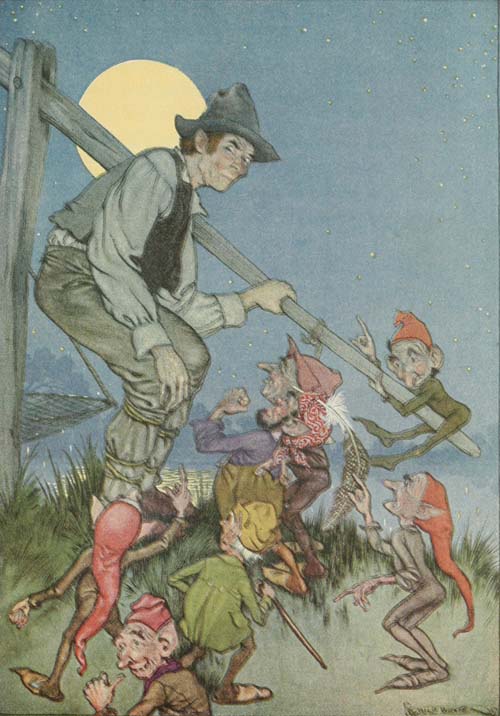
“DERMOD GAZED AT THEM IN WONDER”
He went slowly back to his cabin. He opened the door. The fire was burning brightly. The candles were lighted. And good Father Horrigan was seated comfortably at the table, a pitcher of new milk before him, and a bit of fresh butter, from Dermod’s cow. And Dermod’s wife was handing him a big, handsome potato, whose white, mealy insides were bursting through its skin, and smoking like a hard-ridden horse on a frosty night.
Dermod sat down at the table, and began to eat without a word. And when Father Horrigan was through the good Priest smacked his lips, and said that he had relished the hot tasty potatoes, more than a dozen fat salmon, and a whole Fairy feast!
THE MILK-WHITE CALF AND THE FAIRY RING
From Ireland
In Tipperary is one of the most singularly shaped hills in the world. It has a peak at the top like a conical nightcap. On this very peak, long years ago, a herdsman spent his nights and days watching the herd. Now, the hill was ancient Fairy ground, and the Little People were angry that the scene of their light and airy gambols should be trampled by the rude hoofs of bulls and cows. The lowing of the cattle sounded sad in their ears. So the Queen of the Fairies determined to drive away the herdsman.
One night the moon shone brightly on the hill. The cattle were lying down. The herdsman, wrapped in his mantle, was watching the twinkling stars, when suddenly there appeared before him a great horse with the wings of an eagle, and the tail of a dragon. This beast hissed loudly and spat fire, and, while the herdsman was looking on, half dead with fright, it turned into a little old man, lame of leg, with a bull’s head around which flames were playing.
The next moment the little old man changed into a huge ape, with duck’s feet, and a turkey-cock’s tail. And then the Queen of the Fairies—for of course it was she—roared, neighed, hissed, bellowed, howled, and hooted so fearfully that the poor herdsman in terror covered his head with his mantle. But it was of no use, for with one puff of wind she blew away the fold of his mantle, let him hold it never so tightly. As for the poor man, he could not stir or close his eyes, but was forced to sit there gazing at this terrible sight until his hair lifted his hat half a foot from his head, and his teeth chattered so that they almost fell out of his mouth.
Meanwhile the frightened cattle scampered about like mad, as if bitten by fleas, and so they continued to do until the sun rose. Then the Fairy Queen disappeared.
Night after night, the same thing happened, and the cattle went mad. Some fell into pits, or tumbled into the river and were drowned. By and by, not a herdsman was willing to tend the cattle at night. The farmer who owned the hill offered triple and quadruple wages, but not a man was found who would face the terrors of the Fairy Ring. The herd gradually thinned, and the Fairies, on moonlit nights, danced and gambolled as merrily as before, sipping dew-drops from acorn-cups, and spreading their feasts on the heads of mushrooms.
Now, there dwelt in that part of the country a man named Larry Hoolahan, who played on the pipes better than any other player within fifteen parishes. A dashing, roving blade was Larry, and afraid of nothing. One day the farmer met him, and told him all his misfortunes.
“If that is what ails you,” said Larry, “make your mind easy. Were there as many Fairies on the hill as there are potato-blossoms in Tipperary, I would face them. It would be a queer thing, indeed, if I, who was never afraid of a proper man, should turn my back on a Fairy not the bigness of one’s thumb!”
“Larry,” said the farmer, “do not talk so bold, for you know not who is hearing you! But, if you make your words good, and watch my herds for a week on top of the hill, your hand shall be free of my dish till the sun has burnt itself down to the bigness of a farthing rushlight!”
The bargain was struck, and Larry went to the hill-top when the moon was beginning to peep over its brow. He took his seat on a big stone under a hollow of the hill, with his back to the wind, and pulled out his pipes.
He had not played long when the voices of the Fairies were heard upon the blast like a low stream of music. Presently they burst into a loud laugh, and Larry could plainly hear one say:—
“What! Another man upon the Fairies’ Ring! Go to him, Queen, and make him repent of his rashness!”
And away they flew, and Larry felt them pass by his face like a swarm of midges. Looking up hastily he saw, between the moon and him, a great black cat, standing on the very tip of its claws, with its back up, and mewing with a voice like a water-mill.
Presently it swelled up toward the sky, and, turning round on its left hind leg, whirled till it fell to the ground. Then it started up in the shape of a salmon with a cravat round its neck, and wearing a pair of new top-boots.
“Go on, my jewel!” said Larry. “If you dance, I’ll pipe,” and he struck up.
But the Queen of the Fairies—for of course it was she—turned into this and that and the other; but still Larry played on, as well as he knew how. At last she lost patience, and changed herself into a calf, milk-white as the cream of Cork, and with eyes as mild as those of a loving girl.
She came up gentle and fawning, hoping to throw him off his guard, and then to work him some wrong. But Larry was not so deceived, for when she came near, dropping his pipes, he leaped on her back.
Now, from the top of the hill, as you look westward, you may see the broad river Shannon, full ten miles away. On this night its waters shone beautifully under the moon, and no sooner had Larry leaped on the back of the Fairy Queen than she sprang from the hill-top, and bounded clear at one jump, over the Shannon. It was done in a second; and, when she alighted on the distant bank, she kicked up her heels, and flung Larry on the soft turf.
No sooner was Larry thus planted than he looked her straight in the face, and cried out:—
“By my word, well done! That was not a bad leap, for a calf!”
She gazed at him for a moment, and then, assuming her own shape, said:—
“Larry Hoolahan, you are a bold fellow! Will you go back the way you came?”
“And that’s what I will!” said he, “if you’ll let me!”
So she changed to a calf again, and Larry got on her back. At another bound they were standing inside the Fairy Ring.
Then the Queen, once more assuming her own shape, addressed him.
“You have shown so much courage, Larry Hoolahan,” said she, “that while you keep herds on this hill, you shall not be molested by me or mine. The day dawns. Go down to the farmer, and tell him this. And, if anything I can do will be of service to you, ask and you shall have it.”
She vanished accordingly, and kept her word in never visiting the hill during Larry’s lifetime; but he never troubled her with requests. He piped, and ate and drank at the farmer’s expense, and roosted in the chimney-corner, occasionally casting an eye on the herd. He died at last; and is buried in a green valley of pleasant Tipperary. But whether the Fairies returned to the hill after his death is more than I can say.
THE WOOD-LADY
From Bohemia
Once upon a time there was a little girl named Betty. Her mother was a widow and very poor, and owned only a tumble-down house and two goats. Nevertheless, Betty was always cheerful. From Spring to Autumn she pastured the goats in the birch wood. Every morning when she left home, her mother gave her a little basket in which were a slice of bread and a spindle.
“My child,” she said, “work hard to-day and fill the spindle before you return.”
And, as Betty had no distaff, she wound the flax around her head, took the basket, and, with a skip and a jump, led her goats to the birch wood. There she sat under a tree and drew fibres of the flax from her head with her left hand, and let down the spindle with her right, so that it just hummed over the ground. And all the while she sang merrily, and the goats nibbled the green grass.
When the sun showed that it was midday she put aside her work, called her goats, and, after giving them each a morsel of bread, bounded into the wood to look for strawberries. When she came back she ate her fruit and bread, and, folding her hands, danced and sang. The goats, enjoying themselves among the green grass, thought: “What a merry shepherdess we have!” After her dance, she spun again. And at evening she drove her goats home, and her mother never had to scold her for bringing the spindle back empty.
One lovely Spring day, just as Betty sprang up to dance, suddenly—where she came, there she came!—a beautiful maiden stood before her. She wore a white dress as thin as gossamer, golden hair flowed to her waist, and on her head was a garland of wood flowers. Betty was struck dumb with astonishment.
The maiden smiled at her, and said in a very sweet voice:—
“Betty, are you fond of dancing?”
When the maiden spoke so prettily, Betty’s terror quitted her, and she answered:—
“Oh! I should like to dance all day!”
“Come, then, let us dance together. I will teach you,” said the maiden.
And she took Betty by the waist, and began to dance with her.
As they circled, such delicious music sounded over their heads that Betty’s heart skipped within her. The musicians sat on branches of the birches. They were clad in black, ash-coloured, and variegated coats. They were choice musicians who had come together at the call of the beautiful maiden—nightingales, larks, linnets, goldfinches, thrushes, blackbirds, and a very skillful mocking-bird. Betty’s cheeks flamed, her eyes glittered, she forgot her task and her goats. She could only gaze at her partner, who whirled her around with the most charming movements, and so lightly that the grass did not bend beneath her delicate weight.
They danced from noon till eve, and Betty’s feet were neither weary nor sore. Then the beautiful maiden stopped, the music ceased, and as she came, so she went, and she vanished as if the earth had swallowed her.
Betty looked about. The sun had set. She clapped her hands to the top of her head, and remembered that her spindle was by no means full. She took the flax and put it with the spindle into her basket, and drove the goats home. That night her mother did not ask to see her work.
Next morning Betty again drove the goats to pasture. All happened as before. Where she came, there she came!—and the beautiful maiden seized Betty by the waist, and they danced from noon till eve.
Then Betty saw that the sun was setting and her spindle nearly empty, so she began to cry. But the maiden put her hands to Betty’s head, took off the flax, and twined it round the stem of a slender birch, and began to spin. The spindle just swung over the ground. It grew fuller and fuller, and before the sun set behind the wood, all the yarn was spun. Giving the full spindle into Betty’s hands, the maiden said:—
“Reel and grumble not! Reel and grumble not!”
And as she came, so she went, and she vanished as if the ground had swallowed her. Betty drove the goats home, and gave her mother the full spindle.
Well, the next day all happened as before. Where she came, there she came!—and the beautiful maiden seized Betty by the waist, and they danced from noon to eve. Then the maiden handed Betty a covered basket, saying:—
“Peep not, but go home! Peep not, but go home!”
And as she came, so she went, and she vanished as if the ground had swallowed her.
At first Betty was afraid to peep into the basket, but when she was halfway home, she could not restrain herself. She lifted the cover and peeped, and, oh! how disappointed she was when she saw that the basket was full of birch leaves! She began to cry, and threw out two handfuls of the leaves, and was going to shake them all out of the basket, but she thought to herself: “They’ll make good litter for the goats.”
When she reached home her mother was waiting for her at the door.
“What sort of a spindle did you bring home to me yesterday?” cried she. “After you left this morning I began to reel. I reeled and I reeled, and the spindle remained full. One skein! two skeins! three skeins! and the spindle was yet full! ‘What evil spirit has spun you?’ grumbled I; and at that instant the yarn vanished from the spindle. Tell me the meaning of this.”
So Betty confessed how she had danced with the beautiful maiden who had given her the full spindle, and who had said: “Reel and grumble not.”
“That was a Wood-Fairy!” cried her mother in astonishment. “About noon in the Spring-time, the Wood-Ladies dance. Lucky for you that she did not tickle you to death! It’s a pity that you did not tell me before, for I might have had a room full of yarn, if I had reeled and grumbled not.”
Then Betty bethought herself of the basket of leaves. She lifted the cover and peeped in again.
“Look! Look! Mother!” she cried.
Her mother looked and clapped her hands. The birch leaves were turned to gold!
“She told me not to peep until I reached home,” said Betty, “but I disobeyed and threw two handfuls of the leaves away.”
“Lucky for you that you did not throw them all away!” exclaimed her mother.
The next morning they both went to the place where Betty had thrown out the leaves, but on the road lay nothing but birch leaves. However, the gold Betty had brought home was enough to make them rich. Her mother bought a fine house and garden. They had many cattle. Betty had handsome clothes, and she did not need to pasture the goats any more. But though she had everything she desired, nothing gave her so great delight as the dance with the Wood-Fairy. She often went to the birch wood hoping to see the beautiful maiden, but she never again set eyes upon her.
THE DANCE OF THE FAIRIES
By the moon we sport and play, With the night begins our day; As we dance, the dew doth fall— Trip it, little Urchins all, Lightly as the little bee, Two by two, and three by three; And about go we! And about go we! Oh, you must needs dance and sing, Which if you refuse to do, We will pinch you black and blue; And about go we! Round about, round about, in a fine ring-a, Thus we dance, thus we dance, and thus we sing-a; Trip and go, to and fro, over this green-a, All about, in and out, for our brave Queen-a. We have danced round about, in a fine ring-a, We have danced lustily, and thus we sing-a; All about, in and out, over this green-a, To and fro, trip and go, to our brave Queen-a. The Maydes Metamorphosis (1600)
ELFIN MOUNDS AND FAIRY HILLS
’Tis the Midnight Hour! The Moon hangs white! Mortal beware, ’Tis Fairy Night! From Elfin Mound, And Fairy Hill, Comes music sweet, And laughter shrill! Mortal beware, For Fairy-Spell Lies on meadow, Wood and dell!
MONDAY! TUESDAY!
From Ireland
There once lived a lad in old Ireland named Lusmore. He had a great hump on his back, and whenever he sat down he had to rest his chin on his knee for support. But, in spite of this, he was as happy as a cricket, and used to go about the country with a sprig of Fairy-cap, or Foxglove, in his little straw hat. He went from house to house plaiting baskets out of rushes, and in that way he earned a living. And he was so merry that people always gave him a penny more than he asked.
One evening, he was returning from a distant town, and as he walked slowly on account of his hump, it grew dark before he could reach home. He came to an old mound by the side of the road, and, being tired, sat down on it to rest.
He had not been sitting there long when he heard strains of music, and many little voices singing sweetly. He laid his ear to the mound, and perceived that the music and singing came from inside it. And he could hear the words that the little voices were chanting over and over again:—
“Monday! Tuesday! Monday! Tuesday! Monday! Tuesday!”
It was all so very sweet, that Lusmore listened with delight; but by and by he grew tired of hearing the same words sung over and over. He waited politely until the voices had finished their song, then he called:—
“And Wednesday!”
The Fairies—for it was the singing of Fairies that he heard—were so pleased with Lusmore’s addition to their words, that they pulled him right down through the top of the mound with the speed of a whirlwind. And he went falling and twirling round and round as light as a feather.
He found himself in a palace so bright that it dazzled his eyes. Then all the Fairies stopped capering and dancing, and came crowding around him. And one, wearing a crown, stepped forward and said:—
“Lusmore! Lusmore! The hump that you wore, On your back is no more. Look down on the floor, And see it, Lusmore!”
And as these words were being said, Lusmore felt himself grow so light and happy, that he could have bounded up to the moon. And he saw his hump tumble off his back and roll on the floor. Then the Fairies took hands, and danced around him, and as they did so he became dizzy and fell asleep.
When he opened his eyes it was broad daylight, and the sun was shining, and the birds were singing, and cows and sheep were grazing peacefully around him. He put his hand to his hump. It was gone! And there he was, as tall, straight, and handsome as any other lad in Ireland. And, besides all that, he was dressed in a full suit of beautiful clothes.
He went toward his home stepping out lightly, and jumping high at every step, so full of joy was he. And as he passed his neighbours, they hardly knew him without his hump, and because he was so straight and handsome, and was dressed so finely.
Now, in another village, not far away, lived a lad named Jack Madden. He also had a great hump on his back. He was a peevish, cunning creature, and liked to scratch and pinch all who came near him.
When he heard how the Fairies had taken away Lusmore’s hump, he decided that he, too, would visit them. So one night after darkness had fallen, he sat down on the mound all alone, and waited. He had not been there long before he heard the music, and the sweet voices singing:—
“Monday! Tuesday! Monday! Tuesday! Monday! Tuesday! And Wednesday!”
And as he was in a very great hurry to get rid of his hump, he did not wait for the Fairies to finish their song, but yelled out, thinking that two days were better than one:—
“And Thursday and Friday!”
No sooner had the words left his lips, than he was taken up quickly, and whisked through the mound with terrific force. And the Fairies came crowding around him, screeching and buzzing with anger, and crying out:—
“Our song you have spoiled! Our song you have spoiled! Our song you have spoiled!”
Then the one wearing the crown stepped forward, and said:—
“Jack Madden! Jack Madden! Your words came so bad in, That your life we will sadden! Here’s two humps for Jack Madden!”
And quick as a wink, twenty Fairies brought Lusmore’s hump and clapped it down on Jack Madden’s back, and there it was fixed as firmly as if nailed on with tenpenny nails.
Then out of the mound they kicked him. And when morning was come, he crept home with the two humps on his back—and he is wearing them still.
THE GREEDY OLD MAN
From Cornwall
Long ago in Cornwall, on a hillock called “the Gump,” there was a Fairy Ring. Many a good old man or woman, on moonlit nights, had seen the Fairies dancing there at their revels, and had been rewarded with gifts small but rich.
Now, there was one greedy old man, who, having heard his neighbours tell of the Fairy Gold at the revels, decided to steal some of the treasure. So on a moonlit night, when all was quiet, he stole softly up to “the Gump.”
As he drew near he heard delightful music, which seemed to come from inside the hillock. The notes were now slow and solemn, and now quick and gay, so that the old man had to weep and laugh in one breath. Then before he knew it, he began to dance to the Fairy measure. He was forced by some unseen power to whirl round and round; but in spite of this he kept his wits about him, and watched to see what would happen.
Suddenly there was a crashing sound, and a door in the hillock opened. Instantly the old man saw that everything about him was ablaze with coloured lights. Each blade of grass was hung with tiny bright lamps, and every tree and bush was illuminated with stars.
Out of the opening in the hillock marched a band of Goblins, as if to clear the way. Then came a number of Fairy musicians playing on every kind of musical instrument. These were followed by troop after troop of Elfin soldiers, carrying waving banners.
The soldiers arranged themselves in two files on either side of the door; but the Goblins, much to the old man’s disgust, placed themselves close behind him. As they were no bigger than his thumb, he thought to himself: “If they bother me, I can easily step on them and crush them with my foot.”
This vast array having disposed itself, next from the hillock came a crowd of Elfin servants carrying pitchers of silver and gold, and goblets cut out of diamonds, rubies, emeralds, and other precious stones. Servants followed bearing aloft gold and silver platters heaped high with the richest meats, pastries, candies, and glowing fruits. A number of Elfin boys, clad in crimson, then set out small tables made of ivory curiously carved, and the servants arranged the feast with order.
Then out of the hillock came crowding thousands and thousands of lovely winged Fairies clad in gossamer robes of every colour, like the rainbow.
The music suddenly changed to low, delicate notes, and the old man found that he was no longer forced to dance and whirl about. And as he stood still, the perfume of a thousand rich flowers filled the air, and the whole vast host of Fairies began to sing a song as clear and sweet as the tinkle of silver bells.
Then from the hillock issued forth line after line of Elfin boys dressed in green and gold, and behind them on an ivory throne, borne aloft by a hundred Fairies, came the King and Queen of Fairyland blazing with beauty and jewels.
The throne was placed upon the hillock, which immediately bloomed with lilies and roses. Before the King and Queen was set the most beautiful of all the little tables laden with gold and silver dishes and precious goblets. The Fairies took their places at the other tables, and began to feast with a will.
“Now,” thought the old man, “my time is come! If only I can creep up, without being seen, to the Fairy King’s table, I shall be able to snatch enough gold to make me rich for life.”
And with his greedy mind set on this, he crouched down, and began very slowly to creep toward the throne. But he did not see that thousands of Goblins had cast fine threads about his body, and were holding the ends in their hands.
Trembling with greed, the old man crept closer and closer to the Fairy King and Queen. He took his hat from his head, and raised it carefully to cover the royal throne and table; and, as he did so, he heard a shrill whistle. Instantly his hand was fixed powerless in the air. Then, with a sudden crash, all became dark around him.
“Whirr! Whirr! Whirr!” and he heard as if a flight of bees were brushing past his ears, and suddenly, his body, from head to foot, was stabbed with pins and pinched with tweezers. Then he was thrown violently upon his back with his arms outstretched; and his arms and legs were fastened to the ground with magic chains. His tongue seemed tied with cords so that he could not call out.
And as he lay there trembling with fright and pain, he felt as though swarms of insects were running over him. Then he saw standing on his nose a grinning Goblin. This little monster stamped and jumped with great delight; then making a fearful grimace, shouted:—
“Away! Away! I smell the day!”
And on this, an army of Goblins, Fairies, and Elves, who were running up and down the old man’s body, stabbing him with pins, and pinching him with tweezers, jumped quickly down, and rushed into the hillock; which closed immediately. And the old man saw the Fairies no more.
At length the sun rose and he found that he was tied to the ground with a myriad of gossamer webs, which were covered with dew-drops that glistened like diamonds in the sunlight.
He shook himself free, and got up. Wet, cold, ashamed, and pinched black and blue, he returned to his home. And you may be sure that he never again tried to steal the Fairy Gold.
LEGEND OF BOTTLE HILL
From Ireland
It was in the good days, when the Little People were more frequently seen than they are in these unbelieving times, that a farmer, named Mick Purcell, rented a few acres of barren ground not far from the city of Cork.
Mick had a wife and seven children. They did all that they could to get on, which was very little, for the poor man had no child grown big enough to help him in his work; and all that the poor woman could do was to mind the children, milk the cow, boil the potatoes, and carry the eggs to market. So besides the difficulty of getting enough to eat, it was hard on them to pay the rent.
Well, they did manage to get along for a good while; but at last came a bad year, and the little field of oats was spoiled, and the chickens died of the pip, and the pig got the measles, and poor Mick found that he hadn’t enough to pay half his rent.
“Why, then, Molly,” said he, “what’ll we do?”
“Wisha, then, mavourneen, what would you do but take the cow to the Fair of Cork, and sell her?” said she. “And Monday is Fair-day, so you must go to-morrow.”
“And what’ll we do when she’s gone?” said Mick.
“Never a know I know, Mick, but sure God won’t leave us without help. And you know how good He was to us when little Billy was sick, and we had nothing at all for him to take—that good doctor gentleman came riding past and asked for a drink of milk, and he gave us two shillings, and sent me things and a bottle for the child; and he came to see Billy and never left off his goodness until he was well.”
“Oh, you are always hopeful, Molly, and I believe you are right, after all,” Mick said, “so I won’t be sorry for selling the cow. I’ll go to-morrow, and you must put a needle and thread through my coat, for you know it’s ripped under the arm.”
Molly told him he should have everything right. And about twelve o’clock the next day he left her, after having promised not to sell his cow except for the highest penny.
He drove the beast slowly through a little stream that crossed the road under the walls of an old fort; and as he passed, he glanced his eyes on a pile of stones and an old elder tree that stood up sharply against the sky.
“Oh, then, if only I had half the Fairy money that is buried in yon fort, ’tisn’t driving this cow I’d be now!” said he aloud.
Then he moved on after his beast. ’Twas a fine day, and the sun shone brightly, and after he had gone six miles, he came to that hill—Bottle Hill it is called now, but that was not the name of it then.
“Good morrow, Mick!” said a little voice, and with that a little man started up out of the hill.
“Good morrow, kindly,” said Mick, and he looked at the stranger who was like a dwarf with a bit of an old wrinkled face, for all the world like a dried cauliflower; only he had a sharp red nose, red eyes, and white hair. His eyes were never quiet, but looked at everything; and it made Mick’s blood run cold just to see them roll so rapidly from side to side.
In truth Mick did not like the little man’s company at all, and he drove his cow somewhat faster; but the little man kept up with him. Out of the corner of his eye Mick could see that he moved over the road without lifting one foot after the other; and the poor fellow’s heart trembled within him.
“Where are you going with that cow, honest man?” said the little man at last.
“To the Fair of Cork, then,” said Mick, trembling even more at the shrill and piercing voice.
“Are you going to sell her?” asked the little man.
“Why, then, what else am I going for, but to sell her?”
“Will you sell her to me?”
Mick started. He was afraid to have anything to do with the little man, but he was more afraid to say no.
“I’ll tell you what, I’ll give you this bottle,” said the little man, pulling a bottle from under his coat.
Mick looked at him and the bottle, and in spite of his terror he could not help bursting into a loud fit of laughter.
“Laugh if you will!” said the little man, “but I tell you that this bottle is better for you than all the money you will get for the cow at Cork—aye, than ten thousand times as much.”
Mick laughed again. “Why, then,” said he, “do you think I am such a fool as to give my good cow for a bottle—and an empty one, too! Indeed, then, I won’t!”
“You’d better give me the cow, and take the bottle—you’ll not be sorry for it,” said the little man.
“Why, then, what would Molly say? I’d never hear the last of it! And how should I pay the rent? And what should we do without a penny of money?”
“When you go home, never mind if your wife is angry,” answered the little man, “but quiet yourself, and make her sweep the room, and set the table in the middle of the floor, and spread the best cover on it. Then put the bottle on the ground, saying these words: ‘Bottle, do your duty!’ And you will see the end of it.”
“And is this all?” said Mick.
“No more,” said the stranger, forcing the bottle into Mick’s hand. Then he moved swiftly off after the cow.
Well, Mick, rather sick at heart, retraced his steps toward his cabin, and as he went he could not help turning his head to look after the little man; but he had vanished completely.
“He can’t belong to this earth,” exclaimed Mick in horror to himself. “But where is the cow?” She, too, was gone; and Mick hurried homeward muttering prayers and holding fast the bottle.
He soon reached his cabin, and surprised his wife sitting over the turf fire in the big chimney.
“Oh! Mick, are you come back?” said she. “Sure you weren’t at Cork all the way? What has happened to you? Where is the cow? Did you sell her? How much money did you get for her? What news have you? Tell us everything.”
“Why, then, Molly, if you’ll give me time, I’ll tell you all about it!”
“Oh! then, you sold her. Where’s the money?”
“Arrah! stop a while, Molly, and I’ll tell you all about it!”
“But what is that bottle under your waistcoat?” said Molly, seeing its neck sticking out.
“Why, then, be easy about it,” said Mick, “till I tell it you.” And putting the bottle on the table, he added, “That’s all I got for the cow.”
His poor wife was thunderstruck. She sat crying, while Mick told her his story, with many a crossing and blessing between him and harm. She could not help believing him, for she had great faith in Fairies. So she got up, and, without saying a word, began to sweep the earthen floor with a bunch of heather. Then she tidied everything, and put the long table in the middle of the room, and spread over it a clean cloth.
And then Mick, placing the bottle on the ground, said: “Bottle, do your duty!”
“Look! Look there, mammy!” cried his eldest son. “Look there! Look there!” and he sprang to his mother’s side, as two tiny fellows rose like light from the bottle; and in an instant they covered the table with dishes and plates of gold and silver, full of the finest victuals that ever were seen. And when all was done, the two tiny fellows went into the bottle again.
Mick and his wife looked at everything with astonishment; they had never seen such dishes and plates before, and the very sight of them almost took their appetites away. But at length Molly said:—
“Come and sit down, Mick, and try to eat a bit. Sure, you ought to be hungry, after such a good day’s work!”
So they all sat down at the table. After they had eaten as much as they wished, Molly said:—
“I wonder will those two good, little gentlemen carry away these fine things.”
They waited, but no one came; so Molly put the dishes and plates carefully aside. The next day Mick went to Cork and sold some of them, and bought a horse and cart.
Weeks passed by, and the neighbours saw that Mick was making money; and, though he and his wife did all they could to keep the bottle a secret, their landlord soon found out about it. Then he took the bottle by force away from Mick, and carried it carefully home.
As for Mick and his wife, they had so much money left that the loss of the bottle did not worry them much at first; but they kept on spending their wealth as if there was no end to it. And to make a long story short, they became poorer and poorer, until they had to sell their last cow.
So one morning early, Mick once more drove his cow to the Fair of Cork. It was hardly daybreak when he left home, and he walked on until he reached the big hill; and just as he got to its top, and cast his eyes before and around him, up started the little man out of the hill.
“Well, Mick Purcell,” said he, “I told you that you would be a rich man!”
“Indeed, then, so I was, that is no lie for you, sir,” replied Mick. “But it’s not rich I am now! And if you happen to have another bottle, here is the cow for it.”
“And here is the bottle!” said the little man, smiling. “You know what to do with it.”
And with that both the cow and the stranger disappeared as they had done before.
Mick hurried away, anxious to get home with the bottle. He arrived with it safely enough, and called out to Molly to put the room to rights; and to lay a clean cloth on the table. Which she did.
Mick set the bottle on the ground, and cried out: “Bottle, do your duty!”
In a twinkling two great, stout men with two huge clubs, issued from the bottle, and belaboured poor Mick and his family until they lay groaning on the floor. Then the two men went into the bottle again.
Mick, as soon as he came to himself, got up and looked around him. He thought and he thought. He lifted up his wife and children, then leaving them to recover as best they could, he put the bottle under his arm, and went to visit his landlord.
The landlord was having a great feast, and when he saw that Mick had another bottle, he invited him heartily to come in.
“Show us your bottle, Mick,” said he.
So Mick set it on the floor, and spoke the proper words; and in a moment the landlord tumbled to the floor, and all his guests were running, and roaring, and sprawling, and kicking, and shrieking, while the two great, stout men belaboured them well.
“Stop those two scoundrels, Mick Purcell,” shouted the landlord, “or I’ll hang you!”
“They shall never stop,” said Mick, “till I get my own bottle that I see on top of yon shelf.”
“Give it to him! Give it to him, before we are killed!” cried the landlord.
Mick put his old bottle in his bosom. Then the two great, stout men jumped into the new one, and Mick carried both bottles safely home.
And to make my story short, from that time on Mick prospered. He got richer than ever, and his son married the landlord’s daughter. And both Mick and his wife lived to a great old age. They died on the same day, and at their wake the servants broke both bottles. But the hill has the name upon it; for so it will always be Bottle Hill to the end of the world, for this is a strange story.
THE BROWN DWARF
The pleasant isle of Rügen looks the Baltic water o’er, To the silver-sanded beaches of the Pomeranian shore; And in the town of Rambin a little boy and maid Plucked the meadow-flowers together and in the sea-surf played. Alike were they in beauty if not in their degree: He was the Amptman’s first-born, the miller’s child was she. Now of old the isle of Rügen was full of Dwarfs and Trolls, The brown-faced little Earth-men, the people without souls; And for every man and woman in Rügen’s island found Walking in air and sunshine, a Troll was underground. It chanced the little maiden, one morning, strolled away Among the haunted Nine Hills, where the Elves and Goblins play. That day, in barley fields below, the harvesters had known Of evil voices in the air, and heard the small horns blown. She came not back; the search for her in field and wood was vain: They cried her east, they cried her west, but she came not again. “She’s down among the Brown Dwarfs,” said the dream-wives wise and old, And prayers were made, and masses said, and Rambin’s church bell tolled. Five years her father mourned her; and then John Deitrich said: “I will find my little playmate, be she alive or dead.” He watched among the Nine Hills, he heard the Brown Dwarfs sing, And saw them dance by moonlight merrily in a ring. And when their gay-robed leader tossed up his cap of red, Young Deitrich caught it as it fell, and thrust it on his head. The Troll came crouching at his feet and wept for lack of it. “Oh, give me back my magic cap, for your great head unfit!” “Nay,” Deitrich said; “the Dwarf who throws his charmèd cap away, Must serve its finder at his will, and for his folly pay. “You stole my pretty Lisbeth, and hid her in the earth; And you shall ope the door of glass and let me lead her forth.” “She will not come; she’s one of us; she’s mine!” the Brown Dwarf said; “The day is set, the cake is baked, to-morrow we shall wed.” “The fell fiend fetch thee!” Deitrich cried, “and keep thy foul tongue still. Quick! open, to thy evil world, the glass door of the hill!” The Dwarf obeyed; and youth and Troll down the long stairway passed, And saw in dim and sunless light a country strange and vast. Weird, rich, and wonderful, he saw the Elfin under-land,— Its palaces of precious stones, its streets of golden sand. He came into a banquet-hall with tables richly spread, Where a young maiden served to him the red wine and the bread. How fair she seemed among the Trolls so ugly and so wild! Yet pale and very sorrowful, like one who never smiled! Her low, sweet voice, her gold-brown hair, her tender blue eyes seemed Like something he had seen elsewhere or something he had dreamed. He looked; he clasped her in his arms; he knew the long-lost one; “O Lisbeth! See thy playmate—I am the Amptman’s son!” She leaned her fair head on his breast, and through her sobs she spoke: “Oh, take me from this evil place, and from the Elfin folk! “And let me tread the grass-green fields and smell the flowers again, And feel the soft wind on my cheek and hear the dropping rain! “And Oh, to hear the singing bird, the rustling of the tree, The lowing cows, the bleat of sheep, the voices of the sea; “And Oh, upon my father’s knee to sit beside the door, And hear the bell of vespers ring in Rambin church once more!” He kissed her cheek, he kissed her lips; the Brown Dwarf groaned to see, And tore his tangled hair and ground his long teeth angrily. But Deitrich said: “For five long years this tender Christian maid Has served you in your evil world, and well must she be paid! “Haste!—hither bring me precious gems, the richest in your store; Then when we pass the gate of glass, you’ll take your cap once more.” No choice was left the baffled Troll, and, murmuring, he obeyed, And filled the pockets of the youth and apron of the maid. They left the dreadful under-land and passed the gate of glass; They felt the sunshine’s warm caress, they trod the soft, green grass. And when, beneath, they saw the Dwarf stretch up to them his brown And crooked claw-like fingers, they tossed his red cap down. Oh, never shone so bright a sun, was never sky so blue, As hand in hand they homeward walked the pleasant meadows through! And never sang the birds so sweet in Rambin’s woods before, And never washed the waves so soft along the Baltic shore; And when beneath his door-yard trees the father met his child, The bells rung out their merriest peal, the folks with joy ran wild. And soon from Rambin’s holy church the twain came forth as one, The Amptman kissed a daughter, the miller blest a son. John Deitrich’s fame went far and wide, and nurse and maid crooned o’er Their cradle song: “Sleep on, sleep well, the Trolls shall come no more!” For in the haunted Nine Hills he set a cross of stone; And Elf and Brown Dwarf sought in vain a door where door was none. The tower he built in Rambin, fair Rügen’s pride and boast, Looked o’er the Baltic water to the Pomeranian coast; And, for his worth ennobled, and rich beyond compare, Count Deitrich and his lovely bride dwelt long and happy there. John Greenleaf Whittier
LITTLE MEN AND TREASURES OF GOLD
And will you come away, my lad, And search for Fairy-Treasure? The pots of gold and diamond-heaps Lie buried without measure. And Little Men with wagging beards, Guard all with Elfin-spell. And you must catch a Little Man; Then he the Word will tell, The Magic Word that opes the hills, Unearths the Golden Crocks, Uncloses all the Treasure-Caves, And breaks the Fairy-Locks!
THE BOY WHO FOUND THE POTS OF GOLD
From Ireland
There was once a poor boy who used to drive his cart along the road, and sell turf to the neighbours. He was a strange boy, very silent, and spent his evenings in his little hut, where he lived alone, reading old bits of books he had picked up in his rambles. And as he read, he longed to be rich and live in a fine house with a garden all round him, and to have plenty of books.
Now he once read how the Fairies’ Shoemakers, the Leprechauns—merry, tricksy little sprites—sit at sunset under the hedges mending the shoes of Elfin Folk. And how they chuckle as they work, for they know where the pots of Fairy Gold are hidden.
So, evening after evening, the boy watched the hedges hoping to catch a glimpse of a little cobbler, and to hear the click-clack of his tiny hammer.
At last, one evening, just as the sun was setting, the boy saw a little Leprechaun sitting under a dock-leaf, and working away hard on a small boot. He was dressed in green and wore a red cap on his head. The boy jumped down from his cart, and catching the Leprechaun by the neck, cried merrily:—
“Ho! Ho! My fine little man, you can’t get away until you tell me where the Fairy Gold is hidden!”
“Easy now!” said the little man, laughing. “Don’t hurt me, and I’ll tell you all about it. I could harm you, if I wished, for I have the power; but I like you, and you are an industrious lad. So carry me to yonder fort, and I’ll show you the gold.”
Carrying the Leprechaun carefully, the boy took a few steps, and found himself close to the ruins of an old fort. A door opened in a stone wall, and he walked in.
“Now look around,” said the Leprechaun.
Then the boy saw that the whole ground was covered with gold pieces, while pots full of gold and silver money stood about in such plenty that it seemed as if all the riches of the world were there.
“Take what you want,” said the Leprechaun, “and be quick about it; for if the door shuts you will never leave this place alive.”
The boy hurried, and gathered his arms full of gold and silver, and hastening out of the door, flung all into the cart. Then he brought out some of the pots; but when he was on his way back for more, the door shut with a clap like thunder, and night fell, and all was dark.
The boy saw no more of the Leprechaun; and as he could not even thank him, he thought that it was best to drive home at once and hide his treasure.
When he reached his hut, he counted all the bright yellow pieces and shining silver ones, and found that he was as rich as a king. And because he was wise, he told no one about his adventure, but the next day drove to town and put all his money in the bank.
After that he ordered a fine house, and laid out a spacious garden, and had servants, and carriages, and many books. Then he married the daughter of a magistrate, and became great and powerful. His memory is still held in reverence by his townspeople. His descendants are living rich and happy; and no matter how much they give to the poor, their wealth always increases.
THE RAGWEED
From Ireland
Tom was as clean, clever, and tight looking a lad as any in the whole county Cork. One fine holiday in harvest-time, he was taking a ramble and was sauntering along the sunny side of a hedge, when suddenly he heard a crackling sound among the leaves.
“Dear me!” said he, “but isn’t it really surprising to hear the stone-chats singing so late in the season!”
And with that he stole along, going on the tips of his toes, to see if he could get sight of what was making the noise. He looked sharply under the bushes, and what should he see in a nook in the hedge but a big brown pitcher holding a gallon or more of dark looking liquor. And standing close to it was a little, diny, dony bit of an old man as big as your thumb, with a tiny cocked hat stuck on the top of his head, and a deesy, daushy, leather apron hanging down before him.
The little old man pulled a little brown stool from under the hedge, and, standing upon it, dipped a little cup into the pitcher. Then he took the cup out, full of the brown liquor, and putting it on the ground, sat down on the stool under the shadow of the pitcher. He began to put a heel-piece on a bit of a boot just the size for himself.
“Bless my soul!” said Tom to himself, in great surprise, “I’ve often heard tell of the Leprechauns, but I never rightly believed in them! But here’s one in real earnest! Now if I set about things right, I’m a made man! Folks say that a body must never take his eyes off them or they’ll get away.”
So Tom stole nearer, with his eyes fixed on the little man, just as a cat does with a mouse. And when he got close up to him, he said softly:—
“How goes your work, neighbour?”
The little man raised his head. “Very well, thank you kindly,” said he.
“I’m surprised that you should be working on a holiday,” said Tom.
“That’s my own business, not yours,” said the little man.
“Well, will you be civil enough to tell me what’s in your pitcher?” said Tom.
“That I will, with pleasure,” said the little man. “’Tis Elfin beer.”
“Elfin beer!” said Tom. “Thunder and fire! Where did you get it?”
“Why I made it—I made it of heath,” said the little man.
“Of heath!” said Tom bursting out laughing. “And will you give a body a taste of it?” asked he.
“I’ll tell you what it is, young man,” said the Leprechaun, “it would be fitter for you to be looking after your cows that have broken into the oats yonder, than to stand here asking honest folks foolish questions!”
Tom was so taken by surprise at this, that he was just going to turn his head to look for the cows, when he remembered not to take his eyes off the Leprechaun. Instead, he made a grab at the little man and caught him up in his hand; but, as bad luck would have it, he overturned the pitcher with his foot, and all the liquor was spilt.
“You little rogue!” cried he, shaking the Leprechaun hard, and looking very wicked and angry. “Tell me where your gold is hidden, and show me all your money!”
At that the little man was quite frightened. “Come along with me,” said he, “and I’ll show you a crock of gold in a field over there.”
So they went, Tom holding the Leprechaun very tightly, and never taking his eyes off him. They crossed hedges and ditches and a crooked bit of bog, until they came to a great field of ragweed. Then the Leprechaun pointed to one of the weeds, and said:—
“Dig under that, and you’ll get a crock full of guineas.”
As Tom had no spade with him, he thought to himself: “I’ll run home and fetch one. And so that I’ll know the place again, I’ll tie my garter around this weed.”
So he tied his red garter around the ragweed.
“I suppose,” said the Leprechaun politely, “that now you have no further use for me.”
“No,” said Tom, “you may go, if you wish. And thank you very kindly,” he said, laughing loudly, “for showing me where all your money lies!”
“Well, good-bye to you, Tom,” said the little man, “and much good may it do you, what you’ll get,” said he; and with that he jumped behind the weed, and vanished.
So Tom ran home for dear life and fetched a spade, and then back as hard as he could go to the field.
But when he got there, lo, and behold! not a ragweed in the whole field but had a red garter, just like his own, tied to it! And as for digging up that whole field, it was out of the question, for there were more than forty good Irish acres in it.
So Tom went home again with his spade, a little cooler, and, you may be sure, ashamed to tell any one about the neat turn the Leprechaun had served him.
THE BAD BOY AND THE LEPRECHAUN
From Ireland
Now, it is well known that if a Leprechaun is offended he can be most malicious. So one must treat him politely, or he will not reveal where the pots of Fairy Gold are hidden.
It happened one afternoon that a lad was working in the fields when he heard at his feet, “Rip! Rap! Tick! Tack!” and looking down he saw a little fellow no bigger than his hand sitting under a burdock-leaf, mending shoes. He grabbed him up, and putting him in his pocket, ran home. There was no one in the house, so he tied the Leprechaun to the hob, saying:—
“Tell me, you little rogue, where I may find a pot of gold.”
“That I will not tell you,” replied the Leprechaun, “unless you let me go, so that I may finish cobbling the Elfin King’s shoes.”
“I’ll make you tell me now where the gold is!” said the lad.
And with that he built a rousing fire under the Leprechaun to roast him.
“Oh, take me off! Take me off!” yelled the little fellow, “and I’ll tell you! Just go to the burdock-leaf under which I was sitting, and there is the pot of gold. Only go, dig, and find it, before the sun sets.”
The lad was so delighted that, without stopping to untie the Leprechaun, he ran out of the house. It happened that his mother was just coming in with a pail of new milk. He hit the pail and spilt the milk on the floor, but he ran on laughing. And when his mother saw the Leprechaun struggling on the hob, she was furiously angry.
“See what bad luck you have brought us, you rogue!” she cried. And with that she untied the little fellow and kicked him out of the house.
But the lad ran on until he came to the burdock-leaf; and he dug, and dug, and dug, but there was no pot of gold there, for the sun had set. So he started sorrowfully for home, and just as he was passing an old fort he heard laughter, and a squeaky voice crying out:—
“That boy is looking for a pot of gold! ha! ha! But little does he know that a whole crock full is lying at the bottom of the old quarry. Only he must go to fetch it at midnight, and he must not take his mother with him.”
When the lad heard this he hurried home and told his mother. At midnight he started out, after ordering her to stay in the house. But as soon as he was gone she thought to herself: “I’ll get to the quarry before he does, and find and keep the gold!”
So she ran by a shorter way, and when she reached the edge of the quarry she slipped on a stone, fell to the bottom, and broke her leg. And there she lay groaning dreadfully.
Soon the lad came along, and just as he was going to climb down he heard some one groan.
“What’s below?” he cried in a fright. “Is it evil? Is it good?”
“It’s your mother with a broken leg,” groaned she.
“And is this my pot of gold!” exclaimed the lad, angrily.
And with that he ran for a neighbour, and together they drew the woman up and took her home. And from that day on she was lame.
As for the Leprechaun, he is still sitting under the burdock-leaf, and he laughs at the lad and his mother, as he mends his little shoes with his tiny hammer, Rip! Rap! Tick! Tack!—but they are afraid to touch him, for they know he can punish them badly.
TOM AND THE KNOCKERS
From Cornwall
From the time that Tom was old enough to handle pick and shovel, he had worked in the tin mines. And very lucky he was, always finding rich lodes of tin, or stumbling on heaps of Cornish diamonds that some unknown hands had piled up to carry off.
One night Tom was working hard in an old mine—a very ancient mine indeed—when he heard sounds like those of tiny shovels and picks.
“’Tis the Knockers!” said Tom to himself, and he listened quietly. Then he heard, as if only two or three yards away, little miners doing all sorts of underground work. Some were wheeling barrows, others were shovelling; and he could distinguish even the sounds of boring, swabbing the holes, and blasting.
The noises came nearer and nearer, and Tom heard distinctly many squeaky voices all talking at once, and strange cackling laughter. He grew quite savage listening to all this clatter, and to the squeaking and tee-hee-ing; and being a rash fellow, he struck the wall before him violently with his pick, and threw a handful of stones in the direction where the Knockers seemed to be working.
“Scat!” he shouted, “or I’ll beat your brains out, I will, if you don’t leave here!”
The words were scarcely out of his mouth, when a shower of stones fell all around him, and on him, and frightened him nearly out of his senses. Still he was resolved to work there until morning and so he kept on using his pick for about an hour. Then, as his candle was burned out, he stopped, lit another, and sat down to eat his breakfast.
He had almost finished his bread and cheese, when he heard many little squeaking voices, some far away, and others close to him, crying out:—
“Tom! Tom! Leave us a bite of your breakfast, or bad luck to you, to-morrow, Tom!”
At first he could not make out the words, only his own name, then the cries sounded very plain, and he was angry. “Leave the little rogues a bite of my good breakfast!” thought he, “not a crumb of it do they get!” And with that he ate the last morsel.
Then he heard the little voices squeaking louder than before:—
“Tom! Tom! We’ll send you bad luck to-morrow, Tom! you greedy creature not to leave a single crumb for the Knockers!”
And they kept on squeaking, and tee-heeing in a mocking way; but getting farther and farther in the distance until they were quite gone.
Then Tom felt tired and drowsy, and lay down on the floor to sleep awhile.
When he waked, the place was very still. He rubbed his eyes, and saw a score of Knockers leaning on their tools, and standing in a circle around him. They were little, withered old men, with legs like drum-sticks, and arms longer and thinner than their legs. They kept nodding their great ugly heads, squinting their horrid eyes, wriggling their hooked noses, and grinning from ear to ear.
Tom lay there trembling and frightened almost to death. Then the oldest and ugliest of the Knockers came close to him, and stooping, made the most horrid grimaces in Tom’s face; while all the others lolled out their tongues, and rolled themselves into balls, and grinned at him from between their spindle-legs.
Then Tom saw that his candle was sputtering and just going out, and he sprang to his feet to light another. As he did so, all the little men vanished. They seemed to melt away one into the other like puffs of smoke.
Feeling very stiff and tired, Tom mounted the ladders, and left the mine. When he told the old tinners what he had seen, they were not surprised, for it was well known among them that the mine Tom had been working in was the abode of troops of Knockers. But the tinners, one and all, blamed Tom for speaking to the little men in an unfriendly way, and for not leaving them a bite of his breakfast.
From that time on, all Tom’s luck was gone. The mines closed down, and his money went, and he was hurt by a fall. And though he tried hard to find the Knockers again, so that he might feed them well, he never saw one, nor even heard the sounds of their picks and shovels in the mine.
THE KNOCKERS’ DIAMONDS
From Cornwall
JACK THE TINNER’S STORY
One night I was working away for dear life, in yonder old tin mine. I was in good heart, because at every stroke of my tool I heard three or four clicks from Knockers who were working ahead. By the sounds they seemed to be very near.
Just then a hard stroke of my pick broke open the rock in front of me, and I saw into a large grotto. The light of my candle fell on its walls, and my eyes were dazzled by the glistening of bunches of diamonds and crystals of all colours that hung down from the roof, and encrusted the sides.
While I was rubbing my eyes, I saw three little Knockers. They were no bigger than sixpenny dolls, yet their faces were old and strange. The eldest one was sitting on a stone, his jacket off, and his shirt-sleeves rolled up. Between his knees he held a tiny anvil, and he was sharpening a borer about the size of a needle, for one of the Knockers. The third little fellow was awaiting his turn, pick-axe in hand.
When the Knocker-smith had finished sharpening the borer, he rested his hammer on the anvil, and looked toward me.
“What cheer, comrade?” he said. “I could not think from where the cold wind was coming. The draught from your hole has blown out my light.”
“Oh! Good-morning! Is that you? How are you?” said I. “And how is the rest of your family? I am glad to see you. I’ll fetch you my candle in a minute, that you may see better. In fact, I’ll give you a pound of candles, my dear, with all my heart, if you want them,” said I.
In less than no time I put my hand through the hole to give him my candle, when, what do you think?—there wasn’t a Knocker in sight!
“Where are they gone?” thought I. Then I heard them somewhere in the lode ahead, tee-heeing, and cackling, and squeaking like young rabbits.
And there I was left in their pretty workshop, with bunches of diamonds all around me. I laid my coat on the floor, and filled it with diamonds and coloured crystals, and then hurried out of the mine. But when I went back to get some more, the rocks had caved in, and I never could find the grotto again.
SKILLYWIDDEN
From Cornwall
Every one knows that before King Arthur ruled in Britain, the Danes conquered Cornwall. Then many of the rich Cornish folk buried their gold and treasures, and fled to the land of Wales. A few years after that King Arthur came with his knights, and drove the Danes out of Cornwall. Then the folk came back, but never again could they find their buried treasures. And to-day none but the Spriggans know where the gold is hidden.
Well, one morning not very long ago Uncle Billy of Trevidga was out on the side of a hill, cutting away the furze that was as high as his head, with bare places here and there covered with white clover, heath, and whortleberries. Uncle Billy was working hard, when he spied the prettiest little creature, a real little man, not bigger than a kitten, sleeping on a bank of wild thyme. He was dressed in a green coat, sky-blue breeches, and diamond-buckled shoes. His tiny cocked hat was drawn over his face, to shade it from the sun.
Uncle Billy stooped and looked at him, and longed to carry him home to his children, for he had a houseful of little ones, boys and girls. So he took off his cuff, and slipped it quickly over the Spriggan—for a Spriggan it was that lay there—before he could wake.
The little fellow opened his pretty eyes, and said in a sleepy voice: “Mammy! Where are you? Mammy! Daddy!” Then he saw Uncle Billy looking at him. “Who are you?” he said. “You’re a fine, great giant! I want my Mammy! Can you find her for me?”
“I do not know where she is,” answered Uncle Billy. “But come home with me, and play with my children, until your Mammy finds you.”
“Very well,” said the Spriggan. “I love to ride goats over the rocks, and to have milk and blackberries for supper. Will you give me some?”
“Yes, my son,” said Uncle Billy; and with that he picked up the Spriggan gently, and carried him home.
Well, you should have seen the children! They were so happy to own a Spriggan! They set the little fellow on the hearth, and he played with them as if he had known them always. Uncle Billy and his wife were delighted, and the children shouted for joy, when the pretty little man capered and jumped about. They called him Bobby Spriggan. Twice a day they gave him a wee mug of milk and a few blackberries, and now and then some haws for a change.
In the mornings, while Uncle Billy’s wife and the children were doing the housework, Bobby Spriggan sat perched on the faggots in the wood-corner, and sang and chirped away like a Robin Redbreast.
When the hearth was swept, and the kitchen made tidy, and Uncle Billy’s wife was knitting, Bobby would dance for hours on the hearthstone. The faster her needles clicked, the faster he danced and spun around and around. And the children laughed and clapped their hands, and danced with him.
A week or so after Bobby Spriggan had been found, Uncle Billy had to leave home. As he wished to keep the little fellow safe and sound until he told where the crocks of Cornish gold were hidden, Uncle Billy shut him up with the youngest children in the barn, and put a strong padlock on the door.
“Now stay in the barn and play,” called Uncle Billy to the children. “And don’t try to get out, or when I come home you’ll get a walloping,” said he, and then went away.
The children laughed a part of the time, and a part of the time they cried, for they did not like to be locked in the barn. But Bobby Spriggan was as merry as a cricket. He danced and sang, and peeped through the cracks in the wall at the men who were working in the fields. And when the men went to dinner, up jumped Bobby and unbarred a window.
“Come along, children!” he cried. “Now for a game of hide-and-seek in the furze!”
Then he sprang out the window, and the children followed after. And away they all ran to play in the furze.
They were shouting and throwing whortleberries about, when suddenly they saw a little man and woman no bigger than Bobby. The little man was dressed like Bobby, except that he wore high riding-boots with silver spurs. The little woman’s green gown was spangled with glittering stars. Diamond shoe-buckles shone on her high-heeled shoes, and her tiny steeple-crowned hat was perched on a pile of golden curls, wreathed with heath blossoms. The pretty little soul was weeping and wringing her hands, and crying:—
“O my dear, tender Skillywidden! Where canst thou be! Shall I never set eyes on thee again, my only one, my only joy?”
“Go back! Go back!” cried Bobby Spriggan to the children. Then he called out: “Here I am, Mammy!”
And just as he said, “Here I am,” the little man and the little woman, and Bobby Spriggan himself, who was their precious Skillywidden, vanished, and were seen no more.
The children cried and cried, and went home. And when Uncle Billy came back you may be sure that he whipped them all soundly. And it served them right, for if they had minded and stayed in the barn, Bobby Spriggan would have shown Uncle Billy where the Cornish gold was hidden.
THE LEPRECHAUN, OR FAIRY SHOEMAKER
Stranger Little Cowboy, what have you heard, Up on the lonely rath’s green mound? Little Cowboy Only the plaintive yellowbird Sighing in sultry fields around, “Chary, chary, chary, chee-ee!—” Only the grasshopper and the bee. Fairy Shoemaker (singing underground) Tip-tap, rip-rap, Tick-a-tack-too! Scarlet leather, sewn together, This will make a shoe. Left, right, pull it tight; Summer days are warm; Underground in Winter, Laughing at the storm! Stranger Lay your ear close to the hill. Do you not catch the tiny clamour, Busy click of an Elfin hammer, Voice of the Leprechaun singing shrill As he merrily plies his trade? He’s a span And a quarter in height. Get him in sight, hold him tight, And you’re a made Man! You watch your cattle the Summer day, Sup on potatoes, sleep in the hay; How would you like to roll in your carriage, Look for a Duchess’s daughter in marriage? Seize the Shoemaker—then you may! Fairy Shoemaker (singing underground) Big boots a-hunting, Sandals in the hall, White for a wedding-feast, Pink for a ball. This way, that way, So we make a shoe; Getting rich every stitch, Tick-a-tack-too! Stranger Nine-and-ninety treasure-crocks This keen Miser-Fairy hath, Hid in mountains, woods, and rocks, Ruin and round-tow’r, cave and rath, And where the cormorants build; From times of old Guarded by him; Each of them filled Full to the brim With gold! I caught him at work one day, myself, In the castle-ditch, where Foxglove grows,— A wrinkled, wizened, and bearded Elf, Spectacles stuck on his pointed nose, Silver buckles to his hose, Leather apron—shoe in his lap— Fairy Shoemaker (singing underground) Rip-rap, tip-tap, Tick-a-tack-too! (A grasshopper on my cap! Away the moth flew!) Buskins for a Fairy Prince, Brogues for his son,— Pay me well, pay me well, When the job is done! Stranger The rogue was mine, beyond a doubt. I stared at him; he stared at me; “Servant, sir!” “Humph!” says he, And pulled a snuff-box out. He took a long pinch, looked better pleased, The queer little Leprechaun; Offerèd the box with a whimsical grace,— Pouf! he flung the dust in my face, And, while I sneezed, Was gone! William Allingham
GLAD LITTLE, SAD LITTLE, BAD LITTLE ELVES
Saint Francis and Saint Benedict, Bless this house from wicked wight; From the Night-mare and the Goblin That is hight Good-Fellow Robin; Keep it from all evil spirits, Fairies, weasels, rats, and ferrets, From curfew-time To the next prime. William Cartwright (1635?)
LITTLE REDCAP
From Ireland
Sure and it was in old Ireland, some years ago, that Tom Coghlan returned one evening to his house, expecting to find the fire blazing, the potatoes boiling, and his wife and children as merry as grigs. But, instead, the fire was out, his wife was scolding, and the children were all crying from hunger.
Poor Tom was quite astonished to find matters going on so badly, for, though there was a plenty of potatoes in the house, there wasn’t a single stick of wood for the fire. Something had to be done. And Tom bethought himself of the great furze-bushes that grew around the ruins of the old fort on top of the near-by hill. So he snatched up his axe and away he went.
Before he reached the top of the hill the sun had gone down, and the moon had risen and was shedding her wavering, watery light on the ruins of the old fort. The breeze rustled the dark furze-bushes with an eerie sound, and Tom shivered with dread. But he braced up his heart, and, approaching the fort, raised his axe to cut down a big bush. Just then, near him, he heard the shriek of a small, shrill voice.
Tom, startled, let the axe fall from his grasp, and, looking up, saw perched on the furze-bush in front of him a little old man, not more than a foot and a half high. He wore a red cap. His face was the colour of a withered mushroom, while his sparkling eyes, twinkling like diamonds in the dark, illuminated his distorted face. His thin legs dangled from his fat, round body.
“Ho! Ho!” said the Little Redcap, “is that what you’re after, Tom Coghlan? What did me and mine ever do to you that you should cut down our bushes?”
“Why, then, nothing at all, your honour!” said Tom, recovering a bit from his fright, “nothing at all! Only the children were crying from hunger, and I thought I’d make bold to cut a bush or two to boil the potatoes, for we haven’t a stick in the house.”
“You mustn’t cut down these bushes, Tom!” said the Little Redcap. “But, as you are an honest man, I’ll buy them from you, though I have a better right to them than you have. So, if you’ll take my advice, carry this mill home with you, and let the bushes alone,” said the Little Redcap, holding out a tiny stone mill for grinding meal.
“Mill, indeed!” said Tom, looking with astonishment at the thing, which was so small that he could have put it with ease into his breeches pocket. “Mill, indeed! And what good will a bit of a thing like that do me? Sure, it won’t boil the potatoes for the children!”
“What good will it do you?” said the Little Redcap. “I’ll tell you what good it will do you! It will make you and your family as fat and strong as so many stall-fed bullocks. And if it won’t boil the potatoes, it will do a great deal better, for you have only to grind it, and it will give you the greatest plenty of elegant meal. But if you ever sell any of the meal, that moment the mill will lose its power.”
“It’s a bargain,” said Tom. “So give me the mill, and you’re heartily welcome to the bushes.”
“There it is for you, Tom,” said the Little Redcap, throwing the mill down to him; “there it is for you, and much good may it do you! But remember you are not to sell the meal on any account.”
“Let me alone for that!” said Tom.
And then he made the best of his way home, where his wife was trying to comfort the children, wondering all the time what in the world was keeping Tom. And when she saw him return without so much as one stick of wood to boil the potatoes, her anger burst out. But Tom soon quieted her by placing the mill on the table and telling her how he had got it from the Little Redcap.
“We’ll try it directly,” said she. And they pulled the table into the middle of the floor, and commenced grinding away with the mill. Before long a stream of beautiful meal began pouring from it; and in a short time they had filled every dish and pail in the house. Tom’s wife was delighted, as you may believe, and the children managed the best they could for that night by eating plenty of raw meal.
Well, after that everything went very well with Tom and his family. The mill gave them all the meal they wanted, and they grew as fat and sleek as coach-horses. But one morning when Tom was away from home, his wife needed money. So she took a few pecks of the meal to town and sold it in the market.
And sorry enough she was, for that night, when Tom came home and began to grind the mill, not a speck of meal would come from it! He could not for the life of him find out the reason, for his wife was afraid to tell him about her selling the meal.
“Sure, and the little old fellow cheated me well!” thought Tom, as mad as a nest of hornets. So he put his axe under his arm, and away he went to the old fort, determined to punish the Little Redcap by cutting down his bushes. But scarcely had he lifted his axe, when the Little Redcap appeared, and mighty angry he was, too, that Tom should come cutting his bushes, after having made a fair bargain with him.
“You deceitful, little, ugly vagabond!” cried Tom, flourishing his axe, “to give me a mill that wasn’t worth a sixpence! If you don’t give me a good one for it, I’ll cut down every bush!”
“What a blusterer you are, Tom!” said the Little Redcap, “but you’d better be easy and let the bushes alone, or maybe you’ll pay for it! Deceive you, indeed! Didn’t I tell you that mill would lose its power if you sold any of the meal?”
“And sure and I didn’t, either,” said Tom.
“Well, it’s all one for that,” answered the Little Redcap, “for if you didn’t, your wife did. And as to giving you another mill, it’s out of the question. For the one I gave you was the only one in the fort. And a hard battle we had to get it away from another party of the Good People! But I’ll tell you what I’ll do with you, Tom; let the bushes alone, and I’ll make a doctor of you.”
“A doctor, indeed!” said Tom. “Maybe it’s a fool you’re making of me!”
But it was no such thing, for the Little Redcap gave Tom Coghlan a charm so that he could cure any sick person. And Tom took it home, and became a great man with a very full purse. He gave good schooling to his children. One of them he made a grand butter-merchant in the city of Cork, and the youngest son—being ever and always a well-spoken lad—he made a lawyer; and his two daughters married well.
And Tom is as happy as a man can be!
THE CURMUDGEON’S SKIN
From Ireland
It is well known in old Ireland that a Four-leaved Shamrock has the power to open a man’s eyes so that he can see all kinds of enchantments, and this is what happened to Billy Thompson:—
One misfortune after another decreased his goods. His sheep died; and his pig got the measles, so that he was obliged to sell it for little or nothing. But still he had his cow.
“Well,” said Billy to his wife, for he was a good-humoured fellow, and always made the best of things,—“Well!” said he, “it can’t be helped! Anyhow, we’ll not want the drop of milk to our potatoes, as long as the cow’s left to comfort us!”
The words were hardly out of his mouth when a neighbour came running up to tell him that his cow had fallen from a cliff, and was lying dead in the Horses’ Glen. For Billy, you must know, had sent his cow that very morning to graze on the cliff.
“Och! Ullagone!” cried Billy. “What’ll we do now! Och! you cruel, unnatural beast as to clift yourself, when you knowed as well as myself that we couldn’t do without you at all! For sure enough now the children will be crying for the drop of milk to their potatoes!”
Such was Billy’s lament, as with a sorrowful heart he made the best of his way to the Horses’ Glen. “Anyway,” thought he, “I’ll skin the carcass, and the meat will make fine broth for the children.”
It took him some time to find where the poor beast was lying, but at last he did find her, all smashed to pieces at the foot of a big rock. And he began to skin her as fast as he could, but having no one to help him, by the time the job was finished, the sun had gone down.
Now Billy was so intent on his work that he did not perceive the lapse of time, but when he raised his head and saw the darkness coming on, and listened to the murmuring wind, all the tales he had ever heard of the Pooka, the Banshee, and Little Redcap, the mischievous Fairy, floated through his mind, and made him want to get home as fast as possible. He snatched a tuft of grass, wiped his knife, and seized hold of the hide.
It so happened that in the little tuft of grass with which Billy wiped his knife was a Four-leaved Shamrock. And whether from grief or fear, Billy, instead of throwing away the grass, put it in his pocket along with his knife. And when he stood up and turned to take a last look at the carcass he saw, instead of his poor cow, a little old Curmudgeon sitting bolt upright, looking as if he had just been skinned alive!