Subfamily VII. TRAGELAPHINÆ.
Reading edition
General and Colour Characters.—Medium-sized or large bovine Antelopes, typically, but not invariably, marked with transverse white stripes on the body, a pair of white spots on the cheeks, a white stripe running inwards and downwards from the corner of the eye to form an incomplete -shaped mark on the upper half of the nose, a large transverse white patch at the upper and another at the lower extremity of the throat, and a pair of white spots on the front of the pasterns, which are black or brown behind. The belly is never white, and often darker than the sides of the body. The typical colour, as exemplified in the females and young males, is tawny, fawn, or reddish brown; but the adult males often assume a deep brown or slaty hue, and differ strikingly from the females.

Horns generally present only in the male; arising just behind the orbit; usually spirally twisted, and always furnished at the base in front with a longitudinal ridge, which generally curves outwards from the base of the horn.
Skull without anteorbital pits, but with large or small lachrymal vacuities, and usually with large pits on the frontal bones at the apertures of the supraorbital foramina.
Muzzle large and naked.
Mammæ 4.
Range of the Subfamily. Peninsular India and Africa south of the Sahara.
The genera of this subfamily may be tabulated as follows:—
a. Hind limbs shorter than fore limbs, so that the withers stand higher than the hind-quarters. Head flatter behind the ears, the parietals and frontals lying almost in the same plane. Horns present in the male only, shorter than the face, not twisted 1. Boselaphus.
b. Hind and fore limbs subequal in length, withers not appreciably higher than hind-quarters. Cranium more convex longitudinally. Horns longer than the face, spirally twisted.
a1. Horns present only in the male, inserted just behind eye and rising so as to form an obtuse angle with the plane of the face.
a2. Horns flat behind at the base, with a strong external basal ridge and rarely more than two complete turns.
a3. Hoofs normal, short; back of the pasterns covered with hair. 2. Tragelaphus.
b3. Hoofs exceedingly long; back of the pasterns naked. 3. Limnotragus.
b2. Horns rounded behind at the base, without external basal ridge, forming an open corkscrew spiral, with three complete turns. 4. Strepsiceros.
b1. Horns present in both sexes, inserted farther behind the eye and directed straight backwards in the plane of the face. 5. Taurotragus.
Genus I. BOSELAPHUS.
Type.
Boselaphus, Blainv. Bull. Soc. Philom. p. 75 (1816) B. tragocamelus.
Portax, H. Smith, Griff. An. Kingdom, v. p. 366 (1827) B. tragocamelus.
Tragelaphus, Ogilby, P. Z. S. 1836, p. 138 B. tragocamelus.
Of large size and somewhat heavy build, with the withers considerably higher than the hind-quarters. Muzzle large and naked. Ears small. Tail reaching the hocks, tufted at the end, more or less fringed at the sides.
Skull very flat above, the parietals nearly in the same plane as the frontals; occipital ridge strong. Molars with long crowns; those of the upper jaw with accessory column.
Horns present only in male, short, shorter than length of face, broad and triangular in section at the base, with strong anterior basal ridge; base of horn inclined obliquely backwards, transversely ridged, distal extremity nearly vertical, lightly curved, smooth, and tapering.
Range of Genus. Restricted to the Peninsula of India.
One species only.
THE BOOK OF ANTELOPES, PL. LXXXVII.
J. Smit del. et lith.
Hanhart imp.
The Nilgai.
BOSELAPHUS TRAGOCAMELUS.
Published by R. H. Porter.
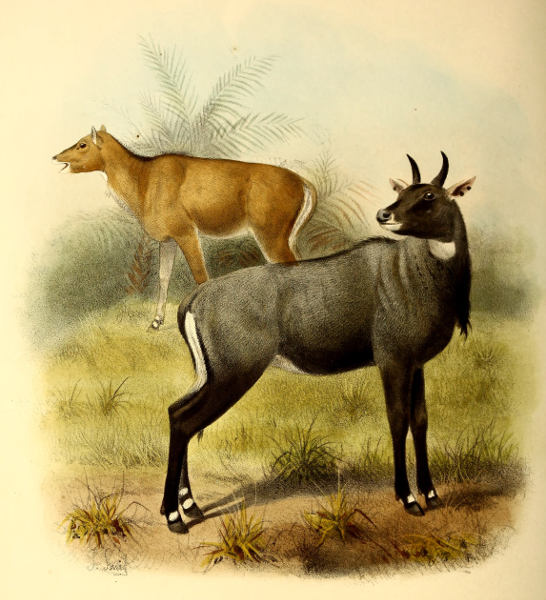
110. THE NILGAI. BOSELAPHUS TRAGOCAMELUS (Pallas). [PLATE LXXXVII.]
Antilope tragocamelus, Pallas, Misc. Zool. p. 5 (1766); id. Spic. Zool. i. p. 9 (1767), xii. p. 13 (1777); Erxl. Syst. R. A. p. 279 (1777); Zimm. Spec. Zool. Geogr. p. 540 (1777); Gatterer, Brev. Zool. pt. i. p. 80 (1780); Schreb. Säug. pl. cclxii. (1784); Bodd. Elench. Anim. p. 140 (1785); Gm. Linn. S. N. i. p. 184 (1788); Kerr, Linn. An. K. p. 308 (1792); Donnd. Zool. Beytr. i. p. 625 (1792); Forst. Zool. Ind. p. 39 (1795); Lath. & Dav. Faun. Ind. p. 4 (1795); Link, Beytr. Nat. p. 99 (1795); Bechst. Syst. Uebers. vierf. Th. ii. p. 77 (1799); Shaw, Gen. Zool. pt. ii. p. 329, fig. 190, lower fig. (1801); Turt. Linn. Syst. Nat. i. p. 112 (1802); Tiedem. Zool. i. p. 409 (1808); G. Fisch. Zoogn. iii. p. 412 (1814); Afz. N. Act. Upsal. vii. p. 220 (1815); G. Cuv. R. A. i. p. 264 (1817); Schinz, Cuv. Thierr. i. p. 396 (1821); G. Cuv. H. N. Mamm. iii. pl. xlvi. (1824); Masson, Cuv. R. A. p. 318 (1836).
Antilope (Bubalis) tragocamelus, Licht. Mag. nat. Freund, vi. p. 164 (1814).
Cemas tragocamelus, Oken, Lehrb. Nat. iii., Zool. p. 729 (1816).
Boselaphus tragocamelus, Scl. List Anim. Z. S. (8) p. 137 (1883), (9) p. 163 (1896); Flow. & Gars. Cat. Ost. p. 260 (1884); Blanf. Faun. Brit. Ind., Mamm. p. 517 (1891); Sclater f. Cat. Mamm. Calc. Mus. p. 154 (1891); Flow. & Lyd. Mamm. p. 345 (1891); Ward, Horn Meas. (1) p. 151 (1892), (2) p. 192 (1896); Lyd. Horns and Hoofs, p. 145 (1893); id. Royal Nat. Hist. ii. p. 278 (1894); Trouessart, Cat. Mamm. pt. iv. p. 956 (1898).
Portax tragelaphus, Sund. Pecora, K. Vet.-Ak. Handl. lxv. p. 198 (18–16) (corrected to tragocamelus, p. 323, 1847); id. Hornsch. Transl., Arch. Skand. Beitr. ii. p. 149 (tragocamelus, p. 315) (1848); Reprint, p. 73.
Portax tragocamelus, Gray, P. Z. S. 1850, p. 146; id. Knowsl. Men. p. 28, pl. xxix. (1850); id. Cat. Ung. B. M. p. 141 (1852); Adams, P. Z. S. 1858, p. 523; Wood, Ill. Nat. Hist. i. p. 667, fig. (1862); Gerr. Cat. Bones Mamm. B. M. p. 247 (1862); Blyth, Cat. Mamm. Mus. As. Soc. p. 165 (1863); Gray, Cat. Rum. B. M. p. 51 (1872); id. Hand-l. Rum. B. M. p. 121 (1873).
Antilope picta, Pallas, Spic. Zool. xii. p. 14 (1777); Schieb. Säug. pls. cclxiii. & cclxiii. B, ♂, ♀ (1784); Bodd. Elench. Anim. p. 141 (1785); Gm. Linn. S. N. i. p. 184 (1788); Pennant, Quadr. ed. i. p. 74, pl. vii. (1781), ed. 3, p. 83, pl. xiii. (1793); Linn. An. K. p. 309 (1792); Donnd. Zool. Beitr. i. p. 625 (1792); Lath. & Dav. Faun. Ind. p. 4 (1795); Link, Beytr. Nat. p. 99 (1795); Cuv. Tabl. Elém. p. 163 (1798); Bechst. Syst. Uebers. vierf. Th. ii. p. 78, pl. 9 (1799); Shaw, Gen. Zool. pt. ii. p. 327, fig. 189 (1801); Turt. Linn. Syst. Nat. i. p. 112 (1802); G. Cuv. Dict. Sci. Nat. ii. p. 248 (1804); Afz. N. Act. Upsal. vii. p. 220 (1815); G. Cuv. R. A. i. p. 264 (1817); Goldf. Schreb. Säug. v. p. 1159 (1818); Desmoul. Dict. Class. d’H. N. i. p. 447 (1822); G. Cuv. H. N. Mamm. iii. pl. xlvi. (1824); J. B. Fisch. Syn. Mamm. p. 476 (1829); Bennett, Gard. & Menag. Z. S. i. p. 125 (1830); Sykes, P. Z. S. 1831, p. 105; Masson, Cuv. R. A. i. p. 318 (1836); Waterh. Cat. Mus. Z. S. (2) p. 42 (1838); Schinz, Syn. Mamm. ii. p. 449 (1845); id. Nat. Abb. d. Säug. p. 355, t. 161 (1824).
Antilope (Damalis) picta, Schinz, Mon. Antil. p. 44, t. 49 (1848).
Antilope (Bubalus) picta, Laurill. Dict. Univ. d’H. N. i. p. 625 (1861).
Antilope (Cephalolophus) picta, Gieb. Säug. p. 323 (1853).
Cemas picta, Oken, Lehrb. Nat. iii., Zool. p. 729 (1816).
Damalis picta, J. Brooke, Cat. Mamm. p. 64. (1828).
Boselaphus pictus, Blainv. Bull. Soc. Philom. p. 75 (1816); Desm. Mamm. ii. p. 471 (1822); Lesson, Man. Mamm. p. 384 (1827); Gerv. Dict Sci. Nat., Suppl. i. p. 266 (1840); Less. N. Tabl. R. A., Mamm. p. 181 (1842).
Portax picta, Less. Compl. Buffon, x. p. 304 (1836); Gray, List Mamm. B. M. p. 154 (1843); Jardine, Nat. Libr. xxii. p. 182, pl. xvi. (1845); Wagner, Schreb. Säug. Suppl. iv. p. 467 (1844); id. op. cit. v. p. 450 (1855); Reichenb. Säug. iii. p. 148 (1845); Hutton, Journ. As. Soc. Bengal, xv. p. 150 (1846); Gray, Cat. Ost. B. M. p. 59 (1847); Horsf. Cat. Mamm. E.-I. Comp. p. 170 (1851); Jerdon, Mamm. India, p. 272 (1867); Fitz. SB. Ak. Wien, lix. pt. 1, p. 181 (1869); McMaster, Notes on Jerdon’s Mamm. p. 122 (1870); Kinloch, Large Game Shooting, i. p. 55 (1876); Brehm, Thierl. iii. p. 251, fig. (1880); Sterndale, Mamm. Ind. p. 476 (1884); Kinloch, Large Game Shooting, p. 93 (1885); Jent. Cat. Ost. Leyd. Mus. (Mus. Pays-Bas, ix.) p. 141 (1887); id. Cat. Mamm. Leyd. Mus. (Mus. Pays-Bas, xi.) p. 173 (1892); Percy, Badminton Big Game Shooting, ii. p. 353 (1894).
Antilope albipes, Erxl. Syst. R. A. p. 280 (1777); Gatterer, Brev. Zool. pt. i. p. 81 (1780); Zoogn. iii. p. 411 (1814).
Boselaphus albipes, Desm. Nouv. Dict. d’Hist. N. (2) ii. p. 199, pl. xxxiii. fig. 2 (1816).
Antilope leucopus, Zimm. Spec. Zool. Geogr. p. 541 (1777); Forst. Zool. Ind. p. 39 (1795); id. Descr. Anim. p. 377 (1844).
Damalis risia, H. Sm. Griff. An. K. iv. p. 363 (1827); Elliot, Madras Journ. x. p. 226 (1839).
Damalis (Portax) risia, H. Sm. Griff. An. K. v. p. 366 (1827).
Tragelaphus hippelaphus, Ogilby, P. Z. S. 1836, p. 138; Rüpp. Verz. Senck. Mus. iii. pt. 2, p. 181 (1839).
Nyl-ghau, Wm. Hunter, Phil. Trans. lxi. p. 170 (1771).
White-footed Antelope, Penn. Syn. p. 29, pl. vi. (1771); id. Quadr. i. p. 74, pl. vii. (1781); id. op. cit. ed. 3, p. 83, pl. xiii. (1793).
Vernacular Names:—Nil, Nilgao (♂), Nilgai (♀); Roz Rojh, Rojra in Hindustani; Rú-i in Dakhani, Mahratti, and Guzrati; Guraya, Gond; Murim (♂), Susam (♀), in Ho Kal; Mánú-potú in Tamil; Mairu Maravi, Kard-Kadrai, Canarese (Blanford).
Male. About four feet six inches in height at the withers. General colour of the head iron-grey, due to the hairs being black at the base and white at the extremities; nose, neck, and cheeks tinted with black; whitish grey above the eye; two small white cheek-spots generally traceable. Lips and chin white; a large white patch at the upper extremity of the throat; inter-ramal area also white. Ears greyish white, blacker behind towards the extremities, and furnished with two black spots on the outer edge in front. Upper parts of the body iron-grey, like the head; lower portion, chest, and belly black, except a median ventral white streak; groin, inner side of thighs above, and subcaudal area of rump pure white, the latter emphasized on each side by a black vertical streak on the buttocks. Tail white below and at the sides, grey above; tuft white at the base, black at the tip. Fore and hind limbs black inside and outside, except for two large white spots on the front and outer sides of the pasterns and on the outer and inner sides of the fetlocks; fetlock-spot of hind leg sometimes extending right round the front to form a complete half-ring; the corresponding spots on the fore legs much smaller, the outer obsolete. A long tuft of black hair on the throat below the white patch; a short hog-mane on the nape formed of stiff hairs, whitish at the base, blackish at the ends; parting of hair on the withers; behind this point a spinal mane of longish black hairs extends to nearly the middle of the back and is represented as far as the root of the tail by a narrow stripe of short black hairs.
Female. Without horns. Smaller and slighter than the male and of a fawn or tawny hue throughout, but with the same white patches and markings as in the male, the fetlock and pastern spots being very conspicuous and set off with black. A short hog-mane on the nape, but no tuft on the throat.
Young male. Like the female in colour.
Measurements of an adult male skull:—Basal length 16·3 inches, greatest breadth 5·75, muzzle to orbit 10, horn 8·5.
Horns usually from 8 to 9 inches long, with a basal girth of about 8 inches, and rarely reaching a length of 11·75 inches, with a basal girth of 9·5.
Hab. The Peninsula of India from the base of the Himalayas to the south of Mysore; North-west Provinces, Eastern Punjab, Guzerat, and the Konkan; but not extending to the Indus on the west, nor into Eastern Bengal, nor into Malabar. Entirely absent from the countries to the east of the Bay of Bengal.
The Asiatic division of the Tragelaphine group, which, in the existing stage of the Earth’s fauna, is represented only by the present species, is nearly as different in its structure as it is in its geographical range from its African brethren, being at once distinguishable by its short hind limbs, untwisted horns, bovine nose, and hypsodont molars, not to mention its very different style of colour. The Asiatic form might, in fact, be more naturally arranged as constituting a Subfamily of itself, but we are content to follow recent authorities who have associated this animal with the more typical Tragelaphs of Africa.
The “Nilgai” (said by some authorities to be more correctly written “Nilgau,” from nil or lil, blue, and gau, cow) was first introduced into scientific literature by Pallas in his memoir on the genus Antilope published in 1766. Pallas’s “Antilope tragocamelus,” as he called this species, was based partly upon Ray, who quoted from Gesner, and partly on the description of Dr. James Parsons, F.R.S., who, in the forty-third volume of the ‘Philosophical Transactions,’ published in 1745, gave a very fair description of this animal from a living male specimen “brought,” as he tells us, “from Bengal, and shown in London.” There can be no doubt as to the identity of Parsons’s “Quadruped,” whatever we may say regarding the less accurate descriptions of Ray and Gesner, and it follows, consequently, that “tragocamelus” must be used as the earliest and most correct specific name of the Nilgai.
In the supplement to his memoir on the genus Antilope published in 1777, besides A. tragocamelus, Pallas introduced into his list an Antilope picta, founded upon Pennant’s “White-footed Antelope.” On referring to Pennant’s description and figure of this animal in his ‘Synopsis of Quadrupeds,’ there can be no doubt whatever that they likewise refer to the Nilgai. They were taken, as the author informs us, from a pair of animals living at Clermont in 1770. Following Pallas’s second name, a large number of authorities, as will be seen by our list of synonyms, have used pictus and picta as the specific name of the Nilgai; but, as we have already pointed out, tragocamelus is prior in point of date, and being also unquestionably applicable, should have the preference.
Erxleben’s name “albipes” and Zimmermann’s “leucopus,” both founded on Pennant’s “White-footed Antelope,” have likewise been proposed for the present species, but are also both later in date. Again, in 1827, Hamilton Smith adopted “risia” as the specific name of the Nilgai on account of some fancied objection to the term picta. But in this change few have been found to follow him. Finally, in 1836, Ogilby proposed to alter the name of the Nilgai to hippelaphus, because he thought it was the true Hippelaphus of Aristotle. This is possibly the case, but it does not necessitate the suggested change of the specific term.
As regards the generic name of the Nilgai, we have fortunately only two to choose from—Boselaphus of De Blainville, published in 1816, and Portax of Hamilton Smith, proposed in 1827. Of these two, according to the rules of Zoological Nomenclature, we employ the oldest; and the scientific name of the Nilgai consequently becomes Boselaphus tragocamelus, as was first adopted by Sclater in 1883.
Before proceeding further we must call attention to the excellent account of the Nilgai read before the Royal Society in 1774 by the great physiologist and physician William Hunter and published, along with an excellent figure of the animal by Stubbs, in the 61st volume of the ‘Philosophical Transactions,’ from which we make the following extracts:—
“Among the riches which of late years have been imported from India may be reckoned a fine animal, the Nyl-ghau; which, it is to be hoped, will now be propagated in this country, so as to become one of the most useful, or at least one of the most ornamental beasts of the field. It is larger than any ruminant of this country, except the ox; its flesh probably will be found to be delicious; and, if it should prove docile enough to be easily trained to labour, its great swiftness, with considerable strength, might be applied, one would think, to valuable purposes.
“Good paintings of animals give much clearer ideas than descriptions. Whoever looks at the picture, which was done under my eye by Mr. Stubbs, that excellent painter of animals, can never be at a loss to know the Nyl-ghau, wherever he may happen to meet with it. However, I shall attempt a description of the animal; and then give as much of its history as I have been hitherto able to learn. The account will be imperfect: yet it will give naturalists some pleasure in the meantime to know even a little of a large and elegant animal, which has not hitherto been described or painted.”
After a capital description of both sexes of this animal from the living specimens, Hunter proceeds as follows:—
“Of late years several of this species, both male and female, have been brought to England. The first were sent from Bombay by Gov. Cromelen, as a present to Lord Clive: they arrived in August 1767. They were male and female, and continued to breed every year. Afterwards two were brought over, and presented to the Queen by Mr. Sullivan. From Her Majesty’s desire to encourage every useful or curious enquiry in natural knowledge, I was permitted to keep these two for some time, which enabled me to describe them, and to get a correct picture made, and, with my brother’s assistance, to dissect the dead animal, and preserve the skin and skeleton. Lord Clive has been so kind to give me every help that he could furnish me with in making out their history; so has General Carnac, and some other gentlemen.
“At all the places in India, where we have settlements, they are rarities, brought from the distant interior parts of the country, as presents to Nabobs and great men. Lord Clive, General Carnac, Mr. Walsh, Mr. Watts, and many other gentlemen, who have seen much of India, tell me they never saw them wild. So far as I have yet found, Bernier is the only author who has ever mentioned them.
“In the fourth vol. of his Mémoires, he gives an account of a journey which he undertook, ann. 1664, from Delhi, to the province of Cachemire, with the Mogul Aurengzeb, who went to that terrestrial paradise, as it is esteemed by the Indians, to avoid the heat of the summer. In giving an account of the hunting, which was the Emperor’s amusement in this journey, he describes, among others, that of le Nyl-ghau, but without saying more of the animal than that the Emperor sometimes kills them in such numbers as to distribute quarters of them to all his Omrachs; which shows that they were there wild, and in plenty, and esteemed good or delicious food.
“This agrees with the rarity of these animals at Bengal, Madras, and Bombay; for Cachemire is the most northern province of the Empire, and it was on the march from Delhi to that place that Bernier saw the Emperor hunt them.”
Although, as we have already seen, living specimens of the Nilgai were long ago brought to Europe, little addition was made to our knowledge of this animal in its native state until the days of Elliot, Jerdon, and Hodgson. In 1839 Sir Walter Elliot included the Nilgai in his catalogue of the Mammals of the Southern Mahratta country, where he states “it is found in the thick low jungles.” Jerdon, in his volume on the Mammals of India, tells us that the Nilgai “frequents thin forests and low jungles, but is also often found in tolerably open plains with only a few scattered bushes. It associates in small herds, varying from 7 or 8 to 20 and upwards.”
Mr. Robert A. Sterndale, whose popular manual on the Mammals of India and Ceylon was published in 1884, does not speak favourably of his experience of the flesh of the Nilgai as an article of diet:—“The Nilgao,” he says, “feeds on Beyr (Zizyphus jujuba) and other trees, and at times devours such quantities of the intensely acrid berries of the Aoula (Phyllanthus emblica) that its flesh becomes saturated with the bitter elements of the fruit. This is most noticeable in soup, less so in a steak, which is at times not bad. The tongue and marrow-bones, however, are generally as much as the sportsman claims, and in the Central Provinces at least the natives are grateful for all the rest.”
Col. Kinloch, who writes of the Nilgai mainly from a sporting point of view, gives us the following account of this animal:—
“The Nilgai does not hold a very high place among the Game-animals of India, and is seldom shot by any but young sportsmen, unless meat is required for camp-followers. It is, however, one of the largest and most conspicuous of the ruminants to be found in the plains, and no records of Indian sport would be complete without some notice of it.
“The bull is a large and powerful beast, attaining a height of at least 14 hands at the withers, which are high and narrow like those of a horse. The neck is long and compressed, and the head slender and deer-like, the eyes being remarkably full and lustrous. The hind-quarters fall away considerably, giving the animal rather an awkward appearance. The legs are slender and wiry, and the hoofs rather upright. The tail is tufted, something like that of the domestic cow, but it is not so long in proportion, reaching only to the hocks. The color is a dark bluish grey, deepening to nearly black in very old individuals, while the legs are jet-black, curiously marked with white patches about the fetlocks. The throat is white, and from the lower part of it depends a long tuft of blackish hair, while the hair on the withers is developed into a thin upright mane.
“The cow is of a light brown colour, and is destitute of horns. The young males are like the females, but become gradually darker with age.
“Nilgai inhabit extensive grass-and tree-jungles, but appear to prefer those that are not very thick, and interspersed with occasional bare open spaces. Their favorite cover seems to be that composed of the ‘dhák’ or ‘palás’ tree (Butea frondosa). They are also fond of resorting to the sugar-cane fields, and they frequently commit considerable damage among cultivation. They are generally to be found in herds, varying in number from four or five to twenty, and composed of both sexes; but occasionally small parties of old Blue Bulls, and even solitary bulls, are to be met with. In places where they are not disturbed, especially in some of the Native States, Nilgai are absurdly tame, but in districts where they are much molested they become extremely shy and wary. It must not therefore be supposed that they can always be easily shot, but they afford such a poor trophy that, as already mentioned, they are not much sought after. When they can be found sufficiently far from thick cover, they may be speared, and they then show capital sport; as they will probably lead a well-mounted horseman a chase of several miles. On hard ground I doubt if a cow Nilgai could be speared by a solitary hunter; the bull, being much heavier, is more easily ridden down.
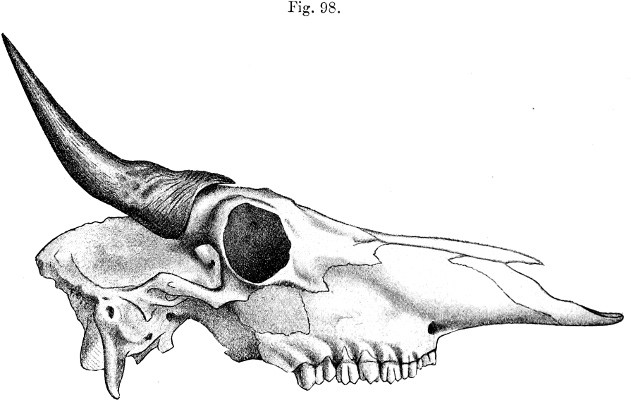
Fig. 98.
Skull and horns of an adult male Nilgai.
(Brit. Mus.)
“The flesh of a cow Nilgai is occasionally excellent, and the tongue and marrow-bones are supposed to be delicacies. They are, however, hardly worth shooting, except when one is in want of meat for Mahomedan servants: Hindoos, of course, will not touch the flesh.”
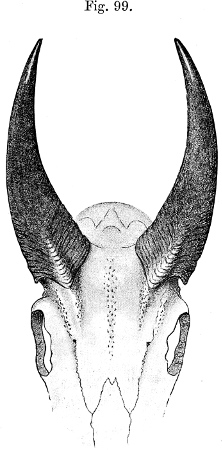
Fig. 99.
Frontlet of an adult male Nilgai.
(Brit. Mus.).
The Nilgai does well in captivity, and, as we have already mentioned, several of the original descriptions of this animal by the older writers were based on specimens brought alive to Europe. In 1824 both sexes of the Nilgai were well figured by Geoffroy Saint-Hilaire and F. Cuvier in their
‘Histoire Naturelle des Mammifères,’ from specimens living in the Jardin des Plantes. In 1845, as we learn from Gray, the Nilgai bred in the Knowsley Menagerie, and there was at that time a herd of a male and four females kept in one of the paddocks along with the Elands. In 1847 the half-grown male and young were drawn from some of these specimens by Waterhouse Hawkins, and the figures were published in the twenty-ninth plate of the ‘Gleanings.’ The Nilgai has been an inhabitant of the Zoological Society’s Menagerie from its commencement. In 1830 it was described and figured in the first of the two volumes on the ‘Gardens and Menagerie of the Zoological Society’ by Vigors and Bennett, and in February 1831, as recorded in the ‘Proceedings,’ a specimen of a young one, born at the Society’s farm at Kingston, was exhibited and described at one of the Scientific Meetings. This appears to have been the first instance of its breeding in the Society’s Gardens, but since that date many other examples have been received, and the species has frequently bred in the Menagerie. On referring to the Society’s registers we find that this has taken place in 1856, 1864, 1866, 1868, and 1869. As a general rule, two young ones are produced at the same birth; but the young animals, although they thrive well, are excessively shy and timid, as is also the case with many others of the Deer and Antelopes, so that, if frightened, they frequently injure themselves by rushing against the fences of their paddocks.
Our coloured illustration of the Nilgai (Plate LXXXVII.) has been prepared from specimens of both sexes of this animal now living in the Zoological Society’s Gardens, where they were received in exchange on October 14th, 1896.
There is a good mounted example of the male Nilgai in the British Museum, obtained from the Zoological Society’s Gardens in 1896, besides two other older mounted specimens kept in store. There are also specimens of heads of this animal from the Khalcote jungle south of Mhow, presented by Col. J. Evans, and from Jullunder near Sangor, presented by Mr. G. A. Carmichael, and some skulls and horns from Oude and the North-west Provinces, presented by Mr. A. O. Hume, C.B. From the last of these the drawings of the skull and horns and frontlet of an adult male (figs. 98 and 99) have been prepared.
November, 1899.
Genus II. TRAGELAPHUS.
Type.
Tragelaphus, De Blainv. Bull. Soc. Philom. 1816, p. 75 T. sylvaticus.
Euryceros, Gray, Cat. Rum. B. M. p. 47 (1872) T. eurycerus.
Large or medium-sized Antelopes, with the facial, neck, body, and leg markings characteristic of the subfamily usually well expressed.
Hind-quarters as high as or higher than the withers; fore limbs not longer than hind limbs. Hoofs of normal form, their length along the anterior border about equal to the basal width from back to front; posterior surface of the pasterns covered with hair. Ears large and expanded.
Horns present only in the male; of medium length or long, always longer than the face; flat at the base behind; with a strong external basal ridge arising just behind the orbit and forming an obtuse angle with the plane of the nasals; spirally twisted, the twist affecting the whole horn with the exception of its extreme tip, but shallow and not taking the form of an open corkscrew spiral; the anterior ridge, which starts in front of the middle of the base of the horn, only reappearing once close to the tip.
Skull much less flat than in Boselaphus, the parietal region more depressed. Molar teeth with short crowns; those of the upper jaw with only a small accessory column.
Range of the Genus. Africa, south of the Sahara, from Senegambia, Abyssinia, and Somaliland, over the whole continent.
The species of this genus here recognized may be tabulated as follows:—
a. Height at withers of adult male about 30 inches; horns from about 10 to 15 inches, normally with black tips; a white patch present upon the upper end of the throat.
a1. A large white patch at the base of the fore leg on the inner side; inner side of fore leg from knee to fetlock and of hind leg from hock to fetlock white; body striped or spotted with white.
a2. Adult male a rich dark red colour above, and very distinctly marked with many white spots and stripes 121. T. scriptus.
b2. Adult male much duller or darker in colour, spots and stripes less numerous, the latter often absent.
a3. Colour yellowish brown; an upper longitudinal white stripe. 120. T. decula.
b3. Colour darker and richer in adult; no upper white stripe.
a4. White stripes visible in immature and sometimes retained by adult 123. T. roualeyni.
b4. White stripes usually absent in young and always in adult. 122. T. sylvaticus.
b1. Fore leg from base to fetlock on inner side a uniform yellowish brown; hind leg similarly coloured, except for a white patch on front of hock; no stripes or spots on body 124. T. delamerei.
b. Height at withers of adult male over 40 inches; horns 24 inches or more in length, with amber-yellow tips; no white patch at upper end of throat in either sex.
a1. Tail thickly hairy at sides and end; inner sides of legs below knees and hocks fawn-coloured: adult male slate-grey, with mane of long hairs extending along throat, nape, and sides above belly; females and young chestnut, with white stripes 126. T. angasi.
b1. Tail with tuft of hairs only at tip; inner sides of legs below knees and hocks white in front; adult male without mane and, like the female, chestnut with white stripes 125. T. eurycerus.
THE BOOK OF ANTELOPES, PL. LXXXVIII.
Wolf del. Smit lith.
Hanhart imp.
The Decula Antelope.
TRAGELAPHUS DECULA.
Published by R. H. Porter.
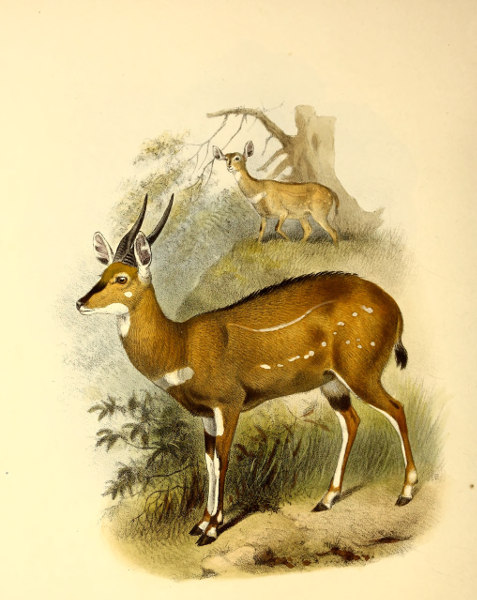
120. THE DECULA ANTELOPE. TRAGELAPHUS DECULA (Rüpp.). [PLATE LXXXVIII.]
Antilope decula, Rüpp. Neue Wirb. Abyss. p. 11, pl. iv., ♂ ♀ (1838–1840); Schinz, Syn. Mamm. ii. p. 427 (1845); Huet, Bull. Soc. Acclim. (4) iv. p. 78 (1887).
Calliope decula, Rüpp. Verz. Senck. Mus. iii. pt. 2, p. 182 (1839).
Antilope (Tragelaphus) decula, Gerv. Dict. Sci. Nat. Suppl. i. p. 266 (1840); Less. N. Tabl. R. A., Mamm. p. 181 (1842); Reichenb. Säug. iii. p. 78 (1845); Gieb. Säug. p. 311 (1853).
Tragelaphus decula, Gray, List Mamm. B. M. p. 166 (1843); Sund. Pecora, K. Vet.-Akad. Handl. lxv. p. 189 (1846); id. Hornschuch’s Transl., Arch. Skand. Beitr. ii. p. 141; Reprint, p. 65 (1848); Wagn. Schreb. Säug., Suppl. iv. p. 442 (1844), v. p. 443 (1855); Schinz, Mon. Antil. p. 26 (1848); Gray, P. Z. S. 1850, p. 145; id. Knowsl. Men. p. 28 (1850); id. Cat. Ung. B. M. p. 139 (1852); Heugl. N. Acta Leop. xxx. p. 20, pl. i. figs. 5 a, b (1863); id. Faun. Roth. Meer. p. 16; Fitz. SB. Ak. Wien, lix. pt. 1, p. 174 (1869); Heugl. Reise Weiss. Nil, p. 319 (1869); Gray, Cat. Rum. B. M. p. 50 (1872); id. Hand-l. Rum. p. 120 (1873); Flower, P. Z. S. 1875, p. 186 (skull char.); Heugl. Reise in Nordost-Afr. ii. p. 120 (1877); Brooke, P. Z. S. 1878, p. 884 (skull char.); Jent. Cat. Ost. Leyd. Mus. (Mus. P.-Bas, ix.) p. 141 (1889); id. Cat. Mamm. Leyd. Mus. (Mus. P.-Bas, xi.) p. 173 (1892); Lyd. Horns and Hoofs, p. 252 (1893); Ward, Rec. Big Game, p. 196 (1896), p. 286 (1899); Pousarg. Ann. Sci. Nat. iv. pp. 81, 83 (1897).
Tragelaphus scriptus decula, Thos. P. Z. S. 1891, p. 388; Trouess. Cat. Mamm. p. 959 (1899).
Tragelaphus bor, Heugl. Reise N.O.-Afr. ii. p. 122 (1877).
Vernacular Names:—Husch (Arabic); Dakula, Daggula, Dekula, or Dekuela (Amharic); Ber (Djengish) (Heuglin).
Height at withers of adult male about 26 inches. Prevailing colour a yellowish or sandy brown, becoming darker upon the chest and belly and upon the shoulder and lower portion of the hind-quarters. Edge of upper lip, chin, and inter-ramal area white; a white spot on the cheek below the eye, a white patch at the upper and a second at the lower extremity of the throat. Hairs along spine darker brown and not noticeably tipped with white. A few white spots upon the haunches and a row of them extending along the sides of the body above the belly. Upper half of the body marked in front with a distinct white stripe, which extends longitudinally backwards from the shoulder. Transverse stripes generally entirely absent. Fore leg white on inner side at base and behind knee, also white on inner side of cannon-bone; a brown stripe extending along front of cannon-bone; white pastern-spots large and confluent. Hind limb coloured like the fore limb, but with the hocks white in front, not behind. Tail bushy, white below, with a darker tip. No collar of short hairs round base of neck. Horns short, scarcely 12 inches in length, black-tipped.
Female like male, but smaller, without horns, and with less dark colour upon the upper portions of the limbs and lower parts of body.
A male skull gives the following measurements:—Basal length 8 inches, nose to orbit 4·25, width 3·6.
Hab. Wooded districts of Abyssinia and Upper Nubia.
Like many other characteristic animals of North-eastern Africa, the present Antelope was one of the discoveries of the great explorer and naturalist Rüppell, who first described it in his volume upon new Mammals from Abyssinia which contained the results of his long investigations in that country. Rüppell called this species “decula,” from the Latin transliteration of its Amharic native name, remarking at the same time that this word must not be confounded with “thecula,” which is the Abyssinian name for the Hunting-dog (Lycaon pictus). He remarks that the species belongs to the subgenus Tragelaphus of Blainville, and is closely allied to T. sylvaticus of the Cape, from which it is distinguishable by its smaller size and different colouring. Rüppell obtained a good series of this Antelope, and gives excellent descriptions of the adult male, the adult female, the two-year-old male, and the newly-born calf. He met with it in the bushy valleys of Central Abyssinia, round the lake of Dembea or Tana, where it feeds principally on small leaves of trees, and is said to be specially fond of the ripe fallen fruits of the sycamore fig-tree. The Deculas pair in the month of May in this district, and produce their young ones in October. They are very quick and shy, but are occasionally hunted by the natives with dogs. Their flesh, according to Rüppell, is not particularly palatable.
The only other African explorer that appears to have come across this Antelope in its native wilds is Heuglin, who, however, does not favour us with a very distinct account of his experiences of it. In his memoir on the Antelopes and Buffaloes of North-east Africa, published in 1863, Heuglin states that the range of this species extends over the districts of Upper Nubia bordering on Abyssinia, Galabat, the River Settite, and Takeh. He also gives a figure of the skull of a specimen obtained by him, which he points out differs slightly in the shape of the horns from that figured by Rüppell and in some other particulars. In a subsequent work (‘Reise in Nordost-Afrika’) Heuglin has described what he considered to be possibly a different animal (although closely allied to the Abyssinian T. decula) from the banks of the White Nile, where it is called by the Djengs “Bor,” in Bonga “Towa,” and by the Dgurs “Burah.” This Antelope he met with in pairs amongst the high grass and thick bushes of Bauhinia and Acacia-trees in the above-named districts. In case of its proving different from T. decula he proposed to designate it Tragelaphus bor.
As will be seen by our subsequent remarks, it is not quite certain which of the species of this group of Tragelaphus occurs on the White Nile. It may be either the present T. decula or one of the forms of T. scriptus.
In the British Museum there is a skin of an immature male of this species, together with its skull, belonging to the series obtained by Rüppell in Abyssinia. There are also in the National Collection an adult mounted male and female from the Upper Atbara obtained in 1874 and 1876.
Our illustration (Plate LXXXVIII.), which was put upon the stone by Mr. Smit from a sketch prepared by Mr. Wolf under the directions of the late Sir Victor Brooke, is believed to have been taken from the mounted specimens in the British Museum.
So far as we know, no examples of this form of the Bushbuck have ever been brought to Europe alive.
November, 1899.
THE BOOK OF ANTELOPES, PL. LXXXIX.
J. Smit del. et lith.
Hanhart imp.
The Harnessed Antelope.
TRAGELAPHUS SCRIPTUS
Published by R. H. Porter.
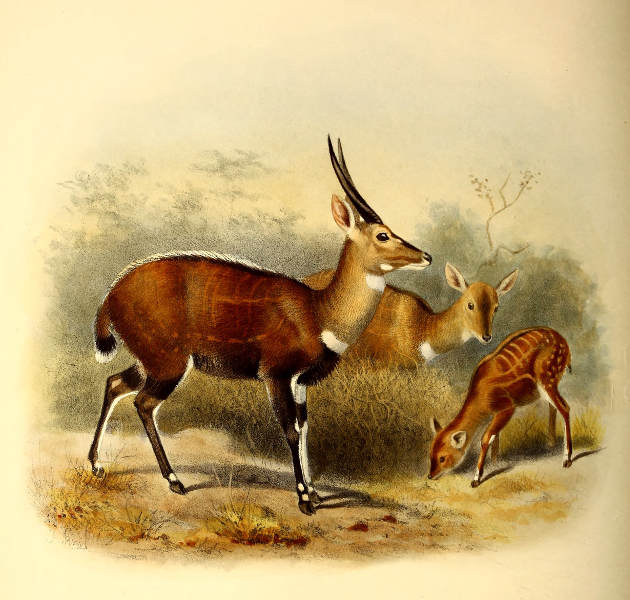
121. THE HARNESSED ANTELOPE. TRAGELAPHUS SCRIPTUS (Pallas). [PLATE LXXXIX.]
Subspecies a. Tragelaphus scriptus typicus.
Le Guib, Buffon, Hist. Nat. xii. pp. 305,327, pls. xl., xli. (1764), whence
Antilope scripta, Pallas, Misc. Zool. p. 8 (1766); id. Spic. Zool. i. p. 15 (1767), & xii. p. 18 (1777); Erxl. Syst. R. A. p. 276 (1777); Zimm. Spec. Zool. Geogr. p. 539 (1777); id. Geogr. Ges. ii. p. 111 (1780); Gatt. Brev. Zool. pt. i. p. 79 (1780); Schreb. Säug. pl. cclviii, (1784) (ex Buff.); Bodd. Elench. Anim. p. 140 (1785); Gm. Linn. S. N. i. p. 191 (1788); Kerr, Linn. An. K. p. 317 (1792); Donnd. Zool. Beitr. i. p. 640 (1792); Link, Beytr. Nat. p. 99 (1795); Shaw, Gen. Zool. p. 322, fig. 186 (1801); Turt. Linn. Syst. Nat. p. 115 (1802); Desm. N. Dict. d’H. Nat. x. p. 256 (1803); G. Cuv. Dict. Sci. Nat. ii. p. 245 (1804); G. Fisch. Zoogn. iii. p. 441 (1814); Licht. Mag. nat. Freunde, vi. p. 169 (1814); Afz. N. Acta Ups. vii. p. 220 (1815); Goldf. Schreb. Säug. v. p. 1212 (1818); Schinz, Cuv. Thierr. i. p. 396 (1821); Desmoul. Dict. Class. d’H. N. i. p. 447 (1822); H. Sm. Griff. An. K. iv. p. 274, v. p. 351 (1827); J. B. Fisch. Syn. Mamm. p. 472 (1829); Masson, Cuv. R. A., Atlas, pl. xl. fig. 1 (1836); Waterh. Cat. Mus. Z. S. (2) p. 42 (1838); Cuv. & Geoffr. Hist. Nat. Mamm. vii. tabb. 380, 381 (1842); Schinz, Syn. Mamm. ii. p. 428 (1845); id. Mon. Antil. p. 28, tab. xxx. (1848); Huet, Bull. Soc. Acclim. (4) iv. p. 273 (1887).
Cemas scriptus, Oken, Lehrb. Nat. iii., Zool. p. 734 (1816).
Calliope scripta, Rüpp. Verz. Senck. Mus. iii. pt. 2, p. 182 (1839).
Antilope (Addax) scripta, Laurill. Dict. Univ. d’H. N. p. 621 (1861).
Tragelaphus scriptus[a], Gray, List Mamm. B. M. p. 166 (1843); Jard. Nat. Libr., Mamm. xxii. p. 95, pl. i. (1845); Sund. Pecora, K. Vet.-Akad. Handl. lxv. p. 189 (1846); id. Hornschuch’s Transl., Arch. Skand. Beitr. ii. p. 141; Reprint, p. 65 (1848); Gray, Cat. Ost. B. M. p.146 (1847); id. P. Z. S. 1850, p. 145; id. Knowsl. Menag. p. 28, pl. iv. (1850); id. Cat. Ung. B. M. p. 138 (1852); Wagner, Schreb. Säug., Suppl. iv. p. 442 (1844), v. p. 443 (1855); Temm. Esq. Zool. Guin. p. 197 (1853); Gerv. H. N. Mamm. ii. p. 201, fig. p. 202 (1855); Gerr. Cat. Bones B. M. p. 246 (1862); Fitz. SB. Ak. Wien, lix. pt. 1, p. 174 (1869); Gray, Cat. Rum. B. M. p. 50 (1872); id. Hand-l. Rum. p. 120 (1873); Flow. P. Z. S. 1875, p. 186 (skull char.); Garrod, P. Z. S. 1877, p. 44 (anatomy); Brehm, Thierl. p. 242, fig. p. 243 (1880); Scl. Cat. An. Z. S. (8) p. 137 (1883), (9) p. 161 (1896); Flow. & Gars. Cat. Coll. Surg. p. 259 (1884); Johnst. River Congo, pp. 385, 391 (1884); Jent. Notes Leyd. Mus. x. p. 25 (1888); Büttik. Reisebilder, etc. ii. p. 380 (1890); Flow. & Lyd. Mamm. p. 347 (1891); Ward, Horn Meas. (1) p. 154 (1892), (2) p. 196 (1896); id. Rec. Big Game, p. 282 (1899); Jent. Cat. Ost. Leyd. Mus. (Mus. Pays-Bas, ix.) p. 141 (1887); id. Cat. Mamm. Leyd. Mus. (ibid. xi.) p. 172 (1892); Lyd. Horns and Hoofs, p. 251 (1893); id. Royal Nat. Hist. ii. p. 277, fig. (1894); Trouess. Cat. Mamm. p. 959 (1899); Pousarg. Ann. Sci. Nat. iv. 6, p. 82 (1899) (French Congo).
Tragelaphus scriptus typicus, Thomas, P. Z. S. 1891, p. 388; Bryden, in Ward’s Great and Small Game of Africa, p. 480 (1899).
Antilope phalerata, H. Sm. Griff. An. K. iv. p. 275, v. p. 351 (1827); Schinz, Syn. Mamm. ii. p. 429 (1845).
Antilope (Tragelaphus) phalerata, A. Sm. S. Afr. Quart. Journ. ii. p. 219 (1834); Less. Compl. Buff. x. p. 296 (1836); Gerv. Dict. Sci. Nat. Suppl. i. p. 266 (1840); Less. N. Tabl. R. A., Mamm. p. 181 (1842); Reichenb. Säug. iii. p. 81 (1845).
Tragelaphus phaleratus[a], Sund. Pecora, K. Vet.-Akad. Handl. lxv. p. 189 (1846); id. Hornschuch’s Transl., Arch. Skand. Beitr. ii. p. 141; Reprint, p. 65 (1850); Fitz. SB. Ak. Wien, lix. pt. 1, p. 174 (1869).
Antilope leucophæa, Forst. Descr. An. p. 386 (1844) (nec Pall.).
Tragelaphus gratus, Rochebrune, Bull. Soc. Philom. Paris, 1882, p. 9; id. Faune de la Sénégamb., Mamm. p. 123, pl. viii. fig. 1 (1883)?
Tragelaphus obscurus, Trouess. Cat. Mamm. pt. iv. p. 958 (1898).
Harnessed Antelope, Penn. Hist. Quadr. (1) p. 71 (1781), (3) p. 81 (1793).
Subspecies b. Tragelaphus scriptus ornatus.
“A new Antelope,” J. Chapman, Travels &c. vol. i. pp. 229–230 (1868).
Bushbuck from the Chobe River, Selous, Hunter’s Wanderings, p. 208, & p. 285, pl.; id. P. Z. S. 1881, p. 753.
Tragelaphus scriptus ornatus, Pocock, Ann. & Mag. N. H., Jan. 1900.
Vernacular Names:—Guib of Negroes of Senegal (Adanson); Zaloufe or Oualof of the Gambia (Whitfield); Red Deer of the Liberians (Büttikofer); Thamma by the Batawana and Tugwumgo by the Bazèyè of the Upper Zambesi (Chapman).
Male adult. Height about 28 inches. General colour a rich dark red, passing in places into black. Head fawn-colour, with an ashy-black band extending from between the eyes to the muzzle; upper lip white at the sides; chin and inter-ramal area white; two white spots on each cheek, the lower fusing with the white of the inter-ramal area; a small white stripe running inwards from the eye, sometimes but not always present; whitish patch at base of ear; ear ashy black behind, a dark spot near the outer edge in front. Neck greyish fawn above, clouded with black towards the shoulders. Throat with two, upper and lower, white patches; area between the patches a dusky yellowish grey. Body a rich dark red at the sides, passing into black below, marked with about half-a-dozen transverse white stripes; a few white spots on the shoulders, and a large, though variable, number of white spots on the haunches; a white line, sometimes broken up into a series of spots, running longitudinally along the lower portion of the sides above the belly between the shoulder and the hind-quarters, and an upper longitudinal white stripe, sometimes long, sometimes short, running backwards from the shoulder. Tail red, with white edges and usually a black tip. Belly and chest blackish. Outer side of fore and hind legs blackish above the knees and hocks, reddish fawn below; inner sides white at the bases close up to body; a broad black band above the knee and hock; back and inner sides of the knee and front and inner side of hock white, whence a white stripe extends downwards along the inner side and anterior edge of the cannon-bone to the fetlock; fetlocks and pasterns blackish; pasterns with a large white patch in front.
Hairs on body longish. At the base of the neck there is a more or less well-defined collar of short hair passing inferiorly above the lower white neck-band. Along the back from the shoulders to the root of the tail extends a crest or mane of long hairs, black over the withers, tipped with white on the rest of the back. Horns as in preceding species.
The skull of an adult male gives the following measurements:—Basal length 8·25 inches, nose to orbit 4·75, width 3·5, horn 9·5.
Female similar to the male, but without horns, and without the black tints on the body; white markings very conspicuous.
Young like the female.
Hab. Forest-districts of Western Africa from Senegal to Angola, and extending thence to the Chobé on the south.
The Bushbucks of the typical section of the genus Tragelaphus appear to be spread all over Africa south of the Sahara, wherever wooded districts suitable for their mode of life are met with. But although they are all nearly similar in general structure they vary much in their markings and other minor characters, and it is an exceedingly difficult task to decide how far these differences should be regarded as specific or subspecific, or in some cases as merely individual variations. A much larger series of specimens from the various localities in the wide area over which this animal ranges than we can yet command is necessary before any certain conclusions can be arrived at on this subject. Meanwhile we propose to follow, as probably approximately correct, the view already put forward on this group by Thomas in his article on the Tragelaphi, published in the Zoological Society’s ‘Proceedings’ for 1891, merely elevating the four forms there treated of as subspecies to the rank of species. Of these four species thus recognized we have already treated of one—Tragelaphus decula, which appears to be a somewhat isolated form only met with in Abyssinia and the immediately adjacent districts. We have now come to the true T. scriptus, which, on the contrary, seems to have a very wide distribution under its various phases.
The “Harnessed Antelope,” as it is usually called in English, was first discovered in Senegal by the celebrated naturalist and traveller Adanson, who visited that Colony in the middle of the last century, and communicated many of his notes and specimens to Buffon. The latter described and figured it in his ‘Histoire Naturelle’ under the name “Le Guib” which Adanson gave as its native name in Senegal, stating that it is found in the woods and plains of the country of the Jaloufs and on the Senegal River. From Senegal also living specimens of both sexes of this Antelope were subsequently received at the Jardin des Plantes, and figured under the same name by F. Cuvier and Geoffroy St.-Hilaire in their great work upon Mammals. Pallas established his “Antilope scripta” upon Buffon’s “Guib,” stating that he had not himself met with examples of it. There can be no doubt, therefore, that this particular local form is entitled to be called Tragelaphus scriptus. Like most of the Senegalese mammals, it also occurs on the Gambia, where Whitfield, and, in more recent days, Dr. Rendall procured specimens which are now in the British Museum.
Descending the West-African coast we find the same species also recorded from Liberia, where Herr Büttikofer and his fellow-explorers of that Republic, as recorded by Dr. Jentink, met with it in many localities and obtained a good series of specimens of it for the Leyden Museum.
In his ‘Reisebilder aus Liberia’ Büttikofer tells us that this Antelope is universally known to the Liberians as the “Red Deer,” and is found wherever the forest is interspersed with meadows and plantations. Its palatable meat is often brought to the market in Moravia. It is the more easily obtained by the hunter because it is by no means shy, and often comes to feed into the vegetable-gardens adjoining the planters’ dwellings. It is also frequently caught alive, and does well in captivity.
Pel, another well-known collector for the Leyden Museum, obtained for that institution examples of this Antelope on the Gold Coast, and there are specimens of it in the British Museum from Fantee, and from Mount Victoria in the Cameroons. We may therefore consider it established that the typical form of Tragelaphus scriptus is found all along the wooded districts of Western Africa from the Senegal River to the Cameroons. But as we proceed further south soon after this a slight alteration in the characters of this Antelope begins to appear.
Hamilton Smith, writing in Griffith’s ‘Animal Kingdom’ in 1827, was the first to notice differences in the specimens of this species from the Congo, which had been sent home by Tuckey’s Expedition, and proposed to name the Congo form Antilope phalerata. M. Pousargues, who has recently published an excellent essay on the Mammals of French Congo-land, informs us that only one of three specimens of this Antelope received at Paris from that country presented the special difference upon which Hamilton Smith mainly based his species—that is, the absence of the longitudinal white stripe on the shoulder and flanks,—and states his opinion that this character is of no systematic value. This opinion is supported by the fact that in one of the two bucks, referred to later on, from Senegambia, now living in the Society’s Gardens, the stripe in question is very conspicuous, whereas in the other it is faintly defined and very short. It is significant, too, that the latter animal is the larger and apparently the older of the two. Hence it is not unlikely that the stripe tends to disappear in old individuals and that the type of T. phaleratus was nothing but an aged example of T. scriptus. However that may be, our knowledge of the Congo form is too incomplete to admit of our regarding it as distinct from the typical Senegambian T. scriptus.
Further to the south, in the valley of the Chobé and Upper Zambesi, T. scriptus is again met with, but under a modified form, which may for the present be regarded as a distinct subspecies. This animal was first discovered by Mr. Chapman on the Botletlie River, and subsequently on the Chobé by Mr. Selous, who described it in his ‘Hunter’s Wanderings’ and in the Zoological Society’s ‘Proceedings’ for 1881. Mr. Selous, in response to an inquiry on this point, kindly informs us that he has never seen a skin either of adult or young of the Chobé Bushbuck marked with an upper longitudinal white stripe; and we learn from his published observations on this animal, and from the skins of it that are now in the British Museum, that the females and young are much less strongly striped and spotted with white than are the adult males.
This does not appear to be the case as regards the typical T. scriptus; and although the entire absence of the upper white band in the form from the Chobé suggests the possibility of identity between it and the form from the Congo, we know nothing of the characters of the females and young of the latter to justify us in assigning the name phaleratus to the subspecies first figured and described by Mr. Selous. The animal for which we propose to adopt Mr. Pocock’s name T. scriptus ornatus may be described as follows:—
Male adult. General characters as in T. scriptus. Height at withers of adult male about 28 inches. Colour dark red, with as many as seven or eight transverse white stripes, about six white spots on the shoulders, and as many as twenty on the hind-quarters, and a line of white spots passing longitudinally above the belly. Belly, chest, and limbs on outer side down to knees and hocks blackish. Face deep greyish fawn, with very faint white eye-spots. A dorsal crest of long white hairs extending from the shoulder to the root of the tail.
Young male. Pale reddish yellow, with spots and stripes much more faintly marked.
Female. Smaller than male, chestnut in colour, marked with only three or four faint white stripes and with fewer spots than in the other sex; belly reddish yellow, paler than the sides of the body; outer side of limbs chestnut above and below the knees and hocks.
Young female. Lighter red and less spotted than adult.
At the end of our list of synonyms of the typical form of this Antelope it will be observed that we have added, with a mark of doubt, Tragelaphus gratus of Rochebrune’s ‘Faune de la Sénégambie,’ upon which Dr. Trouessart has based his Tragelaphus obscurus. All that can be said of Rochebrune’s figure is that, if correctly drawn, it cannot have been taken from Limnotragus gratus, which is at once recognizable by its elongated hoofs, and that it is more likely to have been based on an example of the present species. But we have already on more than one occasion alluded to the untrustworthiness of Dr. Rochebrune’s work, and think it hardly worth while to discuss the subject further.
The Harnessed Antelope is frequently brought alive to Europe from the ports on the West Coast of Africa and does nicely in captivity. It was well represented in the great Knowsley Menagerie, where it frequently bred. In May 1845, as we learn from the ‘Gleanings,’ there was at Knowsley a herd of two males and four females, of which three were then expected to produce young. Both sexes were figured by Waterhouse Hawkins on the 28th plate of that work. Several specimens of it were sold at the dispersal of the Knowsley Menagerie in 1851.
The Zoological Society of London has exhibited specimens of this handsome Antelope ever since its gardens were instituted, but it does not appear to have bred there. Dr. Percy Rendall, F.Z.S., brought home a fine male from the Gambia in 1890, and in the following year a pair was presented to the Society by Sir R. B. Llewelyn, K.C.M.G., the Governor of that Colony. In Mr. Smit’s illustration of this species (Plate LXXXIX.) the figures of the male and female were taken from the Zoological Society’s specimens; the young one in the front was drawn from a specimen from Fantee, in the British Museum.
November, 1899.
THE BOOK OF ANTELOPES, PL. XC.
Smit del. et lith.
Hanhart imp.
Fig 1. Cumming’s Bush-bok.
TRAGELAPHUS ROUALEYNI.
Fig 2. The Cape Bush-bok.
TRAGELAPHUS SYLVATICUS.
Published by R. H. Porter.
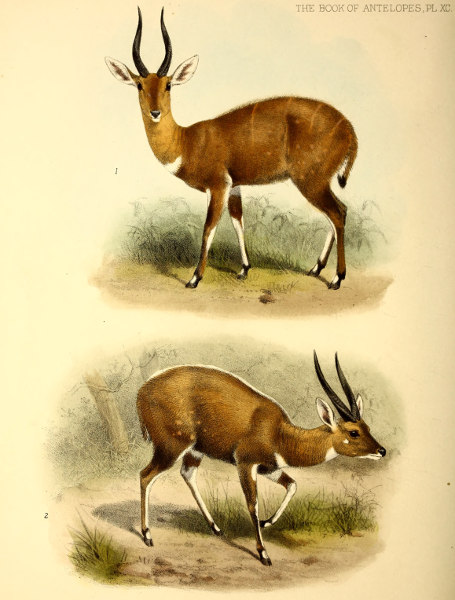
122. THE CAPE BUSHBUCK. TRAGELAPHUS SYLVATICUS (Sparrm.). [PLATE XC. Fig. 2.]
Antilope sylvatica, Sparrm. Act. Holm. 1780, p. 197, pl. vii.; id. Reise etc. p. 517, pl. iii. (1784); id. Engl. Tr. i. p. 270, ii. p. 220, pl. vi. (1786); id. French Tr. i. p. 293, pl. iii. (lower fig.) (1787); Schreb. Säug. pl. cclvii. B (1784); Bodd. Elench. Anim. p. 141 (1785); Gm. Linn. S. N. i. p. 192 (1788); Kerr, Linn. An. K. p. 318 (1792); Donnd. Zool. Beitr. p. 643 (1792); Link, Beytr. Nat. ii. p. 99 (1795); Shaw, Gen. Zool. pt. ii. p. 348, fig. 193 (upper) (1801); Turt. Linn. Syst. Nat. i. p. 115 (1802); G. Cuv. Dict. Sci. Nat. ii. p. 246 (1804); Thunb. Mém. Ac. St. Pétersb. iii. p. 315 (1811); Licht. Reise, i. p. 647 (1811); Fisch. Zoogn. iii. p. 441 (1814); Afz. N. Acta Upsal. vii. p. 220 (1815); Burchell, List Quadr. p. 7 (1817); Goldf. Schreb. Säug. v. p. 1209 (1818); Schinz, Cuv. Thierr. i. p. 396 (1821); Desmoul. Dict. Class. d’H. N. i. p. 447 (1822); H. Sm. Griff. An. K. iv. p. 275, v. p. 350 (1827); J. B. Fisch. Syn. Mamm. p. 472 (1829); Smuts, En. Mamm. Cap. p. 87 (1832); Waterh. Cat. Mus. Z. S. (2) p. 42 (1838); Schinz, Syn. Mamm. ii. p. 428 (1845); id. Mon. Säugeth. p. 27, pl. xxix. (1848); Huet, Bull. Soc. Acclim. (4) iv. p. 480 (1887).
Antilope (Gazella) sylvatica, Licht. Mag. nat. Fr. vi. p. 173 (1814).
Antilope (Addax) sylvatica, Laurill. Dict. Univ. d’H. N. i. p. 621 (1861).
Cemas sylvatica, Oken, Lehrb. Nat. iii., Zool. p. 733 (1816).
Calliope sylvatica, Rüpp. Verz. Senck. Mus. iii. pt. 2, p. 182 (1839).
Antilope (Tragelaphus) sylvatica, Desm. Mamm. p. 469 (1822); Less. Man. Mamm. p. 383 (1827); A. Sm. S. Afr. Quart. J. ii. p. 218 (1834); Less. Compl. Buff. x. p. 296 (1836); Reichenb. Säug. iii. p. 78 (1845); Gieb. Säug. p. 309 (1853).
Tragelaphus sylvaticus, Blainv. Bull. Soc. Philom. 1816, p. 75; Desm. N. Dict. d’H.N. (2) ii. p. 197 (1816); Harris, Wild Anim. S. Afr. pp. 144–149, pl. xxvi. (1840); Gerv. Dict. Sci. Nat., Suppl. i. p. 266 (1840); Less. N. Tabl. R. A., Mamm. p. 181 (1842); Gray, List Mamm. B. M. p. 165 (1843); Sund. Pecora, K. Vet.-Akad. Handl. lxv. p. 189 (1846); id. Hornschuch’s Transl., Arch. Skand. Beitr. ii. p. 141; Reprint, p. 65 (1848); Gray, Cat. Ost. B. M. pp. 59, 60, 146 (1847); id. P. Z. S. 1850, p. 145; Wagner, Schreb. Säug., Suppl. iv. p. 441 (1844), v. p. 443 (1855); Gray, Knowsl. Menag. p. 28 (1850); id. Cat. Ung. B. M. p. 139 (1852); Gerr. Cat. Bones Mamm. B. M. p. 246 (1862); Wood, Ill. Nat. Hist. i. p. 666, fig. (1862); Chapman, Travels &c. ii. p. 335 (1868); Fitz. SB. Ak. Wien, lix. pt. 1, p. 174 (1869); Gray, Cat. Rum. B. M. p. 50 (1872); id. Hand-l. Rum. p. 120 (1873); Drumm. Large Game, p. 425 (1875); Brooke, P. Z. S. 1878, p. 884; Selous, P. Z. S. 1881, p. 752; id. Hunter’s Wand. p. 208 (1881); Flow. & Gars. Cat. Coll. Surg. p. 260 (1884); Bryden, Kloof and Karroo, p. 300, fig. (1889); Jent. Cat. Ost. Leyd. Mus. (Mus. P.-Bas, ix.) p. 141 (1887); Scl. f. Cat. Mamm. Calc. Mus. p. 154 (1891); Flow. & Lyd. Mamm. p. 347 (1891); Nicolls & Egl. Sportsm. S. Afr. p. 37 (1892); Ward, Horn Meas. (1) p. 152 (1892), (2) p. 194 (1896) (part.); Jentink, Cat. Mamm. Leyd. Mus. (Mus. P.-Bas, xi.) p. 173 (1892); Lyd. Horns and Hoofs, p. 252 (1893); Kendall, P. Z. S. 1895, p. 359 (Transvaal); Pousargues, Ann. Sci. Nat. iv. pp. 81, 83 (1897).
Tragelaphus scriptus sylvaticus, Thos. P. Z. S. 1891, p. 389; Kirby, in Ward’s Great and Small Game of Africa, p. 484, pl. xiii. fig. (1899); Trouess. Cat. Mamm. p. 959 (1899).
Tragelaphus scriptus, Ward, Rec. Big Game, p. 282 (1899) (part.).
Le Bosbok, Buff. Hist. Nat., Suppl. v. p. 35, pl. xv. (1782).
Forest Antelope, Penn. Hist. Quadr. (3) i. p. 86 (1793).
Vernacular Names:—Boschbok of the Dutch; Bushbuck of the English at the Cape; Inkonka (♂), Imbabula (♀) of the Zulus (Selous).
General colours much as in the other species of this section, and especially as in T. roualeyni, but without any traces of transverse stripes either in the adult or immature stages. Adult male of a deep dark brownish black, with only a few small white spots on the haunches and one or two on the shoulders. Younger males reddish brown on the rump and sides, almost greyish brown above; a narrow white spinal stripe over the rump and about nine white spots on the haunches, with a line of white spots extending inferiorly above the belly. Horns 12 or 14 inches in length, rarely attaining to 16 inches.
Female. Without horns, of a light reddish brown, as in the immature male, with white spots on the hind-quarters, and sometimes a lateral line of white spots above the belly.
Hab. Forest-districts of South Africa up to the Limpopo, north of which it is replaced by T. roualeyni.
The Bushbuck, so named by the Dutch settlers at the Cape from its being an inhabitant of the forest (bosch), was first made known to science by the famous Swedish traveller and naturalist Sparrman, who obtained specimens of it during his expedition to the Cape, and described it on his return home in the ‘Acta Holmiensia,’ and subsequently in the several editions of his ‘Travels.’ Sparrman specially mentions Groot Vaders-bosch and Houtniquas-bosch, in the south of the Colony, as the districts in which he had encountered this Antelope.
The Bushbuck was also described and figured by Buffon in the ‘Supplement’ to his ‘Histoire Naturelle’ from information received from Allamand and first published in Schneider’s edition of the ‘Histoire Naturelle’ issued at Amsterdam. It was likewise mentioned by Thunberg, Lichtenstein, and other earlier writers, who adopted Sparrman’s scientific name for it. Little of moment, however, is added to our knowledge of its habits and range until we come to Harris’s illustrated volume on the ‘Game-Animals of Southern Africa,’ published in 1840. In this work a special chapter is devoted to an account of the sport of hunting the Bushbuck along with the Grysbok and the Blue Duiker, which are all figured together in the twenty-sixth plate of Harris’s ‘Portraits.’ This author discourses eloquently on the first-named Antelope as follows:—
“Aptly enough has this elegant and game-looking Antelope been designated the ‘Bush-goat’; since, concealing itself during the day in the deepest glens of the wooded mountains, it quits not its retreat except during the matin hours, when it warily sallies forth to graze along the outskirts of the forest, or tempted by the bright moonlight nights, makes a foray upon the neighbouring gardens and cultivation. Slow of foot, and easily overtaken if surprised in open situations, it is wise to lie thus close in its native jungles, the thickest of which it traverses with ease—darting from one shrubbery to another, and forcing its elastic form through the plaited undergrowth, with its horns so crouched along the neck as to prevent their impeding progress by becoming entangled in the sylvan labyrinth. So perfectly does the voice of this singular species counterfeit the barking of a dog that the benighted wayfarer is said to have been decoyed by it into the most lonely depths of the forest, vainly hoping to discover some human habitation, whereas every step has but removed him further from the abodes of man. Combining singular elegance and vigour with the most marked and decided colouring, the Bushbuck stands quite by itself among the Antelopes of Southern Africa, and is to be found only in those parts of the Colony and of Caffraria where sufficient cover exists to afford it a safe asylum. Naturally preferring solitude, the buck is nevertheless frequently found in the society of the doe, accompanied during the breeding-season by one or two kids, but never by adult individuals. Every specimen that I have seen displayed a bare ring around the neck, from which, by some process not satisfactorily explained, the hair had been removed as if through long confinement by a chain and collar. Very old subjects wear white stockings, gartered above the knee, and it is usual to find a narrow white tape along the back, partially concealed by the goat-like mane which bristles from the ridge of the spine. But of these characters none are constant, all being often absent in the female, and even in the non-adult male, whose lighter coloured coats are never so prominently ‘picked out’ as the dark robes of the patriarchs.”
Messrs. Nicolls and Eglington, in their ‘Sportsman in South Africa,’ inform us that at the present time the Bushbuck is still plentiful in all the maritime divisions of the Cape Colony and Natal, wherever there are any considerable belts of thick bush. It is not usual to find more than a pair of adults together, and the animals seldom emerge from the impenetrable bush except at night-time, when they come out into the open glades to feed. The bare patches on the neck alluded to by Harris are explained by these authors to be caused by the horns being constantly thrown backwards along the neck, which thus becomes denuded of hair.
In the neighbourhood of Port Elizabeth we are told, and in other districts of the Colony, the Bushbuck is very strictly preserved, and battues are held every year about Easter-time, when large drives of them take place. Numbers of natives are employed with the assistance of dogs to beat the wooded kloofs, and to drive the game towards the guns, which are placed in the narrow necks of the valleys. Excellent sport is thus obtained.
When we proceed as far up the coast as the Limpopo the Cape Bushbuck, as we shall presently more fully explain, is replaced by Cumming’s Bushbuck (Tragelaphus roualeyni). In this Bushbuck, as Mr. Selous informs us, the adult rams are of a brownish grey, often without a sign of any spots, and the adult females of a dark red with a few white spots. The young rams, however, are of a red colour and a good deal spotted, and have a few faint transverse stripes, while the young females are also more spotted than the old ones. If, however, Mr. Selous continues, we examine the Bushbucks found on the Zambesi to the east of the Victoria Falls, the adult rams are in colour like the young rams of the Limpopo, being of a dark red thickly spotted on the haunches, shoulders, and sides with small white spots, with three or four faint white stripes down each side. On the other hand, if we take the Bushbucks found on the banks of the Chobé and in the country to the west of the Victoria Falls we find an animal of a very dark red colour, most beautifully spotted with large white spots, and ornamented in some cases with as many as eight well-defined white stripes and a long mane of white hair. This Bushbuck of the Chobé is that which, following Mr. Pocock, we have called Tragelaphus scriptus ornatus (v. s. p. 110).
On the whole, there seems to be little doubt that there are intermediate forms between what we have here treated of as three species of Bushbuck, but the question is by no means finally settled, and waits for a better and larger series of specimens than is at our command before a satisfactory conclusion can be arrived at.
The Cape Bushbuck does well in captivity, and is frequently brought to Europe. Living specimens of it may often be seen in the principal Zoological Gardens. The first example possessed by the Zoological Society of London appears to have been acquired in April 1859, when it was presented by the late Sir George Grey. Other specimens arrived in 1881 and 1887, and the Society has lately received good examples of it presented by its excellent correspondents Mr. J. E. Matcham of Port Elizabeth and Mr. W. Champion of Natal.
Our illustration of this species (Plate XC. fig. 2) was prepared by Mr. Smit from one of the specimens living in the Zoological Society’s Gardens in May of the present year.
November, 1899.
123. CUMMING’S BUSHBUCK. TRAGELAPHUS ROUALEYNI (Cumming). [PLATE XC. Fig. 1.]
Subspecies a. Tragelaphus roualeyni typicus.
Antelopus roualeynei, Cumming, Hunter’s Life in S. Afr. ii. pp. 165, 168 (1850); Gray, P. Z. S. 1850, p. 146; id. Cat. Ung. B. M. p. 140 (1852).
Tragelaphus roualeynei, Fitz. SB. Wien, lix. pt. 1, p. 175 (1869); Selous, P. Z. S. 1881, p. 753; id. Hunter’s Wand. p. 209 (1881); Matschie, Säug. D.-O.-Afr. p. 138 (1895); id. in Werther’s Hochländ Deutsch-Ost-Afr. p. 257, plate (1898).
Tragelaphus sylvaticus, Pet. Reise n. Mossamb. p. 183 (1852); Scl. P. Z. S. 1864, p. 105; Kirk, P. Z. S. 1864, p. 659; Johnst. P. Z. S. 1885, p. 218; id. Kilima Njaro Exped. p. 354 (1886); Hunter, in Willoughby’s E. Afr. pp. 194, 288 (1889); Crawshay, P. Z. S. 1890, p. 655; Lugard, Rise E. Afr. Emp. i. p. 536, fig. (1893); Jacks. P. Z. S. 1897, p. 456 (Mau Plateau); Johnst. Brit. Centr. Afr. p. 309 (1897).
Tragelaphus scriptus, Thos. P. Z. S. 1894, p. 145; Lorenz, Ann. Mus. Wien, ix., Notiz. p. 62 (1894); Johnst. Brit. Centr. Afr. p. 306, fig. (1897).
Tragelaphus scriptus roualeynei, Thos. P. Z. S. 1891, p. 389, 1893, p. 504; True, P. U. S. N. Mus. 1892, p. 471; Scl. P. Z. S. 1893, pp. 507, 728; Thos. P. Z. S. 1896, p. 798; Rendall, Novitat. Zool. v. p. 211 (1898); Trouess. Cat. Mamm. p. 959 (1899).
Tragelaphus sylvaticus roualeynei, Jacks. Badm. Big Game Shooting, pp. 285, 306 (1894); id. in Ward’s Great and Small Game of Africa, p. 481, pl. xiii. fig. (1899).
Subspecies b. Tragelaphus roualeyni fasciatus.
Tragelaphus decula, Swayne, P. Z. S. 1894, p. 317; id. Somaliland, p. 309; Ghika, Au Pays des Somalis, p. 184 (1898); Straker, in Ward’s Great and Small Game of Africa, p. 478 (1899).
Tragelaphus scriptus fasciatus, Pocock, Ann. & Mag. N. H., Jan. 1900.
Vernacular Names:—Serolomootlooque of the Bakalahari on the Limpopo (Cumming); Babala of the Anyanga, Mbawala of the Agawa, Imbabala of the Angoni, and Mpatu of the Ahenga, and Anyika in British Central Africa (Crawshay); Mpongo in Kinyamwesi (Böhm); Mbawara, Mbala, or Mbawala in Kisuaheli; Dol of Somalis (Swayne).
The typical form of this species is very nearly allied to the Bushbuck of the Cape Colony (T. sylvaticus), but is more strongly marked with white. Colour variable. Adult bucks sometimes nearly black or brownish grey, without traces of stripes and spots; sometimes marked with a few faint stripes and a few spots.
Females and immature males are redder in colour than adult bucks, and generally weakly striped and spotted.
Hab. From the Limpopo River across the Lower Zambesi to Nyasaland, and thence northwards to British East Africa and Somaliland.
The great sportsman Roualeyn Gordon Cumming was the first observer of this East-African form of the Bushbuck, and with characteristic audacity named it after himself. He seems to have first met with it on the Limpopo in June 1847, and in his ‘Hunter’s Life’ has given us the following account of his discovery:—
“I was in a sequestered bend of the river, where the banks for several acres were densely clad with lofty reeds and grass which towered above my head as I sat on my horse’s back. Beyond the reeds and grass were trees of all sizes, forming a dense shade; this is the general character of the Limpopo, as far as I have yet seen. I was slowly returning to my camp, in anything but good humour at my want of success with the game I had just been after, when, behold, an antelope of the most exquisite beauty, and utterly unknown to sportsmen or naturalists, stood broadside in my path, looking me full in the face. It was a princely old buck of the ‘Serolomootlooque’ of the Bakalahari, or ‘Bushbuck of the Limpopo.’ He carried a very fine wide-set pair of horns. On beholding him I was struck with wonder and delight. My heart beat with excitement. I sprang from my saddle, but before I could fire a shot this gem of beauty bounded into the reeds and was lost to my sight. At that moment I would have given half what I possessed in this world for a broadside at that lovely antelope, and I at once resolved not to proceed farther on my expedition until I had captured him, although it should cost me the labour of a month.
“The antelope having entered the reeds, I gave my horse to my after-rider, and with my rifle on full cock and at the ready I proceeded to stalk with extreme caution throughout the length and breadth of the cover; but I stalked in vain; the antelope had vanished, and was nowhere to be found. I then returned to my steed and rode slowly up the river’s bank towards my camp. I had ridden to within a few hundred yards of the wagons, and was meditating how I should best circumvent the Serolomootlooque, when once more this lovely antelope crossed my path; I had been unwittingly driving him before me along the bank of the river. He trotted like a roebuck into the thick cover and then stood broadside among the thorn bushes. I sprang from my saddle, and guessing about his position, I fired and missed him; he then trotted along a rhinoceros’s footpath, and gave me a second chance. Again I fired, and before my rifle was down from my shoulder the Serolomootlooque lay prostrate in the dust. The ball had cut the skin open along his ribs, and entering his body had passed along his neck, and had lodged in his brains, where we found it on preparing the head for stuffing. I was not a little gratified at my good fortune in securing this novel and valuable trophy; he was one of the most perfect antelopes I had ever beheld, both in symmetry and colour. I had him immediately conveyed to camp, where I took his measurement, and wrote out a correct description of him for the benefit of naturalists. I christened him the ‘Antelopus roualeynei,’ or ‘Bushbuck of the Limpopo.’”
It is not, however, without considerable hesitation that we have decided to retain Cumming’s name for the form of Bushbuck that, as will be presently seen, extends from the Limpopo River northwards to British East Africa and Somaliland. Although, according to Selous, the Bushbucks that are found on the Zambesi to the east of the Victoria Falls differ from those inhabiting the Limpopo (that is to say, from the typical roualeyni) in being of a dark red colour, thickly spotted on the haunches, shoulders, and sides, and marked with three or four faint white stripes, whereas the adult of the Limpopo form is a dark brownish grey, not striped, and often without a sign of spots, we venture to think there is sufficient evidence to show that these distinctions will not hold good when more material from the two rivers has been examined. For example, a fine series of skins of bucks of various ages sent by Sir Harry Johnston from Nyasaland, and presumably identical with the form observed by Selous on the Lower Zambesi, shows considerable variation in colour. The young male is yellowish red throughout, with about half-a-dozen spots on the hind-quarters and scarcely a trace of stripes. The adult is of a richer yellowish red, brighter on the hind-quarters, and passing into black on the shoulders, belly, and base of the neck, with a few white spots on the hind-quarters, and occasionally also on the shoulder, and sometimes a row of spots along the sides above the belly. Sometimes there are about three indistinct white stripes on each side, sometimes only one; but more often there are no traces of them to be seen, the presence or absence of the stripes being apparently independent of age. As we pass northwards into East Africa from Nyasaland the stripes, judging from accounts given by sportsmen and naturalists, seem to become more persistent, and in a mounted example in the British Museum, obtained on Manda Island, opposite Witu, by Sir John Kirk, as will be seen by Mr. Smit’s figure of this specimen (Plate XC. fig. 1), they are plainly visible. This specimen stands about 32 inches at the withers, and its horns surpass 14 inches in length, so there is no doubt as to its maturity. On the whole, the most reasonable course to pursue seems to be, at least for the present, to refer all the specimens met with in Eastern Africa, from the Limpopo to the Shebeyli, to one species.
We will now say a few words as to what the principal writers who have met with this Bushbuck in the more northern portion of its range have recorded of its habits and distribution. Mr. Crawshay, one of our best authorities on the Antelopes of Nyasaland, tells us that it is the commonest of all the Antelopes of that country. From the great variety that exists in the colour and markings of the Nyasan Bushbucks, Mr. Crawshay thought at first there must be more than one species; but after carefully examining a great many of both sexes, young and old, he came to the conclusion that there is only one, of the various stages of which he gives minute descriptions.
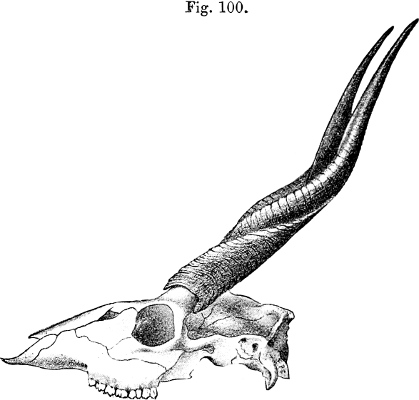
Fig. 100.
Skull and horns of Cumming’s Bushbuck.
(Brit. Mus.)
Sir Harry Johnston, in his ‘British Central Africa,’ gives us an excellent figure of the male Bushbuck, which he says is extremely common throughout the Protectorate. He describes its flesh as without exception the most delicious eating of any mammal in the world, “surpassing in tenderness and flavour that of the best Welsh mutton, or of any kind of venison.”
In German East Africa, Herr Matschie informs us that Cumming’s Bushbuck is also found all over the country, generally in the immediate neighbourhood of water, where it resorts to the thickest bush on the banks. Herr Matschie also gives a good figure of Tragelaphus roualeyni, in which, however, no traces of transverse bands are perceptible.
In British East Africa this Antelope, according to Mr. F. J. Jackson, is also common everywhere on the coast, and is to be met with as far west as the edge of the Mau Plateau, where, as he informs us (P. Z. S. 1897, p. 456), it is plentiful.
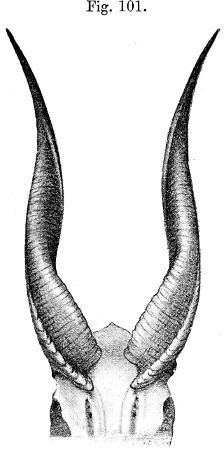
Fig. 101.
Frontlet of Cumming’s Bushbuck.
(Brit. Mus.)
Further north in Somaliland the Bushbuck, although not met with anywhere on the high plateau, was found in the dense forests of the Webbe by Capt. Swayne during his second expedition in 1893. It is described by him as the most wary and difficult to shoot of all the game-animals he has ever encountered. It is often caught by the natives on the Webbe in staked pits, excavated in the jungles on the banks of the river.
Capt. Swayne has referred the Bushbuck of the Webbe to T. decula, but this is certainly not correct, as, according to his own description, it has “four or five white stripes, and sometimes as many as thirty white spots.” In some skins from Sen Morettu, on the Webbe, received from Capt. Swayne, now in the British Museum, there are four or five distinct white stripes on the flanks, both in adult and immature males, a few white spots on the hind-quarters, and a row of white spots extending along each side of the body above the belly. Although in some respects this form comes nearer to T. scriptus, we think it better for the present to regard it as a subspecific form of T. roualeyni, which, using Mr. Pocock’s subspecific term, we call T. roualeyni fasciatus, and describe as follows:—
Height at withers about 26 inches. Head and legs of the same colour and pattern as in T. roualeyni and the other species of this section of the genus. General colour a reddish yellow, brighter on the hind-quarters, and distinctly blacker in the dorsal region, where the hair assumes a dusky greyish-brown hue. Body marked with four or five very distinct, mostly broad, white stripes, a row of white spots running along above the belly and a few white spots on the haunches. Hair on body shorter than in T. roualeyni. No distinct collar of short hair round the base of the neck, as in T. roualeyni, T. sylvaticus, and T. scriptus, the entire neck being covered with a coating of short silky hairs of the same length as those of the head, much shorter than those of the body, and of a dusky, greyish-brown colour.
Young male redder in colour than the adult and equally strongly marked with white.
The skull of a subadult male gives the following measurements:—Basal length 8·25 inches, orbit to muzzle 4·6, greatest width 3·75.
In the British Museum are a skull of the typical T. roualeyni of the Limpopo, procured by Gordon Cumming, and a skin and skull from the Zambesi obtained by Mr. Selous. There is also in the Museum a good series of skins and skulls of this species from Zomba, Nyasaland, and its vicinity, transmitted by Sir Harry Johnston and Mr. A. Sharpe, of which we have already spoken, and from one of which our figures of the adult skull (pp. 126, 127) have been taken. From British East Africa the National Collection possesses the mounted adult male from Manda Island presented by Sir John Kirk (and figured on our Plate XC., as already mentioned), also a mounted female from the same source obtained in British East Africa about one hundred miles inland at 6° S. lat. Besides these there are Capt. Swayne’s specimens from the River Webbe in the interior of Somaliland, already referred to.
We are not aware that any examples of this Bushbuck have been brought to Europe alive.
November, 1899.
124. DELAMERE’S BUSHBUCK. TRAGELAPHUS DELAMEREI, Pocock. Tragelaphus delamerei, Pocock, Ann. & Mag. N. H., Jan. 1900.
Of about the same size as T. scriptus. Head ruddy brown on the forehead, with a blackish band extending down the muzzle; cheeks fawn, with two small white spots; no white stripe running inwards from the corner of the eye; edge of upper lip and chin white; white patches at upper and lower ends of throat small, the former only just traceable. General colour of body dark yellowish brown above, paler below, and gradually passing into yellowish fawn upon the shoulder and upon the lower half of the hind-quarters. No traces of white stripes or spots observable either upon the body or upon the hind-or fore-quarters. Fore legs both outside and inside right up to the base yellowish brown, blackish all down the front from above the knee to the fetlocks; fetlocks and pasterns black, except for a pair of white spots on the pasterns in front. Hind legs coloured like fore legs, but paler above the hock and marked with a distinct white patch in front of the hock. Tail white below, dark at the tip. A collar of short hairs round the base of the neck. No long crest of hairs along the spine.
Hab. Somaliland.
A single nearly adult example of this species (fig. 102, p. 130), remarkable for the absence of white on the inner sides of the legs and on the body, was procured by Lord Delamere on his last sporting expedition into Somaliland at a place called “Sayer,” and was kindly presented by him to the British Museum.
The specimen in question was examined by the person who skinned it for Lord Delamere, and, according to his evidence, was ascertained to be of the male sex. But in the face of its bearing no traces of horns we are hardly disposed to accept this statement, which may well have been made in error. Even, however, if we take it to be the female of a Tragelaphus, we are unable to refer it to any known species, and we therefore insert it in what would seem to be its proper place under the name attached to it by Mr. Pocock.
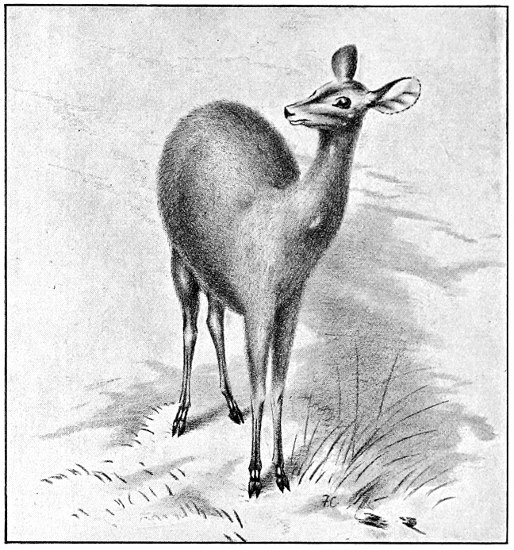
Fig. 102.
Delamere’s Bushbuck.
The accompanying figure of Delamere’s Bushbuck has been prepared from the typical specimen in the British Museum.
November, 1899.
THE BOOK OF ANTELOPES. PL. XCI.
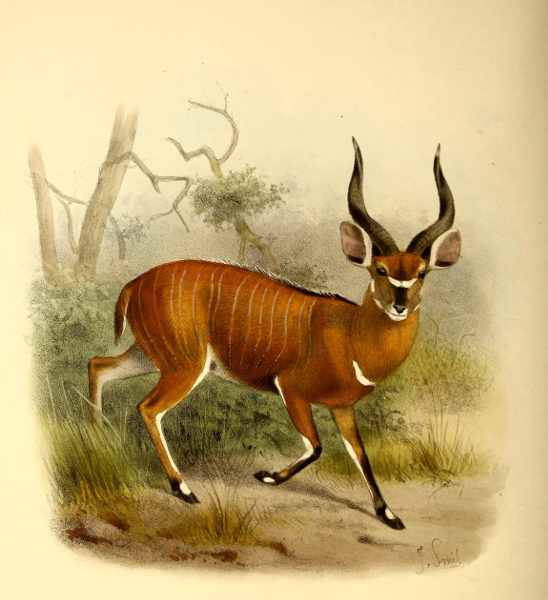
J. Smit del. et lith.
Hanhart imp.
The Broad Horned Antelope.
TRAGELAPHUS EURYCEROS.
Published by R. H. Porter.
125. THE BROAD-HORNED ANTELOPE. TRAGELAPHUS EURYCERUS (Ogilby). [PLATE XCI.]
Antilope, sp., Afz. N. Acta Upsal. vii. p. 269, pl. viii. fig. 3; H. Sm. Griff. An. K. v. p. 361 (?).
Antilope eurycerus, Ogilby, P. Z. S. 1836, p. 120; Waterh. Cat. Mus. Zool. Soc. (2) p. 42 (1838); Temm. Esq. Zool. Guin. p. 190 (1853); Huet, Bull. Soc. Acclim. (4) iv. p. 468 (1887).
Antilope (Addax) euryceros, Laurill. Dict. Univ. d’H. N. i. p. 620 (1861).
Tragelaphus eurycerus, Less. N. Tabl. R. A., Mamm. p. 181 (1842); Wagn. Schr. Säug., Suppl. v. p. 441 (1855); Gray, P. Z. S. 1850, p. 144; id. Knowsl. Menag. p. 27, pl. xxiii. fig. 1 (horns) (1850); id. Cat. Ung. B. M. p. 136 (1852); id. P. Z. S. 1861, p. 276; Gerr. Cat. Bones B. M. p. 246 (1862); Fitz. SB. Ak. Wien, lix. pt. 1, p. 174 (1869); Brooke, P. Z. S. 1871, p. 485, pl. xxxix.; Scl. P. Z. S. 1883, p. 35; Thomas, P. Z. S. 1891, p. 387; Flow. & Lyd. Mamm. p. 347 (1891); Ward, Horn Meas. p. 158 (1892); id. Rec. Big Game, p. 202 (1896); Jent. Cat. Mamm. Leyd. Mus. (Mus. Pays-Bas, xi.) p. 172 (1892); Lyd. Horns and Hoofs, p. 254 (1893); id. Royal Nat. Hist. ii. p. 275 (1894); Pousarg. Ann. Sci. Nat. iv. p. 81 (1897); Trouess. Cat. Mamm. p. 957 (1898); Bryden, in Ward’s Great and Small Game of Africa, p. 454, pl. xiii. fig. 3 (1899).
Euryceros euryceros, Gray, Cat. Rum. B. M. p. 48 (1872); id. Hand-l. Rum. B. M. p. 119 (1873); Jent. Cat. Ost. Leyd. Mus. (Mus. Pays-Bas, ix.) p. 141 (1887); id. Notes Leyd. Mus. 1888, pp. 23–25; Büttik. Reisebilder, ii. p. 380, cum fig. (1890).
Tragelaphus albo-virgatus, Du Chaill. Pr. Bost. Soc. N. H. vii. pp. 299–300 (1861); id. Expl. & Adv. Equat. Afr. p. 306, pl. (1861).
Tragelaphus albovittatus, Gray, P. Z. S. 1861, p. 276.
Vernacular Names:—Trommé of the Mandingos (Temminck); Elk of Liberians and Guin of the Veys in Liberia (Büttikofer); Bongo of Gaboon (Du Chaillu).
Height at the withers of the adult male about 43 inches. General colour of the head and body bright chestnut, with a white spinal stripe extending from the withers to the root of the tail, and about 14 or 15 transverse white stripes on the shoulders, flanks, and hind-quarters, passing from the spinal stripe above on to the belly beneath. Head with a patch of deeper colour upon the forehead, and extending about two inches below the eyes. An angular V-shaped white mark extending inwards from the eye on to the nose, interrupted in the middle line by a narrow brown band; chin and lips white; two or three cheek-spots large and sometimes fused together; inter-ramal area and upper end of throat covered with hairs of a blackish hue; lower end of the throat with a very distinct transverse white band; chest and belly covered with short hair of a purplish-brown colour; area between the hind legs and beneath the tail up to the anus white. Fore legs blackish from the fetlocks to the knees, chestnut from the knees to the shoulders externally; white at the bases close to the chest, as also above the knees and between knees and fetlocks internally; a large white spot on the front of the pasterns. Hind legs chestnut down to the fetlocks on the outer side; front of the hocks and cannon-bones broadly white; fetlocks blackish or brownish, both without and within; a white patch on the pasterns as on the fore legs.
Hair short and close all over the body. No mane on the throat; hairs along the nape reversed, but scarcely forming a mane, being merely slightly elongated; behind the parting there is a short spinal mane. Tail bovine, thinly covered with hairs of the same colour as those of the body, and ending in a tuft of long hairs of a darker red tint[10].
Horns massive, rather smooth, with weak anterior basal crest, amber-yellow tip, and a single twist; usually about 30 inches long round the curve and about 25 in a straight line. A skull gives the following measurements:—Basal length 14·5 inches, orbit to muzzle 8·5, greatest width 6·25.
Female. Similar to the male in markings, but without horns, and rather paler in colour and smaller in size.
Hab. Forests of the West-African coast-range, from Liberia to Gaboon.
Whether the horn from Sierra Leone, figured and described by Afzelius in his essay on Antelopes, published in the ‘Nova Acta’ of the Society of Sciences of Upsala in 1795, and subsequently referred to by Hamilton Smith and other authors, really belonged to the present species is somewhat uncertain, although such may very possibly have been the case. The first trustworthy introduction of this species to scientific literature is therefore due to Ogilby, a well-known authority on the Ruminants, who in 1836 established his Antilope eurycerus in a paper read before the Zoological Society of London on November the 22nd of that year. Ogilby’s materials consisted of “two pairs of horns, one attached to the skull, the other to the integuments of the head,” which had then “long existed in the Society’s collection.” Their origin was unknown, but they were believed to have come from Western Africa. These specimens, we may add, are now in the British Museum, to which they were transferred by the Zoological Society in 1858. One of the pairs was figured by Gray in the volume of the ‘Gleanings from the Knowsley Menagerie,’ published in 1850.
In 1853 Temminck recorded the existence of a pair of horns of this species in the Leyden Museum, and gave its vernacular name as the “Trommé” of the Mandingos of Western Africa.
With this exception no addition appears to have been made to our knowledge of this Antelope until 1860, when Mr. P. B. Du Chaillu, who had met with it during his excursions in the interior of Gaboon from 1856 to 1859, described it before the Boston Society of Natural History as a new species, under the name Tragelaphus albo-virgatus. In the report of his paper published in the ‘Proceedings’ of that Society we find its locality given as the “forests about the head-waters of the Fernand-Vaz in the Aschankolo Mountains, 60 miles south of the Equator, and 140 from the coast.” In the narrative of his travels, published in 1861, Mr. Du Chaillu writes of the same Antelope as belonging to the fauna of the “Rembo Region,” the Rembo being one of the rivers that flows from these mountains, and tells us that it is “very shy, swift of foot, and exceedingly graceful in its motions.” The full-page steel engraving that accompanies these remarks, which, by the kindness of Messrs. Murray, we are enabled to reproduce (fig. 103, p. 134), is stated to have been taken from a well-preserved specimen in his collection. The native name is given as “Bongo.”
After describing his specimens in America, Mr. Du Chaillu brought them to this country, and disposed of them to the British Museum.
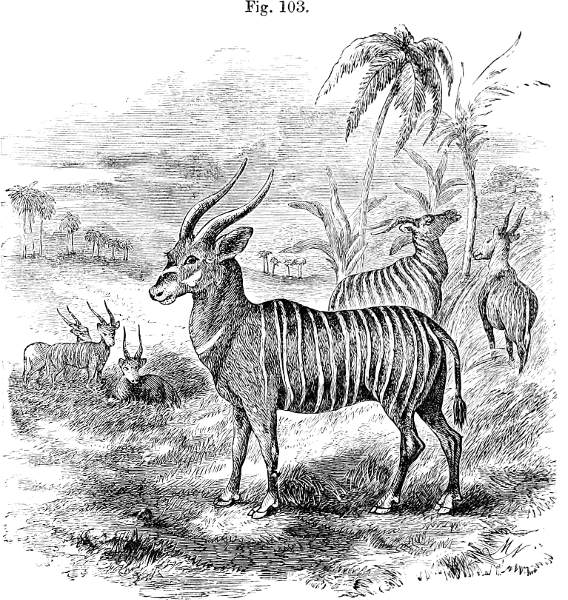
Fig. 103.
The Bongo Antelope.
(From Du Chaillu’s ‘Travels in Equatorial Africa,’ p. 306.)
The late Dr. J. E. Gray, who was not very friendly with the great explorer, and had carried on a paper warfare with him in the ‘Athenæum’ journal, lost no time in bringing the specimens before the Zoological Society, where he subjected them to a somewhat severe criticism. The supposed new species of Tragelaphus, he pointed out, was “evidently only a specimen of Antilope eurycerus of Ogilby.” This was, no doubt, correct, but at the same time Mr. Du Chaillu’s skin, imperfect as it was, was the first specimen of the animal, except the original two pairs of horns, acquired by the National Collection, where it is now to be seen mounted in the Gallery, and allows an idea to be formed of the brilliant colours of this splendid Antelope. It will be found figured by Sir Victor Brooke, from a sketch by Wolf (put upon the stone by Smit), in the Zoological Society’s ‘Proceedings’ for 1871. In the same article, is given a figure of the skull and horns of this Antelope, taken from one of the type specimens in the British Museum, which, by the kind permission of the Zoological Society, we are enabled to reproduce on the present occasion (fig. 104).
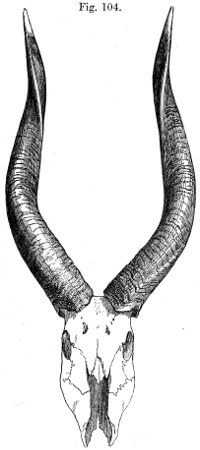
Fig. 104.
Head and horns of the Broad-horned Antelope.
(P. Z. S. 1871, p. 488.)
Besides Mr. Du Chaillu, the only travellers who have met with this beautiful Antelope in its native wilds appear to have been Messrs. Büttikofer and Stampfli, during their well-known researches in Liberia. From Dr. Jentink’s article upon the mammals collected during their explorations we learn that these naturalists obtained a complete specimen of an adult male of this species near Hill Town, besides two skins on the Junk River and the Mahfa River. In the second volume of his ‘Reisebilder aus Liberia’ Herr Büttikofer gives a figure of the Antelope in the text, and informs us that it lives in the forests and feeds principally upon leaves of trees, on which it browses up to a height of eight feet.
Besides the typical specimens of Ogilby’s Antilope eurycerus and Du Chaillu’s Tragelaphus albo-virgatus, which, as already mentioned, are now in the British Museum, the National Collection contains a good mounted head of an adult male of this Antelope from Fantee, which is accompanied by a flat body-skin, and the mounted skeleton of an adult male from Gaboon.
We are not aware that any living examples of the Broad-horned Antelope have ever reached Europe.
Our figure of this species (Plate XCI.) has been drawn by Mr. Smit from the mounted specimen in the British Museum.
November, 1899.
THE BOOK OF ANTELOPES, PL. XCII.
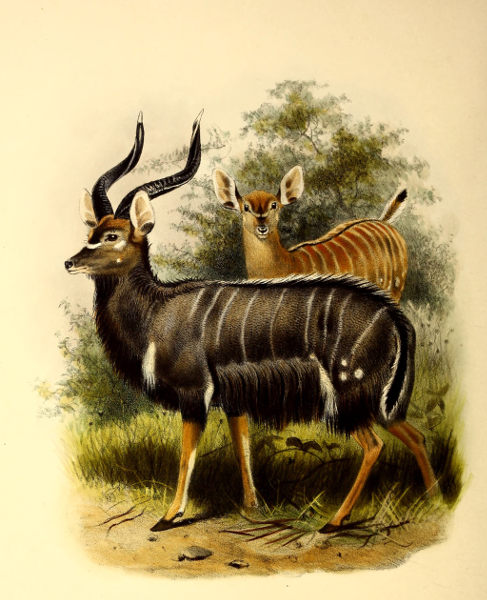
Wolf del. Smit lith.
Hanhart imp.
Angas’ Antelope.
TRAGELAPHUS ANGASI.
Published by R. H. Porter.
126. ANGAS’ ANTELOPE. TRAGELAPHUS ANGASI, Angas. [PLATE XCII.]
Tragelaphus angasi, G. F. Angas, P. Z. S. 1848, p. 89, pls. iv. (♂), v. (♀); id. Kaffirs Illustrated, p. 51, pl. xxix. (1849); Gray, P. Z. S. 1850, p. 144; id. Knowsl. Menag. p. 27 (1850); id. Cat. Ung. B. M. p. 138 (1852); Proudf. P. Z. S. 1850, p. 199; Baldwin, Afr. Hunt. p. 76 (1854); Gerr. Cat. Bones B. M. p. 246 (1862); Fitz. SB. Ak. Wien, lix. pt. 1, p. 174 (1869); Brooke, P. Z. S. 1871, p. 485; id. P. Z. S. 1878, p. 884 (cranial characters); Buckley, P. Z. S. 1876, p. 285; Thomas, P. Z. S. 1891, p. 387; Flow. & Lyd. Mamm. p. 347 (1891); Scl. P. Z. S. 1892, p. 98 (Shiré R.); Ward, Horn Meas. p. 157 (1892); id. Rec. Big Game, p. 200 (1896); Lyd. Horns and Hoofs, p. 252 (1893); Scl. P. Z. S. 1893, p. 729 (B. C. Afr.); Lyd. Roy. Nat. Hist. ii. p. 275 (1894); Rendall, P. Z. S. 1895, p. 359 (R. Tembé); Thomas, P. Z. S. 1896, p. 798, 1897, p. 939 (B. C. Afr.); Pousarg. Ann. Sci. Nat. iv. p. 81 (1897); Johnston, Brit. Centr. Africa, p. 305 (1897); Rendall, Novitat. Zool. v. p. 212 (1898); Trouess. Cat. Mamm. p. 957 (1898); Selous, Sharpe, and Neumann, in Ward’s Great and Small Game of Africa, pp. 455–462, fig. 39, & pl. xiii. fig. 4 (1899).
Strepsiceros angasi, Turner, P. Z. S. 1850, p. 171.
Euryceros angasii, Gray, Cat. Rum. B. M. p. 48 (1872); id. Hand-l. Rum. B. M. p. 119 (1873).
Vernacular Names:—Inyala of the Amatongas; Bö of the Shiré districts.
Height at withers of adult male about 42 inches; of lighter and more graceful build than T. eurycerus. General colour of head, neck, and body a slate-grey, with a tinge of yellowish red. Head with forehead reddish, and area around eye fawn-coloured; upper lip and chin white; two widely-separated white cheek-spots on each side; -shaped white nasal stripe distinct and mesially divided. Back of ear white below, tan above. Neck distinctly darker in hue than the shoulder and rest of the body; a transverse white patch at the lower end of throat; no corresponding patch at upper extremity of throat. Body from shoulder to root of tail marked with indications of about fourteen pale transverse stripes, some six of these standing out more clearly than the rest; a few white spots, mostly low down upon the haunches. Tail nearly black above, at sides, and at tip; white below. Fore legs black above the knee on the outer side and on inner side halfway up to the chest; a large white patch above close to chest; knee also white on inner side and behind; portion between knee and fetlock a rich fawn-colour; fetlocks and pasterns black behind and above the hoofs in front; a white spot on the inner side of fetlocks, and two on front of the pastern. Hind leg coloured like the front leg, with the front and inner side of the thigh and of the hock white, the two white patches separated by a black band; no white patch on the inner side of the fetlock.