Subfamily VII. TRAGELAPHINÆ. (continued 2)
Reading edition

Long mane of dark hair extending almost from chin along throat, chest, and each side of belly, and fringing the front of the thigh almost to the hock, and the back of it up to the root of the tail. There is also a dorsal mane extending from the nape to the neck, reversed from the base of the neck; the hairs black or brown in colour along the nape of the neck from the occiput to the shoulder, tipped with white from the shoulders to the tail. Tail cervine, thickly hairy throughout.
Horns black, pale amber-coloured at the tips, ridged in the basal half; about 29 inches long round the curve, and 24 in a straight line; usually with a single, and rarely with a double, curvature.
The skull of an adult male gives the following measurements:—Basal length 12 inches, orbit to muzzle a little over 7, width almost 5.
Female without horns and strikingly different from the male in colour. General colour a bright chestnut. Sides of the body and haunches marked with about eleven white stripes, those behind shoulder reaching almost to the ventral surface; ventral surface pale yellow; a few white spots on the haunches. Nose marked with a broad black band, which extends laterally on to the muzzle; a narrow black dorsal stripe, extending from the occiput to the root of the tail, intersected with white where the lateral stripes cross it. No mane on any part of neck, body, or hind-quarters.
Hab. South-eastern Africa, from Zululand to Southern Nyasaland.
The discoverer of this fine Antelope, the late Mr. George French Angas, was an accomplished artist and traveller, and the author of several books on Africa and Australia. Angas first met with this species on the northern shores of St. Lucia Bay, in Zululand, during his journeyings in that district in 1847. Here, he tells us, it inhabits the low undulating hills, scattered with mimosa-bushes, which border the northern shores of the Bay. On returning to England, Angas showed his notes and sketches of this Antelope to the late Dr. Gray, who assured him of its being an animal new to science, and communicated them to the Zoological Society of London in the name of the discoverer. Angas was not successful in obtaining specimens for himself, as the Boers, he tells us, refused to part with them, and the two plates which illustrate his paper in the Zoological Society’s ‘Proceedings’ were lithographed by Waterhouse Hawkins from his notes and sketches. It should also be mentioned that the Antelope was named, not after Angas himself, but after his father, Mr. George Fife Angas, of South Australia, who, we are told, had always “taken great interest” in his son’s travels and researches in natural history. In a folio work called ‘Kaffirs Illustrated,’ published in 1849, Angas again figured this Antelope, on a plate containing representations of the male, female, and young, but did not furnish any further particulars concerning its life and habits.
The next observer of Angas’ Antelope in its native wilds appears to have been a well-known hunter, Proudfoot, who met with it on the banks of the Maputa River, about sixty miles above its embochure into Delagoa Bay, and exhibited specimens of both sexes, shot by himself, at a meeting of the Zoological Society of London on July 9th, 1851. On the Maputa, Mr. Proudfoot stated, on exhibiting his specimens, that the Inyala, as the natives call it, was at that time more plentiful than on the Umcoozi or Umbelozi, in the same district, where it was found, though rarely. “They occur in small troops composed of one ram and four or five females, with their young: they always resort to the densest bush, and browse chiefly on shrubs.”
In June 1854 the well-known African sportsman, William Charles Baldwin, was in Amatonga-land, on a hunting expedition from Natal. On the 25th of that month, as he tells us in his ‘African Hunting,’ he met with the first “Inyalas” he had ever seen, and succeeded in bagging a fine male, and subsequently more of them in the same district. A tinted lithographic plate in Baldwin’s volume, drawn by Wolf, contains an excellent representation of a group of these Antelopes.
In 1871 the late Sir Victor Brooke published in the ‘Proceedings’ of the Zoological Society a figure of the head and horns of this Antelope, taken from a specimen in his own Collection. This figure, by the kind permission of that Society, we are now enabled to reproduce (fig. 105).
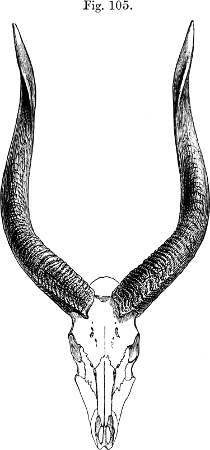
Fig. 105.
Head and horns of Angas’ Antelope.
(P. Z. S. 1871, p. 487.)
The Hon. W. H. Drummond, another well-known sportsman, who was in South Africa from 1867 to 1872, writes of the “Nyala” as perhaps the most beautiful of all the Antelopes he had seen there. “Unfortunately,” he says, “it does not exist except in low, fever-stricken districts, and I have never seen it south of the Bombo Range, about 28° S. lat., where it frequents the densest thickets it can find, and is wary and difficult to stalk.” Mr. Drummond also, in his volume on the ‘Large Game of South and South-east Africa,’ has given a lithographic plate with figures of both sexes of this animal.
When he wrote his ‘Hunter’s Wanderings,’ in 1881, Mr. Selous, our leading authority on the game-mammals of South Africa, had never seen a living example of this Antelope. But in September 1896 he made a successful expedition to Amatonga-land in search of it, and subsequently wrote an account of his adventures on this occasion in ‘The Field’ newspaper, from which, by his kind consent, we make the following extracts.
Arriving at Lourenço Marques on September 21st, he was invited by a Mr. Wissels, a Cape colonist of German extraction, to visit his station near the junction of the Pongolo and Usutu Rivers, where Inyalas were said to be plentiful, and arrived there after a long tramp of several days through the swampy forests.
We will give Mr. Selous’s account of his hunt after Inyalas in this district in his own words:—
“There were now abundant signs that I was approaching the haunts of the beautiful Antelope I had come so far to seek, as Inyala horns and skins were very much in evidence round Mr. Wissels’s store, and several of the latter had manifestly been but recently killed.
“All these animals, I was assured, had been shot by the Amatonga within a short distance of the store, in the dense jungles lying in the angle between the Usutu and Pongolo Rivers, which I could now see covering some low ridges at a distance of not more than six or seven miles from where we stood. Had it not been for the rain, I should have gone on the same afternoon; however, I gathered a good deal of information, and arranged for a start with fresh carriers as early as possible the following day—my objective point being the kraal of an Amatonga head-man named Gugawi, who, I was told, lived a few miles up the Usutu River, on the very edge of the jungle where Inyala were said to be plentiful. I noticed, however, that my informants were not over confident about my being likely to shoot any of these animals.
“That night we had a most tremendous thunderstorm, the rain falling in torrents; and, as the place in which I was sleeping was not water-tight, I had rather a bad time of it, and was very glad when day broke.
“The thunderstorm had cleared the air, and Sunday, Sept. 27, dawned bright and clear, with every prospect of its being a fine day. I had all my things packed up pretty early, and with four new women-carriers, and accompanied by two men who knew the way to Gugawi’s kraal, managed to get off about an hour after sunrise, and reached my destination before 10 o’clock. On our way we crossed the Usutu River—here a clear, swift-flowing stream, about 200 yards in breadth, running over a bed of sand. We waded across it, and found the water quite shallow for the most part, and never more than 3 feet deep.
“On reaching the kraal we were making for, I told Longman to cook me some breakfast, and whilst he was frying me some Reedbuck steaks, I had a talk with the head-man, Gugawi, and told him the reason of my visit. He replied that the ‘unbala-intendi’ were numerous in the jungle just behind his kraal, and promised to do his best to help me to secure the specimens I wanted, though, like everyone else, he said the animals were very cunning and difficult to get a sight of. As soon as I had had my breakfast I asked Gugawi to give me a man who was well acquainted with the habits of the Inyala, as I wished to go into the bush after them without any loss of time. He gave me one of his sons, and, accompanied by Longman and one of the Kaffirs who had come from Mr. Wissels’ store, we forthwith entered the jungle, which extended to within a few yards of the kraal. From this we were not distant more than 200 yards before we saw fresh Inyala-spoor plainly imprinted in the wet ground. The rain at least had done us this service, that it had washed out all old spoor and rendered any fresh tracks quite conspicuous. We now commenced to creep very cautiously through the thick thorny bush, making our way for the most part through tunnels made by hippopotami during their night excursions in search of food. We had usually to walk bent nearly double, often having to creep on our hands and knees; and, as the air was now very hot and steamy, we were soon bathed in perspiration. Now and again we came to little open spaces in the bush, and in one of these which we passed through soon after leaving the kraal I saw a very handsome Crested Guinea-fowl, which looked very much like the birds I have seen on the Central Zambesi, to the east of the Victoria Falls.
“We had been creeping about the bush in the uncomfortable manner I have described for about an hour, when we came suddenly upon a little circular opening some fifty or sixty yards in diameter. As we approached the edge of this open space, advancing very cautiously in a stooping attitude down a hippopotamus-path, my guide suddenly dropped to the ground. As he did so, I got a clear view past him, and saw standing amongst the grass and bush, just on the further side of the opening, what I knew was an Inyala ewe, as I could distinctly see it was reddish in colour. I could see no other animal near her, and, as I required two specimens of Inyala ewes, the one for the British and the other for the South-African Museum, I lost no time about firing at the animal in question, which I saw drop instantly to the shot. But even as she did so, there appeared in her place, or very close to where she had stood, a great black shaggy form, which, indistinctly as I could see it in the deep shadow of the bush, I knew was an Inyala ram, the first that my eyes had ever looked upon in the flesh. My rifle was a single-barrelled one; and before I could fire the shot that might make that rare and beautiful beast mine, I had to open the breech of my rifle, take another cartridge from my belt, slip it into the chamber, close the breech again, and then raise the rifle to my shoulder and take aim. All this meant time and noise. Would the Inyala, which stood like a statue by the dead body of its mate, give me the few seconds I required to take his own life too? I little thought he would; but he did; and as I raised my rifle once more, and took a quick but careful sight at his dark shoulder, I felt, as I pulled the trigger, that he was mine.
“As the report of the rifle sounded, he plunged madly forward and was instantly lost to sight in the thick scrub. But I felt sure he carried death with him, and so it proved, for we found him lying dead not twenty yards from where he had stood when the bullet struck him. The fatal missile had passed right through his shoulders, and, having expanded on impact, had torn his heart to pieces. I had the dead ewe brought to where the ram had fallen, and laid them side by side; and then stood admiring them for a long time before I could bring myself to skin them. To thus secure a very fine pair of Inyala Antelopes—whose excellently-mounted skins are now safe in the Mammalian Gallery of the new Natural History Museum in Cromwell Road—on the very first day I had hunted for them, and after a little more than an hour’s search, was indeed a most glorious and exceptional piece of good fortune; which, however, has been balanced by many and many a day that I can remember of unrequited labour in search of game.
“As soon as I had stripped the skins, with the leg-bones still attached, from my two beautiful specimens, I had them carried, together with the skulls, to Gugawi’s kraal on the edge of the bush, and there spent the remainder of the day in preparing them for mounting. Of the meat, which was all brought in, I sent a couple of haunches over to Mr. Wissels, and then, after keeping a small piece for myself, gave the remainder to Gugawi to divide amongst his people as he thought fit.
“Next morning I was up and out in the bush just as day was breaking, accompanied only by my guide of yesterday and Longman, who, however, kept some distance behind, in order to allow my guide and myself to approach our game as noiselessly as possible. We had been creeping about in the dense jungle for some three hours without having seen anything, although there was a good deal of fresh spoor about, and twice we had heard Inyalas dash away through the bush without getting a sight of them, when suddenly my guide crouched to the ground, at the same time pointing towards a large ant-heap growing out of the dense scrub, and itself covered with undergrowth. Following the direction of his arm, I made out a reddish patch not fifteen yards away in the gloom of the bush; and taking it for an Inyala ewe, I fired into it point blank, as I required another specimen for mounting. At the shot the animal fell, and, on creeping up to it, I found that it was a young ram. It was something less in size than a full-grown female, from which it did not differ in any way in coloration, and the number and distribution of white stripes and spots. It was thus interesting, as showing that the Inyala changes in general colour from red to grey, only losing the rufous and orange tints on the ears and forehead, which were still conspicuous in the type-specimen described by Mr. Angas, when fully adult.
“On returning to the kraal, Gugawi proposed to take me to a spot some few miles higher up the Usutu, where he said there were plenty of Inyalas, whilst at the same time the bush was not so dense as near his kraal. Being by this time thoroughly sick of crawling about bent nearly double, I hailed with delight the idea of finding the game I was seeking in a country where I could walk upright, and visions of Inyala feeding through open glades passed through my mind; visions, alas! which were never realized, for in my small experience I never found these Antelope anywhere except in dense bush. However, I was glad of the change, and soon had everything ready for a move.
“In the afternoon we travelled some five or six miles up the river, and pitched camp in a bit of jungle near the water’s edge. The Usutu River is here very broad, and reminded me strongly of parts of the Chobi; but whereas the banks of the latter river, as I knew it in the early seventies, abounded in game of many descriptions, from the elephant downwards, there was not a track to be seen along the Usutu of any kind of animal with the exception of the Inyala. All the wealth of wild life which Baldwin saw in this same district forty years ago has melted away before the guns of the native Amatonga hunters; for, be it noted, this is a country in which but very little game has been killed by white men. Rhinoceroses, buffaloes, koodoos, waterbucks, impalas, lions, all are gone—the only game left being the Inyalas, which owe their preservation to the dense jungles in which they live; and even they are being rapidly killed off, as the natives are always after them, lying in wait for them in the paths made by the hippopotami, or creeping stealthily through the bush in their pursuit.
“It would be but tedious reading were I to continue to describe in detail my further bush-crawling experiences in search of Inyalas. Suffice it to say that on Oct. 1 and 2 I secured two more good rams, and preserved their heads for my own Collection. Although I should have liked to get a fourth ram for the South-African Museum, I did not think it prudent to remain any longer in my camp on the edge of a swamp, where I knew the air must be reeking with malarial poison, as, besides the exhalations from the marsh, the ground (from which I was only separated at nights by a little dry grass and a blanket) had been soaked to the depth of 2 feet by the recent rain, thus rendering the conditions more than usually unhealthy. The weather, too, was now again looking very threatening, and I did not relish the idea of any further lying out in the rain; as I knew, from former experience, that I should probably have to pay for the wettings I had already suffered by some attacks of fever—a disease from which I had been entirely exempt for seven years, but the poison of which I knew was still in my blood, and would be likely to be again stirred into activity by my recent exposure to unhealthy conditions.
“Hence, on Saturday, Oct. 3, I packed up my things and returned to Gugawi’s kraal, walking on in the afternoon to Mr. Wissels’s store, and thence to Lourenço Marques, Delagoa Bay, which I reached on October 7th, after a hot and weary tramp.”
Until lately the Inyala was believed to be restricted to the coast-lands of Eastern Africa south of the Zambesi. Recently, however, it has been discovered that this Antelope is likewise found further northward on the Upper Shiré, where it is known to the natives as the “Bō,” the o being pronounced very long. Mr. Alfred Sharpe, C.B., on his return to England at the end of 1891, first brought home a single flat skin of the so-called “Bō,” which was identified by Sclater as belonging to the male of this species, and other specimens have since been obtained in the same district. Mr. Sharpe’s information was that it is found only in a piece of thick scrubby country bordering the Moanza River, which enters the Shiré on its right bank, near the Murchison Cataracts.
In 1895 a fine specimen of this Antelope was forwarded to the British Museum by Mr. Gerald Oliver, R.N., of H.M.S. ‘Herald,’ with the following information in an accompanying letter:—
“On the 5th of October, last year, I was shooting near a village called Mantana’s (lat. 16° 30´ S., long. 35° E.), about 7´ W. by S. of Chilomo, near the right bank of the Shiré River. Impala (Æpyceros melampus) are very plentiful about this particular spot, but I had not been able to get a shot at a good head. Later in the day, wanting meat, I decided to kill what I could, and coming across a solitary doe I fired. Great was the astonishment of myself and boys to find I had killed a female Inyala. I took the skin to Chilomo, and was told it was the first Inyala ever known to have been killed about these parts, and that it was practically an unknown animal there.
“On the 26th of October, near the same spot, a male Inyala was killed by the then Surgeon of this ship. On the 29th of October I saw together 2 Inyalas and 8 Impalas. On the following day, at dusk, I met with and killed a solitary male Inyala, whose skin I forward. The natives were tremendously excited, dancing about and exclaiming ‘Bōōh,’ ‘Bōōh,’ the local name for the Inyala. They examined the body with great care. I was told in the village that the natives, on account of some superstition, would not touch the meat. Our bluejackets, however, ate it, and it was very good. The skin was remarkably glossy and soft, and the hair was long under the neck.”
In 1893 (see P. Z. S. 1893, p. 729) Sclater found a skull of this Antelope in one of Mr. Crawshay’s collections from the district of Lake Mweru, but we are not quite certain that it was actually obtained in that locality. Sir Harry Johnston, in his volume on ‘British Central Africa,’ sums up his information on this species as follows:—
“I am inclined to think that the Inyala Antelope of British Central Africa is limited in its range, so far as we yet know, to the Western and Upper Shiré districts and the Lake Mweru district, and that it may be of a different form from the Inyala of South-east Africa, inasmuch as the males retain the white spots and stripes on the skin to a greater extent, and do not assume such a grey fur at maturity. The Inyala, locally called Bōō, is a very rare animal, frequenting dense thickets. Its horns somewhat resemble those of the Bushbuck, but are much larger proportionately, much wider apart, and slenderer. They may measure as much as 22½ inches in length along the curve (I have a pair of horns giving this measurement). I have only twice seen skins of the adult animal. They were extraordinarily beautiful in colour, the females a deep chestnut, with narrow stripes and spots in pure white, and a black line along the middle of the back from the neck to the base of the tail; the male purplish-grey, with white markings.”
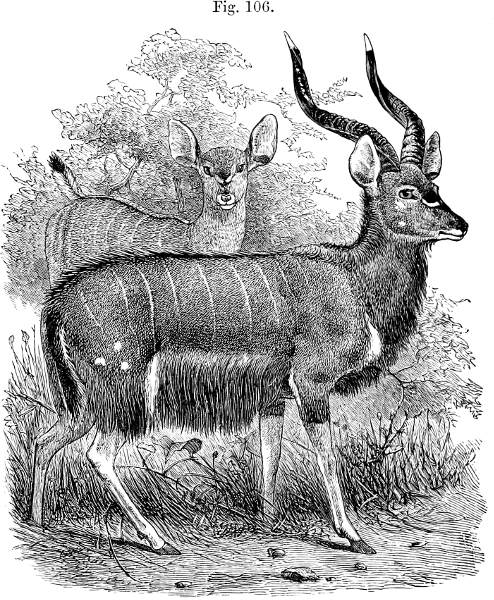
Fig. 106.
Angas’ Antelope, ♂ & ♀.
There is also some reason for suspecting that the Inyala, or a nearly allied form, extends even as far north as British East Africa. This suspicion rests upon the evidence supplied by a pair of horns, not specifically distinguishable from those of the typical Tragelaphus angasi, which were procured from the Mau Forest by Mr. F. J. Jackson, C.B. These horns, which are now in the British Museum, were exhibited by Sclater before the Zoological Society of London in May 1897, and are figured on p. 455 of the Society’s ‘Proceedings’ for that year (see fig. 107, p. 147). Unfortunately no skin accompanied the horns; and the specific determination of the Antelope that bore them is rendered uncertain on account of the description of the animal given by the native hunter who killed it. This description, if accurate, certainly applies to a species of Bushbuck distinct both from the Inyala and from all the other known species of Tragelaphus. Hence it is earnestly to be hoped that Mr. Jackson will soon be successful in his attempt to clear up the mystery in which the identity of this interesting Antelope is involved.
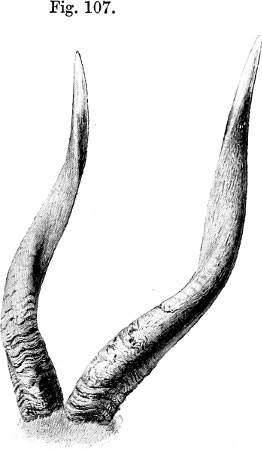
Fig. 107.
Horns of Tragelaphus sp. inc.
(P. Z. S. 1897, p. 455.)
We are not aware that any specimen of Angas’ Antelope has ever been brought to Europe alive, and it is by no means commonly met with in our museums. The British Museum contains an adult pair mounted, obtained in St. Lucia Bay by Mr. R. S. Fellowes in 1871, also specimens from the Pongolo River, Zululand, obtained by Mr. Eastwood, and from the Maputa River, obtained by Proudfoot. There are also in the National Collection the specimens from Nyasaland procured by Mr. Sharpe, Sir Harry Johnston, Mr. Crawshay, and Lieut. Oliver, of which we have made mention above. Finally, there is a good mounted pair of specimens obtained by Mr. Selous during his special expedition in quest of this Antelope.
Our principal illustration of Angas’ Antelope (Plate XCII.) was put upon the stone by Mr. Smit, under the directions of the late Sir Victor Brooke, from sketches made by Wolf, and was probably taken from the mounted specimens then in the British Museum. At the same time the woodcut (fig. 106, p. 146), also containing figures of both sexes, was prepared by Mr. Smit.
November, 1899.
Genus III. LIMNOTRAGUS (nom. nov.).
Type.
Hydrotragus, Gray, Cat. Rum. B. M. p. 49 (1872) (nec Fitz.)[11] L. spekii.
Medium or large-sized Antelopes allied to Tragelaphus, but with rougher and shaggier coats, longer legs, and with horns which more nearly approach those of Strepsiceros, as they show a strong tendency to assume a third twist. Further, Limnotragus differs strikingly from Tragelaphus and Strepsiceros in the structure of its feet, the hoofs being often nearly three times as long (measured along the front edge) as thick (measured along the margin of the pastern). Moreover, the skin which covers the back of the pastern is denuded of hair, and thick and horny, being practically of the same consistency as the upper rim of the posterior side of the hoof.
It is not without some hesitation that we refer to a separate genus those species of Tragelaphine Antelopes (hitherto placed in Tragelaphus) which have undergone certain special modifications of structure in adaptation to a semi-aquatic mode of life. In the species of Tragelaphus discussed in the preceding part of this work, as well as in all the other genera of Tragelaphinæ, the feet adhere to the digitigrade type characteristic of most of the ruminant artiodactyle Ungulates, retaining the short narrow hoofs and strong elastic ankles fitted for easy and swift progress over the firm soil of the veldt or woodland. In the species of Limnotragus, on the contrary, the feet are furnished with hoofs of relatively enormous length, which spread far apart at every step, and are obviously designed to enable their owner to pass over the soft soil of marshes and river-banks without sinking deeply into the ground. This modification is accompanied by an increase in the flexibility of the ankle-joints, which are capable of yielding to the weight of the body, so as to allow the false-hoofs and the smooth tough horny skin at the back of the pasterns to rest upon the soil, and thus to further augment the supporting area of the foot. It is these peculiarities in the structure of the feet, in conjunction with a length of limb exceeding that of other Tragelaphines, which impart to the species of Limnotragus that characteristic semiplantigrade aspect and that unusual awkwardness of gait so noticeable in these Antelopes when walking upon firm resisting ground.
Up to the present time three species referable to this genus have been described, namely, L. spekii from E. Africa, L. gratus from Tropical West Africa, and L. selousi from the valley of the Zambesi. Unfortunately there are not at present available materials from the different parts of the area over which the genus ranges, sufficient to enable us to determine satisfactorily the exact value to be assigned to these three forms. Consequently, although the evidence, so far as it goes, tends to show that the characters upon which they have been based may ultimately prove to have merely a subspecific importance, we prefer, for the time being, to allow them to take the rank that was originally assigned to them by their respective describers, and to arrange them as three species.
Range of the Genus. Congo Valley and Lake-districts of Southern and Eastern Africa.
The three species may be shortly distinguished as follows:—
a. Size smaller; height at withers about 36 inches: sexes dissimilar; male blackish, female rufous 127. L. spekii.
b. Size larger; height at withers about 40 inches.
a1. Sexes similar, blackish 128. L. selousi.
b1. Sexes dissimilar; male blackish brown, female red. 129. L. gratus.
THE BOOK OF ANTELOPES, PL. XCIII.
Wolf del. Smit lith.
Hanhant imp.
Speke’s Sitatunga.
LIMNOTRAGUS SPEKII.
Published by R. H. Porter.
127. SPEKE’S SITATUNGA. LIMNOTRAGUS SPEKII (Sclater). [PLATE XCIII.]
Tragelaphus spekii, Sclater, in Speke’s Journ. of Discov. p. 223 (1863); id. P. Z. S. 1864, p. 103, pl. xii., 1880, p. 452, 1883, pp. 34–37; Heugl. Reise Weiss. Nil, p. 319 (1869); Brooke, P. Z. S. 1871, p. 485 (part.); id. P. Z. S. 1878, p. 884; Huet, Bull. Soc. Acclim. (4) iv. p. 83 (1887); Thos. P. Z. S. 1891, p. 388 (part.); Flow. & Lyd. Mamm. p. 347 (1891) (part.); Ward, Horn Meas. p. 155 (1892); id. Records, p. 197 (1896), (2) p. 292 (1899) (part.); Lugard, Rise E. Afr. Emp. i. p. 533 (1893); Lyd. Horns and Hoofs, p. 254 (1893); id. Royal Nat. Hist. ii. p. 276 (1894) (part.); Jackson, Big Game Shooting, p. 311 (1894); Matsch. Säug. Deutsch-Ost-Afr. p. 139 (1895); Trouessart, Cat. Mamm. p. 958 (1898) (part.); Gedge, in Ward’s Great and Small Game of Africa, p. 476 (1899).
Eurycerus (Hydrotragus) spekii, J. E. Gray, Cat. Rum. B. M. p. 49 (1872) (part.).
Eurycerus spekii, Gray, Hand-l. Rum. p. 119 (1873) (part.).
Tragelaphus spekii spekii, Rothschild, Novit. Zool. v. p. 206 (1898).
Vernacular Names:—Nzoé of Karagweh (Speke); Chobé or Njobé of Uganda (Gedge).
Adult male. Height at the withers about 36 inches. General colour a tolerably uniform greyish brown, greyer on the sides of the neck; a dark median dorsal line running down the nape, over the withers, and then passing into white in the middle line of the back. Head with white ocular and cheek-spots and white chin, as in the other species of the genus. A few pale spots low down on the hind-quarters, an indistinct line of similar spots extending along the sides above the belly, and in the adult at last only very ill-defined white stripes on the body. Legs of a richer and darker brown than the body; fore legs pale behind the knee and down the inner side of the cannon-bone, the pastern-spots scarcely distinct; hind legs coloured like fore legs, but pale in front of the hock.
Horns without a third twist.
Subadult male of a darker brown than the adult and with the white markings even less distinct.
Adult female. Smaller than the male and of a rich dark red colour, blacker dorsally, with a dark spinal stripe and very faint indications of white stripes on the body. Fore legs blackish from above the knee; hind legs blackish from below the hock; pastern-spots distinct.
Young female more or less distinctly marked with white stripes and spots, and more yellowish in colour than the adult.
[We have taken our descriptions of this species from a series of skins, unfortunately for the most part imperfect and without determination of sex, that were brought from Lake Victoria by Herr Oscar Neumann, who has kindly lent them to us. Three of these skins appear to be those of males, while the remainder, four in number, are, judging by their colour, females, or young of doubtful sex. One of the latter has the hoofs very much worn, and must be regarded from this circumstance as adult, although it is very much smaller than the skin of what we suppose to be the adult male.]
Hab. Lakes and swamps of Eastern Africa near Lake Victoria.
The name of John Hanning Speke will ever go down to posterity as that of one of the most enterprising and most successful of African Explorers. Speke, however, was by no means only an Explorer, he was also an ardent lover of Natural History, and during his many expeditions in Africa never failed to bring home such specimens as his rapid mode of travelling would allow him to carry with him. Amongst the discoveries of his celebrated journey of 1859–63 to the Victoria Nyanza was the present Antelope, which he met with in December 1861, when enjoying the hospitality of King Rumanika of Karagweh. The king presented Speke with a living example of a young male of this species, which had been captured in the high rushes at the head of one of the neighbouring Lakes, and also gave him the horns of an adult male specimen. We learn further, from Speke’s ‘Journal,’ that King Rumanika was clad in a wrapper made of the skin of this Antelope, which is said to be much prized by the natives for its excellent quality. For the illustration of his ‘Journal of Discovery,’ published in 1863, Speke had a beautiful woodcut prepared by Wolf from these specimens, which, by the kindness of Messrs. William Blackwood and Sons, we are enabled to reproduce on the present occasion (fig. 108).
Sclater’s original description of this species, published in his report on the Mammal-collection made during Speke’s journey, was based on Speke’s specimens, and contained, besides a coloured illustration of the younger animal by Wolf, a drawing of the horns and feet of the adult, which, by the kind favour of the Zoological Society of London, we are allowed to use again here (see fig. 109, p. 154).
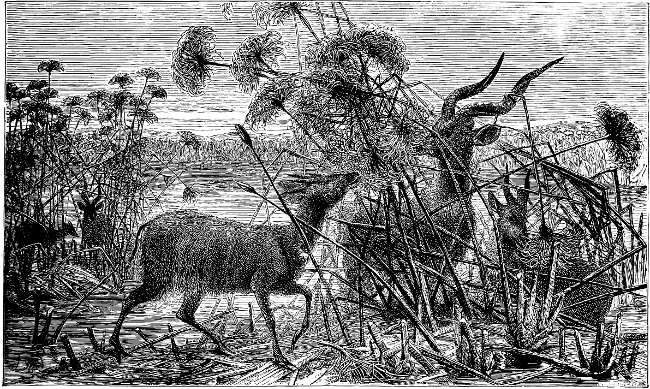
Fig. 108.
Speke’s Sitatunga in a Papyrus-swamp.
(Speke’s ‘Journal of Discovery,’ p. 223.)
Since the days of Speke the Sitatunga of this district has rarely been met with by travellers, as, in addition to its being exceedingly wary and timid, the impenetrable nature of the papyrus-swamps, which are its habitual resort, precludes easy access to its retreats. It is, however, occasionally trapped or speared by the native fishermen, and pairs of the horns thus obtained have occasionally reached Europe. The only recent traveller, so far as we know, that has personally encountered the ‘Nzoe’ in its native wilds is Mr. Ernest Gedge, who has kindly favoured us with the following notes on this subject:—
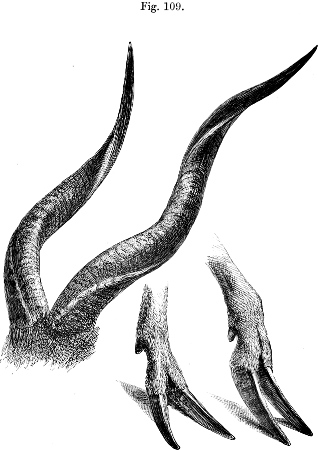
Fig. 109.
Horns and feet of Speke’s Sitatunga.
(P. Z. S. 1864, p. 104.)
“So far as is known at present, Speke’s Antelope is not to be found anywhere in East Africa between the Victoria Nyanza and the coast—in fact, the only occasion on which I had the good fortune to encounter it was during my sojourn in the Budda district of Uganda along with Capt. R. H. Williams, in the early part of 1893, under the following circumstances:—
“We were told by the natives that these Antelopes (called by them ‘Chobé’ or ‘Njobé’) existed in great numbers on one of the small outlying islands which constitute the Sesse group in the Victoria Lake. Being anxious to prove the truth of this report, we embarked, and proceeded thither in canoes. The island in question, which is situated well out in the Lake at a distance of some 10 miles from the main island, was reached on the afternoon of the second day. The shores are low and rocky, and, with the exception of a small turf-covered portion at its southern extremity, it is entirely covered with dense, almost impenetrable bush, interspersed only by a number of fine trees, principally species of Ficus. In shape it is something like an irregular hour-glass, being possibly a third of a mile in length and a few hundred yards across its greatest width. A very short examination revealed the presence of the Antelopes, and finding it impossible to approach them by any ordinary methods of stalking, a drive was organized, with the aid of the canoemen, with most satisfactory results: the total bag amounted to 24 head, including some fine specimens both male and female. This afforded ample testimony to their extraordinary numbers, as, owing to the dense character of the bush, it was impossible to see more than a few yards in any direction, and many of them passed us unseen. The greater number were killed in the first drive, after which the majority took refuge in the Lake, which is said to be their habit when hard pressed, though Speke describes them as being fierce and aggressive under such circumstances. The specimens procured on this occasion have been identified as true Sitatungas, though it is impossible to imagine how they ever got on to the island, or came to frequent a locality which is so entirely at variance with their usual habits.
“These Antelopes are said to have also existed formerly on a small neighbouring island, but to have been exterminated there by the Ba-Sesse canoemen.”
During his recent travels in Uganda, Herr Oscar Neumann also obtained a series of skins of this Antelope, which, as already mentioned, he has most kindly lent to us for examination. We are sorry not to have received any exact particulars respecting the specimens, except that they were procured from the natives in the districts of Kavirondo, Usoga, and Uganda, on the shores of Lake Victoria. Herr Neumann has also sent us two pairs of horns of this species, which were obtained from the “Wakenji” in the swamps west of Mount Elgon. Along with these specimens we have received for comparison from the authorities of the Berlin Museum a flat skin obtained by Herr Stuhlmann near the slopes of Mt. Ruwenzori.
The National Museum of this country is, we regret to say, very imperfectly furnished with specimens of the East-African form of the Sitatunga, containing only the original examples of Speke. It will be evident, therefore, that Herr Neumann’s kind assistance in this matter has been of considerable value to us.
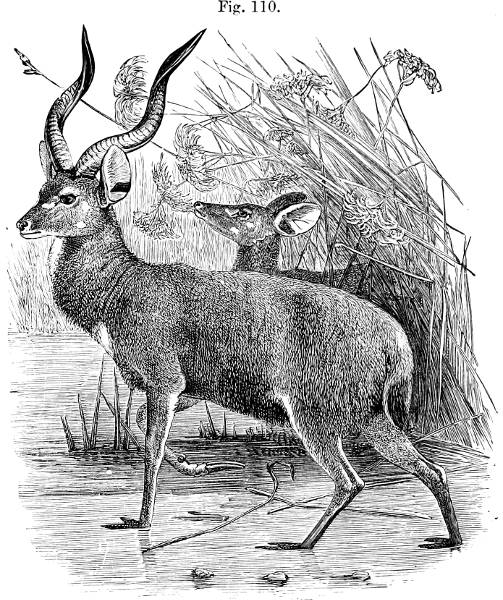
Fig. 110.
Speke’s Sitatunga, ♂ et ♀.
Our coloured illustration of this Antelope (Plate XCIII.) was prepared by Wolf, under Sir Victor Brooke’s instructions, from Speke’s original specimens. It will be noticed that the artist has joined the horns of the adult animal to a body which must have been copied from the young male, and has coloured the female from conjecture, representing it as greyish brown instead of yellowish red. The accompanying woodcut (fig. 110) was likewise prepared by Mr. Wolf under Brooke’s directions.
April, 1900.
THE BOOK OF ANTELOPES, PL. XCIV.
Smit del. et lith.
Hanhart imp.
Selous’ Sitatunga
LIMNOTRAGUS SELOUSI.
Published by R. H. Porter.
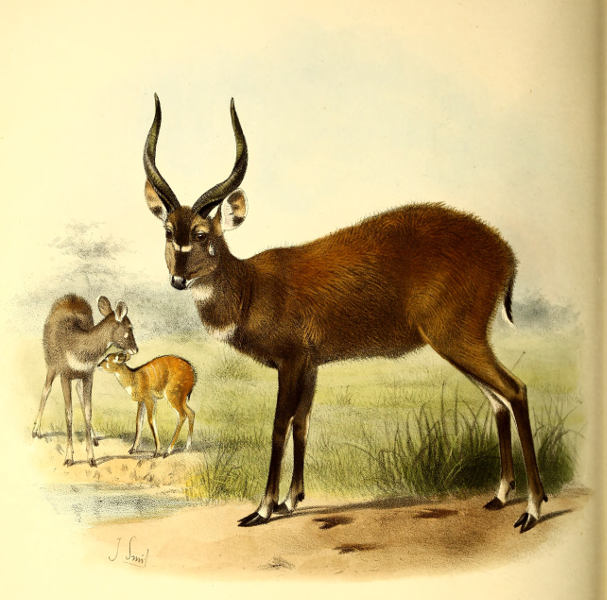
128. SELOUS’S SITATUNGA. LIMNOTRAGUS SELOUSI (Rothsch.). [PLATE XCIV.]
“Nakony,” Andersson, Lake Ngami, p. 449 (1856); Baines, Expl. S.W. Afr. p. 458 (1864).
Tragelaphus eurycerus, Layard, Cat. Mamm. S. Afr. Mus. p. 79 (1861).
Tragelaphus spekii, Kirk, P. Z. S. 1864, p. 659 (Chobé); Brooke, P. Z. S. 1871, p. 484 (part.), 1878, p. 884 (part.); Selous, P. Z. S. 1881, p. 753; id. Hunter’s Wanderings, p. 210 (1881); Sclater, P. Z. S. 1890, p. 590, pl. xlvii. (Lake Ngami), 1893, pp. 724, 729 (Lake Mweru); id. List An. Z. Soc. 1896, p. 163; Thomas, P. Z. S. 1891, p. 388 (part.); Flow. & Lyd. Mamm. p. 347 (1891) (part.); Nicolls & Egl. Sportsman in S. Afr. p. 40 (1892); Ward, Horn Meas. p. 155 (1892), p. 197 (1896) (part.); Lyd. Horns and Hoofs, p. 254 (1893); id. Royal Nat. Hist. ii. p. 276 (1894) (part.); Johnst. Brit. Centr. Afr. p. 306 (1897); Selous, in Ward’s Great and Small Game of Africa, p. 470 (1899).
Tragelaphus selousii, Rothsch. Novit. Zool. v. p. 206 (1898); Rendall, ibid. p. 212.
Euryceros spekii, J. E. Gray, Hand-l. Rum. 1873, p. 119 (part.).
Vernacular Names:—Waterskap of Boers (Nicolls & Eglington); Nakong of Batauwani at Lake Ngami; Sitatunga, Puvula, and Unzuzu of the natives of the Chobé and Central Zambesi; N’zoe of the natives on the Lukanga River north of the Zambesi (Selous); Mula of the Awemba and Nsowi of the Ulungu and Mambwé districts of Mweru (Crawshay).
Adult male. Height at withers about 40 inches. Colour nearly uniform dark yellowish brown, becoming darker and of a more dusky hue on the shoulder, belly, and legs. Head a darker and richer brown, with a large whitish patch running inwards on each side from the inner corner of the eye; also a yellowish patch above the eye; two pale spots on the cheeks, the upper situated a short distance beneath the eye. Ears blackish behind, with a large grey patch below. Throat with an upper and lower white patch. Underside of tail white. Fore legs white on the inner side at the base and behind the knee; spots on the pasterns faint; hind legs white on the inner side down to the hock.
Adult female. Without horns, but nearly resembling the adult male in colour.
The skull of an adult male (type) gives the following measurements:—Basal length 10·5 inches; orbit to muzzle 6·5; greatest width 4·5; horn 21 in straight line, 25·75 round the curve. Hoof: length along front 4·10; thickness from back to front 1·5.
These descriptions are taken from the skin and skull of an adult male (the type), obtained by Mr. Coryndon on the Barotze River, and kindly lent to us by the Hon. Walter Rothschild, M.P.
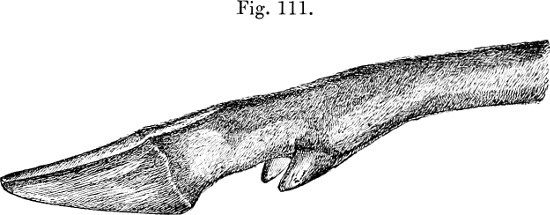
Fig. 111.
Outer view of the right foot of Selous’s Sitatunga. ⅓ nat. size.
In his original diagnosis of Limnotragus selousi, Mr. Rothschild took the characters of the female from the specimen of this sex, from Lake Ngami, now living in the Zoological Society’s Gardens. In the specimens of L. selousi, however, from the Barotze River the immature female is of a rich red colour, inclining to black in the dorsal region, whereas the female from Lake Ngami was at the time of its arrival in England, when only half-grown, of the same nearly uniform tint as it is now when fully adult. Moreover, Mr. Selous, who has seen many skins of this Antelope from the Chobé, kindly informs us, in reply to an inquiry on this point, that the young are, according to his experience, never rufous in colour; although when newly born they are marked with white stripes and spots which subsequently disappear.
We cannot explain these discrepancies at present, but must leave the matter as it stands for the investigation of future observers.
Hab. Swamps of the district of Lake Ngami and similar localities on the Zambesi and its tributaries; thence north to Lake Mweru.
The discovery of the existence of an Antelope of this water-loving group in South-west Africa was made even before Speke obtained his specimens of the last species in Karagweh. The well-known traveller, Charles John Andersson, met with the “Nakong,” as he calls it, during his explorations of Lake Ngami. In the volume descriptive of his four years’ wanderings, published in 1856, when calling attention to the great variety of large animals found in that district, more especially in the vicinity of the rivers, he mentions “two new species of Antelope, the Nakong and the Leché,” and gives a lithographic plate, drawn by Wolf, to illustrate them as they appeared in their native haunts. Not having before him actual specimens of the former Antelope to draw from, the great artist had apparently only Andersson’s somewhat imperfect information upon which to prepare his likeness of the “Nakong.” He consequently gave a more prominent place in his illustration to the Leché (Cobus lechee), and hid the Nakong in a reed-bed, leaving only its kudu-like horns, of which Mr. Andersson’s friend, Col. Steele, was fortunately able to supply specimens, plainly visible. Andersson speaks of the Nakong as a “Waterbuck,” which, by means of its peculiarly long hoofs, not unfrequently attaining a length of six or seven inches, is able to traverse with great facility the reedy bogs and quagmires with which the country abounds.
Another well-known African explorer, Thomas Baines, who penetrated far into South-west Africa from Walfisch Bay a few years later, also mentions the Nakong as amongst several new or little-known Antelopes found in that district.
About the same time also the South African Museum received specimens of this Antelope from the Lake Ngami district, through Mr. J. J. Wilson, of Otjimbinque, and Messrs. Chapman. Mr. Layard, in his Catalogue of the Mammals of that Museum, published in 1861, refers these specimens very doubtfully to Tragelaphus eurycerus, but shows very clearly by his description that they really belonged to the present species.
Sir John Kirk, in his article on the Mammals of Zambesia, read before the Zoological Society in 1864, mentions the “Nakong” as frequenting the papyrus and rushes on the River Chobé. He naturally refers it to Tragelaphus spekii, with which, until quite recently, it was generally believed to be identical. In the same way Sir Victor Brooke, in his article on Speke’s Antelope and its allied species, published in the Zoological Society’s ‘Proceedings’ for 1871, comprises in his list of specimens of Tragelaphus spekii those of the two allied forms, which we here treat of as probably distinct. Of these, his specimens “h” (“frontal bones, horns, and feet, in the collection of Mr. Oswell”) are, no doubt, referable to Limnotragus selousi.
Mr. Selous, in his excellent and often-quoted article on the Antelopes of Central South Africa (P. Z. S. 1881, p. 753), writes of this species (which Mr. Rothschild has appropriately named after the famous hunter) as follows:—
“This Antelope is only met with in the extensive swamps which exist in some parts of the interior of Africa. In the reed-beds of the Mababe, Tamalakan, and Machabe rivers it is to be found; and in the vast marshes through which the Chobe runs it must exist in considerable numbers, although, as it only emerges from the dense reed-beds at night, it is scarcely ever to be seen. In 1879 I tried hard to shoot some of these animals on the Chobe, searching for them in a canoe amongst the reed-beds at early dawn and after sunset; but though I disturbed several, and heard them splashing away amongst the reeds and papyrus, I only saw one female alive, though one morning I found a fine ram lying dead that had evidently been killed fighting with a rival during the night. The head and feet of this animal I preserved. The female that I saw was standing breast deep in the water, in the midst of a bed of reeds, feeding on the young shoots that just appeared above the water. When she saw us she at once made off, making a tremendous splashing as she plunged through the water. The natives told me that very often when these Antelopes are met with under similar circumstances they do not attempt to run, but, sinking down in the water, submerge their whole bodies, leaving only their nostrils above the surface, and trusting that their enemies will pass them unobserved; they (the Kafirs) then paddle close alongside and assegai them from the canoe. As all the Situtungas the skins of which I saw had been killed with assegais, and not shot, I have no doubt that this statement is correct. Another way the natives have of killing them is by setting fire to the reeds when they become quite dry, and then waiting for the Situtungas in their canoes in one of the channels of open water by which the marsh is intersected. Driven forwards by the advancing fire, the Antelopes are at last obliged to swim across the open water to gain the shelter of the reeds on the further side; and the natives are thus often enabled to cut off and assegai some of them in mid stream.”
We have already alluded to the occurrence of this species in Barotze-land, where Mr. Coryndon obtained specimens for Mr. Rothschild. Still further to the north-east we find that a species of the Sitatunga group, which, we suppose, should also be referred to L. selousi, occurs, according to Sir Harry Johnston, “in the swamps of Lake Mweru, in the Loangwa valley, and in other parts of British Central Africa.” Mr. Richard Crawshay, C.M.Z.S., has favoured us with the following field-notes which he has drawn up as the result of his long experience with the animal-life of the district of Lake Mweru:—
“This Antelope is known by the people of the Itawa and Kabwiri—who are, as I have before mentioned, branches of the Awemba—as ‘Mula.’ By the people of Ulungu and Mambwe (where I suppose it is also found) it is known as ‘Nsowi.’
“I had been six months or more at Mweru before any proof was forthcoming that such an animal existed. Then, when shooting wild-fowl on the outskirts of a vast and impenetrable swamp between Rhodesia and the Luao River, I came upon the remains of what had been a fine pair of horns just on the margin of the water. The horns had been submerged during the rains and were fast decaying. All that was recoverable was one fairly sound horn with a fragment of the frontal bone attached. This horn, I think, measured 21¾ inches.
“Some months later when at Mkula’s, on the Chisela River, I was given by the chief a perfect, though smaller, pair of horns. A skin was also offered me—I don’t know if it was the skin—but so discoloured with dirt and smoke, from lying in a native hut, that I did not think it worth having.
“Mkula told me there were a good many ‘Mula’ in the swamps below his town, and that one way or another his people had killed seven or eight during the six years or so he had been at the Chisela River, but that they were very difficult to get at, and when got at—viz., roused—even more difficult to kill.
“On expressing my eagerness to shoot, or at least see, a ‘Mula,’ he did not give me much hope of doing either the one or the other. A glance at the Chisela River reed-beds from a heap outside the town did not reassure me. All the same, during two visits to Mkula’s—one the middle of July, the other at the very end of October 1892—I did my utmost to effect my object, spending the greater part of my time in the swamp, wading and wallowing in mud, water, and reeds, but found it killing work. Scarcely a native would follow me in a second attempt. The combined rays of the sun, mosquitos, leeches, and a most sickening stench from the swamp, proved a severe trial to my patience and perseverance. Ultimately I gave up without getting a shot at a ‘Mula.’ Luckily such hard labour earned some reward. I saw two ‘Mula’ and heard others, besides gaining an insight into their ways and haunts. Were I to try again for this Antelope under similar conditions, I would build a platform, 20 feet high or so, in the swamp, overlooking the feeding-grounds of the ‘Mula,’ and would watch from this platform say from 3.30 P.M. until dark. The remains of the ‘Mula’s’ head from the Luao River swamp, as also the horns given me by Mkula, were sent home along with the other Antelopes’ heads.”
So far as we know, only two examples of this Sitatunga have ever reached Europe alive. Both of these are now living, in good health, in the Zoological Society’s Gardens in the Regent’s Park. The first arrival was a young female, received as a present from Mr. James A. Nicolls, F.Z.S., of Belmont House, Navan, Ireland, on October 14th, 1890. In a footnote to Nicolls and Eglington’s ‘Sportsman in South Africa’ we are informed that the animal in question was captured by Mr. Nicolls alongside the dead body of its dam, which had been shot by him in the Taoke swamp, forty miles from Lake Ngami.
On referring to Mr. Nicolls’s articles in the ‘Field’ newspaper, in which his “Travels and Sport along the Botletle River and round Lake Ngami” are narrated, we find the occurrence in question described as follows:—
“At midday (in August 1887) we arrived at Ku-Ku’s. A native missionary, who has spent several years in this country representing the London Missionary Society, informed us that his efforts towards converting the Western Bamangwato tribes and Makobas to Christianity had up to the present proved unsuccessful. From him we also received intelligence that the Nakon waterbuck was very plentiful in the Taoke swamp, a distance of twenty miles off. This was indeed very joyful news to me, as I had always been most anxious to shoot a specimen of this animal, a prize which, I understood, had not previously been obtained by any white man, at least south of the Zambesi. However, Ku-Ku strongly advised me not to go shooting in the swamp till I had seen Moremi and obtained his permission to do so, on account, Ku-Ku said, of that chief being very unwilling to allow any strangers there, the district being used by his people as a place of refuge in case of another attack by the Matabele. I adopted his advice, which, as it turned out afterwards, was rightly given.
“I arrived at De Nokane, Moremi’s town (a distance of 537 miles 680 yards from Khama’s). The station occupied by the chief is situated on a small river which issues from the Okavango, and finally gets lost in the vast Taoke swamp.
“At midday I came to a large Makoba village, built on a small piece of rising ground adjoining the swamp. To the left, right, and front, as far as the eye could reach, there was nothing visible but vast patches of tall reeds; here and there, on portions of more rising ground, little groves of dwarf fan-palms; and occasionally, as if a godsend to relieve the monotony of such a dreary landscape, a towering palm waved its feathered head to the uncertain breeze.
“As I had still a long distance to walk before arriving at the spot most frequented by the Nakon, and as I desired to be there at least an hour before sundown (this, or shortly after daylight in the morning, being the only time at which a fair chance of a shot could be obtained), without making any delay, I at once entered the swamp, and for the first half-hour waded knee-deep in water, caused by a late overflow from the Taoke river, and my progress, although very tiring, was at least endurable. Resting for about twenty minutes on a small dry knoll, overgrown with fan-palms, my Makoba guides, of whom I had three, pointed to a long green streak of rushes about three miles off, which, they assured me, was very much frequented by the game I was in search of. Progression now became more difficult, as the water not only became much deeper, but firm footing was more uncertain, owing to the burrowing of fish in the alluvial soil. One of my guides now took the lead, and with the end of his long fish assegai tried every inch of the ground in front as we went along. Notwithstanding his solicitude on my behalf, I had the misfortune to plunge head forward into a hole, thoroughly saturating my clothing and filling my rifle with water. It was nearly four o’clock in the afternoon when I arrived at another small island within 300 or 400 yards of the fringe of reeds I have before alluded to, and which was really the bed of the Taoke choked up by rotten vegetation and papyrus-roots, the river slowly percolating through the mass. Having enjoyed an hour’s rest on this haven of safety, and the favourable time having arrived, I again proceeded onwards, and found that my work up to that time had been merely child’s play, compared to that which I now had before me. There was no footing whatever obtainable, with the exception of a network of papyrus-roots, which stretched along in every direction, and was just sufficiently tough to support a man, the bog moving up and down at every footstep. To add to the charm of the situation, the mosquitoes, prematurely disturbed from their afternoon siesta, rose in clouds from the rotten swamp, biting my face, neck, and hands most viciously. Groping and staggering along in this manner till about an hour before sundown, I had seen no game, and was just beginning to give it up as a bad job, when one of the Makobas pointed out the figure of an animal lying, or standing, with a portion of its back and the whole head out of the water, about 200 yards away. It was a Nakon ram, carrying a very fine pair of horns; but from the position he was placed in, I saw there was no earthly chance of killing him at the distance. Thinking to approach a little, I advanced cautiously; but had scarcely proceeded a dozen yards when, as if out of the water, not more than 60 yards off, up jumped another one, bounding along crossways with a most convulsive-looking movement. I took a very hasty shot, and had the satisfaction of seeing the animal tumble over with a big splash in the water. It turned out, unfortunately, to be a doe, full-grown, with a young one at foot. I had shot my first Nakon, and I solemnly affirm it will certainly be my last, except under much more favourable circumstances. An attempt to bring out the carcase that night being utterly useless, two Makobas slept on the small island, and I myself turned back to the village, where I arrived long after midnight, and, although completely done up with fatigue, could not sleep a wink, owing to the myriads of mosquitoes which preyed on me the whole night long.”
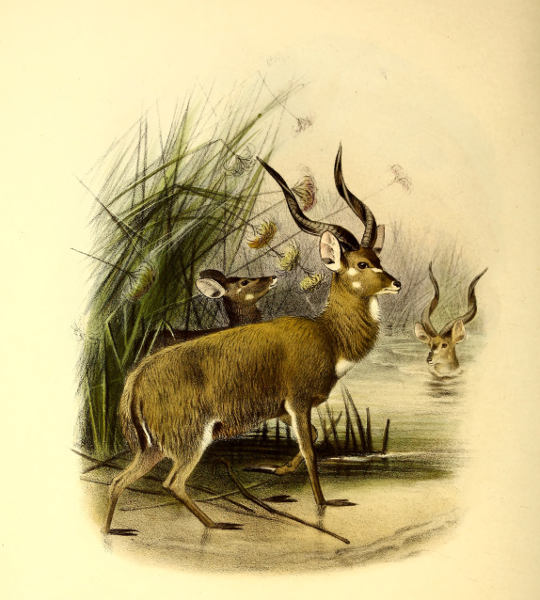
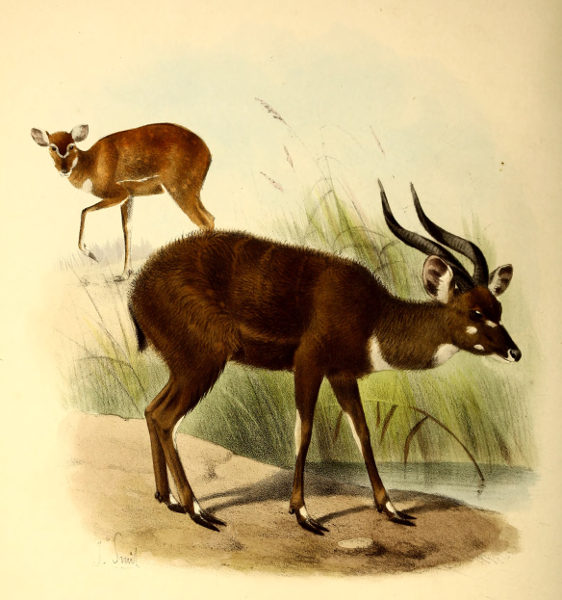
From Lake Ngami the little animal thus captured was carried by Mr. Nicolls and his companions in their waggon 800 miles to Kimberley, and thence brought by rail and steamer to London. On arrival at the Gardens it was placed in a sheltered compartment of the Gazelles’ sheds, in which the yard in front was covered with dried peat-fibre in order to suit its elongated hoofs. Accompanying the Secretary’s Report on the additions to the Society’s Menagerie in October 1890, in which its arrival was noticed, will be found a coloured plate by Mr. Smit, giving an accurate representation of the animal as it then appeared. The Sitatunga thus acquired quickly attained its full stature, and showing symptoms of readiness to breed, was placed, in 1894, in company with a male of the Congo species (L. gratus) which had been obtained by purchase from the Zoological Gardens, Hamburg, no male of its own species being available. From this union hybrids were born on February 12th, 1896, and on February 28th, 1897, being in each case of the female sex. The period of gestation was, in both cases, about seven months. The young animals in general appearance took after the colour of the female of L. gratus, being of a generally bright red colour with white lateral stripes and white spots on the haunches. Such a young one is well represented, along with its mother, in the background of our Plate XCIV. In June 1899 the Society were fortunate enough to obtain a fine adult male example of this Antelope from the Right Honourable Cecil J. Rhodes’s Park at Groot Schuur, near Capetown, from which the principal figure in our Plate XCIV. has been taken. Mr. Rhodes kindly accepted in exchange for it one of the female hybrids above mentioned. The Society have therefore at present a unique pair of this scarce and beautiful Antelope in the Collection, besides the female hybrid born in 1896.
The specimens in the National Collection referable to this form of the Sitatunga comprise two pairs of horns from the Chobé River (Selous), one pair of young horns from Lake Ngami (J. A. Green), the skin of an adult from the Zambesi (Chapman), and a pair of horns from Lake Mweru (Crawshay).
When Mr. Rothschild separated this southern form of the Sitatunga as Tragelaphus selousi in 1898 (Nov. Zool. vol. v. p. 206), he did not distinctly state the specimen from which he took the description of the adult male, but we presume it to be the above-mentioned specimen from the Barotze District (Coryndon), which he has kindly lent us. For the type of his female, however, Mr. Rothschild expressly designates the female now living in the Zoological Society’s Gardens. We are therefore, no doubt, correct in applying the appropriate specific name “selousi” to the present form.
April, 1900.
THE BOOK OF ANTELOPES, PL. XCV.
Smit del, et lith.
Hanhart imp.
The Congan Sitatunga.
LIMNOTRAGUS GRATUS.
Published by R. H. Porter.
129. THE CONGAN SITATUNGA. LIMNOTRAGUS GRATUS (Sclater). [PLATE XCV.]
Antelope from the Cameroons, Mitchell, P. Z. S. 1848, p. 88.
Tragelaphus gratus, Sclater, P. Z. S. 1880, p. 452, pl. xliv. (♀), 1883, pp. 34, 36, pl. viii. (♂ ♀), 1889, p. 220; Huet, Bull. Soc. Acclim. (4) iv. p. 275, fig. 23 (1887); Thos. P. Z. S. 1891, p. 387; Flow. & Lyd. Mamm. p. 347 (1891); Ward, Horn Meas. p. 156 (1892); id. Records Big Game, p. 199 (1896); Lyd. Horns and Hoofs, p. 254 (1893); id. Royal Nat. Hist. ii. p. 276 (1894); Scl. List An. Z. S. 1896, p. 62, fig. 24; Trouessart, Cat. Mamm. p. 952 (1898).
Tragelaphus spekii, Peters, MB. Ak. Berlin, 1876, p. 484; Pousarg. Ann. Sci. Nat. iv. p. 78 (1897).
Vernacular Names:—Kawe and Mburi or Mbuli of natives in the Cameroons; Nkaya and Nkoko on the Congo.
Adult male about 40 inches at the shoulder. Colour a dark rich, nearly chocolate, brown, becoming blacker upon the forehead, nose, throat, belly, and legs. Head with a white patch extending on to the nose from the inner corner of the eye on each side; two white cheek-spots and sometimes a pale patch above the eye; chin and rim of the upper lip white; two white patches on the throat, one at its upper, the other at its lower end. Body with dorsal line white; a row of white spots extending laterally above the belly, about six more or less defined white stripes on the flanks and haunches, and some white spots on the hind-quarters. Fore legs white on the inner side at the base; the fetlocks and pasterns whitish in front: hind limbs white in front of the knee and on the inner side of the cannon-bone down to the fetlocks; fetlocks and pasterns, like those of the fore limbs, whitish.
Horns with not more than two turns.
Female. Smaller than the male; of a rich chestnut-red, darker above than below; white markings on the head and body resembling those of the male in position and distinctness, but the spinal stripe black. Legs whitish on the inner sides below the knees and hocks; the outer sides dark in front down to the fetlock.
The skull of an adult male gives the following measurements:—Basal length 11·5 inches, orbit to muzzle 6·5, greatest width 4·75.
Hab. West Africa, from the Cameroons to the Congo.
The first allusion that we can find to the occurrence of a species of the Sitatunga-group on the West Coast of Africa is in the Zoological Society’s ‘Proceedings’ for 1848, where it is recorded that the Secretary exhibited, at the meeting on June 13th, the skull and horns of an Antelope closely allied to Antilope euryceros, Ogilby, and read a letter in reference to it received from Capt. William Allen, R.N. Capt. Allen described the appearance of the animal from memory only, but stated that he had himself obtained the specimen at a place called Kokki on the Cameroons River. The pair of horns in question are now in the British Museum, and belong, in all probability, to the present species.
In 1871 Sir Victor Brooke read an excellent paper on Speke’s Antelope and its allies before the Zoological Society of London. The list of specimens of his Tragelaphus spekii given in the ‘Proceedings’ contains examples of all three species of Limnotragus, as we here consider them. The figure (fig. 112, p. 167) of specimen “g” (which we are allowed to reproduce by the kindness of that Society) was taken, we believe, from a West-Coast example, and is therefore referable to L. gratus.
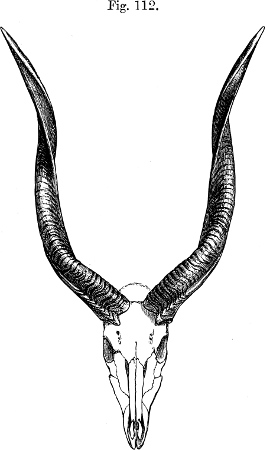
Fig. 112.
Horns of Congan Sitatunga.
(P. Z. S. 1871, p. 486.)
In 1880 Mr. Sclater received from Mr. R. W. Rolleston, of Liverpool, a flat skin of the very remarkable red female of this species, said to have been received from Gaboon. This was exhibited and described at the meeting of the Zoological Society on June 15th of that year, and a new species—Tragelaphus gratus—was founded upon it. Sclater’s original description was accompanied by a beautiful figure of the animal prepared by Joseph Wolf, and put upon the stone by Smit. Soon after this date Sclater was able to acquire some further information concerning this interesting Antelope. On visiting the Menagerie of the Jardin des Plantes at Paris in the autumn of the same year, his attention was called to a pair of Antelopes lately received from the Jardin d’Acclimatation, which he at once recognized as being the male and female of his Tragelaphus gratus. On returning to England, Sclater sent the typical skin of Tragelaphus gratus to Paris for comparison, and convinced M. Milne-Edwards of its identity with the living pair. Visiting the Jardin des Plantes again in 1881, Sclater had the pleasure of inspecting for the second time this fine pair of Antelopes, which were then accompanied by a young female, born in the previous December. Mr. Keulemans, being at that time in Paris, was employed to execute a water-colour drawing of these Antelopes, which was subsequently published in the Zoological Society’s ‘Proceedings’ along with further notes on the same subject. M. Milne-Edwards informed Mr. Sclater that the female of the pair had been received from the Jardin d’Acclimatation in March 1876, and the male in November 1879, and that both were believed to have come from Gaboon. The female had brought forth her young one on December 4th, 1880, after a period of gestation of 7 months and 24 days. A young male had likewise been born of the same mother in December 1881, but had not lived long.
Besides those of Paris, several other Gardens in continental Europe have of late years obtained specimens of Limnotragus gratus, which, singularly enough, when we consider its habits in a state of nature, appears to thrive in captivity and to breed with facility. There are at present small herds of this species in the Zoological Gardens of Hamburg and Amsterdam. Dr. Kerbert, the Director of the last-named Garden, has kindly sent us for this work a list of the nine individuals bred in that establishment from 1891 to 1896, which is here subjoined:—
Female covered. Young born. Sex. Period of gestation.
days.
1. 18.4.91 26.12.91 ♂ 252
2. 31.7.91 28.3.92 ♂ 240
3. 26.5.92 5.2.93 ♀ 255
4. 3.7.92 17.3.93 ♂ 257
5. 21.6.93 4.3.94 ♂ 256
6. 22.6.93 7.3.94 ♂ 258
7. 9.7.94 15.3.95 ♂ 249
8. 30.8.94 6.5.95 ♀ 249
9. 25.5.95 24.1.96 ♀ 245
Dr. Kerbert observes that the colour of the young males and females when born is exactly like that of the mother, but that the sexes are easily distinguishable by the white hairs in the middle of the black stripe over the back in the males.
The Zoological Society of London have not as yet been so successful in the treatment of this Antelope. They received their first female in 1885, but lost it. A male purchased in 1894 bred with the female L. selousi, as already mentioned, and produced two hybrids. A young female bred at Amsterdam, and received in September 1898, was lost shortly after its arrival.
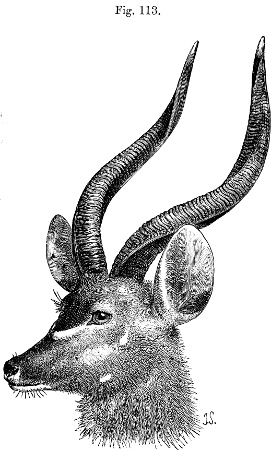
Fig. 113.
Head of the male Congan Sitatunga, from the specimen in the British Museum.
(P. Z. S. 1883, p. 36.)
In our illustration of this species (Plate XCV.) the male has been drawn by Mr. Smit from the adult specimen above mentioned, now in the Zoological Society’s Gardens. The female, in the background, was drawn from the typical skin (now in the British Museum) upon which Sclater founded the species in 1880.
The National Collection likewise contains a skin of an adult male (with horns) of this Antelope, obtained by Mr. du Chaillu in Gaboon, and a stuffed adult male from the same country obtained by purchase. From this last specimen the drawing of the head (fig. 113, p. 169) was taken by Mr. Smit in 1883. It has been kindly lent us for this work by the Zoological Society of London.
April, 1900.
Genus IV. STREPSICEROS.
Type.
Strepsiceros, Hamilton Smith, Griff. An. K. v. p. 365 (1827) S. capensis.
Calliope, Ogilby, P. Z. S. 1836, p. 138 S. capensis.
Large-sized Antelopes resembling Tragelaphus and Limnotragus in that the horns are spirally twisted and present only in the male; but differing from these two genera in that the horns are rounded behind at the base, with a scarcely appreciable external ridge, and form from two and a half to three complete turns with a more open spiral curvature. Further differing from Limnotragus, but resembling Tragelaphus, in the structure of the feet, which are adapted for progression on hard ground. Tail thickly hairy at the sides as in Limnotragus and in most of the species of Tragelaphus.
Range of the Genus. Eastern and Southern Africa from Abyssinia and Somaliland to Cape Colony, extending in Western Africa as far north as the Congo region.
The two known species of this genus may be recognized as follows:—
a. Height of adult male about four feet or over; horns with a bold and open spiral curvature and strongly diverging from the base; a mane of hairs running along throat in male; no white patches on the throat in either sex, and transverse body-stripes varying from four to ten. 130. S. capensis.
b. Height of adult male only a little over three feet; horns with much less open curve and but little diverging from base; no throat-mane in the male; two white throat-patches in both sexes, and transverse body-stripes almost always more than twelve 131. S. imberbis.
THE BOOK OF ANTELOPES, PL. XCVI.
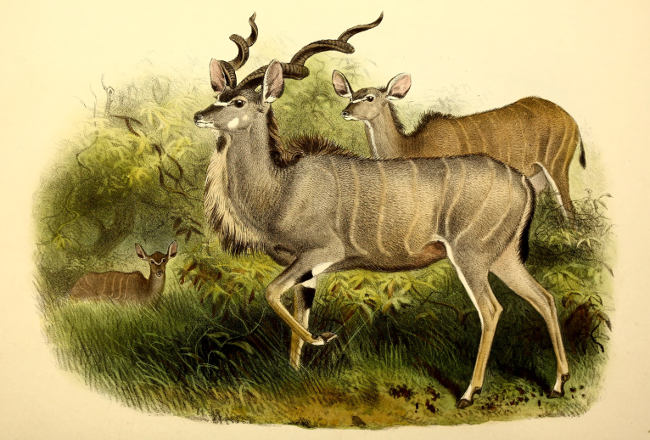
Wolf del. Smit lith.
Hanhart imp.
The Greater Kudu.
STREPSICEROS CAPENSIS.
Published by R. H. Porter.
130. THE GREATER KUDU. STREPSICEROS CAPENSIS (A. Smith). [PLATE XCVI.]
Le Condoma, Buffon, Hist. Nat. xii. p. 301, pl. xxxix. fig. 1 (1764).
Le Condoma ou Coësdoës, Allamand, in Schneider’s ed. Buffon, Suppl. vol. iv. p. 143 (1781); Buff. Hist. Nat., Suppl. vi. p. 124, pl. xiii. (1782).
Antilope strepsiceros, Pallas, Misc. Zool. p. 9 (1766); id. Spic. Zool. i. p. 17 (1767), xii. pp. 19, 69 (1777); Erxl. Syst. R. A. p. 282 (1777); Zimm. Spec. Zool. Geogr. p. 542 (1777); id. Geogr. Ges. ii. p. 115 (1780); Gatt. Brev. Zool. pt. i. p. 81 (1780); Schreb. Säug. pl. cclxvii. (1784); Bodd. Elench. Anim. p. 142 (1785); Gmel. Linn. S. N. i. p. 192 (1788); Penn. Quadr. i. p. 77 (1781), p. 88, pl. xiv. (1793); Kerr, Linn. An. K. p. 319 (1792); Donnd. Zool. Beitr. i. p. 643 (1792); Link, Beytr. Nat. ii. p. 99 (1795); G. Cuv. Tabl. Elém. p. 164 (1798); Shaw, Gen. Zool. pt. 2, p. 334, fig. 185 (upper) (1801); Turt. Linn. Syst. Nat. i. p. 116 (1802); Desm. N. Dict. d’Hist. Nat. vi. p. 129 (1803); G. Cuv. Dict. Sci. Nat. ii. p. 246 (1804); Tiedemann, Zool. i. p. 410 (1808); Thunb. Mém. Ac. St. Pétersb. iii. p. 317 (1811); G. Fisch. Zoogn. iii. p. 439 (1814); Afz. N. Acta Upsal. vii. p. 220 (1815); G. Cuv. R. A. i. p. 263 (1817); Burchell, List Quadr. p. 7 (1817); Goldf. Schreb. Säug. v. p. 1207 (1818); Schinz, Cuv. Thierr. i. p. 396 (1821); Burchell, Travels, i. pp. 337, 374 (1822); Desmoul. Dict. Class. d’H. N. i. p. 447 (1822); G. B. Fisch. Syn. Mamm. p. 471 (1829); Rüpp. Neue Wirbelth. Abyss. p. 26 (1835–40); Masson, Cuv. R. A. i. p. 317 (1836); Waterh. Cat. Mus. Z. S. (2) p. 42 (1838); Forst. (J. R.) Descr. Anim. pp. 36, 377 (1844); Schinz, Syn. Mamm. ii. p. 430 (1845); id. Mon. Antil. p. 28, pl. xxxi. (1848); Drummond, Large Game, p. 425 (1875).
Antilope (Gazella) strepsiceros, Licht. Mag. nat. Freund, vi. p. 172 (1814).
Capra strepsiceros, Thunb. Resa, ii. p. 100 (1789); Engl. Tr. ii. p. 89 (1793).
Ovis strepsiceros, Müller, Linn. Natursyst. i. p. 429, pl. xxvi. figs. 1 & 2 (1773).
Cerophorus (Tragelaphus) strepsiceros, Blainv. Bull. Soc. Philom. 1816, p. 75.
Antilope (Tragelaphus) strepsiceros, Desm. Dict. d’H. N. (2) ii. p. 197 (1816); id. Mamm. ii. p. 468 (1822); Less. Man. Mamm. p. 383 (1827); Gerv. Dict. Sci. Nat. Suppl. i. p. 266 (1840); Less. N. Tabl. R. A., Mamm. p. 181 (1842); Wagn. Schreb. Säug., Suppl. iv. p. 445 (1844), v. p. 440 (1855); Gieb. Säug. p. 311 (1853).
Tragelaphus strepsiceros, Heugl. Reise Weiss. Nil, p. 319 (1869); id. Säug. Reise Nordost-Afr. p. 113, fig. (1877).
Antilope (Addax) strepsiceros, Laurill. Dict. Univ. d’H. N. i. p. 620 (1861).
Damalis strepsiceros, H. Sm. Griff. An. K. iv. p. 359 (1827).
Damalis (Strepsiceros) strepsiceros, H. Sm. op. cit. v. p. 365 (1827).
Calliope strepsiceros, Ogilby, P. Z. S. 1836, p. 138; Rüpp. Senck. Mus. iii. pt. 2, p. 181 (1839).
Strepsiceros strepsiceros, Smuts, En. Mamm. Cap. p. 92 (1832); Peters, Reise Mossam. p. 190 (1852); Jent. Cat. Ost. Leyd. Mus. (Mus. Pays-Bas, ix.) p. 140 (1887); id. Notes Leyd. Mus. ix. p. 173 (1887) (Mossamedes); id. Cat. Mamm. Leyd. Mus. (Mus. Pays-Bas, xi.) p. 172 (1892); Rendall & Rothschild, Novitat. Zool. v. p. 212 (1898); Matschie, in Werther’s Die mittl. Hochl. Deutsch-Ost-Afr. p. 254, fig. 27 (1898); De Winton, P. Z. S. 1898, p. 768.
Antilope strepsiceros, Less. Compl. Buff. x. p. 303 (1836); Reichenb. Säug. iii. p. 145 (1845).
Strepsiceros strepsiceros zambesiensis, Lorenz, Ann. Mus. Wien, ix., Notizen, p. 62 (1894).
Strepsiceros capensis, A. Sm. S. Afr. Quart. J. ii. p. 223 (1834); Harris, Wild Anim. S. Afr. pp. 103–107, pl. xx. (1840).
Strepsiceros kudu, Gray, List Mamm. B. M. p. 155 (1843); id. Cat. Ost. B. M. p. 59 (1847); id. P. Z. S. 1850, p. 143; id. Knowsley Menag. p. 26, pl. xxiv. fig. 2 (1850); Jard. Nat. Libr. xxii., Mamm. p. 180, pl. xx. (1850) (Koodoo); Gray, Ann. Mag. Nat. Hist. (2) viii. p. 225 (1851); id. Cat. Ung. B. M. p. 133, pl. xvii. figs. 1, 2 (1852); Gerv. Hist. Nat. Mamm. ii. p. 200 (1855) (Coudou); Gerr. Cat. Bones Mamm. B. M. p. 245 (1862); Wood, Ill. Nat. Hist. i. p. 663, fig. (1862); Sclater, P. Z. S. 1864, p. 105; Kirk, P. Z. S. 1864, p. 659; Fitz. SB. Ak. Wien, lix. pt. 1, p. 176 (1869); Blanf. Zool. Abyss, p. 270 (1870); Gray, Cat. Rum. B. M. p. 46 (1872); id. Hand-l. Rum. p. 117 (1873); Buckley, P. Z. S. 1872, p. 454, 1876, pp. 284, 291; Garrod, P. Z. S. 1877, p. 4 (anatomy); Bocage, P. Z. S. 1878, p. 745 (Angola); Brehm, Thierl. iii. p. 227, fig. (1880); Selous, P. Z. S. 1881, p. 751; id. Hunter’s Wand. p. 207 (1881); Scl. List An. Z. S. p. 136 (1883), p. 160, fig. 23 (1896); id. P. Z. S. 1884, p. 47, fig. 2 (horns) (nec fig. 1); Johnston, River Congo, pp. 386, 391 (1884); id. P. Z. S. 1884, p. 542; Flow. & Gars. Cat. Ost. Coll. Surg. p. 258 (1884); Lort Phillips, P. Z. S. 1885, p. 931; Hunter, in Willoughby’s E. Africa, p. 287 (1889); Bryden, Kloof and Karroo, pp. 291, 292 (1889); Crawshay, P. Z. S. 1890, p. 659; Jent. Mus. Pays-Bas, xii. p. 211 (1890); Scl. fil. Cat. Mamm. Calc. Mus. p. 153 (1891); Flow. & Lyd. Mamm. p. 348 (1891); Inverarity, Journ. Bombay Nat. Hist. Soc. vi. no. 4, p. 463, pl. (1891); Nicolls & Eglin. Sportsm. in S. Afr. p. 52 (1892); Ward, Horn Meas. p. 159 (1892), p. 203 (1896); Lugard, Rise of E. Afr. Emp. i. p. 531 (1893); Scl. P. Z. S. 1892, pp. 102, 118; Swayne, P. Z. S. 1892, p. 301; Lyd. Horns and Hoofs, p. 256 (1893); id. Royal Nat. Hist. ii. p. 273, pl. (1894); Jackson, Big Game Shooting (Badm. Libr.), pp. 288, 304 (1894); Thos. P. Z. S. 1894, p. 145; Matschie, Säug. Deutsch-Ost-Afr. p. 136 (1895); Swayne, Somaliland, p. 302, fig. facing p. 144 (1895); Thos. P. Z. S. 1896, p. 798; Elliot, Publ. Mus. Chicago, Zool. i. p. 132; Bryden, Nat. & Sportsm. in S. Afr. pp. 241–250 (1897); Pousarg. Ann. Sci. Nat. iv. p. 81 (1897); Jackson, P. Z. S. 1897, p. 454; Ghika, Pays des Somalis, p. 181 (1898); Trouess. Cat. Mamm. ii. pt. 4, p. 960 (1898); Lydekker, Selous, Buckley, & Inverarity, in Ward’s Great and Small Game of Africa, pp. 440–451, pl. xiii. fig. 1 (1899).
Damalis (Strepsiceros) capensis, A. Sm. Illust. Zool. S. Afr. pls. xlii., xliii. (1859).
Antilope tendal, Cretzschm. Atl. Rüpp. Reise, Säug. p. 22 (1826); J. B. Fisch. Syn. Mamm. p. 475 (1829).
Antilope chora, J. B. Fisch. Syn. Mamm. p. 475 (1829).
Strepsiceros kudu abyssinicus, Fitz. SB. Ak. Wien, lix. pt. 1, p. 176 (1869).
Strepsiceros excelsus, Sund. Pecora, K. Vet.-Ak. Handl. lxv. p. 196 (1846); id. Hornsch. Transl., Arch. Skand. Beitr. ii. p. 147; Reprint, p. 71 (1848).
?? Antilope torticornis, Herm. Obs. Zool. i. p. 87[12].
Cerf du Cap de Bonne-Espérance, Colini, Acta Acad. Theod. Palat. pp. 487–491, pl. (1766).
Striped Antelope, Penn. Syn. Quadr. pp. 31, 224 (1771); id. Hist. of Quadr. (1) i, p. 76, (3) i. p. 88, pl. xiv.
Koedoe, Sparrm. Reise, p. 511 (1784); Engl. Tr. ii. p. 213 (1786); French Tr. p. 237 (1787).
Le Condoma, Huet, Coll. Mamm. Mus. d’Hist. Nat. p. 47, pl. xli. fig. 1 (1808).
The Koodoo, Daniell, Afr. Scenery, no. 6 (1812); Baldwin, Afr. Hunting, p. 376 (1863); Johnston, Kilima-Njaro Exped. pp. 301, 354 (and of most English sportsmen and naturalists).
Vernacular Names:—Koedoe of the Dutch, and Kudu or Koodoo of the English Colonists at the Cape; Tolo of Bechuana; Ee-bala-bala of Amandables; Ee-zilarwa of Makalakas; Noro of Mashunas; Unza of Masubias; Unzwa of Makubas; Muzeelona of Batongas; Dwar of Masuras (Selous). Unganxa of Kaffirs (Drummond). Mivimveh, Njellet, Neled, and Jelled of the Arabs of the Upper Nile; Garna or Qarna and Nellet at Massaua; Ungŭtir of Hamran Arabs; Agasehn, A’gasen, and Agasen in Amharic (Heuglin). Goder and Gouriali in Somaliland (Swayne).
Adult male. Height at withers about 50–52 inches. General colour of body varying from reddish to pale slaty bluish grey, the latter especially prevalent in older animals, and perhaps due, in part, to the scantiness of the hair revealing the tint of the skin. Neck brown on each side at its base and darker than the shoulders, becoming paler towards its anterior extremity. Head darker fawn than the anterior end of the neck, whitish around the eye, a white bar running inwards from the corner of each eye and forming an incomplete -shaped mark on the nose; two or three white cheek-spots; edge of the upper lip and chin white, the white of the chin extending back on to the fore part of the inter-ramal area. From the middle of this area back to the hinder end of the throat extends a thickish mane of white and blackish-brown hairs; no white patches on the throat. There is also a dorsal mane passing from the occiput, backwards along the nape, over the withers and down the spine to the root of the tail; the mane brown on the neck and shoulders, white along the back. Sides of the body and hind-quarters marked with white stripes, which vary in number from about four in the northern forms to about nine or ten in the southern. Tail white below, black at the tip. Belly greyish, blacker in the middle. Fore legs of a rich fawn down the front, whitish at the base on inner side and behind the knee, also on the inner and posterior side of the cannon-bone, a pale blackish-brown patch above the knee on the inner side; fetlocks and pasterns also rich fawn, black behind; the white pastern-spots only just traceable. Hind leg coloured like the fore leg; inner side of the thigh at the base and anterior side down to the hock white, the white fading away between the hock and the pastern.
Horns with bold and open spiral curvature, measuring about 40 inches or more in a straight line, and an additional 12 inches or so round the curve; distance between the tips varying, irrespective of the length, from about 24 to nearly 40 inches. The skull of an adult gives the following measurements:—Basal length 15 inches, orbit to muzzle 9, greatest width 6·33.
Female. Generally similar to the male, but hornless and smaller and slighter; similarly marked with white, but the ground-colour of the body of a tolerably uniform fawn, becoming darker above.
Young redder in colour than the adult and strongly marked with white.
Hab. Africa south of the Zambesi, extending on the west into Angola, and on the east throughout East Africa up to Abyssinia, mostly in the higher districts.
We come now to one of the largest and finest of the whole long series of African Antelopes. In Mr. John Millais’s well-known ‘Breath from the Veldt,’ drawings of the heads of the Sable Antelope and the Kudu occupy a conspicuous position on the cover. Mr. Millais, than whom there can be no better judge, although he rather gives the palm to the Sable, admits that the Kudu surpasses its rival “in elegance and general appearance” when dead, but gives the Sable preference when seen alive on the veldt. It is really a difficult question, he allows, to decide between the “two rival beauties.” But we will proceed to the history of the Kudu.
Although the Kudu was certainly known to Kolben and other visitors to the Cape in early days, Buffon was the first writer to give us a good account of it. In the twelfth volume of his ‘Histoire Naturelle,’ published in 1764, Buffon introduced it into his work under the title of “Le Condoma,” and gave a figure of its unmistakable horns from a pair in the possession of the Marquis de Marigny. In these horns Buffon recognized the animal previously indicated by Kolben as a “kind of large Wild Goat.” In the sixth volume of the Supplement to the ‘Histoire Naturelle,’ published in 1782, Buffon entered into fuller particulars of the Kudu, which he now called the “Condoma ou Coësdoës,” apparently recognizing that the first of these names had been based on a mistake or misspelling. He was also now able to give a figure of the whole animal from a well-preserved skin received from “the interior of Africa.” Further information was added, taken from the Dutch edition of the ‘Histoire Naturelle,’ which had been then recently published by Schneider in Amsterdam, and to which Prof. Allamand had contributed a description of this animal, based on a specimen living in 1776 in the Menagerie of the Prince of Orange, to whom it had been sent by Joachim van Plattenberg, then Dutch Governor of the Cape. In his first essay on the genus Antilope, published in 1766, the great naturalist, Pallas, placed the Kudu sixteenth in his list, basing it mainly on the “Condoma” of Buffon, and proposed for it the specific name “strepsiceros.” Although, therefore, the Kudu could not have been the Strepsiceros of classical authors (which was in all probability the Addax), there can be no question that the Antilope strepsiceros of Pallas, as based on Buffon’s “Condoma,” is this species.
In 1827, Hamilton Smith, writing on the Mammals in Griffith’s ‘Animal Kingdom,’ used the term Strepsiceros as one of the subgeneric divisions of his genus Damalis, thus, according to the views of modern systematists, creating a new generic name, which has ever since been universally employed for the Kudu. Although many authorities are of opinion that the adoption of a specific name for the genus ought not to interfere with its usage for the species also, and consequently that the present animal ought to be called Strepsiceros strepsiceros, such has not been our custom in the present work, and it is consequently necessary to search out the second given specific name. For this there may be said to be two generally recognized claimants—first, “capensis,” bestowed upon it by Dr. Andrew Smith in 1834; and, secondly, “kudu,” applied to it by Gray in 1843. Of these we are inclined to adopt the former as first given, although the latter has been more generally accepted.
It is true no doubt that so long ago as 1816, in his ‘Lehrbuch der Zoologie,’ Oken introduced the Kudu into his list of the species of the genus “Cemas” under the heading “C. kuhdu, Strepsiceros, Cervus capensis.” But it does not seem to be quite certain that Oken hereby intended to bestow on the Kudu a new specific name, and under these circumstances it would be objectionable, we think, to call the Kudu, Strepsiceros kuhdu (Oken). It has therefore been decided to employ Andrew Smith’s name, concerning which there can be no doubt whatever, for the present Antelope, and to designate it Strepsiceros capensis.
The well-known travellers Sparrman (1785), Thunberg (1795), Daniell (1804), Burchell (1822), and Steedman (1835), all met with the Kudu during their journeyings in different parts of the Cape Colony, in the more remote parts of which it was still plentiful in their days. Harris (1836–37) states that although at that period the Kudu was still found in many of the more retired portions of the Colony, he did not himself meet with it until he had entered the “prolific environs” of the Cashaan Mountains of Pretoria. Harris claims for the Kudu the “right and title to the sovereignty of all the Antelopes.” Other species of this group, he allows, may be “stately, elegant, or curious,” but the Kudu is “absolutely regal.”
Harris, in the letterpress to his ‘Portraits,’ describes the habits of the Kudu in the Cashaan Mountains in the following lively manner:—
“There in the depths of solitary woods, by human foot untrod, the noble animal occurs in such every-day abundance, that many a gory trophy was realized; but his great sagacity, wildness, and self-possession, demanding the most skilful generalship to out-manæuvre him, the pursuit necessarily differs altogether from the usual stamp of African hunting, and involves no inconsiderable acquaintance with the subtleties of woodcraft. We have here no dashing among countless herds, no helter-skelter riding by the side of a closely-packed phalanx; yet have we a quarry well worth the hardest day’s fag on foot to triumph over. Shunning both the open plain and the society of the multitude, the crafty fellow never ventures from his almost inaccessible fastness, unless during the morning and evening; and even then must he be sought au pied amid the dark upland dells which usually form his solitary abode. With all his wits about him, the lordly bull, active and powerful, may now and then be detected browsing at grey dawn upon some rugged hill summit, or ranging some grassy slope, either alone, or escorted by a small troop of skittish dames, all seeming alike his sentinels; but taking the note of alarm from the slightest noise, he stamps his brave foot upon the ground, tosses his spiral frontlet to the blue sky, and once fairly in motion, never stops to look behind until he has gained the threshold of his sanctuary. There, in some deep chasm which the sunbeam rarely penetrates, among tangled ravines, and hollows densely clothed with trees and brushwood, he lazily reclines during the solar heat, beside some fern-clad stone, and leisurely turns the cud until the cool breezes of eventide once more invite him from his snug retreat.”
Amongst modern authorities on the Great Game-mammals of South Africa, we may select passages from the writings of Mr. Kirby and Mr. J. Millais as giving us good ideas of the present localities of the Kudu and its usual habits. In his already-mentioned ‘Breath from the Veldt,’ Mr. Millais writes as follows:—
“Though the species is gone from the countries south of the Transvaal, there is still a very fair number in the northern forests of that country, and these are not confined to ‘a few troops which still linger,’ as most books on the subject would give us to understand. The fact is, very little hunting goes on in these countries, owing to absence of water and thickness of the bush; the amount of game still to be found there cannot therefore be very much less than in the greater part of Mashonaland, which is very much hunted. I think the following speaks for itself. Four hunters whom I trekked up with each killed on an average ten Koodoos in three months, besides a lot of Pallah and Blue Wildebeests; and this too, in every instance, close to the main road in the Transvaal. If then they could do this, there must surely be a very fair quantity of game in the hundreds of untrodden miles in the south-west and east of the several drifts of the Limpopo. In Mashonaland the Koodoo is probably only reduced in numbers near the transport roads, while it is still plentiful in the neighbourhood of all the rivers and pans of that country where the bush is suitable to its habits.”
In his well-known volume on the ‘Haunts of Wild Game,’ Mr. F. V. Kirby introduces us to the habits of the present species in the following terms:—
“Koodoo frequent rocky bush-covered hills—the rougher and more apparently inaccessible they are the better they like them; but in the Low Country they are equally at home in the heavy belts of bush which line the rivers and water-courses. As a rule, in the latter district they are fairly easy to run into on horseback, although individual bulls and the cows will display great speed and endurance; but in the hill country it requires much patience and care to circumvent an old bull successfully. Unfortunately for themselves, Koodoo are of a most curious disposition, and seldom run far without standing and looking back at their pursuer. Their leaping powers are marvellous, and I have seen them clear obstacles 8 feet in height with apparent ease. Their sense of hearing is very acute—one needs only to look at the large, rounded, mobile ears to be satisfied on that point; and I believe they trust more to that sense for their safety than to any other. Though almost invariably found in the near neighbourhood of water, I fancy they can go for a long time without drinking, judging by the extensive dry areas in which I have found them.”
Mr. W. L. Sclater, in his new volume on the Mammals of South Africa, states that within the limits of his work (that is Africa south of the Zambesi and Cunene Rivers) the Kudu is still probably the most abundant and widespread of the larger Antelopes. Within the Cape Colony, Mr. Sclater tells us, the Kudu is yet to be met with in the southern districts, from the Riversdale and Prince Albert divisions, eastwards to Albany and Fort Beaufort. It is stated to be even abundant in the bush-country along the Koonap and Great Fish Rivers. In the northern parts of the Colony it is also fairly common in parts of Griqualand West and Prieska. In German South-west Africa, Bechuanaland, Rhodesia, the northern and eastern parts of the Transvaal, the Portuguese territories, and in Zululand it is also fairly plentiful in suitable localities. In the South-African Museum at Capetown there are mounted specimens of a male Kudu from near Barberton in the Transvaal, and of a female from Koonap in the Albany division of the Cape Colony.
But the Kudu, as we shall see, ranges far beyond the limits of Mr. Sclater’s South Africa, and we will now proceed to trace its distribution throughout Eastern Africa into the northern territories of Abyssinia and the Egyptian Soudan.
In Nyasaland, Mr. Crawshay tells us, the Kudu is to be met with practically all over the Protectorate, especially in the rugged wooded highlands away from the haunts of men. In the Portuguese provinces on the coast, according to Peters, it appears to be likewise generally distributed. Proceeding to German East Africa, we find it also widely diffused there, extending westwards up to Lake Tanganyika, although, as Herr Matschie tells us, it is “nowhere common.” In British East Africa, Mr. F. J. Jackson informs us, the Kudu is “a rare beast and only found in certain places.” There are always “a few,” he says, “in the Teita country west of Ndara and Kisigao, and on the banks of the Tsavo River, down which it ranges from the head-waters to the Sabaki, and then north up the Athi. All these districts are more or less undulating, very rough, dry and stony, and covered with thick bush.” Further north, Graf Teleki shot two Greater Kudus a few miles to the south of Lake Barengo, and Dr. Donaldson Smith, in the course of his travels, saw one at El Madu in about 4° N. lat. Mr. Arthur H. Neumann met with the Greater Koodoo near Lake Rudolf, as related in his ‘Elephant-hunting,’ but considers it very uncommon in the districts which he traversed. Passing northwards to Somaliland, we find the Kudu more abundant on the higher grounds. Capt. Swayne informs us that it inhabits the top of Wagar Mountain and the Golis Range, which rise to about 6800 feet.
Lieut.-Col. H. D. Olivier, R.E., F.Z.S., who has recently returned from a hunting excursion in Northern Somaliland, has favoured us with the following notes:—
“I first came across the Greater Koodoo in the Golis Range, and I also found it to the west of Hargeisa and near Milmil, as far south as lat. 8°. The first locality, however, was the only one where I pursued it, and it was there more abundant than in the two last-mentioned places. The Golis Range consists of a series of high bluffs under which lies a sort of undercliff forming a lower plateau. This is grown over with gigantic Euphorbias and dense brushwood, interspersed with huge boulders which have fallen from the cliffs above. The Koodoo apparently lie up in very thick patches of such jungle, at least I always found this the case, and the first intimation of their presence was invariably a crash as the quarry dashed off, generally out of sight. Their habit, however, of stopping after a hundred yards or so, to examine the cause of their alarm, is often fatal to them. They seem to lie pretty close, and on one occasion I walked all round one without discovering it, which we did eventually by finding its tracks at the end of our circuit and following them up. The Koodoo browse on the young shoots, and I have also found them eating the smaller kinds of Euphorbias.
“At the time I was looking for them the rainy season was on, and I think this much assisted us, for it rendered tracking easy and our movements less noisy than they would have been in the dry weather. During five days’ shooting we saw five good bucks, and secured three of them. I found that when alarmed they did not travel very far, and that by patiently following the tracks we generally came up to them within a couple of miles. All the bucks I came across were solitary, and the hinds seemed to live in small herds of from three to seven or eight. A sportsman could not wish for a grander sight than a startled Koodoo dashing off along the hillside, or standing on the look-out on some point of vantage. Their flesh is poor eating, and their hides are of little value from an ornamental point of view, but the head and neck, and the ruff, when well mounted, form a splendid trophy.”