Front matter
Reading edition
Cover
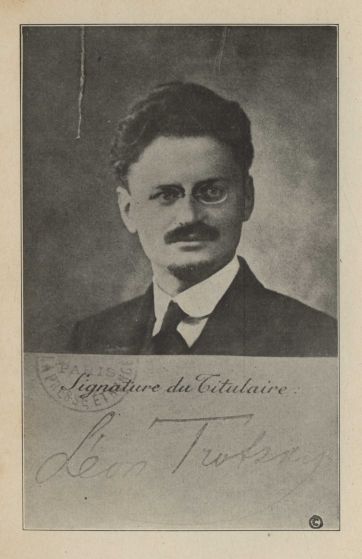
Leon Trotzky
THE BOLSHEVIKI AND WORLD PEACE
BY LEON TROTZKY
INTRODUCTION BY LINCOLN STEFFENS
BONI AND LIVERIGHT NEW YORK 1918
Copyright 1918 Boni & Liveright Inc.
CONTENTS
Introduction by Lincoln Steffens Author's Preface
CHAPTER
The Balkan Question
Austria-Hungary
The War against Czarism
The War against the West
The War of Defense
What Have Socialists to do with Capitalist Wars?
The Collapse of the International
Socialist Opportunism
The Decline of the Revolutionary Spirit
Working Class Imperialism
The Revolutionary Epoch
INTRODUCTION
The voice that speaks in this book is the voice of Leon Trotzky, the Bolshevik Minister of Foreign Affairs for Revolutionary Russia. It is expressing ideas and views which lighted him on the course of his policy toward the War, Peace and the Revolution. It throws light, therefore, on that policy; it helps to an understanding of it, if one wishes to understand. But that isn't all. The spirit that flames and casts shadows upon these pages is not only Trotzky's. It is the spirit also of the Bolsheviki; of the red left of the left wing of the revolutionary movement of New Russia. It flashed from Petrograd to Vladivostok, in the first week of the revolt; it burned all along the Russian Front before Trotzky appeared on the scene. It will smoulder long after he is gone. It is a hot Fact which has to be picked up and examined, this spirit. Whether we like it or don't, it is there; in Russia; it is elsewhere; it is everywhere to-day. It is the spirit of war; class war, but war. It is in this book.
Nor is that all.
The mind in this book--the point of view from which it starts, the views to which it points--Trotzky's mind is the international mind. We have heard before of this new intelligence; we have read books, heard speeches, witnessed acts demonstrative of thoughts and feelings which are not national, but international; not patriotic, but loyal only to the lower-class-conscious war aims of the workers of the world. The class warrior is as familiar a figure to us as the red spirit is of the red left of revolution. But the voice which utters here the spirit and the mind, not only of the Russian, but of the world revolution is the voice of one having authority.
And Trotzky, in power, has been as red as he is in this book. The minister of foreign affairs practised in Petrograd what he preached in Switzerland, where he wrote most of the chapters of his book. And he practised also what all the other great International Socialist leaders talked and wrote.
That's what makes him so hard to understand, him and his party and the Bolshevik policy. We are accustomed to the sight of Socialists and Radicals going into office and being "sobered by the responsibilities of power." French and Italian Socialists in the Liberal ministries of their countries; British Labor leaders in Parliament in England or in the governments of their Colonies; and the whole Socialist party in Germany and Austria (except Liebknecht in prison)--all are examples of the effect of power upon the International Mind. The phenomenon of compromise and surrender is so common that many radicals oppose the taking of any responsible office by any member of their parties; and some of the extremists are advocating no political action whatsoever, nothing but industrial, economic or what they call "direct action." (Our I.W.W.'s don't vote, on principle.) This is anarchism.
Leon Trotzky is not an anarchist; except in the ignorant sense of the word as used by educated people. He is a Socialist; an orthodox Marxian Socialist. But he has seen vividly the danger of political power. The body of this book was addressed originally to the German and Austrian Socialists, and it is a reasoned, but indignant reproach of them for letting their political position and their nationalistic loyalty carry them away into an undemocratic, patriotic, political policy which betrayed the weaker nations in their empires, helped break up the Second (Socialist) International and led the Socialist parties into the support of the War.
Clear upon it, Trotzky himself does not illustrate his own thesis. He not only detests intellectually the secrecy and the sordid wickedness of the "old diplomacy"; when he came as minister into possession of the archives of the Russian Foreign Office, he published the secret treaties.
That hurt. And so with the idea of a people's peace. All the democratic world had been talking ever since the war began of a peace made, not by diplomats in a private room, but by the chosen representatives of all the peoples meeting in an open congress. The Bolsheviki worked for that from the moment the Russian Revolution broke; and they labored for the Stockholm Conference while Paul Milyoukov and Alexander Kerensky were negotiating with the allied governments. When the Bolsheviki succeeded to power, Lenine and Trotzky formally authorized and officially proposed such a congress. Moreover Trotzky showed that they were willing, if they could, to force the other countries to accept the people's peace conference.
This hurt. This hurt so much that the governments united in extraordinary measures to prevent the event. And when they succeeded, and it was seen that no people's peace could be made openly and directly, Trotzky proceeded by another way to get to the same end. He opened negotiations with the Kaiser's government and allies; arranged an armistice and agreed tentatively upon terms of peace.
This act not only hurt; it stunned the world, and no wonder! It was like a declaration of war against a whole world at war. It was unbelievable. The only explanation offered was that Trotzky and Lenine were pro-German or dishonest, or both, and these things were said in high places; and they were said with conviction, too. Moreover this conviction colored, if it did not determine, the attitude the Allies took toward New Russia and the peace proposals Trotzky got from the German government. Was this assumption of the dishonesty of Trotzky the only explanation of his act?
This book shows, as I have said, that Trotzky saw things from the revolutionary, international point of view, which is not that of his judges; which is incomprehensible to them. He wrote it after the War began; he finished the main part of it before the Russian Revolution. It is his view of the War, its causes and its effects, especially upon international Socialism and "the" Revolution. These are the things he holds in his mind all through all these pages: "the" Revolution and world democracy. Also I have shown that, like the Russians generally, his mind is literal. The Russians mean what they say, exactly; and Trotzky not only means, he does what he writes. Putting these considerations together, we can make a comprehensible statement of the motive and the purpose of his policy; if we want to comprehend.
To all the other secretaries of state or of foreign affairs in the world, the Russian Revolution was an incident, an interruption of the War. To Minister Trotzky it was the other way around.
The World War was an incident, an effect, a check of "the" Revolution. Not the Russian Revolution, you understand. To Trotzky the Russian Revolution is but one, the first of that series of national revolutions which together will become the Thing he yearns for and prophesies: the World Revolution.
His peace policy therefore is a peace drive directed, not at a separate peace with the Central Powers; and not even at a general peace, but to an ending of the War in and by "the" Revolution everywhere.
Especially in Germany and Austria. He said this. The correspondent of the London Daily News cabled on January 2, right after the armistice and the agreement upon peace terms to be offered the Allies, that "Trotzky is doing his utmost to stimulate a revolution in Germany.... Our only chance to defeat German designs is to publish terms (from the Allies) ... to help the democratic movement in Germany."
Trotzky is not pro-German. He certainly was not when he wrote this book. He hates here both the Austrian and the German dynasties, and his ill-will toward the House of Hapsburg is so bitter that it sounds sometimes as if there were something personal about it. And there is. He shows a knowledge of and a living sympathy with the small and subject nations which Austria rules, exploits and mistreats. He blames his Austrian comrades for their allegiance to a throne which is not merely undemocratic, but "senile" and tyrannical. That he, the literal Trotzky, would turn right around and, as the Russian Minister of Foreign Affairs, do what he had so recently criticized the Austrian Socialists for doing is unlikely.
Trotzky is against all the present governments of Europe, and the "bourgeois system" everywhere in the world. He isn't pro-Allies; he isn't even pro-Russian. He isn't a patriot at all. He is for a class, the proletariat, the working people of all countries, and he is for his class only to get rid of classes and get down or up to--humanity. And so with his people.
The Russians have listened to the Socialist propaganda for generations now. They have learned the chief lessons it has taught: liberty, land, industrial democracy and the class-war the world over. This War was not their war; it was the Czar's war; a war of the governments in the interest of their enemies, the capitalists of their several countries, who, as Trotzky says, were forcing their states to fight for the right to exploit other and smaller peoples. So when they overthrew the Czar, the Russians wanted to drop his war and go into their own, the class war. Kerensky held them at the front in the name of "the" Revolution; he would get peace for them by arrangement with the allies. He didn't; he couldn't; he was dismissed by them. Not by the Bolsheviki, but by the Russian people who know the three or four things they want: land and liberty at home; the Revolution and Democracy for all the world.
I heard a radical assert one day that that was the reason Trotzky could be such an exception to the rule about radicals in power. He came to the head of the Russian Revolution when his ideas were the actual demands of the Russian people and that it was not his strength of character, but the force of a democratic public opinion in mob power, which made him stick to his philosophy and carry out his theories and promises. I find upon inquiry here in New York that while he was living and working as a journalist on the East Side, he left one paper after another because he could not conform, to their editorial policies and would not compromise. He was "stiff-necked," "obstinate," "unreasonable." In other, kinder words, Trotzky is a strong man, with a definite mind and a purpose of his own, which he has the will and the nerve to pursue.
Also, however, Trotzky is a strong man who is ruled by and represents a very simple-minded people who are acting like him, literally upon the theory that the people govern now, in Russia; the common people; and that, since they don't like the War of the Czar, the Kaiser, the Kings and the Emperors, their government should make peace with the peoples of the world, a democratic peace against imperialism and capitalism and the state everywhere, for the establishment in its stead of a free, world-wide democracy.
That may be the true explanation of Trotzky's Bolshevik peace policy in the world crisis of the World War. That is the explanation which is suggested by this book.
"Written in extreme haste," he says at the close of his preface, "under conditions far from favorable to systematic work ... the entire book, from the first page to the last, was written with the idea of the New International constantly in mind--the New International which must rise out of the present world cataclysm, the International of the last conflict and the final victory."
LINCOLN STEFFENS. New York, January 4th, 1918
AUTHOR'S PREFACE
The forces of production which capitalism has evolved have outgrown the limits of nation and state. The national state, the present political form, is too narrow for the exploitation of these productive forces. The natural tendency of our economic system, therefore, is to seek to break through the state boundaries. The whole globe, the land and the sea, the surface as well as the interior, has become one economic workshop, the different parts of which are inseparably connected with each other. This work was accomplished by capitalism. But in accomplishing it the capitalist states were led to struggle for the subjection of the world-embracing economic system to the profit interests of the bourgeoisie of each country. What the politics of imperialism has demonstrated more than anything else is that the old national state that was created in the revolutions and the wars of 1789-1815, 1848-1859, 1864-1866, and 1870 has outlived itself, and is now an intolerable hindrance to economic development.
The present War is at bottom a revolt of the forces of production against the political form of nation and state. It means the collapse of the national state as an independent economic unit.
The nation must continue to exist as a cultural, ideologic and psychological fact, but its economic foundation has been pulled from under its feet. All talk of the present bloody clash being a work of national defense is either hypocrisy or blindness. On the contrary, the real, objective significance of the war is the breakdown of the present national economic centres, and the substitution of a world economy in its stead. But the way the governments propose to solve this problem of imperialism is not through the intelligent, organized coöperation of all of humanity's producers, but through the exploitation of the world's economic system by the capitalist class of the victorious country; which country is by this War to be transformed from a great power into the world power.
The War proclaims the downfall of the national state. Yet at the same time it proclaims the downfall of the capitalist system of economy. By means of the national state capitalism has revolutionized the whole economic system of the world. It has divided the whole earth among the oligarchies of the great powers, around which were grouped the satellites, the small nations, who lived off the rivalry between the great ones. The future development of world economy on the capitalistic basis means a ceaseless struggle for new and ever new fields of capitalist exploitation, which must be obtained from one and the same source, the earth. The economic rivalry under the banner of militarism is accompanied by robbery and destruction which violate the elementary principles of human economy. World production revolts not only against the confusion produced by national and state divisions but also against the capitalist economic organization, which has now turned into barbarous disorganization and chaos.
The War of 1914 is the most colossal breakdown in history of an economic system destroyed by its own inherent contradictions.
All the historical forces whose task it has been to guide the bourgeois society, to speak in its name and to exploit it, have declared their historical bankruptcy by the War. They defended capitalism as a system of human civilization, and the catastrophe born out of that system is primarily their catastrophe. The first wave of events raised the national governments and armies to unprecedented heights never attained before. For the moment the nations rallied around them. But the more terrible will be the crash of the governments when the people, deafened by the thunder of the cannon, realize the meaning of the events now taking place in all their truth and frightfulness.
The revolutionary reaction of the masses will be all the more powerful the more prodigious the cataclysm which history is now bringing upon them.
Capitalism has created the material conditions of a new Socialist economic system. Imperialism has led the capitalist nations into historic chaos. The War of 1914 shows the way out of this chaos by violently urging the proletariat on to the path of Revolution.
For the economic backward countries of Europe the War brings to the fore problems of a far earlier historic origin--problems of democracy and national unity. This is in a large measure the case with the peoples of Russia, Austria-Hungary and the Balkan Peninsula. But these historically belated questions, which were bequeathed to the present epoch as a heritage from the past, do not alter the fundamental character of the events. It is not the national aspirations of the Serbs, Poles, Roumanians or Finns that has mobilized twenty-five million soldiers and placed them in the battlefields, but the imperialistic interests of the bourgeoisie of the Great Powers. It is imperialism that has upset completely the European status quo, maintained for forty-five years, and raised again the old questions which the bourgeois revolution proved itself powerless to solve.
Yet in the present epoch it is quite impossible to treat these questions in and by themselves. They are utterly devoid of an independent character. The creation of normal relations of national life and economic development on the Balkan Peninsula is unthinkable if Czarism and Austria-Hungary are preserved. Czarism is now the indispensable military reservoir for the financial imperialism of France and the conservative colonial power of England. Austria-Hungary is the mainstay of Germany's imperialism. Issuing from the private family clashes between the national Servian terrorists and the Hapsburg political police, the War very quickly revealed its true fundamental character--a struggle of life and death between Germany and England. While the simpletons and hypocrites prate of the defense of national freedom and independence, the German-English War is really being waged for the freedom of the imperialistic exploitation of the peoples of India and Egypt on the one hand, and for the imperialistic division of the peoples of the earth on the other.
Germany began its capitalistic development on a national basis with the destruction of the continental hegemony of France in the year 1870-1871. Now that the development of German industry on a national foundation has transformed Germany into the first capitalistic power of the world, she finds herself colliding with the hegemony of England in her further course of development. The complete and unlimited domination of the European continent seems to Germany the indispensable prerequisite of the overthrow of her world enemy. The first thing, therefore, that imperialistic Germany writes in her programme is the creation of a Middle European League of Nations. Germany, Austria-Hungary, the Balkan Peninsula and Turkey, Holland, the Scandinavian countries, Switzerland, Italy, and, if possible, enfeebled France and Spain and Portugal, are to make one economic and military whole, a Great Germany under the hegemony of the present German state.
This programme, which has been thoroughly elaborated by the economists, political students, jurists and diplomats of German imperialism and translated into reality by its strategists, is the most striking proof and most eloquent expression of the fact that capitalism has expanded beyond the limits of the national state and feels intolerably cramped within its boundaries. The national Great Power must go and in its place must step the imperialistic World Power.
In these historical circumstances the working class, the proletariat, can have no interest in defending the outlived and antiquated national "fatherland," which has become the main obstacle to economic development. The task of the proletariat is to create a far more powerful fatherland, with far greater power of resistance--the republican United States of Europe, as the foundation of the United States of the World.
The only way in which the proletariat can meet the imperialistic perplexity of capitalism is by opposing to it as a practical programme of the day the Socialist organization of world economy.
War is the method by which capitalism, at the climax of its development, seeks to solve its insoluble contradictions. To this method the proletariat must oppose its own method, the method of the Social Revolution.
The Balkan question and the question of the overthrow of Czarism, propounded to us by the Europe of yesterday, can be solved only in a revolutionary way, in connection with the problem of the United Europe of to-morrow. The immediate, urgent task of the Russian Social Democracy, to which the author belongs, is the fight against Czarism. What Czarism primarily seeks in Austria-Hungary and the Balkans is a market for its political methods of plunder, robbery and acts of violence. The Russian bourgeoisie all the way up to its radical intellectuals has become completely demoralized by the tremendous growth of industry in the last five years, and it has entered into a bloody league with the dynasty, which had to secure to the impatient Russian capitalists their part of the world's booty by new land robberies. While Czarism stormed and devastated Galicia, and deprived it even of the rags and tatters of liberty granted to it by the Hapsburgs, while it dismembered unhappy Persia, and from the corner of the Bosporus strove to throw the noose around the neck of the Balkan peoples, it left to the liberalism which it despised the task of concealing its robbery by sickening declamations over the defense of Belgium and France. The year 1914 spells the complete bankruptcy of Russian liberalism, and makes the Russian proletariat the sole champion of the war of liberation. It makes the Russian Revolution definitely an integral part of the Social Revolution of the European proletariat.
In our war against Czarism, in which we have never known a "national" truce, we have never looked for help from Hapsburg or Hohenzollern militarism, and we are not looking for it now. We have preserved a sufficiently clear revolutionary vision to know that the idea of destroying Czarism was utterly repugnant to German imperialism. Czarism has been its best ally on the Eastern border. It is united to it by close ties of social structure and historical aims. Yet even if it were otherwise, even if it could be assumed that, in obedience to the logic of military operations, it would deal a destructive blow to Czarism, in defiance of the logic of its own political interests--even in such a highly improbable case we should refuse to regard the Hohenzollerns not only as an objective but as a subjective ally. The fate of the Russian Revolution is so inseparably bound up with the fate of European Socialism, and we Russian Socialists stand so firmly on the ground of internationalism, that we cannot, we must not for a moment, entertain the idea of purchasing the doubtful liberation of Russia by the certain destruction of the liberty of Belgium and France, and--what is more important still--thereby inoculating the German and Austrian proletariat with the virus of imperialism.
We are united by many ties to the German Social Democracy. We have all gone through the German Socialist school, and learned lessons from its successes as well as from its failures. The German Social Democracy was to us not only a party of the International. It was the Party par excellence. We have always preserved and fortified the fraternal bond that united us with the Austrian Social Democracy. On the other hand, we have always taken pride in the fact that we have made our modest contribution towards winning suffrage in Austria and arousing revolutionary tendencies in the German working class. It cost more than one drop of blood to do it. We have unhesitatingly accepted moral and material support from our older brother who fought for the same ends as we on the other side of our Western border.
Yet it is just because of this respect for the past, and still more out of respect for the future, which ought to unite the working class of Russia with the working classes of Germany and Austria, that we indignantly reject the "liberating" aid which German imperialism offers us in a Krupp munition box, with the blessing, alas! of German Socialism. And we hope that the indignant protest of Russian Socialism will be loud enough to be heard in Berlin and in Vienna.
The collapse of the Second International is a tragic fact, and it were blindness or cowardice to close one's eyes to it. The position taken by the French and by the larger part of English Socialism is as much a part of this breakdown as the position of the German and Austrian Social Democracy. If the present work addresses itself chiefly to the German Social Democracy it is only because the German party was the strongest, most influential, and in principle the most basic member of the Socialist world. Its historic capitulation reveals most clearly the causes of the downfall of the Second International. At first glance it may appear that the social revolutionary prospects of the future are wholly deceptive. The insolvency of the old Socialist parties has become catastrophically apparent. Why should we have faith in the future of the Socialist movement? Such skepticism, though natural, nevertheless leads to quite an erroneous conclusion. It leaves out of account the good will of history, just as we have often been too prone to ignore its ill will, which has now so cruelly shown itself in the fate that has overcome the International.
The present War signalizes the collapse of the national states. The Socialist parties of the epoch now concluded were national parties. They had become ingrained in the national states with all the different branches of their organizations, with all their activities and with their psychology. In the face of the solemn declarations at their congresses they rose to the defense of the conservative state, when imperialism, grown big on the national soil, began to demolish the antiquated national barriers. And in their historic crash the national states have pulled down with them the national Socialist parties also.
It is not Socialism that has gone down, but its temporary historical external form. The revolutionary idea begins its life anew as it casts off its old rigid shell. This shell is made up of living human beings, of an entire generation of Socialists that has become fossilized in self-abnegating work of agitation and organization through a period of several decades of political reaction, and has fallen into the habits and views of national opportunism or possibilism. All efforts to save the Second International on the old basis, by personal diplomatic methods and mutual concessions, are quite hopeless. The old mole of history is now digging its passageways all too well and none has the power to stop him.
As the national states have become a hindrance to the development of the forces of production, so the old Socialist parties have become the main hindrance to the revolutionary movement of the working class. It was necessary that they should demonstrate to the full their extreme backwardness, that they should discredit their utterly inadequate and narrow methods, and bring the shame and horror of national discord upon the proletariat, in order that the working class might emancipate itself, through these fearful disillusionments, from the prejudices and slavish habits of the period of preparation, and become at last that which the voice of history is now calling it to be--the revolutionary class fighting for power.
The Second International has not lived in vain. It has accomplished a huge cultural work. There has been nothing like it in history before. It has educated and assembled the oppressed classes. The proletariat does not now need to begin at the beginning. It enters on the new road not with empty hands. The past epoch has bequeathed to it a rich arsenal of ideas. It has bequeathed to it the weapons of criticism. The new epoch will teach the proletariat to combine the old weapons of criticism with the new criticism of weapons.
This book was written in extreme haste, under conditions far from favorable to systematic work. A large part of it is devoted to the old International which has fallen. But the entire book, from the first to the last page, was written with the idea of the New International constantly in mind, the New International which must rise up out of the present world cataclysm, the International of the last conflict and the final victory.
LEON TROTZKY.
THE BOLSHEVIKI AND WORLD PEACE
CHAPTER I
THE BALKAN QUESTION
"The War at present being waged against Russian Czarism and its vassals is dominated by a great historic idea. The impetus of this great historic idea consecrates the battlefields of Poland and of Eastern Russia. The roar of cannon, the rattling of machine guns, and the onrush of cavalry, all betoken the enforcement of the democratic programme for the liberation of the nations. Had Czarism, in league with the French capitalistic powers and in league with an unscrupulous 'nation of shopkeepers,' not succeeded in suppressing the Revolution of 1905, the present slaughter of the nations would have been avoided.
"A democratic Russia would never have consented to wage this unscrupulous and futile War. The great ideas of freedom and justice now speak the persuasive language of the machine gun and the sword, and every heart susceptible of sympathy with justice and humanity can only wish that the power of Czarism may be destroyed once for all, and that the oppressed Russian nationalities may again secure the right to decide their own destinies."
The above quotation is from the Nepszava of August 31, 1914, the official organ of the Socialist party of Hungary. Hungary is the land whose entire inner life was erected upon the high-handed oppression of the national minorities, upon the enslavement of the laboring classes, upon the official parasitism and usury of the ruling caste of large landowners. It is the land in which men like Tisza are masters of the situation, dyed-in-the-wool agrarians, with the manners of political bandits. In a word, Hungary is a country closest of kin to Czar-ruled Russia.
So what is more fitting than that the Nepszava, the Socialist organ of Hungary, should hail with outbursts of enthusiasm the liberating mission of the German and Austro-Hungarian armies? Who other than Count Tisza could have felt the call to "enforce the democratic programme for the liberation of the nations"? Who was there to uphold the eternal principles of law and justice in Europe but the ruling clique of Budapest, the discredited Panamists? Would you entrust this mission to the unscrupulous diplomacy of "perfidious Albion," to the nation of shopkeepers?
Laughter turns away wrath. The tragic inconsistencies of the policies followed by the International not only reach their climax in the articles of the poor Nepszava; they disarm us by their humor.
The present series of events began with the ultimatum, sent to Servia by Austria-Hungary. There was not the slightest reason why the international Social Democracy should take under its protection the intrigues of the Serbs or any other of the petty dynasties of the Balkan Peninsula. They were all endeavoring to hide their political adventures under the cloak of national aspirations. We had still less cause to lash ourselves into a state of moral indignation because a fanatic young Serb responded to the cowardly, criminal and wily national politics of the Vienna and Budapest government authorities with a bloody assassination.1
Of one thing we have no doubt. In the dealings between the Danube Monarchy and the Servian government, the historic right, that is to say, the right of free development, rests entirely with Servia, just as Italy was in the right in the year 1859. Underneath the duel between the imperial police scoundrels and the terrorists of Belgrade, there is hidden a far deeper meaning than merely the greed of the Kareorgoievitches or the crimes of the Czar's diplomacy. On one side were the imperialistic claims of a national state that had lost its vitality, and on the other side, the strivings of the dismembered Servian nation to reintegrate itself into a national whole and become a living vital state.
Is it for this that we have sat so long in the school of Socialism to forget the first three letters of the democratic alphabet? This absolute lapse of memory, moreover, made its appearance only after the fourth of August. Up to that fatal date the German Marxists showed that they knew very well what was happening in Southeastern Europe.
On July 3, 1914, after the assassination at Sarajevo, the Vorwärts wrote:
"The bourgeois revolution of the South Slavs is in full swing, and the shooting at Sarajevo, however wild and senseless an act in itself, is as much a chapter of this revolution as the battles by which the Bulgarians, Serbs and Montenegrins liberated the peasants of Macedonia from the yoke of Turkish feudal exploitation. Is it a wonder that the South Slavs of Austria-Hungary look with longing to their racial brothers in the kingdom of Servia? The Serbs in Servia have attained the highest goal a people can attain in the present order of society. They have attained national independence. Whereas in Vienna or Budapest they treat every one bearing the name of Serb or Croatian with blows and kicks, with court-martial justice and the gallows.... There are seven and a half million South Slavs who, as a result of the victories in the Balkans, have grown bolder than ever in demanding their political rights. And if the imperial throne of Austria continues to resist their impact, it will topple over and the entire Empire with which we have coupled our destiny will break to pieces. For it is in line with historic evolution that such national revolutions should march onward to victory."
If the international Social Democracy together with its Servian contingent, offered unyielding resistance to Servia's national claims, it was certainly not out of any consideration for the historic rights of Austria-Hungary to oppress and disintegrate the nationalities living within her borders; and most certainly not out of consideration for the liberating mission of the Hapsburgs. Until August, 1914, no one, except the black and yellow hirelings of the press, dared to breathe a word about that. The Socialists were influenced in their course of conduct by entirely different motives. First of all, the proletariat, although by no means disputing the historic right of Servia to strive for national unity, could not trust the solution of this problem to the powers then controlling the destinies of the Servian kingdom. And in the second place--and this was for us the deciding factor--the international Social Democracy could not sacrifice the peace of Europe to the national cause of the Serbs, recognizing, as it did, that, except for a European revolution, the only way such unity could be achieved was through a European war.
But from the moment Austria-Hungary carried the question of her own fate and that of Servia to the battlefield, Socialists could no longer have the slightest doubt that social and national progress would be hit much harder in Southeastern Europe by a Hapsburg victory than by a Servian victory. To be sure, there was still no reason for us Socialists to identify our cause with the aims of the Servian army. This was the idea that animated the Servian Socialists, Ljaptchevitch and Katzlerovitch, when they took the manly stand of voting against the war credits.2 But surely we had still less reason to support the purely dynastic rights of the Hapsburgs and the imperialistic interests of the feudal-capitalistic cliques against the national struggle of the Serbs. At all events, the Austro-Hungarian Social Democracy, which now invokes its blessings upon the sword of the Hapsburgs for the liberation of the Poles, the Ukrainians, the Finns and the Russian people, must first of all clarify its ideas on the Servian question, which it has gotten so hopelessly muddled.
The question at issue, however, is not confined to the fate of the ten million Serbs. The clash of the European nations has brought up the entire Balkan question anew. The Peace of Bucharest, signed in 1903, has solved neither the national nor the international problems in the Near East. It has only intensified the added confusion resulting from the two unfinished Balkan Wars, unfinished because of the complete temporary exhaustion of the nations participating in it.
Roumania had followed in the path of Austro-Hungarian politics, despite the Romanesque sympathies of its population, especially in the cities. This was due not so much to dynastic causes, to the fact that a Hohenzollern prince occupied the throne, as to the imminent danger of a Russian invasion. In 1879 the Russian Czar, as thanks for Roumania's support in the Russo-Turkish war of "liberation," cut off a slice of Roumanian territory, the province of Bessarabia. This eloquent deed provided a sufficient backing to the dynastic sympathies of the Hohenzollern in Bucharest. But the Magyar-Hapsburg clique succeeded in incensing the Roumanian people against them by their denationalizing policy in Transylvania, which has a population of three million Roumanians as against three-fourths of a million in the Russian province of Bessarabia; and they further antagonized them by their commercial treaties, which were dictated by the interests of the large Austro-Hungarian land-owners. So that Roumania's entrance into the War on the side of the Czar, despite the courageous and active agitation against participation in the War on either side, carried on by the Socialist party under the leadership of my friends Gherea and Rakowsky, is to be laid altogether at the door of the ruling class of Austria-Hungary, who are reaping the harvest they have sown here as well as elsewhere.
But the matter is not disposed of by fixing the historical responsibility. To-morrow, in a month, in a year or more the War will bring to the foreground the whole question of the destiny of the Balkan peoples and of Austria-Hungary, and the proletariat will have to have its answer to this question. European democracy in the nineteenth century looked with distrust at the Balkan people's struggle for independence, because it feared that Russia might be strengthened at the expense of Turkey. On this subject Karl Marx wrote in 1853, on the eve of the Crimean War:
"It may be said that the more firmly established Servia and the Servian nationality is the more the direct influence of Russia on the Turkish Slavs is shoved into the background. For in order to be able to assert its peculiar position as a state, Servia had to import its political institutions, its schools ... from Western Europe."
This prophecy has been brilliantly fulfilled in what has actually happened in Bulgaria, which was created by Russia as an outpost on the Balkans. As soon as Bulgaria was fairly well established as a national state, it developed a strong anti-Russian party, under the leadership of Russia's former pupil, Stambulov, and this party was able to stamp its iron seal upon the entire foreign policy of the young country. The whole mechanism of the political parties in Bulgaria is so constructed as to enable it to steer between the two European combinations without being absolutely forced into the channel of either, unless it chooses to enter it of its own accord. Roumania went with the Austro-German alliance, Servia, since 1903, with Russia, because the one was menaced directly by Russia, the other by Austria. The more independent the countries of Southeast Europe are from Austria-Hungary, the more effectively they will be able to protect their independence against Czarism.
The balance of power in the Balkans, created by the Congress of Berlin in 1879, was full of contradictions. Cut up by artificial ethnographical boundaries, placed under the control of imported dynasties from German nurseries, bound hand and foot by the intrigues of the Great Powers, the peoples of the Balkans could not cease their efforts for further national freedom and unity. The national politics of independent Bulgaria was naturally directed towards Macedonia, populated by Bulgarians. The Berlin Congress had left it under Turkish rule. On the other hand, Servia had practically nothing to look for in Turkey with the exception of the little strip of land, the sandbag Novy Bazar. Its national interests lay on the other side of the Austro-Hungarian boundary, in Bosnia-Herzegovina, Croatia, Slavonia and Dalmatia. Roumania had no interests in the south, where it is separated from European Turkey by Servia and Bulgaria. Roumania's expansion policy was directed towards the northwest and east, towards Hungarian Transylvania and Russian Bessarabia. Finally, the national expansion of Greece, like that of Bulgaria, collided with Turkey.
Austro-German politics, aiming at the artificial preservation of European Turkey, broke down not on account of the diplomatic intrigues of Russia, although these of course were not lacking. It broke down because of the inevitable course of evolution. The Balkan Peninsula had entered on the path of capitalist development, and it was this fact that raised the question of the self-determination of the Balkan peoples as national states to the historical issue of the day.
The Balkan War disposed of European Turkey, and thereby created the conditions necessary for the solution of the Bulgarian and Greek questions. But Servia and Roumania, whose national completion could only be achieved at the expense of Austria-Hungary, found themselves checked in their efforts at expansion southwards, and were compensated at the expense of what racially belonged to Bulgaria--Servia in Macedonia, and Roumania in Dobrudja. This is the meaning of the second Balkan War and the Peace of Bucharest by which it was concluded.
The mere existence of Austria-Hungary, this Turkey of Middle Europe, blocks the way to the natural self-determination of the peoples of the Southeast. It compels them to keep constantly fighting against each other, to seek support against each other from the outside, and so makes them the tool of the political combinations of the Great Powers. It was only in such chaos that Czaristic diplomacy was enabled to spin the web of its Balkan politics, the last thread of which was Constantinople. And only a federation of the Balkan states, both economic and military, can interpose an invincible barrier to the greed of Czarism.
Now that European Turkey has been disposed of, it is Austria-Hungary that stands in the way of a federation of the Balkan states. Roumania, Bulgaria, and Servia would have found their natural boundaries, and would have united with Greece and Turkey, on the basis of common economic interests, into a league of defense. This would finally have brought peace to the Balkan Peninsula, that witches' cauldron which periodically threatened Europe with explosions, until it drew it into the present catastrophe.
Up to a certain time the Socialists had to reconcile themselves to the routine way in which the Balkan question was treated by capitalistic diplomats, who in their conferences and secret agreements stopped up one hole only to open another, even wider one. So long as this dilatory method kept postponing the final solution, the Socialist International could hope that the settlement of the Hapsburg succession would be a matter not for a European war, but for the European Revolution. But now that the War has destroyed the equilibrium of the whole of Europe, and the predatory Powers are seeking to remodel the map of Europe--not on the basis of national democratic principles, but of military strength--the Social Democracy must come to a clear comprehension of the fact that one of the chief obstacles to freedom, peace and progress, in addition to Czarism and German militarism, is the Hapsburg Monarchy as a state organization. The crime of the Galician Socialist group under Daszynski consisted not only in placing the Polish cause above the cause of Socialism, but also in linking the fate of Poland with the fate of the Austro-Hungarian armies and the fate of the Hapsburg Monarchy.
The Socialist proletariat of Europe cannot adopt such a solution of the question. For us the question of united and independent Poland is on a par with the question of united and independent Servia. We cannot and we will not permit the Polish question to be solved by methods which will perpetuate the chaos at present prevailing in Southeastern Europe, in fact through the whole of Europe. For us Socialists the independence of Poland means its independence on both fronts, on the Romanoff front and on the Hapsburg front. We not only wish the Polish people to be free from the oppression of Czarism. We wish also that the fate of the Servian people shall not be dependent upon the Polish nobility in Galicia.
For the present we need not consider what the relations of an independent Poland will be to Bohemia, Hungary and the Balkan Federation. But it is perfectly clear that a complex of medium-sized and small states on the Danube and in the Balkan Peninsula will constitute a far more effective bar to the Czaristic designs on Europe than the weak, chaotic Austro-Hungarian State, which proves its right to existence only by its continued attempts upon the peace of Europe.
In the article of 1853, quoted above, Marx wrote as follows on the Eastern question:
"We have seen that the statesmen of Europe, in their obdurate stupidity, petrified routine, and hereditary intellectual indolence, recoil from every attempt at answering the question of what is to become of Turkey in Europe. The driving force that favors Russia's advance towards Constantinople is the very means by which it is thought to keep her away from it, the empty theory, never carried out, of maintaining the status quo. What is this status quo? For the Christian subjects of the Porte it means nothing else than the perpetuation of their oppression by Turkey. As long as they are under the yoke of the Turkish rule, they look upon the head of the Greek Church, the ruler of 60 million Greek Church Christians, as their natural protector and liberator."
What is here said of Turkey now applies in a still greater degree to Austria-Hungary. The solution of the Balkan question is unthinkable without the solution of the Austro-Hungarian question, as they are both comprised in one and the same formula--the Democratic Federation of the Danube and Balkan Nations.
"The governments with their old-fashioned diplomacy," wrote Marx, "will never solve the difficulty. Like the solution of so many other problems, the Turkish problem, too, is reserved for the European Revolution." This statement holds just as good to-day as when it was first written. But for the Revolution to solve the difficulties that have piled up in the course of centuries, the proletariat must have its own programme for the solution of the Austro-Hungarian question. And this programme it must oppose just as strenuously to the Czaristic greed of conquest as to the cowardly and conservative efforts to maintain the Austro-Hungarian status quo.
CHAPTER II
AUSTRIA-HUNGARY
Russian Czarism undoubtedly represents a cruder and more barbarian form of state organization than does the feebler absolutism of Austria-Hungary, which has been mitigated by the weakness of old age. But Russian Czarism and the Russian state are by no means identical. The destruction of Czarism does not mean the disintegration of the state. On the contrary it means its liberation and its strengthening. All such assertions, as that it is necessary to push Russia back into Asia, which found an echo even in certain Social Democratic organs, are based on a poor knowledge of geography and ethnography. Whatever may be the fate of various parts of present Russia--Russian Poland, Finland, the Ukraine or Bessarabia--European Russia will not cease to exist as the national territory of a many-millioned race that has made notable conquests along the line of cultural development during the last quarter century.
Quite different is the case of Austria-Hungary. As a state organization it is identical with the Hapsburg Monarchy. It stands or falls with the Hapsburgs, just as European Turkey was identical with the feudal-military Ottoman caste and fell when that caste fell. A conglomerate of racial fragments centrifugal in tendency, yet forced by a dynasty to stick together, Austria-Hungary presents the most reactionary picture in the very heart of Europe. Its continuation after the present European catastrophe would not only delay the development of the Danube and Balkan peoples for more decades to come and make a repetition of the present War a practical certainty, but it would also strengthen Czarism politically by preserving its main source of spiritual nourishment.
If the German Social Democracy reconciles itself to the ruin of France by regarding it as punishment for France's alliance with Czarism, then we must ask that the same criterion be applied to the German-Austrian alliance. And if the alliance of the two Western democracies with a despotic Czarism gives the lie to the French and English press when they represent the War as one of liberation, then is it not equally arrogant, if not more so, for the German Social Democracy to spread the banner of liberty over the Hohenzollern army, the army that is fighting not only against Czarism and its allies but also for the entrenchment of the Hapsburg Monarchy?
Austria-Hungary is indispensable to Germany, to the ruling class in Germany as we know it. When the ruling Junker class threw France into the arms of Czarism by the forceful annexation of Alsace-Lorraine, and systematically embittered the relations with England by rapidly increasing naval armaments; when it repulsed all attempts at an understanding with the Western democracies because such an understanding would have implied the democratization of Germany--then this ruling class saw itself compelled to seek support from the Austro-Hungarian Monarchy as a reserve source of military strength against the enemies in the East and the West.
According to the German point of view the mission of the Dual Monarchy was to place Hungarian, Polish, Roumanian, Czech, Ruthenian, Servian and Italian auxiliaries in the service of the German military and Junker policy. The ruling class in Germany had easily reconciled itself to the expatriation of ten to twelve millions of Germans, for these twelve millions formed the kernel around which the Hapsburgs united a non-German population of more than forty million. A democratic federation of independent Danube nations would have made these peoples useless as allies of German militarism. Only a monarchy, in Austria-Hungary, a monarchy enforced by militarism, would make that country of any value as an ally to Junker Germany. The indispensable condition for this alliance, sanctified by the Nibelungen troth of dynasties, was the military preparedness of Austria-Hungary, a condition to be achieved in no other way than by the mechanical suppression of the centrifugal national tendencies.
Since Austria-Hungary is surrounded on all sides by states composed of the same races as are within its own borders, its foreign policy is necessarily intimately connected with its internal policy. To keep seven million Serbs and South Slavs within the frame of its own military state, Austria-Hungary is compelled to extinguish the hearthfire that kindles their political leanings--the independent kingdom of Servia.
Austria's ultimatum to Servia was the decisive step in this direction. "Austria-Hungary took this step under the pressure of necessity," wrote Eduard Bernstein in Die Sozialistische Monatshefte (No. 16). To be sure it was, if political events are considered from the viewpoint of dynastic necessity.
To defend the Hapsburg policy on the ground of the low moral standard of the Belgrade rulers is to close one's eyes to the fact that the Hapsburgs did make friends with Servia, but only when Servia was under the most despicable government that the history of the unfortunate Balkan Peninsula has known, that is, when it had at its head an Austrian agent, Milan. The reckoning with Servia came so late because the efforts made at self-preservation were too weak in the enfeebled organism of the Dual Monarchy. But after the death of the Archduke, the support and hope of the Austrian military party--and of Berlin--Austria's ally gave her a sharp dig in the ribs, insisting upon a demonstration of firmness and strength. Not only was Austria's ultimatum to Servia approved of in advance by the rulers of Germany, but, according to all information, it was actually inspired from that quarter. The evidence is plainly set forth in the very same White Book which professional and amateur diplomats offer as a document of the Hohenzollern love of peace.
After defining the aims of Greater Servian propaganda and the machinations of Czarism in the Balkans, the White Book states:
"Under such conditions Austria was forced to the realization that it was not compatible with the dignity or the self-preservation of the Monarchy to look on at the doings across the border and remain passive. The Imperial Government informed us of this view and asked for our opinion. We could sincerely tell our ally that we agreed with his estimate of the situation and could assure him that any action he might find necessary to put an end to the movement in Servia against the Austrian Monarchy would meet with our approval. In doing so, we were well aware of the fact that eventual war operations on the part of Austria-Hungary might bring Russia into the field and might, according to the terms of our alliance, involve us in a war.
"But in view of the vital interests of Austria-Hungary that were at stake, we could not advise our ally to show a leniency incompatible with his dignity, or refuse him our support in a moment of such grave portent. We were the less able to do so because our own interests also were vitally threatened by the persistent agitation in Servia. If the Serbs, aided by Russia and France, had been allowed to go on endangering the stability of our neighboring Monarchy, this would have led to the gradual breakdown of Austria and to the subjection of all the Slavic races to the Russian rule. And this in turn would have made the position of the Germanic race in Central Europe quite precarious. An Austria morally weakened, breaking down before the advance of Russian Pan-Slavism, would not be an ally with whom we could reckon and on whom we could depend, as we are obliged to depend, in the face of the increasingly threatening attitude of our neighbors to the East and the West. We therefore left Austria a free hand in its action against Servia."
The relation of the ruling class in Germany to the Austro-Servian conflict is here fully and clearly defined. It is not merely that Germany was informed by the Austrian Government of the latter's intentions, not merely that she approved them, and not merely that she accepted the consequences of fidelity to an ally. No, Germany looked on Austria's aggression as unavoidable, as a saving act for herself, and actually made it a condition of the continuance of the alliance. Otherwise, "Austria would not be an ally with whom we could reckon."
The German Marxists were fully aware of this state of affairs and of the dangers lurking in it. On June 29th, a day after the murder of the Austrian Archduke, the Vorwärts wrote as follows:
"The fate of our nation has been all too closely knit with that of Austria as a result of a bungling foreign policy. Our rulers have made the alliance with Austria the basis of our entire foreign policy. Yet it becomes clearer every day that this alliance is a source of weakness rather than of strength. The problem of Austria threatens more and more to become a menace to the peace of Europe."
A month later, when the menace was about to culminate in the dread actuality of war, on July 28th, the chief organ of the German Social Democracy wrote in equally definite terms. "How shall the German proletariat act in the face of such a senseless paroxysm?" it asked; and then gave the answer: "The German proletariat is not in the least interested in the preservation of the Austrian national chaos."
Quite the contrary. Democratic Germany is far more interested in the disruption than in the preservation of Austria-Hungary. A disrupted Austria-Hungary would mean a gain to Germany of an educated population of twelve million and a capital city of the first rank, Vienna. Italy would achieve national completion, and would cease to play the rôle of the incalculable factor that she always has been in the Triple Alliance. An independent Poland, Hungary, Bohemia, and a Balkan Federation including a Roumania of ten million inhabitants on the Russian frontier, would be a mighty bulwark against Czarism. And most important of all, a democratic Germany with a population of 75,000,000 Germans could easily, without the Hohenzollerns and the ruling Junkers, come to an agreement with France and England and could isolate Czarism and condemn its foreign and internal policies to complete impotence. A policy directed towards this goal would indeed be a policy of liberation for the people of Russia as well as of Austria-Hungary. But such a policy requires an essential preliminary condition, namely, that the German people, instead of entrusting the Hohenzollerns with the liberation of other nations, should set about liberating themselves from the Hohenzollerns.
The attitude of the German and Austro-Hungarian Social Democracy in this war is in blatant contradiction to such aims. At the present moment it seems convinced of the necessity of preserving and strengthening the Hapsburg Monarchy in the interests of Germany or of the German nation. And it is absolutely from this anti-democratic viewpoint--which drives the blush of shame to the cheek of every internationally minded Socialist--that the Wiener Arbeiter-Zeitung formulates the historical meaning of the present War, when it declares "it is primarily a war [of the Allies] against the German spirit."
"Whether diplomacy has acted wisely, whether this has had to come, time alone can decide. Now the fate of the German nation is at stake! And there can be no hesitation, no wavering! The German people are one in the inflexible iron determination not to bend to the yoke, and neither death nor devil can succeed"--and so forth and so on. (Wiener Arbeiter-Zeitung, August 5th.) We will not offend the political and literary taste of the reader by continuing this quotation. Nothing is said here about the mission of liberating other nations. Here the object of the war is to preserve and secure "German humanity."
The defense of German culture, German soil, German humanity seems to be the mission not only of the German army but of the Austro-Hungarian army as well. Serb must fight against Serb, Pole against Pole, Ukranian against Ukranian, for the sake of "German humanity." The forty million non-German nationalities of Austria-Hungary are considered as simply historical manure for the field of German culture. That this is not the standpoint of international Socialism, it is not necessary to point out. It is not even pure national democracy in its most elementary form. The Austro-Hungarian General Staff explains this "humanity" in its communiqué of September 18th: "All peoples of our revered monarchy, as our military oath says, 'against any enemy no matter whom,' must stand together as one, vying with one another in courage."
The Wiener Arbeiter-Zeitung accepts in its entirety this Hapsburg-Hohenzollern viewpoint of the Austro-Hungarian problem as an unnational military reservoir. It is the same attitude as the militarists of France have toward the Senegalese and the Moroccans, and the English have toward the Hindus. And when we consider that such opinions are not a new phenomenon among the German Socialists of Austria, we have found the main reason why the Austrian Social Democracy broke up so miserably into national groups, and thus reduced its political importance to a minimum.
The disintegration of the Austrian Social Democracy into national parts fighting among themselves, is one expression of the inadequacy of Austria as a state organization. At the same time the attitude of the German-Austrian Social Democracy proved that it was itself the sorry victim of this inadequacy, to which it capitulated spiritually. When it proved itself impotent to unite the many-raced Austrian proletariat under the principles of Internationalism, and finally gave up this task altogether, the Austro-German Social Democracy subordinated all Austria-Hungary and even its own policies to the "Idea" of Prussian Junker Nationalism. This utter denial of principles speaks to us in an unprecedented manner from the pages of the Wiener Arbeiter-Zeitung. But if we listen more carefully to the tones of this hysterical nationalism we cannot fail to hear a graver voice, the voice of history telling us that the path of political progress for Central and Southeastern Europe leads over the ruins of the Austro-Hungarian Monarchy.
CHAPTER III
THE WAR AGAINST CZARISM
But how about Czarism? Would not Germany's and Austria's victory mean the defeat of Czarism? And would not the beneficent results of the defeat of Czarism greatly outbalance the beneficent results of a dismembered Austria-Hungary?
The German and Austrian Social Democrats lay much stress upon this question in the arguing they do about the War. The crushing of a small neutral country, the ruin of France--all this is justified by the need to fight Czarism. Haase gives as the reason for voting the war credits the necessity of "defense against the danger of Russian despotism." Bernstein goes back to Marx and Engels and quotes old texts for his slogan, "Settling with Russia!"
Südekum, dissatisfied with the result of his Italian mission, says that what the Italians are to blame for is not understanding Czarism. And when the Social Democrats of Vienna and Budapest fall in line under the Hapsburg banner in its "holy war" against the Servians struggling for their national unity, they sacrifice their Socialistic honor to the necessity for fighting Czarism.
And the Social Democrats are not alone in this. The entire bourgeois German press has no other aims, for the moment, than the annihilation of the Russian autocracy, which oppresses the peoples of Russia and menaces the freedom of Europe.
The Imperial Chancellor denounces France and England as vassals of Russian despotism. Even the German Major-General von Morgen, assuredly a true and tried "friend of liberty and independence," calls on the Poles to rebel against the despotism of the Czar.
But for us who have gone through the school of historical materialism it would be a disgrace if we did not perceive the actual relations of the interests in spite of these phrases, these lies, this boasting, this foul vulgarity and stupidity.
No one can genuinely believe that the German reactionaries really do cherish such a hatred of Czarism, and are aiming their blows against it. On the contrary, after the War Czarism will be the same to the rulers of Germany that it was before the War--the most closely related form of government. Czarism is indispensable to the Germany of the Hohenzollerns, for two reasons. In the first place, it weakens Russia economically, culturally and militaristically, and so prevents its development as an imperialistic rival. In the second place, the existence of Czarism strengthens the Hohenzollern Monarchy and the Junker oligarchy, since if there were no Czarism, German absolutism would face Europe as the last mainstay of feudal barbarism.
German absolutism never has concealed the interest of blood relationship that it has in the maintenance of Czarism, which represents the same social form though in more shameless ways. Interests, tradition, sympathies draw the German reactionary element to the side Czarism. "Russia's sorrow is Germany's sorrow." At the same time the Hohenzollerns, behind the back of Czarism, can make a show of being the bulwark of culture "against barbarism," and can succeed in fooling their own people if not the rest of Western Europe.
"With sincere sorrow I see a friendship broken that Germany has kept faithfully," said William II. in his speech upon the declaration of war, referring neither to France nor to England, but to Russia, or rather, to the Russian dynasty, in accordance with the Hohenzollern's Russian religion, as Marx would have said.
We are told that Germany's political plan is to create, on the one hand, a basis of rapprochement with France and England by a victory over those countries, and, on the other hand, to utilize a strategic victory over France in order to crush Russian despotism.
The German Social Democrats must either have inspired William and his chancellor with this plan, or else must have ascribed this plan to William and his chancellor.
As a matter of fact, however, the political plans of the German reactionaries are of exactly the opposite character, must necessarily be of the opposite character.
For the present we will leave open the question of whether the destructive blow at France was dictated by strategic considerations, and whether "strategy" sanctioned defensive tactics on the Western front. But one thing is certain, that not to see that the policy of the Junkers required the ruin of France, is to prove that one has a reason for keeping one's eyes closed. France--France is the enemy!
Eduard Bernstein, who is sincerely trying to justify the political stand taken by the German Social Democracy, draws the following conclusions: Were Germany under a democratic rule, there would be no doubt as to how to settle accounts with Czarism. A democratic Germany would conduct a revolutionary war on the East. It would call on the nations oppressed by Russia to resist the tyrant and would give them the means wherewith to wage a powerful fight for freedom. [Quite right!] However, Germany is not a democracy, and therefore it would be a utopian dream [Exactly!] to expect any such policy with all its consequences from Germany as she is. (Vorwärts, August 28.) Very well then! But right here Bernstein suddenly breaks off his analysis of the actual German policy "with all its consequences." After showing up the blatant contradiction in the position of the German Social Democracy, he closes with the unexpected hope that a reactionary Germany may accomplish what none but a revolutionary Germany could accomplish. Credo quid absurdum.
Nevertheless, it might be said in opposition to this that while the ruling class in Germany has naturally no interest in fighting Czarism, still Russia is now Germany's enemy, and, quite independently of the will of the Hohenzollerns, the victory of Germany over Russia might result in the great weakening, if not the complete overthrow of Czarism. Long live Hindenburg, the great unconscious instrument of the Russian Revolution, we might cry along with the Chemnitz Volksstimme. Long live the Prussian Crown Prince--also a quite unconscious instrument. Long live the Sultan of Turkey who is now serving in the cause of the Revolution by bombarding the Russian cities around the Black Sea. Happy Russian Revolution--how quickly the ranks of her army are growing!
However, let us see if there is not something really to be said on this side of the question. Is it not possible that the defeat of Czarism might actually aid the cause of the Revolution?
As to such a possibility, there is nothing to be said against it. The Mikado and his Samurai were not in the least interested in freeing Russia, yet the Russo-Japanese War gave a powerful impetus to the revolutionary events that followed.
Consequently similar results may be expected from the German-Russian War.
But to place the right political estimate upon these historical possibilities we must take the following circumstances into consideration.
Those who believe that the Russo-Japanese War brought on the Revolution neither know nor understand historical events and their relations. The war merely hastened the outbreak of the Revolution; but for that very reason it also weakened it. For had the Revolution developed as a result of the organic growth of inner forces, it would have come later, but would have been far stronger and more systematic. Therefore, revolution has no real interest in war. This is the first consideration. And the second thing is, that while the Russo-Japanese War weakened Czarism, it strengthened Japanese militarism. The same considerations apply in a still higher degree to the present German-Russian War.
In the course of 1912-1914 Russia's enormous industrial development once for all pulled the country out of its state of counter-revolutionary depression.
The growth of the revolutionary movement on the foundation of the economic and political condition of the laboring masses, the growth of opposition in broad strata of the population, led to a new period of storm and stress. But in contrast to the years 1902-1905, this movement developed in a far more conscious, systematic manner, and, what is more, was based on a far broader social foundation. It needed time to mature, but it did not need the lances of the Prussian Samurai. On the contrary, the Prussian Samurai gave the Czar the opportunity of playing the rôle of defender of the Serbs, the Belgians and the French.
If we presuppose a catastrophal Russian defeat, the war may bring a quicker outbreak of the Revolution, but at the cost of its inner weakness. And if the Revolution should even gain the upper hand under such circumstances, then the bayonets of the Hohenzollern armies would be turned on the Revolution. Such a prospect can hardly fail to paralyze Russia's revolutionary forces; for it is impossible to deny the fact that the party of the German proletariat stands behind the Hohenzollern bayonets. But this is only one side of the question. The defeat of Russia necessarily presupposes decisive victories by Germany and Austria on the other battlefields, and this would mean the enforced preservation of the national-political chaos in Central and Southeastern Europe and the unlimited mastery of German militarism in all Europe.
An enforced disarmament for France, billions in indemnities, enforced tariff walls around the conquered nations, and an enforced commercial treaty with Russia, all this in conjunction would make German imperialism master of the situation for many decades.
Germany's new policy, which began with the capitulation of the party of the proletariat to nationalistic militarism, would be strengthened for years to come. The German working class would feed itself, materially and spiritually, on the crumbs from the table of victorious imperialism, while the cause of the Social Revolution would have received a mortal blow.
That in such circumstances a Russian revolution, even if temporarily successful, would be an historical miscarriage, needs no further proof.
Consequently, this present battling of the nations under the yoke of militarism laid upon them by the capitalistic classes contains within itself monstrous contrasts which neither the War itself nor the governments directing it can solve in any way to the interest of future historical development. The Social Democrats could not, and can not now, combine their aims with any of the historical possibilities of this War, that is, with either the victory of the Triple Alliance or the victory of the Entente.
The German Social Democracy was once well aware of this. The Vorwärts in its issue of July 28, discussing the very question of the war against Czarism, said:
"But if it is not possible to localize the trouble, if Russia should step into the field? What should our attitude toward Czarism be then? Herein lies the great difficulty of the situation. Has not the moment come to strike a death blow at Czarism? If German troops cross the Russian frontier, will that not mean the victory of the Russian Revolution?"
And the Vorwärts comes to the following conclusion:
"Are we so sure that it will mean victory to the Russian Revolution if German troops cross the Russian frontier? It may readily bring the collapse of Czarism, but will not the German armies fight a revolutionary Russia with even greater energy, with a keener desire for victory, than they do the absolutistic Russia?"
More than this. On August 3, on the eve of the historical session of the Reichstag, the Vorwärts wrote in an article entitled "The War upon Czarism":
"While the conservative press is accusing the strongest party in the Empire of high treason, to the rejoicing of other countries, there are other elements endeavoring to prove to the Social Democracy that the impending war is really an old Social Democratic demand. War against Russia, war upon the blood-stained and faithless Czarism--this last is a recent phrase of the press which once kissed the knout--isn't this what Social Democracy has been asking for from the beginning? ...
"These are literally the arguments used by one portion of the bourgeois press, in fact the more intelligent portion, and it only goes to show what importance is attached to the opinion of that part of the German people which stands behind the Social Democracy. The slogan no longer is 'Russia's sorrow is Germany's sorrow.' Now it is 'Down with Czarism!' But since the days when the leaders of the Social Democracy referred to [Bebel, Lassalle, Engels, Marx] demanded a democratic war against Russia, Russia has quite ceased to be the mere palladium of reaction. Russia is also the seat of revolution. The overthrow of Czarism is now the task of all the Russian people, especially the Russian proletariat, and it is just the last weeks that have shown how vigorously this very working class in Russia is attacking the task that history has laid upon it.... And all the nationalistic attempts of the 'True Russians' to turn the hatred of the masses away from Czarism and arouse a reactionary hatred against foreign countries, particularly Germany, have failed so far. The Russian proletariat knows too well that its enemy is not beyond the border but within its own land. Nothing was more distasteful to these nationalistic agitators, the True Russians and Pan-Slavists, than the news of the great peace demonstration of the German Social Democracy. Oh, how they would have rejoiced had the contrary been the case, had they been able to say to the Russian proletariat, 'There, you see, the German Social Democrats stand at the head of those who are inciting the war against Russia!' And the Little Father in St. Petersburg would also have breathed a sigh of relief and said, 'That is the news I wanted to hear. Now the backbone of my most dangerous enemy, the Russian Revolution, is broken. The international solidarity of the proletariat is torn. Now I can unchain the beast of nationalism. I am saved!"
Thus wrote the Vorwärts after Germany had already declared war on Russia.
These words characterize the honest manly stand of the proletariat against a belligerent jingoism. The Vorwärts clearly understood and cleverly stigmatized the base hypocrisy of the knout-loving ruling class of Germany, which suddenly became conscious of its mission to free Russia from Czarism. The Vorwärts warned the German working class of the political extortion that the bourgeois press would practise on their revolutionary conscience. "Do not believe these friends of the knout," the Vorwärts said to the German proletariat. "They are hungry for your souls, and hide their imperialistic designs behind liberal-sounding phrases. They are deceiving you--you, the cannon-fodder with souls that they need. If they succeed in winning you over, they will only be helping Czarism by dealing the Russian Revolution a fearful moral blow. And if, in spite of this, the Russian Revolution should raise its head, these very people will help Czarism to crush it."
That is the sense of what the Vorwärts preached to the working class up to the 4th of August.
And exactly three weeks later the same Vorwärts wrote:
"Liberation from Muscovitism (?), freedom and independence for Poland and Finland, free development for the great Russian people themselves, dissolution of the unnatural alliance between two cultural nations and Czaristic barbarism--these were the aims that inspired the German people and made them ready for any sacrifice,"
and inspired also the German Social Democracy and its chief organ.
What happened in those three weeks to cause the Vorwärts to repudiate its original standpoint?
What happened? Nothing of importance. The German armies strangled neutral Belgium, burned down a number of Belgian towns, destroyed Louvain, the inhabitants of which had been so criminally audacious as to fire at the armed invaders when they themselves wore no helmets and waving feathers.3 In those three weeks the German armies carried death and destruction into French territory, and the troops of their ally, Austria-Hungary, pounded the love of the Hapsburg Monarchy into the Serbs on the Save and the Drina. These are the facts that apparently convinced the Vorwärts that the Hohenzollerns were waging the war of liberation of the nations.
Neutral Belgium was crushed, and the Social Democrats remained silent. And Richard Fischer was sent to Switzerland as special envoy of the Party to explain to the people of a neutral country that the violation of Belgian neutrality and the ruin of a small nation were a perfectly natural phenomenon. Why so much excitement? Any other European government, in Germany's place, would have acted in the same way. It was just at this time that the German Social Democracy not only reconciled itself to the War as a work of real or supposed national defense, but even surrounded the Hohenzollern-Hapsburg armies with the halo of an offensive campaign for freedom. What an unprecedented fall for a party that for fifty years had taught the German working class to look upon the German Government as the foe of liberty and democracy!
In the meantime every day of the War discloses the danger to Europe that the Marxists should have foreseen at once. The chief blows of the German government were not aimed at the East, but at the West, at Belgium, France and England. Even if we accept the improbable premise that nothing but strategic necessity determined this plan of campaign, the logical political outcome of this strategy remains with all its consequences, that is, the necessity for a full and definite defeat of Belgium, France and the English land forces, so that Germany's hands might be free to deal with Russia. Wasn't it perfectly clear that what was at first represented as a temporary measure of strategic necessity in order to soothe the German Social Democracy, would become an end in itself through the force of events? The more stubborn the resistance made by France, whose duty it has actually become to defend its territory and its independence against the German attack, the more certainly will the German armies be held on the Western front; and the more exhausted Germany is on the Western front, the less strength and inclination will remain for her supposedly main task, the task with which the Social Democracy credited her, the "settling with Russia." And then history will witness an "honorable" peace between the two most reactionary powers of Europe, between Nicholas, to whom fate granted cheap victories over the Hapsburg Monarchy,4 rotten to its core, and William, who had his "settling," but with Belgium, not with Russia.
The alliance between Hohenzollern and Romanoff--after the exhaustion and degradation of the Western nations--will mean a period of the darkest reaction in Europe and the whole world.
The German Social Democracy by its present policy smooths the way for this awful danger. And the danger will become an actuality unless the European proletariat interferes and enters as a revolutionary factor into the plans of the dynasties and the capitalistic governments.
CHAPTER IV
THE WAR AGAINST THE WEST
On his return from his diplomatic trip to Italy, Dr. Südekum wrote in the Vorwärts that the Italian comrades did not sufficiently comprehend the nature of Czarism. We agree with Dr. Südekum that a German can more easily understand the nature of Czarism as he experiences daily, in his own person, the nature of Prussian-German absolutism. The two "natures" are very closely akin to each other.
German absolutism represents a feudal-monarchical organization, resting upon a mighty capitalist foundation, which the development of the last half-century has erected for it. The strength of the German army, as we have learned to know it anew in its present bloody work, consists not alone in the great material and technical resources of the nation, and in the intelligence and precision of the workman-soldier, who had been drilled in the school of industry and his own class organizations. It has its foundation also in its Junker officer caste, with its master class traditions, its oppression of those who are below and its subordination to those who are above. The German army, like the German state, is a feudal-monarchical organization with inexhaustible capitalistic resources. The bourgeois scribblers may chatter all they want about the supremacy of the German, the man of duty, over the Frenchman, the man of pleasure; the real difference lies not in the racial qualities, but in the social and political conditions. The standing army, that closed corporation, that self-sufficing state within the state, remains, despite universal military service, a caste organization that in order to thrive must have artificial distinctions of rank and a monarchical top to crown the commanding hierarchy.
In his work, "The New Army," Jaurès showed that the only army France could have is an army of defense built on the plan of arming every citizen, that is, a democratic army, a militia. The bourgeois French Republic is now paying the penalty for having made her army a counterpoise to her democratic state organization. She created, in Jaurès' words, "a bastard régime in which antiquated forms clashed with newly developing forms and neutralized each other." This incongruity between the standing army and the republican régime is the fundamental weakness of the French military system.
The reverse is true of Germany. Germany's barbarian retrograde political system gives her a great military supremacy. The German bourgeoisie may grumble now and then when the pretorian caste spirit of the officers' corps leads to outbreaks like that of Zabern. They may make wry faces at the Crown Prince and his slogan, "Give it to them! Give it to them!" The German Social Democracy may inveigh ever so sharply against the systematic personal ill-treatment of the German soldier which has caused proportionately double the number of suicides in the German barracks of that in any other country. But for all that, the fact that the German bourgeoisie has absolutely no political character and that the German Socialist party has failed to inspire the proletariat with the revolutionary spirit has enabled the ruling class to erect the gigantic structure of militarism, and so place the efficient and intelligent German workmen under the command of the Zabern heroes and their slogan, "Give it to them!"
Professor Hans Delbrück seeks the source of Germany's military strength in the ancient model of the Teutoburgerwald, and he is perfectly justified.
"The oldest Germanic system of warfare," he writes, "was based on the retinue of princes, a body of specially selected warriors, and the mass of fighters comprising the entire nation. This is the system we have to-day also. How vastly different are the methods of fighting now from those of our ancestors in the Teutoburgerwald! We have the technical marvels of modern machine guns. We have the wonderful organization of immense masses of troops. And yet, our military system is at bottom the same. The martial spirit is raised to its highest power, developed to its utmost in a body which once was small but now numbers many thousands, a body giving fealty to their War Lord, and by him, as by the princes of old, regarded as his comrades; and under their leadership the whole people, educated by them and disciplined by them. Here we have the secret of the warlike character of the German nation."
The French Major, Driant, looks on at the German Kaiser in his White Cuirassier's uniform, undoubtedly the most imposing military uniform in the world, and republican by constraint that he is, his heart is filled with a lover's jealousy. And how the Kaiser spends his time "in the midst of his army, that true family of the Hohenzollerns!" The Major is fascinated.
The feudal caste, whose hour of political and moral decay had struck long ago, found its connection with the nation once more in the fertile soil of imperialism. And this connection with the nation has taken such deep root that the prophecies of Major Driant, written several years ago, have actually come true--prophecies that until now could only have appeared as either the poisonous promptings of a secret Bonapartist, or the drivellings of a lunatic.
"The Kaiser," he wrote, "is the Commander in Chief ... and behind him stands the entire working class of Germany as one man.... Bebel's Social Democrats are in the ranks, their fingers on the trigger, and they too think only of the welfare of the Fatherland. The ten-billion war indemnity that France will have to pay will be a greater help to them than the Socialist chimeras on which they fed the day before."
Yes, and now they are writing of this future indemnity even in some Social Democratic (!) papers, with open rowdy insolence--an indemnity, however, not of ten billions, but of twenty or thirty billions.
Germany's victory over France--a deplorable strategic necessity, according to the German Social Democrats--would mean not only the defeat of France's standing army; it would mean primarily the victory of the feudal-monarchical state over the democratic-republican state.
For the ancient race of Hindenburgs, Moltkes and Klucks, hereditary specialists in mass-murder, are just as indispensable a condition of German victory as are the 42 centimeter guns, the last word in human technical skill.
The entire capitalist press is already talking of the unshakable stability of the German Monarchy, strengthened by the war. And German professors, the same who proclaimed Hindenburg a doctor of All the Sciences, are already declaring that political slavery is a higher form of social life.
"The democratic republics, and the so-called monarchies that are under subjection to a parliamentary régime, and all the other beautiful things that were so extolled--what little capacity they have shown to stand the storm!"
These are the things that the German professors are writing now.
It is shameful and humiliating enough to read the expressions of the French Socialists, who had proved themselves too weak to break the alliance of France with Russia or even to prevent the return to three-years' military service, but who, when the War began, nevertheless donned their red trousers and set out to free Germany. But we are seized with a feeling of unspeakable indignation on reading the German Socialist party press, which in the language of exalted slaves extols the brave heroic caste of hereditary oppressors for their armed exploits on French territory.
On August 15, 1870, when the victorious German armies were approaching Paris, Engels wrote in a letter to Marx, after describing the confused condition of the French defense:
"Nevertheless, a revolutionary government, if it comes soon, need not despair. But it must leave Paris to its fate, and continue to carry on the war from the south. It is then still possible that such a government may hold out until arms and ammunition are bought and a new army organized with which the enemy can be gradually pushed back to the frontier. That would be the right ending to the war--for both countries to demonstrate that they cannot be conquered."
And yet there are people who shout like drunken helots, "On to Paris." And in doing so they have the impudence to invoke the names of Marx and Engels. In what measure are they superior to the thrice despised Russian liberals who crawled on their bellies before his Excellency, the military Commander, who introduced the Russian knout into East Galicia. It is cowardly arrogance--this talk of the purely "strategic" character of the War on the Western front. Who takes any account of it? Certainly not the German ruling classes. They speak the language of conviction and of main force. They call things by their right names. They know what they want and they know how to fight for it.
The Social Democrats tell us that the War is being waged for the cause of national independence. "That is not true," retorted Herr Arthur Dix.
"Just as the high politics of the last century," wrote Dix, "owed its specially marked character to the National Idea, so the political-world events of this century stand under the emblem of the Imperialistic Idea. The imperialistic idea that is destined to give the impetus, the scope and the goal to the striving for power of the great (Der Weltwirtschaftskrieg, 1914, p. 3).
"It shows gratifying sagacity," says the same Herr Arthur Dix, "on the part of those who had charge of the military preparations of the War, that the advance of our armies against France and Russia in the very first stage of the War took place precisely where it was most important to keep valuable German mineral wealth free from foreign invasion, and to occupy such portions of the enemy's territory as would supplement our own underground resources" (Ibid., p. 38).
The "strategy," of which the Socialists now speak in devout whispers, really begins its activities with the robbery of mineral wealth.
The Social Democrats tell us that the War is a war of defense. But Herr Georg Irmer says clearly and distinctly:
"People ought not to be talking as though the German nation had come too late for rivalry for world economy and world dominion,--that the world has already been divided. Has not the earth been divided over and over again in all epochs of history?" (Los vom englischen Weltjoch, 1914, p. 42.)
The Socialists try to comfort us by telling us that Belgium has only been temporarily crushed and that the Germans will soon vacate their Belgian quarters. But Herr Arthur Dix, who knows very well what he wants, and who has the right and the power to want it, writes that what England fears most, and expressly so, is that Germany should have an outlet to the Atlantic Ocean.
"For this very reason," he continues, "we must neither let Belgium go out of our hands, nor must we fail to make sure that the coast line from Ostende to the Somme shall not again fall into the hands of any state which may become a political vassal of England. We must see to it that in some form or other German influence is securely established there."
In the endless battles between Ostende and Dunkirk, sacred "strategy" is now carrying out this programme of the Berlin stock exchange, also.
The Socialists tell us that the War between France and Germany is merely a brief prelude to a lasting alliance between those countries. But here, too, Herr Arthur Dix shows Germany's cards. According to him, "there is but one answer: to seek to destroy the English world trade, and to deal deadly blows at English national economy."
"The aim for the foreign policy of the German Empire for the next decades is clearly indicated," Professor Franz von Liszt announces. "'Protection against England,' that must be our slogan" (Ein mitteleuropäischer Staatenverband, 1914, p. 24).
"We must crush the most treacherous and malicious of our foes," cries a third. "We must break the tyranny which England exercises over the sea with base self-seeking and shameless contempt of justice and right."
The War is directed not against Czarism, but primarily against England's supremacy on the sea.
"It may be said," Professor Schiehmann confesses, "that no success of ours has given us such joy as the defeat of the English at Maubeuge and St. Quentin on August 28."
The German Social Democrats tell us that the chief object of the War is the "settlement with Russia." But plain, straightforward Herr Rudolf Theuden wants to give Galicia to Russia with North Persia thrown in. Then Russia "would have got enough to be satisfied for many decades to come. We may even make her our friend by it."
"What ought the War to bring us?" asks Theuden, and then he answers:
"The chief payment must be made us by France.... France must give us Belfort, that part of Lorraine which borders on the Moselle, and, in case of stubborn resistance, that part as well which borders on the Maas. If we make the Maas and the Moselle German boundaries, the French will some day perhaps wean themselves away from the idea of making the Rhine a French boundary."
The bourgeois politicians and professors tell us that England is the chief enemy; that Belgium and France are the gateway to the Atlantic Ocean; that the hope of a Russian indemnity is only a Utopian dream, anyway; that Russia would be more useful as friend than as foe; that France will have to pay in land and in gold--and the Vorwärts exhorts the German workers to "hold out until the decisive victory is ours."
And yet the Vorwärts tells us that the War is being waged for the independence of the German nation, and for the liberation of the Russian people. What does this mean? Of course we must not look for ideas, logic and truth where they do not exist. This is simply a case of an ulcer of slavish sentiments bursting open and foul pus crawling over the pages of the workingmen's press. It is clear that the oppressed class which proceeds too slowly and inertly on its way toward freedom must in the final hour drag all its hopes and promises through mire and blood, before there arises in its soul the pure, unimpeachable voice--the voice of revolutionary honor.
CHAPTER V
THE WAR OF DEFENSE
"The thing for us to do now is to avert this danger [Russian despotism], and to secure the culture and the independence of our land. Thus we will make good our word, and do what we have always said we would. In the hour of danger we will not leave our Fatherland in the lurch.... Guided by these principles we vote for the war credits."
This was the declaration of the German Social Democratic fraction, read by Haase in the Reichstag session of August 4.
Here only the defense of the fatherland is mentioned. Not a word is said of the "liberating" mission of this War in behalf of the peoples of Russia, which was later sung in every key by the Social Democratic press. The logic of the Socialist press, however, did not keep pace with its patriotism. For while it made desperate efforts to represent the War as one of pure defense, to secure the safety of Germany's possessions, it at the same time pictured it as a revolutionary offensive war for the liberation of Russia and of Europe from Czarism.
We have already shown clearly enough why the peoples of Russia had every reason to decline with thanks the assistance offered them at the point of the Hohenzollern bayonets. But how about the "defensive" character of the War?
What surprises us even more than what is said in the declaration of the Social Democracy is what it conceals and leaves unsaid. After Hollweg had already announced in the Reichstag the accomplished violation of the neutrality of Belgium and Luxemburg as a means of attacking France, Haase does not mention this fact in a single word. This silence is so monstrous that one is tempted to read the declaration a second and a third time. But in vain. The declaration is written as though such countries as Belgium, France and England had never existed on the political map of the German Social Democracy.
But facts do not cease to be facts simply because political parties shut their eyes to them. And every member of the International has the right to ask this question of Comrade Haase, "What portion of the five billions voted by the Social Democratic fraction was meant for the destruction of Belgium?" It is quite possible that in order to protect the German fatherland from Russian despotism it was inevitable that the Belgian fatherland should be crushed. But why did the Social Democratic fraction keep silent on this point?
The reason is clear. The English Liberal government, in its effort to make the War popular with the masses, made its plea exclusively on the ground of the necessity of protecting the independence of Belgium and the integrity of France, but utterly ignored its alliance with Russian Czarism. In like manner, and from the same motives, the German Social Democracy speaks to the masses only about the war against Czarism, but does not mention even by name Belgium, France and England. All this is of course not exactly flattering to the international reputation of Czarism. Yet it is quite distressing that the German Social Democracy should sacrifice its own good name to the call to arms against Czarism. Lassalle said that every great political action should begin with a statement of things as they are. Then why does the defense of the Fatherland begin with an abashed silence as to things as they are? Or did the German Social Democracy perhaps think that this was not a "big political action"?