THE BLOCKADE: (continued 3)
Reading edition
Everybody ran to the bastions.
I had opened one of our windows, and leaned out in my nightcap. It was thawing, the snow was sliding from the roofs, and that in the streets was melting in the mud. Sorlé, who was turning up our bed, called to me: "Do shut the window, Moses! We shall catch cold from the draught!"
But I did not listen. I laughed as I thought: "The rascals have had enough of my old bars and rusty nails; they have found out that they fly a good way: experience is a good thing!"
I could have stayed there till night to hear the neighbors talk about the clearing away of the Russians, and those who came from the ramparts declaring that there was not one to be seen in the whole region. Some said that they might come back, but that seemed to me contrary to reason. It was clear that the villains would not quit the country at once, that they would still for a long time pillage the villages, and live on the peasants; but to believe that the officers would excite their men to take our city, or that the soldiers would be foolish enough to obey them, never entered my head.
At last Zeffen came into our room to dress the children, and I shut the window. A good fire roared in the stove. Sorlé made ready our breakfast, while Zeffen washed her little Esdras in a basin of warm water.
"Ah, now, if I could only hear from Baruch, it would all be well," said she.
Little David played on the floor with Sâfel, and I thanked the Lord for having delivered us from the scoundrels.
While we were at breakfast, I said to my wife: "It has all gone well! We shall be shut up for a while until the Emperor has carried the day, but they will not fire upon us, they will be satisfied with blockading us; and bread, wine, meats, and brandies, will grow dearer. It is the right time for us to sell, or else we might fare like the people of Samaria when Ben-Hadad besieged their city. There was a great famine, so that the head of an ass sold for four-score pieces of silver, and the fourth part of a cab of dove's-dung for five pieces. It was a good price; but still the merchants were holding back, when a noise of chariots and horses and of a great host came from heaven, and made the Syrians escape with Ben-Hadad, and after the people had pillaged their camp, a measure of fine flour sold for only a shekel, and two measures of barley for a shekel. So let us try to sell while things are at a reasonable price; we must begin in good season."
Sorlé assented, and after breakfast I went down to the cellar to go on with the mixing.
Many of the mechanics had gone back to their work. Klipfel's hammer sounded on his anvil. Chanoine put back his rolls into his windows, and Tribolin, the druggist, his bottles of red and blue water behind his panes.
Confidence was restored everywhere. The citizen-gunners had taken off their uniforms, and the joiners had come back to finish our counter; the noise of the saw and plane filled the house.
Everybody was glad to return to his own business, for war brings nothing but harm; the sooner it is over the better.
As I carried my jugs from one tun to another, in the cellar, I saw the passers-by stop before our old shop, and heard them say to each other, "Moses is going to make his fortune with the brandy; these rascals of Jews always have good scent; while we have been selling this month past, he has been buying. Now that we are shut up he can sell at any price he pleases."
You can judge whether that was not pleasant to hear! A man's greatest happiness is to succeed in his business; everybody is obliged to say: "This man has neither army, nor generals, nor cannon, he has nothing but his own wit, like everybody else; when he succeeds he owes it to himself, and not to the courage of others. And then he ruins no one; he does not rob, or steal, or kill; while, in war, the strongest crushes the weakest and often the best."
So I worked on with great zeal, and would have kept on till night if little Sâfel had not come to call me to dinner. I was hungry, and was going upstairs, glad in the thought of sitting down in the midst of my children, when the call-beat began on the Place d'Armes, before the town-house. During a blockade a court-martial sits continually at the mayoralty to try those who do not answer to the call. Some of my neighbors were already leaving their houses with their muskets on their shoulders. I had to go up very hastily, and swallow a little soup, a morsel of meat, and a glass of wine.
I was very pale. Sorlé, Zeffen, and the children said not a word. The drum corps continued the call to arms; it came down the main street and stopped at last before our house, on the little square. Then I ran for my cartridge-box and musket.
"Ah!" said Sorlé, "we thought we were going to have a quiet time, and now it is all beginning again."
Zeffen did not speak, but burst into tears.
At that moment the old Rabbi Heymann came in, with his old martin-skin cap drawn down to the nape of his neck.
"For heaven's sake let the women and children hurry to the casemates! An envoy has come threatening to burn the whole city if the gates are not opened. Fly, Sorlé! Zeffen, fly!"
Imagine the cries of the women on hearing this; as for myself, my hair stood on end.
"The rascals have no shame in them!" I exclaimed. "They have no pity on women or children! May the curse of heaven fall on them!"
Zeffen threw herself into my arms. I did not know what to do.
But the old rabbi said: "They are doing to us what our people have done to them! So the words of the Lord are fulfilled: 'As thou hast done unto thy brother so shall it be done unto thee!'—But, you must fly quickly."
Below, the call-beat had ceased; my knees trembled. Sorlé, who never lost courage, said to me: "Moses, run to the square, make haste, or they will send you to prison!"
Her judgment was always right; she pushed me by the shoulders, and in spite of Zeffen's tears I went down, calling out: "Rabbi, I trust in you—save them!"
I could not see clearly; I went through the snow, miserable man that I was, running to the townhouse where the National Guard was already assembled. I came just in time to answer the call, and you can imagine my trouble, for Zeffen, Sorlé, Sâfel, and the little ones were abandoned before my eyes. What was Phalsburg to me? I would have opened the gates in a minute to have had peace.
The others did not look any better pleased than myself; they were all thinking of their families.
Our governor, Moulin, Lieutenant-Colonel Brancion, and Captains Renvoyé, Vigneron, Grébillet, with their great military caps put on crosswise, these alone felt no anxiety. They would have murdered and burnt everything for the Emperor. The governor even laughed, and said that he would surrender the city when the shells set his pocket-handkerchief on fire. Judge from this, how much sense such a being had!
While they were reviewing us, groups of the aged and infirm, of women and children, passed across the square on their way to the casemates.
I saw our little wagon go by with the roll of coverings and mattresses on it. The old rabbi was between the shafts—Sâfel pushed behind. Sorlé carried David, and Zeffen Esdras. They were walking in the mud, with their hair loose as if they were escaping from a fire; but they did not speak, and went on silently in the midst of that great trouble.
I would have given my life to go and help them—I must stay in the ranks. Ah, the old men of my time have seen terrible things! How often have they thought:—"Happy is he who lives alone in the world; he suffers only for himself, he does not see those whom he loves weeping and groaning, without the power to help them."
Immediately after the review, detachments of citizen-gunners were sent to the armories to man the pieces, the firemen were sent to the old market to get out the pumps, and the rest of us, with half a battalion of the Sixth Light Infantry, were sent to the guard-house on the square, to relieve the guards and supply patrols.
The two other battalions had already gone to the advance-posts of Trois-Maisons, of La Fontaine-du-Chateau,—to the block-houses, the half moons, the Ozillo farm, and the Maisons-Rouges, outside of the city.
Our post at the mayoralty consisted of thirty-two men; sixteen soldiers of the line below, commanded by Lieutenant Schnindret, and sixteen of the National Guard above, commanded by Desplaces Jacob. We used Burrhus's lodging for our guard-house. It was a large hall with six-inch planks, and beams such as you do not find nowadays in our forests. A large, round, cast-iron stove, standing on a slab four feet square, was in the left-hand corner, near the door; the zigzag pipes went into the chimney at the right, and piles of wood covered the floor.
It seems as if I were now in that hall. The melted snow which we shook off on entering ran along the floor. I have never seen a sadder day than that; not only because the bombshells and balls might rain upon us at any moment, and set everything on fire, but because of the melting snow, and the mud, and the dampness which reached your very bones, and the orders of the sergeant, who did nothing but call out: "Such and such an one, march! Such an one forward, it is your turn!" etc.
And then the jests and jokes of this mass of tilers, and cobblers, and plasterers, with their patched blouses, shoes run down at the heel, and caps without visors, seated in a circle around the stove, with, their rags sticking to their backs, thouing you like all the rest of their beggarly race: "Moses, pass along the pitcher! Moses, give me some fire!—Ah, rascals of Jews, when a body risks his life to save property, how proud it makes them! Ah, the villains!"
And they winked at each other, and pushed each other's elbows, and made up faces askance. Some of them wanted me to go and get some tobacco for them, and pay for it myself! In fine, all sorts of insults, which a respectable man could endure from the rabble!—Yes, it disgusts me whenever I think of it.
In this guard-house, where we burned whole logs of wood as if they were straw, the steaming old rags which came in soaking wet did not smell very pleasantly. I had to go out every minute to the little platform behind the hall, in order to breathe, and the cold water which the wind blew from the spout sent me in again at once.
Afterward, in thinking it over, it has seemed as if, without these troubles, my heart would have broken at the thought of Sorlé, Zeffen, and the children shut up in a cellar, and that these very annoyances preserved my reason.
This lasted till evening. We did nothing but go in and out, sit down, smoke our pipes, and then begin again to walk the pavement in the rain, or remain on duty for hours together at the entrance of the posterns.
Toward nine o'clock, when all was dark without, and nothing was to be heard but the pacing of the patrols, the shouts of the sentries on the ramparts: "Sentries, attention!" and the steps of our men on their rounds up and down the great wooden stairway of the admiralty, the thought suddenly came to me that the Russians had only tried to frighten us, that it meant nothing; and that there would be no shells that night.
In order to be on good terms with the men, I had asked Monborne's permission to go and get a jug full of brandy, which he at once granted. I took advantage of the opportunity to bite a crust and drink a glass of wine at home. Then I went back, and all the men at the station were very friendly; they passed the jug from one to another, and said that my brandy was very good, and that the sergeant would give me leave to go and fill it as often as I pleased.
"Yes, since it is Moses," replied Monborne, "he may have leave, but nobody else."
We were all on excellent terms with each other and nobody thought of bombardment, when a red flash passed along the high windows of the room. We all turned round, and in a few seconds the shell rumbled on the Bichelberg hill. At the same time a second, then a third flash passed, one after the other, through the large dark room, showing us the houses opposite.
You can never have an idea, Fritz, of those first lights at night! Corporal Winter, an old soldier, who grated tobacco for Tribou, stooped down quietly and lighted his pipe, and said: "Well, the dance is beginning!"
Almost instantly we heard a shell burst at the right in the infantry quarters, another at the left in the Piplinger house on the square, and another quite near us in the Hemmerle house.
I can't help trembling as I think of it now after thirty years.
All the women were in the casemates, except some old servants who did not want to leave their kitchens; they screamed out: "Help! Fire!"
We were all sure that we were lost; only the old soldiers, crooked on their bench by the stove, with their pipes in their mouths, seemed very calm, as people might who have nothing to lose.
What was worst of all, at the moment when our cannon at the arsenal and powder-house began to answer the Russians', and made every pane of glass in the old building rattle, Sergeant Monborne called out: "Somme, Chevreux, Moses, Dubourg: Forward!"
To send fathers of families roaming about through the mud, in danger, at every step, of being struck by bursting shells, tiles, and whole chimneys falling on their backs, is something against nature; the very mention of it makes me perfectly furious.
Somme and the big innkeeper Chevreux turned round, full of indignation also; they wanted to exclaim: "It is abominable!"
But that rascal of a Monborne was sergeant, and nobody dared speak a word or even give a side-look; and as Winter, the corporal of the round, had taken down his musket, and made a signal for us to go on, we all took our arms and followed him.
As we went down the stairway, you should have seen the red light, flash after flash, lighting up every nook and corner under the stairs and the worm-eaten rafters; you should have heard our twenty-four pounders thunder; the old rat-hole shook to its foundations, and seemed as if it was all falling to pieces. And under the arch below, toward the Place d'Armes, this light shone from the snow banks to the tops of the roofs, showing the glittering pavements, the puddles of water, the chimneys, and dormer-windows, and, at the very end of the street, the cavalry barracks, even the sentry in his box near the large gate:—what a sight!
"It is all over! We are all lost!" I thought.
Two shells passed at this moment over the city: they were the first that I had seen; they moved so slowly that I could follow them through the dark sky; both fell in the trenches, behind the hospital. The charge was too heavy, luckily for us.
I did not speak, nor did the others—we kept our thoughts to ourselves. We heard the calls "Sentries, attention!" answered from one bastion to another all around the place, warning us of the terrible danger we were in.
Corporal Winter, with his old faded blouse, coarse cotton cap, stooping shoulders, musket in shoulder-belt, pipe-end between his teeth, and lantern full of tallow swinging at arm's length, walked before us, calling out: "Look out for the shells! Lie flat! Do you hear?"
I have always thought that veterans of this sort despise citizens, and that he said this to frighten us still more.
A little farther on, at the entrance of the cul-de-sac where Cloutier lived, he halted.
"Come on!" he called, for we marched in file without seeing each other. When we had come up to him he said, "There, now, you men, try to keep together! Our patrol is to prevent fire from breaking out anywhere; as soon as we see a shell pass, Moses will run up and snatch the fuse."
He burst into a laugh as he spoke, so that my anger was roused.
"I have not come here to be laughed at," said I; "if you take me for a fool, I will throw down my musket and cartridge-box, and go to the casemates."
He laughed harder than ever. "Moses, respect thy superiors, or beware of the court-martial!" said he.
The others would have laughed too, but the shell-flashes began again; they went down the rampart street, driving the air before them like gusts of wind; the cannon of the arsenal bastion had just fired. At the same time a shell burst in the street of the Capuchins; Spick's chimney and half his roof fell to the ground with a frightful noise.
"Forward! March!" called Winter.
They had now all become sober. We followed the lantern to the French gate. Behind us, in the street of the Capuchins, a dog howled incessantly. Now and then Winter stopped, and we all listened; nothing was stirring, and nothing was to be heard but the dog and the cries: "Sentries, attention!" The city was as still as death.
We ought to have gone into the guard-house, for there was nothing to be seen; but the lantern went on toward the gate, swinging above the gutter. That Winter had taken too much brandy!
"We are of no use in this street," said Cheyreux; "we can't keep the balls from passing."
But Winter kept calling out: "Are you coming?" And we had to obey.
In front of Genodet's stables, where the old barns of the gendarmerie begin, a lane turned to the left toward the hospital. This was full of manure and heaps of dirt—a drain in fact. Well, this rascal of a Winter turned into it, and as we could not see our feet without the lantern, we had to follow him. We went groping, under the roofs of the sheds, along the crazy old walls. It seemed as if we should never get out of this gutter; but at last we came out near the hospital in the midst of the great piles of manure, which were heaped against the grating of the sewer.
It seemed a little lighter, and we saw the roof of the French gate, and the line of fortifications black against the sky; and almost immediately I perceived the figure of a man gliding among the trees at the top of the rampart. It was a soldier stooping so that his hands almost touched the ground. They did not fire on this side; the distant flashes passed over the roofs, and did not lighten the streets below.
I caught Winter's arm, and pointed out to him this man; he instantly hid his lantern under his blouse. The soldier whose back was toward us, stood up, and looked round, apparently listening. This lasted for two or three minutes; then he passed over the rampart at the corner of the bastion, and we heard something scrape the wall of the rampart.
Winter immediately began to run, crying out: "A deserter! To the postern!"
We had heard before this of deserters slipping down into the trenches by means of their bayonets. We all ran. The sentry called out: "Who goes there?"
"The citizen patrol," replied Winter.
He advanced, gave the order, and we went down the postern steps like wild beasts.
Below, at the foot of the large bastions built on the rock, we saw nothing but snow, large black atones, and bushes covered with frost. The deserter needed only to keep still under the bushes; our lantern, which shone only for fifteen or twenty feet, might have wandered about till morning without discovering him: and we should ourselves have supposed that he had escaped. But unfortunately for him, fear urged him on, and we saw him in the distance running to the stairs which lead up to the covered ways. He went like the wind.
"Halt! or I fire!" cried Winter; but he did not stop, and we all ran together on his track, calling out "Halt! Halt!"
Winter had given me the lantern so as to run faster; I followed at a distance, thinking to myself: "Moses, if this man is taken, thou will be the cause of his death." I wanted to put out the lantern, but if Winter had seen me he would have been capable of knocking me down with the butt-end of his musket. He had for a long time been hoping for the cross, and was all the time expecting it and the pension with it.
The deserter ran, as I said, to the stairs. Suddenly he perceived that the ladder, which takes the place of the eight lower steps, was taken away, and he stopped, stupefied! We came nearer—he heard us and began to run faster, to the right toward the half-moon. The poor devil rolled over the snow-banks. Winter aimed at him, and called out: "Halt! Surrender!"
But he got up and began to run again.
Behind the outworks, under the drawbridge, we thought we had lost him: the corporal called to me, "Come along! A thousand thunders!" and at that moment we saw him leaning against the wall, as pale as death. Winter took him by the collar and said: "I have got you!"
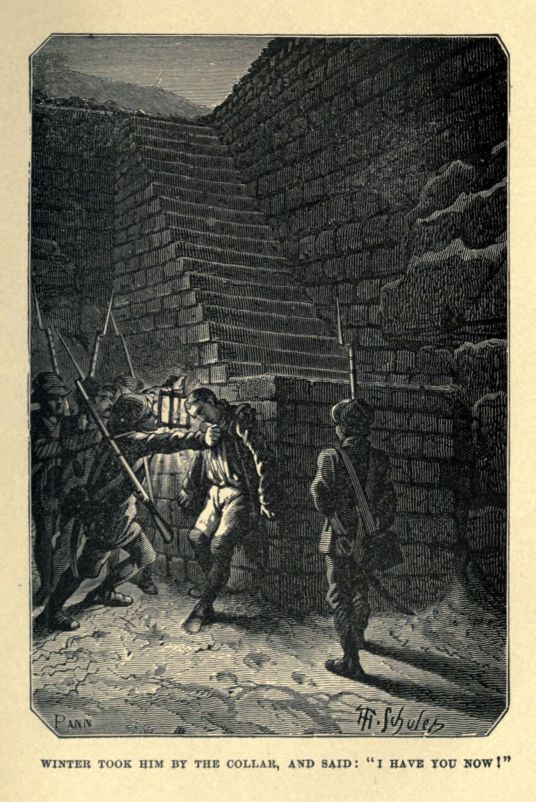
WINTER TOOK HIM BY THE COLLAR, AND SAID: "I HAVE YOU NOW!"
Then he tore an epaulette from his shoulder: "You are not worthy to wear that!" said he; "come along!"
He dragged him out of his corner, and held the lantern before his face. We saw a handsome boy of eighteen or nineteen, tall and slender, with small, light mustaches, and blue eyes.
Seeing him there so pale, with Winter's fist at his throat, I thought of the poor boy's father and mother; my heart smote me, and I could not help Baying: "Come, Winter, he is a child, a mere child! He will not do it again!"
But Winter, who thought that now surely his cross was won, turned upon me furiously:
"I tell thee what, Jew, stop, or I will run my bayonet through thy body!"
"Wretch!" thought I, "what will not a man do to make sure of his glass of wine for the rest of his days?"
I had a sort of horror of that man; there are wild beasts in the human race!
Chevreux, Somme, and Dubourg did not speak.
Winter began to walk toward the postern, with his hand on the deserter's collar.
"If he stops," said he, "strike him on the back with your muskets! Ah, scoundrel, you desert in the face of the enemy! Your case is clear: next Sunday you will sleep under the turf of the half-moon! Will you come on? Strike him with the butt-end, you cowards!"
What pained me most was to hear the poor fellow's heavy sighs; he breathed so hard, from his fright at being taken, and knowing that he would be shot, that we could hear him fifteen paces off; the sweat ran down my forehead. And now and then he turned to me and gave me such a look as I shall never forget, as if to say: "Save me!"
If I had been alone with Dubourg and Chevreux, we would have let him go; but Winter would sooner have murdered him.
We came in this way to the foot of the postern. They made the deserter pass first. When we reached the top, a sergeant, with four men from the next station, was already there, waiting for us.
"What is it?" asked the sergeant.
"A deserter," said Winter.
The sergeant—an old man—looked at him, and said: "Take him to the station."
"No," said Winter, "he will go with us to the station on the square."
"I will reinforce you with two men," said the sergeant.
"We do not need them," replied Winter roughly. "We took him ourselves, and we are enough to guard him."
The sergeant saw that we ought to have all the glory of it, and he said no more.
We started off again, shouldering our arms; the prisoner, all in tatters and without his shako, walked in the midst.
We soon came to the little square; we had only to cross the old market before reaching the guard-house. The cannon of the arsenal were firing all the time; as we were starting to leave the market, one of the flashes lighted up the arch in front of us; the prisoner saw the door of the jail at the left, with its great locks, and the sight gave him terrible strength; he tore off his collar, and threw himself from us with both arms stretched out behind.
Winter had been almost thrown down, but he threw himself at once upon the deserter, exclaiming, "Ah, scoundrel, you want to run away!"
We saw no more, for the lantern fell to the ground.
"Guard! guard!" cried Chevreux.
All this took but a moment, and half of the infantry post were already there under arms. Then we saw the prisoner again; he was sitting on the edge of the stairway among the pillars; blood was running from his mouth; not more than half his waistcoat was left, and he was bent forward, trembling from head to foot.
Winter held him by the nape of the neck, and said to Lieutenant Schnindret, who was looking on: "A deserter, lieutenant! He has tried to escape twice, but Winter was on hand."
"That is right," said the lieutenant. "Let them find the jailer."
Two soldiers went away. A number of our comrades of the National Guard had come down, but nobody spoke. However hard men may be, when they see a wretch in such a condition, and think, "the day after to-morrow he will be shot!" everybody is silent, and a good many would even release him if they could.
After some minutes Harmantier arrived with his woollen jacket and his bunch of keys.
The lieutenant said to him, "Lock up this man!"
"Come, get up and walk!" he said to the deserter, who rose and followed Harmantier, while everybody crowded round.
The jailer opened the two massive doors of the prison; the prisoner entered without resistance, and then the large locks and bolts fastened him in.
"Every man return to his post!" said the lieutenant to us. And we went up the steps of the mayoralty.
All this had so upset me that I had not thought of my wife and children. But when once above, in the large warm room, full of smoke, with all that set who were laughing and boasting at having taken a poor, unresisting deserter, the thought that I was the cause of this misery filled my soul with anguish; I stretched myself on the camp-bed, and thought of all the trouble that is in the world, of Zeffen, of Sâfel, of my children, who might, perhaps, some day be arrested for not liking war. And the words of the Lord came to my mind, which He spake to Samuel, when the people desired a king:
"Hearken unto the voice of the people in all that they say unto thee; for they have not rejected thee, but they have rejected me, that I should not reign over them. Howbeit yet protest solemnly unto them, and show them the manner of the king that shall reign over them. He will take your sons and appoint them for himself; and some shall run before his chariots. He will set them to make his instruments of war. And he will take your daughters to be cooks and bakers. And he will take your fields and your vineyards, and your olive-yards, even the best of them, and give them to his servants. He will take your men-servants, and your maid-servants, and your goodliest young men. He will take the tenth of your sheep; and ye shall be his servants. And ye shall cry out in that day, and the Lord will not hear you."
These thoughts made me very wretched; my only consolation was in knowing that my sons Frômel and Itzig were in America. I resolved to send Sâfel, David, and Esdras there also, when the time should come.
These reveries lasted till daylight. I heard no longer the shouts of laughter or the jokes of the ragamuffins. Now and then they would come and shake me, and say, "Go, Moses, and fill your brandy jug! The sergeant gives you leave."
But I did not wish to hear them.
About four o'clock in the morning, our arsenal cannon having dismounted the Russian howitzers on the Quatre-Vents hill, the patrols ceased.
Exactly at seven we were relieved. We went down, one by one, our muskets on our shoulders. We were ranged before the mayoralty, and Captain Vigneron gave the orders: "Carry arms! Present arms! Shoulder arms! Break ranks!"
We all dispersed, very glad to get rid of glory.
I was going to run at once to the casemates when I had laid aside my musket, to find Sorlé, Zeffen, and the children; but what was my joy at seeing little Sâfel already at our door! As soon as he saw me turn the corner, he ran to me, exclaiming: "We have all come back! We are waiting for you!"
I stooped to embrace him. At that moment Zeffen opened the window above, and showed me her little Esdras, and Sorlé stood laughing behind them. I went up quickly, blessing the Lord for having delivered us from all our troubles, and exclaiming inwardly: "The Lord is merciful and gracious, slow to anger and plenteous in mercy. Let the glory of the Lord endure forever! Let the Lord rejoice in his works!"
XIV
BURGUET'S VISIT TO THE DESERTER
I still think it one of the happiest moments of my life, Fritz. Scarcely had I come up the stairs when Zeffen and Sorlé were in my arms; the little ones clung to my shoulders, and I felt their lovely full lips on my cheeks; Sâfel held my hand, and I could not speak a word, but my eyes filled with tears.
Ah! if we had had Baruch with us, how happy we should have been!
At length I went to lay aside my musket, and hang my cartridge-box in the alcove. The children were laughing, and joy was in the house once more. And when I came back in my old beaver cap, and my large, warm woollen stockings, and sat down in the old arm-chair, in front of the little table set with porringers, in which Zeffen was pouring the soup; when I was again in the midst of all these happy faces, bright eyes, and outstretched hands, I could have sung like an old lark on his branch, over the nest where his little ones were opening their beaks and flapping their wings.
I blessed them in my heart a hundred times over. Sorlé, who saw in my eyes what I was thinking, said: "They are all together, Moses, just as they were yesterday; the Lord has preserved them."
"Yes, blessed be the name of the Lord, forever and ever!" I replied.
While we were at breakfast, Zeffen told me about their going to the large casemate at the barracks, how it was full of people stretched on their mattresses in every direction—the cries of some, the fright of others, the torment from the vermin, the water dropping from the arch, the crowds of children who could not sleep, and did nothing but cry, the lamentations of five or six old men who kept calling out, "Ah! our last hour has come! Ah! how cold it is! Ah! we shall never go home—it is all over!"
Then suddenly the deep silence of all, when they heard the cannon about ten o'clock—the reports, coming slowly at first, then like the roar of a tempest—the flashes, which could be seen even through the blindages of the gate, and old Christine Evig telling her beads as loud as if she were in a procession, and the other women responding together.
As she told me this, Zeffen clasped her little Esdras tightly, while I held David on my knees, embracing him as I thought to myself, "Yes, my poor children, you have been through a great deal!"
Notwithstanding the joy of seeing that we were all safe, the thought of the deserter in his dungeon at the town-house would come to me; he too had parents! And when you think of all the trouble which a father and mother have in bringing up a child, of the nights spent in soothing his cries, of their cares when he is sick, of their hopes in seeing him growing up; and then imagine to yourself some old soldiers sitting around a table to try him, and coolly send him to be shot behind the bastion, it makes you shudder, especially when you say to yourself: "But for me, this boy would have been at liberty; he would be on the road to his village; to-morrow perhaps he would have reached the poor old people's door, and have called out to them, 'Open! it is I!'"
Such thoughts are enough to make one wild.
I did not dare to speak to my wife and children of the poor fellow's arrest; I kept my thoughts to myself.
Without, the detachments from La Roulette, Trois-Maisons, and La Fontaine-du-Chateau, passed through the street, keeping step; groups of children ran about the city to find the pieces of shells; neighbors collected to talk about the events of the night—the roofs torn off, chimneys thrown down, the frights they had had. We heard their voices rising and falling, and their shouts of laughter. And I have since seen that it is always the same thing after a bombardment; the shower is forgotten as soon as it is over, and they exclaim: "Huzza! the enemy is routed!"
While we were there meditating, some one came up the stairs. We listened, and our sergeant, with his musket on his shoulder, and his cape and gaiters covered with mud, opened the door, exclaiming: "Good for you, Father Moses! Good for you!—You distinguished yourself last night!"
"Ha! what is it, sergeant?" asked my wife in astonishment.
"What! has he not told you of the famous thing he did, Madame Sorlé? Has he not told you that the national guard Moses, on patrol about nine o'clock at the Hospital bastion, discovered and then arrested a deserter in the very act! It is on Lieutenant Schnindret's affidavit!"
"But I was not alone," I exclaimed in despair; "there were four of us."
"Bah! You discovered the track, you went down into the trenches, you carried the lantern! Father Moses, you must not try to make your good deed seem less; you are wrong. You are going to be named for corporal. The court-martial will sit to-morrow at nine. Be easy, they will take care of your man!"
Imagine, Fritz, how I looked; Sorlé, Zeffen, and the children looked at me, and I did not know what to say.
"Now I must go and change my clothes," said the sergeant, shaking my hand. "We will talk about it again, Father Moses. I always said that you would turn out well in the end."
He gave a low laugh as was his custom, winking his eyes, and then went across the passage into his room.
My wife was very pale.
"Is it true, Moses?" she asked after a minute.
"He! I did not know that he wanted to desert, Sorlé," I replied. "And then the boy ought to have looked round on all sides; he ought to have gone down on the Hospital square, gone round the dunghills, and even into the lane to see if any one was coming; he brought it on himself; I did not know anything, I——"
But Sorlé did not let me finish.
"Run quickly, Moses, to Burguet's!" she exclaimed; "if this man is shot, his blood will be upon our children. Make haste, do not lose a minute."
She raised her hands, and I went out, much troubled.
My only fear was that I should not find Burguet at home; fortunately, on opening his door, on the first floor of the old Cauchois house, I saw the tall barber Vésenaire shaving him, in the midst of the old books and papers which filled the room.
Burguet was sitting with the towel at his chin.
"Ah! It is you, Moses!" he exclaimed, in a glad tone. "What gives me the pleasure of a visit from you?"
"I come to ask a favor of you, Burguet."
"If it is for money," said he, "we shall have difficulty."
He laughed, and his servant-woman, Marie Loriot, who heard us from the kitchen, opened the door, and thrust her red head-gear into the room, as she called out, "I think that we shall have difficulty! We owe Vésenaire for three months' shaving; do not we, Vésenaire?"
She said this very seriously, and Burguet, instead of being angry, began to laugh. I have always fancied that a man of his talents had a sort of need of such an incarnation of human stupidity to laugh at, and help his digestion. He never was willing to dismiss this Marie Loriot.
In short, while Vésenaire kept on shaving him, I gave him an account of our patrol and the arrest of the deserter; and begged him to defend the poor fellow. I told him that he alone was able to save him, and restore peace, not only to my own mind, but to Sorlé, Zeffen, and the whole family, for we were all in great distress, and we depended entirely upon him to help us.
"Ah! you take me at my weak point, Moses! If it is possible for me to save this man, I must try. But it will not be an easy matter. During the last fortnight, desertions have begun—the court-martial wishes to make an example. It is a bad business. You have money, Moses; give Vésenaire four sous to go and take a drop."
I gave four sous to Vésenaire, who made a grand bow and went out. Burguet finished dressing himself.
"Let us go and see!" said he, taking me by the arm.
And we went down together on our way to the mayoralty.
Many years have passed since that day. Ah, well! it seems now as if we were going under the arch, and I heard Burguet saying: "Hey, sergeant! Tell the turnkey that the prisoner's advocate is here."
Harmantier came, bowed, and opened the door. We went down into the dungeon full of stench, and saw in the right-hand corner a figure gathered in a heap on the straw.
"Get up!" said Harmantier, "here is your advocate."
The poor wretch moved and raised himself in the darkness. Burguet leaned toward him and said: "Come! Take courage! I have come to talk with you about your defence."
And the other began to sob.
When a man has been knocked down, torn to tatters, beaten till he cannot stand, when he knows that the law is against him, that he must die without seeing those whom he loves, he becomes as weak as a baby. Those who maltreat their prisoners are great villains.
"Let us see!" said Burguet. "Sit down on the side of your camp-bed. What is your name? Where did you come from? Harmantier, give this man a little water to drink and wash himself!"
"He has some, M. Burguet; he has some in the corner."
"Ah, well!"
"Compose yourself, my boy!"
The more gently he spoke, the more did the poor fellow weep. At last, however, he said that his family lived near Gérarmer, in the Vosges; that his father's name was Mathieu Belin, and that he was a fisherman at Retournemer.
Burguet drew every word out of his mouth; he wanted to know every particular about his father and mother, his brothers and sisters.
I remember that his father had served under the Republic, and had even been wounded at Fleurus; that his oldest brother had died in Russia; that he himself was the second son taken from home by the conscription, and that there was still at home three sisters younger than himself.
This came from him slowly; he was so prostrated by Winter's blows, that he moved and sank down like a soulless body.
There was still another thing, Fritz, as you may think—the boy was young! and that brought to my mind the days when I used to go in two hours from Phalsburg to Marmoutier, to see Sorlé—Ah, poor wretch! As he told all this, sobbing, with his face in his hands, my heart melted within me.
Burguet was quite overcome. When we were leaving, at the end of an hour, he said, "Come, let us be hopeful! You will be tried to-morrow.—Don't despair! Harmantier, we must give this man a cloak; it is dreadfully cold, especially at night. It is a bad business, my boy, but it is not hopeless. Try to appear as well as you can before the audience; the court-martial always thinks better of a man who is well dressed."
When we were out, he said to me: "Moses, you send the man a clean shirt. His waistcoat is torn; don't forget to have him decently dressed every way; soldiers always judge of a man by his appearance."
"Be easy about that," said I.
The prison doors were closed, and we went across the market.
"Now," said Burguet, "I must go in. I must think it over. It is well that the brother was left in Russia, and that the father has been in the service—it is something to make a point of."
We had reached the corner of the rampart street; he kept on, and I went home more miserable than before.
You cannot imagine, Fritz, how troubled I was; when a man has always had a quiet conscience it is terrible to reproach one's self, and think: "If this man is shot, if his father, and mother, and sisters, and that other one, who is expecting him, are made miserable, thou, Moses, wilt be the cause of it all!"
Fortunately there was no lack of work to be done at home; Sorlé had just opened the old shop to begin to sell our brandies, and it was full of people. For a week the keepers of coffee-houses and inns had had nothing wherewith to fill their casks; they were on the point of shutting up shop. Imagine the crowd! They came in a row, with their jugs and little casks and pitchers. The old topers came too, sticking out their elbows; Sorlé, Zeffen, and Sâfel had not time to serve them.
The sergeant said that we must put a policeman at our door to prevent quarrels, for some of them said that they lost their turn, and that their money was as good as anybody's.
It will be a good many years before such a crowd will be seen again in front of a Phalsburg shop.
I had only time to tell my wife that Burguet would defend the deserter, and then went down into the cellar to fill the two tuns at the counter, which were already empty.
A fortnight after, Sorlé doubled the price; our first two pipes were sold, and this extra price did not lessen the demand.
Men always find money for brandy and tobacco, even when they have none left for bread. This is why governments impose their heaviest taxes upon these two articles; they might be heavier still without diminishing their use—only, children would starve to death.
I have seen this—I have seen this great folly in men, and I am astonished whenever I think of it.
That day we kept on selling until seven o'clock in the evening, when the tattoo was sounded.
My pleasure in making money had made me forget the deserter; I did not think of him again till after supper, when night set in; but I did not say a word about him; we were all so tired and so delighted with the day's profits that we did not want to be troubled with thinking of such things. But after Zeffen and the children had retired, I told Sorlé of our visit to the prisoner. I told her, too, that Burguet had hopes, which made her very happy.
About nine o'clock, by God's blessing, we were all asleep.
XV
TRIAL OF THE DESERTER
You can believe, Fritz, that I did not sleep much that night, notwithstanding my fatigue. The thought of the deserter tormented me. I knew that if he should be shot, Zeffen and Sorlé would be inconsolable; and I knew, too, that after three or four years the vile race would say: "Look at this Moses, with his large brown cloak, his cape turned down over the back of his neck, and his respectable look—well, during the blockade he caused the arrest of a poor deserter, who was shot: so much you can trust a Jew's appearance!"
They would have said this, undoubtedly; for the only consolation of villains is to make people think that everybody is like themselves.
And then how often should I reproach myself for this man's death, in times of misfortune or in my old age, when I should not have a minute's peace! How often should I have said that it was a judgment of the Lord, that it was on account of this deserter.
So I wanted to do immediately all that I could, and by six o'clock in the morning I was in my old shop in the market with my lantern, selecting epaulettes and my best clothes. I put them in a napkin and took them to Harmantier at daybreak.
The special council of war, which was called—I do not know why—the Ventose council, was to meet at nine o'clock. It was composed of a major, president, four captains, and two lieutenants. Monbrun, the captain of the foreign legion, was judge-advocate, and Brigadier Duphot recorder.
It was astonishing how the whole city knew about it beforehand, and that by seven o'clock the Nicaises, and Pigots, and Vinatiers, etc., had left their rickety quarters, and had already filled the whole mayoralty, the arch, the stairway, and the large room above, laughing, whistling, stamping, as if it were a bear-fight at Klein's inn, the "Ox."
You do not see things like that nowadays, thank God! men have become more gentle and humane. But after all these wars, a deserter met with less pity than a fox caught in a trap, or a wolf led by the muzzle.
As I saw all this, my courage failed; all my admiration for Burguet's talents could not keep me from thinking:
The man is lost! Who can save him, when this crowd has come on purpose to see him condemned to death, and led to the Glacière bastion?
I was overwhelmed by the thought.
I went trembling into Harmantier's little room, and said to him: "This is for the deserter; take it to him from me." "All right!" said he.
I asked him if he had confidence in Burguet. He shrugged his shoulders, and said: "We must have examples."
The stamping outside continued, and when I went out there was a great whistling in the balcony, the arch, and everywhere, and shouts of "Moses! hey, Moses! this way!"
But I did not turn my head, and went home very sad.
Sorlé handed me a summons to appear as a witness before the court-martial, which a gendarme had just brought; and till nine o'clock I sat meditating behind the stove, trying to think of some way of escape for the prisoner.
Sâfel was playing with the children; Zeffen and Sorlé had gone down to continue our sales.
A few minutes before nine I started for the townhouse, which was already so crowded that, had it not been for the guard at the door, and the gendarmes scattered within the building, the witnesses could hardly have got in.
Just as I got there, Captain Monbrun was beginning to read his report. Burguet sat opposite, with his head leaning on his hand.
They showed me into a little room, where were Winter, Chevreux, Dubourg, and the gendarme Fiegel; so that we didn't hear anything before being called.
On the wall at the right it was written in large letters that any witness who did not tell the truth, should be delivered to the council, and suffer the same penalty as the accused. This made one consider, and I resolved at once to conceal nothing, as was right and sensible. The gendarme also informed us that we were forbidden to speak to each other.
After a quarter of an hour Winter was summoned, and then, at intervals of ten minutes, Chevreux, Dubourg, and myself.
When I went into the court-room, the judges were all in their places; the major had laid his hat on the desk before him; the recorder was mending his pen. Burguet looked at me calmly. Without they were stamping, and the major said to the brigadier:
"Inform the public that if this noise continues, I shall have the mayoralty cleared."
The brigadier went out at once, and the major said to me:
"National guard Moses, make your deposition. What do you know?"
I told it all simply. The deserter at the left, between two gendarmes, seemed more dead than alive. I would gladly have acquitted him of everything; but when a man fears for himself, when old officers in full dress are scowling at you as if they could see through you, the simplest and best way is not to lie. A father's first thought should be for his children! In short, I told everything that I had seen, nothing more or less, and at last the major said to me:
"That is enough; you may go."
But seeing that the others, Winter, Chevreux, Dubourg, remained sitting on a bench at the left, I did the same.
Almost immediately five or six good-for-nothings began to stamp and murmur, "Shoot him! shoot him!" The president ordered the brigadier to arrest them, and in spite of their resistance they were all led to prison. Silence was then established in the court-room, but the stampings without continued.
"Judge-advocate, it is your turn to speak," said the major.
This judge-advocate, who seems now before my eyes, and whom I can almost hear speak, was a man of fifty, short and thick, with a short neck, long, thick, straight nose, very wide forehead, shining black hair, thin mustaches, and bright eyes. While he was listening, his head turned right and left as if on a pivot; you could see his long nose and the corner of his eye, but his elbows did not stir from the table. He looked like one of those large crows which seem to be sleeping in the fields at the close of autumn, and yet see everything that is going on around them.
Now and then he raised his arm as if to draw back his sleeve, as advocates have a way of doing. He was in full dress, and spoke terribly well, in a clear and strong voice, stopping and looking at the people to see if they agreed with him; and if he saw even a slight grimace, he began again at once in some other way, and, as it were, obliged you to understand in spite of yourself.
As he went on very slowly, without hurrying or forgetting anything, to show that the deserter was on the road when we arrested him, that he not only had the intention of escaping, but was already outside of the city, quite as guilty as if he had been found in the ranks of the enemy—as he clearly showed all this, I was angry because he was right, and I thought to myself, "Now, what was there to be said in reply."
And then, when he said that the greatest of crimes was to abandon one's flag, because one betrays at once his country, his family, all that has a right to his life, and makes himself unworthy to live; when he said that the court would follow the conscience of all who had a heart, of all who held to the honor of France; that he would give a new example of his zeal for the safety of the country and the glory of the Emperor; that he would show the new recruits that they could only succeed by doing their duty and by obeying orders; when he said all this with terrible power and clearness, and I heard from time to time, a murmur of assent and admiration, then, Fritz, I thought that the Lord alone was able to save that man!
The deserter sat motionless, his arms folded on the dock, and his face upon them. He felt, doubtless, as I did, and every one in the room, and the court itself. Those old men seemed pleased as they heard the judge-advocate express so well what had all along been their own opinion. Their faces showed their satisfaction.
This lasted for more than an hour. The captain sometimes stopped a moment to give his audience time to reflect on what he had said. I have always thought that he must have been attorney-general, or something more dangerous still to deserters.
I remember that he said, in closing, "You will make an example! You will be of one mind. You will not forget that, at this time, firmness in the court is more necessary than ever to the safety of the country."
When he sat down, such a murmur of approbation arose in the room that it reached the stairway at once, and we heard the shouts outside, "Vive l'Empereur!"
The major and the other members of the council looked smilingly at each other, as if to say, "It is all settled. What remains is a mere formality!"
The shouts without increased. This lasted more than ten minutes. At last the major said:
"Brigadier, if the tumult continues, clear the town-house! Begin with the court-room!"
There was silence at once, for every one was curious to know what Burguet would say in reply. I would not have given two farthings for the life of the deserter.
"Counsel for the prisoner, you have the floor!" said the major, and Burguet rose.
Now, Fritz, if I had an idea that I could repeat to you what Burguet said, for a whole hour, to save the life of a poor conscript; if I should try to depict his face, the sweetness of his voice, and then his heart-rending cries, and then his silent pauses and his appeals—if I had such an idea, I should consider myself a being full of pride and vanity!
No; nothing finer was ever heard. It was not a man speaking; it was a mother, trying to snatch her babe from death! Ah! what a great thing it is to have this power of moving to tears those who hear us! But we ought not to call it talent, it is heart.
"Who is there without faults? Who does not need pity?"
This is what he said, as he asked the council if they could find a perfectly blameless man; if evil thoughts never came to the bravest; if they had never, for even a day or a moment, had the thought of running away to their native village, when they were young, when they were eighteen, when father and mother and the friends of their childhood were living, and they had not another in the world. A poor child without instruction, without knowledge of the world, brought up at hap-hazard, thrown into the army—what could you expect of him? What fault of his could not be pardoned? What does he know of country, the honor of his flag, the glory of his Majesty? Is it not later in life that these great ideas come to him?
And then he asked those old men if they had not a son, if they were sure that, even at that moment, that son were not committing an offence which was liable to the punishment of death. He said to them:
"Plead for him! What would you say? You would say, 'I am an old soldier. For thirty years I have shed my blood for France. I have grown gray upon the battle-fields, I am riddled with wounds, I have gained every rank at the point of the sword. Ah, well! take my epaulettes, take my decorations, take everything; but save my child! Let my blood be the ransom for his offence! He does not know the greatness of his crime; he is too young; he is a conscript; he loved us; he longed to embrace us, and then go back again—he loved a maiden. Ah! you, too, have been young! Pardon him. Do not disgrace an old soldier in his son.'
"Perhaps you could say, too, 'I had other sons. They died for their country. Let their blood answer for his, and give me back this one—the last that I have left!'
"This is what you would say, and far better than I, because you would be the father, the old soldier speaking of his own services! Well, the father of this youth could speak like you! He is an old soldier of the Republic! He went with you, perhaps, when the Prussians entered Champagne! He was wounded at Fleurus! He is an old comrade in arms! His oldest son was left behind in Russia!"
And Burguet turned pale as he spoke. It seemed as if grief had robbed him of his strength, and he were about to fall. The silence was so great that we heard the breathing throughout the court-room. The deserter sobbed. Everybody thought, "It is done! Burguet need say no more! It must be that he has gained his cause!"
But all at once he began again in another and more tender manner. Speaking slowly, he described the life of a poor peasant and his wife, who had but one comfort, one solitary hope on earth—their child! As we listened we saw these poor people, we heard them talk together, we saw over the door the old chapeau of the time of the Republic. And when we were thinking only of this, suddenly Burguet showed us the old man and his wife learning that their son had been killed, not by Russians or Germans, but by Frenchmen. We heard the old man's cry!
But it was terrible, Fritz! I wanted to run away. The officers of the council, several of whom were married men, looked before them with fixed eyes, and clinched hands; their gray mustaches shook. The major had raised his hand two or three times, as if to signify that it was enough, but Burguet had always something still more powerful, more just, more grand to add. His plea lasted till nearly eleven, when he sat down. There was not a murmur to be heard in the three rooms nor outside. And the judge-advocate on the other side began again, saying that all that signified nothing, that it was unfortunate for the father that his son was unworthy, that every man clung to his children, that soldiers must be taught not to desert in face of the enemy; that, if the court yielded to such arguments, nobody would ever be shot, discipline would be utterly destroyed, the army could not exist, and that the army was the strength and glory of the country.
Burguet replied almost immediately. I cannot recall what he said; my head could not hold so many things at once: but I shall never forget this, that about one o'clock, the council having sent us away that they might deliberate—the prisoner meanwhile having been taken back to his cell—after a few minutes we were allowed to return, and the major, standing on the platform where conscriptions were drawn, declared that the accused Jean Balin was acquitted, and gave the order for his immediate release.
It was the first acquittal since the departure of the Spanish prisoners before the blockade; the rowdies, who had come in crowds to see a man condemned and shot, could not believe it; several of them exclaimed: "We are cheated!"
But the major ordered Brigadier Descarmes to take the names of these brawlers, so that they should be seen to; then the whole mass trampled down the stairs in five minutes, and we, in our turn, were able to descend.
I had taken Burguet by the arm, my eyes full of tears.
"Are you satisfied, Moses?" said he, already quite his own joyous self again.
"Burguet!" said I, "Aaron himself, the own brother of Moses, and the greatest orator of Israel, could not have spoken better than you did; it was admirable! I owe my peace of mind to you! Whatever you may ask for so great a service I am ready to give to the extent of my means."
We went down the stairs; the members of the council following us thoughtfully, one by one. Burguet smiled.
"Do you mean it, Moses?" said he, stopping under the arch.
"Yes, here is my hand."
"Very well!" said he, "I ask you to give me a good dinner at the Ville-de-Metz."
"With all my heart!"
Several citizens, Father Parmentier, Cochois the tax-gatherer, and Adjutant Muller, were waiting for Burguet at the foot of the mayoralty steps, to congratulate him. As they were surrounding and shaking hands with him, Sâfel came and rushed into my arms; Zeffen had sent him to learn the news. I embraced him, and said joyously: "Go, tell your mother that we have won! Take your dinner. I am going to dine at the Ville-de-Metz with Burguet. Make haste, my child!"
He started running.
"You dine with me, Burguet," said Father Parmentier.
"Thank you, Mr. Mayor, I am engaged to dine with Moses; I will go at another time."
And, with our arms around each other, we entered Mother Barrière's large corridor, where there was still the odor of good roasts, in spite of the blockade.
"Listen, Burguet," said I; "we are going to dine alone, and you shall choose whatever wines and dishes you like best; you know them better than I do."
I saw his eyes sparkle.
"Good! good!" said he, "it is understood."
In the large dining-hall the war-commissioner and two officers were dining together; they turned round, and we saluted them.
I sent for Mother Barrière, who came at once, her apron on her arm, as smiling and chubby as usual. Burguet whispered a couple of words in her ear, and she instantly opened the door at the right, and said:
"Walk in, gentlemen, walk in! You will not have to wait long."
We went into the square room at the corner of the square, a small, high room, with two large windows covered with muslin curtains, and the porcelain stove well heated, as it should be in winter.
A servant came to lay the table, while we warmed our hands upon the marble.
"I have a good appetite, Moses; my pleading is going to cost you dear," said Burguet, laughing.
"So much the better; it cannot be too dear for the gratitude I owe you."
"Come," said he, putting his hand on my shoulder, "I won't ruin you, but we must have a good dinner."
When the table was ready, we sat down, opposite each other, in soft, comfortable arm-chairs; and Burguet, fastening his napkin in his button-hole, as was his custom, took up the bill of fare. He pondered over it a long time; for you know, Fritz, that though nightingales are good singers, they have the sharpest beaks in the world. Burguet was like them, and I was delighted at seeing him thus meditating.
At last he said to the servant, slowly and solemnly:
"This and that, Madeleine, cooked so and so. And such a wine to begin with, and such another at the end."
"Very well, M. Burguet," replied Madeleine, as she went out.
Two minutes afterward she brought us a good toast soup. During a blockade this was something greatly to be desired; three weeks later we should have been very fortunate to have got one.
Then she brought us some Bordeaux wine, warmed in a napkin. But you do not suppose, Fritz, that I am going to tell you all the details of this dinner? although I remember it all, with great pleasure, to this day. Believe me, there was nothing wanting, meats nor fresh vegetables, nor the large well-smoked ham, nor any of the things which are dreadfully scarce in a shut-up city. We had even salad! Madame Barrière had kept it in the cellar, in earth, and Burguet wished to dress it himself with olive oil. We had, too, the last juicy pears which were seen in Phalsburg, during that winter of 1814.
Burguet seemed happy, especially when the bottle of old Lironcourt was brought, and we drank together.
"Moses," said he with softened eyes, "if all my pleas had as good pay as you give, I would resign my place in college; but this is the first fee I have received."
"And if I were in your place, Burguet," I exclaimed, "instead of staying in Phalsburg, I would go to a large city. You would have plenty of good dinners, good hotels, and the rest would soon follow."
"Ah! twenty years ago this might have been good advice," said he, rising, "but it is too late now. Let us go and take our coffee, Moses."
Thus it is that men of great talents often bury themselves in small places, where nobody values them at their true worth; they fall gradually into their own ruts, and disappear without notice.
Burguet never forgot to go to the coffee-house at about five o'clock, to play a game of cards with the old Jew Solomon, whose trade it was. Burguet and five or six citizens fully supported this man, who took his beer and coffee twice a day at their expense, to say nothing of the crowns he pocketed for the support of his family.
So far as the others were concerned, I was not surprised at this, for they were fools! but for a man like Burguet I was always astonished at it; for, out of twenty deals, Solomon did not let them win more than one or two, with the risk before his eyes of losing his best practice, by discouraging them altogether.
I had explained this fifty times to Burguet; he assented, and kept on all the same.
When we reached the coffee-house, Solomon was already there, in the corner of a window at the left—his little dirty cap on his nose, and his old greasy frock hanging at the foot of the stool. He was shuffling the cards all by himself. He looked at Burguet out of the corner of his eye, as a bird-catcher looks at larks, as if to say:
"Come! I am here! I am expecting you!"
But Burguet, when with me, dared not obey the old man; he was ashamed of his weakness, and merely made a little motion of his head while he seated himself at the opposite table, where coffee was served to us.
The comrades came soon, and Solomon began to fleece them. Burguet turned his back to them; I tried to divert his attention, but his heart was with them; he listened to all the throws, and yawned in his hand.
About seven o'clock, when the room was full of smoke, and the balls were rolling on the billiard tables, suddenly a young man, a soldier, entered, looking round in all directions.
It was the deserter.
He saw us at last, and approached us with his foraging cap in his hand. Burguet looked up and recognized him; I saw him turn red; the deserter, on the contrary, was very pale; he tried to speak, but could not say a word.
"Ah! my friend!" said Burguet, "here you are, safe!"
"Yes, sir," replied the conscript, "and I have come to thank you for myself, for my father, and for my mother!"
"Ah!" said Burguet, coughing, "it is all right! it is all right!"
He looked tenderly at the young man, and asked him softly, "You are glad to live?"
"Oh! yes, sir," replied the conscript, "very glad."
"Yes," said Burguet, in a low voice, looking at the clock; "it would have been all over now! Poor child!"
And suddenly beginning to use the thou he said, "Thou hast had nothing with which to drink my health, and I have not another sou. Moses, give him a hundred sous."
I gave him ten francs. The deserter tried to thank me.
"That is good!" said Burguet, rising. "Go and take a drink with thy comrades. Be happy, and do not desert again."
He made as if he would follow Solomon's playing; but when the deserter said, "I thank you, too, for her who is expecting me!" he looked at me sideways, not knowing what to answer, so much was he moved. Then I said to the conscript, "We are very glad that we have been of assistance to you; go and drink the health of your advocate, and behave yourself well."
He looked at us for a moment longer, as if he were unable to move; we saw his thanks in his face, a thousand times better than he had been able to utter them. At length he slowly went out, saluting us, and Burguet finished his cup of coffee.
We meditated for some minutes upon what had passed. But soon the thought of seeing my family seized me.
Burguet was like a soul in purgatory. Every minute he got up to look on, as one or another played, with his hands crossed behind his back; then he sat down with a melancholy look. I should have been very sorry to plague him longer, and, as the clock struck eight, I bade him good-evening, which evidently pleased him.
"Good-night, Moses," said he, leading me to the door. "My compliments to Madame Sorlé, and Madame Zeffen."
"Thank you! I shall not forget it."
I went, very glad to return home, where I arrived in a few minutes. Sorlé saw at once that I was in good spirits, for, meeting her at the door of our little kitchen, I embraced her joyfully.
"It is all right, Sorlé," said I, "all just right!"
"Yes," said she, "I see that it is all right!"
She laughed, and we went into the room where Zeffen was undressing David. The poor little fellow, in his shirt, came and offered me his cheek to kiss. Whenever I dined in the city, I used to bring him some of the dessert, and, in spite of his sleepy eyes, he soon found his way to my pockets.
You see, Fritz, what makes grandfathers happy is to find out how bright and sensible their grandchildren are.
Even little Esdras, whom Sorlé was rocking, understood at once that something unusual was going on; he stretched out his little hands to me, as if to say, "I like cake too!"
We were all of us very happy. At length, having sat down, I gave them an account of the day, setting forth the eloquence of Burguet, and the poor deserter's happiness. They all listened attentively. Sâfel, seated on my knees, whispered to me, "We have sold three hundred francs' worth of brandy!"
This news pleased me greatly: when one makes an outlay, he ought to profit by it.
About ten o'clock, after Zeffen had wished us good-night, I went down and shut the door, and put the key underneath for the sergeant, if he should come in late.
While we were going to bed, Sorlé repeated what Sâfel had said, adding that we should be in easy circumstances when the blockade was over, and that the Lord had helped us in the midst of great calamities.
We were happy and without fear of the future.
XVI
A SORTIE OF THE GARRISON
Nothing extraordinary occurred for several days. The governor had the plants and bushes growing in the crevices of the ramparts torn away, to make desertion less easy, and he forbade the officers being too rough with the men, which had a good effect.
At this time, hundreds of thousands of Austrians, Russians, Bavarians, and Wurtemburgers, by squadrons and regiments, passed around the city beyond range of our cannon, and marched upon Paris.
Then there were terrible battles in Champagne, but we knew nothing of them.
The uniforms changed every day outside the city; our old soldiers on top of the ramparts recognized all the different nations they had been fighting for twenty years.
Our sergeant came regularly after the call, to take me upon the arsenal bastion; citizens were there all the time, talking about the invasion, which did not come to an end.
It was wonderful! In the direction of St. Jean, on the edge of the forest of La Bonne-Fontaine, we saw, for hours at a time, cavalry and infantry defiling, and then convoys of powder and balls, and then cannon, and then files of bayonets, helmets, red and green and blue coats, lances, peasants' wagons covered with cloth—all these passed, passed like a river.
On this broad white plateau, surrounded by forests, we could see everything.
Now and then some Cossacks or dragoons would leave the main body, and push on galloping to the very foot of the glacis, in the lane des Dames, or near the little chapel. Instantly one of our old marine artillerymen would stretch out his gray mustaches upon a rampart gun, and slowly take aim; the bystanders would all gather round him, even the children, who would creep between your legs, fearless of balls or shells—and the heavy rifle-gun would go off!
Many a time I have seen the Cossack or Uhlan fall from his saddle, and the horse rush back to the squadron with his bridle on his neck. The people would shout with joy; they would climb up on the ramparts and look down, and the gunner would rub his hands and say, "One more out of the way!"
At other times these old men, with their ragged cloaks full of holes, would bet a couple of sous as to who should bring down this sentinel or that vidette, on the Mittelbronn or Bichelberg hill.
It was so far that they needed good eyes to see the one they designated; but these men, accustomed to the sea, can discern everything as far as the eye can reach.
"Come, Paradis, there he is!" one would say.
"Yes, there he is! Lay down your two sous; there are mine!"
And they would fire. They would go on as if it were a game of ninepins. God knows how many men they killed for the sake of their two sous. Every morning about nine o'clock I found these marines in my shop, drinking "to the Cossack," as they said. The last drop they poured into their hands, to strengthen their nerves, and started off with rounded backs, calling out:
"Hey! good-day, Father Moses! The kaiserlich is very well!"
I do not think that I ever saw so many people in my life as in those months of January and February, 1814; they were like the locusts of Egypt! How the earth could produce so many people I could not comprehend.
I was naturally greatly troubled on account of it, and the other citizens also, as I need not say; but our sergeant laughed and winked.
"Look, Father Moses!" said he, pointing from Quatre-Vents to Bichelberg—"all these that are passing by, all that have passed, and all that are going to pass, are to enrich the soil of Champagne and Lorraine! The Emperor is down there, waiting for them in a good place—he will fall upon them! The thunder-bolt of Austerlitz, of Jena, of Wagram, is all ready—it can wait no longer! Then they will file back in retreat; but our armies will follow them, with our bayonets in their backs, and we shall go out from here, and flank them off. Not one shall escape. Their account is settled. And then will be the time for you to have old clothes and other things to sell, Father Moses! He! he! he! How fat you will grow!"
He was merry at the thought of it; but you may suppose, Fritz, that I did not count much upon those uniforms that were running across the fields; I would much rather they had been a thousand leagues away.
Such are men—some are glad and others miserable from the same cause. The sergeant was so confident that sometimes he persuaded me, and I thought as he did.
We would go down the rampart street together, he would go to the cantine where they had begun to distribute siege-rations, or perhaps he would go home with me, take his little glass of cherry-brandy, and explain to me the Emperor's grand strokes since '96 in Italy. I did not understand anything about it, but I made believe that I understood, which answered all the purpose.
There came envoys, too, sometimes on the road from Nancy, sometimes from Saverne or Metz. They raised, at a distance, the little white flag; one of their trumpeters sounded and then withdrew; the officer of the guard received the envoy and bandaged his eyes, then he went under escort through the city to the governor's house. But what these envoys told or demanded never transpired in the city; the council of defence alone were informed of it.
We lived confined within our walls as if we were in the middle of the sea, and you cannot believe how that weighs upon one after a while, how depressing and overpowering it is not to be able to go out even upon the glacis. Old men who had been nailed for ten years to their arm-chairs, and who never thought of moving, were oppressed by grief at knowing that the gates remained shut. And then every one wants to know what is going on, to see strangers and talk of the affairs of the country—no one knows how necessary these things are until he has had experience like ours. The meanest peasant, the lowest man in Dagsburg who might have chanced to come into the city, would have been received like a god; everybody would have run to see him and ask for the news from France.
Ah! those are right who hold that liberty is the greatest of blessings, for it is insupportable being shut up in a prison—let it be as large as France. Men are made to come and go, to talk and write, and live together, to carry on trade, to tell the news; and if you take these from them, you leave nothing desirable.
Governments do not understand this simple matter; they think that they are stronger when they prevent men from living at their ease, and at last everybody is tired of them. The true power of a sovereign is always in proportion to the liberty he can give, and not to that which he is obliged to take away. The allies had learned this for Napoleon, and thence came their confidence.
The saddest thing of all was that, toward the end of January, the citizens began to be in want. I cannot say that money was scarce, because a centime never went out of the city, but everything was dear; what three weeks before was worth two sous now cost twenty! This has often led me to think that scarcity of money is one of the fooleries invented by scoundrels to deceive the weak-minded. What else can make money scarce? You are not poor with two sous, if they are enough to buy your bread, wine, meat, clothes, etc.; but if you need twenty times more to buy these things, then not only are you poor, but the whole country is poor. There is no want of money when everything is cheap; it is always scarce when the necessaries of life are dear.
So, when people are shut up as we were, it is very fortunate to be able to sell more than you buy. My brandy sold for three francs the quart, but at the same time we needed bread, oil, potatoes, and their prices were all proportionately high.
One morning old Mother Queru came to my shop weeping; she had eaten nothing for two days! and yet that was the least thing, said she; she missed nothing but her glass of wine, which I gave her gratis. She gave me a hundred blessings and went away happy. A good many others would have liked their glass of wine! I have seen old men in despair because they had nothing to snuff; they even went so far as to snuff ashes; some at this time smoked the leaves of the large walnut-tree by the arsenal, and liked it well.
Unfortunately, all this was but the beginning of want: later we learned to fast for the glory of his Majesty.
Toward the end of February, it became cold again. Every evening they fired a hundred shells upon us, but we became accustomed to all that, till it seemed quite a thing of course. As soon as the shell burst everybody ran to put out the fire, which was an easy matter, since there were tubs full of water ready in every house.
Our guns replied to the enemy; but as after ten o'clock the Russians fired only with field-pieces, our men could aim only at their fire, which was changing continually, and it was not easy to reach them.
Sometimes the enemy fired incendiary balls; these are balls pierced with three nails in a triangle, and filled with such inflammable matter that it could be extinguished only by throwing the ball under water, which was done.
We had as yet had no fires; but our outposts had fallen back, and the allies drew closer and closer around the city. They occupied the Ozillo farm, Pernette's tile-kiln, and the Maisons-Rouges, which had been abandoned by our troops. Here they intended to pass the winter pleasantly. These were Wurtemburg, Bavarian, and Baden troops, and other landwehr, who replaced in Alsace the regular troops that had left for the interior.
We could plainly see their sentinels in long, grayish-blue coats, flat helmets, and muskets on their shoulders, walking slowly in the poplar alley which leads to the tile-kiln.
From thence these troops could any moment, on a dark night, enter the trenches, and even attempt to force a postern.
They were in large numbers and denied themselves nothing, having three or four villages around them to furnish their provisions, and the great fires of the tile-kiln to keep them warm.
Sometimes a Russian battalion relieved them, but only for a day or two, being obliged to continue its route. These Russians bathed in the little pond behind the building, in spite of the ice and snow which filled it.
All of them, Russians, Wurtemburgers, and Baden men, fired upon our sentinels, and we wondered that our governor had not stopped them with our balls. But one day the sergeant came in joyfully, and whispered to me, winking:
"Get up early to-morrow morning, Father Moses; don't say a word to any one, and follow me. You will see something that will make you laugh."
"All right, sergeant!" said I.
He went to bed at once, and long before day, about five o'clock, I heard him jump out of bed, which astonished me the more, as I had not heard the call.
I rose softly. Sorlé sleepily asked me: "What is it, Moses?"
"Go to sleep again, Sorlé," I replied; "the sergeant told me that he wanted to show me something."
She said no more, and I finished dressing myself.
Just then the sergeant knocked at the door; I blew out the candle, and we went down. It was very dark.
We heard a faint noise in the direction of the barracks; the sergeant went toward it, saying: "Go up on the bastion; we are going to attack the tile-kiln."
I ran up the street at once. As I came upon the ramparts I saw in the shadow of the bastion on the right our gunners at their pieces. They did not stir, and all around was still; matches lighted and set in the ground gave the only light, and shone like stars in the darkness.
Five or six citizens, in the secret, like myself, stood motionless at the entrance of the postern. The usual cries, "Sentries, attention!" were answered around the city; and without, from the part of the enemy, we heard the cries "Verdâ!" and "Souïda!"*
It was very cold, a dry cold, notwithstanding the fog.
Soon, from the direction of the square in the interior of the city, a number of men went up the street; if they had kept step the enemy would have heard them from the distance upon the glacis; but they came pell-mell, and turned near us into the postern stair-way. It took full ten minutes for them to pass. You can imagine whether I watched them, and yet I could not recognize our sergeant in the darkness.
The two companies formed again in the trenches after their defiling, and all was still.
My feet were perfectly numb, it was so cold; but curiosity kept me there.
At last, after about half an hour, a pale line stretched behind the bottom-land of Fiquet, around the woods of La Bonne-Fontaine. Captain Rolfo, the other citizens, and myself, leaned against the rampart, and looked at the snow-covered plain, where some German patrols were wandering in the fog, and nearer to us, at the foot of the glacis, the Wurtemburg sentinel stood motionless in the poplar alley which leads to the large shed of the tile-kiln.
Everything was still gray and indistinct; though the winter sun, as white as snow, rose above the dark line of firs. Our soldiers stood motionless, with grounded arms, in the covered ways. The "Verdâs!" and "Souïdas!" went their rounds. It grew lighter every moment.
No one would have believed that a fight was preparing, when six o'clock sounded from the mayoralty, and suddenly our two companies, without command, started, shouldering their arms, from the covered ways, and silently descended the glacis.
In less than a minute, they reached the road which stretches along the gardens, and defiled to the left, following the hedges.
You cannot imagine my fright when I found that the fight was about to begin. It was not yet clear daylight, but still the enemy's sentinel saw the line of bayonets filing behind the hedges, and called out in a terrible way: "Verdâ!"
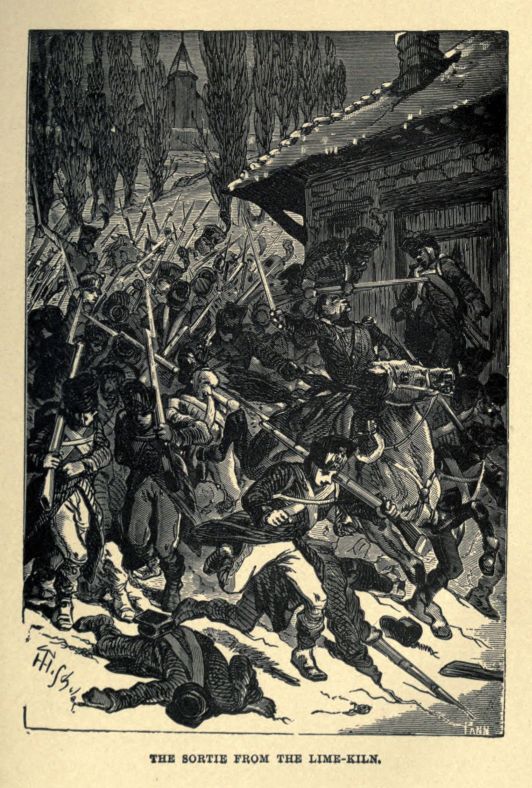
THE SORTIE FROM THE LIME-KILN.
"Forward!" replied Captain Vigneron, in a voice like thunder, and the heavy soles of our soldiers sounded on the hard ground like an avalanche.
The sentinel fired, and then ran up the alley, shouting I know not what. Fifteen of the landwehr, who formed the outpost under the old shed used for drying bricks, started at once; they did not have time for repentance, but were all massacred without mercy.
We could not see very well at that distance, through the hedges and poplars, but after the post was carried, the firing of the musketry and the horrible cries were heard even in the city.
All the unfortunate landwehr who were quartered in the Pernette farm-house—a large number of whom were undressed, like respectable men at home, so as to sleep more comfortably—jumped from the windows in their pantaloons, in their drawers, in their shirts, with their cartridge-boxes on their backs, and ranged themselves behind the tile-kiln, in the large Seltier meadow. Their officers urged them on, and gave their orders in the midst of the tumult.
There must have been six or seven hundred of them there, almost naked in the snow, and, notwithstanding their being thus surprised, they opened a running fire which was well sustained, when our two pieces on the bastion began to take part in the contest.
Oh! what carnage!
Looking down upon them, you should have seen the bullets hit, and the shirts fly in the air! And, what was worst for these poor wretches, they had to close ranks, because, after destroying everything in the tile-kiln, our soldiers went out to make an attack with their bayonets!
What a situation!—just imagine it, Fritz, for respectable citizens, merchants, bankers, brewers, innkeepers—peaceable men who wanted nothing but peace and quietness.
I have always thought, since then, that the landwehr system is a very bad one, and that it is much better to pay a good army of volunteers, who are attached to the country, and know that their pay, pensions, and decorations come from the nation and not from the government; young men devoted to their country like those of '92, and full of enthusiasm, because they are respected and honored in proportion to their sacrifices. Yes, this is what they ought to be—and not men who are thinking of their wives and children.
Our balls struck down these poor fathers and husbands by the dozen. To add to all these abominations, two other companies, sent out with the greatest secrecy by the council of defence from the posterns of the guard and of the German gate, and which came up, one by the Saverne road, and the other by the road of Petit-Saint-Jean, now began to outflank them, and forming behind them, fired upon them in the rear.
It must be confessed that these old soldiers of the Empire had a diabolical talent for stratagem! Who would ever have imagined such a stroke!
On seeing this, the remnant of the landwehr disbanded on the great white plain like a whirlwind of sparrows. Those who had not had time to put on their shoes did not mind the stones or briers or thorns of the Fiquet bottom; they ran like stags, the stoutest as fast as the rest.
Our soldiers followed them as skirmishers, stopping not a second except to make ready and fire. All the ground in front, up to the old beech in the middle of the meadow of Quatre-Vents, was covered with their bodies.
Their colonel, a burgomaster doubtless, galloped before them on horseback, his shirt flying out behind him.
If the Baden soldiers, quartered in the village, had not come to their assistance, they would all have been exterminated. But two battalions of Baden men being deployed at the right of Quatre-Vents, our trumpets sounded the recall, and the four companies formed in the alley des Dames to await them.
The Baden soldiers then halted, and the last of the Wurtemburgers passed behind them, glad to escape from such a terrible destruction. They could well say: "I know what war is—I have seen it at the worst!"
It was now seven o'clock—the whole city was on the ramparts. Soon a thick smoke rose above the tile-kiln and the surrounding buildings; some sappers had gone out with fagots and set it on fire. It was all burned to cinders; nothing remained but a great black space, and some rubbish behind the poplars.
Our four companies, seeing that the Baden soldiers did not mean to attack them, returned quietly, the trumpeter leading.
Long before this, I had gone down to the square, near the German gate, to meet our troops as they came back. It was one of the sights which I shall never forget; the post under arms, the veterans hanging by the chains of the lowered drawbridge; the men, women, and children pushing in the street; and outside, on the ramparts, the trumpets sounding, and answered from the distance by the echoes of the bastions and half-moon; the wounded, who, pale, tattered, covered with blood, came in first, supported on the shoulders of their comrades; Lieutenant Schnindret, in one of the tile-kiln armchairs, his face covered with sweat, with a bullet in his abdomen, shouting with thick voice and extended hand, "Vive l'Empereur!"; the soldiers who threw the Wurtemburg commander from his litter to put one of our own in it; the drums under the gate beating the march, while the troops, with arms at will, and bread and all kinds of provisions stuck on their bayonets, entered proudly in the midst of the shouts: "Hurra for the Sixth Light Infantry!" These are things which only old people can boast of having seen!
Ah, Fritz, men are not what they once were! In my time, foreigners paid the cost of war. The Emperor Napoleon had that virtue; he ruined not France, but his enemies. Nowadays we pay for our own glory.
And, in those times, the soldiers brought back booty, sacks, epaulettes, cloaks, officers' sashes, watches, etc., etc.! They remembered that General Bonaparte had said to them in 1796: "You need clothes and shoes; the Republic owes you much, she can give you nothing. I am going to lead you into the richest country in the world; there you will find honors, glory, riches!" In fine, I saw at once that we were going to sell glasses of wine at a great rate.
As the sergeant passed I called to him from the distance, "Sergeant!"
He saw me in the crowd, and we shook hands joyfully. "All right, Father Moses! All right!" he said.
Everybody laughed.
Then, without waiting for the end of the procession, I ran to the market to open my shop.
Little Sâfel had also understood that we were going to have a profitable day, for, in the midst of the crowd, he had come and pulled my coat-tails, and said, "I have the key of the market; I have it; let us make haste! Let us try to get there before Frichard!"
Whatever natural wit a child may have, it shows itself at once; it is truly a gift of God.
So we ran to the shop. I opened my windows, and Sâfel remained while I went home to eat a morsel, and get a good quantity of sous and small change.