THE BLOCKADE: (continued 2)
Reading edition
"He! he! Father Moses," said he, in a good-natured voice, "it has been a dreadful cold night." He did not look or speak like the same person.
"Yes, sergeant," I replied, "it is December, and that is what we must expect."
"What we must expect," he repeated;—"all the more reason for taking a drop. Let us see, is there any more of that old cherry-brandy?"
He looked, as he spoke, as if he could see through me. I got up at once from my arm-chair, and ran to fetch the bottle: "Yes, yes, sergeant," I exclaimed, "there is more, drink and enjoy it."
As I said this, his face, still a little hard, seemed to smile all over. He placed his gun in a corner, and, standing up, handed me the glass, saying, "Pour out, Father Moses, pour out!"
I filled it brimful. As I did so, he laughed quietly. His yellow face puckered up in hundreds of wrinkles at the corners of his eyes, and around his cheeks and mustaches and chin. He did not laugh so as to be heard, but his eyes showed his good-humor.
"Famous cherry-brandy this, in truth, Father Moses!" he said as he drank it. "A body knows who has drank it in the Black Forest, where it cost nothing! Aren't you going to drink with me?"
"With pleasure," I answered. And we drank together. He looked at me all the time. Suddenly he said, with a mischievous look, "Hey, Father Moses, say, you were afraid of me yesterday?" He smiled as he spoke.
"Oh—Sergeant——"
"Come, come," said he, laying his hand upon my shoulder—"confess that I frightened you."
He smiled so pleasantly that I could not help saying: "Well, yes, a little!"
"He! he! he! I knew it very well," said he. "You had heard them say, 'Sergeant Trubert is a tough one!' You were afraid, and you gave me a dinner fit for a prince to coax me!"
He laughed aloud, and I ended by laughing too. Sorlé had heard all, in the next room, and now came to the door and said, "Good-morning, Mr. Sergeant."
He exclaimed, "Father Moses, here is what may be called a woman! You can boast of having a spirited woman, a sly woman, slyer than you are, Father Moses; he, he, he! That is as it should be—that is as it should be!"
Sorlé was delighted.
"Oh! Mr. Sergeant," said she, "can you really think so?"
"Bah! bah!" he exclaimed. "You are a first-rate woman! I saw you when I first came, and said to myself, 'Take heed, Trubert! They make a fair pretence; it is a stratagem to send you to the hotel to sleep. We will let the enemy unmask his batteries!'
"Ha! ha! ha! You are nice folks. You gave me a dinner fit for a Marshal of the Empire. Now, Father Moses, I invite myself to take a small glass of cherry-brandy with you now and then. Put the bottle aside, by itself, it is excellent! And as for the rest, the room which you have given me is too handsome; I don't like such gewgaws; this fine furniture and these soft beds are good for women. What I want is a small room, like that at the side, two good chairs, a pine table, a plain bed with a mattress, paillasse, and coverings, and five or six nails in the wall for hanging my things. You just give me that!"
"Since you wish it, Mr. Sergeant."
"Yes, I wish it; the handsome room will be for state occasions."
"You will breakfast with us?" asked my wife, well pleased.
"I breakfast and dine at the cantine," replied the sergeant. "I do very well there; and I don't want to have good people go to any expense for me. When people respect an old soldier as he ought to be respected, when they treat him kindly, when they are like you,—Trubert, too, is what he ought to be."
"But, Mr. Sergeant!" said Sorlé.
"Call me sergeant," said he, "I know you now. You are not like all the rabble of the city; rascals who have been growing rich while we have been off fighting; wretches who do nothing but heap up money and grow big at the expense of the army, who live on us, who are indebted to us for everything, and who send us to sleep in nests of vermin. Ah! a thousand million thunders!"
His face resumed its bad look; his mustaches shook with his anger, and I thought to myself, "What a good idea it was to treat him well! Sorlé's ideas are always good!"
But in a moment he relaxed, and laying his hand on my arm, he exclaimed:
"To think that you are Jews! a kind of abominable race; everything that is dirty and vile and niggardly! To think that you are Jews! It is true, is it not, that you are Jews?"
"Yes, sir," replied Sorlé.
"Well, upon my word, I am surprised to hear it," said he; "I have seen so many Jews, in Poland and Germany, that I thought to myself 'They are sending me to some Jews; they had better look out or I'll smash everything.'"
We kept silent in our mortification, and he added, "Come, we will say no more about that. You are good, honest people; I should be sorry to trouble you. Your hand, Father Moses!"
I gave him my hand.
"I like you," said he. "Now, Madame Moses, the side room!"
We showed him the small room that he asked for, and he went at once to fetch his knapsack from the other, saying as he went:
"Now I am among honest people! We shall have no difficulty in getting along together. You do not trouble me, I do not trouble you; I come in and go out, by day or night; it is Sergeant Trubert, that is enough. And now and then, in the morning, we will take our little glass; it is agreed, is it not, Father Moses!"
"Yes, sergeant."
"And here is the key of the house," said Sorlé.
"Very well; everything is arranged; now I am going to take a nap; good-by, my friends."
"I hope you will sleep well, sergeant." We went out at once, and heard him lie down.
"You see, Moses, you see," whispered my wife, in the alley, "it has all come right."
"Yes," I replied, "all right, excellent; your plan was a good one; and now, if the spirits of wine only come, we shall be happy."
VIII
FATHER MOSES'S FIRST ENCOUNTER
From that time the sergeant lived with us without troubling anybody. Every morning, before he went to his duties, he came and sat a few minutes in my room, and talked with me while he took his glass. He liked to laugh with Sâfel, and we called him "our sergeant," as if he were one of the family. He seemed to like to be with us; he was a careful man; he would not allow our schabisboïé to black his shoes; he cleaned his own buff-skins, and would not let any one touch his arms.
One morning, when I was going to answer to the call, he met me in the alley, and, seeing a little rust on my musket, he began to swear like the devil.
"Ah! Father Moses, if I had you in my company, it would go hard with you!"
"Yes," thought I; "but, thank God, I'm not."
Sorlé, leaning over the balustrades above, laughed heartily.
From that time the sergeant regularly inspected my equipments; I must clean my gun over and over, take it to pieces, clean the barrel and furbish the bayonet, as if I expected to go and fight. And even when he knew how Monborne treated me, he also wanted to teach me the exercises. All my remonstrances were of no avail, he would frown, and say:
"Father Moses, I can't stand it, that an honest man like you should know less than the rabble. Go along!"
And then we would up to the loft. It was very cold, but the sergeant was so provoked at my want of briskness in performing the movements, that he always put me in a great perspiration before we finished.
"Attention to the word of command, and no laziness!" he would exclaim.
I used to hear Sorlé, Sâfel, and the servant laughing in the stairway, as they peeped through the laths, and I did not dare to turn my head. In fine, it was entirely owing to this good Trubert that I learned to charge well, and became one of the best vaulters in the company.
Ah! Fritz, it would all have been very well if the spirits of wine had come; but instead of my dozen pipes, there came half a company of marine artillery, and four hundred recruits for the sixth light infantry.
About this time the governor ordered that a space six hundred metres wide should be cleared all round the city.
You should have seen the havoc that was made in the place; the fences, palisades, and trees hewn down, the houses demolished, from which everybody carried away a beam or some timbers. You should have looked down from the ramparts and seen the little gardens, the line of poplars, the old trees in the orchards felled to the ground and dragged away by swarms of workmen. You should have seen all this to know what war is!
Father Frise, the two Camus boys, the Sades, the Bosserts, and all the families of the gardeners and small farmers who lived at Phalsburg, suffered the most. I can almost hear old Fritz exclaim:
"Ah! my poor apple-trees! Ah! my poor pear-trees; I planted you myself, forty years ago. How beautiful you were, always covered with fine fruit! Oh, misery! misery!"
And the soldiers still chopped away. Toward the end, old Fritz went away, his cap drawn over his eyes, and weeping bitterly.
The rumor spread also that they were going to burn the Maisons Rouges at the foot of the Mittelbronn hill, the tile-kiln at Pernette, and the little inns of l'Arbre Vert and Panier Fleuri, but it seemed that the governor found it was not necessary as these houses were out of range; or rather, that they would reserve that till later; and, that the allies were coming sooner than they were expected.
Of what happened before the blockade, I remember, too, that on the twenty-second of December, about eleven o'clock in the morning, the call was beat. Everybody supposed that it was for the drill, and I set out quietly, with my musket on my shoulder, as usual; but, as I reached the corner of the mayoralty, I saw the troops of the garrison formed under the trees of the square.
They placed us with them in two ranks; and then Governor Moulin, Commandants Thomas and Pettigenet, and the mayor, with his tri-colored sash, arrived.
They beat the march, and then the drum-major raised his baton, and the drums stopped. The governor began to speak, everybody listened, and the words heard from a distance were repeated from one to another.
"Officers, non-commissioned, National Guards, and Soldiers!
"The enemy is concentrated upon the Rhine, only three days' march from us. The city is declared to be in a state of siege; the civil authorities give place to martial law. A permanent court-martial replaces ordinary tribunals.
"Inhabitants of Phalsburg! we expect from you courage, devotion, obedience! Vive l'Empereur!"
And a thousand cries of "Vive l'Empereur!" filled the air.
I trembled to the ends of my hair; my spirits of wine were still on the road; I considered myself a ruined man.
The immediate distribution of cartridges, and the order to the battalion to go and forage for provisions, and bring in cattle from the surrounding villages for the supply of the city, prevented me from thinking of my misfortune.
I had also to think of my own life, for, in receiving such an order, we supposed of course that the peasants would resist, and it is abominable to have to fight the people you are robbing.
I was very pale as I thought of all this.
But when Commandant Thomas cried out, "Charge!" and I tore off my first cartridge, and put it in the barrel, and, instead of hearing the ramrod I felt a ball at the bottom!—when they ordered us: "By file—left! left! forward! quick step! march!" and we set out for the barracks of the Bois-de-Chênes, while the first battalion went on to Quatre-Vents and Bichelberg, the second to Wechern and Metting; when I thought that we were going to seize and carry away everything, and that the court-martial was at the mayoralty to pass sentence upon those who did not do their duty;—all these new and terrible things completely upset me. I was troubled as I saw the village in the distance, and pictured to myself beforehand the cries of the women and children.
You see, Fritz, to take from the poor peasant all his living at the beginning of winter; to take from him his cow, his goats, his pigs, everything in short, it is dreadful! and my own misfortune made me feel more for that of others.
And then, as we marched, I thought of my daughter Zeffen, and Baruch, and their children, and I exclaimed to myself:
"Mercy on us! if the enemy comes, what will they do in an exposed town like Saverne? They will lose everything. We may be beggared any day."
These thoughts took away my breath, and in the midst of them I saw some peasants, who, from their little windows, watched our approach over the fields and along their street, without stirring. They did not know what we were coming for.
Six mounted soldiers preceded us; Commandant Thomas ordered them to pass to the right and left of the barracks, to prevent the peasants from driving their cattle into the woods, when they had found out that we had come to rob them.
They set off on a gallop.
We came to the first house, where there is the stone crucifix. We heard the order:
"Halt!"
Then thirty men were detached to act as sentinels in the little streets, and I was among the number, which I liked, for I preferred being on duty to going into their stables and barns.
As we filed through the principal street the peasants asked us:
"What is going on? Have they been cutting wood? Have they been making arrests?" and such like questions. But we did not answer them, and hastened on.
Monborne placed me in the third street to the right, near the large house of Father Franz, who raised bees on the slope of the valley behind his house. We heard the sheep bleating and the cattle lowing; that wretch of a Monborne said, winking at me:
"It will be jolly! We will make the Baraquois open their eyes."
He had no mercy in him. He said to me:
"Moses, thou must stay there. If any one tries to pass, cross your bayonet. If any one resists, prick him well and then fire. The law must be supported by force."
I don't know where the cobbler picked up that expression; but he left me in the street, between two fences white with frost, and went on his way with the rest of the guard.
I waited there nearly twenty minutes, considering what I should do if the peasants tried to save their property, and thinking it would be much better to fire upon the cattle than upon their owners.
I was much perplexed and was very cold, when I heard a great shouting; at the same time the drum began to beat. Some men went into the stables and drove the cattle. The Baraquins swore and wept; some tried to defend themselves. Commandant Thomas cried out:
"To the square! Drive them to the square!"
Some cows escaped through the fences, and you can't imagine what a tumult there was. I congratulated myself that I was not in the midst of this pillage. But this did not last long, for suddenly a herd of goats, driven by two old women, filed down the street on their way to the valley.
Then I had to stop them with my bayonet and call out:
"Halt!"
One of the women, Mother Migneron, knew me; she had a pitchfork, and was very pale.
"Let me pass, Moses," said she.
I saw that she was coming slowly toward me, meaning to throw me down with her pitchfork. The other tried to drive the goats into a little garden at the side, but the slats were too near together, and the fence too high.
I should have liked to let them go by, and deny having seen anything; but, unfortunately, Lieutenant Rollet came up and called out:
"Attention!"
And two men of the company followed: Mâcry and Schweyer, the brewer.
Old Migneron, seeing me cross the bayonet, began to grind her teeth, saying:
"Ah! wretch of a Jew, thou'lt pay for this!"
She was so angry that she had no fear of my musket, and three times she tried to thrust her pitchfork into me; then I found the benefit of my drilling, for I parried all her attacks.
Two goats escaped between my legs; the rest were taken. The soldiers pushed back the old women, broke their pitchforks, and finally regained the chief street, which was full of cattle, lowing and kicking.
Old Migneron sat down on the fence and tore her hair.
Just then two cows came along, their tails in the air, leaping over the fences and upsetting everything, the baskets of bees and their old keeper. Fortunately, as it was winter, the bees remained as if dead in their baskets, or else I believe they would have routed our whole battalion.
The horn of the hardier* sounded in the village. He had been summoned in the name of the law. This old hardier, Nickel, passed along the street, and the animals became quiet, and could be put in some order. I saw the procession go along the street; the oxen and cows in front, then the goats, and the pigs behind.
The Baraquins followed, flinging stones and throwing sticks. I saw that, if I should be forgotten, these wretches would fall upon me, and I should be murdered; but Sergeant Monborne, with other comrades, came and relieved me. They all laughed and said:
"We have shaved them well! There is not a goat left at the Barracks; we have taken everything at one haul."
We hastened to rejoin the column, which marched in two lines at the right and left of the road, the cattle in the middle, our company behind, and Nickel, with Commandant Thomas, in front. This formed a file of at least three hundred paces. On every animal a bundle of hay had been tied for fodder.
In this way we passed slowly into the cemetery lane.
Upon the glacis we halted, and tied up the animals, and the order came to take them down into the fosses behind the arsenal.
We were the first that returned; we had seized thirty oxen, forty-five cows, a quantity of goats and pigs, and some sheep.
All day long the companies were coming back with their booty, so that the fosses were filled with cattle, which remained in the open air. Then the governor said that the garrison had provisions for six months, and every inhabitant must prove that he had enough to last as long, and that domiciliary visits were to begin.
We broke ranks before the city hall. I was going up the main street, my gun on my shoulder, when some one called me:
"Hey! Father Moses!"
I turned and saw our sergeant.
"Well," said he, laughing, "you have made your first attack; you have brought us back some provisions. Well and good!"
"Yes, sergeant, but it is very sad!"
"What, sad? Thirty oxen, forty-five cows, some pigs and goats—it is magnificent!"
"To be sure, but if you had heard the cries of these poor people, if you had seen them!"
"Bah! bah!" said he. "Primo, Father Moses, soldiers must live; men must have their rations if they are going to fight. I have often seen these things done in Germany and Spain and Italy! Peasants are selfish; they want to keep their own; they do not regard the honor of the flag; that is trash! In some respects they would be worse than townspeople, if we were foolish enough to listen to them; we must be strict."
"We have been, sergeant," I replied; "but if I had been master, we should not have robbed these poor wretches; they are in a pitiable condition enough already."
"You are too compassionate, Father Moses, and you think that others are like yourself. But we must remember that peasants, citizens, civilians, live only by the soldiers, and have all the profit without wanting to pay any of the cost. If we followed your advice we should die of hunger in this little town; our peasants would support the Russians, the Austrians, and Bavarians at our expense. This pack of scoundrels would be having a good time from morning to night, and the rest of us would be as poor as church-mice. That would not do—there is no sense in it!"
He laughed aloud. We had now come into our passage, and I went upstairs.
"Is it thou, Moses?" asked Sorlé in the darkness, for it was nightfall.
"Yes, the sergeant and I."
"Ah, good!" said she; "I was expecting you."
"Madame Moses," exclaimed the sergeant, "your husband can boast now of being a real soldier; he has not yet seen fire, but he has charged with his bayonet."
"Ah!" said Sorlé, "I am very glad to see him back."
In the room, through the little white door-curtains, we saw the lamp burning, and smelt the soup. The sergeant went to his room, as usual, and we into ours. Sorlé looked at me with her great black eyes, she saw how pale I was, and knew what I was thinking about. She took from me my cartridge-box, and placed my musket in the closet.
"Where is Sâfel?" I asked.
"He must be in the square. I sent him to see if you had come back. Hark! There he is coming up!"
Then I heard the child come up the stairs; he opened the door at once and ran joyfully to embrace me.
We sat down to dinner, and, in spite of my trouble, I ate with a good appetite, having taken nothing since morning.
Suddenly Sorlé said: "If the invoice does not come before the city gates are closed we shall not have to pay anything, for goods are at the risk of the merchant until they are delivered. And we have not received the inventory."
"Yes," I replied, "you are right; M. Quataya, instead of sending us the spirits of wine at once, waited a week before answering us. If he had sent the twelve pipes that day or the day after, they would be here by this time. The delay is not our fault."
You see, Fritz, how anxious we were; but, as the sergeant came to smoke his pipe at the corner of the stove, as usual, we said no more about it.
I spoke only of my fears in regard to Zeffen, Baruch, and their children, in an exposed town like Saverne. The sergeant tried to put my mind at ease, and said that in such places they made, to be sure, all sorts of requisitions in wines, brandies, provisions, carriages, carts, and horses, but, except in case of resistance, the people were let alone, and the soldiers even tried to keep on good terms with them.
We kept on talking till nearly ten o'clock; then the sergeant, who had to keep guard at the German gate, went away, and we went to bed.
This was the night of the twenty-second and twenty-third of December, a very cold night.
IX
APPROACH OF THE ENEMY
The next morning, when I threw back the shutters of our room, everything was white with snow; the old elms of the square, the street, the roofs of the mayoralty and market and church. Some of our neighbors, Recco the tinman, Spick the baker, and old Durand the mattress-maker, opened their doors and looked as if dazzled, while they exclaimed:
"He! Winter has come!"
Although we see it every year yet it is like a new existence. We breathe better out of doors, and within it is a pleasure to sit in the corner of the fireplace and smoke our pipes, while we watch the crackling of the red fire. Yes, I have always felt so for seventy-five years, and I feel so still!
I had scarcely opened the shutters when Sâfel sprang from his bed like a squirrel, and came and flattened his nose against a pane of glass, his long hair dishevelled and his legs bare.
"Oh! snow! snow!" he exclaimed. "Now we can have some slides!"
Sorlé, in the next room, made haste to dress herself and run in. We all looked out for some minutes; then I went to make the fire, Sorlé went to the kitchen, Sâfel dressed himself hastily, and everything fell back into the ordinary channel.
Notwithstanding the falling snow, it was very cold. You need only to see the fire kindle at once, and hear it roar in the stove, to know that it was freezing hard.
As we were eating our soup, I said to Sorlé, "The poor sergeant must have passed a dreadful night. His little glass of cherry-brandy will taste good."
"Yes," she said, "it is well you thought of it."
She went to the closet, and filled my little pocket-flask from the bottle of cherry-brandy.
You know, Fritz, that we do not like to go into public houses when we are on our way to our own business. Each of us carries his own little bottle and crust of bread; it is the best way and most conformed to the law of the Lord.
Sorlé then filled my flask, and I put it in my pocket, under my great-coat, to go to the guard-house. Sâfel wanted to follow me, but his mother told him to stay, and I went down alone, well pleased at being able to do the sergeant a kindness.
It was about seven o'clock. The snow falling from the roofs at every gust of wind was enough to blind you. But going along the walls, with my nose in my great-coat, which was well drawn up on the shoulders, I reached the German gate, and was about going down the three steps of the guard-house, under the arch at the left, when the sergeant himself opened the heavy door and exclaimed:
"Is it you, Father Moses! What the devil has brought you here in this cold?"
The guard-house was full of mist; we could hardly see some men stretched on camp-beds at the farther end, and five or six veterans near the red-hot stove.
I stood and looked.
"Here," I said to the sergeant as I handed him my little bottle, "I have brought you your drop of cherry-brandy; it was such a cold night, you must need it."
"And you have thought of me, Father Moses!" he exclaimed, taking me by the arm, and looking at me with emotion.
"Yes, sergeant."
"Well, I am glad of it."
He raised the flask to his mouth and took a good drink. At that moment there was a distant cry. "Who goes there?" and the guard of the outpost ran to open the gate.
"That is good!" said the sergeant, tapping on the cork, and giving me the bottle; "take it back, Father Moses, and thank you!"
Then he turned toward the half-moon and asked, "News! What is it?"
We both looked and saw a hussar quartermaster, a withered, gray old man, with quantities of chevrons on his arm, arrive in great haste.
All my life I shall have that man before my eyes; his smoking horse, his flying sabretash, his sword clinking against his boots; his cap and jacket covered with frost; his long, bony, wrinkled face, his pointed nose, long chin, and yellow eyes. I shall always see him riding like the wind, then stopping his rearing horse under the arch in front of us, and calling out to us with a voice like a trumpet: "Where is the governor's house, sergeant?"
"The first house at the right, quartermaster. What is the news?"
"The enemy is in Alsace!"
Those who have never seen such men—men accustomed to long warfare, and hard as iron—can have no idea of them. And then if you had heard the exclamation, "The enemy is in Alsace!" it would have made you tremble.
The veterans had gone away; the sergeant, as he saw the hussar fasten his horse at the governor's door, said to me: "Ah, well, Father Moses, now we shall see the whites of their eyes!"
He laughed, and the others seemed pleased.
As for myself, I set forth quickly, with my head bent, and in my terror repeating to myself the words of the prophet:
"One post shall run to meet another, and one messenger to meet another, to show the king that his passages are stopped, and the reeds they have burned with fire, and the men of war are affrighted.
"The mighty men have forborne to fight, they have remained in their holds, their might hath failed, and the bars are broken.
"Set ye up a standard in the land, blow the trumpet among the nations, prepare the nations against her, call together against her the kingdoms, appoint a captain against her.
"And the land shall tremble and sorrow; for every purpose of the Lord shall be performed, to make the land a desolation without an inhabitant!"
I saw my ruin at hand—the destruction of my hopes.
"Mercy, Moses!" exclaimed my wife, as she saw me come back, "what is the matter? Your face is all drawn up. Something dreadful has happened."
"Yes, Sorlé," I said, as I sat down; "the time of trouble has come of which the prophet spoke: 'The king of the south shall push at him, and the king of the north shall come against him like a whirlwind; and he shall enter into the countries and shall overflow and pass over.'"
This I said with my hands raised toward heaven. Little Sâfel squeezed himself between my knees, while Sorlé looked on, not knowing what to say; and I told them that the Austrians were in Alsace; that the Bavarians, Swedes, Prussians, and Russians were coming by hundreds of thousands; that a hussar had come to announce all these calamities; that our spirits of wine were lost, and ruin was threatening us.
I shed a few tears, and neither Sorlé nor Sâfel would comfort me.
It was eight o'clock. There was a great commotion in the city. We heard the drum beat, and proclamations read; it seemed as if the enemy were already there.
One thing which I remember especially, for we had opened a window to hear, was that the governor ordered the inhabitants to empty immediately their barns and granaries; and that, while we were listening, a large Alsatian wagon with two horses, with Baruch sitting on the pole, and Zeffen behind on some straw—her infant in her arms, and her other child at her side—turned suddenly into the street.
They were coming to us for safety!
The sight of them upset me, and raising my hands, I exclaimed:
"Lord, take from me all weakness! Thou seest that I need to live for the sake of these little ones. Therefore be thou my strength, and let me not be cast down!"
And I went down at once to receive them, Sorlé and Sâfel following me. I took my daughter in my arms, and helped her to the ground, while Sorlé took the children, and Baruch exclaimed:
"We came at the last minute! The gate was closed as soon as we had come in. There were many others from Quatre-Vents and Saverne who had to stay outside."
"God be praised, Baruch!" I replied. "You are all welcome, my dear children! I have not much, I am not rich; but what I have, you have—it is all yours. Come in!"
And we went upstairs; Zeffen, Sorlé, and I carrying the children, while Baruch stayed to take their things out of the wagon, and then he came up.
The street was now full of straw and hay, thrown out from the lofts; there was no wind, and the snow had stopped falling. In a little while the shouts and proclamations ceased.
Sorlé hastened to serve up the remains of our breakfast, with a bottle of wine; and Baruch, while he was eating, told us that there was a panic in Alsace, that the Austrians had turned Basle, and were advancing by forced marches upon Schlestadt, Neuf Brisach, and Strasburg, after having surrounded Huninguen.
"Everybody is escaping," said he. "They are fleeing to the mountain, taking their valuables on their carts, and driving their cattle into the woods. There is a rumor already that bands of Cossacks have been seen at Mutzig, but that is hardly possible, as the army of Marshal Victor is on the Upper Rhine, and dragoons are passing every day to join him. How could they pass his lines without giving battle?"
We were listening very attentively to these things when the sergeant came in. He was just off duty, and stood outside of the door, looking at us with astonishment.
I took Zeffen by the hand, and said: "Sergeant, this is my daughter, this is my son-in-law, and these are my grandchildren, about whom I have told you. They know you, for I have told them in my letters how much we think of you."
The sergeant looked at Zeffen.—"Father Moses," said he, "you have a handsome daughter, and your son-in-law looks like a worthy man."
Then he took little Esdras from Zeffen's arms, and lifted him up, and made a face at him, at which the child laughed, and everybody was pleased. The other little one opened his eyes wide and looked on.
"My children have come to stay with me," I said to the sergeant; "you will excuse them if they make a little noise in the house?"
"How! Father Moses," he exclaimed. "I will excuse everything! Do not be concerned; are we not old friends?"
And at once, in spite of all we could say, he chose another room looking upon the court.
"All the nestful ought to be together," said he. "I am the friend of the family, the old sergeant, who will not trouble anybody, provided they are willing to see him here."
I was so much moved that I gave him both my hands.
"It was a happy day when you entered my house," said I. "The Lord be thanked for it!"
He laughed, and said: "Come now, Father Moses; come! Have I done anything more than was natural? Why do you wonder at it?"
He went at once to get his things and carry them to his new room; and then went away, so as not to disturb us.
How we are mistaken! This sergeant, whom Frichard had sent to plague us, at the end of a fortnight was one of our family; he consulted our comfort in everything—and, notwithstanding all the years that have passed since then, I cannot think of that good man without emotion.
When we were alone, Baruch told us that he could not stay at Phalsburg; that he had come to bring his family, with everything that he could provide for them in the first hurried moments; but that, in the midst of such dangers, when the enemy could not long delay coming, his duty was to guard his house, and prevent, as much as possible, the pillage of his goods.
This seemed right, though it made us none the less grieved to have him go. We thought of the pain of living apart from each other; of hearing no tidings; of being all the time uncertain about the fate of our beloved ones! Meanwhile we were all busy. Sorlé and Zeffen prepared the children's bed; Baruch took out the provisions which he had brought; Sâfel played with the two little ones, and I went and came, thinking about our troubles.
At last, when the best room was ready for Zeffen and the children, as the German gate was already shut, and the French gate would be open only until two o'clock at the latest, for strangers to leave the city, Baruch exclaimed: "Zeffen, the moment has come!"
He had scarcely said the words when the great agony began—cries, embraces, and tears!
Ah! it is a great joy to be loved, the only true joy of life. But what sorrow to be separated! And how our family loved each other! How Zeffen and Baruch embraced one another! How they leaned over their little ones, how they looked at them, and began to sob again!
What can be said at such a moment? I sat by the window, with my hands before my face, without strength to speak. I thought to myself: "My God, must it be that a single man shall hold in his hands the fate of us all! Must it be that, for his pleasure, for the gratification of his pride, everything shall be confounded, overturned, torn asunder! My God, shall these troubles never end? Hast thou no pity on thy poor creatures?"
I did not raise my eyes, but I heard the lamentations which rent my heart, and which lasted till the moment when Baruch, perceiving that Zeffen was quite exhausted, ran out, exclaiming: "It must be! It must be! Adieu, Zeffen! Adieu, my children! Adieu, all!"
No one followed him.
We heard the carriage roll away, and then was the great sorrow—that sorrow of which it is written:
"By the rivers of Babylon, there we sat down; yea, we wept when we remembered Zion.
"We hanged our harps upon the willows.
"For there they that carried us away captive, required of us a song, saying: 'Sing us one of the songs of Zion!'
"How shall we sing the Lord's song in a strange land?"
X
AN ENGAGEMENT WITH THE COSSACKS
But that day I was to have the greatest fright of all. You remember, Fritz, that Sorlé had told me at supper the night before, that if we did not receive the invoice, our spirits of wine would be at the risk of M. Quataya of Pézenas, and that we need feel no anxiety about it.
I thought so, too, for it seemed to me right; and as the French and German gates were closed at three o'clock, and nothing more could enter the city, I supposed that that was the end of the matter, and felt quite relieved.
"It is a pity, Moses!" I said to myself, as I walked up and down the room; "yes, for if these spirits had been sent a week sooner, we should have made a great profit; but now, at least, thou art relieved of great anxiety. Be content with thine old trade. Let alone for the future such harassing undertakings. Don't stake thine all again on one throw, and let this be a lesson to thee!"
Such thoughts were in my mind, when, about four o'clock, I heard some one coming up our stairs. It was a heavy step, as of a man trying to find his way in the dark.
Zeffen and Sorlé were in the kitchen, preparing supper. Women always have something to talk about by themselves, for nobody else to hear. So I listened, and then opened the door.
"Who is there?" I asked.
"Does not Mr. Moses, the wine-merchant, live here?" asked the man in a blouse and broad-brimmed felt hat, with his whip on his shoulder—a wagoner's figure, in short. I turned pale as I heard him, and replied: "Yes, my name is Moses. What do you want?"
He came in, and took out a large leather portfolio from under his blouse. I trembled as I looked on.
"There!" said he, giving me two papers, "my invoice and my bill of lading! Are not the twelve pipes of three-six from Pézenas for you?"
"Yes, where are they?"
"On the Mittelbronn hill, twenty minutes from here," he quietly answered. "Some Cossacks stopped my wagons, and I had to take off the horses. I hurried into the city by a postern under the bridge."
My legs failed me as he spoke. I sank into my arm-chair, unable to speak a word.
"You will pay me the portage," said the man, "and give me a receipt for the delivery."
"Sorlé! Sorlé!" I cried in a despairing voice. And she and Zeffen ran to me. The wagoner explained it all to them. As for me, I heard nothing. I had strength only to exclaim: "Now all is lost! Now I must pay without receiving the goods."
"We are willing to pay, sir," said my wife, "but the letter states that the twelve pipes shall be delivered in the city."
The wagoner said: "I have just come from the justice of the peace, as I wanted to find out before coming to you what I had a right to claim; he told me that you ought to pay for everything, even my horses and carriages, do you understand? I unharnessed my horses, and escaped, myself, which is so much the less on your account. Will you settle? Yes or no?"
We were almost dead with fright when the sergeant came in. He had heard loud words, and asked: "What is it, Father Moses? What is it about? What does this man want?"
Sorlé, who never lost her presence of mind, told him the whole story, shortly and clearly; he comprehended it at once.
"Twelve pipes of three-six, that makes twenty-four pipes of cognac. What luck for the garrison! what luck!"
"Yes," said I, "but it cannot come in; the city gates are shut, and the wagons are surrounded by Cossacks."
"Cannot come in!" cried the sergeant, raising his shoulders. "Go along! Do you take the governor for a fool? Is he going to refuse twenty-four pipes of good brandy, when the garrison needs it? Is he going to leave this windfall to the Cossacks? Madame Sorlé, pay the portage at once; and you, Father Moses, put on your cap and follow me to the governor's, with the letter in your pocket. Come along! Don't lose a minute! If the Cossacks have time to put their noses in your casks, you will find a famous deficit, I warrant you!"
When I heard that I exclaimed: "Sergeant, you have saved my life!" And I hastened to get my cap.
"Shall I pay the portage?" asked Sorlé.
"Yes! pay!" I answered as I went down, for it was plain that the wagoner could compel us. I went down with an anxious heart.
All that I remember after this is that the sergeant walked before me in the snow, that he said a few words to the sapper on orderly duty at the governor's house, and that we went up the grand stairway with the marble balustrade.
Upstairs, in the gallery with the balustrade around it, he said to me: "Be easy, Father Moses! Take out your letter, and let me do the talking."
He knocked softly at a door as he spoke:
Somebody said: "Come in!"
We went in.
Colonel Moulin, a fat man in a dressing-gown and little silk cap, was smoking his pipe in front of a good fire. He was very red, and had a caraffe of rum and a glass at its side on the marble mantel-piece, where were also a clock and vases of flowers.
"What is it?" he asked, turning round.
"Colonel, this is what is the matter," replied the sergeant: "twelve pipes of spirits of wine have been stopped on the Mittelbronn hill, and are surrounded by Cossacks."
"Cossacks!" exclaimed the governor. "Have they broken through our lines already?"
"Yes," said the sergeant, "a sudden attack of Cossacks! They have possession of the twelve pipes of three-six which this patriot brought from Pézenas to sustain the garrison."
"Some bandits," said the governor—"thieves!"
"Here is the letter," said the sergeant, taking it from my hand.
The colonel cast his eyes over it, and said hastily:
"Sergeant, go and take twenty-five men of your company. Go on the run, free the wagons, and put in requisition horses from the village to bring them into the city."
And, as we were going: "Wait!" said he; and he went to his bureau and wrote four words; "here is the order."
When we were once on the stairway, the sergeant said: "Father Moses, run to the cooper's; we may perhaps need him and his boys. I know the Cossacks; their first thought will be to unload the casks so as to be more sure of keeping them. Have them bring ropes and ladders; and I will go to the Barracks and get my men together."
Then I ran home like a hart, for I was enraged at the Cossacks. I went in to get my musket and cartridge-box. I could have fought an army: I could not see straight.
"What is it? Where are you going?" asked Sorlé and Zeffen.
"You will know by and by," I replied.
I went to Schweyer's. He had two large saddle-pistols, which he put quickly into his apron-belt with the axe; his two boys, Nickel and Frantz, took the ladder and ropes, and we ran to the French gate.
The sergeant was not yet there; but two minutes after he came running down the street by the rampart with thirty veterans in file, their muskets on their shoulders.
The officer guarding the postern had only to see the order to let us go out, and a few minutes after we were in the trenches behind the hospital, where the sergeant ranged his men.
"It is cognac!" he told them; "twenty-four pipes of cognac! So, comrades, attention! The garrison is without brandy; those who do not like brandy have only to fall to the rear."
But they all wanted to be in front, and laughed in anticipation.
We went up the stairway, and were ranged in order in the covered ways. It might have been five o'clock. Looking from the top of the glacis we could see the broad meadow of Eichmatt, and above it the hills of Mittelbronn covered with snow. The sky was full of clouds, and night was coming on. It was very cold.
"Forward!" said the sergeant.
And we gained the highway. The veterans ran, in two files, at the right and left, their backs rounded, and their muskets in their shoulder-belts; the snow was up to their knees.
Schweyer, his two boys, and I walked behind.
At the end of a quarter of an hour, the veterans, who ran all the way, had left us far behind; we heard for some time their cartridge-boxes rattling, but soon this sound was lost in the distance, and then we heard the dog of the Trois-Maisons barking in his chain.
The deep silence of the night gave me a chance to think. If it had not been for the thought of my spirits of wine, I would have gone straight back to Phalsburg, but fortunately that thought prevailed, and I said:
"Make haste, Schweyer, make haste!"
"Make haste!" he exclaimed angrily, "you can make haste to get back your spirits of wine, but what do we care for it? Is the highway the place for us? Are we bandits that we should risk our lives?"
I understood at once that he wanted to escape, and was enraged.
"Take care, Schweyer," said I, "take care! If you and your boys go back, people will say that you have been a traitor to the city brandy, and that is worse than being a traitor to the flag, especially in a cooper."
"The devil take thee!" said he, "we ought never to have come."
However, he kept on ascending the hill with me. Nickel and Frantz followed us without hurrying.
When we reached the plateau we saw lights in the village. All was still and seemed quiet, although there was a great crowd around the two first houses.
The door of the Bunch of Grapes was wide open, and its kitchen fire shone through the passage to the street where my two wagons stood.
This crowd came from the Cossacks who were carousing at Heitz's house, after tying their horses under the shed. They had made Mother Heitz cook them a good hot soup, and we saw them plainly, two or three hundred paces distant, go up and down the outside steps, with jugs and bottles which they passed from one to another. The thought came to me that they were drinking my spirits of wine, for a lantern hung behind the first wagon, and the rascals were all going from it with their elbows raised. I was so furious that, regardless of danger, I began to run to put a stop to the pillage.
Fortunately the veterans were in advance of me, or I should have been murdered by the Cossacks; I had not gone half way when our whole troop sprang from the fences of the highway, and ran like a pack of wolves, crying out, "To the bayonet!"
You never saw such confusion, Fritz. In a second the Cossacks were on their horses, and the veterans in the midst of them; the front of the inn with its trellis, its pigeon-house, and its little fenced garden, was lighted up by the firing of muskets and pistols. Heitz's two daughters stood at the windows, with their arms lifted and screamed so that they could be heard all over Mittelbronn.
Every minute, in the midst of the confusion, something fell upon the road, and then the horses started and ran through the fields like deer, with their heads run out, and their manes and tails flying. The villagers ran; Father Heitz slipped into the barn, and climbed up the ladder, and I came up breathless, as if out of my senses.
I had not gone more than fifteen steps when a Cossack, who was running away at full speed, turned about furiously close to me, with his lance in the air, and called out, "Hurra!"
I had only time to stoop, and I felt the wind from the lance as it passed along my body.
I never felt so in my life, Fritz; I felt the chill of death, that trembling of the flesh, of which the prophet spoke: "Fear came upon me and trembling; the hair of my flesh stood up."
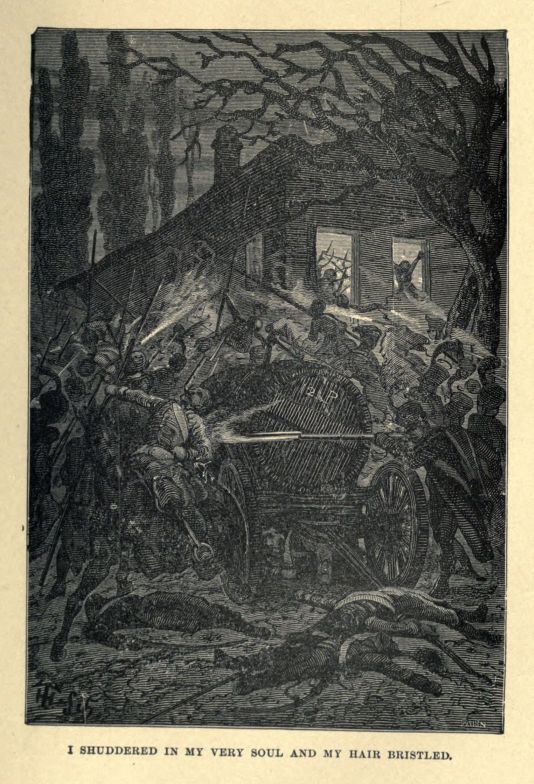
I SHUDDERED IN MY VERY SOUL AND MY HAIR BRISTLED.
But what shows the spirit of wisdom and prudence which the Lord puts into his creatures, when he means to spare them for a good old age, is that immediately afterward, in spite of my trembling knees, I went and sat under the first wagon, where the blows of the lances could not reach me; and there I saw the veterans finish the extermination of the rascals, who had retreated into the court, and not one of whom escaped.
Five or six were in a heap before the door, and three others were stretched upon the highway.
This did not take more than ten minutes; then all was dark again, and I heard the sergeant call: "Cease firing!"
Heitz, who had come down from his hay-loft, had just lighted a lantern; the sergeant seeing me under the wagon, called out: "Are you wounded, Father Moses?"
"No," I replied, "but a Cossack tried to thrust his lance into me, and I got into a safe place."
He laughed aloud, and gave me his hand to help me to rise.
"Father Moses," said he, "I was frightened about you. Wipe your back; people might think you were not brave."
I laughed too, and thought: "People may think what they please! The great thing is to live in good health as long as possible."
We had only one wounded, Corporal Duhem, an old man, who bandaged his own leg, and tried to walk. He had had a blow from a lance in the right calf. He was placed on the first wagon, and Lehnel, Heitz's granddaughter, came and gave him a drop of cherry-brandy, which at once restored his strength and even his good spirits.
"It is the fifteenth," he exclaimed. "I am in for a week at the hospital; but leave me the bottle for the compresses."
I was delighted to see my twelve pipes on the wagons, for Schweyer and his two boys had run away, and without their help we could hardly have reloaded.
I tapped at once at the bung-hole of the hindmost cask to find out how much was missing. These scamps of Cossacks had already drunk nearly half a measure of spirits; Father Heitz told me that some of them scarcely added a drop of water. Such creatures must have throats of tin; the oldest topers among us could not bear a glass of three-six without being upset.
At last all was ready and we had only to return to the city. When I think of it, it all seems before me now: Heitz's large dapple-gray horses going out of the stable one by one; the sergeant standing by the dark door with his lantern in his hand, and calling out, "Come, hurry up! The rascals may come back!" On the road in front of the inn, the veterans surrounded the wagons; farther on the right some peasants, who had hastened to the scene with pitchforks and mattocks, were looking at the dead Cossacks, and myself, standing on the stairs above, singing praises to God in my heart as I thought how glad Sorlé and Zeffen and little Sâfel would be to see me come back with our goods.
And then when all is ready, when the little bells jingle, when the whip snaps, and we start on the way—what delight!
Ah Fritz! everything looks bright after thirty years; we forget fears, anxieties, and fatigues; but the memory of good men and happy hours remains with us forever!
The veterans, on both sides of the wagons, with their muskets under their arms, escorted my twelve pipes as if they were the tabernacle; Heitz led the horses, and the sergeant and I walked behind.
"Well, Father Moses!" said he laughing, "it has all gone off well; are you satisfied?"
"More than I can possibly tell, sergeant! What would have been my ruin will make the fortune of my family, and we owe it all to you."
"Go along," said he, "you are joking."
He laughed, but I felt deeply; to have been in danger of losing everything, and then to regain it all and make profit out of it—it makes one feel deeply.
I exclaimed inwardly: "I will praise thee, O Lord, among the people; and I will sing praises unto thee among the nations.
"For thy mercy is great above the heavens, and thy truth reacheth unto the clouds."
XI
FATHER MOSES RETURNS IN TRIUMPH
Now I must tell you about our return to Phalsburg.
You may suppose that my wife and children, after seeing me take my gun and go away, were in a state of great anxiety. About five o'clock Sorlé went out with Zeffen to try to learn what was going on, and only then they heard that I had started for Mittelbronn with a detachment of veterans.
Imagine their terror!
The rumor of these extraordinary proceedings had spread through the city, and quantities of people were on the bastion of the artillery barracks, looking on from the distance. Burguet was there, with the mayor, and other persons of distinction, and a number of women and children, all trying to see through the darkness. Some insisted that Moses marched with the detachment, but nobody would believe it, and Burguet exclaimed: "It is not possible that a sensible man like Moses would go and risk his life in fighting Cossacks—no, it is not possible!"
If I had been in his place I should have said the same of him. But what can you do, Fritz? The most prudent of men become blind when their property is at stake; blind, I say, and terrible, for they lose sight of danger.
This crowd was waiting, as I said, and soon Zeffen and Sorlé came, as pale as death, with their large shawls over their heads. They went up the rampart and stood there, with their feet in the snow, too much frightened to speak.
I learned these things afterward.
When Zeffen and her mother went up on the bastion, it was, perhaps, half-past five; there was not a star to be seen. Just at that time, Schweyer and his boys ran away, and five minutes later the skirmish began.
Burguet told me afterward that, notwithstanding the darkness and the distance, they saw the flash of the muskets around the inn as plainly as if they were a hundred paces off, and everybody was still and listened to hear the shots, which were repeated by the echoes of the Bois-de-Chênes and Lutzelburg.
When they ceased Sorlé descended from the slope leaning on Zeffen's arm, for she could not support herself. Burguet helped them to reach the street, and took them into old Frise's house on the corner, where they found him warming himself gloomily by his hearth.
"My last day has come!" said Sorlé. Zeffen wept bitterly.
I have often reproached myself for having caused this sorrow, but who can answer for his own wisdom? Has not the wise man himself said: "I turned myself to behold wisdom, and madness, and folly; and I saw that wisdom excelleth folly; and I myself perceived that one event happeneth to the wise man and the fool. Wherefore, I said in my heart, that wisdom also is vanity."
Burguet was going out from Father Frise's when Schweyer and his sons came up the postern stairs, crying out that we were surrounded by Cossacks and lost. Fortunately my wife and daughter could not hear them, and the mayor soon came along and ordered them to stop talking and go home quickly, if they did not want to be sent to prison.
They obeyed, but that did not prevent people from believing what they said, especially as it was all dark again in the direction of Mittelbronn.
The crowd came down from the ramparts and filled the street; many of them went to their homes thinking they should never see us again, when, just as the clock struck seven, the sentinel of the outworks called out, "Who goes there?"
We had reached the gate.
The crowd was soon on the ramparts again. The squad in front of the sergeant on duty flew to arms; they had just recognized us.
We heard the murmur, without knowing what it was. So, when, after a reconnoissance, the gates were slowly opened to us, and the two bridges lowered for us to pass, what was our surprise at hearing the shouts: "Hurrah for Father Moses! Hurrah for the spirits of wine!"
The tears came to my eyes. And my wagons rolling heavily under the gates, the soldiers presented arms to us, the great crowd surrounding us, shouting: "Moses! Hey, Moses! are you all right? you have not been killed?" the shouts of laughter, the people seizing my arm to hear me tell about the fight,—all these things were very pleasant.
Everybody wanted to talk with me, even the mayor, and I had not time to answer them.
But all this was nothing compared with the joy I felt at seeing Sorlé, Zeffen, and little Sâfel run from Father Frise's and throw themselves all at once into my arms, exclaiming: "He is safe! he is safe!"
Ah, Fritz! what are honors by the side of such love? What is all the glory of the world compared with the joy of seeing our beloved ones? The others might have cried out, "Hurrah for Moses!" a hundred years, and I would not even have turned my head; but I was terribly moved by the sight of my family.
I gave Sâfel my gun, and while the wagons, escorted by the veterans, went on toward the little market, I led Zeffen and Sorlé through the crowd to old Frise's, and there, when we were alone, we began to hug each other again.
Without, the shouts of joy were redoubled; you would have thought that the spirits of wine belonged to the whole city. But within the room, my wife and daughter burst into tears, and I confessed my imprudence.
So, instead of telling them of the dangers I had experienced, I told them that the Cossacks ran away as soon as they saw us, and that we had only to put horses to the wagons before starting.
A quarter of an hour afterward, when the cries and tumult had ceased, I went out, with Zeffen and Sorlé on my arms, and little Sâfel in front, with my gun on his shoulder, and in this way we went home, to see to the unlading of the brandy.
I wanted to put everything in order before morning, so as to begin to sell at double price as soon as possible.
When a man runs such risks he ought to make something by it; for if he should sell at cost price, as some persons wish, nobody would be willing to run any risk for the sake of others; and if it should come to pass that a man should sacrifice himself for other people, he would be thought a blockhead; we have seen it a hundred times, and it will always be so.
Thank God! such ideas never entered into my head! I have always thought that the true idea of trade was to make as much profit as we can, honestly and lawfully.
That is according to justice and good sense.
As we turned at the corner of the market, our two wagons were already unharnessed before our house. Heitz was running back with his horses, so as to take advantage of the open gates, and the veterans, with their arms at will, were going up the street toward the infantry quarters.
It might have been eight o'clock. Zeffen and Sorlé went to bed, and I sent Sâfel for Gros the cooper, to come and unload the casks. Quantities of people came and offered to help us. Gros came soon with his boys, and the work began.
It is very pleasant, Fritz, to see great tuns going into your cellar, and to say to yourself, "These splendid tuns are mine: it is spirits which cost me twenty sous the quart, and which I am going to sell for three francs!" This shows the beauty of trade; but everybody can imagine the pleasure for himself—there is no use in speaking of it.
About midnight my twelve pipes were down on the stands, and there was nothing left to do but to broach them.
While the crowd was dispersing, I engaged Gros to come in the morning to help me mix the spirits with water, and we went up, well pleased with our day's work. We closed the double oak door, and I fastened the padlock and went to bed.
What a pleasure it is to own something and feel that it is all safe!
This is how my twelve pipes were saved.
You see now, Fritz, what anxieties and fears we had at that time. Nobody was sure of anything; for you must not suppose that I was the only one living like a bird on the branch; there were hundreds of others who were not able to close their eyes. You should have seen how the citizens looked every morning, when they heard that the Austrians and Russians occupied Alsace, that the Prussians were marching upon Sarrebruck, or when an order was published for domiciliary visits, or for days' labor to wall up the posterns and orillons of the place, or to form companies of firemen to remove at once all inflammable matter, or to report to the governor the situation of the city treasury, and the list of the principal persons subject to taxes for the supply of shoes, caps, bed-linen, and so forth.
You should have seen how people looked at each other.
In war times civil life is nothing, and they will take from you your last shirt, giving you the governor's receipt for it. The first men of the land are zeros when the governor has spoken. This is why I have often thought that everybody who wishes for war, or at least wants to be a soldier, is either demented or half ruined, and hopes to better himself by the ruin of everybody else. It must be so.
But notwithstanding all these troubles, I could not lose time, and I spent all the next day in mixing my spirits. I took off my cloak, and drew out with great gusto. Gros and his boys brought jugs, and emptied them in the casks which I had bought beforehand, so that by evening these casks were brimful of good white brandy, eighteen degrees.
I had caramel prepared, also, to give the brandy a good color of old cognac, and when I turned the faucet, and raised the glass before the candle, and saw that it was exactly the right tint, I was in ecstasies, and exclaimed: "Give strong drink unto him that is ready to perish, and wine unto those that be of heavy hearts! Let him drink and remember his misery no more."
Father Gros, standing at my side on his great flat feet, smiled quietly, and his boys looked well pleased.
I filled the glass for them; they passed it to each other and were delighted with it.
About five o'clock we went upstairs. Sâfel, on the same day, had brought three workmen, and had them remove our old iron into the court under the shed. The old rickety storehouse was cleaned. Desmarets, the joiner, put up some shelves behind the door in the arch, for holding bottles, and glasses, and tin measures, when the time for selling should come, and his son put together the planks of the counter. This was all done at once, as at a time of great pressure, when people like to make a good sum of money quickly.
I looked at it all with a good deal of satisfaction. Zeffen, with her baby in her arms, and Sorlé, had also come down. I showed my wife the place behind the counter, and said, "That is the place where you are to sit, with your feet in loose slippers, and a warm tippet on your shoulders, and sell our brandy."
She smiled as she thought of it.
Our neighbors, Bailly the armorer, Koffel the little weaver, and several others, came and looked on without speaking; they were astonished to see what quick work we were making.
At six o'clock, just as Desmarets laid aside his hammer, the sergeant arrived in great glee, on his return from the cantine.
"Well, Father Moses!" he exclaimed, "the work goes on! But there is still something wanting."
"What is that, sergeant?"
"Hi! It is all right, only you must put a screen up above, or look out for the shells!"
I saw that he was right, and we were all well frightened, except the neighbors, who laughed to see our surprise.
"Yes," said the sergeant, "we must have it."
This took away all my pleasure; I saw that our troubles were not yet at an end.
Sorlé, Zeffen, and I went up, while Desmarets closed the door. Supper was ready; we sat down thoughtfully, and little Sâfel brought the keys.
The noise had ceased without; now and then a citizen on patrol passed by.
The sergeant came to smoke his pipe as usual. He explained how the screens were made, by crossing beams in the form of a sentry-box, the two sides supported against the gables, but while he maintained that it would hold like an arch, I did not think it strong enough, and I saw by Sorlé's face that she thought as I did.
We sat there talking till ten o'clock, and then all went to bed.
XII
THE ENEMY REPULSED
About one o'clock in the morning of the sixth of January, the day of the feast of the Kings, the enemy arrived on the hill of Saverne.
It was terribly cold, our windows under the persiennes were white with frost. I woke as the clock struck one; they were beating the call at the infantry barracks.
You can have no idea how it sounded in the silence of the night.
"Dost thou hear, Moses?" whispered Sorlé.
"Yes, I hear," said I, almost without breathing.
After a minute some windows were opened in our street, and we knew that others too were listening; then we heard running, and suddenly the cry, "To arms! to arms!"
It made one's hair stand on end.
I had just risen, and was lighting a lamp, when we heard two knocks at our door.
"Come in!" said Sorlé, trembling.
The sergeant opened the door. He was in marching equipments, with his gaiters on his legs, his large gray cap turned up at the sides, his musket on his shoulder, and his sabre and cartridge-box on his back.
"Father Moses," said he, "go back to bed and be quiet: it is the battalion call at the barracks, and has nothing to do with you."
And we saw at once that he was right, for the drums did not come up the street two by two, as when the National Guard was called in.
"Thank you, sergeant," I said.
"Go to sleep!" said he, and he went down the stairs.
The door of the alley below slammed to. Then the children, who had waked up, began to cry. Zeffen came in, very pale, with her baby in her arms, exclaiming, "Mercy! What is the matter?"
"It is nothing, Zeffen," said Sorlé. "It is nothing, my child: they are beating the call for the soldiers."
At the same moment the battalion came down the main street. We heard them march as far as to the Place d'Armes, and beyond it toward the German gate.
We shut the windows, Zeffen went back to her room, and I lay down again.
But how could I sleep after such a start? My head was full of a thousand thoughts: I fancied the arrival of the Russians on the hill this cold night, and our soldiers marching to meet them, or manning the ramparts. I thought of all the blindages and block-houses, and batteries inside the bastions, and that all these great works had been made to guard against bombs and shells, and I exclaimed inwardly: "Before the enemy has demolished all these works, our houses will be crushed, and we shall be exterminated to the last man."
I took on in this way for about half an hour, thinking of all the calamities which threatened us, when I heard outside the city, toward Quatre-Vents, a kind of heavy rolling, rising and falling like the murmur of running water. This was repeated every second. I raised myself on my elbow to listen, and I knew that it was a fight far more terrible than that at Mittelbronn, for the rolling did not stop, but seemed rather to increase.
"How they are fighting, Sorlé, how they are fighting!" I exclaimed, as I pictured to myself the fury of those men murdering each other at the dead of night, not knowing what they were doing. "Listen! Sorlé, listen! If that does not make one shudder!"
"Yes," said she. "I hope our sergeant will not be wounded; I hope he will come back safe!"
"May the Lord watch over him!" I replied, jumping from my bed, and lighting a candle.
I could not control myself. I dressed myself as quickly as if I were going to run away; and afterward I listened to that terrible rolling, which came nearer or died away with every gust of wind.
When once dressed, I opened a window, to try to see something. The street was still black; but toward the ramparts, above the dark line of the arsenal bastions, was stretched a line of red.
The smoke of powder is red on account of the musket shots which light it up. It looked like a great fire. All the windows in the street were open: nothing could be seen, but I heard our neighbor the armorer say to his wife, "It is growing warm down there! It is the beginning of the dance, Annette; but they have not got the big drum yet; that will come, by and by!"
The woman did not answer, and I thought, "Is it possible to jest about such things! It is against nature."
The cold was so severe that after five or six minutes I shut the window. Sorlé got up and made a fire in the stove.
The whole city was in commotion; men were shouting and dogs barking. Sâfel, who had been wakened by all these noises, went to dress himself in the warm room. I looked very tenderly on this poor little one, his eyes still heavy with sleep; and as I thought that we were to be fired upon, that we must hide ourselves in cellars, and all of us be in danger of being killed for matters which did not concern us, and about which nobody had asked our opinion, I was full of indignation. But what distressed me most was to hear Zeffen sob and say that it would have been better for her and her children to stay with Baruch at Saverne and all die together.
Then the words of the prophet came to me: "Is not this thy fear, thy confidence, thy hope, and the uprightness of thy ways?
"Remember, I pray thee, who ever perished being innocent, or where were the righteous cut off.
"No, they that plough iniquity and sow wickedness, reap the same.
"By the blast of God they perish, and by the breath of his nostrils are they consumed.
"But thee, his servant, he shall redeem from death.
"Thou shalt come to thy grave in a full age, like as a shock of corn cometh in his season."
In this way I strengthened my heart, while I heard the great tumult of the panic-stricken crowd, running and trying to save their property.
About seven o'clock it was announced that the casemates were open, and that everybody might take their mattresses there, and that there must be tubs full of water in every house, and the wells left open in case of fire.
Think, Fritz, what ideas these orders suggested.
Some of our neighbors, Lisbeth Dubourg, Bével Ruppert, Camus's daughters, and some others, came up to us exclaiming, "We are all lost!"
Their husbands had gone out, right and left, to see what they could see, and these women hung on Zeffen and Sorlé's necks, repeating again and again, "Oh, dear! oh, dear! what misery!"
I could have wished them all to the devil, for instead of comforting us they only increased our fears; but at such times women will get together and cry out all at once; you can't talk reason to them; they like these loud cryings and groanings.
Just as the clock struck eight, Bailly the armorer came to find his wife: he had come from the ramparts. "The Russians," he said, "have come down in a mass from Quatre-Vents to the very gate, filling the whole plain—Cossacks, Baskirs, and rabble! Why don't they fire down upon them from the ramparts? The governor is betraying us."
"Where are our soldiers?" I asked.
"Retreating!" exclaimed he. "The wounded came back two hours ago, and our men stay yonder, with folded arms."
His bony face shook with rage. He led away his wife; then others came crying out, "The enemy has advanced to the lower part of the gardens, upon the glacis." I was astonished at these things.
The women had gone away to cry somewhere else, and just then a great noise of wheels was heard from the direction of the rampart. I looked out of the window, and saw a wagon from the arsenal, some citizen gunners; old Goulden, Holender, Jacob Cloutier, and Barrier galloped at its sides; Captain Jovis ran in front. They stopped at our door.
"Call the iron-merchant!" cried the captain. "Tell him to come down."
Baker Chanoine, the brigadier of the second battery, came up. I opened the door.
"What do you want of me?" I asked in the stairway.
"Come down, Moses," said Chanoine. And I went down.
Captain Jovis, a tall old man, with his face covered with sweat, in spite of the cold, said to me, "You are Moses, the iron-merchant?"
"Yes, sir."
"Open your storehouse. Your iron is required for the defence of the city."
So I had to lead all these people into my court, under the shed. The captain on looking round, saw some cast-iron bars, which were used at that time for closing up the backs of fireplaces. They weighed from thirty to forty pounds each, and I sold a good many in the vicinity of the city. There was no lack of old nails, rusty bolts, and old iron of all sorts.
"This is what we want," said he. "Break up these bars, and take away the old iron, quick!"
The others, with the help of our two axes, began at once to break up everything. Some of them filled a basket with the pieces of cast-iron, and ran with it to the wagon.
The captain looked at his watch, and said, "Make haste! We have just ten minutes!"
I thought to myself, "They have no need of credit; they take what they please; it is more convenient."
All my bars and old iron were broken in pieces—more than fifteen hundred pounds of iron.
As they were starting to run to the ramparts, Chanoine laughed, and said to me, "Capital grape-shot, Moses! Thou canst get ready thy pennies. We'll come and take them to-morrow."
The wagon started through the crowd which ran behind it, and I followed too.
As we came nearer the ramparts the firing became more and more frequent. As we turned from the curate's house two sentinels stopped everybody, but they let me pass on account of my iron, which they were going to fire.
You can never imagine that mass of people, the noise around the bastion, the smoke which covered it, the orders of the infantry officers whom we heard going up the glacis, the gunners, the lighted match, caissons with the piles of bullets behind! No, in all these thirty years I have not forgotten those men with their levers, running back the cannon to load them to their mouths; those firings in file, at the bottom of the ramparts; those volleys of balls hissing in the air; the orders of the gun-captains, "Load! Ram! Prime!"
What crowds upon those gun-carriages, seven feet high, where the gunners were obliged to stand and stretch their arms to fire the cannon! And what a frightful smoke!
Men invent such machines to destroy each other, and they would think that they did a great deal if they sacrificed a quarter as much to assist their fellow-men, to instruct them in infancy, and to give them a little bread in their old age.
Ah! those who make an outcry against war, and demand a different state of things, are not in the wrong.
I was in the corner, at the left of the bastion, where the stairs go down to the postern behind the college, among three or four willow baskets as high as chimneys, and filled with clay. I ought to have stayed there quietly, and made use of the right moment to get away, but the thought seized me that I would go and see what was going on below the ramparts, and while they were loading the cannon, I climbed to the level of the glacis, and lay down flat between two enormous baskets, where there was scarcely a chance that balls could reach me.
If hundreds of others who were killed in the bastions had done as I did, how many of them might be still living, respectable fathers of families in their villages!
Lying in this place, and raising my nose, I could see over the whole plain. I saw the cordon of the rampart below, and the line of our skirmishers behind the palankas, on the other side of the moat; they did nothing but tear off their cartridges, prime, charge, and fire. There one could appreciate the beauty of drilling; there were only two companies of them, and their firing by file kept up an incessant roll.
Farther on, directly to the right, stretched the road to Quatre-Vents. The Ozillo farm, the cemetery, the horse-post-station, and George Mouton's farm at the right; the inn of La Roulette and the great poplar-walk at the left, all were full of Cossacks, and such-like rascals, who were galloping into the very gardens, to reconnoitre the environs of the place. This is what I suppose, for it is against nature to run without an object, and to risk being struck by a ball.
These people, mounted on small horses, with large gray cloaks, soft boots, fox-skin caps, like those of the Baden peasants, long beards, lances in rest, great pistols in their belts, came whirling on like birds.
They had not been fired upon as yet, because they kept themselves scattered, so that bullets would have no effect; but their trumpets sounded the rally from La Roulette, and they began to collect behind the buildings of the inn.
About thirty of our veterans, who had been kept back in the cemetery lane, were making a slow retreat; they made a few paces, at the same time hastily reloading, then turned, shouldered, fired, and began marching again among the hedges and bushes, which there had not been time to cut down in this locality.
Our sergeant was one of these; I recognized him at once, and trembled for him.
Every time these veterans gave fire, five or six Cossacks came on like the wind, with their lances lowered; but it did not frighten them: they leaned against a tree and levelled their bayonets. Other veterans came up, and then some loaded, while others parried the blows. Scarcely had they torn open their cartridges when the Cossacks fled right and left, their lances in the air. Some of them turned for a moment and fired their large pistols behind like regular bandits. At length our men began to march toward the city.
Those old soldiers, with their great shakos set square on their heads, their large capes hanging to the back of their calves, their sabres and cartridge-boxes on their backs, calm in the midst of these savages, reloading, trimming, and parrying as quietly as if they were smoking their pipes in the guard-house, were something to be admired. At last, after seeing them come out of the whirlwind two or three times, it seemed almost an easy thing to do.
Our sergeant commanded them. I understood then why he was such a favorite with the officers, and why they always took his part against the citizens: there were not many such. I wanted to call out, "Make haste, sergeant; let us make haste!" but neither he nor his men hurried in the least.
As they reached the foot of the glacis, suddenly a large mass of Cossacks, seeing that they were escaping, galloped up in two files, to cut off their retreat. It was a dangerous moment, and they formed in a square instantly.
I felt my back turn cold, as if I had been one of them.
Our sharpshooters behind the ammunition wagons did not fire, doubtless for fear of hitting their comrades; our gunners on the bastion leaned down to see, and the file of Cossacks stretched to the corner near the drawbridge.
There were seven or eight hundred of them. We heard them cry, "Hurra! hurra! hurra!" like crows. Several officers in green cloaks and small caps galloped at the sides of their lines, with raised sabres. I thought our poor sergeant and his thirty men were lost; I thought already, "How sorry little Sâfel and Sorlé will be!"
But then, as the Cossacks formed in a half-circle at the left of the outworks, I heard our gun-captain call out, "Fire!"
I turned my head; old Goulden struck the match, the fusee glittered, and at the same instant the bastion with its great baskets of clay shook to the very rocks of the rampart.
I looked toward the road; nothing was to be seen but men and horses on the ground.
Just then came a second shot, and I can truly say that I saw the grape-shot pass like the stroke of a scythe into that mass of cavalry; it all tumbled and fell; those who a second before were living beings were now nothing. We saw some try to raise themselves, the rest made their escape.
The firing by file began again, and our gunners, without waiting for the smoke to clear away, reloaded so quickly that the two discharges seemed to come at once.
This mass of old nails, bolts, broken bits of cast-iron, flying three hundred metres, almost to the little bridge, made such slaughter that, some days after, the Russians asked for an armistice in order to bury their dead.
Four hundred were found scattered in the ditches of the road.
This I saw myself.
And if you want to see the place where those savages were buried, you have only to go up the cemetery lane.
On the other side, at the right, in M. Adam Ottendorf's orchard, you will see a stone cross in the middle of the fence; they were all buried there, with their horses, in one great trench.
You can imagine the delight of our gunners at seeing this massacre. They lifted up their sponges and shouted, "Vive l'Empereur!"
The soldiers shouted back from the covered ways, and the air was filled with their cries.
Our sergeant, with his thirty men, their guns on their shoulders, quietly reached the glacis. The barrier was quickly opened for them, but the two companies descended together to the moat and came up again by the postern.
I was waiting for them above.
When our sergeant came up I took him by the arm, "Ah, sergeant!" said I, "how glad I am to see you out of danger!"
I wanted to embrace him. He laughed and squeezed my hand.
"Then you saw the engagement, Father Moses!" said he, with a mischievous wink. "We have shown them what stuff the Fifth is made of!"
"Oh, yes! yes! you have made me tremble."
"Bah!" said he, "you will see a good deal more of it; it is a small affair."
The two companies re-formed against the wall of the chemin de ronde, and the whole city shouted, "Vive l'Empereur!"
They went down the rampart street in the midst of the crowd. I kept near our sergeant.
As the detachment was turning our corner, Sorlé, Zeffen, and Sâfel called out from the windows, "Hurrah for the veterans! Hurrah for the Fifth!"
The sergeant saw them and made a little sign to them with his head. As I was going in I said to him, "Sergeant, don't forget your glass of cherry-brandy."
"Don't worry, Father Moses," said he.
The detachment went on to break ranks at the Place d'Armes as usual, and I went up home at a quarter to four. I was scarcely in the room before Zeffen, Sorlé, and Sâfel threw their arms round me as if I had come back from the war; little David clung to my knee, and they all wanted to know the news.
I had to tell them about the attack, the grape-shot, the routing of the Cossacks. But the table was ready. I had not had my breakfast, and I said, "Let us sit down. You shall hear the rest by and by. Let me take breath."
Just then the sergeant entered in fine spirits, and set the butt-end of his musket on the floor. We were going to meet him when we saw a tuft of red hair on the point of his bayonet, that made us tremble.
"Mercy, what is that?" said Zeffen, covering her face.
He knew nothing about it, and looked to see, much surprised.
"That?" said he, "oh! it is the beard of a Cossack that I touched as I passed him—it is not much of anything."
He took the musket at once to his own room; but we were all horror-struck, and Zeffen could not recover herself. When the sergeant came back she was still sitting in the arm-chair, with both hands before her face.
"Ah, Madame Zeffen," said he sadly, "now you are going to detest me!"
I thought, too, that Zeffen would be afraid of him, but women always like these men who risk their lives at random. I have seen it a hundred times. And Zeffen smiled as she answered: "No, sergeant, no; these Cossacks ought to stay at home and not come and trouble us! You protect us—we love you very much!"
I persuaded him to breakfast with us, and it ended by his opening a window, and calling out to some soldiers passing by to give notice at the cantine that Sergeant Trubert was not coming to breakfast.
So we were all calmed down, and seated ourselves at the table. Sorlé went down to get a bottle of good wine, and we began to eat our breakfast.
We had coffee, too, and Zeffen wanted to pour it out herself for the sergeant. He was delighted.
"Madame Zeffen," said he, "you load me with kindness!"
She laughed. We had never been happier.
While he was taking his cherry-brandy, the sergeant told us all about the attack in the night; the way in which the Wurtemberg troops had stationed themselves at La Roulette, how it had been necessary to dislodge them as they were forcing open the two large gates, the arrival of the Cossacks at daybreak, and the sending out two companies to fire at them.
He told all this so well that we could almost think we saw it. But about eleven o'clock, as I took up the bottle to pour out another glassful, he wiped his mustache, and said, as he rose: "No, Father Moses, we have something to do besides taking our ease and enjoying ourselves; to-morrow, or next day, the shells will be coming; it is time to go and screen the garret."
We all became sober at these words.
"Let us see!" said he; "I have seen in your court some long logs of wood which have not been sawed, and there are three or four large beams against the wall. Are we two strong enough to carry them up? Let us try!"
He was going to take off his cape at once; but, as the beams were very heavy, I told him to wait and I would run for the two Carabins, Nicolas, who was called the Greyhound, and Mathis, the wood-sawyer. They came at once, and, being used to heavy work, they carried up the timber. They had brought their saws and axes with them; the sergeant made them saw the beams, so as to cross them above in the form of a sentry-box. He worked himself like a regular carpenter, and Sorlé, Zeffen, and I looked on. As it took some time, my wife and daughter went down to prepare supper, and I went down with them, to get a lantern for the workmen.
I was going up again very quietly, never thinking of danger, when, suddenly, a frightful noise, a kind of terrible rumbling, passed along the roof, and almost made me drop my lantern.
The two Carabins turned pale and looked at each other.
"It is a ball!" said the sergeant.
At the same time a loud sound of cannon in the distance was heard in the darkness.
I had a terrible feeling in my stomach, and I thought to myself, "Since one ball has passed, there may be two, three, four!"
My strength was all gone. The two Carabins doubtless thought the same, for they took down at once their waistcoats, which were hanging on the gable, to go away.
"Wait!" said the sergeant. "It is nothing. Let us keep at our work—it is going on well. It will be done in an hour more."
But the elder Carabin called out, "You may do as you please! I am not going to stay here—I have a family!"
And while he was speaking, a second ball, more frightful than the first, began to rumble upon the roof, and five or six seconds after we heard the explosion.
It was astonishing! The Russians were firing from the edge of the Bois-de-Chênes, more than a half-hour distant, and yet we saw the red flash pass before our two windows, and even under the tiles.
The sergeant tried to keep us still at work.
"Two bullets never pass in the same place," said he. "We are in a safe spot, since that has grazed the roof. Come, let us go to work!"
It was too much for us. I placed the lantern on the floor and went down, feeling as if my thighs were broken. I wanted to sit down at every step.
Out of doors they were shouting as if it were morning, and in a more frightful way. Chimneys were falling, and women running to the windows; but I paid no attention to it, I was so frightened myself.
The two Carabins had gone away paler than death.
All that night I was ill. Sorlé and Zeffen were no more at ease than myself. The sergeant kept on alone, placing the logs and making them fast. About midnight he came down.
"Father Moses," said he, "the roof is screened, but your two men are cowards; they left me alone."
I thanked him, and told him that we were all sick, and as for myself I had never felt anything like it. He laughed.
"I know what that is," said he. "Conscripts always feel so when they hear the first ball; but that is soon over—they only need to get a little used to it."
Then he went to bed, and everybody in the house, except myself, went to sleep.
The Russians did not fire after ten o'clock that night; they had only tried one or two field-pieces, to warn us of what they had in store.
All this, Fritz, was but the beginning of the blockade; you are going to hear now of the miseries we endured for three months.
XIII
A DESERTER CAPTURED
The city was joyful the next day, notwithstanding the firing in the night. A number of men who came from the ramparts about seven o'clock, came down our street shouting: "They are gone! There is not a single Cossack to be seen in the direction of Quatre-Vents, nor behind the barracks of the Bois-de-Chênes! Vive l'Empereur!"