APPENDIX
Reading edition
A
ROLL FROM AN OLD PAPER IN POSSESSION OF THE 7TH DUKE OF ATHOLL. OFFICERS OF THE 42ND HIGHLANDERS, NEW YORK, MAY 22, 1757.
Lt. Col. Francis Grant, son of the Laird of Grant, wounded at Ticonderoga.
Major Duncan Campbell, of Inverawe, killed at Ticonderoga.
Captain Gordon Graham, of Drainie, wounded at Ticonderoga.
Captain John Reid, of Straloch, wounded at Martinique.
Captain John NcNeil.
Captain Allan Campbell, son of Barcaldine.
Captain Thomas Graeme, of Duchray, wounded at Ticonderoga.
Captain James Abercrombie.
Captain John Campbell, of Strachur, wounded at Ticonderoga.
Captain John Campbell, of Duneavis, killed at Ticonderoga.
Lieutenant William Grant, of Rothiemurchus family, wounded at Ticonderoga.
Lieutenant Robert Gray, wounded at Ticonderoga.
Lieutenant John Campbell, younger of Glenyon, wounded at Ticonderoga.[39]
Lieutenant George Farquharson, son of Farquharson of Micris, Braemar, killed at Ticonderoga.
Lieutenant Sir James Cockburn.[40]
Lieutenant Kenneth Tolmie.
Lieutenant James Grant (Adjutant), wounded at Ticonderoga.
Lieutenant John Graham (quartermaster) wounded at Ticonderoga and wounded at Fort Pitt.
Lieutenant Hugh McPherson, killed at Ticonderoga.
Lieutenant Alex. Turnbull, of Strathcavers, wounded at Martinique.
Lieutenant Alex. Campbell, son of Inverawe, wounded at Ticonderoga.
Lieutenant Alex. McIntosh, wounded at Ticonderoga.
Lieutenant James Gray.
Lieutenant William Baillie, killed at Ticonderoga.
Lieutenant Hugh Arnot.
Lieutenant John Sutherland, killed at Ticonderoga.
Lieutenant John Small.
Lieutenant Archibald Campbell.
Lieutenant James Campbell.
Lieutenant Archibald Lamont.
Ensign Duncan Campbell, wounded at Fort Pitt.
Ensign Patrick Balneavis,[41] son of Edradour, wounded at Ticonderoga, wounded at Martinique.
Ensign Patrick Stewart,[42] son of Bonskeid, killed at Ticonderoga.
Ensign Norman MacLeod.
Ensign George Campbell.
Ensign Donald Campbell.
Ensign James McIntosh, wounded at Fort Pitt.
Ensign Alex. McIntosh, wounded at Martinique.
Ensign Peter Grant, wounded at Ticonderoga.
Three additional Companies embarked for America, November, 1757.
Captain James Stewart, younger of Urrard, wounded at Ticonderoga.
Captain James Murray, son of Lord G. Murray, wounded at Ticonderoga, wounded at Martinique.
Captain Thomas Stirling, younger of Ardoch, wounded at Martinique, wounded at New Jersey.
Lieutenant Simon Blair.
Lieutenant David Barclay, killed at Martinique.
Lieutenant Archibald Campbell, wounded at Ticonderoga.
Lieutenant Alex. Mackay.
Lieutenant Alex. Menzies.
Lieutenant David Milne,[43] wounded at Ticonderoga, wounded at Martinique.
Ensign Duncan Stewart, son of Derculich.
Ensign George Rattray, son of Dalralzion, killed at Ticonderoga.
Ensign Alex. Farquharson.
Ensign John Smith is added in ink to the 1858 Army List in the N. Y. State Library at Albany and is also marked as “wounded at Ticonderoga.”
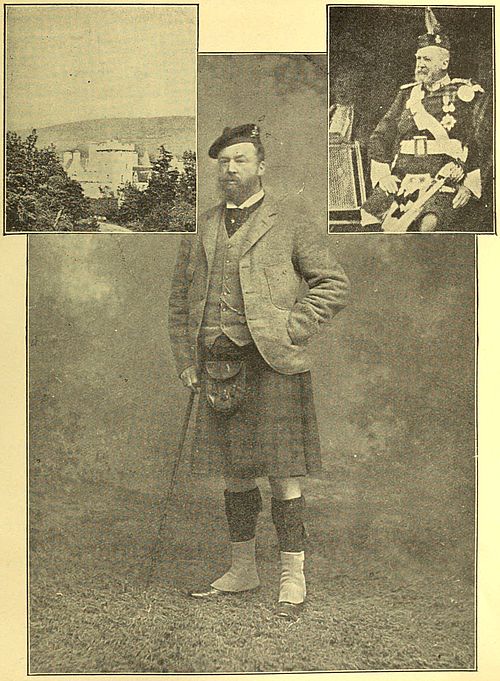
Blair Castle at Blair Atholl Reviewing the Atholl Highlanders
Sir John James Hugh Henry Stewart-Murray, K. T., Seventh Duke of Atholl
B
ROLL OF CAPT. JOHN REID’S COMPANY, NOV. 1757.
The following is the roll of Capt. John Reid’s Company of the 42nd, which was commanded by Capt. James Murray during the expedition. Taken from Atholl Records, page 440, Vol. III.
Capt. James Murray, wounded. Lieut. Kenneth Tolmie. Lieut. David Mill, wounded. Ensign Charles Menzies. Sergt. James McNab. Sergt. John McAndrews. Sergt. John Watson.
Sergt. Alex’r Cumming. Corporal John Cumming. Corporal Jonathan Grant. Corporal Angus McDonald. Corporal John Stewart. Drum Walter McIntyre, killed. Drum Alan Campbell.
Privates
Wm. Anderson. John Buchanan, killed. Angus Cameron. Hugh Cameron, killed. Wm. Carmichael. Donald Carr, killed. Hugh Christie. Alex. Cumming. James Farquharson, killed. Alex Fraser. Donald Fraser. Donald Fraser. Hugh Fraser. Hugh Fraser, killed. John Forbes. John Graham. Donald Grant. James Grant. John Grant. John Grant. William Grant. James Gordon. William Gordon. Donald Kennedy. Donald Kennedy. John Kennedy. George McAdam. John McArthur. Donald McColl. Donald McDiarmid. Angus McDonald. Arch’d McDonald. Arch’d McDonald, killed. James McDonald, killed. John McDonald. Lachlan McDonald. William McDonald, killed. Neil McEachern. Peter McFarlane. Peter McFarlane, killed. John McGillvray. Leonard McGlashan. Alex McGregor. Donald McGregor. Robert McGregor. John McIntosh. Alex McIntyre. Donald McIntyre.
James McIntyre, killed. Hector McInven. Hugh McKay. Alex’r McKenzie. Hugh McKenzie. John McKenzie, killed. John McKenzie. Roderick McKenzie. Dougall McLachlan, killed. John McLaren. Roderick McLaren. Neil McLeod. Norman McLeod, killed. Donald McLeish. Donald McLeish. William McLinnion. Neil McMillan. Donald McNeil, killed. Neil McNeil. Hugh McPhee. John McPhee. Alex McPherson. Donald McPherson. Donald McQueen, killed. James Michael. Donald Murray. James Murray. James Rea. Alex’r Reid. Alex’r Ross. Donald Ross. Hugh Ross, killed. John Ross. Donald Robertson. Neil Shaw. John Sinclair, died of wounds. John Smith. Walter Spaulding. Alex’r Stewart. Charles Stewart, died of wounds. Donald Stewart, died of wounds. Walter Stewart, died of wounds. Robert Urquhart. Donald Watson. Donald Wheet. William Wishart. Duncan Wright.
The above roll was made out at the muster in October, 1757, and contains the names of those who served in the Company for the previous six months. Unfortunately the names of the non-commissioned officers and men who were wounded at Ticonderoga are not shown.
C
ROLL OF CAPT. JAMES MURRAY’S COMPANY, NOV. 1757.
This Company was at Fort Edward captained by Capt. James Abercrombie and not in the battle of July 8, 1758.
Atholl Records, p. 431, Vol. III.
Sergt. Wm. Grant. Sergt. Charles Robinson. Sergt, John McQueen.
Corporal John Leslie. Corporal Robert Lachlan. Drummer Alan Campbell.
Privates
George Bremmer. Donald Brown. Duncan Cameron. John Campbell. Donald Conacher. William Cowie. James Douglas. Donald Drummond. James Duncan. Alex Fraser (1). Alex Fraser (2). William Fife. Robert Grant. Alex Irvine. James Kennedy. Duncan McAndrew. Donald McDiarmid. Archibald McDonald. Archibald McDonald. Donald McDonald. John McDonald. William McDonald. Peter McFarlane. Alex’r McIntosh. Robert McIntosh. Robert McIntosh. William McIntosh. Donald McLean. Donald McLean.
Thos. McNab. Alex McPherson. James McPherson. Donald McRaw. Robert Menzies. William Munroe. John Murray. Alex’r Nicholson. Alex’r Norrie. Alex’r Reid. Alex’r Robertson. Angus Robertson. Archibald Robertson. Charles Robertson. Donald Robertson. James Robertson. James Robertson. John Robertson. Peter Robertson. James Scroggie. Alex’r Stewart. Alex’r Stewart. Alex’r Stewart. John Stewart. Robert Stewart. Thomas Stewart. William Stewart. John Wighton. John Wighton.
D
LIST OF PROMOTION 42D REGIMENT OF FOOT.
From Paper in Public Record Office, London.
DATE
RANK NAME 1758 IN ROOM OF
Major Gordon Graham 17th July Duncan Campbell, dead
Captain William Grant 23d ” Gordon Graham, promoted
Capt. Lieut. Robert Gray 22d ” John Campbell, killed
Lieut. Duncan Campbell 23d ” William Grant, promoted
” Donald Campbell 24th ” Robert Gray, promoted
” James McIntosh 25th ” George Farquharson, killed
” John Smith 26th ” Hugh McPherson, killed
” Peter Grant 27th ” William Baillie, killed
” Duncan Stewart 28th ” John Sutherland, killed
” Alex. Farquharson 29th ” Hugh Arnotte, pref’d (80th foot)
Ensign Arch. Campbell, Jr. 21st ” Norman McLeod, pref’d (80th foot)
” John Gregor 22nd ” George Campbell, pref’d (80th foot)
” Lewis Grant 23d ” Patrick Stewart, killed
” Arch. Campbell, Sen’r 24th ” George Ratthray, killed
” John Graham 25th ” Duncan Campbell, promoted
” Allen Grant 26th ” Donald Campbell, promoted
” John Leith 27th ” Jas. McIntosh, promoted
” Charles Menzies 28th ” John Smith, promoted
” Archibald McNab 29th ” Peter Grant, promoted
E
COMPARISON OF LOSSES OF BLACK WATCH AT TICONDEROGA WITH THOSE OF OTHER WARS.
In the “Regimental Losses in the American Civil War, 1861, 1865. A treatise in the extent and nature of the mortuary losses in the Union Regiments, with full and exhaustive statistics compiled from the official records on file on the State Military Bureaus and at Washington, by William F. Fox, Lieut. Col. U. S. V., president of the Society of the 12th Army Corps; late president of the 107th New York Veteran Volunteer Association. Albany Publishing Company, Albany, N. Y., 1899.” The writer states that he has examined the records of 2,000 regiments of the Union Army and on page 2 he says, “The one regiment in all the Union Army which sustained the greatest loss in battle during the American Civil War was the 5th New Hampshire Infantry. It lost 295 men, killed or mortally wounded in action during the four years of service from 1861 to 1865. It served in the first division, second corps. This division was commanded successively by General Richardson, Hancock, Caldwall, Barlow and Miles and any regiment that followed the fortunes of these men was sure to find plenty of bloody work cut out for it. Its loss includes 18 officers killed, a number far in excess of the usual proportions and indicates that the men were bravely led.”
“There were 34 regiments of the Union Army whose casualties in killed, wounded or missing amounted to 58 per cent or over of the men engaged in one battle in each case, however, there was not a full regiment engaged. For example, the 1st Minnesota at Gettysburg, which was the highest per centage, had 47 killed and 168 wounded, or a total loss of 215 out of 262 men engaged. This is a loss of 82 per cent.
The 9th Illinois at Shiloh had 61 killed, 300 wounded and 5 missing, a total of 63.3 per cent.
The Light Brigade which has been immortalized by Tennyson took 673 officers and men into that charge at Balaklava in which 113 were killed and 134 wounded, a total of 247 or 36.7 per cent.
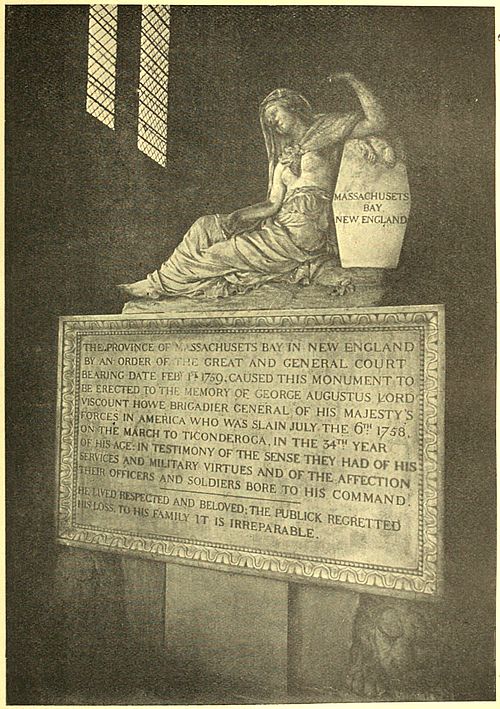
Lord Howe’s Monument in Westminster Abbey
THE PROVINCE OF MASSACHUSETS BAY, IN NEW ENGLAND BY AN ORDER OF THE GREAT AND GENERAL COURT BEARING DATE FEBY 1ST 1759, CAUSED THIS MONUMENT TO BE ERECTED TO THE MEMORY OF GEORGE AUGUSTUS LORD VISCOUNT HOWE, BRIGADIER GENERAL OF HIS MAJESTY’S FORCES IN AMERICA, WHO WAS SLAIN JULY THE 6TH 1758, ON THE MARCH TO TICONDEROGA, IN THE 34TH YEAR OF HIS AGE: IN TESTIMONY OF THE SENSE THEY HAD OF HIS SERVICES AND MILITARY VIRTUES, AND OF THE AFFECTION THEIR OFFICERS AND SOLDIERS BORE TO HIS COMMAND.
HE LIVED RESPECTED AND BELOVED: THE PUBLICK REGRETTED HIS LOSS; TO HIS FAMILY IT IS IRREPARABLE.
The heaviest loss in the German army of the Franco-Prussian war was the 16th Infantry (3d Westphalian) at Mars LaTour which had 509 killed, 619 wounded, 365 missing, a total of 1,484 or 49.4 per cent. out of 3,000 men. The regiments of the German army had 3,000 men.”
The above are the greatest casualties suffered in three great wars taken from a book compiled by an authority who had made a study of the subject. Compare with these the loss of the Black Watch at Ticonderoga given by Col. Stewart of Garth as 8 officers, 9 sergeants and 297 men killed and 17 officers, 10 sergeants and 306 soldiers wounded or a casualty of 647 (64.7 per cent) out of the 1,000 men of the 42nd reported by General Abercrombie at Lake George, June 29, 1758.
F
TABLE OF LOSSES OF BLACK WATCH IN SEVEN YEAR WAR.
The loss sustained by the regiment during the seven years it was employed in America and the West Indies was as follows:
KILLED WOUNDED
F C S S D P F C S S D P
i a u e r r i a u e r r
e p b r u i e p b r u i
l t a j m v l t a j m v
d a l e m a d a l e m a
i t a e t i t a e t
O n e n r e O n e n r e
f s r t s s f s r t s s
f n s f n s
i s i s
c c
e e
r r
s s
Ticonderoga, July 8, 1758 1 1 6 9 2 297 - 5 12 10 - 306
Martinique, January, 1759 - - - - - 8 - - 1 2 - 22
Guadeloupe, Feb. and Mar., 1759 - - 1 1 - 25 - - 4 3 - 57
General Amherst’s E-pedition to the Lakes, July and Aug., 1759 - - - - - 3 - - - 1 - 4
Martinique, Jan. and Feb., 1762 - 1 1 6 - 12 1 1 7 3 1 72
Havana, June and July, 1762, both battalions - - - - - 6 - - - 1 - 12
E-pedition under Colonel Boquet, August, 1763 - 1 1 1 - 26 - 1 1 2 2 30
Second E-pedition under Boquet, in 1764 and 1765 - - - - - 7 - - - 1 - 19
Total in the Seven Year’s War 1 3 9 12 2 384 1 7 25 22 4 522
Stewart of Garth, Appendix.
G
OFFICIAL TITLES OF BLACK WATCH AT DIFFERENT PERIODS.
1667 to 1739, The Black Watch.
1739 to 1749, The Regiment was known during this period by the names of its Colonels, as was the custom in the British Army at that time, Earl of Crawford’s, Lord Sempill’s, Lord John Murray’s. It was also called The Highland Regiment. It is said that the Regiment was at first the 43d Regt. of Foot, but while it was 43d in order of precedence it is a question if it was ever officially called the 43d.
1749 to 1758, 42nd Regiment of Foot (The Highland Regiment).
1758 to 1861, 42nd (or Royal Highland) Regiment of Foot.
1861 to 1881, 42nd Royal Highlanders (The Black Watch).
1881 to date, 1st Battalion The Black Watch (Royal Highlanders).
1758 to 1786, 2nd Battalion 42nd (or Royal Highland), Regiment of Foot.
1786 to 1862, 73d (Highland) Regiment of Foot.
1862 to 1881, 73d (Perthshire) Regiment of Foot.
1881 to date, 2nd Battalion The Black Watch (Royal Highlanders).
PRINCIPAL CAMPAIGNS, BATTLES, ETC.
* “Honors” on the Colors, the figures showing the Battalion concerned.
1743-47 Flanders. 1745 Fontenoy. 1745 Jacobite rising. 1757-60 Canada. 1758 Ticonderoga. 1759 Guadeloupe. 1762 Martinique. 1762 Havannah. 1762-67 Indian Frontier. 1763 Bushy Run. 1775-81 America. 1776 Long Island. 1776 White Plains. 1776 Brooklyn. 1776 Fort Washington. 1777 Pisquata. 1777 Brandywine. 1777 Germantown. 1778 Freehold. 1780 Charlestown. *1783 Mysore (2). *1783 Mangalore (2). 1793 Pondicherry. 1793-95 Flanders. 1793 Nieuport. 1794 Nimeguen. 1795 Ceylon. 1795 Guildermalsen. 1796 St. Lucia. 1797 St. Vincent. 1798 Minorca. *1799 Seringapatam (2). 1799 Genoa. 1799 Cadiz. 1800 Malta. *1801 Egypt (1). 1801 Alexandria. 1801 Aboukir.
1801 Mandora. *1808-14 Peninsula (1). 1808 Roleia. 1808 Vimiera. *1809 Corunna (1). 1810 Busaco. *1811 Fuentes d’Onor (1). 1812 Ciudad Rodrigo. 1812 Salamanca. 1812 Burgos. *1813 Pyrenees (1). 1813 Gohrde. *1813 Nivelle (1). *1813 Nive (1). *1814 Orthes (1). 1814 Antwerp. *1814 Toulouse (1). 1815 Quatre Bras. *1815 Waterloo (1 and 2). 1815 Netherlands. *1846-53 South Africa (2). *1854 Alma (1). 1854 Balaclava. 1854 Kertch. 1855 Yenikale. *1855 Sevastopol (1). 1857-58 Indian Mutiny. 1857 Cawnpore. *1858 Lucknow (1). *1874 Ashantee (1). *1882-84 Egypt (1). *1882 Tel-el-Kebir (1). *1884-85 Nile (1). 1884 El-Teb. 1884 Tamai. *1885 Kirbekan (1). *1899-1902 South Africa. *1900 Paardeberg.
H
BRITISH REGIMENTS AT TICONDEROGA, 1758.
With Notes From Farmer’s Regimental Records.
27th.
1751-1881, The 27th (Inniskilling) Regiment of Foot. Also 1758 “Lord Blakeney’s.”
1881 (from) First Battalion “The Royal Inniskilling Fusiliers.”
Nickname—“The Lumps.”
Notes.—Formed from three Companies of the Inniskilling forces. It is unique in using the old Irish war-pipes. While employed on the Isthmus of Darien all but nine of six hundred men succumbed. For distinguished gallantry at St. Lucia, in 1696, it was directed that the French garrison in marching out should lay down their arms to the 27th, other marks of favor being likewise accorded to the officers and men of the regiment.
42nd.
1749-58, 42nd Regiment of Foot (The Highland Regiment).
1758-1861, 42nd (or Royal Highland) Regiment of Foot. Also “Lord John Murray’s,” 1758 and 59.
1881 (from) 1st Battalion The Black Watch (Royal Highlanders).
Regimental Badges-“The Royal Cypher within the Garter.” The badge and motto of the Order of the Thistle. Also (in each of the four corners) the Royal Cypher ensigned with the Imperial Crown. Also “ The Sphinx” (for Egypt, 1801).
Notes.—The 1st Battalion of this famous corps, the oldest Highland regiment in the British army, was raised from six Independent companies of Highlanders. Its sombre dress of black, blue, and green tartan gave rise to its popular name. To enumerate its services is simply to narrate the military history of Great Britain since the early part of the last century. Hardly a campaign has been conducted, or a battle fought, in which the Black Watch—one battalion or the other, or both in company—has not participated; always with bravery, and frequently with conspicuous gallantry. Thereto its records of services abundantly testifies. At Fontenoy, Ticonderoga, and at Bushy Run “extraordinary and unexampled” gallantry was shown. It received Royal distinction in its change of title in 1758, and was privileged to wear the red heckle in the bonnet, in recognition of its conduct at the battle of Guildermalsen in 1795. In Egypt (in 1801, for which it bears “The Sphinx”), before Alexandria, it captured the Standard of the French Invincible Legion. Since then it has heaped fame on fame, and added “honor” to “honor” to its colours. Nor has the 2nd Battalion (raised in Perthshire in 1758 as the second Battalion of the 42nd, but, renumbered, long known as the 73rd prior to the territorial restoration of the ancient status) failed to win fresh laurels as occasion arose. At Mangalore (1783) against Tippoo Sahib, and side by side with the senior Battalion at Waterloo, in the Netherlands, in the Indian Mutiny, and in the Kaffir wars of 1846-53, it has worthily sustained the undying fame of the regiment. Recent events in South Africa show that neither the officers nor the men of today have lost one iota of that traditional dash, determination, and the bravery which have won for the Black Watch so glorious a place in British military annals.
44th.
1751-82, The 44th Regiment of Foot. Also 1758, “General Abercrombie’s.”
1881 (from) The First Battalion “The Essex Regiment.”
Nicknames—“The Two Fours” (of the 44th). “The Little Fighting Fours,” (the regiment saw hard service in the Peninsula, and its men were of small average stature). “The Pompadours” and “Saucy Pompeys.” (Tradition relates that when the facings were changed in 1764 (the crimson not wearing well) the Colonel desired Blue, but the authorities objecting, he chose Purple, a favorite color of Madame de Pompadour, a mistress of Louis XV, of France).
Notes.—The 44th captured an Eagle of the 62nd French Infantry at Salamanica.
46th.
1751-82, The 46th Regiment of Foot. Also 1758 “Lieut. Gen. Thomas Murray’s.”
1881 (from) Second Battalion “Duke of Cornwall’s Light infantry.”
Nicknames—These pertain to the late 46th; “Murray’s Buck’s” (from Colonel name (1743-64) and its smart appearance on home duty in Scottish Royal livery). “The Surprisers” (from an incident (1777) in the American War). “The Lacedemonians” (its Colonel once when under fire, made a disciplinarian speech concerning the Lacedemonians). Also in early days, “The Edinburgh Regiment.” “The Red Feathers.” “The Docs” (the initials).
Note.—“The Two Feathers” is a distinction of the 46th, a Light company of which, in 1777, with others were brigaded as “The Light Battalion.” The Americans were so harrassed by the Brigade that they vowed “No Quarter.” In derision, to prevent mistakes, the Light Battalion dyed their feathers red; the 46th Foot alone has retained the distinction.
55th
1757-82, The 55th Regiment of Foot. Also “Lord Howe’s” in 1858 and “Prideaux’s” in 1759.
1881 (from) Second Battalion “The Border Regiment.”
Nickname—“The Two Fives” (to the 55th for its number).
Notes.—The Dragon of China is on the Regimental Badge of the 55th in honor of the victorious campaign in China in 1840-42.
1st and 4th Battalions 60th.
1755-57, The 62nd (Royal American) Regiment of Foot; renumbered.
1757-1824, The 60th (Royal American) Regiment of Foot.
1881 (from) Second Battalion “The Border Regiment.”
Notes.—This regiment, though possessing no “Colors,” bears more honors than any other regiment, the Highland Light Infantry coming next with twenty-nine. Motto, “Swift and Bold,” bestowed according to tradition by General Wolfe in recognition of its conduct at Quebec.
80th.
1758-64, The 80th (Light-armed) Regiment of Foot. Also “Gage’s.” (Disbanded 1764).
The Royal Regiment of Artillery.
One arm or other of this branch of the Service has, obviously, taken part in every campaign; a particularized list is therefore unnecessary. The guns are the “Colours” of the Artillery, and as such are entitled to all “parade honours.” Formerly, regimental honors appear to have been worn by certain companies. Amongst such are “Niagara,” “Leipsic,” “Waterloo,” and “The Dragon of China.”
Nicknames—“The Gunners;” “The Four-wheeled Hussars” (of the Royal Horse Artillery).
Notes.—Trains of artillery seem to have been raised in the time of Henry VIII., and up to 1716 appear to have been disbanded after each campaign. In 1716 several companies received permanent corporate existence, since which exigencies of modern warfare have led to an enormous increase in the number of batteries. But from first to last, the record of the Royal Artillery has been one of distinction, and it may fitly be said to share the honors of all other regiments. The Royal Irish Artillery were absorbed in 1801, and the East India Company’s Artillery in 1858.
BRITISH REGIMENTS AT TICONDEROGA, 1759.
1st.
1751-1812, The 1st, or The Royal Regiment of Foot, also the “Royals.”
1881 (from) The Royal Scots (Lothian Regiment).
Nickname—“Pontius Pilate’s Body-Guard.” It is a legend of the Regiment that the Romans carried off a number of wild, war-like Highlanders as prisoners after their conquest of Britain, and these men and their descendants became soldiers of the Roman Empire and as such they guarded the tomb of Our Saviour after the crucifixion. This Scottish company, for it only consisted of one hundred men under a centurion, was kept distinct from the Roman Army proper. At the time of the crucifixion they were called Pontius Pilate’s Scots Guards, and their descendants were the nucleus of the First Royal Scots in later years.
Notes.—The oldest Regiment of Foot in the British Army. Traditionally regarded as the ancient body-guard of the Scottish kings, this famous corps was in the service of Sweden, as “Hepburn’s Regiment,” from 1625 to 1633; and in that of France from 1633 to 1678, when (under Dumbarton) it came to England. It received its title in 1684 in recognition of the capture of a Colour from the Moors at Tangier. At Sedgemoor (1685) it also captured the Duke of Monmouth’s Standard.
17th.
1751-82, The 17th Regiment of Foot. Also “Forbes.”
1881 (from) “The Leicestershire Regiment.”
Nicknames—“The Bengal Tigers” (from its badge); “The Lily-whites” (from its facings).
Notes.—Mainly raised near London; twelve regiments in all were formed in 1688, but this and the 16th (The Bedfordshire) are alone in commission now.
27th.
See above, Ticonderoga, 1758.
42nd.
See above, Ticonderoga, 1758.
55th.
See above, Ticonderoga, 1758.
77th.
1756-63, The 77th (Montgomery Highlanders) Regiment; disbanded 1763.
80th.
See above, Ticonderoga, 1758.
Royal Artillery.
See above, Ticonderoga, 1758.
I
PROVINCIAL REGIMENTS AT TICONDEROGA.
(The writer will have to admit that this list is more or less incomplete, even the N. Y. State Library at Albany had only scattered items. It would seem as if this would be a good subject for an article for some future meeting of the Association and any information will be gratefully received).
1758.
The New York Colonial Manuscripts, edited by Callaghan, page 732, in the list of regiments having officers wounded at the battle of July 8, 1758, gives the following regiments: Col. DeLancey’s, New York; Col. Babcock’s, Rhode Island; Col. Fitche’s, Connecticut; Col. Worcester’s, Connecticut; Col. Bagley’s, Massachusetts; Col. Partridge’s, Massachusetts; Col. Preble’s, Massachusetts; Col. Johnston’s, New Jersey. Parkman mentions Col. Bradstreet with his regiment of boatmen, armed and drilled as soldiers and it is also certain that Roger’s Rangers were with the expedition.
The year book of the Maine Chapter of the Society of Colonial Wars for 1900 gives much information in regard to Col. Preble’s regiment, Maine being in 1758 a part of Massachusetts. Mention is made in this article of regiments officered by “Col. Doty, Col. Joseph Williams, Col. Nickols, Col. Whitings.”
Also in the New York Colonial Manuscripts, Vol. 10, P. 827 it mentions a force of about 3,000 men nearly all of whom were provincials, under Col. Bradstreet, in the expedition against Fort Frontinac after the battle of July 8, 1758, and of the number of soldiers engaged, the list is given as “New Yorkers 1112, Col. Williams’ regiment 413, Col. Douty’s 248, Rhode Island 318, and Jersey 418.”
It is not clear whether these regiments were at the battle of Ticonderoga and were not mentioned in list page 732 of the New York Colonial Manuscripts because none of the officers were wounded, or whether they were the same regiments but with different officers, a change having been made after the battle.
1759
The provincial regiments mentioned in Commissary Wilson’s Orderly Book as being in the Ticonderoga expedition of 1759 are as follows: Col. Lyman’s, Connecticut; Col. Whiting’s, Connecticut; Col. Worcester’s, Connecticut; Col. Fitch’s, Connecticut; Col. Willard’s, Massachusetts; Col. Ruggle’s, Massachusetts; Col. Lovell’s, New Hampshire; Col. Schuyler’s, New Jersey; Col. Babcock’s, Rhode Island.
J
BIOGRAPHICAL SKETCHES OF AS MANY OF THE OFFICERS OF 1758 AS COULD BE TRACED.
James Abercrombie.
James Abercrombie was promoted to a captaincy in the 42nd or 1st Battalion of the Royal Highlanders on the 16th of February, 1756. On the 5th of May, 1759, he was appointed aide de camp to Maj. Gen. Amherst, with whom he made the campaigns of that and the following year. On the 25th of July, 1760, he was appointed Major of the 78th or Fraser’s Highlanders and in September following was employed by Gen. Amherst in communicating to the Marquis de Vaudreuil the conditions preparatory to the surrender of Montreal and in obtaining the signature of that governor to them. (Knox’s Journal). The 78th having been disbanded in 1763, Major Abercrombie retired on half pay. On the 27th of March, 1770, he again entered active service as Lt. Colonel of the 22nd Regiment then serving in America under the command of Lt. Col. Gage and was killed in the memorable Battle of Bunker Hill on the 17th of June, 1775.
New York Colonial Manuscripts by Broadhead, Weed, Parsons Co., Albany, 1856, page 160.
Hugh Arnot.
Hugh Arnot was taken from the half pay list and appointed a Lieutenant in the 42nd Highlanders, 9th April, 1756, at the augmentation of that Regiment on its coming to America, and was promoted to a Company on the 27th December, 1757. He served in the unfortunate affair of Ticonderoga in 1758, and in 1759 accompanied Amherst as above. On the 16th August, 1760, he exchanged into the 46th Foot, in which Regiment he continued to serve until 1769, when his name was dropped from the Army List.
Wilson’s Orderly Book, p. 143.
Patrick Balneaves.
Patrick Balneaves, of Edradour, entered the 42nd, as Ensign, 28th January, 1756, and was promoted to be Lieutenant 1st April, 1758; he was wounded at Ticonderoga, 1758; and again at Martinico in 1762; became Captain-Lieutenant 23rd August, 1763, and left the army in 1770.
Stewart. Army Lists. N. Y. Colonial Manuscripts, p. 729, Vol. 10.
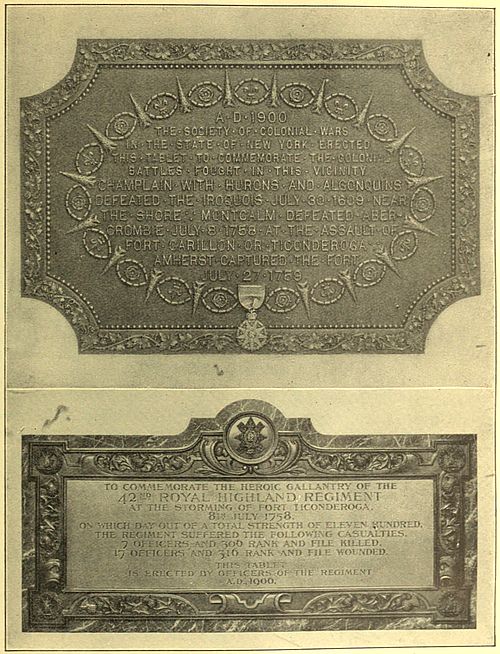
AT TICONDEROGA Tablet on Boulder near French Lines at Fort Ticonderoga Tablet in Black Watch Memorial at Ticonderoga
Allan Campbell.
Allan Campbell, son of Barcaldine, entered the Army as Ensign of the 43d (now the 42nd) Highlanders, Dec. 25, 1744, and served that year against the Pretender. Was made prisoner of war at Preston Pans, 21st Sept. 1745 and sent on parole to Perth. Was appointed lieutenant Dec. 1, 1746. He obtained a Company 13th of May, 1755, and the next year came to America, where he shared the difficulties and honors of the Regiment. In June, 1759, he was appointed Major for the campaign under Amherst, and was actively employed at the Head of the Grenadiers and Rangers, clearing the way for the army up the Lakes. He became major in the army 15th August, 1762, and went on half-pay on the reduction of the regiment in 1763, having obtained a grant of 5,000 acres of land at Crown Point. He served 19 years in the regiment. In 1770, he was appointed Major of the 36th or Herefordshire Foot, then serving in Jamaica; became Lieutenant-Colonel in the army in May (1772), and of his regiment in January, 1778; Colonel in the Army, 17th Nov. 1780; Major-General in 1787; and died 1795. His Regiment did not serve in America during the Revolutionary War.
An extract from his will dated 2nd March 1787, reads:
“And whereas I am under a grant from the Crown intitled to a considerable tract of land and heredits situate, lying and being in the Province of New York in the County of Albany in America, between Ticonderoga and Crown Point. * * * I do hereby give, devise and bequeath unto my two sisters, Isabella Campbell, (wife of John C. of Archalader, in the Shire of Perth, in North Britain, aforesaid Esquire), and Jane Campbell of Edinchip, in the Shire of Perth, aforesaid, widow of Colin Campbell of Edinchip, aforesaid, Esq. deceased, their heirs, executors, Administrates, and Assigns, all my said track of land and heredits, in America,” etc.
Browne, IV, 150.
Knox Journal, I, 373, 377, 387; II, 401.
Army List. Commissionary Wilson’s Orderly Book. 1759. p. 18. Stewart of Garth Appendix.
Archibald Campbell.
Archibald Campbell. Born 1720. Eldest son of Duncan Campbell of Glendaruel and Lockhead. His mother was Elizabeth, daughter of the Rev. Archibald Campbell of Inverary. He was appointed Ensign 42d Regt. 23d Jan. 1756, Lieut. 28th July 1757, Captain 4th Dec. 1759. Died 3d June 1762.
Donald Campbell.
Donald Campbell, son of Donald Campbell Bailie of McKairn, Taynuilt Argyll, was appointed Ensign in the 42d Regt. of Foot, 5th May 1756. He was with one of the additional companies in the “Anandall” which sprang two leaks, lost her mizen mast, was attacked three times by Privateers (which they beat off with small arms), and was driven into the West Indies, so that she did not arrive in New York, in time for the company to join the attack on Ticonderoga. He was appointed Lieut. 24th July 1758 and retired 13th June 1761, having served with the Royal Highlanders from 1758 to 1761.
Highlanders in America by MacLean, page 176, N. Y. Colonial Documents, page 629.
Duncan Campbell (Killochronan, Island of Mull).
Extract from the Memorial of Captain Duncan Campbell, American Loyalist Claims.
“Humbly Sheweth, that he was a native of Great Britain and he was appointed Ensign in the 42nd Highlanders 26 January 1756, in which Corps he served the war before last in America and the West Indies. And in August 1763 the Regiment was ordered on an expedition to the relief of Fort Pitt, then invested by the savages.
On the march he was severely wounded at the battle of Bushy Run, and for a long time rendered unfit for service. (In this skirmishing warfare the troops suffered much from the want of water and the extreme heat of the weather) which occasioned his retiring on half pay in 1764.
He soon thereafter settled at Fredricksburg, Dutchess Co. in the Prov. of New York (in 1769) and purchased a valuable track of land from Colonel Beverly Robinson and others on good terms. In 1775 he was Colonel of Militia and Magistrate for the said county.
That at the commencement of the troubles he took an early and decided part in favor of His Majesty’s government, which rendered him so obnoxious to the popular party where he dwelt that he was obliged to fly to New York, to save his life, from the family and abandon his property in June 1775. That soon after his arrival there he engaged as an officer in the 2nd Battalion Highland Emigrant’s in which he continued doing duty until the cessation of hostilities, and consequent reduction of the Regiment in Nova Scotia, in which Province he now dwells. (2 January 1784).
That early in June 1775 he got on board the Asia ship of war (64 gun frigate) then stationed in New York and soon after was joined by some recruits he had engaged to follow him. In July thereafter he went to Boston where Gen. Gage then Commander-in-Chief, gave him command of an armed transport in which he returned to New York where he enlisted and received on board about 60 more recruits. That in September he returned again to Boston where he left all his recruits except 26 which were left on board as Marines, on the 8 October he was sent back on the same service. But on the 16 of the same month was unfortunately shipwrecked on the coast of New Jersey.
On this service he lost all his money and baggage to the amount of £100. This loss His Excellency Sir William Howe, then Commander-in-Chief, would not think of reimbursing at the time. In consequence of the shipwreck he and his party had the misfortune to be made prisoners and was carried to Philadelphia where he was fourteen months in a small apartment of the dismal gaol where he contracted a sickness which was likely to prove fatal to him.
How soon he was taken his family were turned out of doors and deprived of everything they had except some wearing apparell. The distressed situation of the family so driven from their home may be easier felt than described. It brought on for a beginning the untimely death of an amiable wife, and deprived his five infant children of a mother’s care whereby they for some time became objects of compassion which he was unable to rescue them from. Until he was exchanged and joined his Regiment (in January 1777) he thereafter continued to serve during the war.
N. B. The Memorialist was appointed Second Oldest Captain in the 2nd Batt. 84th Regiment the 14 June 1775 and was reduced in October 1783 without a step of preferment in the Regt. or in the Line.
Captain 4th Breadalbane Regt. of Fencibles 2nd Batt. 1 March 1793; Major 17 Feb. 1794; Lieut. Col. 9 Dec. 1795; Regiment disbanded 18 April 1799. He died at Edinburgh in Dec. 1799.”
Major Sir Duncan Campbell of Barcaldine, Bart. C. V. O.
Stewart, I, 279; II, Appendix No. 11.
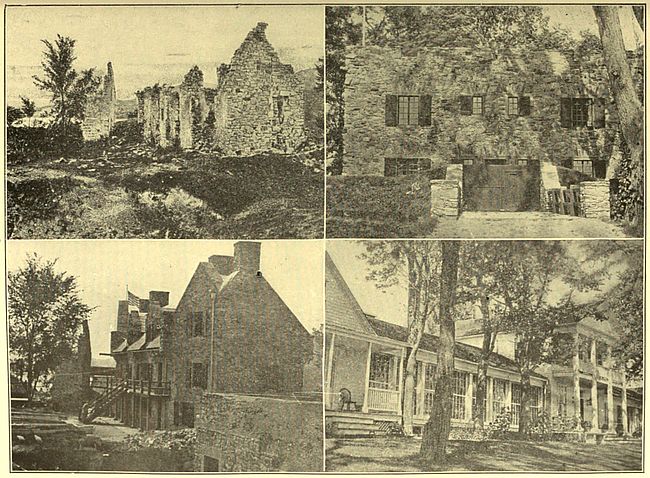
AT FORT TICONDEROGA
Officers Quarters or West Barracks The Block House, summer residence of Howland Pell
A reproduction of the Germain redoubt
Two views from same point showing before and after restoration The Pavilion, summer residence of S. H. Pell. Built in 1826 by William F. Pell, Esq
John Campbell of Duneavis.
John Campbell, of Duneaves, Perthshire, was originally a private in the Black Watch. In 1743, he was presented, with Gregor McGregor, to George II, as a specimen of the Highland soldier and performed at St. James the broadsword exercise and that of the Lochaber axe, before his Majesty and a number of General officers. Each got a gratuity of a guinea, which they gave to the porter at the gate of the palace as they passed out. Mr. Campbell obtained an Ensigncy in 1745 for his bravery at the battle of Fontenoy; was promoted to be Captain-Lieutenant, 16th February, 1756, and landed in New York the following June. He was among the few resolute men who forced their way into the work at Ticonderoga, on the 8th of July, where he was killed.
John Campbell of Glendaruel.
John Campbell of Glendaruel, born in 1721, was appointed Ensign of the 42nd Regt. of Foot 25th Sept., 1745; Lieutenant 16th May, 1748; Captain Lieut. 2nd July 1759; and Captain 20th July 1760; Captain 27th or Inniskilling Regiment of Foot 25th March 1762; Major Supt. of Indian Affairs in the Province of Quebec 2nd July, 1773; Lieut. Col. of Indian Affairs 29th August 1777; and Colonel 16th Nov. 1790.
He married Marianna St. Lucan (date not given) and died Montreal, 23rd June 1795.
“In the course of a long and meritorious service with his Regiment, the 42nd Highlanders, in all its campaigns from the Rebellion in 1745 to the attack on Ticonderoga, where he was wounded on the 8th July, 1758, and the conquest of Canada, Martinique, and Havanna. He subsequently served in the expedition commanded by General Burgoyne, at the head of a number of Indians, and was distinguished for his spirited conduct as an officer, adorned by that elegance and politeness which mark the accomplished gentleman and his virtues in private life endeared him to his family and companions.
His remains were attended to the grave in a manner suitable to his rank. Not only by a very numerous assembly of citizens of all ranks, but by a large body of Indian warriors, whose very decent behavior evinced the sincerity with which they partook of the universal regret occasioned by the loss of so very respectable a member of society.”
Major Sir Duncan Campbell of Barcaldine, Bart. C. V. O.
John Campbell of Strachur.
John Campbell of Strachur, in the Highlands of Scotland, entered the Army in June, 1745, as Lieutenant of Loudon’s Highlanders; served through the Scotch Rebellion; made the Campaign in Flanders, 1747, and was promoted to a company on the 1st October of that year. At the peace of 1748, he went on Half-Pay and so remained until the 9th April, 1756, when he was appointed to the 42nd Highlanders previous to the embarcation of that Regiment for America. He was wounded in the attack on Ticonderoga in 1758, and was appointed by General Amherst Major of the 17th Foot on the 11th July, 1759; was promoted to be Lieutenant-Colonel in the Army, 1st February, 1762 and commanded his Regiment in the expedition that year against Martinico and Havana. On the 1st May, 1773, he became Lieutenant-Colonel of the 57th or West Middlesex Foot, returned to America in 1776 with his Regiment at the breaking out of the Revolution; was appointed Maj. General 19th February, 1779, Colonel of his Regiment 2d November, 1780, and commanded the British Forces in West Florida, where after a gallant though ineffectual defence he was obliged to surrender Pensacola to the Spaniards 10th May, 1781. He became Lieutenant-General 28th September, 1787; General in the Army, 26th January, 1797, and died in the fore part of 1806.
Brown, IV., 155, 159.
Stewart’s Sketches of the Highlanders, I, 295, 306, 359, 370; II, 5, app. iii; Knox Journal, I, 373; II, 401; Beatson’s Naval and Mil. Mem. V, 50, 226-233; VI, 274-280; Army Lists. Wilson’s Orderly Book, page 94.
Moses Campbell.
A native of Scotland, joined the 42nd Regt. and was promoted Sergeant.
Served with this Regiment throughout the war of French and Indians in America of 1756-63, discharged at the reduction, and settled with his family on a portion of Maj. Allan Campbell’s (same Regt.) grant of land, situated on the south (bank) side of Lake Champlain, between Crown Point (about 5 miles above the point) and Ticonderoga.
Also served (possibly in the Royal Highland Emigrants, bounty 50s rendezvous Lake Champlain, 1775) in the War of Independence of 1775, (for which his property was confiscated, including boats.)
He died in active (British) service on the 18th Feb. 1781.
His widow, Elizabeth, and seven children claimed 366 pounds for losses, allowed 80 pounds.
N. B. On behalf of her son, Alexander, (aged 21 years), 50 pounds, who complained that one of the rebels was now living in his house, Feb. 1783.
Gordon Graham.
Gordon Graham of Drainie in the Highlands of Scotland, was appointed ensign in the 43rd Highlanders in Oct. 25, 1739, and was made lieutenant June 24, 1743. He served in Flanders and shared in the defeat at Fontenoy in 1745, after which the Regiment returned home. In 1747 he made another campaign in Flanders. On August 7, 1747, he was appointed captain. In 1749 the number of the regiment was changed to the 42d and Mr. Graham obtained a company in it 3d June, 1752, came to America in 1756, was at the surrender of Fort William Henry under Colonel Munro in 1757, and was wounded at Ticonderoga in 1758. The Major of the Regiment having been killed on that occasion Captain Graham succeeded to the vacancy, July 17th, 1758, and made the campaign of 1759 and 1760 under Amherst. He next served in the West Indies in the expedition against Martinique and July 9, 1762, became Lieutenant Colonel of the Regiment, which returned to New York, and in the year 1763, proceeded to the relief of Fort Pitt, defeating the Indians on the way in the Battle of Bushy Run. In December, 1770, he retired after 31 years of service in the Regiment. As his name does not appear in the army list of 1771 it is presumed that he died at this time.
Brown’s Highland Clans IV, 139, 159. Beatson’s Naval and Mil. Mem. II, 530. Wilson’s Orderly Book, p. 14.
John Graham.
John Graham was the brother of Thomas; entered the 42nd regiment as Ensign and was promoted to a Lieutenancy 25th January, 1776; was wounded at Ticonderoga 1758; became Captain in February, 1762, and was again wounded at Bushy Run in 1763; shortly after which his company having been disbanded, he went on half pay. He rejoined the regiment 25th December, 1765, and is dropped in 1772, having attained the rank of field officer.
Stewart I, 359, Army Lists. N. Y. Col. Manuscripts, p. 729, Vol. 10.
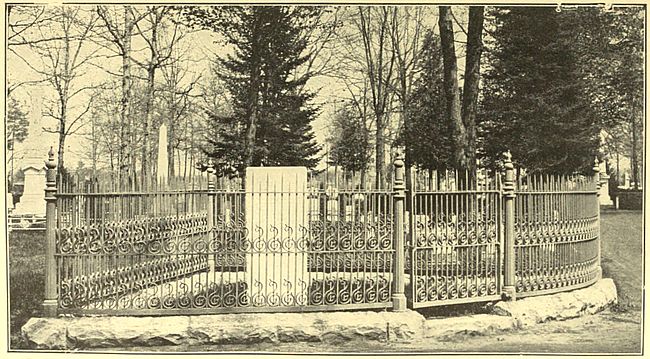
Grave of Jane McCrea, Union Cemetery, between Hudson Falls and Fort Edward Major Duncan Campbell is now buried in this lot.
Thomas Graham.
Thomas Graham, or Graeme, of Duchay, entered the 43rd, or Black Watch, as Ensign June 30, 1741; was promoted to a Lieutenancy August 6, 1746, and obtained a company February 15, 1756, shortly before the regiment, then the 42nd, came to America. He served in the several Campaigns on the northern lakes; was wounded at Ticonderoga in 1758; was again wounded at the battle of Bushy Run, near Pittsburg, in 1763; served in the subsequent campaigns against the Indians, and embarked for Ireland in 1767. He succeeded Major Reid 31st March, 1770, and became Lieutenant-Colonel 12th December following. He retired from the army December, 1771, after 30 years of service.
Army Lists. Stewart. N. Y. Colonial Manuscripts, p. 729, Vol. 10.
Francis Grant.
Francis Grant, son of the Laird of Grant, and brother of Sir Ludovick Grant, of Grant, Scotland, was received from half-pay in Loudon’s Regiment and was made ensign in the Black Watch Oct. 25, 1739. Nov. 5, 1739, he was made lieutenant; June 18, 1743, captain; and Oct. 3, 1745, he became major. A vacancy occurring in the lieutenant-colonelcy, in December, 1755, the men of the Regiment subscribed a sum of money among themselves to purchase the step for him, but it was not required; he had already obtained his promotion. He accompanied the Regiment to America in 1756 and was present at the bloody battle of Ticonderoga, July 8, 1758, where he was wounded. In the following year he accompanied Amherst on his expedition, and in 1760 was in command of the van of the Army from Oswego to Montreal. In 1761 he commanded the Army sent to the south to chastise the Cherokees. He served as Brigadier-General in the expedition against Martinico in 1762, and on the 19th of February of that year became colonel in the army. On July 9, 1762, after twenty-three years of service in the Black Watch Regiment, he was removed and appointed to the command of the 90th Light Infantry. In August, 1762, he commanded the 4th Brigade at the siege of Havana and went on half pay at the peace of 1763. In November, 1768, he became colonel of the 63rd; Major-General in 1770; and Lieutenant-General in 1777. He died at the beginning of 1782 (Army Lists).
Lieut.-Gen. Grant’s daughter was married to the Hon. and Rt. Rev. George Murray, fourth son of the Duke of Athol, and Bishop of St. David’s.
Brown’s Highland Clans, IV, 155.
Knox’s Journal, II, 404, 410, 465.
Beatson N. and M., Mem. III, 363, 359.
Debrett’s Peerage. Wilson’s Orderly Book, p. 3.
James Grant.
James Grant, appointed Ensign, Nov. 20, 1746; Lieutenant, Jan. 22, 1756; Captain, Dec. 26, 1760; removed Aug. 13, 1762, after 16 years of service in the Regiment and was made Fort-Major Limerick. Died in 1778. He was wounded at Ticonderoga.
Stewart of Garth, Appendix.
William Grant.
William Grant, appointed Ensign, Oct. 1, 1745; Lieutenant, May 22, 1746; Captain, July 23, 1758; Major, Dec. 5, 1777; retired August, 1778, after 33 years of service with rank of Brevet Lieut.-Colonel. He was wounded at the battle of Ticonderoga.
Stewart of Garth, Appendix.
James Gray.
James Gray was taken from the Half-pay list and appointed Lieutenant in the 42nd Royal Highlanders 30th January, 1756. His name is omitted in the Army List of 1765.
Stewart’s Highlanders. Wilson’s Orderly Book, page 83.
Robert Gray.
Robert Gray, appointed Ensign, June 6, 1745; Lieutenant, June 9, 1747; Captain, July 22, 1758. He was wounded at Ticonderoga. Aug. 2, 1759, after 14 years of service in the Regiment, he was promoted to the 55th Regiment. He died in 1771 with rank of Lieut.-Colonel.
Stewart of Garth, Appendix.
Alexander McIntosh.
Alexander McIntosh was taken from half pay in 1756 and appointed Lieutenant in the 42nd. He was wounded at Ticonderoga, 1758, and again at Martinico in 1762, and was promoted to a company 24th July of the same year. He went on half pay in 1763 and was not again called on active service until 25th December, 1770, when he was appointed to the 10th regiment then serving in America. Captain McIntosh was killed at the storming of Fort Washington, 16th November, 1776.
Army Lists. Beatson’s Naval and Military Memoirs. N. Y. Colonial Manuscripts, p. 729, Vol. 10.
Norman McLeod.
Norman McLeod entered the army as ensign of the 42d January 1756, and was promoted to Lieutenancy in the 69th in June 1761. At the peace of 1763 he elected to remain in this country and received 3,000 acres of land and retired on half pay. Sometime later he was appointed Commissioner at Niagara under Sir William Johnson. At the breaking out of the War of the Revolution he offered his services to Governor Martin of North Carolina. Later he was captured and was a prisoner for about five years.
Wm. M. McBean, Secy. St. Andrew’s Society of the State of New York.
John MacNeil.
John MacNeil was appointed ensign, Aug. 6, 1742, Lieutenant Oct. 10, 1745; Captain, Dec. 16, 1752; Major, July 9, 1762. He died at the siege of Havana in 1762 after 20 years of service in the Regiment.
Stewart of Garth, Appendix.
David Milne.
David Mill, or Milne, received a commission as Lieutenant in this Corps 19th July, 1757; was wounded at Ticonderoga in 1758, and again at Martinique in 1762; retired from the army at the peace of 1763.
N. Y. Colonial Manuscripts, p. 729, Vol. 10.
James Murray.
James Murray, second son of Lord George Murray, by his marriage with Amelia Murray, heiress of Strowan and Glencarse, and grandson of the first Duke of Atholl, was born at Tullibardine on the 19th of March, 1734, and it is interesting to know that Lord John Murray, who was destined in after years to be his colonel, was called upon to be his godfather. A commission as Lieutenant in the Saxon Grenadier Guards was obtained for him in 1749, and he joined his regiment in 1751. He served against the forces of Frederick the Great until the Saxon Army capitulated at Pirna on the Elbe in October, 1756. He was released on parole and returned to Scotland in 1757 and on the nomination of his uncle, James Duke of Atholl, was given a captain’s commission in the Black Watch and was placed in command of one of the three additional companies then being raised for service in America. He reached New York in April, 1758, and commanded Captain Reid’s company in the unsuccessful attack on Ticonderoga—his own company having been left in garrison at Fort Edward. He was wounded but was soon able to return to duty and took part in the successful expedition of 1759 to Lake Champlain. Toward the close of that year he was given command—by Lord John Murray’s desire—of the Grenadier Company of the newly-raised 2nd Battalion, and with this battalion he served in the advance on Montreal in 1760 and in the capture of Martinique in 1762. He was wounded here and invalided home and was on sick leave for more than six years. He rejoined the Black Watch in 1768 and in 1769 was appointed Captain-lieutenant in the 3rd Foot Guards, obtaining his promotion as Captain and Lieutenant-colonel the following year. In 1772 he was elected member of Parliament for Perthshire, a position which he held for twenty-two years. He was appointed Governor of Upnor Castle in 1775 and Fort William in 1780, but these were merely nominal posts and did not interfere with his other duties. In 1776 he bought Strowan (originally the property of his mother), from his nephew, the fourth Duke of Atholl.
On the outbreak of the War of Independence, Col. Murray offered to raise a regiment of Highlanders for service in America, but this offer was refused, and in March, 1777, he was sent out to join the brigade of Guards under General Howe in New Jersey. He was with Lord Cornwallis at Quibbletown and presumably took part in the actions at Brandywine and Germantown in 1777. He spent the following winter in quarters at Philadelphia, and left America in the summer of 1778 and joined the Atholl Highlanders in Ireland in September of that year, of which regiment he was given the command. This regiment remained in Ireland during the war, at the conclusion of which it was disbanded. James Murray was appointed Lieutenant-colonel-commandant of the 78th Highlanders in 1783, but as he was already a general officer he never did any duty with this regiment. After 1783 General Murray resided a good deal at Strowan; in 1786 he was promoted full Colonel of the 78th (by that time the 72nd), and in 1793 he was made Lieutenant-general. In March, 1794, he felt himself obliged to resign his seat in Parliament owing to ill health and a few days later—on the 19th of March—he died in London and was buried in St. Margaret’s, Westminster.
Of Lord George Murray’s three sons, General James seems to have been the one who most resembled his father. He had inherited the Jacobite General’s sympathetic knowledge of Highland character, something of his pride, and the same affectionate disposition. And that he had at least a share of his father’s determination, and presence of mind is shown by two anecdotes which have been handed down with regard to him. One of these refers to his earlier days, and is to the effect that, having been attacked by a highwayman one night that he was driving over a heath near London, he leant out of the window of the chaise, “groped in the dark for the ears of his assailant’s horse,” and with the brief but expressive exclamation. “Thereut’s-” fired a shot which ended the highwayman’s career. The other relates that during the Gordon Riots of 1780 Colonel James Murray was seated next Lord George Gordon in the House of Commons at the very moment at which the mob threatened to break into the House. Colonel Murray with a soldier’s instinct drew his sword, pointed it at Lord George, and notwithstanding that he was his cousin, declared his intention of running him through the body if a single one of the rioters should enter. His promptness saved the situation, but he had committed a breach of the privileges of the House and was ordered to apologize on bended knee to the Speaker. Colonel Murray made the required amende, but on rising from his knee took out his handkerchief and dusted it, remarking, “Damned Dirty House this; sooner it’s cleaned out the better.”
Army Lists: Brown’s Highl. Clans, IV, 159, 300, 304, 306. Wilson’s Orderly Book, p. 67. Military History of Perthshire, p. 411-413.
Stewart of Garth gives the following in regard to General Murray’s wound, received at the capture of Martinique; (page 126, Vol. 10.)
“The musket ball entered his left side, under the lower rib, passed up through the left lobe of the lung, (as ascertained after his death) crossed his chest, and mounting up to his right shoulder, lodged under the scapula. His case being considered desperate, the only object of the surgeon was to make his situation as easy as possible for, the few hours they supposed he had to live; but, to the great surprise of all, he was on his legs in a few weeks, and, before he reached England, was quite recovered, or at least his health and appetite were restored. He was never afterwards, however, able to lie down; and during the thirty-two years of his subsequent life, he slept in an upright posture, supported in his bed by pillows.”
Lord John Murray.
Lord John Murray, born on the 14th of April, 1711, was the eldest son of John, first Duke of Atholl, by his second wife, the Hon. Mary Ross, and half-brother to John, Marquess of Tullibardine, and Lord George Murray. He became an ensign in the 3rd Foot Guards (now the Scots Guards) in 1727, and a captain in the same regiment in 1738. Immediately after the mutiny of the regiment in 1743 he applied for the colonelcy in the 42nd or Black Watch, but he did not obtain the appointment he so greatly desired until two years later. In July, 1743, he was appointed first aide-de-camp to George II and was in attendance on the King in Germany at the close of the Dettingen campaign, but returned to England without having taken part in any engagements. In April 1745, when at last gazetted colonel of the Black Watch, he proceeded to join his regiment in Flanders, but arrived too late for Fontenoy. He distinguished himself, however, during the subsequent retreat of the British army to Brussels, by his defence of a pass which the French attacked by night. For this service he was publicly thanked by the Duke of Cumberland. In 1745 he returned home with his regiment but in 1747 he was in the Netherlands taking part in the attempted relief of Hulst. After the surrender of the town by the Dutch Governor, Lord John commanded the rear-guard in the retreat to Welsharden, and shortly afterwards, having been ordered to take part in the defence of Bergen-op-Zoom, he was placed in command of the British troops in the lines there. At the close of operations he received a message of approbation from the King.
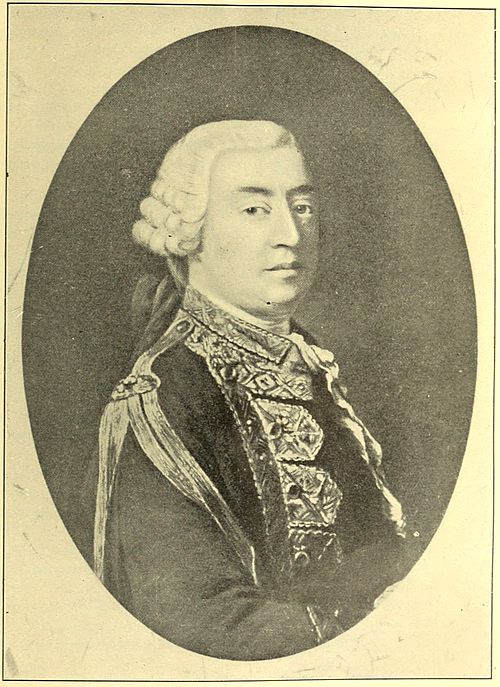
From “A Military History of Perthshire”
Lord John Murray, Colonel the Black Watch, 1745 to 1787
In 1755 he was promoted major-general, and in 1758 lieutenant-general, but although he offered his services more than once, he was not employed abroad during the Seven Years’ War. He took the keenest interest, however, in all the exploits of his regiment and worked hard to raise a second battalion in 1758. Stewart of Garth tells us that when the men who had been disabled at Ticonderoga appeared before the Board of Chelsea to claim their pensions, Lord John went with them and explained their case in such a manner to the commissioners that they were all successful. He gave them money, got them a free passage to Perth, and offered a house and garden to all who chose to settle on his estate. General Stewart also describes how, when the 42nd at last returned from America in 1767, Lord John, who had been for weeks at Cork awaiting its arrival, marched into that town at its head.
Lord John was a great deal with the regiment while it was quartered in Ireland, and, according to Stewart of Garth, was “ever attentive to the interest of the officers and vigilant that their promotion should not be interrupted by ministerial or other influence.” He was also “unremitting in his exertions to procure the appointment of good officers, and of officers who understood perfectly the peculiar dispositions and character of the men.” For this reason he strenuously endeavored to exclude all but the members of Scots—and more especially Highland—families. He was equally particular that only Gaelic-speaking men and Protestants should be recruited for the ranks.
In spite of his military duties Lord John resided a good deal in the country—and not only at the home of his boyhood—for early in life he bought Pitnacree in Strathtay, and in later years he had also a house in Perth. He represented Perthshire in Parliament from 1734 to 1761. In 1758 he married Miss Dalton of Bannercross—a Derbyshire heiress, by whom he had one daughter. In 1770 he became a full general. His last military achievement was the raising in 1779 and 1780 (at his own expense) of another second battalion to the 42nd. This battalion so distinguished itself in India that in 1786 it was placed permanently on the establishment under the title of the 73rd Regiment. The veteran to whose patriotism it owed its existence died on the 26th day of May, 1787, at the age of seventy-six, the senior officer in the Army.
Lord John made the most of such chances as occurred of distinguishing himself in the field, but those opportunities were small for he never served in any war but the Austrian Succession. It is therefore as the Colonel of the Black Watch that his name has survived—as a man who understood the Highland soldiers well enough to wish to command them at a time when to many that might have seemed a task of great difficulty—and who, having at last obtained the post he desired, completely identified himself with the interests of his men, and for upwards of half a century was the “friend and supporter of every deserving officer and soldier in the regiment.”
Military History of Perthshire, page 382-384.
John Reid.
John Reid was the eldest son of Alexander Robertson of Straloch, but the head of the family had always been known as “Baron Reid” and the General and his younger brother, Alexander (who was an officer in the 42nd), adopted the more distinctive surname early in life. He was born at Inverchroskie in Strathardle, on the 13th of February, 1721, and received his early education at Perth. Being destined for the law, he was afterwards sent to Edinburgh University. Nature, however, had intended him for a soldier, and in June, 1745, having recruited the necessary quota of men, he obtained a commission as lieutenant in Loudon’s Highlanders. He was taken prisoner at Prestonpans the following September, but when released the following spring he rejoined his regiment and was able to render important service to the Government. From 1747 to 1748 he served in Flanders with Loudon’s Highlanders and took part in the defence of Bergen-op-Zoom, but on the reduction of his regiment at the Peace of Aix-la-Chapelle he was placed on half-pay. In 1751 he bought a captain-lieutenant’s commission in the Black Watch and in 1752 a commission as captain in the same regiment. Four years later on the outbreak of the war with France, he sailed with his regiment to America. He was not present at the first attack on Ticonderoga as he had been left behind sick at Albany, and his company was commanded in that desperate engagement by Captain James Murray. In 1759, Reid, by that time a major, took part in the second advance to Lake Champlain, which resulted in the surrender of Forts Ticonderoga and Crown Point; and on him devolved the command of the 42nd during the greater part of the campaign of 1760 which ended with the capture of Montreal and the expulsion of the French from Canada.
Reid remained in America with the 42nd until Dec., 1761, when he accompanied it to the West Indies. He served in the capture of Martinique and at the storming of Morne Tortenson, on Jan. 24, 1762, was in command of the 1st Battalion of his regiment. His battalion suffered heavy loss and he was wounded in two places, but recovered in time to take part in the expedition against Havana of that same year. After the surrender of Cuba he returned to America. In 1764 Reid acted as second-in-command of Colonel Bouquet’s arduous but successful expedition against the Indians on the Ohio and Muskingum Rivers. In the following year we hear of him fitting out an expedition which was to be sent to the Illinois country under the command of Captain Thomas Stirling of the 42nd.
About 1760, Reid married an American lady of Scots descent, Susanna Alexander, daughter of James Alexander, surveyor-general of New York and New Jersey. She owned property on Otter Creek in what is now the State of Vermont, which was added to and improved by her husband with the result that at the end of ten years Reid owned “about thirty-five thousand acres of very valuable land” near Crown Point and had “obtained from the Governor and Council of New York a warrant of survey for fifteen thousand more,” which he intended to “erect” into a manor.
In 1767 the Royal Highland Regiment left America for Ireland and Reid presumably accompanied it. In 1770 Reid retired on half-pay, intending no doubt to settle down to the enjoyment and improvement of his American estates. However, in 1772 his tenants were expelled by the people of Bennington “on the pretence of having claim to that country under the Government of New Hampshire, notwithstanding that the King in Council had, ten years before, decreed Connecticut River to be the Eastern Boundary of New York.” In 1775 war broke out with the American colonists, and though his case finally came before the Commissioners for American Claims, the only compensation awarded him was a trifling allowance for mills he had erected and for fees he had paid for surveys. In May, 1778 his father’s estate, Straloch, passed under the hammer as he was unable to pay the mortgages and his son could give him no help.
Notwithstanding that he was a comparatively poor man, in 1779-1780 Reid raised at his own expense a regiment of foot, of which he was appointed colonel. This was called the 95th and was disbanded in 1783. In 1781 Reid was promoted major-general, and in 1793 a lieutenant-general. He was appointed colonel of the 88th Regiment (Connaught Rangers) in November, 1794, and became a general in 1798. In 1803, when an invasion was hourly expected, Reid, in response to an order that all general officers not employed on the staff should transmit their addresses to the Adjutant-General, wrote that though in the eighty-second years of his age “and very deaf and infirm,” he was still ready to use his feeble arm in defence of his country. He died in the Haymarket on the 6th of February, 1807, and was buried in St. Margaret’s, Westminster.
The General would probably have had but little property to dispose of at his death, had he not in 1796 succeeded to a valuable estate of some four or five thousand acres in Nova Scotia, which was left to him by his cousin, Gen. John Small, “as a mark of ... respect ... and attachment to the preservation of his name and representation for succeeding ages.” Reid’s daughter had made a marriage of which he disapproved, she had no children, and his only brother had died in 1762 during the siege of Havana. It was probably these circumstances that induced him to realize the property in Nova Scotia and at the time of his death he was worth some £52,000. This entire fortune, went after the death of his daughter, to the University of Edinburgh to found a musical professorship. He also left directions that a concert should be given annually on or about his birthday to commence with several pieces of his own composition, among the first of which is that of the “Garb of Old Gaul,” a composition written by Sir Charles Erskine, but set to music by Reid while major of the 42nd, and which has ever since been a regimental march.
Reid also composed several military marches and was esteemed the best gentleman player on the German flute in England. It may safely be predicted that as long as the University exists this old Perthshire soldier of the 18th century will be remembered as one of its benefactors.
N. Y. Documentary History IV.
Military History of Perthshire pp. 387-395.
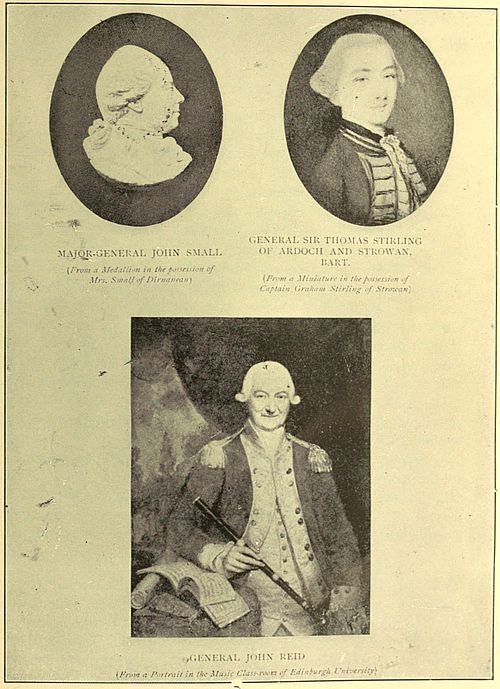
From “A Military History of Perthshire”
Officers in the Black Watch 1758-9
MAJOR-GENERAL JOHN SMALL
(From a Medallion in the possession of Mrs. Small of Dirnanean)
GENERAL SIR THOMAS STIRLING OF ARDOCH AND STROWAN, BART.
(From a Miniature in the possession of Captain Graham Stirling of Strowan)
GENERAL JOHN REID
(From a Portrait in the Music Class-room of Edinburgh University)
John Small.
John Small was the third son of Patrick Small, who married Magdalen Robertson, sister of Alexander Robertson, the father of General John Reid. Reid and Small were thus not only neighbors and brother-officers, but first cousins, and were evidently on terms of close friendship. Born in Strathardle, Atholl, Scotland, in 1730, Small, like many of his countrymen of that date, began his military career with the Scots Brigade in Holland, being appointed a 2nd lieutenant in the Earl of Drumlanrig’s Regiment when it was raised for service of the States-General in 1747. How long he remained abroad is unknown but it is probable that he returned to England when the regiment was reduced in 1752. He did not, however, obtain a commission in the British army until four years later, when he was appointed lieutenant in the 42nd, just prior to its departure for America. So far as is known, Small took part in all the campaigns in which his regiment was engaged from 1756 to 1763. He fought at Ticonderoga in 1758, served with General Amherst’s successful expedition to Lake Champlain in the following year, and took part in the operations which completed the conquest of Canada in 1760. After the surrender of Montreal he was sent in charge of French prisoners to New York, and we learn from a brother officer that General Amherst had great confidence in him, and frequently employed him “on particular services.” Two years later he served in the capture of Martinique and Havana and obtained his promotion as captain.
At the peace of 1763 Small was placed on half-pay, but, according to General Stewart, he was almost immediately put on the full-pay list of the North British Fusiliers (21st) and when in 1767 the Black Watch left for Europe, most of the men of that regiment who had volunteered to stay in America joined the Fusiliers in order to serve under Small, who was “deservedly popular” with them. Small, however, cannot have served long with the 21st, for in the same year in which the Black Watch left America he was appointed “major of brigade” to the forces in North America. It was probably during the interval between the Seven Years’ War and the war with the Americans that he began to acquire the property in Nova Scotia, part of which he afterwards bequeathed to his cousin, John Reid. We have some indication that during this period he interested himself in local politics and formed the friendship of at least one American which was of value to him later.
Small served throughout the War of Independence though but rare glimpses are obtained of him. He was present as a brigade-major at the battle of Bunker Hill, June 17, 1777, and in the course of that day his life was saved by the American General Putnam, who, seeing Small standing alone at a time when all around him had fallen, struck up the barrels of his men’s muskets to save his life. Shortly after this, Small raised the 2nd battalion of the Royal Highland Regiment and was appointed major-commandant. In 1778 the regiment was numbered the 84th and in 1780 he was promoted to lieutenant-colonel-commandant of his battalion. He is said to have joined Sir Henry Clinton at New York in 1779, but it is more probable that he was stationed for the most part in Nova Scotia. In March, 1783, Small and his battalion were at Fort Edward, New York, and in the following autumn the battalion was disbanded at Windsor, Nova Scotia, where many of the men settled and formed the present town of Douglas.
Small, once more on half-pay, returned home and in 1790 was promoted colonel and three years later was appointed lieutenant governor of Guernsey. In October, 1794, he became major-general and on the 17th of March, 1796, he died in Guernsey and was buried in the church of St. Peter Port.
General Stewart of Garth wrote of General John Small that “No chief of former days ever more fairly secured the attachment of his clan, and no chief, certainly, ever deserved it better. With an enthusiastic and almost romantic love for his country and countrymen, it seemed as if the principal object of his life had been to serve them, and promote prosperity. Equally brave in leading them in the field, and kind, just, and conciliating in quarters, they would have indeed been ungrateful if they regarded him otherwise than as they did. There was not an instance of desertion in his battalion.”
Stewart II, 143. Military Hist. of Perthshire, pp. 396-399.
James Stewart of Urrard.
James Stewart of Urrard, obtained a company in the 42nd, July 18th, 1757. He was wounded at Ticonderoga, 1758. He sold out after the peace.
Stewart I, 306, 359. N. Y. Col. MSS., p. 729, Vol. 10.
Thomas Stirling.
Thomas Stirling, second son of Sir Henry Stirling, of Ardoch, was born October 8, 1731. He began his military career in the Dutch service, being given a commission as ensign in the 1st Battalion of Col. Marjoribanks’ Regiment on the 30th of September, 1747, and was probably placed on half-pay when the establishment of the Scots Brigade was reduced in 1752. On the 24th of July, 1757, having been nominated by James, Duke of Atholl, and having raised the requisite number of men, he was gazetted captain of one of the three companies added to the 42nd in that year. In November, 1757, he sailed for America, where he served with his regiment in the campaigns of the ensuing years, though he was not present at the first attack on Ticonderoga, owing to the fact that the new companies had been left behind to garrison Fort Edward. He took part in the capture of Martinique in 1762 and was wounded but was able to serve in the capture of Havana later in that year. He returned with his regiment to America and in August, 1765, was sent in command of a company to take possession of Fort de Chartes on the Mississippi. After holding this fort that winter and spring, he returned with his detachment to the regiment in June, 1766. The following year the 42nd left America and for upwards of eight years was quartered in Ireland, after which it was for a short time in Scotland. In 1770 Stirling was gazetted major of the regiment, and 1771 lieutenant-Colonel-commandant. Hostilities broke out with the Americans in 1775, and, Stirling, having in five months raised the strength of his regiment from 350 men to 1,200, returned with it in the following spring to America, where he commanded it continuously for three years during the war. He took part in the engagement at Brooklyn, the attack on Fort Washington, the expedition to Pennsylvania, battle of Monmouth, and others. During 1778-9 he was stationed at or near New York. In June, 1779, he accompanied a force under General Mathews through New Jersey in an attempt to rally the supposed loyalists of that state. This was unsuccessful and ended in the destruction of the town of Springfield. General Stirling was so severely wounded while leading the attack that he could take no further part in the war. His thigh was broken and fearing to be rendered incapable of further service he refused to have it amputated. He recovered and was invalided home but he does not appear after this to have been ever again fit for active duty. In 1782 he was promoted major-general and appointed colonel of the 71st Foot, but his regiment was disbanded the following year. His services were rewarded with a baronetcy and in 1790, he became colonel of the 41st Regiment. In 1796 he was promoted lieutenant-general, and in 1799 he succeeded his brother in the baronetcy of Ardock. He attained the rank of general in 1801 and died unmarried on the 9th of May, 1808.
Kenneth Tolmie.
Kenneth Tolmie was commissioned a lieutenant in the 42nd Highlanders, 23rd January, 1756, and promoted to the Command of a Company 27th July, 1760. His name is dropped after the Peace of 1763.
Wilson’s Orderly Book, p. 166.
Alexander Turnbull.
Alexander Turnbull of Stracathro, appointed ensign, June 3, 1752; lieutenant, Sept. 27, 1756; captain, Aug. 14, 1762. After 11 years of service, he went on half-pay in 1763; full pay of the 32nd Foot. He died in 1804 with rank of major.
Stewart of Garth, Appendix.
K
ORIGINAL REGIMENTAL LIST OF THE BLACK WATCH.
From A Military History of Perthshire, pages 51, 52, and The Black Watch Chronicle, 1913, pages 6-8.
No. 1 Company.
Colonel and Captain John, Earl of Crawford. Died 1748.
Captain-Lieutenant Duncan Mackfarland. Retired 1744.
Ensign Gilbert Stewart of Kincraigie.
No. 2 Company.
Lieutenant-Colonel and Captain Sir Robert Munro, Bart., of Foulis. Killed at Falkirk 1746.
Lieutenant Paul Macferson.
Ensign Archibald Macknab, younger son of the Laird of Macnab. Died Lieut. General, 1790.
No. 3 Company.
Major and Captain George Grant. Removed from the service by sentence of Court-martial, 1746.
Lieutenant John MacKenzie of Rencraig (? Kincraig).
Ensign Collin Campbell.
No. 4 Company.
Captain Collin Campbell, Jr., of Monzie. Retired 1743.
Lieutenant Alexander Macdonald.
Ensign James Campbell of Glenfalloch. Died of wounds at Fontenoy.
No. 5 Company.
Captain James Colquhoun of Luss. Promoted to be Major. Retired in 1748.
Lieutenant George Ramsay.
Ensign James Campbell of Stronslanie.[44]
No. 6 Company.
Captain John Campbell of Carrick. Killed at Fontenoy.
Lieutenant John MacLean of Kingairloch.
Ensign Dougall Stewart (of Appin?).
No. 7 Company.
Captain Collin Campbell of Balliemore. Retired.
Lieutenant Malcom Frazer, son of Culduthel.[45] Killed at Bergen-op-Zoom, 1747.
Ensign Dougal Stewart.
No. 8 Company.
Captain George Munro of Culcairn, brother of Foulis. Killed 1746.
Lieutenant Lewis Grant of Auchterblair.
Ensign John Menzies of Comrie.
No. 9 Company.
Captain Dougal Campbell of Craignish. Retired in 1745.
Lieutenant John Mackneil.
Ensign Gordon Graham of Draines.[46]
No. 10 Company.
Captain John Monro of Newmore. Promoted to be Lt. Col. 1743; retired 1749.
Lieutenant Francis Grant, son of the Laird of Grant.[47] Died Lieut.-General 1782.
Ensign Edward Carrick.
Surgeon George Monro.
Quarter Master John Forbes.
Chaplain Hon. Gideon Murray.
Adjutant John Lindsay.[48]
L
OFFICERS OF THE 42ND ROYAL HIGHLAND REGIMENT AS COPIED FROM THE BRITISH ARMY LIST, PUBLISHED 20TH JUNE, 1759.
Col. Lord Jno. Murray, Lt. Gen.
Lt. Col. Francis Grant. Major Gordon Graham. Capt. John Reid. Capt. John McNeil. Capt. Allan Campbell. Capt. Thomas Graeme. Capt. James Abercrombie. Capt. John Campbell. Capt. James Stewart. Capt. James Murray. Capt. Thomas Stirling. Capt. Francis McLean. Capt. Archibald Campbell. Capt. Alexander St. Clair. Capt. William Murray. Capt. John Stuart. Capt. Alexander Reid. Capt. William Grant. Capt. David Haldane. Capt. Lieut. Robert Gray. Lieut. John Campbell. Lieut. Kenneth Tolme. Lieut. James Grant. Lieut. John Graham. Lieut. Alex. Turnbull. Lieut. Alex. Campbell. Lieut. Alex. McIntosh. Lieut. James Gray. Lieut. John Small. Lieut. Arch. Campbell, Sen. Lieut. James Campbell. Lieut. Archibald Lamont. Lieut. David Mills. Lieut. Simon Blair. Lieut. David Barclay. Lieut. Archibald Campbell, Jr. Lieut. Alex Mackay. Lieut. Robert Menzies. Lieut. Patrick Balneavis. Lieut. John Campbell, Sen. Lieut. Alex. McLean. Lieut. George Sinclair. Lieut. John Murray.
Lieut. Gordon Clunes. Lieut. James Fraser. Lieut. John Robertson. Lieut. John Grant. Lieut. George Leslie. Lieut. Duncan Campbell. Lieut. Adam Stuart. Lieut. Donald Campbell. Lieut. George Grant. Lieut. James McIntosh. Lieut. Robert Robertson. Lieut. John Smith. Lieut. Peter Grant. Lieut. Alex. Farquharson. Lieut. John Campbell, Jr. Lieut. George Sinclair. Ensign Elbert Herring. Ensign William Brown. Ensign Thomas Fletcher. Ensign Alex. Donaldson. Ensign William McIntosh. Ensign Patrick Sinclair. Ensign Archibald Campbell, Jun. Ensign John Gregor. Ensign Lewis Grant. Ensign Archibald Campbell, Sen. Ensign John Graham. Ensign Allen Grant. Ensign John Leith. Ensign Charles Menzies. Ensign Archibald McNab. Ensign John Chas. St. Clair. Ensign John Gordon. Ensign Neil McLean. Ensign Thomas Cunison. Sergt. Phineas McPherson. Chaplain James Stewart. Adj. James Grant. Aldj. Alex McLean. Quarter Master John Graham. Quarter Master Adam Stewart. Surgeon David Hepburn. Surgeon Robt. Drummond.
Agt., Mr. Drummond, Spring Garden.
The following corrections were interlined in ink in the above Army List of 1759, which was found in the British Museum:
Capt. John Reid was made Major. Aug. 5, 1759.
Capt. John Campbell, removed to the 17th.
Capt. David Haldane, removed to a Regiment at Jamaica.
Lieut. Alexander McLean, made captain of corps of Highlanders.
Lieut. George Sinclair, dead.
Lieut. George Sinclair, removed to Crawford’s Regiment.
Ensign Thomas Fletcher, made lieutenant June 1, 1759.
Ensign William McIntosh, removed to Keith’s Corps.
Sergt. Phineas McPherson, made ensign June 1, 1759.
Lauchlan Johnson, made chaplain 20th August, 1759, in place of James Stewart.
Alexander Donaldson, made adjutant 20th March, 1759, in place of Alexander McLean.
M
REFERENCES TO THE BLACK WATCH IN THE 1759 CAMPAIGN TAKEN FROM “COMMISSARY WILSON’S ORDERLY BOOK.”
Albany, 22 May, 1759. Two companies of the Royal Highland Regiment are also to receive batteaux and load them with provision and baggage. A sergeant and 12 men of the Rhode Island Regiment are to relieve a party of the Royal Highland Regiment at the Half-Way House on the way to Schenectady; they are to march tomorrow morning and carry six days’ provision with them.
Albany, 23d May, 1759. Three captains of the Royal Highlanders summoned among others to a general Court Martial, of which Col. Francis Grant was President, to set tomorrow at the Town House in Albany at 3 o’clock to try all prisoners that may be brought before them.
Albany, 26th May, 1759. An officer and 25 men of the Royal Highland Regiment with a week’s provision to be sent this afternoon to Widow McGinnes House to protect settlement; one Company of the Royal Highland Regiment to march tomorrow morning at 5 o’clock; they will take their tents and camp equipage with them, for which a wagon will be allowed on sending to Col. Bradstreet for it; the officer commanding that company to call upon the General this night. The General Court Martial of which Col. Grant is President to meet again tomorrow at 8 o’clock.
Albany, 31st May, 1759. The Royal Highland Regiment to march tomorrow morning at 5 o’clock to Halfmoon, where they will take the artillery under their charge and escort the same to Fort Edward.
Fort Edward, 6th June, 1759. Lieut. Col. Robinson will mark out the Camp tomorrow morning at 5 o’clock that the Regiments may take up their ground as they arrive; the Regiments to encamp * * * Royal Highlanders on the right. A Serj. and 16 men of ye Royal Highlanders to take the General’s Guard.
Fort Edward, 7th June, 1759. The Regiments are not to change their encampment until the ground be quite dry.
Fort Edward, 8th June, 1759. The Regiments to change their encampment this day at 12 o’clock.
Fort Edward, 9th June, 1759. Field Officer for the Picquit tomorrow, Major Graham. The Light infantry of the Highland Regiment is to practice firing ball tomorrow morning at 6 o’clock, near the Royal Block House on the other side of the river.
The Royal Highland Regiment to furnish 2 captains, 6 subs., and 200 men * * *; this detachment to take batteaux tomorrow morning at day break. The Royal Highland Regiment to take 20 batteaux, and 60 of the 200 men with arms to serve as a covering party. The whole to take provisions for tomorrow with them; they are to proceed to Col. Haviland’s Camp, opposite to Fort Miller, where the commanding officer will apply to Col. Haviland who will order the batteaux to be immediately loaded, that the whole party may return to Fort Edward without loss of time.
Fort Edward, 10th June, 1759. Field Officer for the Picquit this night Major (Gordon) Graham, for tomorrow Major (Allen) Campbell, Colonel of the day, Col. (Francis) Grant. Two captains of the Royal Highlanders to sit with others in General Court Martial tomorrow morning at 8 o’clock, to try such prisoners as are on the Provost Guard. The Royal Highlanders and Montgomery’s Regiments to send as many men this afternoon at 4 o’clock as are necessary to clean the ground where the Light Infantry is to encamp. They will receive axes on applying to the store-keeper in the Fort, which they will return when they have finished that work.
Fort Edward, 11th June, 1759. Colo. of the day, Col. Grant, Field Officer of the Picquits, Major Campbell.
Fort Edward, 12th June, 1759. Block Houses to be relieved tomorrow by the Line * * * the one joining the east side of the Bridge by 1 Sub., 2 Serjts., 2 corpls. and 24 men of the Royal Highlanders; the one in the front of the Right of the Royal, one Serjt., one Corpl. and 10 men of the Royal Highlanders.
Fort Edward, 13th June, 1759. The Royal Highland Regiment to strick their tents tomorrow at Revallie Beating. The Royal Highlanders posted in their Block Houses as per ordered of yesterday, to be relieved immediately.
Fort Edward, 17th June. The First Battalion Massachusetts to strike their tents at Revallie Beating and march half an hour after to the Halfway Brook where the commanding officer will put himself under the command of Col. Grant.
Fort Edward, 19th June, 1759. The Royal Highlanders will furnish one Sub. and 30 men towards the working party required tomorrow to repair the roads.
Fort Edward, 20th June. Capt. Campbell of the Royal Highland Grenediers is appointed Major to the Battalion of Grenediers for the Campaign.
Lake George, 22d June, 1759. The Royal Highlanders to receive one day’s fresh beef tomorrow.
Lake George 24th June. Field Officer for tomorrow, Major Graham.
Lake George, 26th June, 1759. The Royal Highlanders to receive 7 days’ provisions tomorrow.
Lake George, 27th June. Generals Guard tomorrow, Royal Highlanders. 2 Companies of Grenediers with 2 Companies of Light Infantry ordered this morning with as many Rangers and Indians as Maj. Rogers can furnish, the whole commanded by Maj. Campbell, to march tomorrow two hours before daybreak by the same route Col. Haviland took; which post Capt. Johnson will show, and to remain there whilst the boats are fishing. They are to take one day’s provisions and to go as light as possible as they are not only a covering party to the boats, but to attack any body of the enemy they may find.
Lake George, 5th July, 1759. A General Court Martial to set tomorrow morning at the President’s Tent at 8 o’clock for the trial of a man suspected of robbery * * * Major Graham and two captains of the Royal Highlanders to attend.
Lake George 8th July, 1759. The Royal Highlanders will take the Gen’s Guard tomorrow half an hour after 4.
Lake George, 11th July, 1759. Capt. John Campbell of the Royal Highlanders is appointed Major in the late Forbes, and is to be obeyed as such. Royal Highlanders to receive 35 batteaux. Oars and whatever else belongs to the batteaux will be delivered at the same time. Each batteaux will carry 12 barrels of flour or 9 of pork when ordered to load, and it is supposed will have about 20 men or a few more in each battoe.
Lake George, 12th July. A General Court Martial of the Regulars to be held tomorrow morning at 6 o’clock. Col. Grant President, Major John Campbell to attend.
Lake George, 13th July. Colonel of the Day tomorrow, Col. Grant. Field Officer tomorrow night, Major Graham. Generals Guard tomorrow, Royal Highlanders. The General Court Martial of which Col. Grant was President, is dissolved. Royal Highlanders to receive a proportion of flour for five days which they are to get baked tomorrow and keep.
Lake George, 19th July, 1759. The Royal Highlanders one of the Regiments appointed to sit in general Court Martial tomorrow at 6 o’clock. The Regiments to load their batteaux tomorrow morning beginning at 5 o’clock in the following manner, Montgomery’s Pork, Royal Highlanders, Flour, * * * two regiments to load at a time, one flour and one pork, and to be allowed an hour for loading, and when loaded to return to their stations.
Lake George, 20th July, 1759. For the day this day, Regulars, Col. Grant. On landing the Col. Grant to take the command of the late Forbes’ Brigade.
Camp near Ticonderoga, 22d July. For the Picquit tomorrow night, Major Graham.
Camp before Ticonderoga, 23d July, 1759. Collo. of the day tomorrow, Collo. Grant. Field Officer of the Picquits this night, Major Graham.
Camp at Ticonderoga, 24th July, 1759. Serjt. Murray of the Royal Highland Regiment is appointed to oversee people making Fasciens, and to keep an account of the number made.
Camp at Ticonderoga, 25th July, 1759. The following carpenters * * * James Frazer, George McDougall, James Frazer, John McColme, John Robinson, James Cumming, and James McDonald of the Royal Highlanders to be at the sawmills tomorrow at 5 o’clock and if Capt. Loreing should not be there they will receive their directions from Brigadier Ruggles.
The Royal Highland Regiment to draw tomorrow early two days bisquit and two days pork, bisquit in lieu of flour, which completes them to the 28th inclusive.
Ticonderoga, 26th July, 1759. Adjutant for the day tomorrow Royal Highlands.
Ticonderoga, 28th July, 1759. A General Court Martial of the line to be held at the President’s tent at 8 o’clock tomorrow morning. Col. Grant, President, two Majors and ten Captains, two of whom were from the Royal Highlanders.
Ticonderoga, 29th July, 1759. The ovens to be given for the use of troops in the following manner:— * * * No. 2 to the Inniskilling and Royal Highlanders. No bakers but such as those Corps imploy to make in any of those ovens. The Royal Highland Regiments to strick their tents and march immediately to the Landing Place, and they will send their tents and baggage in batteaux.
Ticonderoga, 1st August, 1759. As a number of shoes are come up, intended for the use of the Army, and will be delivered to them at the prime cost in England, which three shillings and six pence per pair. The Regiments may receive in the following manner and proportion, or as many of that proportion as they like to take by applying to Mr. Tucker, agent to Mr. Kilby at the Landing Place. Royal Highlanders 366.
Capt. Reid is appointed Major to the Royal Highland Regiment.
Crown Point, 5th August, 1759. Collo. of the day tomorrow Regulars Collo. Grant; Field officer for the Picquits tomorrow night Maj. Reid.
Crown Point, 6th August, 1759. Adjutant of the day tomorrow Royal Highlanders. As twenty-four barrels of Spruce beer is come to the fort the corps may send for it immediately in the following proportions * * * Royal Highlanders, three barrels.
Crown Point, 7th August, 1759. Corporal Sinclair of the Highlanders and Parceloo of the Inniskilling Regiment with 16 leabours used to digging to attend Lieut. Gray Tomorrow at 5 o’clock; the evening gun is the signal for the working party to leave of work.
Crown Point, 8th August, 1759. The Regulars to receive 4 days provisions tomorrow of pork, beginning at Revallie Beating by Forbes followed by Royal Highlanders, etc. It is concluded that they have their bread from Ticonderoga as was ordered.
Crown Point, 10th August, 1759. Ens. Gregor of the Royal Highlanders * * * are appointed overseers of the works that are carrying on at the fort. They will attend Lieut. Col. Eyre tomorrow morning at 5 o’clock and follow such directions as they shall receive from him.
Crown Point, 11th August, 1759. Collo. of the day tomorrow, Collo. Grant. For the building of the fort the following quarriers * * * five of the Royal Highlanders * * * to attend Lieut. Col. Eyre tomorrow morning at the hour of work, and are to continue daily to work as quarriers.
Crown Point, 12th August, 1759. Adjutant of the Day tomorrow, Royal Highlanders.
Crown Point, 14th August, 1759. Field officer for the work tomorrow, Major Reid.
Crown Point, 15th August, 1759. The following Surgeons Mates are to join the Regiments and serve as Mates in room of Officers serving as such; Mr. Goldthwat an additional Mate in the Royal Highlanders to be put on the establishment of Forbe’s, Mr. Carter to the Royal Highlanders.
Crown Point, 16th August, 1759. The following sawiers are to attend Lieut. Col. Eyre tomorrow at 5 o’clock: * * * Royal Highlanders, Robert Kennedy, John McFarling and Robert Bain. The following masons are likewise to attend Lieut. Col. Eyre tomorrow morning at 5 o’clock: * * * Royal Highlanders, Dougal McKeafter and John Stewart. The above artificers are to work daily and to follow such directions as they shall receive from Lieut. Col. Eyre.
Crown Point, 17th August, 1759. Collo. of the day tomorrow, Collo. Grant. The following masons to attend Lieut. Col. Eyre tomorrow morning at five o’clock; * * * Royal Highlanders Angus McDonald and William Milligan.
Crown Point, 18th August, 1759. Adjutant of the day tomorrow, Royal Highlanders.
Crown Point, 24th Aug., 1759. Adjutant of the day, tomorrow, Royal Highlanders.
Crown Point, 27th August, 1759. The following soldiers to attend Lieut. Eyre tomorrow morning at 5 o’clock and to take their directions from him; Royal Highlanders, John Fraser, John McElvore, James Bruce, Allex’r Sutherland.
Crown Point, 28th Aug. Field Officer of the work tomorrow, Major Reid.
Crown Point, 30 August, 1759. Adjutant of the day, Royal Highlanders.
Crown Point, 1st Sept. Collo. of the day, tomorrow, Collo. Grant.
Crown Point, 3d September, 1759. John McNeal, Grenadier in Royal Highland Regiment, * * * to attend Lieut. Col. Eyre this day at 12 o’clock and to follow such directions as he shall give.
Crown Point, 4th Sept., 1759. Collo. of the day, tomorrow, Collo. Grant. Field Officer for the work, Major Reid. The men of the Royal Highland Regiment who have been employed in making baskets will be paid for the same by the Quartermaster’s applying to Mr. Gray this afternoon after the work is over. The Regiments to receive tomorrow morning two pounds of fresh meat and one pound of rice for the number of men set opposite the names of each corps, and the Regiments are to apply said fresh beef and rice entirely for the use of the sick. Royal Highlanders 22.
Crown Point, 5th Sept., 1759. Field Officer for the works tomorrow, Major Reid. Adjutant of the day, tomorrow, Royal Highlanders. Allex’r Forbes of the Royal Highlanders, mason, to accompany Lieut. Col. Eyre tomorrow and follow such directions as he shall give.
Crown Point, 6th Sept. Serjt. Clark of the Royal Highlanders to be one of the four sergeants to attend the works daily and to receive directions from Lieut. Col. Eyre.
Crown Point, 7th Sept. For the day, tomorrow, Collo. Grant.
Crown Point, 11th Sept. Adjutant of the day tomorrow, Royal Highlanders. A general court martial of the Regulars to sit tomorrow at the President’s Tent at 8 o’clock; Collo. Foster, President, Major John Campbell, Major Reid, * * * one captain of the Royal Highlanders.
Crown Point, 12th Sept. A detachment of 100 Grenadiers, 30 of the Light Infantry of Regiments, non-commissioned officers in proportion to be commanded by a captain of the Grenadiers and 2 Subalterns of each Corps to parade tomorrow at Revallie beating on the left of the front of the light infantry and to take 30 batteaux to Ticonderoga where he is to apply to the Commissary and load 15 with 30 barrels of flour in each batteaux, the other 15 with 16 barrels of pork each. The Royal Highland Regiment to furnish the batteaux and the captain commanding the party will see them this night that they may be ready to set off at Revallie beating and to return as soon as they are loaded.
Crown Point, 15th Sept., 1759. For the day tomorrow, Collo. Grant. Field Officer for the Picquits this night, Regulars Major Reid. Field Officer for the works tomorrow, Major John Campbell.
Crown Point, 16th Sept., 1759. Field Officer for the works tomorrow, Major Reid.
Crown Point, 17th Sept. Adjutant of the day tomorrow, Royal Highlanders.
Crown Point, 18th Sept., 1759. For the day tomorrow, Collo. Grant.
Crown Point, 21st Sept., 1759. For the day tomorrow, Collo. Grant. For the Picquits this night, Major Reid. Field Officer for the works tomorrow, Major John Campbell.
Crown Point, 23d Sept., 1759. Adjutant of the day tomorrow, Royal Highlanders.
Crown Point, 25th Sept. Lieut. Tolmey of the Royal Highlanders is appointed Overseer for the work on the fort and to receive his directions from Lieut. Col. Eyre.
Crown Point, 26th Sept., 1759. Field officer for the Picquits this night, Major John Campbell; tomorrow night, Major Reid.
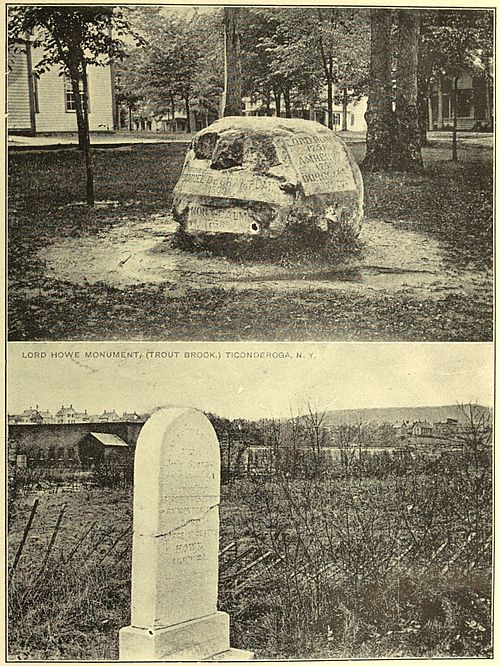
AT TICONDEROGA
LORD HOWE MONUMENT, (TROUT BROOK.) TICONDEROGA, N. Y.
Boulder in Academy Park to the Heroes of the Four Nations—Indian, French, British and American who fought at Ticonderoga.
Monument marking the spot at the mouth of Trout Brook, where Lord Howe was supposed to have fallen.
(Both Boulder and Monument were erected by the late
Rev. Joseph Cook)
Crown Point, 27th Sept., 1759. For the day tomorrow, Collo. Grant. Field Officer for the Picquits this night, Major Reid.
Crown Point, 29th Sept. Adjutant for the day tomorrow, Royal Highlanders.
Crown Point, 30th Sept., 1759. Collo. for the day tomorrow, Collo. Grant.
Crown Point, 2d Oct., 1759. Field Officer for the Picquits this night, Major John Campbell; tomorrow night, Major Reid.
Crown Point, 3d October. For the day tomorrow, Collo. Grant. Field Officer for the Picquits this night, Major Reid. Field Officer for the works tomorrow, John Campbell. A General Court martial of the Regulars to sit at the President’s tent tomorrow at 9 o’clock * * * two captains of the Royal Highlanders.
Crown Point, 5th Oct., 1759. Adjutant of the day tomorrow, Royal Highlanders.
Crown Point, 6th Oct., 1759. For the day tomorrow, Collo. Grant. The regular regiments to give in their cartridges that are damaged this day to the artillery and to receive as much powder, paper, ball and twine as will compleat their ammunition. The Royal Highlanders 475.
Crown Point, 7th October. The Regiments to prepare their batteaux to the following numbers and to have their sails fixed according to patern Col. Haviland approved of; * * * Royal Highlanders 24, * * *
Crown Point, 8th October. Royal Highlanders are to take two batteaux more than what were ordered yesterday.
Crown Point, 9th October. For the day tomorrow, Collo. Grant. Field Officer for Picquits this night, Major Reid. The undermentioned Corps are to send a batteaux each at Retreat beating to Ticonderoga to receive tomorrow morning the following number of loaves weighing six pounds and a half each; they are to pay to the person Gen. Lyman appoints to receive the money the following sums being one penny sterling for baking seven pounds of flour: Royal Highlanders 460 loaves, 1; 7; 8 Sterling. * * *
The Royal Highlanders are to leave Subaltern Officer each, exclusive of officers employed as overseers at the King’s Works, with three Sergeants, three Corp’ls each with the men that are left behind; when the Regiments march, the officers and men of each corps will encamp on the Center of the encampment of the Corps * * * and a sentry to be kept in the encampment that nothing may be spoiled or taken away during the absence of the Regiment. The Regiments are to give the following numbers for the Brig and Sloop and will send seamen if they have them: For the Brig, * * * Royal Highlanders 14 men.