APPENDIX (continued 2)
Reading edition
Crown Point, 11th Oct., 1759. Adjutant of the day tomorrow, Royal Highlanders.
Lake Shamplaine, 15th Oct., 1759. For the day tomorrow, Collo. Grant.
Ligonier Bay, 14th Oct., 1759. Field Officer for the Picquit this night, Major John Campbell; tomorrow night, Major Reid.
Lake Shamplaine, 15th Oct., 1759. For the day tomorrow, Collo. Grant. Field Officer for the Picquits this night, Major Reid.
Camp at Schuylers Island, 18th Oct., 1759. For the day tomorrow, Collo. Grant.
Crown Point, 22nd Oct., 1759. Adjutant of the day tomorrow, Royal Highlanders.
Crown Point, 25th October. 22 men of the Royal Highlanders are to be sent to the Hospital at Fort Edward. * * * The surgeon of the Royal Highlanders is to attend them to Fort Edward, a Corporal and 6 men of the Royal Highlanders with one batteaux * * * are to convey the sick to the Sawmills, where the officer will leave the batteau with Lieut. Col. Miller and march the sick to the Landing Place.
Crown Point, 27th Oct., 1759. For the day tomorrow, Collo. Grant. Field Officer for the Picquits this night, Major Reid.
Crown Point, 28th Oct., 1759. Adjutant for the day tomorrow, Royal Highlanders.
Crown Point, 30th October. Officer for the day, tomorrow, Collo. Grant. A General Court martial to be held at the President’s Tent tomorrow at 9 o’clock to try all such prisoners as shall be brought before them; Col. Grant, President, * * * One Captain of the Royal Highlanders.
Crown Point, 31st Oct., 1759. Field Officer for the Picquits this night, Major Reid. The General Court martial of which Collo. Grant was President is dissolved; the Prisoners of the Royal Highland Regiment is acquitted.
Crown Point, 1st Nov., 1759. For the day tomorrow, Collo. Grant.
Crown Point, 3d Nov., 1759. For the Picquits tomorrow night, Major John Campbell; for the works tomorrow, Major John Campbell; Adjutant of the day tomorrow, Royal Highlanders.
N
COLONEL ROGER TOWNSHEND.
Roger Townshend, fifth son of Charles Viscount Townshend, and younger brother of Gen’l George Townshend (afterwards 4th Viscount and 1st Marquis) to whom Quebec surrendered when Wolfe was killed, was commissioned Lieutenant-Colonel 1st Feb., 1758, and served as Adjutant-General in the Expedition against Louisbourg, and Deputy Adjutant-General in this Campaign with Rank of Colonel. He was killed in the Trenches before Ticonderoga by a cannon ball on the 25th July, 1759, and his remains were transmitted to Albany for interment. His spirit and military knowledge justly entitled him to the esteem of every soldier; and accordingly the loss of him was universally lamented.
Knox I, 360, 289, 401, 403.
Wilson’s Orderly Book, page 77.
Supplement to the New York Mercury, Tuesday, July 31, 1759.
Extract from a letter dated Albany, July 29, 1759.
“The same evening (July 27), an Express arrived from Ticonderoga, with an account of Colonel Townshend being killed, in reconnoitering the Fort, by a cannon ball.
Yesterday about 12 o’clock, Colonel Townshend’s corpse arrived here, and was decently interred.”
In the “Church Book” St. Peter’s, Albany, appears the following entry:
1759 July 30 To cash received for braking ground in the church to lay the body of Coll. Townson £5/0/0
To cash ret for Paull 9
The following is a copy of the inscription on the monument to Col. Townshend in Westminster Abbey
“This Monument was erected By a disconsolate Parent The Lady Viscountess Townshend To the Memory of her Fifth Son The Hon’ble Lieut. Colonel Roger Townshend who was killed by a Cannon Ball on the 25th of July, 1759, in the 28th year of his age as he was reconnoitering ye French lines at Ticonderoga In North America From the Parent the Brother and the Friend His sociable and amiable manners His enterprizing Bravery And the Integrity of His Heart May claim the tribute of affliction Yet Stranger weep not For tho’ premature His Death His life was glorious Enrolling Him with the names of those Immortal Statesmen and Commanders Whose wisdom and Intrepidity In the course of this Comprehensive and Successful War Have Extended the Commerce And upheld the Majesty of these Kingdoms Beyond the idea of any former age.”
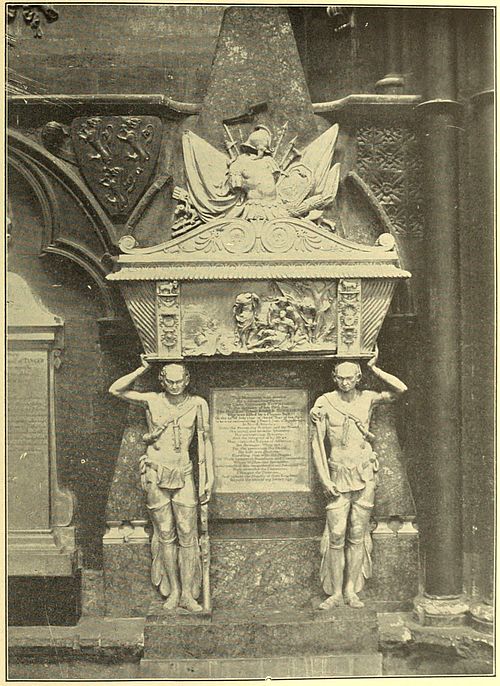
Monument to Lieut. Colonel Roger Townshend in Westminster Abbey (The Bayonet on Monument found on battlefield of Ticonderoga and placed on memorial by Dean Stanley)
The following is an extract from a letter from the head verger of Westminster Abbey
“I should like to draw your attention to the broken bayonet in the upper part of the Townshend monument. It is a relic of the struggle between the French and English in North America and it comes from Ticonderoga and may have been used in that particular ‘march to Ticonderoga, where Col. Townshend was killed.’ It was given to Dean Stanley when in America and he fixed it on the monument as he did the wreath of leaves on the monument of Major Andre.
Lord Eversley, who when H. M. first Commissioner of Works was the Rt. Hon. J. G. Shaw Lefevre—is much struck by the Townshend inscription, especially the latter part, which, he has told me, is worthy of Edmund Burke and which I know he would like to attribute to that great orator and statesman.”
O
BIBLIOGRAPHY.
A Military History of Perthshire, 1660-1902. Edited by the Marchioness of Tullibardine. Perth R. A. & J. Hay, 1908.
Chronicles of the Atholl and Tullibardine Families. Collected and arranged by John, Seventh Duke of Atholl, K. T., in Five Volumes. Ballantyne Press, 1908.
Sketches of the Character, Manners and Present State of the Highlanders of Scotland, with details of the Military Service of the Highland Regiments, by Colonel David Stewart (of Garth), Edinburgh. Archibald, Constable & Co., 1822.
The Scottish Highlands, Highland Clans and Regiments, by John S. Keltie, F. S. A. S. Edinburgh, A. Fullerton & Co.
The Regimental Records of the British Army, by John S. Farmer, London, Grant Richards, 1901.
An Historical Account of the Settlements of Scotch Highlanders in America, etc., by J. P. MacLean, Ph. D. Cleveland, The Helmar-Taylor Co., Glasgow, John MacKay, 1900.
Historical Record of the 42nd or Royal Highland Regiment of Foot, 1729-1844. Illustrated. London, Parker, 1845.
Historical Record of the 73rd Regiment, 1780-1851. Illustrated. London. Parker, 1851.
Chronology and Book of Days of the 42nd Royal Highlanders, The Black Watch, 1729-1905. Berwick-on-Tweed, Martin’s Printing Works, 1906.
History of Black Watch. Johnston, 1893.
The Black Watch. The Record of an Historic Regiment, by Archibald Forbes, LL. D. Cassell & Co., 1910.
Black Watch Episode of the Year 1731, by H. D. MacWilliam. Johnston, 1908.
Short History of the Black Watch, 1725-1907. Blackwood, 1908.
The Official Records of the Mutiny in the Highland Regiment (The Black Watch), A London Incident of the Year 1743, by H. D. MacWilliam. Johnston, 1910.
Legends of the Black Watch, by James Grant, Routledge, 1904.
Knox’s Journal.
Brown’s Highland Clans.
Beaston’s Naval and Military Memoirs.
A Biographical Dictionary of Eminent Scotsmen. Chambers. Glasgow, 1832-35.
Pennsylvania Colonial Records.
Correspondence of William Pitt when Secretary of State, with Colonial Governors, etc., by Gertrude Selwyn Kimball. MacMillan, 1906.
Commissary Wilson’s Orderly Book. Expedition of the British and Provincial Army under Maj. Gen. Jeffrey Amherst, against Ticonderoga and Crown Point, 1759. Albany, J. Munsell. London, Trubner Co., 1857.
New York Colonial Manuscript, by Broadhead, Weed, Parsons & Co., Albany, 1856.
History of Canada. Translated from L’Histoire du Canada by F. N. Garneau, by Andrew Bell. Richard Worthington & Son, Montreal, 1866.
Illustrated Histories of the Scottish Regiments by Lieut. Colonel Percy Groves. Illustrated by Harry Payne. Edinburgh, 1893.
The Regimental Records of the 1st and 2nd Battalions The Black Watch.
The Regimental Records of the Perthshire Militia, now the 3rd Battalion, The Black Watch.
Cannon’s Official History of the 42nd, 1729-1844.
Cannon’s Official History of the 73rd, 1779-1850.
The Annual Register.
Records and Badges of the British Army. Chichester.
Standards and Colors of the Army. Milne.
War Medals of the British Army. Carter and Long.
The Black Watch. Andrew Picken.
Reminiscences of a Campaign. John Malcolm, 42nd.
Retrospect of a Military Life. Q. M. S. Anton, 42nd.
Fontenoy, The Campaign of. Skrine.
Mangalore, The Siege of. By an Officer Present.
Recollections of a Military Life. Sergeant Morris, 73rd.
Military Reminiscences (Polygar Campaigns). Colonel Welsh.
Five Years in Kaffirland (Second War). Mrs. Ward.
Campaigning in Kaffirland.
The 5th Regiment Royal Scots of Canada. Captain Chambers.
History of the British Army. J. W. Fortescue.
Memoirs of Sergeant Donald Macleod. Late 42nd.
Reminiscences of a Veteran. Alexander Robb, Late 42nd.
P
The British Army.
Milne in “Standards and Colors of the Army,” says that the British Army as a permanent force dates from 26 January 1660-61. Charles II established three troops of Life Guards—one of Horse (subsequently Royal Horse Guards Blue), the King’s Royal Regiment of Guards (now Grenadier Guards), and the Duke of Albemarle’s Regiment of Foot (now Coldstream Guards.)
The Present Establishment:
I. The Cavalry.
The First Life Guards, The Second Life Guards, The Royal Horse Guards (The Blues), The First (The King’s) Dragoon Guards, The Second Dragoon Guards (Queen’s Bays), The Third (The Prince of Wales’s) Dragoon Guards. The Fourth (Royal Irish) Dragoon Guards, The Fifth (Princess Charlotte of Wales’s) Dragoon Guards, The Sixth Dragoon Guards (Carabiniers), The Seventh (The Princess Royal’s) Dragoon Guards, The First (Royal) Dragoons, The Second Dragoons (Royal Scots Greys), The Third (The King’s Own) Hussars, The Fourth (The Queen’s Own) Hussars, The Fifth (Royal Irish) Lancers, The Sixth (Inniskilling) Dragoons, The Seventh (The Queen’s Own) Hussars, The Eighth (The King’s Royal Irish) Hussars, The Ninth (The Queen’s Royal) Lancers, The Tenth (The Prince of Wales’ Own Royal) Hussars, The Eleventh (Prince Albert’s Own) Hussars, The Twelfth (The Prince of Wales’s Royal) Lancers, The Thirteenth Hussars, The Fourteenth (The King’s) Hussars, The Fifteenth (The King’s) Hussars, The Sixteenth (The Queen’s) Lancers, The Seventeenth (The Duke of Cambridge’s Own) Lancers, The Eighteenth Hussars, The Nineteenth (Princess of Wales’s Own) Hussars, The Twentieth Hussars, The Twenty-first (Empress of India’s) Lancers.
II. The Royal Artillery.
The Royal Regiment of Artillery.
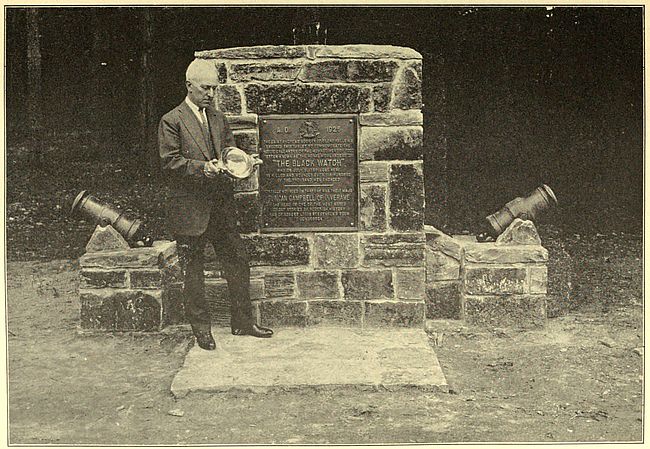
The Memorial Tablet to the Black Watch of 1758 and its Major, Duncan Campbell of Inverawe, erected on the Battle Ground of July 8, 1758
(Frederick B. Richards at side of Monument reading inscription on the QUAICH presented to him by the Campbells of Inverawe).
III. The Royal Engineers.
The Corps of Royal Engineers.
IV. The Foot Guards.
The Grenadier Guards, The Coldstream Guards, The Scots Guards, The Irish Guards.
V. Territorial Regiments (Regiments of Foot).
The Royal Scots (Lothian Regiment), formerly The 1st.
The Queen’s (Royal West Surrey Regiment), formerly The 2nd.
The Buffs (East Kent Regiment), formerly The 3rd.
The King’s Own (Royal Lancaster Regiment), formerly The 4th.
The Northumberland Fusiliers, formerly The 5th.
The Royal Warwickshire Regiment, formerly The 6th.
The Royal Fusiliers (City of London Regiment), formerly The 7th.
The King’s (Liverpool Regiment), formerly The 8th.
The Norfolk Regiment, formerly The 9th.
The Lincolnshire Regiment, formerly The 10th.
The Devonshire Regiment, formerly The 11th.
The Suffolk Regiment, formerly The 12th.
The Prince Albert’s (Somersetshire Light Infantry), formerly The 13th.
The Prince of Wales’s Own (West Yorkshire Regiment), formerly The 14th.
The East Yorkshire Regiment, formerly The 15th.
The Bedfordshire Regiment, formerly The 16th.
The Leicestershire Regiment, formerly The 17th.
The Royal Irish Regiment, formerly The 18th.
The Princess of Wales’s Own (Yorkshire Regiment), formerly The 19th.
The Lancashire Fusiliers, formerly The 20th (East Devonshire).
The Royal Scots Fusiliers, formerly The 21st.
The Cheshire Regiment, formerly The 22nd.
The Royal Welsh Fusiliers, formerly The 23rd.
The South Wales Borderers, formerly The 24th. (2nd Warwickshire).
The King’s Own Scottish Borderers, formerly The 25th.
The Cameronians (Scottish Rifles). 1st Batt., formerly The 26th. 2nd Batt., formerly The 90th. (Perthshire Volunteers—Light Infantry).
The Royal Inniskilling Fusiliers, 1st Batt., formerly The 27th. 2nd Batt., formerly The 108th (Madras Infantry).
The Gloucestershire Regiment, 1st. Batt., formerly The 28th (North Gloucestershire). 2nd Batt., formerly The 61st (South Gloucestershire).
The Worcestershire Regiment, 1st Batt., formerly The 29th. 2nd Batt., Formerly The 36th (Herefordshire).
The East Lancashire Regiment, 1st Batt., formerly The 30th (Cambridgeshire). 2nd Batt., formerly The 59th (2nd Nottinghamshire).
The East Surrey Regiment, 1st Batt., formerly The 31st (Huntingdonshire). 2nd Batt., formerly The 70th (Surrey).
Duke of Cornwall’s Light Infantry, 1st Batt., formerly The 32nd. 2nd Batt., formerly The 46th (South Devonshire).
The Duke of Wellington’s (West Riding Regiment) 1st Batt., formerly The 33rd. 2nd Batt., formerly The 76th.
The Border Regiment, 1st Batt., formerly The 34th (Cumberland). 2nd Batt., formerly The 55th (Westmoreland).
The Royal Sussex Regiment, 1st Batt., formerly The 35th. 2nd Batt., formerly The 10th (Bengal Infantry).
The Hampshire Regiment, 1st Batt., formerly The 37th. 2nd Batt., formerly The 67th (South Hampshire).
The South Staffordshire Regiment, 1st Batt., formerly The 38th (1st Staffordshire). 2nd Batt., formerly The 80th (Staffordshire Volunteers).
The Dorsetshire Regiment, 1st Batt., formerly The 39th. 2nd Batt., formerly The 54th (West Norfolk).
The Prince of Wales’s Volunteers (South Lancashire Regiment), 1st Batt., formerly The 40th (2nd Somersetshire); 2nd Batt., formerly The 82nd.
The Welsh Regiment, 1st Batt., formerly The 41st; 2nd Batt., formerly The 69th (South Lincolnshire).
The Black Watch (Royal Highlanders) 1st Batt., formerly The 42nd; 2nd Batt., formerly The 73rd (Perthshire).
The Oxfordshire Light Infantry, 1st Batt., formerly The 43rd (Monmouthshire Light Infantry); 2nd Batt., formerly The 52nd.
The Essex Regiment, 1st Batt., formerly The 44th; 2nd Batt., The 56th (West Essex).
The Sherwood Foresters (Derbyshire Regiment), 1st Batt., formerly the 45th (Nottinghamshire); 2nd Batt., The 95th (Derbyshire).
The Royal North Lancashire Regiment, 1st Batt., formerly The 47th (Lancashire); 2nd Batt., formerly The 81st (Loyal Lincoln Volunteers).
The Northamptonshire Regiment, 1st Batt., formerly The 48th; 2nd Batt., formerly The 58th (Rutlandshire).
Princess Charlotte of Wales’s (Royal Berkshire Regiment), 1st Batt., formerly The 49th (Hertfordshire); 2nd Batt., formerly The 66th (Berkshire).
The Queen’s Own (Royal West Kent) Regiment, 1st Batt., formerly The 50th; 2nd Batt., formerly The 97th (The Earl of Ulster’s).
The King’s Own Yorkshire Light Infantry, 1st Batt., formerly The 51st (2nd Yorkshire West Riding); 2nd Batt., The 105th (Madras Light Infantry).
The King’s (Shropshire Light Infantry) 1st Batt., formerly The 53rd; 2nd Batt., formerly The 85th (Bucks Volunteers).
The Duke of Cambridge’s Own (Middlesex Regiment), 1st Batt., formerly The 57th (West Middlesex); 2nd Batt., formerly The 77th (East Middlesex).
The King’s Royal Rifle Corps, formerly The 60th.
The Duke of Edinburgh’s (Wiltshire Regiment), 1st Batt., formerly The 62nd; 2nd Batt., formerly The 99th.
The Manchester Regiment, 1st Batt., formerly the 63rd (West Suffolk); 2nd Batt., formerly The 96th.
The Prince of Wales’s (North Staffordshire Regiment), 1st Batt., formerly The 64th (2nd Staffordshire); 2nd Batt., formerly The 98th.
The York and Lancaster Regiment, 1st Batt., formerly The 65th (2nd Yorkshire, North Riding); 2nd Batt., formerly The 84th (York and Lancaster).
The Durham Light Infantry, 1st Batt., formerly The 68th; 2nd Batt., formerly 106th (Bombay Light Infantry).
The Highland Light Infantry, 1st Batt., formerly The 71st; 2nd Batt., formerly The 74th.
The Seaforth Highlanders (Ross-shire Buffs, The Duke of Albany’s Own Regiment of Foot), 1st Batt., formerly The 72nd; 2nd Batt., The 78th.
The Gordon Highlanders, 1st Batt., formerly The 75th (Stirlingshire); 2nd Batt., formerly The 92nd.
The Queen’s Own Cameron Highlanders, 1st Batt., formerly The 79th.
The Royal Irish Rifles, 1st Batt., formerly The 83rd (County Dublin); 2nd Batt., formerly The 86th (Royal County Down).
Princess Victoria’s (Royal Irish Fusiliers) 1st Batt., formerly The 87th; 2nd Batt., formerly The 89th.
The Connaught Rangers, 1st Batt., formerly The 88th; 2nd Batt., formerly The 94th.
The Princess Louise’s (Argyll & Sutherland Highlanders), 1st Batt., formerly The 91st; 2nd Batt., formerly The 93rd.
The Prince of Wales’s Leinster Regiment (Royal Canadians), 1st Batt., formerly The 100th (Prince of Wales’s Royal Canadian); 2nd Batt., formerly The 109th (Bombay Infantry).
The Royal Munster Fusiliers, 1st Batt., formerly The 101st (Royal Bengal Fusiliers); 2nd Batt., formerly The 104th (Bengal Fusiliers).
The Royal Dublin Fusiliers, 1st Batt., formerly The 102nd (Royal Madras Fusiliers); 2nd Batt., The 103rd (Royal Bombay Fusiliers).
The Rifle Brigade (Prince Consort’s Own).
The West India Regiment, 1st Batt., formerly Malcolm’s Black Rangers; 2nd Batt., formerly The St. Vincent’s Black Rangers.
The Royal Marines, Royal Marine Artillery, Royal Marine Light Infantry.
Q
TICONDEROGA
Ticonderoga, familiar as the name of the historic fortress at Lake George, was written by Sir William Johnson, in 1756, Tionderogue and Ticonderoro, and in grant of lands in 1760, “near the fort at Ticonderoga.” Gov. Colden wrote Ticontarogen, and an Iroquoian sachem is credited with Decariaderoga. Interpretations are almost as numerous as orthographies. The most generally quoted is from Spofford’s Gazetter: “Ticonderoga, from Tsindrosie, or Cheonderoga, signifying ‘brawling water,’ and the French name, Carillon, signifying ‘a chime of bells,’ were both suggested by the rapids upon the outlet of Lake George.” The French name may have been so suggested, but neither Tsindrosie or Cheonderoga means “brawling water.” The latter is probably an orthography of Teonderoga. Ticonderoga as now written, is from Te or Ti, “dual,” two; Kaniatare, “lake,” and -ogen, “intervallum, divisionem” (Bruyas), the combination meaning, literally “Between two lakes.” Horatio Hale wrote me of one of the forms “Dekariaderage, in modern orthography, Tekaniataroken, from which Ticonderoga, means, simple ‘Between two lakes.’ It is derived from Tioken, ‘between,’ and Kaniatara, ‘lake.’ Its composition illustrates a peculiar idiom of the Iroquoian language. Tioken when combined with a noun, is split in two, so to speak, and the noun inserted. Thus in combining Tioken with Oneonte, ‘mountain,’ we have Ti-ononte-oken, ‘Between two mountains,’ which was the name of one of the Mohawk castles—sometimes written Theonondioga. In like manner, Kaniatare, ‘lake,’ thus compounded, yields Te-kaniatare-oken, ‘Between two lakes.’ In the Huron dialect Kiniatare is contracted to Yontare or Ontare, from which, with io or iyo, ‘great,’ we get Ontario (pronounced Ontareeyo), ‘Great lake,’ which combined with Tioken, becomes Tionteroken, which would seem to be the original of Colden’s Ticonderoga.”
(“Indian Geographical Names,” by E. M. Ruttenber, page 71 Vol. VI, New York State Historical Association).
R
TESTIMONIALS TO THE BLACK WATCH.
The Virginia Gazette, July 30, 1767, published an article from which the following extracts have been taken:
“Last Sunday evening, the Royal Highland Regiment embarked from Philadelphia for Ireland, which regiment, since its arrival in America, had been distinguished for having undergone most amazing fatigues, made long and frequent marches through an unhospitable country, bearing excessive heat and severe cold with alacrity and cheerfulness, frequently encamping in deep snow, such as those who inhabit the interior parts of this province do not see, and which only those who inhabit the most northern parts of Europe can have any idea of, continually exposed in camp and on their marches to the alarms of a savage enemy, who, in all their attempts, were forced to fly. * * * And, in a particular manner, the free-men of this and the neighboring provinces have most sincerely to thank them for that resolution and bravery with which they, under Colonel Boquet, and a small number of Royal Americans, defeated the enemy, and ensured to us peace and security from a savage foe; and, along with our blessings for these benefits, they have our thanks for that decorum in behavior which they maintained during their stay in this city, giving an example that the most amiable behavior in civil life is no way inconsistent with the character of the good soldier; and for their loyalty, fidelity, and orderly behavior, they have every wish of the people for health, honor, and a pleasant voyage.”
Extract from speech by the elder Pitt in vindication of the employment of Highland Regiments of which the Black Watch was the first raised of the eighty-six during the four wars between 1739 and 1815.
“I sought for merit wherever it was to be found; it is my boast that I was the first Minister who looked for it and found it in the mountains of the North. I called it forth and drew into your service a hardy and intrepid race of men, who, when left by your jealousy, became a prey to the artifice of your enemies, and had gone nigh to have overturned the State in the war before the last. These men in the last war were brought to combat on your side, they served with fidelity as they fought with valour, and conquered for you in every part of the world.”
S
COPY OF ALL REFERENCES TO THE BLACK WATCH OF THE TICONDEROGA PERIOD TO BE FOUND IN THE ARCHIVES OF THE DOMINION OF CANADA AT OTTAWA.
I am indebted for this Memorandum to Arthur Doughty Litt.D., Archivist of the Dominion of Canada.
1758. March 29, New York. Abercrombie to Haldimand (?) Plan of operations settled at Home. Southern Operations.
Corps, Blakeney’s, Lord John Murray’s &c.
B.6 p. 35
1756. New York. M.204-2 p. 397 Shirley to Fox
Just arrived from Albany Major Abercrombie and General Webb arrived one on the 25th of June and the other the next morning with great part of Otway’s Regiment and with all the Highland Regiments, &c.
In a letter from Abercrombie to London dated Albany, 3d August, 1756.
Col. Schuyler’s New Jersey Regiment and four North Carolina Companies are barely sufficient to Garrison Oswego and keep the communication open to Schenectady and there remains the 48th Regiment together with Otway’s and the Highlanders to Garrison Fort William Henry, &c., &c.
M.205-1 p.
1756. June 21. New York. James Abercrombie to ——. On the 15th of April sailed from Plymouth and arrived here on the 16th June with General Otway’s and Lord John Murray’s Regiments, &c.
B.205-1 p. 8
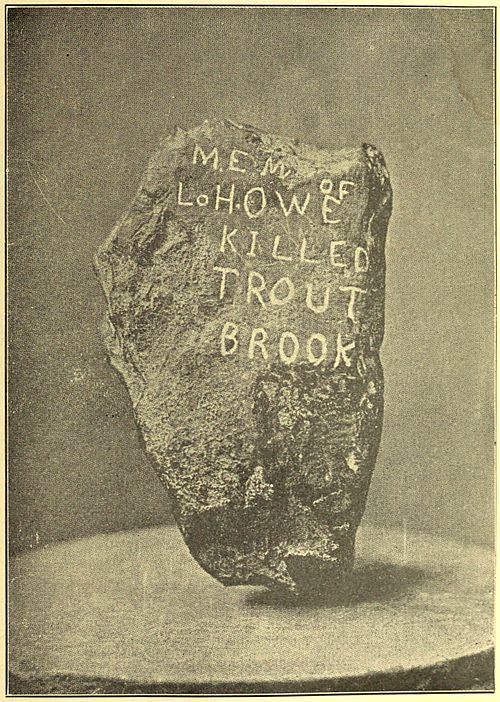
LORD HOWE STONE Unearthed at Ticonderoga, Oct. 1889. Now Preserved at Headquarters House
1756. Aug. 29, Albany. Loudon to Fox.
Though I was informed that the whole Transports with the Highland Recruits were arrived, I heard this morning that there were still five missing, and that those that are come were very short of Provisions, they were victualled only for two months, &c., &c.
M.205-1 p. 240
1756. Sept. 4. Boston. Shirley to Loudon.
Upon this I beg leave to observe to your Lordship, that it appearing from Col. Webb’s letter to me dated from New York the 9th June, that Otway’s and the Highland Regiments might be daily expected there (Oswego).
What confirms me in the matter is, that your Lordship told me, when I had the honour to wait on you, when the day you set from New York, being the 26th July that the Garrison at Oswego was so weak, that the 44th Regiment was to be sent to strengthen it and at the same time your Lordship mentioned, that you thought 900 men, by which I suppose your Lordship meant Otway’s and the Highland Regiments were but a few to cover the country.
M.205-2 p. 306
1756. Nov. 22, Albany. Loudon to Fox.
The 42nd Regiment, I quarter at Schenectady, from whence they take the posts, on the Mohawk river, &c.
M.207-1 p. 2
1757. April 25. New York. Loudon to Pitt.
As the Garrison (Fort Henry) had been troubled with the scurvy I had ordered Lieutenant General Otway’s Regiment to relieve them, and Colonel Monro met the account of the attack being made on the Fort on his march; he immediately left his baggage, and made all possible dispatch to Fort Edward, where he received the account of their being retired. Colonel Gage and Burton followed him directly with the remains of the 44th and 46th Regiments and the Highlanders were set in motion from Schenectady. They all marched without Tents, and lay in the woods, &c.
We have on that river (Mohawk), at Schenectady, and up to the German Flats, the Highland Regiment, upwards of a thousand men. &c.
M.207-1 p. 174
1758. Feb’y 14. New York. Loudon to Pitt.
... ... ... storming of Fort Herkemer and I threw in part of the 42nd Regiment of Highlanders into Schenectady, that there might be no want of numbers for this service.
M.208. p. 2
Divisions of Manuscripts, February 22, 1911.
T
THE BLACK WATCH MEMORIAL AT TICONDEROGA.
The genesis of this memorial was an address made by the late Joseph Cook at the services held in front of the boulder erected to the heroes of Ticonderoga, Academy Park, Ticonderoga, N. Y. July 31, 1899, in which he made this remark: “There ought to be a memorial to the Black Watch composed largely of Scotch Highlanders who, with the Colonials charged Montcalm’s entrenchments for eight consecutive hours.”
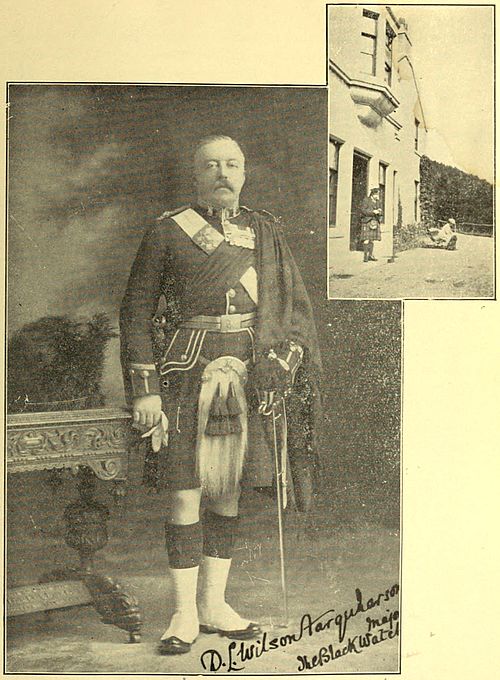
Major D. L. Wilson Farquharson, D. S. O., at “Allargue” Representation of the Black Watch at Unveiling of Memorial Tablet, Ticonderoga, July 4, 1906
The writer, who was secretary of the Ticonderoga Historical Society at that time, had the honor of being the medium through which this chance remark became an enduring memorial of brick and stone. He was unsuccessful, however, until Mr. David Williams, the publisher of “The Iron Age,” a summer resident of Ticonderoga at Rogers Rock, came to his assistance. Mr. Andrew Carnegie was the generous donor of the funds to build this memorial. The grants were in two amounts, the first gift for a public library with the usual provisions, and the second gift, with no limitations, with which to build an historical addition to the library, thus making it both a public library and historical building.
The laying of the corner stone, Oct. 4. 1905, was made the occasion for one of the greatest celebrations Ticonderoga has ever seen. The pipe band of the 5th Royal Scots of Canada, Highlanders, now the 5th Royal Highlanders of Canada, from Montreal, and the Regimental band and a Battalion of the 5th Infantry, U. S. A., from Plattsburgh, were the principal features of the parade. It was particularly appropriate that the Royal Scots should be present, as they are allied to the Black Watch and wear the same uniform. It was also an education to the thousands of spectators, few, if any of whom had ever seen Highlanders in full regimentals marching to the music of bagpipes. After the exercises of the day, the Royal Scots visited the ruins of old Fort Ticonderoga, about two miles from the village and the picture of a body of Highlanders with their scarlet coats and tartan kilts marching up the green slopes of the old ramparts, with the setting sun behind them, was one never to be forgotten and which probably had not occurred since the Revolution.
The officers of the present Black Watch Regiment, then stationed at Fort George Scotland, being advised of the Memorial sent the following letter to the secretary of the Ticonderoga Historical Society:
“Dear Sir: Your letter 9th Sept., 1905, on the subject of a Black Watch Memorial, has been perused by the Commanding Officer and the Officers of the 1st battalion of The Black Watch, formerly called the 42nd Royal Highland Regiment, and it was also submitted and discussed at the Annual Gathering of Black Watch Officers—past and present—recently held in Edinburgh. I am authorized to inform you that all Ranks of the Regiment are proud to know that the Ticonderoga Historical Society had decided to appropriate an alcove in the Ticonderoga Free Public Library as a memorial to the 42nd Regiment, to commemorate their services in the engagement before Fort Ticonderoga on July 8, 1758. The suggestion contained in your letter, to the effect that Officers of the Regiment might be disposed to erect a tablet on a wall of the Alcove to the memory of the officers and men of the 42nd who were killed or wounded in the action has met with the unanimous approval of those to whose notice it has been brought, and I am to inform you that such a Tablet will gladly be provided and that the work of executing the Tablet will be entrusted to a London firm as soon as a suitable design has been decided upon. In order to assist us in choosing a suitable form of tablet I shall be much obliged if you can favor me with a rough plan of the alcove, the dimensions of the actual wall on which the Tablet will rest, and an idea of the general style of the building.
I shall be glad to hear from you as soon as you can conveniently supply the information for which I have asked.
I am, Sir, yours truly,
D. L. Wilson Farquharson. Major The Black Watch.”
The exercises for the unveiling of the memorial tablet July 4, 1906, was made the occasion for another grand celebration at which the full bag pipe band of the 5th Royal Highlanders of Canada and a company of 50 men from the same regiment, making a total of 75 Highlanders, were a feature of the parade. Major D. L. Wilson Farquharson of the Black Watch, came over from Scotland to unveil the tablet in behalf of the Regiment. It was accepted by Frank B. Wickes of Ticonderoga for the Ticonderoga Historical Society. The address of the day was delivered by Senator Edgar T. Brackett of Saratoga Springs.
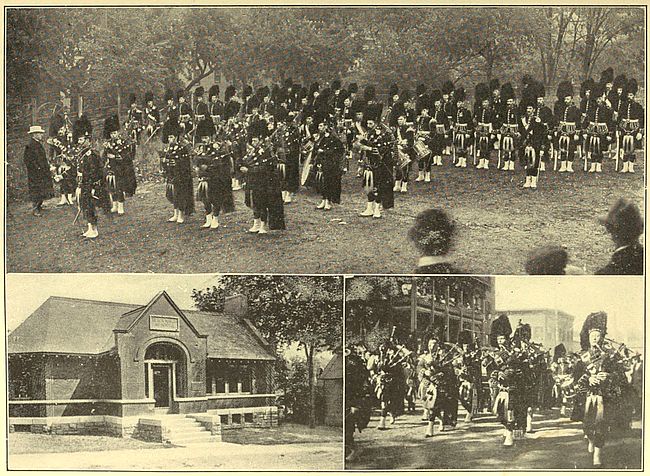
—Photo by L. Def. Cone, Ticonderoga
THE BLACK WATCH MEMORIAL AT TICONDEROGA
Two views of the 5th Royal Highlanders of Canada who attended ceremonies of laying corner stone and of unveiling Memorial Tablet
List of Officers, Non-Commissioned Officers and Partial List of Men Composing Ticonderoga Detachment, 5th Royal Highlanders of Canada, July 4th, 1906.
Capt. A. F. Gault. Capt. V. C. Buchanan. Capt. C. M. Monsarrat. Capt. J. Muir, Quartermaster. Sergt. Major D. A. Bethune. Q. M. Sergt. B. Howard. Col. Sergt. J. H. A. Mackay. Staff Sergt. T. A. Gardiner. Staff Sergt. J. Phillips. Sergt. C. Denman. Sergt. P. Forde. Sergt. T. Mitchell. Bugle Sergt. P. Broadhurst. Drum Sergt. F. W. Flood. Drum Major, G. Foley. Pipe Major, D. Manson. Sergt. J. MacLean. Corp. P. W. MacFarlane. Corp. H. Massey. Corp. N. Manson. Corp. P. Sutton. Privates. J. Bayley. F. H. Benson. Walsh. A. E. Smith. S. Tapster. Scobie. P. Roache. J. Cockburn. A. Bishop.
J. A. McLean. Jeffries. W. Marsh. J. Ferguson. J. Corbett. J. Palmer. C. Myers. C. Black. J. Stuart. J. Roney. Dean. A. Reid. A. Williams. A. Betts. D. Reid. L. Pickering. Pipers. R. Morrison. M. McLeod. J. Ferrier. D. McArthur. D. Brash. J. Husband. B. Milligan. Drummers. J. Ryan. Gore. Kemp. Jones.