Part 2 — CHAPTER XI.
Reading edition
THE PHALANX IN VIRGINIA.
The laurels won by the Phalanx in the Southern States, notwithstanding the "no quarter" policy, was proof of its devotion to the cause of liberty and the old flag, which latter, until within a short period had been but a symbol of oppression to the black man; Cailloux had reddened it with his life's blood, and Carney, in a seething fire had planted it on the ramparts of Wagner. The audacious bravery of the Phalanx had wrung from Generals Banks and Gillmore congratulatory orders, while the loyal people of the nation poured out unstinted praises. Not a breach of discipline marred the negro soldier's record; not one cowardly act tarnished their fame. Grant pronounced them gallant and reliable, and Weitzel was willing to command them.
In New York City, where negroes had been hung to lamp posts, and where a colored orphan asylum had been sacked and burned, crowds gathered in Broadway and cheered Phalanx regiments on their way to the front. General Logan, author of the Illinois Black Code, greeted them as comrades, and Jefferson Davis finally accorded to them the rights due captured soldiers as prisoners of war. Congress at last took up the question of pay, and placed the black on an equal footing with the white soldiers. Their valor, excelled by no troops in the field, had finally won full recognition from every quarter, and henceforth they were to share the full glory as well as the toils of their white comrades-in-arms. Not until those just rights and attentions were attained, was the Phalanx allowed, to any great extent, to show its efficiency and prowess in the manœuvres in Virginia and vicinity, where that magnificent "Army of Northern Virginia," the hope and the pride of the Confederacy, was operating against the Federal government. But when General Grant came to direct the movements of the Eastern armies of the United States, there was a change. He had learned from his experience at Vicksburg and other places in his western campaigns, that the negro soldiers were valuable; that they could be fully relied upon in critical times, and their patriotic zeal had made a deep impression upon him. Therefore, as before stated, there were changes, and quite a good many Phalanx regiments—numbering about 20,000 men—were taken from Southern and Western armies and transferred to the different armies in Virginia.
The 19th Army Corps sent one brigade. General Gillmore brought a brigade from the Tenth Army Corps. At least ten thousand of them were veterans, and had driven many confederates out of their breastworks.
The world never saw such a spectacle as America presented in the winter and early spring of 1864. The attempt to capture Richmond and Petersburg had failed. The Army of the Potomac lay like a weary lion under cover, watching its opponent. Bruised, but spirited and defiant, it had driven, and in turn had been driven time and again, by its equally valient foe. It had advanced and retreated until the soldiers were foot-sore from marching and counter-marching, crossing and re-crossing the now historic streams of the Old Dominion. Of all this, the loyal people were tired and demanded of the Administration a change. The causes of the failures to take the confederate capitol were not so much the fault of the commanders of the brave army as that of the authorities at Washington, whose indecision and interference had entailed almost a disgrace upon McClellan, Hooker, Burnside and Meade. But finally the people saw the greatest of the difficulties, and demanded its removal, which the Administration signified its willingness to do. Then began an activity at the North, East and West, such as was never before witnessed. The loyal heart was again aroused by the President's call for troops, and all realized the necessity of a more sagacious policy, and the importance of bringing the war to a close. The lion of the South must be bearded in his lair, and forced to surrender Richmond, the Confederate Capitol, that had already cost the Government millions of dollars, and the North thousands of lives. The cockade city,—Petersburg,—like the Gibralter of the Mississippi, should haul down the confederate banner from her breastworks; in fact, Lee must be vanquished. That was the demand of the loyal nation, and right well did they enter into preparations to consummate it; placing brave and skillful officers in command.
PARADE OF THE 20th REGT. U. S. C. T. IN NEW YORK.
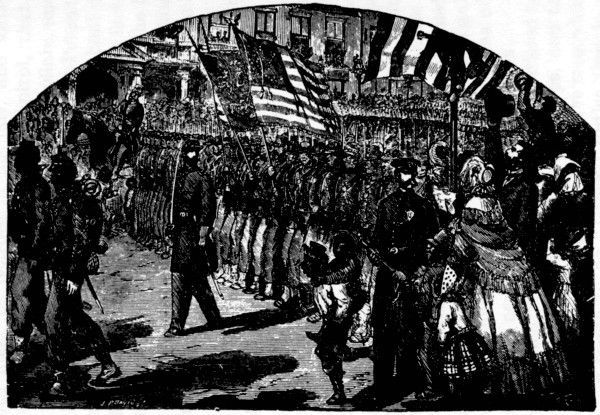
The whole North became a recruiting station. Sumner, Wilson, Stevens and Sherman, in Congress, and Greeley, Beecher, Philips and Curtis, with the press, had succeeded in placing the fight upon the highest plane of civilization, and linked freedom to the cause of the Union thus making the success of one the success of the other,—"Liberty and Union, one and inseparable." What patriotism should fail in accomplishing, bounties—National, State, county, city and township—were to induce and effect. The depleted ranks of the army were filled to its maximum, and with a hitherto victorious and gallant leader would be hurled against the fortifications of the Confederacy with new energy and determination.
Early in January, General Burnside was ordered again to take command of the Ninth Army Corps, and to recruit its strength to fifty thousand effective men, which he immediately began to do. General Butler, then in command of the Department of Virginia and North Carolina, began the organization of the Army of the James, collecting at Norfolk, Portsmouth and on the Peninsula, the forces scattered throughout his Department, and to recruit Phalanx regiments. In March, General Grant was called to Washington, and received the appointment of Lieutenant General, and placed in command of the armies of the Republic. He immediately began their reorganization, as a preliminary to attacking Lee's veteran army of northern Virginia.
As has before been stated, the negro had, up to this time, taken no very active part in the battles fought in Virginia. The seed of prejudice sown by Generals McDowell and McClellan at the beginning of hostilities, had ripened into productive fruit. The Army of the Potomac being early engaged in apprehending and returning runaway slaves to their presumed owners, had imbibed a bitter, unrelenting hatred for the poor, but ever loyal, negro. To this bitterness the Emancipation Proclamation gave a zest, through the pro-slavery press at the North, which taunted the soldiers with "fighting to free the negroes." This feeling had served to practically keep the negro, as a soldier, out of the Army of the Potomac.
General Burnside, upon assuming his command, asked for and obtained permission from the War Department to raise and unite a division of Negro troops to the 9th Army Corps. Annapolis, Md., was selected as the "depot and rendezvous," and very soon Camp Stanton had received its allowance of Phalanx regiments for the Corps. Early in April, the camp was broken, and the line of march taken for Washington. It was rumored throughout the city that the 9th Corps would pass through there, and that about 6,000 Phalanx men would be among the troops. The citizens were on the qui vive; members of Congress and the President were eager to witness the passage of the Corps.
At nine o'clock on the morning of the 25th of April, the head of the column entered the city, and at eleven the troops were marching down New York Avenue. Halting a short distance from the corner of 14th street, the column closed up, and prepared to pay the President a marching salute, who, with General Burnside and a few friends, was awaiting their coming. Mr. Lincoln and his party occupied a balcony over the entrance of Willard's Hotel. The scene was one of great beauty and animation. The day was superbly clear; the soft atmosphere of the early spring was made additionally pleasant by a cool breeze; rain had fallen the previous night, and there was no dust to cause discomfort to the soldiers or spectators. The troops marched and appeared well; their soiled and battered flags bearing inscriptions of battles of six States. The corps had achieved almost the first success of the war in North Carolina; it had hastened to the Potomac in time to aid in rescuing the Capitol, when Lee made his first Northern invasion; it won glory at South Mountain, and made the narrow bridge at Antietam, forever historic; it had likewise reached Kentucky in time to aid in driving the confederates from that State. Now it appeared with recruited ranks, and new regiments of as good blood as ever was poured out in the cause of right; and with a new element—those whom they had helped set free from the thraldom of slavery—whom they were proud to claim as comrades.
Their banners were silent, effective witnesses of their valor and their sacrifices; Bull's Run, Ball's Bluff, Roanoke, Newburn, Gaines' Mills, Mechanicsville, Seven Pines, Savage Station, Glendale, Malvern, Fredericksburg, Chancellorsville, Antietam, South Mountain, Knoxville, Vicksburg, Port Hudson and Gettysburg, were emblazoned in letters of gold. The firm and soldierly bearing of the veterans, the eager and expectant countenances of the men and officers of the new regiments, the gay trappings of the cavalry, the thorough equipment and fine condition of the artillery, the clattering of hoofs, the clanking of sabres, the drum-beat, the bugle call, and the music of the bands were all subjects of interest. The President beheld the scene. Pavement, sidewalks, windows and roofs were crowded with people. A division of veterans passed, saluting the President and their commander with cheers. And then, with full ranks—platoons extending from sidewalk to sidewalk—brigades which had never been in battle, for the first time shouldered arms for their country; they who even then were disfranchised and were not American citizens, yet they were going out to fight for the flag. Their country was given them by the tall, pale, benevolent hearted man standing upon the balcony. For the first time, they beheld their benefactor. They were darker hued than their veteran comrades, but they cheered as lustily, "hurrah, hurrah, hurrah for Massa Linkun! Three cheers for the President!" They swung their caps, clapped their hands and shouted their joy. Long, loud and jubilant were the rejoicings of these redeemed sons of Africa. Regiment after regiment of stalwart men,—slaves once, but freemen now,—with steady step and even ranks, passed down the street, moving on to the Old Dominion. It was the first review of the negro troops by the President. Mr. Lincoln himself seemed greatly pleased, and acknowledged the plaudits and cheers of the Phalanx soldiers with a dignified kindness and courtesy. It was a spectacle which made many eyes grow moist, and left a life-long impression. Thus the corps that had never lost a flag or a gun, marched through the National Capitol, crossed long bridge and went into camp near Alexandria, where it remained until the 4th of May.
The Phalanx regiments composing the 4th division were the 19th, 23rd, 27th, 28th, 29th, 30th, 31st, 39th and 43rd, commanded by General E. Ferrero.
The Army of the James, under General Butler, which was to act in conjunction with the Army of the Potomac, under Meade, was composed of the 10th and 18th Corps. The 10th Corps had two brigades of the Phalanx, consisting of the 7th, 9th, 29th, 16th, 8th, 41st, 45th and 127th Regiments, commanded by Colonels James Shaw, Jr., and Ulysses Doubleday, and constituted the 3rd division of that Corps commanded by Brigadier-General Wm. Birney.
The 3rd division of the 18th Corps, commanded by Brigadier-General Charles G. Paine, was composed of the 1st, 22nd, 37th, 5th, 36th, 38th, 4th, 6th, 10th, 107th, 117th, 118th and 2nd Cavalry, with Colonels Elias Wright, Alonzo G. Draper, John W. Ames and E. Martindale as brigade commanders of the four brigades. A cavalry force numbering about two thousand, comprising the 1st and 2nd, was under command of Colonel West,[31] making not less than 20,000 of the Phalanx troops, including the 4th Division with the Ninth Corps, and augmenting Butler's force to 47,000, concentrated at Yorktown and Gloucester Point.
On the 28th of April, Butler received his final orders, and on the night of the 4th of May embarked his troops on transports, descended the York river, passed Fortress Monroe and ascended the James River. Convoyed by a fleet of armored war vessels and gunboats, his transports reached Bermuda Hundreds on the afternoon of the 5th. General Wilde, with a brigade of the Phalanx, occupied Fort Powhatan, on the south bank of the river, and Wilson's Wharf, about five miles below on the north side of the James, with the remainder of his division of 5,000 of the Phalanx. General Hinks landed at City Point, at the mouth of the Appomattox. The next morning the troops advanced to Trent's, with their left resting on the Appomattox, near Walthall, and the right on the James, and intrenched. In the meantime, Butler telegraphed Grant:
"Off City Point, Va., May 5th. "Lieut. Gen. Grant, Commanding Armies of the United States, Washington, D. C.:
"We have seized Wilson's Wharf Landing; a brigade of Wilde's colored troops are there; at Fort Powhatan landing two regiments of the same brigade have landed. At City Point, Hinks' division, with the remaining troops and battery, have landed. The remainder of both the 18th and 10th Army Corps are being landed at Bermuda Hundreds, above Appomattox. No opposition experienced thus far, the movement was comparatively a complete surprise. Both army corps left Yorktown during last night. The monitors are all over the bar at Harrison's landing and above City Point. The operations of the fleet have been conducted to-day with energy and success. Gens. Smith and Gillmore are pushing the landing of the men. Gen. Graham with the army gunboats, lead the advance during the night, capturing the signal station of the rebels. Colonel West, with 1800 cavalry, made several demonstrations from Williamsburg yesterday morning. Gen. Rantz left Suffolk this morning with his cavalry, for the service indicated during the conference with the Lieut.-General. The New York flag-of-truce boat was found lying at the wharf with four hundred prisoners, whom she had not time to deliver. She went up yesterday morning. We are landing troops during the night, a hazardous service in the face of the enemy.
"BENJ. F. BUTLER,
"A. F. Puffer, Capt. and A. D. C. Maj.-Gen. Commanding."
About two miles in front of their line ran the Richmond & Petersburg Railroad, near which the enemy was encountered. Butler's movements being in concert with that of the Army of the Potomac and the 9th Corps,—the latter as yet an independent organization.
General Meade, with the Army of the Potomac, numbering 120,000 effective men, crossed the Rapidan en route for the Wilderness, each soldier carrying fifty rounds of ammunition and three days rations. The supply trains were loaded with ten days forage and subsistence. The advance was in two columns, General Warren being on the right and General Hancock on the left. Sedgwick followed closely upon Warren and crossed the Rapidan at Germania Ford. The Ninth Corps received its orders on the 4th, whereupon General Burnside immediately put the Corps in motion toward the front. Bivouacking at midnight, the line of march was again taken up at daylight, and at night the Rapidan was crossed at Germania Ford. The corps marched on a road parallel to that of its old antagonist, General Longstreet's army, which was hastening to assist Lee, who had met the Army of the Potomac in the entanglements of the wilderness, where a stubborn and sanguinary fight raged for two days. General Ferrero's division, composed of the Phalanx regiments, reached Germania Ford on the morning of the 6th, with the cavalry, and reported to General Sedgwick, of the 6th Corps, who had the care of the trains. The enemy was projecting an attack upon the rear of the advancing columns. Gen. Ferrero was ordered to guard with his Phalanx division, the bridges, roads and trains near and at the Rapidan river. That night the confederates attacked Sedgwick in force; wisely the immense supply trains had been committed to the care of the Phalanx, and the enemy was driven back before daylight, while the trains were securely moved up closer to the advance. General Grant, finding that the confederates were not disposed to continue the battle, began the movement toward Spottsylvania Court House on the night of the 7th. The 9th Corps brought up the rear, with the Phalanx division and cavalry covering the trains.
Butler and his Phalanx troops, as we have seen, was within six miles of Petersburg, and on the 7th, Generals Smith and Gillmore reached the railroad near Port Walthall Junction, and commenced destroying it; the confederates attacked them, but were repulsed. Col. West, on the north side of the James River, forded the Chickahominy with the Phalanx cavalry, and arrived opposite City Point, having destroyed the railroad for some distance on that side.
Leaving General Hinks with his Phalanx division to hold City Point, on the 9th Butler again moved forward to break up the railroad which the forces under Smith and Gillmore succeeded in doing, thus separating Beaureguard's force from Lee's. He announced the result of his operation's in the following message to Washington:
"May 9th, 1864.
"Our operations may be summed up in a few words. With one thousand and seven hundred cavalry we have advanced up the Peninsula, forced the Chickahominy and have safely brought them to our present position. These were colored cavalry, and are now holding our advanced pickets toward Richmond. General Kautz, with three thousand cavalry from Suffolk, on the same day with our movement up James river, forced the Blackwater, burned the railroad bridge at Stony Creek, below Petersburg, cutting in two Beauregard's force at that point. We have landed here, intrenched ourselves, destroyed many miles of railroad, and got possession, which, with proper supplies, we can hold out against the whole of Lee's army. I have ordered up the supplies. Beauregard, with a large portion of his force, was left south, by the cutting of the railroad by Kautz. That portion which reached Petersburg under Hill, I have whipped to-day, killing and wounding many, and taking many prisoners, after a well contested fight. General Grant will not be troubled with any further re-inforcements to Lee from Beaureguard's force.
"BENJ. F. BUTLER, Major-General."
But for having been misinformed as to Lee's retreating on Richmond,—which led him to draw his forces back into his intrenchments,—Butler would have undoubtedly marched triumphantly into Petersburg. The mistake gave the enemy holding the approaches to that city time to be re-enforced, and Petersburg soon became well fortified and garrisoned. Beaureguard succeeded in a few days time in concentrating in front of Butler 25,000 troops, thus checking the latter's advance toward Richmond and Petersburg, on the south side of the James, though skirmishing went on at various points.
General Grant intended to have Butler advance and capture Petersburg, while General Meade, with the Army of the Potomac, advanced upon Richmond from the north bank of the James river. Gen. Butler failed to accomplish more than his dispatches related, though his forces entered the city of Petersburg, captured Chester Station, and destroyed the railroad connection between Petersburg and Richmond. Failure to support his troops and to intrench lost him all he had gained, and he returned to his intrenchments at Bermuda Hundreds.
The Phalanx (Hinks division) held City Point and other stations on the river, occasionally skirmishing with the enemy, who, ever mindful of the fact that City Point was the base of supplies for the Army of the James, sought every opportunity to raid it, but they always found the Phalanx ready and on the alert.
After the battle of Drewry's Bluff, May 16th, Butler thought to remain quiet in his intrenchments, but Grant, on the 22nd, ordered him to send all his troops, save enough to hold City Point, to join the Army of the Potomac; whereupon General W. F. Smith, with 16,000 men, embarked for the White House, on the Pamunky river, Butler retaining the Phalanx division and the Cavalry. Thus ended the operations of the Army of the James, until Grant crossed the river with the army of the Potomac.
SCENE IN THE ARMY OF THE POTOMAC. Negro baggage train drivers watering their mules.
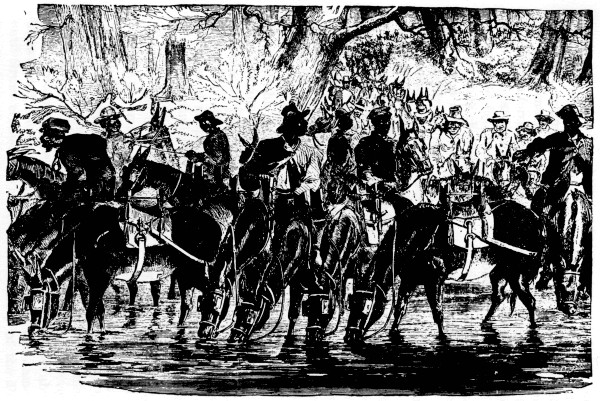
On the 13th of May, Grant determined upon a flank movement toward Bowling Green, with a view of making Port Royal, instead of Fredericksburg, his depot for supplies. Sending his reserve artillery to Belle Plain, he prepared to advance. It was in this manœuvre that Lee, for the last time, attacked the Federal forces, outside of cover, in any important movement. The attempt to change the base of supply was indeed a hazardous move for Grant; it necessitated the moving of his immense train, numbering four thousand wagons, used in carrying rations, ammunition and supplies for his army, and transportation of the badly wounded to the rear, where they could be cared for.
Up to this time the Wilderness campaign had been a continuous fight and march. The anxiety which Grant felt for his train, is perhaps best told by himself:
"My movements are terribly embarrassed by our immense wagon train. It could not be avoided, however."
It was the only means by which the army could obtain needful supplies, and was consequently indispensable. It was the near approach to the train that made the confederates often fight so desperately, for they knew if they could succeed in capturing a wagon they would probably get something to eat. Soon after the advance began, it was reported to Grant, that the confederate cavalry was in the rear, in search of the trains. On the 14th he ordered General Ferrero to "keep a sharp lookout for this cavalry, and if you can attack it with your (Phalanx) infantry and (white) cavalry, do so." On the 19th Ferrero, with his Phalanx division, (4th division, 9th Corps) was on the road to Fredericksburg, in rear of and to the right of General Tyler's forces, in the confederates' front. The road formed Grant's direct communication with his base, and here the confederates, under Ewell attacked the Federal troops. Grant sent this dispatch to Ferrero:
"The enemy have crossed the Ny on the right of our lines, in considerable force, and may possibly detach a force to move on Fredericksburg. Keep your cavalry pickets well out on the plank road, and all other roads leading west and south of you. If you find the enemy moving infantry and artillery to you, report it promptly. In that case take up strong positions and detain him all you can, turning all your trains back to Fredericksburg, and whatever falling back you may be forced to do, do it in that direction."
The confederates made a dash for the train and captured twenty-seven wagons, but before they had time to feast off of their booty the Phalanx was upon them. The enemy fought with uncommon spirit; it was the first time "F. F. V's," the chivalry of the South,—composing the Army of Northern Virginia,—had met the negro soldiers, and true to their instinctive hatred of their black brothers, they gave them the best they had; lead poured like rain for a while, and then came a lull. Ferrero knew what it meant, and prepared for their coming. A moment more and the accustomed yell rang out above the roar of the artillery. The confederates charged down upon the Phalanx, but to no purpose, save to make the black line more stable. They retaliated, and the confederates were driven as the gale drives chaff, the Phalanx recapturing the wagons and saving Grant's line of communication. General Badeau, speaking of their action, in his military history of Grant, says:
"It was the first time at the East when colored troops had been engaged in any important battle, and the display of soldierly qualities won a frank acknowledgment from both troops and commanders, not all of whom had before been willing to look upon negroes as comrades. But after that time, white soldiers in the army of the Potomac were not displeased to receive the support of black ones; they had found the support worth having."
Ferrero had the confidence of his men, who were ever ready to follow where Grant ordered them to be led.
But this was not the last important battle the Phalanx took part in. Butler, after sending the larger portion of his forces to join the Army of the Potomac, was not permitted to remain quiet in his intrenchments. The confederates felt divined to destroy, if not capture, his base, and therefore were continually striving to break through the lines. On the 24th of May, General Fitzhugh Lee made a dash with his cavalry upon Wilson's Wharf, Butler's most northern outpost, held by two Phalanx Regiments of General Wilde's brigade. Lee's men had been led to believe that it was only necessary to yell at the "niggers" in order to make them leave the Post, but in this affair they found a foe worthy of their steel. They fought for several hours, when finally the confederate troops beat a retreat. An eye witness of the fight says:
"The chivalry of Fitzhugh Lee and his cavalry division was badly worsted in the contest last Tuesday with negro troops, composing the garrison at Wilson's Landing; the chivalry made a gallant fight, however. The battle began at half-past twelve p. m., and ended at six o'clock, when the chivalry retired, disgusted and defeated. Lee's men dismounted far in the rear, and fought as infantry; they drove in the pickets and skirmishers to the intrenchments, and made several valiant charges upon our works. To make an assault, it was necessary to come across an opening in front of our position, up to the very edge of a deep and impassable ravine. The rebels, with deafening yells, made furious onsets, but the negroes did not flinch, and the mad assailants, discomforted, returned to cover with shrunken ranks. The rebels' fighting was very wicked; it showed that Lee's heart was bent on taking the negroes at any cost. Assaults on the center having failed, the rebels tried first the left, and then the right flank, with no greater success. When the battle was over, our loss footed up, one man killed outright, twenty wounded, and two missing. Nineteen rebels were prisoners in our hands. Lee's losses must have been very heavy; the proof thereof was left on the ground. Twenty-five rebel bodies lay in the woods unburied, and pools of blood unmistakably told of other victims taken away. The estimate, from all the evidence carefully considered, puts the enemy's casualties at two hundred. Among the corpses Lee left on the field, was that of Major Breckenridge, of the 2nd Virginia Cavalry. There is no hesitation here in acknowledging the soldierly qualities which the colored men engaged in the fight have exhibited. Even the officers who have hitherto felt no confidence in them are compelled to express themselves mistaken. General Wilde, commanding the Post, says that the troops stood up to their work like veterans."
Newspaper correspondents were not apt to overstate the facts, nor to give too much favorable coloring to the Phalanx in those days. Very much of the sentiment in the army—East and West—was manufactured by them. The Democratic partizan press at the North, especially in New York and Ohio, still engaged in throwing paper bullets at the negro soldiers, who were shooting lead bullets at the country's foes.
The gallantry and heroic courage of the Phalanx in the Departments of the Gulf and South, and their bloody sacrifices, had not been sufficient to stop the violent clamor and assertions of those journals, that the "niggers won't fight!"
Many papers favorable to the Emancipation; opposed putting negro troops in battle in Virginia. But to all these bomb-proof opinions Grant turned a deaf ear, and when and where necessity required it, he hurled his Phalanx brigades against the enemy as readily as he did the white troops. The conduct of the former was, nevertheless, watched eagerly by the correspondents of the press who were with the army, and when they began to chronicle the achievements of the Phalanx, the prejudice began to give way, and praises were substituted in the place of their well-worn denunciations. A correspondent of the New York Herald thus wrote in May:
"The conduct of the colored troops, by the way, in the actions of the last few days, is described as superb. An Ohio soldier said to me to-day, 'I never saw men fight with such desperate gallantry as those negroes did. They advanced as grim and stern as death, and when within reach of the enemy struck about them with a pitiless vigor, that was almost fearful.' Another soldier said to me, 'These negroes never shrink, nor hold back, no matter what the order. Through scorching heat and pelting storms, if the order comes, they march with prompt, ready feet.' Such praise is great praise, and it is deserved. The negroes here who have been slaves, are loyal, to a man, and on our occupation of Fredericksburg, pointed out the prominent secessionists, who were at once seized by our cavalry and put in safe quarters. In a talk with a group of faithful fellows, I discovered in them all a perfect understanding of the issues of the conflict, and a grand determination to prove themselves worthy of the place and privileges to which they are to be exalted."
The ice was thus broken, and then each war correspondent found it his duty to write in deservedly glowing terms of the Phalanx.
The newspaper reports of the engagements stirred the blood of the Englishman, and he eschewed his professed love for the freedom of mankind, and particularly that of the American negro. The London Times, in the following article, lashed the North for arming the negroes to shoot the confederates, forgetting, perhaps, that England employed negroes against the colonist in 1775, and at New Orleans, in 1814, had her black regiments to shoot down the fathers of the men whom it now sought to uphold, in rebellion against the government of the United States:
"THE NEGRO UNION SOLDIERS.
"Six months have now passed from the time Mr. Lincoln issued his proclamation abolishing slavery in the States of the Southern Confederacy. To many it may seem that this measure has failed of the intended effect and this is doubtless in some respects the case. It was intended to frighten the Southern whites into submission, and it has only made them more fierce and resolute than ever. It was intended to raise a servile war, or produce such signs of it as should compel the Confederates to lay down their arms through fear for their wives and families; and it has only caused desertion from some of the border plantations and some disorders along the coast. But in other respects the consequences of this measure are becoming important enough. The negro race has been too much attached to the whites, or too ignorant or too sluggish to show any signs of revolt in places remote from the presence of the federal armies: but on some points where the federals have been able to maintain themselves in force in the midst of a large negro population, the process of enrolling and arming black regiments has been carried on in a manner which must give a new character to the war. It is in the State of Louisiana, and under the command of General Banks, that this use of negro soldiers has been most extensive. The great city of New Orleans having fallen into the possession of the federals more than a year ago, and the neighboring country being to a certain degree abandoned by the white population, a vast number of negroes have been thrown on the hands of the General in command to support and, if he can, make use of. The arming of these was begun by General Butler, and it has been continued by his successor. Though the number actually under arms is no doubt exaggerated by Northern writers, yet enough have been brought into service to produce a powerful effect on the imaginations of the combatants, and, as we can now clearly see, to add almost grievously to the fury of the struggle.
"Of all wars, those between races which had been accustomed to stand to each other in the relation of master and slave have been so much the most horrible that by general consent the exciting of a servile insurrection has been considered as beyond the pale of legitimate warfare. This had been held even in the case of European serfdom, although there the rulers and the ruled are of the same blood, religion and language. But the conflict between the white men and the negro, and particularly the American white man and the American negro, is likely to be more ruthless than any which the ancient world, fruitful in such histories, or the modern records of Algeria can furnish. There was reason to hope that the deeds of 1857 in India would not be paralleled in our time or in any after age. The Asiatic savagery rose upon a dominant race scattered throughout the land, and wreaked its vengeance upon it by atrocities which it would be a relief to forget. But it has been reserved for the New World to present the spectacle of civil war, calling servile war to its aid, and of men of English race and language so envenomed against each other that one party places arms in the hands of the half savage negro, and the other acts as if resolved to give no quarter to the insurgent race or the white man who commands them or fights by their side. In the valley of the Mississippi, where these negro soldiers are in actual service, it seems likely that a story as revolting as that of St. Domingo is being prepared for the world. No one who reads the description of the fighting at Port Hudson, and the accounts given by the papers of scenes at other places, can help fearing that the worst part of this war has yet to come, and that a people who lately boasted that they took the lead in education and material civilization are now carrying on a contest without regard to any law of conventional warfare,—one side training negroes to fight against its own white flesh and blood, the other slaughtering them without mercy whenever they find them in the field.
" * * * It is pitiable to find these unhappy Africans, whose clumsy frames are no match for the sinewy and agile white American, thus led on to be destroyed by a merciless enemy. Should the war proceed in this manner, it is possible that the massacre of Africans may not be confined to actual conflict in the field. Hitherto the whites have been sufficiently confident in the negroes to leave them unmolested, even when the enemy was near; but with two or three black regiments in each federal corps, and such events as the Port Hudson massacre occuring to infuriate the minds on either side, who can foresee what three months more of war may bring forth?
"All that we can say with certainty is that the unhappy negro will be the chief sufferer in this unequal conflict. An even greater calamity, however, is the brutalization of two antagonistic peoples by the introduction into the war of these servile allies of the federals. Already there are military murders and executions on both sides. The horrors which Europe has foreseen for a year past are now upon us. Reprisal will provoke reprisal, until all men's natures are hardened, and the land flows with blood."
The article is truly instructive to the present generation; its malignity and misrepresentation of the Administration's intentions in regard to the arming of negroes, serves to illustrate the deep-seated animosity which then existed in England toward the union of the States. Nor will the American negro ever forget England's advice to the confederates, whose massacre of negro soldiers fighting for freedom she endorsed and applauded. The descendants of those black soldiers, who were engaged in the prolonged struggle for freedom, can rejoice in the fact that no single act of those patriots is in keeping with the Englishman's prediction; no taint of brutality is even charged against them by those whom they took prisoners in battle. The confederates themselves testify to the humane treatment they unexpectedly received at the hands of their negro captors. Mr. Pollard, the historian, says:
"No servile insurrections had taken place in the South."
But it is gratifying to know that all Englishmen did not agree with the writer of the Times. A London letter in the New York Evening Post, said:
"Mr. Spurgeon makes most effective and touching prayers, remembering, at least once on a Sunday, the United States. 'Grant, O God,' he said recently, 'that the right may conquer, and that if the fearful canker of slavery must be cut out by the sword, it be wholly eradicated from the body politic of which it is the curse.' He is seldom, however, as pointed as this; and, like other clergymen of England, prays for the return of peace. Indeed, it must be acknowledged that if the English press and government have done what they could to continue this war, the dissenting clergy of England have nobly shown their good will and hearty sympathy with the Americans, and their sincere desire for the settlement of our difficulties. 'If praying would do you Americans any good,' said an irreverent acquaintance last Sunday, 'you will be gratified to learn that a force of a thousand-clergymen-power is constantly at work for you over here.'"
After the heroic and bloody effort at Cold Harbor to reach Richmond, or to cross the James above the confederate capitol, and thus cut off the enemy's supplies,—after Grant had flanked, until to flank again would be to leave Richmond in his rear,—when Lee had withdrawn to his fortifications, refusing to accept Grant's challenge to come out and fight a decisive battle,—when all hope of accomplishing either of these objects had vanished, Grant determined to return to his original plan of attack from the coast, and turned his face toward the James river. On the 12th of June the Army of the Potomac began to move, and by the 16th it was, with all its trains across, and on the south side of the James.
Petersburg Grant regarded as the citadel of Richmond, and to capture it was the first thing on his list to be accomplished. General Butler was made acquainted with this, and as soon as General Smith, who, with a portion of Butler's forces had been temporarily dispatched to join the army of the Potomac at Cold Harbor, returned to Bermuda Hundreds with his force, he was ordered forward to capture the Cockade City. It was midnight on the 14th, when Smith's troops arrived. Butler ordered him immediately forward against Petersburg, and he moved accordingly. His force was in three divisions of Infantry, and one of Cavalry, under General Kautz, who was to threaten the line of works on the Norfolk road. General Hinks, with his division of the Phalanx, was to take position across the Jordon's Point road on the right of Kautz; Brooks' division of white troops was to follow, Hinks coming in at the center of the line, while General Martindale with the other division was to move along the Appomattox and strike the City Point road. Smith's movement was directed against the northeast side of Petersburg, extending from the City Point to the Norfolk railroad. About daylight on the 15th, as the columns advanced on the City Point road at Bailey's farm, six miles from Petersburg, a confederate battery opened fire. Kautz reconnoitered and found a line of rifle trench, extending along the front, on rapidly rising ground, with a thicket covering. The work was held by a regiment of cavalry and a light battery. At once there was use for the Phalanx; the works must be captured with the battery before the troops could proceed. The cavalry was re-called, and Hinks began the formation of an attacking party from his division. The confederates were in an open field, their battery upon a knoll in the same field, commanding a sweeping position to its approaches. The advancing troops must come out from the woods, rush up the slope and carry it at the point of the bayonet, exposed to the tempest of musketry and cannister of the battery. Hinks formed his line for the assault, and the word of command was given,—"forward." The line emerged from the woods, the enemy opened with cannister upon the steadily advancing column, which, without stopping, replied with a volley of Minie bullets.
"The long, dusky line, arm to arm, knee to knee."
PHALANX SOLDIERS AT WORK ON RIVER OBSTRUCTIONS.
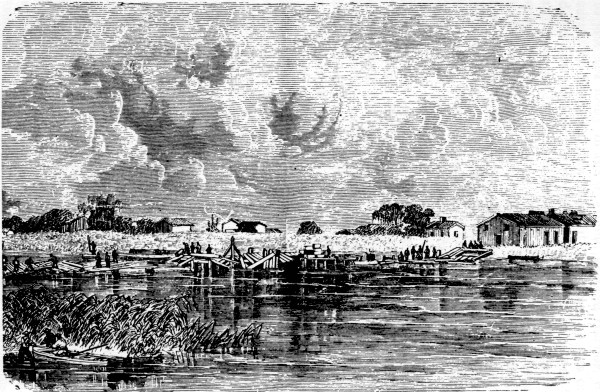
Then shells came crashing through the line, dealing death and shattering the ranks; but on they went, with a wild cheer, running up the slope; again a storm of cannister met them; a shower of musketry came down upon the advancing column, whose bristling bayonets were to make the way clear for their white comrades awaiting on the roadside. A hundred black men went down under the fire; the ranks were quickly closed however, and with another wild cheer the living hundreds went over the works with the impetuosity of a cyclone; they seized the cannon and turned them upon the fleeing foe, who, in consternation, stampeded toward Petersburg, to their main line of intrenchments on the east. Thus the work of the 5th and 22nd Phalanx regiments was completed and the road made clear for the 18th Corps.
Brooks now moved up simultaneously with Martindale, on the river road. By noon the whole corps was in front of the enemy's main line of works, Martindale on the right, Brooks in the center, the Phalanx and cavalry on the left, sweeping down to the Jerusalem Plank Road on the southeast. Hinks, with the Phalanx, in order to gain the position assigned him, had necessarily to pass over an open space exposed to a direct and cross-fire. Nevertheless, he prepared to occupy his post, and forming a line of battle, he began the march. The division numbered about 3,000, a portion of it being still at Wilson's Landing, Fort Powhatan, City Point and Bermuda Hundreds. This was a march that veterans might falter in, without criticism or censure. The steady black line advanced a few rods at a time, when coming within range of the confederate guns they were obliged to lie down and wait for another opportunity. Now a lull,—they would rise, go forward, and again lie down. Thus they continued their march, under a most galling, concentrated artillery fire until they reached their position, from which they were to join in a general assault; and here they lay, from one till five o'clock,—four long hours,—exposed to ceaseless shelling by the enemy. Badeau says, in speaking of the Phalanx in this ordeal:
"No worse strain on the nerves of troops is possible, for it is harder to remain quiet under cannon fire, even though comparatively harmless, than to advance against a storm of musketry."
General W. F. Smith, though brave, was too cautious and particular in detail, and he spent those four hours in careful reconnoissance, while the troops lay exposed to the enemy's concentric fire.
The main road leading east from Petersburg ascends a hill two or more miles out, upon the top of which stood what was then known as Mr. Dunn's house. In front of it was a fort, and another south, and a third north, with other works; heavy embankments and deep ravines and ditches, trunks of hewn trees blackened by camp fires, formed an abatis on the even ground. Here the sharpshooters and riflemen had a fair view of the entire field. The distance from these works to the woods was about three hundred and sixty paces, in the edge of which lay the black Phalanx division, ready, like so many tigers, waiting for the command, "forward." The forts near Dunn's house had direct front fire, and those on the north an enfilading fire on the line of advance. Smith got his troops in line for battle by one o'clock, but there they lay. Hinks impatiently awaited orders; oh! what a suspense—each hour seemed a day,—what endurance—what valor. Shells from the batteries ploughed into the earth where they stood, and began making trouble for the troops. Hinks gave the order, "lie down;" they obeyed, and were somewhat sheltered. Five o'clock—yet no orders. At length the command was given, "forward." The skirmishers started at quick time; the enemy opened upon them vigorously from their batteries and breastworks, upon which they rested their muskets, in order to fire with accuracy. A torrent of bullets was poured upon the advancing line, and the men fell fast as autumn leaves in a gale of wind. Then the whole line advanced, the Phalanx going at double-quick; their well aligned ranks, with bayonets glittering obliquely in the receding sunlight, presented a spectacle both magnificent and grand.
A GALLANT CHARGE. The 22nd Negro Regiment, Duncan's Brigade, carrying the first line of Confederate works before Petersburg, Va.
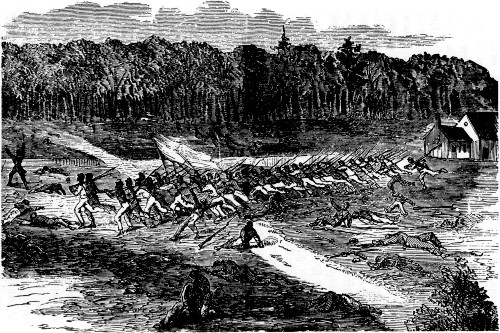
Duncan rushed his skirmishers and reached the ditches in front of the breastworks, which, without waiting for the main body, they entered and clambered up the steep embankments. A sheet of flame from above was rained down, causing many a brave man to stagger and fall back into the ditch, never to rise again. The troops following, inspired by the daring of the skirmishers, pressed forward on the run up to the forts, swept round the curtains, scaled the breastworks and dashed with patriotic rage at the confederate gunners, who deserted their pieces and ran for their lives. Brooks and Martindale advanced simultaneously upon the works at Osborn's house and up the railroad, sweeping everything before them. The Phalanx seized upon the guns and turned them instantly upon the fleeing foe, and then with spades and shovels reversed the fortifications and prepared to hold them. Fifteen pieces of artillery and three hundred confederates were captured. "The Phalanx," says the official report, took two-thirds of the prisoners and nine pieces of artillery. General Smith, finding that General Birney, with the 2nd Corps, had not arrived, instead of marching the troops into Petersburg, waited for re-inforcements unnecessarily, and thereby lost his chance of taking the city, which was soon garrisoned with troops enough to defy the whole army. Thus Grant was necessitated afterward to lay siege to the place.
The confederates never forgot nor forgave this daring of the "niggers," who drove them, at the point of the bayonet, out of their breastworks, killing and capturing their comrades and their guns. They were chided by their brother confederates for allowing negroes to take their works from them. The maidens of the Cockade City were told that they could not trust themselves to men who surrendered their guns to "niggers." The soldiers of the Phalanx were delirious with joy. They had caught "ole massa," and he was theirs. General Hinks had their confidence, and they were ready to follow wherever he led.
The chaplin of the 9th Corps, in his history, says:
"In this movement a division of colored troops, under Brigadier-General Hinks, seems to have won the brightest laurels. They first attacked and carried the enemy's outpost at Bailey's farm, capturing one piece of artillery in the most gallant manner. On their arrival before Petersburg, they lay in front of the works for nearly five hours, waiting for the word of command. They then, in company with the white troops, and showing equal bravery, rushed and carried the enemy's line of works, with what glorious success has already been related."
This, indeed, was a victory, yet shorn of its full fruits; but that Petersburg was not captured was no fault of the Phalanx. They had carried and occupied the most formidable obstacles.
Badeau, in chronicling these achievements, says:
"General Smith assaulted the works on the City Point and Prince George Court House roads. The rebels resisted with a sharp infantry fire, but the center and left dashed into the works, consisting of five redan's on the crest of a deep and difficult ravine. Kiddoo's (22d) black regiment was one of the first to gain the hill. In support of this movement, the second line was swung around and moved against the front of the remaining works. The rebels, assaulted thus in front and flank, gave way, four of the guns already captured were turned upon them by the negro conquerors, enfilading the line, and before dark, Smith was in possession of the whole of the outer works, two and a half miles long, with fifteen pieces of artillery and three hundred prisoners. Petersburg was at his mercy."
This failure made a siege necessary, and General Grant began by regular approaches to invest the place, after making the three desperate assaults on the 16th, 17th and 18th. It had been indeed a bloody June; the soil of the Old Dominion, which for two centuries the negro had tilled and made to yield the choicest products, under a system of cruel and inhuman bondage he now reddened with his blood in defense of his liberty, proving by his patriotism, not only his love of liberty, but his courage and capacity to defend it. The negro troops had marched and fought with the white regiments with equal intrepidity and courage; they were no longer despised by their comrades; they now had recognition as soldiers, and went into the trenches before Petersburg as a part of as grand an army as ever laid siege to a stronghold or stormed a fortification.
On the 18th of June, General Ferrero reported to General Meade, with his division of the Phalanx, (4th Division, 9th Corps), and was immediately ordered to join its own proper corps,—from which it had been separated since the 6th of May,—at the crossing of the Rapidan. It had served under Sedgwick and Sheridan until the 17th, when it came under the direct command of General Grant, and thus remained until the 25th of May, when General Burnside, waiving rank to Meade, the 9th Corps was incorporated into the Army of the Potomac. During its absence the division sustained the reputable renown of its corps, not only in protecting the trains, but in fighting the enemy, and capturing prisoners. Before rejoining the corps, the division was strengthened by three regiments of cavalry,—the 5th New York, 3rd New Jersey and 2nd Ohio. From the 9th of May till the 17th, the division occupied the plank road, looking to the old Wilderness tavern, covering the extreme right of the army, extending from Todd's to Banks' Ford. On the 17th, the division moved to Salem Church, near the main road to Fredericksburg, where, as we have seen, it defended the rear line against the attack made by the confederates, under General Ewell.
The historian of the corps says:
"The division on the 21st of May was covering Fredericksburg, and the roads leading hence to Bowling Green. On the 22nd it marched toward Bowling Green, and on the 23rd it moved to Milford Station. From that date to the 27th it protected the trains of the army in the rear of the positions on the North Anna. On the 27th, the division moved to Newtown; on the 28th, to Dunkirk, crossing the Maltapony; on the 29th, to the Pamunkey, near Hanovertown. On the 1st of June the troops crossed the Pamunkey, and from the 2nd to the 6th, covered the right of the army; from the 6th to the 12th they covered the approaches from New Castle Ferry, Hanovertown, Hawe's shop, and Bethusda Church. From the 12th to the 18th they moved by easy stages, by way of Tunstall's New Kent Court House, Cole's Ferry, and the pontoon bridge across the James, to the line of the army near Petersburg. The dismounted cavalry were left to guard the trains, and the 4th Division prepared to participate in the more active work of soldiers. Through the remainder of the month of June, and the most of July, the troops were occupied in the second line of trenches, and in active movements towards the left, under Generals Hancock and Warren. While they were engaged in the trenches they were also drilled in the movements necessary for an attack and occupation of the enemy's works. A strong feeling of pride and esprit de corps sprung up within the hearts of the blacks, and they began to think that they too might soon have the opportunity of some glory for their race and country."
How natural was this feeling. As we have seen, their life for more than a month had been one of marching and counter-marching, though hazardous and patriotic. When on the 18th, they entered upon the more active duty of soldiers, they found the 3rd Division of the 18th Corps, composed of the Phalanx of the Army of the James, covered with glory, and the welkin ringing with praises of their recent achievements. The men of the 4th Division chafed with eager ambition to rival their brothers of the 18th Corps, in driving the enemy from the Cockade City. General Burnside was equally as anxious to give his black boys a chance to try the steel of the chivalry in deadly conflict, and this gave them consolation, with the assurance that their day would ere long dawn, so they toiled and drilled carefully for their prospective glory.
But the situation of the Phalanx before Petersburg was far from being enviable. Smarting under the thrashing they had received from Hinks' division, the confederates were ever ready now to slaughter the "niggers" when advantage offered them the opportunity. A steady, incessant fire was kept up against the positions the Phalanx occupied, and their movements were watched with great vigilance. Although they did not raise the black flag, yet manifestly no quarter to negro troops, or to white troops that fought with them, was the confederates' determination.
"Judging from their actions, the presence of the negro soldiers, both in the Eighteenth and Ninth Corps," says Woodbury, "seemed to have the effect of rendering the enemy more spiteful than ever before the Fourth Division came. The closeness of the lines on the front of the corps rendered constant watchfulness imperative, and no day passed without some skirmishing between the opposing pickets. When the colored soldiers appeared, this practice seemed to increase, while in front of the Fifth Corps, upon the left of our line, there was little or no picket firing, and the outposts of both armies were even disposed to be friendly. On the front of the Ninth, the firing was incessant, and in many cases fatal."
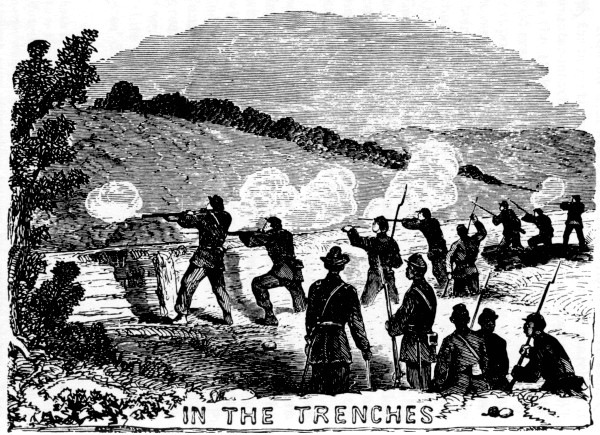
"General Potter, in his report, mentions that, when his division occupied the front, his loss averaged some fourteen or fifteen officers killed and wounded per diem. The sharpshooters on either side were vigilant, and an exposure of any part of the person was the signal for the exchange of shots. The men, worn by hard marching, hard fighting and hard digging, took every precaution to shield themselves, and sought cover at every opportunity. They made fire proofs of logs and earth, and with tortuous covered ways and traverse, endeavoring to secure themselves from the enemy's fire. The artillery and mortars on both sides were kept almost constantly at work. These were all precursors of the coming, sanguinary struggle for the possession of Cemetery Hill. Immediately in front of the salient occupied by the Ninth Corps, the rebels had constructed a very strong redoubt, a short distance below Cemetery Hill. In the rear of the redoubt ran a ridge nearly at right angles with the rebels' lines, to the hill. It appeared that if this redoubt was captured, the enemy's line would be seriously threatened, if not entirely broken up. A feasible plan for the destruction of the redoubt, was seriously discussed among the soldiers of the corps; finally Colonel Pleasants, of the 48th Pennsylvania Regiment, devised a plan to run a mine under the intervening space between the line of the corps and the redoubt, with the design of exploding it, directly under the redoubt. To this plan General Burnside lent his aid, and preparations were made for an assault upon Cemetery Hill, at the time of its explosion. The work of digging and preparing the mine was prosecuted under the most disadvantageous circumstances. General Meade reluctantly gave official sanction, and the work of excavation proceeded with, despite the fact that General Burnside's requisitions for supplies were not responded to. Nevertheless, in less than a month the mine was ready, and after considerable discussion, and not without some bickering, the plan of attack was arranged, which, in brief, was to form two columns, and to charge with them through the breach caused by the explosion of the mine. Then to sweep along the enemy's line, right and left, clearing away the artillery and infantry, by attacking in the flank and rear. Other columns were to make for the crest, the whole to co-operate. General Ferrero, in command of the Phalanx division was informed, that in accordance with the plan of attack, he was to lead in the assault, when the attack was made, after the mine had been fired. He was ordered to drill his troops accordingly. After a careful examination of the ground, Ferrero decided upon his methods of advance,—not to go directly in the crater formed by the explosion, but rather upon one side of it, and then to take the enemy in flank and reverse. When he informed his officers and men that they would be called upon to lead in the assault, they received the information with delight. His men, desirous of emulating their comrades of the Third Division of the Eighteenth Corps, felt that their cherished hope,—the opportunity for which they had prayed,—was near at hand; the hour in which they would show themselves worthy of the honor of being associated with the Army of the Potomac. They rejoiced at the prospect of wiping off whatever reproach an ill-judged prejudice might have cast upon them, by proving themselves brave, thereby demanding the respect which brave men deserve. For three weeks they drilled with alacrity in the various movements; charging upon earthworks, wheeling by the right and left, deployment, and other details of the expected operations. General Burnside had early expressed his confidence in the soldierly capabilities of the men of the Phalanx, and now wished to give them an opportunity to justify his good opinion."
His white troops, moreover, had been greatly exposed throughout the whole campaign, had suffered severely, and had been so much under the fire of the sharpshooters that it had become a second nature with them to dodge bullets. The negro troops had not been so much exposed, and had already shown their steadiness under fire in one or two pretty severe skirmishes in which they had previously been engaged. The white officers and men of the corps were elated with the selection made by General Burnside, and they, too, manifested an uncommon interest in their dark-hued comrades. The demeanor of the former toward the latter was very different from that of the other corps, of which that particular army was composed. The 9th Corps had seen more service than any other corps in the Army of the Potomac. Its operations in six States had given to the men an experience calculated to destroy, very greatly, their race prejudice; besides a very large portion of the regiments in the corps came from the New England States, especially Massachusetts, Vermont and Rhode Island, where race prejudice was not so strong; consequently the treatment of the men in the 4th Division was tempered by humanity, and pregnant with a fraternal feeling of comradeship. And then there was a corps pride very naturally existing among the white troops, which prompted a desire for the achievement of some great and brilliant feat by their black comrades. This feeling was expressed in more than one way by the entire corps, and greatly enhanced the ambition of the Phalanx to rout the enemy and drive him out of his fortifications before Petersburg, if not to capture the city.
These high hopes were soon dissipated, however. General Meade had an interview with General Burnside on the 28th; the subject was fully discussed as to the plan of the assault, as proposed by General Burnside, and made known to Meade by Burnside, in writing, on the 26th. It was at this meeting that General Meade made his objections to the Phalanx leading the assault. General Burnside argued with all the reason he could command, in favor of his plans, and especially for the Phalanx, going over the grounds already cited; why his white troops were unfit and disqualified for performing the task of leading the assault, but in vain. Meade was firm in his purpose, and, true to his training, he had no use for the negro but as a servant; he never had trusted him as a soldier. The plan, with General Meade's objection was referred to General Grant for settlement. Grant, doubting the propriety of agreeing with a subordinate, as against the commander of the army, dismissed the dispute by agreeing with Meade; therefore the Phalanx was ruled out of the lead and placed in the supporting column. It was not till the night of the 29th, a few hours before the assault was made, that the change was made known to General Ferrero and his men, who were greatly chagrined and filled with disappointment.
General Ledlie's division of white troops was to lead the assault, after the explosion of the mine on the morning of the 30th. It was on the night of the 29th, when General Burnside issued his battle order, in accordance with General Meade's plan and instructions, and at the appointed hour all the troops were in readiness for the conflict. The mine, with its several tons of powder, was ready at a quarter past three o'clock on the eventful morning of the 30th of July. The fuses were fired, and "all eyes were turned to the confederate fort opposite," which was discernible but three hundred feet distant. The garrison was sleeping in fancied security; the sentinels slowly paced their rounds, without a suspicion of the crust which lay between them and the awful chasm below. Our own troops, lying upon their arms in unbroken silence, or with an occasional murmur, stilled at once by the whispered word of command, looked for the eventful moment of attack to arrive. A quarter of an hour passed,—a half hour, yet there was no report. Four o'clock, and the sky began to brighten in the east; the confederate garrison was bestirring itself. The enemy's lines once more assumed the appearance of life; the sharpshooters, prepared for their victims, began to pick off those of our men, who came within range of their deadly aim. Another day of siege was drawing on, and still there was no explosion. What could it mean? The fuses had failed;—the dampness having penetrated to the place where the parts had been spliced together, prevented the powder from burning. Two men (Lieut. Jacob Douty and Sergeant—afterwards Lieutenant—Henry Rees,) of the 48th Pennsylvania volunteered to go and ascertain where the trouble was. At quarter past four o'clock they bravely entered the mine, re-arranged the fuses and relighted them. In the meantime, General Meade had arrived at the permanent headquarters of the 9th Corps. Not being able to see anything that was going forward, and not hearing any report, he became somewhat impatient. At fifteen minutes past four o'clock he telegraphed to General Burnside to know what was the cause of the delay. Gen. Burnside was too busy in remedying the failure already incurred to reply immediately, and expected, indeed, that before a dispatch could be sent that the explosion would take place. General Meade ill-naturedly telegraphed the operator to know where General Burnside was. At half-past four, the commanding general became still more impatient, and was on the point of ordering an immediate assault upon the enemy's works, without reference to the mine. Five minutes later he did order an assault. General Grant was there when, at sixteen minutes before five o'clock, the mine exploded. Then ensued a scene which beggars description.
General Badeau, in describing the spectacle, says:
"The mine exploded with a shock like that of an earthquake, tearing up the rebels' work above them, and vomiting men, guns and caissons two hundred feet into the air. The tremendous mass appeared for a moment to hang suspended in the heavens like a huge, inverted cone, the exploding powder still flashing out here and there, while limbs and bodies of mutilated men, and fragments of cannon and wood-work could be seen, then all fell heavily to the ground again, with a second report like thunder. When the smoke and dust had cleared away, only an enormous crater, thirty feet deep, sixty wide, and a hundred and fifty long stretched out in front of the Ninth Corps, where the rebel fort had been."
The explosion was the signal for the federal batteries to open fire, and immediately one hundred and ten guns and fifty mortars opened along the Union front, lending to the sublime horror of the upheaved and quaking earth, the terror of destruction.
A confederate soldier thus describes the explosion, in the Philadelphia Times, January, 1883:
"About fifteen feet of dirt intervened between the sleeping soldiers and all this powder. In a moment the superincumbent earth, for a space forty by eighty feet, was hurled upward, carrying with it the artillery-men, with their four guns, and three companies of soldiers. As the huge mass fell backwards it buried the startled men under immense clods—tons of dirt. Some of the artillery was thrown forty yards towards the enemy's line. The clay subsoil was broken and piled in large pieces, often several yards in diameter, which afterwards protected scores of Federals when surrounded in the crater. The early hour, the unexpected explosion, the concentrated fire of the enemy's batteries, startled and wrought confusion among brave men accustomed to battle."
Says a Union account:
"Now was the time for action, forward went General Ledlie's column, with Colonel Marshall's brigade in advance. The parapets were surmounted, the abatis was quickly removed, and the division prepared to pass over the intervening ground, and charge through the still smoking ruins to gain the crest beyond. But here the leading brigade made a temporary halt; it was said at the time our men suspected a counter mine, and were themselves shocked by the terrible scene they had witnessed. It was, however, but momentary; in less than a quarter of an hour, the entire division was out of its entrenchments, and was advancing gallantly towards the enemy's line. The ground was somewhat difficult to cross over, but the troops pushed steadily on with soldiery bearing, overcoming all the obstacles before them. They reached the edge of the crater, passed down into the chasm and attempted to make their way through the yielding sand, the broken clay, and the masses of rubbish that were everywhere about. Many of the enemy's men were lying among the ruins, half buried, and vainly trying to free themselves. They called for mercy and for help. The soldiers stopped to take prisoners, to dig out guns and other material. Their division commander was not with them, there was no responsible head, the ranks were broken, the regimental organizations could not be preserved, and the troops were becoming confused. The enemy was recovering from his surprise, our artillery began to receive a spirited response, the enemy's men went back to their guns; they gathered on the crest and soon brought to bear upon our troops a fire in front from the Cemetery Hill, and an enfilading and cross-fire from their guns in battery. Our own guns could not altogether silence or overcome this fire in flank, our men in the crater were checked, felt the enemy's fire, sought cover, began to entrench. The day was lost, still heroic men continued to push forward for the crest, but in passing through the crater few got beyond it. Regiment after regiment, brigade followed brigade, until the three white divisions filled the opening and choked the passage to all. What was a few moments ago organization and order, was now a disordered mass of armed men. At six o'clock, General Meade ordered General Burnside to push 'his men forward, at all hazards, white and black.' His white troops were all in the crater, and could not get out. As instructed, he ordered General Ferrero to rush in the Phalanx; Colonel Loving was near when the order came to Ferrero; as the senior staff officer present, seeing the impossibility of the troops to get through the crater, at that time countermanded the order, and reported in person to General Burnside, but he had no discretion to exercise, his duty was simply to repeat Meade's order. The order must be obeyed; it was repeated; away went the Phalanx division, loudly cheering, but to what purpose did they advance? The historian of that valiant corps, presumably more reliable than any other writer, says:
"'The colored troops charged forward, cheering with enthusiasm and gallantry. Colonel J. K. Sigfried, commanding the first brigade, led the attacking column. The command moved out in rear of Colonel Humphrey's brigade of the Third Division. Colonel Sigfried, passing Colonel Humphrey by the flank, crossed the field immediately in front, went down the crater, and attempted to go through. The passage was exceedingly difficult, but after great exertions the brigade made its way through the crowded masses in a somewhat broken and disorganized condition, and advanced towards the crest. The 43rd U. S. Colored troops moved over the lip of the crater toward the right, made an attack upon the enemy's line of intrenchments, and won the chief success of the day, capturing a number of prisoners and rebel colors, and re-capturing a stand of national colors. The other regiments of the brigade were unable to get up, on account of white troops in advance of them crowding the line. The second brigade, under command of Colonel H. G. Thomas, followed the first with equal enthusiasm. The men rushed forward, descended into the crater, and attempted to pass through. Colonel Thomas' intention was to go to the right and attack the enemy's rifle-pits. He partially succeeded in doing so, but his brigade was much broken up when it came under the enemy's fire. The gallant brigade commander endeavored, in person, to rally his command, and at last formed a storming column, of portions of the 29th, 28th, 23rd, and 19th Regiments of the Phalanx division.'
"'These troops' made a spirited attack, but lost heavily in officers and became somewhat disheartened. Lieutenant-Colonel Bross, of the 29th, with the colors in his hands, led the charge; was the first man to leap upon the enemy's works, and was instantly killed. Lieutenant Pennell seized the colors, but was shot down, riddled through and through. Major Theodore H. Rockwood, of the 19th, sprang upon the parapet, and fell while cheering on his regiment to the attack. The conduct of these officers and their associates was indeed magnificent. No troops were ever better lead to an assault; had they been allowed the advance at the outset, before the enemy had recovered from his first surprise, their charge would have been successful. But it was made too late. The fire to which they were exposed was very hot and destructive; it came from front and flank, it poured into the faces of the men. It enfiladed their lines. The enemy's rage against the colored troops had its bloody opportunity."
And they made use of it.
Captain W. L. Fagan, of the 8th Alabama Regiment, thus gives an account of the fight, from the confederate side:
"The crater combat, unlike other battles in Virginia, was a series of deeds of daring, of bloody hand-to-hand fighting, where the survivor could count with a certainty the men he had slain. A few days ago a soldier said to me: 'I killed two at the crater; they were not three feet from me when they fell. I had followed the fortunes of the Confederacy from Williamsburg to Appomattox Court House, and had, to the morning of July 30, only seen two bayonet wounds;—one received at Frazier's Farm, the other at Turkey Ridge, June 3, 1864.' Men stood face to face at the crater. Often a bayonet thrust was given before the Minie ball went crashing through the body. Every man took care of himself, intent on selling his life as dearly as possible. The negroes did not all stampede. They mingled with the white troops. The troops of Mahone, Wilcox and Wright were greeted with defiant yells, while their ranks were mowed down by withering fires. Many officers commanding negro troops held their commissions for bravery. Encouraged, threatened, emulating the white troops, the black men fought with desperation. Some Confederate soldiers recognized their slaves at the crater. Captain J——, of the Forty-first Virginia, gave the military salute to 'Ben' and 'Bob,' whom he had left hoeing corn down in Dinwiddie. If White's Division had occupied Reservoir Hill, Richmond would have been evacuated."
But let the writer of the following tell what the brave black men met after having advanced beyond the crater, where they grappled with the sullen foe filled with the recollection of the capture, in June, of their works, guns and comrades by the "niggers" of the 18th Corps. It was not lex talionis that they observed, but a repetition of the Fort Pillow Massacre. Under the head of "The Confederate Charge," the particulars are given:
"The Federals now held the crater and the inner line. Generals Lee and Mahone arrived on the field about 7:30 a. m. A ravine, which deepened on our right, ran parallel with this inner line and was used by Mahone in which to form his brigade when preparing to attack. At 8 a. m. Mahone's Brigade, commanded by Colonel D. A. Weisiger, brought from the right of Hoke's Division, was formed in this ravine and advanced to the assault. The Federals, concentrating a terrific fire of musketry and artillery, ploughed out great gaps in these fearless Virginians. Nothing daunted, they pressed forward and recaptured the inner line. The loss of this brigade was heavy, both in men and officers, more than two hundred Virginians falling between the ravine and the captured works. The Federal troops, white and colored, fought with a desperation never witnessed on former battle-fields. The negroes, it is said, cried 'No quarter.' Mahone and Wright's Brigades took only twenty-nine of them prisoners. The Federals still held the crater and part of the line. Another charge was necessary and Wright's Georgia Brigade was ordered up from Anderson's Division. Wright's Brigade, forming in the ravine, moved forward to drive the Federals from the line they still held. The enemy, expecting their attack, poured a volley into the Georgians that decimated their ranks, killing and wounding nearly every field officer in the brigade. The men rushing forward, breasting a storm of lead and iron, failed to oblique far enough to the right to recapture the whole line, but gained the line occupied by and contiguous to the line already captured by Weisiger, commanding Mahone's Brigade. Mahone's Brigade and Wright's Brigade had captured forty-two officers, three hundred and ninety men and twenty-nine negroes.
"It was now about 10 a. m. General Grant made no effort to reinforce his line or to dislodge Wright and Mahone from the positions they held. A courier dashed up to General J. C. C. Sanders, commanding Wilcox's Brigade, informing him that his brigade was wanted. The men were expecting this courier, as they were next in line, and they distinctly heard the shouts of Mahone's and Wright's men, followed by the heavy artillery firing, while the word had passed down the line that the salient had not been recaptured. General Sanders moved his brigade, consisting of the Eighth, Ninth, Tenth, Eleventh and Fourteenth Alabama Regiments, to the left and occupied the ravine. There was no shade or water in this ravine, while the men were exposed nearly four hours to a scorching sun. The heat was almost beyond human endurance. Strong men fainted and were carried to the rear. The waves of hot air at times were almost suffocating. For the first and only time the men were told what was expected of them. General Saunders explained the situation to the officers of the regiments. Each captain spoke to his men, urging them to retake the salient, or Petersburg and Richmond must be evacuated. The men were ordered to fix their bayonets securely, to trail arms—not to fire, not to yell, but to move quietly up the side of the ravine, and then, every man run for his life to the breastworks. They were told that Generals Lee, Beauregard, Hill, Mahone, Hoke and every general officer of the army would watch them as they moved forward.
"At 1:30 p. m. the firing had almost ceased and the Federals, overcome with heat, did not expect an attack. Saunders formed his brigade and moved quietly up the side of the ravine. Hardly a word was spoken, for the Alabamians expected to die or retake that salient. The eye of General Lee was fixed on them. When they caught sight of the works their old feelings came back to them and yell they must. With the fury of a whirlwind they rushed upon the line they had been ordered to take. The movement was so unexpected and so quickly executed that only one shell was thrown into the brigade. The works gained, they found the enemy on the other side. It was stated that Lee, speaking to Beauregard, said: 'Splendid!' Beauregard spoke with enthusiasm of the brilliant charge.
"In an instant the Federal army was aroused, and batteries opened along the whole line, while the infantry fire was a continuous roar. Only a breastwork divided Wilcox's Brigade from the Federals. A moment was required for Saunders to reform, and his brigade mounted the inner line and forced the enemy backwards to the outer line and the crater. The crater was full of white and negro soldiers. The Confederates, surrounding it on every side, poured volley after volley into this heaped-up mass of terrified negroes and their brave officers. The negroes ran in every direction and were shot down without a thought. Bayonets, swords and the butts of muskets were used. The deafening roar of artillery and musketry, the yells and imprecations of the combatants, drowned the commands of officers. A negro in the crater attempted to raise a white flag, and it was instantly pulled down by a Federal officer. The Federal colors were planted on a huge lump of dirt, and waved until Sergeant Wallace, of the Eleventh Alabama, followed by others, seized them and tore them from the staff. Instantly a white flag was raised, and the living, who were not many, surrendered. The crater was won."
With the exception of General Burnside, no commander of the Army of the Potomac was in favor of the Phalanx participating in a battle. What, then, had the Phalanx to expect of those to whom they had borne the relation of slave? The confederates had a right to expect hard fighting when they met the Phalanx, and the Phalanx knew they had to fight hard when they met the confederates. It was the previous associations and habits of the negro that kept him from retaliating for the several massacres that had been perpetrated upon his brother-soldiers. It was not for a want of courage to do it: it was only necessary for those who commanded them to have ordered it, and they would never have taken a confederate prisoner.
Many of those who commanded them needed but public opinion to sustain them, to give such an order as would have made every battle between the Phalanx and the confederates bloody and inhuman. It was but the enlightened sentiment of the North, the religious teaching of the brotherhood of man, the high character and moral training of the statesmen on the side of the Union, that restrained the Phalanx from retaliation, else they possessed none of the characteristics of a courageous, sensitive and high tempered people. The negro is not naturally docile; his surroundings, rather than his nature, have given him the trait; it is not naturally his, but something which his trainers have given him; and it is not a difficult task to untrain him and advance him beyond his apparent unconsciousness of self-duty and self-preservation. Let him feel that he is to be supported in any transaction uncommon to him, and he can act as aggressively as any race of men who are naturally quicker in temperament. It is this characteristic that made the negro what General Grant said he was: in discipline a better soldier than the white man. It was said that he would not fight: there is no man in the South who met him on the battle-field that will say so now.
These are a few of the thoughts that came to me as I listened for an hour, one evening in June, 1883, to the confederate Gen. Mahone, whose acquaintance the writer enjoys, reciting the story of the fight at the crater, where the negro met the confederate, and in a hand-to-hand struggle one showed as much brute courage as the other. It would not be doing the negro justice to accord him less, and yet that courage never led him to acts of inhumanity. It is preferable that the confederates themselves should tell the stories of their butcheries than for me to attempt them. Not the stories told at the time, but fifteen years afterward, when men could reflect and write more correctly. There is one, an orator, who has described the fight, whose reference to the crater so gladdened the hearts of his audience that they reproduced the "yell," and yelled themselves hoarse. No battle fought during the war, not even that of Bull Run, elicited so much comment and glorification among the confederates as that of the crater. It was the bloodiest fight on the soil of the Old Dominion, and has been the subject of praise by poets and orators upon the confederate side. Capt. J. B. Hope eulogized "Mahone's brigade" in true Southern verse. Capt. McCabe, on the 1st of November, 1876, in his oration before the "Association of the Army of Northern Virginia," in narrating the recapture of the works, said:
"It was now 8 o'clock in the morning. The rest of Potter's (Federal) division moved out slowly, when Ferrero's negro division, the men, beyond question, inflamed with drink, (there are many officers and men, myself among the number, who will testify to this), burst from the advanced lines, cheering vehemently, passed at a double quick over a crest under a heavy fire, and rushed with scarcely a check over the heads of the white troops in the crater, spread to their right, and captured more than two hundred prisoners and one stand of colors. At the same time Turner, of the Tenth corps, pushed forward a brigade over the Ninth Corps' parapet, seized the Confederate line still further to the north, and quickly dispersed the remaining brigades of his division to confirm his successes."
The truth is over-reached in the statement of this orator if he intended to convey the idea that the men of the Phalanx division were drunk from strong drink; but it may be looked upon as an excuse offered for the treatment the courageous negro soldiers received at the hands of their captors, who, worse than enraged by strong drink, gave the battle-cry on their way to the front, "No quarter to niggers!" This has been admitted by those in a position, at the time, to know what went on. In his "Recollections of the Recapture of the Lines," Colonel Stewart of the 61st Virginia Regiment, says:
"When nearly opposite the portions of our works held by the Federal troops, we met several soldiers who were in the works at the time of the explosion. Our men began ridiculing them for going to the rear, when one of them remarked, 'Ah, boys, you have got hot work ahead,—they are negroes, and show no quarter.' This was the first intimation we had that we were to fight negro troops, and it seemed to infuse the little band with impetuous daring, as they pressed toward the fray. I never felt more like fighting in my life. Our comrades had been slaughtered in a most inhuman and brutal manner, and slaves were trampling over their mangled and bleeding corpses. Revenge must have fired every heart, and strung every arm with nerves of steel, for the herculean task of blood."
On the Monday morning after the assault of Saturday, the Richmond Enquirer said:
"Grant's war cry of 'no quarter' shouted by his negro soldiers, was returned with interest, we regret to hear, not so heavily as ought to have been, since some negroes were captured instead of being shot. Let every salient we are called upon to defend, be a Fort Pillow, and butcher every negro that Grant hurls against our brave troops, and permit them not to soil their hands, with the capture of one negro."
There is no truth in the statement. No such cry was ever made by negro soldiers; and when it is remembered that the confederate congress, in four short months after this declaration, began arming slaves for the defense of Richmond, it is readily seen how deep and with what sincerity such declarations were made. The Southern historian Pollard thus describes the situation after the assault and the ground had again come into the possession of the confederates:
BEFORE PETERSBURG. Phalanx soldiers, under a flag of truce, burying their dead after one of the terrible battles before Petersburg.
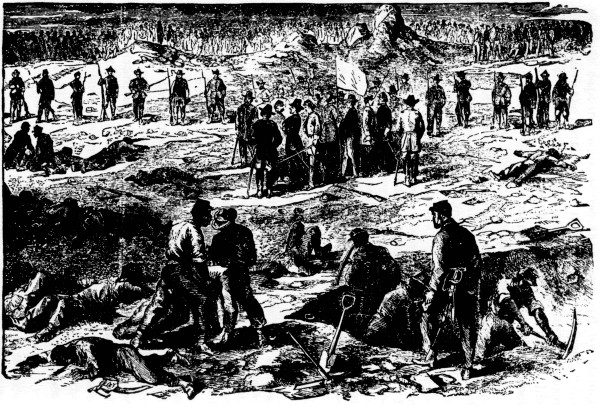
"The ground all around was dotted with the fallen, while the sides and bottom of the crater were literally lined with dead, the bodies lying in every conceivable position. Some had evidently been killed with the butts of muskets, as their crushed skulls and badly smashed faces too plainly indicated.' Within this crater—this hole of forty by eighty feet—were lying one hundred and thirty-six dead soldiers, besides the wounded. The soil was literally saturated with blood. General Bartlett was here, with his steel leg broken. He did not look as though he had been at a 'diamond wedding,' but was present at a 'dance of death.' A covered way for artillery was so full of dead that details were made to throw them out, that artillery might be brought in. The dead bodies formed a heap on each side. The Alabamians captured thirty-four officers, five hundred and thirty-six white and one hundred and thirty-nine colored soldiers. The three brigades had seventeen stands of colors, held by seventeen as brave, sweaty, dirty, powder-stained fellows as ever wore the gray, who knew that, when presenting their colors to division headquarters, to each a furlough of thirty days would be granted.
"The crater was filled with wounded, to whom our men gave water. Adjutant Morgan Cleveland, of the 8th Alabama Regiment, assisted a federal captain who was mortally wounded and suffering intensely. Near him lay a burly, wounded negro. The officer said he would die. The negro, raising himself on his elbow, cried out: 'Thank God. You killed my brother when we charged, because he was afraid and ran. Now the rebels have killed you.' Death soon ended the suffering of one and the hatred of the other. A darkness came down on the battle-field and the victors began to repair the salient. The crater was cleared of the dead and wounded. Men were found buried ten feet under the dirt. Twenty-two of the artillery company were missing. Four hundred and ninety-eight dead and wounded confederates were buried or sent to the hospitals. Between the lines lay hundreds of wounded federals, who vainly called for water. These men had been without water since early morning. Some calling louder than others, their voices were recognized, and as their cries grew fainter, we knew their lives were ebbing away. Our men, risking their lives, carried water to some.
"I find in my diary these lines: 'Sunday, July 31, 1864. Everything comparatively quiet along the lines. Hundreds of federal soldiers are lying in front of the crater exposed to a scorching sun; some are crying for water. The enemy's fire is too heavy for a soldier to expose himself.' Late on Sunday evening a flag of truce was sent in and forwarded to General Lee. General Grant had asked permission to bury his dead and remove his wounded. The truce was granted, to begin on Monday at 5 a. m. and conclude at 9 a. m. Punctual to the hour the federal details came on the field and by 9 a. m. had buried about three hundred. The work was hardly begun and the truce was extended. Hour after hour was granted until it was evening before the field was cleared."
With these selections from the mass of confederate testimony before us, of their "daring, bloody work," given by participants, it is well to read some of the statements of those who battled for the Union on that occasion.
Many of the correspondents at the seat of war, ignorant of the real facts regarding the assault, attributed the failure, not to General Meade's interference with General Burnside's plan, but to the Phalanx division, the men who bore the brunt of the battle and gained for themselves a fame for desperate fighting. But some of those who were acquainted with the facts have left records that tell the true story and give honor to whom honor is due. Gen. Grant is among the number; he perfectly understood the whole matter, knew that General Burnside, not being allowed to carry out his own plans, but at the last moment compelled to act contrary to his judgment, could not fight with that enthusiasm and confidence that he would have done had he been allowed to carry out his own ideas. In his "Memoirs," General Grant gives an account of the explosion of the mine and the assault after placing the blame for the "stupendous failure" where it belongs. I quote a few preliminary words which not only intimate where the trouble lies, but gives the key to the whole matter. Speaking of General Burnside's command, he says:
"The four divisions of his corps were commanded by Generals Potter, Wilcox, Ledlie and Ferrero. The last was a colored division; and Burnside selected it to make the assault. Meade interfered with this. Burnside then took Ledlie's division—a worse selection than the first could have been. * * * * Ledlie, besides being otherwise inefficient, proved also to possess disqualifications less common among soldiers."
A correspondent of the New York Evening Post says:
"We have been continually notified for the last fortnight, that our sappers were mining the enemy's position. As soon as ready, our division was to storm the works on its explosion. This rumor had spread so wide we had no faith in it. On the night of the 29th, we were in a position on the extreme left. We were drawn in about nine p. m., and marched to General Burnside's headquarters, and closed in mass by division, left in front. We there received official notice that the long-looked-for mine was ready charged, and would be fired at daylight next morning. The plan of storming was as follows: One division of white troops was to charge the works immediately after the explosion, and carry the first and second lines of rebel intrenchments. Our division was to follow immediately, and push right into Petersburg, take the city, and be supported by the remainder of the Ninth and Twenty-eighth corps. We were up bright and early, ready and eager for the struggle to commence. I had been wishing for something of this sort to do for some time, to gain the respect of the Army of the Potomac. You know their former prejudices. At thirty minutes after five, the ball opened. The mine, with some fifty pieces of artillery, went off almost instantaneously; at the same time, the white troops, according to the plan, charged the fort, which they carried, for there was nothing to oppose them; but they did not succeed in carrying either of the lines of intrenchments.
"We were held in rear until the development of the movement of the white troops; but, on seeing the disaster which was about to occur, we pushed in by the flank (for we could go in in no other way to allow us to get in position); so you see on this failure we had nothing to do but gain by the flank. A charge in that manner has never proved successful, to my knowledge; when it does, it is a surprise.
"Our men went forward with enthusiasm equal to anything under different circumstances; but, in going through the fort that had been blown up, the passage was almost impeded by obstacles thrown up by the explosion. At the same time, we were receiving a most deadly cross-fire from both flanks. At this time, our lieutenant-colonel (E. W. Ross) fell, shot through the left leg, bravely leading the men. I immediately assumed command, but only to hold it a few minutes, when I fell, struck by a piece of shell in the side. Capt. Robinson, from Connecticut, then took command; and, from all we can learn, he was killed. At this time, our first charge was somewhat checked, and the men sought cover in the works. Again our charge was made, but, like the former, unsuccessful. This was followed by the enemy making a charge. Seeing the unorganized condition and the great loss of officers, the men fell back to our own works. Yet a large number still held the fort until two p. m., when the enemy charged again, and carried it. That ended the great attempt to take Petersburg.
"It will be thus seen that the colored troops did not compose the first assaulting, but the supporting column; and they were not ordered forward until white troops in greater numbers had made a desperate effort to carry the rebel works, and had failed. Then the colored troops were sent in; moved over the broken ground, and up the slope, and within a short distance of the parapet, in order, and with steady courage; but finally broke and retreated under the same fire which just before had sent a whole division of white regiments to the right-about. If there be any disgrace in that, it does not belong exclusively nor mainly to the negroes. A second attack is far more perilous and unlikely to succeed than a first; the enemy having been encouraged by the failure of the first, and had time to concentrate his forces. And, in this case, there seems to have been a fatal delay in ordering both the first and second assault."