Part 2 — CHAPTER XI. (continued 2)
Reading edition
An officer in the same engagement says:
"In regard to the bravery of the colored troops, although I have been in upwards of twenty battles, I never saw so many cases of gallantry. The 'crater,' where we were halted, was a perfect slaughter-pen. Had not 'some one blundered,' but moved us up at daylight, instead of eight o'clock, we should have been crowned with success, instead of being cut to pieces by a terrific enfilading fire, and finally forced from the field in a panic. We had no trouble in rallying the troops and moving them into the rifle-pits; and, in one hour after the rout I had nearly as many men together as were left unhurt.
"I was never under such a terrific fire, and can hardly realize how any escaped alive. Our loss was heavy. In the Twenty-eighth (colored) for instance, commanded by Lieut.-Col. Russell (a Bostonian), he lost seven officers out of eleven, and ninety-one men out of two hundred and twenty-four; and the colonel himself was knocked over senseless, for a few minutes, by a slight wound in the head; both his color-sergeants and all his color-guard were killed. Col. Bross, of the Twenty-ninth, was killed outright, and nearly every one of his officers hit. This was nearly equal to Bunker Hill. Col. Ross, of the Thirty-first, lost his leg. The Twenty-eighth, Twenty-ninth and Thirtieth (colored), all charged over the works; climbing up an earthwork six feet high, then down into a ditch, and up on the other side, all the time under the severest fire in front and flank. Not being supported, of course the storming party fell back. I have seen white troops run faster than these blacks did, when in not half so tight a place. Our brigade lost thirty-six prisoners, all cut off after leaving the 'crater.' My faith in colored troops is not abated one jot.'"
The Congressional Committee on the Conduct of the War investigated the affair, before which General Grant testified. He was severe upon General Ledlie, whom he regarded as an inefficient officer; he blamed himself for allowing that officer to lead the assault. General Grant also testified:
"General Burnside wanted to put his colored division in front; I believe if he had done so it would have been a success."
On the morning of the 13th of August, 1864, a brigade of the Phalanx, consisting of the 7th, 8th, 9th and 29th Regiments, crossed from Bermuda Hundreds to the north side of the James river, on pontoons, near Jones' landing, and bivouacked for the night. General Grant was led to believe that General Lee had sent a portion of his troops, at least three divisions of infantry, and one of cavalry, from the front of Petersburg, to re-enforce Gen. Early, then operating in the valley. Consequently he thought it a favorable opportunity to threaten Richmond, and ordered Hancock with the 2nd, and Birney with a part of the 10th Corps, with Gregg's Cavalry, to attack the confederate works on the north side of the James. The object was two-fold: to prevent Lee from re-enforcing Early, confronted by Sheridan's troops; and likewise to drive the confederates from out their works. The troops crossed the James on the 13th, the 2d Corps going to Deep Bottom by transports, the other troops crossing the river by pontoons, and advancing, found the enemy in force. Several spirited engagements took place, after which the main forces withdrew again across the river, to the front of Petersburg. The following account applies to the brigade as well as the 7th Phalanx Regiment, from whose record it is extracted:
"During the forenoon of the 14th the (7th) Regiment acted as reserve, moving forward occasionally as the line advanced. Most of the work of the day was done to the right, little being done in the immediate front except skirmishing. About 5 p. m. a portion of the Seventh and Ninth, forming line in the edge of some timber, moved across an open field and charged upon reaching the farther side and captured the enemy's line of rifle-pits. The companies of the Seventh pushed on some distance further toward their second line, but were met with so severe a fire that they fell back to the captured line; which was held. This charge, known as the action of Kingsland Road, was made in fine style. The battalion of the Seventh was commanded by Capt. Weiss—Col. Shaw having been detailed as Corps Officer of the day, and Lieut.-Col. Haskell being temporarily in command of the brigade. Our losses were two men killed, and one officer (Lieut. Eler) and thirty-two men wounded.
"About 10 o'clock p. m., the troops moved down the road to the right, and at 1 o'clock Col. Shaw withdrew the pickets of the corps, re-crossed the pontoons, where we had crossed in the morning, and moved down the neck. Then followed four hours of the most wearisome night-marching—moving a few rods at a time and then halting for troops ahead to get out of the way; losing sight of them and hurrying forward to catch up; straggling out into the darkness, stumbling and groping along the rough road, and all the time the rain coming down in a most provoking, exasperating drizzle. About daylight crossed back to the north side and halted for coffee, and then moved forward some four miles and rejoined the corps, taking position behind the crest of a hill. The Eighth and Twenty-ninth were left in a work on the hill.
"About 3:30 p. m. orders came to pile knapsacks and be ready to march immediately. A little after 4 o'clock the brigade moved to the right, some three-quarters of a mile, into an open cornfield, and, after halting a few moments, turned down a road through the woods to the left with Gen. Wm. Birney, who ordered Col. Shaw to throw out skirmishers and advance with his brigade down a road which he pointed out, find the enemy and attack vigorously, and then rode away. Finding the road turning to the left, Col. Shaw sent word to Gen. Birney that the designated road would probably bring him back on our own line. The order came back from Gen. Birney to go ahead. The road still bearing to the left, word was again sent that we should strike our own line if we continued to advance in the direction we were going. A second time the answer came to move on. A third messenger having brought from Gen. Birney the same reply, Col. Shaw decided to disobey the order and call in the skirmishers. Before it could be done firing commenced and continued briskly for several minutes, before the men recognized each other, and it was discovered that we had been firing into our own Second Brigade—Col. Osborn's. This sad affair, which would not have occurred had Col Shaw's caution been heeded, resulted in the killing of the lieutenant commanding the picket-line and the wounding of many men on both sides. After this fiasco the brigade moved out into the cornfield, where it had halted earlier in the day, and bivouacked for the night. The regiment had been more or less exposed all day to shell-fire, but lost from it only four or five men wounded, in addition to the ten or twelve men wounded in the skirmish with Osborn's brigade.
"Early on the morning of the 16th, the regiment marched back to its knapsacks and halted for breakfast. About 10 o'clock it was ordered out to support two batteries, and remained on this duty until 3 p. m., changing position frequently, in the meantime Gen. Terry, with the First Division of the Tenth Corps, had charged the rebel line, near Fuzzel's mills, and captured it, together with three colors and some three hundred prisoners. But the enemy rallied, and with reinforcements, soon compelled Gen. Terry to relinquish the captured line. About dark Gen. Wm. Birney came up, and taking the left wing of the Seventh—the right wing, under Col. Shaw, was in support of a battery—and two companies of the Ninth, placed them under command of Lieut.-Col. Haskell, and ordered him with this handful of men to take an earthwork in his front which a division a short time before had failed to carry. The timely arrival of Gen. Terry put an end to this mad scheme. The regiment lost during the day eight or ten men wounded.
"The general results of the day's fighting had been unsatisfactory, for not only had Terry's attack failed in its object, but the advance on the right, along the Charles City road, by the troops of the Second Corps and Gregg's cavalry division, had been equally unsuccessful. The rebel General Chambliss was among the killed.
"About 2:30 a. m. of the 17th, the left wing of the regiment was sent back to a line of rifle-pits that had been thrown up some two hundred yards to the rear, where it was joined by the right wing in the morning after breakfast. Picket-firing continued during the day and heavy artillery firing was heard in the direction of Petersburg. At 4 p. m. a flag of truce was sent out and two hours given to bring in the dead from between the lines. Gen. Chambliss' body was delivered, and we received that of Capt. Williams, of the Thirty-ninth Illinois. Early in the evening the regiment was ordered on picket. Considerable picket-firing occurred during the night and day, the men being with difficulty restrained from it. We were relieved about noon of the 18th by the One Hundred and Fifteenth New York and Seventy-sixth Pennsylvania. * * *
"Early in the morning the Eighth and the Twenty-ninth Connecticut rejoined the regiment, and after the regiment was relieved from picket, it, with the Twenty-ninth, fell back a quarter of a mile, leaving the Eighth and Ninth on the line. Rations having been drawn, the men got supper and prepared for a good night's sleep. Suddenly a heavy musketry fire broke out toward the left which rapidly extended to the right and the entire line was soon under fire. The regiment moved forward at double-quick, but by the time it reached the front and formed line, darkness set in and the enemy fell back. About 11 p. m. our forces were withdrawn, and, after several hours spent in marching and halting, the regiment went into camp two miles from the pontoons. Here it lay all day of the 19th. The following congratulatory order was received from corps headquarters, in which the brigade was spoken of in very flattering terms by Maj.-Gen. D. B. Birney, commanding:
"'Headquarters Tenth Army Corps, Fuzzel's Mills, Va., August 19, 1864.
"'General Orders.—The Major-General commanding congratulates the Tenth Army Corps upon its success. It has, on each occasion, when ordered, broken the enemy's strong lines. It has captured during this short campaign four siege guns protected by formidable works, six colors and many prisoners. It has proved itself worthy of its old Wagner and Fort Sumter renown.
"'Much fatigue, patience and heroism, may still be demanded of it, but the Major-General commanding is confident of the response. To the colored troops, recently added to us, and fighting with us, the Major-General tenders his thanks for their uniform good conduct and soldierly bearing. They have set a good example to our veterans, by the entire absence of straggling from their ranks on the march.
"'By order of Maj.-Gen. D. B. Birney.
"'E.W. SMITH, Lieutenant-Colonel and Assistant Adjutant-General.'
"The special correspondent of the New York Tribune said:
"'Gen. Butler, in a dispatch to the Tenth Corps, on receiving official report of its work, said: 'All honor to the brave Tenth Corps; you have done more than was expected of you by the Lieutenant-General.'
"'The loss in the four colored regiments is about three hundred. The Seventh U. S. C. T. on the first day, carried, with fixed bayonets, a line of rifle-pits, and carried it without a shot, but with a loss of 35. It was one of the most stirring and gallant affairs I have ever known'.
"It began to rain in the afternoon and continued during the night and until nearly noon of the following day, 20th. During the afternoon of the 20th, orders were received to send all sick to the rear and be ready to withdraw quietly at dark. The movement began at 7 p. m., both the Second and Tenth Corps participating—the Second Corps and the cavalry returning to the Petersburg line, and the Tenth to the Bermuda Hundred front. The night was dark and the roads muddy, and after various delays the pontoons were crossed; and at 2 a. m., the regiment went into camp near the spot it occupied the first night after its arrival in Virginia.
"An amusing incident occurred when we halted, after crossing the river. When the fires were lighted our line presented the appearance of a checker-board—alternate black and white men. The latter belonged to the Second Corps, and having straggled from their commands, and belonging to regiments with the same numbers, had fallen into our solid ranks by mistake. Their astonishment and our amusement were about equal. Capt. Walker, having been asked if his men were all present, replied: 'Yes, and about twenty recruits.'
"Thus ended a very hard week's work, during which the regiment was almost constantly under fire; marching, counter-marching, supporting a battery here or strengthening the line there—duties which required almost constant wakefulness and watchfulness. The losses of the brigade footed up some two hundred and fifty.
"This movement, which had begun on the 12th by the withdrawal of the Second Corps, Gen. Hancock, and Gregg's cavalry division, from the Petersburg front to the north bank of the James, to act in conjunction with the Tenth Corps in an attempt to turn the left of the rebel line, proved as abortive as the similar attempt made by the same corps in the latter part of June; Gen. Lee, in both instances, seeming to have received timely information of our plans to enable him to transfer re-enforcements from the Petersburg to the Richmond front. The Union losses during the movement have been estimated at five thousand.
"Sunday, the 21st, was a day of rest. The men put up shelter tents and made themselves as comfortable as circumstances would allow. Gen. Birney resumed command of the brigade and Col. Shaw returned to the regiment. About 6 p. m. orders came to be ready to move during the night with one day's rations. Moved out of camp at 2 a. m., 22nd, and reported at Maj.-Gen. Birney's headquarters, where, after remaining a short time, the regiment returned to camp. About 8 p. m. orders were received to pack everything, and at 5 the regiment marched to the front and went into the trenches near Battery Walker, (No. 7), relieving a regiment of hundred-days' men, whose time had expired.
"The 23d passed quietly. Tents were pitched, and in the evening a dress-parade was held. Lieut. Mack returned to duty from absent sick.
"Line was formed at dawn on the 24th, and again about noon—rapid picket-firing in each instance rendering an attack probable.
"About daybreak on the 25th, the enemy attacked toward the left, drove in our pickets—Capts. Weld and Thayer in command—but were checked before reaching the main line. The regiment was placed in support of Battery England (No. 5). Two men were wounded.
"Some changes in the division here took place—the Twenty-ninth Connecticut was transferred to another brigade, and the Tenth U. S. C. T. to ours, and Col. Duncan was placed in command.
"About noon (25th) packed up everything, crossed the Appomattox, and after a fatiguing march through the heat and dust, reached the Petersburg front a little before sunset and halted for orders. Soon after dark moved to the left in a heavy rain squall, and lay down on a hillside as reserve to the troops in the trenches. At 11 p. m. ordered to report to Gen. Terry. Marched back a mile and reported. Another mile's march in another direction brought the regiment, about 1 a. m., to its position, where it lay down in the woods, again as a reserve. A rattling fire of musketry was kept up all night.
"On the 26th, a camp was selected and had been partially cleared up, when orders were received for the regiment to go into the trenches. Reported at brigade headquarters at sunset, and soon afterward, through the mud and darkness, the men silently felt their way into the trenches, which the rain had reduced to the condition of a quagmire. It was a slow process, and 10 o'clock came before all were in their places.
"During the following day (27th,) the parapet was raised and paths made through the muddier portions of the trenches. Soon after dark a furious cannonade began which lasted for several hours, and afforded to the spectators on both sides a brilliant pyrotechnic display.
"Just after daybreak on the 28th, the enemy opened a heavy musketry fire which lasted until after sunrise. He did not leave his works, however, and our men remained stationary. A man of Company B, while watching for a shot through a section of stove-pipe, which he had improvised into a port-hole, was struck and killed by a sharpshooter's bullet.
"Soon after midnight on the 28th-29th, the regiment moved out of the trenches, and after daylight marched a quarter of a mile to the right and rear and went into camp in a cornfield. The men were at once put to work constructing bomb-proofs, as the position was within sight and range of the enemy's line. This occupied the entire day.
"Brig.-Gen. Birney's arrangement of the brigade did not seem to have given satisfaction to higher authority, and it was broken up, and the old brigade—Seventh, Eighth, Ninth U. S. C. T., and Twenty-ninth Connecticut—were again united, with Col. Shaw in command.
"From this time until the 24th of September, the Seventh and Eighth alternated with the Ninth and Twenty-ninth for duty in the trenches—two days in and two out; and on the 'off' days furnishing details of officers and men for fatigue purposes, in constructing new works and strengthening old ones. The main lines at this point were scarcely over a hundred yards apart, while from the advanced posts a stone could almost be thrown into the enemy's works, and it was considered the most disagreeable portion of the line.
"During the evening of the 4th of September, there was a grand salute along the whole line, in honor of the fall of Atlanta. At every battery the men stood at the guns, and when the monster mortar—"The Petersburg Express"—gave the expected signal, every lanyard was pulled. The effect was exceedingly grand.
"At 9 o'clock on the morning of the 5th, the regiment met with an irreparable loss in the death of Capt. A. R. Walker. Capt. Walker, who was at the time in the trenches, had raised his head above the parapet to observe the enemy's movements, when he was struck in the head by a bullet, and fell without speaking against the parapet. He was carried back and laid upon the ground in rear of the trench, but all efforts failed to elicit any token of recognition. He breathed for a few moments and life was extinct. His body was sent to the rear the same afternoon under charge of Lieut. Teeple, upon whom the command of his company devolved, who made the necessary arrangements for having it embalmed and forwarded to his friends at Caledonia, New York.
* * * *
"On the 14th Col. Howell, who was commanding the division in the absence of Gen. Birney, who was absent sick, died of injuries received from a fall from his horse, and the command of the division devolved upon Col. Pond. Col. Howell was highly esteemed, and was a thorough gentleman and a good officer.
"On the 17th, Sergt. Wilson, Company F, color-sergeant, was reduced to the ranks for cowardice, and Sergt. Griffin, Company B, appointed in his place.
"On the 21st, Capt. Thayer resigned.
"On the 22d, Gen. Birney returned and resumed command of the brigade; the division having been temporarily broken up by the withdrawal of troops, and Col. Shaw returned to the regiment.
"On the 23d, companies B and C were detailed to garrison Fort Steadman.
"On the evening of the 24th, the regiment was relieved from duty in the trenches by the Sixty-ninth New York, and moving about two miles to the rear, went into camp with the remainder of the brigade—some four miles from City Point. Here regular drills and parades were resumed.
"At 3 p. m. on the 28th, camp was broken, and an hour later the brigade followed the two divisions of the corps on the road toward Bermuda Hundred. A tedious night-march followed, during which the north side of the James was reached by way of Broadway and Jones' landings. After an hour or two of rest on the morning of the 29th, the brigade moved forward as a support to the First Division (Paine's), the First Brigade of which, under Col. Duncan, charged and carried the enemy's works on Signal-Hill, on the New Market road, beyond the line of works taken by the Seventh and Ninth on the 14th of August.[32] [See foot-note next page.] * * * The Eighteenth Corps at the same time charged and carried Fort Harrison and a long line of rebel works. Soon after noon, while the brigade, which had been moving by the flank down the New Market road, had halted in the road, orders came to form column of regiments, faced to the left, in the woods. Scarcely had this been done when Gen. Wm. Birney, commanding brigade, rode up to the right of the column and ordered the Seventh to move off by the right flank. As it was crossing the Mill road, Col. Shaw reached the head of the line and received from him the order to "form on the right by file into line, and charge and take the work that is firing," and adding, "if that work is taken when you reach it, push right on and take the next before Gen. Foster can get there." In the meantime the Ninth had charged a work on the right and had been repulsed, and the commanding officer of the Eighth had been ordered to send four companies deployed as skirmishers to take the work to the left, but when Major Wagner found how strong it was he halted his line and remained in advance as skirmishers. As the regiment was forming for the charge, behind the crest of a knoll, Capt. Bailey, Gen. Birney's Adjutant-General, rode up to Col. Shaw with the order to send four companies deployed as skirmishers to 'attack and take the work that is firing.' Col. Shaw replied that he had orders to charge it with his regiment, to which Capt. Bailey answered, 'well, now the General directs you to send four companies, deployed as skirmishers, to take the work.' Lieut.-Col. Haskell, being absent on leave, and Maj. Mayer sick, companies C, D, G and K were placed under command of Capt. Weiss, who, when he received the order to charge, replied, 'what! take a fort with a skirmish line?' and then added, 'I will try, but it can't be done.' What followed can best be described by quoting his own words:
"Captain Weiss says: 'I at once, about 1 p. m., ordered the four companies on the right of the regiment, C, D, G and K, twenty-five or thirty paces to the front, where a slight depression in the ground secured them from the eyes, if not the projectiles, of the enemy. After being deployed by the flank on the right of the second company from the right, the command advanced in ordinary quick step against the objective point. Emerging from the swale into view, it became at once the target for a seemingly redoubled fire, not only from the fort in front, but also from the one on its right. The fire of the latter had been reported silenced, but instead, from its position to the left oblique, it proved even more destructive than that of the one in front.
"'Both forts were most advantageously situated for defense, at the extremity of a plain, variously estimated at from 500 to 700 yards wide, whose dead level surface afforded at no point shelter from view or shot to an assailing party. The forts were connected by a curtain of rifle-pits containing a re-entrant angle, thus providing for a reciprocal enfilading fire in case either was attacked.
"'The nature of the ground and the small altitude of the ordnance above the level of the plain also made the fire in the nature of a ricochet.
"'As the party advanced the enemy's shell and schrapnel were exchanged for grape and cannister, followed soon by a lively rattle of musketry. When within range of the latter, and after having traversed about three-fourths of the distance, the order to charge was given and obeyed with an alacrity that seemed to make the execution almost precede the order. For a moment, judging from the slacking of their fire, the enemy seemed to be affected by a panicky astonishment, but soon recovering, they opened again with cannister and musketry, which, at the shorter range, tore through the ranks with deadlier effect. Capt. Smith and Lieut. Prime, both of Company G, here fell grievously wounded, while forty or fifty enlisted-men dotted the plain with their prostrate forms.
"'In a few minutes the ditch of the fort was reached. It was some six or seven feet deep and ten or twelve wide, the excavated material sufficing for the embankments of the fort. Some 120 men and officers precipitated themselves into it, many losing their lives at its very edge. After a short breathing spell men were helped up the exterior of the parapet on the shoulders of others; fifty or sixty being thus disposed an attempt was made to storm the fort. At the signal nearly all rose, but the enemy, lying securely sheltered behind the interior slope, the muzzles of their guns almost touching the storming party, received the latter with a crushing fire, sending many into the ditch below shot through the brain or breast. Several other attempts were made with like result, till at last forty or fifty of the assailants were writhing in the ditch or resting forever.
"'The defense having been obviously re-enforced meanwhile from other points not so directly attacked, and having armed the gunners with muskets, it was considered impolitic to attempt another storm with the now greatly reduced force on hand, especially as the cessation of the artillery fire of the fort was considered a sufficient hint to the commander of the Union forces that the attacking party had come to close quarters and were proper subjects for re-enforcements. No signs, however, of the latter appearing, it was decided to surrender, especially as the rebels had now commenced to roll lighted shells among the stormers, against which there was no defense, thus inviting demoralization. Seven officers, Capts. Weiss and McCarty, Lieuts. Sherman, Mack, Spinney, Ferguson and Eler, and from seventy to eighty enlisted-men, delivered up their arms to an enemy gallant enough to have fought for a better cause.
"'Many, in mounting the parapet, could not help taking a last mournful look on their dead comrades in the ditch, whose soldierly qualities had endeared them to their best affections; and many, without for a moment selfishly looking at their own dark future, were oppressed with inexpressible sadness when reflecting on the immensity of the sacrifice and the deplorableness of the result. It was a time for manly tears.'
"Lieut. Spinney gives the following account of the charge against Fort Gilmer:
"'The charge was made in quick time, in open order of about three paces, until we could plainly see the enemy; then the order was given by Capt. Weiss to 'double-quick,' which was promptly obeyed, the line preserving its order as upon drill. Upon arriving at the ditch there was no wavering, but every man jumped into the trap from which but one man returned that day (George W. Washington, Company D.)
"'Upon looking about us after getting into the ditch we found there was but one face where the enemy could not touch us, so all the survivors rallied at that face. Then commenced a scene which will always be very fresh in my memory.
"'Capt. Weiss gave orders to raise men upon the parapet, which was done by two men assisting one to climb. Capt. Weiss, having from thirty to forty men up, attempted to gain the inside of the fort, but he with all of his storming party were knocked back, either killed or wounded, into the ditch. A second attempt was made with the same result, Lieut. Ferguson being wounded by a bullet across the top of his head. A third attempt was made with no better success.
"'The enemy during this time had been rolling shell upon us, and calling upon us to surrender, which was answered by some of the men in the words, 'we will show you how to surrender,' at the same time rising and firing into the fort. One of these men I remember to have been Perry Wallace, Company D.
"'Upon a consultation of the officers who were in the ditch, it was decided to surrender what was left of the command. I was still upon the face of the parapet, when Lieut. Sherman passed me a handkerchief which I raised upon the point of my sword. But the rebels, fearing it was only done to gain a foothold, would not take notice of it, but called upon me to come in, which I did, and met with a warm reception at their hands, being plucked of all they could lay hands upon. An adjutant of an Alabama regiment coming up, ordered his men to return to me what they had taken, but this was not done, however. I stated that our men had disarmed themselves and were ready to give up the hopeless struggle. Still they would not believe me, but made me mount the parapet first, when they had the courage to do so themselves, when the remnant of the four companies marched into the fort.
"'The march to Richmond was one continued insult from the troops that were hurrying to the front; one man being determined to kill Capt. Weiss, whom he thought was not humble enough. The female portion of the inhabitants were also very insolent.
"'Upon arriving at Libby Prison the officer in charge asked the commander of our guard if the 'niggers' would fight. His answer was, 'by G—d! if you had been there you would have thought so. They marched up just as if they were on drill, not firing a shot.'
"'After being lodged in Libby, Salisbury and Danville prisons, we were returned to Richmond about February 17th, paroled on the 21st, and reached our lines on the 22d.'
"An article in the New York Herald of November 4th, 1864, copied from a rebel newspaper, arguing for the arming of slaves, has in it the following passage:
"'But A. B. says that negroes will not fight. We have before us a letter from a distinguished general (we wish we were at liberty to use his name and influence) who says 'Fort Gilmer proved the other day that they would fight. They raised each other on the parapet to be shot as they appeared above.'
"The officer referred to was understood to be Gen. Lee.
"After the four companies had disappeared in the ditch of the fort, Capt. Pratt, with Company F, was ordered to move forward as near the work as he could get and keep down its fire and cover their retreat. Capt. Smith and Lieut. Prime came back, both severely wounded. Later in the day companies A, B, E and I, under Capt. Spaulding, moved to the left and relieved the four companies of the Eighth, who were out of ammunition. Co. F lost two men killed and twenty-three wounded, and the four companies under Capt. Spaulding had eleven men killed and wounded. Lieut. Teeple, commanding Company I, was wounded in the arm, but remained in command of his company during the day.
"Four companies annihilated, 70 killed, 110 wounded and 129 missing tells the story of Fort Gilmer.
"The regiment, or what was left of it, remained at the front until 9 o'clock p. m., when the wounded were gathered together and it moved half a mile to the rear and slept on its arms.
"This day proved the most unfortunate one in the history of the regiment. The storming of a strong field-work, whose garrison was on the alert, with a thin skirmish line without supports, resulted as could easily have been foreseen. First, the Ninth was sent unsupported to charge a work to the left of Fort Gilmer, across an open field where its line was enfiladed by the enemy's fire, and was repulsed; then four companies of the Eighth, as skirmishers, were sent against the same work, with no better success, and after this bitter experience, four companies of the Seventh were sent to their destruction on an errand equally hopeless. Had the brigade been sent together, instead of its three regiments in detail, the rebel line would have been carried and the road to Richmond opened to us. This is no conjecture. The testimony of a rebel staff-officer on duty at Fort Gilmer, and that of our own officers who were captured, fully substantiate the statement.
"About noon on the following day, the 30th, the regiment moved a mile to the left and went into the rifle-pits to the left of Fort Harrison. Soon after, the rebel Maj.-Gen. Field, who had commanded the Ft. Gilmer line the day previous, made a determined assault on Fort Harrison from one side, while Hoke's division attacked on the other; but the attack was not made simultaneously and was repulsed with heavy loss. While this charge was being made, Col. Shaw was struck on the head by a rifle bullet, but was uninjured. The next morning the rebels opened their batteries on our line. During the cannonade, Lieut. Bjornmark was wounded in the foot by the fragment of a shell.
"The following is the report of Capt. Weiss to the commanding officer of the regiment, announcing his arrival in Richmond:
"'Libby Prison, Richmond, Va., September 30, 1864.
"'Sir:—I respectfully inform you that the following officers of the Seventh U. S. C. T. are here, prisoners: Capts. Weiss and McCarty, Lieuts. Mack, Sherman, Eler, Ferguson and Spinney. Lieut. Ferguson and myself are wounded in the head, but doing well.
"'Please inform our friends of the above, and oblige,
"'Yours, on the part of my associates, "'JULIUS A. WEISS, "'Capt. Seventh U. S. C. T."
"On the 5th of October, the regiment was relieved from duty in the trenches by the Eight, and moving a short distance to the rear, went into camp near division headquarters.
"On the 6th, Gen. Birney divided the regiments of his command into two brigades. The First Brigade, composed of the Seventh, Ninth and One Hundred and Twenty-seventh, was placed under command of Col. Voris, of the Sixty-seventh Ohio, although each regiment had a colonel serving with it; and the Second, composed of the Eighth, Twenty-ninth and Forty-fifth, under Lieut.-Col. Armstrong, of the Ninth. Capt. Rice returned from sick-leave the same day and was assigned to the command of Company A, his own company (K) having disappeared in the melee of the 29th of September.
"During the forenoon of the 7th, the enemy attacked in force on the right, driving in Kautz's cavalry and capturing Elder's battery of the First United States Artillery, but was checked and driven back by the First Division of the Tenth Corps. The regiment was moved to the right, and after changing positions several times, went into the trenches near the New Market road.
"On the afternoon of the 12th, orders came for the regiment to be ready to move in light marching order, and later it moved out about half of a mile to the front and right, and deployed two companies as skirmishers. Shortly after dark it was withdrawn to the position it held earlier in the day. A cold rain was falling, and as the men were without overcoats, they suffered considerably.
"About 3 o'clock on the morning of the 13th, our own division (Third), together with the First, moved out of camp and marched to the right until it reached the Darbytown road. Here it formed line, and advancing through the thick undergrowth finally lay down in front of the enemy's works to await developments. At 10 o'clock the First Division, which, with the cavalry, had gone to the right, charged the enemy's line, but failed to break it and had to withdraw with considerable loss. About noon the regiment relieved the Eighth on the skirmish line. Capt. Dickey, of the Eighth, was killed during the movement. Here it remained until about 4 o'clock, when, the remainder of the division having been withdrawn, it fell back covering the movement of the corps and returned to its old camp on the New Market road. * * *
"The regiment remained in camp until the 26th, furnishing in the meantime a large picket detail, together with details for fatigue, employed in the construction of earthworks, abattis, etc. On this date Col. Voris was relieved from command of the brigade by Col. Shaw, Lieut.-Col. Haskell taking command of the regiment.
"On the evening of this day orders were received for the regiment to be ready to move on the following morning, with three days' cooked rations, and in light marching order. At 5 a. m. we moved out of camp and took the road toward the right. The Eighteenth, as well as our own corps, was in motion. The orders were for the Tenth Corps to threaten the enemy's line near the Darbytown road, while the Eighteenth moving by the rear to the right, was to strike their left flank. If they weakened their line in its front, the Tenth Corps was to advance. The whole movement being made to cover the advance of the Army of the Potomoc against the rebel lines covering Hatcher's run and the Boydtown plank-road.
"Marching about two miles to the right we struck the Darbytown road, when line of battle was formed to the left, and moved forward through the woods, and, in places, almost impassable undergrowth—the Seventh having the left of the division as well of the line. Our ears were soon greeted with the scattering fire of our skirmish line, interspersed by the crashing of an occasional shell through the tree-tops. After an advance of half a mile the division halted to await the result of the attack on the right. The irregular skirmish fire soon swelled out into long, heavy volleys, deepened by the hoarser notes of the artillery. From 8 a. m. until 8 p. m. we lay and listened to this concert of diabolical sounds, momentarily expecting the order would be passed along the line to advance. About 11 a. m. it began to rain, which continued until far into the night. At 8 p. m. we fell back out of the woods, behind an old line of rebel rifle-pits, and bivouacked for the night near Kell's House.
"At 3 o'clock the following morning we were ordered in to relieve the Twenty-ninth on the picket-line. The clouds had cleared away and the air was keen and cold. We felt our way through the dense, dripping undergrowth to the musical accompaniment of rebel bullets singing above our heads. By daybreak we were in position along the edge of a belt of woods, something less than a quarter of a mile from the rebel works. Their skirmishers kept up a lively fire all through the forenoon, and as a consequence we lost some thirty odd men, killed and wounded, from their fire. About 3 p. m. orders were given to fall back, but through some misunderstanding, the two companies holding the extreme left of the line failed to receive the order, and held their ground until their retreat was nearly cut off by the rebel advance, when they fell back without orders, meeting on their way the remainder of the brigade coming to their rescue. The same evening the troops returned to their camps.
"Here ended our fighting for the fall. * * *
"On the 28th, Gen. Birney returned and relieved Gen. Hawley in command of the division, which he had held during the absence of the former in Philadelphia, where he had gone about the 21st to attend the funeral of his brother, Maj.-Gen. D. B. Birney. Col. Shaw was placed permanently in command of the First Brigade, and Col. Wright, Tenth U. S. C. T., of the Second.
"About the 30th, a general order was received from Gen. Butler thanking Capt. Weiss and the officers under him for their gallant conduct on the 29th, and saying that their absence in prison alone prevented their promotion.
"On the 1st of November, the division was reviewed by Gen. Birney, and the proclamation of the Governor of Maryland, announcing the adoption of the constitutional amendment abolishing slavery in that State, was read to the command. This paper, which conveyed to the men the knowledge that their wives and children were no longer slaves, produced an effect more easily imagined than described.
* * * *
"On the 5th, Capt. Cheney and Lieut. Teeple, with companies H and I, were detached from the regiment to garrison Fort 'No. 3,' at Spring Hill—a work on the right flank of the Army of the James—where they remained until the 6th of December.
"On the 1st of December, the reorganization of the Tenth and Eighteenth Corps was determined upon. The white troops of the two corps were consolidated and formed the Twenty-fourth Corps, under Gen. Foster; and the colored troops of the Ninth, Tenth and Eighteenth Corps, with other colored troops not assigned, formed the Twenty-fifth Corps, under Gen. Weitzel. Its three divisions were commanded by Gens. Wild, Birney and Paine, respectively. The First Brigade of Birney's division was made up of the Seventh, One Hundred and Ninth, One Hundred and Sixteenth and One hundred and Seventeenth, under Col. Shaw. The Forty-first Forty-fifth and One Hundred and Twenty-seventh had at different times been attached to the brigade—to learn our ways, as they said at headquarters. Eventually, however, the One Hundred and Fifteenth was substituted for the One Hundred and Seventeenth in the brigade.
"On the 4th, a general re-assignment of positions was made. The Seventh moved from the New Market road to Fort Burnham (Harrison), which was garrisoned by the First Brigade. The Second Brigade, under Doubleday, was on our right, and the Third on our left. The Second Brigade joined the Twenty-fourth Corps, near the New Market road, and Paine's division was on our left and extended to the river. The other division was in reserve to the rear. The Seventh was under command of Lieut.-Col. Pratt, and so remained during the remainder of our stay in Virginia."
The prolonged but decisive struggle began to draw near. General Grant had pushed the troops nearer and closer, at every opportunity, to the beleaguered cities, until they were well-nigh completely invested. General Sherman's splendid victories influenced the veteran corps lying before these places, and filled them with the spirit of sure success. The intrepid commander, having reached North Carolina, visited Grant at the latter's headquarters at City Point, where he also found President Lincoln, and received their congratulations for his successful march to the sea, which achievement had not been surpassed by any of the undertakings of either Hannibal or Bonaparte in point of daring and strategy. An important conference then took place, and on the 28th of March Sherman returned to his command.
Grant throughout the winter had been preparing for the spring campaign. The Phalanx regiments heretofore in the 9th, 10th and 18th Corps had been consolidated, and formed the 25th Corps, under the command of Major-General Godfrey Weitzel, who at New Orleans refused to command negro troops. The Corps was divided into three divisions, with Brigadier-Generals Wilde, Birney and Paine as commanders. Major-General Ord had succeeded to the command of the Army of the James, then numbering about 28,000 effective men, and was to take part with three divisions of his command in the onward movement to commence on the 29th of March, while Weitzel was to command the remainder of the troops north of the James and at Bermuda Hundreds.
Lee, as though he had knowledge of Grant's intention and meant to frustrate his plans by taking the initiative, attacked the 9th Corps at Fort Steadman on the 25th, with signal success. He was finally repulsed, however, and Grant began moving the Union troops. On the morning of the 29th, General Birney with the 2nd Division of the 25th Corps was near Hatcher's Run, with General Ord's command. The division consisted of three brigades of Phalanx Infantry, commanded by Colonels James Shaw, Jr., Ulysses Doubleday and William W. Woodward. A brigade of artillery commanded by Captain Louis L. Langdon was attached to the Corps; but, owing to the country being wooded, it was of little use, and most of it was left on the north side with General Weitzel.
On the same day Sheridan reached Dinwiddie, and the next morning he encountered the confederates near the Court House. Here were W. H. F. Lee's Cavalry, Picket's and Bushrod Johnson's divisions of Infantry, and Wise's brigade. Sheridan made the attack. His men, on account of the marshy ground, had to dismount. The confederates fought desperately, but Sheridan's men contested every inch of ground, and at night fell back to Dinwiddie Court House and bivouacked. The 5th Corps came up during the night to attack the confederates in the rear; but at daylight it was found that they had fallen back to Five Forks. Here was found the cavalry of W. H. F. Lee and Fitzhugh Lee, with Ross', Picket's, Wise's and Johnson's divisions of infantry. On the morning of the 1st of April, Sheridan advanced the 5th Corps toward Five Forks. That afternoon it fell upon Picket's rear, and now began the decisive battle. The roar was deafening. Night was coming on, and Sheridan was anxious to carry out Grant's order and "end the matter if possible to do so." He gave the order, "Charge bayonets!" In five minutes Picket's outer line was in possession of the federals. Crawford's division struck them in the flank, and, with McKenzie's brigade, routed and sent the confederates flying. The 5th Corps rallied and captured the enemy's entire force in their front. General Sheridan says in report:
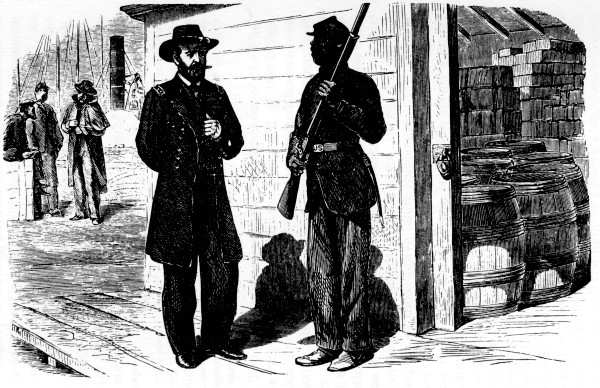
"YOU MUST THROW AWAY THAT CIGAR, SIR!" A Phalanx guard refusing to allow General U. S. Grant to pass by the commissary store-house till he had thrown away his cigar.
"The enemy were driven from their strong line of works, completely routed, the Fifth Corps doubling up their left flank in confusion, and the cavalry of General Merritt dashing on to the White Oak Road, capturing their artillery, turning it upon them, and riding into their broken ranks, so demoralized them that they made no serious stand after their line was carried, but took flight in disorder."
The writer well remembers the eagerness of the Phalanx brigade of Colonel Shaw, composed of the 109th, 116th and 7th Regiments, as they waited orders near Hatcher's Run. The sound of distant guns fell upon their ears; Colonel Shaw was impatient; all seemed to feel the end was near, and wanted to lend a hand in the consummation. Oh, what suspense! The brigade lay upon their arms in a state of great agitation, all that night, waiting for orders to advance upon the foe. Who can tell the thoughts of those brave black soldiers as thus they lay upon the rumbling earth. Fathers, mothers, sisters, wives and children, yet slaves, behind the enemy's guns: precious property they are, and guarded like dearest treasure and even life itself, by an army of slave-holders—Lee's men, who, with the desperation of demons, vainly attempted to check the advance of the men of the North, who, with their lives, defended the Union. The black brigade wanted to strike one more blow for freedom—for the freedom of their wives and children—to make one more charge, and the confederate banner should go down; one more charge, and the light of Liberty's stars should blazon over the ramparts of the confederate forts. At length, with the dawning of day, came the order; then the black brigade went forward, but to find the enemy gone and their works deserted.
The confederate lines were broken, and Sheridan's troopers, McKenzie and Merritt, with their cavalry, although it was night, had followed up the fleeing foe, capturing them by thousands. The brigade pushed on along the captured works. The federal batteries, from every mound and hill, were showering shot and shell into the enemy's inner works; while the gleaming bayonets of the thousands of infantry could be seen as far as the eye could reach, their proud banners kissing the stifling air, and the bugles sounding the "forward march," leaving in their rear smoking camps and blazing dwellings. What a Sunday morning was that, with its thunders of terrific war, instead of the mellow chimes of church bells and the repose of peace.
It was late in the afternoon, and huge, black clouds of smoke rolled up out of the city of Petersburg, and then a loud report, told that the confederates had evacuated it. Away to the left, the huzzas of Colonel Doubleday's Phalanx brigade (2nd) were heard. Now came a race to reach the city, between the 7th and 8th Phalanx regiments. No matter which was first, they were among the troops which took possession of the city, and gladdened the hearts of the negro population, as they marched through the streets singing their battle song:
"We will hang Jeff Davis on a sour apple-tree as we go marching on."
It was a glorious victory, bringing freedom to thousands of slaves, though it cost as many lives and millions of treasure. It was the beginning of the end. The confederates deserted their army by thousands. The South Side Railroad was in the hands of the federals, and starvation threatened the enemy. Lee, says a historian, was no longer himself: he rode wildly through his camps hither, and thither, trying to save his shattered and routed soldiers from annihilation.
The defeat at Five Forks settled the fate of the Army of North Virginia. Grant had almost the entire federal army actively engaged; he stopped the exchange of prisoners, invited President Lincoln, then at City Point, to come out and see the army advance, which he did. He met Grant in the city of Petersburg, amid the exultations of the troops and the joyous demonstrations of the negro population. General Lee made no stop at Richmond; he had informed Jefferson Davis that he must give up the city. The latter, with his aids and all the money he could collect,—not the confederate paper, but the gold of the United States,—stampeded.
General Weitzel, with Kautz's division of the 24th Corps and Thomas' and Ashborne's division of the 25th Corps, on the north side of the James river, lay quietly upon their arms during the fight on the south side. Grant kept Weitzel informed as to the results of the attack, and warned him to be on the alert and take every advantage offered, to press the confederates. General Longstreet's forces had been in Weitzel's front, but were partly withdrawn to defend Petersburg; therefore the latter kept unceasing vigil upon the fortifications before him.
Sunday evening the bands were ordered out to play, and it was late into the night when their melodious strains ceased to float through the air. It was a night long to be remembered, the hearts of the black soldiers of the 25th Corps, gladdened by the reports of the victories of the troops before Petersburg, were jubilant, and with vigilant watch each looked for morning. They were impatient for the light, and ere it dawned they were ready for the onset which they believed must come with it. The enemy whom they supposed were preparing to give them battle, was silently stealing away to the enchanting strains of the Federal musicians. It was near the morning hours when a sudden report startled the sleeping soldiers; an explosion, another, and yet another followed in rapid succession.
General Weitzel soon became satisfied that the enemy was moving, the continuous sound of distant cannonading away to the south, told that the combat still raged. From the signal tower bright lights were discernable at Richmond. The city appeared to be on fire; a confederate picket was captured, but he knew nothing; he had got astray from his comrades and command. A deserter came in with intelligence that the city was being evacuated, and half an hour later a negro drove into camp and gave information that the enemy was flying.
The ground in front was thickly set with torpedoes, and the troops dared not move. Day came and Colonel Draper's black brigade of the 25th Corps went forward. The road was lumbered with all manner and sort of military gear and munitions of war. Keeping clear of the red flags which marked the torpedoes, the troops pushed on; they soon reached the defences of the city to find them untenanted; the negro had told the truth and the Phalanx brigade entered the city welcomed by thousands of happy kinsfolks. Badeau says:
"The sun was an hour up, when suddenly there rose in the streets the cry of 'Yankees! Yankees!' and the mass of plunderers and rioters, cursing, screaming, trampling on each other, alarmed by an enemy not yet in sight, madly strove to extricate themselves and make an opening for the troops. Soon about forty men of the Fourth Massachusetts Cavalry rode into the crowd, and, trotting straight to the public square, planted their guidons on the Capitol. Lieutenant De Peyster, of Weitzel's staff, a New Yorker eighteen years of age, was the first to raise the national colors, and then, in the morning light of the 3d of April, the flag of the United States once more floated over Richmond.
"The command of Weitzel followed—a long blue line—with gun-barrels gleaming, and bands playing 'Hail Columbia' and 'John Brown's Soul Goes Marching On.' One regiment was black.[33] The magistrates formally surrendered the city to Weitzel at the Capitol, which stands on a hill in the centre of the town, and overlooks the whole country for miles. The national commander at once set about restoring order and extinguishing the flames. Guards were established, plundering was stopped, the negroes were organized into a fire corps, and by night the force of the conflagration was subdued, the rioting was at an end, and the conquered city was rescued by the efforts of its captors from the evils which its own authorities had allowed, and its own population had perpetrated."
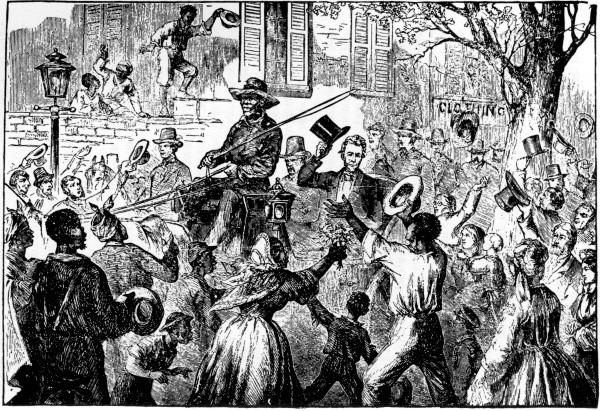
RECEIVING THE PRESIDENT. Abraham Lincoln riding through Richmond, April 4th, 1865, after the evacuation of the city by the Confederates.
Lee and his famishing host were fleeing towards Danville, hotly pursued by the Federal Army. Resting there until the 5th they resumed the march, fighting and running, until, at Appomattox they gave up and surrendered. Major Alexandria S. Johnson of the 116th Phalanx Regiment thus relates the story in part which the Phalanx brigade took in the memorable movement of the two armies to Appomattox. He says:
"As a participant in these events I will speak merely of what came under my own observation. The One Hundred and Sixteenth (colored) Infantry, in which I commanded a company, belonged to the Third Brigade, Second Division of the Twenty-fifth Army Corps, and during the winter of 1864-65 held the lines on Chapin's farm, the left resting on Fort Burnham. The division was commanded by Major-General Birney. The winter was passed in endeavoring to get the troops in as high a state of discipline as possible by constant drill and watchful training. When the spring opened we had the satisfaction of feeling that they were the equal, as soldiers, of most of the white troops. They were a contented body, being well fed and clothed, and they took delight in their various duties. The news of the capture of Savannah by Sherman and the defeat of Hood at Nashville had a cheering effect upon the whole command, and we looked forward with confidence that the end was drawing near.
"On the night of the 26th of March our division silently left the lines on Chapin's farm, and marching to the rear some three miles went into bivouac. On the night of the 27th we crossed the James on muffled pontoons, and after a weary march arrived at Hatcher's Run at daybreak of the 28th. Crossing the original lines of breastworks we built new breastworks some two hundred yards in advance and bivouacked in the pine woods awaiting events. Sheridan at this time was operating on the Confederate right flank. The news of his decisive victory at Five Forks and of the complete turning of the enemy's flank was the immediate cause of a verbal order, given to company commanders by our colonel on the afternoon of April 1st, to advance on the lines in our front at dawn on the following day. That night the Union artillery opened along the whole line. Hissing and bursting shells from Appomattox river to Hatcher's Run filled in a scene never to be forgotten by those who witnessed it. It was as if demons incarnate were holding a jubilee. As far as the eye could reach there was one blaze of fiery shot. The world has seldom seen its like. Where our brigade was to operate was a dense wilderness of pines with matted underbrush, but in the morning it looked as though a sirocco had kissed it.
"With the dawn of day the brigade was in line of battle. Not a breath of air was stirring. A misty vapor shed its gloom and hung like a pall among the tree-tops. The silk covers were taken from our flags, but their folds hung lazily along the staff when the command, 'Forward! guide centre! march!' was given. At first slashed timber and brush obstructed our way, but as the obstruction began to cease an obstacle in the shape of a long line of abattis met our gaze. The dusky line broke through the abattis, however, as if the stakes had been so many reeds, and charged over the breastworks and into the Confederate camp. The rush must have been a surprise, as the enemy offered little resistance. In front of one of the tents a Federal sergeant (white) lay dead, his right arm extended to the full length, and firmly clenched in his hand was a piece of fancy soap. A bullet had entered his forehead, the blood from the wound was trickling down his face, but the hue of health was still on his cheek. How he came to be there is to me a mystery, as that part of the line was forced by colored troops. Swinging by the right flank we kept our way along the Boydton road. A Confederate light battery in position alongside of a cottage, which stood in a hollow, shelled the column as it advanced, and so accurate had the gunners got the range that almost every shell did damage. A couple of shells burst together above my company. The flash blinded me for a few seconds. I heard a scream of pain and just then was ordered to lie down. Not twenty yards from me was a wounded soldier. His leg was shattered badly. He prayed and sang hymns alternately, but his voice gradually grew weaker until it ended in death. One of our batteries was brought into position, and engaging the Confederate battery, the latter was silenced, when the column again resumed the march, arriving in front of Petersburg about noon.
"It was the intention of General Birney to carry by assault the main fort which commanded the city, and he deployed the division in line of battle for that purpose, but General Ord, coming up in time, ordered him to retire his division out of range and await further orders. We went into bivouac for the night, and at early dawn of the 3d we entered the city, the Confederates having evacuated the forts during the night. The field music played "John Brown's Body," and a tiny Union flag in the hands of a girl of ten years waved us a welcome. Resting an hour in the city the division started in pursuit of the Confederates. For a mile or two outside of the city the road was strewn with plug tobacco. Blood could be seen also at intervals in patches along the road. We bivouacked some fifteen miles from the city. A few of our officers took supper in a house close to our camping ground. Our fare was "corn pone," scraps of bacon, sorghum molasses, and a solution of something called coffee, for which we each gave our host, a middle-aged Virginian, one dollar. The colored troops being encamped on his farm his indignation was stirred and he exclaimed, while the tears trickled down his cheeks, 'Poor old Virginia! poor old Virginia! that I should have lived to see this day!'
"At dawn of the 4th the column resumed the pursuit. It is needless for me to tell in detail how our cavalry destroyed and burned over five hundred Confederate wagons on the 5th and 6th, and how Ewell's command was defeated and captured at Sailor's creek on the 6th. Our brigade having arrived at Farmville on the afternoon of the 6th and encamped for the night, some of the citizens poured forth pitiful tales to our officers. They told how our cavalry had entered their houses and ripped open their feather beds, how the rude troopers had broken open bureaus and chests in search of valuables, and how they had carried away with them what they could find. Nothing of interest took place until the 8th, which was noted for the forced march made by the brigade, starting at daybreak and going into bivouac at twelve midnight. The morning of the 9th broke calm and serene. It was a lovely morning, the sun had not yet gotten above the horizon when the brigade was on the march again, but it went only a short distance when it was halted. To the right of the road, in a clearing, was a portion of the Twenty-fourth Corps, with arms stacked and the men cooking breakfast. Sides of bacon at intervals hung from their bayonets. Although the woods were full of our cavalry and three divisions of our infantry were in close proximity, all was as quiet as a Sabbath morning. One of our batteries, some six hundred yards to the right, broke the stillness by fitfully throwing a shell once in a while, but to a looker-on all seemed inaction. Such was the situation at Appomattox at sunrise on the morning of the 9th.
"Our brigade, after resting some thirty minutes, resumed the march. It soon filed to the right. In a few minutes the command was given—'Right shoulder, shift arms! double quick, march!' Onward we went, the objective point being the Lynchburg pike. Dismounted cavalry retreating from the front broke through the column, saying as they passed us, 'Give it to them, boys! they are too many for us!' In a few minutes the head of the column reached the pike, when it halted and faced to the front. The command—'Unsling knapsacks!'—was given, and then we knew we were stripping for a fight. Skirmishers were deployed on our front, and as we advanced the Confederate skirmishers retired before us. After advancing some eight hundred yards the brigade was ordered to halt and form in line of battle. It formed into column of companies. Some eight hundred yards away was the Army of Northern Virginia, with its three lines of battle awaiting us.
"We had not been at a halt more than twenty minutes when the news of Lee's surrender reached us. Our brigade celebrated the event by firing volleys of musketry in the air. Officers hugged each other with joy. About four hundred yards to the rear was a portion of the Twenty-fourth Corps, which had been marching to our support. The men in that long line threw their caps upwards until they looked like a flock of crows. From wood and dale came the sound of cheers from thousands of throats. Appomattox will never hear the like again. The brigade moved forward a short distance and went into camp some three hundred yards from the Confederate camp. In the afternoon I strolled over the ground we had traversed in the morning. I came across the body of a dead Confederate soldier, covered with a blanket. Some one had taken the shoes from his feet. Uncovering him I found that a shot had pierced his right breast. His white cotton shirt was matted with blood. A small bag was attached to the button-hole of his jacket. Undoing the bag I found it contained sixty ounces of corn meal. He was not over twenty-six years of age, and was of fair complexion. Who knows but he was the last soldier who fell belonging to the Army of Northern Virginia?"
It was Palm Sunday, celebrated by many of the followers of Christ as the day of his triumphal entrance into Jerusalem, a day of great rejoicing among Christians, known in our annual calendar as the 9th day of April, 1865. The morning broke clear and bright in the neighborhood of Appomattox Court House, and there was every evidence of spring. The birds chirped in the trees half clad with the early foliage, which trembled in the soft breeze. Along the roadside yet untrod by the hostile feet of man or steed, the tiny floweret buds had begun to open to the warmth of genial nature, and the larger roses, red and white, cast their fragrance to the lingering winds. Here the half clad, sore footed soldiers of the Army of Northern Virginia, were trembling with dread impatience for the onset,—the inevitable—which would decide their fate and their prospect of reaching the mountains just beyond. In front of them the federal cavalry awaited their coming.
It was yet grey in the morning when General Lee sent word to his Lieutenant Gordon to cut his "way through at all hazards." With the impetuosity of a cyclone, his shattered corps rushed upon the dismounted cavalry in their front, the Federal line quivered, and bent to the gale. On and on they came, pressing closer and closer upon the cavalry. The struggle was becoming desperate, it was the last hope of the confederates they must go through the lines, or perish in the attempt. Again the confederate yell rose above the din of the battle's roar, and soon the cavalry fell back. Where was their leader Sheridan? He came, galloping at break-neck speed, his men cheering him as he rode to the front. He had been to the rear some five miles away. He saw at a glance the daring object of the foe, and ordered his men to fall back slowly. The confederates followed up the wavering line with brightened hopes, but hopes that were to be dissipated; soon the bristling bayonets, and glistening musket barrels of the Army of the James gleamed in their front; then the pressure ceased, and Sheridan's bugle sounded the order to mount, and his troopers dashed themselves against the enemy's left flank. Then, one bearing a white flag—a flag of truce, rode to the front of the confederate lines. Capt. J. D. Cook of General Mile's staff went forward to meet him. It was Colonel Taylor of General Lee's staff; he bore a note from Lee, asking a suspension of hostilities, and an interview with General Grant. Now let us go back to the night of the 6th, and trace the flying columns to this point. Badeau says:
"That night once more the rebels evacuated their works, this time in front of Meade, and when morning dawned were far on their way, as they fondly thought, to Lynchburg, and Lee defiantly informed his pursuer that the emergency for the surrender had not yet arrived. But he reckoned without his host. He was stretching, with the terrific haste that precedes despair, to Appomattox for supplies. He need hardly have hastened to that spot, destined to be so fatal to himself and his cause. Grant's legions were making more haste than he. The marvelous marching, not only of Sheridan, but of the men of the Fifth and Twenty-Fourth Corps, was doing as much as a battle to bring the rebellion to a close. Twenty-eight, thirty-two, thirty-five miles a day in succession these infantry soldiers marched, all day and all night. From daylight until daylight again, after more than a week of labor and fatigue almost unexampled, they pushed on to intercept their ancient adversary, while the remainder of the Army of the Potomac was at his heels.
"Finally Lee, still defiant, and refusing to treat with any view of surrender, came up to his goal, but found the national cavalry had reached the point before him, and that the supplies were gone. Still he determined to push his way through, and with no suspicion that men on foot could have marched from Rice's Station to his front in thirty hours, he made his last charge, and discovered a force of infantry greater than his own before him, besides cavalry, while two corps of the Army of the Potomac were close in his rear. He had run straight into the national lines. He was enclosed, walled in, on every side, with imminent instant destruction impending over him. He instantly offered to submit to Grant, and in the agony of alarm, lest the blow should fall, he applied to Meade and Sheridan also for a cessation of hostilities. Thus in three directions at once he was appealing to be allowed to yield. At the same moment he had messengers out to Sheridan, Meade, and Grant. The emergency, whose existence he had denied, had arrived. He was out-marched, out-fought, out-witted, out-generaled—defeated in every possible way. He and his army, every man, numbering 27,516, surrendered. He and his army, every man, was fed by the conqueror."
From the date of Lee's surrender, the confederates, from Virginia to the Mississippi, began to lay down their arms. Howell Cobb surrendered at Macon, Ga., on the 21st; Johnston surrendered to General Sherman on the 26th, in North Carolina; Dick Taylor, east of the Mississippi, on the 4th of May, and on the 26th Kirby Smith surrendered his forces west of the Mississippi. Jeff. Davis had been captured, disguised as a woman, and thus the cause, which originated in treason, based on the enslavement of a race, and which derived its only chance of success from men who were false to their oaths, collapsed. The mightiest blow given the confederacy was struck by the immortal Proclamation of Emancipation, giving freedom to four millions of slaves; more than two hundred thousand of whom, with dash and gallantry excelled by no other race, tore down the traitor's banner from their deemed impregnable breastworks and planted in its stead the national flag. That emblem, whose crimson folds, re-baptised in the blood of liberty's martyrs, invited all men, of all races, who would be free, to gather beneath the effulgent glare of its heaven-lighted stars, regardless of color, creed or condition. The Phalanx nobly bore their part all through the long night of war, and at last they occupied Charleston,—the traitors' nest,—Petersburg,—their eastern Gibraltar,—and Richmond—their Capitol. They marched proudly through the streets of these once impregnable fortresses, in all of which many of the soldiers of the Phalanx had been slaves. Oh! what a realization of the power of right over might. What a picture for the historian's immortal pen to paint of the freemen of America, whose sufferings were long, whose struggle was gigantic, and whose achievement was a glorious personal and political freedom!
At the close of the war, the government, anticipating trouble in Texas, ordered General Steele to the command of the Rio Grande, under these instructions:
"Washington, May 21st, 1865. "Maj. Gen. F. Steele, Commanding Rio Grande Expedition.
"By assignment of the President, Gen. Sheridan takes general command west of the Arkansas. It is the intention to prosecute a vigorous campaign in that country, until the whole of Texas is re-occupied by people acknowledging allegiance to the Government of the United States. Sheridan will probably act offensively from the Red river. But it is highly important that we should have a strong foothold upon the Rio Grande. You have been selected to take that part of the command. In addition to the force you take from Mobile Bay, you will have the 25th Corps and the few troops already in Southern Texas.
"Any directions you may receive from Gen. Sheridan, you will obey. But in the absence of instructions from him you will proceed without delay to the mouth of the Rio Grande and occupy as high up that river as your force and means of supplying will admit of.
"Your landing will probably have to be made at Brazos, but you will learn more fully upon that matter on your arrival. We will have to observe a strict neutrality towards Mexico, in the French and English sense of the word. Your own good sense and knowledge of international law, and experience of policy pursued towards us in this war teaches you what will be proper.
"Signed, U. S. GRANT, Lieutenant-General. "Official: Signed, Geo. K. Leet, A. A. G."
In the meantime General Grant sent the following dispatches to Generals Halleck and Weitzel:
"Washington, May 18th, 1865, 12.40 p. m., "Major-General H. W. Halleck, Richmond Va.
"Please direct Major-General Weitzel commanding 25th Army Corps to get his corps in readiness for embarkation at City Point immediately upon the arrival of ocean transportation. He will take with him forty (40) days rations for twenty thousand men, one-half of his land transportation and one-fourth of his mules with the requisite amount of forage for his animals. All surplus transportation and other public property he may have he will turn over to the depots at City Point.
"By command of Lieutenant-General Grant.
"Signed, JOHN A. RAWLINS, "Brigadier-General and Chief of Staff. "Official. Signed, George K. Leet, A. A. G."
* * * *
"Washington, May 21st, 1865. "Major-General G. Weitzel, Commanding 25th A. C.
"As soon as your corps is embarked you will proceed with it to Mobile Bay, Ala., and report to Major-General Steele for further orders.
"In addition to rations, ammunition, and other articles which you have received directions to take with you, you should take a fair quantity of intrenching tools.
"Signed, U. S. GRANT, Lieutenant-General. "Official, Signed, George K. Leet, A. A. G."
On the 24th of May the 25th Corps began embarking for Texas by way of Mobile Bay. The troops, however, occupied Texas but a short time, the confederate forces there surrendering upon the same terms as those of General Lee. All fears having been dissipated, the troops were slowly mustered out of the United States service. The men returned to their wonted fields of labor to provide for their long-neglected families, upon a new career of peace and happiness, rising, Phœnix like, from the ashes of slavery to join the Phalanx of industry in upbuilding the greatness of their country, which they had aided in saving from desolation and ruin.
Such is the history of the negro in the wars of the United States. Coming to its shores in the condition of slavery, it required more than two centuries for the entire race to reach the estate of freedom. But the imperishable records of their deeds show that however humble and despised they have been in all political and social relations they have never been wanting in patriotism at periods of public peril. Their devotion has been not only unappreciated, but it has failed to receive a fitting commemoration in pages of national history. It has been the purpose of the writer of this volume to relate herein the patriotic career of the negro race in this country in an authentic and connected form. In the time to come the race will take care of itself. Slavery is ended, and now they are striking off link by link the chains of ignorance which the servitude of some and the humility of all imposed upon them. If the past is the story of an oppressed race, the future will reveal that of one uprisen to great opportunities, which they will improve from generation to generation, and guard with the same vigilance that they will the liberties and boundaries of the land.