An Angel of Tenderfoot Hill.
Reading edition
BY FREDERICK BRADFORD.

Evening service at the Blackhawk Presbyterian Church was just finished. As the unpainted door swung open before the little body of home-bound worshipers, a broad-shouldered, blue-eyed young man, who for the last half hour had been patrolling the plank walk outside, strode up to the doorway. Standing there with his back against the sash, his eyes gleaming good-humoredly under the stares and winks of certain unregenerate members of the congregation, Jim Hewson recalled a little grimly that the door of a church was the last place where he would have whiled away his Sunday half hours a year ago. But, then, a year ago he had not known Alice Huyler. Now it seemed to him that he had never known any one else.
Alice was the organist, and would be the last to come out. Meantime, Jim, listening dreamily to the notes of the voluntary, found his mind drifting idly back over the past two years of his life. He remembered how he had come to Blackhawk as the agent for the B. & S. Stage Company, without a string or tie of any kind to bind him to place or person. He was not a bad boy then, he thought, though he had lived in some pretty hard sections, and maybe was a bit too familiar with their customs. It seemed to him that he had started wrong, somehow,—had not met the right sort of people at first. The overland stage boys were all right,—good, big-hearted fellows,—but hardly the friends for a young man who might some day aspire to mingle with the best society of Blackhawk—for they had a best society there, even if it was only a mining camp. Their Four Hundred was composed chiefly of member’s of the Presbyterian church, and actually numbered about twoscore.
It did not take long for “pretty Jim,” as the boys affectionately called him, to distinguish himself as a gentleman able to put away his share of forty rod “mountain dew” and lead reckless expeditions in search of a good time. Before he had been there two weeks he broke up a dance at old Prouty’s hall by deliberately shooting out the candles and decorating the ceiling with bullet holes, “just to stampede the outfit,” he said. If this was his only object it was a dismal failure so far as the “ladies” were concerned; they simply refused to be stampeded, but sat down in the middle of the floor and screamed; the “gents,” however, made it a great success by climbing over each other’s heads in frantic endeavor to be among the first to get out of the narrow door. This brilliant stroke of genius gave Jim such prestige among the boys that they unanimously elected him foreman of the “Mulligan Guards Hose Company No. 1,” an organization that served as a social club for the young men of the camp. Their “business meetings” always ended in a free-for-all-high-old-time, and when they went out for a practise run at their usual hour,—10 P.M.,—the knowing citizens, by common consent, went home to bed.
It was after one of these little runs somebody suggested that the Presbyterians were having a “mush and milk debauch or strawberry hurrah,”—he didn’t know which—over on Main Street, and he thought the boys might be able “to enliven the proceedings a little” by “lending their distinguished presence.” This suggestion was unfortunate, in view of the fact that Henrich Schwer, the People’s Candidate for mayor and the Poor Man’s Friend, had sent over to the hose house a keg of beer and demijohn of whiskey as a “slight testimonial of his esteem,” but the idea was promptly acted upon, and the boys all marched over to the church to the tune of “The Mulligan Guards,” a ditty much in vogue in those days. What they did there Jim could not now remember distinctly; he had a dim recollection of helping to buy out a doll-baby bazaar presided over by several pretty but embarrassed young ladies, and of somebody in his crowd having a “difficulty” with Deacon Huyler, during which the others formed a ring and sold pools on the fight. Anyway, he was very much ashamed of the whole business, and testified to this the next night by asking Stancliff, the Sunday-school superintendent,—a good young man whom he had often, and, he was now convinced, unjustly, characterized as a weak sister,—to take him around for the second night of the bazaar. Stancliff was glad to do so, and Jim, in the main, enjoyed his somewhat novel associations. The good sisters of the church, ever ready to snatch a brand from the burning, took him up and introduced him to all the pretty girls, incidentally relieving him of half a month’s salary for votes in all sorts of impossible things. No, they did not introduce him to quite all the pretty girls; there was one, a tall, slight girl in a dark dress, with pale golden hair, brushed primly from her forehead, escaping down her back in a single plait, child fashion, to whom, for some occult reason, he was not presented. Moreover, though he took pains to keep as much as possible in the neighborhood of this particular young lady, she seemed to be perfectly oblivious to his six feet two and bright blue eyes. Piqued by her obvious indifference, he finally asked Stancliff for an introduction, and was gratified to see that worthy gentleman engaged a few moments later in earnest conversation with this fair-haired member of the Blackhawk Four Hundred. But when Stancliff finally came back he appeared to have forgotten Jim’s request altogether, and seemed embarrassed and annoyed about something. Jim divined what that something was, and felt the blood rush to his neck in anger. He had been snubbed, deliberately snubbed, and there was only one thing to do, in the ethics of Blackhawk, and that was to “get square.”
There was a dangerous glitter in his eyes as he silently watched Stancliff, who was trying to make a feeble joke about nothing in particular.
“See here, Stan,” he finally said, “there’s no use of your getting red in the face and clawin’ away from it. I know what’s the matter with you; yer frien’ don’t want no introduction to me, won’t have it nohow; that’s right, aint it?”
“Well, you know, last night—she was here—and the boys—of course you had no hand in it, but you see girls—church girls—are particular, and—
“Oh, yes, I know about that; it’s all right fer as you’re concerned, Stan; you are a bully little feller—treated me white down to the ground, and I aint got nothin’ agin you. You have an onpleasant duty to perform, an’ it comes hard, but I’ll help you out. We were—well—drowsy last night—drowsier’n duchesses—the whole billin’ of us, and some—mind I don’t say who—some of us made fools of ourselves and licked her dad, an’ she holds it agin me; thinks she’s too good to ’sociate with fellers what has got a little hell in ther’ necks. But, Stan, don’t you let it escape yer two-by-four mem’ry; she will know me better before the night’s over, and its a stack of blues to whites I take her home when this Sunday-school gymnasium lets out, see?”
To the last statement Mr. Stancliff could not subscribe. He admired Jim, as most young men who are admittedly good admire those admittedly bad, and envied him his supreme self-confidence, but, to tell the truth, he expected to be Alice Huyler’s escort that night himself.
Not long after, supper was announced in an adjoining room, and the young people passed out in couples. This was Jim’s opportunity; he purchased two tickets, and, without hesitation, he stepped up to Alice Huyler before Stancliff’s astonished eyes, and said: “Miss Huyler, I know you, and you think you know me well enough not to want to know me any better; that’s so, aint it? Well, you’re making a dead mistake. Now, I’ve two tickets for supper, an’ I don’t want to sit alongside of an empty chair. Will you break bread with a publican and sinner to-night?”
She did not answer at once, but looked about vaguely, as if seeking some avenue of escape. “That’s right; think it over,” Jim went on. “I disremember the circumstances an’ I don’t know whether he belonged to your church or not, but there was a man down in Galilee a few thousand years ago that went around hunting up the kind of fellers what was here last night. I give you my word, Miss Huyler, that if you go in to supper with me it will not stand as an introduction to-morrow unless you wish. I came here because I wanted to do the right thing, and I want you to help me;” then, after a pause, he added significantly, “The hose house is still open.”
Before Alice had time to shape an excuse, Jim had her hand safely on his arm and was in the supper room. What he said to the girl there Stancliff never knew, but that he talked to some purpose was evident from the fact that he walked home with her that night.
This was the beginning of their acquaintance, but, as Jim acknowledged to himself, “he hadn’t no walk over.” Alice Huyler was a girl of Puritan ideals of life, an earnest, consistent church member, with very distinct, if somewhat bigoted, views of right and wrong. Jim did not come up to her standard; she did not approve of him at all, but felt it her Christian duty to do what she could to save his soul, and, with a mental reservation against committing herself in any way, passively permitted his attentions, as their acquaintance progressed. She could not help admiring the big, handsome fellow with his strong, masterful ways; but this weakness she justified to herself by reason of the real good that was in him. Once she let her heart go out to him unreservedly upon learning that he had soundly thrashed two cowboys for insulting a poor little German woman who lived down on the school lands and earned a precarious livelihood by taking in washing; but she repented, and vainly tried to tear the new-born love from her heart when she heard that he, with a dozen other “Guards,” had been arrested and fined for disturbing a prohibition “mass meeting” to the extent of forcing the candidate to announce from a burning dry-goods box that he was the Lone Star candidate for “reform and free whisky.” But Jim squared himself by promptly and vigorously denying the charge; he even went so far as to have his friend, the editor of The Daily Tomahawk, print a full account of the affair, in which it was credited to some Southsiders who had pleaded guilty and paid fines under the names of U. S. Grant, Henry Ward Beecher, Dr. Mary Walker, and others.
But, however much Alice cared for Jim, she gave him no sign. To her Puritan notions she joined a certain wisdom in the world’s ways, and, like most Western maidens, was not to be lightly won; so, though Jim had been her devoted slave for a year—first from pique and a desire to get “square,” and later from a real fondness for the girl,—he had made uncertain progress with his suit. Finally, moved partly by a young man’s desire for worldly advancement, but chiefly by a dogged resolution to break the bond that he could not untie, he had accepted a clerkship with a rich merchant, who monopolized the business for miles around a little border town in Western Arizona. To-night he waited to see Alice for the last time before he went—perhaps for the last time in his life.
She came out of church presently, and smiled up into his face as she laid her hand lightly upon his arm with an air of proprietorship. They walked along in silence, hardly noticing the path which led them through a kind of lovers’ byway over Tenderfoot Hill. At the summit they sat down and looked over the camp, peaceful in the moonlight that veiled its shortcomings.
“It seems good to be here, doesn’t it? just you and me,” Jim said, drawing a long breath of contentment. “I feel away above the boys up here with you.”
“I wish you could get above some of their ways, wherever you are; but that’s too much to hope for, I suppose,” the girl replied, not too graciously; for Jim’s manner that evening was portentous, and she was not sure enough of her own feelings to want to hear what he might have to say. But Jim, who had hitherto shown fight when his associates were aspersed, now only replied wearily:—
“I know you are not fond of the gang I travel with, but their ways are mine for the time being, an’ I’ve no call to be above them; you’re hard on us, just the same.” Then, after a pause, he added bitterly: “It seems to me you are always just a little flintier after a sermon. I don’t seem to belong to the kind of crowd you people want to save; it’s only the good ones you’re after, I guess.”
“Don’t think that,” she cried earnestly; “you wrong the church and you are unjust to me. For my part, I would do anything in the world to make any one better or bring a soul nearer to God. O Jim, there is so much that is good and noble in you, why won’t you give yourself a chance? If I could only make you understand that you are the one I want to save.” Unconsciously, she took his hand and clung to it in the fervor of her appeal. That much Jim understood, and he promptly imprisoned her hand in both of his, saying, “I don’t know about your saving me—I guess you had better let that job out; but you can make me better, little one; you can make me better with a word, and bring me so near heaven that my head will bump the stars. It’s taking a mean advantage of you to tell you now; and, honestly, I didn’t mean to do it, but I love you, Alice, I love you. I was going away to-morrow without saying a word, ’cause I knowed I was a dead loser, anyway, and I aint the kind to squeal; but just now it seemed to me that sometime when you kinder got to thinking of the past you would miss something, and then you’d be glad to know that Jim loves you, and that he’s keeping you in his heart. You don’t care for it now—that’s all right; but know it—know it good—it’s not hard to say; I love you—yes, I love you better than—I do the gang,” he ended lamely; but quickly, fired by the purpose of a great sacrifice for that love, he added, in a tone that carried conviction, “and I’ll shake ’em to-morrow if you say the word.”
For a moment Alice was stunned by the suddenness of her return to earth; but she saw nothing incongruous in her appeal and his reply; she could only think that he loved her and that he was going away. For a few moments she sat without speaking, her face gleaming softly in the moonlight, her slim fingers lying passive in the strong hand that touched hers so reverently. Then she answered simply: “Now that you have said it, Jim, I am not sorry, though I would have prevented it if I could. I can’t help being glad to know that you love me—the knowledge is sweet to me; it would be to any woman, I think; but, O Jim, I don’t know all of my own heart; I can only say that you are very, very dear to me.”
“No, no,” she cried, as he sought to draw her to him, “not that, Jim, not now; I want to be honest with you—with myself. You are dear to me, Jim, it’s true, but I have no confidence in you—I can’t trust you; I am sorry, but I can’t. That sounds hard, I know, and it’s a poor return to make for the love you offer; but what can I say? If you could prove to me that you care more for me than anything else it would come all right, I know, and I’d wait for you, Jim, I’d wait years. I can’t say more than that.”
“Alice,” the man said slowly, “I don’t want you to say more than that. I know what waiting means, an’ its only a grain of hope; but that’s tons and tons more than I deserve. I told you that I was going away to-morrow, and I am; but don’t feel that you drove me out of the camp; whatever happens, you ain’t got nothing to answer for. The fact is, it’s getting too teetotally civilized up here for me, anyway; this thing of building in railroads and developing the country afterwards is ruining this section for a young man. I’ve got a lay-out down in Arizona, and I am going to play it. You think I can’t keep straight? Well, I think I can, if it will pay dividends; and if you say, ‘Jim, come back to me in two years, good and pious like,’ I’ll do it, Alice; I’ll do it if it breaks me.”
“Perhaps I oughtn’t to say it,” the girl answered gently; “but it’s our only chance. In two years, if you want to come back and say again what you have said to-night, I’ll listen.”
When Jim went home that night he astonished Ed Saulsbury, his room-mate, by making him a present of his silver whisky flask and writing out his resignation as foreman of Hose Company No. 1.
Jim’s resignation was received by the boys with sincere regret, and a committee was appointed, which prevailed upon him to defer his departure a day, in order that they might send him away with proper honors. The next morning the following invitation, printed upon glazed cardboard in gold lettering, was issued:—
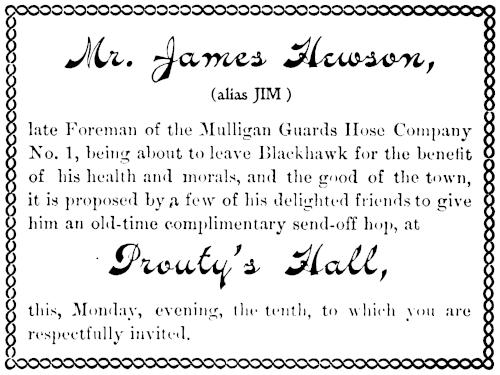
Mr. James Hewson,
(alias JIM)
late Foreman of the Mulligan Guards Hose Company No. 1, being about to leave Blackhawk for the benefit of his health and morals, and the good of the town, it is proposed by a few of his delighted friends to give him an old-time complimentary send-off hop, at
Prouty’s Hall,
this, Monday, evening, the tenth, to which you are respectfully invited.
The dance was a great success, despite the fact that Jack Gillis got more on board than was good for him, and insisted upon setting fire to the hall, just to give Jim a chance to make a last run with the Hose Company.
In the barren little Arizona town of San Biciente a man struggled, and toiled, and dreamed away the two dreary years of his probation. True, many of the asperities of the rough life were smoothed away by the daily increasing favor shown by Don Jose Macias, the rich merchant with whom he lived and worked, and by the assiduous caretaking of Don Jose’s pretty black-eyed daughter, Josfita. Moreover, the better class natives, attracted by his aptitude in acquiring the Spanish tongue and by the boyish bonhomie that had made Jim the joy and pride of the “Blackhawk Mulligan Guards Hose Company,” showed themselves more than ready to initiate him into certain Mexican methods of killing any time not occupied by his business. But, though chuses, monte, cock-fights, and bayles were seductive sports to a young man of Jim’s temperament, his promise to Alice was far more potent. Occasionally, to be sure, he so far fell from grace as to try his luck at the cards or to sun himself a little too long in Josfita’s admiring glances. Jim did not attain his full growth as a man at one bound. But the memory of that face as he had seen it, shining with tenderness for him, and of that voice, bidding him prove himself worthy of her trust, was never long absent from his mind. Alice had said that she would wait for him. That assurance was the pillar of cloud by day and fire by night that guided this wanderer through the desert of distasteful toil and sordid living to the promised land of life with the woman he worshiped. And so the years dragged by.
That promised land seemed very real and near to Jim one spring morning, two years after his arrival, when he boarded the stage that was to carry him toward Blackhawk. Indeed, it was only an hour before that Jim, sitting in the little room behind the shop with his patron, had rejected an estate of earthly acres for this immaterial Canaan.
“You go back to your own country, that’s all right,” the little man had said unctuously, pressing upon his former clerk a glass of the rare wine reserved ordinarily for weddings and fête days. “You find it much changed. Poco tempo you come back. I like your work. You be my partner. You lack Josfita? All right. She have two hundred thousand dollars. You marry her, my bien good amigo.”
But if Jim’s eyes had glistened and Jim’s breath had come short upon his realization of the Don’s generosity, that was simply through joy that he had seen what stood to him for all the kingdoms of the earth unrolled before him, and had renounced them for the woman who waited for him in the North.
Before he went he had assured the Don both of his undying gratitude and of his sorrow that he could not accept his offer, in a manner so delicate that that worthy Mexican realized the full import of the young man’s words only after Jim, seated in the rickety stage-coach, had put at least five miles between himself and San Biciente.
Thirty-six hours later, when the evening train thundered into the big, new brownstone railroad station at Blackhawk, the passengers watched a little curiously the big man in the garb of a cow-puncher, who alighted from the car and stood for a moment on the platform with the set stare and stiff movements of one in a trance. In those two years of banishment, hundreds of miles from railroads and newspapers, Jim’s life had been untouched by the farthest wave of the widening sea of change. At the end of two years San Biciente and the country about it were exactly as he had first found them. On the day that he boarded the stage-coach at San Biciente he himself was the same Jim, a little bigger and stronger, perhaps, and, but for the picturesque long hair, more handsome. His blue eyes shone complacently beneath his wide sombrero, and his broad shoulders, under the rolling shirt collar and bright neck-handkerchief, swung with a certain air of harmless satisfaction. In fact, it was not until he had found himself seated in the railroad car that whirled him over the last stage of his journey, and caught the curious glances bent upon him by the conventionally garbed wearers of patent leather shoes and stiff derby hats, that it occurred to Jim that he was not of the world about him. Then, as the train bore him farther and farther, through rows of newly erected houses, and past enormous factories, which seemed to have sprung like magic among the familiar hills and valleys, the sparkle faded from his eyes, and his big shoulders drooped forward. Even the gold band on his sombrero, that had cost him a good twenty-five dollars at San Biciente, seemed to have lost its glitter.
As he hurried up Blackhawk’s main thoroughfare, lined now with imposing shops and warehouses, he felt that in some inexplicable way everything had grown away from and above him. Upon the very spot where the old engine house had stood a brownstone club house projected its imposing front upon the street. A brick hotel, glittering with electric lights, reared its five stories in the place of the yellow-painted corner store, whose upstairs dance hall had been the scene of the “stampede.”
And the church,—the little unpainted church where he had met Alice, and at whose door he had waited for her on that memorable evening two years ago? Even on the threshold of this long-expected meeting Jim felt drawn by an irresistible impulse towards the spot around which clustered so many sacred memories. But as he drew near to the familiar meeting of ways where the old church had stood the man stopped short and drew his hand across his eyes as if to brush away a mist. The little church was gone, wiped out of existence like a picture from a slate! Nothing but a marble tablet, placed over the arched doorway of a pretentious granite edifice, assured him that this was still the site of the First Presbyterian Church of Blackhawk. At the sight of that last transformation Jim’s heart sank. In all that delirium of progress could Alice alone have remained unchanged? The doubt descended like a black cloud, blotting out all his happy visions of an hour ago. As he stood irresolute, looking up and down the street, the deep notes of an organ floated out through the open door of the church. To Jim, standing outside in the darkness, the solemn music seemed to promise the strengthening of his purpose and the solution of all his doubts and anxieties. Yielding once more to that undefined but irresistible impulse that had brought him hither, he stole through the doorway and into the church. Service had already begun when Jim, entering on tiptoe, seated himself in a pew near the door, reverently removing his sombrero, which he placed on the floor next the aisle. Around him there were flowers, and bright lights, and all the modern church’s appeals to the unregenerate, but Jim noted with a sinking heart that among this fashionably garbed congregation there was not a single familiar face or figure. Again that sickening doubt descended on the man, bowing his head with a weight like that of a physical burden, and for the time blotting out church, and lights, and flowers. Even when the service was finished and the congregation was dispersing to the sound of the organ’s voluntary Jim waited, his head bowed, his eyes fixed like those of a man in a trance—waited until the sound of a man’s voice, that seemed to speak to him across the gulf of two years, sounded in his ears. It was Stancliff, the Sunday-school superintendent of other days, coming down the aisle, talking eagerly to a young woman, whose face, looking up into his own, was hidden, but who, by token of her dress and bearing, belonged to that invading throng whom Jim had already come to hate. As they passed the pew where Jim still sat, the folds of the woman’s dress brushed against his sombrero, and for a moment she looked around. In that moment Jim saw her face. It was the face of Alice Huyler, but so changed under its modish capote, set jauntily on the waving yellow hair, so ripened in its expression and molding, above all, so radiant with emotions and interests that Jim had never touched that it seemed more alien than that of any stranger in the congregation. As he sat there waiting for the couple to pass by him and out of the church, Jim did not attempt to define the relations between Stancliff and Alice. He did not ask to know whether Stancliff was husband, lover, or friend to this woman,—the woman that he had loved and who had promised to wait for him. What he did know was that the years had opened between himself and Alice a yawning chasm, a chasm that no memories nor promises, however sacred, could ever bridge.
Rapt in such thoughts, he sat, half dazed, until the congregation had dispersed and the sexton appeared to put out the lights. Then, rousing, he fumbled for his sombrero, which had been swept under a neighboring pew, recovered it, and, rising, passed slowly, with bowed head, out into the night.