THE BLACK BOX (continued 3)
Reading edition
From close at hand there came the heavy tramp of those who went to join the "Cause", while from the street beyond the cries of "Liberty and pure religion!" rose and fell unceasingly.
With curling lip I listened for a space to what, for me, was now a bitter mockery, by reason of one Ferguson the Plotter; then with tight-clenched teeth I strode across the room, bent on I scarce know what, though if ever man had thought of murder in his heart that had I just then. But ere I reached the door there came the rustle of a dress, and Miriam, the landlord's daughter, stood before me.
It may have been the altered look upon my face, or simply great surprise at seeing me, which was the cause of it, I know not; but with a little cry she clasped her hands and started back, while I stood dumb as Lucifer before an angel.
I tried to murmur something, but I could not; nor was there any need; for now she came to me, took both my hands in hers, and looking up with big sad eyes, said softly:
"Oh, Michael, I am very, very sorry for thee."
Her sweet voice trembled, and her pretty head was bowed.
Those were the gentlest, truest words that I had heard throughout that awful day, and so there is no shame in saying that I could not answer her. Instead I drew her close, and for a moment there was silence in that little room. The setting sun shone in upon us; and, for a time at least, I knew what power a woman has to save man from himself.
This is no tale of love, nor, if it were, would this be any place in which to prate of it; but yet I should be something of a thankless coward were I not to state that Miriam Hope was very dear to me. We had been friends from childhood, and looking backward through the long, long years I know how much I owe to her. And speaking of that night, she saved me from I know not what mad act.
"And how came you here?" she asked, when we had talked a while of other things.
"By the side door yonder," I replied.
"Ah, verily," sighed she, "the front is crowded like a fair. The fearful din hath made my head ache sorely. How, think you, Michael, will this sorry business end?"
"I fear in hanging for the most part, Miriam," was my answer.
"Ah, that is what my father says. 'Tis terrible to think of."
"And so the Duke is in the Great Room yonder?"
"Yes, and a very gracious, kindly gentleman he seems. His smile is very sweet. Aye, 'tis a thousand pities that he ever landed on so wild a business."
"Yes, ten thousand pities," I agreed, though not because I thought of Monmouth's peril.
"My father says he cannot win."
"No; there is little chance of that, methinks."
"And what if he be beaten, Michael?"
"Why, then 'twill be a case of hunt and hunted. But say, Miriam, are many of the gentry coming in to join him?"
"Nay, very few, if any. They are nearly all rough country men, more used to scythes than swords. I pity them, for verily they look like stupid boys let loose from school."
"Yes, yes," I murmured, for my mind was set on other things just then. "Is Ferguson the chaplain with the Duke?"
"Yes; but him I like not," answered Miriam with a little frown. "He may be great and clever as they say, but I go by faces, Michael, and never saw I such an ugly, evil one as his. His little eyes glint out beneath his old torn wig like those of rats, and when he walks he shuffles like a camel. Why the Duke makes so much of him, and trusts him so, 'tis past me to imagine, for verily I would not trust him with my shoes."
"Ah, then he must be bad," said I; then fearing lest my face might tell a tale, I added quickly: "Now for the Great Room, Miriam; I would go there."
She started back from me, glanced fearfully about her, then with a searching look said:
"You would not join these rebels, surely, Michael?"
"Nay, I would only see the fun," I answered carelessly.
"But even that might well be dangerous," said she. "Remember there be wicked, desperate men abroad just now."
I could have told her so much, but I only laughed and said:
"Nay, have no fear, sweet girl, for, look you, I am fully armed and care for no man. But, say, how shall I get into the room through such a press?"
"Why, if you must really go," said she, "I will take you through the antechamber, and that will bring you well into the room, not far from where the Duke is sitting."
"Most excellent!" quoth I. "I pray you lead the way at once, dear Miriam."
She turned as if to go, then stopped and gazed upon me in a sad, reproachful fashion.
"Michael," she murmured, "how can you talk of seeing fun when your poor father is thus lying----"
"Stop! stop!" I broke in swiftly. "We will not speak of that, dear girl. You do not understand. It may be that I seek to drown my thoughts. Lead on, I pray you."
And so I followed Miriam, and was ushered in.
CHAPTER XIII
In the Great Room--and Afterwards
The room was packed; and never saw I such a piteous sight as was presented by that crowd of gaping, moon-struck faces, which, as it seemed to me, stared forth like poor penned cattle into certain doom. On each was writ in fatal characters the one word--Death! Yet all were mighty eager to be signing on; in truth, by the pressing and the jostling it might have been the statutes at a fair.
On a little platform at one end of the room, and not far from where I was standing, sat Monmouth with his officers--Lord Grey, Fletcher of Saltoun, Old Dare (as he was called), the Taunton goldsmith, and others whom I knew not. The Duke, all smiles and bows, watched everything with eager, anxious eyes, and even spoke a word or two when one big strapping fellow, towering high above the rest of them, stepped up to volunteer.
But for me there was small interest either in Monmouth or those who flocked to serve him. My eyes were fixed upon a wry-wigged gentleman who sat before a little table taking down the names. Yes, there, in all his blotch-faced ugliness--a hulking, bony, ill-dressed heap of perfidy--sat Robert Ferguson, the Plotter. His pen was whirling like a windmill; he seemed to catch a name up with the feather of his quill and run it down on paper wellnigh as soon as it was spoken; and all the time he never ceased to jerk forth jests and mock encouragement to those who, in their ignorance, were little more than clay within his hands. Thus, as I entered, he was saying:
"Come on, my friends, come on! Ah, what amazing, lovely zeal is this which moves your hearts! Fear not, the Lord of Hosts is with us, as the Scripture hath it, and verily we must prevail. The next--the next! ... Now, by my life, if such a fine upstanding man as thou shouldst not be captain in a month or so! Yes ... yes ... or more, perchance. Come on! the next! Oh, who shall stand against such zeal as this upon the day of battle? Ah, who, indeed? Not those, I trow, whose hands are stained with blood! Not those who have forsworn the Lord of Hosts and set up their abominations in high places. Not those, I say, not those! The next, the next! Come on, I pray you, speedily, or we shall hear the cock crow ere we've finished. What's that you say, friend? Yes, yes, I have you down quite clearly to the very letter: Uriah Smite--and may you smite full lustily! That is a merry jest, but something to the point, I vow. Back, friend, I pray you, and make room for him who stands behind.... Ah, what's that? You fought with Cromwell, say you? Truly, a handsome warrant for your zeal; and may you fight as well for us. Grey hairs, when mixed with zeal and wisdom, count for much. And as for that sword-cut on your face, well, what adornment could outvie it in true loveliness? ...
"Next, next! Remember that there is something for you all. Here a little--there a little--everywhere a little, and much for those as are right valiant. The Duke is not one to forget, I tell you. No, no, the sowers shall indeed reap heavily! What now, there, you who hold back, muttering? Hath Satan put a craven fear within your hearts? If so, take courage from my case. Look on me! I'm that man, that Ferguson, for whose unworthy life five hundred pounds were offered. Yea, I am he who years ago was driven forth from England, as a thing accurst, by those whose wickedness rose up to heaven like foul black smoke. I say again, I am that man, that Ferguson, who was accounted carrion for the evil-doers, a thing to be cast out and trodden underfoot like Jezebel of old. Yet here am I this day among you, called forth to be the scourge of them who would have slain me. What then! will you, whose road to victory is as broad and easy as the king's highway--will you, I say, hold back like frightened sheep when such a work is calling? Nay, nay, methinks I read a better tale than that upon your faces! Again, I say the Lord of Hosts is on our side, and your enemies shall crumple up before you like a scroll of parchment. Hark to the shouts of them who press behind you in the street! 'A Monmouth! True religion! Liberty! Down with the Scarlet Woman!' Ah, friends, what sweet, melodious, heavenly music! It sounds like Miriam's song of victory in mine ears! Come on, come boldly on, and let there be no Didymus among us!"
I will not weary you with more of the amazing wretch's sayings; but for me, who watched and listened, and knew him for the foul, cold-blooded murderer he was, his every word and movement were alive with grim suggestiveness. In very truth he held me spellbound as a thing scarce human. It seemed as though the Evil One himself sat there taking toll for Hades.
Nor was it less astonishing to note the swaying power he exercised upon a crowd of stalwart, sinewy fellows, who, had they known him rightly, might have torn him limb from limb. His strength in this respect made Monmouth and the rest of them appear like grinning images, whose fate this wicked, frowsy villain juggled with like dice. And as I watched him the desire to put a bullet through his wicked head grew stronger every moment. His ugly, working mouth was what I would have aimed for, and more than once my fingers crept towards a pistol-stock; but, verily, the crowd which was for ever moving straight in front of me would have made shooting something of a risky business even had the power of self-restraint been lacking; and so I stood there with my back against the wall and feasted greedily on Ferguson's each word and movement.
When he had filled a sheet 'twas handed to a messenger, who took it to the town hall, followed by the men whose names it bore, who there received their arms and so passed on to drill.
It was during one of these short breaks that the Duke held up his hand and said:
"Remember, we have arms for all who join--that is, for any number."
"Yes, yes," cried Ferguson, "for thousands! Muskets, pistols, armour plates, and swords for all! And will ye not look fine, my bonnie men? Arms for thousands, arms for thousands, as His Grace the Duke hath said!"
Now this was very far from being true, as those who had to fight with scythes and sickles, bound on staves, were soon to prove; but now the statement was received with shouts of joy, and as the news passed out into the street a deafening babel rent the air.
The Duke smiled glowingly; the chaplain waved his pen; while those in front, whose heads had spoilt my view, moved quickly to the table. At the same time Monmouth raised his eyes in my direction, looked at me enquiringly a moment, then, seeing that I did not move, held up a beckoning hand and said:
"What now, young man? You are the very kind we need. Why, then, hold back? Are you not for us?"
The chaplain's pen stopped writing, and all eyes were turned upon me. Uncovering, I stepped up to the table.
"No, my lord," I answered with a sweeping bow. "I am for neither side at present."
"Ah, that is badly put, young man," said Monmouth smiling. "For, look you, friend, the middle of the road is empty in this matter."
"Aye, verily," snapped Ferguson, casting a swift glance at me from beneath his ragged wig. "His Grace speaks truly. 'Choose ye this day whom ye will serve'--friend--as the Scripture hath it."
"Methinks we sometimes twist the Scriptures to our use," I answered, staring at him fixedly. "Even a murderer might find some text to serve him if he searched for it," I added in a lower voice.
"How now, friend?" put in Monmouth smilingly. "You come here fully armed, the very picture of the man we need, and yet you say you are for neither side! What, then, brings you hither?"
"Mere curiosity, my lord; a wish to see, that is," I answered.
"Or a wish to spy--which?" sneered Ferguson, stabbing his pen into the ink-horn.
I was hard put to it to keep my fingers off his throat, and, indeed, I only saved myself by locking them behind me. Bending over him I answered slowly:
"No, sir, I am no spy. I leave such dirty work for those whose nature suits them to it."
The chaplain strove to hide a start by dipping savagely into the horn again, then cast a swift, uneasy glance at me, and said:
"We are not here to deal in parables, but men, nor have we time to waste on empty words. If you be not for joining us, make way for those that are. Next! Next!"
He waved his quill as though dismissing me.
"Stay! one moment, friend!" cried Monmouth. "I pray you give your name, and say how 'tis that one so likely---- Aye, I would promise you a cornetcy--is that so, my lord?--(he turned to Grey, who nodded)--ah, yes, a cornetcy--if not a captaincy. How is it then, I say, that one so likely hesitates to join our righteous cause?"
"My lord, my name is Michael Fane," I answered, dwelling on the latter words.
The chaplain's pen, which had set out to write my name, stopped with a spluttering squeak and made an ugly blot instead. Its owner started, and though he did not raise his face, it seemed to me as if the blotch thereon lost something of its bloodlike redness. I cast a searching glance at him and then went on again: "As for your other question, my lord, I deal not with a cause that sets up murderous villains in high places."
The crowd behind me buzzed with startled wonder; I saw Lord Grey and Fletcher whisper eagerly together; while Old Dare scratched his short-cropped head in great perplexity. As for the Duke, he coloured somewhat, and, leaning forward in his chair, regarded me with marked uneasiness. It may be that my words had brought back to his memory a lawless deed of his wild early days, when, in some drunken prank, he killed a beadle up in London. I know not; but at any rate his look was something of a guilty one, and he was fain to run a hand across his face ere he could regain his easy self-composure.
"Murderous villains in high places!" echoed he at last. "Those are strong words, young man. What mean you by them?"
"Alas! my lord, I mean exactly what I say," I answered firmly. "I mean that you have one about your person, holding high estate, who is not fit to sit with honest men, much less to be a counsellor in great affairs."
"Ah, then, I pray you name the murderous villain," quoth the Duke, with mocking emphasis upon the last two words, and also, as it seemed, with some relief at finding that it was not he.
I paused a moment, thinking swiftly, and, while I did so, Ferguson sat there below me in an agony of guilty fear. I knew it by the way he gnawed the feather of his pen and hooked his long thin legs together.
What, then? If I denounced him on the spot, who would believe me? No one; for what proof had I to offer? None. Again, if I drew a pistol suddenly and shot him (as I could have done), I knew my fate was sealed. The wild, benighted crowd behind, who looked upon him as a miracle of strength and godliness, would kill me in a twinkling. Therefore:
"No, by your leave, my lord," I said, "I will not name him now. This is no place for doing so, nor would it serve my purpose just at present. Time and other things will surely name him quick enough."
An angry growl ran through the room, and things looked ugly; but at that moment a man I knew leaned over Ferguson and whispered quickly in his ear. The chaplain nodded eagerly; then, turning to the Duke, said:
"By your leave, my lord, I understand the matter fully now. This poor young fellow" (here he waved his pen at me, but did not dare to look) "lost his father suddenly this morning, and doubtless such a shock hath----" he tapped his head and added: "Yes, 'tis plain enough."
"Ah! if that be true----" began the Duke in no unkindly voice.
"'Tis true in part, my lord," I broke in scornfully, "as far as it regards my loss, that is. The other is rank folly. I vow my head is quite as sound and clear as this your godly chaplain's. For the rest, I would repeat my warning. Scripture hath fluttered somewhat freely here to-night, therefore, I pray you, let me add my quota to it, namely: 'Beware of those who come to you in sheep's clothing, but inwardly are ravening wolves'. Yea, have a care, my lord. I wish you well."
With that I bowed, took one last look at Ferguson, then, passing through the crowd, went forth as I had come, and left them to their own devices.
Being in no mood for conversation, I turned towards the kitchen regions, hoping thus to slip out unobserved, except by servants, with whom there was no need to traffic. Kind fortune favoured me in this respect, for, save a hot, perspiring scullion, I met no one, and so I gained my quiet, lonely street again without the utterance of a word.
Oh, how fresh and sweet the cool air was after that crowded, reeking room! I drank it in like nectar, and felt mightily refreshed. What next? Whither should I go? The thought of home (two days before the dearest place on earth for me) was now abhorrent to my soul. The hum of whispering, mournful voices; the reddened eyes that followed me about with pitying looks--nay, by my life I would not, could not face them. To be alone, to think in solitude, was what I needed. Just then the murmur of the sea broke in upon my ears. Ah! what better place than that? I had communed with it, told it many a secret in the past, and now it seemed like some old friend who would not fail me in the hour of need.
Striking across some fields, in order to avoid the town, I made a wide sweep for the eastern shore. To do this I must needs go through the churchyard, and there I chanced upon the sexton finishing a grave--whose I knew full well. I did not stop, but, as I passed, the old man raised a sweating face to glance at me; then, seeing who it was, he touched a dripping forelock, shook his head, and, mumbling sadly, bent o'er his task again; while I--with what black thoughts you may imagine--descended by a narrow cliff-path to the beach, and set off swiftly towards Charmouth.
Dusk was now falling fast, and as I strode along, scarce knowing whither, the cool breeze fanned my burning cheeks refreshingly, the ceaseless thunder of a full-tide sea fell like some soothing music on my ears, until at length a strange deep calm came stealing over me. Rousing myself, I took a backward glance (I know not why), and saw two figures--blurred and indistinct by such a failing light--following in the distance far behind. "Two Charmouth fishers going home," thought I. "Wise men, who will not risk their necks e'en for the pretty Duke of Monmouth." With that I clean dismissed them from my mind, and so pressed on again.
In this aloof, abstracted state I must have gone two miles or more, when, coming to a low, inviting rock, I sat down thereon and let my thoughts go wandering where they pleased. A silver moon tipped Gold Cap; the waves broke loudly close beneath my feet, and cast their welcome spray right over me. I seemed a part of nature, nothing else. The blackened past--Ammon, Ferguson, my father's death, and even that which had just happened in the Great Room at the "George"--all these were like so many ugly dreams from which I should awake to find my old sweet life the only real thing.
How long I sat there brooding thus I know not; but suddenly my reverie was broken by a sound like that of footsteps close enough to be just hearable above the turmoil of the waves. "Ah! they of Charmouth," thought I; and with that was about to turn and look, when, like a flash, two men rushed in upon me from behind.
CHAPTER XIV
"Zion!"
Even great strength (as mine then was) when taken unawares avails but little; and so, ere ever I could move--much less draw a weapon--I was borne down, crashing on the shingle; and there I lay, stretched out upon my back, with two great lusty knaves above me. One of them had a knee upon my chest and pinned my arms down, while the other threw his weight upon my legs; and thus, although I wrenched and strained (not caring to be mastered like a sheep), and made the villains hiss forth oaths, my struggles gained me naught beyond a woeful loss of breath. Indeed, such posture, with that crushing knee upon my breast, was hopeless, as anyone is free to prove who cares to try it. Besides, the horrors of the night before, coupled with loss of rest, had left their mark upon me; therefore, 'tis little to my shame to state that I was vanquished.
Panting, I lay and stared into the face that almost touched my own. The moonlight showed it to me as a coarse one, blotched and hairy; while there was that about the eyes which spoke of desperate deeds, and life held cheap as dust. In truth, the man looked a ruffian of the lowest kind, who would have bartered whatsoever soul he had for money. I doubted not whose tools both he and his companion were.
"Well, and what now?" I asked, as well as want of breath would let me.
Grinning, he pressed still harder on my chest, and answered:
"Well said! What now?"
"Off with that knee of yours," I gasped, "unless you wish to kill me."
"Well, now, it might e'en go as far as that. Can't say. Hi! Dick," he called across his shoulder to the other, "take you his sword and pistols."
Forthwith my legs were loosed, and, thus freed, I would certainly have broke out struggling afresh, had not the galling knee made closer friendship with my heart until it wellnigh stopped its beating.
"Brute!" I gasped again, "you're killing me."
"Nay, not yet, methinks," quoth he, biting his lip and gloating o'er my agony. "Hold you his left hand, and gi' me a pistol, Dick," he added, with another cruel jab that fairly made me groan.
The other, who had withdrawn my weapons, hasted to obey, and next moment I was staring up the barrel of a pistol which threatened me between the eyes.
"Make one sound," hissed my tormentor savagely, "and there's a bullet through your head in no time."
His face endorsed the statement, and certainly I was not going to put it to the proof. At least his knee had left my chest, and for so much I was more than thankful. I took a long, deep breath, then gazed at each of them intently, as they knelt beside me, holding down my hands and threatening me with pistols--and those, alas! my own. Both were as ill-favoured, wicked-looking rascals as one could hope to see, armed with swords and knives, hired desperadoes fit for anything. In truth, things had an ugly look enough, but I was minded to know something of my future fate if it were possible.
"Well, and what next?" I asked.
"You come with us," said he who had been kneeling on me.
"Ah! and where to?"
"Where bidden and where led."
"Who sent you on this business?"
"That's our concern. Ask no more questions."
I had no wish to do so; and, indeed, I knew the answer to my last one just as well as they did. Yes, their master's name was graven on their evil faces. The tools of Ferguson were not to be mistaken.
"Wilt let me rise?" I asked.
Their answer was to free my arms and draw back a little, though still covering me with both pistols. So I sat up and stared at them afresh, the while I strove to form swift plans for their destruction. But this seemed hopeless beyond measure, for my sword lay well behind them; I had no weapon save my fists, and what were they against two pistol bullets, which the slightest threatening movement would most assuredly bring crashing through my skull? Nor would a shout for help be any less disastrous, even supposing help were to be had in such a lonely place at such a time. But I had little chance to think upon such profitless affairs, for, bringing the pistol nearer to my face, the leader said:
"Put your hands close together, that we may bind them. The rope, Dick!"
There being nothing else for it, I instantly obeyed, and held them out; while the man he called Dick brought forth a knot of cord and hasted to unwind it. Thus it seemed that, notwithstanding all my strength, I should soon be bound and helpless--entirely at the mercy of these two conspiring villains. But in that pressing moment some words of Coram's flashed into my brain.
"Stay!" I said, "there's surely some mistake."
He with the rope grinned mockingly, while his companion jerked the pistol threateningly and growled:
"What's that? What mean you?"
"Why, this," I answered, lowering my hands apart. "'Twere well to make quite sure of things before you act."
"What riddle's that?" asked he.
"No riddle," I replied. "A warning. Again I say, there's some mistake about this matter."
"Pish!" quoth he, "I'll take my chance of that. There's no mistake, I fancy, save on your side. Keep a still tongue, and hold your hands out. Dick, do you bind him instantly, We've lost good time enough already."
"All right!" I put in, as the other bent to do his work; "but don't blame me when it turns out that you have bound the wrong man after all."
Both started somewhat.
"Wrong man!" mocked he who held the pistol. "Not much, I fancy. A spy, a dangerous malcontent, an enemy to Monmouth's cause! What say you?"
"Why, this," said I, "that I am neither, therefore have a care. Listen," I went on slowly; "do enemies of Monmouth know his secret passwords?--Zion!"
The cord which had gone once around my wrists dropped off; the pistol jerked aside. With my left hand I struck the would-be binder in the chest and sent him flying backwards; while with my right I seized the barrel of the pistol. It went off with a deafening bang, and the bullet, missing my head by scarce an inch, went singing to the cliffs behind. Leaping up I wrenched the smoking weapon from its holder's grasp and brought the butt-end down with all my might upon his shoulder.
With a loud, fierce cry he staggered back, thus giving me the chance I needed. Snatching up the other pistol and my sword, which lay close by the water, I took a hurried aim at him; but the spray had got into the pan, and so when I pulled the trigger nothing came of it except a flash of flint and steel. Casting the faithless thing away, I turned a keen look on my foes. Their amaze was great, nor do I wonder at it, for indeed the change had been both sudden and bewildering. Thus for a moment we stood staring at each other, then out flew their swords.
Now, two to one is no great odds provided that the one cannot be taken in the rear; but as I then stood such a thing was more than possible. Therefore I made a sudden rush between the half-dazed fellows, and reaching the cliffs, which rose some dozen yards behind, stood with my back thereto and faced them.
"Come on!" I shouted, jeeringly. "The sooner this is settled now the better!"
At first they did not move, but stood there staring in the moonlight, dumbstricken as it seemed by such a turning of the tables. Then they came on slowly, cautiously, their heads thrust forward and their swords held back.
I waited for them eagerly, with blade-point lowered, impatient of their slowness and the space that lay betwixt us. Here was the very thing I longed for, sure enough--a clean, straight sword-fight--no one to disturb us, a kindly moon by way of light, and risk enough to make the matter pleasant. 'Twas as near as I could get to Robert Ferguson just then; besides, I owed these his varlets something, and was minded to repay the debt with usury.
On they came, creeping step by step, as though expecting I might rush upon them, until they were within three yards of me, and there they stopped. Then he whose knee I had such painful knowledge of made shift to speak.
"Hearken!" said he. "Wilt yield, or must we kill thee?"
"That is a question easy of the answering," said I. "Kill me if you can; but as for yielding--go to, now, act like men, not craven cowards. Fight, I say!"
I took a threatening step towards them, and they fell back hurriedly.
"Not so," quoth he, and verily methought I saw him quake with fear. "You have outwitted us, I own it freely. That being so it seems to me 'twere fair to strike a bargain. Thus, we will leave you here in peace and go our way."
"A very pretty plan," I answered mockingly; "but one which scarce commends itself to my desire. Listen! you go not from this place alive if I can help it."
That settled it. They drew together whispering for a moment, then came upon me with a desperate rush.
CHAPTER XV
Tells How I Fleshed My Sword
A moment later and the clash of steel rose merrily above the thunder of the waves; and with each movement of my sword the eager blood rushed faster through my veins and gave new zest to life. In short, I revelled in the business, and thought no more of lurking death than you do when you breathe. I had learned swordsmanship beneath my father's trained and watchful eye; the blade I wielded was his gift to me; my foes were Ferguson's own hirelings. What more could any man require to give him skill and courage? I needed nothing else at any rate; and so, with tight-set lips and watchful eye, I fought beneath the moon.
As for my adversaries, notwithstanding that they had been made to fight against their will, and thus lacked spirit, they yet soon proved themselves to be no paltry swordsmen; indeed, they showed such knowledge of the game that I was more than once hard put to it to save myself from thrust or cut. But, verily, my length of reach exceeded theirs by many inches--moreover, zeal and hatred count for much--and so it was not long before I sent one of them (he who had tried to bind me) reeling with a sword-thrust in the heart. His death-cry echoed loud above us in the cliffs, then down he crashed, a harmless heap, upon the shingle.
At that the other leapt back panting, and stared at me with fearful, terror-stricken eyes.
"Enough!" gasped he. "I yield!"
"Down with your sword, then," I answered sternly.
He cast his weapon to the ground, and, turning, would have fled; but in a moment I had darted after him and seized him by the neck.
"Hold! not so fast!" I said, shaking him till his teeth clicked. "To save your miserable life is one thing, to spread tidings is another."
"I swear to spread no tidings," came his chattering answer.
"Well said," quoth I; "you will not get the chance." Here my eye fell on the cord which had fallen from his hand when I had knocked him over. I led him to it. "See," I said, "you would have bound me with that rope; now let me do so much for you. On your back, I pray you."
Down he went, and lay thus while I tied him hand and foot.
"Good!" said I, regarding him intently when my task was finished. "That is another way we have with those who serve one Robert Ferguson. Be thankful that you do not lie as still as your companion yonder."
"The sea!" he gasped. "I pray you drag me nearer to the cliffs lest I be drowned."
"Nay, have no fear," said I, "'tis now high water; a little spray will serve to cool your blood. So now, good morrow to you, friend, and when you see your master tell him that his plans have failed for once."
With that I picked my pistols up and turned to leave him; but as I looked along the shore towards Lyme, I saw, to my dismay, three men come running in the moonlight; and by the way the foremost of them waved a hand to those behind I knew that they had seen me also.
What now? I wondered. Well, friends or foes, I judged it best to meet them ere they came upon my handiwork, and so I strode straight on towards them. Soon I made out that they were armed, for when some twenty yards away they stopped, drew swords, and thus stood waiting for me.
Moving boldly on as though they were not there, I had come within a dozen paces, when one of them stepped forward, right across my path.
"Halt!" cried he. "Who art thou?"
"Zion!" said I, stopping.
"Ah! and thy business?"
"Such as brooks no delay," I answered firmly, moving on again.
"Stay!" said he, while those behind pressed forward in a threatening fashion. "We heard pistol shots a little while ago; what was it?"
"Some fellows brawling on the shore up yonder," I replied; "but, look you, as I said before, my business brooks not dalliance. Go and make search yourselves."
With that I made to leave them, and by the look of things they were for letting me depart in peace; but at that very moment a ringing cry broke out behind us. I started round, and saw a sight which seemed to spell disaster. The wretch whom I had left for helpless on the shore had managed to break free, and now came running on with waving sword.
"Stop him! Hold him fast! Make sure of him!" he shouted.
CHAPTER XVI
Concerning one Dan Foe--A Friend in Need
My state was now more desperate than ever, for, in the twinkling of an eye, three swords were pointed at me, to which a fourth would soon be added. Drawing my own I went back slowly to the cliffs, they following.
This time the odds were overwhelming, and there seemed little chance enough of winning through; but still I was resolved to fight it out until I either did so or was killed. Take me alive they should not--that I swore.
At first I was for making one big dash for it; cutting my way right through the knaves, that is, and so escaping: but a moment's thought convinced me that 'twere madness to attempt it, for who could safely hope to turn aside three ready swords at once? One would be sure to find a place inside my body. No, there was nothing for it save to wait and play the ugly game out to a finish--whether life or death. And even as I told myself this was so, up came number four.
What with the struggle he had had to free himself, and then the run, his breath was wellnigh sped, and so he stood there, pumping out his very heart, the while he pointed at me with his sword.
"Well, and what now?" enquired the leader sternly. "Why gape you thus? Know you this fellow?"
"Know him!" gasped the bond-breaker. "Know him! Aye, verily!"
"Who is he, then?"
"One--Michael--Fane ... Spy ... malcontent ... murderer! I, Dick Harland, tell you so."
"Ah! whom hath he murdered?"
"My goodly comrade Adam Blunt. He lies up yonder stricken through the heart by this same fellow's sword."
"Is this thing true?" enquired the leader, turning to me.
"'Tis true enough that I have killed the rascal," I replied; "but 'twas a fair straight fight--not murder."
"This hath an ugly look," quoth he, stroking his beard the while he frowned upon me. "Why killed you him?"
"'Twas either that, or being killed myself," I answered; "and most of us choose life in place of death."
He paused a moment with a puzzled look, then turned to Harland, saying:
"You would have killed this man, then, eh?"
"Nay, not so. We had him down and were about to bind him, when he escaped us by a trick. Then we called on him to yield, but he withstood us."
"And why would ye have bound him?"
"Because our orders were to take him, dead or living."
"Ah! whose orders?"
"Our godly chaplain's."
"What! Dr. Ferguson's?'"
"The same. He bade us take this fellow at all costs. Two pounds was the reward for him if dead, and five if----"
He stopped and glanced around him foolishly. In his excitement he had let out a secret which he had not meant to. I started at his words: so did the leader.
"Two pounds if dead," he murmured to himself, "and five if living. Verily, the fellow hath some value, then. But, come," he added quickly, "you say that he escaped you by a trick. What trick was that?"
"Why, as we held him safely on the ground he gave the password of the night, and when, in our amazement, we drew back, he freed himself and laid about him handsomely."
"Ah, a dangerous fellow, by my life," rejoined the other, in whom, no doubt, the thought of promised gold was working. "He also gave it unto us just now. How came you by that word, young man?"
"I got it from a friend," I answered.
"Liar! liar!" broke in Harland fiercely. "He is a spy--a malcontent! He hath no friends among us."
"Stop!" said the leader, holding up a hand. "Such ranting will not help us. Young man," he added, frowning on me, "'tis clear that you are up to no good purpose; and now I come to think of it, you did deceive me when I spoke about the pistol shots we heard. Yea, verily, methinks the statement of our comrade here is true. But say, now, are you for us or against us?"
"Neither."
"Ah, there you stand condemned. A man who fights and kills as you have done this night, and then claims that he takes no side, is little to my liking. I trust him not. Therefore, lay down your sword and pistols and come with us peaceably. So shall your words be proven, whether they be true or false. Down with your arms, I say!"
I did not move, but gripped my sword a little tighter, and stood ready for the worst.
"You will not yield, then?" he went on, after watching me intently for a moment.
"Try me and see," I answered curtly.
"Which means a threat of further violence," quoth he.
"Nay, a simple invitation," I replied.
"Ah, so you mock me, eh?"
He took a threatening step towards me.
"Have a care! I pray you have a care!" sang Harland from behind. "That sword of his is over-ready, as my poor comrade Adam Blunt proved to his cost."
"Perchance your comrade lacked my skill," returned the leader sneeringly. "Again I ask, young man, wilt yield?"
"And again I answer--try me and prove the matter," I replied.
"I pray you let us fall upon him in a heap," cried Harland. "His pistols count for naught, for one of them hath been discharged and the other hath been soaked with water. Let us fall to, I say, and smite him hip and thigh."
"What now!" rejoined the other, turning on him angrily. "Dost take me for a craven coward? Do I, who fought in Cromwell's Ironsides, and who with this same blade have slain a good score of lusty fellows; do I, I say, need help from such as you against this stripling? Nay, verily, I trow not. I give you one more chance, young man," he added turning to me. "Wilt yield?"
"Not while I have a sword and life," I answered firmly.
"Your blood be on your head, then, not on mine," said he. "Friends, bear witness that I would have spared this fellow; also mark well my strokes, from which ye may learn something. Now, back with you and give us room."
They fell back hurriedly, and next moment we were at it tooth and nail.
That was a fight indeed, and one which even now, with over forty years between, still sets my blood a-tingling when I think of it.
This time my foe was no half-hearted fellow, but a battle-seasoned soldier, who by his own account--and as I doubted not--had fought in Cromwell's Ironsides, and smitten many a skilful swordsman to the death. As I write these words I see again the stern, set face, the gleaming eyes that flashed beneath his head-piece, the moonlight glimmering on his breastplate, the sword that seemed to be alive--so swift and ready were its movements. His height was little less than mine, and though I judged his years to be well over fifty, his quickness, both of hand and foot, was wonderful to see.
At first there was a look of mockery, if not of pity, on his face, but when he found how well I knew my business this soon changed to one of crafty eagerness. He thought me worth the killing, and he meant to do it; while I, on my part, had then a no less firm intention.
Thus round and round we went upon that narrow strip of shore, each fighting for his life beneath the staring moon; while those who watched us made no sound except to gasp when a stroke or thrust of more than common deadliness seemed to foretell the end.
At times our feet were fairly covered by the swirling foam, and once I was driven, knee-deep, back into the sea by a sudden, mighty rush that took me unawares, and came near finishing the business. But I saved myself by springing out of reach, and then, with an answering rush, drove my opponent back towards the cliffs.
And now it was that youth began to tell. The Roundhead's breath came faster than it had done, and there was more of fury in his fighting, less of tempered skill. Perceiving this, I played a luring game, and, retreating slowly, encouraged him to press me fiercely, content to guard myself while he attacked. His blows and thrusts came fast and furious, and one false movement would have surely meant my death, but I contrived to parry everything, and soon the tale began to tell upon him sorely. His breath rushed forth in gasps, and in the end I knew that I should kill him if the fight continued. But I had slain one man that night and had no desire to add another to the list if I could help it. Therefore I sprang back suddenly and cried:
"Hold! Let us end this business while we have the chance. You have fought well, indeed, but I am the younger man and have no wish to kill you. Let then each of us depart in peace while he hath both life and honour to his credit."
"What's that!" he wellnigh shrieked. "A beardless stripling such as thou doth offer quarter to a man like me? Behold my answer to your mockery!"
With that he charged upon me like a maddened bull, and, with a diving movement, aimed a blow at me which must have brought his very hilt against my ribs had it gone fairly home.
"How's that?" he hissed as he delivered it.
'Twas thus--with one swift, glancing stroke I turned his sword aside and ran him through the body. Our eyes met as I drew my blade out, and ne'er shall I forget the look in his; 'twas one of such startled horror and surprise as haunts me to this day.
He stood there swaying for a moment, staring at me like some stricken beast, then, with a sobbing cry of "Help! I'm done for!" reeled and fell back dead.
Heaven knows that when I saw him lying there a poor misshapen heap upon the shingle I felt no glory in the deed, but rather sorrow. He had fought manfully, and had, moreover, scorned to take advantage of my lonely state when urged to do so.
But there was little time for vain regrets, for barely had he fallen ere the other three came on with angry shouts and threatening swords.
"Have at him! Down with him!" they cried, and so pressed forward with a will, albeit with some caution also.
I fell back slowly till I reached the cliffs, then, having those behind me as a rear-guard, stood alert and ready, waiting for the onslaught; nor was it long in coming. There was a pause, then, as one man, they rushed upon me.
A dazzling flash of steel broke out beneath my eyes as three long shining blades shot forward in the moonlight. With one great swinging stroke I swept them all aside, then with a downward blow clave Harland through from chin to chine.
That was good start enough for anything, and made the other two draw back in doubtful wonder. But indeed they were fine lusty fellows, who by the look of them had known much fighting, and so next moment they came on again with still greater fierceness and determination.
For a time I held my own, parrying their deadly strokes, and checking every artful trick for mastering me; but no man can go on against such odds for ever, and what I had already gone through now told a woeful tale. My breath and strength began to fail, together with that quickness, both of hand and eye, which meant everything to me just then.
Suddenly my sword-arm stung with pain, and, by warm blood trickling down beneath my sleeve, I knew that I was wounded. At that I made a forward rush, then sprang aside and sought to gain some breath; but, perceiving how things stood, they got between me and the cliffs and drove me slowly back towards the sea.
My firm resolve now was to die fighting; take me alive, I swore they should not. I would, at any rate, save Ferguson three of his proffered pounds. Thus, as they came slowly on, I watched their every movement, and, by the look of exultation on their faces, I knew that they accounted me as vanquished, and only waited for a good safe chance either to make me prisoner or cut me down. But just as everything seemed hopeless, and I was meditating one last desperate effort, a loud voice hailed us from the cliff-top, crying:
"What's that? Who are you?"
"Help! help!" I answered, caring naught in my extremity whether I called on friend or foe.
That which followed was so utterly bewildering that I scarce know how to set it down with clearness. Fearing, doubtless, lest help might be at hand, and bent on ending matters ere it could arrive, my adversaries made a sudden furious rush, which forced me back, waist-deep, into the sea. Next moment, as it seemed, a man came running from the bottom of the cliffs with upraised sword.
"What now? What now?" he shouted. "Have at you for rank cowards!" and reaching my would-be slayers, he laid on with such a right good will that they turned and fled at headlong speed towards Charmouth.
Hot, breathless, and confused, I staggered from the water, and sinking down upon a rock, sat staring at my rescuer like one bedazed.
He was a sturdy, well-set man, some few years older than myself, with a fine, bold face and manner.
"Why, thou art wounded, friend," said he, pointing with his sword at the blood which trickled slowly from my sleeve.
"Nay, 'tis but a prick," I answered.
"Well, we had best make sure of that," said he, and kneeling down, pulled up my sleeve and found the wound. A small vein had been pierced, but nothing more. Taking a kerchief from his neck, he bound it tightly round the spot, then, rising, said:
"You were hard pressed, methinks."
"Yes, I have fought with five this night," I answered, "and have slain three of them--two here, and one up yonder."
"Good, now, by my life! Most excellent!" cried he. "I dearly love a man who wins to victory against such odds."
"The victory was far from being mine," I answered; "for, had you not thus come in the nick of time, I should most surely have been lying dead beneath the sea by now. You saved my life, sir, and I owe you much."
"Nay, 'twas naught," he murmured, sheathing his sword and gazing out across the moonlit water. "Faith, I scarcely struck a blow; 'twas but a nimbleness in coming down yon cliff-path. But to have killed three men out of five! Ah! that was lovely; that was worth the doing. Yes, by my life, such lusty deeds as those have made Old England what she is, and will, methinks, make her still greater and more feared in years to come."
"Well, well," said I, not wishing to dwell further on my work of death, "and whither go you, pray?"
"To Lyme, to join the Duke."
"Ah! I also go to Lyme, though not to join the Duke; but rather to my bed."
"Good, then by your leave I'll bear you company," said he. "So, when you are ready----"
"And that is now," I answered, rising.
He paused a moment to gaze down upon the two dead men, then off we went together.
"Know you who those coward rascals were?" he asked me as we strode along.
"Some of Duke Monmouth's men," I answered.
He stopped and looked at me, then broke into a laugh.
"What now?" I asked.
"Why, just to think of it," said he, "that I should start my fighting for the Duke's cause by drawing sword against his followers! But, say, why did these fellows thus attack you?"
"Because I stand in no high favour with a man named Robert Ferguson."
"Ah! a canting rogue. I know him well. And so you are not for the Duke?"
"Nay, I am for the King," I answered boldly, having now made up my mind on that point.
Again he laughed in merry fashion.
"Oh, what a mocking whirligig is life!" said he. "Here walk I side by side with one with whom perchance I may cross swords in battle."
"Aye, like enough," I answered grimly; "but, say, why stand you for the Duke?"
"Well, now, it might well be for the same reason that you join King James; but, to tell honest truth, it is because his side doth seem to promise most of fine adventure. I love adventure; I was made for it; and some day I will make my name thereby, though not with sword--with pen."
"Ah! you are a writer, then?"
"Nay, but a sorry scribbler as yet; but, look you, some day I will write a book which shall assuredly set all England tingling in my praise. In short, I will be famous. Mark well those words, and think upon them in the years to come."
"That I will," I answered wonderingly.
Talking of many things, we reached at length the place where he must turn aside into the town, while I, who thought it wisdom to avoid the haunts of men, intended to go home along the shore. There he took my hand, and said:
"I would crave one favour ere we part."
"Aye, twenty, and they are granted if 'tis in my power to do it," I answered warmly.
"Nay, 'tis but a little one," said he. "I would know the name of one who used his sword so well."
"My name is Michael Fane; and may I, too, know that of one who saved my life?"
"Dan Foe--a name unknown at present, but one which, as I told you, shall hereafter be as common and familiar as the King's. And so, friend Fane, good night; and if we meet in battle, may we fight fair and bravely, like true Englishmen!"
With that he grasped my hand again, then turned and sped towards the town.
And thus it was that I met one who, as Defoe (a name he took long afterwards), is known to all of you as the writer of that wondrous history of a shipwrecked man upon a lonely island.[1]
[1] The author of Robinson Crusoe was out in the Monmouth Rebellion joining the Duke at Lyme.
On leaving him I hurried on my way along the silent shore with strangest thoughts for company. Once someone shouted from the cliffs, and, yet again, some fellows hailed me from a boat which lay close inshore; but I heeded not, save to increase my speed, for, truly, my adventures for that night were all-sufficient.
So, in the end, I reached The Havering without mishap, and there, tired out in body and in mind, I sought my bed, and slept like any dog.
CHAPTER XVII
Tells how I had Speech of Ferguson
Sound sleep works wonders on a healthy body, and so the morning found me mightily refreshed; nor did it trouble me to think that three dead men lay out upon the eastern shore. I had not sought the quarrel, but had only fought for life and liberty; therefore I felt no guiltiness, and let the matter rest: and, truly, there was quite enough to occupy my thoughts in other ways.
I will not dwell upon the saddened doings of that day. Ere noon we laid my father in his grave, high up above the sea--fit resting-place for one who had been born and bred in hearing of its solemn music, and who had ever loved it dearly.
Few people (scarce a dozen) gathered round us in the churchyard; nor was I sorry, for at such times a crowd of staring eyes is little to my liking. A week before it had been vastly different; scores would then have flocked to see the last of him who had been known by everyone. But now the town was rife with rank rebellion. Its people had gone mad with frenzied hopes as vain and empty as a shadow, but which, alas! within a few short weeks were turned into a scourge of death too horrible to contemplate. Yes, verily, Lyme Regis had gone daft in Monmouth's cause. The turmoil of it reached us like a sound of mockery in which we had no part; and, gazing down into the silent grave, I felt that it was well indeed with him who lay therein. And so we left him there, in peace, beside my mother.
That sad business done, the hours dragged by in dreary fashion, for at such times the mourners lag behind to mope and weep, as though 'twere sinful to be brave and cheerful, as though, in fact, there were no hope beyond the tomb. The only time I caught a change--a glint of hopefulness upon their dolorous faces--was at the reading of the will; and even that soon passed, for everything was left to me.
But all things, whether good or evil, have an end, and ere sunset I had waved a glad good-bye unto the last of those my doleful guests, and so was free to dwell in silence on my future plans. And truly there was plenty to be done, and little time in which to do it; for I had resolved to ride forth with the dawn to Exeter, where lay the Royalist army, commanded by the Duke of Albemarle.
I had come suddenly to this decision after that affair upon the shore, though not from any great love of the King's cause; rather had I reached it on account of what, to me, at any rate, seemed three good reasons. First, having once drawn my sword I felt that I must either go on fighting or go daft; secondly, I could no more fight for Monmouth, knowing what I did, than for the Evil One himself; and thirdly, I had a growing hope that I might meet both Ferguson and Tubal Ammon on the battlefield. Truly, I might kill the former while he yet stalked bare-faced in our midst; but that would mean sure death, and life had still some sweetness left for me. As for Ammon, well, it was far from likely that he would show himself in Lyme again. And even if he did, and we were favoured with a meeting, my killing of him would, I felt assured, be just as fatal to me as the slaying of his wicked master.
Thus you will see that I had no desire to draw my sword against my wretched and misguided fellow-countrymen; but to compass the destruction of the two arch-villains who, by their abominable machinations, had thus turned my life into a barren wilderness. 'Twas not a very clear or hopeful plan, I own, but still it was the best that I could frame; and at any rate, it would afford me plenteous room for vigorous action--the thing I needed most of all just then.
Meanwhile, as I have said before, there was a great deal to be done, and very little time in which to do it. First of all I called up Anne, the housekeeper, and Tom, the groom, into the study, and swiftly told them that I was going to leave them for a space, and that The Havering would be in their sole charge till my return. They were amazed, but seeing how firm-set and sharp I was about the business, they swore fidelity and asked no questions. That done, I locked up my father's papers, together with the broken Black Box, in our iron-bound deed-chest, and then bethought me to pay a final visit to the town; partly to learn the latest news concerning Monmouth, and partly (let me freely own it) that I might say farewell to Miriam at the "George". In doing this I ran some risk, but what were risks to one who had already fought, and killed three men?
Thus, when the dusk began to fall, I walked down into Lyme, as bold as brass. My mission to the "George" proved unavailing, for Miriam was not in; and though her father was I did not tarry. He had strong views upon the Monmouth rising (as indeed he had on everything), and would fain have set them out before me at great length, but time was far too precious. So, leaving messages for Miriam, I betook me to the Market Place, and found it full of soldiery and gaping townsfolk.
News had come in that the Dorset militia had marched into Bridport (a town some eight miles east of Lyme), and after hasty counsel with his generals, Monmouth had decided to attack them. As near as I could judge the force drawn up within the market square consisted of about five hundred foot, including fifty musketeers, together with some fourscore or so of horsemen. They were commanded by Lord Grey, and for the most part were trained soldiers who had seen hard fighting in the past.
The bright blue banner floated bravely in the wind, and beneath it sat the Duke on horseback. Just as I arrived upon the scene, he raised his hand; the crowd was hushed to sudden silence; and then, in a few clear, ringing words, he wished his little army God-speed, victory, and a safe return. At that a great shout rent the air; kerchiefs and hats were waved aloft, while on all sides the cry uprose:
"Monmouth! Our Monmouth! Liberty! The Protestant religion!"
It was, indeed, a stirring scene, and as I think upon it now, and see again the Duke, all gracious smiles and bows, deep sadness holds me that the consummation of such zeal and great devotion should have been the hangman's rope--the headsman's axe!
But at the time I had small thought for anything save him who stood a few yards from the Duke, waving his hat, and shouting till his red-blotched face seemed like to burst into a ravening fire. Yes, Ferguson, the plotter, led the loud hosannas with a will; his voice rang high above the rest; and when the cries began to lull 'twas he who started fresh ones. I watched him for a moment, then, scarce knowing why, pressed through the crowd until I stood beside him. Turning my way, he saw me, ceased shouting, put on his hat, and drawing his cloak about him, moved away. Following, I plucked him by the sleeve, and, with a mocking smile, said:
"Good evening to you, Master Ferguson! That plot of yours last night proved somewhat of a failure, did it not?"
The face he turned upon me at those words was such as I shall ne'er forget; if looks could kill a man, I had most surely been dead then, as, with one fierce, hateful glance, and dog-like baring of the teeth, he turned his back upon me. But for all that I had not done with him. Following, I caught him by the sleeve again, and said:
"Stay, one moment, reverend sir, I pray you! Listen, I have at home a sweet memorial of your godliness; to wit, a small black box. And you hold that which lay therein; use such power against me as you will--I care not; but be assured of this, that you and I will meet again, and that I will have vengeance on those black-souled, murderous villains, Tubal Ammon and Elijah Annabat."
He started at that latter name, and so, with one long meaning stare I strode away, and took my stand right opposite the Duke.
From thence I saw friend Ferguson speak hurriedly to four rough, evil-looking men, the while he pointed at me; I saw them nod and rub their chins; I saw them move away. Then someone touched me on the shoulder and a voice said in my ear:
"Fool! Why run this risk? Was not last night enough?"
Turning, I found Dan Foe behind me.
"Ah, you!" said I. "What now?"
"What now!" he echoed sharply. "Why, this. I have seen everything, and they will surely have you by the heels unless you run for it at once."
There seemed to be some truth in that, and I was more than half inclined to act upon his seasonable warning, when a horseman clattered up behind us and forced his way into the crowd, crying:
"Make way! Make way!"
'Twas Fletcher of Saltoun, and the steed he rode was such as made one break the tenth commandment. Indeed, I never saw a finer horse.
The crowd fell back on either side to let him pass, and he was making straight towards the standard, when Old Dare of Taunton stepped out suddenly and seized the bridle.
"How now!" said he. "How came you by that horse?"
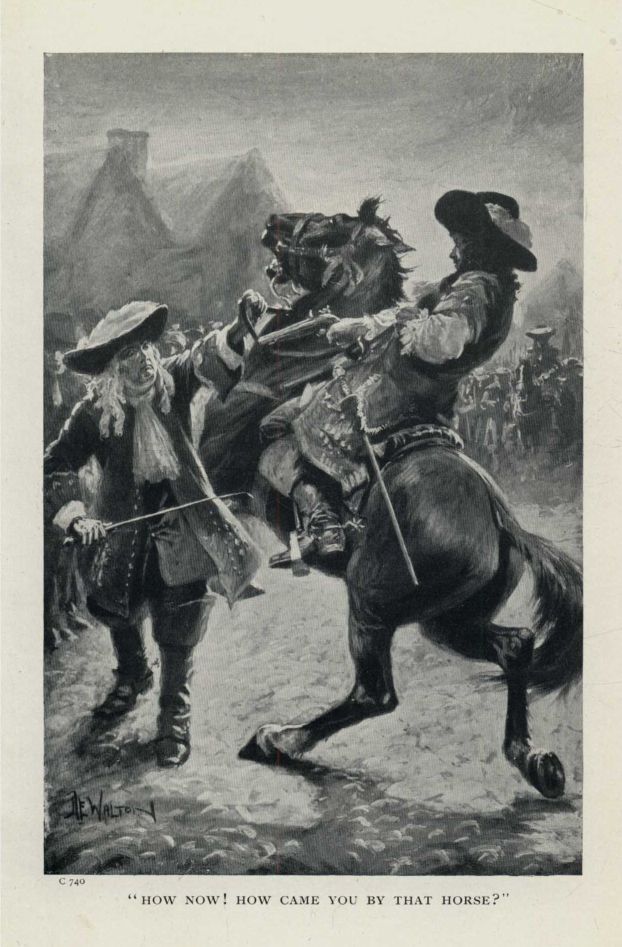
"HOW NOW! HOW CAME YOU BY THAT HORSE?"
"I took it from its stable at the 'George'," replied the other.
"Then know that it is mine, and take it back," rejoined Old Dare with heat.
"Nay, friend," said Fletcher calmly, "you err most grievously; for are not all things common to the Cause? Let go her head, I pray you."
"Nay, but I will not," rejoined the old man stoutly. "No legs save mine have stridden her, nor shall they."
"Ah! there you surely err again," laughed Fletcher, "for are not mine astride her at this very moment?"
That angered Dare beyond endurance; putting forth all his strength he strove to turn the horse, while Fletcher, using rein and bridle, urged it forward. At this Old Dare went clean beside himself with rage; let go a string of oaths and curses terrible to hear; and, when the other mocked him, drew a riding-switch from out his boot and struck him full across the face. 'Twas a cruel, maddening blow, and, in an instant, Fletcher snatched a pistol from his saddle-bow and shot the old man dead.
A moment's gasping silence was followed by a ravening roar of voices, and verily the people would have torn young Fletcher limb from limb (for Dare was much beloved by Western folk) had not the Duke of Monmouth ridden up and saved his life by ordering him aboard the frigate as a prisoner. I did not wait to see the end of it, but, taking advantage of the turmoil, broke out from the crowd and made all speed for home. There I fell to making final preparations for the morrow, and midnight struck before I was abed. Soon after three I was astir again, and ere four was riding on my way to Exeter. The past few days had brought me many strange and perilous adventures; but these were as nothing when compared with those which lay before me in the unknown future. Should you doubt that statement, you have but to follow me to prove its truth.
CHAPTER XVIII
A Timely Warning
As I rode along amid the old familiar scenes that bright June morning, with the gladsome singing of the birds for company, my thoughts were strange indeed. It seemed as though I had set foot upon the threshold of another life, and that the past--so near and yet so far--had been for ever buried in the grave which held my father. Those days--those happy days--were now as nothing but a darkened memory.
Less than a week before I had been riding on this selfsame road, as blithe and free from care as yonder soaring lark, and now----!
Pulling up, I turned a wistful gaze upon the sunlit sea. The ancient, wave-worn Cobb--strong and immovable in spite of kings and factions--stretched forth its long, curved, weather-beaten arm into the glittering water, as though it would fain gather in to safety those who dared the perils of the deep. Beyond it, straining at their anchors, lay the three ill-fated ships which henceforth would be part of one appalling tale of blood and failure.
A bright blue ensign fluttered gaily from the frigate, whose deck young Fletcher of Saltoun--a few hours back the hope of Monmouth's side--now trod a sorry prisoner, doomed to exile; his talents, hopes, and zeal all scattered to the wind by one mad act of rage.
This brought into my mind Old Dare of Taunton, lying dead there in the town--slain, to no purpose, in a brawl which boys might well have jeered at. Then, as other thoughts of death more ugly and disquieting arose, I moved on slowly--a prey to gloomy memories.
But, after all, I communed with myself, what mattered it? The past was gone; the future, rich in unknown adventures--wherein I had a certain mission--lay like a winding lane before me; while for the rest of it--that is, the present--I was well armed, had a good horse beneath me, lacked not money, and was sound in mind and body. What more was needed? Nothing! Let danger dog my heels at every step--I cared not anything, so long as in the end I might meet Ferguson and Ammon face to face and sword to sword.
Stooping, I patted Kitty's neck, and she, who knew my every mood and touch, broke out into a joyous canter, and away we flew along the springing turf which fringed the road. 'Twas all so like old times to be thus rushing through the cool, refreshing air, that for the moment everything seemed banished from my mind.
We had gone thus a mile or so, and I was vaguely thinking that, in spite of all, 'twas fine to be alive, when suddenly the sound of other horse-feet at a gallop reached me from behind. Someone was following us in furious haste, and by his speed he rode upon no common errand.
Remembering what peril I had already gone through, and how little loved I was by certain folk in Lyme, I pulled my mare in, and drawing up behind a thorn bush, sat there listening, the while I peeped forth cautiously in the direction of the thundering hoofs.
Soon round a distant bending of the road a steel-clad horseman shot to view, a very Jehu of a fellow, riding furiously.
Who could it be that thus betimes wore out good horse-flesh, and what might be the nature of his breakneck business? A Monmouth man, perhaps! I knew not--but, as things stood, it seemed to me to be prepared for anything was everything. Therefore I drew a pistol from my saddle, and, having cocked it, sat there ready to be friend or foe.
On, with loose reins and head bent low, the horseman rushed towards us, and judging by his speed would certainly have passed me by unnoticed; but just as he came close, Kitty must needs prick up her ears and give a loud, shrill neigh. At that the rider pulled his lathered steed up with a suddenness that wellnigh shot him from the saddle, and there, red-faced, open-mouthed and panting, sat John Coram, staring at me like a man bedaft.
"Th--h--ank H--ea--ven!" he gasped.
"Yes, truly, for you might have broke your neck by pulling up thus sharply," I replied, and could not keep from smiling.
"Nay--friend--'tis naught--to--jest upon," quoth he severely. "Faith!--but--I--I fairly boil within."
"Then pause and rest awhile," said I.
"I must," quoth he.
Unbuckling his head-piece he hung it on his arm, and verily his breath roared from him like a blacksmith's forge. Thus bared, and with the sunlight shining on his great bald pate, he looked so fat and peaceful--so unwarlike--that I was sorely put to it to save myself from laughing.
"Friend," said he at last, "I count the whinnying of that mare of thine a mercy; but for it I might well have passed thee by."
"True," I agreed; "but, say, what brings you after me in such a headlong fashion?"
John Coram fastened on his head-piece with all the care of some old dame a-tying on her cap, looked up and down the lane, then drawing closer, said:
"Because thou art in peril, friend."
"Ah! and from whom?" I asked, stroking my mare's neck carelessly, for indeed I had got used to peril.
Again John Coram glanced about him, this time taking in the trees as well, as though they might hold danger; then he drew still closer, and, in a low voice, answered:
"Israel Stark!"
At that I started somewhat, for, as you are aware, he named no ordinary open foe, but rather one who lurked in secret places privily to murder. Therefore I paused a moment, looking hard into the steel-framed face before me ere I murmured:
"Ah! so Tubal Ammon is abroad, eh?"
"Yea, and that somewhere on this very road," replied John Coram in a fearful whisper.
'Twas now my turn to glance around and scan the trees, especially a thick-leaved oak just opposite.
"How know you this?" I asked at last.
"Why, in this fashion," answered Coram. "As I stood on guard last night a mile or so from here, I heard sly, slinking footsteps coming from the shadow of a wood. 'Who goes there?' I cried, and someone gave the password of the night."
"Zion!" I put in with a smile, remembering how well the word had served me also. John Coram started.
"Yea, verily," said he; "but--but how came you by it?"
"Why, man," I laughed, "you gave it me last evening at the 'George'!"
"Now, by my life," he muttered, "I have a dim remembrance that 'twas so, though verily my pate was somewhat addled with--Hum! where was I? Ah! as I was saying, that fellow gave the word and so I let him pass. Off he went, a long-cloaked thing of black, into the darkness. But when he was some half-score yards beyond me he turned his face, the moonlight caught it, and I knew it instantly for Israel Stark's."
"Ah! and what did you then?" I put in eagerly.
"Did!" echoed Coram, spreading out his hands. "Friend, I did naught, and shame on me for it. So struck was I that I could neither draw a pistol nor pursue. I stood as stiff as any post, and watched the varlet fly. And fly he did; for, look you, he had known me also by that glance, and so sped off into the darkness like some spirit. The Evil One himself could not have vanished swifter. Heavens, friend! it makes me go quite chilly just to think on't!"
"'Twas a fine chance lost," I murmured ruefully; then, as another view of it came into mind, I added: "and yet it gives me cause for gratitude, for had you killed him you had robbed me of a pleasure."
But Coram shook his head.
"Ah, but all danger had been ended then," said he.
"How long was this ago?" I asked.
"About two hours; 'twas just before the dawn."
I paused a moment. Had Ammon once again been spying on me, and thus got wind of my intentions?
"Art certain that he came this way?" I asked.
"Aye, verily, I am. Would that I were not, for who knows where so sly a villain may be hiding, ready to work mischief on thee?"
Here we both glanced uneasily around. Truly this had a far from pleasing look. The lane was narrow, and bordered thick with trees and bushes--Thrusting such ugly thoughts aside, I asked another question:
"But how came you to know my whereabouts?"
"Why, in this wise: no sooner was I free than I went unto your house, The Havering, in order to report this matter. There I found that you had ridden forth for Exeter. So borrowed I a horse and rode amain."
"Thou art a right good friend, John Coram, and have well earned what I promised thee."
Bringing forth my pouch, I would have given him the money, but----
"No," said he, "I came not out to seek reward," and verily his honest face upheld the statement. "I came to warn thee, save thee from a peril, and having done so I am mightily content; while if you slay this fellow my reward is great indeed."
"Be sure my best endeavour shall go to that end," said I: "but still, a bargain is a bargain. Therefore, I pray you, take this money."
At first he would not; but after much pressing I contrived to give him two gold pieces, for the which his thanks were fervid.
"And now I must be riding back again ere I be missed," said he. "Besides, there is this horse which I have borrowed----"
"Or stolen, which?" I asked maliciously.
"Nay, friend, you said that sorry business was now clean forgiven and forgotten."
"And so it is," I answered laughing. "But, say, before you go, hast any news for me from Lyme?"
"Aye, plenty. Old Dare was slain last night by Fletcher of Saltoun. A pretty brawl, 'tis said, about a horse. And Fletcher hath been sent a prisoner to the ship. Thus lose we two good men at once. A grievous loss, indeed."
"Yes, true. I heard of it," said I. "And hath aught else been forward?"
"Yes. Three of our men have been slain on the shore nigh Charmouth."
Again this was no news to me; yet I contrived to say, surprisedly:
"Ah, so! By whom?"
"I know not," answered Coram; "there is some mystery about the matter, but they were slain by sword, and that by one who knew his business well, according to report."
"Well, well," I murmured, "such is war. But, say, how went it with the fight at Bridport?"
"Ill enough for us. Our men were beaten back by the militia. They fled like frightened sheep, and 'tis whispered that my Lord Grey was the worst of all; 'tis said he ne'er drew rein till safe in Lyme again.
"Now, by my life, that was a bad beginning, sure enough!"
"Aye, verily, yet scarce a thing to marvel at, for, look you, how can untrained ploughboys and the like expect to stand an onslaught e'en though it be but that of rough militiamen?"
"Ah, how indeed?" I murmured. "And know you when the Duke rides forth from Lyme?"
"Nay, that I don't, nor, as it seems to me, doth anyone for certain. Some say to-morrow, others Monday. Yet still they dally, signing on fresh men."
"Ah, they still come in to join, then?"
"Aye, that they do--by hundreds; but, oh, such lumbering louts! Save me, if we should not do as well with cows and sheep. And now, to make it worse, we've lost Old Dare and Fletcher. Faith, but I like it less each day, and were it not for Ferguson, Duke Monmouth's cause might whistle for John Coram."
"Ah, so Ferguson doth count for much," I murmured, stroking Kitty's neck to hide my face.
"Yea, much indeed," quoth Coram warmly. "He is a leader born--a man of parts withal; but surely, friend, you know 'tis so as well as I," he added with a searching look, "for have you not had pressing business with our godly chaplain?"
"Yes, by my life I have, and have it still," I answered. "I ride upon it now."
"Another reason why I should not tarry, then," said Coram. "And so farewell, friend. Have a care of Stark, and make sure to kill him if you get the chance."
"Be sure of that," said I.
"My blessing on it," answered Coram fervently, and with that cantered off. At the bending of the lane he turned and waved a hand. I answered with a will, then also sped upon my way, though with a watchful eye for every tree and bush.
CHAPTER XIX
The Affair at the Barn
As the day grew older and a blazing sun climbed up behind me the heat upon my back became wellnigh unbearable, and a decorous walk was all that Kitty made of it, nor did I wish for more. I was well ahead of Monmouth--therefore of friend Ferguson--and could bide my time.
As I passed along the shady lanes thus leisurely, you may be sure I had continual thought for Tubal Ammon, and when the sound of beast or bird disturbed the leafy silence, my eyes and ears were swiftly turned in that direction. But no harm came of it, and beyond some honest farm hands, who, too wise to change scythe for sword, were laying low the tall, rich grass with measured swing and swish, I chanced on no one. Doubtless the chief reason of this was that, both for purposes of shade and solitude, I kept to bypaths and eschewed the highway. Also, I strove to keep as near the sea as possible, in order that what little breeze there was therefrom might make things more endurable.
But such slow, winding methods take much time, and so, what with that and many stoppages for Kitty's sake, 'twas close on noon ere we had put, maybe, twenty miles behind us, which, reckoning for byways, was little more than half the distance to be covered.
The sun was now at its meridian, and beating down upon us with a fiery heat which threatened danger to my mare, if not to me, for we had now drawn clear of sheltering lanes and come out on a stretch of treeless moorland which ran for miles along the coast. Here the hot air fairly danced above the scorched-up grass and bushes, and naught was to be heard except the languid hum of bees among the gorse. The very sea seemed hushed to languorous silence.
To press on in such a state were cruelty to man and beast, therefore I called a halt and looked about me for some shady place in which to rest. But this was easier sought than found. As far as eye could reach, the barren moor rolled on beneath the shimmering heat, with nothing taller than a stunted thorn bush visible.
As I sat gazing wearily upon this arid sight, while Kitty pawed the turf impatiently and cursed distracting flies (so far as horse was able) with her ears and tail, I saw, far off, a man dart straight across the track and disappear as though the earth had swallowed him, upon the other side.
So quickly had he vanished in a place thus bare of cover that I watched the spot expectantly with shaded eyes, feeling certain he must come to view again. But nothing came of it; indeed, it might have been a rabbit which had gone to earth for any more I saw of him.
This was strange and puzzling beyond measure, and, sun or no sun, must be enquired into. So, marking down the spot, I urged Kitty to a canter and soon reached it. Then that which from a distance had been so mysterious was instantly made plain. A high bank on the left was here divided by a deeply-rutted, and, by the look of it, now unused lane which wound down through a maze of bushes to the sea; and doubtless it was this which had thus swallowed up the flitting figure.
So far so good; but having proved the manner of his disappearance I was minded to explore the matter further.
With this intent I turned my mare into the cutting and rode slowly down the winding track. On either side of me there was a tangle of thick scrub, and on this I kept a ready eye, for a bullet or a poisoned arrow might well prove deadly at so short a range. But nothing stirred, and so at last I came out upon a wide expanse of utter desolation. It was as though the land had slid down seaward and there broken out again in such an uncouth medley of rank, twisted growth as seemed to be scarce English. 'Twas chaos, with the rock-strewn shore beyond.
Who could it be that, flashing as it were from space across my path, had sped to this wild, lonesome place and vanished in its dreary solitude? Ah, who? As I put the question to myself I swept the dreary waste with anxious eyes and thought uneasily of Coram's warning.
My vision of the man had been so sudden and his flight across the path so swift and stoat-like, that, at such a distance, I had been able to make nothing of him. Nor did he now vouchsafe to help me by discovering himself to my enquiring gaze. Not he. Sun-loving insects hummed amid the stifling heat, a dragon-fly hung poised above a bush--a thing of glorious blue--a gull screamed high aloft, while here and there the twittering of tongue-parched birds broke forth in sleepy fashion. But these were the only signs of life; no human being showed himself; my man had vanished like a dream.
What then? To hunt for him among that tangled wilderness in such a blazing heat were folly worse confounded, for, to begin with, I must do the thing on foot--a weary, hopeless task indeed, and risky also if the object of my search were armed with pistol and a bad intention. Yes, there seemed nothing for it but to let the mystery go unsolved, and leave the haunter of this desolation lurking in his hiding-place.
Reluctantly, and not without misgiving, I turned and rode back through the opening to the moor, still musing wonderingly on that which lay behind me. But such thoughts, pressing as they were, gave way at last before my former keen desire for shade. And this time fortune favoured me, for, having ridden on another quarter of a mile or so I saw, not far away, an old grey barn tucked snugly up against the bank, with bushes overshadowing it. What could be better for our sweating needs?
A minute later we were up with it. The entrance lay upon the other side--that is, the shady side--and here a stout oak door hung idly open, thus inviting entrance. How came this stony friend in such a wild deserted spot as that? I could not tell--nor did I care; but verily it was as welcome as an oasis amid the desert. With a blessing on its unknown builder, I dismounted and led Kitty in.
The place was sweet and clean, and thickly carpeted with well-dried bracken, while a gentle sea-breeze found its way inside, thus adding to a most refreshing coolness.
Small wonder that my pretty mare let go a gladsome neigh and rubbed her velvet muzzle on my shoulder. Doubtless she looked upon our new-found quarters as a stable. Having first eased her girths I looked around for water. This I found not far away--a bubbling stream amid the rocks. When poor thirsty Kitty had refreshed herself thereat I led her back to the barn and put her nose-bag on. Then I fell to with a will upon the food that old Anne's forethought had provided. And so, while Kitty munched her oats, I ate my bread and cheese and pasty and drank my wine, and each of us was mightily content. After this refreshment, being wondrous sleepy, I decided to remain there till the sun should have lost something of his fierceness. But, first of all, remembering that flashing vision of a man across the track, I judged it wise to close the heavy door and fasten it, the which I did by running my sword (for lack of wooden pin) through two stout iron staples, thus making it impossible for anyone to attempt an entrance without my hearing him. This done, I lay down on the bracken close beside the door and very soon was wandering in the land of Nod.
Now I count not among my virtues (or, if you will, my vices) that of being what is called a heavy sleeper. Slight noises will awaken me, and so it came about that, while I was slumbering thus, a gentle rattling aroused me thoroughly.
Someone had tried the door, and, as the staples were full long, my sword allowed it to be opened quite four inches. This had been done, and, even as I stared in breathless silence, a great brown hand crept in and groped about in search of that which barred all further entry.
If you have never seen a hand thus armless--lopped off and blindly feeling, as it were--no words of mine can picture it aright for you. 'Twas horrible beyond compare; and though the light which flickered through two narrow slits set high up in the wall was dim enough, it was yet all-sufficient to make plain a sight so awesome--four straining fingers and a thumb which lacked a guiding eye!
I stared like one bewitched until at last the fingers closed upon the sword-hilt; then, with a sudden spring, I tried to seize the wrist, but failed. The hand shot back ere I could even touch it, while next moment swiftly-running feet proclaimed its owner's flight.
Pulling my sword out from the staples, I drew it, and rushed forth in pursuit. Yet, though I had thus lost scarce half a minute, there was no sign of anyone outside; and not a sound came from the bushes which grew thickly all around, and were the only means of hiding near.
Baffled and perplexed, I walked silently along the turf a little way, stopping every yard or so to listen. Still naught was to be heard. That sly disturber of my sleep had disappeared as if by magic.
This was an ugly state of things--indeed, I liked it not; and so, bethinking me that to go farther might spell danger to my mare, I ran back to the stable.
The sun had now moved down considerably (thus proving that I must have slept some hours), and the heat, though still oppressive, was not so overpowering as it had been; but, even had it still been like a furnace, I would not have tarried longer in that haunted place. So, with the memory of a clawing hand to hurry me, I tightened Kitty's girths, and, having led her forth, was just about to mount, when something hissed close past my face and stuck quivering in a tree-stem. It was a small black arrow! The mystery was explained at last, and the knowledge that my dreaded enemy lurked thus close to me was so appalling that I shame not to confess my knees smote one against the other, while a clammy sweat broke out upon my forehead.
Leaping to the saddle I urged Kitty forward, at the same time bending low by instinct; and well it was I did so, for next moment a pistol cracked behind me and the bullet whistled just above my shoulder. Two inches lower and I had been hit!
Glancing back, when we had covered some three hundred yards, I saw no sign of Tubal Ammon, and was just thanking Heaven for such a merciful deliverance, when suddenly my mare stopped dead and broke out trembling with fear.
The cause of this was just ahead, for there an old man lay upon his back among the heather. Going close up I gazed down on him, and, to my horror, found that he was dead. His eyes stared up at me with awful fixedness. Moreover, he had met his death by violence, as was clearly proven by the gaping knife-wound in his breast. Stabbed through the heart!
He was well dressed (a yeoman farmer by the look of him), and wore riding boots with spurs. Thus it was clear he had been riding when death overtook him. What, then? How came he thus? Where was his horse? These questions were full quickly answered; for barely had I put them to myself when from behind there came the sound of thudding hoofs, and, starting round, I saw Tubal Ammon galloping towards me on a long-legged, bony beast.
This made things clear indeed; yea, verily, I understood it all as in a flash. Keeping far ahead of us throughout the morning, running when we walked (though ever making sure of our direction), the miscreant had reached this lonely spot before us, had met this poor old man and slain him for his horse, and, having hidden it, had lurked about in hope of falling me as well by stealth. This having failed, he now pursued me on his blood-bought steed, intent on further mischief.
As this rushed through my mind, I, too, rushed through the air, and such a wild, mad race began as never was. Kitty knew little of the spur, but now I used it on her without knowing that I did so. Heavens, how we flew! The pace we made was such as beggars words. The ugly brute behind, for all his great long legs and furious speed, gained not a yard upon us, for what advantage he possessed in length of limb my mare outwitted by her lightness and agility.
Mile after mile we had covered in this headlong, reckless fashion, when suddenly a shrill cry reached me, and glancing back, I saw that Tubal Ammon's horse was down, while he himself had been shot yards in front of it.
Perceiving this, I stopped to look. Perchance the luckless beast had stumbled in a rabbit burrow, while, by the way its head dropped back when Ammon pulled upon it with the bridle, I judged it to be either broken-necked or broken-hearted. And doubtless its rider shared the same opinion, for, after divers vicious tugs and kicks he dropped the reins, and, turning, shook a fist at me. I answered in like fashion, then trotted on my way.
And here it seems to me that you may well be wondering why, in the name of fortune, I did not instead ride back and try to kill the wicked wretch whose death I so much coveted. But verily, my friends, the chances were not what, to you, they may appear to have been; nay, rather were they all against me. For, look you, thick cover lay on every side, and long ere I could have come up with him, friend Tubal would have darted into hiding; while, having just most providentially escaped from death, I had no mind to seek for it again.
So I pressed on towards Exeter, whose grey cathedral towers were even then just visible, far off, against the glowing sky. But, feeling safe from that which lay behind, I did not hurry, for Kitty's state was truly piteous. Her flanks were streaming, while the foam dripped from her mouth. Thus I walked and trotted her by turns, and the sun was nearly down when at last we clattered noisily along the ancient city's streets.
Here was mighty bustle and excitement, with no little fear mixed up therewith. The streets were all alive with eager, anxious crowds, and many, taking me to be a special messenger bearing news of Monmouth, tried to stop and question me; but, turning a deaf ear to them, I cantered on to Albemarle's head-quarters.