THE BLACK BOX (continued 2)
Reading edition
"Ah, and that round-faced minister who tries to look so solemn and yet cannot. Who is he?"
"'Tis Master Hooke, the Duke's private chaplain, a worthy man, I trow, though somewhat Popish of appearance."
Just then the reader of the declaration turned himself to get a better light, and the setting sun fell full upon his blotched, scorbutic cheek and made it look as though 'twere stained with blood.
I gazed upon him spellbound for a moment, then I asked:
"And prithee, who is he that reads?"
The voice of my informant dropped into a solemn whisper, as though 'twere something sacred that he spoke of, as he answered:
"That is Doctor Robert Ferguson, chaplain to Monmouth's army, and a terror to all workers of iniquity."
On hearing this I started round as though the man had struck me, and barely saved myself from crying out.
"What's that?" I gasped. "Ferguson the Plotter?"
The fellow glowered upon me for a space, looking me up and down with angry eyes.
"Thy tongue wags over free for one so young," snarled he at last. "Nay, Ferguson the godly. See how his face lights up with blazing zeal!"
But that was enough for me. Gaining the outskirts of the crowd I hurried to the "George" to get my horse, pursued by such a hornet's nest of wild, bewildering thoughts as fairly made my head sing.
On coming near the jail I heard a great commotion going forward, and there, as I live, was Simon Jackson, the Nonconformist blacksmith, bare-armed and sledge in hand, raining fierce blows upon the stout, nail-studded door. He had already burst the town-hall open to make a storage place for Monmouth's baggage, and was now bent on setting free his brother Nonconformists, who, as I have said, had lately been imprisoned by the Mayor.
Even as I looked the door flew open with a crash, and out stepped half a score of white-faced, startled men, among them old Sampson Larke, the grey-haired Anabaptist minister.
"There," methought as I turned away, "falls the pride and power of Master Gregory Alford!"
I found the inn yard humming with excitement. Serving men and maids ran to and fro distracted; for the news had already reached outlying villages, and men poured in from every quarter, some armed and eager, others idly curious, but all of them hot and thirsty, and calling loudly to be served with ale: while on a top step stood the landlord, surveying the giddy sight like one bedazed. The name of Monmouth was on every lip, and each new-comer added to the din.
Shouldering my way through the buzzing, drinking throng I made for my horse. The stable in which I had left her lay round a dark, far corner of the yard, and on turning this I noticed that the door was closed and that a flickering light showed underneath it. This surprised me not a little, and hurrying up I tried the door. To my great astonishment I found it fastened on the inner side. I called, but no one answered save my mare, who gave a joyous whinny. Listening for a moment I made out voices talking in a whisper, and thus feeling certain that some mischief was afoot I put my shoulder to the door (an ancient, rickety affair) and burst it open. Then indeed I started back, as well I might, for there was my horse already saddled, while beside her stood two burly, steel-capped fellows, armed with sword and pistol. One of them held a lantern, the other Kitty's bridle, and both regarded me with guilty, startled faces, like the thieving dogs they were.
Just then the mare turned round her pretty head to look at me, and neighed again.
"Is this thy mare?" asked he who held the bridle.
"Well--yes," I answered; "at least, that is, I thought it was; but now it seems as though I must have been mistaken."
"Thou hast a mocking tongue, young man," whined he who held the lantern.
"Yet that were surely better than a thieving hand," quoth I.
"What mean you?" he asked, taking a step towards me.
"Exactly what I say," I answered slowly. "In other words, you are a pair of sneaking thieves."
At that each laid a hand upon his sword and eyed me fiercely, while he with the light came forward in a threatening fashion.
"We are no thieves," he hissed, showing his yellow teeth. "We claim thy mare for the cause."
"And, prithee, what cause is that?" I asked.
"The cause of liberty and truth," whined he.
"The cause of Monmouth, eh?"
He nodded frowningly.
"Then," said I, "if liberty and truth go hand in hand with thieving, may God help the Duke! Let go that bridle," I added, striding up to the fellow who had laid a hand on it again.
He hesitated for a moment, glaring upon me with a pair of angry, bloodshot eyes; but, though only eighteen years, I topped him by a good three inches, and doubtless my face told tales besides. Growling something anent "godless upstarts" he drew back sulkily and joined his comrade by the door which he had closed. And there they stood muttering together and casting ugly glances at me.
Turning Kitty round, I took her bridle on my arm and moved towards them.
"Open that door," I said, "and let me pass."
But they were two to one, and odds give courage even unto cowards. Whipping out their swords they set themselves against the door.
"You leave that horse or go not," said one.
"Aye, verily," quoth the other.
Stopping, I also drew my sword and said:
"Ah! say you so? Listen; do you know that I have but to call, and half a score good friends will come to teach you honesty? Again, I say, open that door and let me pass."
"Ah!" jeered the fellow who had closed it. "You come not over us with that, young man. Know you that we also have some friends without; not half a score, but three score--well-armed withal, and zealous in the cause to boot."
There was ugly truth in that. I thought swiftly for a moment. Yes, 'twas my only chance!
"Fools!" I cried. "You do not know what business I am bent on!"
"Nay, how should we know it?" growled the bridle man. "What is it?"
"Why, such as, if you knew it," I replied, "methinks would make you open that door with right goodwill."
"Prithee then, tell us what such mighty business is," sneered the other. "Whom doth it concern?"
"One Robert Ferguson," I answered slowly.
At that the fellows started as though my words had been a pistol barrel.
"Ferguson!" quoth one of them uneasily. "Our godly chaplain!"
I nodded, though more than doubtful of the godliness; and he added:
"Why, then, didst not tell us this before, friend?"
"What now!" I shouted with a show of anger as I sheathed my sword. "Am I, then, to cry my business out to every brace of thieves I meet?"
"You speak with heat, not knowing," whined the lantern-bearer. "Verily, we are no thieves, but honest fighters for the cause, seeking horses, which are sorely lacking. And if we had known the nature of thy business, we----"
"Fool!" I broke in fiercely. "Cease thy prating, and open that door at once, or methinks 'twill be the worse for you. One word of this delay to Dr. Ferguson, and----"
Back flew the door, and, as I moved slowly forward, the opener of it laid a trembling hand upon my arm, saying:
"Pray you, sir, get not two honest fellows into trouble. 'Twas done in ignorance."
"I will consider that," I answered sternly, striding beside my mare into the yard with great relief. Truly, one Ferguson had served my purpose handsomely!
Turning to the left, in order to avoid the crowded yard, I passed down a well-known entry, and so came out into a dark and now quite deserted street.
"That was a narrow squeak, old girl," I whispered, stroking Kitty's silken neck, and, as though she understood, the pretty creature whinnied gently. Then I mounted, and away we fled for home.
In view of what had happened at the stable, I judged it best to keep as far as possible to by-ways; and so, instead of going through the town (the nearest road), I struck into a narrow, high-banked lane with sheltering trees on either side.
'Twas now dusk. Far off I heard the tumult of the town, rising and falling in a ceaseless hum; but here all seemed silent and deserted. Yet, even so, it was not long before I proved that Monmouth's men were guarding even such unlikely avenues; for just as Kitty, with a hill before her, dropped into an easy trot, I suddenly made out a group of fellows gathered near the top, beneath the shadow of a tree.
This was plaguy awkward, but yet more so when, as I drew nearer, they spread themselves across the road, and I made out they were armed with muskets. Still, there was nothing for it save to put a bold face on the matter; so, bringing Kitty to a walk, I went forward whistling carelessly, and had come within fifty yards of them, when one, who seemed to be a leader, stepped out, and holding up his hand, cried:
"Stop! Thy name and business, friend!"
At that I pulled up the mare, and shouted back:
"What's that you say?"
Fingering his musket-lock, he came a few steps nearer me, and bawled:
"Thou'rt somewhat hard of hearing, friend. I said, Thy name and business? Prithee, give both quickly."
"My name is of small account," I answered; "and for my business, know that it concerns one Robert Ferguson."
That name had done so well for me before, that I could think of nothing better; but, alack! it failed me this time.
"That will not serve thee, friend. 'Tis not sufficient," quoth the man sternly. "If thy business indeed concerns our chaplain, show thy pass, or give the watchword."
"Aye, verily! thy pass or watchword," sang another who had now come up with him.
Here, truly, was an ugly state of things. To turn and flee might mean a musket-ball for me or Kitty. I thought a moment. Yes, to surprise them was my only chance.
"The watchword, say ye? Yes, with all my heart."
So saying, I bent forward in the saddle, and, pressing my knees upon the mare's flanks, spoke softly to her. She gave an angry snort, down went her ears, and next instant she was rushing forward like a mad thing.
'Twas all so sudden that, for the nonce, those valiant keepers of the road were utterly confounded. With startled cries, they broke and fled towards the banks. Yet barely was I past them ere a musket-shot rang out, and a ball sang dangerously near my head. Another and another followed, but by that time I was beyond their reach.
Not till I was well past Uplime did I draw rein; then, pulling up beside a little wood, I stopped to breathe and think. Truly, my mare and I had already had a taste of what rebellion meant. A few short hours had made our quiet roads unsafe for honest men. "'Tis a pretty thing," I muttered, "if a fellow cannot ride home peacefully without the danger of a pistol bullet through his head. If this be the way of 'honest Protestants', then give me Popery! The sooner I am at The Havering, the better."
With that I turned my horse, and, entering a lonely lane, which, as it seemed, was certain to prove empty, cantered on my way. But I had not gone far before I overtook some half-score fellows who were hurrying Lymewards. As they drew aside to let me pass, I reined up suddenly and scanned their faces. They were heavy, lumbering yokels, farm hands for the most part, and several were known to me.
"Well, and whither go you?" I asked.
"Up over, into Lyme," said they, "to join the Duke o' Monmouth. Hast not heard the news, sir?"
"Yes, I have heard it right enough," I answered; "but, if you would be warned in time, go home again, for methinks your present way leads straight to hanging."
Their mouths fell open at my words, and for a moment there was silence; then one of them, a big-limbed fellow, cried:
"A Monmouth! Down with Popery! The Protestant religion!"
The others joined in lustily, and so I left them and rode on. Alack! I was to see three of those simple-minded rustics dangling from a rope-end in the days to come!
On drawing near Hay House (a lonely place), where lived the Mayor of Lyme, I saw a horse come out into the road, with two men on it, riding double.
This seemed so strange that I must needs pull up to look at them, and so, as they came abreast of me, I found the foremost one was Dassell. Both had swords and pistols.
"What now?" said I.
"Hush!" said he. "The very trees have ears to-night. I ride to raise the country on these rebels--to Crewkerne first--and friend Thorold here goes with me."
"Yes, but why ride ye so?" I asked.
"Because there is no other way," he answered, smiling grimly. "'Tis certainly a heavy beast--a coach-horse surely; but 'twill serve, methinks. At any rate, 'twas the only horse in Master Gregory's stable."
"And is the Mayor at home?"
"Nay, there is no one save his sister. All his men have joined the rebels. The Mayor fled long ago to Exeter, to warn the Duke of Albemarle."
"And save his skin!" said I. "Well, have a care. The roads are guarded, and 'tis but a chance that I am not the heavier by a bullet."
"Ah! is that so?" quoth Dassell, glancing at his pistols.
"It is," said I, and, wishing them God-speed, rode on my way.
On reaching home I found the yard deserted, and so, vowing vengeance on our truant fellows, I led Kitty to the stable. There I had removed her harness, fed and watered her, when I heard a footstep just outside; and turning, found my father standing in the doorway with a lantern in his hand.
"Is that you, my son?" he asked, in a voice which methought was strange and hollow.
"Yes, sir," I answered, and was about to start forth on a full account of all that I had seen and heard, when, as my father raised the light, I noticed that his face was deathly white, and that his eyes were full of fear, a look which I had never seen in them before. Then, and not till then, I thought of Tubal Ammon, and the guarding of the window.
"What is it, sir?" I asked with great anxiety.
"Come, quickly, Michael," he replied, and turning, led the way towards the house.
He took me straight into the study, where one glance sufficed to prove that something bad had happened. The window, a pane of which above the fastener had been broken, lay wide open; papers were littered on the floor; while with a thrill of fear, I noticed that my mother's portrait was displaced.
"Father, what is wrong?" I asked, turning to the spot where he stood staring at me in dumb, frightened fashion.
He made no answer, but going over to the secret panel, opened it, and pointed to a darkened corner.
With trembling hand I took a candle from the table, and, kneeling, looked inside.
The Black Box was not there!
CHAPTER VI
"Too Late"
When I glanced up, amazed and stupefied, it was to find my father's eyes fixed on me with a look that I shall ne'er forget. 'Twas one of fear, and bitterness, and deep reproach. For a moment I was stricken dumb, then, scarce knowing what I said, I gasped:
"Gone! How?"
My father waved a hand towards the window, and, in a low voice, answered:
"You have failed me, Michael."
I did not, could not answer him, and so he went on in the same low, crushing voice:
"Yes, Michael, you have failed me utterly. You have placed your father in the shadow of the gallows."
Those words to me were like the plunging of a knife into my heart. Shame, self-reproach, could silence me no longer.
"Sir!" I cried, springing to my feet, and facing him with tight-clenched hands, and burning cheeks, "you judge me harshly! I did not fail you willingly! I----"
"You did not get my letter, then?" he put in sternly.
"Yes, sir, I got your letter, but other stirring things clean drove it from my mind."
"And, pray, what stirring things are those?"
"Why, hast not heard the news?"
"I have heard naught. I have not long returned, and though methought I heard a sound of some commotion in the town, I took but little heed. My thoughts were far away. My friend is dead. But, say, what news is that which made you fail your father?"
"Duke Monmouth landed here, at Lyme, to-night!"
With one deep, sobbing groan, my father staggered back into a chair, and there sat, limp and helpless, like a man bereft of reason.
"Monmouth--landed--here--at--Lyme!" he gasped at length. "Then are we utterly undone, and both may look upon the gallows as our own. For, verily, the words I spake this morning are now proven. He who hath thus put us into jeopardy is in truth a creature of that plotter, Robert Ferguson, and----"
"Nay, sir," I broke in desperately, like one who grasps at silken threads to save himself; "it surely is not proven yet--perchance some other----"
In speaking I had moved a step towards my father, and now, as if to mock me and to prove his words, a something grated underneath my foot. Stooping, I picked it up; and holding it upon my outstretched palm, stared at it fixedly.
"'Tis proven now," I murmured.
"What's that?" rejoined my father, starting forward in his chair.
"The sign of Tubal Ammon," I replied, still gazing hard at what lay in my hand. "'Tis one of those small carven balls he did his trick with by the roadside. He has been here beyond a doubt."
"I knew it, and no proof was needed," groaned my father, sinking back again. "And not only hath he robbed me, but he most likely heard and saw all that passed between us here this very morning. Oh, Michael, Michael! to think that you, my son, should thus have failed me!"
He wrung his hands.
"Yes, yes! and I will make amends for it," I answered fiercely, as, hand on sword, I turned towards the door.
"Stay! whither go you?" cried my father.
"To seek this fellow out," I answered savagely. "To find him, and--to kill him."
"Then save yourself the trouble," rejoined my father firmly. "Two follies never made a wise thing yet, and never will. And this were rankest folly. For, look you, this fellow Ammon will be far away by now; aye, verily, perchance aboard ship, making for his master."
"Not so," said I, "for his master is already here in Lyme."
"What!" cried the old man, springing to his feet. "Ferguson in England?"
"Yes, he landed with Monmouth here to-night." And in a few hot, breathless words I told him all that I had seen and heard that day; while he paced to and fro, now stopping for a moment, now spreading out his hands, and all the time casting wild, hunted glances round the room.
"Michael," he said when I had finished, "the bolt is shot, and nothing now can save me from the gallows; nay, verily, I feel the noose about my neck already."
"No, no!" I cried out in my desperation. "Say not that. I cannot bear it. There is still hope that naught may come of it."
"There--is--no--hope," replied my father, slowly. "Whatever comes of this rebellion, Ferguson will still have power to bring me to account--to crush me! Nor will he stay his hand. I know him well. To be avenged is very life to him. Yes, Ferguson the Plotter will have vengeance! There is no hope! Oh, why is this? Why have I lived to see this awful day?"
Clenching his hands, he raised them high above his head, and stood before me thus--a haunting picture of despair and anguish, awful to remember. It seemed as though the hands were raised to curse me; but it was not so, for, as I stood there with bowed head, they came down gently on my shoulders.
"Michael," he said, "take not this thing too much to heart. You spoke truly--I have judged you harshly. The fault is mine, not yours; for had I not first trafficked with this Ferguson, for the sake of usury, for filthy lucre, this had not happened. Yes, yes, the fault is mine, and whatever evil comes of it, no harm shall come to you. I swear it. Forget my hasty words."
A curse had been much easier to bear than this.
"Nay, sir, I will not have it so," I almost shouted. "The fault is mine. I have been faithless, as you said, and would now make amends for it. What can be done?"
"Hush!" said my father gently. "Naught can be done--to-night. I would think this matter over quietly, alone, here. Therefore, leave me, Michael; go to rest. We may see clearer in the morning. Good-night, my son!"
Our hands met in a long, firm grip, even as they had done in the early morning of that selfsame day, when I had sworn strict secrecy concerning that which now, alas! through my unfaithfulness had thus been turned into a power of threatening danger.
Going over to the fatal, mischief-working window, I slowly closed the tell-tale casement; then once more turned towards my father; and spite of all his efforts at concealment, I read within his eyes the awful words "Too late!" And so I left him.
CHAPTER VII
The Plotters
Such had been the throbbing interest and excitement of that eventful day, that I had taken scarcely anything to eat or drink--I had not thought of it--and now my only craving was for water. Of that I took a long, cold draught, then went up to my lonely bed-chamber. But not to rest; there could be no rest for me now!
Pacing the room I thought bitterly of the state of things, and how different it might all have been but for my own surpassing carelessness; thought, too, of the old man who sat lonely and disconsolate below; of Tubal Ammon and his mischief-working master.
Thus to and fro I went, I know not for how long, while shame and self-reproach hung close and heavy at my heels: but at every turn the hopelessness and desperation of my mind increased, until at length I could endure my thoughts no longer. The confines of that little chamber seemed to grow smaller and more suffocating every moment, until they were as those of some pestiferous dungeon in which I was a maddened prisoner. I must do something--take action, no matter how preposterous and wild--or lose my senses.
Going over to the open window I stood there looking out across the bay. A cool sea breeze played most refreshingly upon my heated face; I drew it in with thankfulness.
The tumult in the town had sunk to silence, the night was dark and still as death. Far off I saw the bobbing lanterns of the three black ships whose coming had so altered everything.
It all seemed like a dream or ugly nightmare, and I was thinking so when suddenly I saw a tiny twinkling light upon the cliffs, it might be half a mile away. On this--I know not why, unless it was presentiment--my eyes became fixed in a fascinated stare. Who at such an hour ('twas now close on midnight) had business in so desolate and wild a spot? Barely had I asked the question, when another light, a trifle larger, blinked forth in answer, some distance from the first one. Even as I watched, they quickly drew together, got close enough to make them seem one light, and then were lost to me.
Here, then, was what I craved for--chance of action! Some mystery was afoot there on the cliffs. I would endeavour to make out the nature of it.
Recking nothing of the risks I ran, careless of everything save blessed movement, I stuck two loaded pistols in my belt, crept downstairs with a noiseless stealth, and left the house.
If ever youth went forth blindfolded on a reckless, wild adventure, I surely was that youth; if ever mind was nearly bursting with a hare-brained folly, such certainly was Michael Fane's as he passed out into the darkness of that fateful night. Yet, had I been assured that Death himself was waiting to embrace me in his icy clasp, 'tis certain I would still have gone. Fate urged me on, nor did I need much driving.
As I have said, the night was dark, the moon being hidden by a mighty bank of clouds: and naught was to be seen save here and there a twinkling light among the distant houses of the town, where doubtless some late sitters talked upon the happenings of that stirring day, or those engaged upon rebellion laid their plans. Thus I had nothing more than chance to guide me to the spot where the two tell-tale lights had drawn so close together and then vanished.
Going full cautiously, stopping every now and then to listen, I crept across the open space which lay between me and the cliffs. Bush and bracken broke the ground at intervals, and thus, with no clear path discernible in such a darkness, it behoved me to move warily, lest by stumbling I might warn instead of catch.
Thus going in and out among the shrubs and ferns, and ever moving like some beast of prey, I came at length upon the narrow path which runs along the cliff-top. There, beaten, and inclined to curse my foolishness, I stood straight up and listened.
A rabbit scuttered somewhere close at hand, the sea moaned plaintively upon the shore below me, but not another sound was to be heard; it seemed, indeed, as though the silence whispered of my folly!
Had, then, my eyes deceived me? Had a seething, maddened brain struck lights where no lights were! It seemed so; or, if not, the bearers of those lights had gone their way, for I was certain that I was not far from where they had thus strangely met and disappeared. Yes, truly, I was minded to call one Michael Fane a fool!
Stay, though, what was that? A hundred yards or so away, across the scrub, I caught the sudden twinkle of a lantern. With bated breath I watched it for a moment, then, dropping down upon the ground, moved towards it like a slinking tiger. Scarcely had I started ere the light vanished just as quickly as it came, but that did not stop me. On hands and knees, feeling for every bush, I crawled on through the darkness. The cracking of the tiniest twig seemed like a gunshot to my anxious, straining ears, my tight-held breathing like the roaring of a grampus.
So slow and stealthy were my movements that a score yards took near half as many minutes: and having covered double that without result except a good array of scratches, I had again begun to doubt my eyes and mutter at my folly, when, as I paused a moment to consider matters, a sound like that of humming voices reached me from ahead.
Kneeling, I listened breathlessly, and with an eagerness as though my very life depended on the act, and yet, for all I knew, it might have been but poachers setting out their snares; therefore 'twould seem indeed as though black fate and dread presentiment went hand in hand that night.
As near as I could tell, the voices came from a spot not far away, and straight ahead of me, but so low and muffled were they that 'twas no easy matter to judge rightly on this point.
For a time I knelt there listening with all my might, first cocking this ear and then that, but all in vain--not one word reached me: the buzzing hum continued in a maddening fashion; indeed, it might have been a hive of droning bees for all that I could make of it.
Down on all-fours I went again, and, with the sound to guide me, crawled towards it.
Some twelve yards farther on I once more stopped to listen, and thus discovered that the talkers were on the far side of a ridge or hillock up which I had commenced to climb; and what was more, I made out that which stiffened me with dread, and set my heart off thumping like a hammer. For now I was near enough to separate the voices, low though they were, and one of them spoke in broadest Scotch--'twas Ferguson's; while the other there was no mistaking either--Tubal Ammon's!
Digging my fingers deep into the turf, for very fear lest overmastering astonishment should cause me to exclaim and so betray myself, I paused a moment, then, with cat-like stealth, crept up the bank.
'Twas a risky, daring business sure enough; the snapping of a twig, the rattle of a stone, and I had brought on me two desperate fellows, who would as soon take life as toss a penny. Still, as it seemed to me, 'twas worth a world of danger--nay, 'twas a stroke of glorious luck--to come thus on those two arch-plotters in their midnight tryst, catch them red-handed, as it were, and, perchance, confound them. And had I needed any goad to urge me forward (which I did not), there was the thought of him whom I had wronged, and who doubtless even then sat lonely and distracted in his study, brooding helplessly upon the dangers which beset him.
Thus I crept up, foot by foot--nay, inch by inch were nearer to the mark, my going was so slow--until at last I was near enough to make out wellnigh every word as it was spoken. Then, stretched full length upon the cool, soft turf, I lay there with a thumping heart and listened, drinking in all I heard as greedily as ever thirst-parched man drank water.
"'Tis so, then," Ferguson was saying; "you come here to drive a hard and grievous bargain, eh?"
"Aye, truly," answered Ammon; "no words could put it better: a bargain--a hard and grievous bargain if you will."
"And not to serve the godly cause?" whined Ferguson.
"Pish to your godly cause!" sneered Ammon. "I trow its value is the same to both of us--and that is money."
"What's that?" returned the chaplain fiercely.
"Cold truth, and nothing else," replied the other. "Look you, Doctor Robert Ferguson, methinks we know each other well--at least 'tis time we did. You, for a groat, would kill a man; by the same token, so would I. Let that suffice us both. We came not here to warble sweet religion through our noses, but to bargain. Let us therefore to the business of the night, without more vain pretence, or, by the Lord, I will away and leave you wanting what you hoped to gain."
"Enough!" groaned Ferguson. "A godless man is not to be persuaded of his evil-doing."
"Nor yet beguiled," snapped Ammon.
"Tut, tut, no more of that. You named a price. Let's see, now" (here I heard him scratch his tousled wig), "was it not fifty guineas?"
"The godlessness is on your side, methinks, friend Ferguson," sneered Ammon. "For verily you have a lie upon your lips. Full well you know the price was double that."
"What?" cracked Ferguson. "A hundr-r-ed guineas! Why, 'tis shee-r-r madness, man! Pr-r-e-poster-rous!" (His "r's" rolled like a drum.)
"Nathless, 'tis my price," returned the other coldly.
"But, man, good man! I have not such a wicked price upon me!"
"Another lie! for verily I see your pockets bulging with it. Have a care, friend Ferguson, or it may well go higher still."
"Nay, nay, that were impossible. Come, friend, let us bargain fairly. Say eighty guineas, and 'tis yours this instant."
"A hundred guineas!" answered Ammon sharply, "and that also instantly, or verily I take the thing away with me for ever. Look you, friend Ferguson, for over half an hour we have sat parleying here, and still you clutch your filthy gold and strive to trick me of my due. Have I not risked my very life to get this paltry thing, and was not the price agreed upon between us? Aye, verily; and unless 'tis paid down now, before these lips of mine have counted ten, that which you crave is gone from you for ever. Methinks I might make more of it elsewhere. One--two----"
"Stay! the box is with you, is it?" asked the chaplain, as a man who clutches at a straw.
"Fool!" snapped Tubal Ammon. "Have I not told thee so at least a dozen times already. Three--four--five----"
"Then prove it! Let me see it. Thou hast not done that yet."
"True, by my life, for once. Then here it is. Six----"
"Ah, my wee, black, bonny bairn! How dear thou wast to me! Wilt let me hold it, friend?"
"Yes, when the gold is counted out. Not till. Seven--eight. Nine!"
"Hast the key to it?"
"Nay, how should I? But 'tis easily forced open."
"Then I must prove the contents ere I pay so vast a sum. That is but fair; for, look you, friend, the box might very well be empty."
"'Tis not so," answered Ammon. "Listen!" He shook it, and I heard the fatal papers rustle.
"But other papers might have been put in," persisted Ferguson. "Therefore, I say, it must be proven. Burst it open, friend; but have a care in doing so, for verily I love it as a child."
The love of Tubal Ammon for it did not seem to count for much, for, with what sounded like a savage crack, he forced the lock and dragged the papers forth.
"Ah, let me see them! Give them to me," said the chaplain eagerly.
"Nay, not so quick, friend Ferguson," quoth Ammon. "Not till the price is paid, that is. Mayst see them if you will, but nothing more. Look you, here they are!"
I heard him smooth the parchments out; then caught the flicker of a lantern as he held it up for Ferguson to see them.
"What? there are three of them!" exclaimed the chaplain. "Well, that boots not. The one I want is there--the one you hold in front. Now, place them here betwixt us, underneath the box, while I count out thy most extortionate reward."
He gave a cracking laugh, of which the other took no heed; then came the clink of slowly-counted gold, the counting of a usurer who weighed each piece and loathed to part therefrom. "Thou art a hard, tight-fisted fellow, Tubal Ammon," snarled Ferguson when all was ready. "Here, then, is thy hard-wrung price, and may the Lord requite thee for the taking of it from a man so poor as me!"
Here Tubal Ammon laughed (or barked, were a truer name for it) and said:
"'Tis well; now we are quits, methinks, for each hath what he sorely wanted. As for your poverty, most worthy chaplain, I would right gladly barter it for mine. Yea, friend, I always thought you rich, yet was not sure of it; and now that it is clearly proven--now I learn that thou art poor! Enough; we never know the truth. Docendo discimus. Pardon such faulty Latin. But, what say you, shall we now let go a psalm upon the night? Truly, our voices are a trifle cracked, but yet methinks 'twould make a fine duetto. Hark you! Like this--join in!"
He raised a rasping, high-pitched voice, and sang a note or two.
"Stop, fool!" hissed Ferguson. "Wouldst bring danger on us? We know not who may be in earshot of such owlish screeching! Art clean daft?"
"Nay, only wondrous happy," answered Ammon.
"Yes, and why?" growled Ferguson. "Because, like Shylock, thou hast claimed thy pound of flesh?"
"Yea, verily, and got it; which is much more to the point."
"Yes, got it," quoth the chaplain bitterly. "Wrung it from me like the clutching Jew you are. Let that suffice, and add not gibe to injury."
"Ah, no! was ever miser yet who could bear parting with his gold, no matter how it had been earned?" sighed Ammon mockingly.
"The devil take thee!"
"Nay, I am his already--thanks to thee, most godly chaplain."
"Provoke me not too far," hissed Ferguson. "I am not to be trifled with. You know me well, friend Ammon."
"Yes, verily, I know you far too well."
"Then keep your rasping tongue still. There was more inside the box than I had bargained for; and I would scan these papers carefully in peace."
"And by the same token, sir," mocked Ammon, "I would fain count my money, lest, haply, thou hast overpaid me. Thus are we quits again."
Here, then, I had the real Tubal Ammon, so different from the sly, tale-telling wretch whom I had met beside the road; and here also was the real Ferguson. But of him I had already known so much that his present character seemed quite in keeping with my knowledge of him.
And now the crackling of parchment and chink of gold was all that reached my ears.
I lay there listening for a while, and then an overmastering desire came over me to look upon these workers of iniquity. Next moment I was moving like a serpent up the bank, holding my breath and fearful lest the very thumping of my heart might give the scoundrels warning and undo me.
At last I gained the ridge, and, having paused a moment, took a cautious peep beneath a little bush. And there I saw a sight indeed. 'Twas worth the risk. The rays of a lantern, set within a cleft, fell on the wicked, red-blotched face of Ferguson, as he sat there, with knees drawn up wellnigh to his chin, poring over his ill-gotten gain; it fell, too, on the evil, cunning face of Tubal Ammon, as, crouching low, he counted up his money with a greedy care. And, midway between them lay the rifled box. Never have I seen a sight more diabolical, and 'tis, perhaps, small wonder that the thought came rushing to my mind: Two Satans, with the light of Hades on them!
From my hiding-place behind the bracken I stared at them like one bewitched, till Ammon, having dropped the last gold-piece into a leathern pouch, glanced up at his companion. Then, fearing lest he might arise, I ducked my head and drew back down the bank a foot or two.
"Right to a single piece," quoth Tubal, jingling the pouch.
"I knew that well enough," growled Ferguson. "Have you a piece of cord wherewith to fasten up the box?"
"Yes, by my life, here is the very thing," replied the other. "Truly my usefulness exceeds all reckoning."
The chaplain murmured something which I did not catch, then, as it seemed to me, he folded up the papers, placed them in the box, and having tied the cord around it, said:
"And now to further business, friend."
"With all my heart; name it, I pray you," answered Tubal Ammon.
"These Fanes, then; you have seen them both?"
"Yes, more than once. Moreover, the coxcomb of a son I have twice come near killing."
"Ah, and what kind of man is he?"
"A great big lusty fellow, over six feet high. I owe him much, and will repay it. Yea, verily, his days are numbered."
"See thou to that. 'Tis no concern of mine. I have no quarrel with the son. But the old man, the father, Ammon" (here he lowered his voice into an ugly whisper), "he who robbed me--str-r-uck me down--I would have vengeance on that man. Yea, I would have him swept from off the earth. Canst do it?"
"Yes, easily."
"How, then? By pistol, bullet, or by knife?"
"Neither. I have a softer way than those, though no less sure."
"What's that?"
"Why, look you," answered Ammon, after fumbling in his coat, "see here--this tiny bow and arrows; things for boys to play with, say you? And yet a prick from one of them would kill the strongest man within an hour. Naught could save him, for they are dipped in deadliest poison."
"No, no! away with them! away with them!" cried Ferguson. "I could not think of it. 'Twere cruel, heathenish, nay, worse, 'twere rankly wicked!"
"Then, verily, our sense of wickedness is far from tallying, friend," sneered Ammon. "Killing is killing, as it seems to me, and the way of doing it makes little difference."
"Yes, but poison, friend, poison, I say, were cruel, heathenish; any way but that!"
"Well, we will leave the way, then. You want this man, this Gilbert Fane--well, let us say, removing. Is that so?"
"Yes; for not only do I hate him, but I also fear him somewhat."
"And you would have me do it for you?"
"Yes."
"Then I will do it--at a price."
"Price!" snapped Ferguson. "Oh, thou grasping, greedy fellow. Doth not the hundred guineas cover this small extra service also?"
"Nay, by life it doth not," answered Ammon slowly. "One bargain doth not drive a second."
"Well, well," groaned Ferguson. "What is your price, then? Name it."
"Ten guineas."
"What!" almost shrieked the chaplain. "Ten guineas just to kill a man?"
"Yes, and a low price too. I run great risk in doing it."
"Oh, thou extortioner! thou greedy leech! But, come, 'tis surely but a jest. Say five and I am with thee."
"Ten guineas."
"Eight."
"Ten."
"No, no! I will not pay a sum so wicked."
"Then Gilbert Fane lives on for all I care, and with him, as you just now showed, your fear and hatred of the man."
"O Lord!" sighed Ferguson, "when will this cruel bleeding of me cease? Right well hast thou been named, thou godless, grasping Jew; for was not Tubal one of Shylock's friends? But, say, if I agree with thee, when wilt thou wipe this fellow off the earth? The Duke rides forth from Lyme within a day or two, and I would be assured that Gilbert Fane is dead before I leave. What, then?"
"He shall be dead before this time to-morrow," answered Tubal Ammon firmly.
"But what proof shall I have that it is so?"
"Good proof, sure proof, a proof there can be no gainsaying."
"Name it, then."
"The key that fits that box," replied the other slowly. "It hangs by a ribbon round his neck. I saw it as I watched him through the window. That will I bring as proof."
"Enough, then; 'tis a bargain. Bring me that key and I will pay thy cruel, wicked price. And now let me away before I am clean ruined."
Here both men rose; but now it was my turn. Throughout their foul plotting my blood had risen pell-mell, till now, with the dastardly completion of their bargain, 'twas surging through me like a burning flood, which drowned all power of reasoning, and seemed to make me someone that I knew not. 'Twas wildly, madly planned, I know--nay, 'twas not planned at all. I had done better to have crept up to the ridge and tried to shoot them thence without their knowing it. I had done ten times better still, to have used the knowledge I had gained to save my father and gone off silently, leaving those thrice-accursed fellows in their ignorance. I see that clearly now. But then the power to reason, plan, nay, even think, had clean forsaken me; while as for caution, danger, fear--I knew them not. One fierce, ungovernable wish was mine--namely, to kill these would-be murderers of my father and regain the box.
Drawing a pistol from my belt I rose suddenly and sprang upon the ridge. Ferguson had just picked up the lantern, but now he flung it far away, and uttering one loud, whelping cry of terror, fled off--with both hands raised above his head--into the night. I took a flying shot at him, but all in vain, for he had vanished ere I pulled the trigger.
'Twas far different with Tubal Ammon; snatching up his money-bags he leapt back with a ringing oath, and there I could just make him out, a dim, black, post-like blotch amid the darkness. In haste I whipped the other pistol from my belt.
CHAPTER VIII
A Fight for Life
Click!--click! went both our pistol locks together, and, an instant later, two shots rang out as one. Nor was there much to choose between the aims. Tubal Ammon's bullet grazed my right side beneath the arm-pit; while mine went smash into his money-bag, and ripping it, brought forth a stream of coins which jingled thick and fast upon the ground. Had it not been for this protection, it had most surely been a stream of blood instead, for he had held the bag pressed tightly to his side. Strange that gold should save the life of one who had but just been bartering life for gold!
Again, had it not been for that wild, chancy shot at Ferguson I might have had friend Tubal now, for, instead of fleeing, he dropped straight down and grovelled in the gold, filling his pockets with it while he muttered oaths and curses terrible to hear. Doubtless greed held him as its own just then, for though my second pistol had been fired, he must have known he ran great risk; and indeed I might have got him with my sword before he could have saved himself. But the truth is, that the pistol flashes had discovered that which for the nonce made Tubal Ammon seem of small account. The Black Box, bound with cord, lay there straight below me on the turf, dropped or for gotten, as I judged it, by the chaplain in his terror-stricken flight.
Down I jumped into the hollow, and having seized my prize, was up again before you could have counted ten.
Having stuffed the precious thing into my pocket, I stood upon the ridge and once more looked at Ammon. He had risen and gone back a little; thus much I could make out but nothing more, for now he was wellnigh invisible. Dead, awful silence followed, and for the first time since leaving home I felt afraid; afraid, that is, because I could not see this murderous villain clearly, because he was now but a lurking, threatening shadow in the darkness. But just as I was thinking swiftly whether to speed home with what I had so luckily secured, or draw my sword and try to end the mischief-working fellow's life, the heavy westward clouds behind me broke; the moon burst forth; and, in a moment, we were made plain to one another.
There, stiff and straight, stood Tubal Ammon with his hands behind him, as motionless as though he had been carved in cold grey stone. The moon shone full upon his yellow, wrinkled face, and, seen by that ghostly light, he was, indeed, as much like Satan as a man could be. The very gold-pieces, glistening here and there, deep red, among the grass, were to my startled fancy as great drops of blood.
Thus, for the second time within the rounding of the clock, did I and Tubal Ammon face each other; and 'tis small wonder that I, stiff as he, stared at him like one spell-bound. And as I stared, I remember wondering vaguely what had possessed him to remain thus, when he might easily have fled to safety in the dark-ness. Surely not the gold, for he had gathered most of that! What, then? Well, I was very soon to know.
Meanwhile the silence grew appalling, unsupportable. It must be broken.
"Once more!" I shouted.
"Once more," he answered, though in a voice so low and still as barely moved his lips.
"What would you have?" I asked, scarce knowing what I said.
Another silence followed, and then two words came hissing through it like a knife-thrust:
"Your life!"
Although this was no news to me, the utterance of it thus was something of a shock. A threat made face to face gains ugly meaning, especially from such a man as he who stood before me. I paused a moment, then said, slowly:
"Yes, truly, you would kill me and my father also. I am forewarned of that. For, look you, Tubal Ammon, all your foul plans are known to me. I have been listening long enough to hear them one and all."
At that he gave a little start, so small as scarcely to be noticed, then murmured:
"Ah! 'twas well done, friend, well, indeed!"
"Well or ill, 'twas done!" I answered hotly; "and now, listen, thou wicked, murderous jail-bird: before this time to-morrow, the law shall have both you and your accursed master by the heels."
"Ah, say you so?" quoth Tubal Ammon, with a mocking grin. "Well, now, the law is what I take no great account of. It may be well enough for some; but me it neither helps nor hinders, therefore, I say, it comes not in my reckoning."
"That being so," I thundered, whipping out my sword, "I will dispense with it and settle with you now!"
With that I sprang into the hollow bent on killing him, but even as I did so, his hands came from behind him, and in them I beheld the little bow with one of its poisoned arrows ready fitted to the string.
"Stop!" said he. "I give thee warning. Truly this will not carry far, some twenty paces maybe; but come against me and I will promise thee sure death within an hour. Go back, or die! Which shall it be, friend? Choose!"
I did so instantly; for this was like waging warfare with the devil, not with man. Shuddering with horror I leapt back to the crest and once more faced my enemy.
"You have chosen wisely, friend," said he.
"I have chosen as a man must choose when matched against a cruel, murderous demon such as you," I answered.
"Well, now, there is some truth in that," replied the shameless knave.
"Yes, but more in this," I put in fiercely. "Listen Tubal Ammon, limb of Satan, as you surely are! Standing here I utterly defy you, dare you, as an honest man may dare the devil! Do your worst or best, I care not! Nay, I flout both you and your accursed master with those murderous plans which I have overheard this night. I care no more for them or you than that!"
Here I shook my sword at him, and having sheathed it with a loud, emphatic smack, turned and strode down the bank and made for home.
That I was far from easy as to what lay behind me needs no saying, and doubtless it was this that made me hurry when I reached the level ground. Hurry, at least, I did, with long, quick strides; and thus, with a moon to light the way, I should have reached The Havering (whose chimneys rose above the distant trees) in no time, but for the wicked wiles of Tubal Ammon.
I had left him standing, bow in hand, when I turned my back upon the ridge; and it seemed to me assured that ere he moved he would gather up the gold that yet remained strewn upon the grass: so much seemed certain in a man so greedy, and, by way of proving it, I more than once glanced cautiously behind me.
I had thus gone perhaps a hundred yards, when suddenly I heard what sounded like the gentle clink of coins.
Turning, I drew my sword and looked back, listening carefully, but there was nothing to be seen or heard. The night was still as death, and so, perhaps, thought I, the sound of Ammon gathering up his gold had carried thus far.
At any rate, I saw no reason for alarm, and therefore, with my sword still drawn in readiness, strode on again a little quicker.
Another dozen yards or so, then--chink! chink! chink! Yes, there could be no doubt about it; and 'twas nearer this time.
Remembering my experience with the oak tree, I went on a few more steps as though unheeding, then turned sharply round. The plan succeeded well; for there, sure enough, some fifty yards away, I saw a head pop down behind a gorse bush.
And then, as in a flash, I saw it all. This was Tubal Ammon's latest plan for dealing death; this was why he had remained and waited, and allowed me to depart, as it appeared, without the least concern. I understood. He had meant to follow me in stealth--to creep upon me from behind, and shoot me in the back!
On realizing this I broke out in a sweat of fear and horror. I am no coward, and vow that had it been a clean, straight sword-fight, man to man, I would have waited for my foe without a qualm. But to be done to death in that heathenish and most atrocious fashion was utterly beyond me. I could not face it. Sheathing my sword I turned and fled for my very life.
A low, fierce cry, and the pad of swiftly-running feet broke out behind. Ammon was after me. Taking a quick, back shoulder glance, I saw him coming like the wind. His feet seemed scarce to touch the ground. It was as though the Evil One himself were in pursuit. Never before, I trow, had such a breathless race 'twixt life and death gone forward on those ancient, wave-washed cliffs.
Putting forth all the strength and length of limb which God had given me, I strove to win, but all in vain. The light-toed villain gained upon me every yard, the clink of gold grew nearer, louder, every moment, until there could not have been twenty yards between us, and I could even hear his hissing breath. At any moment now the poisonous prick might come. The thought was unendurable. Better turn round and face sure death than wait for it to strike me from behind, I knew not when.
With this thought in my head, I leapt aside, and such was Ammon's speed that he had gone flying past a good ten yards ere he could stop himself; then, as he turned, I drew my sword out and rushed at him. But he was all too quick for me; with one great, cat-like spring, he saved himself, so that my upraised weapon clave the air: then, as I turned to face him, I saw his evil eye beyond the little bow as he took a hurried, deadly aim.
Hiss! the murderous arrow struck me full in the breast and quivered there, while by the sound of it, it had cut clean through to the bone.
I felt no pain--nay, not a prick--and yet, so certain was I that a slow and hideous death would surely follow, that in the terror of that awful moment my strength seemed to forsake me, my sword fell to the ground, and thus I stood and stared at Tubal Ammon, as some dumb stricken beast might at the giver of its death-blow. I saw his drooping eyelids rise and fall, his body quivered for a moment, then, with a ravening cry, he sprang upon me.
So fierce and sudden was his rush that I had no chance to pick my sword up, and as he leapt upon me I was driven staggering backwards for a yard or two. Then such a fight began beneath that staring moon as makes me shudder when I think upon it.
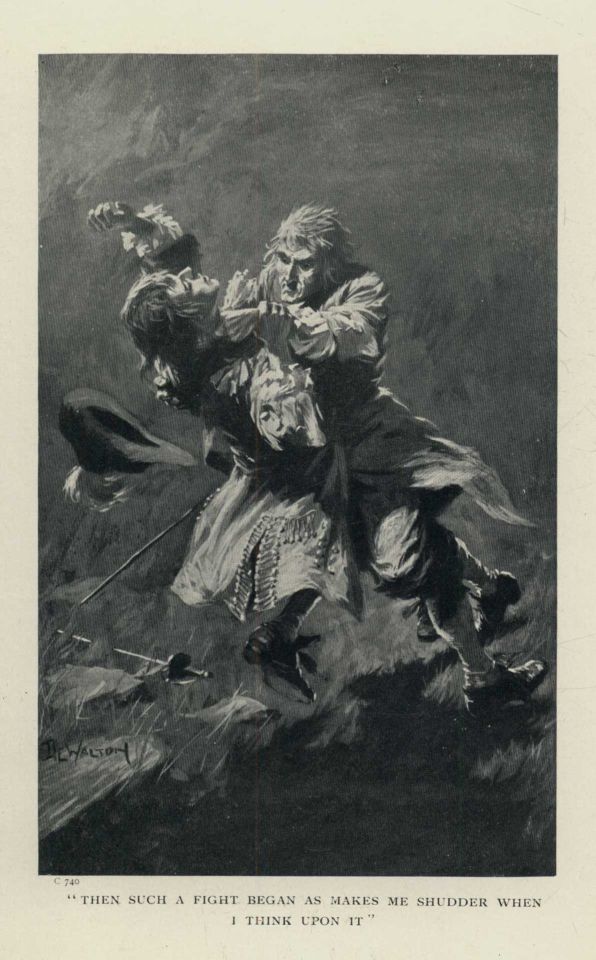
"THEN SUCH A FIGHT BEGAN AS MAKES ME SHUDDER WHEN I THINK UPON IT"
My strength must have been three times that of Ammon's in the way of common wrestling, but so close and snake-like were his methods that from the first he had the best of it. His legs and arms wound round me like the tentacles of an octopus, every moment tightening with a crushing, suffocating power.
In vain I struck and tore and wrenched: he seemed to have no flesh to bruise, no bones to break; a thing of steel and hide had not been more impervious to blows. His fetid breath was on my face, his cruel eyes were close to mine; it was a very nightmare of a fight, in which all skill and knowledge counted for nothing and were powerless to avail.
Thus to and fro we swayed like one, first this way and then that, until my strength and breath began to fail by reason of the hopeless, stifling struggle. With one last desperate wrench I tried in vain to cast the clinging demon from me. His bony hand shot out and gripped me by the throat, his left leg wound about my right, I staggered for a moment, then fell crashing backward. My head struck something hard, the moon shot zigzag down the sky, and with it went the grinning face of Tubal Ammon. Black darkness followed.
CHAPTER IX
The Shadow of Death
"Coome, now, zur, another soop o' this and you'm a man agen."
The words fell on my muffled ears as though the voice were calling from a distance; then the murmur of the sea broke in upon me like a sullen roar, as, with a wild, bewildering rush I rose to life again.
And thus I found that I was sitting up (or lolling like a sack of flour were better words for it), with a knee and arm behind me, while my head, which ached abominably, lay back upon a shoulder. So much I made out in that first dim gleam of consciousness, but for the rest of it I was still half-dazed and could not think.
"Another drop--joost one, zur," urged the voice again.
Something (a leathern bottle, as I found out afterwards) was pressed against my lips. I drew upon it with a will, then nearly choked. Hot, burning stuff it was, that sent the blood a-dancing through my veins like wildfire.
"Brandy!" I gasped, as soon as breath would let me.
"Aye, aye, you'm right, zur. Brandy it be--best French, too."
The cloud of black bewilderment was passing--the voice was now familiar. Glancing up I met the keen grey eyes of Daniel Ratlaw (or Rat as he was called), the greatest thorn in Dassell's side, because he was the king of cargo runners.
"Smuggled?" said I.
"Right agen," he nodded, with a wink. "Smuggled sure enough it were, but mebbe none the worse for that."
"Nay, surely, Rat," I murmured; then sat silent for a time, striving to collect my scattered thoughts, which so far had remained a wild unruly throng. The moon, which I had last seen shooting down the sky with Ammon's head for company, now shone brightly; and what was that which flashed its light back from the grass? My sword! When I saw that, the past rushed on me pell-mell. The poisoned arrow! Surely it was time that death was stealing over me! The throbbing of my head--was that not part of it?
I gave a shuddering downward glance towards my breast. The murderous little shaft was hanging from my coat. Ratlaw's eyes had followed mine and seen it also.
"Whoy, what be that?" says he, and tried to seize it, but I dashed his hand away.
"Have a care!" I cried, "'tis poisoned!"
And with that I plucked the arrow out and cast it clear into the bushes at my back.
"Poisoned!" gasped Dan, and very nearly let me drop.
"Yes," said I, "tipped with deadly poison. Say," I added, "do I look strange? Is my face black, or green, or blue?"
He laughed and answered:
"Nay, 'tis a lovely red, I vow."
That relieved me greatly; still, being far from satisfied, my hand went creeping to the spot where, as it seemed, the arrow had struck clean through to the breastbone, and there, beneath my coat, I felt the Black Box.
"Heaven be thanked!" said I aloud. "It saved me."
"What saved thee, friend?" asked Ratlaw with a puzzled look.
"Nothing," I answered quickly; then added, "or rather, you did, surely."
"Mebbe I did," said he; "you'm right agen, I reckon. Another minute--and----"
"Yes, yes," I put in eagerly; "pray, tell me all about it"--for indeed it seemed astonishing that Tubal Ammon had not finished me while yet he had the power to do so.
"Well, 'twere like this," quoth Ratlaw. "As I were a-cooming 'long oop over from--well, from minding that as needs the minding, I saw what looked like one great whopping man a-swaying in the moonlight. 'Twere a terror of a thing, I tell 'ee, and I were just a bit afeard; but on I coome, and then may I be drownded if that whopping man did not break clean in two, and one half of it (that's you) went flop. I heard your head go crack upon yon stump, then t'other half jumped on you, and I saw the flashing of a knife. I were close by then--a dozen yards away, not more--so I whips out my hanger here and cooms on roarin' like a lion. Joost in toime and only joost. The knife wor raised to stroike, when, hearing me, he joomps oop, snarls at me loike any dog, and flies off cursing. And oh, the face of en! Zur, if 'twere not the Evil One hisself, who wor it?"
"The Evil One himself," I answered slowly.
"Aye, sure, or you had killed a dozen such as he wi' that." He pointed to my sword.
I nodded, then asked:
"How long have I been here?"
"Mebbe the quarter of an hour."
"Ah! so long? And which way ran this villain?"
"Ran? 'Twere no running, zur," replied Dan Ratlaw. "He flew! Yea, as I live, he sailed above yon bushes like a bat. And may I be clean drownded, zur," he added in an awful whisper, "if blazing fire did not drop from en as he flew."
I understood. Ammon had shed gold in flight.
"But which way did he go?" I asked again.
"Straight for The Havering yonder," answered Rat, "and like enough he'll be a-perching on the roof of it."
Then, for the second time that night, a clammy sweat broke out upon my face. Ammon! The Havering! My father!
"Rat," said I, "I must for home at once."
"Whoy, zur, what's wrong?" he asked.
"Naught, but I must away at once."
"I be afeard thou canst not walk," said he. "Take one more pull at this fust."
He held the bottle to my lips.
"No, not a drop. Give me a hand up, man, that's all," said I.
He did it, and, staggering to my feet, I stood there swaying for a moment, giddy and bewildered. Then, when I had mastered this unsteadiness, I took Dan's hand and said: "You've saved my life, and I shall not forget it."
The trusty fellow rubbed a sleeve across his mouth but answered nothing; then his hand went down into his pocket and came forth glittering with gold.
"See here," said he, with something of a shame-faced look, "I found this on the grass beside thee. Doubtless he meant to take it with him, but----"
"Nay," I put in quickly, "'tis not mine. 'Twas his, and now is yours by right. Therefore keep it."
"What, his?--the--the devil's?"
"Yes; and, look you, if you search the way he fled you will, methinks, find more of it. That was the falling fire you saw. His pockets bulged with gold."
So saying, I picked my sword up from the ground, and, leaving Ratlaw gaping with amazement, sped for home.
How I ran I know not, for my head was singing like a sea-shell, and my thoughts (if thoughts they could be called) were such a seething medley as it beats me to describe aright. And thus it came about that, scarce knowing how (as one but half-awake, that is), I reached The Havering gates. There I stopped a moment; then, passing through, crept like a thief into the house, and, having gently closed the door behind me, listened. All was silent, save for the mournful ticking of the great hall clock, which in such awful stillness broke on me like a death-knell.
Pressing both hands upon my throbbing head, I tried to think. My father might perhaps yet be up there wrestling with his trouble. If so, I must be ready with that great surprise which could not fail to put his care to flight.
Filled with this hopeful thought, I lit a candle, brought the Black Box forth, untied the binding cord, and opened it. Then, with a throttled cry, I staggered back, as though a blow had struck me. The box was empty! Ferguson had put the papers in his pocket--not in this; and, in his hurried flight, had left behind what was to me of no more value than a stone!
I could have cursed, or wept, or both, at such a bitter mockery as that; but I did neither. For a moment I stood staring blankly at the gaping box; then, having taken off my shoes, I seized the faithless thing, and, stealing silently upstairs, knocked at the study door. No answer came. I tried the latch. The door was locked. Strange! I had never known my father lock his door by night, though, to be sure, he sometimes did so in the day-time when he did not wish to be disturbed. I knocked again--much louder. Still no answer; then, listening, I heard a stealthy, creeping noise within. I did not wait a moment longer; hurling myself upon the door, I drove it crashing inwards.
Even as I thus burst in, the figure of a man shot past me, and, springing through the open casement, disappeared. Running to the window I looked forth, and saw the black, satanic form of Tubal Ammon fleeing down the moonlit garden. I watched him till he vanished like an evil shadow in the darkness of the trees; then, turning slowly, cast a fearful glance about the room.
At first I could make nothing out, for the candle had burned down into its socket, and all was dark; but, as I left the window, a straggling moonbeam, struggling through the chestnut tree (that fatal chestnut tree!), fell on a silvery patch above a high-backed chair. Slowly, with feet of lead, I moved towards it for a step or two, then stopped. My father sat there, with bowed head, as though he slumbered. What!--had he slept through such a turmoil?
Shaking from head to foot, I went close up and laid a trembling hand upon his shoulder--spoke to him. He neither stirred nor answered. Nay, he would speak no more, for when I took him in my arms I found that he was dead!
CHAPTER X
I Make a Solemn Vow
It may be that I am of a different make from other men--I know not; but in that awful moment, when heaven and earth alike were crashing round me, and my very life itself seemed rent asunder, I neither grieved nor wept. It was, indeed, as though a band of steel had forged itself about my heart and turned me into stone.
If it be hard to have no softened feelings at a time like that, then am I hard as granite; if it be wicked to be filled with vengeful thoughts in face of death, then am I wicked as the Evil One himself: for as I stood there with my father's icy hand in mine (the hand of him who had been everything to me), one thought, and only one, possessed my mind--the fierce resolve to be avenged on those who were his murderers, as truly as was Cain the murderer of Abel.
There was no mark of violence on him, save that his vest had been ripped open, and the key (that proof which was to win the price of blood!) torn from its ribbon. He had been dead some time--the brave, albeit weakened heart had given way at last beneath the strain of threatening danger, and Tubal Ammon, coming to give death, had found it there before him.
So much I noted, swiftly, clearly, as I stood there in that moonlit room of death; then, with the sense of having added years, in moments, to my life, I drew my sword, and holding it above the poor, bowed head, took one deliberate vow of vengeance.
Even as I did so, heavy hurrying footsteps sounded on the stairs, and glancing round, I saw a bunch of wondering, awestruck faces staring at me from the doorway. My crashing entrance had aroused the house, and here, half-dressed and ghost-like, were the servants.
The very sight of such a gaping, helpless throng stirred wild, unreasoning anger in a brain which hitherto had felt like lead. I must have turned upon them with a threatening fierceness, for they one and all fell backward with a fearful look.
"What now! What do you here?" I said.
"Oh, by the love o' Heaven, sir, what be wrong?" asked Tom, the groom, who held a flaring candle high above his head.
I paused a moment, then pointed to the chair, and answered:
"Your master sits there, dead!"
No cry or movement followed, but the glances cast upon me and my naked sword spoke plainly of the awful thought which filled each horror-stricken mind. Yes, for one throbbing instant it was clear to me that I was counted my father's slayer.
"Dead!" gasped Tom at last. "How, sir? Not--not killed?"
The hand which held the candle shook.
"No, not killed;" I answered slowly, for even in that blank, bewildering moment it flashed upon me that the truth could not be told to anyone without great danger. "No, not killed; he died as he had always wished to die--swiftly. Come now," I added, in a voice that sounded strange and far-off to my ears, "help me to bear him to his chamber."
No more was spoken.
The dawn of that the blackest day in all my life broke with a mocking splendour. The sun rose gloriously upon a green glad earth; the joyous song of birds, the scent of many flowers, the gentle whisper of the soft June breeze, the murmur of the sea--all these, the joyous signs of one more resurrection from the things of darkness, were there in plenty; but as I stood and looked down on my father's white, set face, I took no heed of them; they were less than nothing. The present was as a thing I had no part in; the past alone seemed real. A thousand memories of bygone years came flooding over me. It was as though I lived through all my life again, within that silent room of death.
Yet, notwithstanding this, my heart was still like stone; nor grief nor tears were mine. Instead, I vowed fresh vengeance. There should be no rest for me till both Ferguson and Tubal Ammon had been made to answer for their wickedness; until, that is, they had been hunted down and killed. The sword which had been girded on me by the hands now cold and stiff should also know no rest until it had avenged its giver's death. Henceforward that should be its work and mine.
So much I swore, and felt the better for it, yet not without some vision of the perils and the pitfalls which must certainly beset me ere my vow could be fulfilled.
And first among these stumbling-blocks there came the thought that none could help me. The truth about my father's death was one with which I could not trust a living soul; the threatening danger which had hovered over him, and killed him, now just as surely hovered over me; the secret which he had confided to my keeping scarce a day before was still a secret, though now known to three instead of four. Henceforth, in fact, 'twould be a deadly, silent warfare betwixt one and two, and well I knew that God's earth did not hold a blacker pair of villains than the chaplain and his creature Tubal Ammon. But that did not dismay me; nay, rather was I heartened by the thought that now, at least, I had a real work (however desperate) in life. For the rest of it, come rack, come rope, I would not flinch or turn aside. My course was clearly marked, and I was minded to run it with a will. My father's blood flowed in my veins, and though a cruel fate had snatched him from my side, he still was mine, and this that I was bent upon seemed but a poor plain duty due to one who had done everything for me. At any rate, 'twas all I could do now for him, and I would gladly give my life for its accomplishment.
It was such feelings and such fierce resolves as these which kept me up and made me adamant (I know it now--for afterwards, long afterwards, the crash came), and, looking back through many years, I see no reason to regret it; for it was this alone which made it possible for me to go about my many pressing duties firm-jawed, silent, and clear-headed. And this, I knew, was as my father would have had it, for he had ever little tolerance or sympathy for those who wailed and whimpered in the face of sorrow.
I will not dwell upon the many happenings of that dolorous day, for, indeed, they have no business in these pages, and so may be told swiftly in fewest words.
First, then, summoned hastily, came the family physician, an old grey-headed, owl-eyed man, who, as I always felt, knew far more about me than he ought to. He asked divers questions, got, I fear, short answers; then shook his head, and murmured:
"Ah! 'tis as I feared; 'tis as I always said; the heart hath failed."
He said this with a solemn sadness, but yet, as it seemed to me, with some small pride in that his prophecy had been fulfilled.
Next, eagerly (for ill news flies apace, and many messengers had been dispatched) came kith and kin, flocking like crows into the old ancestral tree, and, for the most part, trying hard (but vainly) to hide an eager curiosity by means of sighs and tears. In truth, their plaintive caws were little to my liking; and verily they must have thought me something of a hardened monster as I moved about among them, dry-eyed, immovable, and, as it seemed, bent only on cold business.
Thus the day passed swiftly, crowded as it was with thronging duties (for, in spite of everyone and everything, I had decided that my father should be buried on the morrow), and evening came before I found a chance of going out. But when the sun had set, I left the dismal cawing of the family crows, and, slipping forth, went down by unfrequented ways into the town. Moreover, I went fully armed, for who could tell what ugly violence or treachery might be abroad?
CHAPTER XI
I Live and Learn
The little town was all agog with men both young and old (farm hands for the most part), who had come in to join a cause which ignorance persuaded them would turn the kingdom upside down and make them so much richer by the doing of it. Most of them were armed; some wore green boughs stuck in their hats, while others waved them wildly; and everyone was shouting out these words, which already I was sick of hearing:
"A Monmouth! Liberty! The Protestant religion!"
Faith, 'twas as if the countryside had gone clean mad. "If this be how they go about the changing of a king," thought I, "then Heaven have mercy on them!"
There were many in this bawling throng who knew me, and not a few showed signs of speaking to me of my loss; but I would have none of it, and so passed by with nods or scanty greetings.
The Duke, I learned, had taken up his quarters at the "George", and thither, though scarce knowing why, I went; and what a sight and babel greeted me on drawing near the inn-yard! That of the previous night had been as nothing to it.
The yard, and half the narrow street besides, were packed with men whose one desire in life appeared to be to get inside the inn itself as speedily as possible; and, to that end, they elbowed, pushed, and wellnigh fought each other. They shouted, waved green boughs, sang hymns and psalms; while ever and anon an oath or curse rang strangely out as some poor wretch was crushed beyond endurance.
I watched them from a distance for a while in wondering silence, then going up I touched a burly, pushing yokel on the arm, and asked what was the meaning of so great a pother.
"Whoy, dost not know?" says he, regarding me with pity. "They be a-takin' down the na-ams i'soide thur, and we be all a-goin' to sign on."
"For Monmouth, eh?" said I.
"Aye, sure," says he. "Who else?"
"Have many joined?"
"Aye, hun'reds--thoosands! And you'm be just the sort o' man they be a-wantin', zurr," he added, looking me up and down admiringly. "Coom on! Coom! We be a-moovin' now. Kape tha' close behoind me, zurr."
And spreading out his arms he booed and barked as though the crowd before him were a flock of sheep intended for the slaughter--as, alas! full many of them were.
But although his words had made me quite as keen as he to get inside the "George", methought I knew an easier, swifter way of doing it than his, which, as it seemed to me, must surely take some hours.
So I forsook the crowd, which was far too busy to take heed of me, and slipping round into that quiet street from which I had escaped the night before, went up a narrow passage to the private side door of the inn. 'Twas fast, as had I imagined it would be, but when I knocked the bolts were hastily withdrawn, the door was opened cautiously, and there before me stood one of the thieving rascals who had tried to rob me of my horse.
He started back and stared. I frowned upon him boldly.
"What now?" said he when we had taken our fill of one another. "What is thy business, friend?"
His speech was thick, his face deep red, while as he stood there with a hand upon the door, he swayed a little.
"The same as yesternight," I answered.
"Ah--our--our--godly--chaplain, eh?" jerked he.
I nodded sternly.
"Ah, and what then?" he mumbled, stroking his beard as though unable to collect his thoughts. "Look you, friend, my orders are to keep the door 'gainst all intruders. Yet an your business be in truth with---- Ah, by my soul, friend, yes--that's it--the password of the night; what is it? Give it quickly, and pass on."
At first I felt inclined to turn and flee for it while yet there was a chance, not knowing whom the drunken lout might bring about my ears; but second thoughts constrained me to go boldly through with it, for verily I was in that state which cares not what may happen. Therefore I said:
"I do not know the password of the night."
"What's that?" roared he. "Business with godly chaplain and don't know password? Ho! ho! now, if that be not pretty!"
With that he put his arms akimbo and burst into a roaring laugh, so that for a moment I had half a mind to knock him down and stride across his barrel of a body. But cautiousness prevailed.
"Pretty enough, but true," said I. "For, look you, I have been away on very urgent business of the chaplain's since yesternight, and have but just returned here. Prithee, what is the password, friend?" I added quickly.
Perhaps it was the very brazenness of such a question that threw the muddled fellow off his guard; at any rate, he lurched towards me, and whispered underneath his ale-soaked breath:
"'Tis Zion, friend--Zion--mark you, Zion. Make sure on't, for it may serve thee well enough ere night be ended."
Little knowing how prophetic were those latter words, he drew aside; then, as I would have passed him by, he plucked me by the sleeve, and, with a knowing wink, said:
"A favour, friend, a favour. Speak well of one John Coram to his reverence, for verily my zeal is most abounding. Hark!" he added, raising a shaking hand as a great shout reached us from the street. "Doth not the Lord's cause prosper mightily? Yea, I trow it doth indeed. And what am I, John Coram, to be spoken well of to his reverence? Friend, it might seem to thee that I am overfull of ale, but 'tis not so; nay, I vow I never touch the stuff. 'Tis burning zeal which fills me, nothing else. Zeal, I say, zeal! zeal!"
Nodding heavily, he staggered over to a bench, and crashing down thereon, sat staring in amazement at his jack boots.
But having got thus far I craved some information.
"Where is the Duke?" I asked.
The fellow waved his hand and said:
"He sits in yon great room receiving followers."
"And is the chaplain with him?"
"Aye, verily, why not? Our godly chaplain is the friend of kings, and nigh as full of zeal as me, John Coram. Ho! ho! methinks that's good; ah, passing good be that. Ho! ho!"
I waited till his roaring laugh had sunk into a rumble, then fired a random shot.
"Did'st ever meet a man called Tubal Ammon?"
John Coram tapped his steel-cap, shook his head, and answered:
"Never heard that name; but say, what be he like?"
"A tall, thin, bony fellow; legs like broomsticks; face like parchment; eyes like slits; and short-cropped hair that grows straight up like grass. Moreover, he----"
"Stop!" broke in Coram, who had been following me with wondering eyes and gaping mouth. "What did you call him?"
"Tubal Ammon."
"Ah, then, it cannot be the same, and yet 'tis very like the man I met five years agone. His name was Israel Stark. 'Twas said that he had been a preacher of the Word, though when I knew him he was more a breaker of it, though, to be sure, he had some store of Latin ever ready on his tongue. Yet, for all that, he was the swiftest runner that I ever came across. Moreover, he could climb a tree like any squirrel. Aye, right well I mind me how I once did see him go clean up a----"
"Stay," I put in eagerly, "'tis the same man sure enough, in spite of names."
"What! hast thou met him too, then, friend?" asked Coram.
"Yes, I have met him too," I answered grimly.
"When?"
"Not many hours ago."
"And where?"
"Not very far from here."
John Coram rose up slowly from his seat, and so stood staring at me for a moment in a hungry fashion; then said he:
"I would with all my heart it had been me instead of you, friend; for with these hands of mine I would have wrung his wicked skinny neck."
"Ah, so you have a grudge against him, eh?" I asked, as carelessly as wellnigh throttling eagerness would let me.
"A grudge!" growled Coram. "Aye, friend, that doth not name the tithe of it. I would account it heaven itself to kill the fellow; for, verily, there's not a blacker villain on God's earth than Israel Stark, and well I know it."
"Ah, and how so?"
"Why, hearken. He came to me in sore distress--half-starved--a thing of skin and bones. He told me tales of savages and shipwrecks. I listened to those tales, had pity on him, took him in, fed, clothed him. And in the end he robbed me vilely; moreover, would have murdered me had not a friend come in the nick of time and saved my life. That friend he slew, and so escaped."
"Ah, then, we are one," said I.
"What mean you?" asked John Coram wonderingly. "Hath he injured thee as well, then?"
"Yes."
"How?"
"No matter. We are one, I say, and this our meeting may be fortunate for both of us. Listen! I would give you five gold pieces if you could find this Stark or Ammon for me so that I might kill him."
"What!" gasped Coram. "Five--gold--pieces--to do that which I would gladly do for nothing! But say, friend, if you met this fellow but a few hours back, hast now no sort of knowledge where he is?"
"No, none."
"Nor is that any cause for marvel," rejoined Coram; "for verily the fellow is a thing of darkness, passing like a shadow--well I know 'tis so. But count on me, friend, count on me; for if this mischief-worker still be in these parts, and catchable, he shall be caught. But stay, how shall I let thee know? Where shall I find thee, friend, in case of news?"
I paused a moment, looking fixedly at Coram. Could I trust the fellow? Yes, methought I could. "You will find me at The Havering," I said, "a house out yonder on the Uplime road. 'Tis a well-known place, and anyone will guide you thither."
"The Havering, The Havering," murmured Coram slowly, like one who conned a lesson. "Yes, methinks I've got that. And now for thy name, friend?"
Again I paused to scan his face; for verily the whole thing struck me as a most uncanny echo of that fateful meeting by the roadside less than a week before. But now, for all his bloodshot eyes and ale-marked face, it seemed as though I stood before a lusty, honest fellow. Moreover, when I came to think on it, a risk the more or less was of but small account, for who could suffer now except myself? Therefore:
"Fane--Michael Fane," I answered.
"Fane!" muttered Coram, with a thoughtful stroking of his beard. "Fane! That sounds familiar. Where did I hear it, now? Ah, I have it! 'Twas yesternight, as I kept guard in yonder street, I heard two fellows muttering round a corner. Their voices were so low that I could make little of the conversation, but more than once I caught the words 'Black Box' and 'Fane'. I tried to creep a little closer, but they heard me, and, coming out, slunk off."
"Ha! so? And could you see them? Didst make out who they were?" I asked, scarce able to prevent my hands from clutching him.
"Nay, for the moon was hid, the night full dark, and they passed by upon the other side. But they were friends--not foes--of that I am assured, for when I challenged them they gave the password of the night."
"You could make nothing of them, then?"
"Nay, naught; save that both were tall, and one--him nearest to me--wore a long black cloak."
"And did you mark which road they went?"
"Aye, verily, I followed them a little way, and saw them hurrying off towards the sea. But, say, why show you so much interest in this matter? Truly, they used thy name, but that doth count for little, being friends. Stay, though," he added quickly, "hast lost anything--a box, for instance?"
"No," I answered slowly. "I have lost my father."
John Coram eyed me for a moment in a startled fashion.
"Not killed?" said he at last.
"No; but lost no less for that," I answered.
"Aye, lad, I see--I know--I understand, for I, too, lost mine when I was young like thee. Yea, 'tis a grievous thing, indeed, to lose a father."
The bloodshot eyes that gazed into my own were sad; the voice, though rough and thick, yet rang with kindness. The things about me seemed to fade away, and I saw nothing save that waxen, upturned face at home. John Coram's voice recalled me. "Say, friend," said he, laying a hand upon my arm, "what secret lies behind this matter? Go you in fear of anyone?"
For a moment I was tempted to trust the fellow and tell everything, but wisdom pointed otherwise.
"In fear of anyone!" I echoed with a mocking laugh. "Nay, save me that, I pray you. 'Twas but an idle fancy, nothing else. I only wondered (foolishly enough) if Stark could have been one of them."
"Stark!" cried Coram, springing back. "Now, by my life, how came you to think that?"
"An idle fancy, as I said before, and nothing else. These fellows gave the password of the night, and so were friends. They used my name; and, pray, why not, when it is free to all? Enough, let's say no more about it." I stopped and looked at him, then put a last, most daring question, saying: "I wonder if our godly chaplain knows Israel Stark or Tubal Ammon (to give him both his names). Think you he does?"
On hearing this, John Coram drew away, and stared at me as though I had gone daft; then, throwing back his head, laughed loud and long.
"Ho! ho! if that be not a merry jest, then show me one," cried he. "Doth Master Ferguson know Israel Stark? Oh, by my life, 'tis good--'tis passing good. But, look you, friend, I'll answer it by asking thee a question. Doth Satan mix with angels?"
"It seems to me it may be so," I answered darkly.
John Coram started back, and cast a swift, uneasy glance at me.
"What mean you by such words as those?" he asked.
"Naught," I answered quickly; "nor must I tarry longer. Remember, five gold pieces if you bring me certain news of Tubal Ammon's whereabouts; and here, by way of token, is a crown-piece on account."
"Thou art a rare good fellow, friend," he murmured, staring at the coin; "strange, indeed, but passing good. Nor will I fail thee. True, there is much mystery in the matter, yet I ask no questions. We both want Israel Stark--that's quite enough for me. Yea, 'tis a handsome bargain, friend, and I, John Coram, will stick unto it like glue."
He held a big rough hand out, and I grasped it tightly, for, notwithstanding too much ale and a rather muddled pate, I looked upon him as a kind of brother.
"Yes," said I, "'tis true there is some mystery in this affair; but, as we have one end in view, that matters nothing. Let us not fail each other, that is all."
"Aye, true," said he; "but, look you, friend, 'tis said the Duke rides out of Lyme within a day or two from now. What then?"
"Ah! what then?"
"Well, go you with us?"
"I know not where I go," I answered, turning with my hand upon the door-latch; "but much may happen ere the Duke rides forth. In the meantime I will not lose sight of you; rely on that."
With that I would have gone, but Coram stopped me.
"Stay! one moment, friend," said he, raising his blinking eyes no higher than my waist-belt. "That small affair about thy horse last night. Is it forgiven me?"
"Forgiven and forgotten," I replied.
He heaved a mighty sigh; and I went forth to seek the "godly chaplain".
CHAPTER XII
How I was Saved from Rashness
Turning down a stone-flagged passage, I made for a small, snug parlour, where I had oft held private converse with the landlord and his daughter Miriam, especially the latter. I found the door wide open and the room deserted, but that did not prevent my entering, for indeed the house had ever been a sort of second home to me; and, as things were just then, I did not crave for any company, and silence seemed a blessed thing.
So, standing with my hands behind me, and back towards the empty fire-place, I took swift thought, if thought it could be called--for what a medley filled my brain! John Coram's words had let in such a blinding light upon the question nearest to my heart that I was fairly dazzled and bewildered by it. Thus, there was the mischief-working demon with two names; his meeting on the previous night with Ferguson, not a stone-throw from the spot where I was standing; their slinking by the very man who was as zealous to kill Ammon as I was myself; and, finally, the mocking thought that, in his ignorance, John Coram looked on the murderous chaplain as a thing of spotless righteousness--fit company for angels.
A bitter laugh escaped me when I thought of that, and what the ale-soaked trooper would have said and looked like if I had told him all I knew about his saintly reverence.
This led me to consider whether I could trust myself so far as to look on Ferguson just then--supposing Coram had been right in stating he was with the Duke. For might I not, in spite of cooler, better judgment, be constrained to fire a pistol at him, and thereby bring swift death upon me? Yes, in my then fierce, desperate state, it seemed most likely that I should thus lose myself. What then? Why, to begin with, Tubal Ammon would live on, unless John Coram found and settled with him--which I doubted, for indeed there seemed in him no sort of match for Ammon's wriggling craftiness. Thus, in attempting to kill Ferguson (and such a wild excited shot might easily miss its mark!) I should be foiled of doing that which lay still nearer to my heart's desire. Again, my father must be buried on the morrow, and that he should be laid to rest without his son to mourn him was unthinkable.
No, my life, barren and blighted though it was, must not be risked that night, too much depended on it. For a time, at least, I must restrain myself, meet craftiness with craft and guile with guile.
These thoughts, which were so strange a mixture of cold reckoning and burning hate, left me where I had been. A hot and overmastering desire was on me to watch Ferguson, gloat over him, and see how one who had so vilely bargained for my father's death could play the part of holiness before Duke Monmouth and his followers. The very words with which he had thus bartered life for gold rang in my ears; and once again the vision of my father's white set face rose up before me. And then I muttered something, loosed my sword within its sheath, and cast a hungering glance down at the pistols in my belt.