"SKIPPERING A SCOW" ON THE ATHABASCA
Reading edition
(Continued from last number)
By N. A. Howland
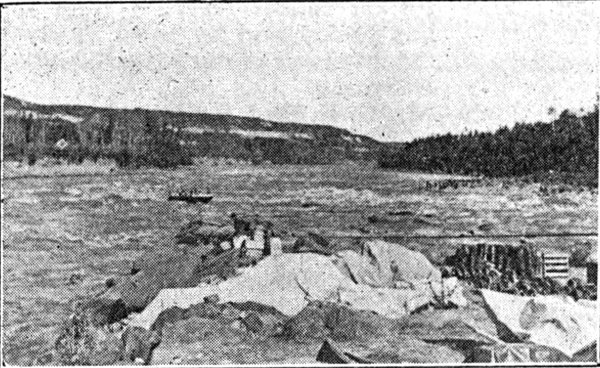
When the men in the scow realized their position they did not shout frenziedly for help. To them the most important business of the moment was to get a smoke.
They Smoked While Facing Death
The frenzied people were all on shore. Under the calming influence of tobacco, the wrecked crew surveyed the damage. The boat was intact though leaking a little. It was impossible for them to extricate themselves. Even if any of them could swim, an attempt to make the shore would have proved fatal. They relied on us. Their hope was founded on a rock as surely as their craft.
Getting Ready for the Rescue
It was not long ere some of the sixty odd men, at Mr. Cornwall's direction, on the island had run to the warehouse to get rope. Fortunately being on the scene, he took matters in hand, and as soon as the necessary tackle had been brought, essayed to rescue the endangered crew. The only way that this could be done was to get a line aboard the scow and pull her off. The distance from shore was too great to permit of a rope being thrown, but there was a rock standing well out of the water about half way between, from which it might be possible to hurl a stick; so Cornwall, taking a club in his hand to which was attached a long cord held by the men on shore, started to work his way out to the vantage point through the rock-studded stream, struggling from boulder to boulder, the swirling water gripping and tearing at his legs in an effort to sweep him away.
Fighting the Torrent
To the tense crowd of men watching it seemed impossible that he could attain his object, but in spite of the great physical strain slowly and surely the figure—now waist deep in the current, now pulling himself up on to a rock, clinging always to the meagre support with a tenacity that the raging torrent could not break—reached its goal.
Getting A Line Aboard the Wreck
A sense of relief came to those who watched, but not for long. He rested for a moment to recover his breath; then coolly gathering the small rope into a coil he made the first throw. A gasp went up from the crowd on shore. The distance was too great; the stick hit the water fully twenty feet short. Again and again the attempt failed. Sometimes the missile fell so close that the rope could almost be reached but they had no boat-hook aboard. The thrower could not stand up with good footing to do his work, but from a precarious position threw with arms alone. He rested, tired by his exertions. Suddenly he gathered all his strength and at imminent hazard of hurling himself into the river sent the stick with unerring aim over its mark.
We Pulled the Scow Off the Rock
A mighty cheer went up from all the watchers. It was but a moment's work to haul in the cable and make it fast to the end of the scow; every available man on shore found a place on the line, and pulled with might and main to the cry of "Yo heave ho!" that she creaked in every seam and her square end was drawn bow-shaped under the strain on that fragile rope. Pull as we might, our efforts to dislodge her were unavailing. Something had to give, however. It was the line which parted with a snap, hurling us to the ground. A groan went up from those in danger, for in a moment they fell from the highest hope to the lowest depth of despair. They were in worse plight than before, but steadfastly the business of renewing communication with the scow proceeded without delay. Cornwall's efforts were again crowned with success. Little by little our task was accomplished and we were gratified to see the men who were in the water scramble aboard in great haste, as with a rousing cheer we let go the cable.
A Tenderfoot Spectator
When we had first arrived at the head of the rapids the previous day, a little man with a large outfit was found encamped on the river bank unable to proceed any further, waiting for something or somebody to turn up. Ten days had passed before help arrived. He had been brought hither by a gasoline engine and canoe, his only companions so far as is known being two spaniels. This gentleman styled himself a prospector ostensibly bound for Fond-du-Lac to investigate the silver strike there; but his proceedings and appearance belied the assertion, for if there were a man who should not have left the shelter of the paternal wings, it was he. The impression gained was that he was one of those helpless useless atoms of humanity that are misfits anywhere, but in the North, where one must be self-reliant, doubly out of place. He having arranged with Mr. Cornwall for a "lift" from there to Fort McMurray, lay all day on his bedding in the sand surrounded by his goods and chattels, playing with his dogs, bestirring himself only to take a photograph occasionally or get a bite to eat.
Fondled His Spaniels and Looked On
He was apparently oblivious to the tragedy being enacted within a hundred yards of him. This man called down upon himself the contempt and scorn of all men present by remaining inert, lazily fondling his spaniels whilst men's lives trembled in the balance. His hand upon the rope would not perhaps have helped much, but we should at least have known that he was a man. The sequel to his apathy was that next day he was deposited on the main land below the rapids and where it was intimated to him that his company was no longer desirable.
An All Night Mosquito Raid
Whether fired by a spirit of recklessness by the events of the day, or whether the writer was too tired to return to his camp on the mainland with the men is of little consequence, but be it known that his mosquito-bar was there. Needless to say, the mosquitoes were victorious. We needed no alarm clock that morning because the enemy forced me out of bed during the night to upbraid myself for a fool. Not a wink of sleep for me as a result; however, we got an early breakfast out of it.
The Tug "Crester" Wrecked
My Russians were making good progress removing the rails, the freight having been all portaged, and the scows run through the previous day were being drawn up to the Island and reloaded. About 10 o'clock Captain Barber started to run the tug "Crester" through the rapids without steam, steering with auxiliary in case of accident. Disaster dogged the footsteps of the railroad party apparently. Nothing had gone well so far. The climax had arrived. Those who were watching the river gave a shout. All eyes went to the rapid immediately; there was the "Crester" shooting down through the roughest of the water well over on the land side, out of control. We learned later that her rudder had been smashed. We saw her take a few bad bumps from a distance of two hundred yards; then with a final heave she seemed to be lifted bodily and dashed on the rocks close inshore where she lay a wreck with her bottom stove in, broadside to the current with the waves breaking over her.
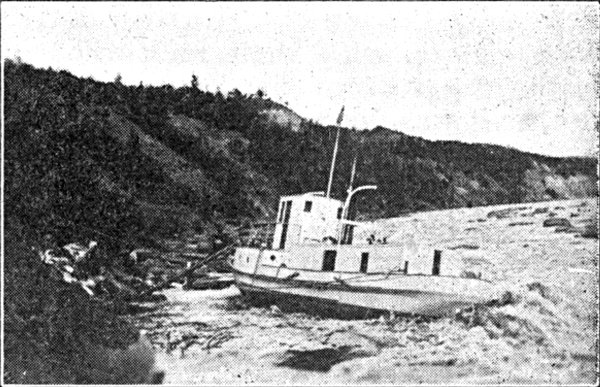
The "Crester" Dismantled
There were no casualties. With the aid of spars, the crew were easily able to make the land. It was the middle of the afternoon before it was possible for me to go over and see the tug. In the space of six hours the captain, engineer and boatmen had her completely dismantled and all her "innards" ashore, whilst preparations were being made to pull her off and float her down the rest of the way into the Big Eddy, where she could be patched up.
(To be continued)