FAMOUS TRIPS BY H.B.C. DOG TEAMS
Reading edition
107 Miles from Dawn to Dark
By H. M. S. COTTER, Cumberland House
In the year 1896 I was in charge of H.B.C. Northwest River Post on the Labrador. It was customary for the post managers to assemble annually at district headquarters which at that time was located at Rigolet on the coast. This council was usually held in April on a specified date. Rigolet is ninety-two miles from Northwest River by the winter trail. The trip occupies two days as a rule, and when we left the Post it was the intention as usual to run the first fifty miles and camp for the night at a place named the Lowlands.
The feet of the dogs are protected by deerskin moccasins from laceration on sharp edges of the ice
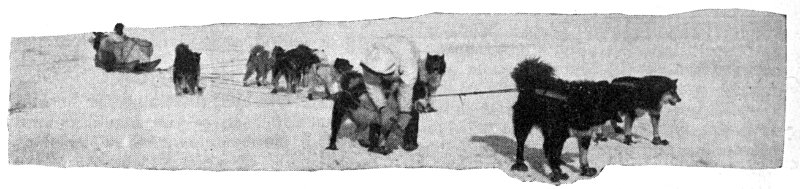
We had the ordinary length of sled or "komatik," which is about twelve feet long and weighs about a hundred pounds. We carried a load of about six hundred pounds, which in that part of the country is considered light.
We left the Post at 4.30 a.m. April 7th, 1896, just before dawn. The sky was somewhat overcast and a light wind was blowing from Southwest. The travelling was good, particularly in the early morning, as the melted snow of the previous day had dried up during the night.
Our nine dogs were in the very pink of condition. They displayed a fierce eagerness to reach the sealing grounds, nine miles below the Post.
"Lieutenant" was the leader's name, and second leader, "Friday." Both these dogs were famous as seal hunters. There was "nothing on four legs," it was claimed, ever approached them either in respect of speed or ability to scent seals at long distance. After we reached the sealing grounds the team broke into a mad pace. No sooner had they run down one batch of seals than the leaders would scent others long before they were visible. In this way the speed of the whole team was maintained at a high rate.
As the local saying was, the dogs were "seal mad" and getting out of hand. I had been over these sealing grounds many times, but never had seen so many seals as on this day. Around the seal or blowing holes they were not in large numbers, but along the cracks which opened across the bay and ran for fifteen or twenty miles, the seals were literally in thousands. It was good sport chasing them. We stopped several times and speared four, adding about three hundred pounds to our load. But this seemed to make no difference in the speed of the dogs.
Finally we got into the Lowlands just before noon, having covered fully sixty-five miles of our journey. As it was yet early and the dogs appeared fresh as when they started, we decided after having a light lunch, to go on to the next stopping place seventeen miles below. The going was excellent and we did the first twelve miles in ninety minutes; but coming to rough and hummocky ice we had to bear in towards the shore to get around it. The wind had swept the rocks clean of snow. Just as we got on land some caribou appeared across our course immediately ahead. Well, talk about dogs moving! Their former speed seemed slow in comparison. They raced over the naked rocks like wolves. I remember looking behind and seeing a stream of fire flying from the steel shoeing of the sledge like a shower of sparks from a high-speed emery wheel. The caribou moved off into the valley and we had a tough job to get the team onto the ice again. Here we came in sight of more seals. Off we went again from our course and past the stopping place we had planned; so we decided to go right on to our destination. We arrived at Rigolet before 8 p.m.
The Post managers came out and greeted us warmly, remarking however that we had made slow time, arriving so late in the evening. They thought we had left the previous day. When I announced that we had left only that morning they said "like —— you did." We had lost two hours, but in the fourteen and a half hours we had been actually travelling we had covered a hundred and seven miles. I am not claiming this is a record, but it is one of the fastest trips ever made by an H.B.C. dog team with full load.
Editor's Note—Mr. James Fraser, who later became H.B.C. District Manager in Esquimaux Bay, made the trip from Rigolet to Northwest River in one day on a previous occasion, but as he lost a twenty-eight pound keg of white lead on the way up much of the glory vanished. The foregoing is the first of a series of authentic stories which The Beaver plans to carry in a regular department which may be styled the "Dog Column"—just plain DOG. Men of the Hudson's Bay: bestir your "recollection equipment" and let us know if you have a better dog story than Mr. Cotter's. Particularly are we expecting to hear from J. J. G. Rosser, of Isle a la Crosse, and Ashton Alston, of Barriere, both famous "dog skinners."