Part 3 — The True Lover's Knot Untied: Being the right path whereby to advise princely Virgins how to behave themselves, by the example of the renowned Princess the Lady Arabella, and the second son of the Lord Seymour, late Earl of Hertford.
Reading edition
The beautiful, much-injured, and ill-fated Lady Arabella of this touching ballad, whose sole crime was that she was born a Stuart, was the daughter of Elizabeth Cavendish of Chatsworth, in Derbyshire, by her husband Charles Stuart, Earl of Lennox, who was brother to Lord Darnley, the husband of the unfortunate Mary Queen of Scots. She was grand-daughter of Sir William Cavendish of Chatsworth, and of his wife, the celebrated "Bess of Hardwick," afterwards Countess of Shrewsbury.
The incidents of the life of this young, beautiful, and accomplished lady, which form one of the most touching episodes in our history,—the jealous eye with which Elizabeth looked upon her from her birth,—the careful watch set over her by Cecil,—the trials of Raleigh and his friends,—her troubles with her aunt (Mary, Countess of Shrewsbury),—her being placed under restraint,—her marriage with Seymour,—her seizure, imprisonment, sufferings, and death as a hopeless lunatic in the Tower of London, where she had been thrown by her cousin, James the First,—are all matters of history, and invest her life with a sad and melancholy interest.
As the autograph signature of this ill-starred but lovely and exemplary young lady is but little known, I append a fac-simile,
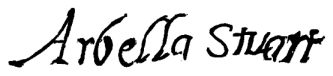
which no doubt will add to the interest of the following ballad. The ballad was sung to the tune of "The Frog Galliard."
As I to Ireland did pass, I saw a ship at anchor lay, Another ship likewise there was, Which from fair England took her way. This ship that sail'd from fair England, Unknown unto our gracious king, The lord chief justice did command, That they to London should her bring. I then drew near and saw more plain, Lady Arabella in distress, She wrung her hands, and wept amain, Bewailing of her heaviness. When near fair London Tower she came, Whereas her landing place should be, The king and queen with all their train, Did meet this lady gallantly. "How now, Arabella," said our good king, Unto this lady straight did say, "Who hath first try'd thee to this thing, That you from England took your way?" "None but myself, my gracious liege, "These ten long years I have been in love, With the lord Seymour's second son, The earl of Hertford, so we prove: "Full many a hundred pound I had In goods and livings in the land, Yet I have lands us to maintain, So much your grace doth understand. "My lands and livings so well known Unto your books of majesty, Amount to twelvescore pounds a week, Besides what I do give," quoth she. "In gallant Derbyshire likewise, I ninescore beadsmen maintain there, With hats and gowns and house-rent free, And every man five marks a year. "I never raised rent," said she, "Nor yet oppress'd the tenant poor, I never did take bribes for fines, For why, I had enough before. "Whom of your nobles will do so, For to maintain the commonalty? Such multitudes would never grow, Nor be such store of poverty. "I would I had a milk-maid been, Or born of some more low degree, Then I might have lov'd where I liked, And no man could have hinder'd me. "Or would I were some yeoman's child, For to receive my portion now, According unto my degree, As other virgins whom I know. "The highest branch that soars aloft, Needs must beshade the myrtle-tree, Needs must the shadow of them both, Shadow the third in his degree. "But when the tree is cut and gone, And from the ground is bore away, The lowest tree that there doth stand, In time may grow as high as they. "Once too I might have been a queen, But that I ever did deny, I knew your grace had right to th' crown, Before Elizabeth did die. "You of the eldest sister came, I of the second in degree, The earl of Hertford of the third, A man of royal blood was he. "And so good night, my sovereign liege, Since in the Tower I must lie, I hope your Grace will condescend, That I may have my liberty." "Lady Arabella," said the king, "I to your freedom would consent, If you would turn and go to church, There to receive the sacrament. And so good night, Arabella fair," Our king replied to her again, "I will take council of my nobility, That you your freedom may obtain." "Once more to prison must I go," Lady Arabella then did say, "To leave my love breeds all my woe, The which will bring my life's decay. "Love is a knot none can unknit, Fancy a liking of the heart, Him whom I love I can't forget, Tho' from his presence I must part. "The meanest people enjoy their mates, But I was born unhappily, For being cross'd by cruel fates, I want both love and liberty. "But death I hope will end the strife, Farewel, farewel, my love," quoth she, "Once I had thought to have been thy wife, But now am forc'd to part with thee." At this sad meeting she had cause, In heart and mind to grieve full sore, After that time Arabella fair, Did never see lord Seymour more.