Ashur-bani-pal, Book-Collector and Patron of Learning.
Reading edition
Ashur-bani-pal (the Asnapper of Ezra iv, 10) succeeded his father Esarhaddon B.C. 668, and at a comparatively early period of his reign he seems to have devoted himself to the study of the history of his country, and to the making of a great Private Library. The tablets that have come down to us prove not only that he was as great a benefactor of the Library of the Temple of Nebo as any of his predecessors, but that he was himself an educated man, a lover of learning, and a patron of the literary folk of his day. In the introduction to his Annals as found inscribed on his great ten-sided cylinder in the British Museum he tells us how he took up his abode in the chambers of the palace from which Sennacherib and Esarhaddon had ruled the Assyrian Empire, and in describing his own education he says:
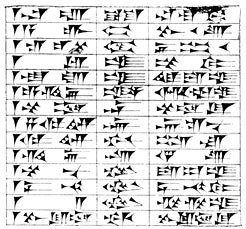
Extract from a List of Signs with Sumerian and Assyrian values. From Rawlinson, Cuneiform Inscriptions of Western Asia, Vol. II, Plate I, ll. 155–168.
Ashur-bani-pal was greatly interested in the literature of the Sumerians, i.e., the non-Semitic people who occupied Lower Babylonia about B.C. 3500 and later. He and his scribes made bilingual lists of signs and words and objects of all classes and kinds, all of which are of priceless value to the modern student of the Sumerian and Assyrian languages. Annexed is an extract from a List of page 18Signs with Sumerian and Assyrian values. The signs of which the meanings are given are in the middle column; the Sumerian values are given in the column to the left, and their meanings in Assyrian in the column to the right. To many of his copies of Sumerian hymns, incantations, magical formulas, etc., Ashur-bani-pal caused interlinear translations to be added in Assyrian, and of such bilingual documents the following extract from a text relating to the Seven Evil Spirits will serve as a specimen. The 1st, 3rd, 5th, etc., lines are written in Sumerian, and the 2nd, 4th, 6th, etc., lines in Assyrian.
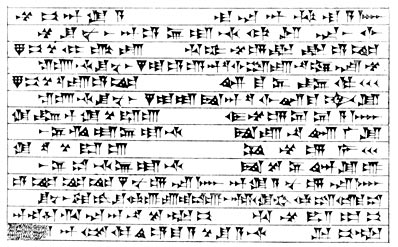
Extract from a tablet containing a text relating to the Seven Evil Spirits, written in the Sumerian language, with an interlinear translation in Assyrian. From Rawlinson, Cuneiform Inscription of Western Asia, Vol. IV, Plate XV, Obverse, ll. 33–46 (K. III—K. 2754).
The tablets that belonged to Ashur-bani-pal's private Library and those of the Temple of Nebo can be distinguished by the colophons, when these exist. Two forms of colophon for each class of the two great collections of tablets are known, one short and one long. The short colophon on the tablets of the King's Library reads:—"Palace of Ashur-bani-pal, king of hosts, king of the country of Assyria" , and that on the tablets of the Library of Nebo reads:—"[Country of ?] Ashur-bani-pal, king of hosts, king of the country of Assyria" . See on the Tablet of Astrological Omens, page 19 p. 22. The longer colophons are of considerable interest and renderings of two typical examples are here appended:—





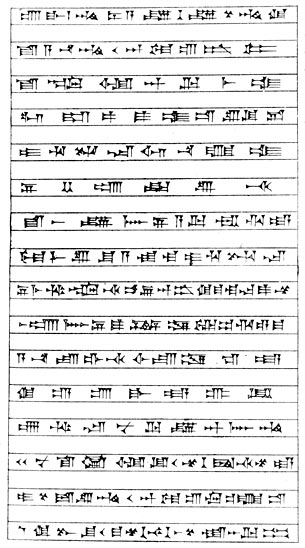
Colophon of a tablet from the Palace Library of Ashur-bani-pal containing incantations in the Sumerian language, with interlinear translations in Assyrian. For an English rendering see following page. From Rawlinson, Cuneiform Inscriptions of Western Asia, Vol. IV, Plate VI, col. 6 (K. 4870).