THE “AYESHA”
Helene S. (Helene Schimmelfennig) White translation
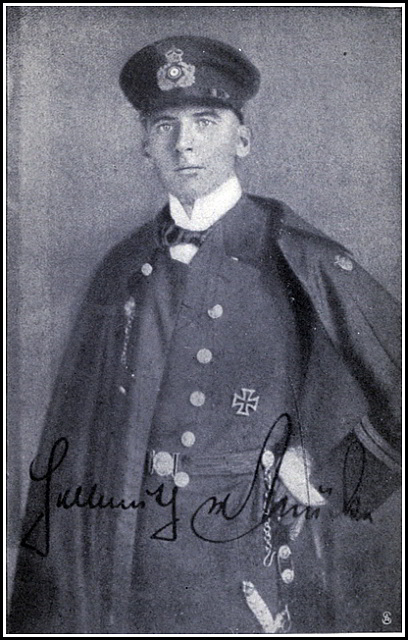
VON MÜCKE
The “AYESHA” BEING THE ADVENTURES OF THE LANDING SQUAD OF THE “EMDEN” BY Kapitänleutnant HELLMUTH von MÜCKE
TRANSLATED BY HELENE S. WHITE RITTER & COMPANY BOSTON, MASS.

Copyright, 1917, by RITTER & COMPANY All rights reserved, including the translation into foreign languages, including the Scandinavian First Printing, January, 1917 Second Printing, February, 1917 THE · PLIMPTON · PRESS NORWOOD · MASS · U · S · A
TRANSLATOR’S PREFACE
The translator has so enjoyed rendering this little volume into English, that she feels impelled to testify to the pleasure it gave her, and to express a hope that it may find many readers who will follow its record of valiant deeds with as great interest.
That men placed in almost daily peril of their lives can retain their sense of humor and a kindly attitude toward men and circumstances throughout a desperate struggle with adverse conditions is a happy testimony to the buoyancy and to the superiority to the merely physical that courage in the face of danger begets.
Although always bravely confident, there is an engaging ingenuousness and freedom from self-conceit in Lieutenant von Mücke’s delightful recital of his amazing achievement, while his never failing appreciation of the humorous side of the situation illumines the entire narrative as with flashes of sunshine.
The translator desires also to acknowledge her indebtedness to an earlier but unpublished translation of the book by Mrs. Anne Richmond Vaughan.
Helene S. White
January, 4th, 1917.
FOREWORD
That TRUTH IS STRANGER THAN FICTION is amply illustrated in the following gripping narrative. I have read practically all the stories and yarns of this war, many in their original languages, but I have found none to surpass this interesting tale. In the years to come, all men, especially those “who go down to the sea in ships,” will find in these adventures some very profitable lessons in perseverance, resourcefulness and courage. Although this feat may be dimmed by the light of the major operations of the war, I predict that no reader who has once started to read this book will fail to complete it, nor on completion, will he fail to say that he has enjoyed a most interesting series of adventures.
J. H. Klein, Jr., Lieutenant, U.S. Navy.
Washington, D.C. 3 January, 1917
CONTENTS
CHAPTER PAGE
I. Keeling Island 1
II. The Ayesha 12
III. On Board 27
IV. A Fine Day on Board 39
V. An Uneasy Day 45
VI. Padang 53
VII. The Meeting with the Choising 76
VIII. The Passing of the Ayesha 88
IX. From Perim to Hodeida 98
X. On to Sanaa 121
XI. Shipwreck 140
XII. The Attack 160
XIII. To the Railroad 204
XIV. Homeward Bound 220
LIST OF ILLUSTRATIONS
Kapitänleutnant von Mücke (after his return) Frontispiece
The Ayesha page 16
Von Mücke (from an earlier photograph) " 72
View of Hodeida; Crossing the Desert " 132
Map of Arabia " 166
Map showing the entire trip from Keeling Islands to Constantinople " 218
Chapter I
KEELING ISLAND
“I report for duty the landing squad from the ship,—three officers, six petty officers, and forty men strong.”
It was on the ninth of November, 1914, at six o’clock in the morning that I reported for duty to the commanding officer of His Majesty’s ship, Emden, Captain von Mueller, at the gangway of the ship. The Emden was lying at anchor in Port Refuge, a harbor formed by Keeling Reefs. Alongside were the two cutters in which the officers and men of the landing squad had already taken their places. The steam launch was ready to push off and tow them ashore. My orders were to destroy the wireless telegraph and cable station on Direction Island, which is the most northerly island of the Keeling group, and to bring back with me, in so far as possible, all signal books, secret code books, and the like.
Three cables run from Direction Island, one line to Mauritius, another to Perth in Australia, and a third to Batavia. As this station was the last absolutely British connection between Australia and the motherland—the other cables having been cut by some of the other ships of our cruising fleet—we had every reason to suppose that we would meet with vigorous military resistance. For this reason we were taking with us all of the four machine guns that the Emden carried. Two were aboard the steam launch, the others had been put on the cutters. The men were equipped with rifles, side arms, and pistols. The launch took the cutters in tow, and we were off for Direction Island.
Even quite small boats must pick their way very carefully while within the waters of this atoll, [1]in order to avoid the numerous, constantly changing coral reefs. The course that we were to take from the ship to the point at which we were to land, covered a distance of about 3000 meters.
Direction Island is very flat, and is covered with a luxuriant growth of tall palms. Among their towering tops we could discern the roofs of the European houses and the high tower of the wireless station. This was our objective point, and I gave orders to steer directly for it. Just below our landing place a small white sailing vessel was riding at anchor.
“Shall we destroy that, too?” inquired one of my lieutenants, pointing to the little schooner.
“Certainly,” was my answer. “It has sailed on its last voyage. Detail a man at once to be ready with the explosive cartridges.”
With our machine guns and fire-arms ready for action, we landed at a little dock on the beach, without meeting with resistance of any kind, and, falling into step, we promptly proceeded to the wireless station. The destruction of the little white sail-boat was deferred for the time being, as I wished first of all to find out how affairs on shore would develop.
We quickly found the telegraph building and the wireless station, took possession of both of them, and so prevented any attempt to send signals. Then I got hold of one of the Englishmen who were swarming about us, and ordered him to summon the director of the station, who soon made his appearance,—a very agreeable and portly gentleman.
“I have orders to destroy the wireless and telegraph station, and I advise you to make no resistance. It will be to your own interest, moreover, to hand over the keys of the several houses at once, as that will relieve me of the necessity of forcing the doors. All fire-arms in your possession are to be delivered immediately. All Europeans on the island are to assemble in the square in front of the telegraph building.”
The director seemed to accept the situation very calmly. He assured me that he had not the least intention of resisting, and then produced a huge bunch of keys from out his pocket, pointed out the houses in which there was electric apparatus of which we had as yet not taken possession, and finished with the remark: “And now, please accept my congratulations.”
“Congratulations! Well, what for?” I asked with some surprise.
“The Iron Cross has been conferred on you. We learned of it from the Reuter telegram that has just been sent on.”
We now set to work to tear down the wireless tower. The men in charge of the torpedoes quickly set them in place. The stays that supported the tower were demolished first, and then the tower itself was brought down and chopped into kindling wood. In the telegraph rooms the Morse machines were still ticking busily. What the messages were we could not decipher, for they were all in secret code. But we chuckled with both amusement and satisfaction as we pictured to ourselves the astonishment of the senders, who were waiting in vain for a reply to their messages, for, from the vigorous action of the apparatus, we concluded that some information was eagerly desired. But this, to our regret, it was not in our power to furnish.
Our next duty was quite to the taste of my vigorous boys in blue. A couple of heavy axes were soon found, and, in a few minutes, Morse apparatus, ink bottles, table legs, cable ends, and the like were flying about the room. “Do the work thoroughly!” had been our orders. Every nook and corner were searched for reserve apparatus and other like matter, and everything that bore any semblance of usefulness in a wireless station was soon destroyed. Unfortunately this fate was shared by a seismometer that had been set up on the island. In their zeal my men had mistaken it for a lately invented addition to the telegraph service.
To locate and cut the submarine cables was the most difficult part of our task. A chart, showing the directions in which the cables extended, was not to be found in the station, but close to the shore we discovered a number of sign-boards bearing the inscription, “Cables.” This, therefore, must be the place where we must search for the ends of the cable strands. Back and forth the steam launch carried us over the cables that were plainly to be seen in the clear water as we tried to grasp them with a couple of drags and heavy dredging hooks, which we drew along the bottom. It was no light task, for the cables were very heavy, and the only power at our command was a very limited amount of human strength. For a while, it seemed impossible to draw the cables to the surface; in the end, after we had succeeded in raising the bight of the cable a little, my men had to get into the water, dive, and tie tackle to it, by the aid of which we continued our labor. With great difficulty we at length succeeded in getting the cable strands into the boat. I did not want to use any of the dynamite cartridges for the work of destruction, as the Emden might have need of them for the sinking of more steamers. So we set to work upon the stout cables with crowbars, axes, driving chisels, and other like implements. After long and weary labor, we succeeded in cutting through two of them, and we then dragged the ends out to sea, and dropped them there. The third cable was not to be found in spite of our diligent search for it.
A small house of corrugated iron, in which were stored quantities of reserve apparatus and all sorts of duplicate parts, was blown up and set on fire with a couple of explosive cartridges. All newspapers, books, Morse tapes, and the like, we took away with us.
Our landing squad was just about to re-embark when, from the Emden, came the signal “Hurry your work.” I quickly summoned my men, abandoned my intention of blowing up the small white schooner as a matter of little importance, and was on the point of pushing off from shore, when it was reported to me: “The Emden has just sounded her siren.” This was the command to return to the ship with the utmost despatch. As I was boarding the steam launch, I saw that the anchor flag of the Emden was flying at half mast, which told us that she was weighing anchor. The reason for this great haste was a mystery to me, and, for the present, was no concern of mine. All my effort was bent upon getting back to the ship as speedily as possible. With all steam on we raced toward the Emden, taking the shortest course between the reefs.
Meanwhile, the Emden had turned seaward, and was running at high speed out of the harbor. My first thought was that she was going to meet our tender, the Buresk, that had been ordered here with coal, and which, I supposed, she was going to pilot through the reefs. In this belief I continued to follow the Emden as fast as I could, but was surprised to find her going at a speed of from sixteen to seventeen miles. Our launch, with the heavily laden cutters in tow, could make barely four miles an hour.
Suddenly we saw the battle flags on the Emden run up, and then a broadside burst from her starboard. Even yet the reason for all this was hidden from me, and I believed the Emden to be in pursuit of a steamer that had come in view.
But now a salvo of five heavy shells struck the water just aft of the Emden; five tall waterspouts marked the places where they fell into the sea. There was no longer any room for doubt; we knew that a battle was on in earnest. The Emden’s opponent we could not see, for the island, with its tall palms, was between us. The Emden, in the meantime, had increased her distance from us to several thousand meters, and was adding to her speed with every moment. All hope of overtaking her had therefore to be abandoned, and I turned back.
Chapter II
THE “AYESHA”
We landed at the same place at which we had gone ashore before. Again I ordered all the Englishmen to assemble, and their fire-arms were taken from them. The German flag was raised on the island, which was declared to be under martial law; every attempt to communicate by signal with any other island, or with the enemy’s ships, was forbidden; my officers were given orders to clear the beach for defence, to mount the machine guns, and to prepare to intrench. Should the engagement between the two ships prove to be a short one, I could count with certainty upon the enemy’s cruiser running into port here, if for no other reason than to look after the station. It was not my intention, however, to surrender without a blow an island on which the German flag was flying.
The Englishmen on the island were little pleased at the prospect, and begged permission, in case it should come to a battle, to withdraw to one of the other islands. Their request was granted.
Accompanied by two of my signal men, I now took my station on the roof of the highest house to watch the fight between the two cruisers. As a whole, the Englishmen showed little interest in the conflict that was going on but a few thousand meters distant from the island. Other matters seemed to claim their attention. With an ingratiating smile one of them stepped up to our officers, who were head over ears in work down on the beach, and asked:
“Do you play tennis?”
It was an invitation which, under the circumstances, we felt compelled to decline.
By the time I had reached the roof, the fight between the Emden and the other cruiser was well under way. I could not identify the enemy’s ship, but, judging from her structure, and the amount of water raised by the falling shells, I concluded that it must be one of the two Australian cruisers, the Sydney or the Melbourne. As the columns of water raised by the enemy’s shells were much taller than those caused by the Emden’s, I estimated the guns of the enemy to be of 15 centimeter caliber.
The Sydney, for she it was, as I learned later, was more than a match for the Emden. Our ship of 3600 tons displacement could deliver a broadside of only five 10½ centimeter guns, and had no side armor, whereas the Sydney, being a vessel of 5700 tons displacement, could fire a broadside of five 15.2 centimeter guns, and had armored sides. From the very beginning, the Emden’s fire reached its mark on the enemy’s cruiser, whose guns, it must be said, were aimed pretty badly. The water spouts that were raised by their falling shells were mostly several hundred meters distant from one another. But when one of the volleys did hit, it made havoc on our unarmored vessel.
During the very first of the fight, the forward smoke stack of the Emden was shot away and lay directly across the deck. Another shell crashed into the stern aft of the cabin, and started a great blaze, the gray smoke of which was mixed with white steam, showing that the steam pipes had been damaged. The Emden now turned sharply about and made a dash for her foe, apparently for the purpose of making a torpedo attack. It cost her her foremast, which was shot away and fell overboard. For the moment it seemed as though the enemy’s ship intended to discontinue the fight, for she turned and ran at high speed, followed by the Emden. Whether the Sydney had suffered serious damage which could not be discerned from without, I could not tell. Perhaps it was simply her intention to increase her fighting distance from the Emden, in order to take advantage of the greater caliber of her guns. The running fight between the two ships now took a northerly course at an ever increasing distance from the island, and soon the two cruisers, still fighting, were lost to view beyond the horizon.
The point for me to settle now was what to do with the landing squad. So far as our ship was concerned, the damage she had suffered at the hands of a far superior foe was so great that a return to the island, even in the event of a most favorable outcome of the battle, was out of the question. She must run for the nearest port where she could make repairs, bury her dead, and leave her wounded. At the same time I could count with certainty upon the arrival of an English war vessel ere long in Keeling harbor, to learn what had befallen the cable and wireless station. For, had not the telegraphic service to Australia, Batavia and Mauritius been cut off entirely?
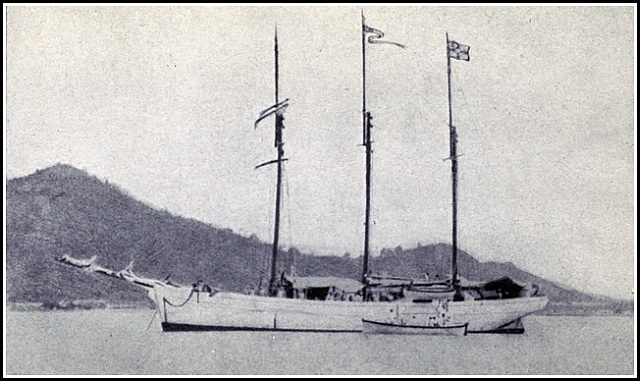
THE AYESHA
With our four machine guns and twenty-nine rifles we could, for the time at least, have prevented the English from making a landing on the island, but against the fire of the English cruiser’s heavy guns, which would then have been directed against us, we would have had no defence whatever. Taking everything into consideration, therefore, we could do no more than defer the surrender of a position that, from the outset, it had been impossible to hold. Moreover, confinement in an English prison was little to our taste.
Now, fortunately for us, the small white schooner that we had failed to blow up was still riding at anchor in the harbor. It could, and it should help us to escape from our predicament. I decided to leave the island on the little boat. Her name was Ayesha,[2] and at one time she had served to carry copra from Keeling to Batavia two or three times a year, and to bring provisions back with her on her return trip. Now that steamship service had been established between these two points, she lay idle and dismantled in the harbor, and was gradually falling into decay.
Taking no one with me, I got into the steam launch and went out to the schooner to learn whether she was at all seaworthy. The captain and a single sailor were aboard her. Of the former I inquired casually whether he had any ammunition aboard, for I did not wish him to suspect the real purpose of my coming. He said there was none, and a brief inspection of the ship led me to believe that she was still seaworthy. Consequently I sent my officers and men aboard the Ayesha to get her into trim for sailing.
There was plenty to do on the little ship. All the sails and rigging had been taken down and stowed away, and had now to be put in place again.
When the Englishmen on the island realized that it was my intention to sail off in the schooner, they warned me with great earnestness against trusting ourselves to her, saying that the Ayesha was old and rotten, and could not stand a sea voyage. Furthermore, they informed me that an English man-of-war, the Minotaur, and a Japanese cruiser were in the vicinity of the island, and that we would surely fall a prey to one of them.
As my predecessor in command of the Ayesha was leaving her, he wished us Godspeed, and concluded with the comforting remark, “But the ship’s bottom is worn through.”
When, in spite of all these warnings, we remained firm in our purpose, and continued the work of getting the Ayesha ready for sea, the sporting side of the situation began to appeal to the Englishmen, and they almost ran their legs off in their eagerness to help us. Could it have been gratitude that impelled them to lend us their aid? It is a question I have never been able to answer to my satisfaction, although, to be sure, several of them did express a feeling of relief at the thought that now the fatiguing telegraph service with its many hours of overwork, and its lack of diversion, was a thing of the past. They showed us where the provisions and water were kept, and urgently advised us to take provisions from the one side, where they were new and fresh, rather than from the other, where they were stale. They fetched out cooking utensils, water, barrels of petroleum, old clothes, blankets, and the like, and themselves loaded them on trucks and brought them to us. From every side invitations to dinner poured down upon us; my men were supplied with pipes and tobacco; in short, the Englishmen did all they could to help us out.
Nor were they sparing with advice as to the course we ought to take, and time proved that all they told us of wind and weather, of currents, etc., was in every way trustworthy. As the last of our boats left the shore, the Englishmen gave us three hearty cheers, wished us a safe journey, and expressed their gratitude for the “moderation” which we had shown in the discharge of our duty, wherein all of our men had behaved “generously,” they said. Then, cameras in hand, they still swarmed about the Ayesha, taking pictures of her.
Meanwhile the lookout on our ship reported that the two battling cruisers had come into sight again. From the top of the Ayesha’s mast I could at first see only the thick cloud of black smoke that the Sydney’s smoke stack was belching forth, but soon the masts, smoke stacks and upper deck came in sight. Of the Emden I could see only one smoke stack and one mast; the rest of the ship was below the horizon. Both cruisers were steering an easterly course, and both were still firing their guns.
Suddenly, at full speed, the Sydney made a dash at the Emden. “Now,” thought I, “the Emden’s last gun has been silenced, and the Sydney is running at her to deal her her death blow.” But then, in the black smoke of the English ship, between the foremast and the nearest smoke stack, a tall column of water shot up, which could only be the result of a serious explosion. We supposed that it was caused by a well-aimed torpedo shot from the Emden. The Sydney, which was still running at a speed of twenty nautical miles, now made a quick turn to starboard, changed her course entirely, and steamed slowly westward. The Emden continued to steer an easterly course. Both ships were still firing at each other, but the distance between them grew greater and greater, until finally they were beyond the reach of each other’s guns. The fight was over. In the approaching darkness both vessels were soon lost to sight beyond the horizon. That was the last we saw of them. The conflict, which had begun at about 8.30 in the morning, ended at six o’clock in the evening. The report, published in all the English newspapers, that it was only a “sixty minutes’ running fight” is therefore to be classed with the many similarly false reports made by the English.
The oncoming darkness now warned me to make my way as speedily as possible out of the harbor, for the dangers of the coral reefs render it unsafe for navigation after nightfall. In the meantime we had taken aboard water enough for four weeks, and provisions for eight. The sails had been bent on as best they could be. I made a short speech, and with three cheers for the Emperor, first in command, the war flag and pennant fluttered up to the masthead of His Majesty’s latest ship, the schooner Ayesha. Slowly the steam launch took us in tow. I climbed to the top of the foremast, as from there I could best discern where lay the reefs and the shoals, for of charts we had none. With the boatswain’s whistle I gave the launch orders to steer to starboard or to port, according to the lay of the reefs. The Emden’s two cutters we carried in tow.
Our departure was much too slow to suit us. The sun was setting, and in these latitudes, so near the equator, there is no twilight. No sooner has the sun disappeared below the horizon than the blackness of midnight reigns. We had not passed quite through the danger zone of the reefs before it grew so dark that, from my position on the foremast, I could not see ahead sufficiently far to direct our course. In order to be able to see anything at all, I climbed down into the port fore channels close by the water, and gave my orders from there.
Just as we were passing the last reef that might prove dangerous to us, we spent some anxious moments. Suddenly, in spite of the darkness, I could see every pebble, every bit of seaweed on the bottom, an unmistakable evidence that we were in very shallow water. Our lucky star guided us over this shoal also, however, and we did not run aground.
Meanwhile we had set some sail, and had thus lightened the work of the steam launch, which still had us in tow. Before long we were free of the sheltering islands, and the long, heavy swells of the ocean put some motion into our new ship.
When we were far enough out at sea to sail our boat without danger of running into the surf to leeward, I called the steam launch back to the ship, so as to take off the crew. The heavy swell made this manœuvre no light task. Again and again the little steamboat was dashed against the side of the Ayesha, and, although the future of the launch was of little interest to me, this unexpected encounter between my old ship and my new one gave me serious concern. I had no confidence in the Ayesha’s ability to endure with safety such vigorous demonstrations of friendship. Finally, however, we succeeded in ridding ourselves of the steam launch in this way: the last man aboard her started her engine again with the little steam that was left in the boiler. Then, from aboard the Ayesha, we reached over with a boat hook, and turned the rudder of the steam launch to port. Curtsying elegantly, the little boat drew away from us, and soon vanished in the darkness. Whither it went, I do not know. In all likelihood it found a grave in the surf that beat wildly only a few hundred meters away. Perhaps, however, it is still beating about the ocean, raiding on its own account.
Chapter III
ON BOARD
On the following day we undertook a closer inspection of our new abiding place. The Ayesha was a ship of 97 tonnage, as we learned from an inscription on one of the beams in the hold. Her length was about thirty meters, and her width somewhere between seven or eight. She was rigged with three masts. Of these, the after two, the mainmast and the mizzen-mast, carried only fore and aft sails, whereas the foremast had two square sails. The ship was originally intended to be manned by a crew of five, besides the captain. There were now fifty of us aboard her. Provision for berthing the crew had been made in a special crew’s cabin in the extreme forward part of the ship. But here there was room for only six men at the most; the rest of my crew had to sleep in the hold.
When we took possession of the Ayesha there was no cargo aboard her—nothing but iron ballast in the hold. Luxurious couches my men surely did not have, for we had brought with us from Keeling but few blankets and mattresses. For the time being, the men slept in a spare sail spread over the iron ballast. In time, however, they would be able to better their condition considerably. They therefore went busily to work at making hammocks out of old ropes which they untwisted, out of twine, and out of old sail cloth torn into strips, and other like material. These hammocks were swung wherever a place could be found for them, and afforded the occupants relief from the rather violent motion of the ship.
Below deck, aft of the hold, were two small cabins originally fitted out for sleeping rooms, but in which we were compelled to store our provisions. Moreover, swarms of huge cockroaches made them impossible as living rooms. In the extreme after part of the ship was another small cabin, designated by a sign over the door as navigation room. In it the petty officers were quartered.
On deck was a little deck house. This was divided into two cabins, with a bed in each. One of them I occupied myself; the other was shared by my two lieutenants. Adjoining these cabins was another tiny one, furnished with a table and a few small benches. This served us as mess, as navigation, smoking and wine room, as saloon and for occupation by the officer whose watch it happened to be.
Our commissary department was carried on under many difficulties. To be sure, the canned provisions that we had taken with us from Keeling were of an excellent quality, but the caboose, that is, the ship’s kitchen, was, of course, planned for cooking to be done for only five men, and the Lilliputian hearth was in no way sufficient for our needs. Nor could the fresh water we had with us be used for cooking, as the supply was sufficient only for drinking purposes. To enlarge our cooking facilities we brought pieces of iron ballast from the hold, and with this and some strips of tin torn from places in the ship where it was not absolutely necessary, we fashioned a fire-proof hearth, and in this improvised fire-place we kindled an open fire. Around it, in a circle, sat the men holding the cooking pots on rods over the fire, until the food was cooked. To set the cooking utensils on the fire and leave them there was quite impossible, as the rolling motion of the ship would soon have dislodged them.
All our cooking was done with salt water. What each day’s bill of fare was to be, we left to the decision of the cook. We did not fare poorly on the Ayesha by any means. For the most part our meals consisted of rice cooked with fruit, smoked sausage, corned beef, or the like.
The drinking problem was a more difficult one. Aboard our little ship we had found four small iron water tanks in which a supply of fresh water sufficient for a crew of five could easily be carried. These tanks we had not had time to examine while getting the Ayesha ready for sea. We had been obliged to fill them as quickly as possible. Now, with the small crew, only one tank had been used, and after a few days we discovered that the other three had become foul. The water we had put into them was therefore unfit to drink. The supply of bottled Seltzer water which I had put aboard at Keeling, I felt must not be used except in case of extreme emergency, for I had to reckon with the possibility that the Ayesha might prove unseaworthy, and that we would have to abandon her, and take to the Emden’s two cutters, that we had aboard. In that case, the bottled water would be all that we could take with us.
We hoped to be able in a reasonably short time to replenish our water supply by refilling with rain-water the three tanks in which the water had fouled. In this hope we were not disappointed. On the thirteenth of November, only four days after our departure from Keeling, the first of the usual tropical rains set in. Our bad tanks had been cleaned in the meantime, and an old sail got ready to catch the rain. It was stretched horizontally across the main hatch. In the middle of the sail was a hole, and directly under this hole a man was stationed with a petroleum can, the kind in which the Standard Oil Company delivers petroleum, and into which the rain-water ran. When it was full, it was passed from hand to hand along a line of men until it reached the tank into which it was to be emptied. In addition to this, the cabin roof was arranged to catch rain-water. Along the edges of the roof we fastened strips of moulding, and the water which collected on the roof was conducted through two gutters into petroleum cans hung where they emptied. This rain-water was not only fit to drink, but was rendered quite palatable by the addition of a dash of lime juice, of which we had fortunately found a few bottles among the provisions of the former captain.
As, from this time forth, the tropical downpours set in with pleasing regularity, every morning and every evening, our tanks were soon full. In addition to these, all the available utensils and petroleum cans were filled with water. These rainfalls were very welcome for other reasons also. Since all the fresh water had to be reserved for drinking purposes, our prospects for washing seemed rather dubious. Soap will not dissolve in salt water, and to wash with salt water alone is not cleansing. We therefore utilized these tropical downpours to wash ourselves, and as shower baths, our necessity resulting in the invention of a new sort of bath,—a swinging bath. To prevent the rain-water from running off the deck, we stopped up the drain holes, the so-called scuppers, with old rags. With the rolling motion of the ship, the water which had thus been collected on the deck ran from one side to the other, and so gave us a most excellent opportunity for a bath, while the descending rain answered for a final shower.
Moreover, the Ayesha carried two small jolly-boats, the one barely large enough to hold two, the other to hold three men. These boats hung on the davits near the deck house. They also were now used to collect water by closing the drain holes with the plugs provided for that purpose. Although we were disappointed to find that the water contained in them was somewhat salty, and therefore unfit to drink, it nevertheless served us very well for washing purposes.
For the ship’s service the crew was divided into two watches, a starboard and a port watch. Most of my men were, of course, wholly unused to life on a sailing vessel, and the handling of the gear was entirely new to them. This was particularly the case with the stokers, who, naturally enough, had never seen service on a sailing vessel. Still, there were among the crew a sufficient number of fishermen and seamen who at some former time had served on sailing vessels, to make it possible for me to handle the ship with safety. Whenever there was a job to be done that required great physical strength, every man aboard was available as so much man power.
At first the gear gave us much trouble. Most of the sails were old and rotten, and tore at the slightest provocation, so that we were constantly at work mending and patching the canvas. The tackle also gave way frequently. We were therefore obliged to exercise the greatest care during a squall, as we never knew just how much the masts could bear.
The condition of the ship itself was not such as to inspire one with any great degree of confidence. The captain’s opinion, expressed in the words, “The bottom is worn through,” as he left the ship, seemed to be well founded. When we went down into the hold and cautiously scraped away at the planking, we discovered that the wood was red and rotten, so much so, indeed, that we quickly stopped our scratching, as we had no desire to poke the point of our knife into the Indian Ocean.
During the first days out we had a heavy swell astern, and the Emden’s two cutters performed some wonderful dancing at the ends of the long ropes by which we carried them in tow. In one of its wild gyrations one of the cutters took a notion to catch on to the ship, just under the overhanging stern. Usually such set-to’s between a ship and its jolly-boat end to the decided disadvantage of the latter, but in this case the conditions were reversed. With a sharp plunge the nose of the boat buried itself in the rotten wood of the stern, and broke a plank above the water line. I had little desire for a repetition of this performance. We therefore set the ill-mannered cutter adrift, and so had but one left, which, for a while, behaved very well. But this proper behavior was not of long duration, for, seized by an overweening desire for its fellow, no doubt, the remaining cutter departed one night, and carried with it a large piece of the bulwarks to which it had been fastened. And again the break in the ship showed red and rotten wood.
In those first days, the Ayesha also leaked badly. In a short time we had so much water in the ship, that it rose to the height of the iron ballast on which the men slept. When we tried to work the ship’s pump, we found that it was out of order. The packing of the pistons was gone. So we took the pump to pieces, got the piston out, replaced the missing rubber packing with rags soaked in oil, and finally succeeded in pumping the ship dry. Taking it all in all, the Ayesha cut a pretty sorry figure as a ship.
Had we had visitors at this period of our sea voyage, they would have been amazed at the resemblance our costumes bore to those in vogue in the Garden of Eden, for even aside from the times when we took our tropical shower baths—then we wore nothing at all—our clothing was very scant. For the landing at Keeling we had not only clothed ourselves as lightly as possible, but I had given the men orders to wear their oldest clothing. Now, with the continuous handling of the sails, and the other strenuous work aboard the ship, our wearing apparel was fast disappearing. Having neither needles nor thread, we could not even mend it. To be sure, we had some garments that had been given us at Keeling, but these served rather as a source of amusement than as clothing. I had always had the impression that Englishmen generally are tall and spare. Whether those at Keeling were an exception, or what the reason was, I cannot say, but certain it is that most of their trousers reached only to a little below the knees of my men, and their jackets and blouses were big enough for two.
Chapter IV
A FINE DAY ON BOARD
Our men rose with the sun, at six o’clock in the morning. On war vessels it is the custom to rouse the crew by a call of three long trills given by all the petty officers at the same time on boatswains’ whistles. At this signal the men turn out and lash their hammocks. We gave up the attempt to conform to this custom, as the noise that our one boatswain’s whistle could make would hardly have been loud enough to attract the attention of waking men. The crew slept side by side, packed like herrings in a box, and all that was needed to waken the men, was to rouse the first one, who, in rising, could not fail to waken his nearest neighbor, who, in turn, would waken the next, and so on, until the last one was up.
After we were up, the next thing to be done was to wash, provided there was water enough left in the jolly-boats from the night before. If it so happened that we could not get a wash, we accepted the situation with a cheerful spirit, as being quite in harmony with the total absence of tooth-brushes aboard the ship. But our hair demanded special attention, for it was growing longer and longer with every day. The only comb that we possessed was passed from hand to hand, each man’s neighbor serving him as looking glass, while for hair tonic we had most excellent salt water. There was even a shaving apparatus for the dandies, the rusty condition of the razor, however, making it necessary to use considerable caution.
Then came the cleaning of the ship. Water was hauled up in pails from over the sides of the vessel, and dashed over the deck. A part of the crew set to work at the pumps to rid the ship of the water that had leaked in over night. The sailors were up in the shrouds, looking after the latest damage that had been sustained there, and making repairs. The cook, in the company of his own chosen helpers, was forward by the caboose, busy with getting breakfast, for which, besides rice, we also had coffee and tea. When this was over, there was really nothing more for the men to do. No drilling could be attempted, for lack of room. So we filled in the time occasionally by initiating the stokers, and others unused to life on a sailing vessel, into the mysteries of steering, of the compass, and of service in the rigging. At other times the one chart of which the ship could boast was fetched out, and the men were shown just where the ship lay. Many an idle hour was spent in making plans for our future.
As for charts, besides special maps of Batavia, where we had no intention of going, there was only the one large map that has been mentioned, which represented the half of the globe, and accordingly was on a very small scale. It began with Hong Kong and Borneo on the east, and ended with Suez, Zanzibar, and Mozambique on the west. The long distance, about 700 nautical miles, to Padang, the port to which I intended to go, was represented on the chart by a space of no more than a hand’s breadth.
Meanwhile the dinner hour had arrived. As there were not enough plates, forks, etc., to go round, we ate in relays. Each man’s portion was dished out by the cook under supervision of one of the petty officers of the commissary department. With the dinner, a cup of coffee or tea was also served. To while away the long afternoon, we prolonged the meal as much as possible, and, when it was over, usually indulged in an afternoon nap. The separation of officers and crew, as is customary on board ship, was, of course, out of the question with us. The deck space was but just large enough to accommodate all the men with some degree of comfort on the upper deck.
Soon little groups had formed among the men, the members of which gathered each afternoon at some favorite spot. There they would sit or lounge, smoking or sleeping, or happy if it was their turn to have the use of one of the few packs of cards that we had been able to secure before we left Keeling. Some of our men were devoted fishermen. Over the bulwarks, at every available spot, hung the fish lines in waiting for an unwary fish, but I cannot remember that I ever heard of one being caught. Can it be possible that this is to be ascribed to a dislike for rice on the part of the fish? For rice was our only bait. Reminiscences were exchanged, and rebuses, arithmetic questions, conundrums, and the like, went the rounds.
In the evening, after supper was over and the sun was setting, the men usually assembled forward on the deck, and sang. As there were a number of good voices among them, their singing in chorus was very pleasing, and, as usual when Germans are having a good time, the “Loreley” and other like tragic songs were those that were oftenest sung. But “Puppchen” and the “Song of the Reeperbahn” were not neglected.
No particular hour was set for turning in. Everyone lay down to sleep when it suited him best, and the watches, that is, the forward lookout, and the man at the wheel, themselves saw to it that they were relieved at the right time. We carried no lights at night. We had but little petroleum aboard, and the two oil lamps that we had, gave out more smoke than light.
Chapter V
AN UNEASY DAY
Not always, however, did the days pass as uneventfully as the one just described. Often we had to struggle against high gales and thunder-gusts. In fact, they had to be reckoned with both morning and evening of every day. As welcome as the thunder-storms were for the supply of fresh water they brought us, we yet looked forward to them with dread also, because of the strain on ship and rigging. In the tropics the coming of a thunder-storm can be seen from afar, and the time of its arrival quite accurately timed.
The approach of one of these storms was usually heralded by a few dark clouds near the horizon, the falling rain showing as a long, broad streak reaching from sky to ocean. As the clouds rose toward the zenith, the columns of rain came visibly nearer. When the storm was within a thousand meters of us, the sails were furled as far as necessary, and we rode out the gale. We “laid to” then, with close reefed sails, the ship’s head close to the wind, until the gale, which was always accompanied by a downpour of rain so heavy that we could see nothing except what was immediately in front of us, was over.
One day we had an especially heavy thunder-storm. The clouds hung so low that it seemed as though we could grasp them with our hands. The wind set in more quickly than we had expected, and just as we had begun to shorten our light sails, the tempest was upon us. It seized the mizzen-topsail, and whipped it furiously through the air. The men on deck could not hold it against the strain, it flew over the mizzen-gaff, caught fast on it, and hung there. To secure it at the time was impossible, because of the heavy rolling of the ship. For a while, the flapping of the sail endangered the whole mizzen-topmast, but more especially the slender upper part of the mast, which is always only lightly stayed. Its violent motion filled us with anxiety. Moreover, we were now in the worst of the gale, and had all we could do to attend to the other sails. Nevertheless, we finally succeeded in furling all the sails with the exception of a few bits of canvas that had to be left out to give the ship steerage way.
The clouds were so heavy that it was almost as dark as night. Unceasingly the lightning flashed about us, followed instantly by a heavy clap of thunder. So near and so vivid were the flashes of lightning, that they blinded us for the moment, and for seconds at a time we could see nothing at all. It was a genuine little cyclone that was sweeping over us.
Then the violent wind suddenly ceased as the center of the storm reached us, and the air about us grew absolutely still. The high seas and swells continued, however. The ship, suddenly robbed of its support by the almost instant falling away of the wind, rolled so heavily from side to side, that we feared the masts would go overboard without our being able to do anything to prevent it. The atmosphere was filled with electricity; on each of our mast-heads burned St. Elmo fires, a foot high.
Slowly the thunder-storm passed over. After a few more brief but violent gusts of the recurring gale, the wind died down and blew more steadily and quietly. Soon nothing remained but a few distant flashes of lightning to remind us of the anxious hours we had but just passed. One after the other the sails were set, and we proceeded on our way. But soon afterward, the wind died away entirely.
The times when we were becalmed were perhaps even more unpleasant than when the wind paid us an over-amount of attention, for, with the high and never-ceasing ocean swells, our ship rolled very heavily whenever there was no breeze to drive her. Then the sails, no longer filled by the wind, flapped from side to side, and when the heavy booms went over, the whole ship shivered, and the masts trembled. At such times we often thought it best to furl all sails, and so avoid any possible danger to ship and rigging.
On account of the violent and jerking motion of the ship on such days, life aboard her was extremely unpleasant and very fatiguing. To remain aboard the ship at all, we had to hold on to some support continuously with both hands, or else wedge ourselves firmly into a secure corner.
On this particular day, we were again obliged to furl all sails. While we were thus in the worst of the rolling, and were swearing vigorously at the ship’s eccentricities, suddenly a cloud of smoke was reported in sight on the port bow forward. As we were wholly outside of any course ordinarily followed by steamers, we concluded that the vessel sighted must, like ourselves, have reason to avoid the usual routes of steamship travel. At first we thought it might, perhaps, be one of our coaling ships, either the Exford or the Buresk, which, just before the fight off Keeling, had been dismissed by the Emden to await her at certain designated points. Having neither heard nor seen anything of the Emden, they might now be running into Padang, hoping there to learn what had happened. On the other hand, it might quite as well be a hostile cruiser that had run into Keeling after the fight, and, having heard of our departure, was now looking for us.
There were, in fact, but three courses for us to choose from while making our escape from Keeling,—to run to Padang, to Batavia, or to Africa. Of these the most probable ones were to Batavia, or to Padang. For a fast cruiser it would be an easy matter to search for us on both of these routes, and so make sure of finding us. Knowing that we were wholly dependent upon the wind for our progress, our pursuers could easily picture to themselves the course we had taken, and where they would most likely find us.
Naturally, we made every effort to discover the character of the unknown vessel. But even from the mast-heads we could see no more than the smoke she was leaving behind her. To elude her by changing our course was quite out of the question with the Ayesha, becalmed as we were, and drifting idly. But, after giving us a few anxious hours, the smoke on the horizon vanished.
Meanwhile, the regular evening breeze had set in, and with it came the usual torrents of rain. We were now in the region where the South-east and North-west Monsoons meet and struggle for the mastery. The wind changed every few moments. First, a gust would strike the ship from forward, and the next minute it would be blowing a gale from aft, a condition of affairs that afforded opportunity for some expert and ingenious sailing manœuvres. After we had practised close hauling the sails a number of times, we were suddenly confronted with a task that well nigh proved too much for us. A violent gust of wind from the north-west was sweeping down upon the ship from forward at the same time that one from the south was approaching from aft. We were therefore obliged to tack by close hauling the fore-sail, while, at the same time, the mainsail had to be set for wind from astern. The two shower baths that the two gusts brought us could not have been better managed in an up-to-date sanitarium, where alternating hot and cold showers are a feature of the baths. The gust from the north-west brought a torrent of rain so icy cold that most of us got below decks as fast as we could, whereas the one from the south, which overtook us a few minutes later, showered us with water that was more than lukewarm.
Chapter VI
PADANG
On the twenty-third of November, early in the morning, the ship was “cleared for action,” for we were now getting near land, and it was not at all improbable that we would run across an English or Japanese torpedo boat destroyer coaling somewhere among the islands. For such an emergency my plans were made. I intended to tack ahead of the destroyer, which would certainly not be expecting an attack from us, to bring up alongside of it by an apparently unsuccessful manœuvre, and then to grapple with the enemy at close quarters. To make the best use of our armament we had cut four holes in the railing of the Ayesha where the machine guns could be placed to some advantage, although the rigging, with its lanyards and dead ends, would certainly be a great hindrance. The rifles and pistols were taken up on deck, and the ammunition was set within easy reach. As the machine guns had not been used for some time, a shot was fired from each of them, to test them.
At ten o’clock in the morning the lookout at the masthead reported: “Land in sight ahead.” Just where we were, and what land we were approaching, it was quite impossible for us to know, with the limited means of navigation at our command. But to be near any land whatever was a source of satisfaction to us. Gradually, one island after another came in sight. By four o’clock in the afternoon we had got our bearings sufficiently to know that we were just outside of Seaflower Channel, and about eighty nautical miles from Padang.
Of Seaflower Channel we had no charts whatever; we only knew that it abounded in reefs. As a calm always set in towards evening, and I dared not venture to pass at night through this channel so unfamiliar to me, we lay to, and slowly drifted seaward under reefed sails. Just before sunrise we turned about, and steered for the Channel again.
Lookouts were stationed in the masts to watch the water for the change in color that indicates the presence of reefs or shoals. With all sails set, and with a light wind in our favor, we passed through the Channel during the course of the day without meeting with any serious difficulties in the way of navigation.
As we no longer had any reason to fear a shortage in our fresh water supply before reaching Padang, the bottles of Seltzer water were brought out, and one was given to each man, as an especial treat, and probably afforded us more enjoyment than had a bottle of champagne under ordinary circumstances. On that evening, just before seven o’clock, our log registered the eight-hundredth mile.
Before the night was over, a final gale, with a rain like a veritable cloud-burst, gave us considerable to do. As the day dawned, the high mountains of Sumatra came in sight against the horizon. Unfortunately, the wind was not only very light, but off shore also, and we could make but little headway. The heat was so intense that towards noon a sail had to be spread for an awning.
Our supply of tobacco had given out entirely by this time. The men smoked tea leaves as a substitute. The officers tried it also, but—bah, the devil was welcome to it! The crew seemed to get considerable enjoyment out of it, however.
As a guide for the run into Padang, between all the many reefs and islands, we had drawn a chart for ourselves according to information gathered from an antiquated sailors’ hand-book that some one had raked up. Although this chart could lay no claim to being either accurate or complete, it was nevertheless better than none. During the evening we saw, on one of the islands that we passed, a beacon which was wholly a surprise to us. Before the night was over the long-looked-for flash-light of Padang came in sight, but we passed it at a great distance. Much to our regret, the current, instead of taking us toward land, was steadily carrying us farther out to sea, and, with the light breeze that was blowing, to tack was out of the question. By morning, therefore, we were five nautical miles farther off shore than we had been on the previous evening.
The strait in which we now were is the highway for all ships. We had little desire to remain here, if for no other reason than that we were very likely to encounter some hostile cruiser. By this time a complete calm had set in. We therefore lowered our two jolly-boats, the smaller one manned by one, the larger boat by two men, hitched them to our Ayesha, and so attempted to make some headway. For the men at the oars, this was no light task, exposed as they were to the full rays of a tropical sun, as they sat unprotected from it in the open boats. We, on board, were not idle either. The oars of the Emden’s two cutters, which we had with us, were fetched out and tied together by pairs, so as to lengthen them, and with these we proceeded to row the Ayesha. Although it cannot be said that we attained the speed of a fast mail steamer in this way, we did, however, make some progress.
On the following day a light wind did at last set in, and relieved us of this strenuous labor. In the distance, near the coast, we saw a number of steamers that were evidently either entering or leaving the port of Padang. One of these roused our interest more than any of the others, because she apparently did not change her position at all, and so was evidently laying to, as the great depth of water in this vicinity precludes the possibility of anchoring. As we drew near to the vessel, we could make out with some degree of certainty that she was not a merchantman. She appeared to be a small warship of some kind—a gun-boat, or a torpedo-boat destroyer, and flew a flag which we could not distinguish, because of its great distance from us.
Suddenly, the ship that had been lying so motionless began to move. Thick clouds of smoke poured from the smoke-stacks; she turned sharply, headed for us, and approached at high speed. In a short time we recognised the war flag of the Netherlands flying at the masthead. As we had no desire to drop our incognito as yet, and as we were sailing in free waters, there was no reason why we should show our colors. We therefore quickly gathered up all our rifles, and, together with our artillery equipment, stowed them away below decks. All the men quickly disappeared down the main hatchway, which was closed after them. The wildest looking one of the sailors and myself were the only ones who remained in sight. That we both belonged to the Imperial Navy no one would ever have imagined, as our clothing was so scant that we would much more readily have been sized up as belonging to the war fleet of some one of the island kingdoms of the Pacific.
Before long, the torpedo-boat destroyer was close beside us, and began to evince an interest in us, which, inexplicable from the first, soon became extremely embarrassing. At a distance of fifty meters she slowly passed by. On the commander’s bridge stood all the officers, each provided with marine glasses, through which they examined our ship with great curiosity. From the lively conversation that was going on between the officers, we concluded that they were talking about us. The destroyer passed around us, close under our stern, and all the binoculars were turned toward our ship’s name, which had long since disappeared under a coat of the thickest white paint. We were just congratulating ourselves that we had bluffed her, when, at a distance of 5000 meters, she suddenly turned, and lay to. At this, I could not rid myself of the thought that we had been expected.
At the destroyer’s approach we had got our war flag ready to run up, for if we had been spoken, we would, of course, have replied by a display of our colors.
In the course of the afternoon our attendant, whom by this time we had identified by the ship’s name as the Dutch destroyer, Lynx, left us, and disappeared in the direction of Padang. In our cheerful but overhasty conclusion that she was preceding us into port to give notice of our coming, so that maids of honor might be in waiting, and triumphal arches be prepared for us, we were doomed to disappointment, however.
By nightfall we lay close before the small, flat coral islands that lie in front of the entrance to the harbor. We could see the lights of a steamer that was coming out of the harbor. Another was moving into port. We looked upon both of them with suspicion, as we supposed one of them to be our companion of the foregoing afternoon. We therefore carefully screened the Ayesha’s lights. We had made no mistake, for in signaling to the incoming steamer, the outgoing ship revealed herself to be our old acquaintance, the Lynx. To our regret, she had sighted us in spite of all the precaution we had taken. Again she became our close companion, and for a while her green and red side lights could be seen immediately astern, at a distance of not more than one hundred meters. We felt truly sorry for the Lynx. It must have been very irritating to her to have to trundle behind us at the wonderful speed of one nautical mile, a speed which, with the light breeze blowing, the Ayesha could not exceed. The engineers at the 1000 horse-power engines of the Lynx probably wished us elsewhere more than once that night.
In so far as our problems of navigation were concerned, the presence of the Lynx was a distinct advantage to us, for we were sailing in waters with which we were wholly unacquainted, but we could feel perfectly sure that wherever the Lynx could float, we could also. We knew that if we were nearing a shoal, our escort would retreat in time, and we could then turn and follow her.
Otherwise, however, her companionship was little to our liking, for it gave us the appearance of a disreputable little vagabond being brought in by a burly policeman. As we were a warship, we had no intention of allowing ourselves to be thus escorted. I therefore determined to communicate with the Lynx by signal. For this purpose I had a white bull’s eye lantern, that usually hung in the men’s quarters, brought on deck. In front of this lantern we held a board, and by raising and lowering it, we gave our Morse signals. By means of this apparatus of high technical development, we conveyed to our escort the message in English, “Why are you following me?” Although the Lynx acknowledged our signal as having understood it, we received no reply to our question. After a half hour had passed without an answer, we resorted to our Morse signal again, but this time asked in German, “Why do you follow me?” And again the signal was acknowledged, but no answer given. Shortly afterward, however, the Lynx increased her speed, and steamed off. For another whole day the poor Lynx had to dog our footsteps, for the wind continued to fail us.
When, on the following day, the Ayesha had carried us within the limits of Dutch territorial waters, we immediately ran up our war flag and pennants. The Lynx did not again draw near to us, but kept at a distance of several thousand meters.
Toward noon we found ourselves in a position of some peril. We were aware that we were now in a region of submerged reefs over which a vessel of even our light draught could not pass in safety, but of the exact location of these reefs we knew nothing. To our great relief, a little Malay sail-boat came alongside, and brought us a native pilot, whom I was glad to employ. The only prospect of remuneration that I could hold out to him was through our consul, as the entire amount of cash on board consisted of a shilling and twopence, which we had found in a pocket-book that the former captain had forgotten to take with him, and which we had confiscated for the benefit of the Imperial treasury. In marked contrast to the impression we made on the Dutch—as developed later—this Malay pilot, who seemed to us to be a very intelligent person, was from the outset untroubled by any doubt of our status as a German warship, for he at once declared himself willing to accept our promise of a later payment through the German consul.
Hardly had the pilot come alongside, when the Lynx made a dash for us at high speed. As we had no idea what her intentions were, I ordered the war flag, which had been lowered in the meantime, to be run up again. In order to impress the Lynx more fully with the fact that she was dealing with an Imperial ship of war, I ordered the salute customary between warships to be given, as she sped past us at a distance of about sixty meters. Our entire crew stood at attention on deck, and our officers saluted. The Lynx at once returned our salute in like manner.
Just before running into the harbor, I flagged a signal to the Lynx, saying, “I am sending a boat.” Then I donned my full-dress uniform—my khaki brown landing suit from the Emden, of which I had been most careful—and went on board the Lynx.
Her commander received me at the gangway ladder, and escorted me to the mess-room. I opened the conversation, saying that we had felt much flattered at the lively interest he had shown in us during the past day and a half, that we were a landing squad from the Emden, and were on the way to Padang with His Majesty’s ship, Ayesha, that at Padang we wished to repair damages, and relieve the distress on board by replenishing our store of provisions and our water supply. I then inquired whether he knew of any reason why we could not run into the harbor. To this the commander replied that he had orders to accompany us, that there was nothing to prevent us from running into the harbor, but that in all probability we would not be allowed to run out again; that these matters would, however, be decided by the civil authorities on shore, and that he could give us neither further, nor more definite, information.
I represented to him that the Ayesha, being a warship, could leave the harbor at any time, and that no one had the right to detain us. Then I added in jest: “I hope you and I will not get into a fight when I run out.”
As I left the destroyer, I saw the Ayesha for the first time from a distance, and under full sail. I must say that she made a capital appearance, and looked very pretty, even though the patched and torn sails she carried were little in harmony with the pennant and war flag of the German Empire.
Just before we reached the entrance to the harbor, a small steam tug came out to meet us. It was bringing the harbor master, who was coming to show us where to drop anchor. He indicated a place quite far out. It was my intention, however, to get as close as possible to the steamships lying in the harbor, for even now I could distinguish the German and Austrian flags flying on some of them. I therefore told the harbor master that I would rather not anchor so far out, but would like to run farther into the harbor. It was not a sufficiently sheltered place for my ship, I explained, and furthermore, that it required a great length of chain to anchor in water of that depth. That our chains were in fact quite long enough to reach to the bottom of water six times as deep, I did not feel obliged to tell him. By and by his objections were overcome by argument in plain German. But, as we got farther in, he demanded very insistently that we anchor at once. Now it chanced that by a mishap the two topsails, the very ones by which a ship makes the most headway, absolutely refused to come down. Again and again the sheets and halyards hitched, so that, as was my original intention, we had come close up to the steamers before we found it possible to anchor.
As soon as the Ayesha lay at anchor, I sent my senior officer, Lieutenant Schmidt, on shore to report our arrival officially, and to make my wishes known to the authorities. At the same time, the German consul was asked to come on board. Furthermore, I announced that, in accordance with international custom, no one would be allowed to come on board without the permission of the government authorities, nor would any one from the ship be permitted to go ashore.
Soon the Ayesha was surrounded by boats coming from the German ships. There were the Kleist, the Rheinland, and the Choising of the Lloyd line, besides an Austrian ship. They all had their top flags set, and greeted us with a “Hurrah.” Cigars, cigarettes, tobacco, watches, clothing, poems, letters, and, what we wanted most of all, German newspapers, were thrown to us. That these were old, none later than the second of October, and it was now the twenty-seventh of November, mattered little. They were most welcome, for up to this time, the only news that we had obtained was from the English papers that we had found on board the English steamers that the Emden had raided. All that we had heard of the war, therefore, were the widely disseminated Reuter tales of horror such as:—The Russians near Berlin—the Kaiser wounded—the Crown Prince fallen—suicide epidemic among German generals—revolution in Germany—the last horse slaughtered—complete rout on the western front, and the like. Together with the newspapers, many pictures had been thrown on board also, and, on coming into the cabin and mess soon afterward, I found the walls covered with pictures of the Kaiser, the chief of the fleet, the Secretary of State for the Imperial Navy, and others, which the men had tacked up for decoration.
At first the Dutch government authorities made trouble for us, as they were not disposed to accord us the status of a warship, but intended to regard us as a prize of war. Against this, I made an instant and vigorous protest by declaring that it was only to my superior officers in Germany that I would have to account for my right to command this ship. At the same time I asked permission to take aboard water, provisions, ropes, sailcloth, clothing, nautical charts, and the simplest toilet necessities, such as soap, tooth brushes, hair brushes, shoe polish, etc. The German consul took charge of this. The “neutrality officer,” especially appointed by the Dutch government to look after such matters, immediately wired to Batavia to get his orders concerning us direct from the authorities there. Altogether, the impression I received was that every effort was being made to hold the Ayesha, and to intern the officers and crew. It was very evident that the local authorities were much disturbed, and feared complications with Japan or England, if we were allowed to leave.
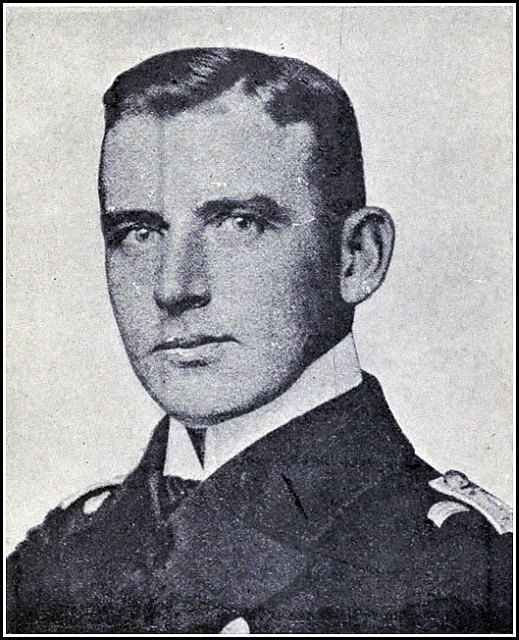
VON MÜCKE
The person most concerned, and the one with whom the decision lay, seemed to be the harbor master, a subaltern official, and a Belgian at that. When the afternoon had well nigh passed, and the things ordered for the ship had not arrived, I requested the senior Dutch commander at Padang to order the goods to be delivered at once, as, in conformity to the neutral code, I would have to run out of the harbor within twenty-four hours. Finally, at seven o’clock in the evening, a part of what had been ordered arrived, and with the things came the neutrality officer. He made every possible effort to induce me to allow officers and crew to be interned. As I had foreseen this, my officers had been asked to be present and take part in the conversation, so that he might be convinced from the beginning that the Ayesha’s officers were unanimous in refusing to consider his proposition.
In the first place, the neutrality officer represented to me—in so far as I could see, by advice from Batavia—how wholly impossible it would be for us to get away, as it was forbidden to deliver either marine charts, or nautical books. There were many other things also with which we could not be supplied, such as clothing, for instance, since, to provide us with these, as well as with soap, tooth powder, etc., would be to “increase our war strength.”
As it had now been three weeks since any of us had been able to brush our teeth, we decided that this hardship could be endured a little longer. Nor had the one comb we possessed failed to serve our modest demands. As the harbor master had seen that my men were going almost naked for want of clothing, and as he also was aware that we had no marine charts, I could but conclude that there was intention in refusing us these very necessary articles. When I persisted in my determination to sail with or without charts, I was told that we could not escape capture if we ran out, as the waters round about were being scoured by Japanese and English cruisers; that it had only been by a lucky chance that we had escaped capture so far, and that we would surely be caught if we put to sea again; that the Emden had acquitted herself well enough, and that no one would criticize us if this hopeless attempt were abandoned. It is needless to say that we absolutely refused to be moved by all this persuasion.
Meanwhile, the provisions had been delivered and stowed away on board, and the ship made ready to weigh anchor, the only hindrance to our departure being the ten live pigs that we had taken with us, for they persisted in standing just where our anchor chain was being hove up. At eight o’clock in the evening we left our anchorage.
From the Dutch papers that we received a few weeks later, we learned that the people had occupied themselves with various speculations as to what we were going to do, and where we were bound. They might have spared themselves the trouble of these speculations if they had listened as we departed, for the answer to the question whither we were going and what were our intentions, was born back to them upon the breeze, as the Ayesha vanished into the night:
“To the Rhine, the Rhine, the German Rhine, To guard its sacred boundary line!”
Chapter VII
THE MEETING WITH THE “CHOISING”
With a light wind astern, the Ayesha slowly made her way out from among the Dutch islands, and toward three o’clock in the morning had passed beyond the limits of Dutch territorial waters. I had but just turned in when Lieutenant Schmidt, whose watch it was, waked me with the words: “Captain, a German boat is coming alongside.”
As I knew that we were then well out at sea, I growled out: “Man, don’t talk nonsense! Let me sleep!”
But he assured me again that it was as he had said, and would not be frightened off even by the most violent protests. At the same time I heard loud voices from outside crying: “There she is, there she is! We have caught her after all.”
As I came on deck, I saw a little row-boat with a few people in it swiftly approaching us from out the darkness of the lingering night. Soon one traveling case, and then another, came flying on board. Their two owners appeared immediately afterward, and turned out to be an officer of the reserves and a chief engineer’s mate, also a reservist. Both reported to me for duty. As we were outside of the limit of Dutch territorial waters, there was no reason for deferring their enrolment.
Our only difficulty was to provide quarters for the officers now aboard the Ayesha, as there was but the one bed, which was hardly big enough for three. In the end, it was arranged that one officer should sleep in the bunk in the cabin, while another chose the place on the floor under the mess table for his bed, a resting place which was not wholly free from disturbance, however, as the third officer, who had the watch, was inclined to put his feet there.
By evening, a moderate, favorable breeze had taken us as far as Seaflower Channel, with which we were well acquainted. To our surprise, we discovered a large steamer coming toward us on an easterly course. As there are no beacon lights on this strait, it is avoided by steamers, most merchantmen preferring to go by way of the more northerly route through Siberut Strait, where there are many lights. The appearance of a steamer in this unfrequented spot was, therefore, to say the least, rather remarkable. I strongly suspected it to be a warship.
As quickly as possible every sail, to the very last rag we had, was set, our course was changed hard to starboard, and, with all the speed we could muster, we tried to get back into Dutch waters. To our great relief, the low, palm-covered coral islands soon came into sight, easily distinguishable by the broad white line of the surf that always breaks on their shores. We crept as close as we dared to this line of surf, keeping at a distance of about a thousand meters from the shore. To anchor in this depth of water was quite impossible, for these coral islands rise abruptly, almost perpendicularly, out of the water.
Our frame of mind was in no wise improved when suddenly our unknown steamer began to exchange flash-light signals in secret code with some other vessel as yet invisible to us. Soon afterward the second warship, for it could be no other kind of vessel, steamed away toward the south, while the other cruised back and forth through Seaflower Channel. Unfortunately the wind died down more and more,—so much so that our hope that by daylight we would be out of sight of the cruising steamer, was doomed to disappointment.
It was my intention now to run in between the many small islands, to tie the Ayesha fast to the first convenient palm tree, take down top-masts and sails, and so make it impossible to discover us from out at sea. Then I meant to find out the nature of the ship in which we were so much interested. The calm which set in rendered it impossible to carry out this plan, however. At sunrise we were only a few nautical miles distant from the warship, and hardly had the daylight revealed to her the masts of the Ayesha, when she changed her course and approached us at high speed. We were still within the limit of Dutch territorial waters, and I had not the least desire to leave them. Fortunately for us, the man-of-war turned out to be neither English nor Japanese. It was the Dutch flagship, De Zeven Provincien. The iron-clad followed us, always at some distance, however, until we had left Dutch waters in our course westward. We continued to sail toward the west, intending to keep the Ayesha within the vicinity of a certain point where we hoped to meet with some German steamer. Although it had not been possible for us to make any definite arrangements with any of the German vessels that were lying at Padang, nevertheless, from the conversations that had taken place from deck to deck, their captains had some knowledge of the course we intended to follow. We took it for granted, therefore, that some one of these steamers would follow us with a view of aiding us on our farther journey. So we drifted about at sea for nearly three weeks. During a part of this time we had rough weather, which was especially trying to our ten pigs, for whom quarters had been put up in the bows near the capstan. To make life aboard the Ayesha, when she was rolling heavily, at all endurable to these animals, we had nailed slats on the flooring of their quarters. Before this had been done, the poor creatures went sliding back and forth across the smooth deck, from rail to rail.
Twice our hope that a friendly steamer was coming to our relief was disappointed. Each time it was an English ship. One of them behaved so peculiarly, and made such unusual manœuvres as we came in sight, that we believed her to be an auxiliary cruiser. We therefore cleared the Ayesha’s deck for action. To occupy the attention of the cruiser, with whom we wished to pass for a harmless merchant vessel, we signaled: “Please give me the geographical position.” This is a signal very commonly used by sailing vessels when meeting a steamer. The desired information was given us, but with it came the embarrassing question: “Who are you?” We had no special signal of our own, and the Ayesha’s signal, which we had learned from the ship’s papers, we did not, for obvious reasons, care to give. So we took four flags that happened to be at hand, arranged them one above the other, tied a knot in the two upper ones, so that no one could tell what they were, and then hoisted this signal in such a way that it was half hidden by the sails. This scheme we hoped would lead the steamer to believe that we had answered the question, but that she had failed to decipher our signal. About half an hour later the steamer had disappeared. We saw her answering signal, “I have seen your signal, but cannot make it out,” fluttering after her at half mast as long as she remained in sight. The second English steamer came in view at a great distance from us, and probably did not see us at all.
The fourteenth of December, 1914, was a thick, foggy and rainy day, with rather high seas running. The Ayesha was tacking back and forth under close reefed sails, when suddenly, through the dense atmosphere, we could see, only about four thousand meters ahead, a steamer looming up out of a thick, gray fog bank. She had two masts and one smoke stack, and was steering an easterly course. We were sailing toward the west. At this point the course of the ordinary merchantman can only be either to the north, or to the south. Hence, a steamer running on an easterly course here, must have some unusual reason for doing so. The natural inference was that this was one of the German steamers looking for us. We steered our course for her at once, under as much sail as our ship could carry. We sent off red and white fire balls that are visible by day as well as by night, in the hope of attracting the attention of the steamer, which by this time we had recognized as the Lloyd steamer, Choising. Our great fear was that the Choising would fail to see us in the foggy weather, and so would pass us by. At last, after we had sent off our fourth or fifth fire ball signal, we saw the ship turn, and come towards us.
Up flew our flag and pennant. The steamer ran up the German flag. The crew laid aloft into the shrouds, and three cheers rang from deck to deck. As usual, our men were dressed in the manner customary in the Garden of Eden, a costume which necessity had forced upon them. The men of the Choising confided to us later that they were blank with astonishment when suddenly, out of the fog, emerged a schooner, the shrouds of which were filled with naked forms. Because of the heavy seas running, an immediate transfer to the Choising was not possible. As better weather had prevailed in the region to the south, from which we had come, I signaled the Choising to follow the Ayesha.
But, instead of growing better, the weather grew steadily worse on the following day, until, during the course of the night, it developed into a heavy storm. The Ayesha’s sails were close reefed, and, it must be said, she behaved well. Not one of the heavy combers broke over her; she rode them like a duck. Of course, the inside of the ship was as wet as the outside, for the spray dashed over the deck without intermission.
At daybreak the Choising, which is a ship of 1700 tonnage, signaled by flag: “On account of the storm and heavy seas I cannot remain here.” I therefore decided to run in under the lee of the land, so as to make the transfer there, and accordingly, signaled another place of meeting to the Choising. The two ships separated again, as I, in my sailing vessel, could not steer the same course that the steamer took. The next night was the worst that we experienced on the Ayesha. All night long the tempest raged. Although aware of our proximity to the islands, we did not know just where we were. Both the wind and the current threatened to dash us against the reefs. The night was so black that we could not see anything. If, under these conditions, we should get too near the shore, both ship and crew were doomed. Even the small rags of sails, closely reefed as they were, which we still carried, were almost too much. Towards morning an especially fierce squall set in. It was too much for our rotten old sails. We heard a sharp crack, and then another,—our fore-sail and our staysail had torn away from their bolt ropes, and only a few small rags were left whipping in the wind. The departing fore-sail took with it a third sail, the fore staysail, so that we lost all our forward canvas. To set a spare sail was quite impossible at the time, both on account of the darkness and of the heavy running seas. We had to lay to, therefore, with only the after-sails, and trust to luck to keep away from the surf.
As soon as the day dawned, the spare sails were got out and bent on. Before long, the wind began to die down. We found it possible to increase our canvas and steer toward the place appointed for our meeting with the Choising. As we drew near to it, at about nine o’clock in the morning, the Choising appeared in the distance. In the meantime, however, the wind had fallen off so completely that the Ayesha could hardly make any headway at all. I therefore signaled the Choising to take us in tow, and get in the lee of the nearest island. There we would find shelter from both wind and waves, and the transfer could be safely made.
Chapter VIII
THE PASSING OF THE “AYESHA”
While we were being towed by the Choising, we began to unrig the good old Ayesha. It saddened us to think that we would have to sink her, as there was no port to which we could take her. There was danger that she would be restored to her former owner if we took her to a Dutch port. This we wanted to prevent under any circumstances. All the provisions we still had on hand were placed on the upper deck, and our arms were taken there also. Trunks there were none to pack. The Ayesha’s figure-head, which represented the favorite wife of the prophet, was taken down, and the rudder wheel unscrewed; both were to be carried with us aboard the Choising, and kept as souvenirs.
Soon we had reached the shelter of the small islands, the swell ceased, and it was possible to bring the Ayesha alongside the steamer. Meanwhile, the Ayesha’s shrouds, the ropes which hold the masts, were cut, and all other ends and stays were either removed, or cut through. At the same time two holes were bored into the hold, and through these the ship began slowly to fill.
Towards four o’clock in the afternoon the Choising’s engine was started up, and the Ayesha was cut adrift. It appeared as though the little ship were loth to part from us, for, although our steamer was moving on, and no hawser was holding the Ayesha to us, she kept alongside the Choising for some time. And then, at last, as though she had found her own strength insufficient to keep up with us, the Ayesha caught on to our ship, just behind the gangway ladder, carrying a part of it with her.
I wanted to stay by the Ayesha as long as she was afloat, so our steamer was stopped, and we lay to at a distance of three hundred to four hundred meters off from her. The loss of the brave little ship touched us deeply. Although our life on board had been anything but comfortable, we nevertheless all realized fully that it was to the Ayesha we owed our liberty. For nearly a month and a half she had been our home. In that time she had carried us 1709 nautical miles. We all stood aft at the stern railing of the Choising, and watched the Ayesha’s last battle with the waves. Gradually, and very slowly, she sank lower and lower in the water. Soon it washed her upper deck. Then suddenly a shudder passed over the whole ship; she seemed to draw a long breath; the bow rose out of the water for a last time, only to plunge into it again the more deeply. The iron ballast rolled forward; standing on end, her rudder up, her masts flat on the water, the Ayesha shot like a stone into the deep, never to be seen again. Three cheers for her rang out above her ocean grave.
The day was the sixteenth of December, 1914, and the hour, fifty-eight minutes after four o’clock in the afternoon.
Aboard the Choising, the first thing to be done was to order a course to the west, and the next, to see what provision could be made for my men. A place had already been prepared for them in a part of the ship ordinarily used for the storing of coal. It had been cleaned up, and mattresses, blankets, etc., sufficient for all, were in readiness, so that, in comparison with the days spent on the Ayesha, a life of luxury was before us.
An ocean greyhound my new ship surely was not. When in the best of trim, she went at the rate of seven and one half miles, but there were times when we had to content ourselves with four. This was due, in part, to poor coal. The Choising was a ship that had originally been intended for use as a coaling steamer for the Emden, and in this capacity had waited long for her at the appointed place. But, as the British Admiralty had been so obliging as to provide the Emden most generously and considerately with the best of Welsh coal, although its intended destination was Hong Kong, there had been no reason why the Emden should take on any of the poor quality of coal from India and Australia, which the Choising had aboard for her. While waiting for the Emden the Choising’s cargo of coal had got on fire, and we were now using what was left of this half-burned coal.
On the Choising we had news which was of importance to us. At the time that we left Padang in the Ayesha, we found it a most difficult problem to decide where to go. My earliest plan, to try to reach Tsing-tao, had to be abandoned when, at Padang, we learned of the fall of that colony. My next intention was to join His Majesty’s ship Königsberg, of whose whereabouts we knew nothing more than that she was somewhere in the Indian Ocean. In case she was no longer there (I had hoped to get news of her from the Choising), my next plan was to sail to German East Africa. We knew that there had been some severe fighting there between our colonial troops and the English, and, upon reflection, I abandoned this project also, as being an absolutely hopeless one. With only fifty men, whose clothing outfit was an entirely inadequate one, and who were wholly unprovided with any of the many things necessary to troops on land, with neither surgeon nor medicines, no knowledge of the language, no guide, and no maps, it would be next to impossible, in a district as large as the fighting area of South-east Africa, to locate and make connection with troops numbering not more than a few thousands themselves. For the present, therefore, there was but one course left open to us,—to make our way homeward by following the route around Africa. How to provision our ship for so long a journey was a problem which suggested many difficulties, however.
But at last we found in one of the newspapers the report of a battle between Turkish and British troops at Sheikh Said, near Perim, an island in the Strait of Bab-el-Mandeb (Gate of Tears). This gave us reason to believe that Turkey also had now entered the war. Our diligent search for confirmation of this surmise was finally rewarded by finding in one of the papers the announcement that war between the Turkish and British Empires had begun. The new situation thus created suggested a landing in Arabia as our nearest and most hopeful prospect. The course which appeared to be even more reasonable, viz., to join the Königsberg, was abandoned, in the first place, because the Choising had brought word that the Königsberg had been sunk in battle somewhere to the north of Australia, and in the second place, because of news that she was bottled up in the Rufiji River. If she had been sunk, our search for her would be to no purpose, and if she was shut in by a blockade, she would neither have coal, nor could she use any that we might bring her. The fifty men whom we should add to her numbers would only make so many more mouths to feed.