THE “AYESHA” (continued 2)
Helene S. (Helene Schimmelfennig) White translation
The Choising was therefore started on a southerly course, in the first place, to avoid the principal steamer routes, and secondly, to keep out of the region in which the tropical cyclones are most frequent, for the Choising was not equal to such a tempest. A sharp lookout was kept, so that we might catch sight of an enemy’s ship before we ourselves were discovered. On account of our ship’s remarkable speed, the only chance of escape we had, in case we came in contact with a hostile man-of-war, lay in a game of bluff.
The Choising was still painted like all Lloyd steamships, viz., black hull, white bulwarks, and ochre brown trimmings. Of course, we could not in safety continue like that. So we gave our ship a coat of paint that made her look like a Dutchman. But on second thought, we concluded that this was hardly safe, as we were likely to meet a number of vessels in the Strait of Bab-el-Mandeb, and that some of them might ask us the question, “Who are you?” which already had proved so embarrassing to us. We had no record of sea-going ships on board, except an English list, at the end of which we found the names of a number of English vessels that had been sold by the English to foreign countries. Among these there was one steamship, the Shenir, that had been sold to a Genoa firm, and that was a vessel of 1700 tons. As this was the exact size of the Choising, we decided to adopt the Shenir as sponsor for our ship, and ere long the legend, “Shenir, Genoa,” in large white letters, adorned our stern.
This discovery we had made in the English shipping list was especially welcome to me, as I preferred to pass for an Italian. In view of Italy’s attitude of vacillation, I had reason to believe that even an English warship would hesitate unnecessarily to harass an Italian vessel.
The Shenir, from Genoa, would naturally be expected to fly the Italian flag. But this was an article which, unfortunately, was not numbered among the possessions of the Choising. Nor was there any green bunting on board. A green window curtain was discovered by some one, however, and to it we sewed a strip of red, and a strip of white bunting. A committee was then selected from among the men who had artistic ability, and they were soon hard at work painting Italy’s coat of arms upon the white strip. The green of the curtain was not of the right shade, however, so we added some yellow paint to a pot of blue, which we happened to have on board, until the desired shade of green was produced, and then dipped the green part of the flag into it.
Chapter IX
FROM PERIM TO HODEIDA
January 7th, 1915, found us in the vicinity of the Straits of Perim. Nothing worthy of note had happened on the way. A number of steamers had been sighted, but always in time to change the course of our vessel toward the coast of Africa. We kept this course until the steamer had disappeared, when we promptly returned to the right one.
Christmas was a very quiet day with us, but our New Year’s festivities were all the more hilarious, and we made the most of what little remained of beer and wine aboard the Choising.
It had been my intention to arrive in the Perim Straits immediately after sundown. In this we were not quite successful, however, and again for the reason that we had no marine charts. Just as once before we had to draw a chart for ourselves when running into Padang, so now we had been obliged to make one of the Red Sea, and, naturally, our knowledge of the Choising’s position was not quite accurate. As a consequence, we arrived at the Straits of Perim a few hours too early. I therefore gave orders to turn about and cruise back and forth a while. A large steamer coming from Dachibuti gave us some anxious moments, for we took her to be a man-of-war. She turned out to be a French mail steamer, however. As soon as darkness set in, we steered for the Straits of Perim again, and proceeded at high speed.
I had counted with certainty upon meeting with some sort of patrol in the Straits. In that event we would have been quite helpless, for with the Choising we could not face even the smallest hostile war vessel. We could not so much as run away, for any steam launch could have overtaken us. As my chief purpose was to conduct my men to where they could again serve in defence of their country, I determined, if necessary, to sacrifice the Choising.
In case we should meet a hostile ship close to the African coast, I intended to strand our vessel and leave her there, taking the men with me in the long boats. We should then be ashore in the enemy’s territory, and free to do as we might deem best. Should we be overtaken on the northerly side of the Straits, it was my intention to run boldly into the Perim harbor, trusting in Heaven for the outcome, or, if I failed in this, I proposed to run the steamer aground, and venture a bold attack upon the telegraph station which we knew was located in this vicinity. To be prepared for any emergency, the Choising’s three largest long boats were swung out, lowered to the bulwarks, and made fast. Water, provisions for eight weeks, arms and ammunition, besides a few personal belongings, were stowed away in the boats. An officer was placed in command of each one of them, and a particular crew designated for duty in it. The only orders given to the boats’ crews were, once for all: “Obey your officer.”
And again, as darkness came on, we were in much uncertainty with regard to our ship’s position. Ahead of us we saw a group of small islands which, we concluded, must be the “Seven Brothers” lying just at the entrance of the Straits. In truth, however, these were the Arabian mountains, whose highest peaks rose into view just above the horizon, a fact which we did not discover until we came in sight of the Perim revolving light. This gave us a good fixed point from which to direct our further course.
Naturally, as we approached the Straits, all hands were on deck. Everyone was keeping a sharp lookout, for our only hope of safety lay in the keenness of our observation. The ship’s lights were closely screened. The officers and petty officers were given orders to make continual rounds through the vessel to see to it that not a single ray of light escaped to reveal our presence, for the Chinese crew of the Choising had little appreciation of the importance of this precaution.
Whether I should sail with or without lights had been a question to which I had given much careful thought. If I calmly proceeded with all lights showing, just as any ordinary merchantman would, it might chance that none of the English patrol ships would hold me up, as it was not at all likely that so small a merchant ship as the Choising would be regarded with suspicion. A ship sailing with screened lights would, on the contrary, become an object of suspicion to any one who should discover her. Nevertheless, in the end, I decided to have the lights screened.
The Strait of Bab-el-Mandeb is a very narrow water-way. I hugged the African shore as closely as possible, to take advantage of the darker horizon there, and also because the shore afforded a dark background for the ship. But in spite of all this exercise of caution, we got so near to the revolving light at Perim that its intermittent ray fell upon us like a search-light, illuminating us for seconds at a time. Moreover, we could see two English warships lying just outside of Perim, and they were signaling to each other in Morse code. During that night’s most anxious half hour we muttered many a bitter imprecation upon our engine that at best could make no more than seven and a half miles. But fortune favored us; the Englishmen did not discover us. Perhaps none of the small patrol boats upon which I had reckoned were abroad, for there was a stiff breeze blowing, and the sea was running high. At the end of two trying hours we had got to where we could consider ourselves as safely “through.”
In the broader expanse of the Red Sea I kept well without the regular steamship course, and on the eighth of January, just after dark, we lay with the Choising close to Hodeida. The only book that we had from which to inform ourselves with regard to Arabian ways and customs was a “round the world” guide book that would have answered the purpose of directing a wedding journey very well. From it we learned that Hodeida is a large commercial city, and that the Hejaz railroad to Hodeida was in course of construction. As the book was some years old, and as one of my officers remembered that years ago he had met a French engineer who told him that he had been engaged in the construction of a railroad to Hodeida, we took it for granted that the railroad was completed by this time. Even should we be wrong in our supposition, we would still, in all likelihood, be able to get some news of the war, and, in case we should have to continue our journey on the Choising, we would at least be able to secure charts of the Red Sea.
As we approached Hodeida, or more accurately speaking, as we approached the locality where we expected to find Hodeida—because of our constant lack of marine charts we were never certain of just where we were—we suddenly beheld a long line of electric lights along the shore. Great was our joy at this first sign of a return to civilization. That Hodeida would be provided with electric lights had not entered into our most hopeful expectations.
“It appears to be a very respectable kind of place after all,” was the opinion expressed on the bridge. “There even are electric lights. Then surely the railroad will be running. I can see ourselves walking into the central railroad station of Hodeida to-morrow morning, and boarding the special express. In a fortnight we shall be on the North Sea again.”
We supposed the row of lights we saw to be on the Hodeida dock, for our “round the world” guide book had told us that Hodeida is a seaport. As we came closer to this dock, my joy gave way to apprehension, for, as I looked, the lights of the dock seemed suddenly and strangely to move closer together, an eccentricity which is not usual with lights on a dock. As we were quite sober, we decided that it must be the dock that was at fault. I therefore gave orders to stop the Choising, so that soundings might be taken, from which to learn how far we were from the shore. A depth of forty meters was reported. Now we were evidently only a few thousand meters off from the supposed dock, while, according to the soundings, there must be a distance of several nautical miles between us and the shore. As we realized this, the dock lost much of its attractiveness in our eyes. It must be something else. I gave orders: “Course, to the south!” and ran off a few nautical miles.
I then ordered the four long boats that had been kept in readiness ever since our approach to Perim, to be lowered, and my men got into them. The Captain of the Choising received written orders to take his ship farther out to sea, to spend the next two days in the vicinity of a given point outside of the usual steamship course, and on each of the succeeding nights to return to the place where my men and I had left the ship, and await us there. If we did not return, he was to proceed to Massowa. My reason for wishing the Choising to return during the next two nights, was our total lack of any definite knowledge as to who was in control in South Arabia. Our latest information in regard to the war was over three months old, and although it had told of battles between the Turks and the English, the outcome of these battles was unknown to us. It was therefore quite possible that Hodeida was now in the hands of the English. In that event, it was my intention to return to the Choising on one of the following nights, and to continue our journey aboard her. The days, I meant to spend somewhere in the desert, in hiding.
At the same time, I arranged for signals by rockets to be given the Choising in case I should learn of the proximity of hostile ships that might prove dangerous to her. There was one special signal that meant: “Enemy’s ships near. Proceed at once to Massowa.” I wanted to avoid exposing the ship unnecessarily to the danger of capture while returning for us.
Soon the Choising had vanished in the darkness of the night, and my little flotilla of long boats was being vigorously rowed toward the shore. The ship’s boats, like all boats that have been out of the water for some time, leaked badly, although days before we left the Choising they had been wet both inside and out, had been freshly painted, and kept half filled with water. Our chief effort for the time being was therefore directed toward bailing out the boats. As soon as the day dawned, all sails were set in the boats of our flotilla, and a goodly regatta in the direction of the shore developed.
On our supposed dock the lights were extinguished, and at sunrise we discovered that it had two masts and three smoke stacks, carried guns, and bore the name of Desaix. It was a French armored cruiser. The other part of the dock revealed itself to be an Italian ship called Juliana. We had little desire to tie up at this dock, and so directed our course toward land.
Our chief concern now was that we might be discovered by the armored cruiser that was not far distant. The rigging of one of my boats was Chinese, of the other three, German. Four gray boats rigged in this extraordinary fashion could not fail to attract attention. When we had come close enough to the shore, I anchored, and had the other three boats come alongside and made fast. Quickly our masts and rigging disappeared, and we held a consultation with regard to what it was now best to do. The Choising was gone. Behind us lay the French armored cruiser and the Italian vessel. What attitude Italy had assumed toward the war by this time was wholly unknown to me. Before us lay the land with the surf beating between us and it. The indications were that this part of Arabia was now in the hands of the French. To remain in the boats was not possible, as, in the course of the day, we would surely be seen by the Frenchmen who were now enjoying an early morning nap aboard the armored cruiser. My orders therefore were: “Pull for the shore.”
Fortunately our heavily laden boats got through the surf without either capsizing or filling. On our way to the shore we met a small Arabian boat whose sole occupant, an Arab, was engaged in fishing, and who in response to our questions gave us the comforting information that Hodeida was now in the hands of the French. The mistake may be ascribed to the fact that although we spoke excellent German, and the Arab had a fluent command of Arabic, we nevertheless failed to understand each other. Just after our boats had passed through the surf and were about 800 meters off shore, they ran aground. All our belongings had therefore to be carried all this distance to land, and through water that was knee deep. Rafts were quickly put together out of the masts, a few boards, some straps, life preservers, and the like. On them we placed our machine guns, the ammunition, etc., so that the transportation might be made as rapidly as possible.
First of all, the machine guns were sent ashore. I waded to land along with them. On the beach an Arab was splashing about in the water. Unarmed, and with every expression of amiability and friendliness of which I am capable, I approached him to offer the hand of friendship. He misunderstood me, however, and departed. A second Arab, who had appeared in the meantime, was quite as unresponsive to my offers of friendship.
While I was employed in having the rest of our things put ashore, a man in uniform, and mounted on a hedjin, or riding camel, came toward me. The uniform was blue and red. Around his head a cloth was wound. To what country the uniform belonged, I had not the least idea. It might easily have been a French one. This man had the unpleasant distinction of being armed. When he had come to within 600 meters of us, he stopped, cocked his rifle, and stood watching us at our work. Carrying no arms of any kind, I went toward him, beckoned to him, called to him, and tried in every way possible to make him understand that I wished to speak with him. He remained immovable until I had come to within two hundred meters of him; then he raised his rifle and aimed it at me. I stood still. He lowered his rifle, whereupon I moved a few steps nearer. Again he pointed his rifle at me. Again I stopped, and he dropped his rifle. Again I took a few steps forward, and again he aimed at me. I stopped again, and so the teasing performance went on for several minutes, until I had reached a point not more than fifty meters distant from him. Then his rifle was not again lowered. Consequently I remained standing for some time. An understanding by way of conversation was out of the question with him. He had not understood one of my efforts at speech. He made a sign, however, which could not be misinterpreted, and by which he gave me to understand that I was to remain with my men where we were. After I had assured him, as best I could, that we had no thought of leaving, and that we were delighted to be there, I returned to my men. He mounted his camel and disappeared at a rapid pace in the direction of Hodeida, the white houses of which we could but just distinguish in the far distance.
It now behooved us to make all haste possible, for in three or four hours the French garrison might be upon us. So we worked with all our might to get the things ashore, and so be able to start upon our march into the desert. It was my intention to remain in the desert during the day, and then at night to send one of my officers to Hodeida to get information. Should this prove unfavorable, I purposed to spend the following day also in the desert, and then, on the next night, to get back to where the Choising would pick us up, and to proceed with her, trusting to luck for the future.
Just as we were about to set off on our march, there poured forth from behind the low sand hills of the desert a swarm of Bedouins,—at first about eighty in number, then a hundred or more, all armed. They spread out into a sort of skirmishing line, and then disappeared behind the sand dunes along the beach. Upon seeing this, we, too, formed a skirmishing line, and made ready for a fight. I waited for the first shot to come from the other side. After a few moments there came out from among our opponents twelve unarmed men. They approached us slowly, all the while beckoning with their arms. Laying aside my sword and pistol, I went toward them. Midway between the two lines we met. Immediately a lively conversation developed, with the unfortunate disadvantage, however, that neither party understood the other. The Bedouins shouted at me, gesticulated violently with the vehemence peculiar to southern races, and made the most remarkable signs, all of which I failed to understand. My own attempt to speak to them in German, English, French, and Malay was of as little avail.
I then had our war flag, which we had with us, brought out, and I called attention in the most explicit manner to the red, white, and black, to the iron cross, to the eagle. They did not understand this either. As I had thought it quite likely that the people of some of the coast regions where we might be forced to land would be unacquainted with the German war flag, I had taken the flag of our merchant marine with me also. It was now produced and displayed to the Arabs, but this, too, they did not recognize. Then we pointed to the French armored cruiser lying at anchor in the roadstead, shook our fists at it with the most extravagant gestures, and all together roared, “Boom! Boom! Boom!”
The only response we received was a return to their crazy signs. One of these was to hold one hand to the forehead, as though to shade the eyes, and then wag the head violently from side to side. Another was to pass two fingers over the face, either up or down. A third consisted in rubbing the two extended forefingers together, and staring at us idiotically the while. This last one we thought we understood. We interpreted it in this way: Two are rubbing against each other, which means, “We are enemies.” With all the means in our power we tried to assure them that quite the reverse was true. Had we been understood, our situation would hardly have been improved by this assurance, for it developed later that this sign meant, “We are friends,” instead of, “We are enemies.” As a last resort, we produced a gold piece. To this means of intercourse the Arabians were very susceptible from the outset. We pointed at the eagle, but it did not seem to suggest anything to them. Then I pointed at the head of the Kaiser. This met with instant response, and aroused the liveliest interest. Among their ejaculations we distinguished the word, “Aleman.” This was understood on our part, for it could mean nothing other than “German.” Instantly, and with ready adaptability to the customs of the country, we all shouted at the top of our voices, “Aleman! Aleman!” And with this, the way to a mutual understanding was opened.
A tremendous and enthusiastic roar of response instantly arose among the Arabs. Their rifles were stacked, and the whole company gathered about us, screaming and shouting, and tumbling over one another in a wild scramble to carry our luggage for us, to drag the machine guns, and to do us other like service. In a tumult of noise the procession set out in the direction of Hodeida. One of our newly acquired brethren could even speak a few words of English, and from him I learned that Hodeida was in the hands of the Turks.
Our onward march was the occasion for still further excitement. As destitute of people as the desert through which we were passing seemed to be, it nevertheless harbored a countless number of people. In this land, where every boy of twelve carries a rifle and is regarded as a warrior, it did not take long for another crowd of about a hundred Bedouins to gather and come out to meet us, all eager, in the assumption that we were enemies, to have a shot at us. With much excited yelling, our hundred attendants endeavored to convince their approaching hundred colleagues that we were friends. When they had been persuaded that such was the case, we continued on our march with a retinue of two hundred, only to be met, a half hour later, by two hundred more who were coming to attack us, and who, in turn, had to be convinced by our escort of two hundred, that we were friends.
These explanations always entailed a considerable loss of time, and so it had got to be midday, and we were still on the way. We had had nothing to eat since the evening before, had worked hard and continuously, and had taken a long tramp through the burning sand at a time of day when, under ordinary circumstances, even to ride abroad is avoided. All told, there were probably eight hundred Bedouins moving along with us. They had at last understood that we were Germans, and now carried on quite a variety show as they went along with us, dancing and singing, yelling and shooting off their rifles, and carrying on all sorts of fantastic performances.
In the meantime, the first Turkish officers from Hodeida had arrived, among them several who could speak German. Our mutual joy at meeting comrades in arms was great. The whole Turkish garrison of Hodeida was marching out against us in the belief that a detachment of the enemy was attempting a landing. Cannons even had been dragged along to assail us.
Surrounded by the Turkish troops, and with banners flying, we made our entry into Hodeida. The people filled the streets and shouted their welcome at us, and flattered us with loud cries of approval and a vigorous clapping of hands at the close of every marching song we sang as we moved along.
Hastily prepared barracks were soon made ready for my men. For the officers, a house in the town was provided. And so, for the present, we were comfortable. From the windows of our house we could see the French armored cruiser peacefully and dreamily rocking upon the blue water a few miles off.
Chapter X
ON TO SANAA
At 5 o’clock in the afternoon of the ninth of January, my men were all settled in their quarters, and I found myself free to consult with the heads of the civil and military authorities at Hodeida with regard to my future course. There were two ways of getting back to Germany open to me: the one, overland, and the other, to continue on my way by sea. Marine charts I could obtain in Hodeida. His Excellency, the Mutessarif of Hodeida, whose name was Raghib, and the colonel of the regiment, also named Raghib, sat together in consultation with me that afternoon.
I learned at once, and much to my regret, that the railroad did not exist. At the same time I received information with regard to the English warships then in the Red Sea. These consisted chiefly of a number of gun-boats and auxiliary cruisers, that could be seen almost daily to the northward of Hodeida, and that were maintaining a sort of blockade line. To continue on the Choising under these circumstances was very nearly a hopeless undertaking, especially so in consideration of the probability that spies would very soon make our presence in Hodeida known abroad. The French iron-clad would surely hear of it, and could at once participate in the search for our ship, while her wireless apparatus could flash information of us to all the English and French war vessels in the vicinity. In waters as narrow as the Red Sea is, it would then be quite impossible for the Choising, with a speed of but seven miles, to elude her pursuers.
The Turkish authorities assured me, moreover, that I would find the overland route to the north both safe and unobstructed, although it would necessarily entail some loss of time. Preparations for the journey by land would require about a fortnight; then we could start on our march, and, in all likelihood, would reach the railroad in about two months.
When this was fully settled, I waited for the darkness to come, and then, from the roof of our house, three times I sent off the signal with fire balls, as agreed upon, to the waiting Choising: “Caution! Hostile ships! Proceed at once to Massowa.” Later we learned that the Choising had reached her destination in safety.
Whereas the health of my men had been excellent up to this time, they now began to show the effects of the extreme climate. In Hodeida the days were terribly hot, the nights very cool. The men of our crew slept in the Turkish barracks along with the soldiers of the Turkish garrison.
In Arabia houses and barracks are constructed very differently from those in our own climate. The barracks provided for my men consisted of a framework of thin boards covered with matting and straw. They slept side by side on a sort of divan, the cushions of which were stuffed with straw. The water especially was unwholesome, and had to be boiled to make it fit to drink. As a preventive measure against malarial infection, we had to take quinine continuously. But in spite of all our precaution, cases of dysentery and malaria soon began to develop among us. I therefore decided to take my men into the mountains. Sanaa, which is the chief city of Yemen, was recommended to me as being a very healthful place, the water conditions good, and the climate closely resembling that of Europe. Since our journey overland lay by way of Sanaa, it was quite as well to await the completion of our preparations for it at that place as at Hodeida. I decided therefore to start on our march to Sanaa on the Kaiser’s birthday.
Before leaving Hodeida we celebrated the anniversary of our Emperor’s birth by ceremonies in which the entire Turkish garrison participated, as did also the entire Turko-Arabian populace, in their own peculiarly enthusiastic fashion. I had in the meantime succeeded in procuring new clothes for my men. Although this, their latest uniform, did not exactly conform to home regulations,—especially the tropical hat designed by myself after the pattern of the hats worn by the colonial troops, and decorated with a large cockade in red, white, and black, the like of which, it is safe to say, had never before been seen in the navy,—nevertheless the men presented a very trim appearance, and made an excellent impression.
The entire garrison marched to the parade square for the ceremony. My little company of men stood in the middle, surrounded by the Turkish troops. Together with the Turkish commander, I passed the combined troops in review; I then made a speech in German in honor of the Kaiser, and ended with three cheers for him, in which our Turkish comrades in arms joined with enthusiasm. After the cheers for our Emperor had been given, the Turkish commander called for three cheers for the Sultan. A parade march by the combined troops closed the ceremonies. With band playing and banners flying, my men then marched off to a feast—mutton and rice—spread for them in the barracks. The officers were invited by the heads of the local authorities to a banquet—mutton and rice—at the palace of the mayor of Hodeida. Here, also, the heartiest good will was expressed in the toasts that were exchanged. At five o’clock in the afternoon we started on our march to Sanaa.
In the Arabian desert it is only possible to travel at night, as the heat of the day is too intense to be borne by either man or beast. Marching on foot is out of the question even at night. Everybody rides. We also had to follow this custom until we reached the foot of the mountains.
The animals placed at our disposal were horses, mules, and donkeys. Our baggage was transported by means of a special caravan of camels. It was no light task to keep this newly organized company together at the start, for this was the first time that some of my blue-jackets had ever been astride of a four-footed creature. The fun began at once, with the mounting, and there were some very ludicrous scenes. Some of the men took advantage of the time before we started on the march, to practise rapid dismounting, many of them taking their saddles along with them in the attempt. However, relations of friendship sufficient to insure against the occurrence of any serious misunderstanding had soon been established between each rider and his mount, and the caravan was ready to start. We were escorted for some distance by the Turkish officers and garrison.
Soon Hodeida was left behind us in the distance, and we were in the heart of the desert. As far as the eye could reach, there was nothing but sand,—low flat sand hills grown over with dry grass. Roads, of course, there were none; tracks in the sand, made by the passing of other caravans,—that was all. Our march was frequently interrupted by a halt, for in the beginning especially, it happened every little while that one of the men devoted an over-amount of energy to guiding and mastering his steed, and the ensuing duel usually came off to the humiliation of the rider. The next thing to be done then, was to catch the riderless beast that was making the most of its freedom, a duty which usually devolved upon the officers, as they were the only ones who could ride. With the donkeys and the mules this was no small undertaking. Hardly had we come up to one of these animals when it would turn and kick out vigorously with its hind legs, and it would then require a resort to all the diplomacy and cunning at our command to get hold of it again. That these diversions should not cause us too great a loss of time, one of the officers always rode at the rear end of the caravan to round up the riderless steeds, and the steedless riders, and form them into a sort of rear guard.
As the nights were clear and bright with moonlight, we found our way very easily. We rode the whole night through, stopping only occasionally for a half hour’s rest. Then we all flung ourselves down in the sand, just where we happened to be, slung our reins around one arm, or tied them to one of our legs, and so found rest for our weary bodies, weary from the strain of the long continued ride.
The region through which we were traveling was not considered a wholly safe one. Robbery and attacks upon small caravans were the order of the day. As early as the second night out, we had an experience of this kind ourselves. Suddenly, in the moonlight, there appeared to one side of our road a dozen or more men mounted on camels. The Turkish gendarmes that had been sent with us as an escort and to guide us on the way, declared them to be robbers, and immediately got their rifles ready to shoot. When the men on the camels saw the size of our caravan, they vanished among the sand hills quite as suddenly as they had appeared.
On the third day we had completed the journey across the broad strip of desert which lies at the foot of the mountains, and we were now at the entrance into the mountain region. Quite abruptly, almost perpendicularly, the mountains rise from out the flat desert country, and attain a height of some 3600 meters. The route now became more difficult. Over loose stones, through dry beds of rivers and brooks, we climbed slowly upward. At last we were again surrounded by trees and bushes, and the vegetation became quite luxuriant. On many of the highest peaks of the mountains Arab castles were to be seen. The Arabs of this region seem to delight in placing their dwellings on as great and inaccessible a height as possible. At every point where a steep cliff or a narrow defile makes the upward way a difficult one, some Arab had built him a castle, frequently large and imposing in appearance, a veritable little fortress in itself. It was almost as though we had suddenly been transported back into the Middle Ages.
The people were very friendly, and we met with a pleasant greeting everywhere. Our periods of rest were usually spent in the caravansaries provided for the Turkish troops. For some days our road lay through a picturesque mountain region, and then brought us directly in front of a lofty mountain ridge that seemed to block our way completely, so that we did not know which way to turn. It was a steep, well nigh perpendicular wall of rock. A serpentine path, most difficult to climb, brought us to the summit of the ridge, after hours of exertion. It was a road by no means free from danger. On the one side of us the wall of rock rose straight up; on the other side it dropped straight down. A road, in the ordinary sense of the word, it really was not. It was no more than a bridle path worn into the rock by many long years of travel, often blocked by a great boulder, and made dangerous with many rolling stones.
The pack animals showed a wonderful ability and power of endurance. Often we came to places so dangerous that I gave orders to dismount, and lead the animals. As a whole, however, the men had come to be quite good riders by this time. We bought eggs and milk on the way whenever we had an opportunity to do so. We carried our cooking utensils with us on one of the animals. An officer, the cook, and another man always preceded the caravan, as a small number of men can travel faster than a larger company. In this way our meals were always ready for us when we arrived at the appointed place. This was a distinct advantage for the men, for the journey was a very fatiguing one, and every hour of sleep was of importance.
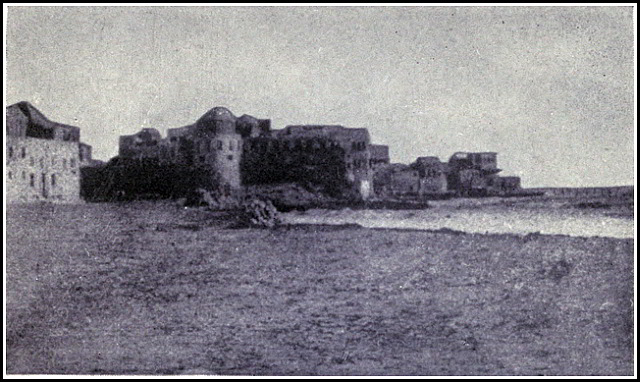
VIEW OF
HODEIDA
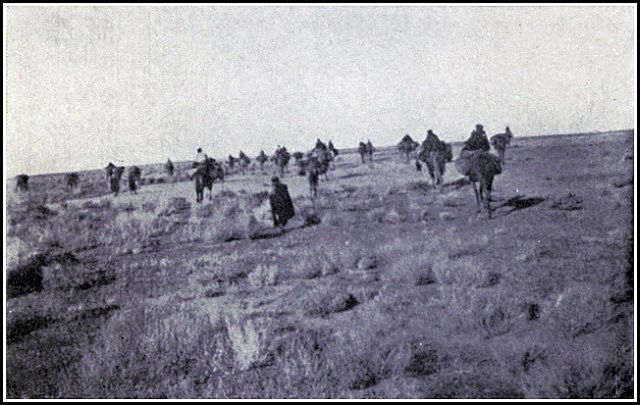
CROSSING THE DESERT
I had arranged for a longer halt to be made at Menakha. This is a small town situated on the highest point of the principal mountain ridge. From thence the road winds gradually downward until it reaches an extensive plateau on which Sanaa is located. In Menakha we were given a pleasant welcome by both the Turkish troops and the people. At a point some hours distant from the little town, we found the commandant, together with his corps of officers and the troops, awaiting us. A crowd of several hundred people had come with them. Together with the Turkish soldiery, we covered the last part of the way to Menakha, while before us went the great crowd of picturesquely dressed Arabs carrying on a sort of performance, and dancing to the accompaniment of a peculiar kind of song.
Excellent provision had been made for us at Menakha. On account of the weather conditions here, the buildings are all of stone. My men found large barracks awaiting them in which every comfort had been provided, and where an abundant and appetizing meal was in readiness. For the officers, accommodations had been prepared in the hotel of the town, the only hotel that I ever saw in Arabia. It could even boast of real beds. So far we had slept on “cursis,” which consist of a wooden framework filled in with a matting of bast. Menakha lies at a height of about 3400 meters, and we often saw the clouds below us. The days were cool, and the nights were bitterly cold.
We remained in Menakha for two days. I took advantage of this time to visit a number of the Arab dignitaries in their homes. The rooms in all Arab houses are white throughout, while the windows are set with bright colored glass—blue, red, and yellow. Along the walls are low comfortable divans and cushions. On the carpet, in the middle of the room, stands a large brass table on which are the nargilehs.[3] According to the customs of the country, we were always offered a cup of Mocha on these occasions, and we spent many a pleasant hour smoking and chatting as best we could with our Arab hosts.
From Menakha our way lay downward again. The Turks were improving the condition of their roadways here, and for some distance from the town we followed a fine, broad and newly made road leading down into the valley, a highway that compared favorably with any in Europe. Our journey now took us through some wonderful mountain scenery. To see camels grazing by the wayside, nibbling at the tops of low trees, never ceased to be a marvelous sight to us. Occasionally, too, we caught a glimpse of a lot of baboons, but never got a shot at one of them, as often as we tried it. By this time the horsemanship of my troop had improved to such a degree that we could maintain a very respectable formation, and now and again could even ride at an easy trot.
The seventh day of our journey found us approaching the capital city. From the heights, on our way through the passes, we could look down upon a wide and fruitful plateau, sprinkled with many villages and towns, among which Sanaa could readily be distinguished by its size. Turkish officers had ridden out to meet us. Just outside of the city the whole garrison stood lined up, and received us with bands playing gaily. “Deutschland, Deutschland ueber Alles” greeted our ears. The heads of the civil and military authorities came on horseback or in carriages. The people also showed a lively interest in our arrival. Even the French consul, who was being detained in the city as a measure of retaliation, appeared on the balcony of his house. We had come in contact with his English colleague on our way hither, although without meeting him face to face. It must have given him a shock of surprise suddenly to hear “The Watch on the Rhine” sung in his home in the heart of the Arabian mountains.
Unfortunately Sanaa was not as healthful a place as we had hoped to find it. Owing to its great altitude it is very cold there even during the daytime. It takes some time to get accustomed to the climate. A few days after our arrival, eighty per cent of my men were sick with the fever, and unfit to continue on the march. We suffered especially with sudden and severe attacks of cramps in the stomach, and with colds.
The city of Sanaa is a most interesting one. It is divided into three sections,—the Jewish, the Arab, and the Turkish quarters. The city is entirely surrounded by brick walls, and is so built as to form a fortress. Within this fortress the three quarters of the town constitute three distinct fortresses, each enclosed within its own wall, and within each of these, every individual home is itself a distinct little fortress. All the streets and roads are enclosed within high walls, and are so laid out that, like our trenches, they can be swept throughout their entire length by rifle fire from certain vantage points. The reason for building the towns in this peculiar fashion is to be found in the very unsafe conditions that prevail. Yemen has always had the reputation of being the most turbulent of the Turkish provinces, and in past years violent encounters between the Arabs and the Turks were the order of the day. Frequently these were of so serious a nature that the towns were besieged by garrisons. Sanaa, also, had been starved into surrender to the Arabs only a decade ago. Since that time, however, peace and quiet have reigned in the land.
After a fortnight spent in Sanaa, we learned that the difficulties of the journey overland were so great, that, after all, it would be impossible for me to get my men safely through by this route. The sickness among them compelled me to remain another fortnight in idleness. By that time, though still weak, the sick had so far recovered as to be able to ride their animals.
So we started on our return journey to Hodeida, there again to entrust ourselves to the sea.
Chapter XI
SHIPWRECK
Our return to Sanaa was accomplished in the same manner as we had traveled thither, and without hindrance of any kind. In order to make arrangements for our onward journey by sea, I had taken a few of my men with me and hurried on ahead of the caravan. In this way I succeded in getting to Hodeida a day and a half ahead of the others. It took the caravan eight days to get there. To be sure, our little advance guard had spent both day and night in the saddle, the only halts being made when we changed animals.
As the Choising had been sent on, and there was nothing in the way of steamboats to be had at Hodeida, there was but one thing left for us to do,—to continue our journey in zambuks. A zambuk is a small sail-boat much in use all along the Arabian coast, and is provided with a dhow sail.
I procured two such boats in Hodeida, each about fourteen meters long and four meters wide. These two zambuks I sent to Yabana, a little bay to the north of Hodeida. Because of the French armored cruiser, still sleepily rocking at anchor, a departure from the harbor of Hodeida was out of the question for me. The Frenchman might accidentally have a spell of wakefulness. As I was aware that the country was swarming with English and French spies, I took pains to spread abroad the report that it was our intention to sail from Isa Bay on the thirteenth of March. It happened just as I had foreseen. On the afternoon of the twelfth of March the little and out-of-the-way Isa Bay, where no house, nor tree, nor bush is to be seen, and where there is hardly any water, was honored for the first time since the beginning of the war by the presence of an English gun-boat, which hunted for us with its search-light all up and down the shore. The poor fellows! How they must have wondered where we were!
On the fourteenth of March, at five o’clock in the afternoon, my fleet sailed from Yabana. The Imperial war flag flew proudly at the masthead of my flagship, and with three cheers for His Majesty, the Emperor, we began our onward journey. The flagship of the second admiral was in command of Lieutenant Gerdts. We made up for the total lack of any further ships in the fleet by our absolutely correct discipline. As the second zambuk was somewhat larger than mine, the sick were put aboard of it. Malaria, dysentery, and typhus were still prevalent among the men, of whom there were always one or two so ill as to cause us the gravest anxiety. Under no circumstances, however, would I have been willing to leave any of them behind, for their only hope of improvement lay in a change of climate.
With regard to the English I had kept myself posted up to the last minute as best I could, and I was aware that an English blockade was being maintained by two gun-boats together with the auxiliary cruiser Empress of Russia, in a line extending from Loheia across Kamaran, Jebel Sebejir to Jebel Soghair. My problem now was how I could run this blockade with my sail-boats. To avoid the possibility of both boats being captured at the same time, I gave Lieutenant Gerdts orders to separate from me. A meeting place farther to the north was appointed, where we were to wait a while for each other.
Soon the other zambuk was lost to sight in the darkness of the approaching night. Now, for the first time, our lucky star forsook us, for, as the day dawned, the wind died away entirely, and, after the sun had risen, we discovered to our extreme discomfiture that we were exactly where we had no wish to be, namely, right in the middle of the English blockade line. We expected at any moment to see the masthead of an English ship appear above the horizon. Our frame of mind was not of the happiest. The absence of wind detained us more surely than the most superior of foes could have held us. But it had not been without a good reason that I had delayed our departure to the end of the week. I was sufficiently familiar with English customs to know that the gentlemen are disinclined to work during week ends, that is, on Saturdays and Sundays. And nothing did, in fact, come in sight during the entire day.
The breeze, which set in during the course of the afternoon, helped us onward considerably, and by evening, soon after sunset, we could go to rest with the comfortable assurance that with two sail-boats, and making but little headway, we had succeeded in running the English blockade.
With my flat-bottomed zambuks it was possible for me to shape my further course so as to keep within the coral reefs of the Farsan Bank. This is a dangerous and very long coral bank having an extent of about three hundred and fifty nautical miles, and near which large ships dare not venture. It is not wholly free from danger even for small craft. In the course of the following day, my second zambuk came in sight, and received orders to keep by me.
Life on the zambuks was rather pleasant and quite cozy. An abundance of room we did not have, of course. Including the interpreter, the pilot, and the Arabs we had taken with us for service with the sails and the ships, we numbered thirty-five men to each zambuk. With a length of fourteen meters, and a width of four, it can be readily seen that but little space could be allotted to each man. Moreover, a large part of each boat had to be devoted to the storing of provisions, water, ammunition, and the machine guns. To protect ourselves, in a measure at least, from the burning rays of the sun, we stretched woolen blankets across the ship so as to be able to keep our heads in the shade. Our culinary department was not run on a lavish scale. In each zambuk there was a small open fire-place lined with tin. Here the meals for thirty persons had to be cooked. We tried to make our meals as varied as possible with the limited means at our disposal. Thus, for instance, if we had tough mutton with rice and gravy on one day, we would have rice with gravy and tough mutton on the next, and on the third day, there would be gravy with tough mutton and rice, and so on.
Our boats made but very slow progress. Oftentimes we were becalmed, and there were frequent struggles with head winds and opposing currents. Nor were these troubles from without our only ones, for there were conflicts within our boat as well. These raged most fiercely at night, for then the cockroaches, bedbugs, and lice were especially active. All articles of clothing that were not in use had to be tied fast to something for fear they might run away. In the morning, as soon as the sun was up, every man of us pulled off his shirt, and the general “early louse hunt” was begun. The record number for one shirt was seventy-four.
On the seventeenth of March I signalled to my fleet: “I intend to anchor in the evening.” According to our pilot, we were getting into a vicinity where the reefs made it unsafe even for our small craft to sail at night. By six o’clock in the evening we were drawing near to the island of Marka, where we were to anchor. Our pilot was conducting us to our anchorage. My zambuk led the way. The second one followed at a distance of two hundred meters. There was a pretty stiff breeze blowing, with correspondingly high seas, and we were looking forward with eagerness to getting a little rest in the lee of the sheltering island. But we had made our reckoning without our host in the person of our capable Arab pilot. He directed our course so skilfully that my boat suddenly struck a coral reef. A second and a third time she pounded so hard that I had grave fears for the safety of the boat. The next moment we were free of the reef, however, and in deeper water. I dropped anchor at once. Then, in order to keep the boat behind us from running aground upon the same reef, I quickly gave her captain orders by signs and shouts to hold off. This he did, but his boat was already so in the midst of the reefs that, in the endeavor to avoid one reef, he struck another. In a moment more I saw a flag run up, a sign that something had happened. The next instant the boat dipped slowly. From the motion of the mast, I knew that the boat was pounding. Suddenly it disappeared,—only the top of the mast could be seen rising on a slant out of the water. It was now just before sundown.
Night sets in very suddenly in these southern latitudes. Ten minutes after the sun has set, it is absolutely dark. There was no moon at the time. Instant help was therefore necessary. Up went the sail on our zambuk. All hands set to work. The anchor was pulled up, and by a difficult manœuvre in which we came near running aground again, we got away, and hastened to the relief of our comrades. I took my boat as close to the submerged zambuk as possible, and cast anchor again. But on account of the reef I was obliged to keep at a distance of four hundred meters. We had no small boats that we could send back and forth. Each zambuk carries but a single dugout,—a very small and narrow paddle boat, made from a single tree trunk, and capable of carrying no more than two men at the most. With the high seas running at the time, their usefulness was a matter of doubt. Nevertheless I sent mine out at once.
In the meantime it had grown dark. We had a lantern aboard our zambuk, but all the many attempts we made to light it, in order to show our ship’s position, failed, as the strong wind that was blowing extinguished the light again and again. “Torch-lights!” was my next order. We had taken with us a few torches from both the Emden and the Choising for possible cases of emergency. These were now brought out and nailed up. The fuses worked all right, but the torches refused to burn. They had grown too damp in the many months that we had carried them about with us.
Suddenly, out of the darkness of the night, I heard voices rising from the water just behind us. The first men from the foundered zambuk had reached us, and, unable to see us in the darkness, they were swimming past us. By shouting, by whistling with the boatswain’s whistle, we tried to call them back, and, after some anxious moments, we succeeded in doing so. The men had swum away from the other zambuk, and, having nothing else to guide them, they had followed a star that shone down from the direction of our boat. How many of the men were in the water we had, of course, no means of knowing. My anxiety for them was great, knowing, as I did, that the water in this vicinity is full of sharks. My greatest concern, however, was for the sick, and I wondered what had been done for them, for many of them were too weak to help themselves. That which was needed above all else now, was for us to show a light. As every other means had failed us, I had the men bring wood, pile it together, pour petroleum on it, and, with little care for the danger we ran of setting our boat afire, we set it in a blaze. In the fire thus kindled, we held our torches until they were dry enough to burn. At the same time we set off a few white fire balls that we had with us, and which, thank God, were still in good condition, although by firing off these rockets, we revealed our presence to other ships for miles about.
At last the two dugouts returned. They were rowed by one man, and in each one lay one of the sick. The others who were too ill to do anything for themselves were either brought aboard our boat in the same way, or else they were tied to one of the dugouts, and towed along in the water. Meanwhile, all those who could swim were arriving from every side. The men who could not swim—and there were a number such—had put on life-preservers, and were paddling along as best they could. One after another they came aboard. Soon there were fifty of us in my little zambuk, and then it settled so low in the water that it was evident it would hold no more. I therefore ordered everything that could possibly be spared, including provisions and water, to be thrown overboard, in order to lighten the boat sufficiently to carry us all. Finally, all that was left us was our arms, ammunition, and food and water sufficient for three days.
In the meantime our torches had burned low, and I was filled with anxiety lest their light would not hold out until the last man from the wrecked zambuk had come aboard. At last all were accounted for except the officers, and, with the arrival of the last one of these, the last torch died out. So, for the present at least, all were safe. The wrecked zambuk, according to the reports of the officers in command of it, lay hard aground on an abruptly descending coral reef, and we had reason to be grateful that at least the mast had remained above water. It might have happened quite as well that the zambuk had slipped down the side of the reef, and vanished in the deep. In that case all the sick would surely have been lost, and most likely some of the men who could not swim would also have been drowned.
Near us lay another zambuk, which belonged to the Idriss tribe. The Idriss are an Arab race that is not very friendly to the Turks, and is especially averse to European influence of any kind. From this zambuk a canoe had been sent to the rescue when my second zambuk stranded. But as soon as it was discovered that we were Europeans—a circumstance which was revealed by the tropical hat worn by our doctor—the canoe turned back, and left our men to their fate. To continue our journey in my one greatly overladen boat was a very precarious undertaking,—there were now some seventy persons aboard of her—and especially so in consideration of the very meager supply of provisions we had with us. Therefore, just before sunrise, I sent our Arab interpreter to the Idriss zambuk to offer those in charge of it a large sum of money for the use of their boat for a few days. They refused my offer flatly, however, saying that, should I offer them a hundred thousand pounds, they would do nothing for dogs of Christians. It would, of course, have been an easy matter for me to have made myself master of the desired zambuk by force, and, indeed, it had been my intention to do so as soon as it should be fully day. I was very averse to such a proceeding, however. It might have had some very unpleasant consequences politically, for it involved the use of armed force against allies, even though these allies were but a race of wild and uncivilized people.
But the day brought us better fortune; our lucky star was once more in the ascendant. A stiff southerly breeze was blowing, which made it possible for me to sail even with my overloaded boat, as I could run before the wind. It gave us the promise of rapid progress during the day. So I left the Idriss boat in peace.
We now hurried to save what we could from the wrecked zambuk. We wanted most of all to recover our arms. The zambuk had sunk still lower during the night. The mast was broken off, and the ship lay on the bottom, tilted downward. By diving, we succeeded in recovering the two machine guns, a few pistols, and a part of the ammunition. Everything else, our provisions, our clothing, and the like, was lost, and, unfortunately, our entire medical outfit as well.
The stiff breeze from the south carried us in a single afternoon over a distance which it would have taken us about six days to cover under the previously existing conditions.
By evening we had arrived at Coonfidah. Here we were given a most friendly welcome. As there had been no opportunity to make special preparation for our coming, a genuine Turkish meal was quickly made ready for us, and we ate it according to the local custom, without the use of plates, forks, or knives. A whole sheep, boiled and stuffed with rice, was placed on the table. With eager hands we set to work to denude the bones of the meat that was on them, and with our fingers we put the rice into our mouths. At Coonfidah we met a Turkish government official and his wife, who were also on their way to Constantinople, and who became our traveling companions. In the further course of our journey this official rendered me good service as dragoman, that is, as interpreter.
It was our good fortune to find a large zambuk while we were in Coonfidah. We chartered it, and so were enabled to continue our journey all together in one boat. Without meeting with further difficulties of any kind, we reached Leet on the afternoon of the twenty-fourth day of March. This town marks the northern extremity of the Farisan Bank, between the coral reefs of which we had so far found safety from pursuit by our English foes. Our further course by water would now take us out into the open sea. It was evident that the English would do all in their power to capture us there. While in Leet, chance placed in my hands a letter that had come from a merchant in Djidda. He wrote that Djidda was closely blockaded by English warships, and that not even a zambuk was allowed to enter the harbor without inspection by the English.
This prohibited our further journey by sea. There was therefore but one way open to us, and that lay overland. We remained in Leet two days, just long enough to get together the animals needed for our caravan, to provide ourselves with the required amount of water, and to make all other necessary preparations for our onward march.
In Leet occurred the first death in our number. One of our seamen, Keil, had been suffering from a severe attack of typhus ever since our sojourn at Hodeida. The hardships of the shipwreck had proved too much for his already exhausted body, and, as our medical stores had all been lost, we could not even give him medical aid as we journeyed on. He died on the twenty-seventh of March, at three o’clock in the morning. Two of his comrades watched at his bier, as they had at his bedside throughout his illness. We made a row-boat ready, sewed the body in sailcloth, and weighted it with stones. The war flag was then draped over it, and on this was laid the hat and bared sword of the dead. After a brief religious service, we laid the body of our comrade in the boat, and, taking it out to where the water was deep, we committed it to its last resting place. Three volleys resounded over his watery grave. We did not deem it wise to give our dead a burial on land, as, in all likelihood, the wild and fanatical people of the country would have disturbed his last sleep.
On the twenty-eighth of March we began our onward journey.
Chapter XII
THE ATTACK
It did not prove an altogether easy task to collect in Leet all the camels that we needed for our journey. Leet is a very small town with a population numbering only a few hundred, and with no commercial connections whatever. To facilitate matters with regard to our journey I thought it advisable to pay my respects to the Sheikh of Leet. Never before had a Christian entered his home.
The medium of our conversation was my dragoman. After the customary felicitations had been exchanged, the Sheikh invited me to dine with him. His house was a hut put together of boards and matting, and without windows of any kind. Along two sides of the room stood divans covered with skins. The walls were hung with weapons. The rest of the furniture of the room consisted of smoking apparatus. Throughout the entire time before dinner, cups of Mocha and of a sort of lemonade were passed around. The coffee was of the Arabian variety, viz., in its preparation the husks of the coffee bean, and not the beans themselves, are boiled. The result is a bitter drink not at all palatable to Europeans, but which, for the sake of politeness, must be swallowed down under any circumstances. The preparations for the meal were begun while we were sitting in the room. First of all, quite a large round mat of woven straw was laid on the bare earth in the middle of the room. Then servants brought in rice, which was heaped in a huge mound in the middle of the mat. A few jars of mixed pickles completed the course. Instead of sitting, we lay down at the table. Spoons were provided, however. Soon we were all cheerfully doing our best to diminish the mountain of rice. Meanwhile the meat course had arrived at the front of the house. It consisted of a whole roast sheep, which, as such, did not make its appearance on the table however. Knives and forks there were none. Two servants, detailed for this special duty, tore the roast sheep into pieces with their hands, and placed before each one of us, on the mat, the piece that was intended for him. In the course of the two days that we had to spend in Leet, we succeeded in getting together about ninety camels. With this number we could begin our march. The Sheikh assured us that we would meet with the others en route on the following day. I purchased a large number of straw mats and distributed them among my men. Later, these mats proved an excellent protection against the heat of the sun. Our caravan left Leet in the evening, and we began our march into the desert. Most of the camels carried only burdens, especially water, ammunition, the machine guns, and provisions. The water prospects for our journey were far from favorable. I had to reckon with the possibility of traveling for days without being able to replenish our water supply.
A journey on camels is necessarily a slow one. To begin with, the camel is not a speedy traveler; furthermore, ours was a caravan of ninety camels at the start, and later, of one hundred and ten. The camels on which the officers rode were the only ones that were allowed to run free. All the others were fastened together by ropes, the muzzle of one being tied by a rope of about four meters’ length to the tail of the one in front of it. Naturally, the long line of camels thus formed could not move with the rapidity of a single animal, since the rate of progress of the whole line had to be kept down to the pace of the slowest camel. Moreover, frequent halts had to be made, to re-adjust packs that had slipped, to mend a broken saddle girth, to recover a saddle that had slipped off, and for other like causes of delay.
We kept to a route that follows the coast, close by the sea. This entire region is considered unsafe, robbery and attacks upon passing caravans being the order of the day. From the time we left Leet, our rifles were therefore kept loaded, and ready to shoot. We were fortunate in that the nights were bright with the light of a full moon. As a rule, we began the day’s march at four o’clock in the afternoon, and arrived at nine or ten in the morning at the place where we were to rest. On an average, we spent about fourteen to eighteen hours a day in the saddle. As camels are pacers, it is very fatiguing to ride them.
The water places that we passed were mere holes dug into the sand of the desert, and were from fourteen to eighteen meters deep. With leather bags, which we lowered into them, we dipped up the water. The word water, in its European sense, is a misnomer, however, for this evil-smelling, brown or black, thick fluid, swarming with insects. At the bottom of some of the water holes a dead dog or sheep could be seen. To use it unboiled was therefore utterly out of the question. It frequently had a brackish taste also.
From Leet out, we were escorted by a Turkish officer and seven gendarmes. In addition, we were always accompanied by the sheikh of the district through which we happened to be passing, for it is customary in these parts to take with one, as hostage, the person who is responsible for the safety of the country. Such precautions are not looked upon as being anything unusual here. In this way our march proceeded without interruption of any kind until the thirty-first day of March.
At about eleven o’clock on the morning of this day, we arrived at a watering place which is but a day’s march distant from Djidda, our next objective point. At this water hole we found an officer and seventeen gendarmes, who had been sent from Djidda to meet us and to bring us the greetings of our Turkish allies and of the civil authorities of Djidda. They had also brought us a liberal supply of water. We camped at the water hole as usual, stretched our straw mats and woolen blankets over the low thorny desert growth, and crawled under them far enough to find protection for our heads at least from the scorching heat of the sun.
The cooking was always the first thing undertaken after we had settled down. Dry wood was gathered along the way by all of the men, and so a fire was quickly started. On it our usual meal of rice and, if we were lucky, of mutton, was soon prepared.
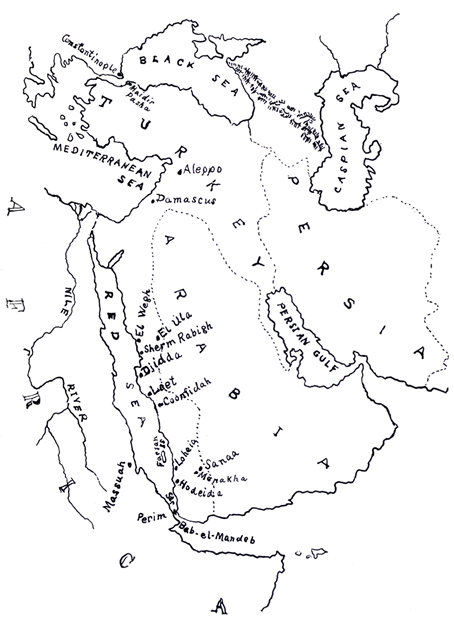
Map of Arabia
When I saw the men who had been sent out from Djidda to meet us, I supposed that the most dangerous part of our journey was behind us. We were now getting into the vicinity of a town in which there was stationed a Turkish garrison of about three hundred men, and I said to myself that if seventeen men could come through unmolested from Djidda to us, then surely we, a company of fifty men, would be able to travel the same road to Djidda in safety.
This district is inhabited by a tribe that is composed wholly of direct descendants of the Prophet, but which nevertheless is notorious for its uncivilized ways, and its robberies. “Father of the Wolf” is the very appropriate name by which this part of the country is known.
As usual, we began our onward march at four o’clock in the afternoon. Our road now led us somewhat away from the sea. The country round about consists wholly of flat sand drifts. Nowhere can one see farther ahead than a distance of about four hundred meters. Hardly has one sand hill been passed, before another looms up to shut out the view. The drifts are overgrown with tufts of grass attaining a height of about two feet. We were trotting slowly along in the moonlight when suddenly, to our right, from beyond the usual course followed by caravans, there appeared a number of Bedouins, about twelve or fifteen, riding in a quick trot, and then vanished in the direction from which we had come. This looked rather suspicious, for, as a rule, caravans do not depart from the routes that have been trodden for thousands of years. Still less is it customary to ride off into the desert at a quick trot in the night-time. Our Turkish escort also took these men to be robbers, and told us that there had been talk in Djidda of a band of robbers, numbering about forty, by which this part of the country was infested.
As from Leet I had notified the authorities at Djidda, as well as those at Mecca, of our coming, I had reason to believe that the whole country round about was aware of our approach. Everybody knew, therefore, that our company was not one of the usual merchant caravans with little armed protection, but that, on the contrary, we were a company of fifty well-armed men, who were, moreover, carrying with them four machine guns. A rumor of forty roaming bandits caused me little disturbance of mind, therefore. Nevertheless, that I might have my men better in hand, and be prepared for any emergency, I took the precaution to divide our one long line of camels into two lines of fifty each. The men were given orders not to go to sleep on their camels, the rifles were all examined, and everything was in readiness for prompt action. The orders to my men were, once for all: “Rally to your commander.”
The officers were riding at the head of the caravan. When the first signs of the coming day began to appear behind the mountains that rose on our right, from out the flat surface of the desert, I supposed that all occasion for anxiety was now passed, as Bedouins never make their attacks by daylight. So I slung my rifle across my saddle, unbuckled my heavy cartridge belt, and rode slowly down the line to see whether everything was in order.
I had got no farther than the middle of the caravan when I suddenly heard a loud, shrill whistle that was instantly followed by a volley of rifle fire. From every side it rained lead into our caravan incessantly, and at close range. The hum and whistle of the bullets made such a noise that the commands I shouted could not be heard. I grabbed my rifle, held it high, jumped from my camel, and, followed by my men, ran to the head of the caravan. Here the firing from both sides was well under way. From out the dusk of the early morning came the flash of the enemy’s shots at a distance of about eighty meters. The riflemen themselves we could not see, any more than they could probably see us, when we lay on the ground. The tall forms of the camels, on the other hand, must have been quite visible to the enemy, and it was at these, most likely, that their fire was chiefly directed. The only guide to the position of our foes was the flash of their shots. As we were being fired at from every side, it was difficult to decide in which direction to turn first. The larger number of my men was with me at the front. A few of them had been given orders to remain with the rear of the caravan.
The most important thing for us to do now was to get our most effective weapons, the machine guns, into play. Of these, two were strapped on camels at the head of the caravan, and two at the rear. In a few minutes we had the machine guns in action, and hardly had their volleys rattled over the enemy’s lines, when silence reigned there. This turn in affairs had evidently not been expected. We took advantage of this lull in the enemy’s fire to pull down the camels that were still standing, so that they would not form so easy a target, to distribute ammunition, and to get together.
The heaviest fire had poured down upon us from forward to the left, and it was therefore in this direction that I now led my men. Our equipment of fire-arms consisted, all told, of the four machine guns, thirteen German, and three modern Turkish rifles, together with ten old Turkish rifles that I had secured in Coonfidah to replace those lost with the wrecked zambuk. Of these, the three modern Turkish rifles had been distributed among the officers. In addition, we had twenty-four pistols among us, which, however, could only be of service in an encounter at close range. What the strength of the enemy was, we could not tell as yet. There might be from sixty to eighty men firing rapidly, or there might be many more who fired slowly. Their number was soon to be revealed to us by the coming day. When it was fully light, we could see that within our immediate vicinity the sand hills were black with Bedouins.
My men behaved splendidly. Not one of them showed the least perturbation in spite of the overwhelming superiority in numbers shown by the enemy, of whom there must have been at least three hundred. With one accord the bayonets appeared on all the rifles, although no order to that effect had been given. During a moment of hesitation at the very outset of the firing, which had now begun in good earnest, and before I had fully decided what it was best to do, the answer to my question came from the man at my right, who called to me.
“Well, what is it?” I asked.
“How soon are we going at it, sir?”
“At what?” was my question in reply.
“Why, at storming the enemy,” came the answer from this eighteen-year-old boy.
“Exactly, my man! You’re right. Up! March, march!”
With a hearty cheer we were up, and rushing the enemy’s line. No doubt, such tactics were a novelty to Bedouins used to attacking a caravan. At any rate, the enemy’s fire ceased almost entirely. As our shining bayonets came closer to our foes, they quickly took to flight, followed by our rifle fire, which visibly thinned their ranks. First, we stormed to our left, then to the front, and then to the right. It was not necessary to follow the same tactics to the rear, as there the enemy had disappeared entirely.
As a result, the narrow circle within which we had been hemmed in by the enemy, had now been widened to one of about 1200 meters’ distance from us. The firing had stopped altogether. I now assembled my men close by the caravan. The machine guns remained in position, in readiness to keep off the enemy, as well as to attack them.
In spite of the close range at which the shots had poured in upon us, we had, thank God, only one man wounded among the Germans of my company. A little surprise was in store for me, however, when I looked about me for my friends of the Arab escort. There is a German saying which runs, “He counts his dear ones that are present, to find his six increased to seven.” In my case the situation was reversed. Instead of twenty-four gendarmes, we now had only seven. There were no dead. The missing were found when we reached Djidda. Nearly all of the Arabs we still had with us had been shot in the leg. This was to be accounted for by the circumstance that, instead of advancing toward the enemy, they had run to cover among the camels. My men, who had lain in the sand some thirty to forty meters distant from the camels, had escaped the enemy’s fire, which had passed over them. Our foes had aimed at the camels, and so, before our Arabs could pull the animals to their knees, to find complete shelter behind them, the enemy’s bullets, in passing between the legs of the camels, had found a mark in the limbs of the heroes who had sought refuge there.
Of the enemy’s losses we knew nothing at all. But, as we stormed past the evacuated positions where they had lain, we counted fifteen dead. It is the custom with Bedouins immediately to remove all weapons from the bodies of their fallen comrades. As such had been the case with all but one of the dead, only one of their rifles fell into our hands. It was a breech loader of the most modern English construction, and was gratefully added to our own equipment. All the distant sand hills were still full of Bedouins, as we could see. In so far as possible, each one of those who showed themselves within range of our rifle fire, received his share of it, the moral effect produced being the principal object in view for the time being.
We could not very well remain lying in the place where we were. I had at first thought that we were dealing with a band of brigands, whose purpose was the usual one, to capture the valuables we had with us. I had therefore come to the conclusion that our assailants, who had suffered considerable loss, had now thought better of their undertaking and had abandoned it.
Quite a number of our camels had been shot. We took from their packs everything that was most necessary to us, water especially, and, discarding all the less useful things from the burdens of the uninjured camels, replaced them with the indispensables.
I decided to leave the road usually traveled, and turn sharply to the left in the direction of the sea, which I saw shimmering in the distance. If we could reach it, it would afford us protection on one side, leaving us free to face our foes in front and at our rear. It was unfortunate that I could not make use of the machine guns while on the march. Having no limbers with us, the guns had to be carried by camels while we were on the march. To make the caravan more compact, it was divided into from four to six lines, which traveled abreast. The wounded were so placed on the camels that they hung on one side of the animal, which thus afforded them some protection against the flying bullets. Two of the four camels that carried machine guns were placed at the head of the caravan, and the other two at the rear. An advance guard of ten men in a widely extended skirmish line was sent out about one hundred and fifty meters ahead of the caravan, while a like number of men formed a rear guard at the same distance from it. As there were only nine more men who carried rifles, these formed a protecting guard, as best they could, for the two wings. The men who were armed with pistols only, and so could take part in no engagement except one at close range, remained near the caravan. Lieutenant Gerdts was placed in command of the advance guard, Lieutenant Schmidt of the rear guard, and Lieutenant Gyssling, of the flanks. Lieutenant Wellmann had charge of the caravan itself, where Dr. Lang was also with the sick.
Slowly our company set forth, our flag carried before us. Our hope, that the enemy would not trouble us again, was not to be realized. We had hardly been ten minutes on the march when shots again poured in upon us from every side. There was scarce a sign of our foes to be seen. Their every movement at any distance of more than four hundred meters was completely hidden by the sand hills. Ten to twenty dark heads popping up with lightning rapidity from behind a sand hill here or there, was all that we could see. Their appearance was always followed the next instant by a volley of shot rattling about the caravan, and before we could get the slightest opportunity to return the fire, the heads had disappeared, and a shower of lead fell upon us from another direction.
At first, strange to say, not one of our number was hit, although the enemy’s fire was so incessant that shots were constantly falling about us, little pillars of sand marking the spot where they struck, while sand and gravel was constantly flying in our faces. In a short time it became evident that the greatest pressure was being brought to bear upon our rear guard. At that end of the caravan the men had to turn every few minutes to silence the enemy by a vigorous return of their fire.
I was with the rear guard when a signal came from the front, reporting that strong hostile forces had come in sight in the direction toward which the caravan was moving. When I arrived at the front, I saw that the whole horizon was black with Bedouins. At the same time came the report from the rear that one of the camels carrying the machine guns had been shot. The rear guard had halted, to protect the gun, and Lieutenant Schmidt asked that fresh camels be sent to the rear, so that he might shift the dead camel’s load. I now heard the machine guns of the rear guard firing. They had been unstrapped, set up, and brought into action.
I now ordered the caravan to halt, an order which was by no means easy to carry out, however, as most of the camel drivers had taken advantage of the darkness to disappear along with the Arab gendarmes at the beginning of the fight. While on my way back to the rear guard, the report reached me that seaman Rademacher had fallen, and that Lieutenant Schmidt was mortally wounded, shot through the breast and abdomen. In the meantime the command of the rear guard had devolved upon Lieutenant Wellmann, who had brought with him two camels from the caravan, for the transport of the machine guns.
During our halt, the enemy’s fire increased in severity, and a vigorous engagement was soon in progress. Suddenly the firing ceased altogether, and, as I looked about me for the cause, I saw two of the Arab gendarmes, who had remained with us, running toward the enemy’s lines, waving large white cloths as they ran. At the same time a third gendarme came to tell me that his comrades wished to parley with the other side. Although this turn in affairs was in no way of my choosing, it was nevertheless a welcome one, for it had now become evident that this was no attack by a mere band of robbers, but one that was thoroughly organized. As our assailants outnumbered us by at least ten to one, it would have been folly to continue our march at the slow gait of a camel’s pace, on an open plain, under continued fire from the enemy. Moreover, my most effective weapon of defence, the machine guns, could not be used while on the march. Nor could our twenty-nine rifles be employed to the best advantage, as there were too few of us to make their fire effective in all the directions from which we would be attacked. In the long run, we would have been shot down one after the other.
We therefore took advantage of the pause in the battle, to fortify ourselves. Hastily we constructed defence works out of camel saddles, which we filled with sand, out of sacks of coffee, rice and other provisions. We strengthened the rampart thus formed by filling it about with sand, as best we could. The camels were placed all together in the middle of the enclosed space, and loop holes were quickly got ready. For want of better material, they were put together out of tin plates and side arms. As all this was done in great haste, our constructions were, of course, but temporary and incomplete. Our water bottles were quickly buried deep in the sand, where they were least likely to be damaged by the enemy’s fire. Within our outer rampart we raised another little fortress, the walls of which were about one meter and a half high, and constructed of empty petroleum cans which we filled with sand. Here were placed the sick who were unfit for duty, the wounded, and the doctor.
As we had to reckon with the possibility of being fired upon from all sides, and our rampart afforded us protection in front only, the camels were so placed as to shelter us from the enemy’s fire at the flanks and rear. For our severely wounded, Lieutenant Schmidt, we made a stretcher of rifles and a woolen blanket, on which he was carefully carried to the inner fortress. The seaman, who had fallen, we buried where he fell.
The four machine guns were set up at the four corners of our defence works, and protected as best they could be by hastily thrown up ramparts of sand. The men armed with rifles were distributed at equal distances along our fortifications. In the spaces between, were stationed the men who were armed with pistols only, and the ammunition was placed within easy reach. Our preparations were hardly completed when the men bringing the enemy’s conditions, returned. The demands were that we surrender all arms and ammunition, our camels, all our provisions and water. In addition we were to pay eleven thousand pounds in gold. Upon compliance with these conditions we were to be allowed to proceed unmolested. Well we might!
The parleying had at first been conducted through the dragoman who, with his wife, had joined us at Coonfidah. He also was among the wounded. Shot in the leg! When he went over to the enemy to negotiate, he did not forget to take his wife with him. We did not see either of them again until we met them in Djidda.
My answer ran: “In the first place, we have no money; in the second, we are guests of the country—get your money in Djidda; thirdly, it is not customary with Germans to surrender their arms.”
Hereupon the firing began again. All the camel drivers who had so far remained with us, and a number of the Arab gendarmes also, took advantage of the truce to follow the example of the dragoman and his wife, and disappear. The engagement lasted until darkness came on. We lay very well protected behind our camel saddles and camels. We returned the enemy’s fire but sparingly, as our store of ammunition was not large. Moreover, much of the ammunition that had gone down with the wrecked zambuk, and had lain in the water until we fished it out on the following morning, now missed fire. For this reason, I had all the undamaged ammunition placed in readiness near the machine guns, so that in a possible night attack at close range, I might feel sure of my most effective weapons. The rest of the ammunition was distributed among the rifles. We suffered no further losses during the day’s engagement. Several of our camels were shot, but we were none the less protected for this, as a dead camel is quite as good a shield against rifle balls as is a live one. We had eaten nothing during the entire day. Nor could we think of doing so while the daylight lasted. No sooner did one of us raise his head above our rampart of saddles, than the enemy’s fire was redoubled.
But our most strenuous work began with the coming of the night. The moon did not rise until about an hour after sunset. During the intervening hour the darkness was so intense that we could see hardly forty or fifty meters ahead. Within our rampart everything was in readiness to withstand a night attack by storm. All rifles and pistols were loaded, the machine guns manned and ready for action, and the men, with their weapons in hand, were kneeling just behind the rampart. But nothing happened.
As soon as the moon had risen, and we could see as much as three hundred meters ahead, we set to work to improve our position. First of all, water was served to the men, and hard tack distributed. While some of the officers and men remained on guard ready for action, others set to work at deepening the trenches, an undertaking that proceeded but slowly, as we had no proper tools for the work. Still others were engaged in removing the dead camels from within our enclosure. The intense heat caused putrefaction to set in very rapidly. The carcasses swelled up, the tense hides burst, and the entrails exuded. As at this season of the year the wind blows persistently from the north, we took the dead camels to the southward of us, so that the stench might not sicken us.
It was well into the night before we felt free to take a little rest. The trenches were now so deep that they afforded ample shelter for the men lying in them. We had thrown up mounds of sand on all sides, in addition to the protection afforded us by the camels. Our rifles and pistols had suffered considerably from the incessantly drifting sand. They were now taken apart, a few at a time, cleaned and tested. Then we wrapped our handkerchiefs around the locks, and stuffed small bits of cloth into the muzzles to keep out the sand. All this care was necessary to insure the efficiency of our weapons. That there might always be some one on guard within our fortification, a part of the men remained awake at their posts while the others slept with their loaded rifles in their arms. There was always one officer awake. But nothing of importance occurred during the night.
At nine o’clock that evening, Lieutenant Schmidt, the officer who had been so terribly wounded, died. We dug a grave for him as deep as possible in the middle of our camping place, and toward eleven o’clock in the night, we four surviving officers ourselves bore our fallen comrade to his grave. There could be no service at the burial. The volley over his freshly made grave was fired by the enemy on the coming morning.