Front matter (continued 3)
Reading edition
Mr. Stuart did not believe the wrecker would return to the boat. He had accomplished his evil purpose. But Mr. Stuart did hope that another launch might visit the coast either that evening or in the early morning. Therefore he requested that any one who discovered his letter would come to Miss Thorne’s home for his party.
CHAPTER XVI
WELCOME AND UNWELCOME GUESTS
The sun was just sinking when Mr. Stuart’s weary cavalcade stopped in front of a great iron gate. The gate was covered with rust and hung loose on its hinges. It opened into a splendid avenue of cypress trees. As far as the eye could see on each side of the road, ran overgrown hedges of the Rose of Sharon. The bushes were in full bloom and the masses of white blossoms gleamed in the gathering shadows like lines of new fallen snow.
“How beautiful!” exclaimed the four “Automobile Girls” in chorus.
Mr. Stuart looked anxiously up the lonely avenue as his party stumbled along the rough road and peered cautiously into the hedge first on one side then on the other. It would have been easy for an army to hide itself in the cover of the thicket, which hemmed them in on all sides in an impenetrable wall of green.
“I feel extremely uneasy, Robert,” declared Miss Sallie, her face pale under the stress of the day’s experiences.
Old Madame de Villiers smiled and shrugged her shoulders. “I have no fear for myself,” she said. “My husband is a soldier. I have followed him through two great wars. What comes must come. It is all in the day’s business. But the countess, she is different. She is in my charge; nothing must happen to her. I assure you, Mr. Stuart, it is of the utmost importance that the Countess Sophia be protected.”
Miss Sallie held her head very high. Madame de Villiers was their guest, so Miss Stuart would say nothing. But why should Madame de Villiers think the safety of the Countess Sophia of more importance than that of the four “Automobile Girls?” Miss Sarah Stuart had other ideas. She was equally determined that no harm should overtake any one of her charges.
The narrow avenue finally broadened into a lawn overgrown with flowers and vines. Back of it stood an old house that had once been a fine colonial mansion. The house seemed to frown on the intruders, who had come to destroy its sacred quiet.
“I should think anybody might be ‘teched’ in the head, who lived alone in a queer place like this,” whispered Ruth to Bab, as the two girls stood with their arms about each other, staring ahead of them.
“Will you see Miss Thorne first, Jim, and explain our plight to her?” Mr. Stuart asked the old colored man. “Or do you think it would be better to have me make matters clear?”
“I’ll do the ’splainin’, Massa,” returned old Jim. “My missis will allus listen to me. I done tole you she wasn’t jes’ like other folks.”
“Is your mistress insane, Jim?” inquired Miss Sallie anxiously.
“No-o, ma’am,” returned the old man. “Miss Thorne she ain’t crazy. She’s puffectly quiet, suh, and she’s all right on every subject ’cept one. I hates to tell you what that thing is.”
“Out with it, Jim. What is the lady’s peculiarity?”
“She imagines, suh, that her fambly is still with her, her own ma and pa, and young massa, and her sister Missy Lucy. Missy Rose ain’t never been married.”
“Where is her family, Jim?” Ruth asked.
“They lies yonder in the buryin’ ground, Missy,” replied the old darkey, pointing toward a clearing some distance from the house, where a few white stones gleamed in the twilight.
Miss Sallie shuddered. Grace and Mollie huddled close to her, while Ruth and Bab gave each other’s hands re-assuring pressures.
“Do you look after this Miss Thorne?” Mr. Stuart inquired further.
“Yes, suh; me and my wife Chloe looks after her. Chloe cooks and I works about the place when I’se not down to the beach with my boat. But my missus ain’t so poor. She’s got enough to git along with. I jest likes to earn a little extra.”
By this time Jim had climbed down from his shaky old wagon. He now opened the front door.
“Walk right in,” he said hospitably, making a low bow. “I’ll go find Miss Rose.”
Mr. Stuart’s party entered a wide hall that seemed shrouded in impenetrable gloom. On the walls hung rows of family portraits. The place was inexpressibly dismal. The “Automobile Girls” kept close to Mr. Stuart. In silence they waited for the appearance of the mistress of the house.
Two candles flickered in the dark hallway. Out of the gloom emerged an old lady, followed by her two servants, who were bearing the lights. She was small and very fragile. She wore a gray silk gown of an old fashioned cut. Her dress was ornamented with a bertha and cuffs of Duchess lace.
The old lady advanced and held out her small hand. “I am pleased to offer you shelter,” she declared to Mr. Stuart. “Jim has explained your predicament to me. We shall be only too happy to have you stay with us for the night.”
At the word “we,” the “Automobile Girls” exchanged frightened glances. Their hostess was alone. But that one word “we” explained the situation. Did she mean that all the ghosts of her past still waited in the house to welcome unexpected visitors?
“It has been many years since we have had guests in our home,” continued Miss Thorne. “But I think we have rooms enough to accommodate you.”
Chloe conducted Miss Sallie, Madame de Villiers, the Countess Sophia and the four “Automobile Girls” into a great parlor. The room was furnished with old fashioned elegance. Candles burned on the high mantel shelves. But the dim lights could not dispel the shadow of desolation that pervaded the great room.
A few minutes later Miss Thorne entered the room. “You must tell me your names,” she inquired sociably. “I wish to run upstairs and tell Mama about you. Poor Mama is an invalid or she would come down to see you.”
Then calling Chloe to her, she said in a loud whisper:
“Notify Miss Lucy and Master Tom at once. Papa can wait. He is busy in the library.”
An uncanny silence followed Miss Thorne’s speech. Every one of the seven women looked unhappy and Mr. Stuart tried vainly to conceal a sense of uneasiness. But Chloe quietly beckoned the party from the room.
“I’ll jes’ show the ladies upstairs,” she explained gently and her mistress made no objection.
Miss Sallie would on no account sleep alone in such a dismal house. She shared a large chamber with Ruth and Bab. The countess asked to spend the night with Mollie and Grace, and Madame de Villiers, who was afraid of nothing, had a room to herself. Mr. Stuart went up to the third floor.
“Let us talk and laugh and try to be cheerful, girls,” proposed the countess. “This poor old soul is quite harmless, I believe, and she seems very sad. Perhaps we may be able to cheer her a little.”
“All right, my lovely countess,” replied Mollie. “Ghosts or no ghosts, we will do our best. But don’t count on me for much merriment. I’m a dreadful coward.” Mollie looked over her shoulder with a shudder.
The countess and Grace laughed, but quickly their laugh died.
The sound of weird music floated up through the dark hall. Their hostess, Miss Thorne, was playing the tall harp that stood in the parlor.
“Goodness!” cried Miss Sallie, “what will that poor soul do next? I should not be in the least surprised if the entire departed family were given places at supper to-night.” Which was exactly what happened. Four empty chairs were left at the table.
“Miss Thorne,” said Mr. Stuart, when they were all seated, “could you not be persuaded to visit the outer world? It would give my sister and me much pleasure if you would spend a few days with us at Palm Beach.”
A spark of pleasure lit up the hostess’s faded eyes for an instant. Then she shook her head sadly.
“You are most kind, sir, but I am much needed at home. Lucy, my sister, is quite delicate, you see. And Mama is an invalid.”
Miss Sallie touched her brother’s foot under the table, as a signal to keep away from dangerous topics. But what topic was not dangerous?
“How charmingly you play the harp, Miss Thorne,” ventured the countess, when they had somewhat recovered themselves.
“Ah,” exclaimed the poor woman, smiling archly, “you must praise the right person, my dear. It was my sister Lucy who was playing.”
Miss Sallie dropped her fork with a loud clatter, while Mollie slipped her hand into the countess’s and the other three girls linked their feet under the table, girl fashion.
Jim, who, in an old black coat, was waiting on the table, smiled grimly and mumbled to himself.
“But, young ladies,” cried Miss Thorne, “you are not eating.”
As a matter of fact the supper was delicious; biscuits as light as snow flakes, broiled sea trout, potatoes roasted in their jackets and preserves in delicate cut glass bowls. But who could enjoy a banquet under such conditions? The two candles seemed to accentuate the blackness of the shadows which gathered at the edges of the room. The guests tried to laugh and talk, but gradually gloomy silence settled upon them. Miss Thorne appeared to have forgotten where she was and Mr. Stuart observing the uneasiness of the whole party remarked that as they had had a long day it would be well to retire early.
As they were about to rise from the table a sudden exclamation from the countess who sat at the lower end of the table caused all eyes to turn toward her in startled inquiry. She was staring at the open window in fascinated terror, unable for the moment to do anything save point to the opening which was swathed in shadows.
“A horrible old man!” she at last managed to articulate. “I saw him looking in at us!”
“What old man?” demanded Mr. Stuart.
“He was white haired and looked like a great ape,” she gasped.
“Why that’s the man whom I drove out of your room the other night, Countess,” exclaimed Bab. “What can his object be in following you?”
“Come, my man,” commanded Mr. Stuart, turning to the engineer who sat beside him, “and you too, Jim, we’ll search the grounds. I believe that this formidable old man can tell us something about the wrecking of the engine. Let’s get after him at once!”
Old Jim lost no time in procuring lanterns, and a thorough search of the grounds was made. The women meantime remained in the dining room, but now that the first effects of their fright had worn off, they prepared to give their fearsome intruder a warm reception should he again show himself. Madame de Villiers moved her chair to one side of the open window, her heavy cane in both hands, ready for instant use. While Barbara took up her station at the other side grasping firmly the heavy silver teapot that had been in the Thorne family for generations. Ruth guarded the door at one end, brandishing ferociously a heavy carving knife she had appropriated from a set on the old fashioned side-board, while Mollie, bravely, held the fort, at the other door with the fork. The countess half laughing, half shuddering, clung to a heavy cut glass water bottle, while Miss Sallie had prepared to meet the enemy with a huge bottle of cayenne pepper, which she had taken from the old-fashioned silver castor.
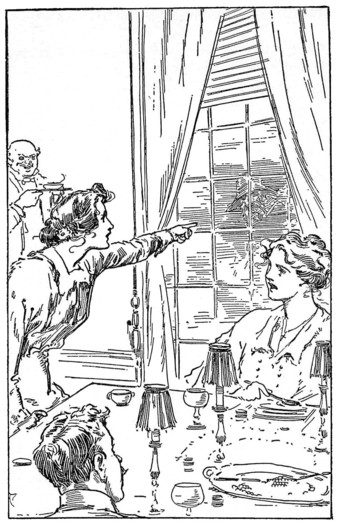
The Countess Pointed Toward the Open Window.
“There is nothing like being prepared,” said Ruth with a hysterical laugh, after ten minutes had passed, and the enemy had not shown himself. “I’m going to get a chair and be comfortable.” Mollie followed suit, and the watchers sat valiantly alert, as the minutes dragged by.
Miss Thorne chattered voluably to and about her family, paying very little attention to her strangely-behaved guests, while Chloe, the old servant, huddled in one corner, her eyes rolling with fright at every sound she heard.
At last the welcome sound of men’s voices was heard and Mr. Stuart, followed by the engineer and old Jim, entered at Mollie’s door.
“What kind of desperado organization is this?” he exclaimed, laughing in spite of himself at the ludicrous appearance this feminine vigilant committee made.
“It’s war to the knife,” cried Ruth.
“And the fork, too, I should say,” laughed her father, “also the teapot, and—what on earth are you cherishing so fondly, Sallie?”
“Cayenne pepper,” responded Miss Sallie, “and I consider myself well armed, at that.”
“I should rather think so,” agreed her brother. “However you are all safe in laying down your arms, for we have searched diligently, and can find no trace of the intruder. He evidently heard the countess and made a quick get away. You must pardon us, Madam, for stirring up your quiet home in this manner,” he said, bowing to Miss Thorne. “I trust we shall meet with no further disagreeable adventures.”
“You have not disturbed either Lucy or me in the least,” declared the demented old woman graciously. “As for Papa and Mama they dearly love to have visitors.” She smiled sweetly and at once began a one-sided conversation with her departed parents.
“Do take us away from her,” whispered Ruth to her father. “She has been addressing the shades of her family ever since you left us, and it’s getting on our nerves.”
“With your kind permission, Miss Thorne, we shall retire,” said Mr. Stuart, and the seven tired women gladly followed him through the shadowy hall and up the wide stairs, to their respective sleeping rooms.
CHAPTER XVII
THE MIDNIGHT INTRUDER
Once in their rooms the drooping spirits of the picnickers revived, somewhat. It was a fine night, the air warm and fragrant. The windows of the sleeping rooms were wide open and the moonlight streamed across the floor, filling the whole place with its soft radiance.
“Oh look!” cried Grace, going over to the open window. “What a darling balcony! I believe the other rooms all open out on it too. Good-bye,” she called to Mollie and the countess, as she stepped nimbly over the sill. “I’m going to make a call.”
Grace had hardly disappeared, before the countess went quickly to the door, closed it, then came back to Mollie, her finger on her lip. Drawing Mollie over to one corner of the room, where they could not be observed from the outside, the countess whispered. “Mademoiselle Mollie, I believe you love me and trust me, even more than do your friends, and because of this I am going to ask you to do me a very great favor.”
Mollie’s blue eyes looked lovingly up into the dark eyes of the countess. So fervent was her feeling of adoration for this fascinating stranger that she was prepared to grant any favor that lay within her power. “I should dearly love to help you in any way I can,” she said earnestly. “You make me very, very happy.”
The countess kissed her.
“Dear child,” she continued, “the thing I am going to ask seems simple enough, but some day you will understand how much it means to me. Wait a moment,” she added almost under her breath. “There is some one whom I hold in such dread that, even in this desolate and far-away place, he or his confederate might be listening.”
She looked about her cautiously, then went to the window and anxiously scanned the balcony. It was quite empty. Her eyes searched the long avenue leading to the grove that looked like a huge black spot in the moonlight. Then she returned to Mollie and said softly, “I am not afraid of ghosts, and neither are you, Mollie, I am sure, because there are no such things; but this place fills me with foreboding. It is so lonesome, so utterly dismal. What was that? I thought I heard a noise below. Did you hear anything?”
“Perhaps it was Jim closing up for the night,” replied Mollie, pressing close to the countess for comfort. “But what was the favor? I will do anything for you.”
“This is it,” answered the countess, her voice again dropping to a whisper. “Will you, for a few days, carry a paper for me? It is a very dangerous paper, dangerous, that is, because some one else wishes it, but it is a very valuable one to me because I may need it, and if you will keep it safely hidden until I do need it, you will not only be doing me a service but Mademoiselle Warren also.”
Mollie looked puzzled. The countess’s words were shrouded in mystery.
“Does it concern the Count de Sonde, too?” she asked breathlessly.
“Yes,” replied the countess; “it concerns him very intimately. Will you do this for me, little Mollie? I know now that the paper is not safe either in my house or on me. It would be quite safe with you, however. Even my enemy would never think of that, and, if anything should happen to me, you may produce the paper at once. Give it to Mr. Stuart. He will know what should be done.”
The countess took from her dress a square, flat chamois bag which fastened with a clasp and evidently contained a document of some sort.
“Fasten it into your dress with this pin,” she said, “and keep the pin as a memento of our friendship.”
And the pin, as Mollie saw later, was no ordinary affair, but a broad gold band on which was a beautifully enameled coat of arms.
“Is this another secret session?” cried Ruth’s voice gayly from the window.
The two conspirators started nervously.
“Come into our room,” Ruth continued. “Papa has sent up the luncheon hamper. There are still some sandwiches and fruit left; likewise a box of candy. We were too frightened to have appetites at supper, but I think a little food, now, will cheer us mightily.”
“This looks quite like a boarding-school spread,” exclaimed Miss Sallie as they gathered around the feast. “But it is really a good idea. I feel that this little midnight luncheon might help me keep up my courage until I get to sleep.”
“What a jolly little feast,” cried the Countess Sophia. “I am quite beginning to take heart again after that fearful ordeal below. I had a feeling all the time that the chairs were not really empty.”
“Goodness me!” cried Grace, “do change the subject, or we shall be afraid to go to bed at all.”
“And I move that we take to our couches at once,” said Ruth, “while we have the courage to do so. Madame de Villiers, are you not afraid to sleep alone?”
“Not in the least, my dear. I am not afraid of the most courageous ghost that ever walked. I believe I will retire at once. I am very tired.”
Taking one of the candles which stood in a row on the mantel, making a cheerful illumination, the stately old woman bade them good night, and the tapping of her stick resounded through the empty hall.
Soon after Grace, Mollie and the countess stepped through the window, and down the balcony to their room.
“You’d better close your shutters,” called Grace over her shoulder. “We’re going to.”
“And lose all this glorious moonlight?” asked Ruth. “Never. This balcony is too high from the ground for any one to climb up, easily, and besides, old Jim is going to be on guard to-night. Aunt Sallie thinks we had better try to make ourselves comfortable without doing much undressing. Even if we don’t sleep very well to-night, we can make up for it when we get back to the hotel.” With these words Ruth blew out the candles and five minutes later, their shoes and outer clothing removed, she and Barbara and Miss Sallie were fast asleep.
Grace and Mollie, however, struggled vainly with the heavy wooden shutters, but try as they might they could not succeed in closing them tightly. After some subdued laughter and many exclamations they abandoned their task in disgust, and blowing out their candles prepared themselves for sleep.
At midnight Ruth awoke with a start. She had a distinct sensation that some one had been looking into her face. But the room was still flooded with moonlight, and she could see plainly that, except for her sleeping companions, no one was there. She turned over and closed her eyes again, but the sudden waking had driven sleep away.
Was that a noise?
Ruth held her breath and listened. There was not a sound except the regular breathing of Miss Sallie.
Ruth lay with every nerve strained to catch the lightest footfall. In a moment it came again, very faint but still distinct. Something—some one—moved somewhere.
She sat up in bed and touched Barbara lightly on the cheek.
Barbara opened her eyes slowly then sat up. Ruth pointed to the next room. The two girls listened intently. Again there was the sound, a soft, a very soft footfall on a creaking board.
Cautiously the two girls climbed from the bed and crept over to the door between the two rooms. On a small bed at the far side of the room lay the countess, sleeping soundly. Grace and Mollie also were fast asleep in the other bed. Suddenly Ruth gripped Bab’s arm. The eyes of both girls were riveted on the old fashioned dressing table in one corner of the room. Before it stood the same terrible old man that Bab had seen at the villa. He was examining minutely every thing on the dresser. Next he turned his attention to the girls’ walking suits which hung over the backs of the chairs. He searched the pockets of the coats, the linings, and even the hems of the skirts.
“He is certainly looking for a paper,” Barbara thought, as she watched him make his systematic search, “and he certainly has something to do with the countess’s affairs.”
Barbara’s mind reverted to the group she had seen on the hotel veranda, the night before. What was the explanation of it all? Was the countess really an impostor and why, when she evidently feared Monsieur Duval and ignored Mrs. De Lancey Smythe, did she hold interviews late at night with them? She had distinctly refused the “Automobile Girls’” invitations to the hotel, yet she had not refused to meet others there. And what part could this ferocious looking old man possibly have in the drama?
All this passed rapidly through Bab’s mind as with her hand clasped tightly in Ruth’s the two girls watched the intruder with bated breath. To Bab there was something strangely familiar about him, his movements suggested some one she had seen before, yet she could find no place in her memory for him.
Failing to find what he desired, the old man again turned toward the countess a look of indescribable menace on his face. He took a step toward her then—a sudden burst of weird music floated up from the gloomy drawing room. With a smothered exclamation the intruder whirled and making for the window swung himself over the ledge. Ruth clutched Barbara for support. She was trembling with fear.
“Don’t be frightened, dear,” soothed Bab bravely. “That isn’t ghost music. It’s only Miss Thorne playing the harp. It’s an unearthly hour for music, but she couldn’t have begun to play at a more opportune moment, either. I believe that frightful old man thought it was ghost music. Just listen to it. It’s enough to give any one the creeps.”
The demented old woman played on in a wailing minor key, and presently footsteps were heard coming down the hall. By this time Mollie, Grace and the countess were wide awake and seeing Bab and Ruth in their room demanded to know what had happened. A moment later Madame de Villiers and Miss Sallie, both fully dressed, entered the room.
“No more sleep for me to-night,” announced Miss Stuart firmly. “I feel that the sooner morning comes and we get out of this house the better pleased I shall be.”
At that instant a melancholy strain like the wail of a lost soul rose from down stairs. Then all was silent.
“I begin to believe it is the departed spirit of her sister Lucy that executed that last passage,” shuddered the countess. “Come, my dears let us finish dressing. It will soon be morning and then surely some way will be provided for us to go back to Palm Beach.”
“Shall we tell her?” whispered Ruth to Bab.
“We’d better,” nodded Bab. “Then she will be constantly on her guard.”
“Listen, everyone,” commanded Ruth. “We are going to tell you something but you mustn’t feel frightened. We think the countess should know it at once. You tell them about it, Bab.”
Bab obediently began a recital of what had transpired after she and Ruth had been so suddenly wakened. The others listened in consternation to her story. The countess who turned very pale while Bab was speaking, looked appealingly at Madame de Villiers. The stern old woman was apparently much agitated. “He shall not harm the Countess Sophia,” she muttered, forgetful of those about her. “I will protect her even from him.”
“Aunt Sallie, shall I call Father?” asked Ruth a few moments later. The seven women were seated about the room in silent dejection.
“No, Ruth,” responded her aunt. “We will not waken him. A man that can sleep through a concert such as we were favored with deserves to be left in peace. It is after four o’clock now. I think we’ll let him sleep until six, at least. Then after breakfast, perhaps, he will be able to devise some means by which we may return to the hotel.”
It was a very tired and sleepy band of picnickers that gathered around the Thorne breakfast table that morning, and breakfast was not over when the honk of an automobile horn was heard and a large touring car rolled up the avenue.
“Hurrah!” shouted Ruth. “It’s Mr. Warren. Oh, but I’m glad to see him.”
It was indeed Mr. Warren, who, when the party did not return that night, had taken the fastest launch he could find and made for the picnic ground. He had discovered the note, as Mr. Stuart had hoped, had returned to the hotel where the history of Thorne house and its mistress was not unknown and had come for them himself after a few hours sleep.
“I should be happy and honored if you would all come again,” said Miss Thorne as she waved adieu to her guests from the front piazza, while Jim and Chloe bobbed and bowed and chuckled over the generous present they had each received from Mr. Stuart.
As the automobile rolled down the avenue they caught a last glimpse of the mistress of Thorne House still waving her handkerchief, and in every heart was a feeling of tender sympathy for the little old woman whose present was so irrevocably linked to the past.
CHAPTER XVIII
THE WATER FÊTE
“Roll along, roll along,
O’er the waters so blue,
We’re afloat, we’re afloat
In our birch bark canoe,”
sang Grace’s high sweet voice as their boat bobbed gayly up and down with the little rippling waves of the lake.
“That is a pretty song, my dear child,” exclaimed Miss Sallie Stuart, from a cushioned seat in the stern of the boat, “but you should substitute ‘naphtha launch’ for canoe. Nothing would induce me to ride in one.”
“The Count de Sonde is going to be at the fête in a canoe,” observed Maud Warren in the tone of one imparting a piece of valuable information. “He asked me to go with him, but Papa was unreasonable, as usual.”
“In a canoe with that little foreigner!” cried Miss Sallie in amazement. “Does he know how to paddle?”
“The count is an expert boatman,” replied Maud stiffly. She had mixed sensations of fear and dislike for Miss Sallie, although fear was the stronger sentiment of the two.
“I imagine his swimming and his canoeing are about alike,” said Ruth aside to Barbara; “just paddling in shallow water.”
The “Automobile Girls” were busily engaged in decorating their launch for the Venetian Fête, which was to take place that evening. The lake dotted with numbers of boats looked like an immense flower bed. Hundreds of craft of every land were anchored near the shore, each filled with gay parties of young people who were stringing up rows of Japanese lanterns, bunting and flags.
“There’s not a boat on the lake that can compare with ours,” cried Mollie proudly, as she tacked the end of a festoon of small banners to the awning-pole, while Barbara gave a finishing touch by crossing the silk flags of the “Automobile Girls” on the bow.
“If only the lanterns don’t catch fire this evening,” said Miss Sallie.
“What a pessimist you are, Auntie, dearest!” exclaimed Ruth. “We can easily pitch them in the water if they do, and still be very handsome with our banners and things.”
“Here comes the count,” cried Maud, who had ignored the conversation of the others and was busily scanning the multitudes of boats in search of her admirer.
Her friends politely controlled a desire to laugh when they saw the count presently emerge from the boats along the shore in a small canoe that was decorated with one lantern hung from a bamboo stick in the bow, while the French flag waved triumphantly from the stern. The count, in white flannels, was working laboriously with the paddle. His little mustache twitched in an agony of exertion and occasionally he paused to wipe the perspiration from his brow.
“The count is quite an athlete, isn’t he, Maud?” asked Mollie wickedly. “I should think he might lead the parade to-night.”
But Maud was not listening. Her whole attention was concentrated on the canoe, which was making straight for the launch.
“Here I am, Count,” she cried, waving her handkerchief to the young Frenchman, who, as soon as he espied the boat full of girls, had begun to paddle with a grand flourish, at the same time casting melting glances in the direction of Maud. But he had not calculated on the distance between the canoe and the launch, and a final, fancy stroke with the paddle, sent the frail little boat scurrying over the water.
It collided with the larger boat, and in an instant turned turtle, dragging the flag of the French ignominiously into the depths while the discomfited son of France, clung to the side of his boat, and wildly called for help.
At first the girls were speechless with laughter and the last of the De Sondes received neither sympathy nor aid. Even Maud joined in the merriment, while the enraged nobleman sputtered angrily in French and denounced America and everything in it as fit only for pigs.
Presently Barbara wiped the tears from her eyes and threw out a life preserver to the unfortunate man.
“There, Count,” she called, “you can’t sink as long as you hold on to that. We’ll see if we can’t right your boat, and you can paddle back to shore.”
“I’m sorry we can’t offer you the hospitality of our boat,” said Miss Sallie, “but we are anchored, you see, and the engineer is ashore. Besides, I am afraid your wet clothing would spoil our decorations.”
The count, however, was too enraged to remember any English. He shook his fist at the upturned canoe and poured forth a perfect torrent of maledictions against it.
Just then a passing launch paused and gave the needed assistance, taking the count on board and towing the canoe to shore. As the little boat was righted an envelope that had evidently fallen from the count’s pocket, floated past them in the current.
“You dropped something,” called Barbara, but the launch had already started for shore and the count did not hear her. Using the crook of her parasol Ruth tried to fish it out. As she drew it to the side of the boat it sank out of sight but not before she had read the inscription on it, written in an angular foreign-looking handwriting: “To Madame La Comtesse Sophia von Stolberg.”
Barbara, too, saw it, and so did Mollie, whose face flushed crimson with the memory of what her beloved countess had said to her that night on the balcony of Thorne House. At that very moment, pinned inside of Mollie’s white silk blouse, was the dangerous paper which “concerned the count very intimately.”
Was it about that mysterious document that he was now writing to the countess?
For the first time Mollie felt the shadow of a doubt cross her mind. It was only a tiny speck of a doubt, but it left its impression, try as she would to shake it off.
Ruth and Barbara exchanged glances, but said nothing. They had seen enough to know that some sort of correspondence was being secretly carried on between the Countess von Stolberg and the Count de Sonde. If Maud were to marry the count she would deeply regret it, the Countess Sophia had said.
Strangely enough, this speech came back to each of the three girls at the same moment.
Ruth felt that perhaps they had rushed too quickly into an intimacy with the countess. For the first time Mollie was inclined to be a little suspicious. While Barbara who had even more evidence against the Countess Sophia tried vainly to fit together the pieces of this most mysterious puzzle.
“Well, fair and beautiful ladies, are you quite ready for a sail on the Grand Canal? Have you your wraps and bonnets? Is Grace’s guitar on hand?” called Mr. Stuart that evening, after dinner, rapping on three doors one after the other.
“In a minute!” called a chorus of voices from the three rooms, while Mr. Stuart put on a look of resigned patience and waited for the girls to appear. At length, tired of waiting, he strolled toward the elevator when Marian De Lancey Smythe hurried along the corridor.
She averted her face when she saw Mr. Stuart, for Marian had sedulously kept out of sight for a number of days, and they had wondered not a little at it.
“Why, Miss Marian,” called the kind-hearted man, who had always felt an interest in the strange young girl, “aren’t you going to see the water fête to-night?”
“I’m afraid not, Mr. Stuart,” she replied, her lips trembling a little, partly from loneliness and partly because people were not often kind to her. “Mama is going with Mr. Duval and some friends, but I didn’t care to go with them.”
“Very well, Miss Marian; you must go with us, then. Get your wraps and meet us on the piazza.”
And ten minutes later, her eyes alight with pleasure, Marian made one of the party of girls who presently found themselves floating in the long procession of illuminated boats on the lake.
All the hotels had emptied themselves upon the lake front, and hundreds of boats had already filled and were forming in line for the water. The moon would not be up until very late, but the place was aglow with Japanese lanterns, which decorated the launches and rowboats and hung in festoons along the boat landings.
The girls had hardly got their lanterns lit when there was a burst of music, and the procession began to wind its sinuous way about the lake.
“The fireworks will begin in a moment, girls,” said Mr. Warren, “and then you will be a part of a wonderful spectacle to those on shore.”
Certainly the Stuart boat was one of the most picturesque of all the craft that floated in the parade. The glow of the lanterns made a soft illumination about the four young girls, each of whom wore a long broadcloth cape, a final gift from Mr. Stuart before leaving Chicago. Barbara’s was her favorite dark red, Ruth’s was pink, Mollie’s her own particular blue and Grace’s a delicate lavender.
“Daughter,” continued Mr. Warren, turning to Maud who in an elaborate white silk evening wrap, was leaning languidly back in her seat, “aren’t you feeling well to-night?”
“Oh, perfectly well, Papa,” replied Maud, resting her chin on her hand and looking out across the fleet of boats moving slowly along the shore. “But spectacles of this sort are so childish and tiresome, I think. They do bore me—oh, there’s the count,” she cried, interrupting herself.
Her father looked so grieved and annoyed that Mr. Stuart’s heart was filled with compassion for his old friend.
“See what a good time the other girls are having,” went on Mr. Warren, in a pleading tone. “Look how jolly they are in their bright capes. I wish you would get one, daughter. These grown-up things make you look so much older than you really are.”
He pressed the girl’s hand but she drew away with a petulant expression.
“Please don’t, Papa. You know how I detest public demonstrations.”
“Oh-h-h!” cried the others.
A sky rocket had exploded and thousands of stars hung for an instant suspended in mid-air. Then an entire artillery of Roman candles seemed to be let loose at once. There was a blare of trumpets, a grand burst of music and the gorgeous water pageant was outlined against the sky like an illuminated picture.
Other boats began dropping out of line after the music had stopped, and Mr. Stuart ordered the engineer to run farther out into the lake where the illumination could be seen to better advantage. Grace struck a chord on her guitar and began to sing: “’Tis night on Venice waters,” when Marian, to the surprise of the others, suddenly joined in with a sweet contralto voice.
“Why, Marian, I never dreamed you could sing like that,” exclaimed Ruth, when the song was done.
Marian blushed, but said nothing. She had hardly spoken during the whole evening.
The air was full of music that night and the sound of laughter and singing floated across the lake from scores of other boats. The strains of the “Marseillaise” came to them from a launch that Maud had been watching for some time.
“I know whose voice that is,” said Barbara. “It’s Monsieur Duval’s.”
“It is, I think,” replied Ruth, “although the boat is too far away for us to see him plainly.”
Marian drew a scarf over her head and crouched down in her seat.
“Could she be afraid of her own mother?” wondered Barbara, for Mrs. De Lancey Smythe was easily recognized as one of the occupants of the boat. The count, who was playing on a tinkling little mandolin, sat beside her. As the boat drew nearer they noticed another figure wrapped in a long blue broadcloth cape. It was that of a woman, sitting with her back to them. A scarf concealed her head and face.
“Barbara,” whispered Ruth, “are we dreaming or is it the Countess Sophia?”
Barbara strained her eyes to distinguish the figure. Mollie and Grace also had seen the familiar wrap and poor little Mollie’s face burned with something very like mortification.
The boat skimmed lightly over the water and in a moment only the lantern at its bow could be seen swinging in the blackness.
“It looks like the countess,” whispered Barbara briefly in reply. “Marian,” she said, turning to the other girl who had closed her eyes as though she wished to shut out the sight of the other boat, “we just saw your mother go past with Monsieur Duval and the count, and we thought—we were almost certain we recognized the other person in the boat. Did you notice who it was?”
Marian opened her eyes and looked straight into Barbara’s.
“I am sorry, Barbara,” she said sadly, “but I can’t answer that question to-night.”
CHAPTER XIX
RED DOMINOS
The water fête a thing of the past, the Warrens’ domino ball became the excitement of the hour.
The “Automobile Girls” were talking over their costumes when there came a rap on their door.
Grace responded, to find the corridor empty; but at her feet lay a sealed envelope addressed to Barbara, who hastily tore it open and read aloud the enclosed note.
“Maud and the Count have planned to elope during the domino ball. At midnight Maud and her chaperon will steal out of the side entrance of the hotel. The chaperon will wear a black domino, but will remain in her room until ten minutes before midnight, when she will go to the veranda, meet Maud, and the two will go to the east entrance of the hotel grounds, where they will be met by the count with an automobile. They will go to the village and be married there. Arrangements have been made and the license secured. Maud will wear a red silk domino and a black mask. Just over her heart will be a small black silk heart the size of the one enclosed. I promised to warn you should anything serious arise, and have done so at great personal risk. Stop the elopement if you can without outside aid. Some day I will explain why.
“M. S.”
“‘M. S.’ Marian Smythe. She is a good scout, girls,” said Ruth. “But I didn’t think that Maud would go so far as this.”
“This pattern for the heart—I imagine that Marian is suggesting that we all wear dominos exactly like Maud’s. But why?” put in Barbara.
“We’ll take that step in the dark, for Father is waiting now to telegraph for the silk to make our dominos, and discuss details later.”
“I did want a pink domino,” sighed Mollie. “But you’re right, Ruth; and the count will be a dizzy man before we’re through with him!”
“Won’t the count be suspicious on seeing five Mauds and change his plans?” asked Grace.
“He’ll not see five Mauds. There will be a big crowd at the ball, and four of the Mauds will carefully keep out of one another’s way,” explained Ruth.
It was after the girls had gone to bed that night that the full answer came to Ruth, so she aroused Barbara to tell her of the plan.
“I have it, Bab! We’ll switch couples on the count! I’m sorry, but you’ll have to take the risk, for you’re the only one tall enough to represent Maud. I’m sure that Mrs. De Lancey Smythe is to be the chaperon on the occasion, and if we can persuade Aunt Sallie—and I think we can—to take her place, our Count de Sonde will find himself with the wrong pair on his hands—and, oh, Bab, shan’t we have fun seeing the count rage!”
It was a brief statement of the plan, but Barbara understood.
“Maud will not be easy to fool, and what if the count gets the right pair?”
“Just before the hour set, one of us will get a note to Mrs. Smythe changing the place of meeting. There—at the new place—Maud and her chaperon will wait in vain for her count, who will be eloping with the wrong couple.”
“It leaves many loopholes for failure, but I can think of no better way; so I’m for it if your Aunt Sallie consents.”
“Monsieur Duval is the unknown X of the problem,” stated Ruth slowly, “but that’s one of the many chances we’ll have to take.”
At last it was the night of the ball.
“How lovely!”
One of the five red dominos paused on the threshold of the ball room, almost breathless with admiration. Glowing lights, exotic decorations, swaying, brilliantly clad figures moving to perfect dance music, made indeed an entrancing scene.
“Yes, lovely, but lovelier outside. Shall we go into the garden?” whispered a voice in the ear of the little red domino.
“Not yet,” she responded, and sped away among the dancers.
“Mademoiselle,” whispered a voice that made the blood of a second red domino tingle, “is it all arranged?”
“Yes,” she answered under her breath.
“You won’t fail us?” whispered the other.
“No,” she replied quietly, but there was a threat in his tone that boded evil. Then this red domino slipped away in the crowd.
Meanwhile, a third red domino was peering from behind a screen of palms when she felt her arm seized and, turning, encountered the angry little mask that had been pursuing red dominos until his brain reeled.
“Mademoiselle,” he hissed, “you are cruel! Why do you avoid me so?”
“Ah, Count, can’t you wait so short a time?” and the third red domino was lost in the crowd.
The fourth red domino had been amusing herself like a wilful butterfly on a summer’s day. But it was getting late, and she paused at length to look about her. As she passed a grotto in the garden, formed by palms and orange trees, she heard the low chatter of voices speaking French. A vine-covered trellis screened her from view. One of the voices she recognized as Monsieur Duval’s. She heard him say:
“In three quarters of an hour we shall start. The maid tells me the officer is asleep. She saw to that. The young one is on the veranda with the older one, and they never retire until after midnight. We must have that paper to-night, even though we use violence.” The fourth red domino did not wait for more.
“I must find Father,” she told herself. “How shall I ever get him in time? They’re talking of the countess, and Monsieur Duval intends to go to the villa!”
But what of the fifth red domino, the hostess of the great ball?
Time had hung rather heavily on her hands. No one recognized her, and, not being a graceful dancer, she was somewhat neglected.
CHAPTER XX
CONCLUSION
At about half-past eleven Barbara concluded that she had better deliver the letter to Mrs. De Lancey Smythe. Summoning a bellboy, she went to the woman’s room. On the way she showed the boy a dollar bill.
“This will be yours,” she said, “if you do exactly as I tell you. If, when you deliver this note, the recipient should ask who gave it to you, say ‘some one in a domino,’ then come away quickly. Do you understand?”
“Yes, ma’am,” replied the boy, his eyes on the dollar bill.
In a few minutes the room was reached. Mrs. De Lancey Smythe, in a black silk domino and mask, responded to the knock on the door.
“Now,” whispered Barbara, who kept out of sight, and the boy delivered the note which read:
“Meet me at the Casino gate. Same time. Have found it necessary to change meeting place.”
“Who gave you this, boy?”
“Some one in a domino,” he replied, turning away.
“Wait! What did the person say?”
“Just ‘take this note to room 601 and give it to the lady there.’”
“It’s from the count,” and, satisfied, she reentered the room.
Meanwhile, Ruth, forgetting Maud Warren, searched frantically for her father. In and out of corridors, smoking and supper rooms, ball room, verandas, and garden she hurried. The recollection of Maud returned, however, when over the hum of talk and laughter the strains of the “Marseillaise” floated out.
“In honor of De Sonde,” thought Ruth contemptuously.
Some one began to sing, and the place soon rang with the notes of the stirring French song. People began throwing confetti, and the air was flecked with the bright-colored stuff. It was midnight.
No one noticed two red dominos, each accompanied by one in black, steal from different doors of the hotel and disappear in the dark.
Ruth finally found her father standing in a doorway, talking to a little red domino.
“Father! I overheard Mr. Duval and some accomplices planning to rob the countess of a valuable paper to-night! Do send help at once!”
“Paper! Oh, Mr. Stuart, it must be the one the countess entrusted to me,” and Mollie pulled from her bosom a chamois bag.
Mr. Stuart took a paper from the bag and glanced through it. Only a few minutes later he and four officers were speeding toward the villa of the countess.
Meanwhile, Miss Stuart and Barbara had been assisted into an automobile waiting at the east entrance. As they neared the station Barbara became nervous. Was the chauffeur a confederate of the plotters or had he been hired to make the run knowing nothing of the details?
Before the car had come to a full stop the count leaped out and turned to help his companions alight. Barbara leaned forward and said sharply to the chauffeur:
“Return at once to the hotel without the gentleman. Ask no questions. You will be answerable to Mr. Stuart for any treachery.”
The car disappeared in the darkness, leaving the count dancing and gesticulating in anger.
When Mr. Stuart and the officers entered the drawing room of the countess’s villa they saw the old man who had before menaced the two women standing threateningly in front of them. Behind him was another man, evidently ready to respond to any command of the old man.
“The paper you seek is not here, Monsieur,” said the countess proudly.
“I say it is here! Give it to me at once!”
“Officers, this is your man! Take him!” shouted Mr. Stuart.
Two of the officers seized and handcuffed the second man, but the old man with surprising agility leaped from the room, and the officers could find not the slightest trace of him.
“Ah, Mr. Stuart,” said the countess, “I do not know what chance brought you to my rescue, but help was greatly needed and I am grateful.”
“Ruth overheard a talk this evening and sent us here to see if we could serve you. The plot was instigated by Monsieur Duval.”
“That old man was Monsieur Duval himself. He is a very dangerous enemy to have.”
“That I already know, Countess. After we learned of your danger, Mollie gave me the paper you had put in her care. It was hardly prudent to give such a document to a young girl. I think we are entitled to an explanation.”
“Ah, please not to-night, Monsieur! But may I ask you to bring Miss Stuart and the girls here to-morrow afternoon? Then I shall be glad to tell you my story.”
“Very well,” replied Mr. Stuart stiffly, displeased at the countess’ lack of frankness.
On Mr. Stuart’s return to the hotel the girls overwhelmed him with questions and called eagerly for a glimpse of the mysterious paper.
Mr. Stuart unfolded the document. It was signed by the Prefect of Police of Paris and stamped with the official seal. Two photographs were pasted to the sheet and under each was a description of the man.
“The count and Monsieur Duval!” gasped Ruth.
From the paper the girls learned that Duval was a French criminal who had served several terms in prison, but who was usually clever enough to escape detection. His real name was Jacques Dupin. The “count,” whose name was Latour, was merely a tool of Dupin’s.
“This says,” cried Ruth excitedly, scanning the paper, “that Dupin can assume any disguise he wishes. He is a linguist and a trained actor and is known as Gentilhomme Jacques, or Gentleman Jack. He plays only for big stakes.”
“How did the countess become involved in this, Mr. Stuart?” asked Barbara, and at the question Mollie’s pretty face clouded.
“The countess has asked us to the villa to-morrow afternoon to offer an explanation,” replied Mr. Stuart shortly.
At noon the next day Ruth rushed up to her companions with exciting news.
“Girls, the count, or Latour, was arrested this morning when about to board a train and has confessed that he had plotted to marry Maud, obtain control of her fortune, and then desert her! Duval was the brains of the plot. Mrs. Smythe was helping them, and, listen girls, she’s been arrested as a professional swindler!”
“Oh, poor Marian!” exclaimed Mollie sympathetically, to be echoed by the others. But just at that moment Marian came up to them, her face radiant.
“Oh, girls, such news! Mrs. Smythe accused me last night of spoiling her plans, and in her anger she let out that she’s not my mother! My mother, who died when I was a baby, was her neighbor. Some money was left me and Mrs. Smythe was made my guardian. She used the money, of course, and kept the truth from me. My name is Marian Dale. I’m poor, but I’m free for the first time in my life, and I’ll work!”
Mr. Stuart had come up and heard the last part of the tale; so he now broke in:
“You are not friendless, my girl. You must stay here as my guest with my other girls for a while, then we’ll discuss your future.”
“You are kind, Mr. Stuart. But I can’t be a burden. I must find work at once. But, oh, I’m grateful to you!” and her eyes were misty.
“I must turn my other girls on you, I see.”
Maud Warren was a changed girl when she realized the danger her headstrong conduct had placed her in. Her father, feeling that a real reformation had begun, asked Marian Dale to come to them as Maud’s companion and encourage her in a saner view of life. This appealed to Maud, and the two girls became close friends, much to the happiness of both.
That afternoon when the “Automobile Girls” arrived at the countess’s villa they were introduced to the Baron von Lichtenberg, who, the countess told them, bore a message from her father.
To the girls’ amazement and fluttered delight, the countess was in reality the Princess Sophia Adele von Nichtenstern. The princess wished to marry the Count de Sonde; and when her father insisted that she marry instead a noble of advanced years for reasons of state, she fled to America under the protection of her cousin and second mother, the Baroness von Lichtenberg, whom the girls knew as Madame de Villiers.
“But since then, my friends, my father has met the Count de Sonde and he has also learned how greatly the man for whom he intended me has persecuted me, so he has given his consent to my marriage with the count. You can imagine my consternation when I met the false Count de Sonde and learned that he was trying to marry your friend Maud. I then sent to Paris and learned the identity of these two men. I wish to tell you, too, that both Monsieur Duval and my other persecutors have been using my maid, and that on several occasions she has taken my clothes and impersonated me.
“Mr. Stuart, I did wrong to involve the pretty Mollie in my affairs; but my father had not then forgiven me and I feared to have him learn at that time of my whereabouts. Will you forgive me?”
The princess was to start for home almost immediately under the protection of the Baron and Baroness von Lichtenberg, but before leaving Florida she exacted a promise from each of the “Automobile Girls” and from Maud Warren as well that they would visit her when she should become the wife of the Count de Sonde.
After the princess had left Palm Beach a package was handed to Miss Stuart. In it was a gift for each of the Automobile Girls. Mollie received a handsome bracelet beautifully ornamented and set with jewels. Inside was inscribed “S von N.—F. de S.”
“Oh,” cried Mollie, “the count gave her this! How she must have loved it, and she gave it to me!”
Barbara’s gift was a gold filigree star of exquisite workmanship; Ruth’s a splendid oriental scarf embroidered in gold and silver threads, and Grace’s a beautiful gold chain.
The “Automobile Girls” spent two more gay and happy weeks at Palm Beach, then turned their faces northward once more, each going to her own home.
It was not until the next winter that they were together again, and what befell them then is told in the sixth and last volume of “The Automobile Girls Series” under the title, “The Automobile Girls at Washington; Or, Checkmating the Plots of Foreign Spies.”
THE END