Front matter (continued 2)
Reading edition
Mr. Stuart crushed the paper in his hand.
“Mr. Stuart,” said the low voice of the countess, just at this moment, “forgive my leaving so soon. But I must go at once. Mollie and Ruth are coming with me.” As the countess rose from her chair she glanced hastily at the three men at the table near them. These men had also risen. But they were not looking at the countess.
The young woman started hurriedly toward the gate. Madame de Villiers quickly followed her. So did Ruth, Mollie and Mr. Stuart.
“Please wait here until we come back for you,” Ruth said to her aunt.
Monsieur Duval had now crossed the space intervening between the two tables. He had seated himself next to Miss Sallie. The other two foreigners were moving toward the gate.
Ruth hurried on. She gave her order to the chauffeur. The man was soon cranking up the machine. The four women had taken their seats in the motor car. At this moment one of the strangers approached Mr. Stuart. The other took off his hat and bowed low to the countess. He spoke to her in German, but her reply was given in English. It was very plain. “I do not know you,” she said.
The man spoke again. This time his manner was insolent. Madame de Villiers’s face grew dark with rage.
“Hurry!” called Ruth to her chauffeur. Mr. Stuart sprang into the automobile.
The machine sped on leaving the two strangers standing alone in the road.
“Do not worry, Cousine,” the countess murmured in the course of their ride. “The man who spoke to me made a mistake. You will frighten our friends if you are so angry.”
Madame de Villiers said nothing. But there was fire in her small shining black eyes. Her beaked nose looked as though it might peck at the next offender.
Mr. Stuart and the two girls left the countess and her companion at their villa. The two women were now composed. Indeed, the countess made Ruth and Mollie promise that the “Automobile Girls” would come to see her again the next day.
Mollie and Ruth could not help puzzling over the countess as they rode back to the cocoanut grove. Mr. Stuart kept his own counsel.
“I am certain there is some mystery about the countess,” Ruth avowed. “But, whatever the mystery is, the ‘Automobile Girls’ are on her side!”
CHAPTER VIII
THE WARNING
In the meantime Mr. Duval was making himself exceedingly entertaining to Miss Sallie, Grace and Barbara in the tea garden. Maud and the Count de Sonde had withdrawn to a seat near the music, and were engrossed in a tête–à–tête.
Mr. Duval had traveled widely. He told his little audience about Chinese and Japanese tea gardens. He told tales of many lands and gave accounts of numerous adventures in which he had participated.
Barbara and Grace listened fascinated. They hardly knew how the time passed. At last Mr. Stuart came back with Ruth and Mollie. Mr. Warren and Mrs. De Lancey Smythe had joined them, without Marian. Mr. Warren was looking for Maud. But Bab wondered how poor Marian had weathered the storm that must have broken when Mrs. De Lancey Smythe returned to the hotel that morning.
“Where is Marian?” Ruth asked the widow abruptly, looking her straight in the eyes.
Mrs. De Lancey Smythe’s eyes dropped before Ruth’s clear gaze. She twirled her parasol, looked annoyed then said frigidly: “Marian has a headache this afternoon.”
“I trust the wetting she got this morning had nothing to do with it.”
“Marian is an impulsive and reckless girl,” snapped her mother. “She is entirely too fond of disregarding all conventions.”
“Has any one seen my daughter?” Mr. Warren’s deep voice was now heard above the hum of conversation. Mrs. De Lancey Smythe joined him and together they strolled over toward Maud and the count. Mrs. De Lancey Smythe seized this opportunity to say a few words in favor of the Count de Sonde, for it was evident that Mr. Warren had taken a violent dislike to the young man. Had some one persuaded the widow to make this appeal, or was she genuinely attracted by the young French nobleman?
Mr. Stuart found himself agreeably surprised by Monsieur Duval. When the sun began to sink, and the tea drinkers prepared to return to their hotel, Mr. Duval occupied a seat in the Stuart automobile. Moreover, when he said good-bye on the hotel veranda, he carried with him two invitations. One was to dine with the Stuart party that very evening, the other, to go with them the next day on a picnic.
No sooner was Bab out of the automobile than she determined to run up to Marian’s room. She knew the widow had not yet returned. Bab found the number of Marian’s room from the hotel clerk. Then she got in the elevator and went up to the top floor of the hotel.
She knocked at a door in the middle of a long narrow passage, and a faint voice said: “Come in.”
Bab entered a small bed room situated under the eaves of the hotel roof. There were three trunks in the tiny chamber which overlooked a court yard. The room was very close and hot. Marian was on the bed. She had cried herself to sleep. At Bab’s knock she opened her heavy eyes.
“Why, Barbara!” she exclaimed. “It is awfully good of you to come up to see me, but Mama would have three fits if she knew you had seen this room. I am glad you have come, because I have something special to tell you. I——” Poor Marian hesitated and stopped.
Barbara looked at her with questioning eyes.
“I am afraid it is dreadfully disloyal of me to say another word.” Marian pressed her hands to her temples. “And I haven’t anything really definite to tell you. But, oh Barbara, I have a suspicion that something may happen soon! Will you remember that I had nothing to do with it, and that I mean to prevent it if I can?”
Barbara, completely mystified, hardly knew what to reply.
“Do you mean to warn me, Marian?” she asked her new friend. “Do you mean that something is going to happen that may concern us?”
“No; not exactly,” Marian answered. Then she made an impetuous movement. “Please don’t question me,” she begged. “There is a reason why I dare not answer your questions. Forget what I have said, if you can. But for goodness’ sake, don’t mention to Mama that I have talked with you. I sometimes wonder what will become of us. Things can’t go on much longer. There is sure to be a grand crash. But please go, now, Barbara, Mama might come in and she would be very angry to find you here. I will see you to-night.”
Barbara did not meet Mrs. De Lancey Smythe as she left Marian’s room, but she did run across her in the evening. The widow was hurrying through a side corridor in the hotel. She was wrapped in a long dark cloak, and appeared to be trying to leave the hotel by stealth. Bab drew back into one end of the corridor until the widow had disappeared, then she walked slowly out on the piazza. Marian’s warning was ringing in her ears. What was it that Marian had feared might happen, and why did her mother leave the hotel in that stealthy mysterious manner?
On the piazza Bab found her own friends enjoying the beauty of the night. Maud and the Count de Sonde were talking just outside the group.
“Do you know what I heard to-day?” remarked Mr. Stuart. “I understand that there is a swindler abroad at Palm Beach. A woman at that.”
“You don’t mean it,” exclaimed Miss Sallie. “How dreadful!”
“It seems,” continued Mr. Stuart, “that the detectives have been on the watch for her for some time, but so far she has been too clever for them. However, they have traced her to the Beach, but among the hundreds of tourists they have lost their clue. They do not despair of finding her yet, and a strict watch is being kept. She may be apprehended at any moment.”
“Well, let’s hope she doesn’t attempt to swindle us,” commented Ruth. “By the way where is Monsieur Duval? He disappeared mysteriously the moment dinner was over.”
“He had an engagement, and begged to be excused,” replied Mr. Stuart. “He said he would return in a little while.”
“Speaking of angels,” remarked Mollie, “here he comes now.”
“Yes, and he’s towing along our pet aversion Mrs. D. L. Smythe,” said Grace.
Bab looked toward the approaching pair.
Monsier Duval and Mrs. De Lancey Smythe not yet aware that they were under the observation of the Stuart party, were deeply engaged in conversation.
Barbara, watching closely, saw the Frenchman glance up, then he quickly dropped his eyes, and an expression of cautious cunning flitted over his face. His lips moved, the widow gave a half frightened look, then her expression of absorption changed to one of languid indifference. As the two neared the steps, from their demeanor, one would have concluded them to be mere acquaintances.
What was the meaning of it all? Barbara wondered. And what secret understanding was there between those two people? Bab’s observant eye noted that Monsieur Duval carried over one arm the heavy cloak in which she had seen the widow wrapped a short time before. Had Mrs. De Lancey Smythe gone to meet the Frenchman, and, if so why did she not do so openly? Suppose Mrs. De Lancey Smythe were an impostor, with a game to play. Suppose Mr. Duval were—Barbara sighed impatiently. She was letting her imagination run riot. She resolved to dismiss the whole tiresome business from her mind, and enjoy herself.
At that moment Maud Warren came languidly forward, the little count at her heels. “Miss Stuart,” she announced, “I have persuaded Papa to let me give a masked ball before we go back to New York. There are a number of smart people here at Palm Beach, and I want the count to see one of our American balls. We shall wear our masks until midnight, and then have a cotillon afterwards.”
“That will be delightful, Maud!” replied Ruth. “And that reminds me. Father and I have never arranged about our picnic to-morrow. Don’t you think it would be fun to motor over to the big ostrich farm and have our luncheon there under the trees?”
“Very delightful,” agreed Maud. “Don’t you think so, Count?”
“I shall be charmed,” replied the little count, with an exaggerated bow.
“But we shan’t,” whispered Mollie, naughtily to Barbara, under cover of general conversation.
“In order to cure, we must endure,” returned Bab in an undertone. Whereupon the sisters both chuckled softly.
At this juncture Marian appeared at the end of the piazza, and came slowly toward the group. Her eyes still showed traces of tears, and she looked ill and wretched.
Mr. Stuart greeted Marian kindly, and immediately invited her to Ruth’s picnic. And the invitation, of course, had to include Marian’s mother. “I am sorry you have been ill,” he said courteously, interrupting his conversation with Mr. Duval.
Monsieur Duval’s eyes rested curiously on Marian. His look searched her face. “Perhaps the climate of Palm Beach does not agree with your health,” he suggested. “You do not like it here?”
“It is not a question of what I like or dislike, Mr. Duval,” said Marian curtly.
“But what do you prefer?” persisted the Frenchman with a shade of interest in his manner.
“To mind my own affairs,” returned Marian coldly, turning her back on Monsieur Duval.
CHAPTER IX
A CASE OF MISTAKEN IDENTITY
Early the next afternoon the picnickers sallied forth in two automobiles, going first to the villa for the Countess Sophia and Madame de Villiers, then the two cars sped along the country road in the direction of the ostrich farm. Marian, Mollie, Mrs. De Lancey Smythe, Miss Stuart, Barbara, Maud and the Count de Sonde were in the foremost car, while the remainder of the party occupied the car first rented by Mr. Stuart, with Ruth as chauffeur.
“Why don’t you start a song?” called Ruth over her shoulder. “Grace, sing something. Sing ‘My Old Kentucky Home.’”
Grace sang the plaintive old melody in her sweet, high soprano voice.
The Countess Sophia was enchanted. “What a charming song!” she declared. “What an exquisite melody. I have not heard it before. Is it not one of your old southern songs?”
“Won’t you sing, Countess?” begged Mr. Stuart.
The countess shook her head and smiled. “I do not care to sing alone,” she avowed. “But I am sure Monsieur Duval has the throat of a singer. Will you not sing a song of your country, Monsieur?”
“If you will sing a song of your land in return,” answered the Frenchman quickly. Could it be that he, too, was curious to discover to a certainty the Countess Sophia von Stolberg’s nationality?
The countess dropped her eyes under Mr. Duval’s steady gaze.
“I do not sing without an accompaniment, Monsieur,” she said briefly.
Madame de Villiers looked annoyed. Grace and Ruth wondered why the countess should be so secretive. She spoke French, German and English almost equally well. On her library table Ruth had discovered a number of Italian books.
Monsieur Duval did not press his request. The Frenchman had very polished manners. Instead in a full baritone voice he sang the “Marseillaise.” His audience was profoundly stirred. “You are a patriot, Mr. Duval,” Mr. Stuart remarked.
Monsieur Duval’s expression changed. But he said nothing. It was impossible to translate his peculiar look.
“Do sing for us, Countess,” begged Grace later. “I know you have a wonderful voice.”
“Remember, you are to give us a song of your country,” Mr. Duval persisted.
The countess made no reply to him. But in a voice clear as a bell she sang:
“Thou art like unto a flower.”
“But that is an English song,” expostulated Mr. Duval when the countess had finished.
“Yes, but it was written first by a German poet: Du bist wie eine blume,” sang the countess, this time in German. “Shall I try it in French and Italian for you? The little song has been translated into every tongue.”
It was evident to her listeners that the Countess Sophia von Stolberg was proficient in half a dozen languages.
Grace thought she caught a glimpse of concealed amusement on Madame de Villiers’s face. But the stately old woman said nothing.
The motor party had now arrived at the ostrich farm. Mollie, the countess and Bab ran on ahead. Ruth slipped her arm through Maud Warren’s. The count joined them, but Ruth did not withdraw her arm. Maud did not seem to mind Ruth’s “playing gooseberry.” Maud was really becoming fond of the “Automobile Girls.” It was plain, however, that the Count de Sonde had eyes only for Maud.
The Count de Sonde, who wore high heeled shoes to make him look taller, walked with the two girls. He talked constantly, using his hands and shoulders to emphasize his remarks.
“You see, Mademoiselle Maud,” he explained. “My parents died when I was a mere infant. Most of my life I have spent in Paris. I do not often go to the Chateau de Sonde. But I love dearly the home of my ancestors.”
“How much land have you around your castle, Count?” asked Ruth.
The count looked annoyed at the question. “It is a very large estate,” he answered vaguely.
But Ruth was determined to secure definite information. “Is your chateau on a hill or in a valley?” she next inquired.
The count shrugged his shoulders. “It is on the side of a mountain, overlooking a valley,” he declared.
The picnic party had now arrived in front of the cages containing the ostriches. The great birds were strolling about in fine disdain.
But Ruth’s mind dwelt on the Chateau de Sonde. She was frankly curious about it. “Have you ever visited the Count de Sonde at his chateau, Mr. Duval?” inquired Ruth, who happened to be standing next the Frenchman.
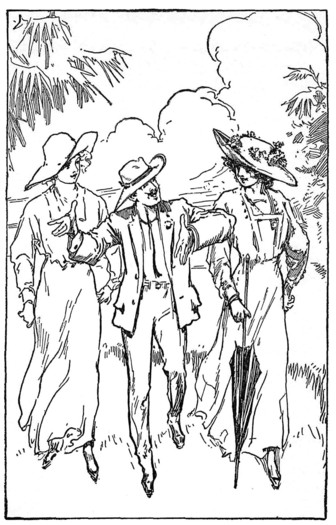
The Count Walked With the Two Girls.
“A number of times, Miss Stuart,” answered Monsieur Duval. “The count and I are old friends.”
“Is it built on a mountain or in a valley?” queried Ruth. She did not know herself exactly why she repeated her question.
“The Chateau de Sonde nestles in the heart of a valley,” was Monsieur Duval’s prompt answer.
He caught Ruth’s eyes fixed on him with an expression of wonder. But it was Ruth, not Monsieur Duval, who blushed furiously. The man’s eyes were gray and inscrutable. “Why do you ask, Mademoiselle?” he inquired.
“I don’t know,” Ruth answered lamely. The man frightened her. He seemed so brilliant, so traveled, so strong, so dangerous. And yet, he had just told Ruth a lie. Why should he pretend he had visited at the Chateau de Sonde?
“Come, everybody; it is time for luncheon,” called Mr. Stuart an hour later, when his guests had finished their survey of the ostrich cages.
The “Automobile Girls” opened their immense lunch basket, which the chauffeur had set under the trees. The Countess Sophia insisted on helping the girls. She was all radiant smiles and gayety. She hummed a song to herself full of delicious, bird-like trills, in a voice that had been wonderfully trained. In every way the countess showed what pleasure she felt in the picnic. So much so that she was easily the central figure of the party.
Finally the entire company seated themselves in a circle on the ground, Maud Warren and her father with flushed faces. They had evidently been having a private altercation about the Count de Sonde. The count however looked serenely unconscious of the fact.
A sense of tranquility and cheerfulness soon stole over every one. The day was enchanting. The chicken and nut sandwiches and other eatables tasted unusually good, and the party did full justice to the tempting luncheon the Stuarts had provided.
All the guests laughed and talked at the same time. Suddenly the countess began to sing again in a low voice: “Knowest thou the land?” from “Mignon.”
The others listened with delight.
Down the avenue a vehicle was heard approaching. There was a cloud of dust enveloping it. It was impossible for the picnic party to distinguish the occupants of the carriage. The countess’s back was turned toward the equipage. She did not look around. Mollie and Ruth were glad that she did not turn, for they recognized the two foreigners who had frightened the young Countess Sophia in the tea garden the afternoon before.
The men drove up to a palm tree near the spot where Mr. Stuart’s guests were eating. They hitched their horse. Then they walked deliberately over to the picnickers. Without a word one of the men reached down. He touched the Countess Sophia von Stolberg on the arm.
Undoubtedly he was German. His face looked threatening and his manner was insulting. His companion waited near him. The Countess Sophia shuddered as the stranger touched her. She trembled and turned pale like a frightened child.
“Madame,” said the German, “you are wanted by the police. We have been sent to arrest you.”
Mrs. De Lancey Smythe gave a hysterical laugh of triumph.
But the young countess quickly recovered her self-control.
“You have made a mistake,” she returned quietly, to the man, whose hand still rested on her arm. “What have I done to be arrested? You have no right to annoy me.”
“You are the notorious swindler wanted by the police of two continents,” accused the German. “I am here to take you back to France where you are wanted.”
Madame de Villiers now arose. She lifted her great mahogany cane, her face dark with anger.
“You will regret this day’s work,” she announced. “Be gone!”
But she had hardly finished her speech, before Mr. Stuart was on his feet. He seized the intruder by the collar, and before the man could more than raise his hand from the Countess Sophia’s arm, he was hurled several feet away, landing in a heap on the ground.
“You foreign idiot,” cried Mr. Stuart, forgetting his women guests in his anger. “How dare you come here and create a disturbance among my friends. You are without a warrant or a policeman. The Countess Sophia von Stolberg is our friend. You shall pay dearly for your insolence. Leave this place without a second’s delay or I shall lay violent hands on you.”
The two strangers did not dare defy Mr. Stuart. Mr. Warren had also risen and hurried to his friend’s aid and the two Americans looked thoroughly capable of enforcing their commands.
The foreigners went back to their carriage. After a slight delay they drove off, still muttering veiled threats.
When they had disappeared down the avenue, Countess Sophia gave Mr. Stuart her hand.
“I thank you, Monsieur,” she said. “Madame de Villiers and I are alone. It is good to have a protector. I do not know why those men attempted to arrest me without a warrant. I assure you they had not just cause. I believe they were sent by an enemy.”
“Perhaps, Countess,” replied Mr. Stuart, “those two men think you are some one else. I know there is a notorious swindler at large at Palm Beach. It is probably a case of mistaken identity.”
The Countess Sophia made no answer. Barbara, who was watching her closely, saw a look of unmistakable fear leap into her dark eyes at the mention of the word “swindler.” Bab glanced quickly about her and encountered the eyes of Monsieur Duval. In them was an expression of cruel triumph that made Bab feel certain that he was in some way responsible for the late unpleasant scene.
CHAPTER X
THE SECRET SIGNALS
Ruth was stretched out on a steamer rug on the warm sands, lazily looking out over the blue waters.
Barbara was disporting herself in the waves like a water sprite who had dared to show herself among mortals. Many of the bathers stopped to watch with admiration the figure of the young girl plunging gracefully through the waves.
But Ruth was not watching Barbara. She was thinking deeply.
Why had the Countess Sophia von Stolberg refused to prosecute the two foreigners who had deliberately insulted her?
Immediately after their return from the picnic Mr. Stuart had written the young countess a note. He suggested that he have the two strangers put out of their hotel, even driven away from Palm Beach. But the countess’s reply had been polite, but firm. No; she did not wish to prosecute her annoyers. The men had simply made a mistake. There would be less notoriety if she let the matter drop.
Mr. Stuart was not satisfied. He assured the countess that he and Mr. Warren had sufficient influence to have the two men sent away without the least publicity attending their dismissal. Still the decision of the countess remained unchanged. She graciously thanked Mr. Stuart for his kindness, but she really preferred to let the whole matter drop.
There was nothing more to be said.
Ruth now observed these same two men. They were seated not far from her, watching Barbara with stolid admiration. So far as Ruth knew they had not repeated their attempt to arrest the countess. But they had not confessed their error, nor offered to apologize either to Mr. Stuart or to the countess.
The story that there was a notorious woman swindler at large at Palm Beach was now common gossip.
“It is absurd to suspect the countess,” Ruth thought as she reviewed the recent disagreeable incident. “If the scandal goes any further I shall side with her, no matter what may be the consequences.” Ruth ended her reverie by making this last statement aloud. But she was sorry a second later.
A voice spoke at her elbow. “Do you think, Mademoiselle Ruth,” it inquired, “that suspicion of a certain person will reach a point where you will be required to take sides?”
Ruth started. She had been in a brown study, and was embarrassed and annoyed at having been caught speaking aloud.
The voice belonged to Monsieur Duval. He had come dripping from his swim in the ocean, and had laid himself in the sand directly behind Ruth without her noticing him.
“To what suspicion do you refer, Mr. Duval?” Ruth asked haughtily. She knew this clever Frenchman could read her mind like an open book. But she did not intend to confess that her remark had referred to the young countess.
Monsieur Duval smiled. “I am afraid I listened at the door of your thoughts,” he said. “I think I can guess with whom you intend to take sides. But I promise not to betray your secret. I am sorry I overheard your last remark. Yet I do not see why you think the Countess Sophia may be accused of being this notorious woman criminal. It is true she allows herself to be persecuted without reason. She will not appear at this, or any other hotel, and keeps herself as much in seclusion as possible. Also she will not tell us the country of her birth, nor does she refer to any friends, but——” Monsieur Duval stopped.
Ruth was indignant at the array of evidence that this Monsieur Duval was able to present against the young countess. She flushed guiltily, but wisely refrained from answering the Frenchman.
Mr. Duval was obliged to continue the conversation.
“Do you wish to help your friend?” he asked Ruth quietly.
“Of course,” Ruth replied warmly.
The Frenchman leaned over. “Then watch everything, but say nothing. And, above all things, do not have a too accurate memory.”
Ruth was about to make an angry retort, when Mr. Duval skilfully changed the subject of their conversation. He praised Bab’s wonderful diving. It reminded him of Neapolitan boys he had seen diving for pennies. Mr. Duval next told Ruth of a walking trip he had once made through southern Italy. She listened very much against her will to the entertaining Frenchman and it was with distinct relief that she saw Miss Sallie approaching them, dressed in an imported lavender linen and carrying a parasol and a book.
Maud and her count appeared from the opposite direction. They also came forward to join Ruth and Monsieur Duval. Bab ran up the beach, shaking the drops of water from her blue bathing suit, her wet curls sparkling in the sun.
Mr. Duval did not wish to remain with so large a party. His words had been for Ruth’s ears alone. As Miss Stuart approached he bowed ironically to Ruth and strolled away.
“How glad I am that we are not in the cold, sleet and blizzards of Chicago, child,” Miss Stuart remarked, bringing Ruth back to earth again. “The Countess Sophia was right in saying our American climate in the north is unbearable in the winter time. I never felt so well in my life as I do in this delightful place.”
“Aunt Sallie,” asked Ruth thoughtfully, ignoring the weather, and going back to the idea that was uppermost in her mind. “Do you think the Countess Sophia could be in need of money?”
“How can I tell, child?” replied Miss Sallie. “The countess dresses plainly, but her gowns are in excellent taste. They are made by a modiste in Vienna, who, I happen to know, is one of the most expensive in Europe. On the other hand Madame de Villiers and the countess live very quietly. They keep only two servants. But the countess has the air of a woman of wealth and culture.”
“Are we going to dine with the countess to-morrow night?” asked Ruth impetuously.
“Certainly, child,” Miss Sallie replied, her serenity undisturbed. “It is true your father may not have returned from his fishing trip, but there is no reason why we should not go without him.”
Ruth closed her eyes. Could it be possible that they might be invited to eat food paid for by money gained dishonestly? Surely Monsieur Duval could not have spoken the truth!
“Here comes that Mrs. De Lancey Smythe,” remarked Miss Sallie with sudden energy. “I do wish that woman would keep away from us.”
“Aunt Sallie,” said Ruth, “what do you dislike most about Mrs. De Lancey Smythe?”
“Don’t ask me, my dear,” returned Miss Stuart rather impatiently. “Everything I should say. I must confess that the very sight of her irritates me.”
“There is something peculiar about her, at any rate,” said Ruth, “I have seen her face grow hard as rock and look positively wicked when she thought no one was noticing her. Marian is afraid of her, too.”
“Nonsense, Ruth,” replied Miss Sallie severely. “You and Barbara let your imaginations have too free rein. I don’t approve of the woman and dislike her intensely, but I am not going to make her out an ogre.”
“She is, though,” persisted Ruth. “That’s why you don’t like her, only you don’t know it yourself. Some day you’ll see I am right. Oh, here come Mollie and Grace. What’s new, chilluns?” and springing to her feet Ruth called to Bab then hurried toward the approaching girls.
Mollie and Grace had been out in a boat all morning with some new friends they had made at the hotel. As Ruth walked toward them she noticed that Mollie’s cheeks were very red, and that she wore a look of suppressed excitement. Grace seemed almost equally agitated. Before she could reach them, however, she was hailed by a crowd of young people who were strolling on the beach, and she and Bab were obliged to stop and hold conversation.
Mollie felt that it was imperative to summon Bab and Ruth. How could she manage without being observed? A sudden thought came to her. Putting her hand back to her curls she hastily untied the ribbon that bound them. The ribbon was blue. In an instant Mollie twisted it into a bow knot and pinned it on her left shoulder. Would Barbara and Ruth remember what the secret signal meant?
Mollie need not have wondered. Hastily separating themselves from the crowd of talkers Bab and Ruth sped up the beach to join Mollie and Grace.
“What is it, Mollie?” cried Bab out of breath. “I remember the blue ribbon. It was to signify: ‘I have important news to communicate!’ What has happened?”
“As we passed the countess’s villa on the launch, this morning,” Mollie whispered mysteriously, “we saw a red flag tied to one of the posts of her pavilion. The countess wishes to see us on important business!”
CHAPTER XI
WHEELS WITHIN WHEELS
“Shall we go to the countess at once, Ruth?” asked Barbara.
Ruth hesitated. “The chauffeur has gone away for the day,” she replied. “And we have no one to take us by boat to the villa.”
Mollie’s blue eyes filled with tears. She had feared that Ruth suspected their lovely countess. Now she was sure of it. How absurd for Ruth to suggest they could not use the automobile because her chauffeur was away. The “Automobile Girls” had traveled for days at a time, with Ruth as her own chauffeur, while the trip to the countess’s villa represented only a few miles.
“How can you be so cruel, Ruth?” Mollie cried. “You just don’t want to go to the countess’s aid because you have listened to tales about her from that horrid Mrs. Smythe.”
“I haven’t listened to Mrs. Smythe, Mollie,” Ruth answered soothingly. “But I have been thinking. You can’t deny that there is a good deal of mystery surrounding the Countess Sophia. There are many things that it seems to me she might explain. I don’t wish to be hateful, and of course I can drive our car over to the countess’s, though I have never taken out such a big car alone before. Come; let’s get ready.”
Barbara hesitated. “Mollie,” she protested, “I don’t think it is right for us to make Ruth take us to see the countess, if she would rather not go.”
Mollie bit her lips. “Ruth Stuart,” she said, “you talk about the countess explaining things. What have you ever asked her to explain? If there is anything you want to know about her, ask her to tell you. It is not fair to keep silent, and still not to trust her.”
Ruth had a sudden conviction that she would as soon approach the Queen of England to inquire into her private affairs as to ask questions of the Countess Sophia von Stolberg.
“Well, Mollie, I will say this much,” Ruth conceded. “I never doubt our countess when I am with her. She is so beautiful and sweet that I forget to be suspicious. But, when I am away from her, I have just wondered a little, that’s all! Now, don’t be cross, Barbara, but come with me. I am going to get out the automobile. Grace, will you and Mollie explain to Aunt Sallie where we are going?”
“I’ll tell you what, Ruth,” Bab suggested. “Let us make up our minds not to suspect the countess because of any gossip we hear. There seems to be a great deal of talking going on, but nobody makes any definite charges. The countess has been delightful to us. I am afraid I am on her side as much as Mollie. The countess, right or wrong, but still the countess!”
“Loyal Bab!” cried Ruth, patting Barbara’s hand. “See, I cast all my suspicions away!” Ruth waved her other hand. “The cause of the countess is my cause also. I shall fight for her, through thick and thin.” Ruth looked as though she meant what she said.
The “Automobile Girls” were soon on their way to the countess’s pretty villa. Mollie still held herself apart from the other three girls. She felt that no one of them had risen to the defence of her adored countess with the ardor she expected.
Ruth was running the car slowly. It was only a few miles to the villa. Ruth was a cautious chauffeur, and was not in the habit of managing so large an automobile.
As her car moved quietly and steadily toward its destination, another small automobile dashed past it. Ruth glanced about quickly. The man who drove the small car was exceeding the speed limit. He was alone. He wore a long dust coat with the collar turned up to his ears; he had a cap pulled low over his face, and he wore an immense pair of green goggles. But Ruth’s quick eyes recognized him. Her three companions paid little attention to the man.
“Bab,” said Ruth, at almost the same instant that the small car swept by them, “it is Monsieur Duval who is driving that car!”
“Well,” replied Bab, “what of it? I did not know Mr. Duval was a motorist. But I am not surprised, for he seems to know almost everything.”
“Bab, I think he is on his way to see the Countess Sophia von Stolberg,” Ruth announced with conviction.
“He does not know the countess, does he?” Grace inquired. “I think he was introduced to her only through us.”
“I don’t know what Monsieur Duval knows and what he doesn’t know,” explained Ruth. “But I should like to find out. Anyhow, I am going to beat him to the countess’s house. If she has something important to tell us, Monsieur Duval shall not keep us from hearing it.”
Ruth put on full speed and started her car in pursuit of the flying automobile in front of her. In a few seconds she drew near the automobile. The little car was on the right side of the road and making its best speed. Ruth sounded her horn. She swerved her great car to the left in order to pass the smaller one.
Bab uttered a cry of terror. Mollie and Grace both screamed. Ruth’s face turned white, but she had no time to scream.
The small motor car just in front of her immense automobile turned like a flash. It swept across the road immediately in the path of Ruth’s on-coming car, and not more than a few paces ahead of her.
It was either a mad piece of foolishness on the part of the chauffeur, or a magnificent dare. At the moment Ruth did not stop to wonder whether the man ahead of her had deliberately risked his life and theirs in order to accomplish some purpose. All her ability as a driver was needed to meet the situation.
Ruth’s hands never left the steering wheel of her car. In less than a half second, she put on the full stop brake. With a terrific wrench her great automobile settled back. It stopped just one foot this side of the car that had crossed their path.
Ruth was white with anger. She saw, a moment later, that the driver ahead of her had accomplished his design. For no sooner had Ruth’s car stopped, than the other motorist forged ahead. Ruth resumed the chase, but she was obliged to be careful. She dared not risk the lives of her friends by driving too close to the other car. The man ahead might repeat his trick. Ruth could not be sure that she could always stop her motor in so brief a space of time and distance.
So the smaller of the two automobiles arrived first at the countess’s villa.
The Countess Sophia von Stolberg evidently expecting a visit from the “Automobile Girls,” sat at her piano in her drawing-room, playing one of Chopin’s nocturnes. At the sound of the automobile outside on the avenue the countess left her music and ran out on her veranda to meet her young visitors. But instead of the four girls a heavy, well-built man in a long dust coat and goggles approached the countess. The countess did not recognize him at once. A suave voice soon enlightened her. “Madame,” it said. “I have come to see you on an important matter of business. I must see you alone.”
“What business can you have with me, Monsieur Duval?” asked the young countess coldly. But her voice trembled slightly.
“I bring you news of a friend,” declared Mr. Duval quietly.
“I have no friends whom you could know, Monsieur,” answered the Countess Sophia.
“No?” her visitor replied, shrugging his shoulders and speaking in a light bantering tone. “Shall I inform you, then, and your young friends, whom I now see approaching?”
Ruth’s motor car was now in plain sight. The four girls rushed forward to join the countess.
At the same moment the tap-tap of a stick was heard inside the house. Madame de Villiers appeared, followed by Johann with a tray of lemonade.
The countess spoke quickly. “No, no, you must say nothing to me, now. I cannot listen to you. Please go away.”
Bab noticed that the countess was trembling when she took her hand.
Monsieur Duval bowed courteously to Ruth. “Mademoiselle,” he declared, “I owe you an apology. I fear I am but a poor chauffeur. My car swerved in front of yours on the road. It was unpardonable. I offer you many thanks for your skill. You saved us from a bad smash-up.”
Ruth colored. Hot words rose to her lips. But she feared to say too much. She looked at Mr. Duval gravely. “I think, Mr. Duval,” she remarked, as suavely as the Frenchman could have spoken, “it will be wise for you not to run a motor car unless you learn how to handle it better. You are right. We were exposed to great danger from your carelessness.”
Madame de Villiers now gazed sternly at Monsieur Duval. “Have I the pleasure of your acquaintance?” she inquired coldly, turning her lorgnette on the Frenchman.
Monsieur Duval lost some of his self-assurance in the presence of this beak-nosed old lady. “I met you at Mr. Stuart’s picnic, Madame,” he explained. “Good-bye, ladies.” Monsieur Duval bowed low. Then he turned to the countess. “I will deliver my news to you, Countess Sophia, whenever you are pleased to hear it.” A moment later the Frenchman disappeared. But on his way back to his hotel he smiled. “If life were not a lottery it would be too stupid to endure. Yet this is the first time in my career that a group of young girls have tried to beat me at my own game.”
When the Frenchman had finally gone the countess turned to Mollie, and kissed her. Then she looked affectionately at Bab, Grace and Ruth.
“You saw my signal, didn’t you?” she asked, smiling. “What an energetic society to come to me in such a hurry! I really have something to tell you. It is something serious. Yet I must ask you to trust me, if I tell you only part of a story. I cannot tell you all. As it is much too beautiful to stay indoors, suppose we go to my pavilion down by the water.”
On the way to the boathouse, Ruth stopped to embrace Mollie. “Mollie, darling, forgive me!” she whispered. “I promise you never to doubt our lovely countess again. She is perfect.”
When the Countess Sophia and the four “Automobile Girls” were safely in the boathouse, the young hostess sighed. “I am sorry to talk about disagreeable things to-day,” she murmured. “You cannot understand what a pleasure it is to me to know four such charming young girls. I have had so few companions in my life. Indeed I have been lonely, always.”
The “Automobile Girls” were silent. They hardly knew what to reply.
“I must try to tell you why I sent for you,” the countess went on. “I want to warn you——”
“About the Count de Sonde?” cried Mollie, who had never gotten over her first prejudice.
“Yes,” replied the countess slowly. “I think I promised to help you save your girl friend Maud Warren. I am afraid she and the count are more interested in each other than you girls imagine.” The countess faltered and looked fearfully about her. “You must not let Miss Warren marry the Count de Sonde,” she murmured. “You must stop such a wedding at all hazards. The Count de Sonde is——”
“Is what?” asked Barbara.
The countess shook her head. Again she blushed painfully. “I cannot tell you now,” explained the countess. “But I know this. If Miss Warren marries the Count de Sonde she will regret it all her life.”
“But how can we prevent Maud’s marrying the count if she wishes to do so?” queried practical Bab. “Unless you can tell us something definite against the count, we cannot go to Mr. Warren or Maud. Mr. Warren has already forbidden Maud to have anything to do with the Count de Sonde, but Maud continually disobeys her father.”
“I am sorry,” said the young countess hesitatingly. “I wish I dared tell you more. But I can explain nothing. Only I warn you to be careful.”
“Need we to fear the Frenchman, Monsieur Duval?” Ruth asked thoughtfully.
The countess was silent for a moment. Then she said slowly, “You must fear him most of all!”
CHAPTER XII
MAUD REFUSES TO BE RESCUED
When the “Automobile Girls” chaperoned by Miss Sallie, descended to the hotel ball room that evening, where a hop was in progress, the orchestra was playing the “Blue Danube” and Maud and the Count de Sonde were waltzing together. The spectators seated along the wall smiled in spite of themselves for the count’s style of dancing was far from graceful. His idea of waltzing consisted in whirling his partner round and round, and as Maud was at least four inches taller than the count and very thin, the effect was indescribably ridiculous.
“How absurd the count looks!” Bab exclaimed to Ruth. “Just look at those high heels and that strutting walk! Do you suppose Maud Warren can really care for him?”
“No; I don’t think she cares for him at all,” Ruth returned. “It is the lure of his title that has fascinated Maud. The title, ‘Count de Sonde’ is like music in her ears.”
“Do you think Mr. Warren would disinherit Maud, if she married the count?” asked Bab.
Ruth shook her head. “Mr. Warren gave Maud half a million dollars in her own name a year ago,” Ruth explained. “So, you see, she is an heiress already. Besides, Mr. Warren would never forsake Maud. He simply adores her. I think he went off on that fishing trip with father just to keep from seeing Maud carry on. He thinks Aunt Sallie may be able to influence her while he is gone. But do look at Miss Sarah Stuart, Bab!”
Miss Sallie swept down the ball-room floor in a handsome black satin and jet evening gown, with Mrs. De Lancey Smythe in her wake.
There was the fire of battle in Miss Stuart’s eye. On the widow’s cheeks burned two flaming signals of wrath.
“Maud Warren was left in my care by her father, Mrs. Smythe,” declared Miss Sallie. “In Mr. Warren’s absence I forbid Maud’s going about unchaperoned with the Count de Sonde.”
“Miss Warren is not a child, Miss Stuart,” replied Mrs. De Lancey Smythe angrily. “If she chooses to go about with the count I hardly see how you can prevent it. The Count de Sonde is a noble, trustworthy young man.”
“Miss Warren shall not go with him against my wishes,” replied Miss Stuart quietly, “and I fail to see how the matter can possibly interest you.”
Mrs. De Lancey Smythe’s voice trembled with rage. “You appear to be excessively strict with Miss Warren, Miss Stuart,” she returned, “yet you allow your niece and her friends to associate, every day, with a woman who is entirely unknown to you, a woman about whom this entire hotel is talking.”
“Whom do you mean?” Miss Sallie demanded. She was exceedingly angry.
“Mean?” Mrs. De Lancey Smythe laughed mockingly. “I mean this so called Countess Sophia von Stolberg. She is no more a countess than I am. She is a fugitive and a swindler. She will be arrested as soon as there is sufficient evidence against her.”
The “Automobile Girls” had moved up close to Miss Sallie. They waited to hear what she would say in regard to the countess.
“I do not believe the countess to be an impostor. She is our friend,” replied Miss Stuart. “I think we need have no further conversation. Miss Warren will do as I request.” Without answering the other woman moved away with flashing eyes and set lips, leaving Miss Sallie in triumphant possession of the situation.
In a few moments Maud Warren came over to where Miss Sallie and the “Automobile Girls” were still standing.
“Maud, won’t you come up to our room to-night after the dance?” Ruth urged. “We thought it would be jolly to make some fudge in a chafing dish.”
“Can you cook?” laughed Maud. “How funny! It is awfully good of you to ask me to join you, but I have another engagement for this evening.”
“Maud,” said Miss Sallie firmly, “your father left you in my charge. I cannot permit you to keep an engagement with the Count de Sonde.”
Maud was speechless with astonishment. No one had ever forbidden her to do anything in her life. Her father had always tried persuasion and argument. Ruth’s eyes twinkled as she saw the effect Miss Sallie’s firmness had upon Maud. Greatly to her surprise Maud Warren answered quite meekly: “Very well, Miss Stuart. I will not see him if you do not wish it.”
The “Automobile Girls” breathed a sigh of relief. They had feared another battle between Miss Sallie and Maud.
“This is jolly!” exclaimed Maud Warren, an hour later. The five girls were in Ruth’s sitting-room. They were eating delicious squares of warm chocolate fudge.
“I am glad you are enjoying yourself,” replied Ruth. “We would be glad to see you often, but you always seem to be busy.”
Maud tried to look unconscious. “It’s the count’s fault. The poor fellow has a dreadful crush on me,” she sighed.
“Do you care for him?” asked Barbara bluntly.
Maud simpered. “I really don’t know,” she replied. “I think the Count de Sonde has a beautiful soul. He tells me I have a remarkable mind—such sympathy, such understanding!”
Ruth choked over a piece of fudge. The other girls seemed to regard her accident as a tremendous joke. Maud was entirely unconscious that she had anything to do with their merriment.
“Then you really like the count very much!” exclaimed Mollie, opening her pretty blue eyes so wide that Maud was amused.
“You dear little innocent thing!” returned Miss Warren. “Of course I think the count a very interesting man. I don’t deny he has taken my fancy. But as for being in love with him—well, that is another thing.”
“Do you really know anything about the count, Maud?” asked Ruth. “Your father doesn’t approve of him, and don’t you think he knows best?”
“Oh, father never approves of any of my friends,” complained Maud Warren impatiently. “But Mrs. De Lancey Smythe is on my side. She likes the count.”
“But do you know much about Mrs. De Lancey Smythe?” Ruth went on.
Maud was nettled. “Mrs. De Lancey Smythe is a Virginian, and belongs to an old southern family,” she returned.
The “Automobile Girls” looked uncomfortable. It was Ruth who finally spoke.
“I hope you won’t be angry, Maud. It is only because we like you that I am going to tell you something you ought to know. Some one told me to warn you to be careful.”
“Careful about what?” cried Maud, though her flushed face betrayed the answer she expected.
“The Count de Sonde,” replied Ruth.
“But what have you heard against him?” demanded Maud indignantly.
It was Ruth’s turn to flush. What had she heard? If only the countess had been a little less vague in her accusations against the count.
“I am afraid I don’t know anything very definite to tell you,” Ruth confessed, in an embarrassed tone. “Yet we have heard rumors about the count. Foreign noblemen are often fortune-hunters, you know.”
“My dear Ruth, the Count de Sonde is not in need of money,” protested Maud. “He is very wealthy. Only the other day he showed me a letter from his lawyer. It spoke of two hundred thousand francs. It is true the letter was written in French. But the count translated it for me. And then, of course, I know a little French myself.”
“Oh, well,” sighed Ruth, “perhaps we have no right to suspect him. But, Maud, I beg of you to go slowly. You may be mistaken in the count. Think how you would regret it if you were to marry him and find afterwards that he had deceived you.”
“Marry the count!” Maud’s tones expressed great astonishment, then she gave a satisfied laugh. “Don’t worry about my affairs. The count is a real nobleman,” she declared.
A knock sounded at the door, and a bellboy handed Ruth a note. It was addressed to Miss Warren. Ruth gave it to her. Maud opened it. A gratified smile overspread her face, then turning to the “Automobile Girls” she said: “Will you please excuse me, girls, I want to go up to my room for a little while. I will be back in a few minutes.”
The girls ate their fudge in silence for a time. Maud did not return.
“I wonder if Maud is coming back?” remarked Barbara, after a little. “Somehow, I am sorry for Maud. It must be dangerous to be so rich and so silly at the same time.”
“I am afraid Maud is hopeless,” Ruth contended. “I don’t believe it is going to do the slightest good for us to warn her against the count. I wonder if we could manage to save her in any other way?”
Miss Sallie came into the room. “Where is Maud Warren?” she demanded immediately.
The “Automobile Girls” could only explain Maud had gone to her room.
Miss Sallie rang the bell, and sent a maid to inquire for Maud.
The answer came back a few moments later. “Miss Warren had left the hotel for the evening with several friends.”
Miss Stuart said nothing. But the “Automobile Girls” knew Miss Sallie would never forgive Maud Warren for her disobedience.
The four girls were almost ready to say good night, when another light tap sounded at their door.
The girls lowered their voices. Perhaps Maud had lost heart, and had returned to them after all.
Barbara went to the door. It was Marian De Lancey Smythe who had knocked. She wished to speak with Bab for a moment.
Five minutes later Barbara returned to her friends, looking considerably mystified.
“Now, Barbara Thurston, what did Marian Smythe have to say to you?” demanded Mollie. “It is not fair, your having secrets with her from the rest of us.”
“Oh, Marian asked me if we were going to the countess’s to dinner to-morrow night,” Bab replied.
“What a strange question!” exclaimed Grace Carter. “I don’t see why she should care where we go to dinner.”
“Perhaps she had some plan or other on hand herself that she wanted us to take part in,” suggested Mollie.
Bab was silent.
“By the way,” exclaimed Ruth, “did you know I received a letter to-day from darling Olive Prescott? She and Jack have arrived in Paris, and have set up housekeeping in the dearest little flat in the Rue de Varennes. They live on the top floor, and Jack has the front room for his studio. Of course Olive declares Jack is the best husband in the world. He is painting Olive’s portrait for the Paris Salon, and working desperately hard so as to have it finished by April. Come, let’s go to bed.”
Just as Barbara was dropping off to sleep Ruth gave her a little shake.
“Tell me Barbara Thurston, what Marian De Lancey Smythe said to you in the hall!”
“I told you, child,” murmured Bab hesitatingly.
“Honor bright, did you tell us everything, Bab Thurston?”
“No-o-o, not everything,” admitted Bab. “This is exactly what Marian said: ‘Barbara are you going to dine with the countess to-morrow night?’ ‘Yes,’ I replied. Then she said: ‘You had better not go. But if you do go, come home early, and don’t ask me the reason, why.”
“We’ll go, sure as fate!” exclaimed Ruth. “No matter what Marian says.”
CHAPTER XIII
A SURPRISE PARTY
It had been a long day of uninterrupted pleasure for the “Automobile Girls”—one of those sparkling, brilliant days that seem to belong peculiarly to Florida in the early spring.
All morning the girls had cruised around the lake in a launch. Later in the day they had bathed in the salt water of the Atlantic. After luncheon they had played several sets of tennis; and, later Miss Sallie had taken them to the cocoanut grove to drink lemonade and listen to the music.
Miss Sallie had not spoken either to Maud Warren or to Mrs. De Lancey Smythe since the evening before. The two women had carefully avoided Miss Stuart. Once inside the cocoanut grove Bab’s sharp eyes soon discovered Maud, Mrs. Smythe and Marian seated at a table concealed by an enormous cluster of palms. They were deep in conversation. Mrs. Smythe was pouring wholesale flattery into Maud’s ears to which the foolish girl was listening eagerly.
Marian espied Barbara and came over to greet Miss Sallie and the “Automobile Girls.” She knew nothing of her mother’s difficulty with Miss Sallie.
“Marian,” whispered Bab, as her new friend sat down next to her, “why did you wish to know whether we were going to the countess’s to dinner to-night?”
“Why do you ask?” said Marian, looking a little frightened.
“Why it sounded to me as though you must have a reason for what you said,” argued Bab. “Were you trying to warn me about anything? Or, is it simply that you do not like the countess?”
“I think the countess is very fascinating,” was Marian’s only reply.
“Won’t you even tell me why you told us to come home early if we did go?” persisted Barbara.
Marian gave a forced laugh. “Oh, I was only giving you a little good advice about sitting up late. But just the same, I’m a very wise person and you had better take my advice.”
“What are you two girls whispering about?” asked Ruth gayly. “Never have secrets from your little friends. It hurts their feelings, dreadfully.”
“We aren’t having secrets,” responded Barbara. “That is not exactly. I’m only trying to persuade Marian to tell me something. But she’s a regular Sphinx.”
“Which would you rather be, a Sphinx or a chatterbox?” inquired Marian. “And if you would, why would you, and if thus, why, therefore and whereupon?”
“Fine!” exclaimed Ruth. “I never dreamed you could reel off nonsense like that, Marian.”
Marian laughed then rising said, “I suppose I shall have to go back to Mama. I only came over for a minute.” Her eyes again met Barbara’s, and she shook her head slightly, then nodding good-bye to the girls she crossed over to where her mother was still conversing with Maud.
“Why did she shake her head at you, Bab?”
“She says again that we must come home early from the villa, to-night, but she won’t tell me why,” replied Bab. “She evidently knows something that we don’t. She was even more mysterious to-day than she was last night. Do you think we had better go?”
“Go! Of course we will,” cried Ruth. “I don’t believe Marian has anything very serious on her mind.”
“Really, children,” interposed Miss Sallie in an annoyed tone, “if you begin to conjure up mystery over so simple a matter as a dinner invitation I shall feel obliged to keep you all at home. One would think I was chaperoning a party of young sleuths, instead of four normal girls out for a holiday.”
This remark was received with discreet silence, on the part of the four girls, and whatever their thoughts on Marian’s warning were they sternly repressed uttering them aloud during the remainder of the time spent in the grove.
At eight o’clock that night Miss Sallie and the “Automobile Girls” were seated about the countess’s table with only their hostess and her chaperon. There were no other guests at dinner.
“How delightful not to be bored by stupid men!” exclaimed the countess, smiling at her circle of guests. “And what a charming picture the young girls make, Madame de Villiers, do they not? There is not a black coat in our midst to mar the effect of our pretty light frocks. Let me see, Miss Stuart wears violet, dear Madame, gray. And the ‘Automobile Girls’ might represent the four seasons. Ruth, you may be Spring, in your pale green silk frock; little Mollie will have to play Summer in her corn colored gown; Bab’s scarlet frock makes me think of October; and Grace is our Snow Maiden in her white frock.”
The countess wore a beautiful gown of white messaline. Her exquisite face was radiant with child-like pleasure. During the dinner the room rang with her gay laughter. She had never seemed so young, so gracious, and so innocent as she appeared to the “Automobile Girls” that night.
At each plate the countess herself had placed a small bunch of freesias, whose delicate perfume filled the room.
“They are my favorite flowers,” the hostess explained gently, “because they remind me of my beloved Italy.”
At the close of dinner a bowl of bon-bons was passed around the table. There was a good deal of noise and confusion. The girls popped the crackers, drew out the mottoes and read them, and decorated themselves with the fancy paper caps. They were too absorbed in their own pleasure to think, or hear, or see, anything that might have been taking place outside the dining-room. Madame de Villiers, a military cap on her gray hair, looked as fierce and terrifying as a seasoned warrior.
Dinner over, the countess led the way into her drawing-room, where the laughter and gayety continued. Madame de Villiers played brilliantly on the piano. The young people danced until they were exhausted. Suddenly the young countess caught her train up over her arm, and ran out into the centre of the floor. At a nod from her, Madame de Villiers began to play the wild, passionate music of the Russian Mazurka. Then the countess danced. Again and again she went through the intricate and dramatic figures. Her audience was spellbound. No one noted the flight of time.
Finally Bab whispered to Ruth: “Don’t you think we had better go upstairs for our wraps? It is growing late.” The two girls slipped quietly away without a word.
Ascending the stairs to the countess’s sleeping room they gathered their arms full of evening coats and scarfs. On a little balcony just outside the window of the sleeping room crouched the figure of a man. His keen eyes watched Bab and Ruth intently as they made ready to leave the room and join their friends downstairs, entirely unconscious of the figure hiding so near to them.
On the first landing of the stairs, Bab stopped. Ruth was ahead.
“Go on, Ruth,” Barbara called down to her. “I have left my handkerchief on the dressing table. I will be with you in a minute.”
Bab ran quickly back to the room she had just left. Her soft satin slippers made no sound on the floor. It was almost impossible to hear her approach.
Bab paused at the half-open door of the bedchamber in horrified surprise. Inside the room that she and Ruth had just left a man bent over the countess’s desk. Her Russian leather writing-case was wide open. The man was running through her papers with a practised hand.
Bab could have turned and run downstairs again. The intruder would never have heard her. But, although Barbara shook with fear for a moment, she placed her wraps softly on the floor and stepped noiselessly back into the room. The man was still unaware of her presence. Bab’s eyes roved about the room in search of a weapon. Her hand resting for an instant on the dressing table, came in touch with something metallic and cold. It was a silver shoe horn, but Barbara gripped it eagerly, then she fastened her gaze upon the intruder. He was an old man with a shock of gray hair and a thick beard, that partially concealed the outline of his face. His lips were drawn back until his teeth showed and in his bent attitude he reminded Bab of a gigantic ape. Under the concentration of her gaze the strange apparition looked up and saw her as she stood unflinching, watching with alert eyes his slightest movement. Without uttering a sound the man began to move slowly toward her, his fierce eyes never for a moment leaving her face.
“What are you doing here?” Bab demanded bravely. “You are a thief!”
Instead of running away from him the girl started toward the man. As she did so she raised the shoe horn and pointed it at him. Had the light in the room not been turned low he must have discovered the trick. As it was the faint light, glinting on the polished metal gave it the appearance of a revolver. The ape-like figure began backing slowly toward the balcony. At the window he paused, as if debating whether he dared take the chance of leaping upon her. Bab settled the question for him by making a threatening move with the supposed weapon. The thief whirled, sprang out on the balcony and dropped to the ground.
Barbara ran to the window. She saw that he had disappeared, then the room began to whirl about her. She thought she was going to faint, for she felt her strength rapidly leaving her.
With a great effort she threw off the weakness that was overcoming her and looked out across the lawn.
During the early part of the evening a large motor boat cruiser, after having put her owner ashore at Palm Beach had dropped down and come to anchor for the night hard by the boathouse belonging to the villa occupied by Countess Sophia. Lights were twinkling from the port holes of the boat and her anchor light swayed listlessly at the stern. There were no other signs of life aboard the boat on the bow of which one at close range might have made out the word “Restless” in raised gold letters.
Barbara wondered if their terrible visitor had come from the boat lying there quietly on the moonlit waters.
Just then the buzz of excited voices was borne to her ears. She heard the Countess Sophia’s clear tones, then an excited little scream, mingled with the deep voice of Madame de Villiers raised in angry expostulation.
Still gripping her shoe horn Bab raced down the stairs, and parted the portières that hung between the drawing room and hall.
What she saw was like the tableau from a melodrama. Crowded close to the piano stood the Countess Sophia, while directly in front of her stood Madame de Villiers, thoroughly enraged and brandishing her gold-headed cane at two men who seemed about to seize the young countess. Clustered in a frightened group at one side of the room stood Miss Stuart, Mollie and Grace. Ruth was nowhere to be seen.
One of the men made a sudden stealthy move toward the countess.
“Stand back,” commanded Madame de Villiers.
Just then Ruth’s clear tones were heard outside the villa. “They’re in that room! Oh, hurry please!”
There was a sound of running feet and into the room darted two young men clad in white yachting clothes, and wearing officers’ caps.
“We’re just in time,” called one of the newcomers. “This is something in our line of sport. Stand aside, girls. We’ll soon have these fellows on the run.”
With this he grasped one of the men by the collar and dragging him to the open hall door, picked him up and threw him off the veranda onto the drive where he landed with a thud. A moment later his companion had disposed of the other offender in like manner.
“Watch them, Joe,” ordered the taller of the two yachtsmen. “If they try to enter the house again, call me. I guess we can give them all they’re looking for. I’m going inside to see if there are any more rascals who need attention.”
“Oh you brave boys!” exclaimed Madame de Villiers as the young man entered the drawing-room where the women were huddled together talking excitedly.
“I think the credit belongs to the young woman who had the presence of mind to go for help,” smiled the youth, bowing to Ruth.
“I had to do something!” exclaimed Ruth. “I saw your boat early in the evening, and when those two men came in here and began threatening the countess I felt that the only thing to do was to see if some one on the yacht would help us.”
“Did you see the other man?” asked Barbara anxiously. “He was old and white-haired and looked exactly like an ape. He was upstairs on the balcony, while I was in the countess’s room getting our wraps. Then I forgot my handkerchief. When I went back for it he was in the room. I frightened him away with a shoe horn. He thought it was a revolver. He dropped to the ground from the balcony and ran towards the yacht. I thought perhaps he belonged on the boat.”
“Not with us,” declared the yachtsman. “Allow me to introduce myself. I am Captain Tom Halstead and my friend out there on the veranda, is Joseph Dawson, engineer of the motor yacht ‘Restless’ which lies at anchor just off the shore. We belong to the ‘Motor Boat Club’ boys, but I doubt if you have ever heard of us before.”
Although Tom Halstead and Joe Dawson were strangers to the “Automobile Girls” they are well known to the majority of our readers. Born and brought up on the Maine coast the ocean was their play ground from early boyhood and their fondness for the sea led them to later perfect themselves in the handling of motor boats. These two youths with a number of other sturdy young men comprised the famous club of young yacht skippers and engineers, organized by a Boston broker and headed by Halstead as fleet captain, with Dawson as fleet engineer.
The reason for the appearance of the yacht “Restless” at this particular place and time is set forth in “The Motor Boat Club in Florida,” the fifth volume of the “Motor Boat Club Series.” That the two young men had responded instantly to Ruth’s call for help was in itself the best proof of the manliness and courage of the “Motor Boat” boys.
The countess who in the meantime had recovered from the first shock of the recent disturbance now presented Miss Stuart, Madame de Villiers and the “Automobile Girls” to Tom Halstead. A moment later Joe Dawson entered the room, and more introductions followed.
“Well, they’ve gone,” declared Dawson. “They picked themselves up very slowly and painfully and fairly slunk down the drive. I don’t imagine they will trouble you again to-night. However we’d better appoint ourselves as special watchmen about the grounds until morning. I do not wish to seem inquisitive but was the motive of these rascals common robbery?”
“The men did not wish money,” replied the countess slowly. “They wished to steal a certain paper I have in my possession in order to destroy it. That is why the old man was searching my writing case. But he did not find the paper, for I carry it about my person. Forgive me for being so mysterious, and believe that my reason for secrecy is one of grave importance.”
“There is nothing to forgive, Madam,” replied Captain Halstead courteously. “We are only too glad to have been of service to you and beg that you will continue to accept our services at least until to-morrow. Then I would advise you to procure a special officer to remain at the villa in case you should be annoyed further by these villains.”
“Thank you,” exclaimed the countess, with evident agitation. “I hardly think we shall be troubled again. I do not wish an officer to come here.”
“We must return to the hotel, Countess,” said Miss Stuart. “It is growing late and my brother will become uneasy about us.”
This time the women were assisted with their cloaks by the “Motor Boat” boys and no startling interruption occurred. Ruth ran down the drive a little ahead of the party to where her automobile stood. Then she uttered a sudden cry of dismay. All four tires had been cut.
“Oh the rascals!” she exclaimed. “How dared they do such a contemptible thing? We’ll have to go back to the villa and telephone for another car. Father will be so worried!”
An indignant babble of feminine voices ensued broken by the deeper tones of the two young men as the party turned to go back to the villa.
Just then a familiar sound was borne to their ears. It was the chug! chug! of a rapidly approaching automobile. A moment later the car rolled up the drive. “It’s Father!” Ruth exclaimed. “Oh, I’m so glad.”
“What seems to be the trouble, Sallie?” queried Mr. Stuart, springing from the car. “It’s after midnight. I grew worried when you didn’t return to the hotel at eleven, so decided I had better come out after you. I rather think we exceeded the speed limit too,” he laughed, turning to the chauffeur.
Then Ruth burst forth with an excited account of the night’s adventure. Mr. Stuart looked grave. “I shall send you an officer in the morning, Countess,” he said.
“These are the two young men who came so gallantly to our rescue, Mr. Stuart,” said the countess, turning to the “Motor Boat” boys who stood modestly in the background.
Mr. Stuart shook hands with both young men, thanking them for their prompt response to the call for help. “We should be pleased to have you dine with us to-morrow evening,” he said.
“Thank you,” responded the young captain, “but we shall weigh anchor in the morning.”
After bidding farewell to the two young men and good night to Madame de Villiers and the Countess Sophia, the “Automobile Girls” and Miss Sallie stepped into the car in which Mr. Stuart had driven to the villa.
“I’ll send a man out to put that other car in shape to-morrow,” he said to Ruth as they sped down the drive. “But, hereafter when this valiant band, known as the ‘Automobile Girls’ pays a visit to the Countess Sophia I shall insist upon accompanying them whether or not I am invited.”
CHAPTER XIV
THE PLOT THICKENS
Maud Warren apologized to Miss Sallie. Mr. Warren had been greatly displeased when he heard of his daughter’s disobedience, and had reprimanded her in such severe terms, that she anxiously endeavored to conciliate Miss Stuart at the earliest opportunity. Miss Sallie, however received her effusive apology very coldly, and it was some time before Maud felt in the least comfortable in her society.
One evening soon after the eventful dinner with the countess, the “Automobile Girls” started out for a moonlight stroll accompanied by Miss Stuart, Mr. Stuart, Mr. Warren and Maud. Just as they were leaving the hotel Marian Smythe appeared on the veranda and was asked to join them.
“Where have you been keeping yourself, Marian?” asked Ruth.
Marian flushed.
“I’ve been very busy,” she said hastily. Then as if anxious to change the subject: “Have you been to the countess’s villa lately?”
“No,” replied Ruth quickly. “Not since the dinner there. Have you heard anything about her?”
“No,” answered Marian shortly, and relapsed into moody silence.
As they strolled leisurely along Barbara who had been walking ahead with Miss Stuart, dropped behind with Marian.
“I want to ask you something, Marian,” she began.
“Little girls should never ask questions,” said Marian lightly, but Barbara felt that her apparent unconcern was forced.
“Have you heard about what happened at the villa the night we dined there?” persisted Bab.
“I have heard something about it,” admitted Marian, in a low voice. “It was an attempt to rob the countess, was it not?”
“You could hardly call it robbery,” replied Barbara. “The men took nothing. But they acted in a very mysterious manner, and there was one perfectly hideous old man who was a real burglar for I caught him going through the things in the countess’s sleeping room, when I went up stairs after our wraps. I drove him from the room.”
“How did you ever do it, Bab?” asked Marian. There was an expression of absolute terror in her eyes.
“You’ll laugh when I tell you,” replied Bab. “I drove him away with a shoe horn.”
“A shoe horn?” repeated Marian questioningly. “I don’t understand.”
“He thought from the way I held it that I had a revolver in my hand,” explained Barbara. “You see it was silver and as the light in the room was turned low it looked like polished steel. At any rate it answered the purpose.”
“You are very brave, Bab,” said Marian admiringly. “Considering the man with whom you had to deal you showed wonderful courage.”
“What do you mean, Marian, by ‘the man with whom I had to deal’? Who is that frightful old man?” asked Barbara, looking searchingly at the other girl. “Why did you warn us not to dine with the countess? Did you know what was to happen? You must tell me, Marian, for I must know. If the countess or any of us is in danger it is your duty to tell me. Can’t you trust me with your secret, Marian?”
Marian shook her head. Her lip quivered, and her eyes filled with tears.
Barbara waited patiently for her to regain her self-control.
“Bab,” she said in a choked voice. “I can’t answer your questions. I dare not. I am a miserable victim of circumstances, and all I can say is that your danger is in being friendly with the countess. She has an enemy who will stop at nothing to gain his own end, and he will crush you, too, if you stand in his way.”
“Tell me, Marian,” said Bab eagerly. “Do you know anything about the countess?”
“Very little,” was the reply, “and that little I may not tell. But this I promise you, that no matter what may be the consequences to myself, I will warn you in time should any special danger threaten you girls or her. That is, if I have the slightest opportunity to do so.”
Marian stretched out her hand and Bab clasped it. “Thank you, dear Marian,” she said. “I know you will keep your word.”
After an hour’s stroll the party repaired to the hotel veranda, where ices and cakes were served to them. Every one, with the exception of Maud Warren, was in high good humor. Even Marian emerged from the gloom that had enveloped her earlier in the evening, laughing and talking merrily with the “Automobile Girls.” Maud, however was in a distinctly rebellious state of mind. During their walk they had encountered the Count de Sonde and Monsieur Duval, and although Mr. Stuart and Mr. Warren had exchanged polite civilities with the two Frenchmen, they had not invited them to join the party. While Maud, still smarting inwardly from her father’s recent sharp censure, had not dared to brave Mr. Warren’s certain anger by doing so. Her only means of retaliation lay in sulking, and this she did in the most approved fashion, refusing to take part in the conversation, and answering in monosyllables when addressed. Ruth and Barbara vainly tried to charm away her sulks by paying her special attention, but she merely curled her lip scornfully, and left the veranda soon after on plea of headache. Mr. Warren sighed heavily as he looked after her retreating figure, but made no comment. Yet his friends knew instinctively what was passing in his mind, and the “Automobile Girls” solemnly vowed each in her own heart to watch over Maud and save her if possible from the schemes of fortune-hunting nobility.
“Is there anything more perfect than this Florida moonlight!” asked Ruth, during a lull in the conversation, as she leaned back in her chair and gazed with half closed eyes at the silvery tropical world before her. “Positively, I could sit out here all night!”
“It looks as though we were in a fair way to do so,” replied her father, glancing at his watch. “Half-past eleven. Time all children were in bed.”
“Really, Robert, I had no idea it was so late,” said Miss Sallie, stifling a yawn. “I believe I am sleepy. Come, girls, it is time for us to retire.”
“Oh, Aunt Sallie!” exclaimed Ruth. “How can you be so cruel?”
“‘I must be cruel to be kind,’” quoted Miss Stuart. “If I allow you to moon out here until unseasonable hours, you will never get started on your picnic to-morrow, at seasonable ones.”
“She speaks the truth,” said Ruth dramatically, “I will arise and hie me to the hay, for come what may, I swear that I will picnic with the rosy morn.”
“I thought you were going to picnic with us,” said Grace flippantly.
“So I am,” replied Ruth calmly. “That statement was mere poetical license.”
“First find your poet,” said Bab slyly.
Whereupon there was a chorus of giggles at Ruth’s expense, in which she good-naturedly joined.
“I’m really more tired than I thought I was,” she yawned, a few moments later as she sat curled up in a big chair in the room adjoining Miss Stuart’s which she and Barbara occupied.
“I’m tired and sleepy, too,” responded Barbara. “It’s almost midnight. We’ll never get up early to-morrow morning. Oh, dear!” she exclaimed a second later, “I’ve left my pink scarf down on the veranda. It’s hanging over the back of the chair I sat in. I’ll go down this minute and get it, before any one has had time to see it or take it away.”
Suiting the action to the word Bab hurried out of the room, and along the corridor. She did not stop for an elevator but ran lightly down the two flights of stairs and out to the veranda. It was but the work of a moment to secure her scarf, which hung over the back of the chair, just as she had left it. The veranda was deserted except for a group of three people who stood at the far end in the shadow. Their backs were toward Bab and they were talking earnestly in low voices. Barbara stood petrified with astonishment, scarcely able to believe the evidence of her own eyes, for the group consisted of Monsieur Duval, Mrs. De Lancey Smythe and—enveloped in the pale blue broadcloth cloak Bab had often seen her wear was the Countess Sophia.
CHAPTER XV
CAUGHT NAPPING
The following morning Barbara awoke with the feeling of one who has experienced a disagreeable dream. Was it a trick of her imagination, or had she really seen their beautiful young countess deep in conversation with Monsieur Duval and Mrs. De Lancey Smythe? True Bab had not seen her face, but her height, and carriage—the blue cloak—were unmistakable.
On her return to their room Bab had not mentioned her unpleasant discovery to Ruth. She could not bear to voice any actual charge against the Countess Sophia. “Perhaps it will all be explained yet,” she told herself, and with a wisdom far beyond her years, she resolved to be silent, at least for the present, about what she had seen.
When the launch which Mr. Stuart had chartered, with its freight of picnickers, had put out from shore and headed for the villa, where they were to pick up the countess and Madame de Villiers, Barbara had loyally decided to let not even the evidence of her own eyes sway her into condemning the countess unheard.
On their arrival at the villa they found the countess and Madame de Villiers ready and waiting for them, and the sailing party was soon comfortably seated in the roomy launch. Madame de Villiers occupied a wicker chair opposite Miss Sallie, while the young countess and the “Automobile Girls” had stretched a steamer rug over the roof of the small cabin, and lay upon it in picturesque attitudes under their sunshades.
There was a churning of the propeller, a shrill toot from the whistle, and the launch glided out over the water as smoothly as a canoe rides down stream.
“We’re off!” cried Mr. Stuart joyously.
“I believe you are just a great boy still, Robert,” smiled Miss Sallie indulgently.
The day’s excursion had been arranged by Mr. Stuart. He was an enthusiastic fisherman, and on his return from the fishing expedition with Mr. Warren he at once began to plan a similar excursion for the “Automobile Girls,” extending his invitation to the countess and Madame de Villiers.
It was an ideal day for a picnic. The sun shone brilliantly down on Palm Beach, making it look like an enchanted land. The bathers were out in full force. A little farther up the beach countless flower-trimmed hats and many-hued parasols made gorgeous blots of color along the white sands. Overhead the sky was an intense blue, and the water reflected the blueness in its depths.
“You can never understand how happy this makes me,” declared the countess, bestowing an enchanting smile upon the little company. “Mr. Stuart, we thank you for the many pleasures you have given Cousine and me. Someday I hope I may be able to do something for you.”
“Wait until the picnic is over before you thank me, Countess,” replied her host. “The fishing may bore you, especially if the fish don’t bite.”
“Ah, well,” laughed the countess, “I could fish patiently all day, under a sky like this without complaining, if I were to catch nothing but a minnow.”
Mr. Stuart’s fishing party had made an early start. They were to land some miles up the coast, where those who were not of a mind to fish could make themselves comfortable on shore.
The journey was not a short one. It was well past eleven o’clock when they landed on a hard shell beach, broken here and there by patches of marsh grass.
“You are especially privileged to be allowed to set foot on these shores,” Mr. Stuart assured his guests, as he handed them out of the launch. “The location of this place has been kept a secret; otherwise it would be overrun with tourists and excursionists.”
“Is it so beautiful?” Ruth inquired.
“Wait until you see it!” was Mr. Stuart’s reply.
The beach sloped upward so as to form a wall that completely hid the land behind it from view.
Ruth and Barbara ran on ahead.
“Oh, Father,” cried Ruth excitedly. “This is a surprise!”
The two girls were looking down into a beautiful little dell. It was like a tiny oasis, with a sand wall on one side of it, and a mass of palmettoes, oak trees and cocoanut palms encircling it on the other three sides. The ground was carpeted thickly with violets. Yellow jasmine and elder flowers gleamed through the foliage. The branches of the oak trees were draped with gray Spanish moss, which made quite a sombre background for the gay tropical scene.
“This is to be your drawing-room and dining-room, Madame,” declared Mr. Stuart, as he helped Madame de Villiers over the sandy hillock. “You may do whatever you like here. You may pull the violets, or walk on them. There are no park rules.”
“Was there ever such a place in the world!” exclaimed Countess Sophia. “I shall not leave it until we sail for home. The most wonderful of sea trout could not lure me from this enchanting spot.”
“We shall stay here, too,” agreed Mollie and Grace. “I would rather gather violets than catch gold fish,” Mollie assured Mr. Stuart.
The wicker chairs were brought from the launch, so that Madame de Villiers and Aunt Sallie could be comfortable in their sylvan retreat. Ruth and Barbara went off with Mr. Stuart on the quest for fish, while the young countess, Mollie and Grace gathered wild flowers and made wreaths of the sweet-smelling yellow jasmine.
Grace ran with her crown of wild jasmine and placed it on Miss Sallie’s soft white hair. The countess placed her wreath on Madame de Villiers’s head.
“Oh, happy day, Oh, day so dear!”
sang Countess Sophia as she stuck one of the beautiful yellow flowers into her dark hair and danced with Mollie over the sands.
It was a happy day indeed—one that the little party would never forget! Mysteries and unanswered questions were banished. Even Bab forgot for the time being all disquieting thoughts. The lovely young countess, with her eyes full of an appealing tenderness, had driven away all ugly suspicion.
Several hours later the fishing party returned.
“See what we’ve got!” Ruth exclaimed proudly, as she ran up the sand hill flourishing a string of speckled sea trout.
“Miss am sho a lucky fisherman,” agreed the old colored man in whose boat Mr. Stuart and the two girls had been fishing.
“But where are your fish, Barbara?” Grace inquired.
Mr. Stuart laughed. “Bab is the unluckiest fisherman that ever threw out a line,” he explained. “Shall I tell them, Bab?”
Barbara flushed. “Oh, go ahead,” she consented.
“Well,” Mr. Stuart continued, “Miss Barbara Thurston caught a tarpon a yard long this morning.”
“Where is it?” cried the waiting audience.
“Back in the sea, whence it came, and it nearly took Mistress Bab along with it,” Mr. Stuart answered. “When Barbara caught her tarpon, she began reeling in her line as fast as she could. But the tarpon was too heavy for it, and the line broke. Then Bab prepared to dive into the ocean after her fish.”
“I was so excited I forgot I did not have on my bathing suit,” Bab explained. “I thought, if I could just dive down into the water, I could catch my tarpon, and then Mr. Stuart could pull us both back into the boat.”
“Reckless, Barbara!” cried Miss Stuart. “What will you do next!”
“Don’t scold, Aunt Sallie,” Ruth begged. “It was too funny, and Father and I caught hold of Bab’s skirts before she jumped. Then old Jim, the colored man, got the fish. So we had a good look at him without Bab’s drowning herself. But when we found that the catch was a tarpon, and not good to eat, Father flung it back in the water.”
While Mr. Stuart and the girls were talking, Jim and the engineer from the launch built a fire. They were soon at work frying the fish for luncheon.
Nobody noticed that a small naphtha launch had been creeping cautiously along the coast. It was sheltered from view by the bank of sand. And it managed to hide itself in a little inlet about a quarter of a mile away from Mr. Stuart’s larger boat.
After a hearty luncheon no one had much to say. The “Automobile Girls” were unusually silent. Finally they confessed to being dreadfully sleepy. There is something in the soft air of Florida that compels drowsiness. Miss Sallie and Madame de Villiers nodded in their chairs. Mr. Stuart, the countess and the four girls stretched themselves on the warm sand. Jim slept under the lea of his small fishing boat, and the engineer of the launch went to sleep on the sand not far from the water’s edge.
For nearly an hour the entire party slumbered. All at once Mr. Stuart awoke with a feeling that something had happened. He rubbed his eyes, then counted the girls and his guests. Miss Sallie was safe under the shadow of her parasol, which had been fixed over her head. Madame de Villiers sat nodding in her chair.
The afternoon shadows had begun to lengthen; a fresh breeze was stirring the leaves of the palm trees. But, except for the occasional call of a mocking bird, not a sound could be heard.
Mr. Stuart waited. Did he not hear a faint noise coming from the direction of his launch. “The engineer has probably gone aboard!” Mr. Stuart thought.
“It is high time we were leaving for home,” said he to himself.
But as he stepped to the edge of the embankment he saw his engineer still lying on the ground sleeping soundly.
A small boat like a black speck disappeared around a curve in the shore.
“What on earth does that mean?” cried Mr. Stuart. Leaping over the sandy wall he ran toward his engineer. Mr. Stuart shook him gently. The man opened his eyes drowsily, yawned then raising himself to a sitting position, looked stupidly about.
“A strange boat has just put out from here,” said Mr. Stuart quietly. “We had better go out to the launch and see if all is well.”
The engineer rose to his feet, and still stupid from his heavy sleep, followed Mr. Stuart to the dinghy. The sound of voices aroused old Jim who clambered to his feet blinking rapidly.
Mr. Stuart and the engineer pushed off toward the launch, each feeling that he was about to come upon something irregular. Their premonitions proved wholly correct. The engine room of the pretty craft was a total wreck. The machinery had been taken apart so deftly, it seemed as though an engineer alone could have accomplished it, while the most important parts of the engine were missing.
“Whose work is this?” ejaculated Mr. Stuart, clenching his fists in impotent rage. Suddenly it dawned upon him what the wrecking of his launch meant. He was on an uninhabited shore with seven women, his engineer, and colored servant, with no prospect of getting away that night.
He felt in his pockets. A pen-knife was his only tool or weapon.
Mr. Stuart rowed back to shore to break the disagreeable news to the members of his party. But the sleepers were awake on his return. They had seen Mr. Stuart row hurriedly out to the launch with the engineer, and surmised instantly that something had happened.
“Oh, dear, oh, dear!” wailed the countess, when Mr. Stuart had explained their plight. “Must I always bring ill-luck to you?”
“Nonsense!” expostulated Mr. Stuart. “How could the wrecking of our engine have any connection with you, Countess?”
Old Jim who still stood blinking and stretching now began to vaguely grasp the situation.
“’Scuse me ladies,” he mumbled. “I spects I’se jest been nappin’ a little. I ain’t been ’zactly asleep.”
The “Automobile Girls” laughed, in spite of the difficulties which confronted them.
“Oh no, you haven’t been asleep,” Mr. Stuart assured him, “but that nap of yours was a close imitation of the real thing.”
Jim grinned sheepishly and hung his woolly head. “I ’low nothin’ bad ain’t happened, suh.”
“Something bad certainly has happened. In fact about as bad as it well could be, Jim,” declared Mr. Stuart. “Some wretch has tampered with the engine of our launch and left us high and dry on this lonely shore. We must do something and that something quickly. It’s getting late, and we don’t want to spend the night here, lovely as the place is. Where’s the nearest house or village?”
“Lor’, suh,” exclaimed old Jim. “This am a lonesome spot. There ain’t no village no wheres round heah!”
“But where is the nearest house, then?” demanded Mr. Stuart.
The darkey scratched his head reflectively.
“Ole Miss Thorne might take you in, Massa. Her place am about two miles from here. She’s my old missis. I live thar. I jest comes down here and helps fishin’ parties to land and takes them out in my boat in the daytime. Nights I sleeps at my old missis’s place. She comes of a fine family she do. But she’s a little teched in the head, suh.”
“All right, Jim; show us the way to the house. But how are we to find a horse and wagon? My sister and Madame de Villiers will not care to walk that distance.”
“I got an old horse and wagon hitched near here, Massa,” Jim returned. “I come over in it this morning.”
Mr. Stuart finally installed Miss Sallie, Madame de Villiers, and the young countess in the bottom of Jim’s old wagon. He also stored their lunch baskets away under the seats. Food might be precious before they found their way back to their hotel.
Then Jim started his patient old horse, while Mr. Stuart and the “Automobile Girls” followed the wagon which led the way along a narrow road through the heart of the jungle.
But before leaving the deserted shore, Mr. Stuart went back to the launch. He tacked a note on the outside of the cabin. The note explained the accident to their engine. It also stated that Mr. Stuart and his party had gone to seek refuge at the home of a Miss Thorne, two miles back from the shore.