INTRODUCTION
Reading edition
INTRODUCTION

1.—The Shipwrights.
It might be supposed that so ancient a craft as that of shipbuilding would have left some trace in contemporary records of its activities, the methods of its technique, and the personalities of those engaged in it. Yet although references to ships and shipping are frequent in the records of this country from the earliest times, and although the shipwright was a distinct class of workman at least as early as the tenth century—probably much earlier—no record of the methods in which he set about the design and construction of ships earlier than the end of the sixteenth century appears to have survived.
It may be presumed that those of our earlier kings who possessed a navy royal, and did not rely entirely on the support of the Cinque Ports and of the merchant shipping, would include among their servants some skilled man to perform the functions of a master shipwright, and if not to design, at any rate to look to the upkeep of the king's ships and to watch the construction in private yards of those intended for the royal service. But if the Clerk of the Ships, who first comes into notice in the reign of John, had any such subordinate, his existence before the end of the reign of Henry V is not known to us. It is, however, possible that, on occasion, this duty was performed by the king's carpenters, whose principal function seems to have been to keep the woodwork of the royal castles in repair. In 1337 forty oaks required in the construction of a galley, then being built at Hull for Edward III under the superintendence of William de la Pole, a prominent merchant of that town, were supplied by the Prior of Blyth, who was directed to hand them over to William de Kelm (Kelham), the king's carpenter (carpentario nostro).[5] The accounts for this galley have not survived, and there is no means of ascertaining whether William de Kelm had anything to do with the actual construction. Another galley and a barge were at the same time being built at Lynn under Thomas and William de Melcheburn. The accounts[6] show that the master carpenter (magister carpentariorum) of the galley was John Kech, who was paid at the rate of sixpence[7] a day and had under him six carpenters at fivepence a day, six 'clynckers' at fourpence, six holders at threepence, and four labourers (servientes) at twopence halfpenny. The master carpenter of the barge was Ralph atte Grene, who received the same rate of pay as Kech. Neither Kech nor Grene appear as the King's servants.
In 1421 the 'King's servant' John Hoggekyns, 'master carpenter of the king's ships,' was granted by letters patent a pension of fourpence a day, 'because in labouring long about them he is much shaken and deteriorated in body,' and this grant was confirmed in December of the following year on the accession of Henry VI. In 1416-18 Hoggekyns had built the Grace Dieu, 'if not the largest, probably the best equipped ship yet built in England.'[8]
With the sale of most of the royal navy on the death of Henry V, the need for a 'master carpenter of the King's Ships' must have passed away, and no trace of any further appointment of this character has been found for over a century. The construction of the Regent in 1486 was entrusted by Henry VII to the Master of the Ordnance, and it seems probable that the design of the Henri Grace à Dieu, built in 1514, was the work of the Clerk of the Ships, Robert Brygandin,[9] although the superintendence of her building was entrusted to William Bond (or Bound), who is described in 1519 as 'late clerk of the poultry, surveyor, and payer of expenses for the construction of the Henri Grace à Dieu and the three other galleys.'[10]
It is not until the later years of Henry VIII's reign that steps appear to have been taken to establish in the royal service a permanent body of men skilled in the art of shipbuilding. From the earliest times of which records exist it had been the practice to send out agents to the various ports to impress the shipwrights, caulkers, sawyers, and other workmen required for the construction and repair of ships of the Royal Navy. This system was no doubt satisfactory while the merchant ship and the royal ship presented no essential points of difference; the latter were, indeed, often let out to hire for mercantile purposes. But when the ship-of-war began to carry a larger number of guns than the trading ship found necessary for her protection—a change that may be roughly dated from the end of the fifteenth century—the methods of construction began to diverge, and the old system of casual impressment must have tended to become less and less satisfactory; so that when Henry, after remodelling the material of the Navy, turned, at the end of his reign, to the improvement of the Administration he no doubt saw the necessity of attracting permanently to his service men capable of directing the art of shipbuilding, as applied to ships of war, in the new channels in which it was henceforth destined to run.
Up to this point, the position of the shipwright—even of the Master Shipwright—was not an exalted one. He was classed among 'servants' and 'artificers,' and his pay was made the subject of legislation expressly designed to keep the wages of those classes as low as possible. In 'Naval Accounts and Inventories of the Reign of Henry VII, 1485-8 and 1495-7,' Mr. Oppenheim has edited material which illustrates the various rates paid to shipwrights, and has pointed out that these rates of pay 'had remained practically unaltered since the days of Henry V.' An Act of Parliament of 1495[11] laid down the following scale of payments:—
From Candlemas to Michaelmas.
With meat and drink, a dayWithout meat and drink, a day
Master Ship Carpenter with charge of work and men under him5d.7d.
Other Ship Carpenter called a Hewer4d.6d.
An able Clincher3d.5d.
Holder2d.4d.
Master Caulker4d.6d.
A mean Caulker3d.5d.
Caulker labouring by the tide, for as long as he may labour above water and beneath water, shall not exceed for every tide4d.—
From Michaelmas to Candlemas.
Master Shipwright4d.6d.
Hewer3d.5d.
Able Clincher2½d.4½d.
Holder1½d.3d.
Master Caulker3d.5d.
A mean Caulker2½d.4½d.
This Act was repealed in 1496, but the same scale was fixed in 1514 by an Act[12] that was not repealed until 1562.
It will be observed that the highest rate under these Acts is sevenpence a day, although in several instances in the accounts[13] referred to above a Master Shipwright was paid eightpence a day.
When Henry VIII instituted[14] the practice of granting by letters patent an annuity for life to certain shipwrights performing the duties of the office known later as 'the Master Shipwright,' he fixed the daily rate upon the basis set forth above, but it must be borne in mind that (as will be shown later) this did not represent the total emoluments of that official, who was in effect raised, both as to emoluments and status, above the class in which he had formerly been placed.
The first of the succession of officials thus established by Henry appears to have been James Baker, who by letters patent[15] dated the 20th May 1538 was granted, as from Michaelmas 1537, an annuity for life of fourpence a day, the lowest rate of a Master Shipwright, or Master Ship Carpenter as he was alternatively called by the Acts referred to. The entry in the Roll is of some interest; unlike the later grants, this grant is not based upon past services, but solely upon services which are to be rendered in the future,[16] and the authority for the letters patent is not the usual writ of privy seal, but the direct motion of the King: 'per ipsum Regem.' In December 1544 new letters patent were issued,[17] in which Baker is described as a 'Shipwright' and the annuity (annuitatem sive annualem redditum) fixed at eightpence a day. In January of the same year, Peter Pett, 'Shipwright,' had by letters patent been granted a wage and fee (vadium et feodum) of sixpence a day for life, as from Michaelmas 1543, 'in consideration of his good and faithful service done and to be done'; from which it appears that Peter Pett was already in the royal service. It is probable that the increase in Baker's annuity was intended to mark his superior position in relation to Pett.
The official title of 'master shipwright' does not appear as yet in use, for when Baker and other shipwrights were, in the next year, sent by the Council, at the request of the Lord Admiral, to Portsmouth to examine into the decay of one of the ships there, they were simply described as 'Masters James Baker and others skilful in ships.'[18] In addition to Baker and Pett, these included John Smyth, Robert Holborn, and Richard Bull. On the 23rd April 1548 these three latter, under the designation of 'Shipwrights,' together with Richard Osborn, anchor-smith, 'had by bill signed by the King's Majesty each of them 4d. per diem in consideration of their long and good service and that they should instruct others in their feats.'[19] Smyth and Holborn were hardly in the same category as Baker and Peter Pett. They seem to have been skilled mechanics rather than constructors or designers, and are not mentioned as having 'built' a ship, though this is perhaps due to the scantiness of the surviving records; but the fact that the formality of letters patent was dispensed with in connexion with this grant is significant. Bull was, however, in May 1550 granted 12d. a day from Midsummer 1549 by letters patent in the usual terms,[20] and since Peter Pett was not granted this higher rate until April 1558,[21] in the last year of Mary's reign, it would seem as though Bull's services were rated by Edward VI more highly than Pett's. James Baker does not seem to have long survived Henry VIII. Probably he died in 1549, and Bull received Baker's annuity, since it is not likely that an additional annuity would be created for Bull at that time, and there is no mention of any reversion in Bull's patent.
Little is known of Bull[22] or of another master shipwright 'William Stephins'[23] who is mentioned in 1553 and 1558. The latter may have been the ancestor of the Stevens[24] who built the Warspite in 1596, and contested the place of Master Shipwright with Phineas.
In 1572 Mathew Baker, son of James, succeeded to Bull's annuity. The letters patent[25] by which the grant was made are different in form from those above referred to, for Baker is first granted the office of Master Shipwright[26] with all profits and emoluments pertaining to it, which he is to hold in as ample a mode and form as 'a certain Richard Bull, deceased,' or any other, had held such office, and then, for the exercise of this office, he is granted the usual annuity of 12d. a day for life, as from Lady Day 1572.
In January 1584 Baker attended personally at the Exchequer and of his free will surrendered this grant in exchange for one in similar form[27] made out to himself and John Addey[28] with reversion to the longer liver. The reasons why Baker thus formally adopted Addey as his successor do not appear. However, Baker outlived him, dying in 1613, whereas Addey died in 1606 at Deptford, where he was then the Master Shipwright.
In July 1582 Peter Pett had appeared at the Exchequer and surrendered his patent of 1558, receiving in exchange a joint patent,[29] in similar terms, for himself and his eldest son, William, who was already in the royal service as a shipwright,[30] with reversion to the longer liver. William, however, died in 1587, two years before his father, so that the annuity never reverted to him. In his will he describes himself as one of her Majesty's Master Shipwrights, and from the reference to him in the patent above referred to it seems probable that he held the office in 1584.
In 1587 Richard Chapman received a grant[31] of the office of 'Naupegiarius,' which was to be held on similar terms (modo et forma) to those in which Peter Pett and Mathew Baker or any other held like office, but the annuity granted with it was 20d. a day, and not the usual 12d. Apparently this was an additional post created especially for Chapman, and the 20d. indicates the rise that had by that time taken place in the shipwrights' rates of pay.
In July 1590 Joseph Pett was granted 12d. a day as from Midsummer.[32] Presumably this was the annuity that had reverted to the Exchequer on the death of his father in 1589, his brother William, who had held the reversion of it, being already dead; but the patent contains no reference to this, the grant being based upon 'his good and faithful service done and to be done in building our ships.' Unlike those issued to Mathew Baker and Chapman, this patent contains no reference to office and is in the earlier form. Phineas (see p. 4) dates Joseph's succession to his father's place as Master Shipwright in 1592, but this is evidently incorrect.
In April 1592 Chapman died[33] at Deptford, and William Bright, one of the Assistant Master Shipwrights, succeeded to his post and annuity of 20d.[34] In July 1603 Edward Stevens, who was a private shipbuilder of some importance,[35] obtained a grant by letters patent[36] in terms that differ from those hitherto noticed. In consideration of service to be rendered in the future (post-hac), he is granted an office of Master Shipwright for life—which office he is to have and exercise directly one becomes vacant, in as ample a manner as Mathew Baker, William Bright and Joseph Pett or any other had held it—together with an annuity of 20d. a day for his services. Finally the patent concludes by declaring that no one else shall be admitted to such an office until after Stevens has been duly appointed and installed. This was the patent that gave Phineas such 'great discouragement' (p. 20). It is drawn up in due form, and it is difficult to understand on what grounds it can legally have been set aside. The patent[37] granted to Phineas in 1604 did not revoke it, it was not recalled, and it would appear that it was in virtue of this same patent that Stevens was finally admitted as Master Shipwright in 1613. However, Phineas, by the all-powerful influence of the Lord High Admiral, managed to get it set aside in his favour on the death of his brother Joseph in 1605, 'by reason the fee was mistaken wherein his Majesty was abused and charged with an innovation.'[38] The 'innovation' was evidently the grant of a 'general reversion.' It would have been interesting to see the arguments laid before the Council by Stevens when, as Phineas tells us, he contested the decision, but unfortunately all the Council Registers from 1603 to 1613 perished in the fire at Whitehall in 1618. There is little wonder that Stevens (who was an older man and had, one would imagine, superior claims) bore a grudge against Pett. Stevens appears to have been appointed as Master Shipwright in the vacancy caused by the death of Baker in 1613. In 1614 he was Master Shipwright at Portsmouth, and was in 1621 serving with Phineas as his 'fellow' Master Shipwright at Chatham, where he died, being succeeded by Henry Goddard in 1626.
On 26th April 1604 Phineas, by the assistance of the Lord High Admiral, obtained the grant by letters patent of two chances of the reversion of an annuity of 12d. a day, either that of Baker-Addey or that of his brother Joseph. His brother was the first to die, and at the end of the following year Phineas succeeded to the annuity that had been in the hands of the Petts since 1544.
It is of interest to note that the patent was not of itself sufficient to enable the patentee to enter into the office of Master Shipwright; the Lord High Admiral's warrant was also necessary. A specimen of such a warrant has been preserved in the State Papers[39] in the case of Goddard, who succeeded Stevens in 1626, having held a reversion by patent since 1620, and runs as follows:—
Whereas we have received certain knowledge of the death of Edward Stevens late one of his Majesty's Master Shipwrights and the necessity and importance of his Majesty's Service requireth another man to be presently entered in his place. And forasmuch as the bearer hereof Henry Goddard is authorised by his Majesty's letters patents to execute the next place of a Master Shipwright that should become void by death or otherwise. And in regard we have had good experience of the sufficiency and honesty of the said Henry Goddard and that the said place of one of his Majesty's Master Shipwrights is granted to him by his Majesty's letters patents under the great seal of England. These are therefore to will and require you to cause the said Henry Goddard to be entered one of his Majesty's Master Shipwrights with such allowances as is usual.
Hereof we require you not to fail. And for your so doing this shall be your warrant.
Dated the 16 of September 1626.
J. Coke.
To our very loving friend Peter Buck, Esq., Clerk of his Majesty's Check at Chatham or his deputy.
The Lord High Admiral's records have long since disappeared, and in the State Papers for the period with which we are concerned very few documents remain of the bulk of naval records that must once have existed. This one is therefore of considerable interest on account of the light which it throws upon the very independent position of the Lord High Admiral in relation to the Crown: it may be doubted whether any other great officer of State was in a position of such authority that he could presume to ratify a grant that had already passed the Great Seal.
At the time when Phineas became a Master Shipwright, the ordinary wages of the post, paid by the Treasurer of the Navy, were 2s. a day; to this was added the Exchequer fee or annuity of 12d. (or in the case of Bright 20d.) a day. Besides these Mathew Baker received a pension from the Exchequer of £40 a year granted by writ of Privy Seal, said to be 'in recompense of his service after the building of the Merhonour'; a concession that at a later period[40] was extended to Phineas. Thus, at that period, the total yearly emoluments of Mathew Baker were £94, 15s.; of Bright £66, 18s. 4d.; and of Phineas Pett £54, 15s.; while the East India Company paid Burrell, their Master Shipwright, £200. After making allowance for the difference in the value of money at the beginning of the seventeenth century and its present (or rather pre-war) value,[41] it is clear that these were inadequate emoluments for so important a post, and it is not surprising that many of the Master Shipwrights kept private shipbuilding yards,[42] while all added to their income at the expense of the Crown in ways that were very irregular and constantly gave rise to scandal. Probably none was more adept in this art than Phineas himself.
In addition to the Master Shipwrights receiving an additional allowance from the Exchequer under letters patent, who seem to have been known as the 'principal' Master Shipwrights, there were others who, although they were never fortunate enough to succeed to an Exchequer annuity, performed the duties of the post, to which, apparently, they were admitted by warrant from the Lord High Admiral before their reversions under letters patent fell due. In this category were William Pett and Addey.
The relationship between the royal shipwrights and the commercial shipbuilders was at all times very close. Not only did the former engage freely in commercial business, but they joined the latter in attempting to regulate the shipbuilding industry of the country. An undated petition of both classes of shipwrights for incorporation occurs among the State Papers of 1578.[43] No answer seems to have been given to it, but as there is a 'brief' of a patent for shipwrights dated 1592 mentioned in the calendar of Salisbury MSS.,[44] it is clear that the proposal subsequently received consideration, although the matter did not come to fruition until thirteen years later.
All record of the steps that preceded the grant of the Charter of 1605[45] appears to be lost. It is not probable that the aged Nottingham would have moved in the matter without strong pressure from below, and we can only surmise that the officers of the company thereby incorporated were the prime movers in the agitation which led to its being granted.
It will be observed that the petition of 1578 is based upon the alleged need for regulating the pay, discipline, and training of the ordinary shipwrights, now increasing rapidly in number with the increase of the mercantile marine. The arguments for granting the Charter of 1605, as set forth in the preamble, are two: first, that all ships, both royal and merchant, were built neither strongly nor well; secondly, that many of the shipwrights were not sufficiently skilful. The remedy proposed for this state of affairs was the formation of a corporation or trade union, of which all persons engaged in shipbuilding in England and Wales were to be compelled to become members. The government of the corporation—and therefore of the whole shipbuilding industry of the country—was placed in the hands of a Master, four Wardens, and twelve Assistants. Baker, as the most noted shipbuilder of the period, was rightly made the Master; the wardenships were divided between the remaining two master-shipwrights and two of the most prominent private shipbuilders; the twelve assistantships were divided as follows: Phineas Pett, Addey, and Apslyn, from the royal dockyards; four shipbuilders of the neighbourhood of London; and one each from Woodbridge, Ipswich, Bristol, Southampton, and Yarmouth. The omission of any representative from Hull or Newcastle is noteworthy.
No record remains to show what effect this charter had; probably very little, if one may judge from the absence of any record of complaints against it, although the documentary remains of the first ten years of James I's reign are so very scanty that no great reliance can be placed upon this argument.
In 1612 another charter[46] was sealed. The necessity for this was based on the ground of the insufficiency of the powers granted by the former charter, and no pains were spared to remedy this, so far as words could do so. The Charter of 1605 extends over five and a half membranes of the Patent Roll, each membrane about 30 inches long and containing 90 lines of writing. The Charter of 1612 was a portentous document; its enrolment extends from membrane 16(2) to membrane 37 and contains about 15,600 words. No possible loophole was left for any verbal quibble or evasion on the part of those who might desire to escape from its jurisdiction; the 'all and every person and persons being shipwrights or carpenters using the art or mystery of shipbuilding and making ships' of the earlier charter—sufficiently explicit, one would have thought—becomes 'all and every person and persons being shipwrights, caulkers or ship-carpenters, or in any sort using, exercising, practising, or professing the art, trade, skill or mystery of building, making, trimming, dressing, graving, launching, winding, drawing, stocking, or repairing of ships, carvels, hoys, pinnaces, crayers, ketches, lighters, boats, barges, wherries, or any other vessel or vessels whatsoever used for navigation, fishing, or transportation,' and to this is added another long clause covering accessories made of wood, from masts downward. The other clauses of the earlier charter are also expanded with the like object, and there are several new ones. Deputies were to be appointed in 'every convenient and needful place' to see that the ordinances of the Corporation were properly carried out, and to collect dues; members might be admitted who were not shipwrights; the admission of apprentices was regulated; dues were to be received on account of all ships built; the secrets of the art were to be kept from foreigners; power was given to punish those who forsook their work or became mutinous; the Corporation was granted the reversion of the post of Surveyor of Tonnage of new-built ships, and was to examine each new ship to see that it was properly built 'with two orlops at convenient distances, strong to carry ordnance aloft and alow, with her forcastle and half deck close for fight'; provision was to be made for the poor; and finally, no doubt on account of the extended powers granted, the ancient liberties of the Cinque Ports were expressly reserved to them.
The provision for the armament of the merchant ships is of especial interest when it is remembered that in this year the Royal Navy reached the low water mark of neglect and inefficiency, while piracy in British waters reached a high water mark of efficiency that promised the speedy extinction of the peaceful trader.
But if the general trend of the new charter was the enlargement and consolidation of the powers of the Corporation, there is one significant change that led in the opposite direction: the 'Shipwrights of England' became the 'Shipwrights of Redrith[47] in the County of Surrey,' a step so retrograde that it is difficult to imagine what possible argument could have been adduced to justify such a change: some reason, no doubt, there was, but owing to the loss of the records it has not been possible to discover it.[48] It will be observed that, although the master under the new charter was a government official, the wardens, reduced to three in number, were all private shipbuilders, and only three of the sixteen assistants were in the service of the State.
In the year following the grant of the enlarged charter, the legal position of the Corporation was further strengthened by the issue of an Order in Council authorising the Master and Wardens to apprehend all persons using the art of shipbuilding contrary to the Charter, and all apprentices or journeymen departing unlawfully from their masters;[49] and by an order of the Lord High Admiral directing the apprehension of all persons who refused to conform to the regulations, and their imprisonment until they complied—'they being chiefly poor men and unable to pay a fine.'[50]
The fact that it was necessary to recapitulate two of the penal clauses of the charter throws light on the uncertain scope—possibly the illegality—of the powers intended to be conferred by it. The active life of the Corporation was one long struggle to enforce its powers and secure its rights, not only against private individuals or rival bodies, but even against the Officers of the Crown, who might well have been expected to respect the provisions of its charter. For the resistance to the Corporation did not come from 'poor men' alone. The other associated bodies of shipwrights that were in being resented interference in their own localities. The most important of these was the London Civic Company, known as the Company or Brotherhood of Free Shipwrights of London, which had been in existence as a 'trade craft' or 'guild' from an early date. It is mentioned among the Civic Companies in 1428,[51] and was in 1456 erected into a 'fraternity in the worship of St. Simon and St. Jude,' and in 1483 regulations were made by it relating to apprenticeship and use of good material and workmanship.
This company held a very obscure position among the minor companies[52] of the City, and during the period in which its activities concern us it seems to have been in a very low financial condition. This, however, did not deter it from contesting the jurisdiction of the Corporation (or 'foreign' shipwrights, as it termed them, despite the fact that, owing to the growth of London, it had itself long left the boundaries of the City's Liberties, and now had its headquarters near Ratcliff Cross), and the City, not unnaturally jealous of its own special privileges, supported the opposition.
At first the efforts of the free shipwrights of the City to dispute the authority of the Corporation were unsuccessful. An attempt made in 1632 ended in the submission of the two citizens who had been put up to contest the matter, and their 'promise to be obedient to the Shipwrights of Rotherhithe, saving the freedom of the City of London';[53] a submission brought about by the fact that they were members of both companies, although they had endeavoured to deny that they were members of the Incorporated Company of Rotherhithe.[54]
A further attempt in 1637, however, by two other free shipwrights, backed again by the City Corporation, was more successful. The case was referred to Sir Henry Marten, the Judge of the Admiralty, who reported to the Admiralty that 'these London Shipwrights, being supported by the countenance of the City, will by no means agree to come under the King's Charter and government, and to that purpose are resolved to oppose themselves by further proceedings at law.'[55] The case was referred back to him by the Admiralty with the remark that 'You have long been acquainted with the said business and know of what importance it is to have the shipwrights kept under government, which was the ground of the grant made to the Company at Rotherhithe.'[56] Marten finally advised the Admiralty not to grant their request, 'it being a business so much importing the general good of the kingdom that all shipwrights should live under a uniform government, as now regulated by the King's charter,'[57] and the two recalcitrants were committed to the Marshalsea, where they made their submission. Nevertheless, in Oct. 1638 the matter was again brought up, coming before the newly appointed Lord High Admiral upon a petition from the City Company, and by an Order in Council of March 1639 that Company was exempted from the jurisdiction of the 'New Corporation of the Suburbs,' although, in view of the fact that 'the said Corporation of shipwrights is of so great importance for the defence of the Kingdom and is dispersed not in the suburbs only but over the whole Kingdom of England,' it was declared 'that this exception ... ought to be no encouragement to any other Society or Trade or particular persons to withdraw their obedience to the said new Corporation or to make suit for the like exemption, which in no sort will be granted.'[58]
The City had won; fine words, whether in a Royal Charter or an Order in Council, were of little use without the consistent support of the authorities, and this the unfortunate Corporation never received. The attempt of the Ipswich Shipwrights in 1621 to secure its dissolution failed, but upon the motion of their member against the 'Patent of the Ship-carpenters who impose exceedingly upon builders of ships,' the House of Commons ordered that the Corporation should not demand or receive any more money by virtue of their patent until it had been brought to the Committee of Grievances and further order been taken therein by the House.[59]
Less drastic attacks on the privileges of the Company frequently succeeded. The exemption from 'land service' was ignored by the Earl Marshal and the Lord Admiral in 1628. In 1631 the King's Bench indirectly curtailed its powers by prohibiting the Lord High Admiral from proceeding in matters relating to freight, wages, and the building of ships; and two years later prohibited the Company from using its powers of arresting ships, thereby preventing the Company from getting 'their suits decided in a speedy way in the Court of Admiralty' and compelling them to 'contend with the master, who, proving poor and litigious, all that the (Company) can get, after long suit, is but the imprisonment of his body.'[60] The East Country merchants also opposed its trading privileges, and in 1634 the Company found it necessary to appeal to the Admiralty for assistance in carrying out its powers in regard to the search and survey of ships, and the regulation of apprentices. In 1635, when Peter Pett was Master, the difficulties of collecting the dues of the shipwrights and the 'tonnage and poundage' granted for the support of the Corporation and its poor, became more acute than ever. After much argument and reference to Sir Henry Marten, the Master, Wardens and Assistants were told, in 1638, 'to cause their charters to be published and put in execution,' while the 'Vice-Admirals, Mayors and other Officers' were charged to assist them. In 1641 the right of freedom from impressment and from attendance on juries was again in question, and although the decision of the Lord Admiral was then favourable the troubles of the Company still continued, for in January 1642 they were petitioning the Commons for relief.
In March 1645 an Ordinance to protect the Shipwrights from impressment for land service 'on account of the importance of their trade and the decrease of qualified workmen,' was presented to the Lords by Warwick, the Lord High Admiral, and was approved by them and passed on to the Commons for concurrence, but it does not appear to have been read.[61]
In August of the following year, Warwick again reported from the Committee of the Admiralty to the Lords a 'Report and Ordinance concerning the better building of ships and granting privileges to the Shipwrights and Caulkers to be freed from Land Service,' elsewhere described as an 'Ordinance for the better regulation of the Mystery and Corporation of Shipwrights.' This was agreed to and sent to the Commons, who read it a first time and ordered it to be read a second time 'on Thursday next come Sevennight,' and then dropped it.
In the meantime the Clerk and other officials of the Company, whose pay was much in arrear, were petitioning the House to take such action with the Company as would force it to meet their claims, while the Master and Wardens were complaining of individual refusals to pay assessments due to the Company.[62] This state of affairs was still in evidence in 1648, when Edward Keling, the Clerk, and the existing and late Beadles of the Company, petitioned the Lords for relief, and asked 'that the public instruments entrusted to Keling may be disposed of and he be indemnified for them.' The statement of the Wardens annexed thereto[63] explains the situation as follows: The Wardens had
consented to pay the established duties of the Corporation as directed by Order of the House, but Peter Pett and other principal members, and great dealers in that mystery, withhold and refuse to pay the duties for support of the Corporation, and so the Wardens have not the means to pay the salaries of their officers, or their house rent, to relieve the poor, to make their due surveys upon ships, or to pursue an ordinance for settlement of their government which passed the House of Peers eighteen months ago, and now remains in the House of Commons.
In June 1650 the difficulties of the Company were evidently still unrelieved, for a petition from them, together with their Charter, was referred by the Council of State to the Committee of the Admiralty, who were to advise with the Admiralty Judges on the matter. The result of this does not appear, but it seems probable that the Corporation shortly after ceased to exercise its functions, for a petition to the Navy Commissioners in 1672 (which shows the same old difficulties still unremedied) refers to 'the discontinuance of the exercise of this Charter in the late troublesome times.'[64]
During the earlier years of its activity the Corporation played a part of some importance in the administration of the Navy. It surveyed and reported upon the workmanship and tonnage of ships built in the royal yards, and gave advice concerning their defects—thus acting to some extent as a check upon the master shipwrights—and notices of the sale of unserviceable ships were given out at Shipwrights' Hall as well as on the Exchange. In one instance[65] it was called upon to submit a scheme 'for the mould of a ship like to prove swiftest of sail and every way best fashioned for a ship of war,' but this attempt to erect it into a board of design seems to have failed completely.
In 1683 the Corporation attempted to set its affairs on a more satisfactory basis by obtaining a new charter, surrendering the charter of 1612 in October 1684[66] and obtaining in January 1686 a warrant from James II. to renew it with additions. This was opposed by its old enemies, and nothing seems to have come of it, although the matter was under discussion until 1688, and the Masters of Trinity House in 1687, in a report to Pepys, had recommended that there should be but one Company of Shipwrights, and that all of that trade in England should be under their rule and government. The Corporation appears then to have become practically extinct, for in a report by the Navy Office, in 1690, on the method of measuring ships reference is made to the 'measurement and calculations ... formerly taken and made by the Corporation of shipwrights (when there was such a company).'[67]
In 1691[68] and 1704 the remnants of the Corporation made a final attempt at reconstruction, backed by the Admiralty, Navy Board, and Trinity House. A petition to this end came before the House of Commons in January 1705, and is recorded in the Journal[69] of the House in the following terms:
A Petition of the Master Shipwrights (who signed the same) in behalf of themselves and others, Master Shipwrights of England, was presented to the House and read: setting forth that the petitioners' predecessors were incorporated by charter in 1605, and were thereby empowered to rectify the disorders and abuses of the Shipwrights' Trade, and to furnish the Crown and Merchants with able workmen, and to bind and enrol their apprentices; but the breed of able workmen is almost lost, and for want of sufficient power to execute the good intent of their charter, the petitioners have not been in a regular method many years past to rectify the disorders amongst the shipwrights and to improve their trade; yet a Proposal of some additional heads to effect the same has been approved, and reported by the Commissioners of the Admiralty, Commissioners of the Navy, Corporation of Trinity House; and also his Royal Highness,[70] the 7th Nov. 1704, declares his opinion that it will be much for the public service to have the shipwrights incorporated by Charter, as desired by them; but in the said proposal there are some necessary clauses which cannot be made practicable and effectual without an Act of Parliament: and praying that leave be given to bring in a Bill, of regulating clauses, to be inserted in a new charter for the better breeding of Shipwrights and for the more firm and well building of ships and other vessels.
The motion to refer it to a Committee was lost, and thus went out the last spark of life of a Corporation that had struggled in vain for a hundred years to carry out the intentions of its founders.
FOOTNOTES:
2.—The Family of Pett.
When Thomas Heywood, in his description of the Sovereign of the Seas written in 1637, referred to the author of this manuscript as 'Captain Phineas Pett, overseer of the work, and one of the principal officers of his Majesty's navy, whose ancestors, as father, grandfather, and great-grandfather, for the space of two hundred years and upwards, have continued in the same name officers and architects in the Royal Navy,' he was, it may be presumed; recording the local tradition of the Pett family. That this tradition was strong and persistent is clear from the fact that Mansell, writing to Thomas Aylesbury[71] in 1620 to propose Peter Pett as builder of the new pinnaces; recommended him on the ground that 'his family have had the employment since Henry the Seventh's time,' while forty years later, Fuller, in his 'Worthies of England,' also referred to it in these words: 'I am credibly informed that that Mystery of Shipwrights for some descents hath been preserved successfully in Families, of whom the Petts about Chatham are of singular regard.'
This tradition, so far as it relates to the descent of the 'mystery' from generation to generation, was no doubt well founded, but there is no evidence that office under the Crown was held by any of Phineas Pett's ancestors earlier than his father, Peter.
The name 'Pett' is said by a modern writer on the history of English surnames to be a Kentish variant of the name 'Pitt.' This would imply a Kentish origin of the family, and this supposition might seem to be strengthened by the fact that the name, as a place-name, only occurs in Kent and on the eastern border of Sussex.[72]
The fact is, however, that 'pet' is simply a Middle-English variant of the familiar word 'pit,' kin to the old Frisian 'pet,' and is found in use throughout the east coast counties from Sussex to Yorkshire, but more frequently in the South than in the North. In the 13th and 14th centuries this surname occurs in the form 'atte Pet' or 'del Pet'; i.e. 'at the pit' or 'of the pit,'[73] which indicates clearly that the bearers had, on the introduction of the hereditary surname from the 12th century onward, taken the name 'Pet'—or had it thrust upon them—because they were known as living near to a pit, and were thereby distinguished from other Walters or Adams dwelling on the heath or by the wood etc. etc. A study of the local distribution of this name in the 14th century shows that the pit in question, though it may occasionally have been a well, a sawpit, or a pitfall for wild beasts, was more usually a place where, owing to the absence of stone from the district, clay or loam had been dug in forming the walls of the rude cottages in which all but the upper strata of society then dwelt. Thus one great centre of the Petts in Suffolk in the 13th and 14th centuries, the district between Thetford and Eye, is a heavy clayland from which stone is absent.[74] By the end of the 16th century this name, in the form 'Pet,' 'Pett,' and 'Pette' was common in Kent, Essex, Suffolk, and South Norfolk.
In 1583, Peter Pett, then Master Shipwright at Deptford, obtained a grant of arms from Herald's College. The original has unfortunately disappeared, but from the reference to it in Le Neve's 'Pedigree of the Knights'[75] it appears that he claimed descent from 'Thomas Pett of Skipton in Cumberland' through John Pett his grandfather and Peter Pett his father, who had been a shipbuilder at Harwich. The fact that there is no Skipton in Cumberland shows that this record is hardly reliable as regards the place of origin of the family. Neither of the existing Skiptons,[76] which are both in Yorkshire, remote from the sea, is likely to have given birth to a family of shipbuilders; and there is no indication that any relations of the Petts were at any time resident in Yorkshire or Cumberland. Moreover, the name was practically unknown at this period in the North.[77] In an attempt to elucidate this matter, Major Bertram Raves put forward in the 'Mariner's Mirror'[78] the suggestion 'that Thomas Pett was of Hopton,[79] in Suffolk, and that Hopton was fudged into Skipton by the Tudor Heralds in the grant of arms to Peter Pett.... Petts about or near to Hopton at the time were yeomen or husbandmen.... The pedigree may, therefore, have seemed to need treatment.' He then goes on to show that Petts were established in the neighbouring villages of Hepworth, Wattisfield, Harling, and Walsham-le-Willows; the Petts at Wattisfield having been in the neighbourhood since the 14th century.[80] One significant fact is the letter which Peter Pett, the half-brother of Phineas, wrote to Sir Bassingbourn Gawdy[81] of Harling, in 1598, in which he apologises for his delay in visiting him and sends his remembrances to Lady Gawdy and others: it is clear from this letter that Peter was well known in the neighbourhood, and was, it may be presumed, related to the Thomas Pett living there at that time.
But it seems very doubtful whether Skipton really was a wilful substitution for, or a mis-transcription of, an original 'Hopton,' for there is no evidence that anyone of the name ever lived at Hopton, and it seems possible that some earlier Pett may have migrated to Yorkshire and his descendant John have returned to East Anglia.[82]
Of Thomas Pett nothing is known; and of John his son nothing can be stated with certainty.
In 1497 William Pette of Dunwich left by will[83] 'to my brother John Pette, my new boat and all my working tools'; a legacy that implies that the brothers were shipwrights. It is not improbable that this was the John Pett who was engaged in caulking the Regent in 1499. From the entry in the Roll[84] it is clear that John was a master workman or shipbuilder; for the sum paid him, 38l. 1s. 4d., is a fairly large amount for that period, and covered miscellaneous stores besides the caulking of the 'overlop' or deck, and the sides of the ship 'against wind and water.' Unfortunately his account, 'billam suam inde factam,' is no longer in existence. This work was possibly carried out at Portsmouth, where the Regent had been fitted for the Expedition to Scotland in 1497,[85] and where she was again undergoing repair in 1501,[86] but there would have been nothing unusual at that period, when the resources of the Portsmouth district were hardly sufficient, in entrusting such work to a shipbuilder from the eastern counties. In 1485 a master shipwright had been sent from London to Bursledon to superintend the removal of the mast of the Grace Dieu and her entry into dock,[87] and shipwrights were frequently impressed from East Anglia for work in Portsmouth and Southampton. The work may, however, have been carried out at Harwich, where the King's ships sometimes rode.[88]
With Peter, the son of John, we come at length upon sure ground. The will he made in March 1554 is upon record, and shows that he was possessed of a dwelling-house and shipbuilding yard at Harwich, which he bequeathed to his son Peter, the father of Phineas. Possibly he was the Peter Pett noted by Mr. Oppenheim[89] as among the shipwrights pressed from Essex and Suffolk working at Portsmouth in 1523: there can be no doubt that he was the Peter Pett of Harwich who, with other shipwrights, signed a decree of appraisement of a ship in 1540.[90]
His son Peter Pett, who died in 1589 when Master Shipwright at Deptford, entered the royal service some time before 1544, as already noted.
There is no record of the names of the earlier ships built by him, but it is known that in 1573 he built the Swiftsure and Achates, and in 1586 the Moon and Rainbow; all at Deptford. At the time of his death in 1589 he was engaged upon the Defiance and Advantage, which were completed by Joseph Pett, his second and eldest surviving son, who, as already remarked, succeeded to his place as Master Shipwright, his eldest son William Pett of Limehouse, also a Master Shipwright, who built the Greyhound in 1586, having died in 1587. Peter Pett was twice married, and had four sons and one daughter by his first wife, whose name is not known; and six daughters and three sons (of whom Phineas was the eldest) by his second wife, Elizabeth Thornton. These will be found set forth in the subjoined tables, which will serve to illustrate the relationship between them and the other members of the family referred to in the manuscript.
Peter Pett, towards the end of his life, had achieved a great reputation as a shipbuilder and was, as is evident from his will, a man of considerable means. He died possessed of a house at Harwich, where he had also built almshouses; a house at Deptford; land at Frating, near Colchester; the lease of a house at Chatham; and 'ground'—presumably a shipbuilding yard—at Wapping. In addition to this property, he left 20l. to the children of his son Richard;[91] 6l. 13s. 4d. to the child of his daughter Lydia; 100l. each to Phineas and his brothers Noah and Peter; and 100 marks to each of his four daughters by his second wife and to an unborn child that probably did not live. The payments to the children of his second wife were to be made on their attaining the age of twenty-four, but from the statements of Phineas on pages 12 and 13 it would appear that part of the money was embezzled by the Rev. Mr. Nunn and part retained by Phineas' brother Joseph.
Peter Pett, of Wapping, the third son of the above, carried on business as a shipbuilder in the private yard at Wapping which had been left to him by his father. He does not appear to have held any office under the Crown, but seems to have been well known to the Lord High Admiral, for in his letter above referred to be puts off his visit to Gawdy on the ground that he has to be 'next Sunday with the Earl of Nottingham at the Court at Richmond.' In 1599 he published a poem entitled 'Time's Journey to seeke his Daughter Truth; and Truth's Letter to Fame of England's Excellencie,' which he dedicated to Nottingham. He was also the author of a sonnet in three stanzas of seven lines entitled 'All Creatures praise God.'[92]
It is not necessary for our present purpose to pursue the fortunes of this family further, but the reader who is desirous of obtaining information as to the later descendants of Peter Pett of Harwich will find it in an excellent paper in vol. x. of the 'Ancestor,' by Mr. Farnham Burke and Mr. Oswald Barron, entitled 'The Builders of the Navy: a Genealogy of the Family of Pett.'[93]
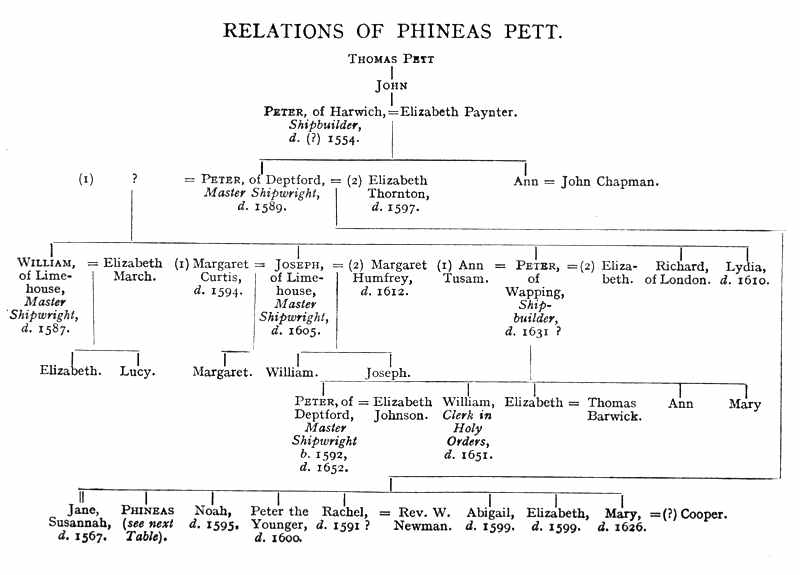
RELATIONS OF PHINEAS PETT.
[[Click here for table image.]]
Thomas Pett
John
Peter, of Harwich, = Elizabeth Paynter.
Shipbuilder,
d. (?) 1554.
(1) ? = Peter, of Deptford, = (2) Elizabeth Ann = John Chapman.
Master Shipwright, Thornton,
d. 1589. d. 1597.
William, = Elizabeth (1) Margaret = Joseph, = (2) Margaret (1) Ann = Peter, = (2) Eliza- Richard, Lydia,
of Lime- March. Curtis, of Lime- Humfrey, Tusam. of beth. of London. d. 1610.
house, d. 1594. house, d. 1612. Wapping,
Master Master Ship-
Shipwright Shipwright builder
d. 1587. d. 1605. d. 1631?
Elizabeth. Lucy. Margaret. William. Joseph.
Peter, of = Elizabeth William, Elizabeth = Thomas Ann Mary
Deptford, Johnson. Clerk in Barwick.
Master Holy
Shipwright Orders,
b. 1592, d. 1651.
d. 1652.
Jane, Phineas Noah, Peter the Rachel, = Rev. W. Abigail, Elizabeth, Mary, = (?) Cooper.
Susannah, (see next d. 1595. Younger, d. 1591? Newman. d. 1599. d. 1599. d. 1626.
d. 1567. Table). d. 1600.
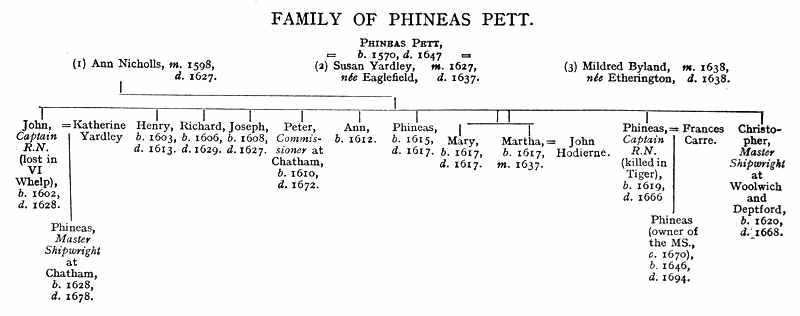
FAMILY OF PHINEAS PETT.
[[Click here for table image.]]
Phineas Pett,
= b. 1570, d. 1647. =
(1) Ann Nicholls, m. 1598, (2) Susan Yardley, m. 1627, (3) Mildred Byland, m. 1638,
d. 1627. née Eaglefield, d. 1637. née Etherington, d. 1638.
John, = Katherine Henry, Richard, Joseph, Peter, Ann, Phineas, Phineas, = Frances Christo-
Captain Yardley b. 1603, b. 1606, b. 1608, Commis- b. 1612. b. 1615, Captain Carre. pher,
R.N. d. 1613. d. 1629. d. 1627. sioner at d. 1617. R.N. Master
(lost in Chatham, (killed in Shipwright
VI b. 1610, Tiger), at
Whelp), d. 1672. b. 1619, Woolwich
b. 1602, d. 1666. and
d. 1628. Deptford,
Phineas b. 1620,
Phineas, (owner of d. 1668.
Master the MS.,
Shipwright Mary, Martha, = John c. 1670),
at b. 1617, b. 1617, Hodierne. b. 1646,
Chatham, d. 1617. m. 1637. d. 1694.
b. 1628,
d. 1678.
FOOTNOTES:
3.—Phineas Pett.
Education.
From the care that had been taken to provide for his education, and from the fact that it was only at the 'instant persuasion' of his mother that he was 'contented' to be apprenticed as a shipwright, it may be inferred that Phineas had been destined for the Church or the Law, and that Peter Pett did not propose that his son should follow in his own footsteps. The peculiarity[94] of the name chosen for him (which no doubt refers, not to the disobedient son of Eli, but to 'Phinehas, the son of Eleazar, the son of Aaron the priest,' who received 'the covenant of an everlasting priesthood')[95] gives rise to the surmise that his parents had intended him for the Church, but whatever the intention may have been, it was certainly abandoned on the death of his father.
Phineas does not seem to have profited greatly from his studies at Cambridge. He was hardly a master of English; possibly he had a good knowledge of Latin, for the influence of the Latin idiom is to be seen in almost all his periods; but the fact that he had subsequently to practise 'cyphering' in the evenings does not imply any great acquirements in mathematics, even of the very elementary forms which at that period were sufficient for the solution of the few problems arising in connection with the design of ships. Nevertheless, he received the degree of Bachelor of Arts in 1592 and that of Master in 1595.
If the statement that he spent the two years of his apprenticeship to Chapman 'to very little purpose' is to be accepted literally, it would seem that the misfortunes that subsequently befell him must have aroused latent energies and filled him with determination to master the details of his future profession when he returned to England in 1594. His voyage to the Levant and subsequent employment as an ordinary workman under his brother Joseph no doubt gave him a practical acquaintance with ships that enabled him to profit greatly by the instruction of Mathew Baker, although apparently this only extended over the winter of 1595-6. Pett's confession that it was from Baker that he received his 'greatest lights,' written, as it must have been, after he had found Baker an 'envious enemy' and an 'old adversary to my name and family,' indicates how great that assistance was. This is borne out by a letter[96] which he wrote to Baker in April 1603, in order to deprecate the old man's wrath, which had been aroused when Phineas, then Assistant Master Shipwright at Chatham, commenced work on the Answer. The letter was partially destroyed by the fire which damaged the Cottonian Library in 1731, but fortunately Pepys had copied it in his Miscellanea.[97]
Sir,—My duty remembered unto you. It is so that I received a message from you by Richard Meritt, the purveyor, concerning the Answer, who gave me to understand from you that you were informed I meant to break up the ship and to lengthen, and that I should no further proceed till I received further order from you. Indeed the ship was heaved up by general consent, both of my Lord, some of the Principal Officers, and two of the Master Shipwrights which were here present at the time she was begun to be hauled up, no determination being resolved upon what should be done unto her; for which cause (other haste of businesses also being some hindrance) she hath lain still ever since, till now that it pleased Sir Henry Palmer to command she should be blocked and searched within board only, and so let alone, partly because our men wanting stuff to perfect other businesses had little else to do, as also to the intent she might be made ready to be the better viewed and surveyed lying upright, being somewhat also easier for the ship. This is now done, but I ensure you there was no intent or other purpose to proceed in anything upon her any further till the Master Shipwrights, especially yourself who built her, had first surveyed her, and under your hands set down what should be done unto her; and therefore, good Mr. Baker, do not give so much credit to those that out of their malice do advertise you untruth concerning either this or any other matter, for it is supposed by whom this hath been done, and he is generally thought to be no other than an Ambodexter[98] or rather a flat sheet,[99] being so far off from either procuring credit to himself by due execution of his place and discharge of his duty, that like Aesop's Dog he doth malice any other that is willing to give him precedent of better course than all men can sufficiently in this place report himself to follow. And for myself it is so sure[100] from me to understand anything that you should think any ways prejudicial unto you, or to any of your works, that you shall always rather find me dutiful as a servant to follow your directions and instructions in any of these businesses, than arrogant as a prescriber or corrector of anything done by you, whose ever memorable works I set before me as a notable precedent and pattern to direct me in any work that I do at any time undertake, and you yourself can say, setting private jars aside, which I hope are all now at a final end, but that I ever both reverenced you for your years and admired you for your Art, in the which I know (to speak without flattery) no Artist in Christendom of our profession able in any respect to come near you. Therefore, good Mr. Baker, carry but that loving mind towards me as you shall find my loving duty to you to deserve, who you shall find always as ready to do you any service, either in this place or any other, as any servant of yours whatsoever, among whose rank I account myself one of the unworthiest, for although I served no years in your service, yet I must ever acknowledge whatever I have of any art (if I have any) it came only from you. Thus hoping this shall suffice to give you satisfaction in this behalf, I humbly take my leave, ever resting ready to do you service.
Chatham this 10 April, 1603.
Your Servant,
Phineas Pett.
To the worshipful and my loving friend Mr. Mathew Baker, one of his Majesty's Master Shipwrights, give this at Woolwich or elsewhere.
This expression of opinion upon Baker's capacity was evidently quite genuine, for many years after, when the old man was dead and there was nothing to be feared from his enmity, Phineas wrote of him as 'the most famous artist of his time.'[101]
Preferment.
Phineas did not rely on his professional skill alone to gain him preferment. When in his brother Joseph's employment, he laid out his earnings in clothing himself 'in very good fashion, always endeavouring to keep company with men of good rank, far better than myself.' By means of a friend thus gained, he obtained an introduction to the Lord Admiral, which was 'the very first beginning' of his rising. No doubt Nottingham had known his father, and it is certain that he was well acquainted with his brother Peter; it is probably to this that the 'extraordinary respect' and the later favours of the Admiral were due. These favours brought upon him the 'malicious envy' of the Master Shipwrights, who were no doubt aggrieved at seeing employment that might have provided them or their friends with 'pickings,' handed to a newcomer.
The post of a purveyor of timber was not without its perquisites, and Pett's thankfulness that 'nothing could be proved against him' when the accounts of his doings in Suffolk and Norfolk were scrutinised, indicates that his labours had not been without some profit to himself; indeed his association with Trevor, who became an able disciple of the arch-thief Mansell, leads one to suspect that Fulke Greville's action in 'wrongfully' cutting off twenty pounds was not the high-handed injustice that Phineas would have one believe. It is true that Mr. Oppenheim[102] dates the 'administrative degeneracy' of the Navy Office from Greville's treasurership, but it is probable that this arose from Greville's incapacity to exercise the strict control which had characterised his predecessor Hawkyns, and not from want of integrity. Three years later Phineas affirms that Greville continued his 'heavy enemy' because the Treasurer could not win him 'to such conditions as he laboured me in' against the Surveyor, a state of affairs that seems to indicate a half-hearted attempt at reform on Greville's part, rather than any underhand conspiracy.
In an anonymous account of the quarrel at Chatham in 1602 preserved in Pepys' Miscellanea,[103] written evidently by George Collins, 'the principal informer and stirrer in this business,'[104] it is stated that the writer told Sir Henry Palmer that Pett
had sold away the Repulse's foretopmast, and that through his negligence the Crane was bilged in the Dock, which cost the Queen 100l.
whereupon Palmer called him a rogue, and asked him if he never stole anything, and then struck him with a cudgel;
and no wonder! though Sir Henry took his part so much, for in six weeks after he had great masts sawed out into boards at the Queen's charge, a long boat full, and towed down to Whitechapel by Boatswain Vale, or his man, at a ketch's stern.
At the term after, I served Phineas Pett upon a battery, and Sir John and Sir Henry procured my Lord Admiral's warrant to send me to the Marshalsea. But that I paid well for it in Mr. Pope's house I had gone thither; and so was forced to agree with Phineas and to enter into bond never to follow suit against him, neither for the King nor yet for myself.'
The writer then goes on to give instances of Pett's misappropriations of materials and labour; four tons of elm timber sawn into boards; fifty deals from the storehouse; fifty small spars; two four-inch planks to make a bridge into his meadow; labour for two or three days; a sluice made in the meadow at a cost of 3l. or 4l.; two or three tons of oak timber sawn into posts to hang clothes on and painted at the Queen's cost. Although the writer has an obvious grievance against Pett, there seems no reason to doubt the substantial accuracy of the charges made.
The Resistance, and the Voyage to Spain.
One of the gravest indictments subsequently brought by the Commission of Inquiry of 1608-1609 against Phineas was that relating to the ship which he had laid down in David Duck's private yard at Gillingham in 1604, when both he and Duck were shipwrights at Chatham. From the account of it presented by Phineas[105] it might be supposed that the charge related merely to the sale of ordnance and ammunition to the Spaniards, but the malpractices alleged went much further than that; and, although Pett was cleared by the King, an examination of the evidence produced before the Commission leads to the conclusion that 'those scandalous and false informations' might have led to very unpleasant results if the King had not been biased in his favour. The story, as made out from the existing documents,[106] is briefly as follows:
The ship—a small one of about 160 tons—had been built largely of timber delivered 'for the King's use at Chatham' and with articles 'borrowed out of the store,' under warrant of the Principal Officers, two of whom, Mansell and Trevor, subsequently had shares in her. She was rigged 'with the rigging of the Foresight, which for bare 12l. only he bought out of her' at much less than the value, by the favour of the Surveyor (Trevor) and the Treasurer (Mansell), so that 'she was sailed with the King's sails and rigged with the King's tackling.' When she set sail for Spain in 1605 'under colour of a transporter of my Lord Admiral's provisions,' she was furnished out of the King's store with cables, anchors, flags, pitch, and other stores and provisions, including 600 cwt. of biscuit. She also drew 120 bolts of canvas for the use of the fleet, part of which was sold by Pett's brother, and for the whole of which Phineas acknowledged himself responsible. Although taken up as a transport and paid wages and tonnage (on a false rating of 300 tons, about twice her capacity) she was entered in the Customs as a merchantman bound for San Lucar, and carried 60 tons of lead for a merchant of London named Alabaster, for which 60l. was received as freight. At Lisbon Pett sold a demi-culverin of brass, captured at Cadiz in 1596, with ammunition and a quantity of bread, biscuit, and peas belonging to the fleet, for which he received 300l., which he sent, 'by the way of exchange,' to Trevor and Mansell, then at Valladolid[107] with Nottingham, who had gone there to ratify the peace recently concluded between the two countries. Altogether, the voyage of this ship cost the King '800l. or 1000l., as appeareth by the accounts, for little or no service done at all.'
As regards the money sent to Valladolid, it is probable that this was used in paying some of the expenses of the embassy, and that this proceeding had the sanction of Nottingham; but Pett's answers before the Commission to some of the other charges, as given in his signed deposition of 12th May 1608, seem rather weak. He stated that the 'riggings' of the Foresight were 'found to be so ill that they stood him in little or no stead,' that the accounts for the provisions were delivered to Sir John Trevor and no copies had been kept, and, by a convenient lapse of memory, he could not say what persons or stuff were landed at the Groyne 'nor what burden the ship was accounted for to the King.' When asked by Captain Morgan to set him down on the east side of the Groyne, he was alleged to have said that 'he could not adventure the ship by his directions for that she was no part of the fleet,' in reply to which allegation he swore that to the best of his recollection no such words were ever used. It appears from the evidence that Sir Richard Leveson had refused to allow the ship as one of the fleet, but he had died shortly after the return to England, and after his death Mansell and Trevor, 'assuming full power into their own hands,' had reversed the decision. One reason given by Pett for visiting ports other than that to which the fleet had gone is of interest; he told the Commission that he had been informed by Trevor and Mansell that the biscuit would not be needed for the fleet 'by reason of the short voyage my Lord Admiral had into Spain,' and he was to go to Lisbon or San Lucar to sell it, 'and that they reported as from my Lord Admiral that because this deponent was a shipwright he might in the harbours where he should put in take view of the Spanish ships and galleys and of the manner of their building.'
With a ship so cheaply built and rigged, and employed on such favourable terms, it could not have been difficult to make a handsome profit, and it is little wonder that Pett calls her a 'lucky ship' when he tells of her sale in 1612.
Commission of Inquiry.
The corruption in the administration of the Navy, which had begun to appear in the last years of Elizabeth's reign, had by 1608 reached such a height that James was at length forced to take some steps in regard to it. The knowledge that Spain was actively engaged in setting her navy in order no doubt quickened the King into action and provided a motive powerful enough to sweep aside for the time the obstruction of the senile Nottingham and his jackal Mansell. At first it had been intended that Nottingham should head the Commission, and letters patent[108] were passed on 1st April 1608, in which his name appears first, Northampton coming second, but for some reason this was altered, and on the 30th April a commission under the great seal was issued to Henry Howard, Earl of Northampton, then Lord Privy Seal and Lord Warden of the Cinque Ports, Charles Howard, Earl of Nottingham, the Lord High Admiral, and thirteen others,[109] of whom Sir Robert Cotton, the famous antiquary, was the most active. Northampton, who was Nottingham's cousin, seems to have been the leader of the reform party, and although he is persistently vilified by Pett, there is little doubt that he was actuated by a more or less sincere desire (sharpened, possibly, by mutual antagonism between the offices of Lord Warden and Lord High Admiral) to reform the many existing abuses. What all these abuses were would take too long in telling, but they were sufficient to justify, and more than justify, the vigorous language of the patent, which speaks of the
'very great and intolerable abuses, deceits, frauds, corruptions, negligences, misdemeanours and offences' that 'have been and daily are perpetrated, committed, and done against the continual admonitions and direction of you our High Admiral by other the officers of and concerning our Navy Royal, and by the Clerks of the Prick and Check, and divers other inferior officers, ministers, soldiers, mariners, and others serving, working, or labouring in and about our said Navy.'
The patent then proceeds to give instructions for the examination of all officials who have been connected with the Navy since 1598 and the investigation of their accounts,
minding that the said intolerable abuses, frauds, misdemeanours, and offences shall forthwith be enquired of, the offenders therein condignly punished and also to provide a speedy reform of the same for the time to come.
Possibly, at the time, James really intended to reform the administration. Nottingham kept out of the way, and his subordinates had an unpleasant time while they were examined upon their misdeeds; but in the end, James' fear of Spain having passed away, he, with his usual weakness, let the offenders off with a lecture.
The Commission commenced to sit in May 1608 and sat for a little over a year, ending with the proceedings before the King recorded on pp. 68-69 below. During this period 161 witnesses were examined, and their signed depositions taken. These are preserved among the manuscripts of Sir Robert Cotton,[110] who acted as the secretary. They were analysed by Cotton, who drew up a lengthy report[111] in which various abuses are set forth and proposals made for their remedy; the latter, as might be expected, were duly ignored by the King. Among the offenders cited by name, Pett appears as one of the chief, and although the present occasion is not convenient for a general examination of the report and evidence, some mention must be made of the matters in which Pett is directly charged with wrong-doing.
The first point made against him is that while he was keeper of the timber store at Chatham he had failed to reject bad timber and plank brought in by one of the purveyors. His answer to this was 'that Sir Henry Palmer had been so quick with him for some of these exceptions as he would complain no more though the purveyors brought in faggot sticks.' He is next charged with certain malpractices in connexion with the Resistance, and other charges on this account are brought against him further on; these have already been referred to. In a general charge against the Master Shipwrights that, for reasons of private gain, ships were repaired 'when they were not worth the labour nor the charges bestowed on them,' the case of the Victory is cited as an example:
Thus did the Victory for transportation, docking and breaking up stand the king in four or five hundred pounds, and yet no one part of her at this day serviceable to any use about the building of a new as was pretended for a colour. To conclude, though we set her at a rate of 200l., yet it had been better absolutely for the King to have given her away to the poor than to have been put to the charge of bringing her from Chatham to Woolwich, no other use having been made of her than to furnish Phineas Pett (that was the only author of her preservation) with fuel for the diet of those Carpenters which he victualled.
In complaining that estimates for repair were made blindfold, with the result that money was spent upon old ships more than sufficient to have built new ones, the illustration is again drawn from Pett's proceedings:
An instance of this art may be drawn from the King's ship now called the Anne Royal, whose estimate being first set down by the Master Shipwrights at 3576l., which sum would have built another (by the judgment of those that made the estimate) newly from the stocks of equal burthen, doth upon her finishing by Phineas Pett (a favourite of the chief officers) amount to full 7600l. upon that false ground which before hath been spoken of.
A little further on, in dealing with frauds connected with the receipt of stores, Pett is again made the principal example:
When timber and other materials come to be received into the stores, of the Clerk of the Check combining closely with the deliverers to increase the quantity of that which is delivered some time to a third part above true measure, which increase is shared between both, and lots are cast upon the robe of the Redeemer.
Sir Foulke Greville, espying plainly this collusion between parties to the wrong of our great Master, sought to prevent this play of fast and loose by adding Phineas Pett to the Clerk of the Check at Chatham as an assistance to take care that there might be no increase of quantities, but all things accounted for in their true proportion in weight and number as they were indeed, without conspiracy. But such was the falsehood of the party, as having found the thief, he ran with him, thrusting himself into [the] pack with the Clerk and the deliverer; and thus adding himself as an assistant indeed, not to plain dealers as Sir Foulke Greville meant, but to filchers and abusers, as Pett himself meant, which appears upon examination.
In a further charge relating to the issue of material for ships building or under repair, it is pointed out that the Surveyor had taken away the keys of the storehouses from the Clerk of the Check, their proper custodian, 'and put them into the hand of Pett his chief favourite, who could not only take just what he liked, but likewise hath power to expend upon the ships (or under that pretence) whatsoever he thinketh good without contradiction, and full scope withal to embezzle what he list.' He is also mentioned in connexion with the construction and decay of the 'pale' which should defend the storeyard from pilferers 'on the outside towards the Thames,' and with the employment of youths and boys 'that fill up numbers but work little.' Finally he is charged with 'wasteful and lavish expense' in repairing the ironwork of the Anne Royal at a cost of 800l., or more than double the amount necessary for the purpose. In the only charge to which Pett himself refers, namely, that of altering his lodgings, he is not mentioned by name, but it is clear that all the resident officials had added rooms to their houses at the expense and to the detriment of the storehouses which adjoined.
There seems little doubt that these charges were well founded, and that Pett was acting in collusion with his 'very good friends' Mansell and Trevor to defraud the State. It is, however, probable that the other officers were little better, and were only restrained by the lack of those opportunities the possession of which they envied Pett.
The Prince Royal.
It is clear from the remarks in the Report of the Commission of Inquiry already quoted and from Pett's narrative[112] that the original intention was to rebuild the Victory, which had been removed from Chatham to Woolwich in the autumn of 1606 for this purpose. The official records do not throw any light upon the circumstances in which this intention came to be abandoned, and indeed the Treasurer's official accounts for 1609 and 1610 preserve the fiction that the Victory was rebuilt.[113] From the story related by Phineas, it appears that the Victory had been given by James to Prince Henry, and that Pett was entrusted with the task of rebuilding her because he was one of the Prince's retainers. He then conceived the idea of constructing a ship larger than any that his predecessors had built, and made a model embodying his design, which so pleased the Lord High Admiral that the King was brought to see it, with the result that it was decided to build a new great ship on the lines suggested by Pett. This procedure of constructing a model to scale from the design, for the approval of the authorities, before starting to build the ship, is probably the first instance of the adoption of a course that later became customary in all cases where a new ship represented an advance in size, or method of construction, or embodied features not to be found in her predecessors. Her keel was not laid until the 20th October 1608, nearly a year after the model had been submitted to the King's inspection. In the meantime the Commission of Inquiry had been appointed, and the construction had not proceeded far before questions were raised as to the correctness of the design, the suitability of the material, and the competence of Pett as designer and builder.
On the 15th December, Baker was examined on the subject before the Commission. The questions put to him related to the estimated cost of the Prince Royal and the material used; the cost of the rebuilding of the Ark Royal; and the experience of Pett as a builder. Baker estimated the probable cost of the Prince at £7000, nearly twice what he had been paid for the Merhonour.[114] This estimate, although apparently in excess of one given by Pett, proved very far short of the mark, since the total cost finally came to nearly £20,000, no less than £1309 being spent on decoration and carving alone. As regards the material, Baker stated that the timber was very badly chosen. It appears that old and unsuitable trees were selected on account of the profit to be made by their larger 'tops,' which seem to have been one of the many perquisites of the officers. In preparing the timber there was, so Baker said,
so much waste as the charge will be well near half so much more as it needed to be to the King; besides the ship will be of many years less continuance serviceable than otherwise she would have been if the timber and plank had been well chosen, and framed in the wood.
In regard to Pett's competence:
Being asked, also by virtue of his oath, whether Phineas Pett be a workman sufficient to be put alone in trust upon a ship of so great charge and burthen, he answereth that he never saw any work of his doing whereby he should so think him sufficient for that work, but rather thinketh the contrary. Further, being demanded what ship he knoweth or have heard the said Pett hath built or repaired, he saith he never knew any new ship of his building, but one of 120 tons or thereabouts which he built by Chatham for himself,[115] as far as he knoweth, and another ship of the burthen of 223 tons he repaired,[116] and a pinnace[117] for his Majesty, which he saith was so done that after he had repaired them they were worse in condition than they were when he took them in hand, for that they were so unserviceable that they would bear no sail, by which default of his they were returned from the seas into Chatham to be new furred[118] to make them bear sail, so that with his first repairing and furring of them he doubts not but it will appear by the accompts that his workmanship with stuff was more chargeable than a new ship of their burthen might have been new built for, which are enough to persuade any man that he cannot be sufficient to perform the building of so great a ship when he hath performed the reparation of a small ship so ill, as of a good ship he made a bad.
Further, being asked what his opinion was concerning the choice of the stuff, he saith it was not chosen for the good of the King but for their own turns, and that very little of it fit to be put into any ship, and much less into a great ship, because it will be of no continuance, and that he never knew Pett to make any frame in the wood either for ship or boat, who cannot do it, being never brought up to it; and as for his brother Peter Pett, who was appointed purveyor, he holdeth him a man most simple for such a purpose, and also saith that, though they be both unsufficient for the making of such a frame, yet the badness of the stuff is not altogether to be imputed to them, but to those who dispose of the business according to their own humour.
Five days later, Bright came up for examination and was required to give answers to seventeen questions, apparently the same as those put to Baker. Six of them he did not answer, but referred the Commissioners to the answers given to them by Baker. His replies to the others were generally in corroboration of what Baker had said, but as regards Pett's capability he expressed no direct opinion, contenting himself with pointing out that
the old Officers, in former times, in such great works did place two Master Shipwrights in the building of one great ship, as my father Mr. Bright was joined with Mr. Pett in the building of the Elizabeth Jonas, as also in the building of the Bear with Mr. Baker. Their reason was that two Master Shipwrights' opinions was little enough for the charge so great in scope as she at Woolwich will be, but now it is carried by the favour of some of the Officers to whom it pleaseth them; but howsoever it is, the charge is great for a young man to do which never made great ship before of that burthen.
Captain George Waymouth.
After this the matter remained in abeyance until the end of March, when Northampton enlisted the services of George Waymouth, who appears to have possessed a great reputation among his contemporaries for his theoretical knowledge of shipbuilding. In 1602 Waymouth had set out, under the auspices of the East India Company, to attempt the North-West Passage in the Discovery, with another small vessel, the Godspeed, but had been compelled, through the mutiny of his crew, to abandon the attempt, after entering the strait subsequently known as Hudson's Strait. In 1605 he made a short voyage of discovery in the Archangel along the American coast. Of actual experience in shipbuilding he seems at that time to have had none whatever, and a perusal of his chapter on that subject in the manuscript volume 'The Jewell of Artes,'[119] which he presented to James in 1604, would not inspire any great confidence in his theoretical knowledge, but fortunately other means of judging the extent to which this knowledge was subsequently increased have lately presented themselves.
The chapter in 'The Jewell of Artes' consists entirely of criticism, together with a few crude drawings not explained in the text. These criticisms are not without point, as may be seen from the following extracts. He says:
Although the form and fashion of these our English ships have always been, and yet are accompted to be made by the best proportion, and fittest both for service and burden, yet if art and diligence were to the full performed in their buildings as they might, there should not remain in them so many dangerous impediments as there do at this day, which maketh me verily suppose that the one of them, if not both, is not in such measure in our shipwrights as with all my heart I do wish.
A little further on, in speaking of the discrepancies to be found in ships supposed to be built from the same design, he says:
Yet could I never see two ships builded of like proportion by the best and most skilful shipwrights in this realm ... the chiefest cause of their error is because they trust rather to their judgment than to their art, and to their eye than to their scale and compass.
He then, feeling, no doubt, that his want of technical experience in shipbuilding gave him small right to pose as a critic of the professional builders, deprecates their censure in the following words:
All which defects in building and many other I have with no less careful endeavour than with the often peril and hazard of mine own life diligently applied myself to search and find out, even to the uttermost of my skill and understanding; and although by mine own experience I can in this point speak as much as most seamen (I might say as any), having been employed in this service ever since I was able to do any, and served therein well near four prenticeships, and having in this time borne all the offices belonging to this trade, even from the lowest unto the highest, yet had I rather that any other should have taken upon them the searching and finding out of these impediments and the laying of them open, than myself; but seeing that no man that ever I heard of hath hitherto, as yet, undertaken the same, the thing being of much importance, as it is, and the dangers so great, though perhaps I shall be hardly censured for the same of the shipwrights, whose want of art or diligence I therein accuse, yet do I think it the part of every good subject rather to seek to do good to the whole state than to fear the displeasure of any one occupation.
In an undated paper, a copy of which is preserved in the Harleian MSS.,[120] he further criticises the shipwrights to the following effect:
The Shipwrights of England and of Christendom build ships only by uncertain traditional precepts and observations and chiefly by the deceiving aim of their eye, where for want of skill to work by such proportions as in Art is required and is ever certain, I have found these defects.
(1) No shipwright is able to make two ships alike in proportion nor qualities; to build a ship to any desired burden certain; nor to propose to himself how much water his ship shall draw until there be trial made thereof.
(2) Ships yet built go not upright in the sea, whereby they often lose the use of their lower tier of ordnance.
(3) They are often forced to be furred; which is a great charge and weakening to the ships; this is for want of skill to work their desired proportions.
(4) They labour and beat in the sea more than they may be made to do; which causeth often leaks to spring and weakeneth them that they cannot last so long as they might.
(5) They go not so near the wind as they might be made to do, the wind being the greatest advantage in fight.
(6) They draw more water in proportion to their burdens than they might be made to do.
(7) They be made of less burdens than they may be made of in proportion to the length, breadth and depth. This defect the Hollanders have in part mended and are able to carry freight for one third part less than our Merchants.
(8) They cannot bear sail nor steer readily to make the best advantage of the wind, for want whereof, and of art in proportioning the Moulds, they sail not so fast as they may be made to do.
My study these twenty years in the Mathematics hath been chiefly directed to the mending of these defects. I have during this time applied myself to know the several ways of building and the secrets of the best shipwrights in England and Christendom, and have likewise observed the several workings of ships in the sea in all the voyages I have been. By these helps I have demonstratively gained the science of making of ships perfect in Art, which of necessity must be made wrought by a differing way from all the Shipwrights in the world.
He goes on to say that ships built after his plan would cost less and be of more burden, and gives reasons why the ships of the Low Countries carried freight at cheaper rates than English ships. This, he says, was because they were longer in proportion to their breadth, broader and longer in the bottom, and therefore of less draught, and not built so high above water, with the result that they required less sail and tackling and could manage with a smaller crew.
These criticisms of the English shipwrights are no doubt well founded, but the step from critic to artist is a long one, and Waymouth never took it. Nevertheless he was a more competent critic than Pett would have us believe. An anonymous seventeenth-century MS., entitled, 'A most excellent briefe and easie Treatize,' containing, among other matters, 'A most excellent mannor for the Buildinge of Shippes,' exists in the Scott collection, and this, by the kindness of the owner, has been placed at the disposal of the editor, who, after a careful examination, has no doubt that it is the work of Waymouth, written after he had built the ship which Pett calls a 'bable and drowne divell,' and of which a midship section is given. Unfortunately, except in this one instance, the treatise is purely theoretical and throws no light on the problems of the Prince Royal, or the methods of the royal shipwrights, but as a theoretical treatise it is far in advance of the 'Jewell of Artes,' and indeed of anything that the English shipwrights of that century produced, and is sufficient to explain why Waymouth's opinions were accorded so much respect.
Inquiry by Nottingham, Worcester, and Suffolk.
After Waymouth's futile visit to Woolwich, the King seems to have been much perplexed, and since there was no independent expert, for they had all taken sides, he handed the matter over to a committee composed of the Lord High Admiral and two of the great officers of State. In theory, no doubt, the selection of the Admiral to superintend such an inquiry was the natural course to be followed, but in this case he was sitting in judgment on one of his own protégés, and could hardly condemn him without indirectly condemning himself and justifying Northampton. The result in such circumstances—and with such a man—was a foregone conclusion, for the other two members, having no professional experience of the matter, would naturally follow his direction. The technical arguments of Baker and Stevens would be lost on Worcester and Suffolk, even if Nottingham could appreciate them, which may be doubted; and—judging by his writings, and allowing for their ignorance of the mathematical side of the questions at issue—it is not surprising that Waymouth bored them beyond endurance, with the result that in the end 'they found the business in every part and point so excellent.'
Northampton's anger at the result was not unnatural, and the King found that there was no other course open to him but to hold an inquiry in person. This was fixed for the 8th May, and during the first week of that month Baker, Waymouth, and their associates took the dimensions of the ship at Woolwich and set out their objections in the following document:[121]
Imperfections found upon view of the new work begun at Woolwich.
First her mould is altogether unperfect, furred[122] in divers places; she hath too much floor;[123] the lower sweep[124] and the upper are too long, and the middle sweep too short.
Her depth is too great and her side too upright, so that of necessity she must be tender sided and not able to bear sail.
Her breadth lieth too high, and so she will draw too much water, and thereby dangerous and unfit for our shoal seas.
Her harpings[125] are too round and lie too low, which maketh a cling at the after end of it, and makes the bow flare off[126] so much that the work is not only misshapen but the ship dangerous to beat in the sea either at an anchor or under sail.
Her workmanship is very ill done, and thereby the ship made weak, as first the limber[127] holes are cut so deep in the midship floor timbers that they are less thickness upon the keel than toward the rung head; whereas they ought to be thicker and stronger in the midst, to bear the weight on ground.
The futtocks[128] have not scarph[129] enough with the floor timbers, but at the lower end of them are divers short clogs of timber put in which serve to no purpose for strength but to fill up the room. Every mean owner in the Thames will assuredly tie the carpenter to allow a great scarph and to have his timber come whole within a foot of his kelson.
Some of the timbers abaft and afore are left so deep by the kelson that the footwales[130] and outside not being well trenailed together will be a great weakness to the ship, and the rather for that the rung,[131] being cut out of right and old grown timber, cannot be brought to a lesser scantling, they will break in sunder at the cross grain.
The provision of timber was not fitting such a chargeable work for that much of the same is overgrown and many pieces of them cross grained, as cut to a roundness out of straight timber, which cannot be strong enough to bear a ship on ground of so great weight as this is; as may be seen both in the ship and yard.
To shew his weakness in art and the imperfection of the mould, Pett himself, after workmen had seen her, hauled down his futtocks[132] 2 foot as soon as the lords were gone, and cut off some of the heads of them, whereby they have made her more imperfect than she was and put all things out of order that she can hardly be ever amended.
Mathew Baker.W. Bright.
Nycholas Clay.Edward Stevenes.
John Greaves.Richard Meryett.
George Waymouth.
All these being Shipwrights (saving Capt. Waymouth) have taken their oath, and answered before us, both upon their conscience to God, their duty to the King and their love to their country that this declaration is true. And Capn. Waymouth also affirmeth that all which the said Shipwrights have declared to be imperfections are so to be accounted. But the error of the limber holes he did not look into, supposing that no man affecting the name of a workman would err in so gross an absurdity.