Chapter IX · Inner Life.
Reading edition
In any life that is worth writing at all the outward events have but a superficial interest in comparison with the landmarks in the development of consciousness and the soul. This was pre-eminently so in the life of Tolstoy, whose biography I wrote chiefly because it was in so marked a degree a spiritual adventure.
My many years’ acquaintance with Dr. Marie Stopes have made me in some small degree acquainted with the landmarks in the development of her inner life, but as in the case of Tolstoy the data carrying conviction are those afforded by autobiographical evidence. So I feel in the present instance that we must await an autobiography fully to understand the character whose life it has here been my task to sketch in outline.
A certain amount of autobiographical detail is to be found in the volume of travels already referred to, the Journal from Japan, as also in the preface to Man, Other Poems, and a Preface; on these I have drawn, but for the main outline of her spiritual growth I depend upon personal notes which I asked Dr. Stopes to write.
“From my earliest childhood religion, not in its narrowest sense of outward performance but in the inner sense of absolute reality, has been a matter of the very greatest concern to me. My mother was Scottish of almost Calvinistic tendencies, and my father a Quaker, but one who felt that the religious education of a little girl should be left absolutely to the mother. I was brought up in the rigours of the stern Scottish old-fashioned Presbyterianism, in which hell was presented to me as an absolute reality which I stood in imminent danger of inheriting; special books were kept for Sunday reading; no toys were allowed on Sundays, when Bible chapters and texts had to be learnt as well as church attendances fulfilled. All this I took with childlike literalness, which was rendered all the more intense by a feeling of guilt at being unable to see Christ and the angels, which I felt, somehow, was my own fault. In spite of my father’s lack of interference I used, even in the very earliest days, to feel that he was wiser than mother, and that his aloofness from our religious observances was not hostile, but something superior; that in fact he dwelt in more direct communion with God than we, who had to make an outward office of it. This, I think, shows how through all the early years of my childhood he must have exercised the greatest care not to interfere in any way with my mother’s more specific instructions.
“One of the earliest religious landmarks that I remember was when, at the age of six or seven, my manifold sins had been made very evident to me, and I felt that if only I were a better girl I would feel the actual floods of the Blood of Jesus which would purify me. I felt I must try to be converted in such a way that I really could see and feel these things. I remember placing myself at the foot of a long flight of stairs at the bottom of which was a sheepskin mat, dyed crimson, and I rubbed myself in the crimson wool of the mat and shut my eyes and tried to picture the stream of the Blood of the Lamb cascading down the stairs and over me, purifying me and taking away my manifold sins. I was discovered by nurse before this process had completed itself, and was led away, but I remember to this day the feeling that the only barrier between me and an actual sensation of the Blood of the Lamb was my manifold crimes of omission and commission, and that I stood in imminent danger of hell-fire if I did not succeed in persuading my senses really to feel the Blood of Jesus.
“Childhood’s memory fades concerning the resolution of that problem; and next I remember clearly, at the age of about eight, getting into very profound religious difficulties over the conflict between the existence of hell-fire, in which human beings, and even children, were burnt eternally, and an all-loving and all-kind God. These difficulties worried me to the extent of keeping me awake at night. The problem was not one that I could take to my mother, because when I was seven years old I had one day observed her sewing in her bedroom on a Sunday, and had hence come to the conclusion that she was ‘not truly religious.’ My grandmother, however, who read the Bible every day and was always spoken of as a very saintly woman, seemed to me to be in immediate communication with God and to be the person to whom I should take this very profound difficulty. I well remember going into her room with her breakfast tray, finding her reading her Bible as usual in bed. Sitting down near her, I began to ask her about the problem of hell and a loving God. She laughed; I suppose I must have sounded absurd, but it shut me up so completely within myself that I do not think I ever spoke of the difficulty to anyone for years. But I remember, most clearly, thinking it out for myself, and in the course of a few months evolving in elaborate detail, something that resembled the Roman Catholic faith, with the exception that I omitted, of course, any idea of the Pope. No Roman Catholic was in contact with me, and my home, as I have explained, was a Calvinistic and Quaker establishment, and yet I came to the conclusion that the only possible God, that was the true God, must be one who did not entirely burn people up in hell, but only allowed them to burn so far as to burn the badness out of them, and that the goodness was then allowed to go into Heaven as a very tiny baby and grow there big enough to be a grown-up soul in Heaven; in short, the theory of purgatory. I evolved also, in my inner consciousness, the theory of saints, and I remember most clearly, night after night through the winter, lying on my side, taking up the least possible room at the edge of my bed, and spreading the bed-clothes comfortably across the part of the bed that I did not inhabit, so as to allow the saints, whom I fancied were there guarding me and talking to me, to be comfortable and warm while they were there. I was convinced that they were there, and felt that it was my own wickedness which prevented my feeling their presence.
“This phase, of course, also passed, although I do not remember when. Then I remember clearly, from the age of about eight to ten, or nine to ten, reading the whole of the Bible through, including all the enormously long and dreary chapters in the Old Testament. I was still ignorant of the Roman numerals, and could not understand them, and I remember going through the Bible with a pencil and counting up on my fingers the numbers of the chapters as I read them and writing them in ordinary numerals, so that I should know how far I had got. The thin pages adhering here and there, naturally the sequence of the Roman numerals was transcribed quite wrongly, a thing I only discovered a good many years after, when I came to look through the same Bible again. At the time I felt that perhaps, if I were good enough to read the whole Bible without skipping a word, I might understand the religious puzzles which still haunted me. At the age of eleven I was still so much a believer in the literal understanding of the Bible that when I was asked by one of my aunts what I wanted for a birthday present, I asked for a New Testament small enough to put in my little pocket, so that I could continue to study it and try to learn the whole of the New Testament by heart.
“At the age of eleven I remember most vividly another experience which was perhaps rather remarkable for a young child. My grandmother was then apparently in good health, living in Edinburgh, and my mother and we children were staying a night or two in Edinburgh. No anxiety had warned us of my grandmother’s condition, but one evening, after being put to bed, I could not sleep for a terrible feeling of icy coldness and death. I had never thought of death before, and my sister and I were sharing a large bed, and all night through I kept putting my hand across, quietly, to see if she were cold, or if it was only I who was cold, and wondering who was dead and what death meant, feeling that it was very, very near. The next day my grandmother was found, quietly sleeping after her afternoon nap, dead in her bed. I may say that quite a number of times during my life similar premonitions of events before they have happened have come to me, but not with a sufficient regularity to allow me to plan my life on the assurance that they will come. Such foreknowledge is always scrappy and incompletely conveyed.
“A few days before I was twelve I was sent to school in Edinburgh, living with a family and attending St. George’s School. The family with whom I stayed were also old-fashioned, extremely Protestant, Scottish people, and I remember being shown, with such strong expressions of disapproval that I looked upon the whole surrounding atmosphere as contaminated by it, an Anglican Church near Alva Street in which the people were wicked enough to have an organ to sing with. I remember my young indignation at such ‘Popery,’ a word that by that time I had learnt, although I still did not realize its meaning. At that age, too, the sense of responsibility, which I felt very early became intensely oppressive. I think it was due to the fact that my parents had admonished me so very much to take care of my younger sister, but it was deeper in origin and seemed to embrace the whole world. It developed about that age into a feeling that I was so terribly guilty that I corresponded to a ‘Jonah,’ like the one whose presence risked the lives of all his fellow-travellers in the ship, and that my guilty presence in the world was responsible for disasters to others. I remember clearly one day the lady with whom we stayed reading some paragraph from a paper about a great calamity abroad—I think an earthquake—when I burst out crying, and said: ‘Oh, but I can’t help it; I can’t help it. It is really not my fault.’ I have never entirely lost this sense of burden, and I still do my birth control work because I feel that the responsibility for the unborn whom I had not helped would be unbearable if I were not to carry it on.
“Life in the more mellowed atmosphere of Kent, where the only church possible for us to attend at Swanscombe was the English Parish church, removed some of the childish supersensitive feeling of guilt, and life became a little easier, more normal, and less narrow. I remember, however, always feeling on my guard against the errors of the Anglican Church, and although I became a communicant, there were certain words and phrases in the creeds and hymns that would cause me to close my mouth firmly, and that nothing could induce me to say. My father still held aloof from religious discussion, but I had a feeling that when I grew up to him, there within him was wisdom that would understand me and that I could meet. Looking back on the extraordinary intimacy and quite exceptionally profound affection between my father and myself, I feel it very curious that I did not go to him with my religious puzzles. I think possibly I may have done so, and that he may have said that I must do what my mother told me in these things till I was older. Certainly about the age of fifteen or sixteen I began to realize the difference between a Friend, that is, a member of the Quaker Society of Friends, and members of other religions, and to feel all my sympathies with the Friends.
“When at the age of sixteen I was away at the seaside, somewhere near Folkestone, in a little village (I do not know what was its name), I used to take long rambles by myself, and I remember one Sunday attending a Quaker meeting on an explorative expedition of my own. At that Quakers’ meeting a very remarkable incident occurred which made the profoundest impression upon me, and which I have narrated literally in a poem called ‘The Brother’ in Man, Other Poems, and a Preface. This incident coloured my life for many years, and inhibited all further desire openly to become a Quaker. So deep was my affection for my father and our mutual understanding, that I always felt that if I could find the proper, old-fashioned type of Quaker community, there would be my spiritual home.
“About this time we gave up the Swanscombe home and moved to Hampstead. In this house I had a little study in which I prepared my ordinary school work and, in addition, read unobserved and without even the companionship of my sister. This was a great pleasure, for by this time I had developed a characteristic which has remained with me, that is, intensely to desire as much solitude as is possible, and to feel certain powers and the capacity to understand what I am reading very much reduced by the presence of any other person in the room. From the age of sixteen to eighteen I read voraciously. The Hampstead Lending Library was an exceptionally good one, and I tapped its uttermost resources. I also had access to a number of other supplies of books. I read all sorts of things, but particularly comparative theology, and a number of works seldom read even by adults to-day; for instance, in these years I read pretty nearly everything that I could get in English by Swedenborg, all Kant’s voluminous philosophy, and a number of old-fashioned and curiously abstruse books, such as the early histories of the Rosicrucians, translations of the Vedas, books of Buddhistic philosophy, Confucius’s writings, and many theological works. Walter Pater and George Meredith were my favourite authors of a lighter kind. I also read all Darwin’s published books, and can well remember one Sunday, when about sixteen or seventeen, my mother’s sister, a very religious Scottish woman, being shocked by some chance phrase of my father, who was speaking of his collection of flint implements. This aunt was shocked to learn that my father read Darwin and took his work seriously, and still more shocked that mention of such a man should be made in the presence of an innocent young girl. I, naturally enough, championed the cause for which my father stood, and proudly boasted that I also had read Darwin. I remember my aunt said no more, but followed me up to my little study to demand my repentance and recantation. When she could not obtain these, she solemnly committed me to hell. I was still young enough, and the childish memories of hell were still sufficiently easily revived, for this to make a great impression upon me, but, of course, not in the least to alter my loyalty to my father or to affect the scientific attitude of mind which was growing in me. I remember not very long after that, I think when I was sixteen and a half, being taken for our spring vacation to Jersey, and there delighting in the stretches of rock and solitude into which it was possible to escape owing to the fact that my sister had caught a cold on the voyage and was laid up, and, my mother taking care of her, I was sent out for walks by myself. Here then I found sunny corners and enjoyed what had already become, and has remained through life, one of my deepest enjoyments as well as my greatest restorative—lying flat on my back without moving for hours. In Jersey a spiritual renaissance, one might call it, took place after a succession of such happy days, and that experience is also published in Man, in a form written at the time, ‘Revelation.’
“I was always very sensitive to the marital relations of those with whom I came in contact, and I remember, as a very young girl, being shocked and hurt by matrimonial bickering. We met Mr. and Mrs. James Huddart (the Huddart who originally planned, many years before, the All Red Route via Canada and Australia), and I was enchanted by something exceptionally feminine and sweet in Mrs. Huddart, and also by the beautiful devotion of her husband and sons. She reciprocated to some extent the feeling I had for her and became one of my warmest friends, and as a girl I was often invited to stay at her house, and there learnt many things that only an older woman of sweet disposition could teach a girl, and which I should never have learnt but for her. Certainly chief among the lessons she taught me was the recognition of the vital importance of the relationship between the two who are the centre of any home life, and how far-reaching may be the influence of any home. I think I may say that here was laid the first seeds of a desire to do the work which ultimately resulted in Married Love.
“The religious phases of my early childhood having been lived through, I naturally enough entered into a phase of scientific materialism, but had already grown out of it by the time I was commencing my college studies, and I remember the keen sense of appreciation and delight with which I listened to Professor Sir William Ramsay, whose classes I attended, once speaking to his large chemistry class, when dealing with the waves of light in vacuum tubes, of the mysticism which is compatible with a profound knowledge of science. I cannot remember his exact words, but they were to the effect that atheism and hostility to religion was no longer in keeping with a really profound knowledge of the wonders of natural science, and that whenever one knew more deeply the details of any subject, it led always to an ultimate mystery in which one might well maintain that the truths of religion could reside. So far as I can remember that was the only reference of any sort at all that I heard to either religion or the deeper philosophy of life in the whole of my time as a student at the University, and his few words, passed over so swiftly in his physical chemistry lecture, left me with a sense of tremendous respect for Sir William Ramsay.
“Before my first term at college I had reached the phase in my inner development that included a great deal of reading on psychological and psychic themes, and so, naturally enough, I wanted to see if I had any psychic powers. At first I spoke to no one about these subjects. No one at all, neither my teacher, nor my college friends; only my school friend, Olga Kapteyn, was in the least degree in my confidence, and she not very completely, as by this time she was staying once more in Amsterdam. I tested in one or two ways at the University whether I had power to hypnotize and perform some of the various semi-psychic tricks made much of in some of the books I was then reading. Under the influence of a member of the Theosophical Society I found I had undoubtedly such powers, but I very sanely came to the conclusion that their use was mean—not quite playing the game—and also that I should undoubtedly be in danger of becoming nervous and ‘queer,’ as I observed the people who claimed such powers generally were. Hence I, to myself, formally, definitely and specifically renounced their use, and decided for the next few years, at any rate, to lead my life in accordance with the revelation in Jersey. I have never again attempted to use these powers.
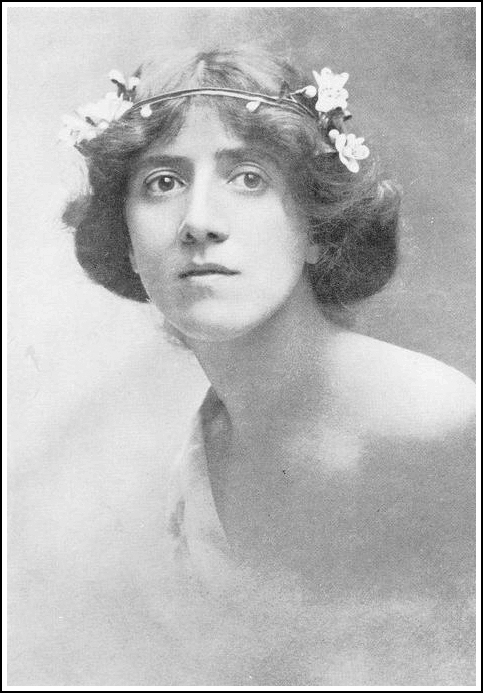
Dr. Marie Stopes.
“Now, many years later, I still think it most important not to hasten the human acquisition of what we call supernatural or supernormal powers. I feel that having taken so long a time to become human, and being now in the present imperfect link between the past and the future, we serve the race and whatever cosmic design there may be behind our existence best by being the best kind of human beings we can; by starving neither our bodies nor our minds, nor wearing out one aspect of ourselves at the expense of normality. The neurotic, half-starved, highly-abnormal ascetic, the psychic, the ‘spiritual’ healer, and other cranks generally fill me with a slight feeling of repugnance and a profound feeling of regret that they took on a job for which they are so obviously unfitted. Even as a young girl I did not wish to become like that. My ambition is to be as normal, healthy, and wholesome a human being as I can be while I am a human being; it will not be very long in any event, even if one outlives the Biblical three-score years and ten.
“I have always had a peculiar sympathy with stones, undoubtedly inherited, for my father’s delight in fossils and flint implements is traceable to his earliest childhood, and I have a sympathy with them which, curiously enough, often includes a knowledge of where they are, almost as if I were a stone-diviner, like water-diviners. Their smell delights me. Of course not all stones have a very noticeable smell, but to me, in quarries, almost every freshly chipped stone has a peculiar, and most have a pleasing, smell. The consciousness of fossils, even at a distance from them, has often manifested itself most usefully in my expeditions, and I may give just one example of this. I remember Dr. D. H. Scott, the leading English palæobotanist, in a discussion at the Linnean Society, speaking of a classical find of a well-preserved fossil in the Isle of Wight, saying that in this deposit, which he had himself examined, there remained no more petrifactions. Like a sudden flash of light a queer, intense feeling came to me that there were lots of petrifactions there calling to me and waiting to be found. Within a few weeks I was able to take my vacation in that locality, at Luccomb Chine in the Isle of Wight, and spent the first day lying comfortably on the shore in hot sunshine gazing up at the cliffs. By the afternoon I had come to the conclusion that at a certain point up the cliffs I should find these specimens, and the next day I went there and found enough to enable me to bring away nearly a bushel, many of which were new to science, and some of which are described and illustrated in my volume on the Palæontology of this horizon, published by the Trustees of the British Museum (Appendix B, p. 217).
“Useful in another way is this sympathy with stones, and I remember on one occasion my sister and I had spent a whole holiday together camping in a cave on the coast of Devonshire. She and I had played at Robinson Crusoe and Man Friday for five or six weeks, sleeping in this cave by the sea with a sense of perfect security and peace, when one night I suddenly felt that I must not allow her to stop there, for it would be most dangerous for us to sleep there, and we must go into the open. We shifted our sleeping bags along the pebbles of the beach, right into the open and away from the cave, leaving however all our little cooking utensils and other camp equipment in the cave. When I went back next morning I found part of the roof had fallen in, with a large slab of stone just where my head would have been. The next night we were quite calmly and happily sleeping in the cave again, probably most foolishly, but nothing happened.
“Possibly correlated with this feeling for stones is the consciousness I have had since early childhood in my spine of the direction of the north. It is as though I were a magnet, and I shall never forget my delight, when I was a girl, at discovering Du Maurier’s book, ‘Peter Ibbetson,’ in which one of the characters is conscious of the position of the north, for I thought I alone was peculiar in this, and was greatly pleased to find that someone else shared that sensitiveness. In childhood it took the curious form of making me twist round and wake with a dazed feeling in bed if my bed was placed wrongly. And still, unless I sleep either north and south, or south and north, I tend to twist round in the night and lie in the direction of the magnetic field, sometimes waking up to find myself lying right across the bed if I am staying in a house where the bed cannot be placed correctly before I go to sleep. A long illness, or a number of nights in London or a big city, tend to reduce this sensitiveness, but when I have been long alone or in the country it becomes intensely strong, and I remember being tested once in a thick fog—a fog so blanket-like that one could not see a yard before one’s face, when I was being trained by Mr. W. H. Dalton, F.G.S., a member of the Geological Survey. At first he laughed at my saying that I could feel the north, and led me zigzags and twists and turns, and then tested me with his compass. Every time I was dead right. Since I have had an operation however this capacity is much reduced, and I only feel it intermittently, depending, I fancy, on some electrical condition of the atmosphere.
“My passion for solitude resulted in a very curious initiation for me at the beginning of the war. I had, when staying earlier as a guest of Lord and Lady Grey at Howick Castle, been greatly attracted by the long stretches of sandy bays and quiet rocks in the neighbourhood, absolutely out of reach of the tripper, and longed to pitch my tent there, which I did, through their kindness, in the summer of 1914. This time I had not even my sister with me, desiring to be absolutely alone, because I felt within me ripe for birth a very long poem which, at the time, seemed important. Life in my tiny tent, weighing only two pounds, had for years been one of my principal enjoyments, and I fixed my tent on psamma grass at the corner of a rocky bay with wide stretches of sand between me and the sunsets. There I deliberately cut myself off from everyone, only going into a neighbouring farmhouse now and then to get fresh scones and bread, and having milk brought to me by one of the farmer’s bonny children. I deliberately refused to read newspapers, and the result was that I had no conception that even a cloud or rumour of war had settled on Europe. I had not heard of the murders at Serajevo. One evening, however, I suddenly felt that the long poem I had come to write had died within me. In the dusk I felt, literally, that I suddenly saw, green and horrible, the corpse of a young man and another standing over him smiting at his dead body. The impression was most vivid, and for two days afterwards I was restless, and could not concentrate in the least on the work I had intended to do. The third night after this I, still unconscious as an unborn babe that anything in the way of war was affecting Europe, tucked myself into my sleeping bag, lying with my head and shoulders outside my tent, as I generally slept, and went off into a sound sleep, to be awakened most startlingly by a young man with a bayonet shouting to me ‘Halt! Who goes there?’ Wakened out of sleep, I replied rather absurdly, ‘Halt yourself; I am lying down.’ I had not succeeded in explaining my existence to the young man before another young man with a fixed bayonet rushed up to him and the bayonets clashed. I thought the two were going to fight each other, both contending that I was their prisoner. I, thinking it was some absurd joke and that an appeal to Lord Grey would straighten matters out, explained that I was there, although not in the house, in a sense as the guest and under the protection of the Greys, and they might leave me in peace until the morning and then decide whose prisoner I really was. Their story that a war was on I took as nonsense. They allowed me to sleep, and by six o’clock in the morning, after some hours of cold, wet mists, both of them were very thankful, rancour ended, to creep to my tent for a cup of hot cocoa. One, a young fellow from Manchester, had not weathered a night on a solitary coast before, and his teeth were literally chattering. I got out my maps and directed them to the nearest place where they could get a square meal, and that was the last I heard of being anybody’s prisoner. I went however into the village to buy newspapers and, running across Viscount Howick (now Lord Grey), was reassured by his telling me that his uncle, Sir Edward, was at the helm and doing everything possible to maintain peace. He asked me to hop into his car, and went round villages and outlying districts reassuring and calming the people. Soon, warships were stationed directly opposite us and rushed up and down, because a landing was actually expected within a mile or two of where I was camping, and the Greys were hurriedly turning Howick Castle into a potential hospital. I think no one who was plunged into the horror of the war thus with no preparation, can ever get over the shock of the first few days and of the news of what was done in Belgium. Perhaps the next generation may again feel the ease and security that we all felt before this war, but shall never feel again. Since that poem was slain on Howick shore, I have never really been able to do the things that I have personally wanted most to do, always being impelled to expend what power I had only on things that seem urgently necessary, either in connection with scientific research on coal and fuel, or in connection with the sex and birth control work. Since the publication of Married Love early in 1918, nearly the whole of my time has been spent in a very inadequate response to the anguished cries of poor mothers and their potential babies for that knowledge and help which is available if it can but be brought to them.
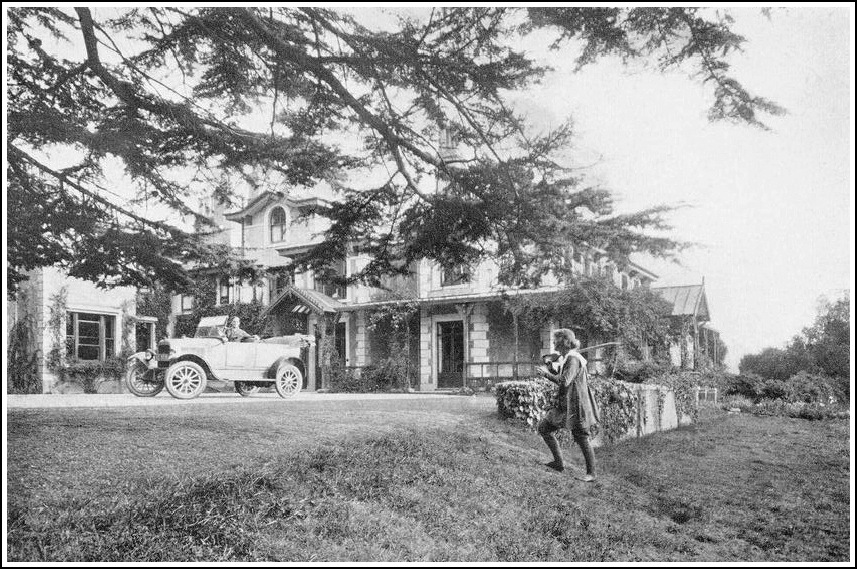
Inner home life: Dr. Stopes as gardener, and her husband with the car.
“1918 was an important year; I published Married Love, Wise Parenthood, and, in conjunction with Dr. R. V. Wheeler, The Constitution of Coal, and I met and married my husband, Humphrey Verdon Roe.
“In 1920 I was impelled, against my worldly judgment, to publish a brief piece of writing called The New Gospel to All Peoples. In its preface I explained how and why it was written, and sent to each of the Bishops in Conference at Lambeth in that year. About sending it to the Bishops I had no hesitation, my orders were so explicit, but my mundane intelligence was perfectly aware that from a purely worldly point of view I was doing a foolish thing in publishing it. The matter was simply taken out of my hands however, and my inner life rendered unlivable until I decided to do what was necessary to get it published. When I say that I was unwilling to publish it, I do not mean to imply that I in any way shirk what is said therein; but knowing the materialistic spirit which rules the greater part of the intellectual world at present, I knew very well that I was, to some extent, jeopardizing the approval of those whose opinion I valued. Beyond a little chaff however and the antagonism of a few materialists, I have suffered nothing to weigh in the balance against the wonderful adherence of other souls and the joy of seeing my message spreading in the whole Empire, now often from the lips of others. For instance, that great heroine, Lady Constance Lytton, wrote to me: ‘I cannot say how much I thank you for sending me your beautiful A New Gospel. It is so reverently given forth, so beautiful in the way it is given. I have promised to write a little article on Constructive Birth Control. I hope you will approve of it, for all I know of constructive birth control is through you.’
“The work for birth control and a reformation in the sex life of the people has for years been a consciously performed task—but all the time I realize that the need for it is a phase in human progress, and my immortal soul has other interests—and a desire ‘to paint the things as I see them for the God of things as they are.’ And among the things I have always desired to do is to write a volume of fairy tales. In my opinion, fairy tales rank among the very highest form of literature. I remember Professor Alexander, the Professor of Philosophy, once saying that all our scientific discoveries were ephemeral and bound to be swept away, and that the only really lasting thing anyone could do is to write a poem. I incline now to agree with him, although then I hotly disputed his conclusion. A good fairy tale, being essentially a poem though in prose, might have well-nigh as long a life as a poem. But in the press of work of recent years I have not had time to write the volume of tales I so much desire, and only one or two have been completed and published. Certainly one of my proudest achievements is the fact that I have had a fairy tale in the Fortnightly Review, the only fairy tale, I think, that periodical ever published. I have also had two or three fairy tales in the English Review; but the rest have either been slaughtered unborn, or await the leisure I am always longing once more to have, to do the things that I want to do instead of those I am impelled to do by the present crisis in human affairs.
“What am I? An immortal soul, having lived previously to this particular life on earth, and destined to live again after my body wears out; of that I am as certain as that I am in the world at present. Nothing can remove me from the universe; one plays at being human for a while, and it is great fun. Why one is given such hard jobs and has to encounter such difficulties on one’s own behalf and on behalf of others I don’t know, but I still feel as I felt at the age of sixteen and a half when I wrote the poem ‘Revelation’ (later on published in Man, Other Poems, and a Preface), that one should ‘be tranquil, at the same time that you strive ... for joyous life alone is perfected.’”
The sketch of her inner life given in the above autobiographical notes may well conclude this short life of one who is still in mid-career.
Dr. Stopes is an example of the truth of John Stuart Mill’s forecast that, as soon as the obstacles that hampered the exercise of women’s powers were removed, they would prove themselves the equals of the best men in fields where they had heretofore always been regarded as inferior. Though she is a very modern woman, Dr. Stopes, in another aspect, reminds one by the variety of her achievements of those artist-scientists of the Renaissance who, before specialization had become so customary as it is to-day, claimed all science and all art as their province.