REASONS FOR DISCARDING A PROPOSED RACE OF THE GLAUCOUS GULL (LARUS HYPERBOREUS).
Reading edition
BY JONATHAN DWIGHT, M. D.
In discussing the moults and plumages of the Glaucous Gull, a dozen years ago I took occasion to bury “Larus barrovianus” among the synonyms of Larus hyperboreus (then known as glaucus) because the alleged characters seemed to me to afford insufficient grounds for recognizing even a subspecies (Auk, XXIII, 1906, p. 29). Later, in the 1910 edition of the A. O. U. ‘Check-List,’ the Committee on Nomenclature and Classification adopted my view of the case and discarded “barrovianus”; but recently Dr. H. C. Oberholser has seen fit to dig it up and it is revived, somewhat impressively, as a subspecies of hyperboreus (Auk, XXXV, 1918, p. 472).
If it were not for certain aspects of the matter I would merely reaffirm my convictions of 1906; for it is a question whether Dr. Oberholser has added anything new to the original claims made by the describer, Mr. R. Ridgway (Auk, III, 1886, p. 330). This does not seem to be the case, for his diagnosis is virtually a restatement of Mr. Ridgway’s, except that a supposed character of the bill is discarded on evidence I submitted in 1906. My measurements had shown that this character, namely, “depth through the angle never less and usually decidedly greater than through the base,” was not diagnostic, but this was not my only “evident reason” then for rejecting “barrovianus” as Dr. Oberholser now wrongly assumes. What I said was that this form “is scarcely 3% smaller [than glaucus] in size and 4% smaller in bill” and furthermore, I said; “It is true that the largest specimens of barrovianus never quite reach the dimensions of the largest glaucus, but overlapping of size is so considerable even when careful comparison of sexes is made that without first reading the labels one cannot, except in a very few cases, tell whether a bird is from Greenland or Alaska. The variation in the size and shape of the bill in gulls is very great and a few millimeters difference in wings that are as long as one’s arm is hardly ground on which to rest a subspecies, much less a full species.”
These conclusions may be contrasted with Dr. Oberholser’s recent diagnosis which reads, “Similar to Larus hyperboreus hyperboreus, but smaller, the bill particularly so and relatively as well as actually more slender; mantle decidedly darker; and the line of demarcation between the white tips to the primaries and the pale grayish basal portions usually more evident.” I would here call attention to the fact that the “line of demarcation” is not a distinct character but a corollary of the preceding, for the color of the mantle in the Glaucous Gull regularly runs over, so to speak, into the wings, and a darker mantle would mean darker bases of the primaries and therefore greater contrast as a matter of course. Consequently, in the final analysis there are two characters and only two on which “barrovianus” rests,—(1) darker mantle and (2) smaller size, especially of the bill. I will invite attention to a new estimate of the value of these characters.
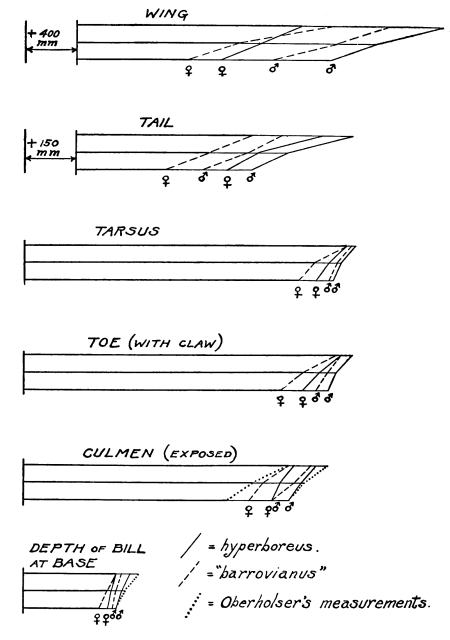
Fig. 1. Diagrams showing relative measurements in millimeters of 31 adult specimens of Larus hyperboreus and its alleged race. Top line shows actual length in largest birds, middle line shows average, and bottom line shows smallest of the series.
1. As for the color of the mantle, which Mr. Ridgway calls “somewhat” and Dr. Oberholser “decidedly” darker, I can only say that my series fails to support either of these statements. I find that if comparison of like stages of plumage be made, birds from Greenland are quite as dark as Alaska specimens and conversely Alaska birds are as pale as those from Greenland. It is, perhaps, a matter of more than passing interest that the majority of adult Greenland birds in the collections I have seen are in worn faded plumage while most of the Alaska material is in fresh dark plumage. One might easily get the impression that the darker birds represent a race unless due allowance is made.
It may not be generally known that the adult Glaucous Gull moults twice in the year, a complete postnuptial moult beginning toward the last of July and extending over nearly two months and a prenuptial in March and April which involves most of the body feathers but not the wings nor the tail. Between moults the mantle fades and looks even paler than it is in color because of the worn and whitened feather edges. There is some individual variation in the depth of color in freshly moulted specimens, whether from Greenland or Alaska, but both may be equally dark and they may become equally pale after the lapse of a few months. I have examined birds taken nearly every month in the year and I am at a loss to understand how Dr. Oberholser finds a “decidedly darker” race unless he has unwittingly compared birds of unlike stages of plumage.
2. As for size, this is a question of relative dimensions that permits some latitude of opinion, so that a new presentation of the facts seems desirable.
My early table of measurements (Auk, XXIII, 1906, p. 28) based on 31 adults (14 of them males and 17 females) is accepted by Dr. Oberholser “except for dimensions of the bill which have been remeasured for the present use.” I have reproduced all of these measurements by the graphic method (Fig. 1) and anyone may see, almost at a glance, what the variations of size in the Glaucous Gull actually are. The diagrams are drawn to scale, the upper horizontal line representing the actual size of the largest specimens, males and females, the middle line the mean or average size and the lower line the smallest specimens. The oblique solid lines represent hyperboreus, the broken lines “barrovianus” and the dotted lines Dr. Oberholser’s remeasurements of the bill. His “depth of bill” for “barrovianus” is the same as mine and therefore cannot be separately plotted. He does not tell us from what series he made the remeasurements that do not tally with mine, but the figures suggest that it may have been a small one and with an unusual proportion of very large and very small birds, possibly wrongly sexed in some cases.
The original series that I measured was composed of breeding birds from Greenland and from Alaska which formed a small part of the 200 specimens I had then gathered together for comparison. Although they are now widely scattered, some of them (as well as new specimens) are still either in my collection or in that of the American Museum of Natural History. A reëxamination and remeasurement of them (68 in all, 39 being adults) confirms to a surprising degree my earlier measurements and conclusions. Individual variation is greater than the supposed subspecific values and the overlapping of size is marked. Birds as large as these Gulls, it must be remembered, may not be measured with unfailing accuracy, especially when different persons attempt it, for specimens are often greatly worn, the wings or tail are sometimes not quite grown and often the feathers are bent and broken. It is not unusual to find a variation of five to ten or more millimeters between the right and left wing of the same bird, due to the make-up of the skin, while tarsi and toes of opposite legs may be bent very much out of shape in drying. Where such variation exists, one may to advantage measure each wing or foot separately and strike an average as I have done in many cases.
Turning finally to the bill, I would call attention to the sketch (Fig. 2) which shows the average adult bill of the male of hyperboreus contrasted with that of “barrovianus.” When one realizes that the variation in the bills of all female gulls is much greater than that of the males and that young birds only very slowly acquire adult dimensions, it becomes evident that “barrovianus” is not “very readily recognizable by its usually smaller size and particularly smaller bill.” One may guess cleverly that large birds belong to one race and small ones to another, but without reference to the labels the guesses may be astray by a continent’s width.
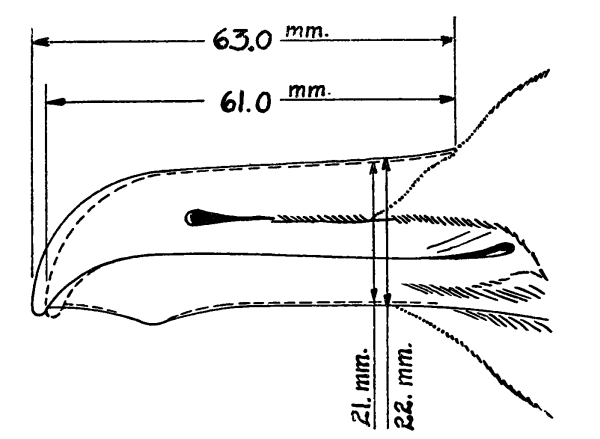
Fig. 2. Bill of average Larus hyperboreus, male, life size, drawn to scale. The broken line shows the bill of the alleged race.
So far as I can see the case of barrovianus stands where it did in 1906 and it is a pity that there should have been any need of reopening it. Fortunately the merits of this and similar cases do not rest upon individual bias, but they are determined by the A. O. U. Committee which, as far as North American birds are concerned, acts somewhat as a supreme court rendering verdicts according to evidence presented. Let us hope they will give us “safe and sane” subspecies rather than the shadowy indefinite groups of averages that too often are named as geographical races. It should be remembered that while a name is a handle to a fact, too many handles would make a door or a basket perfectly useless. Ornithology will become a wilderness of handles if every difference is named at sight,—a wilderness of subspecies founded more on hasty opinions than on digested facts. A step farther and we shall have the psychological subspecies in which the expectant mental attitude of the subspecialist (if I may be pardoned the word) will play the most important rôle. In our gropings after the truth it is wasteful of too much time to spend so much of it stumbling over names of groups so poorly defined that they convey only a vague meaning to a few specialists and none at all to everybody else. Decking the subspecies in all the glittering panoply of diagnosis, dimension, and distribution makes of it an impressive spectacle, but this does not necessarily make of it a good subspecies.