AN EXPERIENCE WITH HORNED GREBES (COLYMBUS AURITUS).
Reading edition
BY ALEXANDER D. DUBOIS.
Plates VIII-X
The southeastern portion of Teton County, Montana, lying in the prairie region east of the Rocky Mountains, comprises flat and rolling bench-lands, traversed at frequent intervals by coulees which are tributary to the Teton and Sun Rivers. On these benches are occasional shallow depressions which have no natural drainage. They form transient “prairie sloughs” which may be dry at one season and wet meadows or ponds of water at another.
The slough which afforded the present observations is a crescent-shaped depression, not more than ten or twelve acres in extent, curving about a knoll upon which stands a homesteader’s cabin. There are no lakes or water courses in the immediate vicinity. During the last few years the region has been rapidly transformed into grain farms. At the time these notes were made the meadow in question was bordered on three sides by plowed fields. The spring of 1917 was an extremely rainy one, following a winter of much more than normal snowfall. In consequence, the crescent-shaped meadow became a marshy sheet of water.
On the open water of this pond two Grebes were seen on several days in May. On the third of June, while walking around the pond scanning its surface with a field-glass, I was suddenly amazed to see a Grebe sitting upon a nest which protruded above the water amid the scant vegetation. Careful examination showed the bird to be Colymbus auritus. She slipped from the nest, as I slowly waded toward her, and swam about in the open water, anxiously watching my every movement. The interest was mutual. After watching the bird for some time I went up to the nest and found that it contained two eggs. Subsequent visits showed that the eggs were deposited at intervals of two days; the dates of the visits and number of eggs found at each visit being as follows: June 3 (2); June 5 (3); June 7 (4); June 9 (5); June 12 (6); June 13 (6).
Plate VIII.
1.
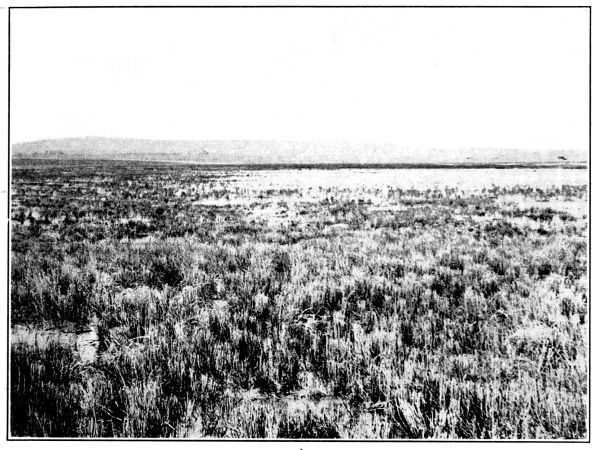
Nesting Site of Horned Grebe in a Flooded Meadow. Nest beyond Open Water. Wheat Stubble in Foreground.
2.
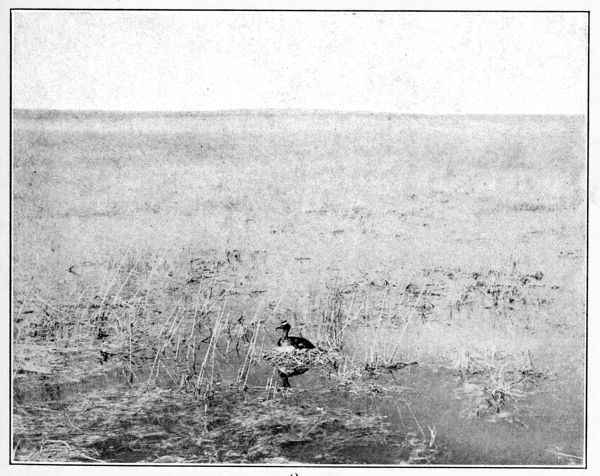
Horned Grebe on her Nest, showing Scant Surrounding Vegetation.
Whenever I appeared at the edge of the slough, it was the custom of the two Grebes to float about upon the area of open water with an air of supreme unconcern. They busied themselves constantly with their toilets, preening the feathers of all parts of their bodies and very frequently tipping or rolling themselves in the water to reach their under parts with their bills. In this half-capsized posture they would float for several seconds, exposing to view the strikingly prominent white area that is normally below the water-line. This preening and floating in different positions, on the part of both birds, proceeded without interruption during my entire stay, each day that I visited them. It became very evident that it was practiced as a ruse to hold the attention of the intruder and thus divert him from their nest.
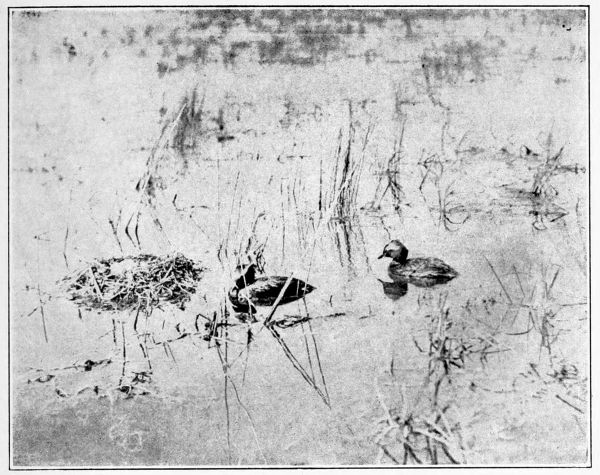
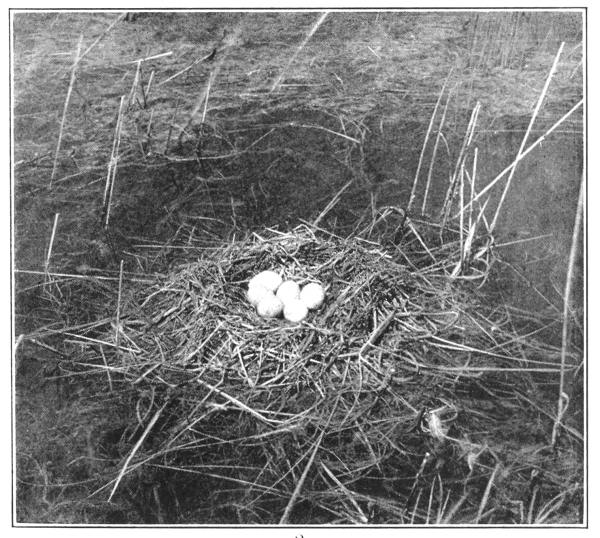
On the morning of June 12, a camera was taken to the nest-site with the purpose of making photographs of the nest and eggs. On the land to the south, a homesteader with eight horses to his plow, was turning over the virgin sod. His furrows ended at the edge of the slough southwest from the nesting site of the Grebes. Upon wading to the nest I found the six eggs shielded on the southwest side, by a partial covering of vegetation which had been pulled up on that side only. The general character of the country and location of the nest are shown in the photograph on Plate VIII. After making a photograph, and remaining for a time near the nest to observe the parent birds, I left the tripod and camera in position and went away. The female was continually gaining either confidence or bravery and had been swimming about in an agitated manner, not far from me, as I stood quietly by the camera. Before I had gotten out of sight of the nest I saw her go to it and change the covering or shielding material to its opposite edge, thus sheltering the eggs from the too inquisitive gaze of the camera’s eye. When I returned from the cabin the bird was on the nest, incubating. She took to the water as I came up, but continued to swim back and forth among the scant, neighboring tufts of marsh grass. As I stood very quietly for some time behind the camera her boldness gradually increased, until at length I was able to photograph her near the nest, with the aid of only ten feet of rubber tubing attached to the shutter release. The making of these photographs consumed much time and continually the Grebe was growing bolder. She swam almost under the camera, and when I came close to the nest she made a dash at me, shooting entirely out of the water. This show of force was afterward repeated frequently, and it sometimes ended with a violent, splashing dive which sent a shower of spray over the camera outfit and the photographer. Meanwhile her spouse drifted quietly at a safe and respectful distance. Although one photograph of the bird on her nest was secured by means of a very long thread, the result was rather unsatisfactory.
On the following day, June 13, I donned the hip boots again and stationed myself with the camera outfit, determined to see if patience would be rewarded by an opportunity to photograph the bird on her nest at close range. It was a wearisome experiment, but not without result, for eventually the Grebes became remarkably bold. The female was the first to approach. She swam around the nest repeatedly, but for a long time refused to venture upon it. For the most part the male witnessed her adventures from a discreet distance. Occasionally however, he came up; and finally, while the female was showing her agitation by swimming hurriedly about, the male swam deliberately to the nest, climbed up its side, and sat on the eggs, facing me. A plate was exposed on this unexpected sitter but unfortunately was ruined by an accident before development. He became alarmed by my activities in changing plate-holders, or perhaps by the removal of my head from beneath the focusing cloth, and suddenly slipped off the nest into the water. Both birds were subsequently photographed together, near the nest.
I cautiously moved the camera somewhat closer and waited. The female frequently shot out of the water at me with a rush accompanied by a harsh cry, and sometimes ended her attack with a dive and a great splash. Eventually she went upon the nest, and once in contact with her eggs, she became invincible. I photographed her thus; then moved the tripod toward her, slowly and cautiously, keeping my head beneath the cloth. In this way the camera was placed within arm’s length of the bird and another exposure made, which resulted in the intimate portrait of Plate X, fig. 1. I uncovered my head, but she remained firm, and when I extended my hand toward her she reached out her long neck and delivered a vicious, stinging stab with her sharp bill. The threatening attitude of the bird, just previous to striking, is shown in Plate X, fig. 2.
The exposed situation of this nest is shown in several of the photographs. It consisted of a mass of coarse grasses, many of them fresh and green, floating in about a foot of water, the body of the nest below the water line being of such bulk as to almost touch the muddy bottom. The nest-lining, in the bottom of the well hollowed cavity, was very wet and soggy, being only slightly above the water surface when the nest was unoccupied, and probably below it when the weight of the bird was added to that of the nest. This lining was composed of decaying vegetation which was decidedly warm to the touch, in the sunshine, while the wet rim of the nest was cold.
The eggs of this set were taken. They were of course in various stages of incubation, from fresh in the last, to well begun in the first-laid egg. For some time after I had left the empty nest, taking the camera with me, the two Grebes swam to and fro beside it, or circled around it, frequently going to the nest and climbing part way up. Occasionally one of the birds, presumably the female, sat upon the nest for a brief period, shifting herself in a restless manner, and then returned to the water.
For several days I stayed away. Would these birds nest again in this small and rapidly diminishing slough at so late a season? Would they leave the slough and go elsewhere to nest? Or would they abandon the duty of reproduction altogether? These questions seemed of sufficient interest to demand further observations, but not wishing to further inject the factor of the human menace into their already complicated affairs, I left the birds entirely to themselves. Meanwhile extremely dry warm weather was causing rapid evaporation and the slough was shrinking very perceptibly.
My next visit, on the eighteenth of June, disclosed the fact that the Grebes were not only present but were building a new nest not far from the old one. The nest seemed nearly completed. The two birds were floating near each other on the open water, preening their plumage in the ostentatious manner previously described.
At seven-thirty on the morning of June 21, the new nest contained two eggs, partially covered, especially on the northwest side, which was the direction from which I approached the slough. There was a striking difference in the coloring of the two eggs, in view of the slight difference in their ages. One egg was a drab-tinted cream; the other a beautiful greenish tint with a freshness and delicacy which is difficult to describe, and which marked it as having just been deposited by the bird. A schedule of the subsequent visits to this nest is given in the accompanying table:
Visit Date Time of # of Were eggs Was either
No. day eggs covered? bird seen?
1 June, 18 0 Both on open water
2 " 21 7:30 A.M 2 Partially covered
3 " 22 8:00 A.M. 2 Sparsely covered
4 " 23 7:30 A.M. 3 Not seen
5 " 24 9:00 A.M. 4 Covered Bird seen on nest
6 " 25 7:30 A.M. 4 Lightly covered Not seen
7 " 25 Sunset 4 Covered on E. side Not seen
8 " 26 7:30 A.M. 5 Covered One on open water
9 " 27 7:00 A.M. 5 Not covered Saw bird leave nest
10 " 28 7:30 A.M. 5 Chiefly on E. side Not seen
11 " 29 Evening 5 Covered Not seen
12 July, 4 5 Covered on top Not seen
13 " 8 5 Covered Yes; in water-lane
14 " 9 5 Covered Not seen
15 " 10 8:00 P.M. 5 Not covered One bird seen
16 " 11 6:00 P.M. 5 Not covered Not seen
17 " 12 5:00 P.M. 5 Partially covered One on open water
18 " 13 6:00 P.M. 4 Not covered Not seen
19 " 14 4 Lightly covered Not seen
20 " 15 Evening 3 Bird on nest
21 " 16 10:00 A.M. 3 Not covered Not seen
22 " 17 10:00 A.M. 3 Not covered One seen with young
23 " 18 7:30 P.M. 2 Not covered Not seen
24 " 20 6:00 A.M. 2 Not covered Not seen
25 " 22 7:30 P.M. 2 Not covered Not seen
26 " 23 9:00 A.M. 2 Not covered Not seen
27 " 24 Evening 2 Not covered Not seen
Plate IX.
1.
A Pair of Horned Grebes at Home. Female at Right.
2.
Nest and Eggs of Horned Grebe.
When I approached on the morning of June 24, the Grebe was on her nest. She made herself as inconspicuous as possible by holding her head down, close to the nest rim. As I came within twenty-five or thirty yards of the nest the bird hastily pulled a covering of green-stuff over the eggs and slid silently into the water, disappearing completely. Although I watched for some time I did not succeed in catching even a glimpse of either of the birds.
On the occasion of the sixth visit (June 26) I found the nest lightly covered with fresh green stems and blades which had been plucked by the bird. At that time I made the notation in my field book: “Never see the birds on the open water any more.” However, on the next day, some time after I had left the nest, I did see one of the Grebes floating on the open water. The eggs had again been covered with fresh vegetation.
On the morning of June 27, I approached by a circuitous route, passing by the nest with my interest ostensibly concentrated elsewhere. But as I passed too near her the bird slipped quickly off the nest without stopping to cover the eggs; and I could not find her afterward. It will be noted from the tabulated schedule that neither of the birds was seen at the tenth, eleventh, or twelfth visits. The thirteenth visit was more successful for I saw a Grebe sitting perfectly motionless, at the edge of a water-lane which traversed some of the thickest vegetation, its bright red eyes appearing as its only conspicuous feature. The next day (fourteenth visit), I could not find the birds, and the fifteenth visit gave me only a fleeting glimpse of a Grebe. The eggs were not covered but were slightly shielded on the side from which I had come. On the evening of July 12, one of the birds was observed floating, silent and solemn, with head toward me, at the farthest side of the open water. It was evident at this time that the birds had changed their dress since my acquaintance with them at their first nest, for no yellow “horns” were now visible.
On July 13, finding only four eggs in the nest, and pieces of egg shell both there and in the water, I searched carefully in the vicinity of the nest but without result. I could neither find the newly hatched young nor catch any glimpse of either parent. On the next day the conditions were the same except that the eggs were slightly covered and a few small feathers had been left on the nest, showing that the bird had been upon it.
The twentieth visit, on the evening of July 15, gave me an opportunity to examine the bird at close range. She was on the nest and allowed me to approach, cautiously, to a point twenty or thirty feet from her. She was considerably changed in appearance. The yellowish-white tip of the bill remained unaltered and the light line through the lower margin of the lore was observed to still persist, but the plumage of the head was much subdued, the yellow plumes having been exchanged for mere inconspicuous grayish streaks on the sides of the head. As I came up I could see a young bird poking its head through her wing. She soon left the nest, with a startling rush, and swam rapidly away, leaving three eggs in the nest and two tiny youngsters in the water. The newly hatched downy young can both swim and dive in a feeble way. As I approached them they tried to escape by diving. When I held them in my hands they gave utterance to a little cry not greatly different from that of domestic chicks.
The downy young are very striking in appearance. They are striped longitudinally with black and white stripes; the white however is rather a “soiled” or grayish white. There are two narrow white stripes on the head which converge to a point at the base of the bill. Between these stripes, on the forehead, is a small slightly raised bare spot, of a bright red color, back of which is a white elongated blotch, or median stripe. The bill is pink and has on both mandibles a white tip which resembles white porcelain. This is larger on the upper mandible than on the lower. On the upper mandible between the nostrils there is a black spot. The iris is brown, not red like that of the adults. The lobate feet are remarkably well developed, but the wings are rudimentary.
On the following day, July 16, I failed to find either the parent or the young at the nest. The three remaining eggs were not covered. Again on the morning of the seventeenth, the nest held only the three uncovered eggs; but when I skirted the east end of the slough to examine a Sora’s nest, I was startled by the parent Grebe taking wing not far from me. She flew over the farthest part of the slough, but soon returned, after circling a time or two, to the small area of open water, where she alighted with a splashing glide. When on the wing this bird shows very prominent white markings. The white secondaries cause the posterior portion of the wing to show as a prominent white area, and of course the entire under surface of the body, being white, is very conspicuous when the bird wheels. The flight is so duck-like that the flying Grebe might readily be mistaken, at a distance, for a duck.
I waded to the spot whence this bird had taken flight and presently saw the water agitated by some small creature beneath the surface. It was one of the diminutive downy Grebes, floating submerged, head downward, with its forward parts thrust into a mass of filamentous vegetation (algae), while its legs, stretched to their full extent posteriorly, were pointed vertically upward toward the surface of the water. I easily took it up in my hand.
The next day, July 18, at 7:30 P. M., another egg had hatched. The nest was not covered. It contained two eggs and nearly all of the opened shell of the other, which last circumstance was of course unusual. I heard the young bird, and by following the faint sound of its voice found it, in the water, about six or eight feet from the nest. It was small enough to have just emerged from the shell. Its bill was very pink and the naked red spot, or comb, on its forehead very bright, though only slightly raised above the surrounding skin. By the merest chance I discovered a downy young duck within a few feet of the Grebe’s nest. It was not identified. Perhaps it had been attracted by the cry of the little Grebe. The adult Grebes were not seen, either on this visit or on July 20, when I looked for them early in the morning. On the latter date the two eggs and the nest were cold and the orphan above mentioned was dead, on the slope of the nest just above the surface of the water. There was an opening in the top of its skull through which its brain had been removed by some small creature. This nestling had probably never seen its parents but had taken to the water wholly by instinct.
On the evening of July 22, the two eggs were cold and had not been disturbed since my previous visit, at which time their positions had been carefully noted. However one of them was “pipped” and I could distinctly hear the voice of the bird within the shell. A search for the parent Grebes was without avail. A faint voice, at the other side of the water, was detected and was followed several times, but when its author was finally located it proved to be not a Grebe but a recently hatched Sora Rail.
The next morning, although the sun shone upon the nest, the eggs were cold and the fetuses in both of them were dead. No birds were seen. My last visit, on the evening of July 24, yielded no further result. But I noted now, that there was no water around the nest. It was stranded upon a mud-bar. This was undoubtedly the cause of forced abandonment of the nest. The Grebes were unable to reach it by a water route, and no other mode of travel was possible to them. A search around the water area, now very small and shallow, gave no further evidence. The Grebes were never seen again.
In reviewing the account of these observations certain groups of data suggest themselves for summarization:
It is interesting to note that only six days elapsed between the removal of the first set of eggs and the deposition of the first egg in a new nest.
The period of incubation is twenty-four or twenty-five days, as shown in the following table of dates, noted at the second nest:
Egg No. Date Laid Date Hatched Incubation Period in days
1 June 19 (?) July 13 24
2 June 21 July 15 24
3 June 22 or 23 July 17 or 18 25
4 June 24 July 22, (Pipped) Fetus died
5 June 26 Fetus died
It will be observed that the fourth egg was alive and on the point of hatching, twenty-eight days after it was deposited, but this cannot be considered normal, since the egg had been deprived of the parent heat for several days. It seems remarkable that the fetus survived the cool nights.
Plate X.
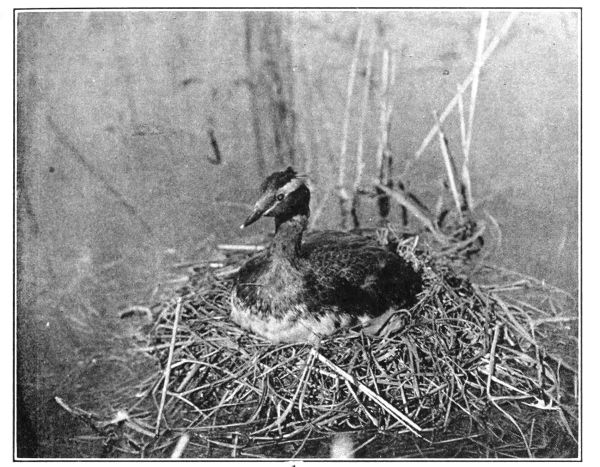
1.
Horned Grebe within Arm’s Length of the Camera.
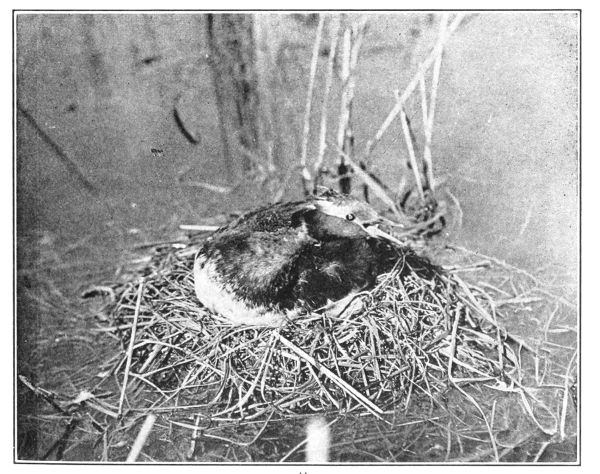
2.
2. Female, Hissing and Ready to Strike in Defense of Nest.
The change of color which these eggs undergo, is also worthy of note. I do not refer to the nest-stains caused by contact with the fermenting vegetation of the nest lining, but to a uniform color change of the surface layer of the shell, which is brought about presumably by exposure to light and atmosphere. Referring to the eggs of the second nest by numbers it will be noted that egg number two, when first observed at 7:30 A. M., had apparently just been deposited. As previously stated, its color was a very delicate bluish-green. Egg number one had already attained its final color; a sort of drab-tinted buff, which rendered it less conspicuous in the nest. Twenty-four hours later, egg number two had changed to the same color as egg number one. No data were recorded for egg number three in this respect. Egg number four, after thirty-six hours, was “nearly but not quite the same color as the others.” After it had been in the nest forty-eight hours it was noted as, “same color as other eggs.” But egg number five could scarcely be recorded as fully changed after eighty-four hours had elapsed. These notes would seem to indicate that the first-laid eggs change color more rapidly than the later ones. It may be noted in this connection that the first eggs are slightly richer in the light green pigment; possibly, also, they receive less shelter from the parent bird than the later eggs.
The usual vocal performance of these Grebes, so far as I was able to determine, is a sort of “ko-wee, ko-wee,” repeated at regular intervals. It might be compared to the squeak of a dry wheelbarrow producing one double squeak at each revolution of the wheel. It is however of a clearer quality than this comparison might indicate. Each “ko-wee” has rising inflection and its two syllables are run closely together, with the accent on the last syllable.
The remarkable change of manner which came over these birds as the moult began will be appreciated by reference to the tabulated schedule of visits. The pugnacious bravery of the female at her first nest is amply attested by the photographs, while the records of the second nest show that the birds rarely permitted themselves to be observed, even at a distance, although they had eggs as before.
These Horned Grebes were absolutely isolated so far as concerns other individuals of the species.[2] There were certainly no other Grebes in the slough. Their nesting associates were as follows: Red-winged Blackbird (Agelaius phœniceus fortis), about three pairs nesting; Sora Rail (Porzana carolina), three or four pairs nesting; Wilson’s Phalarope (Steganopus tricolor), several pairs; Killdeer (Oxyechus vociferus), one pair in evidence; Savannah Sparrows (Passerculus sandwichensis alaudinus) were present at the slough all summer; and a pair of Pintails (Dafila acuta) were believed to have a nest in an adjoining field. The adjoining prairie was monopolized, as usual, by the Horned Larks (Otocoris alpestris leucolæma) and Longspurs (Calcarius ornatus and Rhynchophanes mccowni).
At the present writing this slough is dry; the road which passes through it is traveled every day by automobiles; and the spot where the Grebes established their home a year ago has now been plowed and planted.