THE WORLD OCEAN
Reading edition
But what of this environment into which, armed with the atom, we plunge with such enthusiasm and expectations? A portrait is in order, which must be brief, for not all the books ever written about the sea have yet described it fully.
The world ocean covers 70.8% of our planet. It contains 324,000,000 cubic miles of seawater. Living in it are upwards of a million different species of plants and animals. They range from one-celled organisms that can only be seen with a microscope to the largest creature ever to have lived on this earth—the giant blue (or sulfur-bottom) whale, captured specimens of which have exceeded 90 feet in length and 100 tons in weight.
The ocean’s depth ranges from 600 feet or less above continental shelves to more than 35,000 feet at the Marianas Trench. The mean depth is 12,451 feet. Sea bottom topography includes wide plains, the world’s longest mountain range, steeply rising individual truncated peaks called guyots (pronounced gee-ohs), gentle slopes, narrow canyons, and precipitous escarpments. Mountains higher than Everest rise from the ocean floor and never pierce the surface.
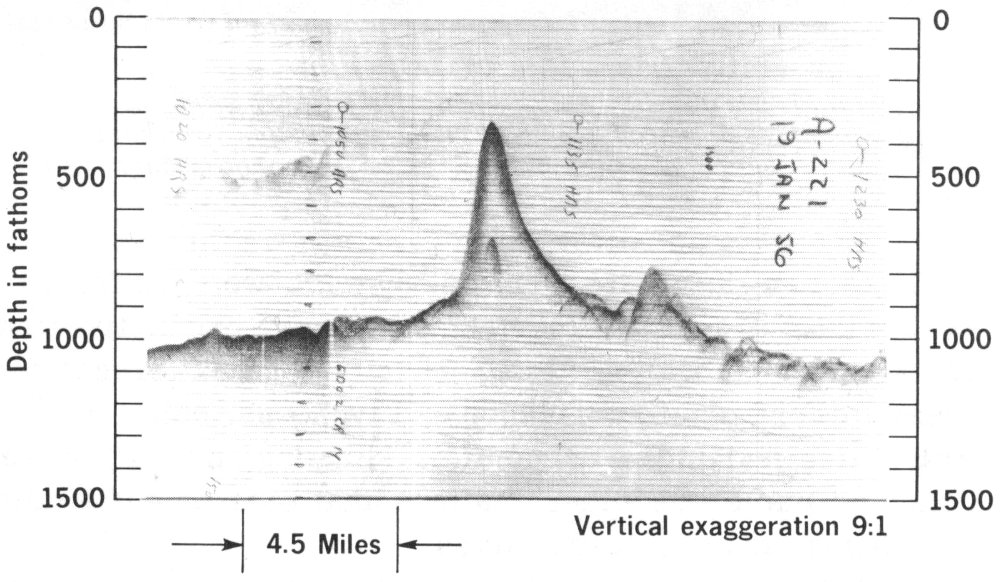
Underwater mountain traced by the Woods Hole Oceanographic Institution echo sounder in the Caribbean area. Depth is determined by the time it takes the sound emitted by the instrument to go to the bottom and return to the surface.
7
Ocean Movements
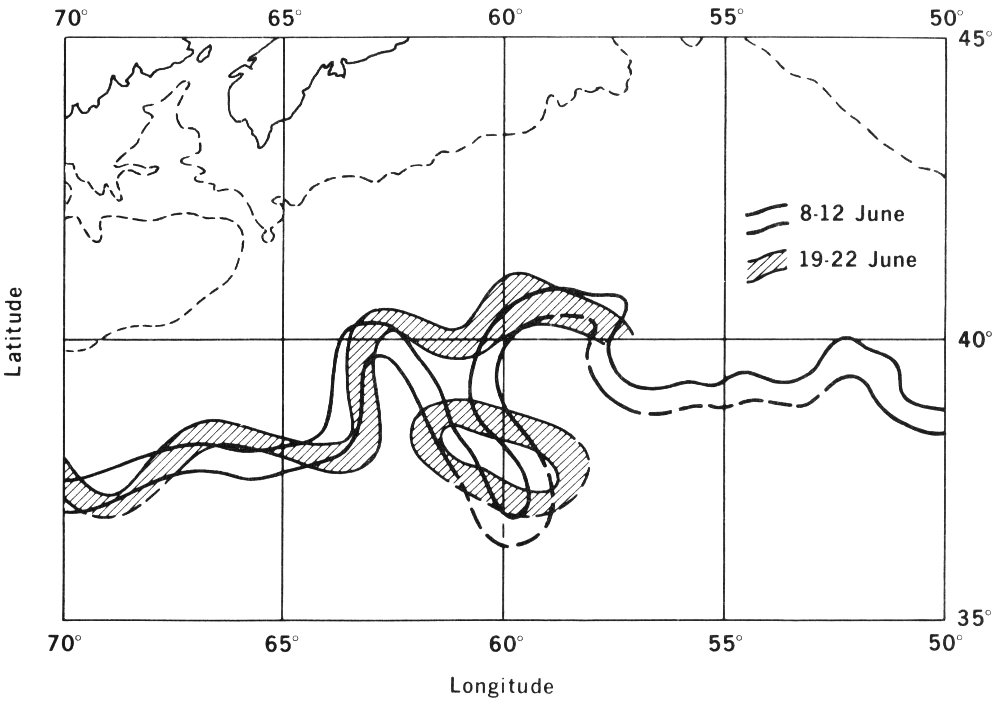
Six ships checking the Gulf Stream’s course through the Atlantic Ocean over a 2-week period found the variations shown above.
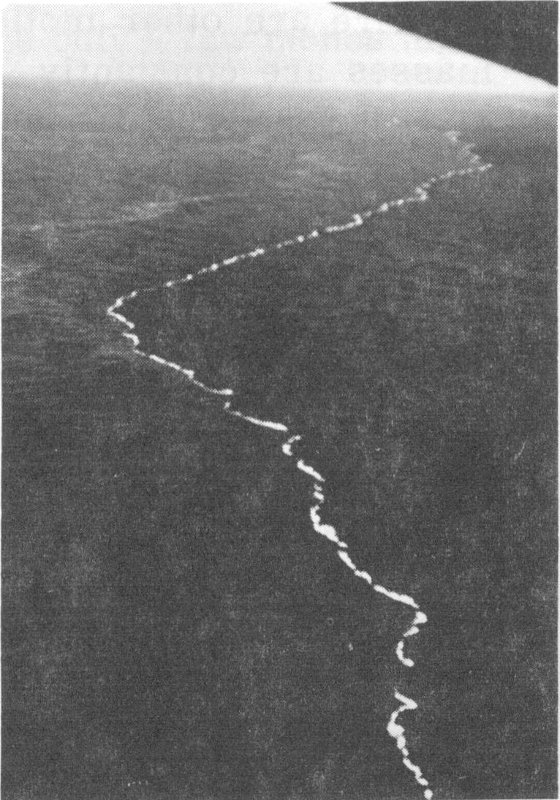
The infrared film photograph shows the edge of the Gulf Stream. The visible line between the Gulf Stream, which is on the right, and Labrador water is made by Sargassum weed concentrated at the interface.
The ocean is constantly in motion—not just in the waves and tides that characterize its surface but in great currents that swirl between continents, moving (among other things) great quantities of heat from one part of the world to 8 another. Beneath these surface currents are others, deeply hidden, that flow as often as not in an entirely different direction from the surface course.
These enormous “rivers”—quite unconstant, sometimes shifting, often branching and eddying in a manner that defies explanation and prediction—occasionally create disastrous results. One example is El Niño, the periodic catastrophe that plagues the west coast of South America. This coast normally is caressed by the cold, rich Humboldt Current. Usually the Humboldt hugs the shore and extends 200 to 300 miles out to sea. It is rich in life. It fosters the largest commercial fishery in the world and is the home of one of the mightiest game fish on record, the black marlin. The droppings of marine birds that feed from its waters are responsible for the fertilizer (guano) exports that undergird the Chilean, Peruvian, and Ecuadorian economies.
Every few years, however, the Humboldt disappears. It moves out from shore or simply sinks, and a flow of warm, exhausted surface water known as El Niño takes its place. Simultaneously, torrential rains assault the coast. Fishes and birds die by the millions. Commercial fisheries are closed. The beaches reek with death. El Niño is a stark demonstration of man’s dependence on the sea and why he must learn more about it.
There are other motions in the restless sea. The water masses are constantly “turning over” in a cycle that may take hundreds of years, yet is essential to bring oxygen down to the creatures of the deeps, and nutrients (fertilizers) up from the sea floor to the surface. Here the floating phytoplankton (the plants of the sea) build through photosynthesis the organic material that will start the nutrient cycle all over again. Enormous tonnages of these tiny sea plants, rather than being rooted in the soil, are separated from solid earth by up to several vertical miles of saltwater. Sometimes, too, there is a more rapid surge of deep water to the surface, a process known as upwelling.
Internal waves, far below the surface, develop between water masses that have different densities and between which there is relative motion. These waves are much like the wind-driven waves on the surface, though much 9 bigger: Internal waves may have heights of 300 feet or more and be 6 miles or more in length!
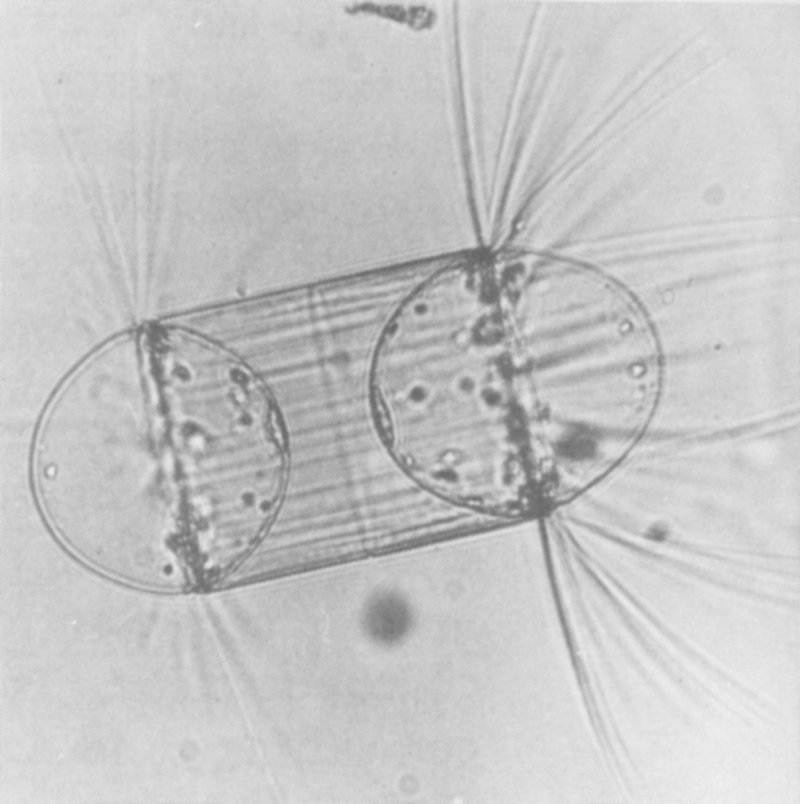
A dividing cell of the diatom Corethron hystrix. Diatoms, one-celled photosynthetic plants, are the primary producers of organic matter in fresh waters.
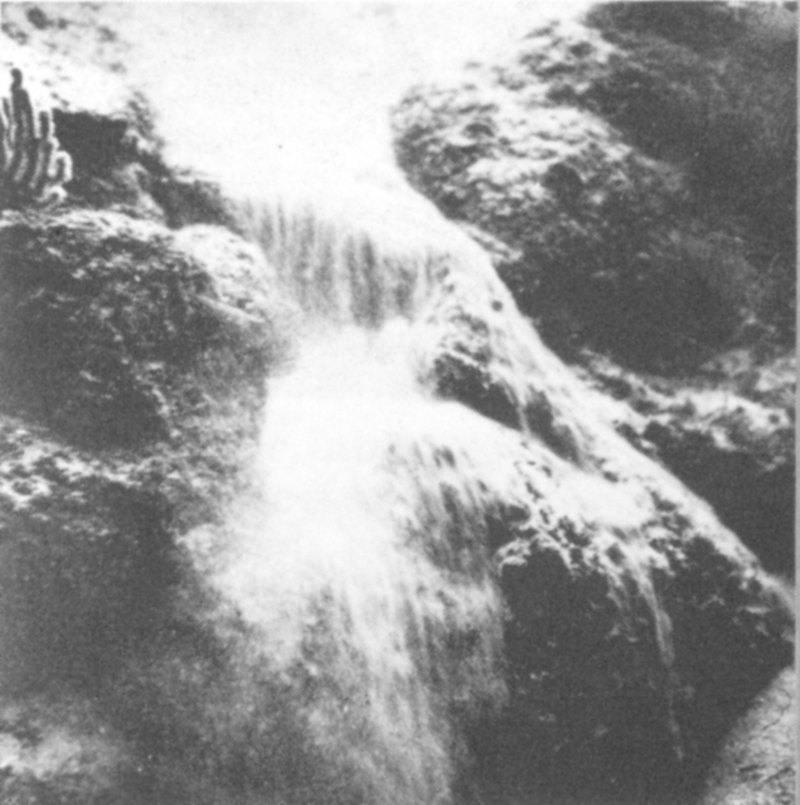
Ocean currents feed sand from nearby beaches into this “sandfall”, which is about 30 feet high, in a submarine canyon off Baja California.
Among other motions of the sea there are landslides, or turbidity currents, which are great boiling mixes of mud, rock, sand, and water rushing down submarine mountainsides at speeds of a mile a minute. They destroy everything in their paths and spread clouds of debris over the abyssal plains like a sandstorm, producing fanlike deposits radiating far out from the base of the slope. And there are tsunamis, or seismic sea waves—popularly misnamed “tidal waves”—that transmit energy from undersea earthquakes or volcanic eruptions. At sea, these waves are only a few inches high, 10 but they may travel great distances at 500 miles an hour. As they approach the shoaling waters of a coast, they are slowed to about 30 miles an hour and build up great surface waves capable of destroying harbor and coastal installations.
A Mix of Elements
The sea is a chemistry, too. Over 60 elements have been discovered in measurable amounts in solution or in suspension in the ocean. Many of these are in the form of salts, making seawater a highly efficient electrolyte, and a most corrosive fluid. The study of corrosion and techniques for combatting it is a continuous one in which nuclear energy already has a principal role.
Because the sea is so much a chemistry, it is a potential source of minerals for the world’s growing industrial appetite. All of our magnesium and most of our bromine already are extracted directly from seawater. Oil and sulfur are mined from the sea floor or beneath it, as are coal (United Kingdom and Japan), iron ore (Japan), tin (Thailand and United Kingdom), diamonds (Southwest Africa), and gold (Alaska). In the layered sediments that cover the ocean-basin floors to depths of thousands of feet, geologists believe there also may be found some missing chapters of earth history.
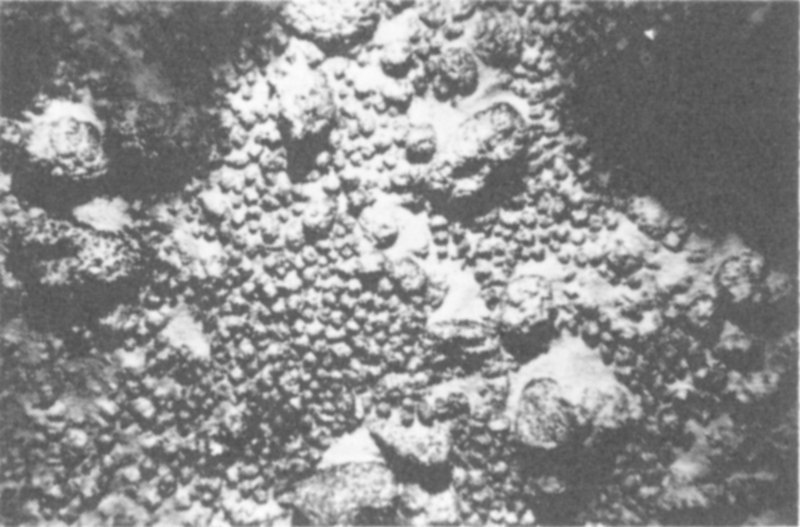
Nodules such as these containing manganese cover millions of undersea acres on the ocean floor. Many nodules are rich in nickel, cobalt, zirconium, and copper. Metallurgists are seeking ways to recover the metals from these deposits.
The ocean, by and large, is an opaque fluid through which light travels only a few hundred feet and most other radiant energy not much more than a few yards; yet through this same fluid, sound waves, by contrast, have been transmitted and received over distances of many thousand miles.
11
The Sea’s Interfaces
What of the interfaces of the sea? Above three-quarters of the globe, water and air are in constant contact, continually exchanging heat and moisture. This is a major factor in the making of weather and climate. The sea constantly feeds electricity into the atmosphere, primarily through the electron-scrubbing action of tiny popping bubbles at the sea surface. It also lifts tiny crystals of salt and the remains of microscopic sea creatures into the air. Perhaps these are the nuclei on which moisture condenses to trigger hurricanes, since it is the latent heat of vaporization of air, made over-moist by long travel over the tropical sea, that provides a hurricane’s energy.
Along its land edges, the sea is constantly working on the shore—sometimes gently, sometimes violently—breaking down rock cliffs, opening bays and harbors, closing channels and inlets, smashing breakwaters and seawalls, and moving sand up and down and to and from beaches.
The Sea’s Resources
In summary, then, the ocean, the largest single geographical feature of our planet, is infinitely varied and infinitely complex. We are learning it bears on our day-to-day living in ways we never suspected. It is the largest resource of food for our exploding population, the largest resource of minerals with which to support the world’s burgeoning industries, the largest resource of energy, and, of course, it is the largest supply of water. It is mankind’s largest dumping ground for the wastes of cities and industries. It is the source of much pleasure and recreation.
Men already have lived experimentally for weeks at a time on the bottom of the ocean. Both sea floor laboratories and military bases are being planned or, in a few cases, installed. Sea floor mining complexes are in the conceptual design stage. It is only a matter of time before recreational “aquotels” are built safely below the sea’s restless surface. Private sports submarines are an actual, though costly, reality. It is not inconceivable that in the 12 not-too-distant future human beings may overflow the land into complete, self-sufficient communities below the oceans.
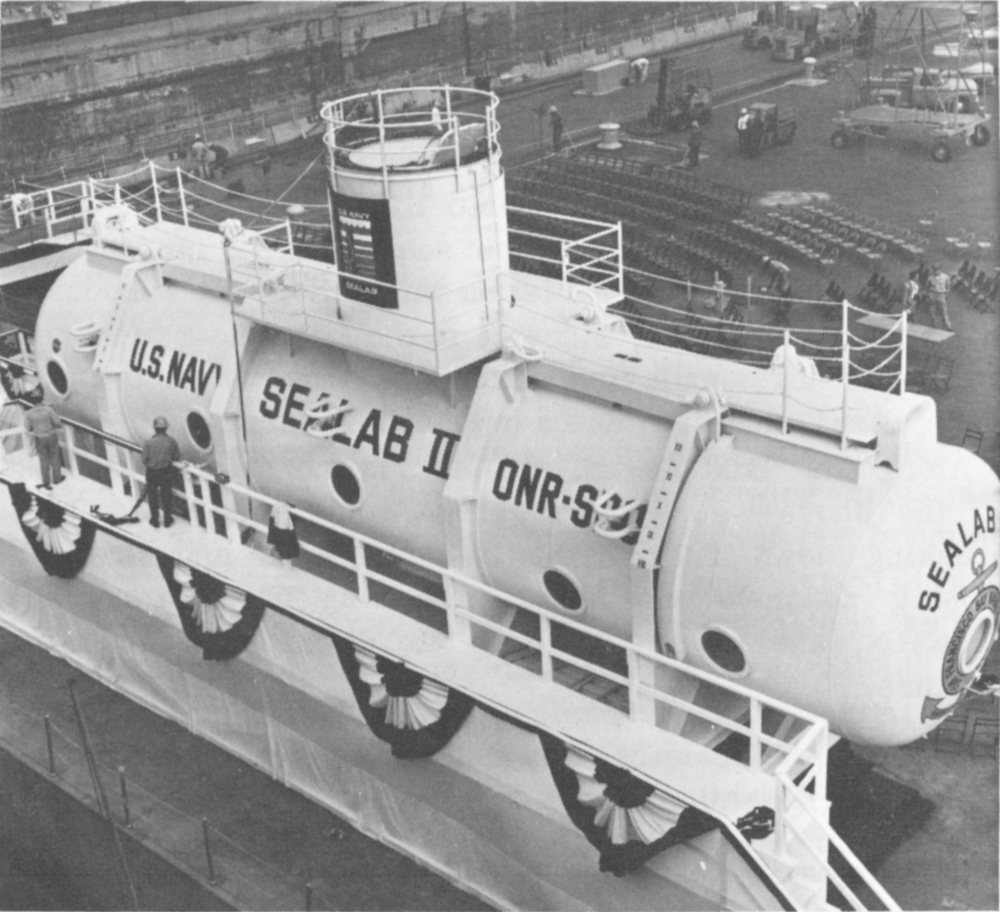
In 1965 the U. S. Navy conducted a 45-day experiment in its “Man-In-The-Sea” program in which 10 aquanauts lived and worked 205 feet below the surface of the sea off La Jolla, California. Their undersea base was Sealab II shown at her christening.
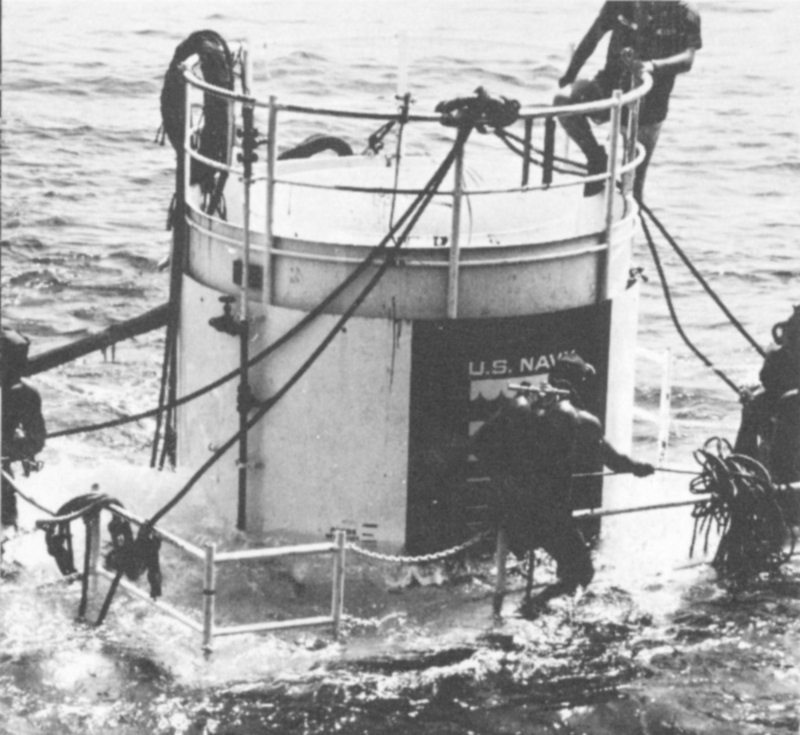
Sealab II shown during final checkout before descent. The aquanauts conducted experimental salvage operations, marine research, and underwent a series of physiological and human performance tests.
13