Volume 2 — POTTERY (continued 2)
Reading edition
I am only aware of one author who derides the statement that this porous clay was eaten by the Spanish women. According to Bowles, who certainly describes and comments on it with intelligence and scholarship, the neighbourhood of Andujar contains “large quantities of the white argil of which are made the jars or alcarrazas which serve in many parts of Spain for cooling water in the summer-time. In other parts of Andalusia is found a red variety of this clay, employed in making the vessels known as búcaros, which serve to freshen the water as well as for drinking it out of—a thing the Spanish ladies love greatly. Both the white alcarrazas and the búcaros as red as the blood of a bull are thin, porous, smooth, and half-baked. When filled with water they emit a pleasant smell like that of dry earth rained upon in summer, and as the water filters through the outer surface, remain continually damp.” The same writer adds that at that time (1752) the búcaros proceeding from the Indies were of finer workmanship, and had a more agreeable smell than those of Spanish manufacture. “In the Encyclopædia,” he continues, “and in the Dictionary of Natural History, we read that Spanish ladies are for ever chewing búcaro, and that the hardest penance their confessors can inflict upon them is to deprive them for a single day of this enjoyment.” Bowles, however, quotes these observations in a scornful tone, and deprecates the habit of “believing writers who without inquiring into things, concoct and publish novels to divert the populace and rid them of their money.”
Turning our attention once again to the finer kinds of Talavera ware, Gestoso adduces proofs that this as well as Chinese porcelain was faultlessly and freely imitated in the potteries of Seville. Here, therefore, is a source of fresh confusion; and probably a great proportion of the polychrome ware which goes by the name of Talaveran is really of Sevillian origin. It is further known that at one period, which seems to begin with the second half of the sixteenth century, potters who were natives of Talavera were hired to work in Seville.
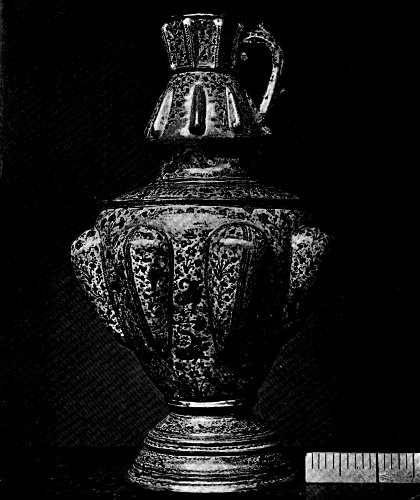
LXX TALAVERA VASE
It has not been ascertained when Talavera herself grew celebrated for this industry. García Llansó supposes that at first, before it felt the influence of Italy and France, her pottery was partly Mudejar, and vestiges of oriental art survive in fairly late examples. The characteristic colour-scheme was either blue on white, or else the decoration is more variegated. Riaño says:—“Although we find by the remarks we have quoted from contemporary authors that earthenware of every description was made at Talavera, the specimens which are more generally met with may be divided into two groups, which are painted on a white ground, either in blue, or in colours, in the manner of Italian maiolica. The most important examples which have reached us consist of bowls of different sizes, dishes, vases (Plate lxx.), tinajas, holy-water vessels, medicine jars, and wall decoration. Blue oriental china was imitated to a vast extent: the colouring was successful, but the design was an imitation of the baroque school of the time, and the figures, landscapes, and decoration follow the bad taste so general in Spain in the eighteenth century. The imitations of Italian maiolica are effective. The colours most commonly used are manganese, orange, blue, and green.”
Talavera maintained her reputation for pottery till nearly the middle of the eighteenth century, supporting more than six hundred workmen employed in eight large potteries.[97] From then onwards the trade declined, and by the close of the same century was practically dead, owing, Larruga tells us, to the constantly increasing cost of prime materials. Nevertheless, the Crown made efforts to revive the craft, and met with some success till 1777, in which year four establishments (locally known as barrerías) for making common pottery were opened in the same town, and speedily crushed their rivals. “The potteries of Talavera,” wrote Laborde soon after this, “were greatly celebrated for many years, and supplied a lucrative and important branch of commerce. They are evidently on the decline. The manufactories are reduced to seven or eight. These productions no longer exhibit the same delicacy of execution. Their designs are also lamentably defective. The material employed in them is a certain earth which is found near Calera, three leagues from Talavera.”
The older Talavera ware, decorated, as a rule, with horses, birds, hunting-scenes, or coats of arms, is seldom met with nowadays. Although it is not particularly choice, the drawing is firm, and the colouring vigorous and agreeable.
I have said that pottery continued to be made in Aragon, at Muel, Villafeliche, and other places. In course of time these local industries were also suffered to decay. Laborde says that early in the nineteenth century the Villafeliche factory employed thirty-eight workmen. “The ware is of a very inferior sort. This article might be carried to a greater extent. In several parts of the province, earth is found of an excellent quality for earthenware, particularly in Zaragoza and in Tauste; the latter affords the best, which is very fine, and of three colours, and would answer for the making of porcelain.”
In the eighteenth century Toledo, upon the initiative of Don Ignacio Velasco, produced good imitations of Genoese ware, while other kinds of pottery were made at Teruel, Valladolid, Jaen, Zamora, Segovia, Puente del Arzobispo, and in the Balearic Islands. Another region which continued to be a most important centre of the potter's craft was Cataluña, where it had always been encouraged by this thrifty and art-loving people. As early as the year 1257 two potters occupied a place upon the municipal council of Barcelona, while the potters' guild was strictly regulated from the beginning of the fourteenth century.[98] At the same time two whole streets in the centre of the town, as well as others in the suburbs, were occupied by potters. The ancient names of these streets are yet retained in the Calles Escudillers, Escudillers Blancs (white varnished pottery), Obradors (where many of the potteries were situated), and Tallers (i.e. the potteries for producing common ware).
The pottery of Cataluña generally was largely exported to Sicily, Alexandria, and other parts. Among the places in this region which produced it were Tarragona, Tortosa, and Villafranca. In 1528 the municipal council of the capital herself forbade, as a protective measure, the introduction into Barcelona of local pottery made at Malgrat, La Selva, and other towns and villages of this neighbourhood. In 1546 the Portuguese Barreyros declared in his work Chorografía de algunos lugares that the Barcelona ware surpassed all other classes made in Spain, including the Valencian. She continued to produce good pottery all through the sixteenth century, and excellent common ware until considerably later.[99]
About the beginning of the eighteenth century Laborde mentioned as working centres of this craft “manufactories of delf-ware at Avilés, Gijón, Oviedo, Nava, and Cangas de Onis, in the Asturias; at Segovia in Old Castile; at Puente del Arzobispo and Talavera de la Reina in New Castile; at Seville in the kingdom of that name; at Villafeliche in Aragon; at Onda, Alcora, and Manises, in the kingdom of Valencia; at San Andero in Biscay; and at Tortosa in Cataluña…. The most important of these potteries is the one at Alcora, the delf of which is tolerably fine, though not of the first quality. No china is made, except at Alcora and Madrid: that of the former place is very common, and inconsiderable as to quantity. The china manufactured at Madrid is beautiful, and without exaggeration may be considered as equalling that of Sèvres. It is a royal pottery; but it is impossible to give any description of its state, because admission to the interior of the manufactory is strictly prohibited.”
Ricord states in his pamphlet relative to Valencian industries that in 1791 factories of high-class pottery were working in the kingdom of Valencia, at Onda, Alcora, Ribesalves, Manises, Eslida, and Bechí; and of common ware at San Felipe, Morella, Manises, Murviedro, Alicante, Moncada, Orihuela, Segorbe, and other towns and villages of this locality. In all, there were throughout the province eighty-seven of these latter potteries, besides two hundred and twenty tileries, and four factories of artistic tiles or azulejos established at Valencia. The yearly output of these azulejerias was 150,000 tiles, 20,000 of which were exported to Andalusia and Castile.
Although the pottery of Alcora only achieved distinction at a later age, this craft had long been practised in the neighbourhood. This circumstance induced the Count of Aranda to found here, in 1726, a large factory for producing costly and artistic ware. Riaño obtained permission to examine the archives of the family of Aranda, with their mass of documents relating to this enterprise. His notice of Alcora ware is therefore most complete and valuable, and has been copied, frequently without acknowledgment, by almost every writer on the subject.
It appears from these archives that the cost of building and opening the factory of Alcora amounted to about £10,000. The works were placed beneath the supervision of Don Joaquín Joseph de Sayas, at the same time that a Frenchman named Ollery was engaged at a good salary and brought from Moustiers to act as principal draughtsman. A couple of years later Count Aranda paid Ollery the high compliment of saying that “the fine and numerous models which he has designed, have contributed to make my manufacture the first in Spain.” He seems to have retired in 1737, when the Count rewarded him with a yearly pension of five hundred francs besides the amount of his salary, “for his especial zeal in the improvement of the manufactory, and his great skill in directing the construction of every kind of work.” Riaño adds that from this date until the manufacture of porcelain in 1764, only Spanish artists worked at Alcora.
The products of this factory continued to improve, and reached, in course of time, a yearly total of about three hundred thousand objects. The ordinances, which are dated between 1732 and 1733, tell us that “in these works of ours no pottery should be made except the very finest, similar to the Chinese, and of as fine an earth. The models and wheels should be perfect, the drawing first-rate, the varnish and colours excellent, and the pottery light and of the highest quality, for it is our express wish that the best pottery should only be distinguished from that of an inferior kind by the greater or less amount of painting which covers it.”
Not less interesting are certain communications, copied by Riaño, which passed in 1746 between the Spanish Tribunal of Commerce and the Count of Aranda, in which it is stated that “the perfection of the earthenware of Alcora consists in the excellent models which have been made by competent foreign artists, as well as in the quality of the earth and the recipes brought at great cost from abroad.” We learn from the same document that “from the earliest period of the manufacture, pyramids with figures of children, holding garlands of flowers and baskets of fruits on their heads, were made with great perfection; also brackets, centre and three-cornered tables, large objects, some as large as five feet high, to be placed upon them, chandeliers, cornucopias, statues of different kinds, and animals of different sorts and sizes. The entire ornamentation of a room has also been made here; the work is so perfect that nothing in Spain, France, Italy, or Holland could equal it in merit.”
It is not necessary to follow in close detail all the modifications and vicissitudes (extending over quite a hundred years) which affected the Alcora factory. I therefore only take some general notices from Riaño. In 1750 Count Aranda transferred the works to a private company, which remained in possession of them until 1766. In 1741 a Frenchman named François Haly was engaged for ten years, and with a yearly salary of rather more than a thousand francs, under the following conditions:—
“That the travelling expenses of his wife and children should be given him, and that his salary should be paid as soon as he made before the Director and two competent judges the different kinds of porcelain which he had undertaken to make.” Haly agreed to surrender his recipes, and it was promised him that he should have two modellers and one painter working by his side, and that if in one year his porcelain were satisfactory, the Count would make him a present of a thousand tornoises.[100]
Porcelain was first produced at Alcora towards the middle of the eighteenth century. A contract was drawn up on March 24th, 1764, with a German called John Christian Knipfer, who had already worked there in the pottery section. By the original agreement, which exists in the archives, we find he was to prepare works of “porcelain and painting similar to those made at Dresden, during a period of six years, under the following conditions:—
“That the said Knipfer obliges himself to make and teach the apprentices the composition and perfection of porcelain paste, its varnishes, and colours, and whatever he may know at the present time, or discover during this period of six years; he is not to prevent the Director of the Works from being present at all the essays made.
“The said Knipfer offers to make and varnish porcelain, and to employ gold and silver in its decoration, and in that of the ordinary wares; likewise the colours of crimson, purple, violet, blues of different shades, yellow, greens, browns, reds, and black.
“That Knipfer will give up an account of his secrets, and the management and manner of using them, in order that in all times the truth of what he has asserted may be verified.”
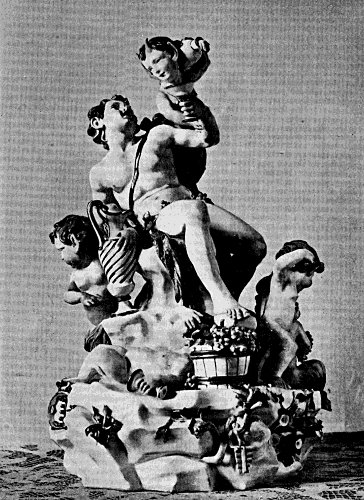
LXXI ORNAMENT IN PORCELAIN OF THE BUEN RETIRO
In 1774 a Frenchman named François Martin was engaged to make “hard paste porcelain, Japanese faïence, English paste (pipeclay), and likewise to mould and bake it: the necessary materials to be provided by the Count of Aranda.” Riaño says that the combined assistance of Knipfer and Martin went far to better the products of the factory.
Martin died in 1786, and Knipfer left soon afterwards. A Frenchman was now engaged, whose services proved also beneficial to the works. This was Pierre Cloostermans, “a skilful man, well versed in the manufacture of porcelain pastes, as well as in painting and decorating them.” Cloostermans, however, was much molested by the envy of the Spanish workmen at Alcora, as well as by their typical intolerance in matters of religion, although the Count, his master, behaved towards him with the utmost kindness. Under his supervision, the quality of Alcora ware was notably improved. Figures and groups of many kinds were attempted, and even Wedgwood jasper ware was creditably imitated. In 1789, among other pottery that was sent to Madrid were “two hard paste porcelain cups, adorned with low relief in the English style.” The most important one was moulded by Francisco Garcés, the garlands and low reliefs by Joaquín Ferrer, sculptor, the flowers on the covers by an apprentice, helped by Cloostermans.
Dated in the same year (1789), Riaño quotes an interesting letter from the Count of Aranda to Don Pedro Abadia, his steward. “I wish,” he said, “to export the porcelain of my manufactory, but chiefly in common objects, such as cups of different kinds, tea and coffee services, etc. These may be varied in form and colour, the principal point being that the paste should bear hot liquids, for we Spaniards above everything wish that nothing we buy should ever break. By no means let time be wasted in making anything that requires much loss of time. The chief object is that the pastes should be of first-rate excellence and durability.”
In 1793 Cloostermans was driven from the country by political disturbances; but he was allowed to return in 1795, and resumed his duties at the factory. All through these years Alcora continued to make most excellent pottery. Essays were made with foreign earths, as well as with the best that could be found in Spain. About this time kaolin was discovered in Cataluña, and the Count was particularly anxious that this native product should be utilised at Alcora. “The kaolin of Cataluña,” he wrote in 1790, “may be good or bad, but it is acknowledged to be kaolin, and if we do not employ it I must close my works.”
The Count of Aranda and Pierre Cloostermans both died in 1798, and in 1800 the Duke of Hijar became the manager and proprietor of the potteries. “Two hundred workmen were employed, and pottery of every description was made, common earthenware, pipeclays in imitation of the English ones, and porcelain in small quantities; common wares were made in large quantities; the pipeclays were pronounced superior to the English in brilliancy, but were so porous that they were easily stained. A large number of snuff-boxes and other small objects belong to this period.”—(Riaño.)
In the early years of the nineteenth century Alcora ware deteriorated not a little. This decline was further aggravated by the French invasion; and although an attempt was subsequently made to revive the industry by bringing craftsmen from the porcelain factory of Madrid, it suffered fresh relapses and produced henceforward little but the commonest kinds of ware. “This system,” says Riaño, “continued until 1858, when the Duke of Hijar sold the manufactory to Don Ramón Girona, who brought over English workmen from Staffordshire in order to improve the wares. Many imitations of the older styles have also been made at Alcora of late years.”
Riaño appends instructive tables, which I copy in Appendix I, of every kind of pottery manufactured at Alcora. He also believes that a great deal of pottery which was formerly thought to proceed from French or English factories is really of Alcora make, including “a great quantity of objects of white pipeclay porcelain which have been found of late years in Spain. They have hitherto been classified by amateurs as Leeds pottery. We find, in papers relating to Alcora, that a decided distinction is made between white and straw-coloured pottery. This indication may be sufficient to distinguish it from English wares.”
The celebrated Royal Porcelain Factory of the Buen Retiro at Madrid, formerly situated in the public gardens of that name and popularly known as the “Fabrica de la China,” was founded in 1759 by Charles the Third, who erected a vast edifice for this purpose, and filled it with a multitude of workmen and their families, including two hundred and twenty-five persons whom he brought over from his other factory of Capo-di-Monte in Italy. He also transferred a great part of the material.[101] The cost of the new works amounted to eleven and a half millions of reales, and they were terminated in 1764. The cost of keeping up the factory is stated by Larruga to have amounted to three millions of reales yearly. The first directors were Juan Tomás Bonicelli and Domingo Bonicelli, and the first modellers-in-chief and superintendents, possessing the secrets of the fabrication (secretistas), were Cayetano Schepers and Carlos Gricci.
Riaño says that every kind of porcelain was made at the Buen Retiro, “hard and soft paste, white china, glazed or unglazed, or painted and modelled in the style of Capo-di-Monte.” A great many objects existed imitating the blue jasper ware of Wedgwood, and they also made flowers, coloured and biscuit, groups (Pl. lxxi.), and single figures, and painted porcelain of different kinds. Great quantities of tiles for pavements were also made there, which may still be seen at the Casa del Labrador at Aranjuez: they are mentioned in the accounts which exist at the Ministry of Finance for 1807 and 1808. We find in these same accounts interesting details of the objects made monthly. In January, 1808, a large number of figures were made, including 151 heads for the table centre which was made for the king, 306 objects ornamented with paintings, 2506 tiles, 577 objects of less artistic importance, such as dishes, plates, etc. The finest specimens which exist are in the Neapolitan style, and are two rooms at the palaces of Madrid and Aranjuez, of which the walls are completely covered with China plaques and looking-glasses, modelled in the most admirable manner with figures, fruits, and flowers. The room at Aranjuez is covered with a bold ornamentation of figures in the Japanese style, in high relief, painted with colours and gold with the most exquisite details. The figures unite the fine Italian modelling with the Japanese decoration. The chandelier is in the same style (Plate lxxii.). Upon a vase on the wainscot to the right of the entrance door is the following inscription:—
JOSEPH GRICCI DELINEAVit ET SCULit 1763.
This same date is repeated in the angles, and in some shields near the roof we find,
“AÑO 1765;
probably the year the work was terminated.”
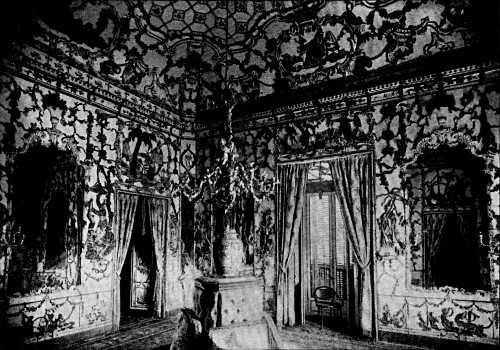
LXXII ROOM DECORATED WITH PORCELAIN OF THE BUEN RETIRO (Royal Palace of Aranjuez)
The earliest mark upon the Buen Retiro porcelain was a blue fleur-de-lis, to which were subsequently added the letter M and a royal crown. Still later, in the reign of Charles the Fourth, the mark used was a fleur-de-lis with two crossed C's.
The object of the Buen Retiro Factory was almost wholly to supply the Crown with costly ware, and would-be visitors were jealously excluded. Townsend wrote in 1786: “I tried to obtain admission to the china manufacture, which is likewise administered on the king's account, but his Majesty's injunctions are so severe, that I could neither get introduced to see it, nor meet with anyone who had ever been able to procure that favour for himself. I was the less mortified upon this occasion, because from the specimens which I have seen, both in the palace at Madrid and in the provinces, it resembles the manufacture of Sèvres, which I had formerly visited in a tour through France.”
Laborde also complained that the factory was “wholly inaccessible: all entrance to it is interdicted, and its existence is only ascertained by the exhibition which is made of its productions in the royal palace.” The same writer refers to another class of work which was produced here, namely, stone mosaic. “The process by which stone is wrought into pictures is as delicate as it is curious: a selection is made from marble fragments of various shades and dimensions, which are found, by judicious assimilation, to produce no bad resemblance to painting.” Jean François de Bourgoing, French Minister at Madrid, was lucky enough, in 1782, to penetrate into the factory and view the process. “Le Monarque actuel,” he wrote, “a établi dans leur intérieur une fabrique de porcelaine, dont l'entrée est jusqu'à présent interdite à tout le monde. On veut sans doute que ses essais se perfectionnent dans le silence, avant de les exposer aux regards des curieux. Ses productions ne peuvent encore se voir que dans les Palais du Souverain, ou dans quelques Cours d'Italie, auxquelles il les envoie en présens. On travaille dans le même édifice à certains ouvrages de marqueterie, qui sont encore peu connus en Europe. J'y pénétrai un jour, sous les auspices d'un étranger distingué en faveur duquel le Roi avoit levé la prohibition rigoureuse, qui en exclut tout le monde. Je suis témoin de la patience and de l'adresse avec lesquelles on taille and on rapproche divers petits morceaux de marbre coloré, pour en former des tableaux assez compliqués, qui en faisant à-peu-près le même effet que la peinture, ont sur elle l'avantage de braver par leur couleur immortelles les ravages du temps, qui n'épargnent pas les plus belles productions de cet art.”[102]
This factory was not long-lived. Until 1803 it followed the styles of the older establishment at Capo-di-Monte, uniting neo-classic motives with the manner of Baroque. In that year it began to produce porcelain imitating that of Sèvres, and two Frenchmen, Vivien and Victor Perche, were brought from Paris to superintend this change. “Among the finest specimens of this period,” says Riaño, “are a splendid clock and four vases, two mètres high, with porcelain flowers, which exist in one of the state rooms of the Palace of Madrid. The vases are placed in the four corners of the room. The clock is ornamented with large biscuit figures. A large number of vases of Retiro china exist at the royal palaces of Madrid, Aranjuez, and the Escorial. They are often finely mounted in gilt bronze with muslin or porcelain flowers. The blue of the imitations of Wedgwood is not so pure, nor is the biscuit work so fine as the English. Gold is often added to these specimens.”
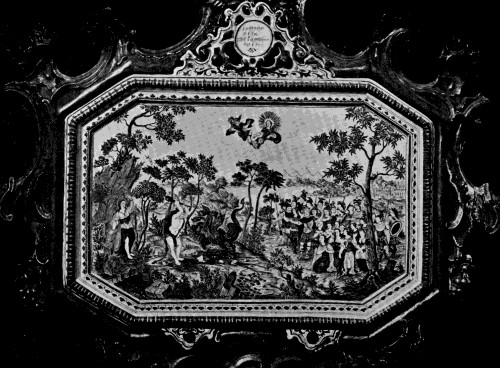
LXXIII PORCELAIN OF THE MONCLOA FACTORY
Nevertheless, this manufacture was by now decadent. It had suffered severely from the death of Charles the Third, and upon the French invasion in 1808 was seized by the enemy and occupied by them for several months. During the reign of the “intruso,” Joseph Buonaparte, porcelain was still produced to some extent; but by the time of the Peninsular campaign the works had practically ceased. “Near this quarter,” wrote Ford, describing the Retiro gardens, towards the middle of last century, “was La China, or the royal porcelain manufactory, that was destroyed by the invaders, and made by them into a fortification, which surrendered, with two hundred cannon, August 14th, 1812, to the Duke. It was blown up October 30th, by Lord Hill, when the misconduct of Ballesteros compelled him to evacuate Madrid. Now La China is one of the standing Spanish and afrancesado calumnies against us, as it is stated that we, the English, destroyed this manufactory from commercial jealousy, because it was a rival to our potteries. ‘What can be done (as the Duke said) with such libels but despise them. There is no end of the calumnies against me and the army, and I should have no time to do anything else if I were to begin either to refute or even to notice them?’ (Disp., Oct. 16, 1813.) These china potsherds and similar inventions of the enemy shivered against his iron power of conscious superiority.
“The real plain truth is this. The French broke the ollas, and converted this Sèvres of Madrid into a Bastile, which, and not the pipkins, was destroyed by the English, who now, so far from dreading any Spanish competition, have actually introduced their system of pottery; and accordingly very fair china is now made at Madrid and Seville, and by English workmen. At the latter place a convent, also converted by Soult into a citadel, is now made a hardware manufactory by our countryman, Mr Pickman. Ferdinand the Seventh, on his restoration, re-created La China, removing the workshops and warerooms to La Moncloa, once a villa of the Alva family on the Manzanares.”
This factory of La Moncloa was founded in 1816, and it continued working until 1849. A specimen of the Moncloa ware is reproduced in Plate lxxiii.
Outside the royal palaces of Spain, the Buen Retiro porcelain is scarce. The choicest collections which are not the property of the Crown belong, or have belonged till recently, to the Marquis of Arcicollar, the Count of Valencia de Don Juan, and Don Francisco Laiglesia.

Footnotes: