Volume 2 — IVORIES
Reading edition
The story of Spanish ivory-work is shortly told, for probably no craft, excepting glass, has been so little practised in this country. The older Spanish writers rarely mention it, although from time to time this substance may have been employed for carving diptyches and boxes, and Roderick is stated to have entered the battle of the Guadalete in an ivory car, by which is meant, perhaps, a chariot of Byzantine make or pattern, covered with ivory plates. However, properly speaking, the history of this art as exercised in Spain begins in the eleventh century, attains its prime towards the fourteenth century, and ceases altogether at the time of the Renaissance.
Among the ivory objects now preserved in Spain, and which were wrought by artists other than Mohammedan, none is more interesting or important than the consular diptych of Oviedo cathedral. Although this valuable diptych was not made in Spain, but manifests Byzantine art in all its purity, it well deserves to be described. It consists of two ivory tablets measuring sixteen inches and a half in height by twelve inches and a half across both leaves. Each leaf has a simple border of a triple form, and just inside each corner is a circular floral ornament in relief, with a lion's head in the centre. Another ornament, also circular, is in the centre of each leaf, and contains, carved within a graceful S-shaped border, a half-length portrait of the Consul, who is represented in the act of throwing down into the amphitheatre his mappa or handkerchief[56] with his right hand, while in his left he holds the sceptre (scipio imaginifer), crowned with a small bust. His hair is curled in the Byzantine fashion, and his costume is a richly decorated toga.
An inscription runs along the top of either tablet, between the border and the circular devices carved with flowers. It says:—
Flavius Strategius Apion—Strategius Apion. Vir inlustris Comes Devotissimorum Domesticorum et Consul ordinarius.
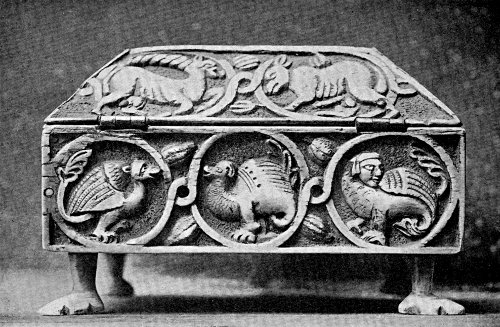
XXXVII IVORY BOX (9th Century. Madrid Museum)
We gather, therefore, that this magnate was a chamberlain at court, as well as ordinary consul.
Diptyches were used among the Romans for all kinds of purposes, such as to convey love-messages, as invitations to a banquet, or to notify the celebration of feasts and games. We find the diptych also used in Christian temples from the time of Constantine, serving to record church festivals or names of saints and martyrs, as covers for a copy of the gospel (diptycha evangeliorum), or as reliquaries (thecae reliquiarum). Sometimes these diptyches were wrought expressly for the church, or sometimes they were consular diptyches that had been preserved from former ages. This latter class, when cleansed from pagan usage and devoted to the ceremonies of the Christian faith, was known as diptycha mixta.
Such early objects as were wrought in ivory by Spanish hands, consisting as a rule of circular or oblong, square or oval caskets, were principally carved by Moors or Mudejares. Among the Spanish-Moorish boxes which are still preserved are several of the greatest interest and beauty (Plates xxxviii., xxxix., xl.). One of them, made from pieces of an older casket believed to date from earlier than the Moorish conquest, is in the National Museum. The decoration in its present form consists of Arabic inscriptions in relief, together with figures of the apostles. This casket, which proceeds from the Colegiata of Saint Isidore at León, measures seven inches in length by five in depth and six in height, and has been used as a reliquary.
Another, dating from the middle of the eleventh century and proceeding from the same temple as the one just noticed, is also in the National Museum. It was a present from the Emir Mohammed Almotamid-Aben-Abed to his second wife, Al-Badir (“the Moon”), and includes among the decoration dogs and doves, symbolic of affection and fidelity. The style of carving is what is known as Persian-Arabic. We do not know, however, whether the box was imported from the East, or whether it was made in Spain by somebody of Persian parentage or skilled in Persian art. The material is a delicate taracea of sandal, aloe, and cypress woods inlaid on larch. The box, which was used at León as a reliquary, has bronze clasps, and is inscribed along the top with sentences from which we learn that it was made by Aben-As-Serag.
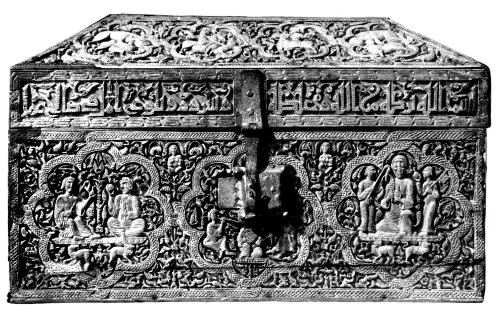
XXXVIII IVORY CASKET (Moorish; 11th Century. Pamplona Cathedral)
In the cathedral of Pamplona is a magnificent ivory box (Plate xxxviii.) which was originally at Sangüesa in Navarre. It measures, says Riaño, fifteen inches long by nine and a quarter inches wide. “It is completely covered with carvings in relief, within circular cusped medallions, with figures in the centres representing different subjects; men seated, hawking, or struggling with wild beasts, and numerous single figures of lions, stags, and other animals. The intermediate spaces contain an ornamentation of leaves and flowers which is accommodated to the geometrical style of Saracenic art. Round the upper part of this box appears an Arabic inscription in fine Cufic characters:—‘In the name of God. The blessing of God, the complete felicity, the happiness, the fulfilment of the hope of good works, and the adjourning the fatal period (of death), be with the Hagib Seifo daula (sword of the State), Abdelmalek ben Almansur. This (box) was made by the orders (of the said Hagib), under the inspection or direction of his chief eunuch, Nomayr ben Mohammad Alaumeri, his slave, in the year of 395 (a.d. 1005).’
“In the centre medallion, on the opposite side to the lock, is represented the standing figure of a man who is attacked by two lions. He holds on his arm a shield, upon which is engraved an inscription, with the following religious formula: ‘There is no god but God,’ or a similar one, for the characters are very illegible and confused. In the centre of this shield may be read the words, ‘Made by Hair,’ undoubtedly one of the artists who made the box. Another artist's name may be read with difficulty in a similar inscription which appears on one of the medallions on the left side; it is written on the thigh of a stag, which is attacked by a lion: ‘It was made by Obeidat.’ Three other inscriptions of a similar character appear in other parts of this box, which probably give the names of other artists, but I have been unable to decipher them.”
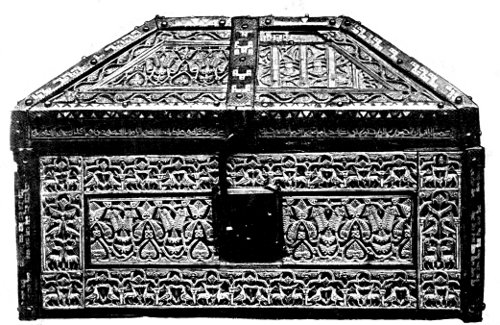
XXXIX IVORY BOX (11th Century. Palencia Cathedral)
Other interesting boxes dating from the same period are that of Santo Domingo de Silos at Burgos, and several which are in the National Museum at Madrid. The box which is preserved at Burgos is made of ivory, and measures thirteen inches and a quarter in length by seven inches and a half in width and height. The decorative work consists of hunting scenes, and also of an inscription in Cufic characters which says: “Permanent felicity for the owner (of this box). May God lengthen his days. It was made at Medina …;[57] in the year four hundred and seventeen (a.d. 1025). It is the work of his servant Mohammed-ibn-Zeiyan. May God glorify him.”
There is also in the provincial museum of Burgos a handsome ivory diptych which was formerly at the convent of Santo Domingo de Silos. It bears at each extremity—that is, four times repeated—the following inscription:—“This was ordered to be made by the Iman, servant of God, Abd-er-Rhaman, prince of believers.”
Among the rectangular boxes in the National Museum is one of carved ivory, with an inscription recording it to have been a gift from Prince Ali to one of the favourites of his harem, and another of the same material which was once upon a time at Carrion de los Condes, in the province of Palencia. This box is painted with a decorative pattern in carmine and dark green. The lid, which is imperfect, contains the following inscription in Cufic characters, standing boldly out against a green ground:—“In the name of Allah, the Merciful, the Compassionate. The protection of Allah and an impending victory for the servant of Allah …; and his wali Maad Abu-Temim—the Iman Al-Moez …; prince of believers (the blessing of Allah be upon him and his sons the good). (This) was commanded to be made for (celebrating) the fortunate victory. It was made by …; Jorasani.” The length of this box is eighteen inches, and its height nine inches.
A fine Moorish box (Plate xxxix.), now in the cathedral of Palencia, is covered with elaborately engraved and perforated ivory plates upon a ground of gilt leather backed by wood, and further ornamented with enamel-work upon a copper surface. This box is fourteen inches long, and has a gable top. The decoration on the sides and lid consists of palm-leaves, birds, and men engaged in combating and chasing antelopes and lions in the characteristic manner of Assyrian art. A lengthy Cufic inscription tells us that the box was made at Cuenca (Medina Cuenca) by Abd-er-Rahman ben Ziyan, to the order of the Moorish princes of Toledo, and that it dates from the year 441 of the Hegira.[58] Vives has pointed out that Cuenca was evidently a principal centre of this industry, and that caskets executed here about this time exist in Perpignan cathedral and in the provincial museum of Burgos.
Riaño mentions seven ivory boxes of particular interest, which were probably made in Spain by Spanish Arabs, or else by Eastern craftsmen who had emigrated to this country. “On all their carving,” he adds, “the names of Spanish historical persons appear, and it is hardly possible that they were ordered in remote countries, especially as some of these objects are small and comparatively unimportant.”
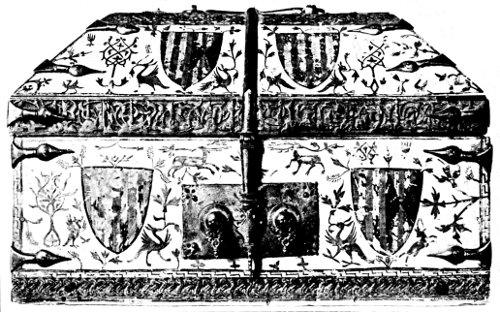
XL HISPANO-MORESQUE IVORY CASKET (13th Century. Royal Academy of History, Madrid)
Two of these boxes are in the South Kensington Museum. The one which is cylindrical in shape and has a domed cover is thus described by Maskell in his Ivories, Ancient and Mediæval, in the South Kensington Museum:—“This beautiful box is carved throughout, except the bottom of it, with interlacing narrow bands forming quatrefoils, in which, on the cover, are four eagles. These have spread wings and stand erect; well designed and most delicately executed. A small knob serves to lift the lid.
“Round the side, each quatrefoil is filled with a star having a leaf ornament. The same decoration is repeated in the spaces between the larger quatrefoils on the cover.”
“The whole is carved in pierced work, except a band which forms the upper upright portion of the box, round the side of the lid. This band has an Arabic inscription: ‘A favour of God to the servant of God, Al Hakem al Mostanser Billah, commander of the faithful.’ He was a Caliph who reigned at Cordova, a.d. 961–976.”
The other box is oblong and rectangular. “The cover and sides are carved with scroll foliated ornament; the hinges and clasp are of chased silver inlaid with niello. Round the sides, immediately below the lid, is the following Arabic inscription in Cufic characters:—‘In the name of God. This (box) was ordered to be made by Seidat Allah, the wife of Abd-er-Rahman, prince of the believers. God be merciful and satisfied with him.’” This inscription, adds Riaño, “must allude to Abd-er-Rahman the Third, the first Caliph of Cordova who bore the title of Emir, el Mumenin. The formula ‘God be merciful,’ etc., denotes that he was dead when it was written. He died a.d. 961.”
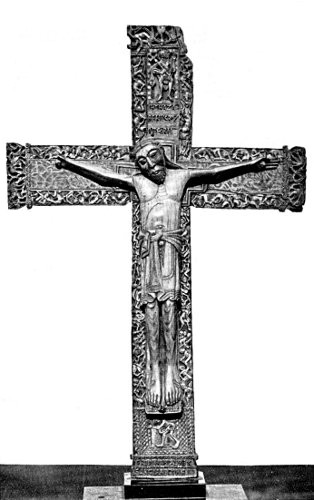
XLI IVORY CRUCIFIX (11th Century. Madrid Museum)
Another Spanish-Moorish casket, also at South Kensington, and dating from the eleventh century, is described by Maskell as “richly carved in deep relief with foliage and animals in scrolls interlacing one another, and forming larger and smaller circles. The top and each side is a single plaque of ivory; the sloping lid at the front and back has two panels. On the two are two animals, like doves; a large bird stands at the back of each, attacking it with his beak. The sloping sides have, in the large circles, men on horseback, and animals fighting. The intermediate spaces are completely filled with foliage, and smaller beasts. Similar subjects are repeated in the circles on the panels forming the lower sides of the casket, and among them are two groups of men and women sitting; one blowing a horn, another playing on a guitar, another holding a cup in one hand and a flower in the other.” Riaño adds: “There is no inscription on this casket, but in one of the medallions on the lid there is a bust, which is carried on the back of a horse, and which is probably a representation of the prince for whom the casket was made.”
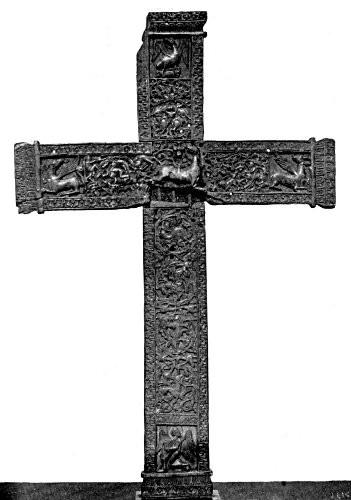
XLI (a) IVORY CRUCIFIX (11th Century. Back view. Madrid Museum)
The Letter of Testament setting forth the various objects bequeathed by Ferdinand the First and his consort Sancha to the church of Saint John the Baptist (or of Saint Isidore) at León, mentions an ivory cross (which will be noticed presently), an ivory box fitted with gold, and two ivory boxes fitted with silver, one of them containing three other silver boxes, similarly decorated.
One of these boxes is described by Ambrosio de Morales, and from his words we conclude it to be the one which was adorned with gold, “of which metal,” he wrote in 1572, “it has even more than of ivory,” adding that it measured more than half a yard in length, and enshrined the body of Saint Vincent of Avila. He also tells us that it bore the following inscription, carved upon a golden frieze:—
ARCULA SANCTORUM MICAT HAEC SUB HONORE DUORUM BAPTISTAE SANCTI JOHANNIS SIVE PELAGII CEU REX FERNANDUS, REGINAQUE SANTIA, FIERI JUSSIT. ERA MILLENA SEPTENA SEU NONAGENA.[59]
This arca has been much mutilated, and stripped of all the precious metal. Morales' description is therefore of especial value, as are the ivory tablets (eleventh century), carved with Christian themes, which yet remain upon the body of the box.
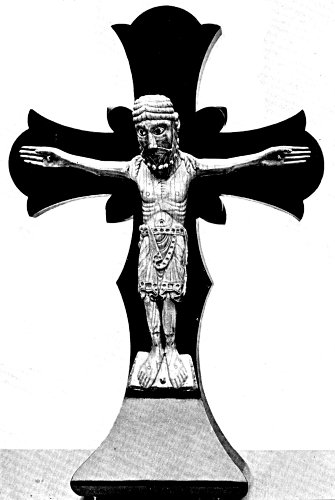
XLII BYZANTINE CRUCIFIX
Dating from the thirteenth century is a Moorish casket (Plate xl.), preserved in the Academy of History at Madrid, and proceeding from the Carthusian monastery of Val de Cristo at Segorbe. It measures a foot in length by eight inches in height and four and a half inches in depth. The lid is deeply bevelled, and contains on each of the bevelled sides shields with the bars which constitute the arms of Aragon, painted upon a gold ground, together with imperial eagles painted in black upon a carmine ground. A decorative device of leaves and stems is also painted on the ivory.
Rodrigo Amador de los Ríos believes that this casket was captured in war by Jayme the First of Aragon, remaining with successive princes of his line until the reign of Don Martin, by whom it was presented to the monastery. The shields would thus be added to the primitive Moorish casket by some Christian-Spanish painter.
The ivory crucifix (Plates xli. and xli. (a)), of Ferdinand the First and Doña Sancha, made in the first half of the eleventh century, and offered by these sovereigns to the church of Saint John the Baptist (or of Saint Isidore) at León, measures twenty-one inches in length by thirteen inches and a half in height. The figure of Christ recalls the rigidness and rudeness of Byzantine craftsmanship, such as is found in ancient crucifixes still preserved in Spain (Plate xlii.). The pupils of the enormous, expressionless eyes are made of jet. We see the wound upon each foot, with wavy marks to imitate the flowing blood, but no trace of a nail. Nails, however, transfix the hands. The arms are separate from the trunk, but the suppedaneum on which the feet are resting is of a single piece with the body of the figure.
The surface of the cross, especially about the borders, contains elaborate decoration, including animals and foliage. Above the Saviour's head is the inscription:—
IHS NAZA RENVS REX IVDEORVM
Above this is another figure of Christ seated, crowned with a cruciform nimbus and holding a Greek processional cross. Beneath the feet of the larger figure is Adam in an uncouth posture, turning his head to gaze upward, and at the lower extremity of the cross are carved the words:—
FERDINANDVS REX SANCIA REGINA
The lateral arms are carved with numerous devices forming an effective whole, including animals upon a tessellated band which seems to imitate a groundwork of mosaic. Other subjects represented are the Resurrection of the Flesh, the ascent of the blessed to Heaven, and the fall of the wicked to Hell.
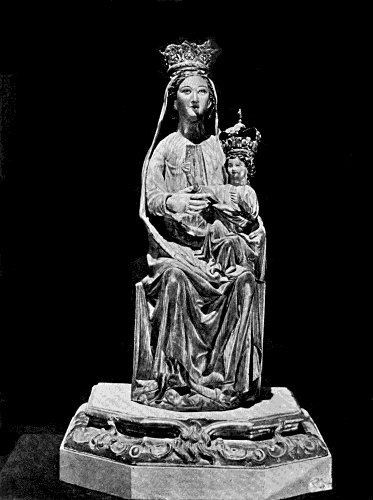
XLIII “THE VIRGIN OF BATTLES” (13th Century. Seville Cathedral)
Upon the obverse side are pairs of quadrupeds, birds, and serpents, among a maze of foliage, together with the eagle, lion, lamb, and ox, as symbols of the evangelists. The lion and the ox have wings, and at the foot of the cross is an angel.
The carving of the Saviour's form is clearly inferior to that of the decoration which surrounds it. Amador de los Ríos seeks to account for this by declaring that “the difficulty from the point of view of art increases in proportion as the size of the figure is required to be larger”—a statement with which I wholly disagree. I believe, in fact, that in this cross the figure of Christ and the surrounding ornamentation are not by the same hand, and that the carver of the decorative detail was simply the better craftsman of the two.
Many of the statuettes of the Virgin which are preserved in Spain were probably made in France. One that is typically and unquestionably Spanish is the celebrated “Virgin of Battles” (Plate xliii.), now guarded, together with other relics of Saint Ferdinand (see Vol. I., Plate xixi.), in the Chapel Royal of Seville cathedral. These statuettes, the use of which originated with the Greek emperors, and which were called by the Byzantines socia belli, consist of a seated figure of the Virgin with a small door opening underneath her throne, and served as reliquaries, and also as a kind of talisman. Boutelou says that the Spanish warriors of the Middle Ages were accustomed to carry these images to war with them, fitted upon a pin protruding from the left side of the saddle-bow. The “Virgin of Battles,” made in Spain in the early part of the thirteenth century, was thus carried by King Ferdinand the Saint, resting between his shield or rodela and his left arm, and so protected, and protecting, in the brunt of war.
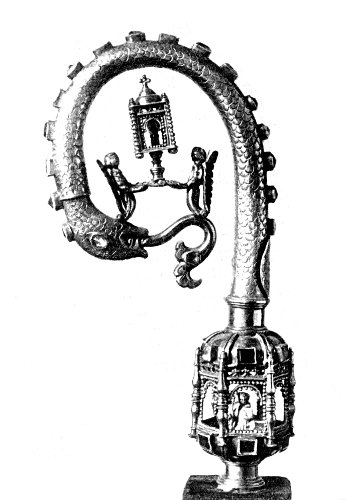
XLIV SPANISH MEDIÆVAL BACULUS
The image is of ivory, and measures seventeen inches in height. The style is primitive Gothic, not as yet emancipated from Romanic and Byzantine art; and the expression of the Madonna and her Babe is marked by an engaging sweetness. Through lapse of centuries, myriads of diminutive cracks have opened on the surface of the ivory, and this has turned, in colour, to a brightish yellow. The right arm of the Virgin was broken off at some time prior to the sixteenth century, and has been replaced by another one. Mother and Child wear crowns of silver-gilt which probably were added later, and the hair, lips, and eyes have been badly painted or repainted with discordant colouring. A four-sided hole bored deep into the ivory served for holding the image to the perno which projected from the monarch's saddle-bow.
A few elaborate baculi or pastoral staves (Plate xliv.) exist in Spain, including one of the fourteenth century, in ivory, which belonged to the late Marquis of Monistrol, and is carved with the Crucifixion and also with the Virgin contemplating the Holy Infant as He is offered cups by angels. Another interesting Spanish baculus, though not of ivory, but copper decorated with turquoises and bright blue enamel, belonged to Bishop Pelayo de Cebeyra of Mondoñedo (a.d. 1199–1218), and has been preserved, together with that prelate's gilded shoes. In the celebrated processions of Santiago, at which Alfonso the Sixth was personally present, magnificent ivory baculi were borne, not only by the archbishop (eburnea virga pontificali decoratus), but even by the choristers.
Between the eleventh and the fifteenth centuries, Spanish craftsmen produced a fair quantity of ivory boxes, reliquaries, diptyches, triptyches, combs, and other less important objects. A fifteenth-century ivory spoon, ten inches long, whose handle is carved with six crocodiles, is in the National Museum, and may be Spanish work. In the same collection are one or two ivory diptyches and leaves of diptyches, and a wooden box (fourteenth century), with figures of carved ivory representing passages from the life of Saint George upon the body of the box, and from the Old Testament upon the lid. A carved Renaissance temple of the same material, with the Virgin and Child in its interior, is probably Italian.
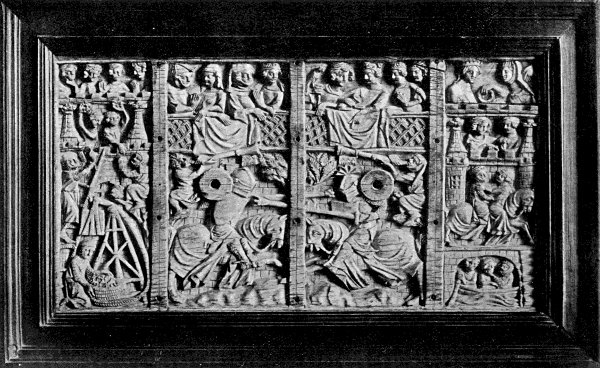
XLV “A TOURNAMENT” (Carved lid of box in ivory; 14th Century)
In the fortieth volume of España Sagrada it is stated that four ivory diptyches (quatuor dictacos eburneos) were offered in a.d. 897 to Lugo cathedral by Alfonso the Third and his queen Jimena. Other ivory diptyches were presented in a.d. 1063 by Ferdinand the Second to the church of Saint Isidore at León. José Villa-amil, in his study of an ivory statuette of the Virgin, belonging to the nuns of Allariz (Boletín de la Sociedad Española de Excursiones; nos. 76 and 77), mentions a carved ivory box (capsa eburnea) made in the year 1122 for Santiago cathedral by order of Archbishop Gelmirez; another which existed in the sixteenth century in the church of Santa María at Finisterre; and a third, used as a reliquary, which in 1572 was opened by the monks of Samos in presence of Ambrosio de Morales.
During the Middle Ages portable altars (altares portátiles) were widely used in Spain, and some were made of ivory. It was the custom to open them at the time of prayer, and as a rule they rested upon reclinatorios or hung upon the wall. The imagen abriente or “opening image” was also popular in Spain throughout the twelfth and thirteenth centuries. As the name implies, these images opened in the manner of a triptych, and were very often used as reliquaries. Specimens are preserved in many parts of Europe, but only one or two exist in Spain and Portugal. That which belongs to the nuns of Allariz dates from the end of the thirteenth century, and was a present from Queen Violante. It is described fantastically by Morales, and accurately by Villa-amil, but the quaintest account is by the chronicler Jacobo de Castro. It measures, Castro tells us, “about half-a-yard in length and is one of the fairest ever seen, since it opens downward from the neck, discovering, on plates of half-relief, the principal mysteries of Christ and of Our Lady. The devotion towards it of the people in this neighbourhood exceeds description, and God has wrought a quantity of miracles through the intercession thereof.”
A fourteenth-century triptych carved in bone with scenes from Scripture is in the National Museum. It proceeds from Aragon, and is said to have belonged to Jayme the Conqueror. The Escorial possesses a handsome ivory diptych (Plate xlvi.) which is either Spanish or Italian—probably the former. It measures exactly a foot in height by nine inches across both leaves, and is deeply carved with passages from the life of Christ. The style is late Romanic merging into Gothic, and points to the second half of the thirteenth century.
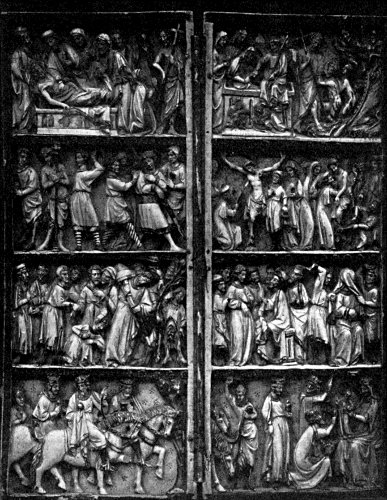
XLVI IVORY DIPTYCH (13th Century. El Escorial)
Footnotes: