LESSON II. Nœud Gordien.
Reading edition
Plate B, fig. 6, 7, 8, 9, 10, and 11.
It would be very difficult to offer to our readers an exact and perfectly intelligible explanation of this most elegant style—of the sovereign of Cravat ties, the Nœud Gordien, the origin of which is lost in the obscurity of antiquity.
Notwithstanding the laborious researches we have bestowed on this interesting subject, we have hitherto been unable to discover the name of the genius to whom the honor of this invention is due. We only know (and it is, we believe, generally known) that Alexander the great, irritated at being unable to comprehend the theory of its composition, and determined not to be foiled, adopted the shorter and easier method of solving the question—that of cutting it with his sword.
In our own times we occasionally meet with young aspirants, who, in the fullest acceptation of the term, adopt the Gordian tie; with this difference, however, that when they wish to untie it, as a sword like that of the Macedonian monarch is too cumbersome for their delicate hands, they make use of a pair of scissors, with which they are more familiar—but to our subject.
We confess, with regret, that we can only speak imperfectly of this interesting tie; but as theory is nothing when compared to practice, we will endeavour to address ourselves to the eyes, rather than to the judgment of our readers, in the conviction that, though we may be unable to accomplish our object entirely, we shall, at least, approach it as nearly as possible. Attention!
PROBLEM.
In the first place, the Cravat for this tie must be of ample size, and properly starched, ironed, and folded (as shewn plate B. fig. 6); whether it be plain or coloured is of little consequence; but a rather stout one should be preferred, as it will offer more facilities to the daring fingers of the beginner who attempts to accomplish this chef-d’œuvre.
It will then be necessary to meditate deeply and seriously on the five following directions.
I. When you have decided on the Cravat, it must be placed on the neck, and the ends left hanging (as shewn plate B, fig. 7, first time).
II. You must take the point K, pass it on the inside of the point Z, and raise it (same plate, fig. 8, second time).
III. You lower the point K on the tie, now half formed O (same plate, fig. 9, third time).
IV. Then, without leaving the point K, you bend it inside and draw it between the point Z, which you repass to the left, Y; in the tie now formed, Y, O, you thus accomplish the formation of the destined knot.
V. and last. After having tightened the knot, and flattened it with the thumb and fore-finger, or more properly with the iron, mentioned in the preceding lesson (see plate A, fig. 5); you lower the points, K, Z, cross them, and place a pin at the point of junction H, and at once solve the problem of the Nœud Gordien.
He who is perfectly conversant with the theory and practice of this tie, may truly boast that he possesses the key to all the others, which are, in fact, derived from this alone. A Cravat which has been once worn in this way, can only be used afterwards en negligé, as it will be so much tumbled by this intricate arrangement.
The slightest error in the first fold of this tie will render all succeeding efforts, with the same handkerchief, entirely useless—we have said it.
We would, therefore, seriously advise any one who really desires to be initiated in the mysteries of this delightful science, to make his first essay on a moderate sized block. We can confidently assure him, that with moderate perseverance, he will soon be enabled to pursue his studies with pleasure and advantage—on himself.
(A careful examination of the figures referred to in this lesson is strongly recommended).
Plate C.
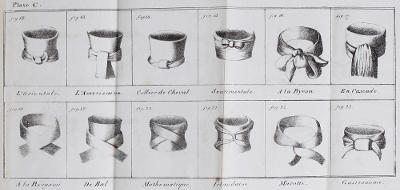
Fig. 12. L’Orientale. Fig. 13. L’Américaine. Fig. 14. Collier de Cheval. Fig. 15. Sentimentale. Fig. 16. A la Byron. Fig. 17. En Cascade. Fig. 18. A la Bergami. Fig. 19. De Bal. Fig. 20. Mathématique. Fig. 21. Irlandaise. Fig. 22. Maratte. Fig. 23. Gastronome.