LESSON I. Preliminary and indispensible Instructions.
Reading edition
When the Cravats are brought from the laundress they should undergo a careful examination, previous to classing them, to ascertain whether they are properly washed, ironed, and folded; and for the purpose of deciding on the exact style in which each may be worn with the best effect. The set of the Cravat and the neatness of the tie entirely depends on its being correctly got up.
If these requisites are not carefully attended to, the Cravat immediately fades and becomes yellow, whilst on the contrary, if properly prepared, it presents an elegant and recherché appearance.
Starch gives a combination of substance, elasticity, and suppleness to the handkerchief, and by filling up the smallest holes effectually excludes the cold air in winter. In summer it also possesses the incalculable advantage of preventing the Cravat from adhering too closely to the neck, and thereby producing an uncomfortable heat.
Whatever style may have been adopted in putting on the Cravat, when the knot is once formed (whether good or bad) it should not be changed under any pretence whatever.
In the duties of the toilet, we may compare the tie of the Cravat to the liaisons de sauces blanches of the kitchen; the least error is fatal to the whole composition of either, and as a new sauce must be prepared, with entirely fresh ingredients, so must a new tie be produced by a fresh Cravat.
When the Cravat is satisfactorily arranged, the finger must be passed lightly along the top, to smooth and thin it, and cause it to coincide with the shirt collar.
A small iron, with a handle, made expressly for the purpose, and moderately warm, is the best instrument for producing a thin and equal edge to the Cravat; it will also serve to smooth the tie; but great care must be taken that it is clean and glossy, as without this precaution spots will be inevitable.
See plate A, fig. 5.
When a Cravat has not been previously folded by the laundress, and you have prepared it yourself, of the exact height required by the style you intend to adopt, particular attention should be paid to the folding the ends, one of which must be folded down and the other up, as it may be, the right or left end.
Plate A, fig 2.
The great advantages of this method will be immediately perceptible, in the prevention of that disagreeable prominence which is generally produced at the back of the neck by the junction of the ends; which being brought to the front without being soiled, or tumbled in the slightest degree, are more easily formed into an elegant tie.
The same care and attention are necessary to the back as to the front of the Cravat.
Although coloured Cravats are made of more costly materials than those which are entirely plain, it is most clearly laid down, as a rule in the laws of taste, that they can be admitted only as undress costume.
The white Cravat, with spots or squares, is received as half-dress; but the plain white alone is allowed at balls or soirées.
The black Stock, or Cravat, is only suited to military men, not on service, who are dressed in plain clothes. As to coloured Cravats, they are entirely prohibited in evening parties.
Plate B.
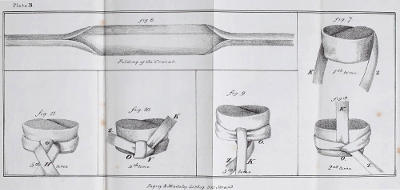
Fig 6. Folding of the Cravat. Fig. 7. 1st time. Fig. 8. 2nd time. Fig. 9. 3rd time. Fig. 10. 4th time. Fig 11. 5th time.
Ingrey & Madeley Lithog. 310 Strand.