Chapter VII
Reading edition
METAL-WORK.
1. Brass and Bronze Inlay.
Saracenic metal-work, so far as we are acquainted with existing dated specimens, begins in Mesopotamia in the early part of the thirteenth century of our era. That the art must, however, have been developing for centuries before this date, possibly at other places, is clear from the perfection of the workmanship displayed on the very earliest pieces; indeed, the oldest are as a rule the most elaborate and finished. Moreover, there is every reason to believe that the art of metal-working, engraving, and chasing, existed in a continuous development from very ancient times in the region of the Tigris and Euphrates. The earliest Saracenic bowls are decorated with hunting-scenes which remind one at once of the favourite designs of the Assyrian bas-reliefs; the bronze gates of Balawat, and the Sassanian cups which have come down to us,[49] present many points of close resemblance to these first examples of the Saracen artist. There was, however, a special reason for a notable extension and development of the art in the thirteenth century.[50] During the earlier ages of Mohammadan rule, though the Khalifs were not remarkable for their piety or observance of the laws of the Korān, a certain decent outward appearance of conformity to the regulations of Mohammad seems to have prevailed. Among other prohibitions, that which forbade the representation in art of animate creatures was particularly observed. The rulers may have cared little about such laws, but the people probably had not yet shaken off the impression of Mohammad’s puritanical teaching, and there were enough orthodox Arabs about the court of the Khalifs to make any flagrant deviation from such a law as that which proscribed images dangerous in the extreme. The coins of the period prove that this was the case. ‘Abd-el-Melik’s abortive attempt to follow the Byzantine model, and place his own image on the coinage, was succeeded by a strictly plain currency, on which no approach to the representation of a living thing appeared for five centuries. But when the Turkish guards, whom the Khalifs unwisely imported for their own safety, were followed by Turkish hordes, who founded dynasties and by degrees abstracted the whole power of the Khalifs, the observance of the law against images became less stringent. The Turkish immigrants were Mohammadans, but they did not adhere to the straitest sect of the Muslim Pharisees, and took a lenient view of the minor regulations of Islām. We cannot be too thankful to them for this happy indifference, for we owe the highest development of Saracenic art in the East to Turkish or Tartar rulers. Among the earliest to introduce the representation of images on the coinage were the small dynasties of Mesopotamia, who followed in the wake of the great Seljūk invasion. The large copper coins of the Urtukīs and Beny Zenky abound with figures of men, saints, princes, and beasts, some derived from Byzantine coins, others taken from the symbols of astrology.[51] Christ and the Virgin are among the images employed by these indiscriminating coiners, while such emblems as the two-headed eagle and the centaur-like figure of Sagittarius show an oriental and probably Assyrian derivation. Coins of this kind begin to be common in the twelfth century, and it is not hard to trace a connection between this sudden appearance of imaged coins and the almost contemporary fabrication of metal bowls and cups and caskets bearing similar images and emblems. The two-headed eagle, the signs of the zodiac, the images of aureoled saints or horsemen engaged in the chase, are found alike on coins and vessels, but in much greater abundance and variety on the latter, where the large surfaces naturally afforded more room for their display. We cannot be far wrong in assuming that the art of metal-working, which had for ages been characteristic of Mesopotamia, where the needful mines were found,[52] after slumbering under the Khalifs, received, like the coinage, a sudden stimulus from the advent of the Turkish dynasties. Up to the twelfth or thirteenth century the arts doubtless lingered on under the stigma of the orthodox, and it needed only the favour of the powerful, especially of princes so fond of display and gorgeous surroundings as the Tartar dynasts, to give a new life to the long-restrained skill of the Mesopotamian artists, and to encourage them to higher efforts.
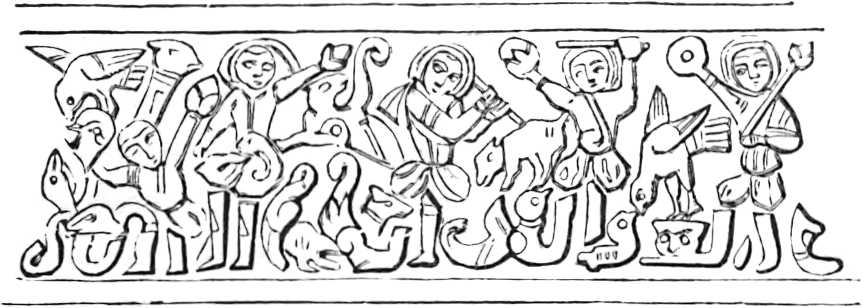
The Mesopotamian, or, to use a shorter term, derived from its chief seat, the Mōsil style is characterized by a predominant use of figures of men and animals. Aureoled horsemen engaged in the various methods of the chase, to which the Persians had ever been addicted, surround the bowls or other vessels in broad bands; with lance or bow, with leopard or chītah on the crupper, with hawk on wrist, or attended by hounds, they pursue the bear or lion or antelope or other quarry; crowned and aureoled princes, seated cross-legged on high-backed thrones, attended by pages, and holding the forbidden wine-cup in the hand, occupy panels or medallions; musicians with cymbals, lute or pipe, dancers, and other types of festivity, or the personified Signs of the Zodiac combined with their ruling planets, vary the monotony of the hunting-scenes; and combats between animals, birds, and men, are among the subjects of the engraver’s skill. In one instance the bottom of a large bowl is covered with the spirited representation of a sporting party on the water: a boat is pulled by three men, two others shoot wild ducks with their arrows, another is engaged in cutting the throat of a wounded duck, a seventh sits at the mast-head on the look-out, and another dives beneath, pursued by an alligator.[53] Long chains of beasts of the chase, lions, panthers, chītahs, antelopes, hounds and birds, pursue one another in narrow borders, and bands of scroll-work or twist-pattern divide the different zones of the ornamentation, while the intervening spaces are filled with ducks and other water-fowl. The ground is generally covered with bold arabesques, or with a kind of hook or key pattern, and little medallions or annulets filled with a simple rose design serve to divide the borders into equal sections. Arabic inscriptions, in the Naskhy character, run round the vessels in narrow bands, sometimes (but rarely) having the tops of the letters chased in the image of human faces or interwoven with the legs of an upper border of beasts of the chase (fig. 73). Occasionally a meaningless inscription, consisting of a few decorative letters frequently repeated, takes the place of the genuine inscription, and so far is this from being an indication of late date, (though it is perhaps most common on late work,) that it is found on objects which undoubtedly belong to the thirteenth century, and occurs, for example, on a cup found buried with the body of Bertrand de Malzand, Abbot of Montmajour, who died in that century.[54] As a rule, the shoals of fish, which are so common at a slightly later period on the bottom of drinking vessels and other utensils intended to hold liquids, do not occur on the early Mōsil work.
FIG. 73.—INSCRIPTION INTERWOVEN WITH FIGURES ON THE “BAPTISTERY OF ST. LOUIS.”
But the main characteristic of Mōsil and all early Saracenic metal-work is the lavish use of silver inlay. Gold does not appear to have been employed by the Mōsil artists, but in silver they were prodigal. Every part of the design was covered with plates of the precious metal, and the intervening spaces, amounting to little more than narrow lines, were generally filled with a black bituminous composition which concealed the copper or brass, and set off the brilliancy of the silver designs. The silver inlay is as nearly as possible let in to the level of the brass base, and is secured by no pins or solder. The delicate hold obtained by the process employed has unfortunately in most instances permitted the greater part of the inlay to escape in the course of wear, and we are thus enabled to observe accurately the method of inlaying adopted by the Saracen workmen. This consisted, in all work of the best period, in cutting away the surface to be inlaid in planes deepening towards the edges, slightly undercutting the edges themselves, and then forcing the silver into the cavity thus excavated, and burnishing the rebated edges over the inlaid plaque.[55] In the case of large surfaces, in order to get a better hold, the edges were not only undercut, but slightly toothed or serrated, but this is by no means universal, and is often a sign of a later repairing of the vessel by less skilful hands. In the inlaying of very narrow lines, where there was hardly room for undercutting, a series of notches were punched along the line with an oblong-headed instrument, and the inlay beaten or pressed with agate or jade into the holes, which served to hold the thin thread. The earliest work is never treated in the mode which became common in Venetian and later inlay, by the process of stippling the whole of a large surface with little triangular notches, which served like teeth to hold the metal plates. Whenever we find such stippling on ancient work, it is a sign that the inlay has dropped off, and has been restored by a later hand. The only approach to stippling in early work is the punching oblong (not triangular) notches in inlaying thin threads of silver or gold.
M. Lavoix, in an interesting paper on “Les Azziministes,”[56] distinguishes three methods of inlaying; (1) incrustation, where a thread of gold is inserted in an under-cut groove; (2) plating, where a plate of metal is enclosed between slightly raised walls, which, he says, is the Damascus manner; and (3) where the workman runs a sort of spur-tool rapidly over the surface to be inlaid, so as to make a series of notches, and then presses on the thin leaf of metal.[57] The last method, he adds, is that chiefly in vogue in Persia, or Al-Ajam, to give the country its Arabic name, whence the art came to be known in Europe as Alla gemina, Algeminia, All’ Azzimina, and the inlayers took the name of Algemina, or Azzimina. The Comte de Rochechouart[58] describes the three processes of damascening or inlaying still employed in Persia. He distinguishes the processes as follows: (1) Zarkhonden, damascening in relief, where the base is cut out and the edges under-cut, and the precious metal pinned on with gold nails, after which the surface is chased. (2) Zarnichanest, damascening in the flat, where the same process is used, but the gold is pressed in with a piece of jade, and all that projects is burnished off. (3) Zarkouft, which, he says, is the most usual way, where the design is traced with the graver, but is not cut out, and the surface is toothed with a special tool, and the gold leaf, which is used very thin, is pressed on with jade, and then exposed to the fire till it sweats, after which it is again burnished with jade, and the process is repeated until the incrustation is firmly fixed. The last process is very cheap, as little gold is used. It is evident that in this last process (which preserves only the name of the old Keft work), we have an inferior development of the stippling process employed by the Oriental artists of Venice, and by the late repairers of Mōsil work. The difference is, that instead of using an honest plate of gold or silver and really inlaying it in a sunken bed, relying on the stippling only to keep the central portions down, the modern Persian method depends wholly on the stippling and the heating, and is not inlay at all, but a cheap imitation. Another process, mentioned by Sir Digby Wyatt (in Waring’s Art Treasures, 1857), is described as consisting in punching little holes round the outline of the surface to be covered, and burnishing down the silver till it is forced into the holes and thus held; but I cannot recall any example of this process among the Saracenic objects I have examined.
When with incredible labour the whole surface of a bowl or other object had been excavated in the intended designs, and the edges had been under-cut, and the silver plates burnished into the recesses thus prepared, the work of the Mōsil artist was only half done. He had next to chase the surface of each plate with details which could not be represented in the outline. The faces and dress of the horsemen and princes, the fur of the beasts, the feathers of every bird, and countless other details, had to be slowly and minutely engraved on the surface of each little plate of silver, till the extraordinarily delicate and finished effect which is characteristic of true Saracenic work had been attained. There were no half-measures, no scamped work, with the Saracen artists; every part of the inlay, if only the size of a pea, if it represented anything but the smooth face of an Arabic letter, must be chased; and these old-fashioned workmen had not yet learned the economical practice of modern artisans, who neglect whatever part is not likely to be seen, but took as much pains with the portions of their work that were not to be seen as with those that were meant to be always visible. Mahmūd the Kurd, a Saracen artist of Venice, carried this principle of honest work so far, that when he made use of the stippling process to retain his silver plates in their places, he traced his stipples in a graceful scroll-pattern, although he knew that they would immediately be concealed by the silver they were designed to hold. If the silver had not accidentally been worn off, we should never have suspected the true artist’s spirit hidden beneath.
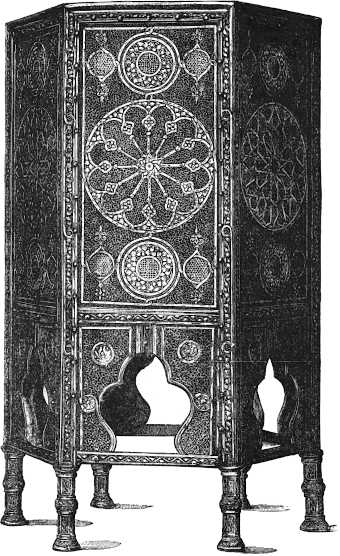
FIG. 74.—TABLE FROM THE MARISTAN OF KALAUN. Thirteenth Century. (Cairo Museum.)
What has been said about the processes of inlaying and chasing applies to the whole of the best period of Saracenic art in the East, to the Syrian and Mamlūk styles, as well as to the Mōsil work, but the predominance in 14th century Mamlūk work of large inscriptions, which need no chasing, instead of the multitudinous figures of the Mōsil artist, renders the later work slightly less elaborate, though even here the prevalence of ducks and birds in the ground-decoration demands prodigious labour in chasing.
Between the Mōsil work and the commoner Mamlūk style, I have distinguished a class to which I have ventured to give the name of Syrian. It combines some of the characteristics of the earliest Mōsil style with others that belong to the succeeding art of the Mamlūks. Thus it shows on some examples the usual Mōsil decoration of figures, while it presents numerous examples of the confronted birds, or fighting cocks, and groups of four or six ducks or other fowl arranged in a circle with their heads together, and also the rosette of flowers and leaves which remind one of Damascus titles,—all of which are typical of the later work of the Mamlūks. One special ornament is to be noticed in this class: this is a medallion filled with a sort of key ornament, consisting of a number of Z’s arranged in a circle, and inlaid with gold wire. These little medallions occur in large numbers all over the writing-boxes, which appear to have been the special product of this school of metal-work, and they seldom recur in similar abundance at any other period. The reasons which lead me to regard this class as the fabric of some Syrian city, probably Damascus or Aleppo, are these:—the style is certainly distinct from both that of Mōsil and the later art of Cairo; gold inlay is historically known to have been a favourite decoration with the Damascus artists, of whom, according to M. Lavoix, there was a distinct school;[59] the rosettes of flowers and leaves have a decidedly Damascus look; the only name, or rather title, that can with probability be identified on the objects classed under this division, appears to refer to a prince of Aleppo, whose slave or Mamlūk made the writing-box described on p. 222.
FIG. 75.—PANEL OF TABLE OF EN-NASIR, SON OF KALAUN. (Cairo Museum.)
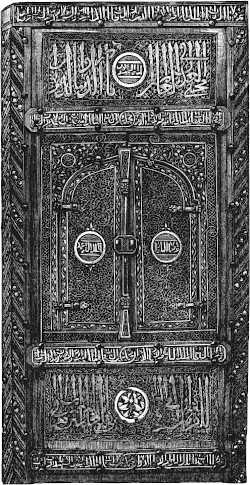
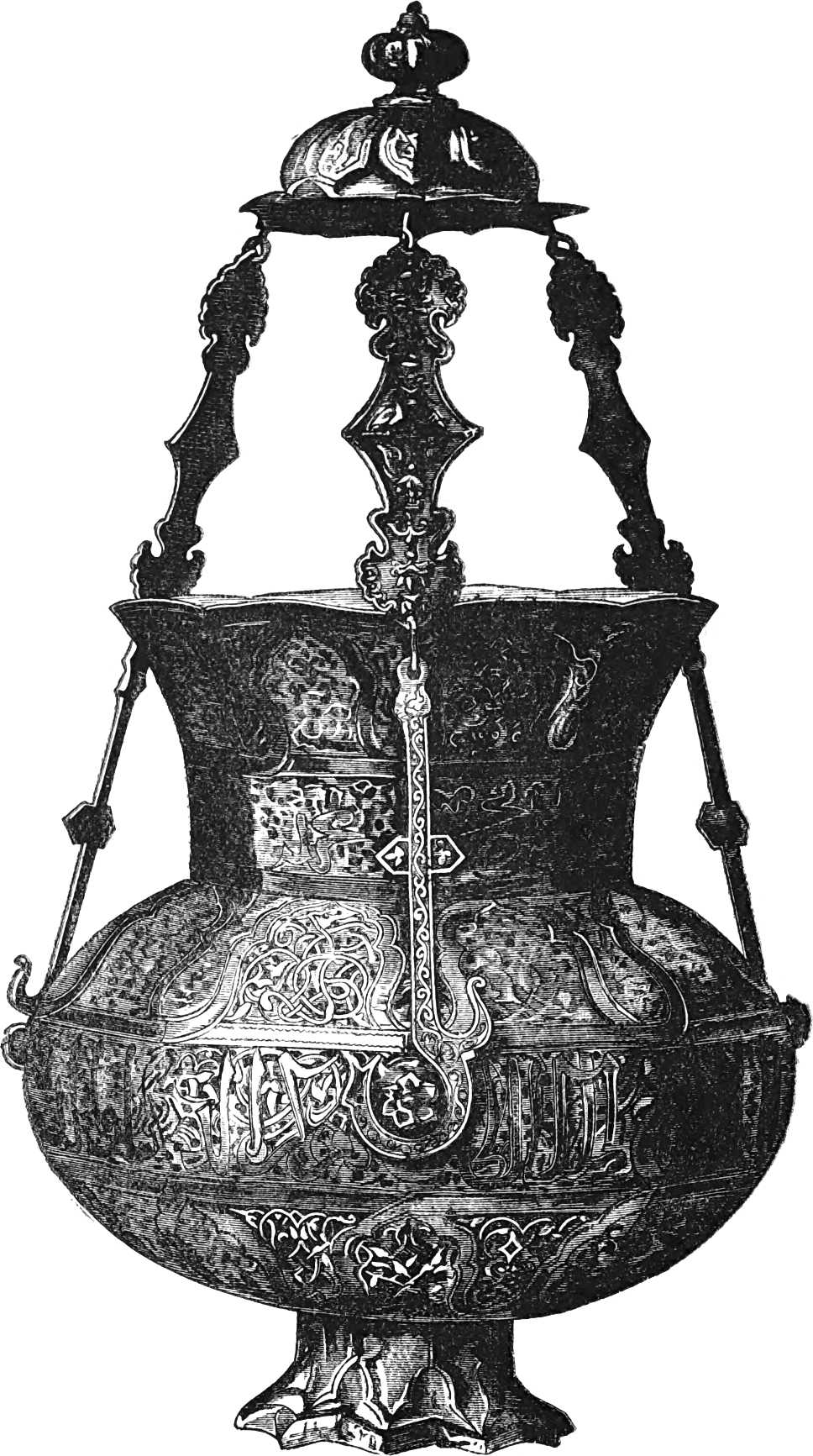
The third, or Mamlūk, class is at once the most numerous and best identified by inscriptions. The greater number of examples belong to the time of the Sultan En-Nāsir Mohammad ibn Kalaūn and his many and wealthy courtiers, the Nāsiry Mamlūks, and it is probable that the style acquired its distinctive character during this period of sumptuous magnificence in the fourteenth century. Indeed we shall see that Beysary, who lived through Kalāūn’s reign, employed the art of Mōsil for his perfume-burner. Kalāūn, again, to judge by his carved doors in the Māristān, preferred the Mōsil style of figure-work, which still probably held the market as the best of its kind. It is, therefore, not unreasonable to place the beginning of what I have called the Mamlūk style at the accession of En-Nāsir Mohammad, who reigned from A.H. 693 to 741 (A.D. 1293 to 1341). From this time onwards, at least until the conquest of Egypt by the Othmānly Turks, the Sultāns and Amīrs of Egypt delighted to surround themselves with exquisitely chased and inlaid vessels and furniture. The Museum at Cairo contains two inlaid tables (figs. 74 and 75), one of which bears the name and titles of the Sultan En-Nāsir ibn Kalāūn, in brass filigree work, inlaid with silver medallions, panels of flowers, and geometrical designs, and Naskhy and Kūfy inscriptions. These tables were used to support such a tray as the splendid specimen preserved in the South Kensington Museum, described at p. 229, on which the Sultān’s repasts, and the wine service that followed, were spread in the usual Eastern manner. The doors of the mosques of this period were covered, not with the rough but effective plaques of cast bronze, which we see on the doors of Beybars (figs. 83-6) in the thirteenth century, but with cut bronze plates, chased and sometimes inlaid with silver. Mosque lamps, when they were not of enamelled glass, were of exquisite filigree silver inlay (fig. 76). Large chandeliers hung in front of the niches of many of the mosques, made of repoussé bronze in an arabesque design and covered with chasing, or of iron filigree work (fig. 78), with zones of shining copper, bright as red gold. Korāns were enclosed in gold cases adorned with precious stones.[60] The utensils of the royal and aristocratic palaces were of inlaid brass and bronze; large bowls or tanks, small cups and trays, censers, candlesticks of ungainly form but beautiful workmanship, ewers, caskets, writing-boxes, all were covered with silver ornament, arabesques, flowers, inscriptions, and geometrical designs, with, not seldom, the heraldic badges of their owner. The specimens described below range from the beginning of the fourteenth to the end of the fifteenth century, when the art of inlaying was already on the wane; but an examination of the numerous collections, public and private, of Europe would doubtless carry the history of the art to a somewhat later date. In the present day the Cairo workmen engrave brass trays and vessels of considerable merit, and if they do not now produce to any appreciable extent the inlaid work of their ancestors it is probably because it is too costly for most purchasers, and is neglected by the modern Pasha.
FIG. 76.—LAMP OF SULTAN BEYBARS II. A.D. 1309-1310.
There can be no doubt that most of this Mamlūk work was made at Cairo. Although the figured work of Mōsil, taking a new start in the 12th and 13th centuries, seems to have at first dominated the artists of the Mohammadan East, and to have influenced schools of design far from its centre, there is no question that inlaid metal-work existed in Egypt before the 13th century. The inventory of the palace of the Fātimy Khalif El-Mustansir, in the 11th century, contains numerous entries of inlaid metal-work,—gold plates enamelled in colours; writing-boxes in gold and silver; great vats for washing clothes, standing on three legs, representing animals; mirrors inlaid with gold and silver in borders of precious stones; quantities of vessels adorned with chased gold; six thousand gold narcissus vases; and even row-galleys coated with gold plates. Nāsir-i-Khusrau, who saw this Khalif holding a state reception, says his throne was covered with gold, on which were depicted scenes of the chase, huntsmen and dogs, and inscriptions; the balustrade was of gold trellis-work of a beauty defying description, and the steps behind the throne were of silver.[61] The same observer tells us of a magnificent silver chandelier placed in the mosque of ‘Amr by the Khalif El-Hākim, which was so large that they had to break down the door to get it into the mosque.[62]
Fātimy work spread to Sicily, where we find very early and singularly perfect metal-work made by Mohammadans. The Bayeaux ivory casket (Prisse, iii., pl. 157), with its finely chased silver plates, has an unmistakable Fātimy inscription in combination with confronted birds, peacocks beak to beak, parrots, and other Mōsil characteristics. The ivory box of Ziyād ibn Aflah, in the South Kensington Museum, with the date 359 (A.D. 971), is probably due to Fātimy workmen. The crystal vase preserved in the treasure of St. Mark at Venice bears the name of El-‘Azīz, a Fātimy Khalif of the last quarter of the tenth century, and is closely similar to another crystal vase of St. Denis, now in the Louvre, which bears inscriptions of the same character as those on the Nürnberg mantle, which was made at Palermo in 1133 under the rule of Roger.[63] These crystal vases, of which examples with the name of El-‘Azīz are mentioned by El-Makrīzy, and the embroidered silks, show a power of design and execution which implies similar proficiency in metal-work. In fine, there is no doubt that the artists of Egypt under the Fātimis were skilled to a degree that found no parallel in the handicrafts of Europe. The art may have succumbed for a while to the influence of the Mōsil school, which would naturally be imported by rulers like Saladin and his successors, who came from the very region of the Mōsil silversmiths; and the Fātimy work may have owed much of its perfection to the teaching of Mesopotamian artists of a date earlier than any existing specimens;[64] but it is impossible to overlook the existence of an ancient skill in arts of all kinds in Egypt itself, and to ascribe much of the merits of the Mamlūk work to the traditions of the Fātimis. The derivation is the more likely, inasmuch as the Mamlūk work betrays more of the arabesque and floral influence of the Egyptian school, as we see it displayed in the older mosques of Cairo, than that of the figure ornament of Mōsil. The ducks of the Mesopotamian swamps indeed survive and are emphasized, in deference, as I believe, to the name of the founder of En-Nāsir’s dynasty, Ḳalāūn (the “duck”); but the general character of the Mamlūk style is certainly different from that of Mōsil, and partakes of the general Saracenic character of arabesque and geometrical design, which was no doubt inherited from the earlier rulers of Egypt, and was probably to a large extent fostered by skilful artists among the Copts.
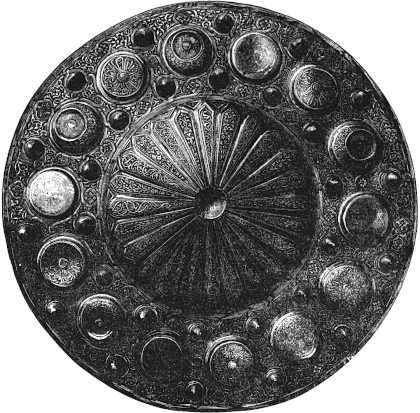
FIG. 77.—BASE OF CHANDELIER OF SULTAN EL-GHORY. Beginning of 16th Century. (Cairo Museum.)
It is unfortunate that so few examples of Coptic art can be ascribed with certainty to fixed dates; for the establishment of the existence of an early Coptic school of art, derived from Byzantium, would explain much that is obscure in the history of Egyptian art. From what Mr. Butler has been able to bring together in his valuable work on the Coptic Churches of Egypt, it seems clear that, however deeply the Saracens were indebted to the Copts for their designs and methods in wood and ivory carving and inlay, they did not draw their metal-work from the same source. Coptic metal-work shows no trace of affinity to the Saracenic bowls, trays, and censers described in the present chapter. The lamps, crosses, textus cases, and flabella of the Copts are more nearly related to European and Byzantine models than to contemporary Saracenic work. Yet the remark made above, that Coptic influence is traceable even in this art, holds good; since it is not uncommon to find one art suggesting ideas to another, and the Coptic designs in wood and ivory may have helped to form the Mamlūk style in brass and silver.
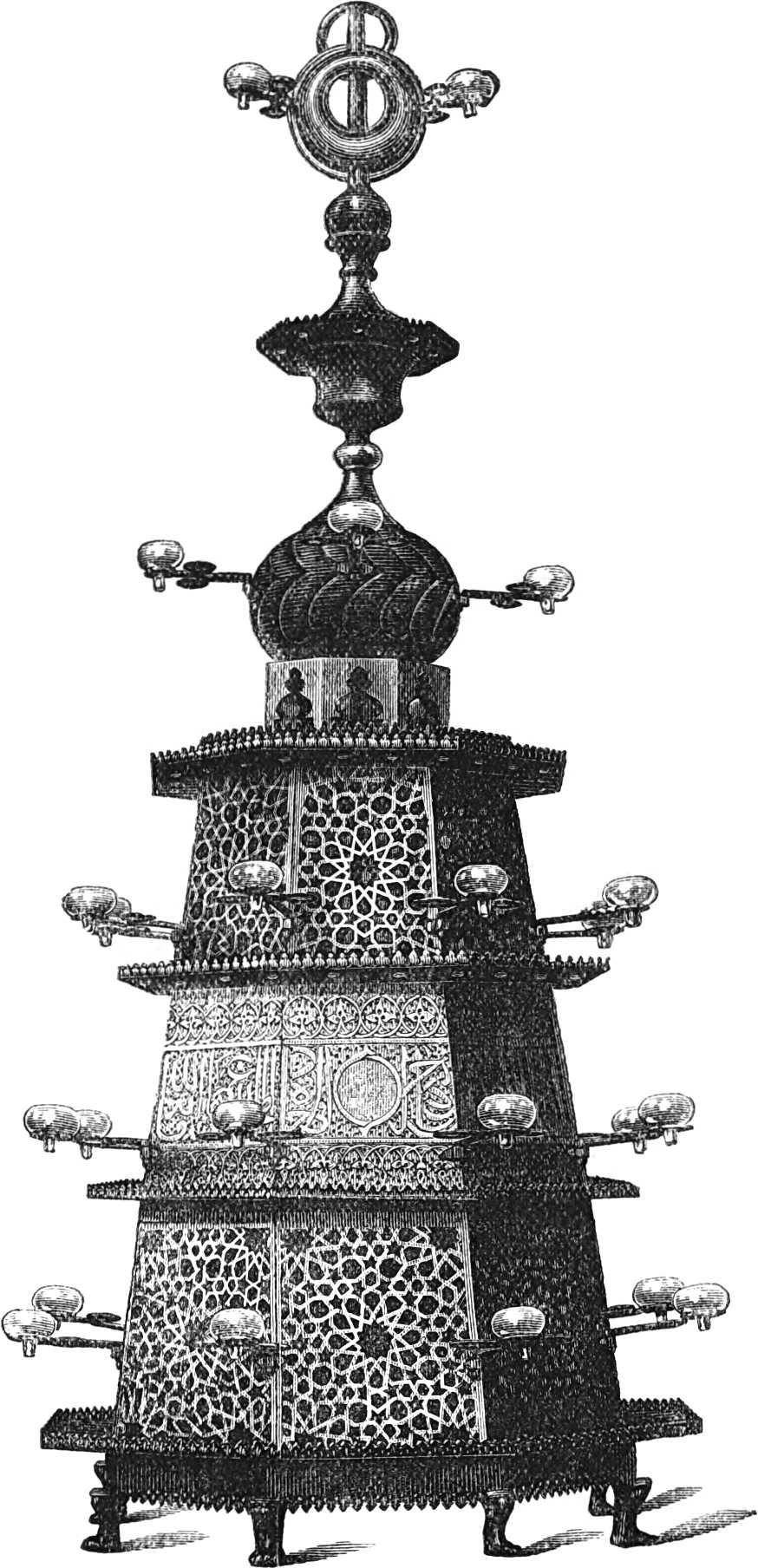
FIG. 78.—LANTERN OF SHEYKH ‘ABD-EL-BASIT. (Cairo Museum.)
But it may be asked, especially when the prevalence of what I have described as a Damascus-looking rosette on Mamlūk work is considered, whether the metal-work of the Mamlūks was not manufactured at their second capital, Damascus, rather than at Cairo, and whether the old Fātimy art had not become extinct, to be succeeded by a Damascus school taking up new ground? There is no reason for supposing that the artists of Damascus stopped with the style described under my second class—if indeed that be really Syrian; doubtless they continued to execute equally fine specimens, and some of the objects bearing Mamlūk names may have been made at Damascus. But it should be noted that there is practically no metal-work of any merit at Damascus now, while the Cairo workmen are still skilful; and further, I can quote a passage from El-Makrīzy which mentions a flourishing school of metal artists under the Mamlūks at Cairo.
“Sūḳ El-Keftīyīn (‘market of the inlayers’). This market . . . contains a number of shops for the making of keft, which is inlaying copper vessels with silver and gold. There was a great sale for this kind of work in the houses of Miṣr [Fusṭāṭ], and the people had a keen relish for inlaid copper. We have seen it in such quantities that it could not be counted, and there was hardly a house in Cairo or Miṣr which had not many pieces of inlaid copper. The equipment (شورة) of a wedding was not complete without a dikka (or stand) of inlaid copper. The dikka means a thing like a divan-frame, made of wood inlaid with ivory and ebony, or painted. Upon the dikka were set cups of yellow copper [brass] inlaid with silver, and the set consisted of seven pieces, some smaller than others, the largest holding about an ardebb of wheat. The length of the [bands of] silver inlay, on those of the larger size, was about a third of a cubit, and the breadth two fingers. And similar to this was a set of plates, in number seven, one fitting into the other, the largest reaching to about two cubits and more. And besides that [inlaid work was used for] lanterns, and lamps, and vessels for الاشنان, and basins, and ewers, and perfume burners. The price of a dikka of inlaid copper thus mounted up to 200 dinārs of gold. If the bride were of the daughters of the Amīrs and the Wezīrs and the chief secretaries and the chiefs of the merchants, the outfit of the marriage included seven dikkas, one of silver, another of inlaid copper, another of white copper, another of painted wood, another of china, another of crystal, another of kedāhy—and this is of pieces of painted sheets [papier-maché?] brought from China: we have seen very many in the houses, but the art is now lacking in Misr.”[65]
El-Makrīzy goes on to describe the dikka of the Kādy ‘Alā-ed-dīn, Muhtesib (or inspector of the markets) of Cairo, who married a daughter of the merchants, named Sitt El-‘Amāïm (“Lady of the Turbans”), of which the metal alone consisted of a hundred thousand pure silver pieces; and then mentions the wedding of a daughter of Sultan Hasan with an Amīr of Sultān Sha‘bān, and describes the fine trousseau she had, including a dikka, or service, of crystal, with a crystal bucket engraved with representations of wild beasts and birds, big enough to hold the contents of a water-skin. He concludes the section with the remark that “the demand for this inlaid copper-work has fallen off in our times, and since many years the people have turned away from purchasing what was to be sold of it, so that but a small remnant of the workers of inlay survive in this market.”[66]
The passage above quoted from El-Makrīzy establishes beyond doubt the fact that there was a school of inlayers and metal-workers at Cairo which survived, though in diminished numbers and prosperity, to his own day, i.e. about the year 1420; and the bowl (fig. 89) described below p. 238, with the name of Kāït Bey, fifty years later, must, if it is of Cairo workmanship, as I believe, have been made by the remnant the historian describes as still occupying the Sūk El-Keftīyīn.[67]
The general characteristics of the class which I have termed Mamlūk work are easily recognizable. The Arabic inscriptions are large and bold, and often, in the case of trays or other flat surfaces, radiating; small inscriptions containing the name or title of the Sultān on a fess, or perhaps a coat-of-arms, are enclosed in a medallion surrounded by a belt of flowers and leaves of the kind familiar on Damascus tiles; the ground is freely sprinkled with ducks and other fowl, and the bottom inside the bowls is generally ornamented with a shoal of fish, suggestive of the purposes for which the vessel was intended; the borders, generally of arabesque or flower scrolls, but sometimes of beasts pursuing each other, are broken by little whorls, typical of the style, and there are no figures, except when the bowl or other vessel is intended for magical or astrological purposes. The style is very distinct, and once seen can never be mistaken.
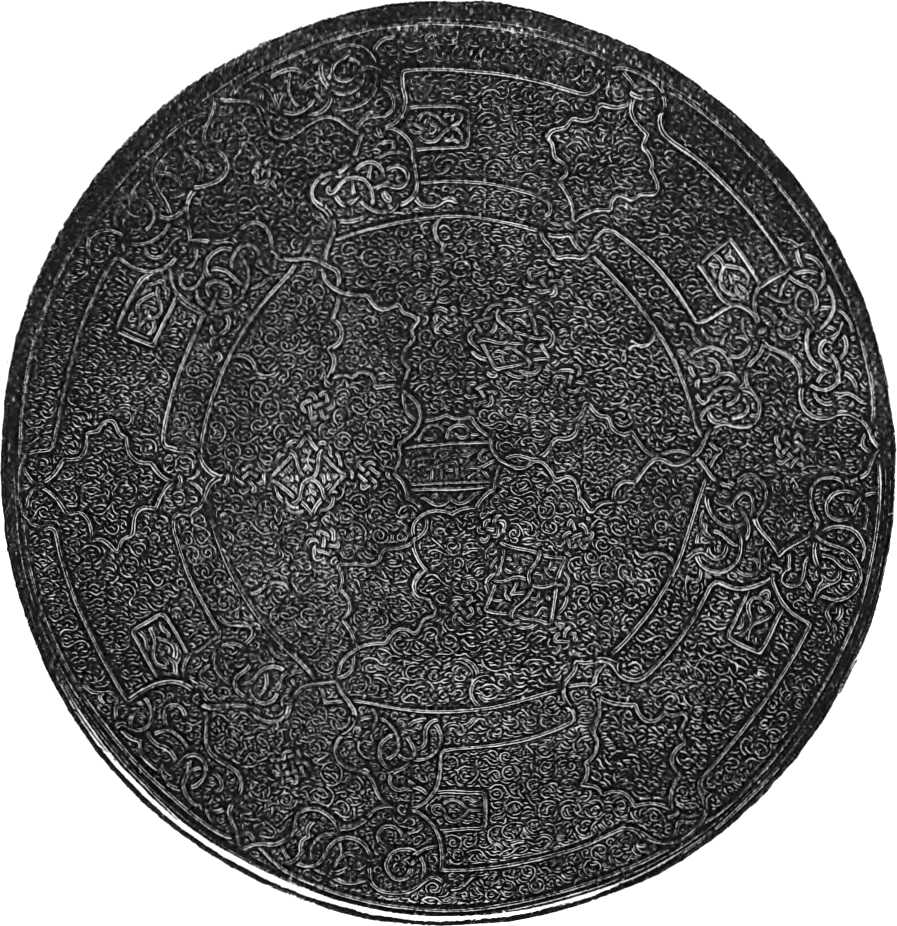
FIG. 79.—COVER OF SHERBET BOWL. Made by Mahmud El-Kurdy at Venice. Sixteenth Century. (South Kensington Museum.)
There remains one more important branch of the history of Saracenic metal-work which must not be passed over, although it does not belong to our special subject of Egyptian Art. This branch is the Saracenic art of Italy, and notably Venice. It stands to reason that the exquisite workmanship of the chased vases and bowls of the Saracens must have soon found its market in Europe, and there is plenty of evidence that even before the Crusades the monasteries of the West had learned to prize chalices made by the infidels. A strong impetus must have been afforded by the Mohammadan proclivities of Frederic II., and his extensive employment of Saracen mercenaries in his campaigns against Gregory IX. These foreign troops were settled in various cities of Italy, where they left their traces in the names as well as in the blood and civilization of the places they inhabited. Thus Lucera came to be called Nocera delli pagani; thus Pisa, which was occupied by Saracen troops for the greater part of the thirteenth century, had its Oriental quarter, known as the “Kinsica,” and even in the preceding century the poet Donizo had lamented the city being “delivered over to Moors, Indians, and Turks;” thus, too, there was a “Via Sarracena” at Ferrara. Saracenic artists lived at Genoa and Florence, and no doubt taught their art to the native workmen. Cellini says he copied Oriental poniards and improved upon them. Before the Crusades, Amalfi was the port whence pilgrims started for the Holy Land, and it was frequented by merchants from Egypt and the East. Here was opportunity enough for the introduction of Saracenic art into Europe. But beyond all these lesser entrances, Venice was the chief port for Eastern wares. Venice had her colonies in the coasts of the Levant, in Turkey, Greece, and Palestine; Venice had treaty rights in Egypt and Syria; Venice welcomed the merchants of the East with equal privileges, and assigned them the old palace of the Dukes of Ferrara for their habitation; and at Venice the name of the “Fondaco dei Turchi” still survives.[68]
This almost Oriental city was the centre of Saracenic metal-work in Italy. Numerous salvers, cups, censers, and other articles, bear the unmistakable stamp of Venetian handicraft. The first and most salient distinction of this European branch of Saracenic work is in the form; the somewhat crude outlines of the true Saracenic bowls and candlesticks give place to more graceful and obviously Western shapes. In the decoration considerable alterations are made. In place of the inscriptional medallions or simple Mamlūk shields, European coats-of-arms are introduced; and the general treatment of the decoration is different. The arabesques remain, but they are more elaborate, and at the same time more mechanical. Silver inlay is sparingly used, and in many instances is entirely wanting; and the design is brought out, not by the contrast of metals, but by relief; the pattern being raised, and the surrounding ground cut away to a lower level. When there is inlay, it is generally in thin lines, secured between slightly raised and serrated edges, and further held by stippling the surface beneath the plate with little notches; but even then the design is in relief. The artists who produced this extremely delicate and beautiful work were at first and probably for some time Easterns. The most famous name we meet with on the sherbet-bowls and trays of Venice is that of Mahmūd El-Kurdy, who must have come from the Kurd country in the neighbourhood of the Euphrates, and was thus an heir to the traditions of the Mesopotamian metal-workers. The number of these Venetian and Italian specimens in the British Museum is considerable, and the series has been instructively arranged, so that one can trace the gradual transition from the Mamlūk style through the Venetian school to the other still semi-oriental salvers of mediaeval Europe. The South Kensington Museum has also a few fine examples of the Venetian style of metal-work, including a specimen of Mahmūd El-Kurdy’s skill which is engraved in fig. 79. Presently the native Italian workmen took up the art, calling themselves Azzimini—workers, all’ Agemina, “in the Persian style”—as did Paulus Ageminius, who made the vase described by M. Lavoix, and Giorgio Ghisi Azzimina of Mantua, a great name among them: but in their hands the art changed character, and we have to go to the East again to see what remains of Saracenic art in the well-chased brass trays of Cairo, the floral decoration of Persian narghilas, and the rude arabesque bowls of Syria and Tōkāt.
I now proceed to describe some typical examples of Saracenic metal-work in our English Museums.
I. Mōṣil-work.
1. Ewer.—Brass inlaid with silver. Made by Shugā‘ ibn Hanfar, at Mōsil, in A.H. 629 (A.D. 1232).
On a ground of key-pattern, zones of scenes of the chase and festivity, benedictory inscriptions, and the date (at the junction of the neck) نقش شجاع ابن حنفر الموصلى فى شهر الله المبارك شهر رجب فى سنة تسع وعشرين وستماىة بالموصل “Engraved by Shugā‘ ibn Hanfar of Mōsil, in the blessed month of God, the month Regeb, in the year 629, at Mōsil.” The figures are arranged in four zones, two of which comprise each ten seated figures, enclosed in quatrefoils, playing musical instruments, drinking from cups, &c.; while the other two zones are adorned with large mounted figures, to wit:—Upper large zone: 1. Horsemen with chītah on rump; 2. Figure seated on throne holding cup and attended by two squires; 3. Horseman with hawk on wrist, rabbit before horse, dog beneath; 4. Archer, bending one knee, shooting ducks; 5. Two men fighting together with swords and round shields; 6. Horseman with beast on rump, a dog beneath; 7. Figure seated on throne, with two attendants, bird above; 8. Horseman spearing lion beneath horse’s head; 9 and 10 were occupied by handle and spout (the latter missing). Lower large zone:—1. Man and woman in howdah on camel’s back, and man leading; 2. Archer drawing bow, and woman in pillion, on a camel; 3. Two seated figures, one playing harp, the other pipe; 4. Horseman with sword and round shield combatting foot man similarly armed; 5. Seated figure, with jug held by servant; 6. Two women playing lute and cymbals; 7. Horseman, with uplifted arms, launching leopard or chītah from the crupper in pursuit of a deer; 8. Two women, with bottle, bowls, and fan; 9. Horseman shooting arrow down throat of boar; 10. Seated king, wearing turban, receiving homage, of a man who prostrates himself before throne and kisses king’s hand; a woman stands behind. Suns (with human faces) divide the ten figures of the lower zone, and floral medallions those of the upper zone. Between the two is a frieze of hunting-scenes broken by octagons of key-pattern: men and beasts and birds contending in fantastic attitudes.
[Brit. Mus., Blacas. Coll. Reinaud, ii. 423.]
COVER.
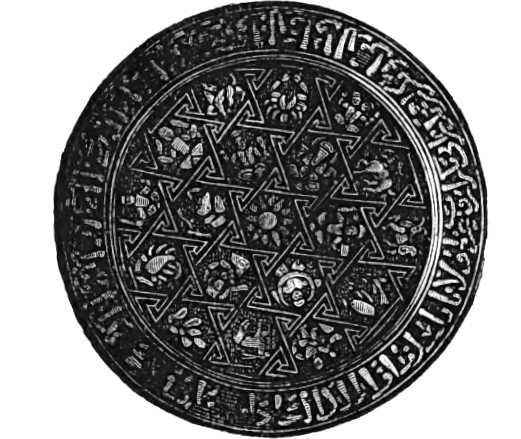
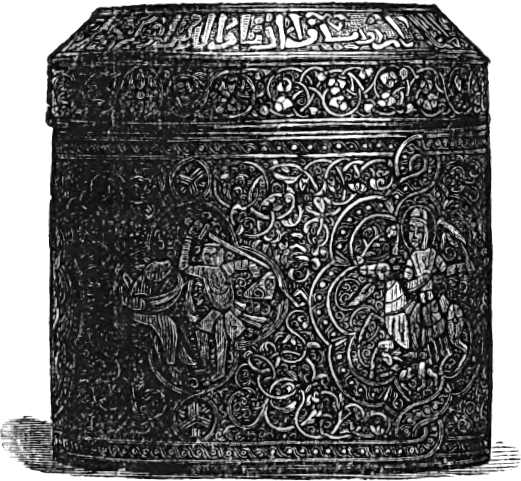
FIG. 80.—CASKET OF EL-‘ADIL, GRAND-NEPHEW OF SALADIN. Thirteenth Century. (South Kensington Museum.)
2. Censer.—Brass inlaid with silver. Dated A.H. 641 (A.D. 1243).
Shape, a cylinder on three feet; with a dome-shaped upper part, hinged to open and shut, and perforated in a zone round middle. The upper part is divided into four zones. Beginning at the button at top, the first zone contains an Arabic inscription:—انا فى باطنى الجحيم ولاكن ظاهرى قتر رائحات احبّات عمل فى سنة احد واربعين وستمائة “Within me is hellfire; but without float sweetest odours: it was made in the year 641.”
The second zone is composed of a three-strand plait-pattern.
The third zone, pierced with small holes, is covered with arabesques, except four medallions which are filled with the characteristic key-pattern &c.
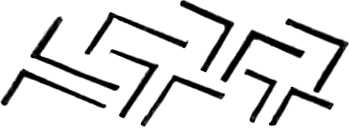
The fourth zone has the same plait-pattern as the second.
The lower part is ornamented with three medallions (one reserved for a handle, which is missing) of key-pattern, with scroll border; and three arabesque quatrefoils, each surrounded by four stars; on a ground of key-pattern; and a benedictory Arabic inscription between the medallions and quatrefoils. The feet are engraved with arabesques.
The bottom is of a later date, and is ornamented with an interlacing geometrical design in five star centres round central star. On the rim of the original bottom are traces of illegible inscription.
[B. M., Henderson, 678.]
This is not a typical example of Mōsil-work; but its early date procures it the second place, and the key-pattern is characteristic, and will be found repeated on later specimens of unmistakably Mōsil fabric. With regard to the material, I should state that without chemical tests it is often impossible to be sure whether the alloy contains tin or zinc, whether, in other words, it is bronze or brass. The colour is a very unsafe guide, as I have proved during a series of chemical assays of the South Kensington collection performed by Professor Hodgkinson.
3. Box.—Brass inlaid with silver. Made for Bedr ed-dīn Lulu, Prince of Mōsil, who reigned A.H. 631-657 (A.D. 1233-1259.)
Shape, cylindrical, with a hinged lid and hasp; edge of lid bevelled.
On the bevel of the lid is an Arabic inscription:—
عز لمولانا اتابك (؟) الملك الرحيم العالم العادل المؤيد المظفر المنصور المجاهد المرابط بدر الدنيا والدين لؤلؤ حسام امير المؤمنين
“Glory to our lord, the merciful king, wise, just, God-aided triumphant, victorious, fighting for the Faith, warden of Islām, Full-moon of state and church, Lulu [Pearl], sword-blade of the Prince of the Faithful.”
Round of the edge of the lid, a plait-border.
On the surface of the lid, a shoal of fish, interlaced, within quatrefoil, surrounded by a key-pattern, within scroll-border.
Round the lower part, in quatrefoil panels, four aureoled seated figures holding wine-cups, &c., alternating with four bold arabesques; these eight panels separated by other panels, enclosing a rosette of annulets, and beasts of the chase and water-fowl; ground of key-pattern; a fine arabesque border above and beneath.
[B. M., Henderson, 674.]
Here we have a vessel made for a well-known Atābek of Mōsil, presenting the key-pattern, plait-border, medallions, quatrefoils, &c., already noticed in No. 1, but with the addition of the aureoled figures, beasts of the chase, water-fowl, and fish, which now become characteristic of thirteenth century work. If the hunting and hunted animals are typical of the Assyrian and Sassanian source of the art, the fish and water-fowl are no less natural in the swamps of Mesopotamia.
4. Box.—Brass inlaid with silver. Made for the Ayyūby Sultan El-‘Ādil Abū-Bekr II. (A.D. 1238-40) grand-nephew of Saladin. Fig. 80.
Cylindrical, the edge of the cover bevelled and engraved with an Arabic inscription:—عز لمولانا السلطان الملك العادل الزاهد العابد المويد المظفر المنصور المجاهد المربط سيف الدنيا والدين ابى بكر ابن محمد بن ابى بكر بن ايوب “Glory to our lord the Sultān, the king, just, virtuous, devout, God-aided, triumphant, victorious, fighter for the Faith, warden of Islam, Sword of state and church, Abū-Bekr son of Mohammad son of Abū-Bekr son of Ayyūb.”
The sides are covered with six aureoled figures:—1. Horseman hawk on wrist, dog below; 2. Man spearing beast; 3. Horseman spearing beast on crupper; 4. Man spearing beast; 5. As 1.; 6. Man slaying beast with sword.
On the cover, diaper of hexagrams enclosing six seated turbaned figures of the planets round central sun, within a zone of the Signs of the Zodiac. Scroll border beneath bevel. Prevailing ornaments, scrolls and

An inscription on the bottom برسم الطشت خاناه العادلية, “Made for the Tisht-Khānāh of El-‘Ādil,” refers to the magazine or store-room, where the dresses and utensils, &c., of the Sultan were kept, and the clothes washed. It was managed by a superintendent (مهتار) and a number of servants (طشتدار).[69]
H. 4½ in., diam. 4¼ in. [S. K. M., 8508-1863.]
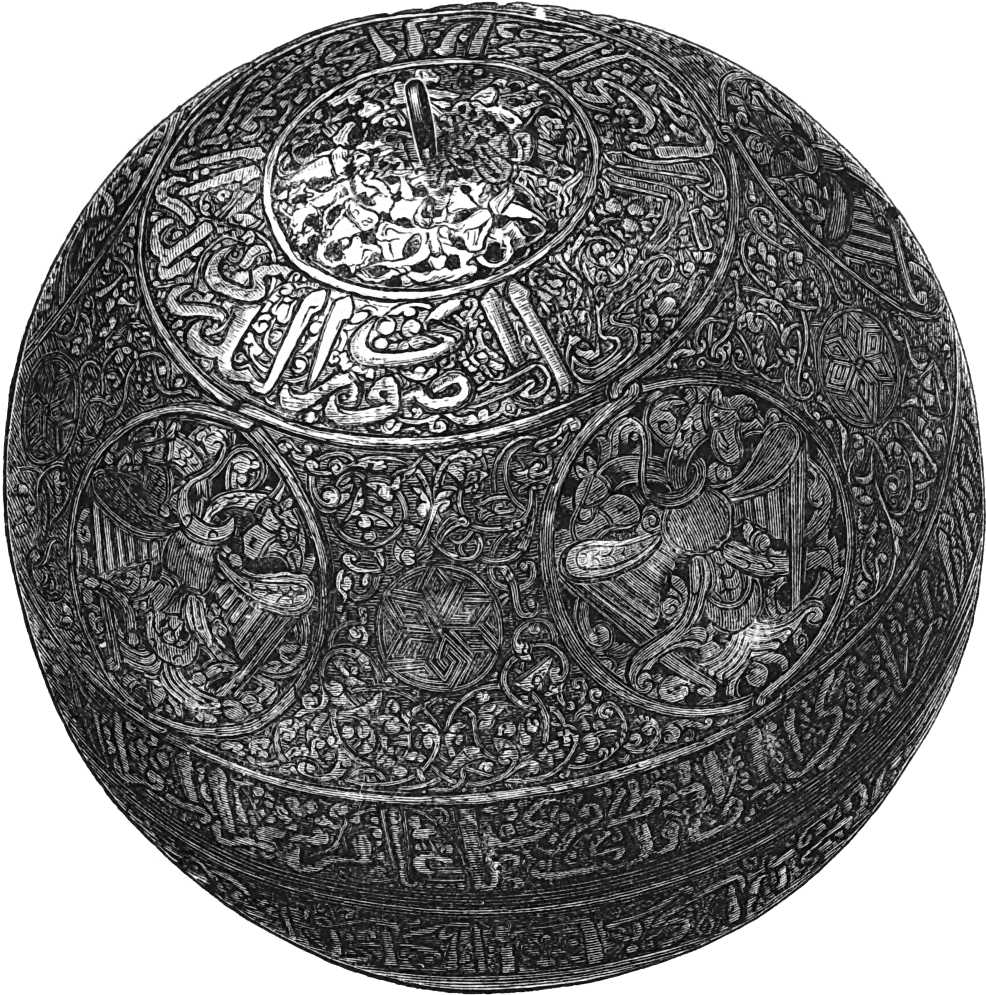
5. Perfume-burner.—Brass inlaid with silver. Made for the Amīr Beysary, a Turkish Mamlūk of Egypt. Circ. A.H. 670 (A.D. 1271). Fig. 81.
Globular: in two hemispheres, pierced with small holes, with a ring at the top.
The upper hemisphere is ornamented with five medallions enclosing two-headed eagles with spreading tails, separated by five smaller medallions filled with the key-pattern in the shape of a six-pointed star, the surrounding ground engraved with free arabesque scroll-work.
Above and below the design are two zones of Arabic inscriptions. Below:
مما عمل برسم المقر الكريم العالى المولولى (sic) الاميرى الكبيرى المحترمى المخدومى السفهسلارى المجاهدى المرابط (sic) المتاعزى المؤيدى المظفرى
“Of what was made by order of his excellency, the generous, exalted, lord, great Amīr, honoured, master, Marshal, fighter for the Faith, warden of Islam, the powerful, the God-aided the victorious.” Above: بدر الدين بيسرى الظاهرى السعيدى الشمسى المنصورى البدرى “Full-moon of the Faith, Beysary, the liegeman of Edh-Dhāhir, of Es-Sa‘īd, of Shems-ed-dīn, of El-Mansūr, of Bedr-ed-dīn.” Within which, round the ring, is a zone of five two-headed eagles in open work.
Lower hemisphere, same as upper, but omitting المولالى, and substituting الاسفهسلارى for السفهسلارى, adding ى to المرابط, and affixing عز نصره to الشمسى.
[B. M., Henderson, 682.]
Lord Beysary was one of the retainers of Es-Sālih Ayyūb, the last ruling king of Egypt of the house of Saladin; rising by degrees, he became one of the most powerful of the Amīrs of the time of Beybars. When El-Melik Es-Sa‘īd Baraka, the son of Beybars, was deposed, Beysary was offered the throne, and refused it. Kalaūn (1279-90) threw him into prison, whence he was liberated, after eleven years’ captivity, by El-Ashraf Khalīl in 1293, who restored him to his rank of centurion, or captain over too men, while the Amīrs showered congratulations and presents upon him. Henceforward he styled himself El-Ashrafy, “follower[70] of El-Ashraf,” instead of his old title of Esh-Shemsy. On the death of Khalīl he was again offered the throne, and again declined the honour. The Sultan Ketbughā allotted him sixty Mamlūks, to each of whom Beysary gave two horses and a mule. The tide of fortune changed in 1297, when the Sultan Lāgīn, moved to jealousy by a rival lord, again consigned Beysary to prison, where he died in 1298, and was buried in his tomb outside the Bāb-en-Nasr. He was lavish in his generosity, prodigal of immense gifts, and perpetually in debt to the amount of 400,000 dirhems (about £16,000); for he had no sooner cleared off one debt than he hastened to contract another. Generosity was his pride, and he would accept no remonstrances from his servants on his prodigality, but straightway dismissed the economical critic. He never drank twice out of the same cup, but took a new vessel each time. At the time of the accession to power of Kalaūn, Beysary is stated to have been wholly given over to wine and gambling. No man approached him in the amount and importance of his charities. His palace, Dār El-Beysarīyeh, in the Beyn-el-Kasreyn, was originally intended, in late Fātimy times, for a residence for Frankish ambassadors, and one actually had resided there to receive certain tribute; but under Beybars, Lord Beysary Es-Sālihy Esh-Shemsy En-Negmy began to rebuild the palace in 1261, and spent immense sums on adorning it. It occupied, with its stables, garden, and bath, about two acres (feddāns): the marbles employed for it were the best that were used in Cairo, and excellently wrought. The palace remained in the possession of his heirs till 1332. Kūsūn wished to own it, and asked the Sultan En-Nāsir Mohammad for permission to treat for it: it was valued at 190,000 dirhems, and the garden brought it up to 200,000; it subsequently passed through many hands, and at the time of El-Makrīzy belonged to a daughter of Barkūk. The door of the house had a panel which was one of the most beautiful ever made at Cairo.[71]
FIG. 81.—PERFUME-BURNER OF BEYSARY. Thirteenth Century. (South Kensington Museum.)
It may be questioned whether the South Kensington box and Beysary’s perfume-burner were made at Mōsil or at Cairo. The statement on the former that it was made “by order of El-‘Ādil’s tisht-khānāh” does not necessarily infer that the order was executed in Cairo: a Mōsil workman may have been employed at Mōsil or have been fetched to Cairo. The two pieces, however, are of the style which is identified by other examples as the fabric of Mōsil, and the two-headed eagle is a familiar device on Mesopotamian coin of the twelfth and thirteenth century; and if either was made at Cairo the artists must have been trained in the Mōsil school. That such work was sometimes done at Cairo is shown by an astrolabe in the British Museum, with the inscription—
صنعه عبد الكريم المصرى الاسطرلابى بمصر الملكى الاشرفى الملكى المعزى الشهابى فى سنة خلج هجرية,
“‘Abd-El-Kerīm made it, the Cairene [Misry], the Astrolabist, at Cairo, the [follower] of El-Melik El-Ashraf and El-Melik El-Mu‘izz, and of Shihāb-ed-dīn, in the year 633.”
This astrolabe has the key ornament, good arabesques, and of course planets and zodiacal figures; and is inlaid with silver and gold by under-cutting and toothed edges. The El-Mu‘izz, whom he once served, was no doubt the prince of Mesopotamia, and El-Ashraf the Ayyūby of Diyārbekr, both of whom reigned in the first quarter of the thirteenth century. This would show that Mesopotamian artists came to Cairo, where there was, as we have seen, a Sūk El-Keftīyīn, or market of the inlayers.
6. Perfume-burner.—Brass inlaid with silver. No date. [Thirteenth century.]
Shape similar to No. 2.
On the lower part are three arabesque frames, one occupied by handle, the other two filled with two aureoled figures seated cross-legged on high-backed thrones, with bird on either side; between which are other medallions filled with quatrefoils; and beasts of the chase; ground of arabesque scroll-work.
On the top, nine seated figures holding cups, cymbals, &c.; and round the button a zone of Arabic inscription:—
العز الدائم والعمر السالم والاقبال الزائد
“Enduring glory and sound life and growing prosperity.”
[B. M., Henderson, 681.]
The seated figures on high thrones are similar to some on coins of Saladin, of 1190, and of the Urtukīs of Māridīn of the year 1230: cross-legged figures are common on the Mesopotamian currency of the thirteenth century.
7. Deep Salver.—Brass inlaid with silver. No date. [Thirteenth century.]
On a ground of key-pattern, a band of hunting-scenes, and cross-legged figures holding crescent moon, alternately, with occasional water-fowl, and a border of hounds. The hunting-scenes depict a horseman attacking, with drawn sword, a leopard on horse’s rump, another shooting a hare with bow and arrow, a third cutting down a deer in front of the horse, and three pairs of seated Byzantine-looking figures, two of these holding cups and the third a hawk, while the companions hold sword or spear. Meaningless Kufic inscription لعالعالعا, &c. Within the curve of the rim, a border of medallions enclosing figures holding wine-cups, &c., and also pairs of figures resembling the Madonna and Child. The central and chief device consists of a seated cross-legged figure on high-backed throne, attended by two squires, holding cup and sword (other cups sprinkled in the field); at the foot of the throne two lions couchant, and beneath them a two-headed eagle, closely resembling that of Beysary, between two bowmen shooting each at one of its heads.
[B. M., Henderson, 706.]
8. Ewer.—Brass inlaid with silver. No date. [Thirteenth century.]
The decoration on the body is arranged in a series of zones on an arabesque ground.
The topmost zone consists of a band of falcons, back to back, with silver eyes, tails crossed, and heads standing out in very bold relief, so as to form a sort of parapet of knobs.
Second zone: Arabic benedictory inscription, tops of alifs, lāms, &c., terminating in chased human faces.
Third zone: Beasts of the chase.
Fourth or central zone, wider than the rest: Large arabesques enclosing twelve quasi-medallions, filled with personified signs of the zodiac combined with the seven planets, viz. (1) Mars on Aries, warrior holding decapitated human head, and riding ram; (2) Venus on Taurus, woman (with lute) riding bull; (3) Mercury and Gemini, two figures linked together with a staff (pen?) between them, terminating in human faces; (4) Moon and Cancer, crab surmounted by human head in crescent formed by claws; (5) Sun and Leo, lion surmounted by sun; (6) [Mercury and] Virgo, woman with two ears of corn; (7) Venus and Libra, balance held up by a woman; (8) Mars and Scorpio, man holding two scorpions; (9) Jupiter and Sagittarius, centaur shooting arrow down gaping mouth of dragon (formed out of his own tail); (10) Saturn and Capricornus, bearded man with long staff, riding goat; (11) Saturn and Aquarius, bearded man and well-bucket; (12) Jupiter and Pisces, two fish (Jupiter covered by handle).
Fifth zone: Beasts of the chase.
Sixth zone: Arabic benedictory inscription.
Seventh zone: Long-necked birds within borders, necks intertwined.
Eighth zone: Arabic benedictory inscription.
On the neck is a zone of Arabic benedictory inscription, with a fine lion sejant at either side; a zone of birds with red copper eyes; the ground consists of beautiful free arabesques. Up the spout and sides of handle run strings of beasts of the chase, and up the back of the handle a string of birds; at the junction of handle with body is a seated figure, cross-legged, holding two serpents.
(B. M. Engraved in Labarte’s Handbook of the Arts of the Middle Ages, ed. Palliser, p. 423.)
The silver inlay of this ewer is effected by undercutting the edges, and not by stippling the surface (what stipples there are belong to a later repairing), and the straight lines are inlaid by punching all along them with a small oblong-headed punch.
9. Bowl.—Bronze inlaid with silver. No date. [Thirteenth century.]
The decoration consists without, in two zones of Arabic religious inscriptions divided by key-medallions, and a double row of medallions enclosing aureoled figures playing musical instruments and drinking from cups; within, a zone of medallions enclosing hunting-scenes, aureoled figures fighting with lions, carrying falcons, riding an elephant, and a Bedawy on camel, the interstices filled with key-pattern; at the bottom, inside, a boat rowed by three men, while two others shoot wild ducks, another cuts a duck’s throat, a seventh sits at the mast-head, and another dives beneath, pursued by an alligator; three zones of Arabic religious and unmeaning inscriptions; on rim, border of animals of the chase, elephants, and a winged centaur. Height 8 in., diam. 19 in.
[S. K. M., 2734-1856.]
The foregoing is one of the finest pieces of Mōsil work in England. The elephant and camel are specially noteworthy; above all, the spirited scene on the bottom of a shooting party on the water, such as is recorded in the accounts of the sports of Persian princes.
10. Stand.—Brass inlaid with silver and gold. No date. [Thirteenth century.]
Nine-sided; chased with representations of nine figures of aureoled horsemen, holding falcons, fighting with dragon, brandishing bow, spear, and other weapons; above, nine cross-legged seated aureoled figures clashing cymbals, blowing pipe, holding candles, and putting wine-glass to lips; the interstices filled with black bituminous enamel; on a background of silver scroll-work; above and below, imitation Arabic inscription (لسا لسا, &c.). Height 5¾ in., diam. 9½ in.
[S. K. M., 917.-1884.]
The workmanship of the preceding is unusually delicate and intricate, and the shape is peculiar. It may have formed the base of a candlestick. The black enamel, composed really of pitch, is here well preserved, and it is probable that the majority of the inlaid works of this period were treated in a similar manner; so that the black composition concealed most of those intervening portions of brass which the silver plates did not cover.
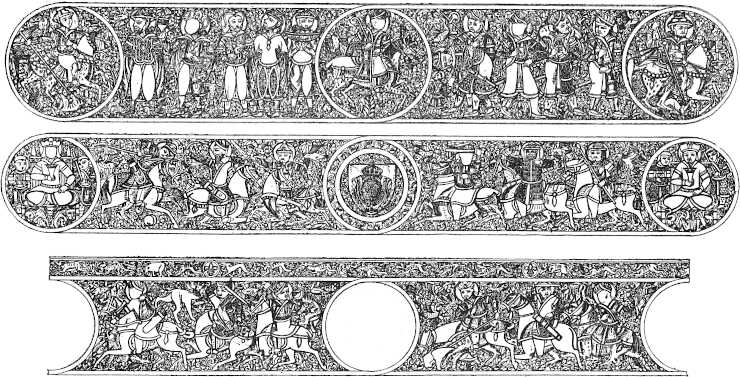
It is impossible to conclude this section without referring to the most famous example of figured Mōsil work in Europe, the so-called “Baptistery of St. Louis,” preserved in the Louvre.[72] This splendid bowl, which belongs in style to the class of Mōsil work of the thirteenth century, measures five feet in circumference, and is covered inside and out with bands of figures richly inlaid with silver, so that little of the copper is visible. On the band inside are two medallions, each enclosing a prince seated cross-legged on a throne with a high pinnacled back and two lions under the feet, and holding a wine-cup, attended by two servants, one on the left of the prince bearing a sword, the other on the right holding a casket inscribed دواة (“writing-case”). On the back of the throne is the inscription “made by Ibn-ez-Zeyn,” or (as it is written elsewhere on the bowl) عمل المعلم محمد ابن الزين غفر له, “Made by master Mohammad ibn-ez-Zeyn, save him!” The little cups held by the princes in the medallions are also signed with his name, as though they represented the vessels actually made in his workshop. Between the medallions are, on the one hand, six horsemen fighting with lances, bows, and maces; on the other, six huntsmen pursuing beasts and game. One carries a chītah on the crupper—one of those “leopardi qui sciant equitare” which the mighty hunter Frederic II. loved to see engraved upon his cups.
On the exterior a frieze of figures, ten centimètres high, is broken by four medallions, each containing a prince on horseback killing a bear, a lion, or a dragon, with lance or arrows. Between, his servants bring him arms, falcons, a slain antelope, dogs in leash, and leopards; one offers a flask and cup (inscribed with Ibn-ez-Zeyn’s name); another, a plate, inscribed انا بجفيز لحمل الطعام, “I hasten to bring food.” This frieze is bounded by two borders of beasts of the chase, divided by eight medallions, containing each a fleur-de-lis—probably a later European addition.
Such, in effect, is M. de Longpérier’s description of this magnificent work of art, to which the engravings inserted to illustrate his article do scant justice. Some of the zones are reproduced from these engravings fig. 82. Mr. W. Burges (in Sir Digby Wyatt’s Metal Work) says that the inlay of this bowl is effected by sinking the designs, especially deeply towards the edges, which are under-cut in a rebate, into which the edges of the inlaid plate are forced.
Before dismissing the Mōsil work, some reference must be made to the numerous mirrors which were made in that part, as well as elsewhere. They have been brought from Mesopotamia, Egypt, and especially from the South of Russia, where they are often found buried in the graves of Tartars. They are generally cast, with a good deal of silver in the bronze; in form they are round or square, and vary in size from two inches to a foot. Several are preserved in the British Museum, including those described by Reinaud, from the Duc de Blacas’ Collection. The ornament is on the back, and generally consists of little more than benedictory inscriptions; but one has a pair of Assyrian winged monsters, resembling Kalaūn’s winged kings.
FIG. 82.—INLAID SILVER PANELS OF THE “BAPTISTERY OF ST. LOUIS.” (Louvre.)
II. Early Syrian Work.
11. Coffret.—Brass, inlaid with silver and gold. No date. [Late thirteenth century?]
Oblong, with sloping lid and silver chains to support it when open. It is covered with silver plates, chased with foliage, birds, and human-headed lions; and inlaid with medallions of designs and religious or unmeaning (العالعالعا) Arabic inscriptions in gold.
On the lid are eight large and small bosses. Height 5⅜ in., L. 5⁷⁄₁₆ in., W. 4 in.
[S. K. M., 459.-1873.]
Other specimens of the same sort are engraved in Prisse, where one is stated to have belonged to En Nāsir ibn Kalaūn.
12. Writing-box.—Brass, inlaid with silver and copper. With hinge and hasp. No date. [Late thirteenth century?]
Oblong, with compartments for pens, ink, sand, &c.
Along the front, sides, and back of lower part, the signs of the zodiac are represented in combination with the planets, much as on No. 8, but with copper as well as silver inlay; the ground is of closely interwoven arabesques, inlaid and chased on the surface. On the bottom are four groups of four water-fowls each, with the heads together. On the lid, three medallions filled with key-pattern; arabesque ground; and border of decorative Kūfy inscription, nearly illegible. Inside the lid is an Arabic benedictory inscription and a Kūfy inscription on the top inside, with a central panel, and arabesque ground.
[B. M., A. W. Franks, 1884.]
13. Writing-box.—Brass, inlaid with silver and a little gold. No date. [Late thirteenth century?]
Similar to 12, but with rounded ends; seventeen figures, riding, drinking, or playing on musical instruments, on the lid and bottom, inside and out; water-fowl confronted in pairs, back to back, and also a group of six; small medallions of key-pattern inlaid with gold wire.
[B. M., Burges, 19.]
14. Writing-box.—Brass, inlaid with silver and a little gold. No date. [Late thirteenth century.]
Similar to 12 in shape and general treatment, but the leaves of the arabesque ground are now frequently converted into birds, and there are no figures: the two birds fighting beak to beak, in chased silver inlay, occur repeatedly, and also the key-pattern medallions in gold: Arabic benedictory inscriptions on top and round sides, and on bottom arabesques on a key-pattern ground: inside, fine rosettes of flowers and leaves like Damascus tiles, numerous key-pattern medallions in gold wire, flower-scroll borders, wild-fowl in panels of six, two Arabic benedictory inscriptions, and one circular radiating inscription, viz.:
الجناب العالى المولموى الكبيرى المالكى السيدى الهمامى الغياثى الدخرى
“His Highness exalted, lordly, great, royal, master, valiant, Ghiyāthy, munificent.”
[B. M., Burges, 20.]
It is dangerous to hazard conjecture as to the identity of the prince Ghiyāth-ed-dīn from whom this Mamlūk (retainer) took his epithet Ghiyāthy, for the name is not uncommon. It does not, however, occur among the Beny Zenky or the Bahry Mamlūks, and it is not unreasonable to suppose it to refer to either Edh-Dhāhir or El-‘Azīz, son and grandson of Saladin, who both bore the surname, and ruled Aleppo from 1186 to 1236. A retainer of the latter might easily be living in the second half of the thirteenth century.
15. Box.—Brass inlaid with silver and a little gold. No date. [Late thirteenth century?]
Oblong, curved outline. Gold inlay chiefly distributed in key-pattern medallions and stars; silver in the confronted birds &c.; two groups of four birds within eightfoils on top; on front, two birds confronted and two beasts confronted within eightfoil, four times repeated, in alternation with arabesques likewise enclosed in eightfoils; ground of key-pattern; border of beasts of the chase.
[B. M., Henderson, 677.]
The last three pieces were in all probability made by the same school of artists. They began with the Mōsil-like system of zodiacal and other figures (but in a much more finished and delicate manner), adding the characteristic mark of this group—the gold-inlaid key-pattern medallions—and then omitted the figures and introduced more of the waterfowl that afterwards became most prominent on Mamlūk work, and also added the typical Damascus rosette ornament. These boxes constitute a class by themselves, and arguing from the Damascus ornament and the (probably) Aleppo epithet, I have provisionally termed it Syrian. A similar writing-box in the South Kensington Museum (8993-1863) has a long series of Mamlūk titles, none of which identify its provenance.
III. Mamluk Work.
The rule of the Mamlūks in Egypt extended from the middle of the 13th to the beginning of the 16th century; but there are hardly any examples of their metal-work of the 13th century, and the finest and most numerous class is that of the Nāsiry Amīrs, or courtiers of the Sultan En-Nāsir Mohammad, in the 14th century: this is the style which is meant when the term Mamlūk work is employed. Of the earlier century, besides the perfume-burner of Mōsil style already described bearing the name of Beysary, the chief specimen of 13th century work made in Cairo is the bronze plating of the doors of Beybars’ mosque extra muros.
16. Door-plating of the Mosque of Beybars I., A.D. 1268.
These plaques are now in the South Kensington Museum, having been acquired in 1884 from M. de St. Maurice. They consist of a central boss, bearing the crest of Beybars, a lion passant (fig. 83), with twelve geometrically shaped plaques arranged round it, each of which contains an arabesque design in open filigree-work (fig. 84); a smaller boss surrounded by nine similar plaques; a knocker (fig. 85); and a border of open arabesque-work (fig. 86) and a portion of an Arabic inscription (الاتابكى الملكى الظاهرى) also in open work. Two other sets consist of a knocker, bosses, and geometrical plaques filled with arabesque designs in open work, arabesque borders, and a portion of a Korān inscription. The plaques form systems of 10 in these sets; of 12 and 9 in the first set. All these pieces are cast, not cut, and are therefore identical each with its fellows in the same system, in contrast to the usual character of Cairene work, where we seldom find two patterns alike. The arabesques are, however, very free and flowing, and the appearance of the numerous plaques, fastened all over the door by ribbed studs, must have been highly effective. The mosque where these doors once hung was built by Sultan Beybars, in the Huseynīya quarter of Cairo, in 665-7 (A.D. 1266-8), and contains many remarkable features.
FIGS. 83-86.—BRONZE PLAQUES FROM DOOR OF BEYBARS I. (South Kensington Museum.)
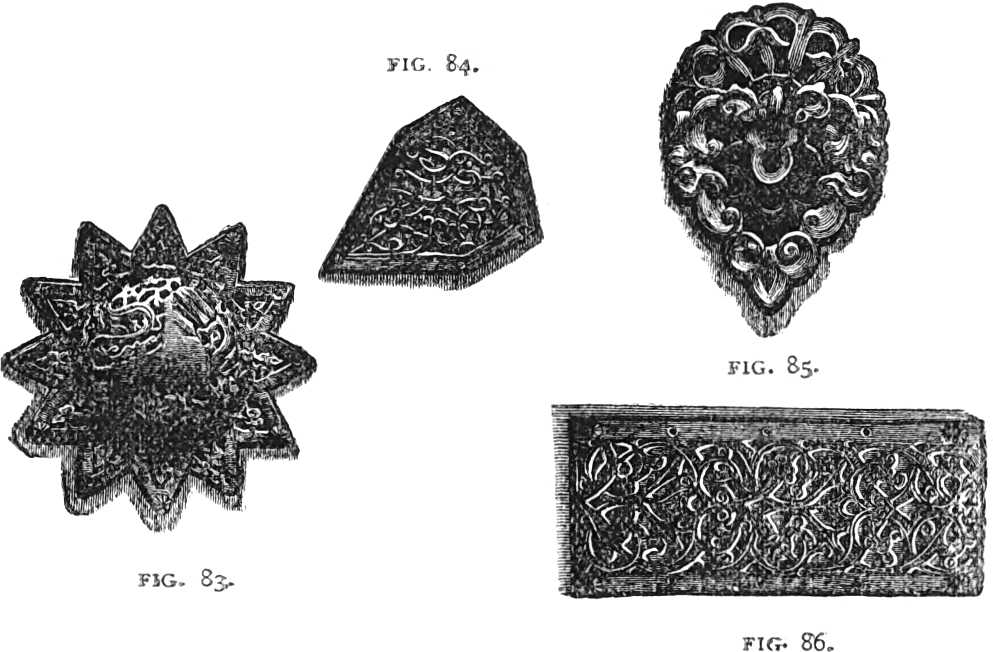
These bronze-plaque doors of Beybars are of a different character from the bronze doors of the later Mamlūks.[73] The mosques of Cairo present many splendid examples of this later style, which usually consists in covering the doors with large plates of thin bronze (about ¼ inch), cut out in various arabesque patterns, or cast in embossed designs, and chased on the surface, and generally distributed in the form of a central circle or oval and four corner-pieces, or spandrils, with a border round the four sides, secured by ribbed-headed nails. The door itself is of wooden planks nailed on to a frame-work behind, and strengthened by bronze bands near the top and bottom, which run through, according to Mr. Wild, and turn round at the edges, being formed into panels by the arabesque border on the front side: it turns on pivots, not hinges. Some of these doors are admirably represented in Prisse d’Avenne’s L’Art Arabe: for example, the beautiful door of Almās (vol. ii. plate 100), where the whole surface is covered with bronze plaques, more like the style of Beybars than is common on later mosques; that of Sultan Barkūk (pl. 96) with a central circular plaque, pointed at top and bottom, four corner-pieces, and narrow border; that of Sultan Kansūh El-Ghōry (pl. 102) arranged somewhat similarly; and that of Talāi‘ ibn Ruzeyk, as restored by Bektemir in the 14th century (pl. 95). There is a splendid bronze door to the mosque of El-Muayyad (A.H. 818-23), which was taken from the mosque of Sultan Hasan, where, however, the entrance to the tomb chamber is still closed by a magnificent gate of bronze inlaid with silver.
From the bronze doors of Beybars, the history of metal-work in Cairo leaps over four Sultans to En-Nāsir Mohammad ibn Kalaūn, who reigned A.D. 1293-4, 1299-1309, and 1310-41, or (omitting the first brief rule) during most of the first half of the 14th century. En-Nāsir built two noble mosques, and the number of works in metal bearing his name and those of his courtiers is very large. Among the finest is the beautiful table preserved in the Arab Museum at Cairo.
17. Table (Kursy).—Brass, inlaid with silver. Made for the Mamlūk Sultan En-Nāsir Mohammad. Fourteenth century.
It is made of filigree brass inlaid with arabesques, flowers, water-fowl, and Arabic inscriptions in silver, and is chased all over in elaborate profusion. One of the panels, forming a folding door, through which no doubt a pan of live charcoal was introduced, to warm the tray of food which was placed upon the table, is represented in fig. 75, where the inscriptions on the top border read, عز لمولانا السطان الملك الناصر ناصر الدنيا والدين محمد بن السلطان الملك المنصور الشهيد قلاون الصالحى غز انصاره
“Glory to our lord the Sultan, the king, En-Nāsir [the Succourer or Helper], Aid of the church and state, Mohammad, son of the Sultan, the king, El-Mansūr [the victorious], the martyr [i.e. defunct] Kalaūn, [liegeman] of Es-Sālih [Ayyūb], be his triumphs magnified!” The inscriptions in the three other narrow borders are practically identical with the above. The large inscription in the upper panel is محيى العدل فى العالمين | ناصر الدنيا والدين “Upholder of justice in the world, Aid of the state and church;” while in the circular medallions is distributed the inscription, “Glory to our master the Sultan | El-Melik En-Nāsir Mohammad ibn | El-Melik El-Mansūr Kalaūn.”[74]
[Musée Arabe.]
18. Another brass and silver filigree Table (kursy), preserved in the same museum, and stated to have belonged to the Māristān of Kalaūn, is represented in fig. 74. It has no inscriptions, but undoubtedly belongs to the same period as the first.
The characteristic designs of the Cairo metal-workers under En-Nāsir Mohammad may, however, best be seen in the large bowl or tank described below. As a rule, but not without exceptions, we may set down, as characteristic of 14th century Cairo work, the absence of figures (except on vessels having astrological uses), the prevalence of ducks or other birds in the ground decoration, the medallions (enclosing a sort of fess bearing the name of the Sultan,) surrounded by a rosette of flowers and leaves resembling the patterns of Damascus tiles, the shoals of fish at the bottom of bowls, the broad bands of tall bold silver-inlaid letters, the large surfaces of inlay, and the little whorl ornament which takes the place of the key-pattern medallion already noticed.

19. Large and deep Bowl.—Brass, inlaid with silver. Made for the Sultan En-Nāsir Mohammad ibn Kalaūn (A.D. 1293-1341).
Ornamented with broad bold zones of Arabic inscriptions, filled in with waterfowl and flowers and leaves (which seem to be conventionalized ducks’ wings), and divided at regular intervals by medallions, enclosing titles on a fess, and enclosed in rosette of flowers and leaves.
Large inscription round the outside:—
عز لمولانا السلطان الملك ◯ لناصر العامل العادل المجاهد ◯ ناصر الدنيا والدين محمد بن قلاون ◯
“Glory to our lord the Sultan, the king, the helper [El-Melik En-Nāsir], ruler, leonine, fighter for the Faith, Aid of the state and church, Mohammad son of Kalaūn.” The medallions enclosed in rosettes of flowers indicated by ◯ contain, on a fess, عز لمولانا السلطان ا “Glory to our master the Sultan the” (sic).
Above and below the large inscription, on a floral ground, six little medallions contain عز لمولانا السلطان “Glory to our master the Sultan,” twelve times repeated.
Scratched under rim by later hand الصبر عبادة “Patience is worship.”
Large inscription inside:—
عز لمولانا السلطان الملك الناصر ◯ العالم العامل العادى المجاهدا ◯ لمرابط ناصر الدنيا والدين محمد بن قلاون عز نصره ◯
“Glory to our lord the Sultan El-Melik En-Nāsir, wise, ruler, leonine, fighter for the Faith, warden of Islam, Aid of the state and church, Mohammad son of Kalaūn, be his triumph magnified!” The medallions marked ◯ are filled as on the outside: but there are no small medallions in the floral border beneath, or in the double scroll border above inscription; but the last is divided by six whorls.
The bottom is covered with a shoal of fish, in a circular spiked border.
[B. M., 51. 1. 4.]
These large inscriptions offer a good example of the method of inlaying silver plates. Each letter was scooped out and deepened towards the edges, which were slightly under-cut and very delicately serrated. As the weak hold thus obtained let the silver escape, a later workman seems to have repaired the tank, and re-inlaid it by stippling the surfaces with a triangular point and rudely serrating the edges. Very little of the silver now remains: what there is shows that the surface was delicately chased when the subject required it (e.g. birds’ wings).
The South Kensington Museum possesses a large tray of the same Sultan, of the sort that is used to carry a meal, splendidly engraved and inlaid, as follows:—
20. Tray.—Brass, inlaid with gold and silver. Made for the Sultan En-Nāsir ibn Kalaūn (A.D. 1293-1341).
The principal inscription (a) occupies a large zone on the upper surface, and is composed of bold Naskhy letters:—
عز لملانا السلطان ا (m) لملك العالم العا (m) مل العادل العادل عز نصره (m)
“Glory to our lord, the Sultan, the king, wise, just, ruler, be his triumph magnified!”
At (m) the inscription is broken by medallions containing the words الملك الناصر El-Melik El-Nāṣir, on a fess; and round each medallion runs an inscription (b) similar to (a), but adding, after العادر, المجاهد المرابط المتاعز المؤيد; the whole enclosed in a belt of leaves and flowers.
An inner zone of inscription is similar to (b), but continued with the words المنصور سلطان الاسلام والمسلمين عز نصره, “The victorious, Sultan of Islam and the Muslims: be his triumph magnified,” and divided by three similar pairs of medallions joined together by a panel of flowers and leaves. The right-hand medallion of each pair contains on a fess the words (c) عز لمولانا السلطان, the left, on a shield, an antelope in an enclosure.
A third innermost zone of inscription is similar to a, but substitutes المجاهد for عز نصره
On the outer surface of the rim is the following inscription, divided at ◯ by sets of three medallions like (c), joined by panels of flowers:—
عز لمولانا السلطان الملك الناصر العامل العادل ◯ flowers ◯ flowers ◯ العادر المجاهد المرابط المتاعز المؤيد المنضور ناصر الدينا والد ◯ fl. fl. ◯ ين قاتل الكفرة والمشركين محيى العدل فى العالمين والفقرا ◯ fl. ◯ fl. ◯ والمساكين السلطان الملك المنصور ناصرالدنيا والدين ◯ fl. ◯ fl. ◯
“Glory to our lord the Sultan, El-Melik En-Nāsir,” &c.
Diam. 31 in. [S. K. M. 420-1854].
21. Box.—Brass, inlaid with silver. Made for the Overseer Ahmad. [Fourteenth century.]
The lid is hinged and fastens with a hasp: on the top is a radiate Arabic inscription surrounding a shield (on a fess a lozenge):—
مما عمل برسم العبد الفقير الرجى الغفران من الرب المنان [ا] لمهتار احمد مهتار الامير محمد بن ساطلمش الجلالى
“Of what was made by order of the humble servant, hoping for forgiveness from the benevolent Lord, the Overseer Ahmad, Overseer to the Amīr Mohammad son of Sātilmish, the Gelāly.”
On the hollowed rim of the lid is a border of flower-scrolls divided by whorls, and below this a border of beasts of the chase divided by shields: on a fess, a lozenge.
On the lower part, divided by four medallions containing water-fowl, on a ground of large arabesques of early style, are the Arabic benedictory verses:
ولا برحت مدا الايام فى سعة | بانعم ومسرّات وافضالى
لا زلت يا مالكى ما دمت فى دعة | وانت من كلّ همّ خالى البالى
Cease not through all thy days to dwell at ease,
Where comforts solace thee, and pleasure charms:
While breath shall last, my Master, cherish peace;
High rest thy heart above the world’s alarms.
On the bottom, a beautiful arabesque border surrounds a whorl.
[B. M., Blacas. Reinaud, ii. 422.]
The name of the Amīr Mohammad ibn Sātilmish has not yet been identified; but a Mamlūk called Sātilmish is mentioned in the latter half of the thirteenth century as taking part in the court at Cairo; and the style of arabesques on the box, the character of the inscriptions, the whorls and shields, undoubtedly indicate a Cairo fabric. The title Mihtār, or Overseer, was given to the officers who presided over the different departments of a princely household.
FIG. 87.—BRASS BOWL INLAID WITH SILVER. Fourteenth Century. (British Museum.)
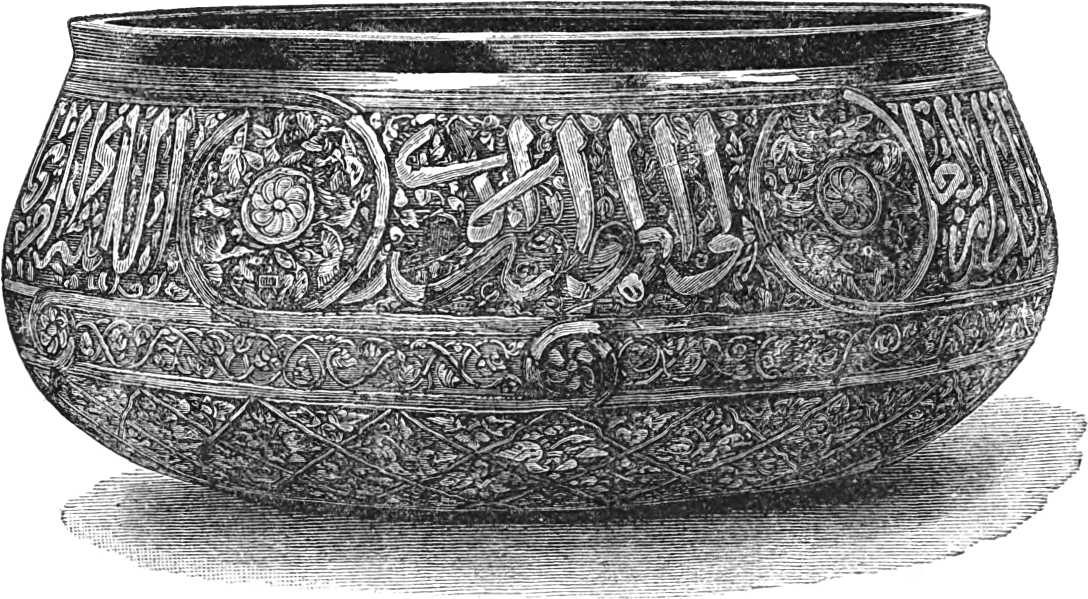
22. Bowl.—Brass, inlaid with silver. Made for a Courtier of En-Nāsir. [Fourteenth century.] (Fig. 87.)
Outside, whorl at bottom surrounded by sort of sixfoil, round which a lozenge-diaper ornament; ground of Damascus flowers and water-fowl; border inscription divided by six whorls enclosed in a ring of flying ducks:—
المقر الكريم العا ◯ لى المولوى الاميرى ◯ الكبيرى العالمى ◯ العاملى العادى ◯ المجاهدى المرابطى ا ◯ لملكى الناصرى ا ◯
“His Excellency, generous, exalted, lordly, great Amīr, wise, ruler, leonine, fighter for the Faith, warden of Islām [liegeman] of El-Melik En-Nāsir.”
On the bottom, inside, a shoal of fish round a whorl.
[B. M., Henderson, 686.]
23. Candlestick with Three Feet.—Brass, inlaid with silver. Made for a Centurion of En-Nāsir. [Fourteenth century.]
Engraved with birds and arabesques, the interstices filled with black enamel. Round central band, inscriptions in silver inlay, recording fourteenth century Mamlūk titles, (including that of Captain over 100,) divided by three medallions enclosing birds and whorls of eight rays. Height 12 in., diam. 10½ in.
[S. K. M., 912.-1884.]
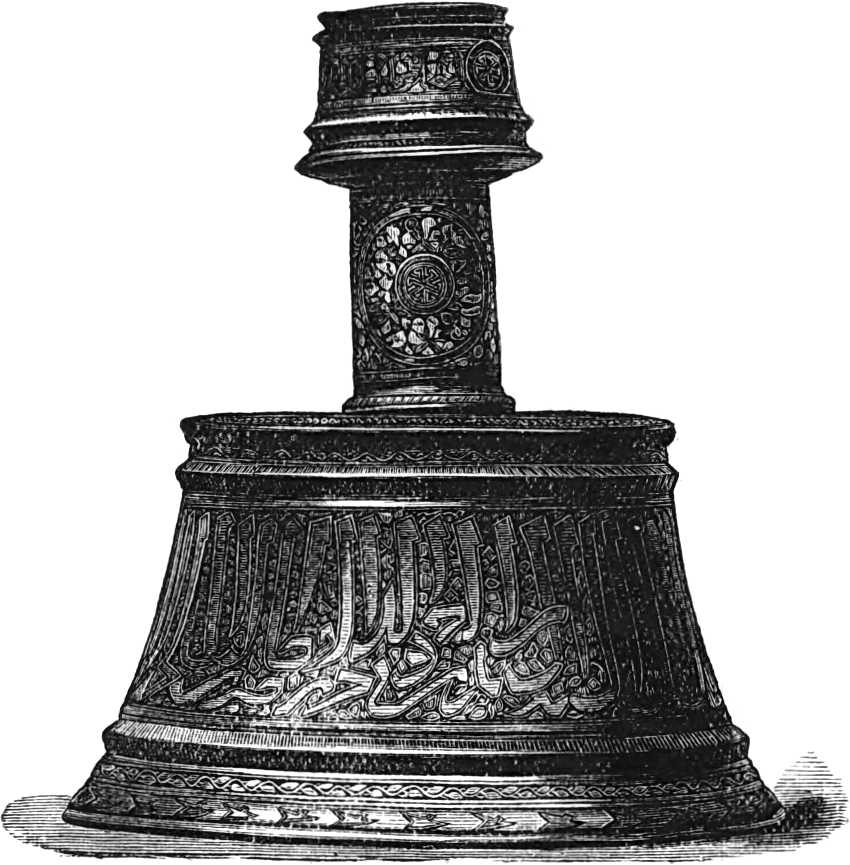
Another candlestick in the South Kensington Museum (4505-1858), is engraved in fig. 88.
24. Stand for Tray.—Brass (with an alloy of silver). Made for a Chief Secretary. [Fourteenth century.]
Dice-box shape; engraved with Arabic inscriptions, divided by medallions containing coats of arms in floral borders; the spaces filled with floral ornaments outlined with black enamel. The inscription reads:
الجناب العالى المولوى ا ◯ السيفى امير دوادار اتابك عز انصاره
“His Highness, exalted, lordly, [liegeman] of Seyf-ed-dīn, Chief Secretary, Atābek: be his triumphs magnified!”
Height 9½ in., diam. 7⅝ in. [S. K. M., 934.-1884.]
The floral ornaments are of the kind already described, the Damascus-like leaves and flowers; and the medallions and floral borders form a kind of rosette very characteristic of the Nāsiry period. The coats of arms consist of a fess bearing a large goblet between two smaller ones; above the fess is a hieroglyphic inscription , denoting “lord of the Upper and Lower country”—which the Mamlūks must have constantly seen on the ancient monuments, but were undoubtedly unable to interpret—and beneath is a lozenge. The subject of heraldic bearings on Mamlūk works of art has been extensively discussed by the late Rogers Bey in a paper published in the Bulletin de l’Institut Egyptien. This particular coat of arms is not described by Mr. Rogers; but several nearly resembling it belong to the Amīrs of the fourteenth century. The cup, as a charge, indicates that the bearer held the post of Sāky, or cupbearer, to the Sultan or to some great noble.
25. Bath Vessel.—Bronze, inlaid with silver. Made for a Courtier of En-Nāsir. [Fourteenth century.]
Round edge, Arabic inscription, divided by four shields, containing a bend between two stars:
المقر العالى المولوى المالكى ا العادلى العاملى العالمى الا (sic) المجاهدى المرابطى المتاعزى الما لكى العادلى الملكى الناصرى

“His Excellence, exalted, lordly, royal, just, worker, wise, fighting for the Faith, warden of Islām, powerful, royal, just, [liegeman] of El-Melik En-Nāsir.”
[B. M., Burges, 22.]
The intention of the next bowl is certainly magical: the planets are to be used astrologically, to secure auspicious results. The bowl would be filled with water, which became imbued with the mysterious influences of the planets, and then the water would be drunk off, or sprinkled on the person. These cups were often made at Mekka, in view of the Ka‘ba, which is sometimes represented: so much is stated on a cup in the Vatican.
26. Bowl or Cup.—Brass, inlaid with silver. Made for a Courtier of En-Nāsir. [Fourteenth century.]
Outside, on bottom, seated figures of the planets: the moon, a crowned human figure, holding a crescent in two uplifted hands; Mars, helmeted and holding sword and bleeding head; Mercury, holding a carpenter’s square; Jupiter, seated judge-like, between two fish; Venus with pear-shaped lute and wine-cup; Saturn with raised staff and purse; the sun should have occupied the centre, but is worn off. Ground of arabesques. An inscription round the side, divided by three seated aureoled figures holding wine-cups, records usual Mamlūk titles of El-Nāsir’s court.
Inside, at bottom, a shoal of fish, arranged in form of whorl.
[B. M., Blacas. Reinaud, ii. 359, ff., and pl. vii.]
27. Tray.—Brass inlaid with silver. Made for Sultan Sha‘bān, who reigned A.H. 746-7 (A.D. 1345-6).
Ornamented somewhat in the Nāsiry style, with rosettes and geometrical designs, on a ground of bold and rather coarse arabesques.
FIG. 88.—BRASS CANDLESTICK INLAID WITH SILVER. Fourteenth Century. (South Kensington Museum.)
A. Large zone of inscription:
عز لمولانا السلطان الملك ا ◯ لكامل العالم العامل العادل ◯ العاذر المجاهد سيف الدنيا والدين شعبان عز نصره ◯
“Glory to our lord the Sultan, the king, perfect, wise, ruler, just, lenient, fighter for the Faith, sword of the state and church, Sha‘bān: be his triumph magnified!”
B. At ◯, medallions:—الملك الكامل surrounded by a circular inscription, C, similar to that above, but omitting العامل العادل and عز نصره; the whole enclosed in border of boldly drawn flowers and leaves.
In the centre of the tray is a sixfoil enclosed in ring of inscription (same as C) within double trefoil, outside which a ring of inscription similar to A (omitting عز نصره), divided into three parts by panels of flowers between whorls.
The rim is covered with floral borders and whorls.
[B. M., Blacas. Reinaud ii. 439].
A beautiful writing-box, with the name of the same Sultan, and decorated with ducks, whorls, and key-pattern, is engraved in Prisse.
Reinaud (ii. 441, n.) describes a tray, nearly four feet in diameter, which he saw in Paris, and which bore the name of Farag son of Barkūk, second of the Burgy or Circassian Mamlūks, who reigned (with a year’s interruption) from A.H. 801 to 815 (A.D. 1398-1412). Unfortunately he does not tell us the style of decoration, the metal or metals, or other details, nor does he mention what has become of the tray. The inscription in the midst ran: عز لمولانا السلطان الملك الناصر فرج بن برقوق عز نصره; while a larger inscription included a long string of titles. These long and sounding titles are often clearly regulated by the space at the artist’s command, and even the words themselves are apparently varied to suit the taste. It is probable that العادر, العادى, &c., are merely fanciful alterations of الغازى.
FIG. 89.—BRASS BOWL OF KAIT BEY. Fifteenth Century. (South Kensington Museum.)
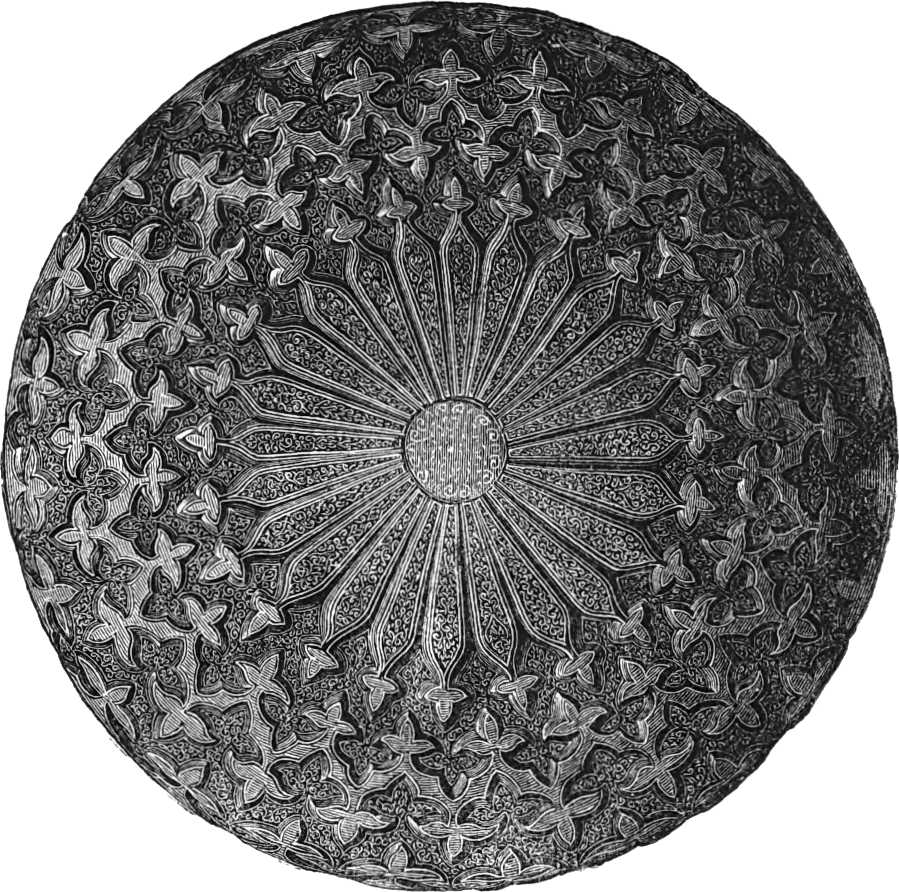
Fig. 89 represents the back of a very beautiful brass bowl of the Mamlūk Sultan Kāït-Bey (A.D. 1468-96), which is preserved in the South Kensington Museum (no. 1325-1856). It is specially noteworthy for the back being ornamented with a repoussé arabesque design of great beauty, covered with delicate chasing. The inscription on the side, inlaid with silver, runs:
عز لمولانا السلطان الملك ◯ العادل المجاهد المرابط ا ◯ لمؤيد المنصور سلطان الاسلام ◯ والمسلمين الملك الاشرف ابو النصر قائتباى عز نصره ◯
“Glory to our master the Sultan, the king, just, fighter for the Faith, warden of Islām, God-aided, victorious, Sultan of Islām and the Muslims, the most noble king [El-Melik El-Ashraf], Father of Victory, Kāït Bey: be his triumph magnified.” At ◯ are four medallions, characteristic of Kāït Bey’s monuments and all his works; they contain his name and style, as below:—
ابو النصر قائتباى عز لمولانا السلطان الملك الاشرف عز نصره
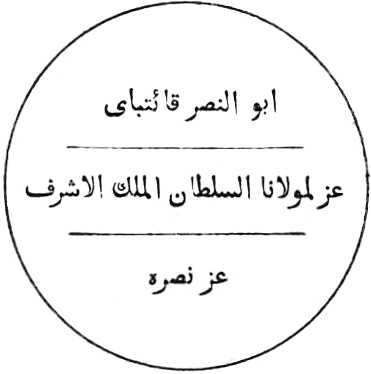
Among the purposes to which metal-work was applied was the manufacture of large chandeliers or lanterns for mosques. Some of these are still hanging before the niches but most of them have been taken away. Coste illustrates a bronze lamp of Sultan Hasan (fig. 23), and two are seen hanging in his representation of that mosque (fig. 25), besides the usual small plain glass lamps: but Coste was quite capable of inserting such details for the sake of artistic effect, and their presence in his drawing is hardly a proof that they really existed. Coste also gives a large lamp to the mosque of Kāït-Bey; and in Prisse there is an illustration (reproduced in fig. 76) of a silver lamp of Beybars II. of the shape of the usual enamelled glass lamps, but made of filigree work, hung by fine metal straps, which, however, are imperfectly rendered in the woodcut. An engraving of an early undated metal lamp of the same form, which comes from Jerusalem, and is now in the Louvre, is reproduced (fig. 90) from M. de Longpérier’s Œuvres. Another form is that of a chandelier, of a conical shape, surrounded by numerous little glass globes to hold oil and wicks. An example of this kind (from the mosque of ‘Abd-el-Basit, and now in the Arab Museum at Cairo), made of filigree iron with a bright copper band, is shown in fig. 77, and fig. 78 represents a bronze tray (intended to be suspended beneath a chandelier), covered with chasing, and bearing the name and titles of the last of the Mamlūk Sultans, Kansūh El-Ghōry (A.D. 1501-1516).
The art of metal-working survives in Cairo, as has been said, to the present day. The finer style of bronze door was made in perfection so late as last century, as may be seen from M. Prisse’s engraving of the door of ‘Abd-er-Rahmān Kikhya (A.D. 1760), which is as delicately wrought as any earlier example. In the present day the coppersmiths of Cairo make trays and ewers and other common utensils decorated with considerable skill in the style of the Mamlūk work, and sometimes with much elaboration of ornament, including inlay of gold wire.
The results of the foregoing examination of the history of Saracenic metal-work may be roughly summarized in the following genealogical tree:—
MŌSIL WORK.
[Descended from the Assyrian metal-workers, and probably existing in very early times and in continuous development, but represented in collections not earlier than the thirteenth century, and apparently ceasing to produce the best work in the same or the fourteenth century.]
FĀTIMY WORK.
[Probably the offspring of Mōsil, but at a very early period, perhaps ninth or tenth century. The art rests on historical evidence; but there is a lack of examples in metal-work in the collections.]
EARLY SYRIAN WORK.
[Containing Mōsil elements with certain local characteristics, probably peculiar to a Damascus or Aleppo school. Examples belong probably to late thirteenth century.]
SICILIAN WORK.
MAMLŪK WORK.
[Containing Fātimy (or Mōsil) and Syrian characteristics. Numerous examples, chiefly of the fourteenth century.]
SARACENIC WORK OF VENICE.
[Derived from Syrian and Mamlūk schools. Examples chiefly from the early sixteenth century.]
[JPG]
FIG. 90.—LAMP FROM JERUSALEM. (Louvre.)
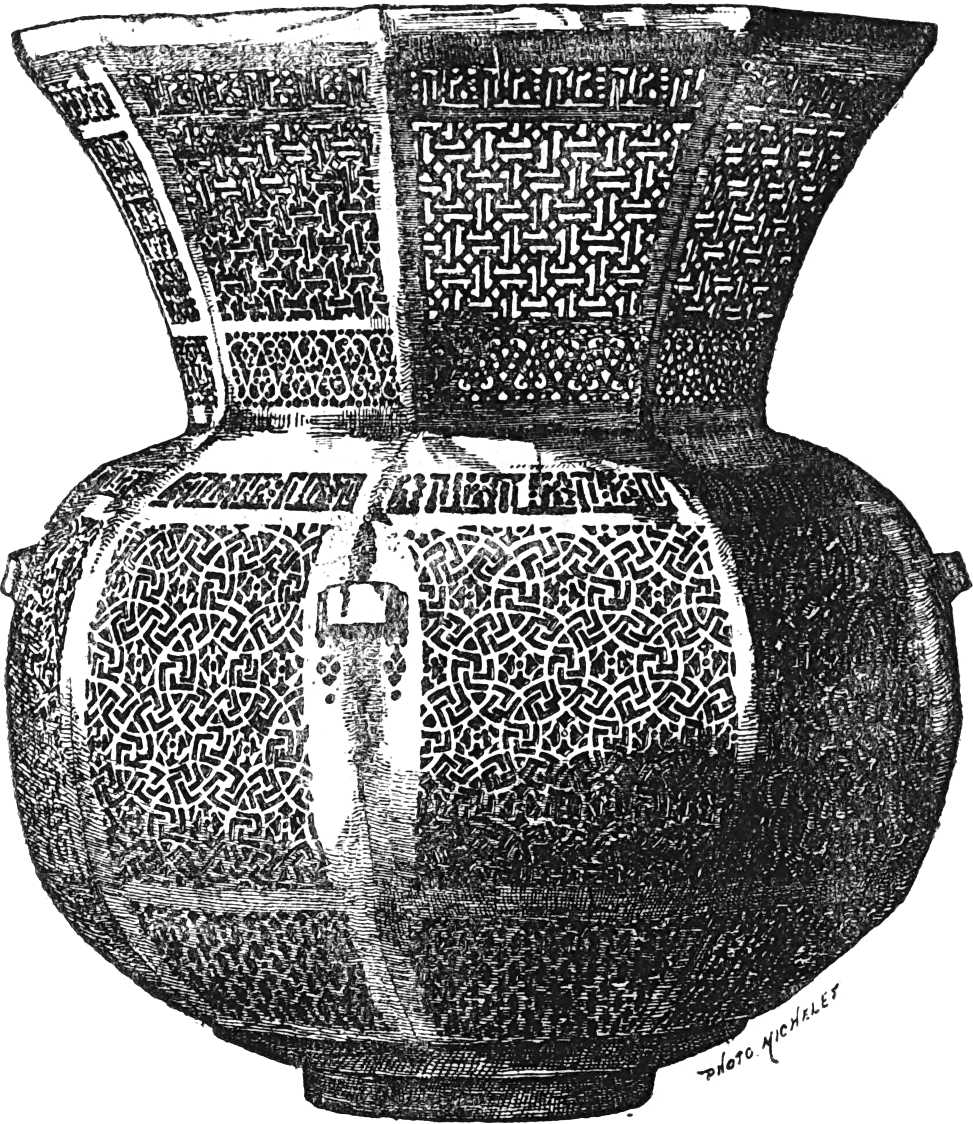
2. Goldsmith’s work and Jewellery.
The Prophet Mohammad entertained a religious dislike to the luxury of gold ornament, and cautioned the women of Arabia against the use of tinkling anklets. Nature, however, was occasionally too strong for the Prophet, and although the mass of the male Muslims observe a strict sobriety in their dress, weave cotton with their silk, and prefer silver to gold for their sole ornament, the signet ring, there are always some whose passion for display overcomes the scruples of conscience; and the women, of course, cannot exist without a little jewellery. We read in the annals of Egypt of extraordinary quantities of precious stones preserved in the treasuries of princesses and khalifs. ‘Abda, the daughter of the Fātimy Khalif El-Mu‘izz, left at her death five bushels of emeralds and a prodigious amount of rubies and precious stones of all sorts. The Khalif El-Mustansir, this lady’s nephew, possessed quantities of emeralds, pearl necklaces, gold and silver and amber rings, caskets set with jewels, figures of birds and animals adorned with precious stones, a table of sardonyx, and a jewelled turban. As a rule, however, we read more of large objects set with jewels than of small ornaments of attire, and this is explained by the fact that jewellery is principally employed by women, and therefore cannot be described in detail by Mohammadan historians, who are bound in delicacy to ignore the fair sex. Thus the seclusion of ladies in the East makes it difficult to trace the history of Saracenic jewellery, and the difficulty becomes insuperable when it is discovered that no specimens of the mediaeval jewellery of the Egyptian ladies have come down to us with a certain date.
In the absence of dated examples of mediaeval Egyptian jewellery, we are forced to work backwards from the existing productions of the jeweller’s market at Cairo, and endeavour to deduce the probable character of the earlier work. There can be little doubt that many of the ornaments now manufactured in Cairo represent ancient patterns, which have been handed from father to son in the goldsmiths’ traditions for several centuries. The ordinary bracelet, composed of two plain bands enclosing a double or single twisted band is certainly an old design, and has worn the same shape and shown the same character of ornament for many generations. So, no doubt, have the anklets with square heads cut in facets. A description of the ornaments now made at Cairo—which is all that is attainable—may therefore not improbably represent the same general character of jewellery as that worn by the famous Queen Sheger-ed-durr, “Tree of Pearls,” who repulsed St. Louis with her gallant Mamlūk troops.
The modern jewellery of Cairo has been so exhaustively described and illustrated by Mr. Lane, in an Appendix to his Modern Egyptians, that it is only necessary to summarize his account and refer to his engravings. A Cairo lady’s ornaments consist in various additions to her head-dress and hair, in ear-rings, necklace, bracelets, anklets, and amulets. The head-dress is composed of a tarbūsh or fez, round which is wound a kerchief (rabta). To the crown of the tarbūsh is sewn the boss-like ornament called a kurs, about five inches in diameter, and ornamented with diamonds set in gold filigree-work. In the present day the diamonds and gold are alike of poor quality, and a good kurs is not worth more than £150. Even the wives of tradesmen, who are usually devoted to diamonds, manage to buy some sort of kurs, though it is a heavy, uncomfortable ornament, and produces headache when put on, and also when taken off, so that many ladies, when once their heads are hardened to its weight, wear it night and day. A common kind of kurs is made of a thin gold plate, embossed with a pattern, and having a false emerald set in the middle.
Attached to the kerchief, over the forehead, is worn the kursa, a band of diamonds, emeralds, or rubies, set in gold, generally with pendants, about seven inches long. On either side of the kerchief hang festoons of pearls, connected together by a pierced emerald, and fastened at the front to the kursa, and at the other end to the back of the kerchief, or to the ear-ring. Sometimes a sprig (rīsha) or crescent (hilāl) of diamonds set in gold or silver is worn, instead of the kursa and pearls, on the front or side of the kerchief; and another favourite ornament is the kamara, or pear-shaped gold plate, embossed with Arabic letters or a pattern, and having flat gold pendants hanging beneath. There are several varieties of this ornament, in the shape of a sakīya, or water-wheel, a comb, &c., with distinctive names, the most curious of which is ‘Ūd-es-Salīb, “Wood of the Cross,” which is clearly of Coptic origin.
The ear-rings (halak) are not remarkable. They consist of diamonds, pearls, emeralds, rubies, &c., set in gold, with sometimes a sprig of floral filigree-work above the drop. The necklace (‘ikd) is seen in great variety, but with this peculiarity, that it does not completely encircle the neck, being but ten inches long; the connecting piece of string is covered by the hair, which is generally ornamented with strings of gold ornaments and coins. There is usually a bead or link larger than the rest in the middle, or also at fixed intervals. Pearls strung, diamonds set in gold, and hollow gold beads, form the usual links of the necklace.
Cairene jewellers do not cut their diamonds and emeralds in facets, as this would induce a belief that they were false; but they commonly pierce the emeralds. Both customs, of course, destroy the beauty of the jewels.
More characteristic than the necklaces are the bracelets (asāwir) and anklets (khulkāl), which are commonly of solid silver, or even gold. Simple twist for gold, and a twist set in plain bands for silver, are the most usual patterns of bracelets, and are doubtless of high antiquity. The anklets are heavy, and clank together as the lady walks, so that the poet says:
“The clink of thine anklets has bereft me of reason.”
The amulet (higāb) is a little silver or gold box, embossed and adorned with pendants, containing a chapter from the Korān or other charm, covered with waxed cloth, and is suspended at the right side above the girdle by a cord passing over the left shoulder.
FIG. 91.—ARMS FOR LION HUNTING.
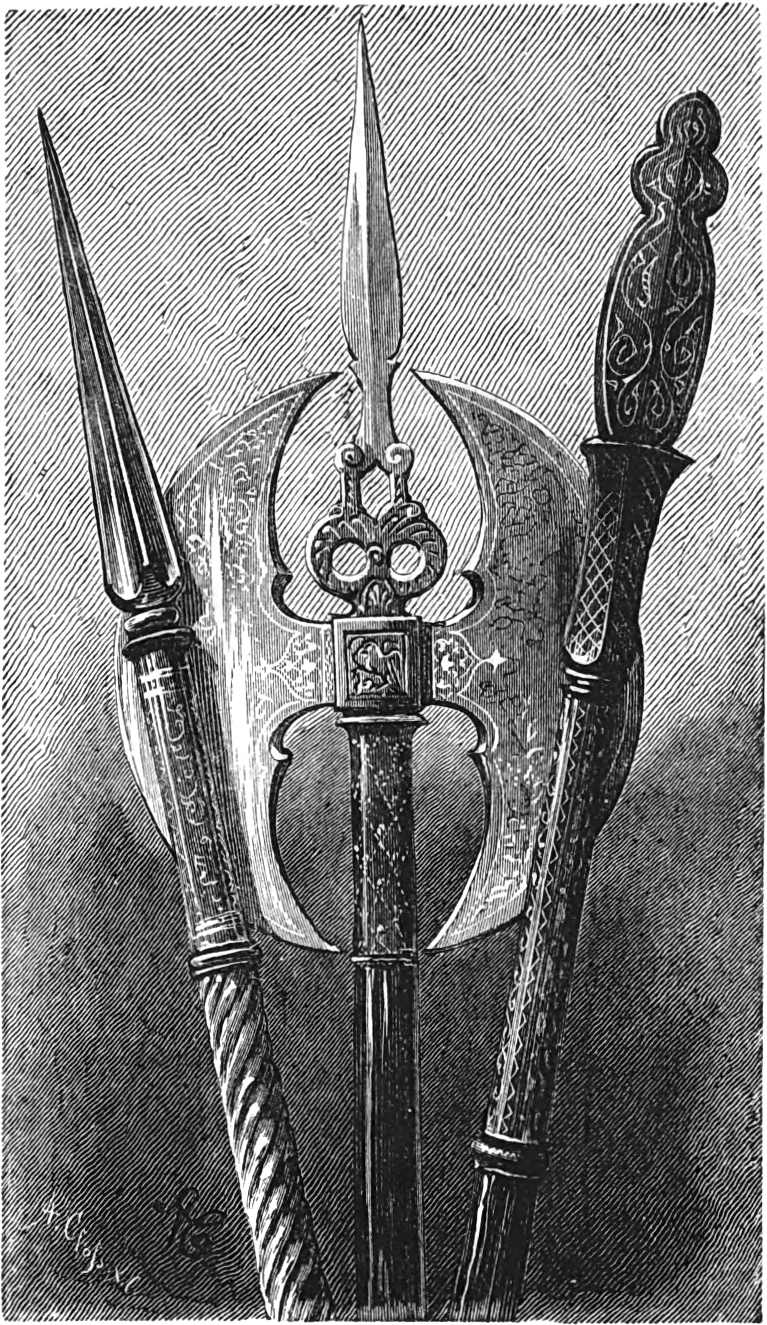
There is another branch of metal-work of which nothing has been said: we know almost nothing of Mamlūk armour; and although there is undoubtedly a “Market of Arms” in Cairo which once plied a busy trade, it is doubtful whether their work did not chiefly consist in fitting and adapting the weapons and armour of Persia and the Indies. Two helmets in the Tower of London have indeed an Egyptian look, and I should be inclined to ascribe them to Cairo workmen of the period of Kalaūn (end of the thirteenth century). These are, however, quite exceptional; and most of the arms attributed to Egypt are undoubtedly Syrian or Persian. It must not be forgotten that, to the Mamlūks, Damascus was almost as much their capital as Cairo; and while Damascus blades were to be had there was little inducement for the establishment of an Egyptian school of armourers. The list of Beybars’ presents (p. 28) includes Damascus weapons, and pikes tempered by the Arabs, but no Cairo armour is mentioned.