Chapter XII
Reading edition
ILLUMINATED MANUSCRIPTS.
Among the minor arts of the Mohammadans, none is more individual and characteristic than that of illuminating manuscripts. Possessing in the Naskhy or cursive hand a script unrivalled in flexuous elegance, the art of calligraphy may be said to have been forced upon the Saracens. Penmanship soon took its place next to scholarship in the estimation of the wise, and the names of great calligraphists, like Ibn-Mukla and Yākūt Er-Rūmy, became almost as famous as those of the poets and historians who provided them with the materials upon which to exercise their art. Many of the ordinary books of reference, such as dictionaries and annals, were transcribed with fastidious care in the fine bold Naskhy character, and a further step was taken when illumination was added to the beauty of penmanship. This embellishment was, however, reserved for the book of books, the “noble Korān,” alone.[92] Ordinary manuscripts might be beautifully written, but the Korān only was ornamented with the rich illuminated title-pages and marginal medallions which form the chief points of decoration in Arabic manuscripts. It is only necessary to turn over the leaves of the thirteenth century Korān, preserved in the British Museum (Orient. 1009), to realise what infinite pains, what elaboration of the few decorative elements at their disposal, what skill in the arrangement and application of gold and colours, the Mohammadan illuminators expended upon their sacred book. The first two and last two pages are the subjects of specially rich decoration. They form each a rich panel, resembling a magnificent carpet. A central ornament of intricate geometrical or arabesque design, with the usual inscription, “Let none touch it save the purified,” (by which the Muslim warns those who would handle the sacred volume to first perform the prescribed religious ablutions,) is surrounded by three borders, composed (1) of a sort of key-pattern, like what we have seen on Mōsil metal-work, on a gold ground, (2) of flowers in various colours on a prevailing blue ground, and (3) of free scroll-work, showing the simple elements of the arabesque, which afterwards received such manifold elaboration. There are generally four or five such full-page illuminations in the best Korāns, two or three at each end of the volume. The remaining pages are less richly ornamented: the headings of chapters alone are framed in gold and colours, with arabesque and geometrical borders, and the outer margins of the leaves are enriched with numerous medallions, filled with arabesques and other designs. In the example referred to, these medallions are exceptionally numerous and varied. There are about three to each page, and their designs, notwithstanding their small compass—for a floral border enclosing a gold rosette is the prevailing type—present every change and contrast that the illuminator’s ingenuity could suggest. The colours are chiefly carmine, deep blue, black and gold, but green and yellow sometimes appear. The bold writing—called Thuluth, or “Thrice-Naskhy”—of the text is lightened by gold rosettes and other ornaments, to indicate the punctuation and other directions to the person who chanted the Korān. The character of the flowers and arabesques, and the scarceness of pure geometrical ornament, lead to the impression that this beautiful manuscript was illuminated at Damascus; but it may have been the work of Cairo artists, trained in the Syrian school. Its date can hardly be later than the thirteenth century.
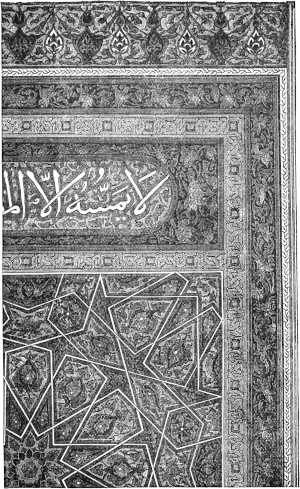
FIG. 103.—ILLUMINATED KORAN OF SULTAN SHA‘BAN. Fourteenth Century. (Viceregal Library, Cairo.)
Another very splendid copy of the Korān in the British Museum (Add. 22,406) bears inscriptions which prove that it was written for Beybars Gāshenkīr in the years 704-5, or A.D. 1304-5, while he was still Ustāddār, or major-domo, to the Sultan En-Nāsir ibn Kalaūn, and had not yet ascended the throne himself. It was no doubt prepared for his Khāngāh, or conventual mosque, which was completed in 706, and is still standing. This magnificent manuscript is in seven volumes, and is written from beginning to end in gold letters (within a delicate ink outline) on a ground resembling the key-pattern of the early metal-work. The first two pages are, as usual, fully illuminated, and covered with splendid arabesques in gold, on blue and red ground, with the inscription “Let none touch it save the purified” in white. The next two pages are framed with interlaced borders; but the rest of the volume, except the last page, has only the customary medallions, to mark the divisions of the text, and the rosettes and whorls, of red, blue, and gold, which are inserted in the writing for purposes of punctuation and accent. The marginal medallions are much less frequent than in the previously described Korān, and the designs are more monotonous. On the last page, within a gold frame with interlaced border, is the inscription
امر بكتابة هذا السبع الشريف واحواته المقر الكريم العالى المولوى الاميرى الكبيرى الركنى استاد الدار العالية اعز الله نصره وكتب محمد بن الوحيد
“The writing of this noble Seventh and its sisters was ordered by his excellency, the generous, the exalted, the lord, the great Amīr, Rukn-ed-dīn, major domo altissimo, God magnify his triumphs; and Mohammad ibn El-Wahīd wrote it.” In the marginal medallions of the same page are the words ذهبه محمد بن مبادر عفا الله عنه, “Mohammad ibn Mubādir gilded it, God assoil him!” Another of the seven volumes, or “sisters,” opens with magnificent geometrical panels filled with arabesques within a free scroll border; the pages are literally stiff with gold. At the end is an inscription similar to that already translated, but with the addition “and he finished the whole of it in the year 705.” A portion of the margin of another volume gives the name of Sandal as the gilder, تذهيب صندل; and the seventh part has the further information that this volume “was incrusted (زمك) by Aydaghdy ibn ‘Abd-Allah el-Bedry,” which raises a difficulty as to what this “incrustation” was. The word is frequently employed to designate the laying on both of ink and of gold on a manuscript; but the previous use of the words كتب and ذهب for these two processes seems to suggest some different operation in the case of Aydaghdy. Dr. Rieu thinks it may refer to the delicate outlining of the characters, but this would more probably be termed كتابة. Perhaps the زمك was the laying on of the colours, as distinguished from the تذهيب, or gilding. It should be noticed that in this example the colours of the medallions, &c., are painted over the gold, which gives them a peculiar brilliancy.
A third Korān in the British Museum (Orient. 1401) is later—probably of the end of the fifteenth or beginning of the sixteenth century—and the decoration is very inferior to that of the two preceding examples. The rosettes and medallions are comparatively few, and the ornament is over-intricate, with something of the Alhambra effect. The headings of chapters are good, but the execution is coarse; the full pages at the beginning and end present some fine arabesques, but none of the designs approach in delicacy those of the first Korān described above. The colours are again laid over gold.
In the South Kensington Museum are the first two pages of a magnificent Korān, belonging to the fourteenth century. They contain the first chapter and the beginning of the second chapter of the Korān, in gold letters on a ground shaded with red lines, and covered with beautiful scrolls in two shades of blue; the border is of gold arabesque scroll-work on a blue ground, with here and there a red flower-like ornament. In the same Museum are a pair of fine leather boards, forming the binding of a Korān, upon which little less skill has been expended than upon the illumination of the manuscript itself. One of these is covered with gold tooling, and has a border containing “the Beautiful Names” of God; the other is tooled with a floral design with an oval centre. These are fine specimens of Saracenic book-binding, and probably date from the fourteenth or fifteenth century.
FIG. 104.—ILLUMINATED KORAN OF SULTAN SHA‘BAN. Fourteenth Century. (Viceregal Library, Cairo.)
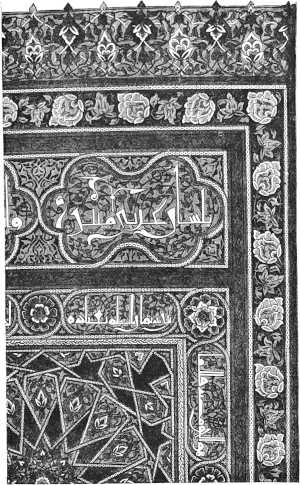
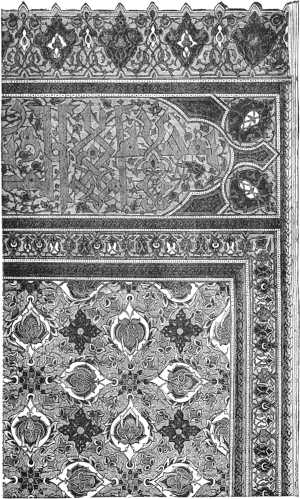
The finest illuminated Korāns in the world, however, are still preserved in Cairo, where the Khedive’s library contains the volumes which have been rescued from the chief mosques of the city. Like the glass lamps, these precious manuscripts were no longer safe in the custody of the mosque guardians; enterprising collectors proved dangerous to mosque treasures; and the score of splendid mushafs, or copies of the Korān, now stored in the Darb-el-Gemāmīz, were prudently saved in time. The earliest of these is said to date from the second century of the flight, and thus to be nearly twelve hundred years old; but the tradition is somewhat apocryphal. The best examples, from the point of view of illumination, belong to the period of the Mamlūk Sultans, like most other works of art in Egypt. Three specimens of these Mamlūk manuscripts are given in figs. 103-5, after Professor Ebers’ “Egypt,” but the size of the present volume unfortunately precludes the possibility of representing more than a quarter of each page. The designs are, however, sufficiently shown even in this mutilated form, and perfect justice could not be done to them without reproduction in the true colours and gilt. The following is the description of the chief Korāns in the Khedive’s library, as described by Spitta Bey, the late librarian:[93]—The first is a Korān of Sultan Mohammad En-Nāsir ibn Kalaūn (1293-1341), 21 by 14 inches, written by Ahmad Yūsuf, a Turk, in 730 of the Higra. It is written entirely in gilded characters, and there is also a second copy of a similar description. Several other Korāns date from the reign of Sultan Sha‘bān (A.D. 1363-77), grandson of the last named, to whose mosque they were dedicated. The first of these, dating from 769, 27½ by 19½ inches, has not its titles written in the usual Cufic character, and the headings “in the name of God the all-merciful” are in gold. Of the same date and similar size is the Korān of Khawend Baraka, mother of Sha‘bān. The first two pages are written in gilded and coloured characters, blue being the prevailing colour, and are illuminated with stars and arabesques; the next two are in gold, embellished with faint arabesques; and the whole work is written in a bold and excellent style. Another copy of Sultan Sha‘bān, dating from 770, of the same width, but a little longer, contains some beautiful workmanship on the early pages. The text is wider than that of the last, and the book is bound in two volumes. Another and still larger copy, dating from the same year, measures 32¾ by 21 inches. All these last were destined for the school in the Khutt et-Tabbāneh (street of the straw-sellers), founded by Baraka, the Sultan’s mother. Lastly we may mention another copy written in 778 (1377), by order of the same prince, by ‘Aly ibn Mohammad El-Mukettib, and gilded by Ibrāhīm El-Amidy. This copy measures 28 by 20¼ inches, and above each sūra is recorded the number of words and letters it contains. All these masāhif are written on thick and strong paper, and vie with each other in magnificence. The designs exhibit no great variety, but they are executed with the most elaborate care and neatness. The text of these Korāns is provided with red letters written above certain passages to indicate where the tone of the reader’s voice is to be raised, lowered, or prolonged.
FIG. 105.—ILLUMINATED KORAN OF SULTAN EL-MUAYYAD. Early Fifteenth Century. (Viceregal Library, Cairo.)
The collection contains three Korāns of the reign of Sultan Barkūk (1382-99), the oldest of which measures 41 by 32 inches. It was written by order of Mohammad ibn Mohammad, surnamed Ibn-el-Butūt, by ‘Abderrahmān Es-Sāigh, with one pen, in sixty days, and revised by Mohammad ibn Ahmad ibn ‘Aly, surnamed El-Kufty. A second copy, of the same Sultan’s reign, and of similar size, has its first and last pages restored in the same style as those of other copies, but the modern workmanship is inferior to the ancient. A smaller Korān, of the year 801, measuring 23 by 19½ inches, is written entirely in gilded characters.
To Sultan Farag (1399-1412), the son of Barkūk, once belonged a copy of the Korān dating from 814, and brought to the library from the mosque of El-Muayyad. It measures 37 by 29¼ inches, and was also written by ‘Abderrahmān Es-Sāigh, the same skilful penman who had been previously employed by Barkūk, and the author of a pamphlet, entitled “Sanā-at el-Kitāba” (‘the art of writing’), and now preserved in this library. From the year 810 dates a fine copy, 38½ by 27 inches, written by Mūsa ibn Isma‘īl el-Kināny, surnamed Gagīny, for Sultan El-Muayyad (1412-21).
A copy which once belonged to the mosque of Kāït-Bey, dating from the year 909, or a century later than the last, and unfortunately in a very injured condition, is the largest Korān in the collection, measuring 44¾ by 35 inches. To the period of the Ottoman Sultans belongs the small mushaf of Safīya, mother of Sultan Mohammad Khān, who caused fifty-two copies to be written by Mohammad ibn Ahmad El-Khalīl Et-Tebrīzy. It dates from 988, and measures 14 by 9⅓ inches. In it, as in one of the other copies, a black line alternates with a gilded one, and the first few pages are very beautifully executed. A copy of Huseyn-Bey Khemashūrgy, 21½ by 16¾ inches, is written in a smaller character.
The description of such manuscripts fitly concludes a book on Saracenic art. In illumination, as in other branches of decoration, the peculiar character of Saracen ornament is clearly expressed. The effect is that of rich embroidery, or gold brocade; in other words, illumination, like mosaic, plaster, wood, and ivory, shows the tapestry motives of Saracenic art. In the sanctuary of a mosque, or the kā‘a of a house, in the complicated panelling of pulpit or ceiling, and in the chasing of vessels of silver,—everywhere the same carpet-like effect strikes one. Another salient feature of Saracenic work is exhibited in these manuscripts: rich as they are,—as rich even as the exquisite Book of Kells,—they suffer from the inevitable restrictions of religion. Mohammad forbade portraits of animate things; and though we have sometimes seen the prohibition evaded or defied, as a rule Mohammadan art is figureless, and the illuminated Korāns exhibit this peculiarity. Yet, without this same arid creed, the special features of Saracenic decoration would never have been developed for the benefit and example of Europe.