Volume 1 — CHAPTER XV JOHANN SEBASTIAN BACH
Reading edition
Introduction—The life of Bach—Bach’s polyphonic skill and the qualities of his genius—Bach’s contribution to the art of music and the forms he employed—The revision of keyboard technique and equal temperament—Bach’s relation to the history of music.
That Bach lived at a time when the musical public was opera mad, when the Italian singers were dictators, when the grace and ease of Italian melody were bewitching and relaxing all music, yet that he himself never wrote for the stage nor ever surrendered in spirit to the force of the new movement, inevitably obscures and misrepresents his relation to the past and present of his day. By the peculiar nature of his genius which has filled his music with a seemingly forever unweakening power to stimulate, because of its perhaps unmatched greatness, he will always stand a little above and apart from other composers and will appear unlinked in the slow development of music. Mozart, Beethoven, Mendelssohn, Schumann, Wagner, Brahms, even the greatest and most original composers of the present age, all have hailed him as the father of modern music, have drawn inspiration and knowledge from him as from an inexhaustible source, and this unfailing tribute and dependence from nearly all subsequent composers has helped to fix our conception of him as the source and ultimate scope of music. His gift of expression was indeed all-comprehending, if not infinite. The freshness of his music has been judged immortal. He partakes of the superhuman. He seems perfection. Yet one has but to look through the eyes of devoted historians to see a man human and simple, straightforward, stubborn, sometimes quarrelsome, quite independent, even defiant, and an artist standing as firmly rooted as an oak in the work of his predecessors, thoroughly awake to the music of his day, and drawing in his own fashion many of the features which marked it.
Like Beethoven, he invented no new forms, but took the forms at hand, property common to all composers of his day, and, by his most uncommon genius, gave the touches which transformed them into monuments of imperishable beauty and perfection. But, more than in the case of Beethoven, it was the quality of his own inspiration which gave to these forms their first and last glory. There are symphonies of Haydn and Mozart written ten or a dozen years before Beethoven wrote his first symphony which we can hardly believe will ever lose their hold upon the public, which seem destined to immortal life, for which no apology of time nor circumstance need ever be made; but before Bach there are no fugues, no suites, no cantatas, no settings of the Passion for which such apologies are not necessary, which must not henceforth conceal defect or weakness in the respectable toga of antiquity. This distinction, of course, offers no ground for a comparison of the two men. It is the result of circumstance, of accident.
The seventeenth century, of which Bach and Handel were the two great results, was a period of experiment fraught with more tentativeness and uncertainty than have ever since hindered composers. We need only recall how, before the beginning of that very century, which was to prove the most fruitful of all in the long history of music, the vocal art of polyphony, the consummation of a century of effort, had been shattered into various parts, each of which had almost to begin life anew, to mold itself to strange needs and surroundings; how the invention of opera had smashed down the last restraining barrier of mediæval scholasticism and let loose a thousand restless composers to wander at will in lands hitherto all but undreamed of. The improvement of the organ and of other instruments, the perfection of the violin had yet to come; the principles of form which should give music a foundation apart from that of a text were yet to be discovered; the modern art of harmony was to develop from the seed; and the vigor of rhythm to be accepted little by little into the constitution of serious music. Music was still either old-fashioned or weak or unsettled to the very day of Bach and Handel. Through them it emerged from its period of probation and experiment, splendid and secure. They therefore appear to the later eye in the glory of creators, and especially Bach, because, for all the vast number and proportions of his choral works, he is fundamentally an instrumental composer and instrumental music was the greatest bequest of the seventeenth century to the future of music.
Only one branch of music had developed relatively independently of the Italian influence—music for the organ. Though this, as we have seen, was given its first impetus by Italian composers, it had grown to its fuller proportions among the Germans, of whom mention has been made in Chapter XI. By the time of Bach organs were well-made and effective instruments, a line of virtuosi in both north and south Germany had developed an astonishing technique, and certain fairly definite types of composition had been established. Of these the toccata, the fugue, and the chorale-fantasy or chorale-prelude received the most attention. The toccata was primarily a piece for display and was looser in structure than the others. Series of brilliant runs, scales and arpeggios over a foundation of rich and varied chords formed the most general and characteristic features, with which were alternated, for effect of contrast, passages of slow moving harmony and thematic significance. The fugue was a piece of music developed contrapuntally throughout from a definite subject and countersubjects, the direct outcome of the old imitative polyphonic music of the later Netherland masters. Both toccatas and fugues were treated with great skill and ingenious variety by Bach’s predecessors—Buxteheude, Reinken, Böhm, Pachelbel and others—but none of these organists succeeded in giving to either form the perfect balance and proportion, the organic unity, the architectonic grandeur, the definitive outline and shape wherewith Bach wrought them into enduring masterpieces. The same is true of the chorale fantasies and preludes. Three distinct types had come into being before the activity of Bach, one dignified and smooth, consisting actually of several short fugues upon sections of the chorale melody, lacking therefore breadth and power; one singing and serene, in which the flowing melody was set above or below an intricate contrapuntal web; and one in which, in the fiery words of Albert Schweitzer, the chorale melody was torn in fragments and tossed into a rushing torrent of virtuosity. The first of these forms was disjunct, the second lacked variety, the third was out of keeping with the simplicity and noble dignity of the chorale. It was Bach who united what was best in all three into a type of prelude which, inspired by the very spirit of the chorale melody, was built up out of the range of organ technique into a structure of faultless proportion. In the department of organ music, therefore, Bach seized upon the materials gathered for his use by men who had gone before, and, for the first time, made of them perfect temples. He was not misled by experiment, he did not falter through lack of power to sustain; he worked with absolute sureness and with the instinct of only the highest genius for perfect form.
In other instrumental music, in suites for clavier, for violin, for violoncello, for orchestra, in sonatas and concertos, he found forms already perfected. Nor can it be said that he did anything to develop or refine the style suitable for these instruments, since his own style was unmistakably influenced by the organ, and is sometimes heavy in comparison with Couperin’s, with Domenico Scarlatti’s, with Corelli’s, and Vivaldi’s. To these branches of music he brought a richness of feeling, an emotional depth and warmth, too, which hitherto had not been expressed in music. Nearly every emotion worthy of expression in music is to be met with in, for example, the Well-tempered Clavichord. On the one hand, liveliness, wit, gaiety; on the other, melancholy, deep sadness, religious exaltation, the lightest, the most serious shades of feeling, the most vivid and the most subdued expression. Thus the equable cool forms of Corelli, so justly proportioned between grace and calm emotion, the scintillating sonatas of Domenico Scarlatti, become suffused with a new, a real, personal life and are neither distorted nor dulled, but animated for all time.
As to organ music, he brought the power to construct and to unify, and to chamber music the warmth of his deep feeling. Vocal music—and his vocal works are, with inconsiderable exceptions, for the church—he made sublime by the true spirit of German religion which has found in him its perfect expression. He wrote in forms which were, as we have said, common to all composers of his day. Keiser, Mattheson, Telemann wrote not only in the same forms as he, but actually set many of the same texts. Undoubtedly they were men of inferior genius, but they were, none the less, excellent musicians, and had remarkable control of the technique of composition; and it is almost incredible that the stupendous numbers of their compositions are lying forgotten in libraries. Many a phrase, many an aria, and many a movement have a real beauty of form and a grace of content, but they are dead and not likely to be restored. The reason, not to be found alone in the second-rate quality of their genius, is, however, not far to seek. The development of opera in Italy during the seventeenth century influenced the whole course of music over Europe. The enthusiasm for opera spread veritably like wildfire. Forms were invented which were obvious and immediate in their appeal to the general public, and these forms were taken over into church music, even in Germany, where the tradition of a more profound and more fitting style still lingered. Cantatas, oratorios, even settings of the Passion, gave way to the universal demand for dramatic and easily pleasing music, were composed of arias and recitatives, and accompanied by instruments just as operas were. It would be absurd to say that church music could not gain, did not gain, as a matter of fact, by the injection of new and extraneous forms. Some few conservatives, notably the austere Johann Kuhnau, cantor of the St. Thomas school at Leipzig, where Bach was to pass the last half of his life, set themselves deliberately against the new movement. Many clergymen waxed bitter and polemical; but by far the majority of musicians, among them the men above mentioned, hailed the new forms with delight and, always more or less closely associated with the theatre, deliberately tried to give to church music the glamour and brilliance of music for the stage. Bach was himself far too much aware of the drift of music in his own day not to take advantage of the new forms which were the outgrowth of the opera. He adopted them into cantata, oratorio, and Passion. But whereas the sacred works of Keiser, Mattheson, and Telemann breathed only the light spirit of the trivial opera of the time, the arias and recitatives of Bach seemed to be the very flower of the meditative religious spirit peculiar to the Teutonic races. Thus his works stand at once with and aloof from his age. Outwardly the same, inwardly different. And that his cantatas and oratorios and Passions, cast in the mold of the Italian opera at the beginning of the eighteenth century, are glowing with the inspiration that was the religious voice of a whole race, is the reason why they live when those of his contemporaries are dead. They brought a trivial style into the church, he made a style glorious by filling it with an intimate, profound, and indescribably tender and genuine devotion. They tried to secularize church music, he to make a secular music the priestess of the temple.
Grandeur of conception, warmth and depth of feeling, nobility and often exaltation of spirit he brought to music, and transformed the materials which were, as the accumulation of a long century, at the service of a hundred of his contemporaries, into masterpieces of imperishable beauty. The cast of his genius seems almost out of place in the general spirit of music at his age. That which makes his music supremely great sprang from out the depths of his own nature, depths which are to-day unsounded and mysterious, the never-failing source of highest inspiration. Famous in his own day as an organist, and a performer on the harpsichord of astounding skill, as a composer he passed unnoticed or misunderstood save by a few pupils and friends. The ideal toward which he worked was fast losing hold upon the world of musicians. He was considered recondite and dry.
I
It is only human to desire the knowledge of some intimate details in the life of such a man, but the exhaustive researches of Philipp Spitta have collected all that is likely ever to be known about Bach, and there is almost a complete absence of any of those details which help to restore the daily life of a man to the admirers of a later age. We know little more than the facts of his life, must remain onlookers except as we may penetrate to his great heart through his music.
He came of a family which can be traced back nearly two hundred years, all of whom were characterized by the strong virtues of the German peasantry, by thrift, honesty, and a sturdy piety which never wavered among all the horrors of religious warfare. Nearly all were musicians, connected either with the church as composers and organists, such as Johann Christoph and Johann Michael, uncles of Johann Sebastian’s father, or with the bands in the towns where they lived, such as Bach’s grandfather, and his father, Johann Ambrosius. The family had so spread over Thuringia that there was hardly a town in the province in which some member of it was not actively associated with music. Ambrosius Bach played the viola in the town band of Eisenach. Here Johann Sebastian was born in March, 1685.[155]
One may believe that his talent showed itself while he was still very young, and that he was intended to follow in the footsteps of his father. Probably he learned from his father how to play the violin. In his father’s house, too, he was surrounded by secular music, lively and rhythmical, so that in his very tenderest years he must have acquired that fondness for, and appreciation of, rhythm which are so strongly evident in all his work. It seems likely, too, that a preference for instrumental music was fostered in his boyhood, for he remained always primarily an instrumental composer. Just how or when he learned to play the harpsichord is not known, but it can hardly be doubted that he had acquired some skill upon it before his father died.
His mother died in 1694. In little more than half a year his father married again, but died very shortly after. Bach was thus left an orphan at the age of ten, the youngest of a large family. He went to live with his brother Johann Christoph, twelve years or more older than he, in the neighboring village of Ohrdruf. Johann Christoph was an organist, a pupil of the great Pachelbel, and in his house Sebastian first came into close contact with church music, and music for the organ. Here he received his first regular instruction on the organ. Here, too, if we may believe one of the few anecdotes which have colored the history of his life, he gave a sign of that tremendous industry which distinguished his whole life in studying and making his own all the scores that came within his reach. The story is that his brother had a valuable collection of music by Pachelbel, Froberger, and other composers famous in that day, which he kept locked behind the latticed doors of a bookcase. Some of this collection the young Sebastian managed to extract for his own use, and he set to work to copy it by stealth, but one day Johann Christoph caught him at his labor, and took the music away. Whether or not the anecdote is true, it is typical of Bach’s method of study. The blindness which fell upon him in the last years of his life was hastened, if not actually caused, by his indefatigable copying of music.
At Ohrdruf he sang in the church choir and thereby gained his first experience in choral music. When at the end of five years he had to begin to earn his own livelihood, it was as a choir boy he went to St. Michael’s school in Lüneburg in the north of Germany. That he had already unusual skill as a musician is proved by the fact that after his voice broke he was still paid to remain at St. Michael’s, probably a prefect of the choir. The year at Lüneburg brought him into contact with much fine music. At the church of St. John in the same town George Böhm was organist, one of the most remarkable organists of his day. He was a pupil of the venerable Jan Adams Reinken, one of the disciples of Peter Sweelinck, founder of the brilliant school of North German organists. Reinken himself was still playing at the church of St. Catharine in Hamburg, near by, and Bach went often on foot to Hamburg to hear the great man. About the time Bach left Lüneburg, Handel came to Hamburg to play the violin and the harpsichord in the orchestra at the opera house. The two men never came nearer meeting.
The circumstances under which Bach left Lüneburg are not known. In 1703 he was for three months in the service of Prince Johann Ernst at Weimar. In August of that year he received the appointment of organist at the New Church in the neighboring town of Arnstadt. With this appointment his student days may be said to end; he now steps before the world as a skilled musician. In his new position he had not only to play the organ but to train the choir as well, and also to train a sort of musical society which furnished a large choir for other churches in the town. Hence he had ample opportunity to advance himself still further in the art of playing the organ, and to train his abilities to the composition of choral music. Only a few works can be definitely assigned to this period. A cantata showing signs of youthful endeavor is among them. The complaint of the church consistory that he accompanied the congregational singing in such an elaborate and complex way as to bewilder the singers seems to prove that he was busy at this time in studying some of the various arrangements of chorales and accompaniments which have come down to us in the mass of his manuscripts. Probably the congregation sang the melody in unison. It was customary for the organist to fill up the pauses at the end of each line with a few flourishes of his own. Doubtless these were oftenest improvised, yet Bach made a special study of the art of accompanying, and wrote down many samples of his own method for the benefit of his pupils. His ardent, independent young spirit must have led him into every kind of experiment during these early years at Arnstadt.
By far the most interesting of his compositions of this time is the little Capriccio written on the departure of his brother, Johann Jacob, to the wars. It consists of six little movements somewhat in the style of the Biblical narratives published but a few years before by Kuhnau in Leipzig. To each is prefixed a title or a program, such as the account of various accidents which may befall the brother, the attempts of friends to dissuade him from his journey, their lament when they see that their tears are of no avail, and, at last, the merry song of the postilion, and a fugue on the call of his horn. The workmanship is perfect and the piece breathes the warm, intimate feeling which is peculiar of all Bach’s work. It has an added interest in that it is the only piece of program music Bach ever wrote.
In October, 1705, he obtained a leave of absence and went on foot fifty miles to Lübeck to hear the famous Abendmusik which was given on certain Sundays in Advent at the church of St. Mary, where the great Dietrich Buxtehude was organist. No detailed record of his experiences in Lübeck has been preserved; but that he stayed there three months over the leave he obtained from Arnstadt proves how much he found there to interest him deeply. On his return he was taken to task by the authorities of the church in a council, the records of which have been preserved. To their reproof for having so long overstayed his leave he had only to reply that he had left his work in the hands of a competent substitute who he had hoped would give satisfaction. At the same meeting he was reprimanded for accompanying the congregational singing too elaborately. They complained that he had made his preludes too long, and, when spoken to in that regard, had promptly made them too short, that he neglected choir practice altogether, and that he went to a wine shop during the sermon. To all this Bach replied laconically, that he would try to do better. He agreed to submit an explanation of his general conduct in writing. All through the report one feels the independent, often angry, young spirit held in restraint behind the brief replies. The promised explanation was not forthcoming and in November, 1706, he was again taken to task. This time complaint was added that he had admitted a young maiden to the organ loft, and allowed her to make music there. The young maiden was probably his cousin, Maria Barbara Bach, to whom he was shortly after betrothed.
Conditions at Arnstadt soon became irksome to him, and on June 15, 1707, we find him installed as organist of the church of St. Blasius in Mühlhausen. Here his salary was a little less than fifty dollars a year, to which were added ‘some measures of corn, two cords of firewood, some brushwood, and three pounds of fish.’ Scanty as it seems, it was evidently enough for him to marry on, and, accordingly, he took his cousin to wife on October 17, 1707. They were married in the village church of Dornheim, near Arnstadt, by an old friend of the Bach family.
Two important records of his stay in Mühlhausen have come down to us, his recommendation for repairs on the church organ, in which he shows a most thorough understanding of the mechanical part of the organ even to the smallest detail, and his first important composition the Rathswechsel cantata composed in honor of the yearly change in municipal authorities, the only one of his choral works which was engraved and printed during his lifetime. It was performed on February 4, 1708.
Bach did not remain a year at Mühlhausen. He received an invitation from Duke Wilhelm Ernst of Weimar to be court organist and chamber musician at a much better salary. The letter by which he notified the council at Mühlhausen of his desire to accept the new post has been preserved.
The nine years Bach spent at Weimar must have been happy and prosperous. The character of the reigning duke influenced his composition. There was no opera at the court and, though there was a band of twenty or more players, in which Bach played both harpsichord and violin, and of which he later became leader, the duke’s chief interest was in music for the church, and Bach’s most important works during his stay at Weimar were for the organ and for the church choir.
Meanwhile his fame was spreading over Germany. It seems probable that every year he journeyed from Weimar to one or another of the big German cities, on what might be regarded as concert tours. One of them has become specially famous on account of an anecdote which has always been associated with it. In 1717 he was in Dresden at the same time J. L. Marchand, one of the most famous French clavicinists, was there. In some way, quite in keeping with the customs of the day, Bach’s friends arranged a contest of skill on the harpsichord between him and Marchand. The outcome is well known. Bach was ready at the appointed spot and hour. Marchand failed to appear. Whether or not Marchand fled because he feared to be worsted in a contest with Bach is hardly of great importance, but the anecdote is extremely important in that it points to the fact that Bach was already one of the great masters of the harpsichord.
His fame as an organist brought many pupils to study with him, among whom were J. M. Schubart, who may have studied with him in Arnstadt; Caspar Vogler, J. T. Krebs, and J. G. Ziegler. In 1715 he took the son of his brother Christoph into his house, young Bernard Bach, to whose industry we owe the greater part of the valuable manuscript copy of Sebastian Bach’s compositions, which passed later into the hands of Andreas Bach. His own family, too, was growing. Both Wilhelm Friedemann, his favorite and most gifted son, and Carl Philipp Emanuel, who became the most distinguished musician of the next generation, were born in Weimar.
His resignation in 1717 from a position where he must have been so happy comes as a surprise. In November of that year he moved with his family to the court of Prince Leopold of Anhalt-Cöthen, where he had been appointed chapel master and director of the prince’s chamber music. Anhalt-Cöthen was a flourishing little community. The prince, himself hardly more than a youth, was generous and free in spirit, fond of art and of music. He played the violin, the 'cello, and the harpsichord, and seems to have been an excellent bass singer as well. His interest was chiefly in secular instrumental music. There was no good organ at the court nor any trained choir of singers, but there was probably a good band, though the names of only a few players have been preserved. Among them is Christopher Ferdinand Abel, whose son, Carl Friedrich, shared with Sebastian Bach’s son Christian the high honors of the musical world of London in the next generation. Through them the young Mozart was destined to be influenced. It is indeed curious to find the fathers of the two men playing in the same little court band. Just what Bach’s duties were in his new position has never been discovered. It was a good appointment and well paid, and he was in high favor with the young prince. But, as Spitta has eloquently written, time has effaced or overgrown almost every trace of his labors, as the grass has overgrown the castle yard which he must so often have crossed, and his name has died out among the people of the place almost as completely as the sounds with which he once roused the echoes of the now empty and deserted halls.
The six years spent at Cöthen were the happiest of his life. It will seem strange to those who think of Bach as a composer of religious music and organ music that he could have treasured in his memory these years at Cöthen, when his energy was directed almost wholly to the composition of chamber music. Yet such was the case. The explanation of this seeming riddle is to be found in his personal character and in the peculiar quality of his genius. For all the independent strength of his will and his intellect, his was essentially a meditative nature, which found its truest expression apart from the public, and in the small intimate forms of chamber music. He delighted in the circle of his family, he delighted in the tender, faint music of the clavichord, which, we are assured, was his favorite instrument. The glory and majesty of his great power are in his music for the organ, the exaltation of his spirit is in the St. Matthew Passion and in the mass in B minor, but nowhere is the essence of his heart so warm, so simple and so unadorned as in the music he composed for clavichord, for violin, and for 'cello while he was at Cöthen.
His life went quietly on there within the court, broken by occasional journeys such as he was accustomed to take from Weimar. In the autumn of 1719 he passed through Halle, where Handel was staying for a short while with his family, during the trip he made from London to Italy, in search of singers. Bach made an effort to meet him, only to find that Handel had just departed. Later in life he again attempted to see and talk with the world-famous master, and again failed. The two greatest musicians of their time never met.
On the seventh of July, 1720, while Bach was away with his prince, his wife died. Left with four young children, he married again, in about a year and a half, Anna Magdalena Wülker, youngest daughter of Johann Caspar Wülker, court trumpeter at Weissenfels. She was at that time twenty-one years old, intensely musical and was an excellent singer. She was, moreover, skillful with the pen, and helped her husband in copying his own and other music. Her clear, flowing handwriting can be seen in the manuscript copies of the solo violin and violoncello sonatas, and in those of later works. That she worked diligently to master the clavichord is only one of the many instances of her desire to improve her knowledge of music in every way that would help her to follow and assist her husband. She thus became the centre of a home life which must have been in many ways the source of cheer and deep happiness to her husband and her family. How much this meant to Bach as he grew older amid the vexations of his post in the St. Thomas school in Leipzig cannot be overestimated, for, as we have already said, he was at heart a man who withdrew from the bustle of society and the world at large into the intimacy of home life.
The list of works he composed at Cöthen is a long one and momentous in the history of music. Many of them are epoch-making; all bear the marks of his undying genius in their workmanship, in their perfection of form and of detail, in the warmth of the inspiration that prompted them. Inasmuch as during the six years of his stay there he devoted himself almost solely to the composition of secular instrumental music, the period stands out distinct and unique in his life. What his daily life was, what his actual duties at the court, we do not know; but that they were happy years the music he wrote attests. Moreover, we have his own word written some years later to a friend in Russia that he would have been content to pass the remainder of his days there. But the marriage of Prince Leopold in 1722 seems to have changed the spirit of the court. The young princess had no special fondness for music, and Bach no longer felt himself in congenial surroundings. In 1722 the venerable Johann Kuhnau, cantor of the St. Thomas school in Leipzig, died. Within a year Bach obtained the post, moved with his family to Leipzig, and at the end of May, 1723, was installed in the position which he was to hold until the time of his death.
The St. Thomas school was an adjunct of the old St. Thomas church. It had been founded in the thirteenth century, and up to the time of the Reformation had been under the control of Augustinian monks, but at that time had been taken into the control of the municipal council. Bach was, therefore, in the employ of the town authorities, for the most part men with little knowledge or love of music, with whom he was seldom in good accord. From the earliest times the main purpose of the school had been to train singers for the church of St. Thomas and later for the church of St. Nicholas, but it was a charity school for orphans as well, and most of the boys were unruly. Bach’s chief duties were the training of these choir boys and the furnishing of music for the St. Thomas and St. Nicholas churches. Officially he had nothing to do with the organ in either church.[156]
Bach was beset by difficulties and unpleasantness on every hand. To begin, the school was disorganized and the boys unruly, as we have said. Nor was music in very high respect there, if we may judge by the prospectus of studies which said that, next to the glory of God, the chief aim of singing was to promote the pupils’ digestions. Bach’s work with them was not heavy. On Monday, Tuesday, and Wednesday he had to give a lesson in music at nine, and one at twelve, and on Friday one at twelve. On Friday, too, he had to take the boys to church at seven in the morning, and on Saturday at the same time had to expound the Latin catechism to the third and fourth classes. On certain days in the week he had to give a Latin lesson to the third class. On Thursday he was free. The rehearsals of the Sunday music took place regularly on Saturday afternoon. But the boys were frequently in bad condition. It was a custom for them to parade through the streets from time to time at various houses for donations. Their voices were often ruined by colds, and Bach could have had but little pleasure in training such material. Moreover, the spirit of the school had been demoralized by the light Italian music which had gained a foothold through the town opera house, and through Telemann, organist at the New Church, and the boys frequently deserted the school to sing in the musical union which Telemann had organized. However, in the course of a few years Bach got control of the musical union and of music in the famous old university as well, and was thus in a position to train a portion of the inhabitants of the town to an appreciation of his own kind of music.
From the start he set himself vigorously to reform and improve the condition of music in the St. Thomas and St. Nicholas churches. To this end he tried to get hold of as many singers and as many players as possible. Here he was in constant conflict with the town council, who refused to furnish him with money necessary to engage the boys and men he needed. In August, 1730, he submitted to the council a statement of what material should be rightly placed at his service if he was expected to furnish ‘well-appointed church music,’ and a brief and very telling account of what he actually had. Concerning the instrumentalists necessary to accompany church cantatas, etc., he writes: ‘In all, at least eighteen persons are needed for instruments. The number appointed is eight, four town pipers, three town violinists, and one assistant. Discretion forbids me telling the plain truth as to their ability and musical knowledge; however, it ought to be considered that they are partly inefficient and partly not in such good practice as they should be. The most important instruments for supporting the parts, and the most indispensable in themselves are wanting.’ He gives the names of the boys in the school, dividing them into three classes: ‘seventeen available, twenty not yet available, and seventeen useless.’ The statement was quite ignored by the town council. Up to the year 1746 no additional appropriation was devoted to keeping up the music in the churches of St. Thomas and St. Nicholas. That Bach was angry and embittered by such a disregard is evident in the famous letter to his friend Erdmann, in which he wrote, among other things, that the appointment was by no means so advantageous as it had been described to him, that many fees incidental to it had been stopped, that the town was very dear to live in and the authorities were very strange folks with no love of music, so that he lived under almost constant vexation, jealousy, and persecution; finally, that he felt compelled to seek his fortune, with God’s assistance, elsewhere.[157]
Affairs could not have been quite so hopeless as Bach felt they were. At any rate, he seems to have done nothing more in the way of finding another position. It can hardly be doubted that he would have had no difficulty in doing so had he long wanted to. His fame as an organist was widespread over Germany; and he was a man of firmest determination and no end of courage. He must have decided that the advantages Leipzig offered him outweighed the disadvantages under which the stupidity or indifference of the town council placed him. Moreover, shortly after this affair, in fact, just before the letter to Erdmann was written, a new rector, J. M. Gesner, was appointed to the St. Thomas school, a man who never failed in his appreciation of Bach and sympathy with his aims, and who, most important of all, had the special talent of managing boys, and was able in the few years of his stay in Leipzig to establish order and to put the school upon a new and solid foundation. He probably succeeded in easing the relations between Bach and the town council, and through his efforts Bach was released from giving lessons in Latin and all other general instruction apart from music.
Bach settled in Leipzig. His home life was happy, and varied by the visits of all musicians of prominence who passed through the town. His hospitality and his courtesy were famous. Men journeyed to Leipzig just to hear him play upon the organ. One man wrote in the account of his life which he contributed to Mattheson’s Ehrenpforte: ‘I journeyed to Leipzig to hear the great Johann Sebastian Bach play. This great artist received me most courteously and so bewitched me by his uncommon skill that the troubles of the journey were forgotten as nothing.’ Quantz, the famous flute player, teacher of Frederick the Great, wrote: ‘The admirable Johann Sebastian Bach has at length in modern times brought the art of the organ to its greatest perfection.’ Occasionally he went to Dresden to hear the opera or to play for friends there. One chronicle has it that he would say to his favorite son: ‘Friedemann, shall we go to Dresden again and hear their beautiful little songs?’ In 1736 he was appointed court composer to August III, king of Poland and of Saxony. He retained an honorary position at the court of Anhalt-Cöthen, though Prince Leopold, his former friend and patron, died not long after Bach came to Leipzig. His sons Friedemann and Emanuel grew to manhood and acquired positions. Emanuel was employed at the court of Frederick the Great at Potsdam. Pupils surrounded him, most of whom were not members of the St. Thomas school, but students at the university; and in spite of the fact that on many occasions he showed signs of quick and violent temper, he won not only respect but love from most of them. One of the most famous, Altnikol, married a daughter of the house. At last Frederick the Great, having heard much of his marvellous talent through Emanuel and his pupils, many of whom were playing in the royal band, summoned him to the court at Potsdam. Bach arrived at Potsdam on the 7th of May, 1747, accompanied by Friedemann, and was received with respect by the great king. The story is well known how Frederick, when he heard that Bach was in town, laid aside his flute, which he had taken up for his evening concert, and saying, ‘Gentlemen, old Bach is arrived,’ sent for him to come at once to the palace. Bach was made to try over the new Silbermann pianofortes, of which the king had several, and the next evening the king desired him to improvise a six-part fugue on a subject which he was allowed to choose for himself. In all this experience Bach very evidently fulfilled the expectations which had been roused in the king. Upon his return to Leipzig he composed his famous ‘Musical Offering,’ a collection of pieces in most complicated style, all based upon or related to a theme which the king had given him, and dedicated it to the king. This led to the much greater ‘Art of Fugue,’ the last great work from his pen. It is made up of fifteen fugues and four canons on one and the same theme, employing the most complicated and difficult counterpoint in the expression of a calm and noble emotion. A good part of it had been engraved on copper plates before Bach died, but not all.
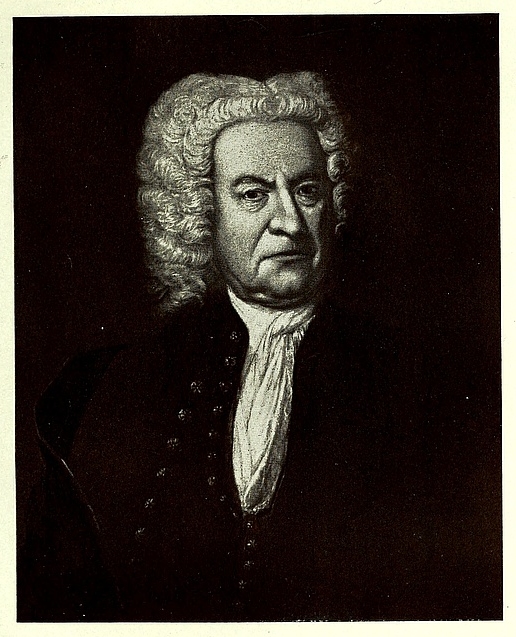
Johann Sebastian Bach.
After the painting recently discovered by Dr. Fritz Vollbach.
During the last year of his life his sight failed. In the winter of 1749-50 he underwent two operations, both of which were unsuccessful, and he was left totally blind and shaken in health. On July 18, 1750, his sight was suddenly restored, but a few hours afterward he was stricken with apoplexy and he died on Tuesday, July 28, at a quarter to nine in the evening. With him at the time of his death were his wife and daughters, his youngest son Christian, his son-in-law Altnikol and one of his pupils. The funeral was on the following Friday from St. John’s church, where the preacher announced: ‘The very worthy and venerable Herr Johann Sebastian Bach, court composer to his kingly majesty of Poland and electoral and serene highness of Saxony, chapel master to his highness the prince of Anhalt-Cöthen, and cantor to the school at St. Thomas’s in town, having fallen calmly and blessedly asleep in God, in St. Thomas’s churchyard his body has this day, according to Christian usage, been consigned to the earth.’ It was remarked in a sitting of the town council on August 8 that Herr Bach had been a great musician but not a schoolmaster.
Such are the outlines of Bach’s life. It was decidedly a happy one as lives go. There is much evidence to show that he was impulsive and that he worked at his music with great enthusiasm, but the tenor of his life was even, not erratic, methodical, and simple. It is strange to think of him as a schoolmaster, but such he was for a great part of his life. Though the duties of teaching must have been often irksome, they were relatively light, and in no way demanded so much time or effort as to deprive him of opportunity or enthusiasm to compose. His own report of the condition of the choirs and band at the school can leave no doubt that he never heard his choral works performed in a manner which we should deem at the present day appropriate to their greatness. Probably the two choirs at his service for singing the St. Matthew Passion numbered not more than twelve singers each, and the soloists were members of the choir; he never had a complete band, and the organs at St. Thomas church were bad. There was lax discipline and disorder, too. Still these were inadequacies and improprieties from which most composers of his day suffered. Even the Abendmusik at Lübeck, as fine church music as was likely to be heard in all Germany, was interrupted and marred by the noise of the choir boys racing and capering in the choir loft. Bach was not exceptionally unfortunate in this regard. In material affairs he was relatively well-off; his family life was exceptionally happy and complete, he won the love and admiration of many friends and pupils, and honor from princes.
Of his many children but three boys and a girl long survived him, Wilhelm Friedemann, Carl Philipp Emanuel, Johann Christian, and Regina. Friedemann, the most gifted and the favorite son, became a drunkard, Emanuel and Christian became famous, one in Germany, the other in London. All three are to blame for the fact that their father’s widow, all but their mother, fell into abject poverty and dependence upon public charity. Regina lived to be an old woman, friendless and likewise poverty-stricken until not long before her death, Rochlitz, the publisher, undertook a publication by subscription of her father’s works. Among the subscribers Beethoven was the first.
Bach published only a very few works during his lifetime. The majority of his compositions passed in manuscript into the keeping of his sons. Emanuel later brought out many, but much of what fell to the keeping of Friedemann was carelessly lost or sold for a pittance here and there. There is no way of telling how much of the great man’s music has disappeared, but the amount which has been preserved is prodigious. As is so often the case among musicians, and, indeed, among most artists, his activity is more or less clearly divided into several periods. Thus the early years at Arnstadt and Mühlhausen are years of experiment and study. In the account of his life the ‘Necrology,’ which was published by Emanuel in a periodical owned by Mizler and called the Bibliothèque, we learn that during these years he frequently spent the whole night in study and practice. During the Weimar period, when he was both organist and player in the duke’s band, he came into contact with Italian music, and devoted himself with enthusiasm and evidently untiring energy to the mastery of those principles of clear and lucid form which were at that time exemplified at their best in the violin works of Corelli and Vivaldi. It was a period of great and brilliant works for the organ, probably the toccata and fugue in D minor, which, however, because of its very evident relationship in style and even in theme to works of Buxtehude, may have been conceived earlier; almost certainly the fugue in G minor, the prelude and fugue in A minor, the colossal toccata in F, and perhaps the one passacaglia. At this time, possibly largely as a matter of study and exercise, he transcribed concertos of Vivaldi for harpsichord, mastering thus the form, practically invented by the Italian, which he later used so brilliantly in the Italian Concerto for clavicembalo.
At Cöthen he was cut off from the organ and associated wholly with secular music, and in this period naturally fall the first part of the Well-tempered Clavichord, the French suites, the suites for violin alone and for 'cello, the Brandenburg concertos and the overtures for orchestra. Finally at Leipzig, where he was expected to furnish music for almost every Sunday of the year, he composed his great choral works, about three hundred cantatas, six motets at least, the Christmas and Easter oratorios, the Magnificats, the great mass in B minor, and shorter masses, and four settings of the Passion, of which that according to St. Matthew is perhaps the most sublime of his works and the perfect expression of his genius. Instrumental works also belong to this period, marked by maturity and calm, a broadening of form, an alienation from the lucid conciseness of the Italian and French styles. There are, for example, the prelude and fugue for organ in E-flat major, the English suites and the second part of the Well-tempered Clavichord for clavier, the overture à la manière française, the ‘Musical Offering,’ and the ‘Art of Fugue.’
II
Within the limits of a single chapter there is no space to discuss these great works in detail, nor to point to the ways in which Bach’s genius manifested itself in each of them. We shall, therefore, give a brief analysis of that genius in general and then proceed to show the position Bach occupies in the course of the development of music.
Bach’s skill in polyphonic writing is perhaps unequalled both in its minute perfection and in its breadth and power. It is evident in nearly everything he wrote, be it the simplest of the two-part Inventions or the mighty choruses in the B minor mass, the fugues for organ or the fugues for solo violin. Within the most confined limits or ranging over mighty expanses it still serves his end, marvellously flexible and seeming spontaneous. Yet this skill does not constitute his genius. In general it differs more in degree than in kind from that of his predecessors and his contemporaries. In spite of the rapidly spreading domination of the monodic style, which was the style resulting from the Italian opera, the style of melody and simple accompaniments in chords, the polyphonic style still retained the allegiance of serious musicians, and even, in fact, of those who were less serious. All composers, probably all church organists, in the time of Bach could write fugues, double or single; could even improvise fugues; could write canons; wrote them as a pastime. Such skill was acquired almost in childhood, aided largely by copying volumes of music. Many composers discarded it altogether in writing for the public, many made a false show of it. It was, however, a manner of expression still common to the time, almost an idiom. So, though Bach’s skill could amaze even those who had been brought up to write fugues as daily exercise, it appeared to his contemporaries something as a matter of course, and to historians and critics allied with the new schools a positive detriment—a failing. At the present day the idiom in its naturalness is so far lost that our ears can hardly understand it. We no longer listen to polyphonic music without very special training. We do not follow it naturally, almost instinctively. The skill amazes, does not immediately express. It was, of course, thoroughly natural to Bach. But it was no more to him than an art, than, let us say, the art of speech; for he was wont to liken the interweaving of several parts in music to a conversation upon a given subject. Bach’s skill in polyphony is but a manner of speech, most faultless and subtle and powerful. Others acquired the manner, not perfectly, but none had the ideals, the emotions to express which have filled his works with warmth, with vitality, with actual life.
Thus his melodies are beautiful and expressive. Take, for example, the subjects of the fugues in the first part of the Well-tempered Clavichord. Here one might reasonably expect type melodies, mechanical phrases inexpressive in themselves, worthless, except as polyphonic material; the sort of phrases handed on from composer to composer, almost note for note—mere formulas. But one is astonished by the endless variety and freshness. All are original. Even the shortest, those which are hardly more than a kernel of melody, have a distinction, such as the subjects of the very first fugue, in C major, of the serious, indescribably sad figures in C-sharp minor, and E-flat minor, and the exalted, inspired fugue in B-flat minor. A more passionately expressive phrase is hardly to be found in music than that upon which the fugue in G minor is built, a more graceful melody than the subject of the fugue in C-sharp major; more delicate or humorous than those of the C minor and B-flat major fugues. These touches of pure melodic expressiveness are but preludes to the great melodies of the cantatas and the Passion. The melodies Mein gläubiges Herze from the Pentecost cantata, ‘Only Weep’ and ‘Have Mercy, Lord’ from the Passion according to St. Matthew are no more conspicuous than many others for their expanse and the depth of feeling which breathes in them. The grace of certain melodies in the suites for violin and for 'cello alone are captivating, the aria for the G string from the second orchestral suite most profound; and there is a type of melody especially dear to him, such as is found in the middle movement of the sonatas and concertos for violin, wonderfully free, rhapsodical, as though improvised. In general he avoided the elaborate, ornamental roulades characteristic of the Italian aria, even when writing in that form. In the few cases in which he did employ them they are expressive and gently realistic. In all his work there is evidence of a melodic genius of the purest kind, often not vocal, it is true, and often wound in a polyphonic web, but astonishingly genuine and inspired.
Though the quality of a great part of the music of Bach is meditative and not seldom mystical, parts of it are conspicuous for their rhythmical lightness and delicacy. Especially the suites for violin and ‘cello have a rhythmical animation which is irresistible. The dance movements which compose the last parts of the Ouverture à la manière française, and movements in the English suites, depend almost wholly for their charm on the incisiveness and zest of their rhythm. Nor is such sprightliness lacking in the fugues, though in polyphonic music it is usually unemphasized. The fugue in D major in the first part of the Well-tempered Clavichord might be called a fugue in rhythm; the fugue in F minor in the second part, too, is almost wholly guided by a playful rhythm. It is to the music of Bach therefore that one should look to find the polyphonic style set free of its proverbial heaviness and inertia, light and airy as laughter and true wit, strong as the march of an army.
But to harmony more than to all else in music the touch of the genius of Bach brought new life and a splendor that can never grow dull. It is as a harmonist that he stands the father of modern music. His pupils have told us that the first task to which he set them was exercise, not in counterpoint, but in harmonization of simple chorale melodies. If one tries to analyze the difference between a Bach fugue and other fugues it is not to be found in the superior workmanship and finish, nor, save little, in the melodic and rhythmical inspiration, but in the background of harmony. In harmony lie the mystery and wonder of Bach’s imperishable music. It is half the strength of its form. One might well ask what is a fugue without Bach. The seeds of it are in the old vocal polyphonic style, passages in which one voice imitated another at the interval of a fifth or fourth, were perhaps suggested to composers by voices singing the same words in turn; and the device was taken over by organists in the late sixteenth and early seventeenth century and used in ricercari and canzone, with no notion of form and balance; it was used in preludizing to the singing of the congregation, but had no true independent existence apart from the chorale to which it led; it was used as the second part of the so-called French overture. Experimenting in one way or another, composers gradually built up a fairly definite instrumental form of fugue. But the fugues, notably the organ fugues, of even the greatest organists before Bach, lacked logical construction. Buxtehude’s were built, as Albert Schweitzer has said, on a principle of laisser-aller. There seemed to be no good reason, according to Dr. Hugo Riemann, why any of them should not end or should not go on. It was Bach at last who gave to the fugue perfect proportion and organic unity. Principles of a form in music more clear-cut than any German forms he acquired, as we have said, in Weimar from a study of Italian and French masterpieces, but he based all his forms on a foundation of harmony and to all his works gave proportion and logic sprung from harmony alone.
Sir Hubert Parry in his study of Johann Sebastian Bach has demonstrated by careful analysis what a surprising number of preludes in the Well-tempered Clavichord are fundamentally progressions of chords. The name alone of this great series is suggestive, as we shall later prove. The clearest example of this harmonic prelude is the very first—that in C major. Hardly less clear are the second, the third, the sixth, the fifteenth, the twenty-first, and the twenty-third. Practically all, indeed, are upon the same plan, though in those mentioned the plan is clearest. This is, of course, no invention of Bach. The prelude grew out of a few chords rolled by an organist or player of the harpsichord or lute to claim the attention of his audience. The point is that Bach has made out of these preludes music of ineffable beauty merely by the gift of his genius in harmony. The sequences of his chords may be as modern as Wagner’s, chromatic alterations even more subtle; or, as in the organ works, they may move through broad diatonic highways, powerful in suspensions and magnificent in delays. And, as to his power of expression through harmony, let one listen to the recitatives of the St. Matthew Passion, one of the immortal, unfathomable creations of man’s genius; consider how they move on phrase after phrase, page after page, bearing the whole weight of a mighty composition and unaccompanied save by a few scattered chords. It may well be doubted if any art has or could have added one touch more of inexplicable, unspeakable beauty to the story of the Passion, save only these few scattered chords of Bach’s genius.
III
We have already observed that all great composers from the time of Beethoven have acknowledged Bach as the father of modern music, but this relationship which his descendants have so gladly acknowledged is, on the whole, general and intangible. The reason is partly that Bach invented no new forms, and that the forms which he chose, and the style in which he wrote, passed out of circulation, so to speak, immediately after his death. The fugue, the cantata, and the Passion he brought to the highest point it was possible for these forms to attain. They have rarely been attempted since with near enough success to suggest even imitation. The fugues of Mozart, Beethoven, and Brahms are essentially different from the fugues of Bach. Mendelssohn fell far short of the master whom he, more almost than all others, worshipped. César Franck has been compared to Bach, but is curiously unlike him. The cantata and the Passion grew up to Bach and then stopped: the cantata, because even in the hands of Bach it was an uncouth hybrid, neither opera, which is itself an illogical mixture, nor church music; the Passion, because, as Bach left it, it is as unattainable as the sun. As far as form and outward show are concerned, therefore, Bach’s position in the history of music is that of the culmination, the ultimate consummation, of certain styles and forms now obsolete. To understand his appearance in the history of music one must step back into the history of the seventeenth century in German music, a history strangely complicated with that of Protestantism, Lutheran hymns, and cantata texts, inextricably associated with the church and with the organ loft. In the growth of church music in Germany Bach had not one, nor two predecessors. A dozen different courses converged in him. Strangely enough, of the music of the one man before him with whom he might seem related, Heinrich Schütz, he knew little or nothing. All others worthy of the name of composers, however, contributed some share to his development.
All the great organists from the time there were great organists led to Bach, step by step, unmistakably. Every new phase of form, every new device of virtuosity but paved the way for one who was so supremely great as to cast them all into shade or oblivion. All hymn writers, all composers of chorales led the same way. The Protestant religion found its perfect artistic expression in Bach, not in the cantatas but in the chorale fantasies for organ, the motets and the Passion according to St. Matthew. Catholic art contributed its share. He copied out masses by Palestrina, and by other men now forgotten, such as Lotti and Caldara. For a good part of the Lutheran service, especially at St. Thomas church in Leipzig, was practically Catholic in form. The Kyrie, the Gloria, Credo, Benedictus, Sanctus, and Agnus Dei had their place in the ritual; and, what is more, German composers, and Bach was no exception, seldom troubled to set them to new music but adapted music of the earlier Italian writers to the new German words. The enormous number of cantatas was owing to the fact that the form had grown out of a native German custom of singing hymns between the reading of the Gospel and the Credo, on the one hand, and the sermon, on the other, and composers were given opportunity to set texts not already time-worn. The history of these texts is one full of sad failures to achieve a truly artistic form, of futile efforts to reconcile chorale and hymn with the new operatic style, of bad verse and trivial, mechanical sentiment. Bach was constantly harassed by problems of text, varying in his choice between an old style Bible text woven with the strophes of the chorale hymns, by far the best though least suited to the operatic style of music which had established itself in the church, and a free text developed from a line or passage in the Bible, consisting of strophic arias and passages for recitative in the so-called madrigal style, a loose versification. The artistic perfection of the Passion is due no little to the fact that he himself supervised the arrangement of the text, the introduction of strophic verse for arias, and madrigal style for ariosos and the chorales.
The history of Passion music leads to Bach, and further than that it cannot go. Way back in the Middle Ages the story of the Passion was chanted in the churches, some time, usually on Good Friday in holy week. The words of the evangelist, of actors in the drama, and of Christ were chanted by a priest or deacon in the monotonous reciting tone, and the choir was given the ejaculations of the crowd. Later the words of Christ, the evangelist, Pilate, Peter, etc., were allowed to different chanters and with the growth of the operatic style the monotonous chant was changed to more expressive recitative. This intrusion of the operatic style was at times bitterly opposed, and the greatest German composer before Bach—Heinrich Schütz—was among the reactionaries, though he had received his training in Italy under Giovanni Gabrieli and Monteverdi himself. However, the influence of opera was too strong for the conservative clergy, and not only did recitative, aria, and dramatic choruses come to play a part in the singing of the story of the Passion, but instruments were introduced into the accompaniment, and the whole became practically a drama. The need for texts suitable for treatment in recitative and aria finally led to versified arrangements of the Biblical narrative itself, as well as to the introduction of strophic stanzas interpretative of the mood or action of the story. A new character, the so-called daughter of Zion, was introduced as a convenient spokeswoman for the congregation.
Such were the theatrical arrangements made by C. F. Hunold, known as Menantes, and by B. H. Brockes, a town councillor of Hamburg, whose arrangement was set to music by Keiser, Mattheson, Telemann, and Handel. Chorale melodies and hymns found no place in these passions. Schütz had employed them at the beginning and the end of his settings, as introduction and epilogue. They were apparently first woven into the body of the work by a little-known composer, Johann Sebastiani, about 1672. The arrangement which Bach finally used for his St. Matthew Passion was a combination of these earlier styles. For the narrative he reverted to the Biblical text, divided among the various characters. He retained the interpretative arias which in the midst of the story dwell for a time on the suffering, on the horror of it all, and their effect upon man; he included among the singers the Daughter of Zion. The chorus was used for the utterances of the crowd, with considerable restraint, and, throughout the work, for richly harmonized chorales which served to draw the congregation into the tragedy even though they were but once or twice given a voice in them. At the beginning and the end massive double choruses, into the first of which a chorale melody was woven, opened and concluded the story. Orchestra and organ made up the accompaniment. All these various elements he combined with unerring sense of proportion and fitness and with no inconsistencies and no histrionic glamour, so that the work stands perfect as a piece of art, and as the purest expression in music of the Lutheran religion.
In his general treatment of the orchestra Bach is allied so much more closely to the past than to the future that in this regard he can be said to have had practically no influence upon his successors. Before his death the Mannheim school, led by Johann Stamitz, was already pointing the way toward a new treatment of the orchestra which was to be taken up and developed by Haydn, Mozart, and Beethoven. Bach differs from these later men not so much in a lack of appreciation of tone color as in his forcing all instruments, irrespective of their peculiar capabilities, to conformity in a polyphonic style much influenced by the organ. The result is that trumpets and oboes, for examples, are made to play rapid, agile figures suitable only to violin. All instruments are treated in the same way, may be required to take equal and similar parts in the music. This is, of course, distinctly old-fashioned. Purely technical reasons would prevent any composer of the new school from writing for the oboes as he would write for the violins. Sonority and color, too, ousted the old polyphonic ideal. Bach was not, however, deaf to orchestral color. Often in the accompaniments to cantatas and other vocal works the coloring is rich and unusual, and unusual combinations of solo instruments in the Brandenburg concertos seem to show him on voyages of discovery, so to speak, into the effects of combinations of different timbres.
The two series of orchestral works are the Brandenburg concertos and the Ouvertures, both written during his stay at Cöthen. The names themselves speak from the now distant past of orchestral music. The name concerto then signified a composition written for a small group of solo instruments, called the concertino, accompanied by or alternating with a larger group called the tutti. For instance, in the second concerto the solo group is composed of trumpet, flute, oboe, and violin, the tutti being in all cases made up of strings. The form is Corellian. The relatively modern treatment of a solo instrument in a concerto, writing for it to show off its special qualities and technical peculiarities, is hardly suggested, tutti and concertino having to play the same musical material in the same polyphonic style, offering principally contrast between sonority and delicacy; though, as we have said, the element of tone color plays a part. It must be added, however, that the long passage for harpsichord at the end of the first movement of the fifth concerto is very similar to modern cadenzas. The treatment of all parts is consistently polyphonic.
The same is true of the four Ouvertures. These compositions are in reality suites, having as the first two movements the two characteristics of the French ouverture invented by Lully, one slow and serious, the other an extended allegro in fugal style. The following movements are in dance forms and rhythms. They are scored for the customary brass, wood, and strings, employed here not so much for their specialties as for contrasts of sonority and delicacy.
Bach has not, therefore, contributed in matters of style and form to the development of music after his time nor to the growth of orchestral music, which was the distinguishing feature of the age which followed immediately upon his death. This is due, as we have said, to the fact that the style and forms which were his own inheritance passed out of circulation. In many cases, too, his work was of such unique greatness that no imitation of it could come near enough to suggest more than most vaguely an influence. Copies of his style but emphasize its remoteness, both in time and quality. Certain works must remain forever unique because their peculiar perfection must always keep them in a class by themselves. Among these there are none more striking than the works for solo violin and for solo violoncello, works which have no counterpart in music. Still, we are not limited to intangible influences of melody and harmony in noting the effect which his compositions have had upon his followers. In two ways at least he gave a definite impulse to the course of music; he reorganized the system of fingering keyboard instruments, and invented a satisfactory and universally accepted method of equal temperament.
IV
About the time Friedemann, his first born son, was nine years old Bach began to compose for him the book of pieces known as the ‘Little Clavier Book.’ It is what we should call to-day a graded collection of short pieces intended to perfect the already striking abilities of his son. Beginning with the simplest elements, he introduced difficulties by degrees until the last pieces, in polyphonic style, demand a very considerable skill. The most interesting passages are those in which Bach has indicated the fingering, for they prove that he reorganized all the systems of fingering in use in his day and perfected one of his own upon which future developments are based. His chief innovation is in the manner of using the thumb. Up to the time of Couperin, players of keyed instruments used only the four fingers of the hand. The thumb hung idle. The position must have been stiff and awkward and it is hard to understand how such brilliant performers as the north German organists ever overcame the difficulties of it. Yet Bach himself told his son Emanuel that in his youth he had seen great organists play who never used the thumb except for the widest stretches. Couperin’s famous book on the art of playing the harpsichord appeared in 1717, the very year Bach went to Cöthen. In it he advocated the use of the thumb, but over the fingers, not under them. Bach was one of the first to appreciate the advantages of passing the thumb under the hand. It is hardly possible that he invented the practice. Many of the oldest works for the harpsichord must have called for a use of the thumb, and the contemporary works of Domenico Scarlatti would have been almost insurmountably difficult without it; but in theory the use of the thumb under the hand was avoided, and Bach’s ‘Little Clavier Book’ contains probably the first open recognition of the advantages of so using it, no matter what the actual practice of virtuosi had been up to that time. One will observe that Bach did not abandon the old system, and that many passages marked by him are to be played in the old way; that is, by passing the long fingers, chiefly the middle finger, over the short ones; but he laid the foundations of the new. The most famous of players in the next generation was his own son Emanuel, whose book on playing the harpsichord was the standard authority down to the time that the harpsichord was finally supplanted by the pianoforte. Haydn and Mozart undoubtedly profited by it, and thus the methods of the father were spread abroad through the son and played a considerable part in the development of music for the pianoforte.
‘The Well-tempered Clavichord’[158] is unquestionably an epoch-making work. It is, as is well known, a series of preludes and fugues in all major and minor keys. The term ‘well-tempered’ refers to Bach’s method of tuning the clavichord, which for the first time made such an unbounded use of harmony possible. It will be remembered that the first keyboards had only those keys which are to-day white, sounding only the diatonic tones of the modes. The first chromatic alteration allowed in these modes was the B-flat, which was practically forced upon musicians in order to avoid the augmented interval between F and B natural, an interval excruciating to their ears. So the black key between A and B was the first to find its place on the keyboard, and it was tuned in the relation of a perfect fourth with the F below. E-flat seems to have been the next black key and was tuned in the relation of a perfect fourth to the B-flat. The other black keys were added one by one, nearly always in exact relation to some one of the white keys or the original diatonic notes of the modes, F sharp in that of a perfect fifth with the B below, G sharp in that of a perfect major third with E, C sharp in the same relation with A. Inasmuch as all these intervals were mathematically exact—and such was the idea of tuning all through the Middle Ages and nearly to the time of Bach—the black keys were in perfect relation only with one or more of the white keys, and often quite out of relation with each other. The intervals between them were very noticeably out of tune and false. When, during the seventeenth century, our harmonic system of transposing keys finally supplanted the old modal system, composers for the harpsichord and the organ still found themselves limited by their keyboards to three sharp keys and two flat, so long as their instruments were perfectly tuned.
A cursory glance at some of the old harpsichord music shows that composers did not by any means submit to such a restriction, and we must presume that, unless they were willing to endure the sound of many hideous imperfections, they developed in practice at any rate some system of tuning which softened or tempered them. Bach, therefore, is not the inventor of the first tempered tuning, but it is doubtful if any composer before him had worked out such a satisfactory system as his which has been called equal temperament, and which amounts practically to the division of the keyboard octave into twelve equal though slightly imperfect intervals. Only the octave remained strictly in tune. The imperfections of the other intervals were so slight, however, as to be hardly perceptible. Thus the black keys of the keyboard came to represent two notes, different in theory, the sharp of the note below and the flat of the note above; and, by such a compromise, composers for the instrument were enabled to modulate freely through all keys. Bach must be acknowledged the first great musician to recognize the inestimable value of such a liberation, in proof of which he wrote the first series of the ‘Well-tempered Clavichord.’ The fugues notably are enriched by the most beautiful modulations, and in this regard the collection may be said to be almost the foundation upon which all subsequent music has been built, and to contain the seeds from which the most soaring harmonies of Beethoven, Chopin and even Wagner have sprung. Thus we are brought back by the ‘Well-tempered Clavichord’ to the crowning glory of his genius, his gift for harmony. Beethoven knew the Well-tempered Clavichord.’ He is said to have won his first distinction as a pianist by his playing of those preludes and fugues in Vienna. And Beethoven called Bach the forefather of harmony.
Probably no collection of pieces has been so carefully studied and sounded again and again by generation after generation of composers and probably no other set of pieces will ever prove so impervious to every influence of time. It is like an eternal spring, forever fresh, forever marvellous. Scarcely less wonderful are the collections of two- and three-part Inventions. Both these and the preludes and fugues were written as exercises—the one, in Bach’s own words, as ‘an honest guide by which the lovers of the clavier, but particularly those who desire to learn, are shown a plain way not only to play neatly in two parts, but also, in further progress, to play correctly and well in three obbligato parts; and, at the same time, not only to acquire good ideas, but also to work them out themselves; and, finally, to acquire a cantabile style of playing, and, at the same time, to gain a strong predilection for, and foretaste of, composition’; the other ‘for the use and practice of young musicians who desire to learn, as for those who are already skilled in this study, for amusement.’ There can be no better testimony to Bach as a teacher than these short prefaces, written in his own fine hand, upon the title pages of the two sets. For him, the greatest virtuoso of his day, virtuosity was nothing, and he taught those about him above all to seek to express only what was genuine and fine in music. So he continues to teach the world of musicians, though music has passed through fire and tempest since he wrote these pieces all but two hundred years ago in the castle at Cöthen. Styles have changed, forms have changed, instruments have changed; the state, the world, are no longer the same; yet in every state and to every corner of the world where there are men and women who have devoted their lives to music, there will Bach be found as the touchstone of all that is good in the art.
V
This is in essence his position at the present day in music, a position unique and special. He will always be the greatest of teachers. His music is profoundly mystical and for this reason the secret of its extraordinary vitality will perhaps never be revealed; and it is nearly always intimate; in this most different from Handel, his great contemporary, with whom he will ever be compared, though the startling contrasts between them lead no nearer to the comprehension or just estimate of either. Handel is outspoken, Bach suggestive; the one compels, the other stimulates.
In conclusion we may once more draw attention to some of the salient points in his genius. As a man he had keen practical knowledge, yet he was impulsive and ardent. He was unshakable in his convictions. He was generous but not always peaceable. And he was always quietly but profoundly thoughtful. Among his friends were men of prominence, knowledge, and high social rank. The circumstances of his life kept him from the theatre, which was the goal of most composers of his time, but, furthermore, his genius was not of the dramatic kind nor his nature one to seek public acclaim. He was, however, in the words of a contemporary, the prince of all players on the harpsichord and the organ, and was so recognized over a large part of Germany.
His unmatched technique in composition was acquired by constant labor and a never-ending study of all available music, both Italian and French, as well as German, while he remained essentially a son of his race. The works of Couperin were known to him, those of Vivaldi and Corelli, of all the great German organists and composers, save only Heinrich Schütz, of the old Italian masters, Palestrina, Lotti, and Caldara. The forms of his day he mastered, both those of ancient descent and those of more recent make; and he invented no new forms. He was first and foremost an organist, the culmination of a long line of German masters. His music for the organ rises higher than that of any of his predecessors, largely because of the logical harmonic foundation upon which he built it. It has never since been equalled. To music for other keyboard installments, precursors of the pianoforte, he brought a richness of harmony and of feeling not to be found in such music before his day. The polyphonic forms, especially the fugues, were influenced by the organ style. Other forms, such as the suites, suggest the influence of French writers. The so-called English suites, the name of which has given rise to much discussion, are the greatest suites in existence. The suites for violin and 'cello alone are unique. The polyphonic style in which many movements of them are written is characteristic of German violin music of the time; the conciseness of form, of the Italian masters. All his vocal works show the influence of the organ style, which was the most natural and most familiar to him, but in these he has incorporated forms such as recitative and da capo aria directly from the contemporary Italian opera. Difficulties and improprieties of text affected the cantatas. The Passions, especially that according to St. Matthew, are flawless in structure. The perfection of the latter is largely due to his supervision of and arrangement of the plan and the text. The mass in B minor is his most colossal work, seeming, however, a less natural expression of his genius than the Passion. Preludes, fugues, suites, concertos in the old style, the church cantata and the musical setting of the Passion he brought to their highest point.
After his death other forms occupied composers, so that he has not served as a model. Also, the next age was preëminently the age of the orchestra, the modern orchestra with its peculiar problems, to the settlement of which Bach contributed little or nothing. The sonorous pianoforte persuaded composers from the organ. The polyphonic style was abandoned or was radically modified. Thus the new era of Haydn, Mozart, and Beethoven is seemingly completely severed from Bach, totally disconnected save for the links of a revised system of fingering for keyboard instruments and a satisfactory method of equal temperament. But the new age was the age of the supremacy of harmony in music and the genius of Bach, often concealed behind the polyphonic fabric of his greatest works, is essentially harmonic. Chords, modulation, chromaticism are the essence of his music. In all his compositions they give the mysterious warmth. They are the basis of his form, the power of his suggestion. That he might be free to modulate at will he so tuned his clavichord that all keys, both major and minor, could mingle through it; and as initiative for his students to the beauties of harmony unrestricted he composed two series of preludes and fugues in every key which to-day seem an epitome of musical expression. Written for students, they have taught every great composer from Beethoven to Richard Strauss and Claude Debussy. They open the way to his other and to his bigger works, where the lover of music may so lose himself in wonder and deepest joy that he will say, as many have said, here is the beginning and the end of music.
L. H.
FOOTNOTES: